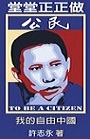
Sinitic Civilization-Book 1
Sinitic Civilization-Book 2
Tribute of Yu

Heavenly Questions
Zhou King Muwang's Travels
The Legends of Mountains & Seas
The Bamboo Annals - Book 1
The Scourge-of-God-Tetralogy:
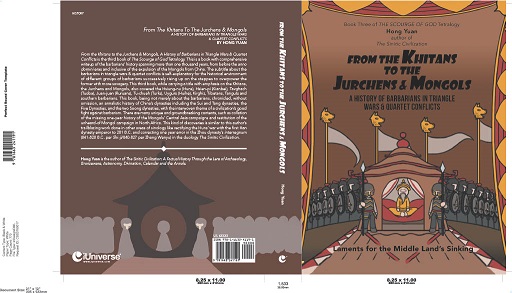
From the Khitans to the Jurchens & Mongols: A History of Barbarians in Triangle Wars and Quartet Conflicts
(available at iUniverse;
Google;
Amazon;
B&N)
|
|
America, i.e., the United States, was and is still shortsighted today, not knowing that Korea, at one time paradise of the American Evangelicals, was delivered into the hands of the Japanese imperialists as a result of the Anglo-American confrontation against Czar Russia, and in this geopolitical process, China, the land of the Great Sinitic Civilization (Barnes & Noble,
Amazon,
Google Play|Books
and
Nook Book), was made into a piggy-backed sacrificial/funereal object -the land ruled by the most evil cult called 'communism' that was an 'import' or an 'export' of Soviet Russia.
America would not learn the lesson that the geopolitical actions it is taking today would yield the 'bad fruit' 50 years or 100 years down the road.
America, and their British cousins, must have forgot the twenty-year Anglo-Japanese military alliance that allowed Japan to develop the warplanes and aircraft carriers to invade mainland China, not to mention the post-WWI ten-year arms embargo against Republic China and George Marshall's post-WWII arms embargo against Republic China 1946-1948.
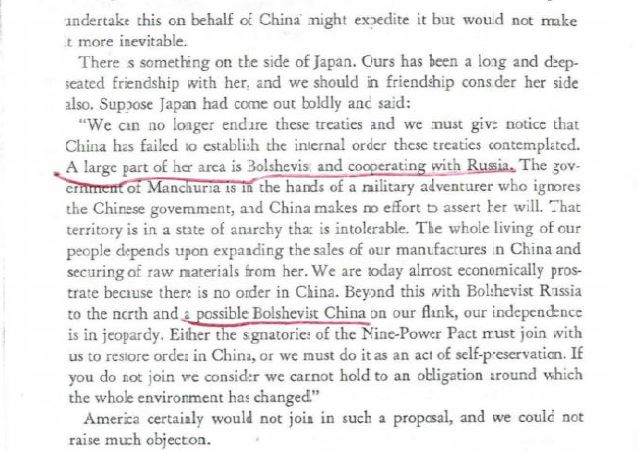
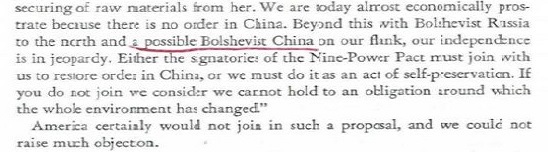
They forgot that in 1931, President Herbert Hoover gave Japan a free hand in the invasion of Manchuria on the pretext that Japan could not tolerate a half-Bolshevik China.
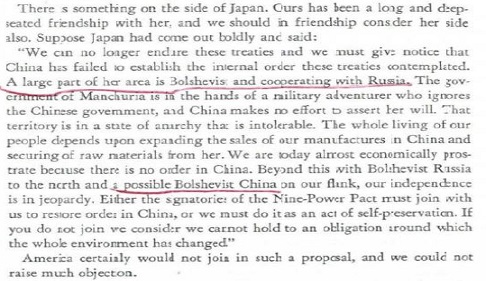 Earlier, President Hoover, who personally nipped the post-WWI communist uprisings in Germany and Hungary with the grains embargo, fed Lenin the ingenuity, i.e., the [worldwide communist revolution] road to Paris lay through Peking.
They of course forgot that
after the eruption of the 1937 Sino-Japanese War, the Americans, biased towards Japan and against China, adopted a policy of "neutrality" (what Utley called by "unpositive neutrality") against the 'belligerent' countries, namely, Japan and China, which was free and unrestrained arms sale to Japan and de facto arms embargo against China.
Note that the Japanese navy had a full blockade of China's coastline.
Note that the blockade would choke China since China did not have an industrial base to produce the basic weapons while Japan's factories could roll out the warships and airplanes on a wholesale scale.
Also note that in contrast with the Americans, the European powers, being constrained by the mediation role of the League of Nations, dared not openly sell arms to Japan.
Through 1940-1941, prior to the U.S. revocation of the 1911 U.S.-Japan Commerce Treaty, the Americans were the biggest supplier of raw material, oil, aviation oil, and weapons, to the extent that some U.S. senator called by Scott making a claim that out of every one million Chinese killed by the Japanese, 544,000 Chinese were killed by the Americans.
Thirty-one U.S. congressional members made a joint declaration to the effect that the U.S., not NAZI Germany, nor Italy, was the best ally of Japan.
Earlier, President Hoover, who personally nipped the post-WWI communist uprisings in Germany and Hungary with the grains embargo, fed Lenin the ingenuity, i.e., the [worldwide communist revolution] road to Paris lay through Peking.
They of course forgot that
after the eruption of the 1937 Sino-Japanese War, the Americans, biased towards Japan and against China, adopted a policy of "neutrality" (what Utley called by "unpositive neutrality") against the 'belligerent' countries, namely, Japan and China, which was free and unrestrained arms sale to Japan and de facto arms embargo against China.
Note that the Japanese navy had a full blockade of China's coastline.
Note that the blockade would choke China since China did not have an industrial base to produce the basic weapons while Japan's factories could roll out the warships and airplanes on a wholesale scale.
Also note that in contrast with the Americans, the European powers, being constrained by the mediation role of the League of Nations, dared not openly sell arms to Japan.
Through 1940-1941, prior to the U.S. revocation of the 1911 U.S.-Japan Commerce Treaty, the Americans were the biggest supplier of raw material, oil, aviation oil, and weapons, to the extent that some U.S. senator called by Scott making a claim that out of every one million Chinese killed by the Japanese, 544,000 Chinese were killed by the Americans.
Thirty-one U.S. congressional members made a joint declaration to the effect that the U.S., not NAZI Germany, nor Italy, was the best ally of Japan.
 Not to mention that the Japanese navy had a full blockade of China's coastline.
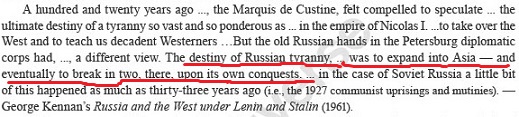
America, the 'stars' that engendered or heralded the rise of the [Japan] 'sun', long ago had the blueprint to make Japan into a stalwart against China and Russia, i.e., the source of the Yellow Peril and the source of the Half-Tartars [or the Russians], respectively, --whom the Americans could not assimilate according to George Kennan.
William Christian Bullitt Jr. (1891-1967) disclosed that the Americans' national policy or strategic aim was to see the Russians and Japanese' holding a balance of power against each other in China rather than seeing either the Russians or the Japanese overpowering the other party in taking control of China.
In making this geopolitical decision, you had victimized the 1 billion humble Chinese peasants.
(Note President Wilson's doctrine that the intactness of China was vital to the white civilization -- in the sense that the nation of China should be managed delicately, that is, should not be allowed to grow too powerful to pose threat to the white civilization, nor should it be allowed to be hijacked by a non-U.S. power since China's immense human labor could be turned against the white civilization.
The theme of China to the white civilization, morphing superficially into a ***hypocritical*** American national policy of engagement with Communist China for changing the Chinese communists' behavior, rested on the same underlying logic:
"The
China Exception: Russian Communism being wicked, the
Chinese are good communists", which is an inherent fear
of the Yellow Peril,
i.e., billion Chinese would actually enjoy real
democracy, go to college and develop their intelligence.
Now, President Biden, a stooge of Communist China, explicitly abandoned the
hypocritical American policy of engagement to change communist China to his imbecilic communist buddy and dictator Xi Jinping.
Other than the stooge Bidens who ripped communist China's financial coffer (Tony Bobulinski FULL INTERVIEW Tucker Carlson), don't forget that President Roosevelt boasted of his family's ripping the China trade money in the 19th century, i.e., the opium trade;
and President Hoover certainly got the first bin of gold from the Kai-luan coal mine in collusion with the British during the 1900-1901 boxers' incident-related invasion.)
Not to mention that the Japanese navy had a full blockade of China's coastline.
America, the 'stars' that engendered or heralded the rise of the [Japan] 'sun', long ago had the blueprint to make Japan into a stalwart against China and Russia, i.e., the source of the Yellow Peril and the source of the Half-Tartars [or the Russians], respectively, --whom the Americans could not assimilate according to George Kennan.
William Christian Bullitt Jr. (1891-1967) disclosed that the Americans' national policy or strategic aim was to see the Russians and Japanese' holding a balance of power against each other in China rather than seeing either the Russians or the Japanese overpowering the other party in taking control of China.
In making this geopolitical decision, you had victimized the 1 billion humble Chinese peasants.
(Note President Wilson's doctrine that the intactness of China was vital to the white civilization -- in the sense that the nation of China should be managed delicately, that is, should not be allowed to grow too powerful to pose threat to the white civilization, nor should it be allowed to be hijacked by a non-U.S. power since China's immense human labor could be turned against the white civilization.
The theme of China to the white civilization, morphing superficially into a ***hypocritical*** American national policy of engagement with Communist China for changing the Chinese communists' behavior, rested on the same underlying logic:
"The
China Exception: Russian Communism being wicked, the
Chinese are good communists", which is an inherent fear
of the Yellow Peril,
i.e., billion Chinese would actually enjoy real
democracy, go to college and develop their intelligence.
Now, President Biden, a stooge of Communist China, explicitly abandoned the
hypocritical American policy of engagement to change communist China to his imbecilic communist buddy and dictator Xi Jinping.
Other than the stooge Bidens who ripped communist China's financial coffer (Tony Bobulinski FULL INTERVIEW Tucker Carlson), don't forget that President Roosevelt boasted of his family's ripping the China trade money in the 19th century, i.e., the opium trade;
and President Hoover certainly got the first bin of gold from the Kai-luan coal mine in collusion with the British during the 1900-1901 boxers' incident-related invasion.)
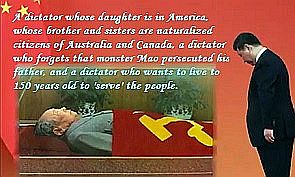 Now, you, as the midwife who delivered China into the communist hands, are morally obligated to take China [and North Korea {and Vietnam}] out of communism.
This time, you may feel your hands forced as North Korea, with its nuclear weapons, could become Communist China's cecal appendix in a repeat of history.
(The Chicoms don't understand the urgency of Trump's trade war having the roots in nuclear North Korea, nor the domino effect on North Korea and Russia after the knock-out of communist China.
Putin thought he would reap profits by sitting on the fence of the U.S.-China trade war, i.e., the Zheltorossiya dream
- revitalized by Aleksandr Gelyevich Dugin
[, and India would not be satisfied with grabbing South Tibet, Bhutan, and Sikkim alone].
Previously, this webmaster thought that the Americans could be hoodwinked by the Chicoms who might just sign any agreement just for sake of getting a red carpet at the White House in lieu of a visit to Mar-a-Lago.
With Trump's war with Communist China flaring up, this webmaster believed that China's dictator would continue to commit blunders and became the tomb digger for the Chinese communist regime.
The thuggery communists, who would not allow the millions of the Hongkong people to have autonomy, could have caused the demise of the regime over the inevitable crackdown, not knowing that the communist ascension to power had its very roots in Churchill's collusion with Roosevelt in selling out the Republic of China for sake of retaining crown jewel Hongkong after hoodwinking Wellington Koo and Chiang Kai-shek that Britain would return Hongkong to China after Japan was to surrender so as not to damage the British wartime morale.
--What happened was that Putin first jumped off the fence ahead of communist China in launching an invasion of Ukraine.)
Now, you, as the midwife who delivered China into the communist hands, are morally obligated to take China [and North Korea {and Vietnam}] out of communism.
This time, you may feel your hands forced as North Korea, with its nuclear weapons, could become Communist China's cecal appendix in a repeat of history.
(The Chicoms don't understand the urgency of Trump's trade war having the roots in nuclear North Korea, nor the domino effect on North Korea and Russia after the knock-out of communist China.
Putin thought he would reap profits by sitting on the fence of the U.S.-China trade war, i.e., the Zheltorossiya dream
- revitalized by Aleksandr Gelyevich Dugin
[, and India would not be satisfied with grabbing South Tibet, Bhutan, and Sikkim alone].
Previously, this webmaster thought that the Americans could be hoodwinked by the Chicoms who might just sign any agreement just for sake of getting a red carpet at the White House in lieu of a visit to Mar-a-Lago.
With Trump's war with Communist China flaring up, this webmaster believed that China's dictator would continue to commit blunders and became the tomb digger for the Chinese communist regime.
The thuggery communists, who would not allow the millions of the Hongkong people to have autonomy, could have caused the demise of the regime over the inevitable crackdown, not knowing that the communist ascension to power had its very roots in Churchill's collusion with Roosevelt in selling out the Republic of China for sake of retaining crown jewel Hongkong after hoodwinking Wellington Koo and Chiang Kai-shek that Britain would return Hongkong to China after Japan was to surrender so as not to damage the British wartime morale.
--What happened was that Putin first jumped off the fence ahead of communist China in launching an invasion of Ukraine.)
|
President Trump
understood the China situation and the China problem.
Should the American politicians follow the footsteps of Anson Burlingame (1820-1870),
Paul Samuel Reinsch (1869-1923)
and
Patrick Jay Hurley (1883-1963), i.e., three most prominent U.S. statemen who loved China and the Chinese people,
then the Chinese people could have a chance of salvation from the communist tyranny.
Note the historic recurrence and the repetition of similar events:
Anson Burlingame, in opposition to the anti-Chinese discriminatory whirlwinds rampant in the U.S. in the 19th century, authored the Burlingame Treaty for China and
died for China in 1870 in St. Petersburg
while still on the Manchu China's mission to the U.S. and Europe;
Paul Samuel Reinsch, who was disillusioned by President Wilson's betrayal of China over the division of WWI spoils at the Paris Peace Conference, quit the minister-to-China job to work for China and died for China in Shanghai in 1923;
and
Patrick Jay Hurley, who convinced President Roosevelt of the American moral blunders in selling out the Republic of China at Tehran and Yalta, personally travelled to Moscow and London for sake of averting and reverting China's fate of becoming a victim of WWII war spoils (i.e., the loss of Port Arthur and Hong Kong, etc.), but failed to make remedy to the secret Tehran and Yalta agreements in the aftermath of President Roosevelt's death in April 1945.
|
|
For better understanding the head-on collision between the United States and Communuist China,
refer to
the U.S.-China fatalistic conjunction through the hands of the Japanese firepower during WWII, that derived from the American unpositive neutrality;
the U.S.-China fatalistic conjunction through the hands of communist army's firepower during the 1945-1950 civil war, that derived from American-supplied Soviet August Storm weapons; and
the U.S.-China fatalistic conjunction through Joseph Stalin, Kim Il Sung and Mao Tse-ting's hands during the 1950-1953 Korean War.
|
|
|
|
More, refer to the Communist Platonic Club at wartime capital Chungking
and
The American Involvement in China: the Soviet Operation Snow, the I.P.R. Conspiracy, the Dixie Mission, the Stilwell Incident, the O.S.S. Scheme, the Coalition Government Crap, the Amerasia Case, & The China White Paper.
|
|
|
|
RESISTANCE WARS
(*** machine-translated Chinese language version:  ***) ***)
|
|
The Invasion Of Manchuria, Chaha'er & Jehol 1931-34
The Mukden Incident - 9/18/1931 & The Battle Of Jiangqiao
The Shanghai Provocation - 1/28/1932
Battles of the Great Wall
China In Crises Of Internal turmoil & Foreign Invasion
The Japanese Invasion (1937-1945)
Marco Polo Bridge Incident & Battle of Tianjin-Peking
Campaign Of Nankou & Campaign of Xinkou
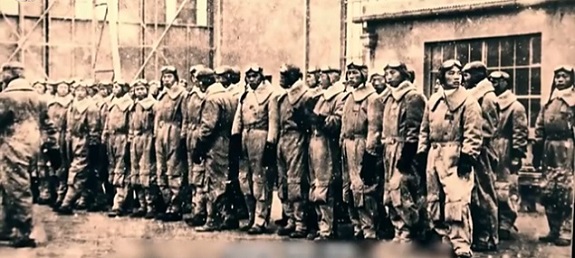
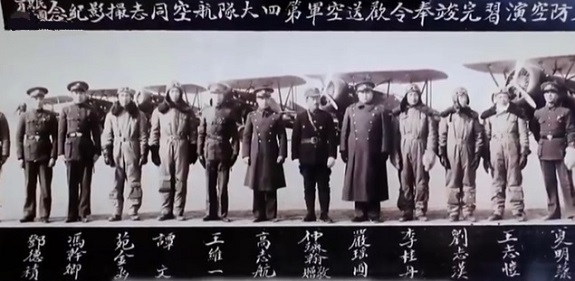
Air Battles Directed By Chennault & With Russian Pilots
Battles of Shanghai, Jiangyin,
Si'an &
Nanking Defence
Rape Of Nanking & The Great Rescue Of 1937
Eight Year Long Resistance War
Mingguang,
Linyi-Tengxian, Tai-er-zhuang , & Xuzhou
Battles of Lanfeng, Wuhan, Nanchang, &
Sui-Zao,
1st Changsha Battle, Kunlunguan, Wuyuan, &
Zao-Yi,
Saturation Bombing of Chungking by the Japanese
Aggression Against Vietnam & Southeast Asia
Yu-nan & E-bei, Shanggao, & Mt Zhongtiaoshan
2nd Changsha Battle, & Pacific Wars
3rd Changsha Battle, Zhe-Gan,
Changde, &
E-xi
The First, &
Second Burma Campaign, &
Phase II |
| [ revolution.htm & tragedy.htm] |
The Communist Armed Rebellion
Second Northern Expedition
War Of Chiang Kai-shek versus Gui-xi (March 1929)
War Of The Central Plains (May 1930)
Campaigns Against Communist Strongholds
The Long March (Iron Chain Bridge)
The Xi'an Incident - Turning Point of Modern History
Demise Of the Red Army Western Expedition |
| [ campaign.htm & terror.htm ] |
[ default page: war.htm ] |
|
1945-1949 Civil War
Liao-Shen Campaign
Korean War
Vietnamese War
Continuing from Tragedy of Chinese Revolution, Campaigns & Civil Wars, & White Terror vs Red Terror:
1) World War II, in both the East and the West, was the result of the inducement of the British, American[, and French] interest groups and syndicates, as well as the result of the scheme by Soviet Russia. First there was the October 1925 Locarno Treaties which, per Polish foreign minister Jozef Beck, led to the opinion that "Germany was officially asked to attack the east, in return for peace in the west." Poland, as a country, was anti-Republic of China since birth, as it colluded with Japan at the 1919 Paris Conference, at the post-1931 League of Nations' conference, and at the post-1937 League of Nations' conference, in the attempt at encouraging Japan in the invasion against China to ultimately war with the Soviet Union.
In 1931, President Herbert Hoover gave Japan a free hand in the invasion of Manchuria on the pretext that Japan could not tolerate a half-Bolshevik China.
After the eruption of the 1937 war, the Anglo-Americans, still biased towards Japan and against China, adopted a policy of "neutrality" (what Utley called by "unpositive neutrality") against the 'belligerent' countries, namely, Japan and China, which was free and unrestrained arms sale to Japan and de facto arms embargo against China.
Note that the Japanese navy had a full blockade of China's coastline. Note that the blockade would choke China since China did not have an industrial base to produce the basic weapons while Japan's factories could roll out the warships and airplanes on a wholesale scale.
Thereafter the September 1938 Munich Agreement. For what? Britain, France and the United States wanted Hitler to attack the Soviet Union, and wanted Japan to suppress China's nationalist movement and counter the Soviet Union. In both cases, Stalin out-smarted the Anglo-American and the French. Hitler attacked westward instead, and signed a non-aggression pact with Stalin to halve Poland; and Japan attacked Southeast Asia and the Pearl Harbor after China, not the Soviet Union.
Half a year before the Russo-Japanese Neutrality Treaty of April 1941 and one year ahead of the Pacific War, Japan already reached a secret deal with the U.S.S.R. to halve China, mapping the "Poland partition" scheme by the U.S.S.R. and Nazi Germany, as evidenced by the clauses of the Dec 1940 negotiation and treaty between Wang Ching-wei's puppet R.O.C. government and Japan in regards to the reserved territories for the Chinese communists and the hinted Western China's boundary between the U.S.S.R. and Japan.
(More available at "Changing Alliances On the International Arena", "Century-long American hypocrisy towards China", "Anglo-American & Jewish romance with the Japanese",
"America's Unpositive Neutrality in the Sino-Japanese War",
"Joe Stilwell's Authorization To Assassinate Chiang Kai-shek", and "What Foreign Powers Did To The Flowery Republic Prior To, During And After The 1911 Revolution".)
A rather simple explanation for the ultimate American intervention in China in March 1940, i.e., the Americans' hastily giving Chiang Kai-shek a badly-needed loan, would be to prevent Japan and China from reaching a truce since Chiang Kai-shek deliberately spread a rumor that his Chongqing government could merge with the puppet Nanking government.
As Paul Reinsch and Arthur Young repeatedly said, the United States of America could have done just a little to help China in WWI or WWII, but chose to do nothing during WWI other than a Lansing-Ishii Agreement [which was to acknowledge that Japan had its special interests (in the specified areas of China specified by the secret memorandum)], chose to do lip-service to Wu Peifu's ROC government while the Soviets equipped Feng Yuxiang and Sun Yat-sen's military factions with free guns; chose to do nothing after making sure China was to stay in the Second World War by merely granting the currency stabilization loan of 1940; and chose to use the Lend-Lease coercion to force China into throwing the crack troops at northern Burma just prior to the Japanese Ichigo Campaign in 1944.
2) Stalin was the evil genius of the 20th century. Stalin, after the 1929 war against Zhang Xueliang over the Chinese-Eastern Railway [which erupted over the Soviet Russian and Chinese communist agitation in sabotaging Japan's attempt at building five additional railways in Manchuria and Inner Mongolia], quickly divested himself of the railway when Japan invaded Manchuria on Sept 18th, 1931. After initially calling on the world communists to militarily defend the Soviet Union from 1931 to 1933, Stalin subsequently designed the united front and popular front in 1935, and in the time period of 1936-1937 successfully lit the fuse of the Sino-Japanese War by means of repeated G.R.U. operations in northern China and Manchuria.
To thwart the Anglo-American attempts at using Japan against the U.S.S.R., Stalin hijacked the American government policies by utilizing agents, saboteurs, provocateurs and sympathizers from the Institute of Pacific Relations. "16 out of 17 of the AMERICANS that were involved in creating the U.N. were later identified, in sworn testimony, as secret communist agents." The whole United States government was in fact taken over by the Comintern agents, including: Alger Hiss; Harry Dexter White; Lauchlin Currie; Laurence Duggan; Frank Coe; Solomon Adler; Klaus Fuchs; and Duncan Lee."
John Fairbank and Owen Lattimore, i.e., two "Old China Hands" who were repeatedly cited by the Chi-com for substantiation of the cause and success of the Chinese communist revolution, had merely been the Soviet Russian and/or Chicom tools. (Most of the Comintern spies of the European and American background had been recruited during their stay in China during the turbulent 1920s. Note that 95% of the Comintern agents sent to China were American Jews and 100% of the Soviet Red Army G.R.U. agents sent to China were German Jews. Owen Lattimore's belief and orientation should have been shaped during his early years in Peking in the 1920s. John King Fairbank, who had done everything Agnes Smedley had asked him to do other than putting his name on the roster of the G.R.U. (Main Intelligence Directorate of the General Staff of the Armed Forces of the Russian Federation), was a member of the Chinese League for the Protection of Civil Rights in late 1932 and early 1933, and further rafted with Comintern agent Harold Isaacs on the Jehol River in 1934 before the latter switched to the Trotskyite path. Working directly under Lattimore would be two Chicom spies called Chi Chao-ting and Chen Han-sheng who designed America's China policies.)
3) It was the century's misfortune for China to have to see the Anglo-American interest groups and Russian/Comintern agents colluding with each other in subverting Nationalist China
--
the last bastion against the imperialists and colonialists and
the beacon tower
for the independence of all Asian countries and people
, colonized or semi-colonized by the West,
as "...British Ambassador personally suggested to me [Albert Wedemeyer]
that a strong unified China would be dangerous to the world and certainly would jeopardize the white man's position immediately in Far East and ultimately throughout the world."
No matter it was the 1904-05 Russo-Japanese War, or the Japanese invasion of Manchuria in 1931, or the 1937-1945 Sino-Japanese War, the aforesaid parties, plus the Chinese communist henchmen, were the ONLY people who wanted Japan to invade China, albeit for different reasons and agenda at different stages and times.
In another word, the Japanese never realized that they had been brought up and used as a tool since Matthew Perry's timeframe, first as a tool against Russia in 1904-5 and then used by the Soviets as a tool against China.
"When other nations tried to bar ... [Japan] progress or slur ... [Japan] reputation," as commented by Inazo Nitobe:
"America always stood for ... [Japan] ...[America's] Stars heralded to the world the rising of ... [Japan] Sun..."
The warships and planes built and used against China in 1931/2 were the products of twenty years of military alliance between Britain and Japan,
following the American support of the Japanese ventures against Ryukyu and Taiwan in the late 19th century.
(Do not forget the post-WWI ten-year arms embargo against Republic China and George Marshall's post-WWII arms embargo against Republic China 1946-1948, as well as
the synarchists' backing Japan's war against China and Sun Yat Sen.)
4) There is no truth in Stalin and Truman racing against each other as suggested by Tsuyoshi Hasegawa. While Truman was blindfolded as to the making of the Atomic Bomb, the Russians had been receiving ships of the uranium ore throughout the war, which was to make sure that the United States was not to become the nuclear monopoly. Stalin's American proxies already had Truman agree to the terms reached by Roosevelt at Yalta. The United States had utterly no preparation for racing its army to Japan or Korea. "It was after the U.S. dropped two bombs onto Japan, on Aug 6th & 9th, respectively, that Rusk & Bonesteel, drew up the 38th Parallel on the map as an artificial division line separating the U.S. sphere of influence from the U.S.S.R.
(The Japanese, of course, don't know that they were used as a tool against China.
Working as a secretary of the Japanese prime minister Konoye Fumimaro as one of the five brain trusts, Stalin's spy Ozaki,
likening Japanese prime minister Konoe to Alexander Kerenski (head of the 1917 transitionary Russian government),
wanted to turn Japan into a replay of the Soviet revolution.
How brilliant it was to hit two birds (China and Japan) with one stone!
It was the Tokyo Special Higher Police, 'tokko' or 'tokubetsu', who broke the Sorge-Ozaki spy rings in China and Japan, not the Japanese military kempeitai or the Japanese military that was permeated with the JCP and Tobun [same language] Academy spies.
Do you Japanese know that?)
5) Japan already explored with the Soviets for surrender. But the Soviets declined it. Otherwise, what's the need to enter Manchuria and Korea? Since the Russians were eager to invade Manchuria & Korea, Japan had to turn around to request with Sweden for relaying a message of surrender.
Japan was in self-denial over the prospect of the Russian entry into war. Intelligence already poured into Japan as to the Russian complicity at Yalta. Back on June 9th, 1945, Truman officially told TV Soong (Soong Ziwen) that he was to honor the late President's signature on the Yalta Agreement and requested that China dispatch a delegation to Moscow for stamping a Sino-Russian friendship agreement no later than July 1st. The Chinese were busy repairing the damages. Japan knew about it. Japan sent secret negotiators to Chiang Kai-shek multiple times in July-August of 1945 for the peace talks. Looking in hind sight, China, separately, should have struck a partial peace with Japan to ward off the Soviets.
(When the Soviet Red Army invaded Manchuria, Japan, who had issued orders to its armies to surrender across the battlefields of China and Southeast Asia, had to make a special order to the Kwantung Army to resist the Soviet Red Army in Jehol, Manchuria, and the Sakhalin for about 20 days for sake of stopping the Soviets from landing in Hokkaido.)
6) Though, the Japanese emperor played a trick in surrender. He signed a "truce" order to his army and listing Britain, American and China and etc., but when he made the announcement on radio, he changed China to Chungking [Chongqing] the Chinese interim capital. We know Japanese have a problem with saving face. But the truth is known no matter how the professor wanted to discount the atomic bombs and gave weight to the Russian entry into the war. Professor Tsuyoshi Hasegawa, who skipped the name of China in his book title and ignored the death toll of 1 million Japanese on mainland China, should spend more time researching into the fate of half of the 500-600,000 Kwantung Army that had perished in Russian Siberia.
Konoe Fumitaka, i.e., son of imbecilic Japanese prime minister Konoe Fumimaro who designed the policy of "Shokaiseki o aite to sezu", was exiled to Siberia by the Soviets
and just days before repatriation in the late 1950s, could have been killed by the Soviets.
(From the memoirs related to some Taiwan native who joined the Japanese Kwantung Army and was later exiled by the Soviet Red Army to Siberia for the coolie labor, the Soviets, to help Mao Tse-tung and Kim Il Sung, on a wholesale scale, in 1947 repatriated the Korean-ethnic Japanese Kwantung Army prisoners of war to North Korea and the Taiwan-ethnic Japanese Kwantung Army prisoners of war to Manchuria, as fodder of war, which probably explained why there was no accounting of some huge numbers of the Japanese Kwantung Army troops in the later repatriation to Japan and the Republic of China's generals kept mentioning that the Koreans and the Japanese were manning the guns and the tanks of the Chinese communist army.)
The Soviets sorted out at least 30,000 Japanese artillery troops, medical Kwantung Army staff, a full airforce contingent with generals and crewmen under Hayashi Yayichiro, and no less than two full Korean-ethnic divisions for deployment by the Chinese communists in the civil war against the Nationalist Chinese Government, not to count the Outer Mongolian Cavalry and 100,000 fully-trained Korean mercenaries sent to China in 1947, with about 60,000-70,000 remnants [out of the total headcount of 250,000 Korean mercenaries] shipped back to Korea prior to the Korean War of June 1950. According to Kim Il-sung, altogether 250,000 Korean mercenaries took part in the 1945-1950 civil war against the Nationalist Government, with 60,000-70,000 remnants surviving the bloody Chinese civil war to return to Korean for the 1950 Korean War.
Note the fundamental difference between the 250,000 ethnic-Korean Japanese Kwantung Army diehards and the ethnic-Korean Chinese living in China.
The communist statistics claimed that altogether 65,000 ethnic-Korean Chinese minority people, or the Korean migrants living in China, joined the communist army, with approximately
60% coming from the Jirin subprovince,
21% from the Sungari subprovince, and
15% from the Liaodong subprovince.
7)
Stalin and the Soviets were behind each step of monster Mao Tse-tung in making sure that no peace could have a chance from the day Japan surrendered. Cumulatively, the Soviet Russians acknowledged in the 1970s that they had given the Chinese communists 700,000 guns, with North Korea's arsenals open for free pickup throughout the Chinese civil wars. (On the 1947 anniversary date of the Russian Revolution, the Soviet Russians already disclosed that they had given the Chinese communists massive military aid - which the Americans refused to acknowledge.) At about the same time the Republican Party forced through the China Aid Act in 1948, Stalin officially stamped a loan for the Chinese communists of an equivalent amount allocated by the China Aid Act, with no strings attached.
Stalin understood that the generations of brave Chinese during first part of the 20th century were the flower that China ever had in the whole history of 5000 years, a force that must be destroyed so that the Soviet Russian scheme at world domination could succeed.
Didn't know the Russian cold-bloodedness? Read into the Katyn Murder of 20,000+ Polish officers, and Stalin's plan to shoot 50,000 German officers- which Roosevelt echoed by lessening to 49,500.
Separately, Stalin disclosed to the son of Chinese president that he wanted to imprison 500,000 to 600,000 Japanese lower-level officers and 12,000 Japanese generals for preventing the Japanese from rising up again to pose threat to the Soviet Union.
Likely, Stalin passed on a suggestion to McArthur to arrest 8000 to 12,000 Japanese generals.
(Numerous nationalist army generals, who survived the valiant wars against the Japanese invasion, would be imprisoned and executed by the communists from 1949 to 1975. E.g.,
Lu Shiyang was executed by the communists in 1951 simply because he was a former Nationalist Army company commander even though he left the army after the VJ (victory over Japan) day in 1945 and never ever fought against the communist army.
Wu Dehou, released by the CCP's amnesty on Dec 15th, 1975, returned to his impoverished Shanxi Province countryside as a peasant.
Du Yuming, the war hero on the Burma Theater, was released from over 10-year long prison sentence on Dec 4th, 1959 in accordance with the CCP's 17 Sept 1959 First Amnesty Order for sake of having him show off at a diplomatic meeting in April 1960 with former British General Montogomery as well as for sake of instigating the return of his son-in-law, i.e., noble prize winner Yang Zhenning.
The Nationalist Army colonel-level officers, about one tenth of the total captives rounded up in the communist provincial quasi-prisons since the 1950s, survived the execution, torture and hunger to get amnesty in 1975.
It would be in 1985 that the CCP first declared the title of 'national heroes' for 85 Nationalist generals who sacrificed their lives in the Resistance Wars Against Japan.)
As this webmaster had elaborated on the battles and campaigns in Civil Wars section,
the Chinese Civil War of 1945-1950 [using the Korean War as a breakpoint rather than the PRC's proclaimed date of founding] is the "Last Duel of the Middle Earth"
involving millions of the fighting-to-death Yellow Men,
with the outcome determined on the battlefields by means of a) the military tactics and strategies,
b) political conspiracy and plots, c) economic manipulation and sabotage, c) societal disruption and coercion,
and d) international alliance and betrayal, never ever the free choice of the Chinese people or the 'Mandate of Heaven' as John Fairbank and Owen Lattimore
[and their student-sinologists in the American colleges and universities] wanted you to believe in.
|
The brave R.O.C. soldiers against the armed-to-the-teeth Japanese Army
After squandering the 1st tier troops of 1st-20th Shidans and 2nd tier troops of 100th-120th Shidans in the "yocho" (penalizing) action against China, the Japanese sent the demoralized Shidans
to the Pacific War graves, to the extent that by the time Japan surrendered, the Japanese homeland soldiers of 1-2 million new recruits possessed bamboo sticks and spears
for defense, while the Soviet/Comintern agents inside of the Japanese government/military, in the name of moving the duel battlefield to the mainland, hoarded large cache of weapons in Manchuria/Korea for free pickup by the Soviets and the
Chinese/Koreans.
Working as a secretary of Konoye Fumimaro the Japanese prime minister as one of five brain trusts, Stalin's spy Ozaki,
likening Japanese prime minister Konoe to Kerenski (head of the 1917 transitionary Russian government),
wanted to turn Japan into a replay of the Soviet revolution.
(It was the Tokyo Special Higher Police, 'tokko' or 'tokubetsu', who broke the Sorge-Ozaki spy rings in China and Japan, not the Japanese military kempeitei or the Japanese military that was permeated with the JCP and Tobun [same language] Academy spies.
Do you Japanese know that?)
|
|
|
The brave and victorious National Revolutionary Army (NRA) of the Republic of China chased the remnant communists to the north bank of the Sungari River.
|
|
The Americans sold out China in Tehran, Yalta and Potsdam. In late 1944, American navy general Leahy was probing China about the Soviet demand for Dairen, Port Arthur and the railways. Roosevelt locked up the secret treaties in his drawer till his death. Both Hurley and Leahy merely knew part of the Roosevelt's secret deals with Stalin. Truman pressured China numerous times demanding that China sign an agreement with the Soviets no later than July 1st, 1945. Late 1945, George Marshall and the Americans continued to sell out China on the matter of the Soviet pillage of Manchuria, and held a U.S.-U.K.-U.S.S.R. three-country foreign ministers' meeting, to demand that the Republic of China must talk peace with the communists --namely, the imposition of a worldwide arms embargo against the Republic of China.
Marshall, in the spring of 1946, flew back to China to stop the Chinese army from moving beyond the Sungari River.
As disclosed by the documents at the George Marshall foundation, George Marshall, possibly the most hideous agent working on behalf of Stalin and the Soviet Union, saved the ass of the Chinese Communists with a threat to withhold the economic aid that was supposedly coming from the U.S. export-import bank, which never materialized.
|
|
|
|
G Marshall, from 1946 to 1948, repeatedly probed numerous Chinese officials and generals as to who could be Chiang's successor.
The U.S. Department of State, run by the Russian agents, were repeatedly sending out rumors about getting a successor for Chiang. Marshall's hands had the blood of millions of Chinese killed in the civil wars.
G Marshall, as Wedemeyer said, first armed China and then disarmed China.
This was what Wedemeyer, after taking over Stilwell's job, began as the 30-division training place in the spring of 1945 --that did not get fully started before it was scrapped, with Shi Jue's 13th Corps going into Manchuria in the spring of 1946 with one third of the American-supplied training ammunition, for example.
The U.S. arms embargo continued till the China Aid Act of 1948, and ammunition did not get released till Nov of 1948.
After weapons were shipped
out, Acheson and the undercover Russian agents further attempted to order the ships to turn around at Guam, Saipan and Okinawa.
In Oct 1949, Acheson pleaded with the British, where the Cambridge Soviet Spy Ring was at work, for recognition of Communist China, which Britain did on Jan 1st, 1950.
After that, Acheson declared the Aleutian curvature, which directly led to the eruption of the Korean War.
The Korean War and the Vietnam War, invariably, were the extension of the Chinese Civil War of 1945-1950.
|
The nationalist government under Chiang Kai-shek, having barely united China, would be engaged in numerous rounds of the civil wars with the communists as well as the KMT opponents & adversaries [termed "neo-warlords" by Chiang Kai-shek].
In the early years, Chiang Kai-shek had been commented by Li Zongren to have deliberately adopted the approach of "yang [multiplying] fei [the communist banditry] zi [for self-enhancing] zhong [important position of being indispensable]." (Li Zongren, however, did not know that the communists were working among the various military leaders for staging rebellion.)
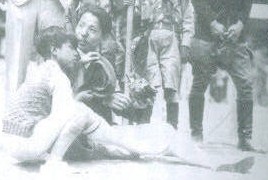 In 1929, Chiang Kai-shek launched two wars with the Guangxi Province armies [i.e., the 4th group army], i.e., The War Of Chiang Kai-shek versus the Gui-xi Clique.
Senior KMT leader Zhu Peide had commented that Chiang Kai-shek, in the early years, had a temper, but by the mid-1930s, Chiang Kai-shek had mastered the political skills in comparison with the rash approach Chiang Kai-shek adopted towards the Guangxi clique and senior KMT leader Hu Hanmin in the early days.
In 1929, Chiang Kai-shek launched two wars with the Guangxi Province armies [i.e., the 4th group army], i.e., The War Of Chiang Kai-shek versus the Gui-xi Clique.
Senior KMT leader Zhu Peide had commented that Chiang Kai-shek, in the early years, had a temper, but by the mid-1930s, Chiang Kai-shek had mastered the political skills in comparison with the rash approach Chiang Kai-shek adopted towards the Guangxi clique and senior KMT leader Hu Hanmin in the early days.
Though, the war with the Gui-xi Clique had the trace of instigation from the Chinese Communists, namely, the CPC Southern China (HK) branch's scheme to use Yu Zuoyu/Yu Zuobo brothers and cousin Li Mingrui to instigate a confrontation between the Guangxi Army and the central army so as to take advantage of the conflicts to conduct a mutiny among the Guangxi provincial army for sake of launching the Soviet revolution in the Left River and Right River areas.
In 1930, Chiang Kai-shek had to fight The War Of The Central Plains, which again had the Chinese Communists scheming behind the scene among Feng Yuxiang and Deng Baoshan's army. As early as in 1929, prior to the War of the Chinese Eastern Railway, the documents confiscated by Zhang Xueliang from the Soviet consulate in Harbin showed that Feng Yuxiang was in liaison with the Soviets for fighting Chiang Kai-shek's central government.
The direct consequence of the civil wars would be: i) the Communist disturbance in multiple provinces; ii) the Japanese invasion of Manchuria.
(After perusing records, this webmaster had a conviction that the Chinese communists, their predecessor [international] socialist (and communist) youth leagues, and the successor Chinese G.R.U. agents were behind almost every rebellion, mutiny, sabotage and instigation from 1919 to 1949, including the 1929 Wars by the KMT Reorganizers, the 1930 Wars of the Great Plains, the Fujian Mutiny of 1933, the Xi'an Coup of 1936, and the 1937 Marco Polo Bridge Incident.)
Zhang Xueliang, who was shooting pictures at the Manchuria sports contest in October 1930, would soon see his hometown abandoned to the Japanese. Li Dongfang pointed out that Zhang Xueliang often warded off the Japanese by claiming that diplomacy rested with Chiang Kai-shek in Nanking; however, Zhang Xueliang did not bother to report to Nanking his conflicts with the Japanese as to building the Chinese-owned railways and harbors. Zhang Xueliang also failed to brief the Nanking government after the Japanese consul in Liaoning raised a protest in regards to the disappearance of Nakamura Shintaro and some spies -- Zhang Xueliang's soldiers, under the 3rd Farming Regiment commander Guan Yuheng of the Xing'an Military Farming, on June 26th, 1931, secretly executed 4 Japanese military spies, including Nakamura Shintaro, who faked the identity of an agriculturalist and intruded into the Xing'an Ridge area for espionage activity at the turn of May-June 1930.
Killings of the Japanese spies would not be something that Japan would pass easily, with the Japanese army officers frequently drinking oath wines and swearing revenge. Though the Japanese felt it awkward to use this particular excuse publicly. That's why the Japanese blew up the railway tracks, instead, and claimed that the Northeastern Army at the Northern Barracks of Mukden had sabotaged it.
(Before the conflict with the Japanese, Zhang Xueliang had blundered in the War of the Chinese-Eastern Railway in May 1929, which incidentally was to do with the Soviet/CPC scheme to instigate the anti-Japanese movements to disrupt the Japanese attempts at building the additional railways in Manchuria and eastern Inner Mongolia, i.e., a scheme that was contrived since the days of Yuan Shi-kai's Republican China and WWI.)
Historical riddles still exist as to the Zhang Xueliang's order to withdraw his Northeastern Army from Manchuria in 1931.
Zhang Xueliang himself denied, on multiple occasions, that it was Chiang Kai-shek who ordered him to evacuate the army from Manchuria;
Li Zongren firmly believed in a "secret agreement" between Chiang Kai-shek & Japan that was struck in 1928,
an agreement that Li Zongren mentioned was stolen by Chiang Kai-shek's agents from the Japanese agents for destruction by luring them to a secret meeting in Shanghai
--which was often inferred to be the root cause of the assassination death of Saburi Sadao, Japan's minister to China, at a hotel in Hakone Miyanoshita.
Saburi Sadao was taken by Arthur Young to be a decent Japanese who harbored sympathy with the Chinese.
The Chinese communists claimed to be ready to "militarily defend the U.S.S.R. [during the War of Chinese-Eastern Railway in May 1929]" and suspected that it was a Nationalist Government's scheme to draw the Japanese fire towards the Soviet Union's border. Back in July 1931, Gu Weijun (Wellington Koo), who had been retiring in Tientsin [Tianjin] after the overthrow of the Peking government in 1928, rushed to Zhang Xueliang to advise on taking the precautionary measures as to a possible Japanese "general attack" at China. Zhang Xueliang, who later ignored almost 100 pieces of communication from Gu Weijun in the three months ensuing from the 9-18-1931 Incident, refused to put up a fight in Jinzhou, with false expectation that the League of Nations would step in to solve the Manchuria Incident the same way as what the 1922-3 Washington Conference did to the Japanese inheritance of the Shandong Peninsula interests from Germany.
Though Chiang Kai-shek stepped down in late 1931, the central government's order for Zhang Xueliang was to put up the resistance at Jinzhou.
Zhang Xueliang's oral recitals confirmed the suspicion that it was Zhang Xueliang himself, with an understanding that Chiang Kai-shek would not assist him as promised in 1928 at the time of the Manchuria's unification with China proper, had decided to preserve his forces rather than fighting the Japanese on his own accord.
Zhang Xueliang's discussion with the Soviet-spies-infiltrated Mukden YMCA gang was that he would be willing to die as a jade, not as a tile, meaning that should the central government not step to the front, the Northeastern Army would not risk being destroyed by the Japanese Army in fighting a resistance war.
Chiang Kai-shek had shown a contrast on the matter of General Soong Zheyuan vs General Zhang Xueliang. Soong Zheyuan, i.e., a Chinese national hero at the Battles of the Great Wall, would suddenly become a pro-Japan regional leader who had participated in the "autonomous movement" similar to Japan's "puppet Eastern Hebei Province government." After the eruption of the 1937 Resistance War, Chiang Kai-shek explained to the whole nation that Soong Zheyuan was under his personal order to "befriend" Japan as a coverup. In contrast, Chiang Kai-shek, who had put Zhang Xueliang into house arrest in late 1936 for the Xi'an Coup d'etat, never acknowledged that he had instructed Zhang on the matter of appeasing the Japanese invasion of Manchuria. Do note that Chiang Kai-shek, from 1935 to 1936, had authorized the "Secretive Sino-U.S.S.R. Contacts and KMT-CCP Contacts In Multiple Channels", a manifestation that Chiang Kai-shek was preparing for an inevitable confrontation with Japan by means of an alliance with the Soviets & Chinese communists.
Zhang Xueliang, in his recollections, had acknowledged his misjudgment by likening Japan's invasion of Manchuria to either the 1927 Nanking Bloody Incident or the 1928 Ji'nan Incident, i.e., two international incidents that had limited damages. Chiang Kai-shek, being always pre-occupied with dealing with the internal feuds and enemies, had apparently misjudged the Japanese on basis of three diplomatic breakthroughs, namely, i) Japan's backing off from the key demand in the "Twenty One Demands" during Yuan Shikai's reign; ii) the Japanese withdrawal from the Shandong Peninsula under the pressure of the Washington Conference and the League of Nations; and iii) Japan's refraining from joining the British-American warships' bombardment of Nanking during 1927 Nanking Bloody Incident [which was provoked by communist Li Shizhang, the acting politics director of the NRA 6th Corps].
The Japanese Invasion Of Manchuria, Chahar & Jehol (1931-1934)
At http://www.larouchepub.com/other/2004/3123morgan_v_dr_sun.html, Mike Billington wrote for "Executive Intelligence Review" an article entitled "How London, Wall Street Backed Japan's War Against China and Sun Yat Sen", pointing out the behind-the-scene manipulations as to "SYNARCHISM AND WORLD WAR." As stated by Mike Billington, "... British synarchist banking interests, centered around Bank of England head Montagu Norman, Hongkong and Shanghai Bank director Sir Charles Addis, and J.P. Morgan chief executive Thomas Lamont, deployed militarily and politically to destroy Sun Yat Sen and his influence. ... when their subversion and looting failed to crush Sun's republican movement, the British threw their weight behind the synarchist/fascist forces in Japan, financing the Japanese military occupation of the Chinese mainland... By 1931, J.P. Morgan had floated $263 million in loans for Japanese borrowers, including direct loans to the government in 1930", with quite some of the funds going direct to the Southern Manchurian Railway under disguise to avert the world opinions. Note that President Wilson rejected Reinsch's 1917 financing arrangement for building an alternative rail route to the South Manchurian Railroad, "even assured Japan that the United States would honor their special position in Manchuria", and in October 1918 agreed to the formation of a new bankers' Consortium which was orchestrated by Anglo-American bankers for sake of depriving China of any chance of obtaining an international loan.
(The European and American synarchists actually triggered the 1911 Xin Hai Revolution that overthrew the Manchu rule when they colluded with the Manchu government in the attempt at having the Manchu government nationalize the privately-funded Sichuan railways so as to sell the railway rights to the European and Americans.)
President Wilson's China policy was what
this webmaster referred to as the 100-year American hypocrisy.
It was pivoted from the hypocritical nature of America's Open Door Policy for China, which was originally an idea sold to the Americans by the British career customs officer working in Manchu China's customs office.
The reason that China should remain open to all powers, in the opinion of the U.S. president Thomas Woodrow Wilson, was that the 'white civilization' and its domination in the world rested largely on the ability to keep China intact, in the sense that should China fall completely under the Japanese [or the Tsarist Russian or someone else's] influence, then the massive Chinese manpower could be utilized like by Genghis Khan to conquer the world. This was the theme of the Yellow Peril, which was inverse to what the British ambassador claimed to Albert Wedemeyer during WWII that a strong and unified China would pose a threat to the White men's position in the Far East and immediately throughout the world.
So to say that the nation of China should be managed delicately, that is, should not be allowed to grow too powerful to pose a threat to the white civilization, nor should it be allowed to be hijacked by a non-U.S. power since China's immense human labor could be turned against the white civilization.
(During WWII, the Japanese, who were brought up by the Americans and the British, never realized that they could at most conquer half of China, not as a whole.)
It was the century's misfortune for China to have to see that the Anglo-American interest groups and Russian/Comintern agents colluded with each other in subverting Nationalist China. No matter it was the 1904-05 Russo-Japanese War, or the Japanese Invasion of Manchuria in 1931, or the 1937-1945 Sino-Japanese War, the aforesaid parties, plus the Chinese communist henchmen, were the ONLY people who wanted Japan to invade China, albeit for different reasons and agenda at different stages and times. A rather simple explanation for the ultimate American intervention in China in March 1940, i.e., Americans' hastily giving Chiang Kai-shek a badly-needed loan, would be to keep China in the war and to prevent Japan and China from reaching a truce since Chiang Kai-shek deliberately spread a rumor that his Chungking government could merge with the puppet Nanking government.
In the domestic arena, on Feb 28th, 1931 [lc ?], Hu Hanmin was put under house arrest by Chiang Kai-shek in Nanking. Chiang Kai-shek also ordered the arrest of Deng Yanda who was later executed before Chiang Kai-shek's stepdown on December 15th, 1931. Chiang Kai-shek further hijacked two more senior KMT leaders, i.e., Ju Zheng and Xie Chi. Sun Ke left Nanking for Canton, and Deng Zeru & Lin Sen et al., rebuked Chiang Kai-shek on April 30th [lc ?].
On May 28th, 1931, Whang Jingwei (aka Whang Zhaoming), Tang Shaoyi, Zou Lu, Chen Youren, Gu Yingfen and Li Zongren [Li Tsung-jen] established a separate National Government in Guangzhou [Canton] and dispatched the southern troops against Chiang Kai-shek.
Eugene Chen was sent to Japan, where he sold the crap to have the Japanese pincer-attack the Nanking government from two directions, with the Japanese Kwantung Army taking action in Manchuria, a scheme that the Japanese had been fomenting for decades. Li Zongren received a warm welcome at Tianzi Wharf and sighed about the bloody war between Guangxi and Guangdong provinces back in Feb. Chen Jitang & Li Zongren assumed the posts of commander-in-chief for the 1st & 4th Group Army against Chiang Kai-shek.
Taking advantage of the Chinese internal strife, the Japanese Kwantung Army blew up railway tracks at Liutiaogou as an excuse for the occupation of Manchuria, officially starting what it called the "Fifteen Year War", i.e., a war that would lead to a death toll of 1 million Japanese on mainland China. (In 1956, the Japanese "defense department" claimed that about 560,000 Japanese died on the Chinese battleground. However, in 1946, the Nationalist Government Tactician Department estimated that over 1.4 million Japanese had lost their lives inside of China.
Liu Feng compromised the numbers with the adoption of a number of about 1 million. On basis of the recounts conducted by Taiwan upon the death toll of
Taiwanese drafted into the Imperial Japanese Army, there was good evidence to show that Japan had underreported the total number of their deaths by a wide margin.)
Frank E. Smitha, at http://www.fsmitha.com/h2/ch18.htm, adopted a common excuse in the Western history books, i.e., the Japanese had invaded China as a result of the worldwide economic depression of 1929-1931. Simtha mentioned that Japanese Prime Minister Osachi Hamaguchi of the Democratic (Minseito) Party, who was responsible for signing Navy reduction agreement with Great Britain and the United States, was assassinated by 'rightist' back in 1930. Frank E. Smitha also pointed out that "by 1931, however, in Manchuria the Chinese were annoying (?) the Japanese by building rail lines parallel to Japanese rail lines", that "Manchurians and Chinese rioted against the growing Korean presence" invited over by Japanese, and that with "eight hundred Japanese-owned factories" in Manchuria, "Japan's control over Manchuria had to be made secure."
(The Korean revolts against the Chinese was incited into the Wanbaoshan Incident by the Japanese in July 1931:
the Korean immigrants illegally built irrigation trenches and dams near Changchun for tilling fields; and the Koreans on the Korea Peninsula persecuted and massacred the overseas Chinese in a concerted action.
At the incredible lightning speed [as was the case of the CPC proclamation of a national war of defense against the Japanese on July 8th, 1937, following the overnight incident at Wanping, next to the Marco Polo Bridge] and in a synched-up action,
the KCP-dominated CPC Manchuria provincial commissariat on July 7th, 1931, issued a "propaganda guideline in regards to the Wanbaoshan Incident and the Korea [Peninsula] Bloodshed Incident",
admonishing the Chinese and the Korean people against falling into the scheme of the Japanese who sowed discord between the two groups of people [as if the Korean communists-staged uprisings from 1930 onward did not do any harm to the relationship between the Koreans and the Chinese] and claiming that the Japanese criminal objective in the manufacturing of those bloody incidents was to attempt to occupy Manchuria and Mongolia, and attack the Soviet Union. The communist guideline laid out the party's main tasks, and called on the party and youth league members to utilize the two tragedies to make cases for expanding the masses anti-imperialist work, organizing anti-imperialist league organizations and the Sino-Korean Anti-Imperialist League, stepping up the struggles against the Kuomintang warlords, stepping up support for the Soviet Union, the Soviet enclaves and the Red Army. For details, see
KOREAN COMMUNISTS & THE JAPANESE INVASION OF MANCHURIA - 1930-1931
[Modified : Saturday, 31-Mar-2012 04:14:16 EDT]
)
The Mukden Incident - 9/18/1931
The Japanese militarists had been fomenting calls for war against China throughout 1931.
Liu Feng stated that in May 1931, Itagaki Seishiro, a colonel equivalent of the Kwantung Army, was responsible for devising the one-night provocation and occupation of major cities.
Ishihara, who transferred to the Kwantung Army's staff headquarters at the recommendation of Komoto Daisaku in late 1928, had played a role in combining two militarist radical organizations of Futaba Kai and Mokuyo Kai into Issekikai (one night society) in May 1929, and further in autumn 1929 expanded on basis of the Japanese-exclusive ronin organization "Manchurian Youth League" to form a low-level puppet-inclusive Hornet Society , with Issekikai officers leading its peripheral organizations. By summer 1931, the hornet society possessed thousands of members, including the Japanese officers, the Japanese militarymen in civilian clothing, the Japanese migrants in Manchuria, and the Chinese puppets. Back in September 1930, Ishihara Kanji designed the scheme for the Kwantung Army to occupy Manchuria and Inner Mongolia in three stages, namely, the occupation of Manchuria and the launch of a pro-Japan puppet regime, the transformation of the puppet regime to an independent country, and the annexation of Manchuria into Japan, which Shigemitsu Mamoru in his recollections termed by "tora no maki", i.e., the wallpaper roll of tiger canvas painting, an ancient military strategic planning terminology that was later used as code for the 1941 Pearl Harbor attack. Further, from April to June, Itagaki Seishiro and Isiwara Kanji devised the scheme of one-night provocation and occupation of major Manchuria cities, i.e., what Issekikai meant in essence.
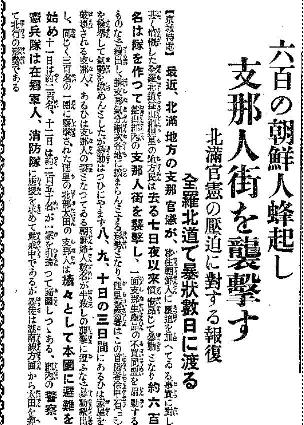 In June, the Japanese spies, Nakamura Shintaro and et al., were caught, and later shot dead. At Wanbaoshan, near Changchun, the Koreans forcefully dug a ditch for irrigating their fields. The Japanese, today, still claimed that the Wanbaoshan Incident was rooted in Zhang Xueliang's "Korean Exclusion Laws", which was a fallacious reading of the new Chinese policies requiring approval at the county and provincial levels for lease of a certain number of acres of land to the Koreans in the aftermath of 1930-1931 Korean Communists-instigated Soviet land revolution in Manchuria.
One month later, on July 2nd, the Japanese incited a massive ethnic cleansing against the Chinese on the Korean peninsula. Chinese newspapers pointed out that it could very well be the signal portending the start of a full Japanese invasion against China. (In the aftermath of the Korean Communists-instigated May 1930 uprising in Jiandao, Zhang Xueliang and the Chinese people in Manchuria deemed the general population of the Koreans as agents of the Japanese imperialists, and passed the restriction laws to require county and provincial approval for lease of land to the Korean farmers. The Japanese, to excuse themselves from the conspiracy on Manchuria,
falsely claimed that Zhang Xueliang's new rules were an enactment of the "Korean expulsion ordinance" of February 1931, and had directly triggered the Wanbaoshan Incident.)
In June, the Japanese spies, Nakamura Shintaro and et al., were caught, and later shot dead. At Wanbaoshan, near Changchun, the Koreans forcefully dug a ditch for irrigating their fields. The Japanese, today, still claimed that the Wanbaoshan Incident was rooted in Zhang Xueliang's "Korean Exclusion Laws", which was a fallacious reading of the new Chinese policies requiring approval at the county and provincial levels for lease of a certain number of acres of land to the Koreans in the aftermath of 1930-1931 Korean Communists-instigated Soviet land revolution in Manchuria.
One month later, on July 2nd, the Japanese incited a massive ethnic cleansing against the Chinese on the Korean peninsula. Chinese newspapers pointed out that it could very well be the signal portending the start of a full Japanese invasion against China. (In the aftermath of the Korean Communists-instigated May 1930 uprising in Jiandao, Zhang Xueliang and the Chinese people in Manchuria deemed the general population of the Koreans as agents of the Japanese imperialists, and passed the restriction laws to require county and provincial approval for lease of land to the Korean farmers. The Japanese, to excuse themselves from the conspiracy on Manchuria,
falsely claimed that Zhang Xueliang's new rules were an enactment of the "Korean expulsion ordinance" of February 1931, and had directly triggered the Wanbaoshan Incident.)
More available at ManchuriaIncident.pdf
[Modified : Saturday, 31-Mar-2012 19:29:38 EDT]
(Check
RepublicanChina-pdf.htm
page for up-to-date updates.)
* In Commemoration of China's Fall under the Alien Conquests in A.D. 1279,
A.D. 1644 & A.D. 1949 *
 U.S.S.R./Comintern Alliance with the KMT & CCP (1923-1927)
 Korean/Chinese Communists & the 1931 Japanese Invasion of Manchuria Korean/Chinese Communists & the 1931 Japanese Invasion of Manchuria
American Involvement in China: Soviet Operation Snow, IPR Conspiracy, Dixie Mission, Stilwell
Incident, O.S.S. Scheme, Coalition Government Crap, Amerasia Case & The China White Paper
* Stay tuned for "Republican China 1911-1955: A Complete Untold History" *
|
|
Zou Rong's Revolutionary Army;
Shin Kyu Sik's
Shrine (Spirit, Kunitama) of Korea
|
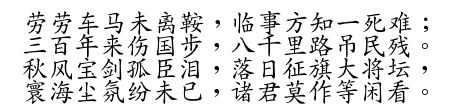
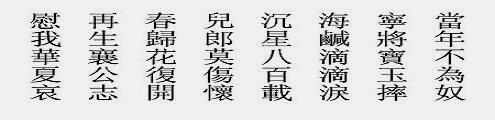
This snippet is for sons and daughters of China:
Heed the sons & ministers' agony and sorrow of our ancestors who died or lived through the Mongol, Manchu and Soviet-Chicom conquest
and
the Yongjia, Jingkang and Jiashen cataclysms !
Jeanne d'Arc of China:
Teenager girl Xun Guan breaking out of the Wancheng city to borrow the relief troops in the late Western Jinn dynasty;
Liu-Shao-shi riding into the barbarian army to rescue her husband in the late Western Jinn dynasty;
teenager girl Shen Yunying breaking into Zhang Xianzhong's rebels on the horseback to avenge on father's death in the late Ming dynasty.
China's Solitary and Lone Heroes:
Nan Jiyun breaking out of the Suiyang siege and charging back into the city in the Tang dynasty;
Zhang Gui & Zhang Shun Brothers breaking through the Mongol siege of Xiangyang in the Southern Soong dynasty;
Liu Tiejun breaking through three communist field armies' siege of Kaifeng in the Republican China time period;
Zhang Jian's lone confrontation against the communist army during the June 3rd & 4th Massacre of 1989.
|
|
|
The Kwantung Army pulled ahead the provocation to September 18th from September 28th as a result of the arrival of an investigation emissary from Tokyo.
Saionji Kinmochi, a Japanese sennior statesman (genro) intervened to contact prime minister Wakatsuki Reijiro and asked Minami Jiro to send an investigator, i.e., major-general Tatekawa Yoshiji, to Manchuria.
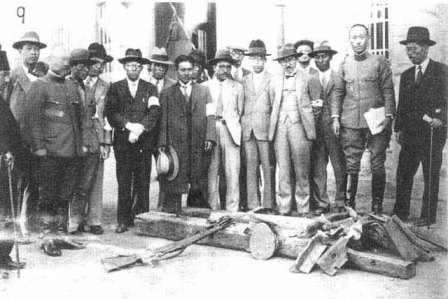 At around 10:20 pm, on September 18th, 1931, the Japanese Kwantung Army blew up railway tracks at Liutiaogou ["Ryujoko", a name devised by Japanese to hint at a ditch or bridge whereas the spot of sabotage was a flat land close to a place named Liutiaohu without the actual 'hu-lake' or 'gou-ditch'] of northern Shenyang City, i.e., the 'Liutiaogou Incident' [i.e., the Mukden Incident], and then accused Chinese troops of sabotage.
Liutiaohu Lake was about 800 meters away from Chinese armies of 'Bei-da-ying' [the north army camp] in Shenyang city. The Japanese Kwantung Army used the blast as the signal for charge.
With the 24-centimeter cannons, the Japanese bombarded and attacked the 7th Brigade of Chinese armies inside of the "north army barracks" as well as the Dongta Airport.
The Japanese, taking advantage of the Chinese army's restraint, intruded into the army camp, killing the Chinese soldiers with machineguns and bayonets.
While the 2nd independent garrison Daitai attacks the barracks, the 29th Rentai from the 2nd Shidan attacked the Shenyang city.
At 50 minutes past midnight, on September 18th, 1931, three Japanese columns attacked the Shenyang city.
Back on September 16th, the Japanese had obtained advance information that Chinese armies would not resist in any circumstance.
Brigade commander Wang Yizhe, who was not at the North Barracks, reported the Japanese attack to Rong Zhen, chief of staff for the commander's headquarters of the Northeastern Defense Army.
Rong Zhen subsequently made a long distance call to Zhang Xueliang at about 10:30 pm. In Peking, Zhang Xueliang was inviting Miles Lampson to a Peking Opera show at the Kaiming Theater,
which was held for donation funds on behalf of the flood victims in northern Liaoning Province, when he received a long distance call from Mukden.
Zhang Xueliang gave Rong Zhen the order of non-resistance in regards to the Japanese provocation, and instructed to relay the order to brigade commander Wang Yizhe et al.
Zhang Xueliang additionally instructed Rong Zhen to have Japanese military advisers, Senoo and Shibayama, contact the high command of the Kwantung Army to stop the war,
as well as to contact consul-general Hayashi in regards to the Japanese attack. The Northeastern Army's airforce commander Chen Haihua, under the order of non-resistance, prohibited pilots from taking off at Dongta Airport. Brigade commander Wang Yizhe and Zhu Guangmu, Zhang Xueliang's secretary, made separate calls to Zhang Xueliang to confirm non-resistance, a policy purportedly known to the Japanese spies.
Later in 1932, when Wellington Koo followed Lord Lytton in the investigation journey in Manchuria, Honjo Shigeru repeatedly invited Koo to a meeting, on which occasion Honjo Shigeru claimed that he could have restrained the Kwantung Army should the Chinese army initiate the resistance at the very beginning.
Honjo was purportedly relieved of the command in 1932 to appease the League of Nations but once back in Tokyo, was conferred the rank of a byron and further appointed the post of aide-de-camp for Hirohito.
At around 10:20 pm, on September 18th, 1931, the Japanese Kwantung Army blew up railway tracks at Liutiaogou ["Ryujoko", a name devised by Japanese to hint at a ditch or bridge whereas the spot of sabotage was a flat land close to a place named Liutiaohu without the actual 'hu-lake' or 'gou-ditch'] of northern Shenyang City, i.e., the 'Liutiaogou Incident' [i.e., the Mukden Incident], and then accused Chinese troops of sabotage.
Liutiaohu Lake was about 800 meters away from Chinese armies of 'Bei-da-ying' [the north army camp] in Shenyang city. The Japanese Kwantung Army used the blast as the signal for charge.
With the 24-centimeter cannons, the Japanese bombarded and attacked the 7th Brigade of Chinese armies inside of the "north army barracks" as well as the Dongta Airport.
The Japanese, taking advantage of the Chinese army's restraint, intruded into the army camp, killing the Chinese soldiers with machineguns and bayonets.
While the 2nd independent garrison Daitai attacks the barracks, the 29th Rentai from the 2nd Shidan attacked the Shenyang city.
At 50 minutes past midnight, on September 18th, 1931, three Japanese columns attacked the Shenyang city.
Back on September 16th, the Japanese had obtained advance information that Chinese armies would not resist in any circumstance.
Brigade commander Wang Yizhe, who was not at the North Barracks, reported the Japanese attack to Rong Zhen, chief of staff for the commander's headquarters of the Northeastern Defense Army.
Rong Zhen subsequently made a long distance call to Zhang Xueliang at about 10:30 pm. In Peking, Zhang Xueliang was inviting Miles Lampson to a Peking Opera show at the Kaiming Theater,
which was held for donation funds on behalf of the flood victims in northern Liaoning Province, when he received a long distance call from Mukden.
Zhang Xueliang gave Rong Zhen the order of non-resistance in regards to the Japanese provocation, and instructed to relay the order to brigade commander Wang Yizhe et al.
Zhang Xueliang additionally instructed Rong Zhen to have Japanese military advisers, Senoo and Shibayama, contact the high command of the Kwantung Army to stop the war,
as well as to contact consul-general Hayashi in regards to the Japanese attack. The Northeastern Army's airforce commander Chen Haihua, under the order of non-resistance, prohibited pilots from taking off at Dongta Airport. Brigade commander Wang Yizhe and Zhu Guangmu, Zhang Xueliang's secretary, made separate calls to Zhang Xueliang to confirm non-resistance, a policy purportedly known to the Japanese spies.
Later in 1932, when Wellington Koo followed Lord Lytton in the investigation journey in Manchuria, Honjo Shigeru repeatedly invited Koo to a meeting, on which occasion Honjo Shigeru claimed that he could have restrained the Kwantung Army should the Chinese army initiate the resistance at the very beginning.
Honjo was purportedly relieved of the command in 1932 to appease the League of Nations but once back in Tokyo, was conferred the rank of a byron and further appointed the post of aide-de-camp for Hirohito.
The Chinese foreign ministry in Nanjing raised the serious protest with Shigemitsu Mamaoru, Japan's acting minister to China, in regards to the Kwantung Army's attacks at Mukden and the cities along the major railway lines. On September 19th, Chiang Kai-shek, upon arrival in Hukou from Nanking via riding on Warship Yongsui overnight, changed ship at Poyanghu Lake for Nanchang where he learnt of the Mukden Incident from news reports relayed from Shanghai. The Japanese Army attacked Manchuria while Zhang Xueliang was in Peiping, Chiang Kai-shek was riding on the Yangtze for the Jiangxi front and American ambassador to Japan, W. Cameron Forbes, was en route of vacation. At night, between 10 and 11 pm, Chiang Kai-shek wired to Zhang Xueliang with instructions to pierce the Japanese pretext as to the railway sabotage as well as a request for constant update on events developing in Manchuria. On the 20th, the KMT-controlled Central Daily carried an account of non-resistance on the part of the Northeastern Army. The newly-arising issue in Manchuria caused Chiang Kai-shek to change plan to return to Nanking from Nanchang by plane in lieu of supervising the encirclement campaign.
More available at ManchuriaIncident.pdf (Check RepublicanChina-pdf.htm page for up-to-date updates.)
* In Commemoration of China's Fall under the Alien Conquests in A.D. 1279,
A.D. 1644 & A.D. 1949 *
U.S.S.R./Comintern Alliance with the KMT & CCP (1923-1927)
Korean/Chinese Communists & the 1931 Japanese Invasion of Manchuria
American Involvement in China: Soviet Operation Snow, IPR Conspiracy, Dixie Mission, Stilwell
Incident, O.S.S. Scheme, Coalition Government Crap, Amerasia Case & The China White Paper
* Stay tuned for "Republican China 1911-1955: A Complete Untold History" *
|
|
Zou Rong's Revolutionary Army;
Shin Kyu Sik's
Shrine (Spirit, Kunitama) of Korea
|
This snippet is for sons and daughters of China:
Heed the sons & ministers' agony and sorrow of our ancestors who died or lived through the Mongol, Manchu and Soviet-Chicom conquest
and
the Yongjia, Jingkang and Jiashen cataclysms !
Jeanne d'Arc of China:
Teenager girl Xun Guan breaking out of the Wancheng city to borrow the relief troops in the late Western Jinn dynasty;
Liu-Shao-shi riding into the barbarian army to rescue her husband in the late Western Jinn dynasty;
teenager girl Shen Yunying breaking into Zhang Xianzhong's rebels on the horseback to avenge on father's death in the late Ming dynasty.
China's Solitary and Lone Heroes:
Nan Jiyun breaking out of the Suiyang siege and charging back into the city in the Tang dynasty;
Zhang Gui & Zhang Shun Brothers breaking through the Mongol siege of Xiangyang in the Southern Soong dynasty;
Liu Tiejun breaking through three communist field armies' siege of Kaifeng in the Republican China time period;
Zhang Jian's lone confrontation against the communist army during the June 3rd & 4th Massacre of 1989.
|
|
|
On September 24th, the Japanese government issued a statement claiming that China had sabotaged railway and attacked the Japanese on the midnight of September 18th, emphasizing the contrast of 10,400 Japanese soldiers versus 220,000 Chinese troops. Further, it claimed that the Japanese action was for protecting one million Japanese citizens inside of Manchuria; that the occupation of outlying cities were rumors; that the Japanese troops sent to Jilin Province on September 21st would return to Changchun once they finished the policing job; that 4000 relief troops from Korea did not exceed the total number allowed to station in Manchuria per treaty; and that Japan had no ambition for the Manchuria territory. On September 29th, the U.S.S.R. declared neutrality on the Mukden Incident.
When Japan invaded Manchuria, Zhang Xueliang possessed about 12 brigades and 3 cavalry brigades or 179,505 troops in Manchuria, in addition to 12 infantry brigades, 2 cavalry brigades and 3 cannons brigade that stationed in northern China.
Per Li Dongfang, Chiang Kai-shek did send a telegraph to Zhang Xueliang on September 12th [should be September 11th], stating that "Now is not a time to wage a war against Japan";
however, the telegraph was sent in response to the Wanbaoshan Incident, not the 9-18-1931 incident, per LDF.
(Zhang Zhenglong cited a similar fabricated telegraph from Chiang Kai-shek that was dated Aug 16th, 1931. Communist propaganda made up a sensational account in stating that
Chiang Kai-shek met with Zhang Xueliang on a train near Shijiazhuang to personally deliver the non-resistance order.) Further, Li Dongfang claimed that it was Rong Zhen who misread Zhang Xueliang's September 6th telegraph as to "10000 degree tolerance [of Japan's provocations]." Regiment Chief Wang Tiehan under the 7th brigade did resist the Japanese attack at "North Barracks" from 1:40 am to 5:0 am on September 19th 1931; but, Rong Zhen forcefully issued the withdrawal order.
Historian Tang Degang pointed out that Chiang Kai-shek faced the same pressing matter as Yuan Shi-kai had at the time when Japan took advantage of WWI in raising "The 21 Demands" by in early 1915. Chen Bulei drafted "Chiang Kai-shek's Open Letter To the Chinese Nationals", in which there was the statement to the effect that "It is the government's crime to have lost the [Chinese] statehood when it refuses to fight while it is still capable of fighting, and it is also a government's crime to have lost the statehood when it fights while it is incapable of fighting."
Tang Degang's whole class of students were in tears when the teacher read the open letter.
This webmaster is in tears whenever reading about this section of China's history.
The Battle Of Jiangqiao
On October 5th, Doihara Kenji proposed a bombing of the Jinzhou City for testing the response of China, the U.S. and the U.S.S.R. Three days later, the Japanese Kwantung Army commander ordered two Japanese bomber groups to attack Jinzhou. The Northeastern Army countered the bombing with field-to-air shoot-back.
Even though the U.S.S.R. had declared neutrality on the Mukden Incident, the Japanese took special care to invade the Amur Province with Zhang Haipeng’s puppet troops initially. The puppet force, attacking north on October 13th, was routed to the south of the Jiangqiao Bridge on the 16th.
More available at ManchuriaIncident.pdf (Check RepublicanChina-pdf.htm page for up-to-date updates.)
* In Commemoration of China's Fall under the Alien Conquests in A.D. 1279,
A.D. 1644 & A.D. 1949 *
U.S.S.R./Comintern Alliance with the KMT & CCP (1923-1927)
Korean/Chinese Communists & the 1931 Japanese Invasion of Manchuria
American Involvement in China: Soviet Operation Snow, IPR Conspiracy, Dixie Mission, Stilwell
Incident, O.S.S. Scheme, Coalition Government Crap, Amerasia Case & The China White Paper
* Stay tuned for "Republican China 1911-1955: A Complete Untold History" *
|
|
Zou Rong's Revolutionary Army;
Shin Kyu Sik's
Shrine (Spirit, Kunitama) of Korea
|
This snippet is for sons and daughters of China:
Heed the sons & ministers' agony and sorrow of our ancestors who died or lived through the Mongol, Manchu and Soviet-Chicom conquest
and
the Yongjia, Jingkang and Jiashen cataclysms !
Jeanne d'Arc of China:
Teenager girl Xun Guan breaking out of the Wancheng city to borrow the relief troops in the late Western Jinn dynasty;
Liu-Shao-shi riding into the barbarian army to rescue her husband in the late Western Jinn dynasty;
teenager girl Shen Yunying breaking into Zhang Xianzhong's rebels on the horseback to avenge on father's death in the late Ming dynasty.
China's Solitary and Lone Heroes:
Nan Jiyun breaking out of the Suiyang siege and charging back into the city in the Tang dynasty;
Zhang Gui & Zhang Shun Brothers breaking through the Mongol siege of Xiangyang in the Southern Soong dynasty;
Liu Tiejun breaking through three communist field armies' siege of Kaifeng in the Republican China time period;
Zhang Jian's lone confrontation against the communist army during the June 3rd & 4th Massacre of 1989.
|
|
|
Chiang Kai-shek's Central Army withdrew from the 3rd Siege of the communists in Jiangxi Province and rerouted towards Manchuria, while the communists mounted the counter-attacks against the National Army's positions.
On September 26th, Chiang Kai-shek, upon the news of the League's change of attitude, swore in his dairies to plan to concentrate the bulk of troops onto the Long-hai Railway. On October 3rd, Chiang Kai-shek contemplated on making Luoyang or Xian the interim capital. On the 6th, Chiang Kai-shek drafted a statement for a possible declaration of war against Japan, with a sentence calling on the world powers to bear responsibility for the covenants.
Before the outbreak of the Japanese invasion in September 1931, the Chinese Central Army had aborted the Third Siege Campaign that started in July and begun the withdrawal from the Third Siege Campaign in Jiangxi Province for sake of countering the Canton rebels.
The government army left behind a limited number of troops to guard certain key points. With the eruption of war in Manchuria, Chiang Kai-shek began to reroute troops towards North China. The communist Red Army, other than ambushing Jiang Dingwen and Cai Tingkai's armies [which were en route to counter the Canton rebels] on basis of deciphered telegrams, mounted the counter-attacks against positions of the government troops in southern Jiangxi and western Fujian. Taking advantage of the Japanese invasion, the Red Army from the Hubei-Henan-Anhui enclave and the western Hunan-Hubei enclave also racked up military actions. On October 4th, Xu Xiangqian's Hubei-Henan-Anhui Red Army laid siege of Huangchuan and Shangcheng that were guarded by Zeng Wanzhong's 12th Division and Chen Yaohan's 58th Division. The siege continued till the 25th when Lou Jingyue's 2nd Division came to the relief. On October 8th, Duan Dechang's western Hunan-Hubei Red Army defeated Zhang Zhenhan's 41st Division at Yuekou of Hubei Province.
The KMT party held the Fourth National Congress in November of 1931 for uniting the various factions, including the faction of Xi-shan [West Hill] Meeting Participants and the faction of 'KMT Re-organizers.' The Fourth National Congress made a decree to empower Chiang Kai-shek with the task of taking the national army to the north to resist the Japanese. While Chiang Kai-shek expressed wish to take the army to North China to fight the Japanese, Hu Han-min insisted that Chiang Kai-shek must step before returning to the capital. Ever since the Japanese takeover of Manchuria, Chiang Kai-shek, in his diary, wrote every day at the upper right corner the words "avenge the humiliation."
More available at ManchuriaIncident.pdf
(Check
RepublicanChina-pdf.htm page for up-to-date updates.)
* In Commemoration of China's Fall under the Alien Conquests in A.D. 1279,
A.D. 1644 & A.D. 1949 *
U.S.S.R./Comintern Alliance with the KMT & CCP (1923-1927)
Korean/Chinese Communists & the 1931 Japanese Invasion of Manchuria
American Involvement in China: Soviet Operation Snow, IPR Conspiracy, Dixie Mission, Stilwell
Incident, O.S.S. Scheme, Coalition Government Crap, Amerasia Case & The China White Paper
* Stay tuned for "Republican China 1911-1955: A Complete Untold History" *
|
|
Zou Rong's Revolutionary Army;
Shin Kyu Sik's
Shrine (Spirit, Kunitama) of Korea
|
This snippet is for sons and daughters of China:
Heed the sons & ministers' agony and sorrow of our ancestors who died or lived through the Mongol, Manchu and Soviet-Chicom conquest
and
the Yongjia, Jingkang and Jiashen cataclysms !
Jeanne d'Arc of China:
Teenager girl Xun Guan breaking out of the Wancheng city to borrow the relief troops in the late Western Jinn dynasty;
Liu-Shao-shi riding into the barbarian army to rescue her husband in the late Western Jinn dynasty;
teenager girl Shen Yunying breaking into Zhang Xianzhong's rebels on the horseback to avenge on father's death in the late Ming dynasty.
China's Solitary and Lone Heroes:
Nan Jiyun breaking out of the Suiyang siege and charging back into the city in the Tang dynasty;
Zhang Gui & Zhang Shun Brothers breaking through the Mongol siege of Xiangyang in the Southern Soong dynasty;
Liu Tiejun breaking through three communist field armies' siege of Kaifeng in the Republican China time period;
Zhang Jian's lone confrontation against the communist army during the June 3rd & 4th Massacre of 1989.
|
|
|
Campaign Against Jinzhou
Smitha stated that "a month into the crisis, the Emperor Hirohito was angry over the commander of the Kwantung army, Honjo Shigeru, Honjo Shigeru, declaring his intention to pacify all of Manchuria and Mongolia." Japan's ambition in 1931 was more than the territory of Manchuria and Mongolia. Doihara Kenji planned the "Tianjin Incident" for fetching last Manchu emperor. By mid-November, Japanese controlled northern Manchuria.
On December 13th, Kwantung Army devised the Jinzhou Campaign guidelines with additional troops consisting of 8th Mixed Ryodan, one armored unit, a 15-cm howitzer Daitai, a 10.5-cm cannons Chudai, 20th Shidan headquarters troops, 38th Mixed Ryodan and a heavy bomber squadron. On 18th, Kwantung Army refined the attack plan to make it two-stage campaign.
At the turn of November-December, Zhang Xueliang was dissuaded from withdrawing his troops from Jinzhou. On November 30th, Rong Zhen, in a telegram to Zhang Xueliang, which was intercepted by the Japanese, claimed that he had confidence in Zhang Tingshu's 12th Brigade defending Jinzhou and hoped that the proposal to set up a neutral area in Jinzhou could be rescinded. On December 1st, Zhang Xueliang, in a telegram to Chiang Kai-shek, refuted the rumor about the Jinzhou withdrawal. On the 4th, Shi Zhaoji, China's representative at the League, received instructions as to the Chinese opposition to making Jinzhou a neutral area. The Chinese government claimed that China would defend Jinzhou against the Japanese attack should the League fail to stop the Japanese from moving on Jinzhou. The League's council abandoned the neutrality plan on December 7th and merely authorized a Lytton delegation to investigate the Manchurian crisis. Later on February 1st, 1932, Henry Stimson, together with the British, called on China and Japan to observe the Pact of Paris and the Resolution of the League of Nations of December 9 [10] to cease conflict and fighting in Shanghai. On December 15th, Chiang Kai-shek was pressured into a stepdown.
On December 15th, the Japanese Kwantung Army, after routing the resistance force in Heilongjiang (Amur) Province, began to move the troops southward to attack Jinzhou. On December 17th, the Japanese army ministry in Tokyo ordered to deploy the Japanese domestic 8th Mixed Ryodan to Manchuria as reinforcement, and transferred the 20th Shidan headquarters, the 38th Mixed Ryodan, and the heavy bombing squadron to reinforcing the Kwantung Army from Korea. On the 18th, the Kwantung Army refined the Jinzhou attack plan to make it a two-stage and three-prong campaign, with combined troops numbering at 40,000.
On December 21st, Zhang Xueliang first gave instructions about making preparations for withdrawal from Jinzhou in an order to his 2nd Army Corps, stating that if the current government's policy was not clear yet, then the army should not stick to the Jinzhou defense but should withdraw to Qian'an, Yongping, Luanhe and Changli at the appropriate time. On the 22nd, Zhang Xueliang wired to Chiang Kai-shek in request for a final pointer on the pressing issue of Japanese attack against Jinzhou and the complication in Hebei Province. After Chiang Kai-shek stepped down on the 15th, Wu Jingheng, a senior KMT leader, wired to Zhang Xueliang on the 24th to encourage a desperate fight-back at Jinzhou.
On the 25th, the Canton rebels-controlled government wired to Zhang Xueliang with a request that Zhang Xueliang was to actively plan by himself so as to build up a solid position of defense. Zhang Xueliang replied with a demand for the central government to supply the cash and ammunition. On the 26th, Zhang Xueliang gave instructions on the Jinzhou defense to Rong Zhen who was at Jinzhou.
On December 24, the Japanese, who obtained intelligence on Zhang Xueliang's psychology, plans and military arrangement, began the operation to solve the problem of the Jinzhou city in southern Manchuria. In Tokyo, Inukai, in talks with American ambassador William Cameron Forbes, made an assurance that Japan had no intention to infringe on China's sovereignty in Manchuria other than providing protection for the Japanese nationals residing in Manchuria. On December 28th, the Japanese crossed the Liao-he River to attack Jinzhou. The Japanese 39th Mixed RyoBrig, departing Xinmin and Mukden (Shenyang) on the 30th by train, pushed southwestward along the railway, while the 8th Mixed RyoBrig took control of the railway segment behind. On December 30th, the Japanese 39th Mixed Ryodan attacked Dahushan (hit tiger mountain). On the 31st, the Japanese Army reached Goubangzi, and then embarked on the second-stage push towards Jinzhou.
Zhang Xueliang, on December 29th, ordered that his army at Jinzhou withdraw into the Shanhaiguan, leaving Jinzhou to the defense by the loyal righteous army. 44 trains were arranged for transporting the bulk of army. On 1 Jan 1932, the Japanese Army, after fighting the Chinese irregulars, reached the outskirts of Jinzhou, and on the afternoon of the 3rd, the Japanese took over Jinzhou [Chinchow]. The Japanese Army then moved southward along the coast towards the Shanhaiguan Pass at the Great Wall.
More available at ManchuriaIncident.pdf (Check RepublicanChina-pdf.htm page for up-to-date updates.)
* In Commemoration of China's Fall under the Alien Conquests in A.D. 1279,
A.D. 1644 & A.D. 1949 *
U.S.S.R./Comintern Alliance with the KMT & CCP (1923-1927)
Korean/Chinese Communists & the 1931 Japanese Invasion of Manchuria
American Involvement in China: Soviet Operation Snow, IPR Conspiracy, Dixie Mission, Stilwell
Incident, O.S.S. Scheme, Coalition Government Crap, Amerasia Case & The China White Paper
* Stay tuned for "Republican China 1911-1955: A Complete Untold History" *
|
|
Zou Rong's Revolutionary Army;
Shin Kyu Sik's
Shrine (Spirit, Kunitama) of Korea
|
This snippet is for sons and daughters of China:
Heed the sons & ministers' agony and sorrow of our ancestors who died or lived through the Mongol, Manchu and Soviet-Chicom conquest
and
the Yongjia, Jingkang and Jiashen cataclysms !
Jeanne d'Arc of China:
Teenager girl Xun Guan breaking out of the Wancheng city to borrow the relief troops in the late Western Jinn dynasty;
Liu-Shao-shi riding into the barbarian army to rescue her husband in the late Western Jinn dynasty;
teenager girl Shen Yunying breaking into Zhang Xianzhong's rebels on the horseback to avenge on father's death in the late Ming dynasty.
China's Solitary and Lone Heroes:
Nan Jiyun breaking out of the Suiyang siege and charging back into the city in the Tang dynasty;
Zhang Gui & Zhang Shun Brothers breaking through the Mongol siege of Xiangyang in the Southern Soong dynasty;
Liu Tiejun breaking through three communist field armies' siege of Kaifeng in the Republican China time period;
Zhang Jian's lone confrontation against the communist army during the June 3rd & 4th Massacre of 1989.
|
|
|
On January 4, 1932, the Japanese reached the Shanhaiguan [Shanhaikwan] Pass.
The Japanese did not get to take over the Pass till Jan 3rd, 1933. A battalion, headed by An Deqin, died to the last person at Shanhaiguan Pass. On Jan 24th, League of Nations, in the name of 19 countries, refused to acknowledge Manchukuo. Japan announced its intent to exit the League.
Militia Resistance To Japanese Invasion
On September 26th, 1931, Chinese Youth Party issued a five-point proclamation to the Nation, and called for the military factions to unite under a common cause as well as a total rescission of economic relations with Japan. Within months, youth party members expanded to over 2000 among Northeastern Army military officers. During the initial Japanese attacks, part of stranded Chinese troops, notably under Wang Yizhe’s 7th Independent Brigade, Li Guilin’s 23rd Independent Brigade and Mu Chunchang’s 10th Cannons Regiment, had unorganized resistance and counterattacks against Japanese in Liaoning and Jilin provinces. Chinese guerrillas, entitled "Northeastern Volunteer Righteous & Brave Fighters", had at one time succeeded in attacking major cities including Shenyang [Mukden].
By the end of 1931, the volunteer fighters expanded to 22 routes, and accepted the nominal coordination and supervision under the Northeast Patriotic Society. At one time in 1932, the total fighting force swelled to as many as 54 routes and 27 detachments. For the whole year, the Japanese had to preoccupy themselves with fighting the Chinese guerrillas in various areas of Manchuria.
After the loss of Jinzhou, the volunteer fighters under Geng Jizhou, Wang Xianting, Jin Ziming, Liu Chunqi, Zhang Haitian and Deng Tiemei repeatedly raided Japanese outposts in western and southern Liaoning Province.
On January 1st, Koga Dentaro's cavalry, acting as the main attack force, attacked Jinxi and pushed towards the Jinzhou suburbs at noon on the same day.
On January 2, the vanguard force of the Japanese 8th Shidan arrived at the east bank of the Dalinghe River, and crossed the river at three separate places to encircle and attack the Chinese public security cavalry. On the 2nd, the Koga Rentai, reinforced by more Japanese troops, launched a powerful attack across the river. The 3rd Public Security Column, out of supply and outnumbered and lacking heavy equipment, failed to stop the Japanese and gave up the Dalinghe position. Past midnight, fighting to half past two, Huang Xiansheng ordered to have the Nuerhe railway bridge [to the southwest of Jinzhou, a river that flowed west to Jinxi and Nanpiao] blew up to block the Japanese pursuit, before retreating west. On the morning of January 3rd, Jinzhou fell into the Japanese hands.
At Jinxi, about 50 kilometers to the west of Jinzhou, the county implemented a mandatory rule of organizing militia and buying weapons with self-funding since 1928. The militia, formed into the "lianzhuang-hui" [affiliated village associations], was divided into five groups in the west and five in the east. Jinxi police chief Yuan Fengtai, who refused to go with the county magistrate to receive the Japanese, went to his hometown and assembled Liu-family armed band leaders, who were related to him, at Liujiatun, on the south bank of the Dalinghe River, between Chaoyang and Yixian.
The county militia leaders for the west five associations, under Zhou Yugui et al., attempted to rescue the county magistrate. After Zhang Guodong refused to help the militia from inside out, militia leaders decided to induce the Japanese out of the town for an ambush along the hilly road to the northwest of Jiangjiatun.
After reconnaissance to check out the militia strength, Koga, before the relief army from Jinzhou was to arrive, decided to launch a pre-emptive strike against the Jinxi militia so as to break out of the dilemma of a small Japanese force being surrounded by militia all around. On the morning of the 9th, Koga sent lieutenant Matsuo to Jinzhou for fetching supplies, retained Murakami lieutenant with a team to guard the county capital. At 9:40 am on the 9th, Koga, with over 50 cavalries and over twenty infantry soldiers, personally took command of the mop-up force and exited the west gate. Upon arriving at Xiyuanzi, which was outside of a checkpoint to the western quarter of Jiangjiatun, Koga split his forces into two prongs.
At the Longwangmiao Village, the Japanese were attacked on three sides by militia led by Liu Chunshan.
At about 10:30, near the Shangpozi-cun (uphill) Village, Koga's forces came under attacks from the Xiwuhui Militia. At the outbreak of battles, Liu Cunqi (Liu Chunqi), leaving about a dozen militia at Xiyuanzi to ambush the Japanese along the retreat path, went straight for the county capital to attack the Japanese headquarters.
While Koga was fighting the militia at Shangpozi-cun (uphill) Village, his headquarters at the Jinxi county capital, under siege, frantically sent a message for help. Koga, giving order to two cavalry Shyoudai to rescue an infantry Ishino Shyoudai which was surrounded by militia at the Longwangmiao hill, quickly led another infantry shyoudai Noguchi and a machinegun unit [under Hoshino] out of combat for returning to the headquarters. En route of return to Jinxi county capital, Koga was attacked by Liu Guochen militia force at Xiyuanzi (Westgarden village).
Koga, brandishing the sword, was shot down from the horse. Koga's adjutant, Yonei Saburo, who ran forward to take up Koga, was shot and killed. Lance Corporal Uehara, succeeding Yonai to take up Koga, was shot in the head and killed. Koga, lying on the ground, ordered Hoshino to burn the tower with sorghum stalks after suppressing the militia with machinegun fire.
En route, Koga bled to death at about 15 pm. Oyadomari Chousei, who committed suicide with wife and child at the Japanese surrender in 1945, wrote an article depicting the death of Koga.
To the east of Jiangjiatun, about 15 kilometers away, Matsuo was completely routed by the militia at Qiandatun. On this day during the two fighting, the Chinese militia annihilated more than 80 Japanese troops.
Meanwhile, the Japanese planes hovered over Jiangjiatun and dropped bombs to lend support to the besieged force at the education board building. The Japanese remnants, after converging with Koga's remnants, stayed inside of the education board building till the Japanese sent two more relief army columns from Jinzhou and Lianshan (Huludao), respectively.
On January 16th, the Japanese, after staying in Jiangjiatun for three days and revenging Koga's debacle with burning and massacre along the path of previous battles, retreated to Lianshan where they had county magistrate Zhang Guodong relaunch the county office. After the Japanese pullout, Liu Chunqi tacked on the Jinxi county magistrate post. The Japanese Army did not return till February 20th. The Japanese revenge killing against former Chinese militia members continued through 1933.
Resistance to the Japanese Invasion by Northeastern Army Officers and Volunteer Armies
Li Du, Ding Chao and Feng Zhanhai Defending Harbin
Wang Delin Battling the Japanese at Jingpohu Lake
Ma Zhanshan's Counter-attack against Harbin
Li Du, Feng Zhanhai, Liu Wankui and Yang Yaojun's Battles against the Japanese at Yimianpo on the Chinese Eastern Railway
Feng Zhanhai Counter-attacking the Japanese and the Puppets at Jirin and Changchun
Su Bingwen's Battle against the Japanese at Hailar-Manzhouli
Unable to quell the volunteer fighters, the Japanese sent in the 4th Cavalry Ryodan and 14th Mixed Ryodan to strengthen the existing troop level of 4 Shidan, 2 Ryodan and puppet troops. On October 11th, 1932, two Japanese cavalry Ryodans, 1 mixed Ryodan, and 7 Manchukuo puppet brigades attacked Tang Juwu's forces in Tonghuo & Hengren area. After defection of 37th route commander Wang Yongcheng, Tang Juwu broke through the Japanese encirclement for a western move. On the 16th, the Japanese took over Tonghua, and on the 17th, took over Hengren. From November 10th onward, the Japanese swept through the territory among Shenyang, Changchun and Jilin, and forced the Chinese guerrilla forces a retreat towards Huinan & Siping.
On November 28th, 1932, the Japanese 14th Shidan attacked Ma Zhanshan & Su Bingwen around Qiqihar. The Japanese planes bombed Ma Zhanshan's headquarters in Hailaer. On December 3rd, the Japanese took over Hailaer's Ma Zhanshan headquarters. On December 4th, Ma Zhanshan & Su Bingwen left Hailaer for the Soviet border and entered the Russian territory on December 5th.
On December 24th, 1932, the Japanese 10th Shidan attacked the guerrilla forces to the north of the Mudanjiang River. On Jan 7th, 1933, the Japanese took over Mishan. On the 9th, Li Du's guerrilla forces crossed the Ussuri River into the U.S.S.R.
At Modaoshi, the undercover communists, under Li Yanlu, suddenly abandoned the defense of the pass and mutinied to launch a Soviet army, causing the collapse of the guerrilla army.
By this time, the Kwantung army had reinforcement reaching 100,000.
After the "Northeastern Volunteer Righteous & Brave Fighters" would be the communist-controlled "People's Revolutionary Army Of Northeast China" which consecutively transformed into the "Allied Anti-Japan Army" [i.e., the Northeast Anti-Japanese Coalition Army] in 1936. The "Allied Anti-Japan Army" consisted of Yang Jingyu's 1st Route, Zhou Baozhong's 2nd Route, and Li Zhaolin's 3rd Route. Yang Jingyu later died on Feb 23rd, 1940, during a Japanese siege campaign. Remnant resistance fighters, including Kim Il-sung, retreated into the U.S.S.R.
The Chinese Communists were able to survive the nationalist-communist civil wars in Manchuria in 1931-1932 as a result of the maverick activities of Kim Il Sung
who managed to legalize his small band of army under Red Spear Society leader Yu Xianrui, a band under Wang Delin's salvation army, and further called on his Korean pals to copycat the model in the counties
at the Sino-Korean border.
Meanwhile, the communists, other than launching the direct Soviet land revolution, dispatched agents into the volunteer armies,
including Li Yanlu and Zhou Baozhong.
There were two kinds of communist agents involved here. Li Yanlu and Zhou Baozhong, as top-tier communists, were aiming for hijacking the entire volunteer army,
while the lower-level communists infiltrated into the volunteer army to conduct the 'military work' or 'soldier work', with objectives of launching mutinies
and converting the volunteer army into the Red Army or Red Guards' troops.
Not interested in fighting the Japanese, Li Yanlu's communist-controlled band came into conflict with Ding Chao's railway guardsmen's army.
In jan 1933, at the Battle of Modaoshi, Li Yanlu abandoned the pass and declared his army the communist guerrillas, hence frustrating the northern defense
of Wang Delin's army and causing Wang Delin to retreat into the Soviet Union. Zhou Baozhong, staying behind, hijacked the remnant volunteer army but still
kept a low profile.
While the battles were raging on in Manchuria,
Kim Il Sung and the Chinese-Korean communists launched the radical purge movement, killing the communist fellows in a horrific Min-sheng-tuan (Minseto corps) movement.
Wang Delin, who still harbored sympathy with the communists, later transferred the silver dollars he raised in China proper to Li Yanlu who, upon return to Manchuria,
kept the money for the communist cause.
It would be in 1933-1934, when Moscow sent over the new directives about a united front, when the communists put aside the Soviet land revolution and re-allied with the volunteer
armies to take control of the movement with the inducement of possible Soviet military supplies from across the border. The volunteer fighters formed into about ten army corps,
with about 2-4 partially or wholly-controlled by the communists. Resistance lasted till about 1940 when the Soviets, who had signed a treaty with Japan,
instructed an end to active resistance and recalled the volunteer fighters back to the Soviet Union for training.
The Soviet order was to wait out for the coming of some new international development, namely, a war between Japan and the U.S.A. or the Pearl Harbor attack.
Shanghai Provocation - 1/28/1932
On Jan 6th, Jiang Guangnai's 19th Route Army relocated to the Nanking-Shanghai area for countering the possible Japanese invasion while the Nationalist Government central politics meeting made a decision in inviting Chiang Kai-shek back to the military leadership. Whang Jingwei and Sun Ke, et al., personally went to Hangzhou for persuading Chiang Kai-shek into a return.
Liu Feng pointed out that Japan provoked the Shanghai Incident for distracting the attention of the "League of Nations" which planned to dispatch an investigation team to Manchuria. Itagaki Seishiro contacted a military attaché of the Japanese consulate in Shanghai with an offer of 20000 yens for sake of provoking an incident. Military attaché Tanaga colluded with Chuandao Fangzi [Kawashima Yoshiko] in hiring rascals for attacks at the Japanese citizens. On Jan 18th, Kawashima Yoshiko's rascals attacked five Japanese monks on Mayushan Road in Shanghai, near Sanyou Enterprise Company which was noted for "desisting from the Japanese commodities." On 19th, the Japanese consulate raised a protest. On the early morning of the 20th, Tanaga dispatched over thirty Japanese ronin [vagrants] for setting fire on the Sanyou company. The Japanese killed a policeman and injured two. In the afternoon, the Japanese societies further rallied 4000 residents in front of the Japanese consulate in demand of protection by the Japanese military as well as punishing the Chinese ‘culprits’. On the 21st, Japanese consul-general Murai delivered a four-demand protest to Shanghai mayor Wu Tiecheng. Subsequently, Japanese First Overseas Fleet commander Shiozawa issued an ultimatum for capturing the culprit(s) on the 24th, the Japanese claimed that one monk was dead.
Frank E. Smitha stated that "a rise in hostility toward the Japanese among the Chinese had resulted in some incidents in Shanghai, including an attack of five Japanese persons, two of them Buddhist priests, one of whom died. The Japanese consul-general in Shanghai demanded reparations, and Japan's navy, encouraged by the success of the army in Manchuria, sent ships and over a thousand marines to Shanghai to backup the consul-general... The army sent reinforcements to Shanghai and started a drive from the city's International Settlement against one of China's armies."
On Jan 26th, Prince Kan'in-no-miya Kotohito authorized Shiozawa to exercise self-defense if necessary. On the 27th, the Japanese consul delivered an ultimatum good till 6 pm of Jan 28th. The Japanese, prior to the deadline, attacked Shanghai on the evening of Jan 28th of 1932. After one night and one day’s street battles, the 156th Brigade recovered the North Train Station at 5 pm on the 29th, drove the Japanese away from the railway line, and pressed the Japanese back to the east of North Sichuan Road.
More available at ShanghaiProvocation1932.pdf
(Check RepublicanChina-pdf.htm page for up-to-date updates.)
* In Commemoration of China's Fall under the Alien Conquests in A.D. 1279,
A.D. 1644 & A.D. 1949 *
U.S.S.R./Comintern Alliance with the KMT & CCP (1923-1927)
Korean/Chinese Communists & the 1931 Japanese Invasion of Manchuria
American Involvement in China: Soviet Operation Snow, IPR Conspiracy, Dixie Mission, Stilwell
Incident, O.S.S. Scheme, Coalition Government Crap, Amerasia Case & The China White Paper
* Stay tuned for "Republican China 1911-1955: A Complete Untold History" *
|
|
Zou Rong's Revolutionary Army;
Shin Kyu Sik's
Shrine (Spirit, Kunitama) of Korea
|
This snippet is for sons and daughters of China:
Heed the sons & ministers' agony and sorrow of our ancestors who died or lived through the Mongol, Manchu and Soviet-Chicom conquest
and
the Yongjia, Jingkang and Jiashen cataclysms !
Jeanne d'Arc of China:
Teenager girl Xun Guan breaking out of the Wancheng city to borrow the relief troops in the late Western Jinn dynasty;
Liu-Shao-shi riding into the barbarian army to rescue her husband in the late Western Jinn dynasty;
teenager girl Shen Yunying breaking into Zhang Xianzhong's rebels on the horseback to avenge on father's death in the late Ming dynasty.
China's Solitary and Lone Heroes:
Nan Jiyun breaking out of the Suiyang siege and charging back into the city in the Tang dynasty;
Zhang Gui & Zhang Shun Brothers breaking through the Mongol siege of Xiangyang in the Southern Soong dynasty;
Liu Tiejun breaking through three communist field armies' siege of Kaifeng in the Republican China time period;
Zhang Jian's lone confrontation against the communist army during the June 3rd & 4th Massacre of 1989.
|
|
|
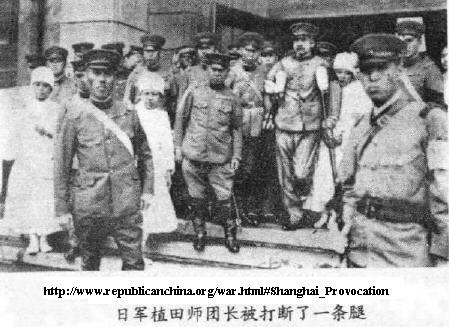 On the afternoon of Feb 13th, Ueda Kenkichi, under the escort of the 1st minesweeper unit, arrived with the 6th Ryodan of the 9th Shidan. To counter the Japanese attacks, the Chinese armies were arranged into a right flank and a left flank, with Shenjiahang-Jiangwan-Dachang towns as the division line. Though the Japanese were aided with reinforcements from Japan as well as the airforce/navy support, they failed to break the Chinese defense line while changing commanders several times and incurring heavy casualties. The Chinese side organized a dare-to-die force, raided the Japanese command center, and broke one leg of Japanese Shidan commander Ueda.
On February 19th, U.S. Reserve 2nd Lieutenant Robert McCawley Short, a salesman for the Boeing contractor L.E. Gale and acting as an advisor to the Chinese airforce, flew an experimental fighter plane, the Boeing XP925A (later modified to P218), to Nanking from the Hongqiao Airport after the plane was quickly set up and armed for delivery to the Chinese government as a test ship. Near the Nanxiangzhen town, Short ran into a flight of three Japanese fighter planes. Taking advantage of the speed of the Boeing plane, Short engaged with and rendered damages to the Japanese planes. Since Short seriously damaged the Japanese commanding plane, also shot the wing plane and broke off the Japanese plane formation, he was mistakenly attributed in later posthumous commemoration to shooting down the Japanese commanding flyer, Lt. Kidokoro Mohachiro who was the later Japanese 281st Flight Group commander to die at the 1944 Battle of Kwajalein Atoll, part of the Marshall Islands chain. On February 22nd, 1932, the Chinese airforce made a decision to move the planes to Hangzhou from Nanking. Short, whose Boeing plane, numbered X66W and painted green, was too fast to join the formation, flew alone. While above the sky of Suzhou, Short noticed Japanese planes which were aiming to bomb a refugee train at the Suzhou train station. Short single-handedly attacked the formation of six Japanese naval aircrafts from Kaga, which included Lt. Kotani Susumu's three Type 13 [Mitsubishi] bomber planes (B1M) and Ikuta Nogiji's three Type 3 [Nakajima] fighter planes (A1N2)). Short, despite having Japanese fighter planes on his tail, pressed on to attack the three-seat bombers via repeating pull-up and dive maneuver, killing bomber flight commander Lt. Kotani Susumu. In the subsequent low altitude combat, Ikuta Nogiji, Japanese fighter plane commander, together with two other assistants Kuroiwa Toshio and Takeo Kazuo, shot down the Boeing plane in flames above the sky to the southeast of Suzhou.
Lu Xun, the communist mouthpiece who was hiding in Japan's concession territory and drinking wine in the company of Japanese sing-song women, later on February 5th, 1933, used alias Heh Jiagan to write for the Shenbao Newspaper a sarcastic article of accusation in blaming the Chinese government for letting Robert Short fly stranded, termed "Three Wishes for the National Salvation via Aviation", an article collected under compilation "On the Fake Freedom."
Lu Xun claimed that he heard that the Cantonese air force, with traditional family girls embroidering the war oath on their suits, was never heard to have arrived at the battlefield up to then, i.e., one year after the war, and made three sarcastic admonishments, including i) pilots should know their path better (i.e., no following the example of Robert Short to go astray), ii) pilots should fly faster; and iii) pilots should not slaughter the people (i.e., no participation in the civil war against the Red Army).
On March 1st, at 6:30 am, the 9th SquDiv and 24th Mixed RyoBrig, after three and half hours' blanket bombing and shelling, launched multiple-route incursions with tanks and armored vehicles, with the main thrusts directed at Zhuyuandun-Guangzhaoshanzhuang-Zhangsanqiao [defended by Huang Gu 's 155th Brigade of the 78th Division], Zhuyuandun-Jinjiamadou-Tangdongzhai, Miaohangzhen-Caijiazhai-Zhougang. The 7th Rentai, as the center attack force of the left prong, launched a general attack behind the cover of armored vehicles at 11 am. Before noon, the Japanese left (western) prong, consisting of troops from the 9th SquDiv, intruded into the line of Guangdingyidi, Maijiazhai and Lujiazhai. At Xiajiatang-Guangzhaoshanzhuang, the 1st Regiment of Huang Gu 's brigade exhausted itself in defense under the attacks by the Japanese cavalry and tanks. Post noon, the remnants of the 1st Regiment retreated towards Tanjiazhai-Mengjiajiao villages. At Zhangsanqiao-Zoumatang line, the 2nd Regiment of Huang Gu 's Brigade defended the positions till noon when the Japanese sent over reinforcement from the 11th Shidan. With one battalion from the 3rd Regiment of the 60th Division coming to the relief, the remnant 2nd Regiment held on to Yangjialou position at 1 pm. At Guangzhaoshanzhuang-Zhuyuandun, the 3rd Regiment of Huang Gu 's Brigade fought till 3 pm when the Zhuyuandun position was breached. The Japanese at 2 pm pushed against the Chinese forces to the east of Tanjiazhai, Lingnanqiao and Yangjialou line. During the battle, Japanese 7th Rentai commander Hayashi Daihachi was killed at Hanjiatang. (Later in 1937, the Japanese, who gave Hayashi a posthumous title of major general, set up a checkpoint at Hayashi 's death place and purportedly named it Daba [Daihachi in Japanese], which later mutated into Daba-si [the Greater Eight Monastery] without substantiation of a monastery as coded in the name.) At 3 pm, the Japanese breached the positions of the 78th Division, which exposed the right flank of the 5th Corps and led to the Chinese right flank troops ' retreat to the line of Yanghuanqiao, Shuichedou, Tanjiazhai and Mengjiajiao.
The Japanese central prong took over the north side of Ershisanyuan (23 gardens). The 24th Mixed RyoBrig in the afternoon took over Daijiazhai and intruded into Zhangjiaqiao and Zhujiaqiao line. The assigned tasks for the 24th Mixed RyoBrig was to attack west against Hujiawan and Lijiaku (Liku) with its main force while exerting a small portion of its force to providing cover to the 9th Shidan attacking northward.
The Japanese right (northern) prong was directed against the Chinese defense extending from Zhuyuandun to Miaohang, to Sitang and all the way along the Yunzaobang River. Relying on the Yunzaobang River which ran roughly eastward towards the Whampoo rivermouth and the Wusong Fortress, the 87th Division was able to hold on the line from Hujiazhai to Jijiaqiao to Sitang till 11 pm at night when it pulled out under the retreat order. To the west of Hujiazhai to Jijiaqiao to Sitang and to the south of the Yunzaobang River, Sun Yuanliang 's brigade defended the Miaohang-Zhougang line till 3 pm. At 5 pm, Sun Yuanliang's brigade pulled out of the Miaohang-Zhougang line for Yanghuanqiao-Hujiazhuang line after the 88th Division lost the Zhuyuandun-Tangdongzhai line The Japanese, at heavy casualties and fighting non-stop battles from dawn to 3 pm, took over Zhuyuandun-Jinjiamadou-Tangdongzhai from the 88th Division. The Japanese breaching of the Zhuyuandong positions of the 78th Division at 3 pm exposed the left flank of the 88th Division of the 5th Corps, triggering the retreat of the 88th Division and 78th Division to the line of Yanghuanqiao, Shuichedou, Tanjiazhai and Mengjiajiao, which in turn affected Sun Yuanliang's brigade at the Miaohangzhen-Caijiazhai-Zhougang line. After taking over Zhuyuandun and two sides of Guangdongyidi, the Japanese further intruded into the Zhoujiazhai and Shuichedou line. By 5 pm, the Japanese pressed the 88th Division to the Yanzhai, Lijiaku and Yanghuanqiao line. Later in 1936, on the 4th anniversary date, the people of Baoshan donated 30 Chinese acres of land to have a 3,000 martyrs ' monument built to the east of Zhougangcun Village to commemorate the Battle of Miaohang. (For details on the First Battle of Shanghai, check
The Air Battle over Shanghai-Suzhou-Hangzhou & Western Power Intervention - 1932 and
Battles of Miaohang, Qianjingying & Loutang - 1932)
Chiang Kai-shek, to counter the Japanese reinforcements, relocated Xu Tingyao’s 4th Division, Zhao Guantao’s 6th Division and Tang Yunshan’s 33rd Independent Brigade away from the siege campaign against the Red Army. To cover the stealthy troop movement, Japan accepted the British fleet commander’s mediation again. Nomura and Matsuoka held a talk with 19th Route Army tactician Huang Qiang and Wellington Koo on board a British ship. During the Battle of Shanghai, the Chinese communists called on its Shanghai members to stage an uprising and conducted mutinies among the army soldiers; however, Liu Shaoqi, with merely 30-50 members under his helm, failed to strike at the government.
More available at ShanghaiProvocation1932.pdf (Check RepublicanChina-pdf.htm page for up-to-date updates.)
* In Commemoration of China's Fall under the Alien Conquests in A.D. 1279,
A.D. 1644 & A.D. 1949 *
U.S.S.R./Comintern Alliance with the KMT & CCP (1923-1927)
Korean/Chinese Communists & the 1931 Japanese Invasion of Manchuria
American Involvement in China: Soviet Operation Snow, IPR Conspiracy, Dixie Mission, Stilwell
Incident, O.S.S. Scheme, Coalition Government Crap, Amerasia Case & The China White Paper
* Stay tuned for "Republican China 1911-1955: A Complete Untold History" *
|
|
Zou Rong's Revolutionary Army;
Shin Kyu Sik's
Shrine (Spirit, Kunitama) of Korea
|
This snippet is for sons and daughters of China:
Heed the sons & ministers' agony and sorrow of our ancestors who died or lived through the Mongol, Manchu and Soviet-Chicom conquest
and
the Yongjia, Jingkang and Jiashen cataclysms !
Jeanne d'Arc of China:
Teenager girl Xun Guan breaking out of the Wancheng city to borrow the relief troops in the late Western Jinn dynasty;
Liu-Shao-shi riding into the barbarian army to rescue her husband in the late Western Jinn dynasty;
teenager girl Shen Yunying breaking into Zhang Xianzhong's rebels on the horseback to avenge on father's death in the late Ming dynasty.
China's Solitary and Lone Heroes:
Nan Jiyun breaking out of the Suiyang siege and charging back into the city in the Tang dynasty;
Zhang Gui & Zhang Shun Brothers breaking through the Mongol siege of Xiangyang in the Southern Soong dynasty;
Liu Tiejun breaking through three communist field armies' siege of Kaifeng in the Republican China time period;
Zhang Jian's lone confrontation against the communist army during the June 3rd & 4th Massacre of 1989.
|
|
|
On March 14th, the Lytton Commission arrived in Shanghai. Western powers brokered an informal peace talk between the Chinese and the Japanese. On the 24th, the two parties started official negotiations. Having reached the objective of detaching Manchuria from China, Japan announced troop withdrawal from Shanghai, withdrawing the 11th Shidan and 24th Mixed Ryodan to Japan while forwarding the 14th Shidan to Manchuria for the crackdown on the Chinese volunteer fighters.
Assassination Of the Japanese Commander In Shanghai
In Shanghai, on April 29th, 1932, i.e., the Japanese emperor's 31st birthday, Wang Yaqiao's assassination team, using the Koreans who had access to the Japanese societies, killed the Japanese occupation commander at today's Hongkou Park during a celebration ceremony. Alternatively speaking, a Korean patriot, by the name of Yin Fengji [Yoon Bong-Gil], threw a teapot bomb onto the parade platform, injuring seven prominent Japanese military and commercial leaders as well as a special imperial emissary. The Japanese commerce leader died the second day, and the occupation commander, Shirakawa Yoshinori [Baichuan Yize], died on May 26th.
per Zhang Ling'ao, Jin Jiu [Kin Kau] of the "interim Korean government", after seeking asylum in Haiyan for half a year, was fetched by Chen Guofu to Nanking's Central Military Academy for a meeting with Chiang Kai-shek in the winter of 1932. Chiang Kai-shek, being appreciative of the Korean assassination activity, continued Chen Qimei's line of funding the Korean movement by offering a subsidy of 5000 yuan per month.
Jin Jiu, Li Dongning & Min Shilin had taken charge of the "interim Korean government" after Syngman Rhee went to the U.S. in 1921 and Jin Kuizhi went to the U.S.S.R. Majority Korean exiles joined the Chinese army. After the ROC issued a self-defense proclamation on Aug 14th, 1937, in the aftermath of Japan's invasion of Shanghai, the secretive Chinese support for the Korean restoration went into public. Also see the three columns of the "Korean restoration army" for the cooperation with the American Office of Strategic Services, a Soviet scheme to divert the Korean resistance fighters to the communist side.
"Quelling Internal Enemies Before Expelling External Invaders"
The Nationalist Government, after the month long '1-28 Campaign', would officially declare a priority of 'quelling the internal enemies before expelling the external invaders', namely, quelling the CCP before engaging themselves in the resistance wars against Japanese invasion. Chiang Kai-shek, per JYJ, had derived this decision after reflecting on the apathy of various regional commanders-in-chief, the Japanese navy blockade of the lower Yangtze River, and the expansion of the communist bases as a result of the CCP taking advantage of the Nationalist Government's war in Shanghai region. The '1-28 Campaign' [i.e., the Shanghai-WuSong Campaign] were undertaken by only two corps, the 19th Corps and 5th Corps. (The CCP propaganda often mentioned that the 19th Route, i.e., later the Fujian Mutiny Army, had fought the Japanese on their own accord while Chiang Kai-shek ordered that his army should not have confrontation with the Japanese army. The Nationalist Government records stated that Chiang Kai-shek had secretly provided support to the 19th Route, and ordered the 5th Corps to battles under the banner of the 19th Route. Later in 1937, Chiang Kai-shek decided to commit to the second battlefield in Shanghai for sake of drawing the world-wide support and sympathy as well as diverting the Japanese thrusts in northern China.)
From 1931 onward, 33 million Manchurian Chinese were to suffer 14 year long cruel colonialist ruling in the hands of Japanese. Manchuria, being forbidden any Chinese immigration by the Manchu from 1668 to 1813, had been a safe haven of Chinese refugees as had been the case since the late years of Qin Dynasty 2200 years ago. The Japanese colonization, in another sense, had taken in quite some Chinese coolies who sought for job opportunities there. The latest influx to Manchuria would be during the famine years of 1959-1962 when Shandong Province disaster-stricken populace were rerouted by the communist government to Manchuria in the name of "lending relief to the border construction." (Per ZZR, his class of students were asked to receive those mal-nutrition Shandong people and kids at a train station.)
Implanting Emperor K'ang Te of Puppet State Manchukuo
The Japanese, after smuggling former Manchu Emperor Xuantong (Aixinjueluo Pu-yi or Henry Pu Yi) out of Tianjin, announced the launch of Manchukuo on March 1st. Female spy, Chuandao Fangzi [Kawashima Yoshiko], thereafter transported to Manchuria Pu-yi's concubine who at one time thought that Pu-yi had abandoned her. Japan made Pu-yi into Emperor K'ang Te of puppet state Manchukuo in 1934, and divided Manchuria into nine provinces. In between, Pu-yi's title was Regent [Administrator] of Manchukuo. (Aside from Pu-yi, one Japanese spy adopted an ex-princess of Manchu King Suqin-wang, renamed her Chuandao Fangzi [Kawashima Yoshiko], and dispatched her to numerous sabotage and espionage missions. Among China-borne Japanese, they located a Japanese girl by the name of Shankou Shuzi [YAMAGUCHI Yoshiko], renamed her to Li Xianglan, and trained her to become a Hollywood-type icon to fool the Chinese populace. One year later, Li Xianglan sang the Manchukuo anthem.)
In January 1932, the United States told Japan that it would not recognize any territory taken in violation of the Kellogg-Briand Pact. The United States issued the Hoover-Stimson Doctrine, declaring that the "United States would not recognize the impairment of treaty rights in China resulting from Japan's illegal military actions." However, Hoover, with a bad memory about Chiang Kai-shek's early collaboration with the Soviets and communists, thought that China was already half-Bolshevized and Japan was justified in the invasion.
Earlier, in the 1920s, President Hoover, who personally nipped the post-WWI communist uprisings in Germany and Hungary with the grains embargo, fed Lenin the ingenuity, i.e., 'the [worldwide communist revolution] road to Paris lay through Peking.
The Morgan House claimed to the U.S. government that "the Chinese had broken agreements by building competing railroads, in 'deliberate economic wastage in duplicating existing facilities'; and China was 'withholding payment on any Japanese bonds' and using the money for the competing railroad... China has conducted the most lawless and aggravating course possible..."
On Jan 8th 1932, Hirohito issued an imperial decree commending the feats of Kwantung Army to the following effect: "You [the Kwantung Army] displayed the awe of imperial army both domestic and overseas. Me [Hirohito] strongly commend and praise your loyalty and staunchness. Hope you generals and soldiers alike will become more persevering and self-possessed for sake of solidifying the basis of peace in East Asia as well as requiting the favor of imperial trust from me."
On Jan 27th, 1933, Japan, after threatening the League with exit, launched a three-prong attack at Rehe [Jehol] Province, the Gubeikou Pass & the Xifengkou Pass [and the Lengkou Pass].
The Invasion Into Jehol
Shortly after the Shanghai Ceasefire Agreement, Japan’s militarists staged a coup d’état on May 15th, 1932, and killed their dove-faction prime minister Inukai Tsuyoshi.
The rebels also attacked the residence of Makino Nobuaki who was the Lord Keeper of the Privy Seal, the residence of head of the Rikken Seiyukai political party, and the Mitsubishi Bank headquarters in Tokyo,
The assasination of Inukai was taken to be a sequel to a series of assassinations on February 9th and March 5th against
Inoue Junnosuke (former Finance Minister and head of the Rikken Minseito party)
and
Takuma Dan
(director-general of Mitsui Holding Company), that were conducted by young naval officers in collaboration with Nichirenist Inoue Nissho and his ultranationalist "League of Blood" (Ketsumeidan).
The zaibatsu financiers and industrialists were blamed for leading Japan into economic depression, and Inukai Tsuyoshi was blamed for ratifying the 22 April 1930 London Naval Treaty limiting the number and tonnage of the Imperial Japanese Navy.
Declaring the inseparable relationship between Jehol [Rehe] and Manchuria in the “Manchukuo independence proclamation” in Feb 1932, the Japanese Kwantung Army commander took the coup as a green light for encroaching onto Jehol. Initially, the Japanese intended to pacify Jehol by converting the provincial chair Tang Yulin. Having failed to buy over Tang Yulin, Japan resorted to the military attacks by moving the bulk of its Kwantung Army towards the Jehol border.
For distracting the Chinese forces, Japan orchestrated two provocations at the Pass of Sea and Mountain in October and December of 1932. On the night of Jan 1st, 1933, Japan’s Shanhaiguan garrison commander made up an incident by exploding grenades and firing a few shots, and then demanded with the Chinese for pulling out troops. The next day, the Japanese 8th Shidan rode over on four armored trains and three armored vehicles. The Japanese, with the support of five planes, continued the attacks through 5 pm. From the sea, the Japanese Second Overseas Fleet, which had a total of one dozen warships, also blasted at the Shanhaiguan citadel. 626th Regiment commander Shi Shian retreated through the Xishuimen Gate with remnants after the 1st Battalion commander was killed in battle.
More available at Battle_of_the_Great_Wall.pdf (Check RepublicanChina-pdf.htm page for up-to-date updates.)
* In Commemoration of China's Fall under the Alien Conquests in A.D. 1279,
A.D. 1644 & A.D. 1949 *
U.S.S.R./Comintern Alliance with the KMT & CCP (1923-1927)
Korean/Chinese Communists & the 1931 Japanese Invasion of Manchuria
American Involvement in China: Soviet Operation Snow, IPR Conspiracy, Dixie Mission, Stilwell
Incident, O.S.S. Scheme, Coalition Government Crap, Amerasia Case & The China White Paper
* Stay tuned for "Republican China 1911-1955: A Complete Untold History" *
|
|
Zou Rong's Revolutionary Army;
Shin Kyu Sik's
Shrine (Spirit, Kunitama) of Korea
|
This snippet is for sons and daughters of China:
Heed the sons & ministers' agony and sorrow of our ancestors who died or lived through the Mongol, Manchu and Soviet-Chicom conquest
and
the Yongjia, Jingkang and Jiashen cataclysms !
Jeanne d'Arc of China:
Teenager girl Xun Guan breaking out of the Wancheng city to borrow the relief troops in the late Western Jinn dynasty;
Liu-Shao-shi riding into the barbarian army to rescue her husband in the late Western Jinn dynasty;
teenager girl Shen Yunying breaking into Zhang Xianzhong's rebels on the horseback to avenge on father's death in the late Ming dynasty.
China's Solitary and Lone Heroes:
Nan Jiyun breaking out of the Suiyang siege and charging back into the city in the Tang dynasty;
Zhang Gui & Zhang Shun Brothers breaking through the Mongol siege of Xiangyang in the Southern Soong dynasty;
Liu Tiejun breaking through three communist field armies' siege of Kaifeng in the Republican China time period;
Zhang Jian's lone confrontation against the communist army during the June 3rd & 4th Massacre of 1989.
|
|
|
The Japanese emperor congratulated the Japanese Kwantung army and called Rehe [Jehol] by the term "province." Seeing that Zhang Xueliang was very much addicted to drugs, T.V. Soong suggested to Zhang Xueliang to step down for medical treatment as well as for appeasing the national resentment. On the 12th, Zhang Xueliang resigned the post of chairman for the Peiping Branch of the Central Committee to Heh Yingqin.
In February, per Frank E. Smitha, "the [Japanese] army's chief of staff requested Emperor Hirohito's sanction for a 'strategic operation' against Chinese forces in Jehol. Hoping that it was the last of the army's operations in the area and that it would bring an end to the Manchurian matter, the Emperor approved, while stating that the army was not go beyond China's Great Wall." In late February of 1933, the League of Nations Assembly voted on "no recognition of Manchuokuo." On March 3rd, the Japanese attacked Rehe Province, and sacked Chengde & Xifengkou Pass. By mid-March, Jehol fell under the Japanese control.
Battles of the Great Wall ("Changcheng Zhi Zhan")
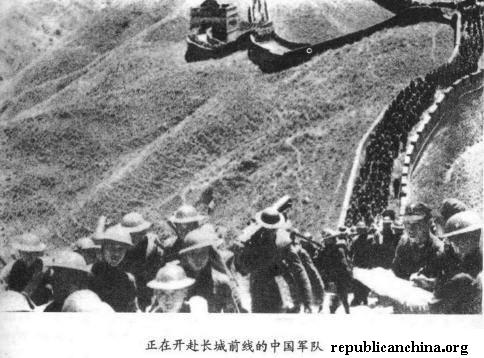 Soong Zheyuan’s 29th Corps, beginning from March 2nd, began to converge upon the Xifengkou Pass. On March 4th, Zhang Zhengfang’s 107th Division of the 67th Corps was dispatched towards the Qingshiliang-Huangtuliang area for impeding the advancement of the Japanese 8th Shidan; and Shang Zhen’s 32nd Corps, which was digging the defense positions on two banks of the Luanhe River, was ordered to recover the Lengkou Pass from the Japanese 14th Mixed Ryodan. To reinforce the defense of the Great Wall, the military committee relocated Guan Linzheng’s 25th Division of the 17th Corps to Tongxian on March 5th and subsequently Miyun on the 8th. Huang Jie’s 2nd Division of the 17th Corps followed through to Tongxian on the 7th.
 The 139th Division, after two days of fighting, recovered the Lengkou Pass on the early morning of March 7th. Shang Zhen then deployed Gao Hongwen’s 141st Division to the left of the pass, Du Jiwu’s 118th Division under the 51st Corps to the right of the pass, and Li Xincun’s 142nd Division as reserves at Jianchangying.
At 3 pm, on the 10th, the Japanese launched a short duration probing attack at Gubeikou Pass. On March 11th, at dawn, the Japanese 8th Shidan attacked the pass, and by 10 am, wrestled over the control of the entry area from the 112th Division. The Japanese then attacked the 25th Division and surrounded the 145th Regiment of the 73rd Brigade. Guan Linzheng personally led the 75th Brigade to the relief from the eastern gate of Gubeikou Town. In the ensuing short distance battle, Guan Linzheng was seriously wounded, regiment commander Wang Lunbo died, and 73rd Brigade commander Du Yuming took over the job of acting division chief.
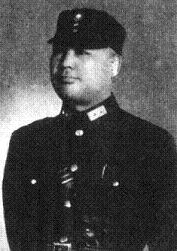 |
 |
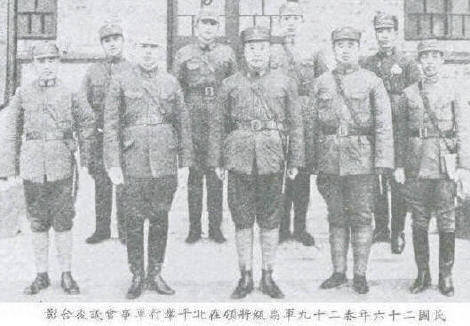 By 5 pm of March 12th, the Japanese took over the Gubeikou pass and town, and pressed the 25th Division to the Nantianmen Gate where Huang Jie’s 2nd Division assumed the task of continuous defense.
The Herald 109th Brigade under the 37th Division of the 29th Corps, upon arrival at the Xifengkou, immediately took control of the Panjiakou Pass sitting above the Luanhe River to the left and the Tienmenguan-Dongjiakou passes to the right. To route the Japanese attack force, 29th Corps Chief Soong Zheyuan ordered Zhao Dengyu’s 109th Brigade and Tong Zeguang’s 113th Brigade to circumvent to the right and left flanks of the Japanese for a raid into the Japanese camps on the night of the 11th. Past midnight, Zhao Dengyu’s brigade, with blades, swept through the Japanese camps at a dozen locations, and by 4 am, destroyed the Japanese command center and cannons at Baitaizi. (It was said that General Zhang Zizhong, frontline general director for the Xifengkou Campaign, first organized the famous "Broad Sword Contingent" of the Northwestern Army.)
More available at Battle_of_the_Great_Wall.pdf (Check RepublicanChina-pdf.htm page for up-to-date updates.)
* In Commemoration of China's Fall under the Alien Conquests in A.D. 1279,
A.D. 1644 & A.D. 1949 *
U.S.S.R./Comintern Alliance with the KMT & CCP (1923-1927)
Korean/Chinese Communists & the 1931 Japanese Invasion of Manchuria
American Involvement in China: Soviet Operation Snow, IPR Conspiracy, Dixie Mission, Stilwell
Incident, O.S.S. Scheme, Coalition Government Crap, Amerasia Case & The China White Paper
* Stay tuned for "Republican China 1911-1955: A Complete Untold History" *
|
|
Zou Rong's Revolutionary Army;
Shin Kyu Sik's
Shrine (Spirit, Kunitama) of Korea
|
This snippet is for sons and daughters of China:
Heed the sons & ministers' agony and sorrow of our ancestors who died or lived through the Mongol, Manchu and Soviet-Chicom conquest
and
the Yongjia, Jingkang and Jiashen cataclysms !
Jeanne d'Arc of China:
Teenager girl Xun Guan breaking out of the Wancheng city to borrow the relief troops in the late Western Jinn dynasty;
Liu-Shao-shi riding into the barbarian army to rescue her husband in the late Western Jinn dynasty;
teenager girl Shen Yunying breaking into Zhang Xianzhong's rebels on the horseback to avenge on father's death in the late Ming dynasty.
China's Solitary and Lone Heroes:
Nan Jiyun breaking out of the Suiyang siege and charging back into the city in the Tang dynasty;
Zhang Gui & Zhang Shun Brothers breaking through the Mongol siege of Xiangyang in the Southern Soong dynasty;
Liu Tiejun breaking through three communist field armies' siege of Kaifeng in the Republican China time period;
Zhang Jian's lone confrontation against the communist army during the June 3rd & 4th Massacre of 1989.
|
|
|
The truce talks in Shanghai continued into early May. Whang Jingwei was commented to have stopped advocating for war with Japan after the generals at Gubeikou informed him that the Japanese cannons and firepower could reach the Chinese soldiers while the Chinese weapons did not even have the range to hit the Japanese positions. On May 3rd, Nobuyoshi Muto adopted the approach of pressing for a peaceful settlement. The 28th Ryodan of the Japanese 14th Shidan was rerouted south from the Amur (Heilongjiang) Province for a new offensive. On May 7th, the reinforced Japanese troops launched attacks across the Great Wall line, from the Gubeikou Pass to the Shanhaiguan Pass. On May 14th, the Japanese took over Luanzhou. Fu Zuoyi’s 59th Corps was sent to Huairou for assisting Xiao Zhichu’s 26th Corps in defending Peiping. Additionally, Chiang Kai-shek shipped Feng Qinzai’s 42nd Division and the Central Army’s crack force of the 87th Division and 88th Division towards Peiping. On May 23rd, Fu Zuoyi’s 59th Corps engaged with the Japanese 8th Shidan at Huairou. On the same day, the Japanese offered a ceasefire to Huang Fu.
More available at Battle_of_the_Great_Wall.pdf
(Check RepublicanChina-pdf.htm page for up-to-date updates.)
* In Commemoration of China's Fall under the Alien Conquests in A.D. 1279,
A.D. 1644 & A.D. 1949 *
U.S.S.R./Comintern Alliance with the KMT & CCP (1923-1927)
Korean/Chinese Communists & the 1931 Japanese Invasion of Manchuria
American Involvement in China: Soviet Operation Snow, IPR Conspiracy, Dixie Mission, Stilwell
Incident, O.S.S. Scheme, Coalition Government Crap, Amerasia Case & The China White Paper
* Stay tuned for "Republican China 1911-1955: A Complete Untold History" *
|
|
Zou Rong's Revolutionary Army;
Shin Kyu Sik's
Shrine (Spirit, Kunitama) of Korea
|
This snippet is for sons and daughters of China:
Heed the sons & ministers' agony and sorrow of our ancestors who died or lived through the Mongol, Manchu and Soviet-Chicom conquest
and
the Yongjia, Jingkang and Jiashen cataclysms !
Jeanne d'Arc of China:
Teenager girl Xun Guan breaking out of the Wancheng city to borrow the relief troops in the late Western Jinn dynasty;
Liu-Shao-shi riding into the barbarian army to rescue her husband in the late Western Jinn dynasty;
teenager girl Shen Yunying breaking into Zhang Xianzhong's rebels on the horseback to avenge on father's death in the late Ming dynasty.
China's Solitary and Lone Heroes:
Nan Jiyun breaking out of the Suiyang siege and charging back into the city in the Tang dynasty;
Zhang Gui & Zhang Shun Brothers breaking through the Mongol siege of Xiangyang in the Southern Soong dynasty;
Liu Tiejun breaking through three communist field armies' siege of Kaifeng in the Republican China time period;
Zhang Jian's lone confrontation against the communist army during the June 3rd & 4th Massacre of 1989.
|
|
|
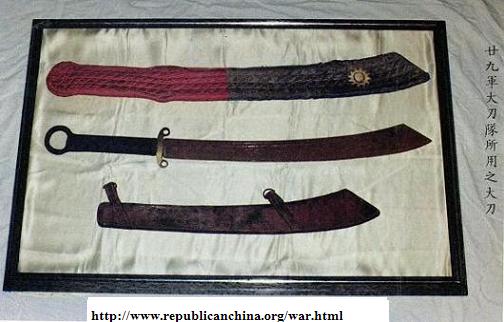
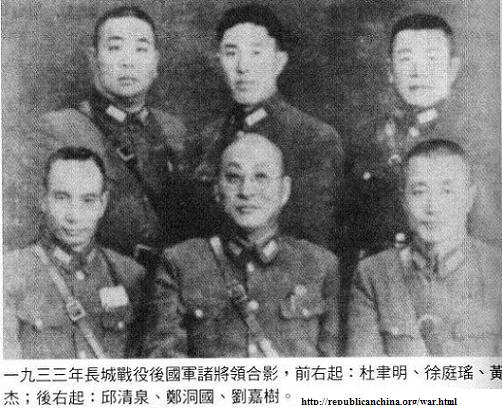
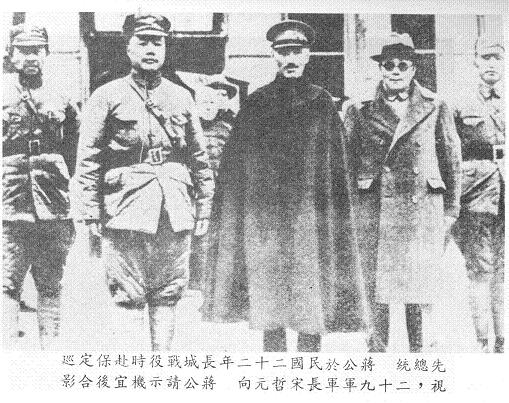
The Sino-Japanese "Tang-Gu Treaty"
In late May of 1933, Chiang Kai-shek began to negotiate with the Japanese for a ceasefire.
The Nationalist Government generals, including Soong Zheyuan, Wan Fulin and Yu Xuezhong, publicly objected to the Sino-Japanese "Tang-Gu Treaty."
Lu Weicheng claimed
that this ceasefire bought two years of time for China to prepare against Japan's invasion.
Wu Xiangxiang stated that China began to build railway systems in earnest after the Tang-Gu Treaty.
 Per Li Ao ("Commentary Biography Of Chiang Kai-shek", Shang-Zhou Culture Enterprise Publishing House, Taipei, Taiwan, April 1995 edition), Chiang Kai-shek's sworn brother, i.e., Huang Fu, had rebuked Chiang Kai-shek in a May 27th, 1933 telegraph as to Chiang's superficial patriotism while pushing him out as a negotiator for peace with the Japanese. Li Ao further stated that Whang Jingwei, head for both the Nationalist Government Administrative Council [i.e., "Xing Zheng Yuan"] and the Nationalist Government Foreign Ministry, had to stamp the Tang-Gu Agreement on behalf of Chiang Kai-shek even though Whang Jingwei never participated in the negotiation. Later, in 1936, at Huang Fu's deathbed in a Shanghai hospital, Chiang assuaged his sworn brother that he had "completed half of the necessary preparation work for fighting against the Japanese, with one or two more years at most to finish the rest" and assured Huang Fu that whatever humiliation he had taken would not be in vain.
Hirohito, after signing of the treaty, went to the Yasukuni Shrine to report the victory to the "martyrs." See page 631 of Jin Hui's "Questioning The Heaven's Spirit In Deep Grief: A Memorandum On Japanese Atrocities In China" (Heaven & Earth Book Publishing House, HK, 1995 edition). This same shrine, now being visited by the Japanese prime ministers regularly, had contained the tombstones and altars of the Japanese military dead, together with inscription of their army ranks, wars or battles engaged as well as the perjured historical accounts.
Feng Yuxiang's Anti-Japanese Allied Army
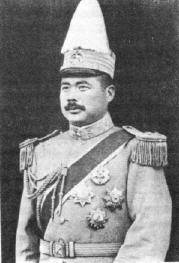 On May 26th 1933, Feng Yuxiang was conferred the post of commander-in-chief of "Anti-Japanese Allied Army",
with Fang Zhenwu acting as omnipotent director and Ji Hongchang as frontline commissar.
Having developed into over 100,000 people, Ji Hongchang's army pushed against Duolun
(i.e., a town in former Cha-ha-er and present Inner Mongolian and directly to the north of Peking city).
By late July, Feng Yuxiang and Ji Hongchang established, at Zhangjiakou (Kalgan), the "committee for recovering the four provinces of the Northeast." On May 26th 1933, Feng Yuxiang was conferred the post of commander-in-chief of "Anti-Japanese Allied Army",
with Fang Zhenwu acting as omnipotent director and Ji Hongchang as frontline commissar.
Having developed into over 100,000 people, Ji Hongchang's army pushed against Duolun
(i.e., a town in former Cha-ha-er and present Inner Mongolian and directly to the north of Peking city).
By late July, Feng Yuxiang and Ji Hongchang established, at Zhangjiakou (Kalgan), the "committee for recovering the four provinces of the Northeast."
During the Chahar campaign, the Hebei Provincial Commissar Committee of the Chinese communists dispatched Keh Qingshi to Kalgan for instigating the rebellion of Feng Yuxiang's allied army into the communist Red Army. Senior communist leader Zhang Mutao, who was responsible for instigating the 1929-1930 rebellion by Feng Yuxiang, disagreed with the new orientation and was consequently kicked out of the communist party. Chiang Kai-shek, fearing that the communists had taken control of the "Anti-Japanese Allied Army", would launch a concerted siege of the resistance army. Surrounded by the government troops, the communist instigators and the Japanese army on all sides,
Feng Yuxiang resigned his post.
More available at
Chinese Communists & Feng Yuxiang's Chahar Allied Army - 1933
[Modified : Tuesday, 23-Oct-2007 01:06:37 EDT];
Chinese Communists & Feng Yuxiang's Chahar Allied Army - 1933: The Final Demise
[Modified : Monday, 10-Oct-2011 14:14:51 EDT].
(Check RepublicanChina-pdf.htm page for up-to-date updates.)
* In Commemoration of China's Fall under the Alien Conquests in A.D. 1279,
A.D. 1644 & A.D. 1949 *
U.S.S.R./Comintern Alliance with the KMT & CCP (1923-1927)
Korean/Chinese Communists & the 1931 Japanese Invasion of Manchuria
American Involvement in China: Soviet Operation Snow, IPR Conspiracy, Dixie Mission, Stilwell
Incident, O.S.S. Scheme, Coalition Government Crap, Amerasia Case & The China White Paper
* Stay tuned for "Republican China 1911-1955: A Complete Untold History" *
|
|
Zou Rong's Revolutionary Army;
Shin Kyu Sik's
Shrine (Spirit, Kunitama) of Korea
|
This snippet is for sons and daughters of China:
Heed the sons & ministers' agony and sorrow of our ancestors who died or lived through the Mongol, Manchu and Soviet-Chicom conquest
and
the Yongjia, Jingkang and Jiashen cataclysms !
Jeanne d'Arc of China:
Teenager girl Xun Guan breaking out of the Wancheng city to borrow the relief troops in the late Western Jinn dynasty;
Liu-Shao-shi riding into the barbarian army to rescue her husband in the late Western Jinn dynasty;
teenager girl Shen Yunying breaking into Zhang Xianzhong's rebels on the horseback to avenge on father's death in the late Ming dynasty.
China's Solitary and Lone Heroes:
Nan Jiyun breaking out of the Suiyang siege and charging back into the city in the Tang dynasty;
Zhang Gui & Zhang Shun Brothers breaking through the Mongol siege of Xiangyang in the Southern Soong dynasty;
Liu Tiejun breaking through three communist field armies' siege of Kaifeng in the Republican China time period;
Zhang Jian's lone confrontation against the communist army during the June 3rd & 4th Massacre of 1989.
|
|
|
Ji Hongchang (an undercover communist) and Fang Zhenwu (whose followers mostly joined the hatchet gang) answered the call of the Chinese communists for first a relocation towards northern Chahar and then a southern attack against Peiping. The two fought on for a while, surrendered to the government troops, escaped half away during the disarmament, and stealthily sought asylum in Tianjin's foreign settlements in Jan 1934.
Later, on April 24th, 1934, Ji Hongchang, colluding with the communists, established the "Great Anti-Fascism Alliance of the Chinese People" in Tientsin (Tianjin), with Feng Yuxiang, Li Jishen, Fang Zhenwu and Ren Yingqi echoing support elsewhere in the country. Chiang Kai-shek's agents injured Ji Hongchang in an assassination on November 9th, and colluded with the French police in extraditing Ji Hongchang for execution in Peking on November 24th.
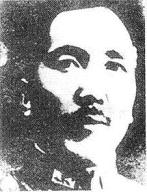 |
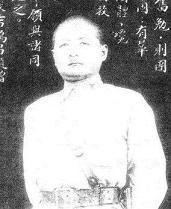 |
In 1934, the Soviet Union sold to Japan its interest in the Chinese Eastern Railway for avoiding friction with Japan.
The cunning Soviets, knowing that American president Hoover thought the Japanese were justified in the invasion and could serve as a counterweight against the Soviet Union and the West wanted Japan to conflict with Soviet Russia, claimed that the Soviet Union's priority was to fulfil the national economic construction. Just years back, in late 1929, the Soviet Red Army mounted a multi-route invasion against Manchuria under Galens’ command,
with the Kuban 5th Cavalry Brigade and the 35th Infantry Division invading Chalainor and Manzhouli while the other routes of Soviet Red Armies attacking from north of the Amur River and east of the Ussuri River.
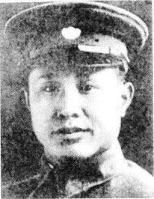 On April 1st, Chiang Kai-shek launched the "economic construction movement" in Guiyang of Guizhou Province and made Soong Ziwen (T.V. Soong) the chief of the Bank of China.
The Soviets, fearing a two-front war with Germany and Japan, instructed Mme Sun Yat-sen to launch anti-war and anti-imperialism movements, with the Anti-War [and Defend-USSR] Conference of the Far East convened in September 1933 in Shanghai.
Mme Sun Yat-sen further in April 1934 orchestrated a declaration entitled "Basic Guidelines of the Chinese People for War against Japan", and in September 1934, together with Heh Xiangning (i.e., Liao Zhongkai's widow), launched the "Armed Self-Defense Committee of the Chinese People". On April 1st, Chiang Kai-shek launched the "economic construction movement" in Guiyang of Guizhou Province and made Soong Ziwen (T.V. Soong) the chief of the Bank of China.
The Soviets, fearing a two-front war with Germany and Japan, instructed Mme Sun Yat-sen to launch anti-war and anti-imperialism movements, with the Anti-War [and Defend-USSR] Conference of the Far East convened in September 1933 in Shanghai.
Mme Sun Yat-sen further in April 1934 orchestrated a declaration entitled "Basic Guidelines of the Chinese People for War against Japan", and in September 1934, together with Heh Xiangning (i.e., Liao Zhongkai's widow), launched the "Armed Self-Defense Committee of the Chinese People".
The Ho-Umezu Agreement & Qin- Doihara Agreement
More available at Ho-Umezu-Agreement.pdf (Check RepublicanChina-pdf.htm page for up-to-date updates.)
* In Commemoration of China's Fall under the Alien Conquests in A.D. 1279,
A.D. 1644 & A.D. 1949 *
U.S.S.R./Comintern Alliance with the KMT & CCP (1923-1927)
Korean/Chinese Communists & the 1931 Japanese Invasion of Manchuria
American Involvement in China: Soviet Operation Snow, IPR Conspiracy, Dixie Mission, Stilwell
Incident, O.S.S. Scheme, Coalition Government Crap, Amerasia Case & The China White Paper
* Stay tuned for "Republican China 1911-1955: A Complete Untold History" *
|
|
Zou Rong's Revolutionary Army;
Shin Kyu Sik's
Shrine (Spirit, Kunitama) of Korea
|
This snippet is for sons and daughters of China:
Heed the sons & ministers' agony and sorrow of our ancestors who died or lived through the Mongol, Manchu and Soviet-Chicom conquest
and
the Yongjia, Jingkang and Jiashen cataclysms !
Jeanne d'Arc of China:
Teenager girl Xun Guan breaking out of the Wancheng city to borrow the relief troops in the late Western Jinn dynasty;
Liu-Shao-shi riding into the barbarian army to rescue her husband in the late Western Jinn dynasty;
teenager girl Shen Yunying breaking into Zhang Xianzhong's rebels on the horseback to avenge on father's death in the late Ming dynasty.
China's Solitary and Lone Heroes:
Nan Jiyun breaking out of the Suiyang siege and charging back into the city in the Tang dynasty;
Zhang Gui & Zhang Shun Brothers breaking through the Mongol siege of Xiangyang in the Southern Soong dynasty;
Liu Tiejun breaking through three communist field armies' siege of Kaifeng in the Republican China time period;
Zhang Jian's lone confrontation against the communist army during the June 3rd & 4th Massacre of 1989.
|
|
|
Shang Zhen took over the post in charge of the Peking defense, but refused to ally with the Japanese. In Peking, Shang Zhen, other than his continuous studies of English, would often match his 32nd Corps polo team with the foreigner's teams. Chiang Kai-shek then relocated Shang Zhen and his 32nd Corps to Kaifeng of Henan Province. 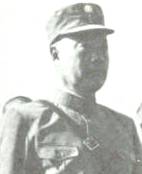 Soong Zheyuan succeeded the post and adopted a "befriending" approach to the Japanese. Soong Zheyuan succeeded the post and adopted a "befriending" approach to the Japanese.
On July 1st, the Mt Lushan Training was moved to Sichuan Province. On July 4th, the Yangtze River flooding impacted 14 million people, with 100000 people drowned. On October 2nd, Chiang Kai-shek and Zhang Xueliang organized the northwestern committee for quelling the communist banditry. On November 3rd, a new currency system was announced for adopting the "legalized currency" paper money, in lieu of the silver dollars, beginning on November 4th. On November 12th, the KMT 5th Congress was convened in Nanking.
On November 25th, the Japanese instituted a puppet government, i.e., the Eastern Ji [Hebei Province] Anti-Communist Autonomous government under a Chinese traitor called Yin Rugeng who was the Nationalist Government administrative commissar for the Luan-Yu region of eastern Hebei Province.
(Yin Rugeng, who had a Japanese wife and was later caught and executed by the Nationalist Government after WWII, would claim that he was asked by some government official to head the puppet government. Serving under Yin would be numerous persons with connection with the communists as well as some overseas returnee who had attempted to broker a Sino-Japanese peace accord to give the nationalist government a non-resistance image during WWII.)
The Nationalist Government foreign ministry raised protest against Japan. The Eastern Ji [Hebei Province] Anti-Communist Autonomous government would lead to the students' protest movement in Peking on December 9th, 1935. The Communists stirred up the massive protests across the cities of China, with such frontal organizations as the "North China's Grand People Alliance For Rescuing China" and the "Joint Society of the Peking-Tientsin Students For Rescuing China" ('Ping-Jin xuesheng jiuguo lianhe-hui'), etc. Huang Jing [Yu Qiwei], i.e., Jiang Qing's first man and lover lasting through the woman's marriage with husband Tang Na or Ma Jiliang, was among the most active students.
Nationwide, college and university students rose up in synchronization.
Dr. Hu Shi wrote an article to comment on the December 16th Peking students' demonstration, with emphasis on law and order.
In National Wuhan University where Li Rui was a student, students also mounted demonstration on December 17th to echo the December 9th Protest by the Peking students, with the students' movement expanded to colleges and universities across Wuhan under the united Wuhan city students' associations ('shi xue-lian'), that numbered by fifty-three including middle schools, and the protests and strikes carrying on for weeks and months into the following year.
On the 17th, students officially launched the Wuhan united national salvation associations of students of middle and higher schools.
Wuhan city police superintendent Cai Mengjian taking the pace at the front of the parade on December 22nd, while
Wuhan city mayor Wu Guozhen and Education Board director Cheng Qibao took part in the parade sometime during the three-day demonstrations and walked in front of the students on December 23rd.
After leader Xu Shengjie of the 9-person joint seat for the Wuhan city students' united associations resigned the demontration and strike committee, apparently over disagreement as to continuing the strike beyond three days, radical students at Wuhan University formed the Wuhan University students' national salvatioon society ('xuesheng jiuguo-hui') that was to permute the leadership to the secretive Wuhan national salvatioon corps the following summer.
During this time period,
Li Rui participated in publishing
Jiu Zhongguo (rescuing China) and
Xiang Liu (Xiang-jiang River) in 1936.
Per Li Rui, at the turn of 1935-1936, Tsing Hwa student representative Liu Yuheng (alias Chen Qiwu, 1914-1984, an Anhui native who joined the communist party later in 1938 and was sent to infiltrating Wei Lihuang's command center) and Yenching (Yanjing) University representative Zhu Nanhua (alias Li Meng, a schoolmate of Xiong Dazhen, with referral of 180 Peking-Tientsin students who were purged by the communists during the war) visited Nanking and Wuhan to report on the Peking students' movements.
To palacate the students' movements nationwide, Chiang Kai-shek announced a personal meeting to be held with students' representatives at the nation's capital on January 15th, 1936, that was offensive to leftist students for using a condescending terminology of a pilgrimage visit for the generalissimo to "listen and lecture".
The representatives sent to Nanking by Wuhan University was later maltreated by the radical students who threw out the bed linens of those students when they returned to Wuhan.
Per Li Rui, prvincial chair Yang Yongtai and the Wuhan garrison command intervened to dismiss the Wuhan students' united associations on April 8th, 1936, which led to the Wuhan students' reorganizing the students' associations into the Wuhan secret (underground) that was termed "mimi xue-lian", with the National Wuhan University's student organization exempt from the provincial government order and alternatively known as the Wuhan University youth salvation corps ('qingnian jiuguo tuan') -- that was likened to the status of the Peking peripheral communist organization of the national liberation vanguards ('minzu-jiefang xianfeng dui').
In May of 1936, a meeting of the national students' united associations ('quan-guo xue-lian') was held in Shanghai.
In late 1936, the Wuhan united association of the national salvation societies of all circles and arenas ('Wuhan ge-jie jiuguo lianhe-hui') was organized to be subject to the national charter "jiuguo-hui" (society for rescuing China) that was initially sponsored by the seven gentlemen like Shen Junru.
The Wuhan all-walks united association was put in charge of Wuhan secret (underground) students' united associations.
And by the spring of 1937, Li Rui and radical students at the Wuhan University organically initiated organization of the communist party cell on campus, with Wan Guorui and Li Rui sent to Peking consecutively for liaising with the communist party leadership which was to approve and sanction the Wuhan cell.
As recalled by Li Rui, before the December 1935 demonstrations,
there was no communist in all Wuhan colleges and universities, and after radical studnets got in touch with what they believed to be possible communists, none of them ever admitted to their communist identity, with at least two middle school teachers confirmed to be secret communists in the future.
China In Crises Of the Internal turmoil & Foreign Invasion
On June 15th, 1931, Chiang Kai-shek personally went to Nanchang of Jiangxi Province to supervise the Third Siege of the Communist stronghold. However, this siege was aborted due to the KMT internal strife. Chiang Kai-shek faced both the internal and external adversaries, with internal being KMT rightist Hu Hanmin and KMT leftist Whang Jingwei. Early in the year, on Feb 28th, 1931, Hu Hanmin was put under house arrest by Chiang Kai-shek at Tangshan in Nanking. Hu Hanmin authorized senior KMT leader Gu Yingfen in contacting the Guangxi-Guangdong generals for launching a new government. Li Zongren dispatched Wang Gongdu to Canton for cooperation with Chen Jitang's Guangdong government. Senior KMT leaders, like Ju Zheng, Xie Chi, Sun Ke, Deng Zeru & Lin Sen et al., i.e., the Cantonese gang and Sun Yat-sen's followers, all opposed Chiang Kai-shek. Jiang Yongjing lamented the split relationship among Chiang Kai-shek, Whang Jingwei and Hu Hanmin and attributed it to the weakness of the KMT party.
On June 28th, Whang Jingwei (aka Whang Zhaoming), Tang Shaoyi, Zou Lu, Chen Youren, and Li Zongren established a separate National Government in Guangzhou [Canton]. The Canton government dispatched the armies to the Hunan-Jiangxi provinces against Chiang Kai-shek, while Zou Lu was dispatched to the north for inciting Feng Yuxiang and Yan Xishan against Chiang Kai-shek.
Chen Mingren was sent to Japan for seeking assistance with the Japanese, and purportedly requested with the Japanese for invading Manchuria.
Taking advantage of the Nanking Government dilemma and with the Japanese instigation, on July 20th 1931, Shi Yousan, who rebelled against Chiang Kai-shek and Feng Yuxiang in 1929-1930 consecutively, rebelled against Chiang Kai-shek again in southern Hebei Province and drove off Zhang Xueliang's Manchurian army.
Zhang Xueliang fell into the Japanese trick and relocated the bulk of the Northeastern Army to northern China for cracking down on Shi Yousan's rebellion.
Hu Zongnan's 1st Division, in collaboration with Zhang Xueliang, defeated the 20-county rebellion by Shi Yousan on July 31st. Shi Yousan's remnants were taken in by Han Fuju on Aug 8th. (Shi Yousan, originally counted as one of the 13 'tai-bao' (soundex 'Gestapo') of Feng Yuxiang, on December 1st, 1940, was ordered to be killed by deputy corps chief Gao Shuxun for implication with the Japanese.)
In Hebei Province, Hu Zongnan arrested a local godfather figure, and then returned to Kaifeng. Thereafter, Hu Zongnan's 1st Division was rerouted to the south for countering the Canton rebellion.
At Kaifeng,
Wang Tianmu already organized the Three People's Principles Chivalry League with Leng Xin, Xiao Sa, Ma Zhichao and Chen Zhiping inside of Hu Zongnan's army in Kaifeng in 1930. Wang, who was sent to Manchuria to check on the Japanese maneuver prior to the 18 September 1931 Japanese invasion of Manchuria, reported back the serious situation in Manchuria. After the September 18th Incident, Wang Tianmu returned to Nanking, and was asked by Liu Jianqun and Teng Jie to take action of organizing a society, and after discussion with Dai Li, Wang Tianmu returned to Kaifeng to disband the chivalry league for building a new organization. Hence, in November 1931, a five-person preparatory committee headed by Kang Ze and Dai Li, et al., was formed under Chiang Kai-shek's auspice. In early March 1932, the Resurrection Society was launched under a nine-person central board of councilors and with a thirteen 'tai-bao' (soundex 'Gestapo') core staff, with Teng Jie as secretary, Kang Ze as propaganda division director, and Dai Li as special services division director.
The Japanese Invasion of Manchuria/Shanghai & Reconciliation Among the KMT Factions
Building ROC's Airforce
In 1932, the Nationalist Government decided to establish China's airforce. The Central Aviation Academy was set up in the Jianqiao Airport of Hangzhou, Zhejiang Province, with about 20 Americans invited to be lecturers.
Similar to Authur Young's private nature throughout the dozens of years of tenure serving the Republic of China as an economic adviser,
the American commerce department's deal with China was not inter-governmental in nature, but a referral to William D. Pawley of the Curtis-Wright Corporation, i.e., a private company.
This joint venture, i.e., the Central Aircraft Manufacturing Company (CAMCO), after the 1932 interruption over the American pilots' refusal to fight the Fujian Republic rebels, was renewed in the mid-1930s, culminating in the visitation of Claire Lee Chennault to China three months prior to the eruption of the Sino-Japanese War of 1937.
Other than the 1931 Yangtze Flood loan to China, the commerce department's referral would be American quasi-government's support for China as a result of the sympathy of the officials of the American commerce department [which was less infiltrated by the CPUSA and the Soviet agents], something to do with the personal contacts between T.V. Soong and some American.
Soon, the Americans under Roosevelt re-established the diplomatic relations with the U.S.S.R., with the U.S. state department and treasury department to be infiltrated by the Soviet agents, i.e., hirings of the Institute of Pacific Relations -- which had its structure morphed from the YMCA, an institution that the Soviets, after failing to crack in the early 1920s with the organization of a worldwide anti-Christian coalition under the helm of Sergi Dalin, then infiltrated.
At the time of the cotton and wheat credit,
the Soviet-agents-hijacked U.S. state department debated about whether to give China assistance, saying that any assistance for Chiang Kai-shek could be used for fighting the civil war against the communist Red Army, a rhetoric that was repeated under George Marshall during 1945-1950.
Later war hero, Zhang Guangming, attended the Jianqiao Aviation Academy with referral of his school master in Northern China. Nationwide, a movement was launched for "donating one airplane in every county." Well over 1 billion worth of money were collected, and a poor county of Sichuan Province donated three planes' worth of money.
After the 1931 Japanese invasion of Manchuria, pilots and lecturers from the Northeastern Army air force, such as Gao Zhihang, a former French air force academy graduate, came to the Jianqiao Aviation Academy.
The Chinese airforce would be later in 1936 strengthened further by the incorporation of the Cantonese airforce, which was staffed mostly by the overseas Chinese from the U.S.A. and Canada.
In the winter of 1932, when the American lecturers at the Central Aviation Academy [in the Jianqiao Airport of Hangzhou] refused to bomb the KMT rebels led by Cai Tingkai in Fujian Province, the ROC Government immediately accepted the Italian offer. About 40 Italian fighter pilots and 100 Italian engineers were dispatched to Nanchang of Jiangxi Province for assembling the airplanes. Wu Xiangxiang stated that Italy had offered to pay their advisers with money from the overcharged war damages from the 1900 boxer incident indemnity funds. China purchased the Italian airplanes in the amount of several millions of the U.S. dollars. However, the Italians gave the Chinese pilots the "pass" score without filtering out those disqualified and cooked the books to make China appear to have 500 planes whereas only 91 planes could actually engage in the battles.
General Chennault concluded that it was Mussolini's scheme to destroy China's airforce from the beginning by offering proof that Mussolini was the first person who came to offer the 'peace deals' on behalf of Japan after the eruption of war on July 7th, 1937.
The Japanese Attempt At New Dominion Province
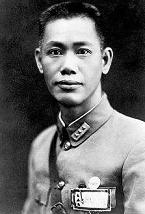 "People's Government" "Fujian People's Government" "People's Government" "Fujian People's Government"
Preparations For Resistance War Inside Guangxi-Guangdong Provinces
Patriotic Movements
In Jan 1934, masses of students, taking advantage of the convention of the KMT 4th Plenary of the 4th Congress, converged onto the KMT party headquarters in Nanking for petitioning a declaration of war on Japan. (Numerous memoirs pointed out that the communist insurgents had mixed up with the student activists for organizing this student petition movement.)
The Nationalist government dispatched senior scholar Cai Yuanpei to the front gate for dissuading the students, but the students refused to leave. On Jan 20th, Chiang Kai-shek personally appeared in front of the students for an explanation of the government policies as to Japan, and students dispersed after Chiang Kai-shek promised to adopt a strong stance against Japan and offered to enroll the progressive students in the Whampoa Academy.
The communist students slipped away instead of enrolling in the academy.
On March 11th, Chiang Kai-shek ordered a four-prong 5th Siege of the Jiangxi Soviet.
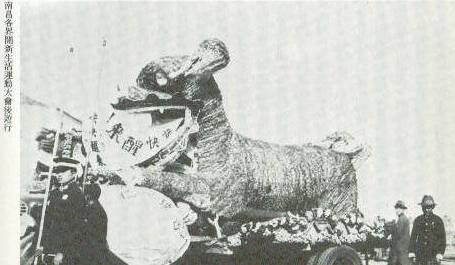 In the summer of 1934, Chiang Kai-shek and Soong Meiling endorsed a "New Life Movement." Xu Zhen stated that Chiang Kai-shek first started this movement on Feb 19th, 1934 in Nanchang of Jiangxi Province.
Yan Baohang, i.e., founder of the Chinese communist Mukden cell which was a hotbed of the Soviet GRU agents, tacked on the leader role at the new life movement for Yan Baohang's connection with Zhang Xueliang as well as his YMCA activities in the 1910s and 1920s.
YMCA, as was explained before, was infiltrated by the Soviet agents and morphed into the I.P.R., a brain trust for Roosevelt's governments. In the summer of 1934, Chiang Kai-shek and Soong Meiling endorsed a "New Life Movement." Xu Zhen stated that Chiang Kai-shek first started this movement on Feb 19th, 1934 in Nanchang of Jiangxi Province.
Yan Baohang, i.e., founder of the Chinese communist Mukden cell which was a hotbed of the Soviet GRU agents, tacked on the leader role at the new life movement for Yan Baohang's connection with Zhang Xueliang as well as his YMCA activities in the 1910s and 1920s.
YMCA, as was explained before, was infiltrated by the Soviet agents and morphed into the I.P.R., a brain trust for Roosevelt's governments.
The Chinese women were said to have played an active role in the public life hence. The "New Life Movement", by preaching the simplicity of lifestyle and punctuality in action among the Chinese citizens, was also devised for reviving the martialness of the nation. In Nanchang of Jiangxi Province, the populace manufactured a "sleeping lion", with a call for the "Chinese to wake up immediately."
(The "sleeping lion" was the symbol of the Chinese Youth Party.)
Changing Alliances In the International Arena
World War II, in both the East and the West, was the result of the inducements of the British, and Anglo-American syndicates. For what? The British wanted Hitler to attack the Soviet Union, and the British wanted Japan to suppress China's nationalist movement and to counter the Soviet Union.
When China intended to forcefully recover the Chinese Eastern Railway in 1929, the world community showed its indifference to the war that Stalin initiated to invade China for sake of restoring the Soviet interests in the railway. The Soviets' disdain of the Kellogg Briand Pact (officially the Pact of Paris) made a farce of the West's efforts at maintaining the peace order. The Japanese followed suit to invade and occupy Manchuria in 1931, while American president Hoover thought the Japanese were justified in the invasion and could serve as a counterweight against the Soviet Union.
The powers were reluctant to allow China to set a precedent in successfully revoking the unequal terms imposed on Manchu China. In supporting Zhang Xueliang’s action, Chiang Kai-shek, who hoped to enhance the prestige of the National Government that continued the anti-imperialism push after the reunification of China in 1928, such as requesting for the powers to abandon extraterritoriality, for example, found the European powers and the United States not enthusiastic about applying the Kellogg Treaty to resolving the Sino-Soviet dispute regarding the Chinese Eastern Railway.
As Arthur Young correctly stated, the roots of World War II could be found in the Soviet invasion of Manchuria in 1929, which rendered the Kellogg Briand Pact a farce.
The same cunning Stalin, who fought Zhang Xueliang over the Chinese-Eastern Railway, would quickly divest himself of the railway after Japan invaded Manchuria on September 18th, 1931.
In both the East and the West, Stalin out-smarted the British and Anglo-American syndicates. Hitler attacked westward instead, and signed a Molotov-Ribbentrop non-aggression pact with Stalin to halve Poland; and Japan attacked Southeast Asia and the Pearl Harbor after the invasion of China, not the Soviet Union.
(Half a year before the Russo-Japanese Neutrality Treaty of April 1941 and one year ahead of the Pacific War, Japan already reached a secret deal with the U.S.S.R. to halve China, as evidenced by the December 1940 negotiation and clauses between Whang Jingwei's puppet government and Japan.)
The Anglo-American support for Japan could be dated to Japan's post-Meiji era.
"When other nations tried to bar ... [Japan] progress or slur ... [Japan] reputation," as commented by Count Hayashi:
"America always stood for ... [Japan] ...[America's] Stars heralded to the world the rising of ... [Japan] Sun..."
The warships and planes built and used against China in 1931/2 were the products of twenty years of the military alliance treaty between Britain and Japan,
following the American support of the Japanese ventures against Ryukyu and Taiwan in the late 19th century.
While the U.S. had supported Japan from the 1894 First Sino-Japanese War to the 1904 Russo-Japanese War, Britain tacked on the job of supporting Japan from 1902 onward, for 20 continuous years by means of two 10-year military alliance treaties. To reign in Japan the mad dog from biting themselves, Britain and America somehow pressured Japan into some concession through several conferences, i.e., the Washington Conference on the naval disarmament in 1922, the Kellogg-Briand Pact in 1928, and the
22 April 1930
London Naval Treaty (a treaty which regulated submarine warfare and limited naval shipbuilding, that was denounced by Churchill as disastrous). Nothing had shaken the Anglo-American long-term objective of supporting Japan, no matter it was the sinking of Captain T. R. Galsworthy's merchant ship from the British-owned Indochina Steam Navigation Company of London in 1894, or the sinking of Panay by the Japanese bombers on the afternoon of December 12th, 1937, or the attacks on two British warships on the Yangtze at the same timeframe. 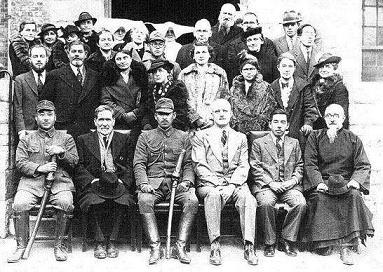
The Anglo-American & Jewish romance with the Japanese, as exhibited in Steven Spielberg’s EMPIRE OF THE SUN [based on the autobiographical novel by J.G. Ballard], had seemed to be corroborated by James Liley's recollections of his family's limited war experiences in China, obscured by the naked truth which the Prisoners of the Japanese : Pows of World War II in the Pacific would rather forget.
The Anglo-American's foes made their moves. In 1933, Germany withdrew from the League of Nations. Soviet Russia launched the diplomatic initiatives by establishing the diplomatic relations with China in December 1932 and with the U.S.A. in 1933, consecutively, hence dispatching a large embassy of agents for espionage and instigation. In September 1934, the Soviet Union joined the League of Nations, a cohort that had numerous Soviet agents embedded. (Later, the Soviet agents infiltrated the United Nations organization.
"16 out of 17 of the AMERICANS that were involved in creating the U.N. were later identified, in sworn testimony, as secret communist agents. The first Secretary General was the AMERICAN Alger Hiss. Hiss served time in prison pursuant to his involvement in a Communist spy ring." The whole United States government was in fact taken over by the Comintern and GRU agents, including: Alger Hiss; Harry Dexter White; Lauchlin Currie; Laurence Duggan; Frank Coe; Solomon Adler; Klaus Fuchs; and Duncan Lee.)
In March 1935, Hitler denounced the disarmament clauses of the Treaty of Versailles and announced Germany's rearmament. Some 20,000 German Jews, with stamped passports by the ROC ambassadors to Germany and Austria, escaped Hitler's Nazis grip to find a haven in Shanghai. The Chinese ambassador to Austria, i.e., Heh Fengshan, assisted the Jews in granting visa to thousands of Jews from 1938 to 1940. See Shanghai Ghetto.
Beginning from 1935, the Nationalist government enlisted 2.5 million labors for building four railway lines leading from Sichuan to the Shenxi, Hunan, Guizhou and Yunnan provinces.
This turns out to be a big contribution to the later resistance wars against Japan.
On June 18th of 1935, Liao Zhongkai's coffin was relocated to Nanking for a state funeral.
One day earlier, in Shanghai, over 300 representatives, together with Mme He Xiangning, received the coffin from a French-registered postal ship.
In July & August 1935, the Third Comintern announced an "anti-imperialist front" all over the world.
Stalin, after declaring the Social Democrats the top enemies and sending assassins to killing the social democrats and Trotskyites, including assassination of the Comintern fugitives in France and Mexico, etc., reversed his policy to make friends with the social democrats in an alliance against the newly-emerging threats from the fascist nations.
In Moscow, Wang Ming, i.e., head of the Chinese communist delegation, passed on the new directives to the CCP at home. When the Communist Red Army forces under Mao Tse-tung, less than 4000-5000 remnants [or even less], relocated to Yan'an [i.e., Yenan] in late 1935, they renamed themselves to the "Chinese Anti-Japanese Red Army."
Chiang Kai-shek, from 1935 to 1936, had authorized the "Secretive Sino-U.S.S.R. Contacts and the KMT-CCP Contacts In Multiple Channels", a manifestation that Chiang Kai-shek was preparing for an inevitable confrontation with Japan by means of an alliance with the Soviets & the Chinese communists. In December 1935, Chen Lifu, with Chiang Kai-shek's approval, went on a secret mission to the U.S.S.R. with Zhang Chong, by disguising themselves among Cheng Tianfang & Feng Ti's embassy to Germany. Stalin declined an invitation over the possible Japanese reaction. Meanwhile, Japan's news agency repeatedly claimed that the Nationalist top representative Chen Lifu was sent to Moscow. Chiang Kai-shek hence recalled Chen & Zhang, and pierced the Japanese "rumor."
The Chinese government vacillated between an alliance with the Soviet Union versus that with Japan.
Meantime, Stalin was playing the trick of settling with Chiang Kai-shek over the matter of two different terms, namely, a settlement between the U.S.S.R and the Republic of China or a one-basket settlement between the U.S.S.R/Chinese communists and the Republic of China.
What this episode was about actually related to the secret talks between Chiang Kai-shek and Stalin, which was disrupted by Zhang Xueliang's Xi'an coup.
Chiang Kai-shek forfeited a chance to strike a military-nature alliance with the Soviet Union, when Stalin was paranoid about Japan's possible attack at Siberia.
Chiang Kai-shek and Stalin, in regards to the Chinese communists, had a difference of approach as to a whole-basket or half-basket solution, with Stalin keen on a whole-basket solution, which was conditioned on Mao Tse-tung and the top communist leadership's being exiled to Moscow in exchange for a Sino-Russian alliance-nature agreement.
To induce Japan into invading China, the Soviets trained a large number of the Chinese G.R.U. agents for sabotage in the Japan-controlled areas such as Manchuria, as well as in Qingdao and Tientsin, etc.
In southern China and along the Yangtze, the communists could be behind numerous assassinations against the Japanese sailors and merchants.
 Meanwhile, the Soviet Union made an alliance with Sheng Shicai the warlord governor of Xinjiang [i.e., Sinkiang] in westernmost China. Sheng Shicai invited the Soviet Red Army and the Chinese Communist Party members into his dominion.
From Moscow, the former 1927 Nanchang mutineers were sent to Chinese Turkestan to be Sheng Shicai's assistants.
From Yenan, Mao Tse-tung sent his brother to Sheng Shicai under an alias.
Sheng Shicai, who could be said to be a cunning person on par with Stalin, outsmarted Stalin in making an application to become a loyal Russian communist.
Sheng Shicai obtained Stalin's permission to become a Russian communist.
It was because of Sheng Shicai's cunningness that Xinjiang, i.e., Chinese Turkestan, was not lost to Stalin and the Soviet Union as was the fate of Outer Mongolia.
Meanwhile, the Soviet Union made an alliance with Sheng Shicai the warlord governor of Xinjiang [i.e., Sinkiang] in westernmost China. Sheng Shicai invited the Soviet Red Army and the Chinese Communist Party members into his dominion.
From Moscow, the former 1927 Nanchang mutineers were sent to Chinese Turkestan to be Sheng Shicai's assistants.
From Yenan, Mao Tse-tung sent his brother to Sheng Shicai under an alias.
Sheng Shicai, who could be said to be a cunning person on par with Stalin, outsmarted Stalin in making an application to become a loyal Russian communist.
Sheng Shicai obtained Stalin's permission to become a Russian communist.
It was because of Sheng Shicai's cunningness that Xinjiang, i.e., Chinese Turkestan, was not lost to Stalin and the Soviet Union as was the fate of Outer Mongolia.
Wu Xiangxiang stated that the Russian Red Army 8th Regiment came to Hami in Jan 1938. However, 2000 Russian Red Army was invited over to Ili by Sheng Shicai on Jan 3rd, 1934, for fighting the "naturalized Russian White Army" which was subordinate to Zhang Peiyuan the Chinese "garrison & farming commissioner" for Ili.
The Russian Red Army at one time took over Yining, Suiding & Huiyuan cities. One month later, on Feb 11th, 1934, the Soviet Red Army, again at the request of Sheng Shicai, intruded to Dihua (Urumqi) where they defeated 36th Division Chief Ma Zhongying [i.e., the commander-in-chief of the "joint armies of Gansu-Ningxia-Qinghai provinces"]. Later, on Aug 5th and October 13th of 1937, twice, the Russian Red Army attacked Ma Hushan rivalry in southern Chinese Turkistan on behalf of Sheng Shicai, and on October 15th, bombed the city of Yutian where the Chinese casualties numbered at 2000.
Ma Zhongying, with a Japanese and several communist students from the Peking-Tientsin area, returned to the Northwest via the caravan desert road, the same path that Owen Lattimore took [and wrote his book "The Desert Road to Turkestan" on], and at the instigation of the communist students, intruded into Chinese Turkestan.
It was purely Stalin's gimmick in making a choice between Ma Zhongying and Sheng Shicai on the criteria as to who was a strongman to be used as a henchman than the ideological underpinnings of the various opposing parties like Ma Zhongying or Sheng Shicai.
Sheng Shicai, who defected to Chiang Kai-shek at the time Germany attacked the Soviet Union, arrested the communists including Mao Tse-tung's brother Mao Zemin in 1942, on the pretext that the communists had hijacked his government and killed his brother Sheng Shiqi.
Mao Zemin could have been secretly executed under an alias rather than as Mao Tse-tung's brother.
Mao Zemin purportedly wrote a confession letter in 1943, which blamed the Soviets for misunderstanding between Sheng Shicai and the Soviets, as well as misunderstanding between Sheng Shicai and the Chinese Communists.
Among 150 plus communist captives, Mao Zemin, and Li Jilu, et al., i.e., the top leadership, were secretly executed while the majority were released to Yenan in 1946 after imprisonment of four years.
According to Sheng Shicai's recollection of a talk with a Soviet consular officials, when challenged about Mao Zemin's true identity, Sheng Shicai told the Soviets that he killed Mao Zemin because the communists killed his brother Sheng Shiqi.
Shi Shicai, for his jumping fences constantly and destroying the Ma Zhongying and Ma Hushan factions, would saw his in-law family members murdered at Lanzhou by the Dungans in the late 1940s.
More available at Changing_Alliances-v0.pdf (Check RepublicanChina-pdf.htm page for up-to-date updates.)
* In Commemoration of China's Fall under the Alien Conquests in A.D. 1279,
A.D. 1644 & A.D. 1949 *
U.S.S.R./Comintern Alliance with the KMT & CCP (1923-1927)
Korean/Chinese Communists & the 1931 Japanese Invasion of Manchuria
American Involvement in China: Soviet Operation Snow, IPR Conspiracy, Dixie Mission, Stilwell
Incident, O.S.S. Scheme, Coalition Government Crap, Amerasia Case & The China White Paper
* Stay tuned for "Republican China 1911-1955: A Complete Untold History" *
|
|
Zou Rong's Revolutionary Army;
Shin Kyu Sik's
Shrine (Spirit, Kunitama) of Korea
|
This snippet is for sons and daughters of China:
Heed the sons & ministers' agony and sorrow of our ancestors who died or lived through the Mongol, Manchu and Soviet-Chicom conquest
and
the Yongjia, Jingkang and Jiashen cataclysms !
Jeanne d'Arc of China:
Teenager girl Xun Guan breaking out of the Wancheng city to borrow the relief troops in the late Western Jinn dynasty;
Liu-Shao-shi riding into the barbarian army to rescue her husband in the late Western Jinn dynasty;
teenager girl Shen Yunying breaking into Zhang Xianzhong's rebels on the horseback to avenge on father's death in the late Ming dynasty.
China's Solitary and Lone Heroes:
Nan Jiyun breaking out of the Suiyang siege and charging back into the city in the Tang dynasty;
Zhang Gui & Zhang Shun Brothers breaking through the Mongol siege of Xiangyang in the Southern Soong dynasty;
Liu Tiejun breaking through three communist field armies' siege of Kaifeng in the Republican China time period;
Zhang Jian's lone confrontation against the communist army during the June 3rd & 4th Massacre of 1989.
|
|
|
1936
In early 1936, the Red Army mounted a so-called "Eastern Expedition" by crossing the Yellow River to Shanxi Province. Chen Yongfa pointed out that Mao Tse-tung directed the eastern campaign for solving the financial crisis.
Other than robbery, the other objective was to link up with the Soviets in Outer Mongolia through the Suiyuan corridor.
In Manchuria, the communists-controlled guerrilla force was ordered to fight across Manchuria to converge with the Red Army coming from the west, but was impeded by the Japanese Kwantung Army.
The entry of Tang Enbo's central army thwarted the communist attempt. Tang Enbo, chasing the Red Army to Shenmu (divine tree) of Suide at the Shenxi-Suiyuan border, stayed on in the area and later in 1937 travelled to Nankou for the defense of the pass against the Japanese.
Before being driven out of Shanxi, the Red Army confiscated a huge amount of currency and recruited tens of thousands of soldiers to compensate on the loss of ranks.
Along the Yellow River, the communist founder for the Shenxi Red Army, Liu Zhidan, was killed in a mysterious situation, or in another word, Liu Zhidan was placed under supervision for the cross-river campaign, with some former subordinate suspecting that Mao's Central Red Army officer could have assassinated Liu Zhidan. (What was not talked about was the purge going on in Shenxi, that was directed against estranged communist Zhang Mutao [Zhang Jinren], a figure who worked with Feng Yuxiang to launch the Chahar Allied Army in 1933 but was kicked out of the party subsequently. As recalled by Liu Zhidan's lieutenant, Zhang Mutao was made into a straw man and used as an aiming target during the purge that continued on after Mao's Red Army took over Shenxi from the terror of Xu Haidong's Red Army. Zhang Mutao, a Shenxi native, was linked to the Shenxi communist clique, and during the resistance war, was targeted as a must-kill Trotskyite, arrested by the communists at Yan Xishan's liberation university and handed over to the KMT agents for execution.)
On May 5th, 1936, the Nationalist Government announced the draft ROC Constitution, with eight chapters and 146 clauses. This would be a step towards Sun Yat-sen's "constitutional government" from the stages of a "military government" and a "KMT-supervised administration." The KMT 3rd Plenary of the 5th Congress stipulated November 12th, 1937, as the date for the National congregation, which did not take place owning to the 7 July 1937 war eruption.
In Nanking, in early 1936, actress Hu Die's films were widely welcome, and people lined up for watching the show. 1936 was the year before the full outbreak of the Japanese invasion war. Nobody expected a massacre of the city numbering 300,000 victims would fall upon them in the following year. People still enjoyed life without worry of a pending crisis. On May 31st of 1936, the athletes wore newly-made suits to show respect to Sun Yat-sen before the Zhongshanling Monument before departing for the Olympics in Berlin as representatives of the Republic of China. Similarly, the colonialists also enjoyed their last heyday days of luxury and arrogance. On July 14th of 1936, the arrogant French soldiers, with Indochinese henchmen included, paraded through the streets of the French settlement in Shanghai, marching with askew heads and noses slanted towards the sky.
More available at 1936-Eve_of_Japanese_Invasion-v0.pdf (Check RepublicanChina-pdf.htm page for up-to-date updates.)
* In Commemoration of China's Fall under the Alien Conquests in A.D. 1279,
A.D. 1644 & A.D. 1949 *
U.S.S.R./Comintern Alliance with the KMT & CCP (1923-1927)
Korean/Chinese Communists & the 1931 Japanese Invasion of Manchuria
American Involvement in China: Soviet Operation Snow, IPR Conspiracy, Dixie Mission, Stilwell
Incident, O.S.S. Scheme, Coalition Government Crap, Amerasia Case & The China White Paper
* Stay tuned for "Republican China 1911-1955: A Complete Untold History" *
|
|
Zou Rong's Revolutionary Army;
Shin Kyu Sik's
Shrine (Spirit, Kunitama) of Korea
|
This snippet is for sons and daughters of China:
Heed the sons & ministers' agony and sorrow of our ancestors who died or lived through the Mongol, Manchu and Soviet-Chicom conquest
and
the Yongjia, Jingkang and Jiashen cataclysms !
Jeanne d'Arc of China:
Teenager girl Xun Guan breaking out of the Wancheng city to borrow the relief troops in the late Western Jinn dynasty;
Liu-Shao-shi riding into the barbarian army to rescue her husband in the late Western Jinn dynasty;
teenager girl Shen Yunying breaking into Zhang Xianzhong's rebels on the horseback to avenge on father's death in the late Ming dynasty.
China's Solitary and Lone Heroes:
Nan Jiyun breaking out of the Suiyang siege and charging back into the city in the Tang dynasty;
Zhang Gui & Zhang Shun Brothers breaking through the Mongol siege of Xiangyang in the Southern Soong dynasty;
Liu Tiejun breaking through three communist field armies' siege of Kaifeng in the Republican China time period;
Zhang Jian's lone confrontation against the communist army during the June 3rd & 4th Massacre of 1989.
|
|
|
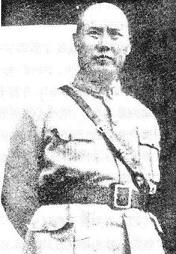 On November 24th, 1936, Fu Zuoyi's Suiyuan Province army sacked Bailingmiao from the Inner Mongolia puppet army.
The arrest of "seven gentlemen" led to the nationwide protests against Chiang Kai-shek's government.
Zhang Xueliang, who already struck secret deals with the communists for sake of obtaining Stalin's military aid through Chinese Turkestan, submitted a release petition, and subsequently orchestrated the Xi'an Incident on December 12th, 1936, with a promise to the communists to turn around the tide for relieving the central army's pressure on the remnant Red Army troops in northwest China.
The KMT-CCP contacts remained secretive after the Xi'an Incident per Zhang Ling'ao so as not to arouse Japan's suspicion and indignation. On November 24th, 1936, Fu Zuoyi's Suiyuan Province army sacked Bailingmiao from the Inner Mongolia puppet army.
The arrest of "seven gentlemen" led to the nationwide protests against Chiang Kai-shek's government.
Zhang Xueliang, who already struck secret deals with the communists for sake of obtaining Stalin's military aid through Chinese Turkestan, submitted a release petition, and subsequently orchestrated the Xi'an Incident on December 12th, 1936, with a promise to the communists to turn around the tide for relieving the central army's pressure on the remnant Red Army troops in northwest China.
The KMT-CCP contacts remained secretive after the Xi'an Incident per Zhang Ling'ao so as not to arouse Japan's suspicion and indignation.
Campaigns Against the Communist Strongholds
Ningdu Rebellion By Northwestern Army
Fourth Encirclement Campaign
Relocation Of Hubei-Henan-Anhui Borderline Soviet
Ambush Battles At Huangpi
the Nationalist Government Routing CCP Underground Network In Shanghai
Fifth Encirclement Campaign
Interruptions By Anti-Japanese Allied Army & Mutiny of 19th Route Army
CCP's Political Movement Against Luo Ming
Drain Of Resources Inside Of Jiangxi Soviet
Red Army's Long March (Oct 1934 - October 1936)
Three Preliminary Breakouts
Xiangjiang River Crossing (Nov 25th to December 3rd)
7000 Communist Prisoners of War
Wu-jiang River Crossing
Zunyi Meeting (Jan 1935)
Crossing Chi-shui [Red Water] River Four Times
Planned Conversion Of 1st & 4th Front Armies
Crossing Jinsha [gold sand] River
Luding-qiao Iron Chain Bridge
Climbing Great Snow Mountain
Lianghekou Meeting
Zhang Guotao's Challenging Zunyi Meeting Decisions
Luhua Meeting & Maoergai Meeting
Shawo Meeting & Grasslands of Qinghai
Split of Mao Tse-tung's Red Army From Zhang Guotao's
Zhang Guotao's Defeat At Baizhangguan Pass
Conversion of Red Army 2nd & 4th Fronts
Ningxia-Yinchuan Campaign
Official Completion Of The Long March
Who Authorized First Western Expedition?
Re-organizing Red Army Western Route
Xi'An Incident - Turning Point Of Modern History
Northeastern Army vs Red Army
Communist Infiltrations Into Northwestern Army
Zhang Xueliang's Collusion With CCP
Secret KMT-CCP Direct Contacts In Multiple Channels
On The Eve Of Coup D'etat
Tang Junyao Abducting Chiang Kai-shek At Lintong
Stalin, Comintern & Xi'an Incident
Solution To Coup D'etat
Disintegration Of Northeastern Army
Dissolution Of Mao Tse-tung's "Marriage"
Demise Of Red Army Western Expeditions
CCP Central Abandoning Ningxia Campaign
First Western Expedition
Red Army 9th Corps Being Frustrated At Gulang
Flipping By Mao Tse-tung's CCP Central
CCP Central Ordering Western Route Army Stay Put
Xi'an Coup & CCP Central Order As To Taking Over Ganzhou & Shuzhou
Second Western Expedition
Dong Zhentang's Death With Red Army 5th Corps At Gaotai
40-Day Defense of Nijiayingzi
Final Demise Of Red Army Western Route
Purge Of Zhang Guotao Path
The Japanese Invasion (1937-1945)
Li Zongren pointed out that Japanese Prime Minister Tanaga Giichi first proposed the invasion of Manchuria-Mongolia on July 25th, 1927. What Li Zongren was referring to would be a Japanese cabinet decision from the Oriental Conference, during which the Japanese decided on a proactive approach to securing the interests in Mongolia and Manchuria. Subsequently, the Japanese launched the September 18th, 1931 invasion after giving acquiesce to Soviet Russia's 1929 War of the Chinese Eastern Railway. The apathy from the League of Nations in regards to Japan's invasion would encourage the Italian venture in Ethiopia and Hitler's nullifying the Versailles Treaty in 1933.
After the success in establishing the Eastern Ji [Hebei Province] Anti-Communist Autonomous government,
Japan invaded Chahar & Suiyuan provinces and intended to establish a Puppet Inner Mongolia Government.
Across northern China, the Korean and Japanese vagrants engaged in drug trafficking and smuggling.
Japan officially launched its invasion war against China after several rounds of internal assassination between the factions of militarists,
and cabinet ministers, such as
the 15 May 15 1932 assassination of prime minister Inukai Tsuyoshi,
and
the 26 February 1936 coup,
which saw the Kodaha (imperial way) military officers conducting an unsuccessful assassination against prime minister Okada Keisuke,
the killing of finance minister Takahashi Korekiyo who was a former prime minister as well as Saito Makoto who was Lord Keeper of the Privy Seal and a former prime minister,
the wounding of grand chamberlain Suzuki Kantaro,
and the killing of Watanabe Jotaro who was the Military Education inspector general of the Army Ministry.
The 26 February 1936 coup was taken to be a sequel to
lieutenant-colonel Aizawa Saiburo's assassination of Nagata Tetsuzan on 12 August 12th, 1935, with Aizawa being a member of the Kokutai Genri-ha (cardinal principles of the national bodily system, a military faction overlapping the Kodo-ha or the imperial way faction) and
Nagata being the spiritual leader of the Tosei-ha (control) Faction.
Nagata Tetsuzan was then
Military Affairs Bureau (gunmu-kyoku) chief of the Army Ministry, who advocated for bacteriological or germ (biological) warfare, was responsible for planning Japan's national mobilization strategy, and devised the total war framework that integrated the military and civilian economies.
The Kokutai Genri-ha, with a plan to replace Emperor Hirohito with brother Chichibu, demanded with Hirohito to
clarify the kokutai (national bodily system), stabilize the national life, and fulfill the national defense.
The Kodo-ha (imperial way) Faction was represented by Araki Sadao and
Masaki Jinzaburo, with the latter's sacking in July 1935 by prime minister Hayashi Senjuro from the post of inspector general of Military Education of the Army Ministry blamed on Nagata Tetsuzan.
The Kodo-ha Faction, whose spritual leader was the socialist-fascist demagogue and Pan-Asianist Kita Ikki, purportedly advocated for 'strike north' against the U.S.S.R. while the rival Tosei-ha advocated for expansion of war in China.
For the 26 February 1936 coup, the Kodo-ha generals were purged, and Kita Ikki was arrested and executed in 1937.
Hence, the Japanese army became unified, which facilitated the execution of military ventures in the future.
On November 3rd, 1936, the Japanese launched a huge scale military exercise in northern China.
Around Peking, the Japanese, in the name of military exercises, took over Fengtai, Mixian and Tongzhou, leaving Wanping as the only exit for Peking.
Nationwide, the Chinese launched numerous boycott movements.
In 1936, the Japanese instigated independence of some Inner Mongolian banners.
The Japanese dispatched the Inner Mongolia puppet army against northern Suiyuan Province from Bailingmiao but got repelled by Fu Zuoyi. About this time, working under Prince De-wang, the Chinese Communists, as well as agents dispatched from Soviet Russia and Outer Mongolia, had penetrated into the puppet army for sake of fomenting the war as well as hijacking the puppet army.
On November 24th, Fu Zuoyi's Suiyuan Province army sacked Bailingmiao from Prince De-wang's Inner Mongolia puppet army.
On March 12th, 1937, the Japanese prime minister published a proclamation of three policies in regards to Manchuria, Inner Mongolia and Northern China.
The Japanese secretly planned for a mobilization of 4.48 million field army for war against China, not to mention their inventory of 2700 airplanes and 1.9 million tons of navy force.
On June 5th, the new Japanese prime minister rescinded the three policies and advocated war against China by relocating two echelons to the Fengtai area.
On June 9th, Toyo Hideki proposed that Japan should attack China for stopping the acts of "excluding and insulting Japanese."
(Back in 1935, the Japanese government protested against the "[Chinese] education [ministry] on the matter of 'excluding the Japanese'", demanding that China must "revise the school textbooks". Sounds familiar to today's protests by the Asian countries against the Japanese Education Ministry's attempt at revising the textbooks to whitewash the WWII invasion history?
Just the other way around.)
After initially calling on the world communists to militarily defend the Soviet Union from 1931 to 1933, Stalin subsequently designed the united front in 1935, and ultimately in the time period of 1936-1937 successfully lit the fuse of the Sino-Japanese War by means of repeated GRU operations in northern China.
The Marco Polo Bridge Incident
On July 7th of 1937, at 10:00 pm, a Japanese column that belonged to the Ryodan stationed at Fengtai held a military exercise north of Lugouqiao Bridge (i.e., Marco Polo Bridge or Roko Bridge).
At around 11 pm, the Japanese claimed that one of their soldiers had disappeared and demanded that they enter the city of Wanping for a search.
After Regiment Chief Ji Xingwen (219th Regiment, 37th Division, 29th Corps) declined the request, the Japanese laid the siege on the Wanping town.
By 5:00 am, on July 8th, the Japanese fired their first shot of siege.
More available at
The Marco Polo Bridge Incident [Modified : Sunday, 26-Aug-2012 17:43:23 EDT];
The Battles of Peking & Tientsin.
(Check RepublicanChina-pdf.htm page for up-to-date updates.)
* In Commemoration of China's Fall under the Alien Conquests in A.D. 1279,
A.D. 1644 & A.D. 1949 *
U.S.S.R./Comintern Alliance with the KMT & CCP (1923-1927)
Korean/Chinese Communists & the 1931 Japanese Invasion of Manchuria
American Involvement in China: Soviet Operation Snow, IPR Conspiracy, Dixie Mission, Stilwell
Incident, O.S.S. Scheme, Coalition Government Crap, Amerasia Case & The China White Paper
* Stay tuned for "Republican China 1911-1955: A Complete Untold History" *
|
|
Zou Rong's Revolutionary Army;
Shin Kyu Sik's
Shrine (Spirit, Kunitama) of Korea
|
This snippet is for sons and daughters of China:
Heed the sons & ministers' agony and sorrow of our ancestors who died or lived through the Mongol, Manchu and Soviet-Chicom conquest
and
the Yongjia, Jingkang and Jiashen cataclysms !
Jeanne d'Arc of China:
Teenager girl Xun Guan breaking out of the Wancheng city to borrow the relief troops in the late Western Jinn dynasty;
Liu-Shao-shi riding into the barbarian army to rescue her husband in the late Western Jinn dynasty;
teenager girl Shen Yunying breaking into Zhang Xianzhong's rebels on the horseback to avenge on father's death in the late Ming dynasty.
China's Solitary and Lone Heroes:
Nan Jiyun breaking out of the Suiyang siege and charging back into the city in the Tang dynasty;
Zhang Gui & Zhang Shun Brothers breaking through the Mongol siege of Xiangyang in the Southern Soong dynasty;
Liu Tiejun breaking through three communist field armies' siege of Kaifeng in the Republican China time period;
Zhang Jian's lone confrontation against the communist army during the June 3rd & 4th Massacre of 1989.
|
|
|
At 9:00 am, on July 8th, the Japanese Kwantung Army proposed to launch a general attack at the Chinese armies in the Hebei and Chahar provinces. Koiso Kuniaki, i.e., occupation commander in Korea, advocated a comprehensive war against China for realizing the grand plan of ruling China.
(Guo Rugui, p. 1:316 citing the Japanese defense agency, the defense research institute, the battle history editorial group, the field army battles during The China Incident, Tokyo, The Asakumo [CHAOYUN] News Press, 1983 1975).
In the late afternoon, the Kwantung Army issued an announcement, accusing Soong Zheyuan's 29th Army Corps of provocation.
The Japanese side continued to mobilize armies for the campaign by calling the soldiers stationed at Tianjin and the Gubeikou Pass.
As far back as 1932, when the Japanese attacked Shanghai, the CCP had instructions for Liu Shaoqi to stage an uprising in Shanghai by taking advantage of the war. In 1933, Ke Qingshi, the CCP rep in Peking, instructed communist, Ji Hongchang, to convert the Chahar Allied Army into the Red Army. In 1937, days before the July 7th Marco Polo Bridge Incident, shots were fired into Wanping, with bullet holes on the wall. Imai checked bullet holes to have determined that they were not from the Japanese guns. On 7-6, Imai, while having a party, was interrupted by Shi Yousan who asked the Japanese to intervene to stop a possible war against China. Heh Jifeng the secret communist, in charge of the 37th Division at the bridge, enrolled in the communist party before 1931, while Zhang Kexia joined the communist party in 1929, not in 1938 or later as the CCP records claimed. In the spring of 1937, Zhang Kexia, taking direct order from Liu Shaoqi (alias Hu Fu), the communist head in North China, proposed to have the 29th Corps proactively attack the Japanese towards the Pass of Mountains and Seas in lieu of a withdrawal towards Baoding and Shijiazhuang.
In the immediate days prior to the 7-7-1937 Incident, Heh made arrangement for live ammunition to be distributed.
More, one week ahead of 7-7-1937, the Peking police arrested a team of plaincoats who disguised themselves as communists.
The Japanese spy agency was recorded to have wide collaboration with Chinese communists agents and student activists.
One more corroboration was from Owen Lattimore who, a top Russian agent recruited in China in the 1920s by the Comintern, claimed that
there was a rumor in Peking that on July 7th, 1937, something similar to 9-18-1931 would happen.
After the eruption of war, Imai Takeo learnt that rumors were in wide circulation in Tokyo that "on the night of double seventh day, there would be a replay of an incident similar to Liutiaogou in North China", over which Okamoto Kiyotomi was sent to Peiping from Tokyo by Ishihara, head of the First Section of the Japanese Imperial Staff Headquarters. (Back in late June, Ootani, a brother of the Japanese colonial minister, descended upon Peiping without advance notice, and inquired with Imai as to the urgency in diffusing any possible flare-up of Sino-Japanese incidents. Count Otani Kozui was the 22nd Abbot of the West Honganji Monastery.)
For details on the Chinese Communist and the Soviet Red Army GRU conspiracy to provoke the Marco Polo Bridge Incident and the Sino-Japanese War,
refer to
The Marco Polo Bridge Incident [Modified : Sunday, 26-Aug-2012 17:43:23 EDT];
The Battles of Peking & Tientsin.
From the 8th to the 11th, the Japanese army and Soong Zheyuan's army had intermittent fighting and truce. On the 11th, the Japanese cabinet issued a proclamation of troop dispatchment to northern China, and a new commander-in-chief, Katsuki Kiyoshi [i.e., Xiang-yue-qing], was named for leading the forces in northern China. On July 10th, the Japanese military headquarters proposed the commitment of 15 Shidans and a timeline of half a year for achieving the success of the campaign in China.
On the 12th, the Japanese raised demands as to peacefully resolving the incident.
Chiang Kai-shek, convening his generals and various party leaders on mount Lushan, received a phone call from Peking mayor Qin Dechun in regards to the attack. 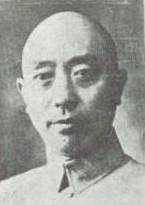 Chiang made a determination that Japan intended to launch a full-scale aggression war against China in the attempt to occupy 'Hua Bei' (i.e., Northern China). Chiang Kai-shek issued a wire calling for resistance in an opposite fashion to what he did in 1931. Chiang made a determination that Japan intended to launch a full-scale aggression war against China in the attempt to occupy 'Hua Bei' (i.e., Northern China). Chiang Kai-shek issued a wire calling for resistance in an opposite fashion to what he did in 1931.
On the three major railway lines of Ping-Han, Long-Hai & Jin-Pu, about 60 passenger trains were allocated for military personnel shipments. Chiang Kai-shek instructed Soong Zheyuan as to uncompromising stand on 8th & 13th, respectively. CCP, which issued a "KMT-CCP cooperation proclamation" on Jul 15th, sent a wire to General Soong Zheyuan's 29th Corps to show support for Soong Zheyuan, Feng Zhian and Zhang Zizhong. Wu Dehou, whose battalion was stationed in Huaiyin of Jiangsu Province, heard of the war outbreak on July 8th via radio, and soldiers were in ecstasy over the prospect of going to the front to fight the Japanese.
On the 17th, on Mt Lushan, Chiang Kai-shek also talked about "peaceful solution." Chiang Kai-shek called upon Soong Zheyuan to deal with Japan on the same standground. Soong Zheyuan continued the talks till the Japanese relief armies arrived to bombard Wanping and Changxindian cities. On the 17th, Tokyo's five-minister cabinet decided to send 400,000 strong army to the Chinese battlefield.
On the same day, on Mt Lushan, Chiang Kai-shek made the famous speech to the nation about 'dying to the last man' and 'sacrificing everything.' From Mt Lushan, Chiang Kai-shek wired to Li Zongren and Bai Chongxi for coming over to the capital. Bai Chongxi flew to Nanking in a French-made six-seat plane, while Li Zongren activated four sessions of trained soldiers who had previously been released back to the countryside for farming. The Guangxi Province recruitment office was immediately packed with peasants who staffed 44 regiments [expanding from the original standing provincial army of 14 regiments], to be led by group army commander Li Pingxian, Xia Wei & Liao Lei, respectively. On July 20th, on Mt Lushan, Dr. Hu Shi and General Jiang Baili adamantly proposed that the ROC government should make ways for both college students and middle school students to continue their studies at the times of war, free of drafting.
The Battle of Tientsin-Peking
The Japanese attacked Langfang, a city between Peking & Tientsin. On July 25th, the Japanese 20th Shidan took over the train station at Langfang, dug positions around the station, and engaged with the 226th regiment of Soong Zheyuan's 29th Corps. By the evening of 26th, the 226th regiment evacuated to Tongxian county. On the 27th, the Japanese commander-in-chief ordered the Campaign of Tianjin-Peking as well as called over the 5th, 6th & 10th Shidans from Japan.
On the 28th, the Japanese commander-in-chief issued the "campaigning oath." The Japanese, with the support of 200 planes, took over Nanyuan. The 38th & 132nd divisions under the 29th Corps resisted Japanese. On July 28th, at the Battle of Tianjin-Peking, 132nd Division Chief Zhao Dengyu as well as Deputy Corps Chief Tong Linge sacrificed their lives fighting the Japanese.
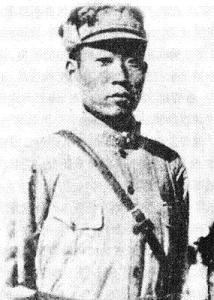 |
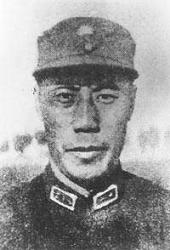 |
At the same time of attacking Nanyuan, the Japanese attacked and took over Beiyuan, Xiyuan and Qinghe, surrounding towns next to Peiping. Japanese planes bombed train stations at Changxindian, Baoding and Shijiazhuang, and chased both passenger and cargo trains along the railway tracks, inflicting heavy damages and injuries. At the urge of Japanese for 'protecting the ancient city', Soong Zheyuan ordered an evacuation out of Peiping. At 9 pm, on 28th, Soong Zheyuan relocated his command center for the south of Yongding-he River and then moved on to Baoding city [which was Chiang Kai-shek's order right after the eruption of Lugouqiao Incident]. 38th Division Chief Zhang Zizhong, with Liu Ruzhen’s regiment which changed into police uniform, was ordered to stay put in Peking to maintain order.
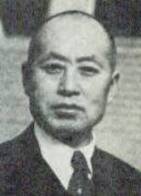 On the night of July 28th, the 1st column of security forces under Yin Rugeng's puppet 'Eastern Hebei Autonomous government', which was re-organized on basis of two regiments of Yu Xuezhong's 51st Corps, staged an uprising overnight, arrested Yin Rugeng, and killed about 300 Japanese soldiers and agents. The Japanese, to avenge on the Chinese killing Japanese militarymen and civilians, subsequently wiped out Tongzhou in a massive massacre. Yin Rugeng escaped after the Chinese security force failed to locate the troops of the 29th Corps and came under the Japanese attack near Peiping. As part of coordinated action, on July 29th, the 38th Division, in collaboration with the police of Tientsin, attacked the Japanese headquarters and army camp at Haiguangshi and took over train stations and Japanese Beicang Airfield. Having penetrated deep into the Japanese concession territory, the 29th Corps failed to take over Haiguangshi as a result of the Japanese plane bombings and relief army from the seas, and had to evacuate from the Tientsin city on the 30th. Residential area of Tientsin incurred heavy Japanese bombing, and Nankai University was bombed to pieces by the Japanese planes. The Japanese, in the Tientsin area, incurred a loss of 2000 deaths and 3800 wounded On the night of July 28th, the 1st column of security forces under Yin Rugeng's puppet 'Eastern Hebei Autonomous government', which was re-organized on basis of two regiments of Yu Xuezhong's 51st Corps, staged an uprising overnight, arrested Yin Rugeng, and killed about 300 Japanese soldiers and agents. The Japanese, to avenge on the Chinese killing Japanese militarymen and civilians, subsequently wiped out Tongzhou in a massive massacre. Yin Rugeng escaped after the Chinese security force failed to locate the troops of the 29th Corps and came under the Japanese attack near Peiping. As part of coordinated action, on July 29th, the 38th Division, in collaboration with the police of Tientsin, attacked the Japanese headquarters and army camp at Haiguangshi and took over train stations and Japanese Beicang Airfield. Having penetrated deep into the Japanese concession territory, the 29th Corps failed to take over Haiguangshi as a result of the Japanese plane bombings and relief army from the seas, and had to evacuate from the Tientsin city on the 30th. Residential area of Tientsin incurred heavy Japanese bombing, and Nankai University was bombed to pieces by the Japanese planes. The Japanese, in the Tientsin area, incurred a loss of 2000 deaths and 3800 wounded
More available at Battles-of-Peking-Tientsin.pdf (Check RepublicanChina-pdf.htm page for up-to-date updates.)
* In Commemoration of China's Fall under the Alien Conquests in A.D. 1279,
A.D. 1644 & A.D. 1949 *
U.S.S.R./Comintern Alliance with the KMT & CCP (1923-1927)
Korean/Chinese Communists & the 1931 Japanese Invasion of Manchuria
American Involvement in China: Soviet Operation Snow, IPR Conspiracy, Dixie Mission, Stilwell
Incident, O.S.S. Scheme, Coalition Government Crap, Amerasia Case & The China White Paper
* Stay tuned for "Republican China 1911-1955: A Complete Untold History" *
|
|
Zou Rong's Revolutionary Army;
Shin Kyu Sik's
Shrine (Spirit, Kunitama) of Korea
|
This snippet is for sons and daughters of China:
Heed the sons & ministers' agony and sorrow of our ancestors who died or lived through the Mongol, Manchu and Soviet-Chicom conquest
and
the Yongjia, Jingkang and Jiashen cataclysms !
Jeanne d'Arc of China:
Teenager girl Xun Guan breaking out of the Wancheng city to borrow the relief troops in the late Western Jinn dynasty;
Liu-Shao-shi riding into the barbarian army to rescue her husband in the late Western Jinn dynasty;
teenager girl Shen Yunying breaking into Zhang Xianzhong's rebels on the horseback to avenge on father's death in the late Ming dynasty.
China's Solitary and Lone Heroes:
Nan Jiyun breaking out of the Suiyang siege and charging back into the city in the Tang dynasty;
Zhang Gui & Zhang Shun Brothers breaking through the Mongol siege of Xiangyang in the Southern Soong dynasty;
Liu Tiejun breaking through three communist field armies' siege of Kaifeng in the Republican China time period;
Zhang Jian's lone confrontation against the communist army during the June 3rd & 4th Massacre of 1989.
|
|
|
On July 31st, professors of the Peking University held a third assembly for peace even though Peking fell into Japanese hands for three days already. (Principals from three universities of Peking, Qinghua and Nankai would set up interim university in Changsha in Aug 1937; school was relaunched on September 28th; and students began to arrive on October 18th.) By late July, about 115 passenger trains were allocated for military personnel shipments. (Later, during the turmoil in the aftermath of the Pacific War, the homo erectus pekinensis excavated by Jia Lanpo in 1936 from Zhoukoudian would disappear from American-funded Xiehe Hospital. http://www.secretchina.com/news/articles/4/8/13/70172.html pointed out that the Americans had shipped homo erectus pekinensis to Qinhuangdao on December 8th 1941 for transfer to President Harrison which, en route from Manila, was sunken at Yangtze River mouth by the Japanese.)
Early German Efforts At Mediation
Li Ao pointed out that Chiang Kai-shek had asked the European powers to intervene, met with British ambassador Anthony Eden on July 28th, and asked British ambassador Dodds see the Japanese minister in Tokyo. Meantime, Kong Xiangxi requested with Chinese ambassador Wang Zhengting to relay a message to the U.S. president for intervention; U.S. ambassador Crew informed the Japanese prime minister of its willingness to mediate between China and Japan.
The British, who had forged and fostered twenty years of military alliance with Japan, could have exerted the most influence onto Japan but chose to pass on the hot potato to the Nine Power Treaty countries in the hope that the Americans could step in.
The Chinese side did not know that the colonialists actually wanted Japan to teach China a lesson so as to inhibit the Chinese nationalism.
German ambassador Oskar Trautmann was most actively involved in mediation on behalf of China as a result of instructions from German foreign minister Ernst von Weizsacker.
There existed misleading academic discourse over the attitudes of the U.S. and the League.
It was wrongly claimed that
during the 1931 Japanese invasion of Manchuria,
the British wanted to intervene but the Americans did not, and
during the 1937 Japanese invasion, the Americans wanted to intervene but the British did not.
Or, vice versa.
In late August, Robert Anthony Eden, having acknowledged the British fault in forging cooperation with the Americans in 1932 over the Manchuria Incident resolution [- which was likely Lord Lytton's proposal to Wellington Koo that China was to make Manchuria into a neutrality zone in exchange for taking back sovereignty from Japan -- a best ever deal possible in the eyes of Lord Lytton], claimed that the Americans did not wish to intervene in the 1937 Sino-Japanese War for the bad experiences incurred in 1932 but that he would not let down the Americans this time around.
The British seemingly did not know the American national policy - always on a higher plateau than the myopic Europeans since President Wilson's times, i.e., President Hoover's proclivity for Japan, using Japan as a counterweight against the Soviet Union.
The British, who had forged and fostered twenty years of military alliance with Japan, could have exerted the most influence onto Japan but chose to pass on the hot potato to the Nine-Power Treaty countries, i.e., the United States, in the hope that the Americans could step in. The Americans, citing its isolation policies, did not wish to help but gave out some false signals like sending a non-voting observer to the League of Nations' conference [at which the Polish supported Japan in the attempt at encouraging Japan to continue the war so as to ultimately war with the Soviet Union], which gave the British and the International League members the excuse to excuse themselves and pass the hot potato to the Americans.
The British and French, according to Wellington, were ready to make concerted actions with the Americans but would not do so without the Americans.
The Americans, sensing the Europeans' scheme in offloading the hot potato, declined to convene the Nine-Power Treaty conference in Washington D.C., which caused the British to haggle with the Belgians back and forth to get approval on October 15th to convene the conference at Brussels, to which Japan repeatedly declined to attend.
The Americans told Wang Zhengting that should China continue to cite the Nine-Power Treaty, the U.S. would implement the neutrality act, which William Christian Bullitt Jr. (1891–1967) felt inscrutable and tried to debunk with the State Department -- which was to make an official announcement on September 14th in a statement to the merchant fleets.
Bullitt later disclosed that the Americans' national policy or strategic aim was to see the Russians and Japanese' holding a balance of power against each other in China rather than seeing either the Russians or the Japanese overpowering the other party in taking control of China.
The Europeans on the Shanghai Bund, who were fed up with China's nationalism such as demand for revocation of extraterritoriality, actually wanted Japan to attack China so as to teach the Chinese a lesson.
With the European and American powers choosing not to intervene, the U.S.S.R. provided China with military support, sending in the Soviet air force during the Battle of Nanking. Stalin, being deeply worried that China would lose the war and capitulate to Japan, had sent in the Soviet airforce to China to join the Defense Battle at Nanking in November, 1937, with both dead and live pilots captured by the Japanese in the ensuing years.
The Japanese, knowing the presence of Soviet pilots, caught alive or shot down dead, cunningly pretended to know nothing, which was exactly like
they did to the Pacific cargo route to Vladivostok
as if ostriches burying heads in the sand.)
On Aug 7th, the Japanese government approved the Kwantung Army's request for attacking Zhangjiakou (Kalgan), Datong, Huhehot [Huhehaote] and Baotou as well as ordered the Japanese "Northern China Army" in campaigning against eastern segment of Ping-Sui Railway. On Aug 14th, Kwantung army organized Chahar expedition force, with Tojo Hideki in charge. From Aug 11th to Aug 22nd, the Kwantung army and Northern China Army attacked the Ping-Sui Railway from south and north.
In August, Chiang Kai-shek devised four war zones for China, with CCP-controlled Eight Route assigned to 2nd war zone. CCP held the so-called Aug 22-25 Luochuan Meeting to discuss the tactics in war participation. During the meeting, Eight Route numbering was approved by the Nationalist Government as reported by Ye Jianying from Nanking.
In the Yangtze Delta area, Japanese planes, which took off from Taiwan, conducted numerous flights. The Chinese airforce, which was originally planned for departure to Northern China, had to make preparation for fighting in the south.
Prior to the Battle of Shanghai, the Japanese marines and the Japanese residents hastily vacated Hankow for retreat towards the Yangtze river mouth. What happened was that the Japanese were tipped by spy Huang Jun as to the Chinese plan to blockade the Yangtze so as to eliminate the Japanese Yangtze fleet.
The Chinese side successfully decoded the Japanese foreign ministry cables which were instructions to the Japanese consulate to destroy all code books. This was taken to be a signal that Japan intended to fight a battle at Shanghai.
Back in early 1935, Wen Yuqing started collecting the Japanese diplomatic secret cables sent from Tokyo to various Japanese embassies and consulates in Asia. After decoding and deciphering the Japanese cables concerning the business affairs, Wen Yuqing's team began to tackle more sophisticated Japanese cables.
Wen Yuqing, who previously in 1929 took over the Zhenru telegraph station of Shanghai and expanded it to the International Radio Station, launched a telegraph station in Nanking and established the Inspection and Decoding Office for the Secret Radiaograms and Telegram Inspection. By the end of April 1935, Wen Yuqing's team finished the compiling of the Japanese foreign ministry's code books that used the five-digit Morse code-based encoded characters and the English alphabetic coding array with sub-vowels. It was Frenchman Septime Auguste Viguier who first invented the digits-to-Morse encoding system of conversion for the non-Western characters like the Chinese in the 1870s.
Michael Smith, in The Bletchley Park Codebreakers, claimed that the British HMS cryptanalysts, with help from the Australian RAN personnel, broke the Japanese Navy's basic code tasogare in 1928, compiled the Japanese military attaché code's code-chart of 240 units in 1933 (i.e., work of John Tilman), and further cloned a Japanese Navy cipher machine in 1934 (i.e., work of Oliver Strachery and Hugh Foss). In 1934, the British, with the contribution from Hobart-Hampton, Harold Parlett, N.K. Roscoe, J.K. Marsden and Malcolm Kennedy, successfully translated the Japanese romanji-based diplomatic codes and deciphered the ciphers, including the keys that purportedly changed every ten days.
The Japanese, sometime in 1937 and possibly right after the eruption of the Shanghai battle, upgraded their code systems.
The British were able to read Japan's diplomatic telegrams up to the spring of 1939.
On September 4th, 1937, Hirohito, at 72nd session of Japanese parliament, stated that he had asked the interim parliament to increase military budget by 200 million Japanese yen."
Li Ao pointed out that Japanese prime minister did send its ambassador for peace talk with Gao Zongwu [East Asia Section chief of Foreign Ministry] in Shanghai on Aug 8th. This peace talk aborted due to the death of a Japanese in Shanghai. Communist veteran general Xu Xiangqian stated that Japanese launched a new battleground in Shanghai on Aug 13th, 1937 to echo their campaign in Nankou area.
The Japanese Provocation In Shanghai
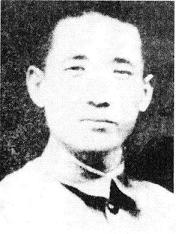 Zhang Zhizhong returned to Shanghai to assume the post of garrison commander on July 13th. One regiment under the 61st Division was secretly sent to the Hongqiao Airport as "security forces." Ammunition was distributed among the security forces and police forces in Shanghai for countering possible Japanese attacks.
On Aug 9th, 1937, a Japanese car, with a captain called Oyama Isao [Dashan Yongfu], intruded into Shanghai's Hongqiao Airport. When the Japanese car refused to stop, the Chinese security forces shot dead the driver. The Japanese captain jumped off the vehicle and was shot dead when fleeing.
Zhang Zhizhong returned to Shanghai to assume the post of garrison commander on July 13th. One regiment under the 61st Division was secretly sent to the Hongqiao Airport as "security forces." Ammunition was distributed among the security forces and police forces in Shanghai for countering possible Japanese attacks.
On Aug 9th, 1937, a Japanese car, with a captain called Oyama Isao [Dashan Yongfu], intruded into Shanghai's Hongqiao Airport. When the Japanese car refused to stop, the Chinese security forces shot dead the driver. The Japanese captain jumped off the vehicle and was shot dead when fleeing.
More available at JapaneseProvocationInShanghai-1937.pdf (Check RepublicanChina-pdf.htm page for up-to-date updates.)
* In Commemoration of China's Fall under the Alien Conquests in A.D. 1279,
A.D. 1644 & A.D. 1949 *
U.S.S.R./Comintern Alliance with the KMT & CCP (1923-1927)
Korean/Chinese Communists & the 1931 Japanese Invasion of Manchuria
American Involvement in China: Soviet Operation Snow, IPR Conspiracy, Dixie Mission, Stilwell
Incident, O.S.S. Scheme, Coalition Government Crap, Amerasia Case & The China White Paper
* Stay tuned for "Republican China 1911-1955: A Complete Untold History" *
|
|
Zou Rong's Revolutionary Army;
Shin Kyu Sik's
Shrine (Spirit, Kunitama) of Korea
|
This snippet is for sons and daughters of China:
Heed the sons & ministers' agony and sorrow of our ancestors who died or lived through the Mongol, Manchu and Soviet-Chicom conquest
and
the Yongjia, Jingkang and Jiashen cataclysms !
Jeanne d'Arc of China:
Teenager girl Xun Guan breaking out of the Wancheng city to borrow the relief troops in the late Western Jinn dynasty;
Liu-Shao-shi riding into the barbarian army to rescue her husband in the late Western Jinn dynasty;
teenager girl Shen Yunying breaking into Zhang Xianzhong's rebels on the horseback to avenge on father's death in the late Ming dynasty.
China's Solitary and Lone Heroes:
Nan Jiyun breaking out of the Suiyang siege and charging back into the city in the Tang dynasty;
Zhang Gui & Zhang Shun Brothers breaking through the Mongol siege of Xiangyang in the Southern Soong dynasty;
Liu Tiejun breaking through three communist field armies' siege of Kaifeng in the Republican China time period;
Zhang Jian's lone confrontation against the communist army during the June 3rd & 4th Massacre of 1989.
|
|
|
By this time, about 180 passenger trains were allocated for the military personnel shipments to both battlefields. The Railway ministry had conducted 3050 train shipments to the front in total.
Dong Zhujun of the Jinjiang [King Kong] Hotel mentioned that innumerable anti-Japanese-invasion magazines sprang up in Shanghai from Aug 13th to November 12th, 1937. This turned out to be the result of liberalization of political control after the eruption of war, which the Chinese communists took advantage of to expand its mantle and hijack the mass movements.
On Aug 13th, the U.S. government issued an order that no American should break the neutrality by helping China to fight the war. Only Chennault, who arrived in Shanghai in June 1937 at the invitation from Mme Chiang Kai-shek, actively helped the Chinese cause.
After seeing Mme Chiang Kai-shek, Chennault signed a three-month contract to be adviser to Mme Chiang's aviation committee, with words recorded in his diaries that Mme Chiang would always be his Princess. Chennault came to China after the encouragement from two friends, Billy McDonald and Luke Williamson. Years back, China's aviation high official Mao Bangchu, after observing Chennault's flying exercises in an air show, had preliminary discussions with Chennault about working for China.
The Air Battles
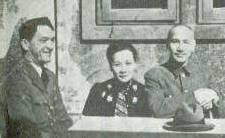 General Chennault, being wary of the Italian scheme at destroying China's airforce, had expressed loyalty to Chiang Kai-shek right after the outbreak of war. Chennault personally went to Nanchang's airplane assembly factory to select good Chinese pilots and instructed them in attacking the unprotected Japanese bombers via a tactic of three against one. Back in late July, Chennault assisted in setting up an air warning system in Nanking, Shanghai and Hangzhou. (Spy chief Dai Li had spent a year in liaising with the Jianqiao Aviation Academy to set up the early warning posts, that extended from the Fujian coastline to the nation's capital.)
On Aug 13th, 1937, Chennault made a decision to bomb the Japanese cruisers with US-made dive-bombers.
Unfortunately, the bombs later dropped onto the Shanghai Bund and the French Concession, causing massive mayhem, as a result of the intense anti-air power from the Japanese anti-air guns set on top of the Bund buildings and the warships.
Chennault instructed the Chinese pilots in dive-bombing the Japanese warships at nights, with loss of only one plane. Pilot Liu Cuigang, on one night, shot down several Japanese planes. General Chennault, being wary of the Italian scheme at destroying China's airforce, had expressed loyalty to Chiang Kai-shek right after the outbreak of war. Chennault personally went to Nanchang's airplane assembly factory to select good Chinese pilots and instructed them in attacking the unprotected Japanese bombers via a tactic of three against one. Back in late July, Chennault assisted in setting up an air warning system in Nanking, Shanghai and Hangzhou. (Spy chief Dai Li had spent a year in liaising with the Jianqiao Aviation Academy to set up the early warning posts, that extended from the Fujian coastline to the nation's capital.)
On Aug 13th, 1937, Chennault made a decision to bomb the Japanese cruisers with US-made dive-bombers.
Unfortunately, the bombs later dropped onto the Shanghai Bund and the French Concession, causing massive mayhem, as a result of the intense anti-air power from the Japanese anti-air guns set on top of the Bund buildings and the warships.
Chennault instructed the Chinese pilots in dive-bombing the Japanese warships at nights, with loss of only one plane. Pilot Liu Cuigang, on one night, shot down several Japanese planes.
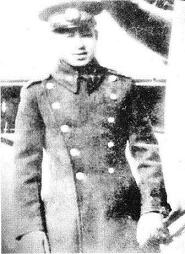 On Aug 14th, there were several batches of Japanese planes attacking into the hinterland, with planes taking off from the carriers as well as from the land base in Taiwan and Korea. In the morning, the Nationalist Airforce shot down multiple Japanese planes above the Jianqiao Airport. In the afternoon, the Nationalist Airforce 4th Group, which just relocated to the Jianqiao Airport, took off without shutting off engine when the news came that 14 Japanese bombers from Taiwan were on the way of bombing Jianqiao. Gao Zhihang, the flight group leader, took over planes (Hawk II) without refueling and destroyed several Japanese bombers over the sky of Hangzhou-Shanghai without incurring any loss on the Chinese side. (Whereas, during the Jan 28th, 1932 conflict, four Chinese planes were shot down during the first round of engagement.) The next day, on the 15th, the Nationalist Airforce 6th Group & 7th Group successfully attacked the Japanese marine headquarters. On this day, Zhang Guangming's 4th Group shot down 3 Japanese bombers which had just bombed Nanking. (Wu Xiangxiang stated that it was on Aug 15th that the Nationalist Airforce shot down 8 Japanese bombers which went for the Nanking bombing.
The exact number of Japanese planes shot down was in dispute; however, the Japanese, having incurred heavy loss, changed the strategy of sending in bombers alone. The Japanese bombers, with powerful engines, could fly much faster than the Chinese fighter planes, not to mention the fuel capacity that enabled them to conduct cross-sea campaigns from Taiwan and Korea airfields.) On Aug 14th, there were several batches of Japanese planes attacking into the hinterland, with planes taking off from the carriers as well as from the land base in Taiwan and Korea. In the morning, the Nationalist Airforce shot down multiple Japanese planes above the Jianqiao Airport. In the afternoon, the Nationalist Airforce 4th Group, which just relocated to the Jianqiao Airport, took off without shutting off engine when the news came that 14 Japanese bombers from Taiwan were on the way of bombing Jianqiao. Gao Zhihang, the flight group leader, took over planes (Hawk II) without refueling and destroyed several Japanese bombers over the sky of Hangzhou-Shanghai without incurring any loss on the Chinese side. (Whereas, during the Jan 28th, 1932 conflict, four Chinese planes were shot down during the first round of engagement.) The next day, on the 15th, the Nationalist Airforce 6th Group & 7th Group successfully attacked the Japanese marine headquarters. On this day, Zhang Guangming's 4th Group shot down 3 Japanese bombers which had just bombed Nanking. (Wu Xiangxiang stated that it was on Aug 15th that the Nationalist Airforce shot down 8 Japanese bombers which went for the Nanking bombing.
The exact number of Japanese planes shot down was in dispute; however, the Japanese, having incurred heavy loss, changed the strategy of sending in bombers alone. The Japanese bombers, with powerful engines, could fly much faster than the Chinese fighter planes, not to mention the fuel capacity that enabled them to conduct cross-sea campaigns from Taiwan and Korea airfields.)
The Japanese revenged the loss of face by continuing to dispatch Taiwan-based planes to the mainland, penetrating as deep as Hunan, Hubei and Jiangxi provinces. The Japanese meantime sent planes to attacking Canton. Meanwhile, the Japanese fighter planes took off from the aircraft carriers to engage the Chinese airforce above the skies of Hangzhou, Changde, Nanchang and Nanking. The Nationalist Airforce 5th Group, which landed in Jianqiao after exhausting fuel in bombing Japanese ships the previous day, joined the 4th Group in fighting the Japanese planes over the sky of Jianqiao Airport. One Japanese pilot was captured alive on this day. Beginning from Aug 15th, the Japanese planes kept dropping bombs over Nanking the capital, and they bombed Nanking three times within 5 days. Books from the Provincial Library, similar to those in Shanghai's Central Library, were destroyed by the Japanese planes.
The National Central University [NCU] of Nanking was bombed on the same day. (NCU called upon professors and students for relocation to Hankou, and on October 10th, 1938, began to relocate again to Chungking. School restarted in early November of 1937 in Shapingba area of Chungking city. When the puppet government was installed in Nanking, former communist party secretary Jiang Zemin attended the puppet National Central University [NCU] of Nanking.
Jiang Zemin tricked the CCP with a claim to be an adopted son of uncle Jiang Shangqing, a communist, in lieu of birth-father Jiang Shijun who served the puppet regime's cultural affairs ministry.
Who cares about this anyway since the communists, the puppets and the Japanese were together all the time?)
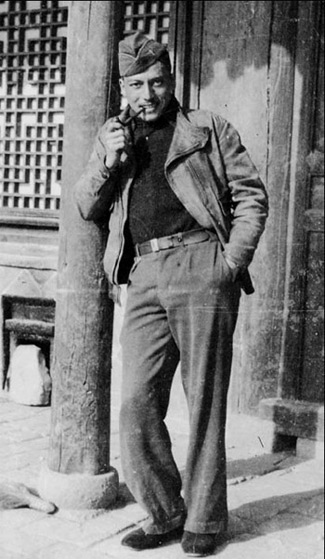 From the 14th to the 16th, the Nationalist Airforce shot down dozens of Japanese planes and bombers. Wu Xiangxiang stated that the Nationalist Airforce, using Chennault's tactic, shot down altogether 54 Japanese bombers, with wreckage of 40 such planes falling in the Chinese-controlled domain. Aug 14th became the Republic Of China's airforce day. Hence, the Japanese dared not send in bombers without cover.
The initial war victory of the Chinese pilots could be attributed to the great sacrifice made by the pilots of the overseas Chinese origin, especially those from Canada and America. Young overseas Chinese men [and women] in America, indignant over the racial discrimination from the Chinese Exclusion Act, longed for serving the motherland, and ever since the 1931 Japanese invasion of Manchuria and the 1932 attack at Shanghai, had volunteered for flight training in the private aviation schools across the cities of Seattle, Oakland, Chicago and Los Angeles, etc., and returned to China to join the Cantonese Air Force which was merged into the Central Air Force later in 1936.
Overseas Chinese pilots came from close to a dozen cities in America, including Seattle, Portland, Oakland, Chicago, Detroit, New York, Phoenix, and Tucson, as well as from Canada.
The most famous of all would be warhawk Arthur Chin of Portland, Oregon, a born-in-America Cantonese with Peruvian heritage.
From the 14th to the 16th, the Nationalist Airforce shot down dozens of Japanese planes and bombers. Wu Xiangxiang stated that the Nationalist Airforce, using Chennault's tactic, shot down altogether 54 Japanese bombers, with wreckage of 40 such planes falling in the Chinese-controlled domain. Aug 14th became the Republic Of China's airforce day. Hence, the Japanese dared not send in bombers without cover.
The initial war victory of the Chinese pilots could be attributed to the great sacrifice made by the pilots of the overseas Chinese origin, especially those from Canada and America. Young overseas Chinese men [and women] in America, indignant over the racial discrimination from the Chinese Exclusion Act, longed for serving the motherland, and ever since the 1931 Japanese invasion of Manchuria and the 1932 attack at Shanghai, had volunteered for flight training in the private aviation schools across the cities of Seattle, Oakland, Chicago and Los Angeles, etc., and returned to China to join the Cantonese Air Force which was merged into the Central Air Force later in 1936.
Overseas Chinese pilots came from close to a dozen cities in America, including Seattle, Portland, Oakland, Chicago, Detroit, New York, Phoenix, and Tucson, as well as from Canada.
The most famous of all would be warhawk Arthur Chin of Portland, Oregon, a born-in-America Cantonese with Peruvian heritage.
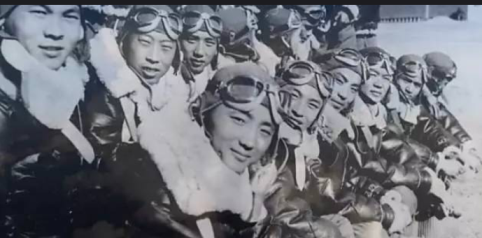
The Japanese exerted pressure on the U.S. government. Some American lecturers and staff left China. Being pressured by the Japanese, the American consulate official tried to have Chennault arrested by the international settlement police. Chennault sent in a letter to the U.S. media stating that he was not 'anonymously' joining the war against the Japanese.
On the 17th, the Chinese airforce bombed the Japanese marines' headquarters again, with pilot Yan Haiwen fighting the Japanese to the last bullet after parachuting out. On the 19th, the Nationalist Airforce, which stationed to the west bank of Taihu Lake, bombed the Japanese warship in the Yangtze River mouth, with one plane [pilot Shen Chonghai] hitting the Japanese warship in an attempt at mutual destruction.
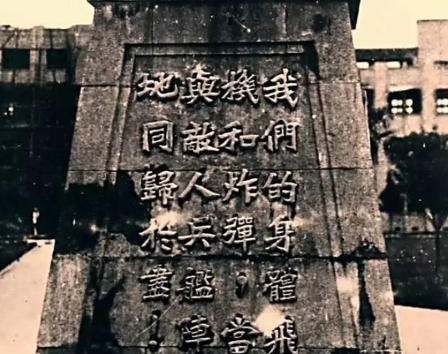 During the course of air battles, Mme Chiang Kai-shek, i.e., Nanny of the Airforce, was recorded to have visited pilots at the airport on a daily basis, and her car, at one time during the Shanghai defense, was chased into a flipover by the Japanese planes.
The Japanese, with espionage report that Chiang Kai-shek might be riding on a British embassy car to Shanghai, chased and shot at the British ambassador's vehicle on the Shanghai-Nanking Road, causing life-threatening injury to the British ambassador.
The Japanese planes, in a sting operation, caused injury to Mme Chiang Kai-shek.
During the course of air battles, Mme Chiang Kai-shek, i.e., Nanny of the Airforce, was recorded to have visited pilots at the airport on a daily basis, and her car, at one time during the Shanghai defense, was chased into a flipover by the Japanese planes.
The Japanese, with espionage report that Chiang Kai-shek might be riding on a British embassy car to Shanghai, chased and shot at the British ambassador's vehicle on the Shanghai-Nanking Road, causing life-threatening injury to the British ambassador.
The Japanese planes, in a sting operation, caused injury to Mme Chiang Kai-shek.
After one month air battles, the Chinese side exhausted most of the planes. Though, Luo Yingde managed to shoot down on September 26, 1937, the first Mitsubishi A5M Type plane
that Yamashita Shichiro was flying.
Luo Yingde, similar to Great Wall Battle hero Huang Jie [who was to become the defense minister of the Republic of China in Taiwan], was to become the deputy commander-in-chief of the R.O.C. airforce in Taiwan, for which the communist government's propaganda TV and movies had skipped his name altogether.
Contrary to the popular historical account stating that Yamashita was executed for attempting to escape prison, Luo Yingde pointed out that he had converted Yamashita to a telegraph decoding agent serving under the Chinese Air Force and petitioned the Republic of China in removing all references to Yamashita in the war records so as to keep Yamashita anonymous. (The Chinese air force had successfully decoded the Japanese air force codes thanks to the defection of Japanese ace Yamashita Shichiro. Though, the Japanese air force codes had no value as the information transmitted was ephemeral, lasting only for the air attack duration. It was due to the Chinese deciphering of the Japanese diplomatic cables that led to the intelligence on the Pearl Harbor attack as well as the intelligence on the Japanese attack on battleship Prince of Wales and cruiser Repulse off Malaya on December 10th, well-noted accomplishment that led the British and Americans to seeking cooperation with the Chinese intelligence. According to Luo Yingde, Yamashita decided to stay on in China and worked as a teacher after the end of the war in 1945 and failed to leave Lanzhou when the communists sacked the city in 1950.)
Oskar Trautmann failed to get any response from Japan on mediation after the outbreak of war in Shanghai.
On Aug 29th, China signed the non-aggression pact with the Soviet Union. Chiang hence naively thought that Stalin might declare war against Japan and fight on the Chinese side, hence delaying the response to the Japanese initiative.
China lodged a protest with the League of Nations on September 9th, 1937.
Due to logistic delay, the Japanese conditions were not presented to China till the eve of the loss of Nanking in early December, by which time the Japanese overturned the previous demands and raised the stakes that made peace impossible.
(The Russians today could still play the same trick to provoke a war between China and Japan/U.S. History could repeat as the Chinese communist rulers were nostalgic about their friendship with Soviet Russia, and had no clue about the Russian cold-bloodedness and cunningness, and did not know what the jungle law was.
Should the Chinese communists ever get into conflict with the United States over Taiwan, there is a good chance that China would lose Chinese Turkestan, parts of Manchuria and Inner Mongolia in addition to Tibet.
In the opinion of Ledovsky or the Russians, Mao Tse-tung hoodwinked Stalin in having the Soviets release the interests back to communist China in late 1952, such as the Chinese Eastern Railway, Dairen and Port Arthur, something that would not be forgotten in the next conflict.
For the
Russians, "not one inch" of land is unwanted.)
The Campaign Of Nankou
On Aug 7th, the Japanese government approved the Kwantung Army's request for attacking Zhangjiakou (Kalgan), Datong, Huhehot and Baotou as well as ordered the Japanese "North China Army" in campaigning against the eastern segment of the Ping-Sui Railway. On Aug 14th, the Kwantung army organized the Chahar expedition force, with Tojo Hideki in charge. From Aug 11th to Aug 22nd, the Kwantung army and Japanese "North China Army" attacked the Ping-Sui Railway from south and north for sake of cutting off China's route towards Outer Mongolia and the U.S.S.R.
The Nationalist Government fought the Battle of Baoding and the Battle of Shijiazhuang along Railroad Ping-han, fought the Battle of Nankou, the Battle of Zhangjiakou (Kalgan) and the Battle of Pingxingguan along Railroad Ping-sui, and fought the Battle of Ping-jin, the Battle of Yaoguandun and the Battle of Dezhou along Railroad Jin-pu.
Meantime, the Chinese were mobilized for paying the roads. Within 20 days, four highways leading from the Shijiazhuang city were completed.
In northern China, on August 13th, Wu Dehou's battalion arrived at Xuzhou of Jiangsu Province. Soldiers were ecstatic upon hearing of the news report of Chinese airforce's shooting down Japanese planes in Shanghai-Wusong Battle.
Wu Dehou's troops arrived in the Liulihe Train Station, near Peking, on Aug 17th and were ordered to defend a height at Yangjiayu, to the northeast of Fangshan. From Aug 18th to mid-September 1937, the 175th Regiment & 176th Regiment under the 88th Brigade of the 30th Division, where Wu Dehou served, defeated repeated Japanese bombardment and charges on a daily basis.
Communist veteran general Xu Xiangqian stated that the Japanese launched a new battleground in Shanghai on Aug 13th, 1937 to echo their campaign in the Nankou area. The Shanghai Battle, however, was not what the Japanese originally contemplated upon.
It was to do with so-called rift between the Japanese field army faction and the navy in regards to the military strategy against China and Soviet Russia.
After the fall of Peking and Tianjin in late July of 1937, fighting moved to Nankou and the Juyongguan Pass. On Aug 11th, the Japanese 11th mixed Ryodan attacked Nankou & the Juyongguan Pass. On the 12th, Tang Enbo's army surrounded the Japanese and cut off the Japanese logistics. On the 14th, Itagaki Seishiro's 5th Shidan was sent to the relief at Juyongguan.
When Wu Dehou's battalion was ordered to retreat, his 4 companies of 621 soldiers had dwindled to 112 while inflicting a death toll of over 700 Japanese in the battleground. Wu Dehou personally shot at the Japanese with heavy machinegun and mounted the bayonet for face-to-face fighting against the Japanese, and he recalled how a deputy platoon chief, Peng Shaofei, wrestled over a Japanese "skewed butt" heavy machinegun and shot at the Japanese till he died of an artillery shell blasting.
On August 16th, Itagaki arrived at Nankou and pushed against Tang Enbo's 13th Corps with five prongs. After 8 days and 8 nights fighting, Itagaki reached the foot of the Great Wall on Aug 24th, and converged with the Kwantung army's 2nd mixed Ryodan at Xiahuayuan.
The Chinese army, after leaving a portion of troops impeding the Japanese army at the front, withdrew to the west.
The reason for the withdrawal was to do with the Japanese Kwantung Army's circuitous maneuver to the northeast side of the pass and the loss of the key positions along the Ping-Sui Railway, to the north of which Liu Ruming's constabulary troops had resisted the Japanese army for weeks.
During the 18 day Nankou Campaign, the Japanese incurred a casualty of 10,000.
http://www.secretchina.com/news/articles/3/11/18/55343.html carried an eyewitness account of the Nationalist army fighting the Japanese near Baoding of Hebei Province. It stated that Wan Fulin's 53rd Corps retreated past their village, and a regiment headed by Lü Zhengcao stranded near their village and developed into Nie Rongzhen's communist-controlled Eighth Route Army in the Renqiu and An'guo area. The author, Zhang Yuming, stated that the Japanese and puppet army visited their village during the days and the communist forces visited their village during the nights. Zhang Yueming stated that the Japanese cavalry frequented their village at an interval of 10-15 days, and often killed peasants in villages where their soldiers died as revenge.
The truth was that Lü Zhengcao, an opium addict who was converted to a communist, took the order from the communist North China Bureau leaders direct to evade the battles, and ordered his battalion of troops to hide in the sorghum fields while letting the Japanese cross the river without a shot.
Lü Zhengcao's army absorbed the various local gentry-organized resistance forces (i.e., the Hebei People's Army) and often massacred the Nationalist Government factions or sympathizers by means of live burial.
There was a book written by a Belgian priest [Raymond de Jaegher] about his entanglement with Lü Zhengcao throughout the years of the anti-Japanese war.
For details, see THE ENEMY WITHIN: An Eyewitness Account of the Communist Conquest of China
In the 1930s, Zhang Yinwu, a retired military general who previously served under Yan Xishan, launched the Sicun (four preservation of Confucius and Mencius' virtues) Middle School in Hebei Province.
At about the same time, Liang Suming (1893-1988) and James Yen launched an experiment with agriculture in Shandong Province by setting up the village schools and Confucian academies, i.e., "The Rural Reconstruction Movement."
Thousands of graduates from both Zhang Yinwu and Liang Sumin's schools later became the pillars of the resistance wars against the Japanese occupation army, and waged relentless guerrilla wars behind the enemy's line, till the Chinese Communists were to wipe them out completely.
The agriculturalist Liang Su-ming, i.e., China's last Confucian, for another example, was hoodwinked by the communists even though he himself walked across Japan-occupied territories to have witnessed the communist brigands' killing of his student-disciples who were waging the guerrilla war against the Japanese behind the enemy's line.
From February to October 1939, Liang Suming spent eight months travelling through the war zones to visit commanders Cheng Qian, Yan Xishan, Wei Lihuang, Yu Xuezhong, Peng Xuefeng (communist), and Shen Honglie, et al.
In northern Henan province, Liang Suming's entourage encountered the Japanese army, on which occasion Liang Suming and six followers broke out of encirclement for a mountain top and escaped the Japanese detection through high clouds that permeated the air.
Among the entourage was Gong Zhuchuan, a former student, who was later killed by the communists.
Back in Chungking, Liang Suming visited the communist Eight Route Army representative office at No. 50 Zengjiayan, and complained to senior communist leaders Chen Shaoyu, Qin Bangxian, Lin Zuhan, Wu Yuzhang and Dong Biwu, et al., about the communist murder of his student Gong Zhuchuan as well as raised the concern over the KMT-CCP civil wars that raged on in the six northern China provinces that he traversed.
Qin Bangxian pretentiously jotted down Liang Suming's talk points but none of the communist leadership had any opinions as to the communist massacre of compatriots during the time of war.
In hometown Anhui Province, Yu Yingshi (Yu Ying-shih, 1930-2021), a later Princeton University Sinologist, experienced the communist New Fourth Army's massacring 300 villagers as well as witnessed the corpse of a clan cousin killed by the communists. This was similar to Belgian priest Raymond de Jaegher's witnessing Lü Zhengcao's communist army murdering thousands of Sicun Middle School graduates.
Lü Zhengcao, an opium addict, pretentiously talked about how his communist-controlled Northeastern Army-converted Hebei guerrilla army fought against the Japanese when he visited Zhang Xueliang in the United States.
Yu Yingshi, who was ready to leave Hongkong for mainland China in 1950, came to his intuition to abort the trip, and throughout his life, refused to return to China, with a claim that he, with thoughts for China enduring on his mind, would be where the flowery Hua-Xia [Sinitic] China was.
Raymond de Jaegher had detailed description about the Chinese communists' killing the Sicun Middle School graduates, by the means of live burial and decapitation by hundreds and thousands.
Belgium-born French Priest Vincent Lebbe, a devout priest who was first sent to China in 1895 and later went back to France to assist with the Chinese students, organized the medical relief activities to the Chinese army from 1927 to 1940: Father Lebbe died in June 1940 after being released from the communist forces led by Liu Bocheng.
More available at THE ENEMY FROM WITHIN: CHINESE COMMUNIST ATTACKS AT GOVERNMENT TROOPS - 1940
(Check RepublicanChina-pdf.htm page for up-to-date updates.)
The Communist Purge of Patriotic Guerrilla Army in Chahar-Jehol-Hebei
One of the earliest communist purge actions would be against the several hundreds of student army troops led by Youth Party (Statist Party) leader Zhao Tong, with the most notorious act being the killing of close to one hundred Peking-Tientsin students, such as Xiong Dashen (Xiong Dazhen), a classmate of China's nobel prize winner Yang Zhenning, among the others.
Xiong Dashen, at one time acting as the communist logistics department chief, was credited with manufacturing the mines and explosives for the communist army, something the communists made into the later propaganda movies such as 'The War of Mines.'
Note that the Jehol area used to be the guerrilla army under Youth Party leader Zhao Tong who fought against the Japanese since 1931-1932. To prevent Zhao Tong's Jehol Vanguard Army, about 200-300 men and women, from returning to Jehol from Chungking, the communist armies, with advance information from communist leader Zhou Enlai who superficially participated in the farewell ceremony for the march of the vanguard army in Chungking, pooled resources all over the military districts including Heh Long's communist army from northwestern Shanxi and Suiyuan area, and ambushed and eliminated the vanguard army in the tri-provincial area of Shanxi-Henan-Hebei around the turn of 1939-1940.
The communists, in the Chahar-Suiyuan area and around Mt. Daqingshan [the great green mountain], had conducted similar horrifying campaign against the patriotic guerrilla forces, including the fire attack that killed a 90-year-old former Northeastern Cavalry Army corps commander and his guerrilla army, and furthermore attacked and eliminated KMT party operator Chen Jianzhong's party-directly-controlled guerrilla forces and all couriers who were sent through the communist-controlled territories of Shanxi-Shenxi, with Chen Jianzhong being the sole survivor to return to Chungking in disguise.)
This webmaster once had a dream about high school teacher leading the classmates into the guerrilla war.
This was after reading communist writer Qu Bo's novels Shan-hu Hai-xiao (wuthering mountains and tsunami).
After reading about the communist purge of the patriotic student army in Mt. Daqingshan, near the Chahar-Jehol area, this webmaster realized that what Qu Bo depicted in novel Shan-hu Hai-xiao had happened across the country.
Namely, patriotic schoolmasters and their student army all fell victims to the communists' killing which was solely for control of the armed forces and people, not for fighting the Japanese.
Qu Bo, in novel Shan-hu Hai-xiao which depicted a middle school principal who led his students in a guerrilla war against the Japanese, talked about the split of the classmates into two camps, with the communists taking over the student army in the fight against 'wan [stubborn] jun [army]', i.e., the government troops.
Like forger Mo Yan (Guan Moye), i.e., year 2012 Nobel literature prize winner with the novel The Red Sorghum, Qu Bo fell into the same brainwashed communist mindset and covered up the Chinese Communists' bloody purge of the patriotic guerrilla armies throughout the Shandong peninsula.
Using the communist coined term 'wan [stubborn] jun [army]' for the government troops, the communist army, during the resistance war, systematically massacred the gentry-organized guerrilla army, the government guerrilla army, the village elderlies and the government behind-the-enemy-line officials, not to mention the communist self-inflicted purge of the communists who were accused of being Trotskyites.
* In Commemoration of China's Fall under the Alien Conquests in A.D. 1279,
A.D. 1644 & A.D. 1949 *
U.S.S.R./Comintern Alliance with the KMT & CCP (1923-1927)
Korean/Chinese Communists & the 1931 Japanese Invasion of Manchuria
American Involvement in China: Soviet Operation Snow, IPR Conspiracy, Dixie Mission, Stilwell
Incident, O.S.S. Scheme, Coalition Government Crap, Amerasia Case & The China White Paper
* Stay tuned for "Republican China 1911-1955: A Complete Untold History" *
|
|
Zou Rong's Revolutionary Army;
Shin Kyu Sik's
Shrine (Spirit, Kunitama) of Korea
|
This snippet is for sons and daughters of China:
Heed the sons & ministers' agony and sorrow of our ancestors who died or lived through the Mongol, Manchu and Soviet-Chicom conquest
and
the Yongjia, Jingkang and Jiashen cataclysms !
Jeanne d'Arc of China:
Teenager girl Xun Guan breaking out of the Wancheng city to borrow the relief troops in the late Western Jinn dynasty;
Liu-Shao-shi riding into the barbarian army to rescue her husband in the late Western Jinn dynasty;
teenager girl Shen Yunying breaking into Zhang Xianzhong's rebels on the horseback to avenge on father's death in the late Ming dynasty.
China's Solitary and Lone Heroes:
Nan Jiyun breaking out of the Suiyang siege and charging back into the city in the Tang dynasty;
Zhang Gui & Zhang Shun Brothers breaking through the Mongol siege of Xiangyang in the Southern Soong dynasty;
Liu Tiejun breaking through three communist field armies' siege of Kaifeng in the Republican China time period;
Zhang Jian's lone confrontation against the communist army during the June 3rd & 4th Massacre of 1989.
|
|
|
Fighting Along the Ping-Sui Railroad, Xuanhua-Yuxian Highway & Railroad Ping-Han
The Chinese national army held an oath of war and departed for the front via the railroads, defending the cities, one by one, along the railroads of Ping-han, Jin-pu and Ping-sui.
Xu Xianqian stated that Japanese attacked northeastern Shanxi via three routes: two Japanese columns, after taking over the Zhangjiakou (Kalgan) city, marched westward against Datong of Shanxi Province along the Ping-Sui Railroad and against Mt Hengshan passes along the Xuan-Yu (Xuan-Wei) Highway, while the 3rd Japanese column marched southwestward against Baoding & Shijiazhuang along Railroad Ping-Han.
Li Zongren commented that Japan, which mis-read the Mongol-Manchu conquest of China, had committed one more mistake in the direction of attacks: Japan invaded into the mountainous Shanxi Province to the west instead of going down south. The Japanese launched invasion of Shanxi Province after victory in Hebei Province, in the attempt to secure the northern Chinese territories.
Li Zongren did not know that Japan and Soviet Russia were scheming to partition China along the North Yellow River Bend, the East Yellow River Bend, and the Tongguan Pass to southern China, similar to Stalin and Hitler's partition scheme for Poland.
On Aug 24th, the Kwantung army's 2nd mixed Ryodan took over a height to the southwest of Zhangjiakou and cut off the Ping-Sui Railway. The Battle of Zhangjiakou went on for four days before the Chinese forces pulled out on Aug 27th. On Aug 31st, Japan established the "Northern China Front Army" with an addition of the 14th, 16th, 108th, and 109th Shidans. On September 4th, Terauchi Hisaichi, commander-in-chief of the 280,000 men "Northern China Front Army", ordered the Japanese First Army on an attack at the northern segment of the Ping-Han Railway, accompanied by the auxiliary attacks on the left and right flank. On the left, the Japanese Second Army was to push along the Tientsin-Pukou Railway, and on the right, the Japanese 5th Shidan was to penetrate into Shanxi Province.
Around the Peiping-Hankow Railway, on September 14th, the Japanese First Army mounted a frontal attack at Liulihe while Doihara Kenji’s 14th Shidan crossed Yongdinghe River to the Gu'an and Yongqing area for a circumvential westward attack at the Zhuoxian county. The Japanese 6th and 20th Shidans also went south and took over Fangshan. On the 16th, the 6th Shidan stranded into a swamp area near the Niutuozhen town and encountered attacks from the Chinese forces. On the 19th, the 6th Shidan took over Dingxing, on the 20th took over Xushui, and on the 21st crossed Caohe to surround the Baoding city.
Wu Dehou's column, while retreating, encountered daily bombing by the Japanese planes, and in Ping-bei of Hebei Province, they fought the Japanese for another two days & two nights. Wu Dehou engaged with the Japanese again after retreating to the Nanyu Train Station, near the Niangziguan Pass of Shanxi Province, on which occasion a bullet pierced through his left palm within 10 seconds of mutual spotting by the two parties. (See Xinkou Campaign for further details on wars towards Shanxi Province.)
On September 23rd, the Japanese 14th and 20th Shidans also came to Baoding. The 6th Shidan incurred heavy loss in attacking the city without heavy artilleries, and had to stop attacks for 140 tanks, 200 cannons and 60 planes to come to its aid. On September 24th, the Chinese defense troops of the 47th Division evacuated from Baoding. The Baoding Battle would cause Japanese a casualty of 8000 against Chinese side of 20000.
On September 28th, the Japanese 1st Army ordered that the 6th, 14th, 20th & 108th Shidans attack Shijiazhuang from two sides of east and west. Meanwhile, the Kwantung army took over Ruyuekou of northern Shanxi Province, while the Japanese 2nd Army took over Cangzhou of Hebei Province. 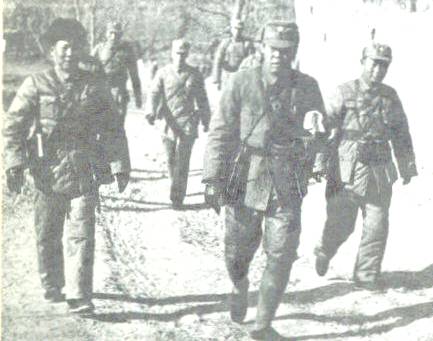
On October 6th, the Japanese reached the Dingxian and Quyang counties. With the Japanese Kwantung army breaching the Ruyuekou and Yanmenguan Pass of northern Shanxi Province on October 2nd, Chiang Kai-shek vacated the Ping-Han Railway by rerouting the 3rd Corps, 17th Division and Sun Lianzhong’s 1st Corps-group towards the Niangziguan Pass of Shanxi Province. Wei Lihuang's 14th Group Army of four divisions also relocated to Xinkou of Shanxi Province. Only the 32nd Corps was retained at the Peiping-Hankow Railway. On October 8th, the Japanese took over Zhengding and Lingshou, the doorway to Shijiazhuang. The Chinese forces at Zhengding evacuated after incurring a loss of more than half. The Japanese then forcefully crossed the Hutuohe River to sack Shijiazhuang on October 10th. The Chinese 32nd Corps retreated across the Zhang-he River.
The Japanese 6th Shidan was dispatched to the Shanghai-Wusong battlefield. On October 15th, the Japanese 14th Shidan took over Xingtai of Hebei Province, and on the 17th took over Handan.
On October 15th, the Japanese 108th Shidan reached Zhaoxian county; meanwhile, Nishio Toshizo's 2nd Army, with the 16th & 109th Shidans, reached east of Zhaoxian. On October 27th, the Japanese 14th Shidan reached Anyang, and on November 4th, took over Anyang. The Japanese completed the campaign of the northern segment of the Ping-Han Railway at a casualty of 30,000. Shang Zhen, who was promoted to the 20th group army commander, had engaged with the Japanese in the battles at Zhengding, Yuanshi & Anyang of Hebei-Henan provinces.
The Battle of the Niangziguan Pass, which Wu Dehou participated in, ensued after the Japanese took over Baoding & Shijiazhuang on the Railroad Ping-Han.
THE PINGXINGGUAN-YANMENGUAN-YANGFANGKOU CAMPAIGN
On September 4th, the Japanese North China Front Army ordered the 5th Shidan to Yuxian County for preparation of the Campaign of the Baoding Plains. On the 6th, the 5th Shidan, with three prongs, pushed against Yuxian from Xuanhua, Xinbaoan and Huailai. On the 10th, the Chinese 68th Corps abandoned Yuxian on the pretext of joining the First Group Army’s battle of order on the Tientsin-Pukow Railway. Tang Enbo immediately sent a regiment from Gao Guizi’s 17th Corps to Yuxian. On the 11th, the Japanese 5th Cavalry Rentai took over Yuxian ahead of the arrival of the Chinese regiment. Meantime, the Japanese 41st Rentai pushed to the north of Laiyuan. Xu Yongchang of the First War Zone dispatched one regiment of Zeng Wanzhong’s 3rd Corps to Laiyuan.
In the northeastern Shanxi, at the railway line, Yan Xishan deployed Li Fuying's 61st Corps at Tianzhen & Yanggao, just inside of great wall and to the northeast of Datong. Also guarding the Datong area would be Zhao Chengshou's cavalry & Wang Jingguo's 19th Corps. 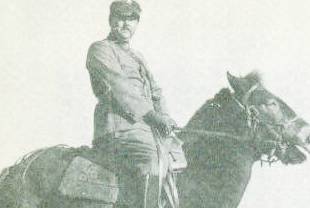 As a synchronized action, the Japanese Kwantung Army pushed along the Peiping-Suiyuan Railway. On September 3rd, the Japanese 15th Mixed Ryodan probed the 61st Corps’s positions till dusk. On the 4th, the Japanese army, under the cover of planes and cannons, attacked two mountains to the east of Tianzhen for another whole day. On the 6th, the Japanese took over Mt Panshan to the southeast of Tianzhen. On the 7th, the 61st Corps abandoned Tianzhen by leaving the 299th Regiment inside of the city. On the 8th, the Japanese planes bombed Yanggao, and the Japanese 15th Ryodan, with the addition of the backup 11th Rentai, attacked towards Yanggao with two prongs. On the 10th, the Japanese laid the siege of Yanggao where the Chinese 414th Regiment lost the city after incurring heavy loss. On the 11th, Tianzhen was lost after the Japanese blasted apart the northeastern citywall. After losing Datong, Yan Xishan executed Li Fuying for dereliction of duty.
(Note that Li Fuying had a secret communist daughter, with the communist plan being to preserve troops for future civil wars rather exhausting selves in the resistance war.)
As a synchronized action, the Japanese Kwantung Army pushed along the Peiping-Suiyuan Railway. On September 3rd, the Japanese 15th Mixed Ryodan probed the 61st Corps’s positions till dusk. On the 4th, the Japanese army, under the cover of planes and cannons, attacked two mountains to the east of Tianzhen for another whole day. On the 6th, the Japanese took over Mt Panshan to the southeast of Tianzhen. On the 7th, the 61st Corps abandoned Tianzhen by leaving the 299th Regiment inside of the city. On the 8th, the Japanese planes bombed Yanggao, and the Japanese 15th Ryodan, with the addition of the backup 11th Rentai, attacked towards Yanggao with two prongs. On the 10th, the Japanese laid the siege of Yanggao where the Chinese 414th Regiment lost the city after incurring heavy loss. On the 11th, Tianzhen was lost after the Japanese blasted apart the northeastern citywall. After losing Datong, Yan Xishan executed Li Fuying for dereliction of duty.
(Note that Li Fuying had a secret communist daughter, with the communist plan being to preserve troops for future civil wars rather exhausting selves in the resistance war.)
The Chinese Communist Party re-organized the Red Army into three divisions (under the Nationalist Army's Eight Route numbering) in accordance with bilateral negotiation held from Aug 9th to September 22nd in Nanking. The communists, having lost ranks in the civil wars, had to create hurdles to prevent the government army inspectors from fully counting the true heads of soldiers that the communists had falsely claimed to have. The CCP initially committed two divisions to participation in the Campaign of Xinkou. After much delay, the communist army participated in the Pingxingguan Pass Campaign against the Japanese in September 1937. The Communist leaders, like Xu Xiangqian, Zhu De, Xiao Ke, Peng Dehuai, Nie Rongzhen and Cheng Zihua, et al., boarded train in Xi'an for Tongguan where they crossed the Yellow River for the Fenglingdu crossing on the other side. While Nie Rongzhen went to the camp of the CCP 115th Division at Houma, Xu Xiangqian at al., went on to Taiyuan for discussions with zone commander Yan Xishan. On September 7th, 1937, Xu Xiangqian went to Lingkou, near the Yanmenguan Pass, where Yan Xishan was directing the Campaign of Datong. (The Yanmen'guan Pass, to the northwest of ancient Dai-xian county, was situated in the middle of Datong and Taiyuan.) Xu Xiangqian pointed out that Yan Xishan had basically adopted the "trench warfare" by lining up the defense along the three passes of Niangziguan, Longquan'guan and Pingxingguan in the middle segment of eastern Shanxi Province. In the northeastern Shanxi, Yan Xishan deployed Li Fuying's 61st Corps at Tianzhen & Yanggao, just inside of the outer great wall and to the northeast of Datong. Xu Xiangqian was asked by Yan Xishan to coordinate with Fu Zuoyi's 35th Corps.
While Xu Xiangqian was visiting his family in the Wutaixian county, after an absence of 12 years, Yan Xishan's forces retreated towards the Yanmen'guan Pass from the Datong area. On September 23rd, CCP leader Zhou Enlai authorized the 115th & the 120th Divisions in assisting Yan Xishan's army. Zhu De, Peng Dehuai & Ren Bishi reported the deployment plan to Mao; however, Mao refrained from approving the plan till after the Battle of Pingxingguan Pass. (Later, in July 1938, a military attaché -- wrongly written as someone of the U.S. consulate, by the name of Carlson, interviewed Xu Xiangqian in regards to the Pingxingguan Pass Battle. Carlson, a pro-communist, of course showed no interest in the truth of the communist army's feats at the Campaign and Battle of Pingxingguan.
Communist general Lin Biao, who directed the Pingxingguan ambush to have eliminated a Japanese logistic column of 100 to 200 men, was shot and wounded by the Shanxi provincial army while wearing the captured Japanese military uniform, for which he was shipped to Moscow for treatment and would not return till 1942, on which occasion Hu Zongnan arranged for spy chief Dai Li to fly over to Xi'an for meeting with Lin Biao and converting Lin Biao back to the Whampoa commandant's side.)
Shortly after the battle, the CCP, no longer following the war zone commander's orders, dispatched the 115th Division to Mt Wutaishan of northeastern Shanxi, the 120th Division to Mt Guancenshan of northwestern Shanxi, the 129th Division to two sides of Railroad Zheng-Tai [Mt Taiyueshan], and Bo Yibo's "Shanxi Native Duel Column" to southeastern Shanxi Province. [Aside from the Pingxingguan Pass Campaign, Peng Dehuai had orchestrated a so-called "Hundred Regiment Campaign" in Aug 1940. During the eight year long resistance wars, the CCP lost two senior military leaders, i.e., Zuo Quan & Yang Jingyu.]
More available at PINGXINGGUAN BATTLE & PINGXINGGUAN CAMPAIGN (Check RepublicanChina-pdf.htm page for up-to-date updates.)
* In Commemoration of China's Fall under the Alien Conquests in A.D. 1279,
A.D. 1644 & A.D. 1949 *
U.S.S.R./Comintern Alliance with the KMT & CCP (1923-1927)
Korean/Chinese Communists & the 1931 Japanese Invasion of Manchuria
American Involvement in China: Soviet Operation Snow, IPR Conspiracy, Dixie Mission, Stilwell
Incident, O.S.S. Scheme, Coalition Government Crap, Amerasia Case & The China White Paper
* Stay tuned for "Republican China 1911-1955: A Complete Untold History" *
|
|
Zou Rong's Revolutionary Army;
Shin Kyu Sik's
Shrine (Spirit, Kunitama) of Korea
|
This snippet is for sons and daughters of China:
Heed the sons & ministers' agony and sorrow of our ancestors who died or lived through the Mongol, Manchu and Soviet-Chicom conquest
and
the Yongjia, Jingkang and Jiashen cataclysms !
Jeanne d'Arc of China:
Teenager girl Xun Guan breaking out of the Wancheng city to borrow the relief troops in the late Western Jinn dynasty;
Liu-Shao-shi riding into the barbarian army to rescue her husband in the late Western Jinn dynasty;
teenager girl Shen Yunying breaking into Zhang Xianzhong's rebels on the horseback to avenge on father's death in the late Ming dynasty.
China's Solitary and Lone Heroes:
Nan Jiyun breaking out of the Suiyang siege and charging back into the city in the Tang dynasty;
Zhang Gui & Zhang Shun Brothers breaking through the Mongol siege of Xiangyang in the Southern Soong dynasty;
Liu Tiejun breaking through three communist field armies' siege of Kaifeng in the Republican China time period;
Zhang Jian's lone confrontation against the communist army during the June 3rd & 4th Massacre of 1989.
|
|
|
The Campaign of Xinkou
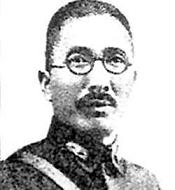 The Nationalist government organized military campaigns centered around Xinkou and Taiyuan, with the Yellow River serving as a natural barrier to the west and south.
After the Yanmen'guan Pass, the Japanese sacked Guoxian [Guoyang] & Yuanping and attacked Xinkou.
A full brigade of Shanxi provincial troops under brigade commander Jiang Yuzhen died to the last person at Yuanping, exceeding the number of days as ordered by the commander to guard the city.
Only a couple hundred wounded soldiers from the brigade were shouldered to the hind.
When the central army troops arrived at the Xinkou area, about 17 kilometers to the south of Yuanping, they noticed the Shanxi army soldiers all standing up silently in the trenches, with tears in the eyes, looking to the north and saluting their fallen comrades.
(The Japanese army, after the war, erected a stone monument recording the event of over 4300 Chinese army soldiers dying to defend the city.)
Yan Xishan & Wei Lihuang were put in charge of defending northeastern Shanxi Province against Itagaki Seishiro's 5th Shidan and three Kwantung Army Ryodan. At Xinkou, the campaign lasted for over one month long, causing the Japanese a casualty of 30,000 to 40,000, but at the price of sacrifice of two Nationalist Army generals, Hao Menglin and Liu Jiaqi. Hao Menglin of the 9th Corps fought against Itagaki Seishiro, with him and division commander Liu Jiaqi sacrificing their lives at the Nanhuaihua battlefield.
To thwart the Xinkou defense, the Japanese army mounted attacks at the Niangziguan Pass In the eastern Shanxi Province. On October 6th, the Japanese First Army diverted attacks towards Jingxing on the Zhengding-Taiyuan Railway, while pincer-attacking the Chinese armies in the Shijiazhuang area in cooperation with the Japanese Second Army.
On October 8th, the Japanese took over Zhengding and Lingshou, the doorway to the Shijiazhuang city and the Jingxing mine area. Shijiazhuang was lost on October 10th. After the loss of Zhengding, Cheng Qian rerouted the rest of the First War Zone troops to Niangziguan-Jingxing, including the 27th Route Army, Zeng Wanzhong’s 3rd Corps, Zhao Shoushan’s 17th Division, the 30th Division of Tian Zhennan’s 30th Corps (i.e., the 26th Route Army), and Li Zhenxi’s Teaching Regiment of the 38th Corps. On October 7th, the 20th Shidan of the Japanese First Army engaged in fighting with the 505th Brigade of the 27th Route Army. The 77th Rentai of the 39th Ryodan from the Japanese 20th Shidan traced behind the Chinese troops towards Jingxing, and engaged with the Chinese 30th Division, 17th Division and 3rd Corps on October 11th. On the 12th, the Japanese, with the assistance of two mountain gun Chutai, breached the 17th Division's positions and took over the Jingxing county capital. The 49th Brigade of the 17th Division retreated towards the Jiuguan Pass. The Chinese troops failed to make preparations for defending the Jiuguan Pass and Mt Xuehuashan, i.e., two prebuilt National Defense fortifications. In the ensuing days of the Niangziguan Pass Campaign, the Chinese troops mounted three offensive operations from October 14th to October 19th.
On October 21st, the 40th Ryodan of the Japanese 20th Shidan, as the southern route, with one field gun Daitai and one mortar Chutai, attacked along the southern circumvential route of Hengkou-Weishuizhen-Ceyuzhen-Shimenkou-Mashancun-Guyipu. Additionally, the Japanese North China Front Army assigned the 109th Shidan to the First Army which consecutively assigned 31st Ryodan of the 109th Shidan to the 20th Shidan as the Xiyang Shitai [Detachment], with the target set at the southernmost route of Xiyang-Guangyang-Yuci-Taiyuan. To the north, the Japanese First Army dispatched the 108th Shidan to the reinforcement of the 20th Shidan. The 104th Ryodan of the 108th Shidan penetrated towards the Liulingguan Pass from the Hongzidian direction as the northernmost route.
After the Japanese took over the Niangziguan Pass [Oct 26th], Yangquan and Pingding consecutively, the Nationalist armies withdrew from the defense of Xinkou on November 2nd.
Taiyuan was taken over by the Japanese on November 9th, 1937, 4 months after the first shot of the war. Prior to the loss, Zhang Shutian ordered the dismantlement of the Northwestern Manufacturing Factory, with 1000 tons worth of equipment, together with two Tong-Pu Railway locomotives, shipped across the Yellow River at the Fenglingdu Crossing. Thereafter, Zhang Shutian, with 1000 staff and workers, shouldered the equipment across the Dasan'guan Pass and precarious Qin-lin Range [2000 meter elevation] for Sichuan Province.
After the fall of Taiyuan, Mao Tse-tung instructed that Lin Biao's 115th Division go to the Lüliang Mountain and that each communist division should aim to recruit three additional regiments immediately.
The communists, with input from Stalin and Dimitri, organized their army into independent regiments without the official numberings. The central government, which received the Soviet aid, had pre-arranged funding for the three communist divisions.
The funding continued till the Jan 1941 Wan-nan Incident.
The CCP's 129th Division released two thirds of its personnel for organizing the communist guerrilla forces in each and every county.
Communist general Xu Xiangqian stated that he was sent to Tang Enbo's Nationalist Government 31st Army Group in Yushe of Shanxi Province for coordination talks; however, Tang Enbo retreated back to Henan Province shortly afterward, leaving southeastern Shanxi Province to the communist forces. Xu was wrong here since Tang Enbo's army was the only Chinese mobile army which participated in almost each and every campaigns throughout the war.
In Shanxi, with the Japanese taking over Niangziguan to the east and the provincial capital in central Shanxi, Tang Enbo orchestrated two battle victories to win enough time for the Chinese army to reestablish positions in southern and southwestern Shanxi, that were to last through the Mt. Zhongtiaoshan Campaign of 1941.
Tang Enbo's army then relocated to the Shandong peninsula and was to play the role of a crack army in the Taierzhuang Campaign on the Shandong peninsula.
Wu Xiangxiang stated that on December 1st, 1939, the Nationalist Government forces launched a winter campaign, with the 1st Military District attacking Kaifeng and Boai and the 2nd Military District cutting off the Zheng-Tai Railroad & Tong-Pu Railroad. The Nationalist Government did not abandon southwestern Shanxi Province till the Battle of Mt Zhongtiaoshan in the spring of 1941.
The communists, after the late 1937 Shanxi campaign, broke away from the united military command of the nationalist government to penetrate towards Jehol, Hebei and Shandong provinces, where they systematically overpowered the local guerrilla armies, including the student army under the command of Zhao Tong.
In Shanxi, the communist army, in collusion with the communist-dominated Shanxi New Army and the Duel Army, first conducted mutiny to convert the New Army and the Duel Army to the communist side, and then very much attacked and kicked out Yan Shanxi's Shanxi Army by the turn of 1939 and 1940.
On November 20th, the Nanking Government announced a relocation of the nation's capital to Chungking, which was reminiscent of the relocation to Luoyang in the aftermath of the Japanese invasion of Shanghai on Jan 28th, 1932. The railway ministry shipped the Jinling Manufacturing Factory to Sichuan via the Jin-Pu & Long-Hai railways.
Later, the railway ministry shipped the weapon manufacturing factory of Bengbu [Anhui Province] as well as equipment of the National Aviation Ministry to the hind.
Reinforced Battle Engagements in Shanghai
The exertion of a whole nation's troops to the Shanghai Campaign, however, was both a Chiang Kai-shek foresight into and a Chiang Kai-shek naivety with geo-politics, which happened to be in the same suits as the Manchu court's pitting one foreign power against the other. What Chiang Kai-shek had hoped for by prolonging the war in Shanghai till early November would be false expectation for intervention by the Nine Power Treaty countries at the Brussels Conference, in the same fashion as the truce brokered by the powers in 1932.
 Jung Chang and Jon Halliday had a Russian conspiracy theory in stating that Chiang Kai-shek's top general Zhang Zhizhong, a Russian mole, had provoked the Sino-Japanese War in Shanghai on Aug 9th 1937. This is Jung Chang's rash conclusion that is similar to the unfounded claim of sabotaged Comintern telegraph set in Shanghai in 1934, or another sense, a commercialization attempt for stirring up interest in her book. Jung Chang mixed up two Russian ambassadors, from 1937 and 1938, respectively, to make up the Zhang Zhizhong conspiracy. The Russian killed in car accident near Moscow was a guy who stationed in Chinese Turkistan before being sent to Wuhan in 1938, not the one in 1937. The Sino-Japanese War officially started on July 11th, 1937. The fallacy of this theory would be to make Japanese cry "foul play" in a revisionist school textbook environment.
(Before the Xi'an Coup of December 12th, 1936, Stalin was playing the trick of settling with Chiang Kai-shek over the matter of two different terms, namely, a half-basket settlement between the U.S.S.R and the Republic of China or a one-basket settlement between the U.S.S.R/Chinese communists and the Republic of China.
The Soviets, using the French fellow-travelers and the pro-communist Chinese exiles in Europe, passed on the wish to strike a security treaty from 1936 onward.
Soviet ambassador Bogomolov, wary of pro-Japan Chinese foreign minister Zhang Qun, worked unofficially towards this end, for which Bogomolov was recalled to the Soviet Union for execution after the eruption of war.
Chiang Kai-shek, being wary of the Soviets' playing the game, had Zhang Qun send a message to Wellington Koo for probing with the Soviet diplomatic staff in Europe as to Bogomolov's true intent in selling a Sino-Soviet security scheme to the non-foreign ministry R.O.C. officials, and forfeited a chance to strike a military-nature alliance with the Soviet Union, when Stalin was paranoid about Japan's possible attack at Siberia.
Even after the Xi'an coup and one month before the July 7th Marco Polo Bridge Incident, ambassador Dmitry Vasilyevich Bogomolov (1890-1937), working with new Chinese foreign minister Wang Chonghui, expressed wish to conclude a Soviet-China mutual security treaty, rather a non-aggression treaty, after an ambiguous condition that the venue to strike a pan-Pacific-rim security treaty (including France, Britain and the U.S.) was to be exhausted, with a detailed suggestion that China was to make the proposal to the powers for convening such a meeting.
This is the notorious ambassador Bogomolov proposal of June 5th, 1937, for which ambassador Bogomolov was executed as Stalin's scapegoat.
The enticement of striking a security treaty with China was a mere attempt at deflecting the possibility of China's joining the anti-Comintern Pact, i.e., Japan's No. 1 demand in the terms of peace in addition to acknowledgement of the puppet Manchukuo's independence;
and that once China was in the war with Japan, Bogomolov's mission or usefulness was over.
Bogomolov actually had Stalin's personal mandate whereas the rest of the Soviet diplomatic corps were not in the know and hence conveyed conflicting opinions.
After the eruption of war, Bogomolov was prohibited from talking about security or alliance treaty, and was soon recalled for execution -- which was a slap on Jung Chang and her British husband's purportedly scholarly research that Bogomolov was executed for protecting the 'communist' identity of General Zhang Zhizhong as the duo were responsible for provoking the Shanghai war as a second front.)
Jung Chang and Jon Halliday had a Russian conspiracy theory in stating that Chiang Kai-shek's top general Zhang Zhizhong, a Russian mole, had provoked the Sino-Japanese War in Shanghai on Aug 9th 1937. This is Jung Chang's rash conclusion that is similar to the unfounded claim of sabotaged Comintern telegraph set in Shanghai in 1934, or another sense, a commercialization attempt for stirring up interest in her book. Jung Chang mixed up two Russian ambassadors, from 1937 and 1938, respectively, to make up the Zhang Zhizhong conspiracy. The Russian killed in car accident near Moscow was a guy who stationed in Chinese Turkistan before being sent to Wuhan in 1938, not the one in 1937. The Sino-Japanese War officially started on July 11th, 1937. The fallacy of this theory would be to make Japanese cry "foul play" in a revisionist school textbook environment.
(Before the Xi'an Coup of December 12th, 1936, Stalin was playing the trick of settling with Chiang Kai-shek over the matter of two different terms, namely, a half-basket settlement between the U.S.S.R and the Republic of China or a one-basket settlement between the U.S.S.R/Chinese communists and the Republic of China.
The Soviets, using the French fellow-travelers and the pro-communist Chinese exiles in Europe, passed on the wish to strike a security treaty from 1936 onward.
Soviet ambassador Bogomolov, wary of pro-Japan Chinese foreign minister Zhang Qun, worked unofficially towards this end, for which Bogomolov was recalled to the Soviet Union for execution after the eruption of war.
Chiang Kai-shek, being wary of the Soviets' playing the game, had Zhang Qun send a message to Wellington Koo for probing with the Soviet diplomatic staff in Europe as to Bogomolov's true intent in selling a Sino-Soviet security scheme to the non-foreign ministry R.O.C. officials, and forfeited a chance to strike a military-nature alliance with the Soviet Union, when Stalin was paranoid about Japan's possible attack at Siberia.
Even after the Xi'an coup and one month before the July 7th Marco Polo Bridge Incident, ambassador Dmitry Vasilyevich Bogomolov (1890-1937), working with new Chinese foreign minister Wang Chonghui, expressed wish to conclude a Soviet-China mutual security treaty, rather a non-aggression treaty, after an ambiguous condition that the venue to strike a pan-Pacific-rim security treaty (including France, Britain and the U.S.) was to be exhausted, with a detailed suggestion that China was to make the proposal to the powers for convening such a meeting.
This is the notorious ambassador Bogomolov proposal of June 5th, 1937, for which ambassador Bogomolov was executed as Stalin's scapegoat.
The enticement of striking a security treaty with China was a mere attempt at deflecting the possibility of China's joining the anti-Comintern Pact, i.e., Japan's No. 1 demand in the terms of peace in addition to acknowledgement of the puppet Manchukuo's independence;
and that once China was in the war with Japan, Bogomolov's mission or usefulness was over.
Bogomolov actually had Stalin's personal mandate whereas the rest of the Soviet diplomatic corps were not in the know and hence conveyed conflicting opinions.
After the eruption of war, Bogomolov was prohibited from talking about security or alliance treaty, and was soon recalled for execution -- which was a slap on Jung Chang and her British husband's purportedly scholarly research that Bogomolov was executed for protecting the 'communist' identity of General Zhang Zhizhong as the duo were responsible for provoking the Shanghai war as a second front.)
Jung Chang called four names, Zhang Zhizhong, Shao Lizi, Hu Zongnan and Wei Lihuang, as communist spies.
She was right on Wei Lihuang, not the others.
This webmaster considers Wei Lihuang's treachery to be comparable to Soong Dynasty prime minister Jia Sidao's abandoning to the Mongol the Xiangyang city [which was under siege for 4-5 years] and Ming Dynasty general Wu Sangui's betrayal of the Mountain and Sea Pass to the Manchus.
As numerous people recalled in their memoirs, Zhang Zhizhong appeared to be the only person daring to call Chiang Kai-shek by "Mr. Chiang" in post-1949 Communist China.
However, Zhang Zhizhong, taking himself to be an erudite, repeatedly fell short of expectations. At the Battle of Shanghai in 1937, Zhang rode on a bike to the front to avoid the
Japanese plane bombing, and later found an excuse to go to the hind to report to Chiang Kai-shek while people were looking for him at the front, which led to a rebuke from Chiang Kai-shek over the phone.
Zhang then further had the dereliction of duty while being empowered as chair of Hunan Province, under whose jurisdiction the scorched-earth policy was mal-executed in Changsha.
However, we could not blame Zhang Zhizhong 100% for his being blindsided by the communist propaganda. The agriculturalist Liang Su-ming, i.e., China's last Confucian, for another example, was
hoodwinked by the communists even though he himself walked across Japan-occupied territories to have witnessed the communist brigands' killing of his student-disciples who were waging the
guerrilla war against the Japanese behind the enemy's line.
(Yang Xiufeng, an Europe/Moscow-returnee who later in 1947/8 ran the communist People's University to vivisect the live government army captives
[including
one young Burma Battle veteran who walked to the west from coastal Zhejiang as a teenager during the 1937 China's Dunkirk Retreat
and did not return home to see his mother for next 12 years],
was one such most notorious dupe who in 1935 returned to China to instigate the anti-government activities in Tientsin, took advantage of the Ho-Umezu Agreement to rebuild the communist cells in North China,
and from 1937 onward was responsible for the communist administration in the Japan-occupied territories of North China. Unfortunately for numerous R.O.C. officials and officers,
their cognizance of the monstrous nature of the communists and communism came too late, often at the time of massive executions in the 1950s.)
For further comments on the validity of accusations against the "four moles", please see Jung Chang's accusations against
Zhang Zhizhong, Shao Lizi, Hu Zongnan and Wei Lihuang.
* In Commemoration of China's Fall under the Alien Conquests in A.D. 1279,
A.D. 1644 & A.D. 1949 *
U.S.S.R./Comintern Alliance with the KMT & CCP (1923-1927)
Korean/Chinese Communists & the 1931 Japanese Invasion of Manchuria
American Involvement in China: Soviet Operation Snow, IPR Conspiracy, Dixie Mission, Stilwell
Incident, O.S.S. Scheme, Coalition Government Crap, Amerasia Case & The China White Paper
* Stay tuned for "Republican China 1911-1955: A Complete Untold History" *
|
|
Zou Rong's Revolutionary Army;
Shin Kyu Sik's
Shrine (Spirit, Kunitama) of Korea
|
This snippet is for sons and daughters of China:
Heed the sons & ministers' agony and sorrow of our ancestors who died or lived through the Mongol, Manchu and Soviet-Chicom conquest
and
the Yongjia, Jingkang and Jiashen cataclysms !
Jeanne d'Arc of China:
Teenager girl Xun Guan breaking out of the Wancheng city to borrow the relief troops in the late Western Jinn dynasty;
Liu-Shao-shi riding into the barbarian army to rescue her husband in the late Western Jinn dynasty;
teenager girl Shen Yunying breaking into Zhang Xianzhong's rebels on the horseback to avenge on father's death in the late Ming dynasty.
China's Solitary and Lone Heroes:
Nan Jiyun breaking out of the Suiyang siege and charging back into the city in the Tang dynasty;
Zhang Gui & Zhang Shun Brothers breaking through the Mongol siege of Xiangyang in the Southern Soong dynasty;
Liu Tiejun breaking through three communist field armies' siege of Kaifeng in the Republican China time period;
Zhang Jian's lone confrontation against the communist army during the June 3rd & 4th Massacre of 1989.
|
|
|
Japan, on July 11th, made the decision to send 4 homeland shidan to China. Bertram, a leftist-leaning news reporter as well as a friend of Smedley, was in Japan to report the event. On page 23 of UNCONQUERED, Bertram noted the Japanese newspaper 'extra', stating that "japan sends an army to north china... four divisions to leave at once..."
In commenting on the Japanese army's war fervor, Hirohito's brother, Takamatsu, claimed that Japan would smash China so hard that China would not stand up again for ten years.
For information on Japan's July 11th, 1937 decision to send in one Shidan from Korea and two Ryodan from Manchuria, in addition to mobilization of three homebase Shidan, refer to
MarcoPoloBridgeIncident.pdf,
Battles-of-Peking-Tientsin.pdf, &
JapaneseProvocationInShanghai-1937.pdf.
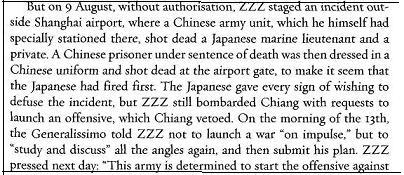 The truth of the Sino-Japanese War could be found in Shanghai Mayor Yu Hongjun's account as well as records of the colonial powers with heavy economic and commercial stakes in Shanghai. On Aug 11th, Yu Hongjun received a briefing that thirty Japanese warships and five transporters from the 1st & 3rd Fleets were coming towards Shanghai. At the request of the Japanese consul, the International Joint Committee for the Shanghai Truce Enforcement [1932] convened a meeting at 3:00 pm on Aug 12th. At the meeting, Mayor Yu Hongjun forced the Japanese consul into acknowledging that the Japanese warships were on their way to Shanghai. During the uproar, Yu Hongjun declared that Japan had broken the truce agreement and that China was no longer bound by the truce. While the newspapers printed about the truce breaching, Sun Yuanliang's 88D (the 72nd Corps) and Wang Jingjiu's 87D (the 71st Corps) entered Shanghai at dawn of Aug 13th. Fighting broke out about 6:00 pm near Baziqiao and Chizhi University.
More about Battle of Shanghai available at
BattleOfShanghai-1937-a.pdf;
BattleOfShanghai-1937-b.pdf;
BattleOfShanghai-1937-c.pdf.
On Aug 23rd, after the Japanese reinforced with two group armies, Chiang Kai-shek dispatched Chen Cheng's relief army to Shanghai. On Aug 30th, Hu Zongnan's 1st Corps, with the 78th Division & the 1st Division, departed Xuzhou of Shandong and Gui'de of Henan Province for Shanghai. The 1st Division entered the battlefield nonstop when Yang Bufei's 61st Division failed to hold the Baoshan-Wusong positions. On September 2nd, the 78th Division also entered the battle to beef up Xia Chuzhong's army. For five days and five nights, the 78th Division & the 1st Division fought the Japanese over every inch of land. The 2nd and 4th Regiment commanders, Yang Jieh and Li Youmei, sacrificed their lives at Gujiazhen during the Battle of Baoshan. On the night of September 4th, Hu Zongnan was ordered to relocate to the Yanghang-Luodian line which was already taken by the Japanese. At the Battle of Yuepu-Luodian, the 1st Corps fought against the Japanese army in an encirclement, a counter-encirclement and an encirclement. Luodian was lost to the Japanese three times and recovered three times within three days. Hu Zongnan personally took pistol and blade in his two hands and charged towards the Japanese position. The Japanese left about 2000 corpses after the defeat.
Three months into the war, China had exhausted most of the planes it had purchased from the U.S., Italy, Germany & France. At this time, General P.V. Rychagov [A-sha-ruo-fu] came to China with four Russian fighter squadrons and two bomber squadrons. Stalin, who declined to invite Chen Lifu & Zhang Chong to Moscow in late 1935 and refused to sign an alliance treaty, stamped a non-aggression pact with China. Though, Stalin refused to join the battles as expected by Chiang Kai-shek. P.V. Rychagov, Chennault & General Zhou Zhirou were responsible for devising tactics during the Defense War at Nanking. The Russians (Soviets) directly controlled their own operations as well as trained the Chinese pilots. Meanwhile, Mussolini recalled home all his Italian aviation advisers while the U.S. continuously sold to Japan the scrap metal & aviation gasoline for war profiteering. (For details on the Russian pilots' fighting in China, see section below on Russian Volunteer Pilots as well as refer to Soviet Fighters in the Sky of China IV (1937-1940) by Anatolii Demin, Aviatsiia i Kosmonavtika, translated by George M. Mellinger)
Before the war outbreak, on Aug 10th, Lin Jiyong, with authorization from the ROC Administrative House, organized a factory dismantlement committee in Shanghai. On Aug 27th, the first batch of 21 wooden ships sailed out of the Suzhou-he River of Shanghai with 4 factories' equipment. After arriving in Suzhou, the engine-driven tractor ships were used to pull the wooden boats to Zhenjiang where larger ships carried them upstream to Hankou. With the Jiangyin segment of the Yangtze blocked, Shanghai factory owners hauled their equipment to Suzhou either via Songjiang or Suzhou. (The segment of the Suzhou-he River was cut off after the loss of Zhabei on October 26th, 1937; after the Japanese' landing in Jinshanwei on November 5th, Shanghai factories were shipped via the foreign-registered ships to Nantong of Jiangsu Province where a relay was made to Zhenjiang or Yangzhou via the Canal; and, thereafter, factories were shipped first to HK or Ningbo of Zhejiang Province.)
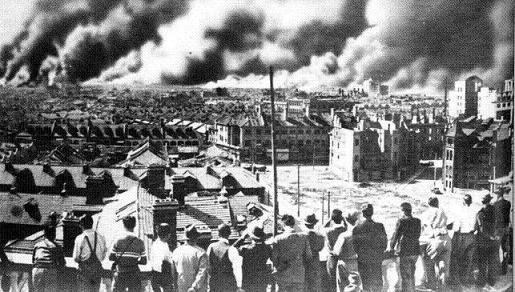 The Japanese army had to send reinforcements to the Shanghai battlefield, consisting of numerous divisions from the Kwantung Army of Manchuria, and the Japanese army units in Taiwan and Japan's homebase.
On Aug 30th, 1937, a general mobilization was ordered. Wu Xiangxiang likened this draft to Tang & Ming Dynasty's draft system. By the end of the year, 700,000 fitful men were recruited either for the army or for the logistics support. From Aug 1937 to May 1940, 6213429 fitful men were called upon for service. Chinese_Tank_Forces_and_Battles_before_1945_ed.htm stated that "The Nationalist Government committed 400,000 troops for the battle. General Chang Fa Kui [Zhang Fakui] commanded 8th and 14th Group Army on the right, General Zhu Shao Liang with 9th and 17th Group army in the center and General Chen Cheng’s 15th and 19th Group army was on the left... On the opposite side, was the IJA [imperial Japanese army] 10th army; 5th and 6th division from Beijing area, 18th division from Manchuria, 114th division, 1st and 2nd infantry reserve regiment, one tank regiment and three independent light tank battalions from Japan. By November 7, the IJA North China army was reinforced with an additional nine divisions and the 3rd and 4th naval squadron including their flagship the Izumo.
In all, the IJA fielded 300,000 men, 200 tanks, 200 aircraft and large number of warships."
The Japanese army had to send reinforcements to the Shanghai battlefield, consisting of numerous divisions from the Kwantung Army of Manchuria, and the Japanese army units in Taiwan and Japan's homebase.
On Aug 30th, 1937, a general mobilization was ordered. Wu Xiangxiang likened this draft to Tang & Ming Dynasty's draft system. By the end of the year, 700,000 fitful men were recruited either for the army or for the logistics support. From Aug 1937 to May 1940, 6213429 fitful men were called upon for service. Chinese_Tank_Forces_and_Battles_before_1945_ed.htm stated that "The Nationalist Government committed 400,000 troops for the battle. General Chang Fa Kui [Zhang Fakui] commanded 8th and 14th Group Army on the right, General Zhu Shao Liang with 9th and 17th Group army in the center and General Chen Cheng’s 15th and 19th Group army was on the left... On the opposite side, was the IJA [imperial Japanese army] 10th army; 5th and 6th division from Beijing area, 18th division from Manchuria, 114th division, 1st and 2nd infantry reserve regiment, one tank regiment and three independent light tank battalions from Japan. By November 7, the IJA North China army was reinforced with an additional nine divisions and the 3rd and 4th naval squadron including their flagship the Izumo.
In all, the IJA fielded 300,000 men, 200 tanks, 200 aircraft and large number of warships."
Three defense lines of Yanghang-Luodian, Baoshan, and Dachang-Beixinjing were in place. On September 18th, Chen Daxun (Chen Suimin), a Wuhan University student, came to report to Hu Zongnan per mutual promise prior to the war. Chen Daxun rallied about 50 youths for fighting the Japanese, with only five surviving by the time of evacuation from Shanghai. In Shanghai, KMT spy chief, Dai Li, authorized gangster leader Du Yuesheng in organizing 4 columns of the "Loyal & Righteous Army For Rescuing Nation" [i.e., 'zhongyi jiuguo jun'] for war participation in Shanghai.
In the Yangtze River mouth, after building an airport on the Chongming-dao Island, the Japanese increased their frequency of bombing campaigns, with 80 planes flying to Nanking on September 20th, one day ahead of a date set in a public announcement. With a ratio of 300:2700, the nationalist air force fought heroically in the air and brought down dozens of Japanese airplanes, with Japanese plane wreckages found in Jurong, Gaozi, Yizheng and Nanking, etc.
On September 25th, the Japanese warplanes flew "five rounds of total 95 sorties" and dropped about 500 bombs onto Nanking the capital. See
http://www-users.cs.umn.edu/~dyue/wiihist/njmassac/situatio.htm
http://museums.cnd.org/njmassacre/njm-tran/.
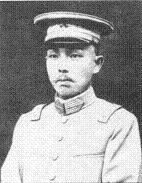 In early Oct, Hu Zongnan's re-organized army took over positions held by Yang Sen's Sichuan army at Dachang, and further defended Yunzaobang for 42 days. After releasing Dachang to Gui-xi's Liao Rui army, Hu Zongnan's army relocated to the south bank of the Suzhou River where they defeated the Japanese attempts at river crossing numerous times. In early Oct, Hu Zongnan's re-organized army took over positions held by Yang Sen's Sichuan army at Dachang, and further defended Yunzaobang for 42 days. After releasing Dachang to Gui-xi's Liao Rui army, Hu Zongnan's army relocated to the south bank of the Suzhou River where they defeated the Japanese attempts at river crossing numerous times.
After spending the National Day on October 10th in Guilin, Li Zongren departed for Nanking, and arrived at the capital on October 12th. The next day, Li Zongren, together with Bai Chongxi, went to see Chiang Kai-shek who previously claimed to have the troops fight to drive the Japanese into the Whampoo [Huangpujiang] River. Days later, Li Zongren suggested that Liao Lei's 21st Group Army could be fetched over for guarding the Suzhou-Jiaxing Concrete Defense Line while the fighting forces in Shanghai could be withdrawn to the hind for re-organization. Li Zongren even suggested that Nanking the capital could be abandoned for sake of a sustained fight against Japan.
Li Zongren likened the narrow battlefield for 50 divisions or 700,000 men as a 'hell of fire' under the bombardment of the Japanese firepower, with the Chinese soldiers falling at a rate of 1000 per hour. However, Chiang Kai-shek adamantly wanted a duel in Shanghai, and further wanted Li Zongren to dispatch Liao Lei's army to the Dachang Battlefield immediately. Chiang Kai-shek, taking cue from the Western nations' officials, wanted to score a few victories ahead of the conference of the League of Nations, not to mention a false belief that Stalin and the Soviets could join the war on the Chinese side. Li Zongren followed Chiang Kai-shek to the Shanghai Battlefield and encountered bombing by dozens of Japanese planes at Suzhou.
On October 21st, Japanese prime minister Konoe Fumimaro refused to allow the Japanese diplomat to attend the League of Nations conference, claiming that Japan would be willing to talk to China direct, with possibly German or Italian mediation. Oskar Trautmann went to the Chinese Foreign Ministry on October 30th with the Japanese message. On November 3rd, Japan proposed "seven demands" to China, including: i) Inner Mongolia to be independent; ii) Northern China to be demilitarized; iii) Shanghai to be administered by the international police, etc.
In mid-Oct, the arrival of Liao Lei's group army temporarily maintained the defense at Dachang. One week later, out of 6 brigade commanders under Liao Lei, 3 were dead, and 2 were wounded. On October 26th, Dachang was lost to the Japanese. But, Hu Zongnan's army still held the line at the Suzhou-he River by daunting the Japanese with short-distance grenade and blade counter-attacks.  In early Nov, Bai Chongxi also advised Chiang Kai-shek of the need to evacuate from Shanghai. 2-3 days later, Bai Chongxi again informed Chiang Kai-shek of the difficulty in sustaining the defense line. 1-2 days later, Bai Chongxi told Chiang Kai-shek that the defense was already broken. By early Nov, the Japanese took over Zhabei, Jiangwan, Liuhang and Zhenru, i.e., the northside of Shanghai, and breached the Nationalist Army's defense line north of the Suzhou-he River. Chiang Kai-shek declined the Japanese demands on November 5th, hoping for the intervention by the Brussels International Conference in which nine countries were participating.
The Jinshanwei Landing
On October 20th, Japan, on basis of the October 9th decision by the Japanese General Staff Headquarters, organized the 10th Army to be commanded by Yamagawa Heisuke, for the Jinshanwei Landing on the Hangzhouwan Bay. Included in the landing force would be the Japanese 18th Shidan, 114th Shidan, 6th Shidan, Kunizaki Shitai Detachment, 9th Independent Light Armor Company Chutai, 2nd Independent Mountain Gun Regiment Rentai, and 6th Independent Heavy Artillery Brigade Ryodan. The Japanese 18th Shidan was originally destined for the Kwantung Army reinforcement. The ferocious Japanese, with the Kwantung Army and some puppets included, undertook the secretive Jinshanwei & Quan'gongting landing on November 5th, slaughtered their way across the countryside of the Hangzhou Bay, massacred the cities of Songjiang and Suzhou, and later participated in the Rape of Nanking via the southern route against the Guanghua-men City Gate of Nanking. Both the "Jinshanwei Landing" and "Southwest of Taihu Lake Campaign" also exhibited the same predatory strategy as shown in the later Pearl Harbor attack of 1941.
Over 100 Japanese ships, carrying the Japanese 10th Army under the escort of the Fourth Fleet, sailed toward Jinshanwei on the night of November 4th. At dawn, the Japanese 18th Shidan landed at Jinshanzui and Caojing, to the east of Jinshanwei, while the 6th Shidan and the Kunizaki Shitai Detachment landed at Jinsiniangqiao and Quan'gongting, to the west of Jinshanwei. Defending the Jinshanwei shoreline would be two companies from an infantry battalion of Chen Guangzhong’s 63rd Division, one cannons company and some salt management police who all died to the last person. The salt management police force was said to have fired the first shot per county chronicle. (The Nationalist army had previously stationed 4 divisions and 1 brigade at Jinshanwei, but those armies were called to the Shanghai defense already.)
Against Chen Cheng’s advice that the Chinese troops immediately withdraw from Shanghai, Chiang Kai-shek wanted three more days. Chiang Kai-shek, back in late October, agreed to pulling back the troops to the Suzhou-Fushan Line and Wuxi-Jiangyin Line; but, on November 1st, Chiang Kai-shek, while speaking to division commanders at a school in Nanxiang, reverted back to the defense of Shanghai when the news came that Belgium agreed to host the Nine Power Treaty conference in Brussels, and pleaded with his generals to persist for at least ten days to two weeks so as to win “sympathy and support” from the international community, not knowing that the colonialists wanted the Japanese to teach China a lesson so as to inhibit China's nationalism.
On November 8th, the Japanese successfully attacked the flank of Shanghai after landing on the muddy beach of Jinshanwei, causing the collapse of the Chinese defense all the way to Nanking. On November 9th, Songjiang was lost. A general retreat from Shanghai was ordered on November 9th, which was too late. Two retreat routes for Hangzhou and Nanking were ordered. Under the bombing of the Japanese planes, 100,000 Nationalist soldiers passed the Suzhou-Jiaxing defense line without a stop.
Eight Hundred Brave Soldiers At the Sihang Cangku Warehouse
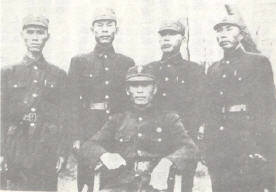 On October 27th, one battalion of Xie Jinyuan's 524th Regiment from Sun Yuanliang's 86th Division, with 400 soldiers, was ordered to provide cover for the Nationalist Government forces' evacuation by taking position at the concrete-walled Sihang Cangku Warehouse on the bank of the Suzhou River, in Zhabei of Shanghai. Xie Jinyuan's 524th Regiment claimed to have 800 soldiers. Dai Li's "Loyal & Righteous Patriotic Army" also participated in providing cover for the main bulk of the Nationalist Army to evacuate from Shanghai.
Hu Zongnan's army retreated under the support of Li Yuetang and Yu Jishi's army. After one day stop at Kunshan, Hu Zongnan's 1st Corps (i.e., the newly-numbered 17th Corps-group) retreated towards Wuxi. Shanghai was lost to the Japanese on November 12th. Xu Zhen stated that the Nationalist Government forces had a total casualty of 300,000 while the Japanese suffered a casualty of 100,000 during the Shanghai-WuSong Campaign. The number of 300,000 is enough to prove that the Chinese were never afraid of dying for the motherland. Later, historians criticized the Shanghai Defense by pointing out that Japan could easily ship over army and supplies via sea while China had to exert great efforts in moving the staff and hauling the equipment overland. For example, Sichuan Prov's Rao Guohua army walked thousands of kilometers to the Taihu Lake after riding ships to sail down the Yangtze from the Sichuan Basin.
Xie Jinyuan's 524th Regiment fought on in Shanghai. People across the river, inside of the foreign settlement, sent over support to the soldiers. A girl scout, i.e., Yang Huimin, was reported to have swum across the Suzhou River carrying a flag of the Republic of China. (In Taiwan, actress Lin Qingxia had assumed the role of Yang Huimin in a film in memory of the resistance war.) Later, at the intervention of the colonialist authorities, this regiment was allowed to evacuate into the settlement where they were disarmed and imprisoned. Xie Jinyuan's 524th Regiment did not retreat to the British settlement till October 31st. While in the Shanghai's settlement territory, Regiment chief Xie Jinyuan died in the hands of a traitor purportedly hired by the Japanese.
Retreat From Shanghai To Nanking
The ancient saying about "the soldiers collapsing like a falling mountain" could be used for this retreat from Shanghai. From Shanghai to Nanking, the concrete defense infrastructure and positions, which were built up in the prior years, was abandoned. Possibly 10 million civilians had joined the exodus leading from coastal China to Nanking and further onward to the hinterland, which showed the determination of the ordinary Chinese to avoid enslavement. Numerous memoirs had description of the arduous trek across China for the Southwest, including people of all ages.
On November 7th, 1927, the Japanese command center established the "Central China Front Army" which was in charge of the "Shanghai Expedition Force" and the Japanese 10th Army. By November 12th, the battles in Shanghai ceased.
After the November 5th Jinshanwei landing, Japan's appetite became insatiable. Taiyuan of Shanxi Province was lost to the Japanese on November 8th, Songjiang was lost on the 9th, Shanghai was lost on the 11th, Daming of Hebei Province was lost on the 11th, Jiashan was lost on the 14th, Kunshan was lost on the 16th, Jiaxing was lost on the 18th, Chefoo [Yantai] of Shandong Province was lost on the 18th, Suzhou was lost on the 20th, Wuxing was lost on the 21st, Wuxi was lost on the 25th, Yixing and Wujing lost on the 29th, and Liyang and Guangde lost on the 30th. Iris Chang cited a British newspaper reporter who visited Songjiang town nine weeks after the Japanese invasion in stating that this British man only found five old persons sobbing in a French church in a city which once possessed an original population of 100,000. Iris Chang also reminded us that at Suzhou, a 350,000 people garden watercourse city on the east bank of the Taihu Lake, the Japanese soldiers intruded into the city gate with masks on their heads and reduced the population to 500 persons. The Japanese raped and abducted tens of thousands of women as 'sex slaves' at Suzhou.
Weeks later, when people returned to Suzhou, the Japanese continued their crime and killed Yang Yinyu, the Japanese-speaking former principal of the women's college of Peking, for the latter's repeated protests with the Japanese consulate about the raping and killing of Chinese girls in Suzhou.
Two concrete defense line, i.e., the Suzhou-Fushan Line and Wuxi-Jiangyin Line, were lost to the Japanese consecutively as a result of chaos. Hu Zongnan, seeing the first line gone because most of the facilities were locked, wired to Dai Li to have the second line be ready for service. Dai Li failed to locate the authorities for opening up the locks on the citadels and blockhouses on the 2nd line. Though, the Chinese forces fought to the last person at the different locations on the two lines. On November 13th, the Chinese forces at Hupuzhen fought the Japanese 16th Shidan which sailed to the Yangtze from Dalian. Hu Zongnan's 1st Corps (i.e., the 17th Corps-group) arrived in Wuxi on November 16th where he received a new regiment of soldiers. Hu Zongnan's troops, which had already lost most of the officers above the platoon level, fought the Japanese tank armies for 3 days and 2 nights between Wuxi and Changzhou, and he wired over to Dai Li about the need to train the new Whampoa cadres. At Sanliqiao and Xiejiaqiao, the Chinese forces fought the Japanese till November 19th. The 956th Regiment at the second defense line fought the Japanese at Zhujiatang on November 20th. On November 20th, Hu Zongnan's 17th Corps-group crossed the Yangtze River to Yangzhou from Zhenjiang, and received three more regiments of new recruits. The Chinese forces fought the Japanese at the outskirts of Wuxi on November 25th. And, on November 26th, with the second defense line breached, the Chinese forces fought Japanese at Jiangyin on the Yangtze River Bank.
The Battle of Jiangyin
Earlier in the war, on Aug 12th, 1937, seven ships from the state-run Commerce Bureau and 16 privately-owned ships were sunken. On September 25th, the outdated warships were sunken as well. Altogether, 43 warships [dating from Manchu Era] and 185 civil purpose ships had been deliberately sunken for preventing the Japanese from sailing upstream. Huge rocks were shipped over from the Yangtze provinces. The blockade lasted for two months over the Japanese bombing. At Jiangyin, Admiral Chen Jiliang led five warships for countering the Japanese attempt at clearing the blockade, and by late September, all five ships were sunken by the Japanese airplanes.
With Tang Shengzhi agreeing to the job for the Nanking defense, Chiang Kai-shek reversed the earlier decision by the Third War Zone as to a symbolic defense of both Nanking and Jiangyin, and conferred onto Liu Xing the deputy commander post for the Nanking Garrison Command Center. At Jiangyin, Liu Xing, the Yangtze defense commander, was ordered to defend the fortress with Heh Zhizhong’s 103rd Division, Huo Shouyi’s 112th Division, two infantry battalions of the fortress and remnant torpedo boats and warships at the blockade line. The 103rd Division was to defend the area to the east of the fortress, while the 112th Division was to defend the area to the south and west of the fortress. Across the Yangtze, the 111th Division of Miao Chengliu’s 57th Corps was assigned the task of defending Jingjiang as well as Nantong. Augmenting the fortress would be eight 88-mm German artilleries and four 150-mm German cannons in addition to 49 guns the fortress was originally equipped with
After taking over Changzhou and Wuxi on November 25th, the Japanese launched three prong attacks at Jiangyin. Liu Xing defended Jiangyin till December 2nd by citing the spirits of Ming Dynasty's "Yan Yingyuan resisting the Manchu invasion at Jiangyin to the last person." Liu Xing's army fought the zigzag wars with the Japanese armored vehicles from November 26th to December 2nd, 1937, and later obtained the approval for an evacuation towards Zhenjiang and Nanking. Under the cover of heavy cannon blasting, Liu Xing evacuated from Jiangyin and later joined the Nanking Defense Battle.
In the subsequent attack on Zhenjiang, the Japanese slaughtered civilians in the same way as they did in Songjiang and Suzhou. However, the horrific news brought to Nanking still failed to vindicate the masses of people who had not witnessed the Japanese atrocity yet.
On December 5th, 1937, the Japanese slaughtered the Chinese villagers around Jiangyin. Jin Hui pointed out that the Japanese soldiers, at the Lujiacun Village, killed 102 male villagers.
The Battle Of Si'an & Guangde
 On November 23rd, Ushijima’s 18th Shidan, riding on boats, crossed the lake to attack towards Changxing on the southern lakeshore.
Yanagawa's Tenth Army moved beyond Huzhou and took over Changxing.
Suematsu’s 114th Shidan, after Changxing, went north towards Yixing and Liyang,
while the Kunizaki Shitai and part of Ushijima’s 18th Shidan attacked southwest towards Si’an and Guangde.
21st Corps Chief Tang Shizun dispatched the 144th Division of the 23rd Corps and the 145th Division of the 21st Corps to defending Nanshan-Jincun
[to the west of Changxing] and Si-an [to the southwest of Changxing].
On November 23rd, Ushijima’s 18th Shidan, riding on boats, crossed the lake to attack towards Changxing on the southern lakeshore.
Yanagawa's Tenth Army moved beyond Huzhou and took over Changxing.
Suematsu’s 114th Shidan, after Changxing, went north towards Yixing and Liyang,
while the Kunizaki Shitai and part of Ushijima’s 18th Shidan attacked southwest towards Si’an and Guangde.
21st Corps Chief Tang Shizun dispatched the 144th Division of the 23rd Corps and the 145th Division of the 21st Corps to defending Nanshan-Jincun
[to the west of Changxing] and Si-an [to the southwest of Changxing].
On 26th, the Japanese army from the 114th Shidan and the 18th Shidan attacked the Chinese 144th Division at Nanshan-Jincun.
The Japanese armored vehicles easily broke through the Chinese defense line on the plains near the Taihu Lake.
The 18th Shidan, together with the Manchukuo puppet army, attacked Rao Guohua's 145th Division of the 21st Corps at Si’an and
subsequently took over Si’an. Guo Xunqi’s 144th Division retreated towards Ningguo.
145th Division Chief Rao Guohua, other than defending Guangde, sent the 437th Brigade towards Si’an.
On the night, the 438th Brigade of Liu Zhaoli’s 146th Division launched a surprise attack with grenades and blades, killed dozens of Japanese,
retook Si'an and captured two field guns.
On November 27th, Rao Guohua and his 437th Brigade continued to defend Si’an against the Japanese attacks.
After numerous seesaw fighting, the Japanese took over most of Si'an again.
By the dawn of the 28th, company commander Hu Rongcheng of the 14th brigade, under Rao Guohua’s command,
led another surprise attack against the Japanese armored vehicles and retook Si'an
On the early morning of November 29th, the Japanese bombers blanket-bombed Si'an. The Japanese field and tank armies launched attack at Si'an.
On the morning of the 30th, Si’an was lost for the fourth time. Rao Guohua retreated to Shibai [Jiebai], within five kilometers of Guangde.
After beating back several rounds of the Japanese attacks, Rao Guohua abandoned Guangde when a regimental commander withdrew from the front line on his own accord. Around noon, Ushijima’s 18th Shidan took over Guangde. With about a battalion of troops left, Rao Guohua mounted an unsuccessful counterattack against Guangde. Besieged by the Japanese at Shizipu, Rao Guohua committed suicide on the night of the 30th. The troops, indignant over the death of their division commander, recovered Si’an and Guangde at one time on December 1st.
The bulk of the Japanese troops were on their way to joining the Nanking attack.
Defense Battle at Nanking
Tang Shengzhi, as garrison commander for Nanking, had about 100,000-150,000 soldiers under his command, including Gu Zhenglun/Gui Yongqing's Central Lecturing Echelon (about 5000 men who retreated from Shanghai), Song Xilian's 36th Division of the 78th Corps, Wang Jingjiu's 87th Division of the 71st Corps, Sun Yuanliang's 88th Division, Ye Zhao's 66th Corps [Yue-jun], Yu Jishi's 74th Corps, Deng Longguang's 83rd Corps [Yue-jun], and one division of Sun Yuanliang's 72nd Corps. Liu Xing's two divisions, the 103rd Division & 112th Div, were pulled over from the Yangtze Bank defense.
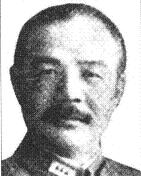 Only Xu Yuanquan's 2nd Corps-group (the 41st & 48th Divisions), arriving from Wuhan, had no prior engagement with the Japanese. Liu Xing and Luo Zhuoying, who both participated in the Shanghai defense, were ordered to be deputy commanders assisting Tang Shengzhi. Shi Huaiyu stated that most of the soldiers were new recruits who filled up the ranks lost in the Shanghai-WuSong Battle.
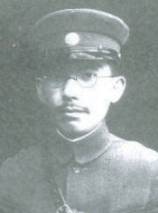 Tang Shengzhi devised the two-layer defense plan: the outlying defense and citywall defense. At the outside, Yu Jishi's two divisions of the 74th Corps guarded Banqiao-Chunhua, Xu Yuanquan's 2nd Corps-group (the 41st & 48th Divisions) guarded Mengtang-Longtan, and Ye Zhao's 66th Corps & Deng Longguang's 83rd Corps [Yue-jun] guarded east and west sides of Mt Tangshan.
At Nanking, Song Xilian's 36th Division of 78th Corps guarded north gate, Sun Yuanliang's 88th Division of 72nd Corps and Shen Fazao's 87th Division (under Wang Jingjiu's 71st Corps) guarded south gate, and Gu Zhenglun/Gui Yongqing's Central Lecturing Echelon guarded three peaks of Mt Zijinshan. A company of 6 ground-to-air cannons, commanded by regiment chief Miao Fan, were retained with Tang Shengzhi. Hu Zongnan was called over to Nanking on December 2nd for assisting Tang Shengzhi. However, Hu Zongnan went back to Pukou on December 5th when news came that Japanese moved along the north bank already.
Tang Shengzhi devised the two-layer defense plan: the outlying defense and citywall defense. At the outside, Yu Jishi's two divisions of the 74th Corps guarded Banqiao-Chunhua, Xu Yuanquan's 2nd Corps-group (the 41st & 48th Divisions) guarded Mengtang-Longtan, and Ye Zhao's 66th Corps & Deng Longguang's 83rd Corps [Yue-jun] guarded east and west sides of Mt Tangshan.
At Nanking, Song Xilian's 36th Division of 78th Corps guarded north gate, Sun Yuanliang's 88th Division of 72nd Corps and Shen Fazao's 87th Division (under Wang Jingjiu's 71st Corps) guarded south gate, and Gu Zhenglun/Gui Yongqing's Central Lecturing Echelon guarded three peaks of Mt Zijinshan. A company of 6 ground-to-air cannons, commanded by regiment chief Miao Fan, were retained with Tang Shengzhi. Hu Zongnan was called over to Nanking on December 2nd for assisting Tang Shengzhi. However, Hu Zongnan went back to Pukou on December 5th when news came that Japanese moved along the north bank already.
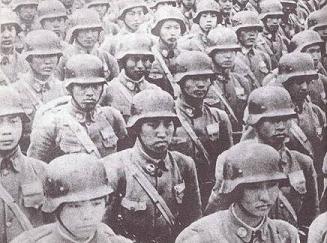 On December 1st, Japan’s Central Front Army received the No. 8 Continental Order to attack and occupy Nanking.
On December 2nd, Prince Yasuhiko Asaka took over Matsui Iwane’s dual commander post for the Shanghai Expeditionary Force,
while Matsui Iwane, as front army commander, directed both the expeditionary force and the Tenth Army against Nanking from multiple directions.
The order to the Tenth Army was for the 114th Shidan and 6th Shidan to move along Liyang-Lishui Highway and Guangde-Honglanbu Highway
on December 3rd for the Lishui area, with two additional contingents to penetrate westward to Wuhu and Dangtu for Anhui Province segment of the Yangtze River. The Shanghai Expeditionary Force was ordered to have 16th Shidan and 9th Shidan move along Danyang-Jurong-Tangshan Highway and Jintan-Tianwangshi-Chunhuazhen Highway, with two additional contingents to cross the Yangtze at Jiangyin and Zhenjiang for a circumvential attack at the Canal and Peking-Pukou Railway in the north. On December 1st, Japan’s Central Front Army received the No. 8 Continental Order to attack and occupy Nanking.
On December 2nd, Prince Yasuhiko Asaka took over Matsui Iwane’s dual commander post for the Shanghai Expeditionary Force,
while Matsui Iwane, as front army commander, directed both the expeditionary force and the Tenth Army against Nanking from multiple directions.
The order to the Tenth Army was for the 114th Shidan and 6th Shidan to move along Liyang-Lishui Highway and Guangde-Honglanbu Highway
on December 3rd for the Lishui area, with two additional contingents to penetrate westward to Wuhu and Dangtu for Anhui Province segment of the Yangtze River. The Shanghai Expeditionary Force was ordered to have 16th Shidan and 9th Shidan move along Danyang-Jurong-Tangshan Highway and Jintan-Tianwangshi-Chunhuazhen Highway, with two additional contingents to cross the Yangtze at Jiangyin and Zhenjiang for a circumvential attack at the Canal and Peking-Pukou Railway in the north.
From December 3rd to 6th, Japanese 16th Shidan and 9th Shidan punched into the cordon lines of 83rd Corps and 66th Corps, took over Jurong on 4th, and pushed to the area of Huangmei, Tuqiao and Hushuzhen. The 10th Ryodan of the 11th Shidan attacked Zhenjiang, while the 13th Shidan crossed Yangtze at Jiangyin to attack Jingjiang. Separately, Japanese 114th Shidan, to be followed by 6th Shidan, burst through the cordon lines of 88th Division and 74th Corps and took over Lishui and Molingguan by December 4th, and pushed to the area of Lulangzhen and Jiangningzhen. Kunizaki Shitai and 8th Shidan attacked Dangtu and Xuancheng, respectively. On December 7th, Matsui Iwane ordered the siege of Nanking.
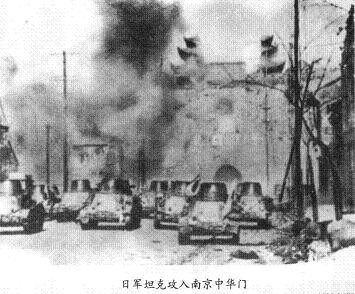 On December 7th, the Japanese army reached the perimeter of the Nanking city from three directions,
and engaged in battles with Tang Shengzhi's forces of over 100,000 men.
As reported by F. Tillman Durdin in New York Times on December 8th,
"The departure of Chiang Kai-shek with his aides was at the break yesterday in his private plane, operated by Royal Leonard and Co-Pilot Arnold Wier, both Americans."
The Nanking city was first breached in the south, i.e., Yuhuatai area, in the afternoon of December 12th.
The Chinese soldiers who were stranded on Mt Zijinshan's three peaks in the east died to the last person till after December 13th.
On December 7th, the Japanese army reached the perimeter of the Nanking city from three directions,
and engaged in battles with Tang Shengzhi's forces of over 100,000 men.
As reported by F. Tillman Durdin in New York Times on December 8th,
"The departure of Chiang Kai-shek with his aides was at the break yesterday in his private plane, operated by Royal Leonard and Co-Pilot Arnold Wier, both Americans."
The Nanking city was first breached in the south, i.e., Yuhuatai area, in the afternoon of December 12th.
The Chinese soldiers who were stranded on Mt Zijinshan's three peaks in the east died to the last person till after December 13th.
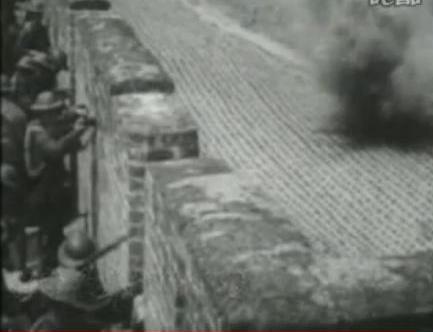
More available at DEFENSE-BATTLE-AT-NANKING-v0.pdf
(Check RepublicanChina-pdf.htm page for up-to-date updates.)
* In Commemoration of China's Fall under the Alien Conquests in A.D. 1279,
A.D. 1644 & A.D. 1949 *
U.S.S.R./Comintern Alliance with the KMT & CCP (1923-1927)
Korean/Chinese Communists & the 1931 Japanese Invasion of Manchuria
American Involvement in China: Soviet Operation Snow, IPR Conspiracy, Dixie Mission, Stilwell
Incident, O.S.S. Scheme, Coalition Government Crap, Amerasia Case & The China White Paper
* Stay tuned for "Republican China 1911-1955: A Complete Untold History" *
|
|
Zou Rong's Revolutionary Army;
Shin Kyu Sik's
Shrine (Spirit, Kunitama) of Korea
|
This snippet is for sons and daughters of China:
Heed the sons & ministers' agony and sorrow of our ancestors who died or lived through the Mongol, Manchu and Soviet-Chicom conquest
and
the Yongjia, Jingkang and Jiashen cataclysms !
Jeanne d'Arc of China:
Teenager girl Xun Guan breaking out of the Wancheng city to borrow the relief troops in the late Western Jinn dynasty;
Liu-Shao-shi riding into the barbarian army to rescue her husband in the late Western Jinn dynasty;
teenager girl Shen Yunying breaking into Zhang Xianzhong's rebels on the horseback to avenge on father's death in the late Ming dynasty.
China's Solitary and Lone Heroes:
Nan Jiyun breaking out of the Suiyang siege and charging back into the city in the Tang dynasty;
Zhang Gui & Zhang Shun Brothers breaking through the Mongol siege of Xiangyang in the Southern Soong dynasty;
Liu Tiejun breaking through three communist field armies' siege of Kaifeng in the Republican China time period;
Zhang Jian's lone confrontation against the communist army during the June 3rd & 4th Massacre of 1989.
|
|
|
Mt Xishan - the Zhongshan-men City Gate
Mt Hongmaoshan - Baigufen
Guanghua-men City Gate
Zhongshan Lingyuan
Mt Zijinshan - Peak II & Peak III
Shi Huaiyu's River Crossing
Blunders Of Tang Shengzhi
On December 13th, Japanese captured Nanking.
The Rape Of Nanking
The 'Rape Of Nanking' occurred in December 1937 under the authorization of Japanese Prince Yasuhiko Asaka and commander Matsui Iwane (Songjing Shigeng) and lasted for six weeks. 340,000 Chinese civilians and soldiers were massacred on basis of the statistics from the Red Cross and other organizations which buried the dead bodies, with the full set of evidence recorded by the foreign journalists as well as the Japanese newspapers. Eyewitness accounts in the West include Martha Lund Smalley, ed, "American Missionary Eyewitnesses To The Nanking Massacre, 1937-1938" (New Haven: Yale Divinity School Library Occasional Publication No. 9, 1997), "John Robe's Diaries" of a German in charge of the International Committee
for the Nanking Safety Zone, and "Bates' Papers", etc. Among 340,000 victims, 190,000 were massacred in batches,
and both the number and the cruelty far outweighed the Atomic bomb victims of 210,000.
Iris Chang, in "The Rape Of Nanking - The Forgotten Holocaust of WWII", pointed out that the International Military Tribunal
of the Far East determined that 260,000 Chinese fell victims to the Japanese Army, not counting those whose bodies floated on the Yangtze River.
At minimum 80,000 Chinese women were raped or raped and killed.
Wang[1] Hao stated that over 320 women from Nanking were sent to Manchuria as 'comfort women.'
http://www-users.cs.umn.edu/~dyue/wiihist/njmassac/killcomp.htm carried pictures of two war criminals,
2nd Lieutenants Mukai Toshiaki and Noda Takeshi, who killed 105 and 106 Chinese people during a "100 kill contest."
The two lieutenants, at the end of WWII, were arrested by the Nationalist Government and executed on December 18th, 1947
at Caotangxie of Nanking where 50000 Chinese soldiers were killed by the machine gunfire ten years earlier.
During the post-war trials, judges from eleven allied countries sentenced 25 surviving A-class Japanese war criminals to death.
However, the Japanese have never truly repented over their war crimes in earnest, and time and again, claimed
that their invasion had helped the Asian countries to get liberated from the colonialist rule of the Western powers. Note that the Japanese denied that the
massacre ever happened. Professor Hata Ikuhiko, out of his limited conscience, estimated
that about 38000 to 42000 Chinese were massacred in Nanking.
Wang[1] Hao pointed out that the Japanese records stated that when the Japanese soldiers first intruded into the Zhonghua-men City Gate on December 13th,
they were surrounded by the 'civilian bandits' ... hundreds of thousands of the "female bandits" swarmed over,
attacking the Japanese soldiers with mouths and teeth ... one of the females, for inciting chaos, took off her clothes on the upper body and shouted... that the Japanese had raped her ...
the female bandits then attacked the Japanese ... the Japanese revenged by raping them..."
The Japanese records further rebutted the reports by "Manchester Tribute" (Temperly, Tian-bo-lie), "New York Times" (John Denver) and Professor Smith at Nanking University.
In Nanking, Tani Hisao was fetched over to China for trial in Aug 1946 and executed at Yuhuatai on April 26th, 1947.
Matsui Iwane, separately, was executed by the tribunal in Tokyo on December 23rd, 1948.
Over 2000 Japanese war criminals caught in China had been spared. The Japan occupation commander-in-chief, Okamura Yasuji
(Gangchun Ningci in Chinese), reached a deal with the Nationalist Government in having him spared the war crime charges
in exchange for the Japanese cooperation in resisting the attempt of the communist forces in disarmament of the Japanese garrison army.
Chiang Kai-shek's Nationalist government mobilized thousands of ships, equivalent to 300,000 tons, for shipping home well over 2 million Japanese occupation forces and their families
within ten months (Nov 1945-July 1946), while the Japanese criminals caught by the Chinese communists, who were used for training the communist army, were mostly set free in the 1950s after the so-called repentance over the crimes.
(In contrast, Stalin had forced the Japanese Kwantung Army troops into coolie labor in Siberia
in retaliation for the Japanese live dissection of the Soviet prisoners of war.)
Later, the Korean War of June 1950 would lead to the U.S. initiation in having the multiple countries sign a peace treaty
with Japan on September 8th, 1951, a treaty which deliberately excluded the Republic of China [Taiwan].
Not to mention the U.S. government's harboring of the Japanese guinea pig experts from Unit 731.
In today's China, the communists, for sake of attracting the Japanese financial aid, had even allowed some Japanese war criminals to come back to China
as 'investor' or so-called 'inverse teaching text.'
In Nanking, the Japanese army was recorded into pictures by their own military doctors and army ranks in using the Chinese as targets for the live practice of bayonet thrusting.
The Japanese officers held numerous killing contests.
The Innocent Chinese, in face of death, stood stiff and motionless mostly,
exhibiting no fear of death on their faces or mind. The Japanese barbarity was exhibited by their ways of killing the unarmed civilians or soldiers, including burning alive with kerosene, decapitation with blades, bayonet thrusting, freezing death, extracting eyes and organs, cutting off arms and limbs, gunning down with machineguns, driving victims into rivers, burning down the buildings with the Chinese forced upstairs, and live burial, etc.
The Japanese soldiers raped Chinese women of all ages, including pregnant women, and moreover mutilated their bodies after their beastly acts like gang rape, cutting off nipples, peeling off breasts and piercing the vagina or abdomen. Victims numbered no less than 80,000, per Iris Chang. The Japanese soldiers took pleasure in bayoneting the fetus even. The Japanese soldiers were recorded by the foreign diplomats to have broken into the neutrality or safety zones (set up by the Westerners), hospitals, churches and schools (such as The Jingling Women's University) to abduct truck-loads of women for the army brothels (i.e., the Japanese army "comfort stations").
Sorted out of the neutrality zones would be hundreds of Chinese policemen in the black uniforms who were later all massacred in the outskirts. Yin Jijun (i.e., James Yin), in "The Great Rescue of 1937: Western Friends & the International Safety Zone" (New Continent Publishing House, HK, November 1997), stated that about 40-50 policemen were taken away and murdered. Picture from "A Journey Through China - A Pictorial Walk, 1927-1997" showed that hundreds of thousands of black-uniformed policemen were escorted out of Nanking for massacre.
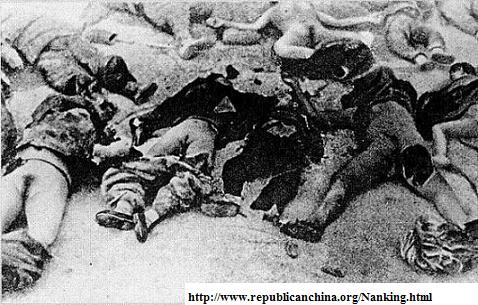
The Nanking Massacre was not an isolated incident. This webmaster mentioned elsewhere that the Japanese invasion forces, upon landing in Jinshanwei, had massacred all their way through the coastal villages and towns on the Hangzhou Bay, leaving "wan ren keng" [i.e., the pit of ten thousand corpses] along their path. At a village called Yaojiaxiang, the Japanese army collected hordes of the Chinese peasants, stacked them together, and massacred them by piercing their long blades from top to bottom. Note that the Japanese, having encountered only two companies of the Chinese soldiers upon landing, had no reason for a bloody revenge. Today's humble Chinese peasants, in recalling the past Japanese atrocity, merely cursed 'dong [east] yang [ocean] ren [people]' whenever they recollected the barbarity of the Japanese soldiers as well as Japanese pirates.
Iris Chang cited a British newspaper reporter who visited the Songjiang town nine weeks after the Japanese invasion in stating that this British man only found five old persons sobbing in a French church in a city which once possessed an original population of 100,000.
Separately, Father Jacquinot de Besange, who set up the Nanshi Refugee Center, had trekked to Songjiang in the aftermath of the Japanese occupation, and reported to the U.S. consulate officials that
he saw almost no live souls along the 40-50 kilometers road to Songjiang.
As noted by Marcia R. Ristaino in "The Jacquinot Safe Zone: wartime refugees in Shanghai",
Jacquinot told Nelson T. Johnson, which was relayed to Stanley Hornbeck (a disciple of Paul Reinsch, one of a limited number of American officials who harbored true sympathy with the Chinese in the last 150 years), that "along the way, he had seen almost no Chinese alive and noted that desperately needed
rice crops were untended and rotting in the fields...Japanese troops had entered the [Nanshi] Zone to round up refugees, including women." Iris Chang also reminded us that at Suzhou, a garden watercourse city on the east bank of the Taihu Lake, the Japanese soldiers intruded into the city gate with masks and reduced the population to 500 persons from the original number of 350,000. The Japanese raped and abducted tens of thousands of women as 'sex slaves' at Suzhou.
(Iris Chang, however, listed some irrelevant incident as something that might possibly changed the picture of the Rape Of Nanking: Iris Chang stated that Matsui Iwane [not Tani Hisao], a notorious figure since his assumption of the Taiwan garrison commander on Aug 1st, 1933, fell sick and stayed behind at Suzhou on December 7th, something which propelled the Japanese emperor's uncle into the post of commanding the three invasion columns against Nanking; that an ultimatum was issued before the siege of Nanking; that Matsui Iwane, for fear of the imperial uncle abusing power, had ordered that the Japanese soldiers should regroup outside of Nanking, with only the disciplined columns allowed for entry into the capital; that it was the Japanese imperial uncle who, having returned to China from Tokyo on December 8th, issued a secret order of "killing all prisoners of war"; and that the idea of "killing all prisoners of war" was derived from the approach adopted by a Japanese Rentai chief in solving the fate of about 300,000[?] Nationalist Army remnants who stranded behind after Japanese landing at the Jinshanwei Beach.)
The Great Rescue of 1937
In Nanking, quite some foreign teachers at both The Nanking University and Nanking Women University changed their summer vacation plans in anticipation of the July 1937 Sino-Japanese War. After the Aug 13th outbreak of war in Shanghai, George A. Fitch of the YMCA, who was once invited to be an adviser to the "New Life Movement Committee", went to Shanghai to organize the "Zhabei Service Team" as a part of his YMCA Youth Society activities. Among the youth employed by Magee would be Xu Qingliang who was spotted inside of the refugee center when the Japanese drove the Shanghai civilians in the Yangshupu area across the Huangpu River during the Jan 28th 1932 Incident. Xu Qingliang et al retreated to Nanking in November after the Zhabei return path from Baoshan to Shanghai was cut off. In Shanghai, Rev John G. Magee of the American Church Mission assisted Father Jacquinot de Besange in establishing a refugee center of 110,000 people in the Nanshi area. Rev John G. Magee returned to Nanking and took charge of providing service for the refugees and wounded soldiers. At the suggestion of the Nanking University board of director Hang Liwu, the International Safety Zone was proposed for covering an area of about 3.86 square kilometers, with the universities, consulates, German club and American Gulou Hospital. The International Safety Zone was both agreed upon by Nanking Mayor Ma Chaojun and acknowledged by the Japanese commander in Shanghai. George A. Fitch, after instructing Xu Qingliang in using the YMCA facilities for receiving the refugees and wounded, took a trip to seeing his family members depart via American warship Chautomont in Qingdao but missed one day late, when he arrived on November 16th, after changing the trains and buses en route due to the Japanese plane bombing.
On November 21st, the International Committee for the Nanking Safety Zone as well as the International Red Cross Nanking Committee were established, with the headquarters set at the residence of Zhang Qun. The International Committee, by the time the Japanese finally arrived, would retain 10 Americans and Germans among the board and 1500 Chinese staff.
The International Committee mobilized the YMCA (which was a nationwide organization developed under the supervision of George A. Fitch's father Jeanetter 50 years ago), the American Church Mission, the teaching staff of universities, colleges and high schools, Nanking's police and firefighters, and various philanthropic organizations for providing asylum to 200,000 people. The International Committee appealed for financial assistance with the Chinese government, Japan's Shanghai invasion army, various embassies, and the relief organization and Red Cross in Shanghai. In addition to the above, Mayor Ma Chaojun sought George A. Fitch in renting British ship Ranpura for relocation of China's "forbidden city" treasures. Fitch instructed Xu Qingliang and Shi Lisheng in locating a circumvential road for 50 trucks to move the treasures to the Xiaguan Wharf. Ranpura was able to leave on December 5th, with Hang Liwu in charge of the "forbidden city" treasures, and sailed past Wuhu about one dozen hours ahead of the Japanese army's thrust. Fitch and Magee both refused to take off on the U.S. Panay when the consulate official called upon them. The International Committee board members all vacated their residencies for housing the refugees. The Safety Zone was subdivided into nine subzones and 25 camps.
By December 10th, 1937, majority foreigners had fled Nanking. Remnants would board American Warship Panay on the evening of 11th. (The next day, i.e., the afternoon of December 12th, Panay was sunken by the Japanese bombers about 50 kilometers upstream of Nanking; however, the Americans continued the appeasement policy well into the Pearl Harbor attack four years later. Later on July 26th, 1939, the U.S. announced the annulment of the "commerce act with Japan" in 6 months in protest of the Japanese encirclement of Tianjin's settlement and insulting the British & American citizens.) Those who remained to be eyewitnesses to the fall of Nanking on December 13th would include Archibold [Archibald] T Steele of "Chicago Daily News", L G Smith of "Reuters", C Yates McDaniel of "Associated Press", Tillman Durdin of "New York Times", and Arthur Mencken of "Paramount Pictures." At the demand of Japanese military, reporters left Nanking on the 15th. On the 17th, Tillman Durdin of "New York Times", on board a ship at the mouth of the Wusongkou & Yangtze, announced the "Nanking Atrocity" to the world, with description of about 200 men gun down within 10 minutes near the dock where the reporters boarded the ship on the 15th. Three months later, on March 16th, George A. Fitch of the YMCA published a report on the atrocities in HK's "South China Morning Post." In July 1938, Harold J. Timberley of "Manchester Guardian Weekly", on basis of MS Bates & George A Fitch accounts, wrote a comprehensive report entitled "What War Means: The Japanese Terror In China: A Documentary Record."
The Japanese Imbecil's Policy of "Shokaiseki o aite to sezu"
The war in Shanghai was tied to the Brussels Conference and the expectation that the League of Nations would intervene. Wellington Koo's memoirs disclosed that the British, the French and the Americans repeatedly said that should China win some decisive battles, then it would be easier for the League of Nations to intervene on behalf of China.
The time interval between the League of Nations' resolutions in early October and the Brussels Conference in early November was crucial for China. Japan, knowing the diplomatic efforts, wanted to thwart China's diplomatic initiatives by intensifying the invasion and playing the German mediation card.
The conference was delayed till the Chinese defense was almost in total collapse.
The German foreign minister advised China in accepting Japan's demands on December 1st, and Chiang Kai-shek met the German ambassador twice on the 2nd & 3rd. However, Germany did not relay Chiang Kai-shek's opinions till December 7th by which time Japan had overthrown its "seven demands" made in Nov. Japan exerted its full force for sacking Nanking the capital in the hope of pressuring China into a surrender.
Surrounded by Comintern agents such as Ozaki,
Konoe Fumimaro,
i.e., the retarded Japanese prime minister
from the Japanese royal family's intermarriage
of close relatives,
declared a policy of "Shokaiseki o aite to sezu" or no dealing with Chiang Kai-shek after sacking Nanking but failing to subjugate China.
For the next two years, Konoe Fumimaro sent his son Fumitaka to China to find ways to reconnect with the Chinese government.
Fumitaka, tacking on a post at the Shanghai Same Language Academy (Toa Dobunshoin Academy), a hotbed of Soviet spies and JCP, continued his father's retarded diplomacy approach, some naiveness that cost the life of a beautiful woman called Zheng Pingru.
Fumitaka, the Toa Dobunshoin Academy, and the Japanese Military Headquarters' special agency, all hot spots staffed by the JCP and Comintern/G.R.U. agents, such as Nakanishi Tsutomo.
Konoe Fumimaro, to escape the fate of being tried as a war criminal, committed suicide in late 1945, and prior to death, claimed that the Japanese military generals of a certain county, i.e., 'Yama' whatever county, must be Soviet agents as they perpetrated the policies that led to Japan's demise.
The imbecil did not know that Ozaki Hotsumi and Richard Sorge's paramount objective was to make sure that Japan and China got entangled in a war so as to defend mother Russia.
Konoe's son, i.e., Konoe Fumitaka, was exiled to Siberia by the Soviets
and just days before repatriation in the late 1950s, could have been killed by the Soviets.
Eight Year Long Resistance War
The 'Rape Of Nanking', from December 1937 to Jan 1938, would arouse the Chinese people's indignation as well as win over the sympathy of the world communities. For eight years, the Chinese fought the resistance war relentlessly. War calamities being unheard of in human history, the Chinese forces engaged Japanese in 20-30 campaigns, hundreds of battles, and thousands of fighting.
From 1937 to 1945, 21,000,000 Chinese lost their lives, among whom about 3.8 million were soldiers, officers and generals. General consensus of the total death toll, including collaborators & the Yellow River breach victims etc, could amount to 38 million. 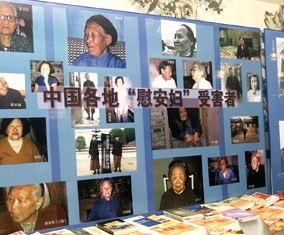 Among victims would be unfortunately the Chinese women whom the Japanese raped, tortured and killed to maintain the psychological imbalance in failing to subdue the Chinese nation militarily.
Note that the mainland Chinese women comprised at least 67.8 of all "comfort women" throughout the Japanese occupation zones [see page 61 of Whang Hao4's "Chinese Comfort Women - A Transnational Archive", Cosmos Books Limited, HK, 1998 edition]. Prior to the Japanese surrender in southeast Asia, Vietnam, and China, the Japanese army murdered all "comfort women" they could laid hands on for sake of burying their beastly acts. Surrender did not mean a stop of barbarity. Yu Dafu, author of "Sinking into Vice" and founder of the Left-Wing Writers Association, was killed by the Japanese in Sumatra on August 29, 1945.
In Tokyo, after surrender, the Japanese government spent weeks burning the government documents to cover up their criminal acts. Unfortunately, the Japanese crimes were not exposed as a result of cover-up of war time collusion activities by the Chinese communist. Every year, when people worldwide remembered the Normandy landing, the Chinese communists just hoped that the people forgot about resistance war against Japan. Though the Chinese communists still refused to deal with Japan on the matter of comfort women today, Tong Zeng, a 23 year old lawyer in the international law, first worked on the Chinese 'comfort women' issue in 1989. Three years later, eight Chinese 'comfort women' appeared in Tokyo in denunciation of the Japanese military crimes.
Among victims would be unfortunately the Chinese women whom the Japanese raped, tortured and killed to maintain the psychological imbalance in failing to subdue the Chinese nation militarily.
Note that the mainland Chinese women comprised at least 67.8 of all "comfort women" throughout the Japanese occupation zones [see page 61 of Whang Hao4's "Chinese Comfort Women - A Transnational Archive", Cosmos Books Limited, HK, 1998 edition]. Prior to the Japanese surrender in southeast Asia, Vietnam, and China, the Japanese army murdered all "comfort women" they could laid hands on for sake of burying their beastly acts. Surrender did not mean a stop of barbarity. Yu Dafu, author of "Sinking into Vice" and founder of the Left-Wing Writers Association, was killed by the Japanese in Sumatra on August 29, 1945.
In Tokyo, after surrender, the Japanese government spent weeks burning the government documents to cover up their criminal acts. Unfortunately, the Japanese crimes were not exposed as a result of cover-up of war time collusion activities by the Chinese communist. Every year, when people worldwide remembered the Normandy landing, the Chinese communists just hoped that the people forgot about resistance war against Japan. Though the Chinese communists still refused to deal with Japan on the matter of comfort women today, Tong Zeng, a 23 year old lawyer in the international law, first worked on the Chinese 'comfort women' issue in 1989. Three years later, eight Chinese 'comfort women' appeared in Tokyo in denunciation of the Japanese military crimes.
Hauling Nation's Industry To Hinterland & Rebuilding Railways-Airports
Talent Retention by Hu Zongnan in Competition with Communist
To the north of the Yangtze River, Hu Zongnan's 17th Corps-Conglomerate relocated to Xuzhou of Jiangsu Province on December 16th and guarded it for one week. Hu Zongnan repelled the Japanese at Mt Baimishan and then relocated to Shouzhou of Anhui Province and Xingyang of Henan Province consecutively. Thereafter, Nationalist government troops fought the Battles of Linyi & Tengxian, and launched the Campaign of Tai-er-zhuang.
At Xuzhou, Hu Zongnan took custody of 400 students led by Zhao Guantao, and at Shouzhou, Hu Zongnan took custody of 500 boy scouts led by Xu Kangming. Hu Zongnan, whose father passed away on December 9th, obtained the help of Dai Li in going behind the Japanese line for mourning as well as fetching Hu Zongnan's sister to Chongqing of Sichuan Province. Hu Zongnan, fully aware of the importance of enlisting talents and patriotic youths, dispatched Chen Daxun (Chen Suimin) to Changsha of Hunan Province where Chen Daxun, against CCP Zhou Enlai & Xu Teli's recruitment, won over 200 college students from the "Exile University" and 50 medical college and nursery girls. Chen Daxun, when invited over by Zhou Enlai to Donghu [East Lake] inside of Wuhan University, rebuked Zhou Enlai's claim that Hu Zongnan did not fight the Japanese in Shanghai. Zhou Enlai commented that Chen Daxun possessed the petty bourgeoisie thought.
Chen Daxun, originally a leftist student, kept in touch with Hu Zongnan who rebutted the communist claim that the KMT government government did not fight Japan and promised to Chen Daxun to give notice the minute his 1st Army Corps entered the battle against Japan, which led to Chen Daxun's deviating from the communist cause for the government side.
Later in 1947, Chen Daxun was appointed by Hu Zongnan the post of mayor of Yenan, on which post Chen Daxun obtained communist Ren Bishi's diaries that had the communist internal conditions on approving Mao Tse-tung's taking in actress Jiang Qing as an unofficial wife.
When Chen Daxun told Hu Zongnan that some of the recruited students could be leftist, Hu Zongnan claimed that anyone before age 30 could still be elastic and moldable in mindset and ideaology, and indeed, Zhou Enlai's mole, i.e., Xiong Xianghui (Xiong Huiquan, 1919-2005), entered Hu Zongnan's camp and hid himself for one dozen years.
Purportedly,
Xiong Xianghui was admitted to the communist party in late 1936 while still a student at the Tsing Hwa University. The communists claimed that communists Jiang Nanxiang and Yang Xuecheng were the oath administrators.
Jiang Nanxiang purportedly joined the social science research society and through schoolmate Wan Jinsheng enrolled in the communist party in 1933 while a student at Tsing Hwa;
had discrete activities like in the name of social science members and "China National Defense League" (a mutation of Mme Sun Yat-sen and Heh Xiangning's "Armed Self-Defense Committee of the Chinese People" launched in September 1934);
did not appear to have working relationship with Zhou Xiaozhou of the Peking communist work commissariat till Tsing Hwa cell branch secretary Heh Fengyuan was arrested in early 1935 and released in the autumn of 1935, on which occasion Jiang connected Heh to Zhou, with Zhou authorizing Heh's rebuilding the Tsing Hwa cell and subsequently transferring the post of Tsing Hwa cell secretary to Jiang in October 1935.
Likely Xiong Xianghui joined the communist peripheral organization of
the Chinese National Liberation Vanguards as Fu Zuoyi's daughter similarly did but was retroactively upgraded to be a communist party member.
This recruitment was said to be some directives from Zhou Enlai in asking Jiang Nanxiang to target
young and well-groomed students from prominent families or government officials' families, who were relatively apolitical in appearance but progressive for the role of moles to lurk within the Chinese Kuomintang government.
Liu Shaoqi was sent to the Peking area in 1936 to rebuild the communist North China Bureau network, with the estranged communist students conducting protests without de facto communist leadership, such as the 12/9/1935 & 12/12/1935 student protest movements, that was triggered by the Japanese launch of puppet Yin Rugeng's Eastern Ji [Hebei Province] Anti-Communist Autonomous government.
Xiong Xianghui was ordered to rush to Changsha in November 1937 to sign up for the Hunan Youths Third Field Service Corps that was subject to Hu Zongnan's First Army Corps, with the service corps head's post held by Li Fanglan.
In early May 1938, Xiong Xianghui was selected by Hu Zongnan
to attend the seventh branch of the Infantry Army Cadet Academy, i.e., the Whampoa Academy officers' branch school,
and became the fifteenth session Whampoa graduate. Xiong Xianghui, after graduation on which occasion he delivered a speech on behalf of graduates,
was appointed as Hu Zongnan's confidential secretary.
Hu Zongnan's army, with 1000 students and two additional regiments, were dispatched to Fengxiang of Shenxi Province for shielding the northwestern China homebase from both Japanese in Shanxi Province and the communists in northern Shenxi Province. Corps Chief Li Tiejun was ordered to defend the Zhengzhou-Lingbao line. Hu Zongnan obtained authorization in establishing the Seventh Branch of the KMT Central Military Academy (which moved to Xi'an in May 1938). Tu Xinyuan led 800 Henan KMT cadre school students to Hu Zongnan's school. Hu Zongnan, after checking out the communist attempts in recruiting youths for the CCP Anti-Japanese University in Yan'an, set up posts on all roads leading to Yenan [Yan'an] for dissuading the youths from travel to Yenan and enrolling them in the "4th Group" cadre school. (The "4th Group" cadre school obtained the budget of grain supply for 5000 people.) Hu Zongnan established the 2nd Column of the 15th Session of the KMT Central Military Academy after accepting Kang Ze and Gu Xiping training schools. Three more columns were established after recruiting patriotic youths who penetrated the Japanese frontlines from Shandong-Henan-Hebei provinces. Further, Hu Zongnan dispatched cadres to the Japanese-occupied territories for the 16th Session recruitment. Zhao Longwen, in Zhejiang Province, sent over 400 youths. Hu Zongnan also participated in setting up the Northwestern Cadre School.
Li Zongren’s memoirs, however, pointed out that Chiang Kai-shek's crony generals were busy fighting against each other for expanding their ranks. In November 1937, at Xuzhou, Li Zongren received about 1000 professors, students, youths and intellectuals, and established the "Fifth War Zone Young Cadre Training Regiment" which at one time possessed 4000-5000 students. This training school would evacuate to Huangchuan of Henan Province prior to loss of the Xuzhou city on May 19th, 1938. Later, Chiang Kai-shek dismissed Li Zongren’s training regiment which still had 2000-3000 students. Li Zongren stated that Chiang Kai-shek allowed his crony Chen Cheng to continue their cadre training session. [In contrast, Hu Zongnan was blessed with setting up a branch of the Whampoa Academy.) Further, Li Zongren stated that quite some of the dismissed students went to the communist side in Yenan instead.
According to Li Rui's recollections, Li Rui was sent to Peking by the radical Wuhan students, communists with hidden identities, and others (including former or estranged communists including someone just released from the Suzhou reformatory) in the spring of 1937 for the communists' sanctioning the communist cell organized by the Wuhan students after female schoolmate went to Peking one step ahead to have made the connection; however, before the eruption of the resistance war, for reading communist publications, Li Rui was arrested by the Peking police for a short time, and after the war, Li Rui, together with Wen Lizheng (Furen University student, a Wuhan native and Li Rui's friend) and Wan Guorui (alias Yang Chun), joined the Peking-Tientsin exile students ('Ping-Jin liuwang tongxue-hui') in travelling via the Tientsin-Yantai sea route to enrol in the Tai'an anti-Japanese cadres' training class ('kangri ganbu xunlian-ban') of the Ji'an 3rd route army under Han Fuju's 3rd Route Army which was later subject to Li Zongren's 5th War Zone.
Li Rui was ordered by the Peking-Tientsin exile students' society and the Shandong national salvation vanguards ('minzu-jiefang xianfeng dui') to go back to Wuhan to liaise with the Wuhan youth salvation corps ('Wuhan qingnian jiuguo tuan') for funding the students' pending guerrilla war at the turn of the year.
When he returned to the Xuzhou battlefront at the instruction of communist youth committee commissar Yang Xuecheng of the communist Hubei provincial provincial commissariat and Yangtze Bureau to enter Li Zongren's 5th War Zone that had a anti-Japanese general mobilization committee ('kangzhan zong dongyuan weiyuan-hui'), Li Rui and the students were instructed by the communist Jiangsu-Shandong special commissariat to organize into the 5th War Zone youth salvation corps that the communists branched out into over twenty countries in Jiangsu and Shandong provinces.
After another trip to Wuhuan to attend a conference of the national students' united associations ('quan-guo xue-lian'),
Li Rui was inducted into Yu Xuezhong's army that fought the pre-Tai'erzhuang battles along the Yih-he River.
The exile students' youth salvation corps ('qingnian jiuguo tuan') was dispersed by the Japanese army after the Tai'erzhaung Campaign, with Li Rui adn about forty remnants returning to Wuhan via the roundabout path of Huaiyin, Shanghai, Hongkong, Canton and Wuhan.
Li Rui lost contact with girlfriend
Wan Guorui (alias Yang Chun) who was sent by the communists into the counties in late 1937 for agitation work, and later married with the communist cadres inclduing Zhang Aiping.
It would be in Changsha in latter part of 1938 that Li Rui reconnected with the Hunan communists' youth commissariat and then met again quasi-girlfriend Fan Yuanzhen who was embedded with the 9th column of the 3rd Division of the KMT Politics Department, after which Li Rui went to Chungking in late 1939 for transfer to the communist base Yenan.
The Nationalist Government Recruiting & Training, "Exile University" & "Interim Middle Schools"
At the outbreak of war, Chinese youths across the country and overseas answered the call of relocating to the hind with the government. ROC issued a self-defense proclamation on August 14th, 1937 in the aftermath of Japan's invasion of Shanghai. 23-year-old Zhang Ling'ao, i.e., a graduate of Japan's Empire University in Hokkaido, immediately returned to China. On September 22nd, the Nationalist Government put up a notice on the "Shen Bao" newspaper, calling on Japanese-fluent returnees to apply with the military-political training school in Nanking. Chen Lifu and Kang Ze were in charge of the "Japan returnee student training session" consecutively. Zhang Ling'ao finished the training in Wuhan by May 1938, and was assigned to the 7th division [i.e., propaganda against enemy] of the 3rd bureau of the KMT Politics Department. The KMT Politics Department, as an example of the KMT-CCP 2nd collaboration, had multiple-party representation including the communists: While Chen Cheng was the chief, Zhou Enlai [CCP] and Huang Qixiang were the deputies. The person in charge of the 3rd bureau was Guo Moruo, i.e., a former communist member who was allowed to flee to Japan at the time of the KMT White Terror 10 years earlier.
Communist Activities Involving The Intellectuals
The Korean Restoration Army
In late 1937, Chiang Kai-shek received Jin Jiu for a second time, and offered to establish a "Korean restoration army." A telegraph set and two staff members from the Nationalist Government "CISB" intelligence agency were sent to Jin Jiu, and the KMT's non-audit party funds were allocated for the interim Korean government. At the Nationalist Government academies in Nanking, Xi'an & Luoyang, Jin Jiu trained multiple batches of Koreans fighters. Aside from Jin Jiu, another leftist Korean, by the name of Jin Ruoshan, who was a graduate of the Whampoa 4th Session, also took charge of training the Korean fighters.
The Koreans had factional infighting, with Jin Jiu injured by a gunshot during a meeting in Changsha. In September 1940, the Nationalist government established a "Korean Village" in Chungking as well as a Korean language school. After the Jan 1941 Wannan Incident, the leftist and rightist Koreans split apart, with Jin Ruoshan's faction going to the communist camp in Yan'an after Sima Lu, who lost contact with the communists while being sent across North China but later re-established contact with Zhou Enlai in Chungking, infiltrated into the Korean headquarters to instigate the split of the Koreans under the order of Zhou Enlai.
With the outbreak of the Pacific War in December 1941, Jin Jiu's interim Korean government officially exhibited its banner on the office building. Three columns of the "Korean restoration army" were established.
Later in the 1940s, the "Korean restoration army" received the American training related to the Office of Strategic Services, namely, a Soviet agents' setup to steer the Koreans to the Chinese Communist side in preparation for the eventual Soviet invasion of Manchuria and Korea.
For related operations of the Soviet-hijacked O.S.S., refer to
American Involvement in China: Soviet Operation Snow, IPR Conspiracy, Dixie Mission, Stilwell Incident, O.S.S. Scheme, Coalition Government Crap, the Amerasia Case, & the White Paper
[Modified : Monday, 25-Feb-2013 22:00:00 EST]
The Nationwide Mobilization
On Jan 3rd, 1938, Chiang Kai-shek devised 9 provincial military command headquarters. On Jan 13th, Jining of Shandong was lost to the Japanese. On Jan 17th, 1938, Chiang Kai-shek devised 6 military districts, covering roughly the Ping-Han Railroad (Chen Qian), Shanxi Province (Yan Xishan), Jiangsu-Zhejiang (Gu Zhutong), Guangdong-Guangxi (Heh Yingqin), Jin-Pu (Li Zongren), and Gansu-Ningxia-Qinghai (Zhu Shaoliang) in addition to Wuhan (Chen Cheng), Xi'an (Jiang Dingwen) and Fujian (Chen Yi). The Nationalist Government Chair for Shandong as well as commander for the 3rd group army, Han Fuju, was executed on Jan 24th for retreating without obeying the order to resist. Lin Wei, per Zhang Ling'ao, was responsible for devising the trick in capturing Han Fuju at a deliberately-scheduled Kaifeng military meeting. (Lin Wei was later responsible for the break of the Yellow River dyke, and the first Burma Expedition.)
In March 1938, the Nationalist government issued the order for establishing the "bao jia" [local administration] system in districts and shires under each and every county, conducted a census check of the nation, and published guidelines for the army recruitment and draft. Later on September 19th, 1938, a new county-prefecture system was set up, with new regulations decreeing that each town or shire must establish a "central school", each "bao" [about 100 households, i.e., ten times the "jia" unit] must establish a "national citizen school" which was to cover adults, women and children. (In March 1940, the Education Ministry published guidelines for extending education nationwide.)
On May 20th, 1938, Mme Chiang Kai-shek assembled a group of women on Mt Lushan of Jiangxi Province for mobilizing "0.2 billion Chinese women" in the resistance war against Japan. On July 1st, the "women guidance committee" was set up in Hankou, and women cadre training sessions were held across the nation. Wu Xiangxiang stated that during the eight year long war, the women's "new life movement committee" was responsible for mobilizing 70,000 families of soldiers and exile women as well as assisting women in production and education. Later in 1944, Chinese women answered the calls for enlisting in the army, and 5,714 women in Sichuan had at one time applied with the army.
The Battle Of Mingguang-Bengbu
In Dec, the Japanese attacked Mingguang for sake of taking over Bengbu of Anhui Province. The Guangxi Army's 31st Corps was sent to defending the Anhui territory. Li Zongren personally trained the 31st Corps per his memoirs. Further, Li Zongren stated that a Guangxi native soldier, who had fled from the Japanese captivity during the Shanghai battles, had told a story that he witnessed a Japanese killing a fat Chinese peasant, cutting off the elbow meat, and barbecuing it at the camp. The 31st Corps soldiers were indignant about the Japanese atrocity. Li Zongren speculated that those Japanese might belong to an ancient Japanese tribe called "Xia [shrimp] Yi [barbarian] Zu [tribe]."
On Jan 15th, the 26th Ryodan of the Japanese 13th Shidan attacked north from Chuxian [Chuzhou]. The Japanese had to attack the midway strategic Mingguang for sake of taking over Bengbu of Anhui Province. The Chinese troops fought the mobile wars and then pulled back to the west bank of the Chi-he River. After hitting Mingguang [Jiashan] empty, the Japanese Central China Front Army, on Jan 26th, ordered to push on towards Dingyuan, Huaiyuan and Bengbu with three prongs. On the 28th, the northern prong crossed the Chihe River at Mingguang, took over Linhuaiguan on Feb 1st, and Bengbu on Feb 2nd; the middle prong crossed the river at Chehezhen [? Chihezhen] on the 29th, and took over Fengyang on Feb 2nd; and the southern prong crossed river at Daqiaozhen and took over Dingyuan on Feb 2nd. On Jan 18th, 1938, Li Zongren ordered the 31st Corps to evacuate from Mingguang for a western move, while relocating Yu Xuezhong's 51st Corps to north bank of the Huai-shui River from coastal Qingdao.
More available at Battle_Of_Mingguang-Bengbu-v0.pdf (Check RepublicanChina-pdf.htm page for up-to-date updates.)
* In Commemoration of China's Fall under the Alien Conquests in A.D. 1279,
A.D. 1644 & A.D. 1949 *
U.S.S.R./Comintern Alliance with the KMT & CCP (1923-1927)
Korean/Chinese Communists & the 1931 Japanese Invasion of Manchuria
American Involvement in China: Soviet Operation Snow, IPR Conspiracy, Dixie Mission, Stilwell
Incident, O.S.S. Scheme, Coalition Government Crap, Amerasia Case & The China White Paper
* Stay tuned for "Republican China 1911-1955: A Complete Untold History" *
|
|
Zou Rong's Revolutionary Army;
Shin Kyu Sik's
Shrine (Spirit, Kunitama) of Korea
|
This snippet is for sons and daughters of China:
Heed the sons & ministers' agony and sorrow of our ancestors who died or lived through the Mongol, Manchu and Soviet-Chicom conquest
and
the Yongjia, Jingkang and Jiashen cataclysms !
Jeanne d'Arc of China:
Teenager girl Xun Guan breaking out of the Wancheng city to borrow the relief troops in the late Western Jinn dynasty;
Liu-Shao-shi riding into the barbarian army to rescue her husband in the late Western Jinn dynasty;
teenager girl Shen Yunying breaking into Zhang Xianzhong's rebels on the horseback to avenge on father's death in the late Ming dynasty.
China's Solitary and Lone Heroes:
Nan Jiyun breaking out of the Suiyang siege and charging back into the city in the Tang dynasty;
Zhang Gui & Zhang Shun Brothers breaking through the Mongol siege of Xiangyang in the Southern Soong dynasty;
Liu Tiejun breaking through three communist field armies' siege of Kaifeng in the Republican China time period;
Zhang Jian's lone confrontation against the communist army during the June 3rd & 4th Massacre of 1989.
|
|
|
Han Fuju
Han Fuju tried to keep Shandong Province as his private domain by negotiating with Koiso Kuniaki & Nishio Toshizo for a compromise. The Japanese demanded that Han Fuju declare independence. Li Zongren paid a visit to Ji'nan to strengthen Han Fuju's determination.
Li Zongren claimed that he had assured Han Fuju by citing his forecasts about the wars in China and possible outbreak of wars in Europe as corroboration that China would ultimately prevail over Japan in a world-wide war.
After Li Zongren analyzed the conflict between two factions of the Japanese militarists [i.e., the southern move faction against Britain-America versus the northern move faction against the U.S.S.R.], Han Fuju repeatedly asked Li Zongren, "Your honor, when do you think the European War might erupt?" Li Zongren claimed that his talk of sustained warfare could have strengthened Han Fuju's confidence but might have led to Han Fuju's narrow-minded belief that he should preserve his troops for a long time period.
At coastal Qingdao, mayor Shen Honglie, a former Northeastern Army navy general, with hundreds of marines, confronted the Japanese for months. Shen Honglie warned the Japanese that should they ever invade Qingdao, all the Japanese factories and industries would be blown up.
The Japanese industrialists, fearing the loss of assets and properties, exerted pressure on the Japanese government not to invade Qingdao, which was a fatal Japanese military mistake and failure to cut China in half along the Long-hai Railway.
Or in another sense, the Japanese navy, which was less infiltrated by the JCP and Soviet spies than the Japanese army, did not wish to expand the war in China, knowing that sinister Soviet Russia was Japan's No. 1 enemy.
When Han Fuju refused to cooperate with Japan, the Japanese army crossed the Yellow River at Qingcheng & Jiyang on December 23rd, 1937. The Japanese intruded into Ji'nan on the 27th and Tai'an on the 31st. Han Fuju, to preserve his troops, continued the retreat without putting up fight and abandoned Dawenkou on Jan 2nd, 1938. The Japanese intruded into Jining on Jan 5th. Li Zongren immediately ordered that Han Fuju retreat along the Jin-Pu Railway and set up defense positions. However, Han Fuju fled towards western Shandong Province without reporting to Li Zongren. Along the Jin-Pu Railway, only small amounts of troops resisted the Japanese, which somehow delayed the advance. In mid-Jan, Chiang Kai-shek assembled generals of the 1st & 5th war zones for a meeting in Gui'de, arrested Han Fuju, and executed him in Wuchang after a military trial. Han Fuju, as precaution, had brought a whole regiment to the meeting.
After the death of Han Fuju, bodyguard brigade chief Wu Hualong surrendered to the Japanese. Wu Hualong, at the end of WWII, surrendered to KMT Chair Wang Yaowu of Shandong Province. Later, being besieged at Yanzhou (Ji'nan) by the communist forces for months, Wu Hualong surrendered to the communists. (In a similar fashion, the communist had reorganized 400000 Manchukuo [Manzhouguo] puppet army after they entered Manchuria.) Furthermore, Wu Hualong had later acted as the communist herald troops for crossing the Yangtze River and sacking Nanking the capital.
(You may want to say a traitor ultimately did the dirtiest job ever. In the Chinese chronicles, wise leaders often executed defectors who knew no conscience but jumping fence.)
At the Gui'de Meeting, Chiang Kai-shek conferred the provincial chair of Henan Province onto Cheng Qian and the provincial chair of Anhui Province onto Li Zongren. Since Anhui Province Chair Jiang Zuobin immediately left his post, Li Zongren had to go to Lu'an [Liu'an] for reporting to the post, which diverted his efforts as commander of 5th war zone. In early June, after one week stay in Lu'an [Liu'an], Li Zongren returned to Xuzhou for directing the fight against Itagaki Seishiro and Isogai Rensuke. Back on Jan 12th, Japanese 5th Shidan under Seishiro landed in Laoshan-wan Bay and Fudao of Qingdao. After the relocation of Yu Xuezhong's army, mayor Shen Honglie had only 500 marines under his command. Itagaki Seishiro then marched southwestward against Linyi via Gaomi, Zhucheng & Juxian. Li Zongren claimed that radical Japanese officers who participated in Feb 26th 1936 coup had mostly served under Itagaki Seishiro and Isogai Rensuke.
Battles Of Linyi & Tengxian, Campaign Of Tai-er-zhuang
In March 1938, the Nationalist Government, in defending Xuzhou of Shandong Province, eradicated about 10,000-15,000 troops from two Japanese Shidans at Linyi and Tai'er'zhuang. Wu Xiangxiang pointed out that Chinese forces had been able to defeat Japanese as a result of the great sacrifice by the railway workers in hauling supplies and reinforcements to the front.
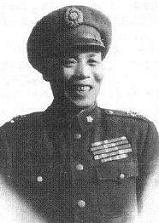 Li Zongren first successfully fended off Japanese attacks along Jin-Pu Railway from the south and then set up a bag at Xuzhou for Japanese to invade. On Feb 17th, Japan’s Second Army, from northern China, authorized 8th Ryodan of 10th Shidan to launch a campaign against the Canal area of Shandong Province. From the coast, on Feb 17th, Japanese 5th Shidan was ordered to echo the push by 10th Shidan. On 27th, near Juxian, Japanese attacked Chinese 115th Brigade with newly organized Sakamoto Shitai which, built on basis of 21st Ryodan of 5th Shidan, consisted of 11th Rentai [lacking one Daitai], 21st Rentai, one Daitai from 42nd Rentai, 5th Field Artillery Rentai and one mountain gun Chutai. Li Zongren first successfully fended off Japanese attacks along Jin-Pu Railway from the south and then set up a bag at Xuzhou for Japanese to invade. On Feb 17th, Japan’s Second Army, from northern China, authorized 8th Ryodan of 10th Shidan to launch a campaign against the Canal area of Shandong Province. From the coast, on Feb 17th, Japanese 5th Shidan was ordered to echo the push by 10th Shidan. On 27th, near Juxian, Japanese attacked Chinese 115th Brigade with newly organized Sakamoto Shitai which, built on basis of 21st Ryodan of 5th Shidan, consisted of 11th Rentai [lacking one Daitai], 21st Rentai, one Daitai from 42nd Rentai, 5th Field Artillery Rentai and one mountain gun Chutai.
At dawn of March 14th, the Seya Shitai launched a general attack at the Chinese positions scattered around the railway line. At Tengxian, Wang Mingzhang, frontline commander for the 41st Corps, ordered the railway bridge to be blown up, called over the special task battalion of the 41st Corps from Lincheng, and withdrew the 364th Brigade into the city after leaving one battalion at Beishahe and one battalion at the western outskirts. One battalion each from the 366th Brigade and 398th Brigade made their way to Tengxian. 727th Regiment Chief Zhang Xuanwu from the 364th Brigade was made into garrison commander for Tengxian, in charge of about 30000 troops, including eleven infantry companies, one mortar company, four special task companies from the 122nd Division and its two brigade headquarters' troops, and about 500 local militia. Wang Mingzhang died in the lane-to-lane fighting that followed. Very few remnant Chinese troops evacuated from the northern citywall by noon of March 18th.
The wounded soldiers strapped hand grenades and committed suicide when the Japanese troops closed in.
Fighting continued throughout the first part of the month of March at Linyi. International observers and newspaper reporters, who stationed in Xuzhou's 5th war zone, hailed the perseverance of the Chinese soldiers at Linyi. On March 9th, Sakamoto Shitai, after an addition of an armored Chutai, resumed attacks at Pang Bingxun’s 40th Corps. On March 12th, Zhang Zizhong and Xu Zuyi, after one day’s nonstop march, arrived at the western bank of the Yihe River where they devised a plan to have the 113th Brigade and 112th Brigade of the 38th Division and the 26th Brigade of the 180th Division cross the Yihe River to intercept the Japanese at Shaling and encircle the Japanese troops that were attacking Linyi. On the morning of the 14th, troops from the 59th Corps forcefully crossed the river at multiple locations, while troops from the 39th Division [40th Corps] counterattacked the Japanese from north and east of Linyi as well, with the 117th Brigade of the 39th Division pushing to the Wangzhuang and Shazhuang villages on the Linyi-Banquanzhen Highway. At dawn of the 16th, the Japanese counterattacked from Shaling and crossed the Yihe River to attack the backup 111th Brigade of the 38th Division at Yadou and Liujiahu. By the morning of the 17th, Zhang Zizhong’s 59th Corps incurred a casualty of 6000. After dusk, the 59th Corps launched a lane-to-lane general attack, defeated the Japanese on the west bank of the river, and learnt from the Japanese prisoner that the Japanese 5th Shidan had incurred a loss of 3000 at the battles on the two banks of the Yihe River, with half of the Japanese on the west bank destroyed, including the death of the 11th Rentai commander. Sakamoto Shitai, having retreated to Tangdou on the 18th, regrouped for a new offensive against Linyi on the 19th. On the 29th, the 333rd brigade of Wang Zhaozhi's 57th Corps and a cavalry regiment of the 20th Corps-group arrived in Linyi. Meanwhile, Itagaki Seishiro, leaving two Daitai at Linyi, rerouted majority of the Sakamoto Shitai to the relief of the Seya Shitai in the Taierzhuang area on the night of the 29th.
 In accordance with Li Zongren's plan, armored vehicles from the Japanese 10th Shidans were let into the trap at Taierzhang. Li Zongren instructed that Sun Lianzhong's 2nd group army fortify positions at Taierzhang for the fame of the Northwestern Army in the defense wars. Sun Lianzhong's 2nd group army, though claiming two corps, had only three divisions left after the Niangziguan Battle, i.e., Zhang Jinzhao's 30th Div, Chi Fengcheng's 31st Division & Huang Qiaosong's 27th Div. In accordance with Li Zongren's plan, armored vehicles from the Japanese 10th Shidans were let into the trap at Taierzhang. Li Zongren instructed that Sun Lianzhong's 2nd group army fortify positions at Taierzhang for the fame of the Northwestern Army in the defense wars. Sun Lianzhong's 2nd group army, though claiming two corps, had only three divisions left after the Niangziguan Battle, i.e., Zhang Jinzhao's 30th Div, Chi Fengcheng's 31st Division & Huang Qiaosong's 27th Div.
More available at Taierzhuang-Campaign.pdf (Check RepublicanChina-pdf.htm page for up-to-date updates.)
* In Commemoration of China's Fall under the Alien Conquests in A.D. 1279,
A.D. 1644 & A.D. 1949 *
U.S.S.R./Comintern Alliance with the KMT & CCP (1923-1927)
Korean/Chinese Communists & the 1931 Japanese Invasion of Manchuria
American Involvement in China: Soviet Operation Snow, IPR Conspiracy, Dixie Mission, Stilwell
Incident, O.S.S. Scheme, Coalition Government Crap, Amerasia Case & The China White Paper
* Stay tuned for "Republican China 1911-1955: A Complete Untold History" *
|
|
Zou Rong's Revolutionary Army;
Shin Kyu Sik's
Shrine (Spirit, Kunitama) of Korea
|
This snippet is for sons and daughters of China:
Heed the sons & ministers' agony and sorrow of our ancestors who died or lived through the Mongol, Manchu and Soviet-Chicom conquest
and
the Yongjia, Jingkang and Jiashen cataclysms !
Jeanne d'Arc of China:
Teenager girl Xun Guan breaking out of the Wancheng city to borrow the relief troops in the late Western Jinn dynasty;
Liu-Shao-shi riding into the barbarian army to rescue her husband in the late Western Jinn dynasty;
teenager girl Shen Yunying breaking into Zhang Xianzhong's rebels on the horseback to avenge on father's death in the late Ming dynasty.
China's Solitary and Lone Heroes:
Nan Jiyun breaking out of the Suiyang siege and charging back into the city in the Tang dynasty;
Zhang Gui & Zhang Shun Brothers breaking through the Mongol siege of Xiangyang in the Southern Soong dynasty;
Liu Tiejun breaking through three communist field armies' siege of Kaifeng in the Republican China time period;
Zhang Jian's lone confrontation against the communist army during the June 3rd & 4th Massacre of 1989.
|
|
|
Evacuation From Xuzhou
 On April 3rd, having reversed an earlier decision as to a limited war under the constraints of the second-tier troop buildup (i.e., the 101st to 120th Shidan), the Japanese General Headquarters decided on a Xuzhou Campaign to eliminate the Chinese crack forces as a face-saver for the Imperial Japanese Army. On April 7th, after consultation with chiefs of staff for the North China Front Army and Central China Front Army, Japan issued Continental Order 84, accompanied by campaign guidelines from the Chief of General Staff. The Japanese planned a seven-prong attack at Xuzhou with five Shidan(s) from the north and two Shidan(s) from the south, totaling 300,000 reinforcements from the Peking-Tientsin area, and Shanxi, Anhui & Jiangsu provinces.
On May 11th, with the Japanese 16th Shidan [[Nakashima Kesao]] already on the west bank of the Canal, the 28th Ryodan of the Japanese 16th Shidan was trucked over to cross the Canal at Jining as well, and then attacked Yuncheng to the west. On the 12th, the bulk of Doihara Kenji’s 14th Shidan crossed the Yellow River at Puxian [Puyang] and took over Dongkou to the north of Heze. On the 13th, the Japanese went south to surround Heze. After the city defense was breached on the 14th, 23rd Division commander Li Bifan committed suicide.
 |
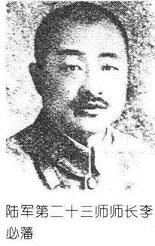 |
More available at Evacuation_From_Xuzhou-v0.pdf (Check RepublicanChina-pdf.htm page for up-to-date updates.)
* In Commemoration of China's Fall under the Alien Conquests in A.D. 1279,
A.D. 1644 & A.D. 1949 *
U.S.S.R./Comintern Alliance with the KMT & CCP (1923-1927)
Korean/Chinese Communists & the 1931 Japanese Invasion of Manchuria
American Involvement in China: Soviet Operation Snow, IPR Conspiracy, Dixie Mission, Stilwell
Incident, O.S.S. Scheme, Coalition Government Crap, Amerasia Case & The China White Paper
* Stay tuned for "Republican China 1911-1955: A Complete Untold History" *
|
|
Zou Rong's Revolutionary Army;
Shin Kyu Sik's
Shrine (Spirit, Kunitama) of Korea
|
This snippet is for sons and daughters of China:
Heed the sons & ministers' agony and sorrow of our ancestors who died or lived through the Mongol, Manchu and Soviet-Chicom conquest
and
the Yongjia, Jingkang and Jiashen cataclysms !
Jeanne d'Arc of China:
Teenager girl Xun Guan breaking out of the Wancheng city to borrow the relief troops in the late Western Jinn dynasty;
Liu-Shao-shi riding into the barbarian army to rescue her husband in the late Western Jinn dynasty;
teenager girl Shen Yunying breaking into Zhang Xianzhong's rebels on the horseback to avenge on father's death in the late Ming dynasty.
China's Solitary and Lone Heroes:
Nan Jiyun breaking out of the Suiyang siege and charging back into the city in the Tang dynasty;
Zhang Gui & Zhang Shun Brothers breaking through the Mongol siege of Xiangyang in the Southern Soong dynasty;
Liu Tiejun breaking through three communist field armies' siege of Kaifeng in the Republican China time period;
Zhang Jian's lone confrontation against the communist army during the June 3rd & 4th Massacre of 1989.
|
|
|
With the Japanese encirclement tightening, Li Zongren issued redeployment orders and divided his troops into four blocs for breakout. The Chinese troops began to break out through the slack areas at nights by taking advantage of the Japanese cowardice over night-time fighting as well as ignorance over the local geography. Li Zongren ordered an evacuation on a southward train at 11:00 pm, on the 18th. Close to the midnight, Li Zongren, with 1000 people, including news reporters, departed Xuzhou. 171st Division chief Yang Junchang, under heavy Japanese attacks, evacuated from Suxian without a prior approval. The Japanese, after sacking Suxian, pressed northeastward against Xuzhou. 50 kilometers away from Xuzhou, Li Zongren’s train had to stop when the engineering soldiers sabotaged the railway track upon news of the fall of Suxian County. About 5 kilometers to the north of Suxian, Li Zongren split with Tang Enbo's crack army and went eastward to circumvent Suxian after Li Zongren dissuaded Tang Enbo from re-taking Suxian and ordered Tang Enbo to move to the west for preserving the strength. Li Zongren's 1000-people column had to evade the Japanese planes on the road, and at one time, left a village without finishing cooking, only to escape a blanket bombing by twenty planes, after leaving village at a distance of 1-1.5 kilometers. To the southeast of Suxian, Li Zongren's column passed a Japanese cavalry force numbering by hundreds without any detection. Li Zongren met with one regiment of soldiers from the 7th Corps (i.e., the famed steel army versus the N.R.A. 4th corps or the iron army) at the bank of the Wohe River after one whole day trekking. After burning all trucks, they crossed the river to the south to enter the territory of the 21st group army. About 110 reporters, international and domestic, as well as military attaché of consulates, and condolence delegation representatives, finally relaxed in freedom. Among the visitors to Xuzhou would be American Stilwell [and Russian V. I. Chuikov (Cui-ke-fu, i.e., someone under Russian General Zhukov (Zhu-ke-fu) per Li Zongren; however, V. I. Chuikov was not sent to China again till December 1940 after subversive missions of the 1920s and 1930s. See “Mission to China: Memoirs of a Military Adviser to Chiang Kaishek”].
Liu Ruming's 68th Corps, part of the [[Long-hai]] Railway army group, went for Guoyang (Woyang) to the west. After the Xuzhou Retreat, Zhang Lanfeng, a graduate from the Japanese cadet academy, requested with Liu Ruming for staying put in eastern Henan Province for the guerrilla warfare. Also fighting the guerrilla warfare behind the enemy lines in Shandong and Jiangsu provinces would be Shi Yousan’s 69th Corps which consisted of the 181st Division and Gao Shuxun’s New 6th Division, as well as Han Deqing’s 24th Group Army.
Under the pincer-attacks by the Japanese and the Chinese communists, notable army generals of northwestern army background had to seek protection with the puppet army and the Japanese throughout 1939 to 1943. For details, refer to THE ENEMY FROM WITHIN: CHINESE COMMUNIST ATTACKS AT GOVERNMENT TROOPS - 1940.
The Air Battle over the Wuhan City
On March 29th, 1938, Chiang Kai-shek assumed the post of KMT Director-general ("zong cai"), while Whang Jingwei the deputy post, with a call for establishment of the "League of Three People's Principles" to replace all other KMT cliques and factions. Chiang Kai-shek attempted to take in the communists as well with this umbrella organization. The March meeting also promulgated the establishment of the "Investigation & Statistics Bureau" under the Military Commission of the National Government, i.e., the Nationalist Government "jun tong" or Military Stats, on basis of the special agent section of Dai Li's Resurrection Society ["fu xing she"].
Li Ao claimed that Chiang Kai-shek had contacted Dr. Sun Yat-sen's Japanese friends via the unofficial channel for assistance in stopping Japan's aggression. Kong Xiangxi (H H Kung) was in charge of establishing the secret contact office in HK, while Mme Chiang Kai-shek personally oversaw the operations. Kong Xiangxi naively requested that Japan's righteous people should uphold justice and Japan's militarymen should wake up at the earliest possible date. Kong Xiangxi's emissary discussed with the Japanese from March to June and requested that Japan immediately stop attack at Hankou (Hankow) of Wuhan, while the Japanese demanded that Chiang Kai-shek should resign, which was to conform with Konoe Fumimaro's declaration in January 1938 that the Japanese would not deal with Chiang Kai-shek, i.e., Shokaiseki o aite to sezu.
On the Japanese side, the navy intelligence officers were interested in making peace with China while the Japanese army intelligence, which was permeated with the J.C.P. agents, was against the peace with China. The Japanese later revoked the Hankow office to have the navy intelligence and army intelligence merge operations under the Nanking office.
The Japanese military's communist infiltration was similar to the American navy and army, where the Soviet spies and Comintern agents infiltrated heavily into the American army institution than American navy.
Stalin, having stamped a non-aggression pact with China, had assured Chinese representative Zhang Chong in a five-hour meeting on December 12th, 1937, that the U.S.S.R. would supply China with necessary equipment and materials for the war against Japan: Stalin, claiming that he was a Bolshevik who meant his words, stated that there was no need to sign any official document as to the promised Soviet aid.
Zhang Chong, being appointed a liaison between the U.S.S.R. and China, helped to establish the Sino-Soviet Cultural Society in Hankou of Wuhan. P.V. Rychagov, who came to China with four Russian-made fighter groups and two bomber groups, would defend the sky of Wuhan. On February 23rd, the Russians, with twenty-eight twin-engine Tupolev SB, bombed the Japanese plane assembly plant in Taipei, Taiwan, and destroyed about 40 Japanese planes. Three aviation generals, including Chennault and Zhou Zhirou, concluded that Japan would conduct a stealthy attack on April 29th by taking advantage of the Japanese Tenchosetsu (Tian-Chang [heaven lengthening]) Holiday, i.e., a copycat of Tang Emperor Xuanzong's birthday celebration. On the 28th, both the Russian and Chinese planes flew to Nanchang at daylight, but secretly returned at night. On April 29th, 1938, the Japanese came to bomb Wuhan after spies informed them of the vacation of the Chinese fleet. Wu Xiangxiang stated that Airforce General Zhou Zhirou first ordered that 20 Chinese pilots fly the Russian-made planes to deplete the gasoline tanks of the Japanese planes. Then, 40 Russian pilots, who were waiting about 15 kilometers east of Wuhan, engaged with 39 Japanese planes and shot down 36 out of 39. The Chinese lost 9 planes and 4 pilots, while the Russians lost 2 planes. Alternative accounts stated that 70 planes flew up to engage 70+ Japanese planes over the skies of Wuhan and that the Nationalist airforce shot down 19 Japanese planes.
(Xu Zhen stated that the Nationalist airforce shot down 21 Japanese planes over the sky of Wuhan.)
There had been some issues as to cooperation between Chennault and the Russians. Chennault, who was asked by Mme Chiang Kai-shek to go to Kunming for training the Chinese pilots, commented that the Russians had rotated pilots every six months to make their pilots experience the real war scenario the same way as they did to the Madrid War. Zhou Zhirou, having returned to China in 1934 from an overseas inspection on the foreign airforces, was responsible for establishing the Central Airforce Academy as well as organizing the "31 October 1936 Airforce Show", a date which was the anniversary of Chiang Kai-shek's birthday.
The Battle Of Lanfeng
In mid-May, Doihara Kenji's 14th Shidan attacked eastern Henan Province along the Long-Hai Railroad. Song Xilian's 71st Corps, Gui Yongqing's 27th Corps and Li Hanhun's 64th Corps resisted the Japanese advance. On May 19th, the Nationalist forces evacuated from Xuzhou of Shandong Province.
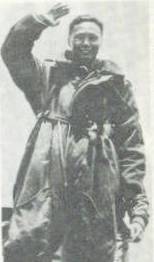 On May 19th (May 20th?), 1938, departing from the Nanhu Airport in Wuchang of Hubei Province, two Nationalist bombers and eight pilots, headed by Chen Guangdou, flew to Japan and dropped tons of leaflets onto Nagasaki, with a call for the Japanese to stop its barbarity against China. Pilot Xu Huansheng's picture showing triumphant return was sent across the nation. It was said that Mme. Chiang Kai-shek made the decision to drop the paper leaflets in lieu of the bombs onto Japan. The leaflet campaign was supposedly authorized by Mme Chiang Kai-shek who always treated herself a nanny of the Chinese airforce all through her life.
After the Xuzhou campaign, the Japanese General Headquarters, on May 21st, instructed that the invasion army would push to the area no further than Gui'de-Lanfeng on the [[Longhai]] Railway and Yongcheng-Mengcheng in northern Anhui Province while consolidation was to be made along the Tientsin-Pukow Railway and to the south of Xuzhou, with the Japanese North China Front Army and Central China Front Army in charge of the areas divided along the Huai River.
Doihara Kenji's 14th Shidan, with 20,000 men and hundreds of tanks, attacked eastern Henan Province along the Long-Hai Railroad. First War Zone commander Cheng Qian ordered Li Hanhun and Gui Yongqing to besiege the Japanese protruding force from the two ends of the railway: 29th Corps-group commander Li Hanhun led Wang Yaowu’s 74th Corps and the 155th Division of the 64th Corps westward from Gui'de, while 27th Corps commander Gui Yongqing led Song Xilian's 71st eastward from Lanfeng. 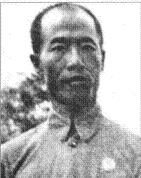 Additionally, Sun Tongxuan’s 3rd Group Army and Shang Zhen’s 20th Group Army were ordered to cut off Doihara Kenji's retreat path towards the Yellow River in the Dongming-Kaocheng and Dingtao-Heze area, while 8th Corps commander Huang Jie, with the 8th Corps, the 187th Division and the 24th Division, was ordered to defend Gui'de-Dangshan and impede the Japanese advance from Xuzhou.
Bai Huizhang (Bo Huizhang)'s 102th Division, which dwindled to 3000 men after the 1937 Battle of Shanghai but was rebuilt to 7000 men with replenishment from the Guizhou home province, joined the campaign in mid-May, and was assigned the job of defending Dangshan under the command of Huang Jie.
During this campaign, division commander Bai Huizhang, who commanded the Guizhou provincial army, lost his brother Bai Xianzhang.
102nd Division was reduced to 2000 troops after the breakout. 304th Regimental commander Chen Yunyu, and battalion commander Cao Wenjie of the 305th Regiment died in battle.
Owning to Huang Jie's ambiguity of orders, Bai Huizhang defended the Dangshan area through May 22nd-26th, with all army units surrounded by the Japanese 4th and 6th Shidan(s).
The Guizhou provincial army, that harbored the Korean nationalists since the late 1910s and early 1920s, such as Jin Hongyi (Gim Hong-yil, Choi Se-pyeong, Wang Yishu), later joined the Defense Battle of Wuhan and the Battle of Wanjialing under the command of Li Hanhun.
Jin Hongyi (Gim Hong-yil, Choi Se-pyeong, Wang Yishu) was responsible for commanding two South Korean divisions during the defense of Daqiu and Pushan in June and July 1950 and won two weeks' time for MacArthur to send in the American G.I.s to repel the North Korean army.
On May 24th, Chiang Kai-shek, furious over the loss of the Lanfeng city and the Yellow River crossings to Doihara Kenji's 14th Shidan, ordered that the 27th Corps recapture the city within 2 days; that the commander responsible for Lanfeng be executed for losing Lanfeng; and that Xue Yue, 19th Group Army commander, was put in charge of the Lanfeng recovery. The 74th Corps, the 64th Corps, the 71st Corps and the 27th Corps attacked east to west, while 17th Corps-group commander Hu Zongnan attacked west to east. Having surrounded the Japanese 14th Shidan at Quxingji, Sayiji, Luowang[zhai] and Lanfeng, Xue Yue launched a general attack at 6:30 pm, on May 25th. At night, the 71st Corps recovered the Lanfeng train station; on the 26th, the 74th Corps recovered the Luowang train station, while the 71st Corps attacked the Japanese perimeter positions around Lanfeng; and on the 27th, the 64th Corps recovered Luowang[ji], and the 71st Corps recovered Lanfeng. After three days’ fighting, Lanfeng was retaken by the Chinese armies with a casualty of 5000. Remnants of the 27th Ryodan under the Japanese 14th Shidan fled towards Sanyiji.
(Purportedly Xue Yue wanted the 71st Corps commander Gui Yongqing to be punished; however, the 88th Division commander Long Muhan was chosen as scapegoat.
Long Muhan, a Whampoa 1st Session cadet and a veteran who fought the 1937 Battle of Nankou as the deputy division commander of the 13th Corps, was just assigned to the ill-fated 88th Division that was rebuilt after heavy loss from the Defense Battle of Nanking.)
To give relief to the besieged 14th Shidan, the Japanese thrusted westward towards Henan Province in lieu of cleaning up the pockets of resistance in Shandong, Anhui and Jiangsu provinces. From north of the Yellow River, the Japanese 4th Mixed Ryodan repeatedly attempted crossings at Fengqiu and Guantai. From the east, the Japanese 16th Shidan, assisted by the 13th Independent Mixed Ryodan, was ordered to attack the Qixian area. The Japanese Second Army assigned the 13th Independent Mixed Ryodan and the Seya Shitai of the 10th Shidan to the command of the 16th Shidan consecutively. By May 31st, the Japanese 10th Shidan took over Guoyang (Woyang) and Bozhou, and the 16th Shidan reached east of Qixian County. On June 1st, Xue Yue issued the redeployment order, leaving Sun Tongxuan and Shang Zhen as the rearguards troops to cover the retreat by the night of June 3rd.
The Yellow River Breaching
On June 9th, 1938, to slow down the Japanese advance along the Long-Hai Railway towards Wuhan, i.e., the heartland of China, Chiang Kai-shek authorized 32nd Corps Chief Shang Zhen in breaking the Yellow River dike at Huayuankou [garden mouth], to the north of the Zhengzhou city of Henan Province, causing the loss of home to 10 million civilians in three provinces of Henan-Anhui-Jiangsu (i.e., 44 counties) and death of innumerable people in the ensuing years as a result of flooding, locust disaster and starvation. Lin Wei was later said to be responsible for proposing the idea of breaking the Yellow River dyke. The New 8th Division under the 32nd Corps engineered the breach. The Yellow River breach caused a lingering death toll till 1943.
(In history, the Northern Soong Chinese, for defending against the Jurchens, breached the Yellow River in A.D. 1128, which started the Yellow River's seven hundred years' history of rerouting to the Huai-shui River to the south for exit to the seas.)
The flooded area would be termed the "huang [yellow river] fan [flooded] qu [area]" where famine and disease would rattle on for years.
The flood zone also became the safe passage routes for the people to travel between the different areas of the country, as well as a spot of espionage.
Puppet Manchukuo emperor Pu-yi's brother, i.e., Prince Pu-jun or Pu Chun, who was once put on the throne for a few days in 1900, was such an agent working for Dai Li (Tai Li) in the floor zone.
Later in 1944, John Birch trekked to the Yellow Flood Zone, where he discovered a flight crew from Doolittle's Tokyo bombing squad and worked to launch a convenience airport strip that was utilized for flying out the stranded European priests of North China during the Japanese Ichigo Campaign.
General Heh Zhuguo's Northeastern Army cavalry corps later entered the Yellow Flood Zone to set up a base, which effectively segregated the communist New 4th Army's link with the rest of communist army.
Heh Zhuguo's cavalry, as well as the rest of government troops, successfully segregated the communist 8RA troops from the N4A forces in Jiangsu.
At one time, Tang Enbo's crack army, via the flood zone, was sent on a mission of crossing the Tientsin-Pukow Railway for beefing up the government guerrilla army that was under the communist siege for years.
After returning west, Tang Enbo's army was responsible for defending the Peking-Wuhan Railway and the new Yellow River line in today's Henan.
Communist general Peng Xuefeng, when attempting to invade west in the footsteps of the 1944 Japanese Ichigo Campaign, was killed in fighting the government troops.
Heh Zhuguo's Northeastern Army cavalry troops successfully set up a guerrilla zone that lasted through the war, unscathed by the 1944 Japanese Ichigo Campaign.
Before the Japanese surrender in September of 1945, Imai Takeo flew to the Yellow Flood Zone to explore unilateral peace with General Heh ZHuguo.
Chiang Kai-shek ordered a relocation of the Nationalist Government forces to the west of the Jing-Han [Peiping-Hankow] Railroad. Li Tiejun was ordered to guard Zhengzhou with three divisions and one cavalry brigade.
The cavalry force could be from Heh Zhuguo's Northeastern Army cavalry that later entered the Yellow Flood zone, where the cavalrymen were described by some teenager locals who joined the cavalry during the Henan Famine and later retreated to Taiwan to have engaged in pillage for food supplies.
(The Japanese, in a later campaign from October 4th, 1941 to October 31st, 1941, had taken over Zhengzhou for a short duration before another attack in the context of the "No. 1 Order" [Ichigo] in 1944. The Japanese set up a beachhead position on the southern bank of the Yellow River before pulling back the bulk of troops to the northern bank.)
The Wuhan Gang
In Wuhan, in 1938, Joseph Stilwill, a U.S. military attaché who cohorted with the Soviet spies and the Wuhan gang, often spread innuendo against China, for which Stilwell was called over to the Chinese government and given a censure.
Both Stilwell and Marshall, who spent time in the U.S. Tientsin mission that was a Boxer-related military occupation, could have been corrupted by the Soviet and communist ideology in the politically-turbulent 1920s.
American Evans Carlson returned to Wuhan after a three-month trip to the communist-controlled territories in North China. Carlson, who was rebuked by the American Navy for the pro-communist news conference conducted among about forty foreign reporters, resigned from the marines, and later wrote a book Twin Star of China and organized the "Gunho commando team" during the Pacific War.
'Gung ho', a term touted by some U.S. senator, was a Comintern scheme to launder money to Yenan as well as a military scheme to train the cooperative workers to be anti-government insurgents in Free China.
Historian Charles Hayford: "Hankow became a world center for the democratic struggle against fascism, and became almost a tourist stop-off for writers and demi-diplomats who swooped through to visit the front."
Durdin: Some of the Wuhan Gang possessed "some experience of the Spanish Civil War and who had been in Moscow."
At the time of the Wuhan Campaign, Utley noticed that the world did not render any assistance to the Chinese who were devastated by the Japanese plane bombing.
Utley shot some pictures of the girl scouts maintaining order during the air raid.
Utley commented that "the great Japanese earthquake in 1923, a catastrophe of … the American red Cross raised thirty million dollars in four weeks, whereas for China it has failed to raise even a million dollars."
Meanwhile, Chen Hansheng, who tacked on the position as secretary for the international committee, personally handled the inflow of funds which numbered about 20 million U.S. dollars for the two and half years’ operations up to the eruption of the Pacific War, and funneled most of the funds to Li Fuchun in Yenan through Liao Chengzhi’s transfer via banks in Shanghai.
From receipts disclosed from the communists, there were lines of entries of American donations totalling more than US$32,729.68 credited to Mme Sun Yat-sen's China National Defense League from 1939-1941.
Also note that
communist actresses and actors, like Wang Ying, collected the overseas Chinese donation of a similar amount of 20M or more in Southeast Asia.
Endo Homare, the only survivor of her family from the 1948 communist siege and blockade of Changchun that led to the starvation death of 300,000 civilians, verified that the Japanese foreign ministry funneled over 3 billion yens of funds to the communists through Pan Hannian, equivalent to 25 million U.S. dollars [more than the amount of an American tung oil, tin or tungsten barter trade].
Additionally,
the communists received the funds and money that that quadruple-identity or quintuple spy Yuan Shu embezzled and passed on to the communists out of budgets that were allocated to the puppet Reviving Asia Movement by the Japanese foreign ministry.
Hu Shoumei, i.e., Guan Lu or Hu Xiumei, working for puppet spymaster Li Shiqun as a secretary till the end of 1942, siphoned off the puppet special agency's money in collaboration with Li Shiqun's wife for the communists, which meant that the puppet agency's ransom money was ultimately destined for the communists.
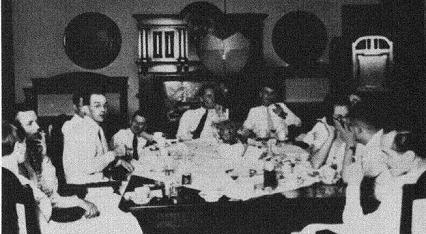
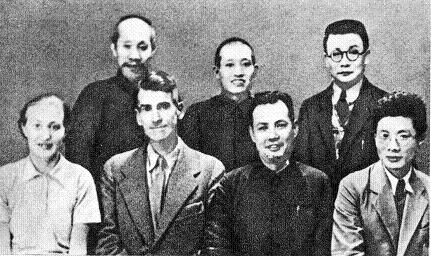 |
The Japanese Changing Direction to an East-to-West Campaign along the Yangtze
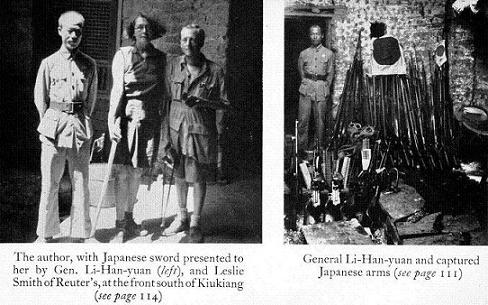 Li Zongren pointed out that the Japanese, after the Yellow River breach, stopped march along the Long-Hai Railway, and relocated forces for a march along the Yangtze River instead. On May 19th, Japan contemplated upon attacking Wuhan right after taking over Xuzhou. The Yellow River breaching on June 9th and 12th changed the Japanese plans of attacking the Yellow River city of Zhengzhou from north and east with Japan’s North China Army and attacking towards Wuhan via routes of the Huai River and the Yangtze River with the Japan’s Central China Army.
 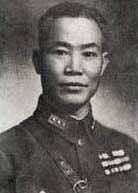 On June 15th, the Japan’s imperial meeting endorsed the Hankow-Canton plan, which the General Staff Headquarters revised on the 18th with cancellation of an attack against Zhengzhou from the eastern direction and rerouting of the Huai River attack toward the perimeter of Mt Dabieshan.
In June of 1938, Chen Cheng, commander of the Ninth Battlefield, was in charge of the Wuhan Campaign, with 14 divisions and 1 brigade under his helm. The Japanese prepared an army of 300,000 against Wuhan in July of 1938.
More available at Japanese-Yangtze-Campaign.pdf (Check RepublicanChina-pdf.htm page for up-to-date updates.)
* In Commemoration of China's Fall under the Alien Conquests in A.D. 1279,
A.D. 1644 & A.D. 1949 *
U.S.S.R./Comintern Alliance with the KMT & CCP (1923-1927)
Korean/Chinese Communists & the 1931 Japanese Invasion of Manchuria
American Involvement in China: Soviet Operation Snow, IPR Conspiracy, Dixie Mission, Stilwell
Incident, O.S.S. Scheme, Coalition Government Crap, Amerasia Case & The China White Paper
* Stay tuned for "Republican China 1911-1955: A Complete Untold History" *
|
|
Zou Rong's Revolutionary Army;
Shin Kyu Sik's
Shrine (Spirit, Kunitama) of Korea
|
This snippet is for sons and daughters of China:
Heed the sons & ministers' agony and sorrow of our ancestors who died or lived through the Mongol, Manchu and Soviet-Chicom conquest
and
the Yongjia, Jingkang and Jiashen cataclysms !
Jeanne d'Arc of China:
Teenager girl Xun Guan breaking out of the Wancheng city to borrow the relief troops in the late Western Jinn dynasty;
Liu-Shao-shi riding into the barbarian army to rescue her husband in the late Western Jinn dynasty;
teenager girl Shen Yunying breaking into Zhang Xianzhong's rebels on the horseback to avenge on father's death in the late Ming dynasty.
China's Solitary and Lone Heroes:
Nan Jiyun breaking out of the Suiyang siege and charging back into the city in the Tang dynasty;
Zhang Gui & Zhang Shun Brothers breaking through the Mongol siege of Xiangyang in the Southern Soong dynasty;
Liu Tiejun breaking through three communist field armies' siege of Kaifeng in the Republican China time period;
Zhang Jian's lone confrontation against the communist army during the June 3rd & 4th Massacre of 1989.
|
|
|
Battle along the Nanchang-Jiujiang Railway
Battle along the Xingzi-De'an Highway & Ruichang-Wuning Highway
Battle of Wanjialing
Matsuura’s 106th Shidan, after being impeded at Shahepu, did not attack south till August 27th when it was ordered to echo the southwestern push from Ruichang by the Japanese 9th Shidan. Past midnight, the Japanese attacked Xuelipo, Changling and Shilishan that were defended by Li Jue’s 70th Corps (the 19th Division), Li Hanhun’s 64th Corps and Ou Zhen’s 4th Corps. Li Hanhun, from the 6th to the 17th, organized three detachments for raiding the Japanese in the Datangjiao-Mahuiling-Xiling area. Owing to heavy casualties, 2700 new Japanese recruits were sent to filling up ranks at the 106th Shidan; further, the 52nd mountain gun Rentai of the newly-organized 22nd Shidan was relocated over from Hangzhou of Zhejiang Province for strengthening the ranks. Matsuura’s 106th Shidan did not move till early October when it was ordered to penetrate between the Chinese defense lines along the Ruichang-Wuning Highway and the Nanchang-Jiujiang Railway to lend support to the 27th InfDiv and the 102nd Ryodan of the 101st Shidan, ending in the destruction debacle at the Battle of Wanjialing (ridge of ten thousand households).
The Japanese, after failure to push forward, realized that they were surrounded by the Chinese army.
To secure the retreat path, the Japanese wrestled over the Zhanggushan peak.
The Chinese 74th Corps, with one of its divisions exhausted in the battles, sent over another division to recovering Zhanggushan.
Zhang Lingfu personally led a commando team to climb up the peak from the hind, then pincer-attacked the Japanese from the mountaintop, and recovered Zhanggushan.
During the Battle of Wanjialing, the Guizhou provincial army, i.e., Bai Huizhang's 102nd Division that harbored the Korean nationalists since the late 1910s and early 1920s, was put under the command of Ou Zhen's 4th Corps for the Nanchang-Jiujiang Railway Campaign.
The 102nd Division first repelled the Japanese attack north of Dalingtou (big ridge head), then circumvented to attack the Japanese at Wushimen (black stony gate) to the left side, and caused the Japanese to fall back towards Wanjialing and Gushan (lonely hill).
On October 6th, the 102nd Division joined the 18th Corps and 64th Corps in besieging the Japanese at Wanjialing. After four days and four nights' battles, the Chinese army sacked Wanjialing and destroyed four Japanese rentai(s) equivalent of army troops, including the air-dropped officer corps.
After this debacle campaign, the Japanese revoked the 106th Shidan from its order of battle.
The Japanese counter-attacked Wanjialing on October 12th. The 102nd Division's positions were breached by the Japanese on the 15th. On the 16th, the 102nd Division pulled back from Wanjialing after the 52nd Division and 109th Division on the right flank abandoned the defense positions.
Jin Hongyi (Gim Hong-yil, Choi Se-pyeong, Wang Yishu), i.e., a Korean nationalist who came to China in the late 1910s and was sponsored by the Sino-Korean nationalists' alliance for military training under the Guizhou provincial army, fought the Battle of Wanjialing under the command of division commander Bai Huizhang.
Jin Hongyi, during the 1950 Korean War, commanded two divisions in repelling the North Korean army at the southeastern Daqiu and Pushan and later served as a South Korean ambassador to the Republic of China, Taiwan, enjoying the title of ambassador emeritus with the summa cum laude honor.
The 102nd Division, after the Chinese loss of De'an on October 28th, was given the task of defending the southern Xiu-shui River riverbank.
In March 1939, the 102nd Division participated in the Defense Battle of Nanchang. In September 1939, the 102nd Division participated in the First Battle of Changsha.
In September 1941, the 102nd Division participated in the Second Battle of Changsha.
After the Pearl Harbor, the 102nd Division, which was under the 4th Corps' order of battle, was sent for the Hongkong mission. With the British surrender of Hongkong to the Japanese, the 102nd Division returned north to fight the Third Battle of Changsha.
Prior to the Fourth Battle of Changsha, Bai Huizhang was deprived of the commanding of the 102nd Division, and was offloaded to the Jiangxi hind to be non-battle official with Jiang Jingguo, i.e., Chiang Kai-shek's Soviet-educated son.
(Bai Huizhang was executed by the communists on September 14th, 1952.)
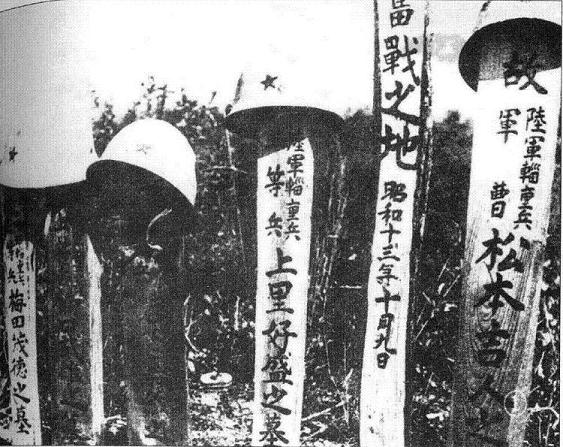 |
Battle of Lake Khasan (Zhanggufeng)
From July 29th to Aug 11th, the Japanese invaded the U.S.S.R. at Zhanggufeng at the Manchurian-Mongolian border, but got repelled.
The Campaign against Yangxin-Dayi-Huangshi
The Battle at Huangmei-Guangji
The Battle Against Tianjiazhen
Li Zongren stated that he had proposed a proactive attack at the Japanese by departing southern Henan Province for western Anhui Province because there was no pass or precarious fortification to rely upon on the plains from Lu'an to Xinyang to the west. Alternatively, both Li Zongren and Bai Chongxi had misjudged the Japanese move by claiming that Japan's main thrusts were directed against the Yangtze. One group of the Japanese army departed the Zhengyangguan Pass for Gushi, Huangchuan, Luoshan and Xinyang of Henan Province for sake of cutting off the Ping-Han Railway and posing threat to the Wushengguan & Pingjingguan passes, while the other group went against Shangcheng & Macheng for crossing Mt Dabieshan and encircling Wuhan city from the east.
Hu Zongnan commanded three divisions, Dong Zhao's 16th Corps and Zhao Xiguang's 167th Division in stopping the Japanese advance, recovering Mt Xiaoluoshan, and pressing them back to the Luoshan city on the 23rd. The Japanese 16th Shidan suffered a casualty of 5000. Hu Zongnan fought the Japanese 3rd & 16th Shidans for two days and two nights thereafter, and after the Battle of Xing-Luo, the Japanese dared not advance further to the west.
The Battle of Lu'an-Huoshan
The Battle Along Lu'an-Yejiaji-Gushi Highway and Shihe River
The Campaign against Shangcheng-Huangchuan
Attempts at Mt Dabieshan Crossing
The Campaign Against Luoshan-Xinyang
The Battle Of Wuhan
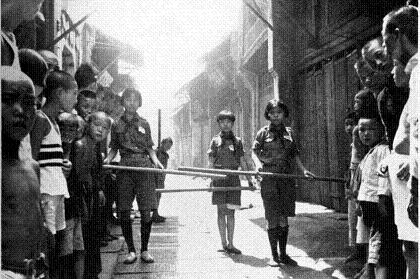 The Japanese took over Xinyang on October 12th. On October 16th, the Military Council made the decision to abandon Wuhan, recalled Luo Zhuoying for the Wuhan outskirts defense, and sent notifications to both zone commanders, Li Zongren and Chen Cheng. On October 17th, the Japanese launched a general attack from all directions. On the northern bank of the Yangtze, the 6th Shidan of the Japanese Eleventh Army, in lieu of waiting for a scheduled replenishment of 3000 new recruits, attacked westward on October 17th after detecting the Chinese pullback. Simultaneously, the 119th Ryodan of the 116th Shidan, from Tianjiazhen, moved westward on the 17th. On the southern bank, the Hada Shitai, after taking over Dayi on the 21st and Echeng (Ezhou) on the 22nd, pushed to Gedian on the 24th; the 9th Shidan fought against Li Yannian and Guan Linzheng’s troops at Mt Huanglongshan, and pushed to east of Heshengqiao by the 24th; and the 27th Shidan, departing from the Xingtanpu area, reached northeast of Xianning by the 24th. To the west of Peiping-Hankow Railway, the 10th Shidan pushed to Yingshan on the 23rd. At Mt Dabieshan, after the Japanese reconnaissance planes detected the Chinese evacuation from the Xiaojieling area, the 13th Shidan and the 16th Shidan began to cross Mt Dabieshan on the 23rd. On the 23rd, the Fifth War Zone command center issued the evacuation order.
Before relocating his army to the west of the Ping-Han Railway, Li Zongren left Liao Lei as guerrilla commander in Mt Dabieshan where a so-called Shangri-La-like safe haven was maintained throughout the coming years. (Zhang Naiqi, one of the "seven gentlemen" of 1936, continued to work as a finance minister under Liao Lei's Anhui Province governor office. Liao Lei, later in October 1939, pass away due to illness inside of Mt Dabieshan.)
In mid-Oct, Li Zongren relocated his command center to the Chenchun village, about 5 kilometers away from the Ping-Han Railway from Xiadian. Li lost contact with his troops which were called over to fill up the vacuum left by Hu Zongnan's army. At night, sleepless, he suddenly decided on a move, and it turned out that 1000 Japanese cavalrymen raided this village two hours after the vacation.
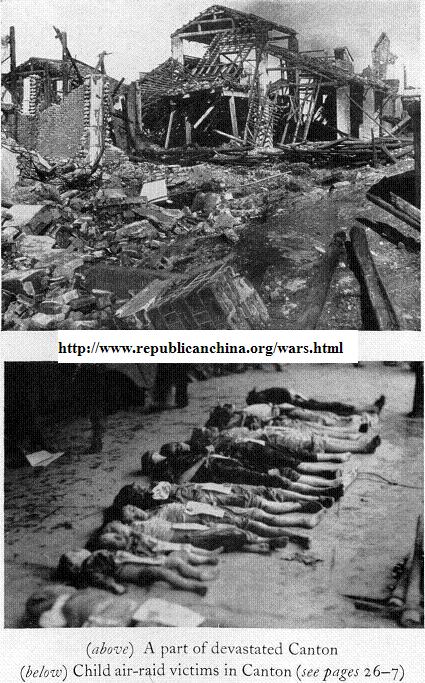 On October 12th, in the south, the Japanese landed at the Dayawan Bay and took over Huizhou of Guangdong Province. Guangzhou (Canton) was lost on October 21st, 1938. Only 3-4 factories managed to be shipped over to HK from Canton. The Russian ships at HK, unable to off-load the military goods for shipment via the Yue-Han Railway, had to sail to Rangoon when Vietnam refused to lend a path. With the Canton-Kowloon and Yue-Han [Guangdong-Wuhan] railways bombarded by the Japanese, the Chinese transported goods via trucks to link up the broken railway tracks. With two ends of the Yue-Han Railway taken by the Japanese, locomotives and trains concentrated in Hengyang of Hunan Province, while the crowded Railway Xiang-Gui became the major pipeline. Prior to the Japanese landing at the Dapengwan Bay in Oct, trucks hastily moved goods from the Canton warehouses. On October 12th, in the south, the Japanese landed at the Dayawan Bay and took over Huizhou of Guangdong Province. Guangzhou (Canton) was lost on October 21st, 1938. Only 3-4 factories managed to be shipped over to HK from Canton. The Russian ships at HK, unable to off-load the military goods for shipment via the Yue-Han Railway, had to sail to Rangoon when Vietnam refused to lend a path. With the Canton-Kowloon and Yue-Han [Guangdong-Wuhan] railways bombarded by the Japanese, the Chinese transported goods via trucks to link up the broken railway tracks. With two ends of the Yue-Han Railway taken by the Japanese, locomotives and trains concentrated in Hengyang of Hunan Province, while the crowded Railway Xiang-Gui became the major pipeline. Prior to the Japanese landing at the Dapengwan Bay in Oct, trucks hastily moved goods from the Canton warehouses.
After taking over Wuchang and Hankou on October 26th and Hanyang on the 27th, the Japanese thrust was passivated and blunted. Li Zongren claimed that the Japanese campaign could last no more than one month from then on. The Battle Of Wuhan, lasting 45 days, would cause the Japanese 13th & 11th Shidans a casualty of 30,000 men.
Re-zoning Of the Military Districts After the Battle Of Wuhan
After the Battle Of Wuhan, Chiang Kai-shek rezoned his military districts:
the 1st District Henan-Anhui (Wei Lihuang)
the 2nd District Shanxi-Shenxi (Yan Xishan)
the 3rd District Jiangsu-Anhui-Zhejiang-Fujian (Gu Zhutong)
the 4th District Guangdong-Guangxi (Zhang Fakui)
5th District Anhui-Hubei-Henan (Li Zongren)
the 8th District Gansu-Ningxia-Qinghai-Suiyuan (Zhu Shaoliang)
the 9th District Hunan-Jiangxi-Hubei(Chen Cheng/Xue Yue)
the 10th District Shenxi (Jiang Dingwen)
the Jiangsu-Shandong District (Yu Xuezhong)
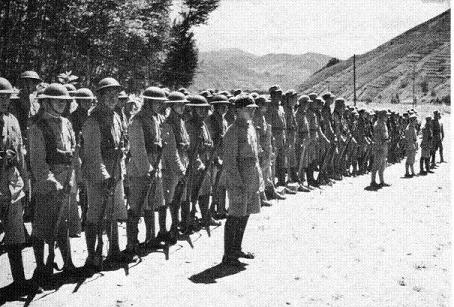 the Hebei-Chahar District (Lu Zhonglin). the Hebei-Chahar District (Lu Zhonglin).
After the Battle of Wuhan, the 9th war zone was carved out from Chen Cheng's 6th war zone. The Yangtze defense, from Yichang downstream, was carved out of Li Zongren's 5th war zone for Chen Cheng, instead.
In Sept, the Japanese re-organized their commander-in-chief office by relocating it to Nanking. By autumn of 1938, the Japanese took control of major railway lines in eastern and northern China and the perimeter of about 10 kilometers on both sides of the railway tracks. The Japanese began to adopt a defense stance against China, with major aims of disrupting China's interiors and cutting off the supply lines in the south. Both Chiang Kai-shek and Itagaki Seishiro talked about a lengthened warfare on the Chinese Battlefield. Some mobile forces were shuffled back to Japan, while some Japanese 'national guard' forces were sent to China. By November 1939, the total Japanese armies in China included 23 Shidans, 20 mixed Ryodans, 2 cavalry divisions, and 1 airforce group army.
In the winter, Chiang Kai-shek dispatched two corps to reinforce the guerrilla warfare in Shandong & Jiangsu Provinces where the Lu-Su [Shandong-Jiangsu] & Ji-Cha [Hebei & Chahar] bases were established. Chiang Kai-shek ordered a three-phase army re-organization at the Nanyue Military Meeting.
Throughout 8-9 years of the resistance war, over 22 more campaigns between the Chinese and the Japanese armies ensued in the provinces of Hunan, Hubei, Jiangxi and Guangxi, etc. In the center of China, in Hunan Province especially, the Japanese armies met with stiff resistance from the Chinese armies. Changsha, the provincial city of Hunan Province, witnessed four major battles. From 1939 to 1945, the Nationalist Government engaged the Japanese aggressors in over a dozen campaigns, including: the Nanchang Battle, the Sui-Zao Battle, the First Changsha Battle, the Gui-nan Battle, the Shanggao Battle, the Second Changsha Battle, the Yu-nan Battle, the Jin-nan Battle, the Zao-Yi Battle, the Burma Battle, the Yu-zhong Battle, the Third Changsha Battle, the Zhe-Gan Battle, the Changde Battle, the Chang-Heng Battle, the Gui-liu Battle, the Yu-xi & Er-bei Battle, the Teng-long Battle, the Dian-xi [& the North Burma Battle, the Xiang-xi Battle, and the Second Gui-Liu Battle.
In late October of 1938, Xinyang of Henan Province was lost. Factories of Henan Province, including the Guanghua Machinery, the Quanxinrong Cotton Factory, the Yufeng Packaging Factory and Xuchang's flour factory, were hauled over to Shenxi Province promptly. Shanxi and Shandong provinces followed suit in transferring equipment to the Guanzhong area of Shenxi, including Qingdao's Renshengdong Oil Factory and Ji'nan's Chengtong Iron Factory & Chengtong Textile Factory. Wuhan was lost on October 26th, 1938.
In Nov, Li Zongren's 5th military district relocated to Zaoyang where they converged with the 84th Corps of Li Pingxian's 11th group army which broke through the Japanese line at Yingcheng earlier. The 84th Corps and the 68th Corps [Liu Ruming] stationed at Suixian county. Li Zongren then moved his command center to Fancheng for supervising the defense of the Shashi-Badong segment of the Yangtze River as well as western Henan Province. In Dec, the Nationalist Government military commission set up the Guilin Generalissimo's Headquarters in Guilin of Guangxi Province, with Bai Chongxi in charge as director.
On November 12th, 1938, the fall of Yueyang and the rumor of a coming Japanese attack at Changsha caused panic and confusion among the military officers and administrative officials, headed by Zhang Zhizhong. The Changsha authorities, which had previously implanted explosives and powder for implementing the scorched-earth policy, mistakenly issued the order before the Japanese started the attack, leading to a casualty toll of 20,000 civilians from arson in the city during November 12th-14th. per Zhang Ling'ao, Zhang Zhizhong had implemented the "scorch earth" policy after receiving a call from presidential attaché Lin Wei as well as a telegraph. On the 14th, Chiang visited Changsha and claimed that it was a blunder by the whole team. Chiang Kai-shek ordered the execution of Changsha garrison commander Feng Ti, 2nd constabulary regiment chief Xu Kun & police chief Wen Chongfu as a scapegoat.
Whang Jingwei's Nanking Puppet Government
 On December 22nd, 1938, the Japanese prime minister issued "three principles" as to peace with China. Unable to win militarily, the Japanese sought for Chinese puppets and traitors for establishing the so-called "Greater East Asia Co-prosperity Sphere." In Peking, the Japanese failed to get Wu Peifu submit to their demands. (Later, Wu Peifu died in a mysterious circumstance, which some people suspected to be a Japanese assassination.) The Japanese already established a so-called Liang Hongzhi 'Reform Government' in Nanking in a similar fashion to the puppet Wang Kemin 'Interim Government' of Peking. After winning over Whang Jingwei, the Japanese established a puppet 'National Government' in Nanking in 1940. On December 22nd, 1938, the Japanese prime minister issued "three principles" as to peace with China. Unable to win militarily, the Japanese sought for Chinese puppets and traitors for establishing the so-called "Greater East Asia Co-prosperity Sphere." In Peking, the Japanese failed to get Wu Peifu submit to their demands. (Later, Wu Peifu died in a mysterious circumstance, which some people suspected to be a Japanese assassination.) The Japanese already established a so-called Liang Hongzhi 'Reform Government' in Nanking in a similar fashion to the puppet Wang Kemin 'Interim Government' of Peking. After winning over Whang Jingwei, the Japanese established a puppet 'National Government' in Nanking in 1940.
Gao Zongwu, a graduate of Japan's Kyushu Empire University, used to be Whang Jingwei's interpreter. Prior to and at the time of the resistance war, Gao Zongwu organized a so-called "low-tone club" in Nanking, while Hu Shi advocated for another negative slogan by claiming that China could not win a war without the American-British intervention.  Before the loss of Nanking in December 1937, Gao Zongwu dispatched Dong Daoning to Shanghai for contacts with the German & Japanese. Dong Daoning, with funding from Zhou Zuomin of Jincheng Bank in Shanghai, shuttled between Shanghai, Tokyo & HK, while Zhou Zuomin befriended the son of Inukai Tsuyoshi. On the ship to Wuhan, Gao Zongwu encountered Zhou Fohai, i.e., a graduate of Kyoto Empire University, and absorbed Zhou Fohai of the Propaganda Ministry into his "low tone club." At the suggestion of Zhou Fohai [Fuhai], Chiang Kai-shek dispatched Gao Zongwu to HK for studying options of making peace with Japan, i.e., an organization that was precursor to the later "International Research Institute."
More available at Puppet_Nanking_Government-v0.pdf (Check RepublicanChina-pdf.htm page for up-to-date updates.)
* In Commemoration of China's Fall under the Alien Conquests in A.D. 1279,
A.D. 1644 & A.D. 1949 *
U.S.S.R./Comintern Alliance with the KMT & CCP (1923-1927)
Korean/Chinese Communists & the 1931 Japanese Invasion of Manchuria
American Involvement in China: Soviet Operation Snow, IPR Conspiracy, Dixie Mission, Stilwell
Incident, O.S.S. Scheme, Coalition Government Crap, Amerasia Case & The China White Paper
* Stay tuned for "Republican China 1911-1955: A Complete Untold History" *
|
|
Zou Rong's Revolutionary Army;
Shin Kyu Sik's
Shrine (Spirit, Kunitama) of Korea
|
This snippet is for sons and daughters of China:
Heed the sons & ministers' agony and sorrow of our ancestors who died or lived through the Mongol, Manchu and Soviet-Chicom conquest
and
the Yongjia, Jingkang and Jiashen cataclysms !
Jeanne d'Arc of China:
Teenager girl Xun Guan breaking out of the Wancheng city to borrow the relief troops in the late Western Jinn dynasty;
Liu-Shao-shi riding into the barbarian army to rescue her husband in the late Western Jinn dynasty;
teenager girl Shen Yunying breaking into Zhang Xianzhong's rebels on the horseback to avenge on father's death in the late Ming dynasty.
China's Solitary and Lone Heroes:
Nan Jiyun breaking out of the Suiyang siege and charging back into the city in the Tang dynasty;
Zhang Gui & Zhang Shun Brothers breaking through the Mongol siege of Xiangyang in the Southern Soong dynasty;
Liu Tiejun breaking through three communist field armies' siege of Kaifeng in the Republican China time period;
Zhang Jian's lone confrontation against the communist army during the June 3rd & 4th Massacre of 1989.
|
|
|
The Japanese Exploitation of the Foreign Exchange System
The Japanese, together with Zhangjiakou (Kalgan)'s puppet Mongolian Bank, Peking's Hebei Province puppet government-controlled bank and Shanghai's Huaxing Commercial Bank, tried to assert the "Japanese military currency" and Whang Jingwei's "puppet reserve bank currency" over the Nationalist Government's "legalized currency" (i.e., fa bi). (Prior to the puppet reserve bank, the Japanese-controlled puppet currency, etc., totaled no less than 0.666 billion equivalent of the Chinese currency; the Japanese military currency, with no numbering, in 1940 alone, totaled 1 billion in the printed amount; and the total Japanese military currency was equivalent to 3.5 billion equivalent Chinese "legalized currency" by 1940.)
Today, the Japanese government still refused to buy back its notorious "military currency" from senior HK residents.
The foreign exchange, which was maintained by the Nationalist Government in cooperation with Britain and America, had been fluctuating in synchronization with the war developments. China's "legalized currency" (i.e., fa bi) was impacted by the 1937 war outbreak in Shanghai when there was a flight of capital to HK and elsewhere. The U.S. bought 312,000,000 taels of silver from China in 1937-1938 for lending support to the exchange rate with the "legalized currency." (China had stored in both U.S. and Europe a considerable amount of silver prior to the war --which was Morgenthau's scheme to force China to link its currency to the U.S. dollar rather the British sterling in the aftermath of the U.S. manipulation of the silver market which crashed the Chinese economy.)
The powers, since 1938, colluded with the Japanese in depositing China's customs tax and salt tax, i.e., the funds reserved for the payment of the reorganized R.O.C. bonds, in the Japanese Yokohama Specie Bank, hence forfeiting the claim to payment of the principal and interests on the R.O.C. debts --that were reorganized in the 1930s to have included the Peking government's debts, i.e., 1913 Chinese Reorganization gold bonds, that in turn was a reorganization of the R.O.C. and Manchu debts.
As to the Huguang railroad and public works debt in what's now Hebei Province and three other southern and southwestern provinces, i.e., southwest China's railway loans that triggered the 1911 Xin Hai Revolution as a result of the Manchu attempt at nationalizing the railways for transfer to the international synarchists, was paid a coupon and interests again in 1928, it was reinstated and reorganized in 1928 and 1937, respectively.
This loan, with the British, German and American funds, became the poster child auctioned on the EBay today.
The Hu-guang (Hukuang) loan, together with the Tientsin-Pukow railway loan, were pledged by the customs and salt revenue tax.
After the Japanese invasion of Manchuria, the salt taxes that were robbed by the Japanese made China default on the two railway loans, portion of which belonged to the Americans. The two railway loans, which were barely reorganized and reinstated in the early part of 1937, fell back again after the Japanese invaded China and seized all ports along the coast.
After the restructuring of the 'aftermath loan' in 1913, the United States withdrew from the six-nation consortium.
In 1920, a new four-nation consortium was formed; however, this consortium did not give any loan to China on the pretext of not offending Japan.
Republic of China, in light of the force majeure event and the fact that the powers colluded with Japan in intercepting the custom taxes, announced in January 1939 that the debt payments would be stopped after the strenuous efforts at making such payments throughout 1937-1938 and that the powers should seek payments of the principal and interests with Japan, instead.
Later, in 1950-1951, the U.S., which again betrayed the R.O.C. in excluding the R.O.C. Taiwan government from the treaty signatory ceremony, reached a consensus with the rest of powers in relinquishing the wartime damages against Japan, which in the sense of international law nullified the claims to the R.O.C. reorganized bonds that were securitized by the customs tax and salt tax that were robbed by the Japanese.
The San Francisco Treaty of Peace in 1950-1951, in a lumpsum settlement, required countries to abandon claims for the financial losses caused by the Japanese aggression, including the claims related to the Chinese war time loss of the customs duties and salt tax.
The powers, in relinquishing the wartime damages against Japan, nullified the claims to the R.O.C. reorganized bonds that were securitized by the customs tax and salt tax that were robbed by the Japanese.
From this point of view, alone, the European powers or the United States lost the recourse to recover debts with payments ceased due to the Sino-Japanese war.
The 1909-1910 Huguang debt instruments available on EBay or auctioned elsewhere carried no enforceability, in another word.
In March, 1939, the "legalized currency" [fa bi] already devalued by 46%. The European War outbreak would see some of the 'flight' money back to Shanghai's settlement areas. 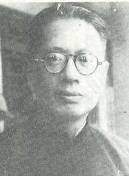 In June 1940, France stopped China from using the Vietnamese-Chinese highway and railway;
in July, Britain forbade China from using HK and Burma as the transport routes.
Pro-communist Ma Yinchu attacked finance minister Kong Xiangxi for 1) the bond market manipulation, 2) the foreign exchange manipulation.
On April 1st, the U.S. agreed to provide a loan of 50 million U.S. dollars for balancing the foreign exchange rate with the Chinese currency. (This loan was never fully utilized
since the Soviet spies, i.e., Solomon Adler and Harry Dexter White, et al., already controlled and hijacked the United States policies towards China, and worked to sabotage the Republic China's wartime finance.) In June 1940, France stopped China from using the Vietnamese-Chinese highway and railway;
in July, Britain forbade China from using HK and Burma as the transport routes.
Pro-communist Ma Yinchu attacked finance minister Kong Xiangxi for 1) the bond market manipulation, 2) the foreign exchange manipulation.
On April 1st, the U.S. agreed to provide a loan of 50 million U.S. dollars for balancing the foreign exchange rate with the Chinese currency. (This loan was never fully utilized
since the Soviet spies, i.e., Solomon Adler and Harry Dexter White, et al., already controlled and hijacked the United States policies towards China, and worked to sabotage the Republic China's wartime finance.)
In March 1941,
the Japanese and the Chinese collaborators launched counter-assassinations against the Chinese bank employees
in the French Concession and the International Settlement of Shanghai.
From February 20, 1941 to April 16, in less than two months, the Military Investigation and Statistics Service agents and the puppet 76 Jessfield agents altogether mounted nine bloody cases of assassinations and counter-assassinations. This was what the puppet government called in its propaganda as the Chungking terror termed "Bombing Massacre and the Chungking Regime", with a claim that "comrades on the side of the peace movement would not be threatened by guns and bombs." The puppets claimed that the puppet China Reserve Bank possessed a huge amount of funds, with its par value increasing daily, and this strong position could not be shaken by violence against the bank and the associated notes exchange institutions, and issued a warning reminder as to the huge loss of life and damages to property of the four banks in the spring. In desperation, the R.O.C. bank managers had to cease business, and requested with Wu Kaixian, head of the Shanghai United Command Committee, to report to Chungking for stopping the "sanctions" operation against the puppets to avoid further retaliation from the puppets, as well as requested with puppet government's leader Zhou Fohai for mediating over the matter. In the end, Chiang Kai-shek on April 23, 1941, ordered Dai Li to stop the "sanction" against the puppet China Reserve Bank of Shanghai.
After one-month bloody killings, a truce was brokered by Du Yuesheng,
yielding to the Japanese to have the puppet money circulate together with the Chinese "legalized currency."
(See the writing on the "Japanese Invasion Money" at http://www.perthmoney.com/docs/info.cfm.)
More available at Puppet_Nanking_Government-v0.pdf (Check RepublicanChina-pdf.htm page for up-to-date updates.)
After the eruption of the Pacific War, the Japanese intruded into Shanghai's settlement areas,
opened a new reserve bank, printed the "puppet money", exchanged into the "legalized currency" with the "puppet money",
and then exchanged it into the international currency with the "legalized currency."
The Japanese reversed the prior policy of maintaining the "legalized currency" to deliberately devalue the "legalized currency"
for sake of grabbing more purchasing power of Chinese commodities with the worthless Japanese "military currency" [i.e., "jun piao"].
* In Commemoration of China's Fall under the Alien Conquests in A.D. 1279,
A.D. 1644 & A.D. 1949 *
U.S.S.R./Comintern Alliance with the KMT & CCP (1923-1927)
Korean/Chinese Communists & the 1931 Japanese Invasion of Manchuria
American Involvement in China: Soviet Operation Snow, IPR Conspiracy, Dixie Mission, Stilwell
Incident, O.S.S. Scheme, Coalition Government Crap, Amerasia Case & The China White Paper
* Stay tuned for "Republican China 1911-1955: A Complete Untold History" *
|
|
Zou Rong's Revolutionary Army;
Shin Kyu Sik's
Shrine (Spirit, Kunitama) of Korea
|
This snippet is for sons and daughters of China:
Heed the sons & ministers' agony and sorrow of our ancestors who died or lived through the Mongol, Manchu and Soviet-Chicom conquest
and
the Yongjia, Jingkang and Jiashen cataclysms !
Jeanne d'Arc of China:
Teenager girl Xun Guan breaking out of the Wancheng city to borrow the relief troops in the late Western Jinn dynasty;
Liu-Shao-shi riding into the barbarian army to rescue her husband in the late Western Jinn dynasty;
teenager girl Shen Yunying breaking into Zhang Xianzhong's rebels on the horseback to avenge on father's death in the late Ming dynasty.
China's Solitary and Lone Heroes:
Nan Jiyun breaking out of the Suiyang siege and charging back into the city in the Tang dynasty;
Zhang Gui & Zhang Shun Brothers breaking through the Mongol siege of Xiangyang in the Southern Soong dynasty;
Liu Tiejun breaking through three communist field armies' siege of Kaifeng in the Republican China time period;
Zhang Jian's lone confrontation against the communist army during the June 3rd & 4th Massacre of 1989.
|
|
|
Battle of Nanchang
On Feb 6th, 1939, Japan’s Central China Expeditionary Army issued an order to the Eleventh Army to take Nanchang for controlling the Nanchang Airfield and cutting off the Zhejiang-Jiangxi Railway, the vital link between China’s two war zones and the supply route for the guerrilla bases in the Anhui and Zhejiang provinces. Earlier, in Feb, the Japanese concentrated forces in the De'an and Hukou area, while Chiang Kai-shek ordered that the 9th Military District take the initiative in attacking the Japanese in northern Jiangxi Province. But, the Japanese took action ahead of the Nationalist Government forces on March 17th.
On March 12th, 1939, Japan’s Central China Expeditionary Army, having organized five Daitai from the 119th Ryodan of the 116th Shidan into the Ishihara Shitai and the Murai Shitai, ordered the probing attacks in collaboration with the navy along the eastern Poyang Lake. On March 18th, along the Xiushui River, the Japanese 101st Shidan and 106th Shidan, augmented by tankette and artillery forces, pushed to the northern bank and began the probing artillery shelling. At 4:30 pm, on the 20th, altogether 300 artillery pieces from the 6th Field Heavy Artillery Ryodan as well as from other divisional units blasted at the defense positions of Liu Duoquan’s 49th Corps and Xia Chuzhong’s 79th Corps. The last ten minutes of three-hour bombardment were about 3000 poisonous gas shells blanketing about two kilometers in depth. 76th Division Chief Wang Lingyun, as well as his brigade commander Gong Chuanwen and regiment commander Tang Ji’e, all suffered from poisoning.
At the western end of the Xiushui River, the 11th Ryodan of the 6th Shidan, in the siege of Wuning, launched a chemical war against the Chinese troops, and at one time pierced dead all 500 paralyzed Chinese defenders with bayonets.
Throughout the war, the Japanese army often bayonetted hundreds and up to thousands of motionless Chinese army soldiers who suffered from the Japanese poisonous gas attack.
After crossing the Xiushui River, the Ishii’s tankette force, i.e., about 135 armored vehicles and tanks from the 5th armored Daitai, intruded to Fengxin at 9:30 am, on March 22nd. On 23rd, the Japanese took over Fengxin. The Ishii Shitai then speedily moved southeastward towards the Dacheng-Nanchang direction. The 101st Shidan, impeded by the Chinese 32nd Corps at Tujiabu, organized a Sato Shitai on basis of the 101st Ryodan for attacking Lehua and Jiaoqiao along the Nanchang-Jiujiang Railway. 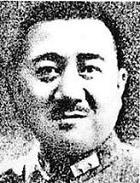 Luo Zhuoying, finding out about the Japanese incursions, frantically ordered that the 32nd Corps pull back from Tujiapu for defending Nanchang together with the 102nd Division. On March 27th, 1939, Nanchang was lost to the Japanese after three days' resistance.
In April, the Chinese forces, after completing phase one of the re-organization, attacked the Japanese on all fronts in a SPRING OFFENSIVE. On April 26th, a portion of the Chinese forces under the 9th Military District intruded into Nanchang city. On May 5th, 1939, the Chinese recovered the Nanchang Train Station & Nanchang Airport, and fought bayonet wars with the Japanese at the city walls. The 29th Corps Chief Chen Bao’an sacrificed his life during the battle, and division chief Liu Yuqing was injured.
Mt Dahongshan & Mt Tongbaishan: the First Suixian-Zaoyang Battle
After the Battle of Wuhan, the 84th Corps and the 68th Corps [Liu Ruming] stationed at Suixian county. Li Zongren moved his command center to Fancheng for supervising the defense of the Shashi-Badong segment of Yangtze River as well as western Henan Province. Meanwhile, the 5th Military District launched attacks at the southern Ping-Han Railway from two sides and dispatched the 21st Group Army to Henan-Hubei-Anhui provinces for guerrilla warfare. 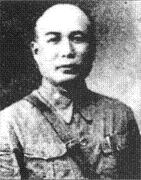 Liao Lei's group army was still at Mt Dabieshan to the east for echoing support to each other. The 31st Group Army relocated southward to Zaoyang of Hubei Province for assisting the 5th Military District, while the Japanese reinforced defense at Wuhan city. Since the Japanese dared not exit Wuhan city, Li Zongren had a quiet New Year Day at Fancheng. Liao Lei's group army was still at Mt Dabieshan to the east for echoing support to each other. The 31st Group Army relocated southward to Zaoyang of Hubei Province for assisting the 5th Military District, while the Japanese reinforced defense at Wuhan city. Since the Japanese dared not exit Wuhan city, Li Zongren had a quiet New Year Day at Fancheng.
In March 1939, the Japanese, after the arrival of the 33rd Shidan and the 34th Shidan, decided to deal a blow to the Chinese troops before the 9th Shidan and the 16th Shidan rotated troops back to Japan for replenishment. On April 20th, the Eleventh Army issued the troop disposition orders to the 3rd Shidan, 13th Shidan, 16th Shidan, and 4th Cavalry Ryodan, with additional allocation of infantry, cavalry, gun and armored units for the left and right prongs. On the 26th, the attack order was issued to the 3rd Shidan for attacking Zaoyang along two sides of Mt Tongbaishan.
Before the Japanese launched the attack, Li Zongren received telegraphs from his spy, i.e., Heh Yizhi [alias Xia Wenyun], who worked for Li Zongren free of charge. (Heh Yizhi, who had provided accurate information since the Xuzhou Campaign, had placed his telegraph set inside of a Japanese residency and made good friendship with the anti-war Japanese generals. Later, Heh stationed in Shanghai's concession territory till evacuation at the time of the Pacific War outbreak.)
Li Zongren decided on defending Mt Tongbaishan & Mt Dahongshan. Along the Highway of Xiangyang-Huayuan, Li Zongren placed the 84th & the 68th corps at the front of Suixian & Zaoyang. Along the Highway of Jingshan-Zhongxiang, Zhang Zizhong's 33rd group army was in charge of the southern ridge of Mt Dahongshan and two sides of the Xianghe River. Sun Lianzhong's 2nd group army & Sun Zheng's 22nd group army in charge of the north ridge of Mt Tongbaishan. Guo Chan's two corps defended the Yangtze Bank and the west bank of the Xianghe River. Li Zongren intended to set up a trap along Highway Xiangyang-Huayuan and hence ordered that Tang Enbo's five divisions to stealthily hide themselves inside of Mt Tongbaishan for a surprise attack at the Japanese mechanized column.
On April 30th, 1939, the Japanese, equipped with 200 cannons and hundred armored vehicles, attacked the Chinese army of the 5th war zone. The Japanese moved along the two highways to the west. Li Zongren pointed out that the Chinese soldiers often fought against the tanks with grenades along the highway which was all level plains. For over ten days, the Chinese engaged the Japanese in over 20 battles at Suixian and Mt Dahongshan without letting go the frontal defense. 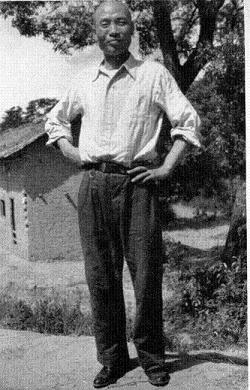 On May 1st, the 3rd Shidan, departing Yingshan (today's Guangshui municipality), breached the Xujiahe cordon lines defended by Zhong Yi’s 173rd Division and Zhang Guangwei’s 174th Division of the 84th Corps, and moved northwestward to take over Haojiadian. The Japanese then moved west against Gaochengzhen, Taerwan and Suixian. At Gaochengzhen, Zhang Xuezhong’s 89th Division and Wu Shaozhou’s 110th Division under Zhang Zhen’s 13th Corps of the 31st Group Army, together with Tan Lianfang’s 84th Corps, repeatedly repelled the Japanese attacks, with some hills wrestled back and forth six to seven times. On the 6th, the Japanese breached the Gaochengzhen-Taerwan line under the cover of armored vehicles, artilleries and gas attacks. The Japanese then attacked the two flanks, dispatched cavalry against the Highway Jingshan-Zhongxiang, and took over Zaoyang to the north. The northern route of the Japanese army departed Xinyang, took over Tanghe, Nanyang & Tongbao by May 12th, and planned a conversion with the southern route at Zaoyang. The Chinese forces retreated northward while leaving the 39th Corps in Mt Dahongshan and the 13th Corps in Mt Tongbaishan. On May 1st, the 3rd Shidan, departing Yingshan (today's Guangshui municipality), breached the Xujiahe cordon lines defended by Zhong Yi’s 173rd Division and Zhang Guangwei’s 174th Division of the 84th Corps, and moved northwestward to take over Haojiadian. The Japanese then moved west against Gaochengzhen, Taerwan and Suixian. At Gaochengzhen, Zhang Xuezhong’s 89th Division and Wu Shaozhou’s 110th Division under Zhang Zhen’s 13th Corps of the 31st Group Army, together with Tan Lianfang’s 84th Corps, repeatedly repelled the Japanese attacks, with some hills wrestled back and forth six to seven times. On the 6th, the Japanese breached the Gaochengzhen-Taerwan line under the cover of armored vehicles, artilleries and gas attacks. The Japanese then attacked the two flanks, dispatched cavalry against the Highway Jingshan-Zhongxiang, and took over Zaoyang to the north. The northern route of the Japanese army departed Xinyang, took over Tanghe, Nanyang & Tongbao by May 12th, and planned a conversion with the southern route at Zaoyang. The Chinese forces retreated northward while leaving the 39th Corps in Mt Dahongshan and the 13th Corps in Mt Tongbaishan.
To prevent the Japanese from encircling the troops in the mountains, Li Zongren forcefully ordered that Tang Enbo & Sun Lianzhong immediately come south for a counter-encirclement of the Japanese. On May 14th, the Chinese army took over Xinye and Tanghe. On the 15th, Li Zongren ordered a general attack from inside and outside of the encirclement. After three days and three nights, the Japanese began to retreat. Zaoyang was recovered. The Japanese defended Suixian, while the Chinese lacked heavy weapons against the city. Li Zongren's memoirs stated that the Japanese had spent three months for war preparation, fought one month, left 5000 corpses, and retreated.
The Japanese Bombing of Civilian Targets
Beginning from spring of 1939, the Japanese planes deliberately bombarded the civil targets in the Chinese hinterlands, including Sichuan, Guizhou, Yunnan and Gansu Provinces.
On May 3rd & May 4th, the Japanese plane bombing destroyed 1200 buildings in Chungking and killed about 4400 people. This would be termed the 'May 4th Bombing.' Chiang Kai-shek, in his diary, stated that he was moved by the populace's strong will in face of the Japanese barbarity and commented that the righteousness of "ignorant, innocent and simple-minded" Chinese people had always exhibit itself during the times of barbarian invasions. 250,000 children, women and elderly people were dispersed to the countryside in the following three days.
On May 25th, 1939, the Japanese planes came to bomb Chungking again. Per Wu Xiangxiang's "History of the Second Sino-Japanese War", in 1939 alone, the Japanese launched 14,138 plane sorties, bombed the Chinese cities 2,603 sorties, dropped 60,174 bombs, killed 28,466 Chinese, injured 31,546 people, and destroyed 138,171 buildings. The Japanese was recorded to have dropped the "germ bombs" and "epidemic bombs" in Zhejiang and Hunan provinces.
On May 1st, 1939, Chiang Kai-shek convened a 'Citizen Publicly Agreed-Upon Rules" meeting in Chungking for sake of inspiring the spirits of the Chinese people. Wu Xiangxiang termed the historical migration of the Chinese people away from Japan-occupied territories as the "No. 4th Migration" in the Chinese history. The Chinese people went into exile rather than to be a slave under the Japanese occupation, and the "disaster relief committees" had played an important role in re-settling the exiles. From April 1938 to December 1939, 4426196 acres of land in Shenxi, Ningxia, Qinghai, Fujian, Guangxi, Jiangxi and Sichuan, etc., were cultivated by resettled refugees, which allowed 630056 refugees to be employed. Other than the "disaster relief committees", the women guidance committee and orphanage protection & nutrition society had been responsible for caring for women and children in exile. Altogether 29849 children had been taken into custody of the orphanages.
Battles of Khalkhin Gol & Nomonhan
Purportedly, the Japanese declined a non-aggression treaty with the Soviets in 1932.
Per Pike, there were 150 border disputes between the Soviets and the Japanese along the border in 1933-1934.
The Battles of Khalkhin Gol and Nomonhan were fought from June to August of 1939 between the Soviets/Mongols and the Japanese at the northwestern corner of Manchuria, at the Kalka River (i.e., Khalkhin Gol in the local language) and the border village of Nomonhan, with the territory between the east riverbank and the village being disputed by Mongolia and puppet Manchukuo.
There ensued hundreds of border clashes from 1935 onward in this area, which led to the Soviets reaching a mutual aid agreement with the Mongols on March 12th, 1936, and the entry of the Soviet Red Army to the Mongolian-Manchukuo border in September 1937.
The trigger for the Battles of Khalkhin Gol & Nomonhan was Mongol cavalrymen's intrusion to the east side of the river on
11 May 1939, that led to Manchukuo puppet cavalrymen's attempt at eviction, Mongol reinforcement, and subsequent involvement of the 23rd Shidan of the Japanese Kwantung Sixth Army on May 14th.
After some rounds of fighting, Grigori Shtern's Soviet army helped the Mongols in defeating the Japanese on May 28th.
Stalin sent Georgy Zhukov to the Far East with reinforcement of mechanized army and aviation force of the I Army Group.
Zhukov launched a major offensive on 20 August 1939 in three prongs, with the left and right prongs
consisting of an armored force of three tank brigades (the 4th, 6th and 11th) and two mechanized brigades (the 7th and 8th) augmented by infantry support,
and
the middle prong consisting of three rifle divisions, two tank divisions and two tank brigades, two motorized infantry divisions, and over 550 fighters and bombers,
plus two Mongol cavalry divisions.
Soviet troops from the 57th Special Corps and the Mongols numbering 50,000 attacked the east bank of the Khalkhin Gol to pin down the Japanese, followed by the Soviet armored units in a double envelopment. The Soviet army converged at Nomonhan village on August 25th, where they encircled the Japanese 23rd Infantry Shidan and part of the 7th Shidan that just changed the commander to Kunisaki Noboru.
The next day, a Japanese counterattack to relieve the 23rd Shidan failed. The 23rd Shidan and the 7th Shidan attempted to break out of the encirclement but failed on August 27th.
By August 31st, the bulk of the Japanese forces were destroyed, with the Asahi Shimbun later reporting that the death toll was 18,000.
Japan, after the defeat, asked for truce, with a joint committee established to demarcate the boundary line.
In Japan, affected by the debacle of the Battle of Nomonkan as well as the non-aggression pact between the Soviet Union and Germany--that was signed on Augsut 24th by Hitler who secretly disparaged the Japanese as lacquered half-monkeys and the Japanese emperor as a companion of the late czars, then Japanese Prime Minister Hiranuma Kiichiro announced the resignation of the cabinet on August 30th, 1939. Minister of War Seishiro Itagaki, who was concurrent president of the Manchuria Affairs Bureau, also stepped down. On September 7, 1939, Kenkichi Ueda stepped down from the post of commander of the Kwantung Army, to be succeeded by Yoshijiro Umezu.
Japan and the Soviet Union
signed
the armistice on September 15th, 1940.
Per Francis Pike, despite Stalin's purge that killed Marshall Mikhail Tukhachesvsky in June 1937 and put under arrest other senior generals in 1937 plus the purge of 37,761 officers in 1938 as well as killing of new Far Eastern Army marshall Blyukher on November 9th, 1938,
the Soviets beat back the Japanese Type-89 I-Go and Type-95 Ha-Go light tanks for the adoption of the Bystrokhodby 'Betushka' BT-5s and BT-7s tanks designed by American J. Walter Christie.
Besides, Pike pointed out that the Soviets discovered that while the Polikarpov I-153 Chayka (seagull) was no match for the Japanese Nakajima Ki-27, the heavy-armored I-16 Ishak (donkey), when upgraded to Type-18 with 830hp engine with a two-speed supercharger and a variable pitch propeller, could defeat the Japanese in dogfight while the Japanese never learnt the lesson in developing the lightly-armored planes for maneuverability.
Altogether 800 Soviet planes took part in the campaign with 250 lost against 250 Japanese planes with 160 lost.
The First Changsha Battle
 In July 1939, Prof Fu Sinian pointed out that the Chinese army had become stronger and stronger while the Japanese army had become weaker and weaker. On Aug 15th, the Japanese Eleventh Army devised the guidelines to launch a south-of-Yangtze campaign across 250 kilometers, ranging from the Xiangjiang River to the Ganjiang River. Germany’s attack on Poland on September 1st exacerbated the Japanese motivation to deal a blow to China’s resisting will so as to pave the way for the establishment of Whang Jingwei’s puppet government in the Central China region. Lacking adequate troops, Okamura Yasuji, other than the garrison needs, had to arrange to have troops from the 6th Shidan, 33rd Shidan, 3rd Shidan and 13th Shidan to launch attacks in the Hunan-Hubei area, and the troops from the 106th Shidan and 101st Shidan attack the Gaoan and Xiushui (Tonggu) area as a distraction.
On September 13th, Okamura Yasuji moved his command center to Xianning. On the night of September 14th, Nakai Ryotaro’s 106th Shidan attacked westward against Wan Baobang’s 184th Division of the 60th Corps from north of Fengxin. On the 15th, [[zuozhi]] Shitai, based on the 102nd Ryodan of Saito Masatoshi’s 101st Shidan, from Dacheng, attacked Mt Lianhuashan and the Gaoan area which were defended by Kang Yongliang’s 141st Division of the 32nd Corps and Liu Zhengfu’s New 10th Division of the 58th Corps. After taking over Gao'an, bulk of the Japanese forces went northwest to attack Sandu and Xiushui. Wang Yaowu’s 74th Corps (51D, 57D & 58D) and Song Kentang’s 32nd Corps (139D & 141D), after recovering Cunqianjie on the 19th, took advantage of the Japanese shift to have recovered Gaoan on the 22nd.
More available at First_Changsha_Battle.pdf (Check RepublicanChina-pdf.htm page for up-to-date updates.)
* In Commemoration of China's Fall under the Alien Conquests in A.D. 1279,
A.D. 1644 & A.D. 1949 *
U.S.S.R./Comintern Alliance with the KMT & CCP (1923-1927)
Korean/Chinese Communists & the 1931 Japanese Invasion of Manchuria
American Involvement in China: Soviet Operation Snow, IPR Conspiracy, Dixie Mission, Stilwell
Incident, O.S.S. Scheme, Coalition Government Crap, Amerasia Case & The China White Paper
* Stay tuned for "Republican China 1911-1955: A Complete Untold History" *
|
|
Zou Rong's Revolutionary Army;
Shin Kyu Sik's
Shrine (Spirit, Kunitama) of Korea
|
This snippet is for sons and daughters of China:
Heed the sons & ministers' agony and sorrow of our ancestors who died or lived through the Mongol, Manchu and Soviet-Chicom conquest
and
the Yongjia, Jingkang and Jiashen cataclysms !
Jeanne d'Arc of China:
Teenager girl Xun Guan breaking out of the Wancheng city to borrow the relief troops in the late Western Jinn dynasty;
Liu-Shao-shi riding into the barbarian army to rescue her husband in the late Western Jinn dynasty;
teenager girl Shen Yunying breaking into Zhang Xianzhong's rebels on the horseback to avenge on father's death in the late Ming dynasty.
China's Solitary and Lone Heroes:
Nan Jiyun breaking out of the Suiyang siege and charging back into the city in the Tang dynasty;
Zhang Gui & Zhang Shun Brothers breaking through the Mongol siege of Xiangyang in the Southern Soong dynasty;
Liu Tiejun breaking through three communist field armies' siege of Kaifeng in the Republican China time period;
Zhang Jian's lone confrontation against the communist army during the June 3rd & 4th Massacre of 1989.
|
|
|
On October 1st, the Japanese began to retreat after suffering heavy losses. Herald troops of the 6th Shidan, which had intruded into the Changsha outskirts, pulled back across the Laodaohe River. Acting group army commander Guan Linzheng immediately ordered the 52nd Corps and 73rd Corps on a pursuit of the Japanese, with initial target set at the Miluojiang river bank. On the 3rd, General Xue Yue ordered a general counter-attack to catch up with the Japanese to the south of Yueyang and Chongyang. The Chinese troops chased the Japanese to Jinjing and Fulinpu. The Chinese planes bombed Wuhan's Japanese airfield on the same day. On the 4th, the Chinese troops recovered Miluo and Xinshi. On the 5th, the Chinese forces shot down a Japanese plane and located Okamura Yasuji's retreat order. At the Dongtinghu lakeshore, near Yingtian, Sheng Fengyao’s New 23rd Division of the 54th Corps attacked the Japanese warships. On the 8th, the Japanese fell back to the northern bank of the Miluojiang River. The 195th Division of the 52nd Corps chased across the Xinqianghe River and recovered the former forward positions as well as launched the nightly raids into Xitang and Yaolin. By October 10th, all lost territories in northern Hunan Province, southern Hubei Province and northern Jiangxi Province were recovered.
The First Changsha Battle would be the first of four major campaigns centered around the city of Changsha for the next five years.
As Hao Bocun, the former ROC defense minister in Taiwan, had said, the territory of Jiangsu Province did not suffer from the wrath of war as a result of the communists' taking control of the area whereas the Hunan province endured four Changsha campaigns, plus the Changde campaign and Hengyang campaign throughout the war.
The Campaign Of Gui-nan & Battle Of Kunlun'guan Pass
In Haifang [Haiphong] of Vietnam, 6000 overseas Chinese organized a donation committee for sending money to China. The French authorities ordered that only the merchandise purchased by China before July 13th, 1937, i.e., mostly the German military equipment, could pass through Haiphong. In November 1938, the French colonialists prohibited the pass-through of 1000 trucks that China purchased. The Vietnamese circumvented the restriction to allow 100 trucks drive through the border every night as an alternative. Elsewhere in Vietnam, young ethnic Chinese launched the truck driving schools for service inside of China. About 3033 drivers and technicians returned to China for serving on the Sino-Vietnamese Highway and the Sino-Burmese Highway.
(After the victory of war over Japan, hundreds of truck drivers continued the service for the motherland, carrying the goods through the Ledo Highway to China from India, passing the high mountains of northern Sichuan, crossing the Yellow River in the Ordos area, and trekking along the Gobi Desert to arrive at Kalgan in today's Mongolia, a remarkable long distance trip that was praised by priest Raymond de Jaegher; further joined General Fu Zuoyi's Suiyuan Army as a mobile force, with a division of Fu Zuoyi's infantry army carried into Manchuria by the trucks at one time for repelling a communist army attack; and stood steadfast with 35th Corps commander Guo Jingyun during the Defense Battle of Xinbao'an, till Geng Biao's communist army sacked the city in December 1948, on which occasion General Guo Jingyun committed suicide as a martyr and 400 trucks and the truck drivers fell into the communist hands.)
The Japanese, early in the year of 1939, on Feb 10th, attacked Haikou of the Hainan Island and took over Qiongshan, Wenchang and Anding counties. The French authorities in Vietnam, fearing the Japanese, procrastinated the pavement of the Vietnam portion of the Nan-Zhen [Nanning-Zhennanguan Pass] Segment of the Xiang-Gui Railway. The Japanese further planned to attack Vietnam for cutting off supplies to China.
From May 11th to 21st, 1939, Japan reorganized the 4th fleet for a possible war against the Dutch East Indies. On June 11th, Japan devised a campaign against Kunming of Yunnan Province for cutting off the Vietnam-Yunnan Highway. On June 29th, the British authorities in HK declared an emergency and evacuated women and children, while a Japanese delegation arrived in Hanoi for talks with the French. On July 26th, the U.S. announced the annulment of the commerce act with Japan in 6 months, which was partly triggered by the Japanese encirclement of Tianjin's settlement and insulting the British & American citizens. On Aug 18th, the Japanese heavy artillery landed in the Kowloon area, while Britain promised to cease all transportation from HK to China as well as to shut down the Burma-China Highway for three months.
On July 1st, Churchill ordered Sir James Somerville to destroy Marcel Gensoul's French fleet at Mers-el-Kebir, off Oran of Algeria, including battlecruisers
Dunkerque and
Strasbough
and
battleships Province and Bretagne after hiccups in communications with the French Vichy government.
While taking harsh action against the French,
Churchill, under threat of an imminent invasion (Operation Sealion) by Germany which was alleviated after delivery of half a million American rifles under the cash-and-carry program in the same month, undertook a policy of appeasing the Japanese with a claim of being short of things except enemies, closed the Burma-China Highway in July 1940 and did not reopen it till October.
The Burma-China Highway trespassed across the Hengduan Mountain Range, crossing the three rivers of Nujiang (upper Salween), Lancangjiang (upper Mekong) & Yangbi-jiang, with three bridges being bombed constantly by the Japanese planes.
 On September 1st, 1939, Hitler launched the invasion wars in Europe. Jiang Huiguo, i.e., the adopted son of Chiang Kai-shek, left Germany after participation in the German panther's invasion of Austria, stayed in the U.S. for a short term to study military science, and thereafter would return to China where he served under Hu Zongnan as a captain and then a company commander. On September 1st, 1939, Hitler launched the invasion wars in Europe. Jiang Huiguo, i.e., the adopted son of Chiang Kai-shek, left Germany after participation in the German panther's invasion of Austria, stayed in the U.S. for a short term to study military science, and thereafter would return to China where he served under Hu Zongnan as a captain and then a company commander.
 The American President called over Dr. Hu Shi and proposed to intermediate with Japan by making Manchuria a trustee territory.
In Chungking, i.e., the interim R.O.C. capital, Li Zongren was purportedly applauded by Stilwell for the correct prediction of the European War eruption. Li Zongren also met with the Russian consulate officials who offered a tea meeting. One and half years ago, Li Zongren predicted the European War to Luo-ke-fu the TASS Far East deputy director, and this time, the Russian ambassador and Chuikov were horrified at Li Zongren's prediction of a Russo-German War on basis of Hitler's "Mein Kampf." After Chungking, Li Zongren flew to Guilin of Guangxi Province for seeing his mother. At Guilin's discussion forum hosted by Ma Junwu, principal of the Guangxi University, Li Zongren rebutted the viewpoint that Britain and France could beat back Germany as well as predicted the inevitability of a Russo-German War. The next day, Ma Junwu, at Guangxi Univ, mentioned Hu Yuzhi's doubt about Li Zongren's prediction: Hu Yuzhi, i.e., China's first class prose writer and an undercover communist, had first expressed doubt about Li Zongren's prediction of an European War during the battle at Wuhan. The American President called over Dr. Hu Shi and proposed to intermediate with Japan by making Manchuria a trustee territory.
In Chungking, i.e., the interim R.O.C. capital, Li Zongren was purportedly applauded by Stilwell for the correct prediction of the European War eruption. Li Zongren also met with the Russian consulate officials who offered a tea meeting. One and half years ago, Li Zongren predicted the European War to Luo-ke-fu the TASS Far East deputy director, and this time, the Russian ambassador and Chuikov were horrified at Li Zongren's prediction of a Russo-German War on basis of Hitler's "Mein Kampf." After Chungking, Li Zongren flew to Guilin of Guangxi Province for seeing his mother. At Guilin's discussion forum hosted by Ma Junwu, principal of the Guangxi University, Li Zongren rebutted the viewpoint that Britain and France could beat back Germany as well as predicted the inevitability of a Russo-German War. The next day, Ma Junwu, at Guangxi Univ, mentioned Hu Yuzhi's doubt about Li Zongren's prediction: Hu Yuzhi, i.e., China's first class prose writer and an undercover communist, had first expressed doubt about Li Zongren's prediction of an European War during the battle at Wuhan.
The United States, which supported the Japanese war against China through unpositive neutrality, continued to pressure the Republic of China on the matter of accepting the status quo of puppet Manchukuo.
What happened was that the Japanese, through two American missionaries, opened a channel of secret negotiations with the United States, that resulted in a to-be-signed memorandum with about five points for solution of the "China Incident", namely, the United States would pressure the Republic of China into accepting the state of puppet Manchukuo and waiving the demand for the Japanese war indemnity on the precondition that Japan withdrew its invasion army from China proper.
Later, this secret U.S.-Japan agreement was to be overturned by Matsuoka Yosuke who reached a non-aggression treaty with the U.S.S.R. on
April 13th, 1941, with the direct consequence of eruption of the Pearl Harbor attack.
 After the eruption of the European War, on October 14th, 1939, the Japanese General Headquarters issued the “Continental Order No. 375” to its China Expeditionary Force for completely routing China’s southwestern transportation lines and controlling the area to the south of the Nanning-Longzhou Highway. On November 15th, at 8:10 am, the 9th Ryodan of the Japanese 5th Shidan landed at Qusha the protruding tip of western Qinzhouwan Bay, which was defended by the 56th Regiment under Huang Gu’s New 19th Division of the 46th Corps. Huang Gu was a veteran general who fought the Japanese to standstill in Shanghai in 1932.
The Chinese Fourth Zone troops, not expecting Japan's landing at the Qinzhouwan bay, spread its troops thinly along the coast towards Xinhui near Macao.
On the 16th, at 6 am, the 21st Ryodan of the 5th Shidan landed at Huangwutun, next to Qusha.
The Japanese 5th Ryodan, for its history of defeating the Russians during the Russo-Japanese War, called itself by the steel army, while zone commander Zhang Fakui's 4th Corps was also known as the iron army during the 1927 Northern Expedition.
At dusk, Shioda Sadaichi’s Taiwan Ryodan landed at Lidouzhui, further into the bay and to the south of the Qinxian county capital. After landing on the coastline, the three Japanese Ryodan pushed north towards Nanning the provincial capital in parallel. On November 21st, the 21st Ryodan of the 5th Shidan pushed against Nanning from Datang, while the 9th Ryodan and the Taiwan Ryodan penetrated towards the western and eastern sides of Nanning.
The siege of Nanning started on the 19th.
At Nanning, only the 405th Regiment was in defense.
16th Group Army commander Xia Wei ordered Su Zuqing’s 135th Division of the 31st Corps and Li Xingshu’s 170th Division of the 46th Corps to the defense of the Nanning city and the northern Yongjiang river bank. At dawn, on the 23rd, the Japanese forcefully crossed the river after over twenty charges. On the morning of the 24th, the Japanese took over Nanning after the 405th Regiment withdrew from the city. Imamura Hitoshi, to further secure the area, ordered the 21st Ryodan and 5th Cavalry Rentai on a pursuit of the Chinese to the north and northeast of Nanning for the Gaofengai and Kunlun'guan mountain passes. After the eruption of the European War, on October 14th, 1939, the Japanese General Headquarters issued the “Continental Order No. 375” to its China Expeditionary Force for completely routing China’s southwestern transportation lines and controlling the area to the south of the Nanning-Longzhou Highway. On November 15th, at 8:10 am, the 9th Ryodan of the Japanese 5th Shidan landed at Qusha the protruding tip of western Qinzhouwan Bay, which was defended by the 56th Regiment under Huang Gu’s New 19th Division of the 46th Corps. Huang Gu was a veteran general who fought the Japanese to standstill in Shanghai in 1932.
The Chinese Fourth Zone troops, not expecting Japan's landing at the Qinzhouwan bay, spread its troops thinly along the coast towards Xinhui near Macao.
On the 16th, at 6 am, the 21st Ryodan of the 5th Shidan landed at Huangwutun, next to Qusha.
The Japanese 5th Ryodan, for its history of defeating the Russians during the Russo-Japanese War, called itself by the steel army, while zone commander Zhang Fakui's 4th Corps was also known as the iron army during the 1927 Northern Expedition.
At dusk, Shioda Sadaichi’s Taiwan Ryodan landed at Lidouzhui, further into the bay and to the south of the Qinxian county capital. After landing on the coastline, the three Japanese Ryodan pushed north towards Nanning the provincial capital in parallel. On November 21st, the 21st Ryodan of the 5th Shidan pushed against Nanning from Datang, while the 9th Ryodan and the Taiwan Ryodan penetrated towards the western and eastern sides of Nanning.
The siege of Nanning started on the 19th.
At Nanning, only the 405th Regiment was in defense.
16th Group Army commander Xia Wei ordered Su Zuqing’s 135th Division of the 31st Corps and Li Xingshu’s 170th Division of the 46th Corps to the defense of the Nanning city and the northern Yongjiang river bank. At dawn, on the 23rd, the Japanese forcefully crossed the river after over twenty charges. On the morning of the 24th, the Japanese took over Nanning after the 405th Regiment withdrew from the city. Imamura Hitoshi, to further secure the area, ordered the 21st Ryodan and 5th Cavalry Rentai on a pursuit of the Chinese to the north and northeast of Nanning for the Gaofengai and Kunlun'guan mountain passes.
The Japanese, other than garrisoning the pass, sent the majority troops towards Longzhou, Zhennan'guan and the Sino-Vietnamese border for robbing the supplies.
On December 1st, 1939, the Chinese forces launched a WINTER OFFENSIVE CAMPAIGN across the nation. After the Kunlun'guan Pass was lost on December 4th, the Nationalist Government's Guilin Military Office devised a counter-attack plan for recovering the pass. On December 16th, the Guilin headquarters, having moved the frontline command center to Qianjiang, scheduled the general attack to be dawn of the 18th. At 8 pm, on December 17th, Zheng Dongguo’s Honor 1st Division of the 5th Corps, consisting of troops who recovered from battle wounds, with armored vehicles and artilleries, arrived in Guangxi from Hunan, and punched into the Japanese forward positions around the Kunlun'guan Pass.
Corps commander Du Yuming ordered the 200th Division and Honor 1st Division to attack the frontal pass while New 22nd Division was to attack from the right flank.
Two preparatory regiments were deployed for impeding the Japanese relief army.
The battle for Kunlun'guan started on December 18th.
On the 19th, the Japanese sent the 21st Ryodan to reinforcing the pass, with the Japanese air force joining in.
On the 20th, at 10 am, 21st Ryodan commander Major Gen. Nakamura Masao personally led two Daitai from the 42nd Rentai to the relief of Kunlun'guan. By the 30th, the Chinese troops cleared most of the Japanese positions around the pass.
The two sides fought zigzag wars around the hills near the pass.
200th Division, at great sacrifice, fought against the Japanese at the Jieshou (borderline head) height, and after taking Jieshou, surrounded the Japanese 21st Ryodan at Kunlun'guan.
By Jan 3rd, the battle was over, with majority of the Japanese 21st Ryodan destroyed, that totaled about 5000 troops.
The Chinese 5th Corps suffered a casualty of over 15000 troops, which was the prevalent casualty ratio throughout the war.
Nakamura Masao was killed in battle, and before death, lamented the agony in the diaries over losing the battle by reflecting on its past glory in the Russo-Japanese War.
Japanese 42nd Rentai commander committed suicide.
With the volunteer airforce support hitting the Japanese relief and supply, the 5th Corps of the northern route forces took over the pass at 11 am on December 31st. The next day, i.e., the New Year Day, two other routes of the Chinese army pushed on towards Nanning.
Art Chin (Chen Ruidian), who was then in the Cantonese airforce, was one of four warplanes participating in the air battles over Kunlun'guan.
During the Gui-nan campaign, Art Chin was shot down on December 27th, 1939, and later while recuperating in Liuzhou near the airfield, incurred a Japanese plane bombing, on which occasion his wife, Eva Wu (Ng Yue-ying), pounced on Art Chin to protect him and died instead.
Ng Yue-ying was a daughter of veteran Chinese diplomat Wu Tingfang (1842-1922).
(The bulk of the Chinese airforce, including the Soviet volunteer fighters, soon pulled out, which led to the loss of Kunlun'guan again.)
Kuno Seiichi’s 18th Shidan and Sakurada Takeshi’s Imperial Guard Mixed Ryodan, by Jan 22nd, 1940, arrived at Nanning and Qitang, respectively. The Japanese continued north to attack Binyang to the hind of the pass. The Japanese 18th Shidan further pressed north to Zouxu. With the loss of Binyang, the Fourth War Zone ordered the 37th Group Army and 38th Group Army to abandon Kunlun'guan for Shanglin and Dalan. On Feb 3rd, the Kunlun'guan Pass was lost again for the second time.
More available at Campaign_Of_Gui-nan_Kunlunguan-v0.pdf (Check RepublicanChina-pdf.htm page for up-to-date updates.)
* In Commemoration of China's Fall under the Alien Conquests in A.D. 1279,
A.D. 1644 & A.D. 1949 *
U.S.S.R./Comintern Alliance with the KMT & CCP (1923-1927)
Korean/Chinese Communists & the 1931 Japanese Invasion of Manchuria
American Involvement in China: Soviet Operation Snow, IPR Conspiracy, Dixie Mission, Stilwell
Incident, O.S.S. Scheme, Coalition Government Crap, Amerasia Case & The China White Paper
* Stay tuned for "Republican China 1911-1955: A Complete Untold History" *
|
|
Zou Rong's Revolutionary Army;
Shin Kyu Sik's
Shrine (Spirit, Kunitama) of Korea
|
This snippet is for sons and daughters of China:
Heed the sons & ministers' agony and sorrow of our ancestors who died or lived through the Mongol, Manchu and Soviet-Chicom conquest
and
the Yongjia, Jingkang and Jiashen cataclysms !
Jeanne d'Arc of China:
Teenager girl Xun Guan breaking out of the Wancheng city to borrow the relief troops in the late Western Jinn dynasty;
Liu-Shao-shi riding into the barbarian army to rescue her husband in the late Western Jinn dynasty;
teenager girl Shen Yunying breaking into Zhang Xianzhong's rebels on the horseback to avenge on father's death in the late Ming dynasty.
China's Solitary and Lone Heroes:
Nan Jiyun breaking out of the Suiyang siege and charging back into the city in the Tang dynasty;
Zhang Gui & Zhang Shun Brothers breaking through the Mongol siege of Xiangyang in the Southern Soong dynasty;
Liu Tiejun breaking through three communist field armies' siege of Kaifeng in the Republican China time period;
Zhang Jian's lone confrontation against the communist army during the June 3rd & 4th Massacre of 1989.
|
|
|
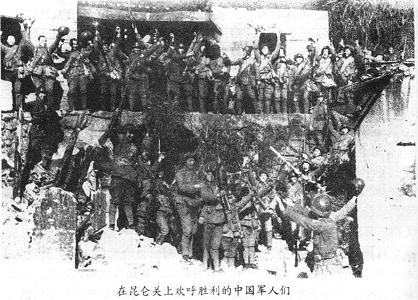 |
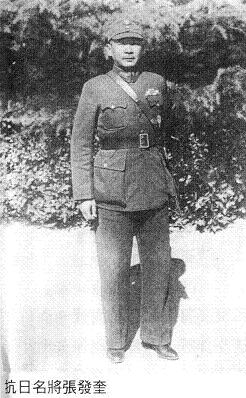 On Feb 1st, Zhang Fakui of the 4th Military District was made into commander-in-chief for the Gui-nan [southern Guangxi Province] Campaign. The Japanese launched offensive on this day, and planes destroyed all phonelines of the Chinese forces. On the 2nd, Zhang Fakui ordered an attack at Ganchang to the southeast of the Kunlun'guan Pass; however, the Japanese took over Binyang to the hind of the pass. The Kunlun'guan Pass was lost again for the second time. On the 5th, Bai Chongxi and Zhang Fakui personally went to the front and recovered Ganchang as well as cut off the return path of the Japanese at Binyang. On the 8th, Ando Rikichi made the decision to contract the line back to Nanning. On the 9th, the Nationalist Government's Guilin Military Office held a meeting in regards to the new supply route from Vietnam in lieu of the lost route via Nanning and decided that there was no need for an offensive to recover Nanning. On the same day, the Japanese retreated towards the coast and majority of the Japanese army relocated elsewhere. On Feb 1st, Zhang Fakui of the 4th Military District was made into commander-in-chief for the Gui-nan [southern Guangxi Province] Campaign. The Japanese launched offensive on this day, and planes destroyed all phonelines of the Chinese forces. On the 2nd, Zhang Fakui ordered an attack at Ganchang to the southeast of the Kunlun'guan Pass; however, the Japanese took over Binyang to the hind of the pass. The Kunlun'guan Pass was lost again for the second time. On the 5th, Bai Chongxi and Zhang Fakui personally went to the front and recovered Ganchang as well as cut off the return path of the Japanese at Binyang. On the 8th, Ando Rikichi made the decision to contract the line back to Nanning. On the 9th, the Nationalist Government's Guilin Military Office held a meeting in regards to the new supply route from Vietnam in lieu of the lost route via Nanning and decided that there was no need for an offensive to recover Nanning. On the same day, the Japanese retreated towards the coast and majority of the Japanese army relocated elsewhere.
General Zhang Fakui erected a monument for the martyrs at the Kunlun'guan Pass.
More available at Campaign_Of_Gui-nan_Kunlunguan-v0.pdf (Check RepublicanChina-pdf.htm page for up-to-date updates.)
* In Commemoration of China's Fall under the Alien Conquests in A.D. 1279,
A.D. 1644 & A.D. 1949 *
U.S.S.R./Comintern Alliance with the KMT & CCP (1923-1927)
Korean/Chinese Communists & the 1931 Japanese Invasion of Manchuria
American Involvement in China: Soviet Operation Snow, IPR Conspiracy, Dixie Mission, Stilwell
Incident, O.S.S. Scheme, Coalition Government Crap, Amerasia Case & The China White Paper
* Stay tuned for "Republican China 1911-1955: A Complete Untold History" *
|
|
Zou Rong's Revolutionary Army;
Shin Kyu Sik's
Shrine (Spirit, Kunitama) of Korea
|
This snippet is for sons and daughters of China:
Heed the sons & ministers' agony and sorrow of our ancestors who died or lived through the Mongol, Manchu and Soviet-Chicom conquest
and
the Yongjia, Jingkang and Jiashen cataclysms !
Jeanne d'Arc of China:
Teenager girl Xun Guan breaking out of the Wancheng city to borrow the relief troops in the late Western Jinn dynasty;
Liu-Shao-shi riding into the barbarian army to rescue her husband in the late Western Jinn dynasty;
teenager girl Shen Yunying breaking into Zhang Xianzhong's rebels on the horseback to avenge on father's death in the late Ming dynasty.
China's Solitary and Lone Heroes:
Nan Jiyun breaking out of the Suiyang siege and charging back into the city in the Tang dynasty;
Zhang Gui & Zhang Shun Brothers breaking through the Mongol siege of Xiangyang in the Southern Soong dynasty;
Liu Tiejun breaking through three communist field armies' siege of Kaifeng in the Republican China time period;
Zhang Jian's lone confrontation against the communist army during the June 3rd & 4th Massacre of 1989.
|
|
|
Japanese Killing of Civilians in Xinxiang of Henan Prov
Whang Hao listed a 4-20-1940 Japanese military report in stating that on April 13th, 1940, the Japanese 35th Shidan attacked Xinxiang of Henan Province. The Japanese killed 521 civilians, arrested and tortured to death 213 more, and abducted 92 women. About 9 women committed suicide, and 19 were sexually tortured to death. The rest were shipped to Datong of Shanxi Province as 'comfort women.'
Leading the Xinxiang sweep would be a Japanese lieutenant general [Tianzhi ?? ‘field’ ‘govern’]. This lieutenant general, back in 1937, participated in the attack on Xinkou and Taiyuan of Shanxi Province. On April 30th, 1940, he died in a fierce fight with Wei Lihuang's Nationalist Government forces in Shanxi Province.
Campaign Of Wuyuan [Suiyuan Province]
On April 1st, 1940, in the north, the Chinese forces recovered Wuyuan [on the western point of the north bank of the North Yellow River Bend] of Suiyuan Province, driving the Japanese out of the Hetao area (i.e., the area inside the sheath of the Yellow River). The Ningxia area was hence secured. The Battle of Wuyuan marked the start of Stage 2 of Phase II of the Resistance War.
Whang Hao4's "Chinese Comfort Women - A Transnational Archive" disclosed a battle that involved defection of the puppet Chinese forces termed "huang [Japan imperial army] xie [assistance] jun [army]." The Japanese army, under lieutenant general [shuichuan yifu], took over Wuyuan. On Feb 21st, 1940, General Fu Zuoyi discussed the lessons from the battles of Baotou [on the middle point of the north bank of the North Yellow River Bend] and Sui-xi [western Suiyuan Province] and authorized a recovery campaign by taking advantage of the water overflow in March. In March, Fu Zuoyi ordered the breaching of a river in Wulahao, causing the inundation of two major highways. On the early morning of March 21st, Fu Zuoyi selected one hundred brave officers and soldiers for a stealthy entry into Wuyuan as plaincoats.
At that time, the Japanese army had with them 54 Chinese women looted from Shanxi Province as "comfort women." Wang Fusen, a puppet army soldier, encountered eight Japanese soldiers raping a teenager girl who kowtowed to Wang Fusen for saving her life. The Japanese, however, continued gang-raping and moreover pierced the girl's belly in front of Wang Fusen. After Wang Fusen informed his team of the atrocity, the puppet army fought with the Japanese for taking back the women from the Japanese custody. About 23 puppet army soldiers, including Wang Fusen, died.
When Fu Zuoyi's plaincoats reached the citywall of Wuyuan, they encountered the puppet army led by Wang Yingbu and managed to persuade them into defection. With the Japanese army's "oral password", the plaincoats intruded into the city and destroyed the Japanese communication center. The Japanese lieutenant general could not discern the situations. The Japanese planes dropped bombs over Wuyuan in chaos. By 11:00 am, Fu Zuoyi's New 32nd Division and the 3rd Regiment of the Garrison Brigade took over most of the city.
To cover up the criminal acts, the Japanese lieutenant general ordered that all 54 "comfort women" be pushed into a well and then the well was exploded into collapse. The Japanese murdered a whole family nearby for witnessing the atrocity. 3000 Japanese were killed at the Battle of Wuyuan, which could be an exaggeration. The Japanese lieutenant general and his entourage fled to Kangburong, about 25 to 30 kilometers to the east of Wuyuan where company chief Zhang Hansan of the garrison brigade encircled the Japanese and destroyed them all after answering the call of guerrillas and civilians. The saber of the Japanese lieutenant general was later transferred to 101st Division Chief Dong Qiwu. Chiang Kai-shek awarded Fu Zuoyi with a bonus of 300000 yuan.
The Campaign Of Zao-Yi [Zaoyang-Yichang]
Li Zongren, before the April 1940 Japanese blitz campaign against Zaoyang-Yichang, had already been informed of this scheme which Nishio Toshizo & Itagaki Seishiro first devised in the aftermath of Hitler's September 1939 invasion. However, both the Military Council and the Fifth War Zone mistakenly thought it was merely a replay of the Japanese East-of-Xianghe-River Campaign (Suixian-Zaoyang Campaign).
In mid-April, the Japanese began the troop concentration in Zhongxiang, Suixian, Xinyang area by abandoning Macheng in eastern Hubei Province, Fengxin (Fengchuan) and Jing'an in northern Jiangxi Province, and pooling troops from the 3rd Shidan, 13th Shidan and 39th Shidan, and units from the 6th Shidan, 34th Shidan, 40th Shidan and 101st Temp Mixed Ryodan, as well as detachments loaned from the 15th Shidan and 22nd Shidan of the Thirteenth Army in the lower Yangtze. On May 1st, the Zaoyang-Yichang Campaign was launched into full swing. The Japanese launched a three-route and five-prong attack at Zaoyang.
More available at Campaign_Of_Zaoyang-Yichang-v0.pdf (Check RepublicanChina-pdf.htm page for up-to-date updates.)
* In Commemoration of China's Fall under the Alien Conquests in A.D. 1279,
A.D. 1644 & A.D. 1949 *
U.S.S.R./Comintern Alliance with the KMT & CCP (1923-1927)
Korean/Chinese Communists & the 1931 Japanese Invasion of Manchuria
American Involvement in China: Soviet Operation Snow, IPR Conspiracy, Dixie Mission, Stilwell
Incident, O.S.S. Scheme, Coalition Government Crap, Amerasia Case & The China White Paper
* Stay tuned for "Republican China 1911-1955: A Complete Untold History" *
|
|
Zou Rong's Revolutionary Army;
Shin Kyu Sik's
Shrine (Spirit, Kunitama) of Korea
|
This snippet is for sons and daughters of China:
Heed the sons & ministers' agony and sorrow of our ancestors who died or lived through the Mongol, Manchu and Soviet-Chicom conquest
and
the Yongjia, Jingkang and Jiashen cataclysms !
Jeanne d'Arc of China:
Teenager girl Xun Guan breaking out of the Wancheng city to borrow the relief troops in the late Western Jinn dynasty;
Liu-Shao-shi riding into the barbarian army to rescue her husband in the late Western Jinn dynasty;
teenager girl Shen Yunying breaking into Zhang Xianzhong's rebels on the horseback to avenge on father's death in the late Ming dynasty.
China's Solitary and Lone Heroes:
Nan Jiyun breaking out of the Suiyang siege and charging back into the city in the Tang dynasty;
Zhang Gui & Zhang Shun Brothers breaking through the Mongol siege of Xiangyang in the Southern Soong dynasty;
Liu Tiejun breaking through three communist field armies' siege of Kaifeng in the Republican China time period;
Zhang Jian's lone confrontation against the communist army during the June 3rd & 4th Massacre of 1989.
|
|
|
Li Zongren, on May 6th, ordered Zhang Zizhong to cross the Xianghe River [Han-shui River] to cut the waist of the Japanese on the east bank of the Xianghe River.
Li Zongren, not knowing the true Japanese intention of the campaign to be the target of Yichang on the Yangtze bank, ordered Zhang Zizhong on an apparently suicide mission.
 On the early morning of the 7th, Zhang Zizhong, leaving a will to Feng Zhi'an, led his special task battalion and two regiments under the 74th Division [? 38th Division of the 59th Corps per Wang Jianji & Wang Yuanchao's "100 Years Of China", Red Flag Publishing House, China] for crossing the river at Guanzhuang of the Yicheng county, and cut the Japanese apart at Nangua'dian.
Sonobe Waichiro, after deciphering Zhang Zizhong’s telegrams, exerted the 13th Shidan and 39th Shidan to attacking south while having the 3rd Shidan act as rearguards at Zaoyang.
Zhang Zizhong was one of two group army commanders to die in the war. On the early morning of the 7th, Zhang Zizhong, leaving a will to Feng Zhi'an, led his special task battalion and two regiments under the 74th Division [? 38th Division of the 59th Corps per Wang Jianji & Wang Yuanchao's "100 Years Of China", Red Flag Publishing House, China] for crossing the river at Guanzhuang of the Yicheng county, and cut the Japanese apart at Nangua'dian.
Sonobe Waichiro, after deciphering Zhang Zizhong’s telegrams, exerted the 13th Shidan and 39th Shidan to attacking south while having the 3rd Shidan act as rearguards at Zaoyang.
Zhang Zizhong was one of two group army commanders to die in the war.
On May 10th, the Japanese encircled another empty city at Tangbaipan. The Chinese forces mounted a counter-encirclement and attacked the Japanese positions by pressing them to the center from two wings. Fierce fighting continued till the 11th when the Japanese began to retreat. The 31st Group Army attacked the Japanese 3rd Shidan from east, south and north. After three days’ fighting, on May 15th, the 3rd Shidan broke out of the encirclement at heavy casualties under the support of 100 planes and 200 division-subordinate armored vehicles.
The Battle of Huyang:
At about the same time Zhang Zizhong's small contingent was fighting the large Japanese formation to death, Shi Jue's 4th Division scored a major victory at the Battle of Huyang-zhen (town on the sun shade side of the lake).
85th Army commander Wang Zhonglian, ordered to chase south to attack the Japanese 3rd division, sent the 4th Division as its vanguard in the Zaoyang direction.
On May 14, Shi Jue's 4th Division arrived in Huyang, north of Zaoyang of Henan province.
3rd Battalion commander Haan Shengtao, having detected a Japanese Daitai unit of 400-500 troops in Wangzhuang, reported to regimental commander Wan Zhairen.
The next day, at 3 am, Wan Zhairen, with the blessing of the high command, immediately ordered two battalions to launch a south-north pincer attack to destroy the Japanese. Two mountain guns were hastily shipped over from the corps headquarters. Artillery fire killed the Japanese Daitai commander in the morning.
After three futile charges into the village, Haan Shengtao, a veteran fighter who joined the Northeastern Army and fought against the Japanese since 1931, called the deputy battalion, company, platoon commanders to a meeting in the trenches, and organized a commando squad, with an order to take out the Japanese at night as the Japanese planes could be coming when the rain was to stop the next day. Equipped with one machinegun, 600 rounds of ammunition, and four grenades per person, the commando squad intruded into the village, followed by the soldiers of the two battalions. At 10 pm, the battle ended with the killing of over 400 Japanese troops, and the escape of dozens of Japanese troops, at a casualty of close to 400 on the part of the two battalions of Chinese forces. 2nd Battalion commander Shen Jinsheng, a 5th Whampoa Session graduate, died in this battle. It was later determined that this Japanese Daitai belonged to the 234th Rentai of the Japanese 40th Shidan.
Meantime, around Huyang, Zhang Rongtian's 10th Regiment and Luo Zhenshao's 12th regiment of the 4th Division were also engaged with the Japanese. All in all, the 4th Division killed over 1000 Japanese troops from the 234th Rentai of the Japanese 40th Shidan at the Battle of Huyang, including two Daitai commanders.
More available at Campaign_Of_Zaoyang-Yichang-v0.pdf (Check RepublicanChina-pdf.htm page for up-to-date updates.)
* In Commemoration of China's Fall under the Alien Conquests in A.D. 1279,
A.D. 1644 & A.D. 1949 *
U.S.S.R./Comintern Alliance with the KMT & CCP (1923-1927)
Korean/Chinese Communists & the 1931 Japanese Invasion of Manchuria
American Involvement in China: Soviet Operation Snow, IPR Conspiracy, Dixie Mission, Stilwell
Incident, O.S.S. Scheme, Coalition Government Crap, Amerasia Case & The China White Paper
* Stay tuned for "Republican China 1911-1955: A Complete Untold History" *
|
|
Zou Rong's Revolutionary Army;
Shin Kyu Sik's
Shrine (Spirit, Kunitama) of Korea
|
This snippet is for sons and daughters of China:
Heed the sons & ministers' agony and sorrow of our ancestors who died or lived through the Mongol, Manchu and Soviet-Chicom conquest
and
the Yongjia, Jingkang and Jiashen cataclysms !
Jeanne d'Arc of China:
Teenager girl Xun Guan breaking out of the Wancheng city to borrow the relief troops in the late Western Jinn dynasty;
Liu-Shao-shi riding into the barbarian army to rescue her husband in the late Western Jinn dynasty;
teenager girl Shen Yunying breaking into Zhang Xianzhong's rebels on the horseback to avenge on father's death in the late Ming dynasty.
China's Solitary and Lone Heroes:
Nan Jiyun breaking out of the Suiyang siege and charging back into the city in the Tang dynasty;
Zhang Gui & Zhang Shun Brothers breaking through the Mongol siege of Xiangyang in the Southern Soong dynasty;
Liu Tiejun breaking through three communist field armies' siege of Kaifeng in the Republican China time period;
Zhang Jian's lone confrontation against the communist army during the June 3rd & 4th Massacre of 1989.
|
|
|
On May 31st, at 7:30 pm, the 39th Shidan, after blasting at the western bank of the Han-shui River for one and a half hours, forcefully crossed the river at Wangji. At midnight, the 3rd Shidan crossed the river to the southeast of Xiangyang, i.e., the spot where the Soong Chinese of 10,000 troops resisted Kubilai's Mongol army for six years. On the night of June 4th, the 13th Shidan, augmented by Ikeda Shitai and Kansui Shitai, crossed the Hanshui River at Jiukou and Shayang, to the south of Zhongxiang, for pincer-attacking the Chinese troops at Jingmen and Dangyang. On June 8th, the Ikeda Shitai breached the defense line of Xiao Zhichu’s 26th Corps, took over Shashi and Jiangling (Jingzhou), and then attacked Yichang along the Shashi-Yichang Highway. On the 10th, the Japanese attacked towards Yichang which was defended by the 199th Division and 18th Division of the 18th Corps outside and inside of the city wall. The 18th Corps, having arrived two days prior, fought on against three Japanese Shidan and plane bombing till 4 pm of June 12th.
With Yichang lost, Li Zongren's 5th war zone had to climb the high mountains to reach Badong of Sichuan Province. The Military Council re-organized the 6th War Zone for defending Chungking by taking advantage of the Three Gorges. Chinese_Tank_Forces_and_Battles_before_1945_ed.htm stated that "Yichang was the most notable city they [Japanese] captured. They attacked from the north eight times between 1938 and 41 and got push[ed] back." During the Changsha Battle in September 1940, the Chinese forces attacked Japanese at Yichang for distracting its forces. And, in Nov, the Japanese, for celebrating Whang Jingwei's puppet government, conducted a sweep campaign against Suixian-Zaoyang. From November 24th to 30th, the Japanese retreated again after leaving thousands of corpses.
Changes in the KMT Politics Department, Foreign Ministry & Presidential Attaché Office
Fatigue [Saturation] Bombing of Chungking by the Japanese
Chungking was bombed 7 times in May 1940. From May in summer to October in autumn, the Japanese planes bombed Chungking and surrounding areas in Sichuan Province for 6 straight months. Chungking was bombed 10 times in June. On June 13th, 1940, Hurley denounced Japan's bombing of Chungking. On June 17th, France surrendered to Germany. From June 27th to July 4th, 1940, the National Central University [NCU] in Shapingba area of Chungking city was continuously targeted by the Japanese. On June 30th, the Chungking city council issued a denunciation of the Japanese militarist barbarity and expressed the determination that 700,000 Chungking citizens were ready to endure the most painful and most solemn sacrifice in the resistance war against Japan.
On July 4th, 200 bombs dropped onto the Chungking National Central University and Chungking Provincial University. Bombing continued on the 5th, 16th, 22nd and 31st. Chungking was bombed 5 times in August. Chiang Kai-shek, in his diary, stated that only the Chinese people could sustain this kind of aggression.
On September 6th, 1940, the National Government declared Chungking the "interim capital". On September 13th, 1940, the newly re-organized Chinese airforce, with 34 planes, took off to fight against 66 Japanese planes, and suffered the most serious loss of 24 planes.
Alternative records stated the Japanese squadrons consisted of 27 bombers and 13 "Zero" fighters, with the Chinese side losing 27 out of 30 planes at the Bishan (cliff mountain) Air Battle.
The Soviet I-15/I-16 planes no longer had the edge against the newly-developed Japanese 'Zero' fighter planes, i.e., the Japanese Mitsubishi A6M fighter planes.
After graduation from the "Central Politics School", Lu Keng & Le Shuren were assigned to the radio station under the Dept of International Propaganda. Lu Keng had been admitted to the school after he faked a publication on the newspapers, claiming that he, a 1937 graduate of the China University in Peking, had lost the school diploma. Throughout the bombing, the radio station of the "Voice of [Free] China" continued operations. Among Lu Keng's colleagues at the station would be a Scottish by the name of J.A MacCausland.
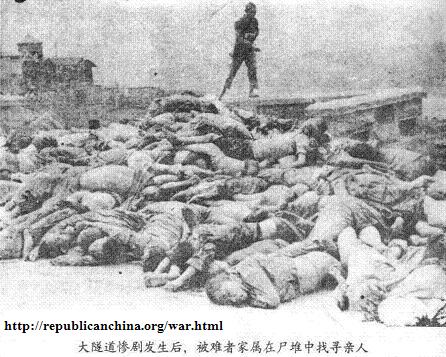 Later, on June 5th, 1941, the Japanese bombing led to death of 9,992 people (including 1,151 children) in a Chungking underground bunker due to suffocation and heat, a horrendous scene of bare bodies of the victims who had earlier stripped off their clothes for the overheat --a reminder of the Jewish victims who died in the "shower" gas chambers of Nazi Germany. per Zhang Ling'ao, the tunnel at the Xiaochangkou-Duyoujie commerce center, which was converted from an underwater channel, did not get unlocked even after siren was cleared at 11:29 pm.
The Chinese did not anticipate the Japanese bombing at night, hence the tragedy.
Chiang Kai-shek visited the horror scene, and censured Chungking mayor Wu Guozhen and garrison commander Liu Zhi. (Heh Yaozu assumed the mayor post from Wu Guozhen in December 1942.) Later, on June 5th, 1941, the Japanese bombing led to death of 9,992 people (including 1,151 children) in a Chungking underground bunker due to suffocation and heat, a horrendous scene of bare bodies of the victims who had earlier stripped off their clothes for the overheat --a reminder of the Jewish victims who died in the "shower" gas chambers of Nazi Germany. per Zhang Ling'ao, the tunnel at the Xiaochangkou-Duyoujie commerce center, which was converted from an underwater channel, did not get unlocked even after siren was cleared at 11:29 pm.
The Chinese did not anticipate the Japanese bombing at night, hence the tragedy.
Chiang Kai-shek visited the horror scene, and censured Chungking mayor Wu Guozhen and garrison commander Liu Zhi. (Heh Yaozu assumed the mayor post from Wu Guozhen in December 1942.)
On Aug 11th, 37-year-old Zhang Chong, i.e., a pro-CCP deputy minister of the KMT Central Organization Dept, passed away at the hospital where the hospital staff often had to interrupt IV for the bunkers during Japan's summer saturation bombing campaigns. Prior to his 2nd admission to the hospital, Zhang Chong had recovered a bit after receiving the Russian medicine that was shipped over at V. I. Chuikov's request. Before death, Zhang Chong, who was thrown a tea cup by an anti-CCP commissar in a party meeting after the Jan 1941 Wannan Incident, had left a wish with Zhou Enlai to have the communists keep in touch with Zheng Jiemin [of the military statistics and investigation bureau] for sake of maintaining the KMT-CCP Collaboration.
On June 28th, Japan declined the U.S.'s request to maintain the status quo of the trustee islands in the Pacific that belonged to the warring European nations. On July 2nd, the U.S. required permits for the oil and scrap metal exports to Japan. On Aug 7th, the U.S. warned Japan of its ambition against Vietnam.
All the American maneuvers were to do with the changing situation in Europe, namely, the German attack at 'Mother Russia', which made an imperative for the Soviet spies in the U.S. government to find a way for the U.S. to join the war through a backdoor.
Unpositive Neutrality
The ultimate American intervention in China in March 1940, i.e., the Americans' hastily giving Chiang Kai-shek a badly-needed loan, would be to prevent Japan and China from reaching a truce after Chiang Kai-shek deliberately spread a rumor that his Chongqing (Chungking) government could merge with the puppet Nanking government.
This is after what Utley called by "unpositive neutrality" against the 'belligerent' countries, namely, Japan and China, which was free and unrestrained arms sale to Japan and de facto arms embargo against China. Note that the arms embargo only hurt China since China did not have an industrial base to produce the basic weapons while Japan's factories could roll out the warships and airplanes on a wholesale scale.
Also note that in contrast with the Americans, the European powers, being constrained by the mediation role of the League of Nations, dared not openly sell arms to Japan. Through 1940-1941, prior to the U.S. revocation of the 1911 U.S.-Japan Commerce Treaty, the Americans were the biggest supplier of raw material, oil, aviation oil, and weapons, to the extent that some U.S. senator called by Scott making a claim that out of every one million Chinese killed by the Japanese, 544,000 Chinese were killed by the Americans.
Thirty-one U.S. congressional members made a joint declaration to the effect that the U.S., not NAZI Germany, nor Italy, was the best ally of Japan.
From 1937 to 1938, the U.S. provided 290 million U.S. dollars worth of war materials to Japan under the Neutrality Act, with 190 million alone in year 1939.
After the outbreak of the 1937 war, the U.S. supplied 18 million U.S. dollars worth of war planes to Japan, seven times more than the planes' sale in 1937.
Another 190 million U.S. dollars worth of war materials were sold to Japan in 1940.
Prior to the U.S. revocation of the U.S.-Japan commerce treaty on Jan 26, 1940, Japan organized six procurement delegations to the U.S. and obtained 500 million U.S. dollars worth of supplies from the U.S., including 36 million U.S. dollars' moulding-tool "master machine" equipment for manufacturing the artillery and other heavy military equipment.
In August 1940 alone, over 300,000 tons of U.S. scrap irons and raw irons were sold to Japan.
In 1941, the U.S. sold to Japan 131% more petrol oil to Japan than in 1940, which was to say that the Japanese planes that bombed the Pearl Harbor used the U.S.-made petrol oil.
Altogether, prior to the Pearl Harbor attack [which ensued from the U.S. freezing the Japan assets and ordering the oil embargo on July 25, 1941, i.e., the Soviet Snow Operation orchestrated by Harry Dexter White], the U.S. provided at least 1 billion U.S. dollars worth of supplies to Japan, including scrap irons, steel, special steel (alloy steel), nickle, cabalt, tungsten, chemicals, etc., with 70% for the military purpose.
Before the war, the U.S. provided Japan with 181 million U.S. dollars worth of weapons and arsenals to meet Japan's purported 1937-1942 six-year war plan against the Soviet Union.
Throughout the 1930s, the DuPond group sold Japan the chemical technology for manufacturing bombs; the Ford group transferred the metallurgy technology to Japan; the Rockefeller group assisted Japan with building the electronics industry; and the Mellon group modernized Japan's aviation.
Only Japanese Akira Ariye understood this part of the U.S.-Japanese history.
(Of course, the same synarchists built the armaments' factories for the Soviets in the Ural mountains.)
The Hundred Regiment Campaign
On the night of Aug 20th, 1940, the communist forces launched a "Hundred Regiment Campaign" aimed at disrupting and destroying the whole railway line of Railroad Zheng-Tai and some partial railway lines of Railways Tong-Pu, Ping-Han, Bei-Ning, and Ping-Sui, etc., plus the major highways, train stations, bridges, tunnels, water towers, and military garrison points. 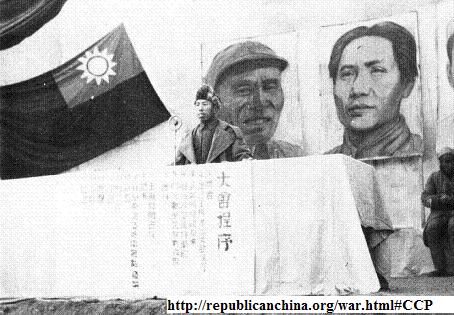 The order was issued by Zhu De, Zuo Quan & Peng Dehuai to i) Nie Rongzhen's communist Jinn-Cha-Ji military district, ii) Liu Bocheng & Deng Xiaoping's communist 129th Division, the [communist-mutiny-converted] New Army Of Southeastern Shanxi Province & the communist forces in southern Hebei, and iii) Heh Long & Guan Xiangying's communist 120th Division & the communist-hijacked Shanxi Province duel army. The order was issued by Zhu De, Zuo Quan & Peng Dehuai to i) Nie Rongzhen's communist Jinn-Cha-Ji military district, ii) Liu Bocheng & Deng Xiaoping's communist 129th Division, the [communist-mutiny-converted] New Army Of Southeastern Shanxi Province & the communist forces in southern Hebei, and iii) Heh Long & Guan Xiangying's communist 120th Division & the communist-hijacked Shanxi Province duel army.
The Communist records claimed that the total troops exerted numbered about "105 regiments or 300000 people" and that Nie Rongzhen's communist army sacked the Niangziguan Pass and destroyed the Jingxing Coal Mine, and Liu Bocheng's communist army purportedly destroyed three Japanese airplanes. Mao Tse-tung was said to have wired to Peng Dehuai as to whether he could organize this kind of massive campaign 1-2 more times. However, during the later political purge movements, Peng Dehuai was blamed for exposing the communist "real force" of 105 regiments or 300000 people. Per Xie Youtian's research, the actual communist strike regiments exerted to the campaign would total about 22 regiments.
Per THE VLADIMIROV DIARIES, Mao Tse-tung's purpose of launching the railway campaign was to deliberately destroy the united front policy and sabotage the KMT-CCP collaboration as the communists no longer reported the military action to the Chinese central government. Vladimirov claimed that by destroying the united front, Mao Tse-tung officially reversed the 1937 Luochuan Meeting to order the communist forces to cease the battles against the Japanese under the pretext of conducting the guerrilla warfare, no longer the guerrilla maneuver warfare as agreed upon by the communist politburo in 1937.
At the time of pulling out of the Ji-zhong [central Hebei] plains, where the communists systematically destroyed the nationalist Hebei Populace Army, the communist armies conducted its last major action against the Japanese army, killing Japanese 2nd Mixed Ryodan commander Abe Norihide with mortar at Huangtuling of Laiyuan in November 1939.
Heh Long's communist army, which travelled a long distance to Hebei to purge the nationalist army troops, happened to be returning towards northwestern Shanxi via a detour through the Laiyuan Inner Great Wall line.
Note that a communist regiment could be a dozen soldiers. So, any extrapolation by calculating the number using the regiments times the supposed staff of a said regiment could be fallacious. THE VLADIMIROV DIARIES pointed out, in two separate places, that the communist troops numbered a little above 300,000 at the time of Japan's surrender in Aug of 1945. The most primitive records invariably stated that the communists had 320,000 troops and 160,000 guns in Aug of 1945, which was subsequently overwhelmed by the propaganda from the Chinese communists that they possessed one million regular and two million guerrillas by the time Japan surrendered.
This webmaster had negated the fallacy by discussing, at chinahistoryforum.com, the number of a total of 2 million guns the Chinese communists possessed at the time they took over power in China, i.e., October 1st, 1949 as well as less than 1 million guns China had prior to the German training and equipment of the Chinese armies in the mid-1930s. Separately, the exact number of communist troops could be validated by adding all headcounts under each and every communist general who took the order to wage the civil wars after the Japanese surrender.
Mao Tse-tung himself had betrayed the actual strength of the communist forces in first demanding the various units of the 8RA divisions and military columns as well as detachments to supply 150,000 "refined" troops for attacking wartime interim capital Chungking and subsequently lowered the par to 70,000 troops in late 1940.
Later, in 1945, during the Chungking peace talks, Mao Tse-tung again betrayed himself with a claim that the communist army had 140,000 broken guns, without knowing that his deputy, Liu Shaoqi, had negated Mao's southern advance plan of re-launching the Soviet enclaves in southern China, and had embarked on an expansion towards Manchuria, where the communist army exploded in huge numbers after absorbing the puppet army, the local army, and etc.
(Don't get obfuscated by the fake number of 1.2 million communist troops [such as Li Yunchang's ragtag puppets-staffed 40,000 troops which were reduced to 5000 men after the 1945 Battle of Jinzhou], that Mao wanted Chiang Kai-shek to reorganize into 16th corps or 48 divisions at the Chungking peace conference.
The Soviet archives, which tracked the actual Chinese communist army headcounts throughout the 1920s to 1940s, had the real numbers that pierced the fabricated myth.
And remember only this webmaster, who thoroughly browsed historical records in multiple languages from both inside and outside of China, holds the key to truth.)
Phase II, from September 20th to early October, expanded into attacks at the enemy positions on the two sides of the transportation lines. The Communist records claimed the following three major battles: the Yu-Liao Battle of Mt Taihangshan, the Lai-Ling Battle of Jinn-Cha-Ji, and the Ren-Qiu Battle of middle Hebei Province. The 3rd phase, lasting from October 6th to December 5th, was waged to counter the Japanese retaliatory sweep campaign. The major victory cited by the communists would be the Battle of Guanjianao during which the majority of 500(?) Japanese from the 36th Shidan were said to be killed.
The Communists claimed that they had waged 1824 battles, killed or injured 20645 (?) Japanese, killed or injured 5155 (?) puppet forces, captured alive 281 (?) Japanese, captured 18400 (?) puppet forces, obtained the defection of 46000 (?) puppet forces, destroyed 2993 (?) citadels, obtained 5400 (?) guns and 200 (?) heavy machineguns, destroyed 6 (?) planes and 11 (?) tanks, destroyed 470 (?) kilometer long railway lines and 1500 (?) km highway, and sabotaged 260(?) bridges, tunnels and train stations.
Per Xie Youtian's research, the damages assessed by the Japanese were far below what the communist propaganda claimed: 48 bridges were blown up on the Zheng-tai Railway, 7 train stations, 40 points of sabotage, 2 water towers, 7 tunnels; on the Ping-han Railway 19 bridges damaged, 67 spots, 12 stations, 38km phone line; and the Tong-pu Railway had destruction of 6 bridges, 7 spots, one station, 3 water towers.
The only reason that the communist forces had to fight a railway disruption war was due to the Japanese success in paving the railways and highways across North China after the communist forces routed all government troops and government guerrillas across the Hebei-Shandong-Shanxi provinces.
See THE ENEMY FROM WITHIN: CHINESE COMMUNIST ATTACKS AT GOVERNMENT TROOPS - 1940.
Tung Oil - The Sweat & Blood Of The Chinese nation
Pre-lend-lease amounts:
On October 25th, 1938, the U.S. approved a barter trade in loaning China a loan of 20 million U.S. dollars after dispelling any doubt of a quick fall of Chiang Kai-shek's government. U.S. finance minister Morgenthau pressured the State Department, which was hijacked by the British hands and the Soviet agents, into accepting this barter by emphasizing the need of becoming China's friend like the [Soviet] Russians --who schemed to provoke the Sino-Japanese War to make China into a blood pool to tie down Japan, an exact word used by Vasily Ivanovich Chuikov in his memoirs to describe the effect of the Sino-Japanese War on the Soviet Union.
On December 15th, the U.S. Import & Export Bank officially cut the loan of 25 million to China. Five days later, Britain followed through with an offer of 500,000 pounds equivalent of amount from a credit line to China for purchasing trucks in the transport of tung oil on the Sino-Burmese Highway. After the eruption of the European War, China obtained a second batch of the "tung oil" loan on March 7th, 1940, with the collateral requirement of China's tin ore.
From March 1939 to Aug 1941, China exported tung oil via the primitive transport tools to Haikou for selling to the U.S. as a means of exchanging 33 million U.S. dollars worth of machinery parts.
In Feb 1940, the U.S.-China signed a second barter agreement for Yunnan-Guangxi Provinces' tin ore in exchange for a loan of 20 million U.S. dollars.
(Chen Guangfu and Morgenthau got acquainted with each other during the silver crisis of the 1930s.)
The ultimate American intervention in China in March 1940, i.e., the Americans' hastily giving Chiang Kai-shek a badly-needed loan, would be to prevent Japan and China from reaching a truce after Chiang Kai-shek deliberately spread a rumor that his Chongqing (Chungking) government could merge with the puppet Nanking government.
On April 1st, 1940, a promise of 50 million U.S. dollars for balancing the foreign exchange rate with the Chinese currency
Plus another loan of 50,000,000 U.S. dollars.
China, for purpose of purchasing the Russian planes, exported huge amounts of wool, tea, silk, tung oil, stibium ore [Hunan Province], and tungsten ore [Jiangxi Province] to Russia by citation of the 1938 barter-loan agreement. (Being dispatched to Lanzhou of Gansu Province from the Shanghai battlefield for receiving the Russian pilots in late September of 1937, Zhu Shixiong, in an article linked at secretchina.com/news/articles/5/2/9/84687.html, pointed out that the Russian aid was never free. Per Zhu Shixiong, the Russian pilots participated in war after the turn of 1937-8. The Soviet pilots entered the war at the turn of November-December, and participated in the Battle of Nanking. The Japanese caught alive a few Soviet pilots during the course of war, not to mention the dead; however, the Japanese, cunningly, did not pierce the Soviet air force's joining the Chinese war in the public.)
Prior to the loss of Canton, the U.S. finance minister, Morgenthau, invited Chen Guangfu to D.C. for barter talks on the tung oil. The loss of Wuhan two days after Canton would make the U.S. statesmen uneasy about the barter trade with China. On October 25th, 1938, the U.S. approved a barter trade in loaning China a loan of 20 million U.S. dollars after dispelling any doubt of a quick fall of Chiang Kai-shek's government. U.S. finance minister Morgenthau pressured the State Department, which were hijacked by the British hands and the Soviet agents, into accepting this barter by emphasizing the need of becoming China's friend like the Russians.
Chen Guangfu and Morgenthau got acquainted with each other during the silver crisis of the 1930s, during which time China was forced to abandon the silver standard as a result of the Americans' manipulation of the silver market, with Morgenthau taking the preemptive strike to link the U.S. dollar to China's newly-issued paper currency (i.e., 'fa bi' or CNC) and beating off the British' attempt at linking the sterling currency to the Chinese legal tender.
The U.S. and China established some shadow commercial corporations, such as the China Defense Supplies, to engage in this barter trade for sake of avoiding the antagonism from Japan.
William S. Youngman, who later acted as the last will executor for
Tse Vung Soong executor statement (available from the Hoover Library and showing assets of $1.125,986), served as President Roosevelt's representative to the "China Defense Supplies" during WWII.
On December 15th, the U.S. Import & Export Bank officially cut the loan of 25 million to China. Five days later, Britain followed through with an offer of 500,000 pounds equivalent of amount from a credit line to China for purchasing trucks in the transport of tung oil on the Sino-Burmese Highway. After the eruption of the European War, China obtained a second batch of the "tung oil" loan on March 7th, 1940, with the collateral requirement of China's tin ore.
(As of this moment, the military gears for China came from Germany and the U.S.S.R., with the Anglo-American aid being non-military in nature.)
After loss of Canton on October 21st, 1938, the tungsten ore mining was transferred to Jiangxi Province from Guangdong Province. In 1940, Southwest China planted 600,000 acres of tung trees. Chen Guangfu, manager for the Shanghai Commercial Reserve Bank, stated that "the tung oil is the sweat and blood of the Chinese nation." From March 1939 to Aug 1941, China exported tung oil via the primitive transport tools to Haikou for selling to the U.S. as a means of exchanging 33 million U.S. dollars worth of machinery parts. After the loss of Haikou, the transport path for stibium ore and tungsten ore went to the Zhennan'guan Pass at the Sino-Vietnamese border or Rangoon of Burma.
Later, after the Japanese invasion of Southwest China, the export was lifted to India.
While China's millions worked to death for the meagre barter-trade aid from the Americans, the Chinese communists and their CPUSA front organizations, under the cloak of pro-Soviet Franklin Roosevelt and George Marshall's women, launched the money to collect donation in the U.S. for transfer to the Chinese communists in Yenan, by at least USD 20+ million prior to the eruption of the Pacific War.
In 1939, China's Yumen [Jade Gate] Oilfield began to produce 4000 gallons of oil, which culminated in 4,046,000 gallons by 1944. From Jan 1939 onward, beasts such as buffalo, mule, horse and donkey were heavily exacted as the means of transportation. Human labor was exerted to the brink of exhaustion point as well.
In Feb 1940, the U.S.-China signed a second barter agreement for Yunnan-Guangxi Provinces' tin ore in exchange for a loan of 20 million U.S. dollars.
China also exported Guizhou Province's mercury to the U.S.
Ultimate American Intervention in China in March 1940
The ultimate American intervention in China in March 1940, i.e., the Americans' hastily giving Chiang Kai-shek a badly-needed loan, would be to prevent Japan and China from reaching a truce after Chiang Kai-shek deliberately spread a rumor that his Chongqing (Chungking) government could merge with the puppet Nanking government.
Ultimately,
the Soviet Snow Operation orchestrated by Harry Dexter White to drag the U.S. into the Pacific War.
Prior to the Pearl Harbor attack [which ensued from the U.S. freezing the Japan assets and ordering the oil embargo on July 25, 1941, the U.S. provided at least 1 billion U.S. dollars worth of supplies to Japan, including scrap irons, steel, special steel (alloy steel), nickle, cabalt, tungsten, chemicals, etc., with 70% for the military purpose.
Stalin and the Soviet Union, after partitioning Poland with Germany in 1939, were in active talks with Hitler to divide Europe.
On September 27th, 1940, Hirohito announced "joining the gang" of the Axis nations with Germany & Italy on top of the November 1936 Anti-Communism Treaty.
Meanwhile, the Soviets began winding down the Soviet volunteer pilots' operations in China.
Later on April 13th, 1941, the U.S.S.R. signed a neutrality pact with Japan.
Matsuoka Yosuke, i.e., Japan's special envoy, claimed to the Soviet Union that Japan would allow the Soviet Union to co-develop Manchuria, while Vyacheslav Mikhailovich Molotov, in signing the non-aggression treaty, claimed that Japan and the Soviet Union shared common interests, and China and the Soviet Union would not become friends. This made Chiang Kai-shek see through the Soviet Union's design and schemes clearly from the deciphered secret messages.
To fend off Japan's liaison with the Soviet Union, Hitler sent a messenger to dissuading Japan from striking a treaty with the Soviet Union.
Japan cheated Hitler with a claim that after Japan was to occupy the Southeast Asia, its strength would be augmented, and then Japan could turn north to advance on the Soviet Union.
In regards to the China problem, Stalin likely ordered the Soviet agents to hint to the Chinese that they should contact the Americans for aid.
China sent T.V. Soong and Clair Lee Chennault back to the U.S. for seeking aid, where they unexpectedly received the U.S. offer of assistance in organizing the American volunteer pilots, i.e., the future Flying Tigers' squadrons, for war in China.
Mao Tse-tung, who caught wind of the Soviet collusion with the Axis nations, wrote propaganda to praise the four country Axis union, including the U.S.S.R.
Hitler, who was mad over Stalin's appetite, launched a blitz attack against the Soviets on June 22, 1941.
Stalin, who was stunned by what he perceived to be a betrayal, buried himself in his bedroom for days and weeks, as recalled by Nikita Khrushchev in the 1956 "Secret Speech."
The Soviet agents-hijacked U.S. government, after the Germany's attack at the Soviets, began to hasten up the efforts to help 'Mother Russia' and seek the back door for the U.S. to enter the war.
Japan's Aggression Against Vietnam & Southeast Asia
In June 1940, France stopped China from using the Vietnamese-Chinese highway and railway; in July, Britain forbade China from using HK and Burma as the transport routes.
On September 23rd, 1940, Japan intruded into northern Vietnam for cutting off the supply route to China. The Chinese transferred oil to two American companies [Texaco & Standard], and then the Americans delivered the same goods to the Chinese at Rangoon. (Later, the Chinese retrieved most of the goods on the German ships that stranded in the Dutch East Indies after the eruption of the European War.
The German goods, however, were hindered from further transportation in Vietnam, and later most of the German goods were surrendered by the French to the Japanese. Germany, using technicality, had let go the goods that were ordered by the Chinese prior to a certain deadline.
The ROC also set up offices in Manila and Singapore for transporting the military supplies to Rangoon.)
The U.S. announced that it did not recognize Japan's interest in Vietnam. The U.S. protested against Japan's action, and on the 26th, issued a ban of steel and scrap metal to Japan.
On September 27th, 1940, Hirohito announced "joining the gang" of the Axis nations with Germany & Italy on top of the November 1936 Anti-Communism Treaty.
The Soviet Union, by then, was in the last stage of talks to join the Germany-Italy-Japan axis power.
In Yenan, communist leader Mao Tse-tung touted the possible Germany-Italy-Japan-U.S.S.R. axis powers, and hinted that China should not join the imperialist warmonger nations, i.e., the Anglo-American-Franco bloc.
 Britain, after the French surrender to Germany on June 17th, 1940, began to appease Japan. Dr. Hu Shi and the U.S. officials talked with the British ambassador numerous times in regards to the Sino-Burmese Highway. On July 18th, Winston Churchill, in the British Lower House, stated that Britain, for sake of its own survival, could not pay attention to China or Burma any more. Britain was to shut down the Sino-Burmese Highway to appease Japan. Churchill privately told the Chinese ambassador that the highway would be reopened after three months' expiration. On October 8th, Britain, in light of the continuous Japanese aggression in Vietnam, announced a re-opening of the Burma-China Highway. On October 9th, Japan dispatched a minister to Vietnam for talks over supplying Japan with rubber, rice and tin, but met with resistance from the De Gaulle faction of the French colonialists in Vietnam. Japan's emissary to the Dutch East Indies also met frustration. On June 12th, Thailand agreed to a "friendship treaty" with Japan; however, the British exerted some influence on Thailand for stopping the advance of the Japanese interest.
(Historian Tang Degang, in the context of the India independence movement, commented on the Thai royal family's collusion with the Japanese for expanding the Thai influence throughout southeast Asia and southwestern China during WWII.)
Britain, after the French surrender to Germany on June 17th, 1940, began to appease Japan. Dr. Hu Shi and the U.S. officials talked with the British ambassador numerous times in regards to the Sino-Burmese Highway. On July 18th, Winston Churchill, in the British Lower House, stated that Britain, for sake of its own survival, could not pay attention to China or Burma any more. Britain was to shut down the Sino-Burmese Highway to appease Japan. Churchill privately told the Chinese ambassador that the highway would be reopened after three months' expiration. On October 8th, Britain, in light of the continuous Japanese aggression in Vietnam, announced a re-opening of the Burma-China Highway. On October 9th, Japan dispatched a minister to Vietnam for talks over supplying Japan with rubber, rice and tin, but met with resistance from the De Gaulle faction of the French colonialists in Vietnam. Japan's emissary to the Dutch East Indies also met frustration. On June 12th, Thailand agreed to a "friendship treaty" with Japan; however, the British exerted some influence on Thailand for stopping the advance of the Japanese interest.
(Historian Tang Degang, in the context of the India independence movement, commented on the Thai royal family's collusion with the Japanese for expanding the Thai influence throughout southeast Asia and southwestern China during WWII.)
In November, there ensued a conflict at the Thai-Vietnamese border. Japan pressured the French into allowing it to intervene in the Thai-Vietnamese conflict for sake of gaining a foot in the future war against the Dutch East Indies to the south.
Elsewhere in Southeast Asia, like Burma [which boasted of a population of 200-300,000 ethnic Chinese], Malaysia, and the Philippines, the overseas Chinese donated huge amounts of money to China's war cause as well as purchased the ROC government bonds.
Back in October 1938, Li Qingquan [an overseas Chinese from the Philippines] and Chen Jiageng (Tan Kah Kee) organized a "Chinese refugee relief society" in Singapore, with a set aim of donating 4 million yuan worth of money. Especially noteworthy would be Chen Jiageng who inherited the Manchu-era patriotism of the overseas Chinese whom Dr Sun Yat-sen had praised as the 'mother of revolution.'
Unfortunately, the Chinese communists saw the opportunity as well. Wang Ying, an undercover communist actress, was part of a team sent to Southeast Asia to collect the funds, with unknown amounts of money secretly steered to the Chinese communists, an amount that could be no less than Chen Hansheng's money laundering with the CPUSA front organizations.
The Communist Eight Route Army Expanding Out Of Shanxi Province
The CCP New Fourth Army Attacking the Nationalist Government (July 1940) - the Huangqiao Battle
Before Ye Ting's return to the N4C army headquarters, Chen Yi, on June 15th, 1940, decided to concentrate his troops to the north of Yangtze for dealing a blow to Haan Deqing's government troops to the north of the Yangtze in lieu of attacking Leng Xin's 2nd Guerrilla District to the south of the Yangtze.
To lower the government troops' vigilance, Chen Yi ordered Su Yu, his newlywed young wife Zhang Xi (Zhang Qian) and the communist troupe to go to Leng Xin's 2nd Guerrilla District command center for a condolence performance.
Meanwhile, the communist troops stealthily crossed the Yangtze for the north bank.
North of the Yangtze River, the communists in 1939 had successfully bought over commander Chen Yusheng, i.e., the 8th detachment commander serving under the 3rd 'zong dui' [corps] of Li Mingyang's North Jiangsu provincial guerrilla troops.
Chen Yusheng's story was similar to Jiang Shangqing, i.e., uncle of communist traitor-son party-secretary Jiang Zemin [whose birth-father Jiang Shijun was a deputy in the puppet Whang Jing-wei government's cultural ministry]. The difference between Chen and Jiang was that Jiang Shangqing was killed in an in-fighting among the guerrilla factions while prematurely attempting to hijack the guerrilla army to the communist side at the Jiangsu-Anhui border, while Chen Yusheng was able to connect with the communists at a mature time.
Jiang Shangqing, who hijacked the 5th war zone's 5th guerrilla force commander Sheng Zijin's army in the northeastern Anhui Province area and played the role of facilitating the communist New 4th Army and 8th Route Army's movement towards Eastern China's coastline, was ambushed and killed by the soldiers under Lingbi county magistrate Xu Zhiyuan.
Jiang Zemin, who was married with a daughter of the sister of Jiang Shangqing's widow, apparently made a false claim of being an adopted son of the dead uncle at the time the communists seized power in China in 1949.
While Jiang Zemin's puppet birth-father, i.e., Jiang Shijun or Jiang Guanqian, was not listed among the puppet ministers at the ministerial levels on the Japanese war cabinet's Shyashin shuho information weekly, there was accusation to this effect by Lv Jiaping, a radical Maoist and an unfilial son of Lv Bingkui who was an independent guerrilla army leader pacified by the communists in the 1930s.
Meanwhile, Bian Shichuan, whose ancestor Bian Jing was a colleague of Jiang Shangqing, also exposed Jiang Zemin family's treachery.
(Chen Yusheng was the father of Chen Huimin [Chen Luwen], a sexy girl who became Mao Tse-tung's sexual stunner since age 14 in 1962, a woman who aspired to be known as the tyrant's woman the same as the pair of Tang Emperor Xuan-zong (Ming-huang) and Concubine Yang-gui-fei.)
After solidifying the Mt Maoshan base, Chen Yi crossed the Yangtze for Ye Fei's beachhead strongholds on the night of June 28th, 1940.
The communist forces, in observance of Liu Shaoqi's order of replaying the Bantaji trick, had taken over Guocun (Guo village) on May 17th and drove a wedge into provincial guerrilla army commander Li Mingyang and Li Changjiang's territories.
With Chen Yusheng stealthily assisting the communists, the N4C army established beachhead and penetrated northward.
On July 14th, Chen Yi, in observance with Liu Shaoqi's "advance east, advance east, and further advance east" slogan, reported to the N4C headquarters and the CCP Central about the pending military action against the Jiangsu Provincial 4th Constabulary Brigade at the Huangqiao [yellow bridge] Town.
On the pretext that Haan Deqing had convened a meeting at Dongtai in regards to forbidding the rice flow to the south from the Haian-Taizhou line, Liu Shaoqi authorized a once-for-all solution to the Northern Jiangsu issues with a promise of nine strike battalions attacking south from behind Haan Deqing's Xinghua-Dongtai rears.
On September 12th, Chen Yi ordered a siege campaign against the electricity-wired Jiangnian stronghold.
Haan Deqing, having devised a fake attack plan against Jiangnian, dispatched Li Shouwei's 89th Corps and Weng Da's 6th Independent Brigade against Huangqiao from the Qutang-Haian direction. With advance information of Haan Deqing's three-route attack plan, the communist forces concentrated on fighting against the National Army 89th Corps and the 6th Independent Brigade.
On October 4th, the 6th Independent Brigade, coming towards the north of Huangqiao from the Guxi direction, was ambushed, intercepted and encircled by the N4C 2nd Column and 1st Column along the two sides of the Guxi-Huangqiao Highway.
Brigade commander Weng Da committed suicide.
The N4C 2nd Column and 1st Column, after routing Weng Da's Brigade, circumvented to the hind of the National Army 33rd Division and 117th Division at midnight. On October 5th, the communist forces launched a three-direction general attack.
On the rooftops, the communist forces, including one battalion from the Old 4th Regiment that just crossed the Yangtze, claimed to have engaged in 8-9 bayonet battles, and after piercing dead 1000 government troops, drove back the 33rd Division. By midnight, the communist 2nd Column and 3rd Column routed the National Army 33rd Division.
Under the joint attacks by the communist 1st Column and 2nd Column, Corps Chief Li Shouwei ordered a general pullback. At the Bachihe River, Li Shouwei got drowned after losing hold of the horse tail, with his body identified by wife Ma Bangzhen [using an odd button that was knit on the clothes prior to the campaign] among thousands of corpses that were retrieved by fishing nets months later.
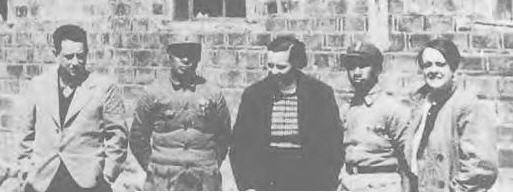 At least 5000 government troops lost their lives during the Huangqiao-Xinghua Battle.
Though, the Comintern and I.P.R agents, embedded with the communist N4C since 1938, continued to broadcast the fake news of the communist N4C fighting against the Japanese through relay of the news agencies in Shanghai's international settlement.
At least 5000 government troops lost their lives during the Huangqiao-Xinghua Battle.
Though, the Comintern and I.P.R agents, embedded with the communist N4C since 1938, continued to broadcast the fake news of the communist N4C fighting against the Japanese through relay of the news agencies in Shanghai's international settlement.
The communists, after taking out the government troops, then became the railway guards for the Japanese invasion army.
As Hao Bocun, the former ROC defense minister in Taiwan, had said, the territory of Jiangsu Province did not suffer from the wrath of war as a result of the communists' taking control of the area whereas the Hunan province endured four Changsha campaigns [and the Changde and Hengyang battles] throughout the war.
The Chinese communists, who took out the Hebei Populace Army and the government guerrillas on the Ji-zhong [central Hebei] plains in 1939-1940, yielded the territory to the Japanese and retreated back to the mountains of Shanxi. Similarly, the communists took out the government troops in the Jiangsu Province in 1939-1940, and became the railway guards for the Japanese invasion army, allowing the unfettered railway traffic along the Tientsin-Pukow Railway throughout the resistance war.
* In Commemoration of China's Fall under the Alien Conquests in A.D. 1279,
A.D. 1644 & A.D. 1949 *
U.S.S.R./Comintern Alliance with the KMT & CCP (1923-1927)
Korean/Chinese Communists & the 1931 Japanese Invasion of Manchuria
American Involvement in China: Soviet Operation Snow, IPR Conspiracy, Dixie Mission, Stilwell
Incident, O.S.S. Scheme, Coalition Government Crap, Amerasia Case & The China White Paper
* Stay tuned for "Republican China 1911-1955: A Complete Untold History" *
|
|
Zou Rong's Revolutionary Army;
Shin Kyu Sik's
Shrine (Spirit, Kunitama) of Korea
|
This snippet is for sons and daughters of China:
Heed the sons & ministers' agony and sorrow of our ancestors who died or lived through the Mongol, Manchu and Soviet-Chicom conquest
and
the Yongjia, Jingkang and Jiashen cataclysms !
Jeanne d'Arc of China:
Teenager girl Xun Guan breaking out of the Wancheng city to borrow the relief troops in the late Western Jinn dynasty;
Liu-Shao-shi riding into the barbarian army to rescue her husband in the late Western Jinn dynasty;
teenager girl Shen Yunying breaking into Zhang Xianzhong's rebels on the horseback to avenge on father's death in the late Ming dynasty.
China's Solitary and Lone Heroes:
Nan Jiyun breaking out of the Suiyang siege and charging back into the city in the Tang dynasty;
Zhang Gui & Zhang Shun Brothers breaking through the Mongol siege of Xiangyang in the Southern Soong dynasty;
Liu Tiejun breaking through three communist field armies' siege of Kaifeng in the Republican China time period;
Zhang Jian's lone confrontation against the communist army during the June 3rd & 4th Massacre of 1989.
|
|
|
Wannan [Southern Anhui Province] Incident (Jan 1941)
The Chinese Communists' Pincer-Attacking the R.O.C. Troops in Collusion with Japanese (in Chinese)
Notwithstanding the heinous crime such as murdering thousands of graduates of the Sicun (preservation of four Confucius and Mencius virtues)
Middle School, and ambushing and killing guerilla fighter Zhao Tong [son of the double-gun Madam Zhao whom the Comintern agents praised in Wuhan in 1938)
and hundreds of fighters en route to Jehol-Hebei border, the Chinese Communists
possessed merely 145,000 "broken" guns as Mao claimed during the 1945 "peace" talks in wartime capital Chungking.
Vladimirov Diaries had two locations detailing the total communist army headcounts,
piercing the fallacy that the Chinese Communists ever possessed more than
300,000-400,000 soldiers during the resistance war.
Zeng Kelin's vanguard force, upon entry into Manchuria, was disarmed by the Soviets because the so-called communist crack 8RA force had a few broken guns and appeared like bandits.
Indeed, communist commander Zhu De wrote to Roosevelt for a $2M loan to buy guns from the puppet army, claiming an amicable relationship with the puppets.
Wasn't an irony?
|
* In Commemoration of China's Fall under the Alien Conquests in A.D. 1279,
A.D. 1644 & A.D. 1949 *
U.S.S.R./Comintern Alliance with the KMT & CCP (1923-1927)
Korean/Chinese Communists & the 1931 Japanese Invasion of Manchuria
American Involvement in China: Soviet Operation Snow, IPR Conspiracy, Dixie Mission, Stilwell
Incident, O.S.S. Scheme, Coalition Government Crap, Amerasia Case & The China White Paper
* Stay tuned for "Republican China 1911-1955: A Complete Untold History" *
|
|
Zou Rong's Revolutionary Army;
Shin Kyu Sik's
Shrine (Spirit, Kunitama) of Korea
|
This snippet is for sons and daughters of China:
Heed the sons & ministers' agony and sorrow of our ancestors who died or lived through the Mongol, Manchu and Soviet-Chicom conquest
and
the Yongjia, Jingkang and Jiashen cataclysms !
Jeanne d'Arc of China:
Teenager girl Xun Guan breaking out of the Wancheng city to borrow the relief troops in the late Western Jinn dynasty;
Liu-Shao-shi riding into the barbarian army to rescue her husband in the late Western Jinn dynasty;
teenager girl Shen Yunying breaking into Zhang Xianzhong's rebels on the horseback to avenge on father's death in the late Ming dynasty.
China's Solitary and Lone Heroes:
Nan Jiyun breaking out of the Suiyang siege and charging back into the city in the Tang dynasty;
Zhang Gui & Zhang Shun Brothers breaking through the Mongol siege of Xiangyang in the Southern Soong dynasty;
Liu Tiejun breaking through three communist field armies' siege of Kaifeng in the Republican China time period;
Zhang Jian's lone confrontation against the communist army during the June 3rd & 4th Massacre of 1989.
|
|
|
More available at Wan-nan-Incident.pdf.
(Check RepublicanChina-pdf.htm page for up-to-date updates.)
* In Commemoration of China's Fall under the Alien Conquests in A.D. 1279,
A.D. 1644 & A.D. 1949 *
U.S.S.R./Comintern Alliance with the KMT & CCP (1923-1927)
Korean/Chinese Communists & the 1931 Japanese Invasion of Manchuria
American Involvement in China: Soviet Operation Snow, IPR Conspiracy, Dixie Mission, Stilwell
Incident, O.S.S. Scheme, Coalition Government Crap, Amerasia Case & The China White Paper
* Stay tuned for "Republican China 1911-1955: A Complete Untold History" *
|
|
Zou Rong's Revolutionary Army;
Shin Kyu Sik's
Shrine (Spirit, Kunitama) of Korea
|
This snippet is for sons and daughters of China:
Heed the sons & ministers' agony and sorrow of our ancestors who died or lived through the Mongol, Manchu and Soviet-Chicom conquest
and
the Yongjia, Jingkang and Jiashen cataclysms !
Jeanne d'Arc of China:
Teenager girl Xun Guan breaking out of the Wancheng city to borrow the relief troops in the late Western Jinn dynasty;
Liu-Shao-shi riding into the barbarian army to rescue her husband in the late Western Jinn dynasty;
teenager girl Shen Yunying breaking into Zhang Xianzhong's rebels on the horseback to avenge on father's death in the late Ming dynasty.
China's Solitary and Lone Heroes:
Nan Jiyun breaking out of the Suiyang siege and charging back into the city in the Tang dynasty;
Zhang Gui & Zhang Shun Brothers breaking through the Mongol siege of Xiangyang in the Southern Soong dynasty;
Liu Tiejun breaking through three communist field armies' siege of Kaifeng in the Republican China time period;
Zhang Jian's lone confrontation against the communist army during the June 3rd & 4th Massacre of 1989.
|
|
|
The Chinese communist claim to have expanded the Eight Route Army to 400,000 [? 500,000] and the New Fourth Army to 100,000 could be mere propaganda. The Vladimirov Diaries pointed out, in two separate places, that the communist troops numbered a little above 300,000 at the time of Japan's surrender in Aug of 1945.
Mao Tse-tung himself had betrayed the actual strength of the communist forces in demanding the various units of the 8RA divisions and columns as well as detachments to supply the "refined" troops for attacking the wartime interim capital Chungking. For the New 4th Corps [New 4th Army], Mao Tse-tung was demanding the N4C to supply 20,000 "refined" troops. The actual N4C troops numbered probably no more than 30,000 in total - consisting of Chen Yi and Su Yu's 8000 troops [i.e., the First Detachment, Second Detachment and Third Detachment] that routed Haan Deqing's Jiangsu troops at the Huangqiao Battle, less than 9,000 combat + 2,000 noncombat at the N4C headquarters, and unspecified number under the Fourth Detachment and Fifth Detachment as well as under Li Xiannian's guerrillas in Hubei Province.
Note that Chen Yusheng, who was a detachment commander under the 3rd Corps of the Jiangsu provincial guerrilla army, had defected to the communists with a large number of troops and equipment, which allowed the communist New Fourth Army to establish the beachhead north of the Yangtze and expand in Northern Jiangsu Province.
Using the communist coined term 'wan [stubborn] jun [army]' for the government troops, the communist army, during the resistance war, systematically massacred the gentry-organized guerrilla army, the government guerrilla army, the village elderlies and the government behind-the-enemy-line officials, not to mention the communist self-inflicted purge of the communists who were accused of being Trotskyites.
The most heinous notoriety included the communist campaigns against the government war zone troops in Shandong and Jiangsu provinces, with the end result being that the communists acted as railway guards for the Tientsin-Pukow Railway in peaceful co-existence with the Japanese army.
The communists fabricated a so-called railway guerrilla force that was centered around Zaozhuang of Shandong Province, with main activities like 'ba1' or stripping the trains, namely, pilfering the Japanese supplies transported on the trains --that was made a movie and a TV series for the entertainment of the buffooned populace.
Purportedly, the guerrilla captain in the movie "Railway Guerrillas" was prototyped on Wen Lizheng (1911-1945), who
was blamed on the puppets for getting killed on February 22nd, 1945 but did not get rehabilitated by the communists till highschool classmate Li Rui and brother Wen Lihui intervened long after death.
Wen Lizheng, a student of Catholic (Fu Jen) University of Peking, was admitted to the communist party through Li Rui, followed Li Rui in a second trip to the Shandong front in 1938, and stayed behind the enemy lines to have acted
as
political director of the Canal Detachment of the 115th Division of the communist Eighth Route Army,
political commissar of the Railway Guerrilla Force, and
commissar and concurrent propaganda department director of the Second Region Committee of the communist Southern Shandong District Committee.
Wen Lizheng's death was suspicious in that there was no distinction between the communists and the puppets throughout the war. His brother Wei Lihui (1917-1999) took a different path in enrolling in the 17th session of the government central military academy, joined the expedition army and fought in Burma, fought the October 1949 Kuningtou Battle of Quemoy as 54th Regiment commander under Hu Lian, and later was the Pescadores garrison commander.
The communist N4C, not fighting the Japanese at all, in late 1944 mounted a cross-Yangtze campaign back to the southern bank, and taking advantage of the Japanese Ichigo Campaign, fought against the government troops in an atrocious bloody civil war that lasted more than half a year.
More available at THE ENEMY FROM WITHIN: CHINESE COMMUNIST ATTACKS AT GOVERNMENT TROOPS - 1940 (Check RepublicanChina-pdf.htm page for up-to-date updates.)
* In Commemoration of China's Fall under the Alien Conquests in A.D. 1279,
A.D. 1644 & A.D. 1949 *
U.S.S.R./Comintern Alliance with the KMT & CCP (1923-1927)
Korean/Chinese Communists & the 1931 Japanese Invasion of Manchuria
American Involvement in China: Soviet Operation Snow, IPR Conspiracy, Dixie Mission, Stilwell
Incident, O.S.S. Scheme, Coalition Government Crap, Amerasia Case & The China White Paper
* Stay tuned for "Republican China 1911-1955: A Complete Untold History" *
|
|
Zou Rong's Revolutionary Army;
Shin Kyu Sik's
Shrine (Spirit, Kunitama) of Korea
|
This snippet is for sons and daughters of China:
Heed the sons & ministers' agony and sorrow of our ancestors who died or lived through the Mongol, Manchu and Soviet-Chicom conquest
and
the Yongjia, Jingkang and Jiashen cataclysms !
Jeanne d'Arc of China:
Teenager girl Xun Guan breaking out of the Wancheng city to borrow the relief troops in the late Western Jinn dynasty;
Liu-Shao-shi riding into the barbarian army to rescue her husband in the late Western Jinn dynasty;
teenager girl Shen Yunying breaking into Zhang Xianzhong's rebels on the horseback to avenge on father's death in the late Ming dynasty.
China's Solitary and Lone Heroes:
Nan Jiyun breaking out of the Suiyang siege and charging back into the city in the Tang dynasty;
Zhang Gui & Zhang Shun Brothers breaking through the Mongol siege of Xiangyang in the Southern Soong dynasty;
Liu Tiejun breaking through three communist field armies' siege of Kaifeng in the Republican China time period;
Zhang Jian's lone confrontation against the communist army during the June 3rd & 4th Massacre of 1989.
|
|
|
Wang Zhen's Communist Troops Following the Japanese Footsteps In the Ichi-go Campaign (1944)
Rebuilding the Railway System & Paving the Sino-Burmese Railway
To the north of Yichang and on the two banks of the Xiang-he River, the Chinese forces posed a threat to Yichang. On November 25th, 1940, the Japanese from Shashi and Yichang mounted a campaign against the Xiang-he River area. Three days later, the Japanese army was beat off. By the 30th, the Xiang-he River area was restored to its original status.
By the year of 1940, major Chinese railways had been isolated. The Chinese had basically retreated to the west of the Ping-Han & Yue-Han railway lines. Along the Railway Long-Hai, only the Baoji-Luoyang segment was open; along the Railway Zhe-Gan, only the Zhuji-Dengjiabu Segment was open; along the Railway Yue-Han, only the Qujiang-Xiangtan Segment was open; and along the Xiang-Gui Railway, only the Hengyang-Liuzhou Segment was open.
In Feb of 1941, the British proposed to fund the Sino-Burmese Railway pavement as to the segment from Lashio to the Chinese border. The Chinese transferred Rangoon's rails to the Burmese government. In May, the U.S. appropriated loans and funds to China per the Chinese Lease Act for building the Sino-Burmese Railway. (The Sino-Burmese Railway stopped construction when the Japanese took over Rangoon in March 1942. The Sino-Burmese Railway was first worked on by Du Chongyuan in the spring of 1939 with funds raised by selling four new ships moored in HK's harbor. The ROC's Commerce Bureau was the owner of the ships.)
Yu-nan Campaign [i.e., Yu-nan & E-bei Campaign]
On Jan 14th, 1941, the Japanese launched a campaign in southern Henan Province, with echo from their counterparts in northern Anhui Province and eastern Henan Province. The purpose was to disrupt the Chinese government's plan to relocate the Chinese communists to the north of the Yellow River. Li Zongren stated that after three abortive campaigns against Suixian-Zaoyang, the Japanese combined 7.5 Shidans from Anhui-Hubei-Henan provinces, one cannon echelon, 300 armored vehicles and hundreds of planes for linking up the Ping-Han Railway. On Jan 25th, 6 Japanese prongs departed Xinyang, Queshan and Zhumadian for the west. The 5th Military District relocated its main army to the two sides of the Japanese thrust path while leaving one band for harassing the Japanese near Xiping on the Ping-Han Railroad and dispatching another band to the hind of the Japanese for cutting off supplies. On the 29th, the middle Japanese prong, along Runan, Yancheng and Wuyang, failed to locate the Chinese forces, while the two flanks came under heavy attacks by the Chinese. Li Zongren claimed that his 100000 forces played the hide-seek game with 100000 Japanese forces on the flat plains of southern Henan Province. On the 31st, the middle Japanese prong split into two parts for attacking Wuyang and Shangcai, separately.
At Wuyang, Tang Enbo's troops fought a fierce battle against Japanese and then evacuated before being encircled. At Shangcai, the Japanese found an empty city as well. Meanwhile, the Chinese forces in Anhui and Henan provinces cut off the Japanese logistics in the hind.
On Feb 2nd, 1941 (?), the Japanese began to retreat per Wu Xiangxiang. Li Zongren stated that the Chinese abandoned Nanyang on Feb 4th. However, the Japanese dared not defend the city and abandoned it on the 6th. The Japanese at Qinyang, under attack, evacuated for Xingyang on Feb 10th. Tang Enbo's troops, after defeating the Japanese campaign, renewed the push towards the Henan-Anhui-Jiangsu border area to counter the communist forces who made the stealthy encroachment in the wake of the Japanese campaign. After three major setbacks, Peng Xuefeng evacuated to the Anhui-Jiangsu border, and would not return till three years later, only to get killed in the civil war under a slogan that it was not too late for a gentleman to take revenge [against the government troops] in three years [by taking advantage of the Japanese Ichigo Campaign].
In northern Hubei Province, the Japanese cavalry at one time rode to within 15 kilometers of the command center of the 5th war zone, i.e., Laohekou. On March 6th, 1941, the Japanese at Yichang tried to expand its territories. The Chinese fought off the Japanese after eight days' fierce fighting.
In the U.S.S.R., Mao Anying, i.e., the elder son of Mao Tse-tung, who entered Moscow's International Orphanage in 1936, would join the Russian Red Army in 1941. Mao Anying was later conferred captain in the Soviet Red Army in 1943, and was offered a pistol by Stalin in 1946 prior to his return to China.
The Shanggao Campaign
On March 15th, 1941, the Japanese launched a campaign against Shanggao of Jiangxi Province via three prongs, with the 33rd Infantry Shidan attacking Fengxin from Anyi and then southwestward against Shanggao, the 20th Mixed Ryodan attacking Shanggao along the southern bank of the Jinjiang River, and the 34th Infantry Shidan along the northern bank.
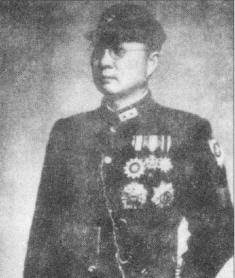 The Chinese army deliberately allowed the middle Japanese prong to advance, and abandoned Gao'an on the night of the 17th. To the north, the 70th Corps, to divert the 33rd Infantry Shidan away from Shanggao, retreated northwestward to Shangfu-Ganfang-Kuzhuao area where they ambushed the Japanese in coordination with Haan Quanpu's 72nd Corps. On the 18th, the 34th Infantry Shidan moved beyond Gaoan to take over Longtanxu (Longtan). On the 19th, the 33rd Infantry Shidan, after two days’ fierce battles, broke out of encirclement to retreat to Fengxin. On the 20th, the 20th Mixed Ryodan after leaving behind one Daitai at Qujiang-Quangang, took over Huibu on the 20th and then crossed the Jinjiang River to join forces with the 34th Infantry Shidan. Liu Duoquan's 49th Corps, tracing behind the 20th Mixed Ryodan, crossed Ganjiang at Shichajie, destroyed majority of the Japanese near Quangang, and continued to attack the Japanese hind.
Besieged by the Chinese forces for six days, Oga Shigeru, having incurred casualties by over a half, ordered a retreat under the support of planes and requested for assistance with the Japanese Eleventh Army headquarters. The 34th Infantry Shidan, with hundreds of casualties on shoulder-strapped litters extending 7-8 kilometers long, crossed the Sixi River on the 27th, only to find Zhang Yanchuan's Preparatory 7th Division of the 70th Corps blocking the way at Tudiwangmiao. On the 28th, the Chinese forces recovered all lost positions around Sixi and Guanqiaojie. The 33rd Infantry Shidan also crossed the Sixi River under constant attacks and impediments, and on the 29th, came under an ambush at Huxingshan hill, about five kilometers to the northwest of Sixi. Having used up all mountain gun ammo, the 33rd Infantry Shidan had to rely on airdrop to fight its way back by April 2nd. The Chinese army chased them all the way back to their base, with the 49th Corps recovering Xishan-Wanshougong and the 70th Corps Fengxin.
On April 13th, 1941, the U.S.S.R. signed a neutrality pact with Japan by betraying the 1937 non-aggression treaty between China and the U.S.S.R. Before the neutrality pact with Japan, the Soviet adviser to Chungking, Chuikov, had adamantly proposed that the Chinese forces mount a counter-attack for recovering Yichang. Chuikov was later recalled to Moscow in August after the U.S.S.R. ascertained that Japan had no intent for invading the U.S.S.R. in the north.
The Soviet betrayal was not a surprise for Chiang Kai-shek as China, since the mid-1930s, had continuously made breakthroughs in deciphering the Japanese foreign ministry's telegrams. Chiang Kai-shek personally read the telegrams to realize that the Soviets could not be trusted.
The Chinese communists, i.e., the most loyal followers of the 3rd Comintern in the eyes of Li Zongren, immediately published the "April 16th Opinions" on the Russian neutrality pact with Japan, stating that the "U.S.S.R.-Japan declaration guaranteed Outer Mongolia from being attacked by Japan ... This is not only good to Outer Mongolia but also to the liberation of the whole China ... Recovery of Manchuria being our own matter, we should not behave like the speculators who looked towards a Russian war with Japan ..."
The Jin-nan Campaign & the Battle Of Mt Zhongtiaoshan
In Aug 1939, the U.S.S.R. and Germany signed the Molotov-Ribbentrop non-aggression pact. The U.S.S.R. withdrew its military personnel from China. On September 1st, 1939, at the news of the Russian invasion of Poland, Mao Tse-tung made an announcement of support, claiming that the Russians [Soviets] had the right to liberate the minority Ukrainians and White Russians who numbered 11 million in Poland. Shi Zhe translated Mao's article on the "New China Newspaper" into Russian, and the Comintern had it translated into French and German for the communist members to study. In the winter, the U.S.S.R. invaded Finland. The U.S.S.R. was kicked out of the League of Nations after China abstained from veto, which led to the Soviets' rebuke of China for being unfriendly to the Soviet Union. In April 1941, the U.S.S.R. signed the neutrality treaty with Japan. Mao Tse-tung applauded the U.S.S.R.-Japan pact as Russian's best choice in avoiding the implication of an imperialist world-wide war.
In the spring of 1941, the Japanese amassed armies in the areas of Jincheng, Yangcheng, Qinshui, Wenxi, Xiaxian and Anyi for a Jin-nan Campaign, intending to take over control of southern Shanxi Province, clear the pockets of resistance in Mt Zhongtiaoshan and extend its control to the northern Yellow River bank. In order to sweep the area effectively, the Japanese North China Area Army requested reinforcements with its China Expeditionary Army headquarters to beef up the existing troop level of four infantry Shidan of the 35th, 36th, 37th and 41st. Shortly after dusk, on the 7th, the 41st Infantry Shidan and the 9th Independent Mixed Ryodan attacked the Henglingguan-Xisangchi line at the junction area between Zeng Wanzhong's 5th Group Army (3C & 17C) and Liu Maoen’s 14th Group Army. Simultaneously, the 36th Infantry Shidan, the 37th Infantry Shidan and the 16th Independent Mixed Ryodan attacked towards the east from Zhangdian, Xiaxian and Wenxi directions.
More available at Mt-Zhongtiaoshan.pdf. (Check RepublicanChina-pdf.htm page for up-to-date updates.)
* In Commemoration of China's Fall under the Alien Conquests in A.D. 1279,
A.D. 1644 & A.D. 1949 *
U.S.S.R./Comintern Alliance with the KMT & CCP (1923-1927)
Korean/Chinese Communists & the 1931 Japanese Invasion of Manchuria
American Involvement in China: Soviet Operation Snow, IPR Conspiracy, Dixie Mission, Stilwell
Incident, O.S.S. Scheme, Coalition Government Crap, Amerasia Case & The China White Paper
* Stay tuned for "Republican China 1911-1955: A Complete Untold History" *
|
|
Zou Rong's Revolutionary Army;
Shin Kyu Sik's
Shrine (Spirit, Kunitama) of Korea
|
This snippet is for sons and daughters of China:
Heed the sons & ministers' agony and sorrow of our ancestors who died or lived through the Mongol, Manchu and Soviet-Chicom conquest
and
the Yongjia, Jingkang and Jiashen cataclysms !
Jeanne d'Arc of China:
Teenager girl Xun Guan breaking out of the Wancheng city to borrow the relief troops in the late Western Jinn dynasty;
Liu-Shao-shi riding into the barbarian army to rescue her husband in the late Western Jinn dynasty;
teenager girl Shen Yunying breaking into Zhang Xianzhong's rebels on the horseback to avenge on father's death in the late Ming dynasty.
China's Solitary and Lone Heroes:
Nan Jiyun breaking out of the Suiyang siege and charging back into the city in the Tang dynasty;
Zhang Gui & Zhang Shun Brothers breaking through the Mongol siege of Xiangyang in the Southern Soong dynasty;
Liu Tiejun breaking through three communist field armies' siege of Kaifeng in the Republican China time period;
Zhang Jian's lone confrontation against the communist army during the June 3rd & 4th Massacre of 1989.
|
|
|
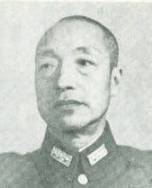 In July 1941, General Xu Yongchang wrote a four year war review, pointing out that China's sustaining and persevering warfare had proved to be the correct strategy. Xu Yongchang further stated that the Japanese generals misjudged the Nationalist government as equivalent to warlordship of the early Republic years, that the Japanese army had lost the martial virtues as a result of barbarity and pillaging, and that the Japanese soldiers and citizens had lost their morale as a result of the prolonged quagmire in China. Citing German strategist Claus Von Clausewitz, Xu Yongchang stated that the Japanese, having relied too much upon cannons, were doomed to be defeated by the Chinese infantry at the separation of cannons from their field army. Statistically, Xu Yongchang stated that the Japanese-initialized wars had decreased to 56% in Feb 1940, while the Chinese counter-attacks amounted to 46% of all engagements. In July 1941, General Xu Yongchang wrote a four year war review, pointing out that China's sustaining and persevering warfare had proved to be the correct strategy. Xu Yongchang further stated that the Japanese generals misjudged the Nationalist government as equivalent to warlordship of the early Republic years, that the Japanese army had lost the martial virtues as a result of barbarity and pillaging, and that the Japanese soldiers and citizens had lost their morale as a result of the prolonged quagmire in China. Citing German strategist Claus Von Clausewitz, Xu Yongchang stated that the Japanese, having relied too much upon cannons, were doomed to be defeated by the Chinese infantry at the separation of cannons from their field army. Statistically, Xu Yongchang stated that the Japanese-initialized wars had decreased to 56% in Feb 1940, while the Chinese counter-attacks amounted to 46% of all engagements.
Germany was the only country to have given China a loan before the 1937 war outbreak. The term was 100 million German marks.
By 1938-1939, the balance of the loan was written off. The exact amount of the German marks allocated was not clear.
After the outbreak of the resistance war, from 1937 to 1939, the U.S.S.R., which of course provoked the Sino-Japanese War through the repeating G.R.U. operations in China
and espionage activities within the Japanese/American governments, gave China three generous loans, with no strings attached,
in the amount of 50 million USD, 50 million USD, and 150 million USD. (One minor string attached, it was said, was to have Chiang Kai-shek agree to equip the small communist army as the New Fourth Army [Corps] and the Eighth Route Army plus funding.)
The United States did not give an unsecured loan to China till the eve of the Japanese launch of the puppet Nanking regime in Nanking in March 1940,
with the only purpose of keeping China in the war with Japan.
(In 1931, there was a customs-revenue-securitized loan of 9 million USD dollars to purchase wheat [Young, p. 49];
and in 1933, there was a cotton and wheat loan of US$50 million, actually a credit offered by Americans for boosting the American Agricultural Price,
which China had to cut down to 10 million from the original 40 million on the cotton component due to hyper-price set in the unfavorable terms of trade. )
|
China's Millions Paving the Burma Road (in English)
While China's people, in millions, were paving the Burma Road to barter-trade the mercury, tungsten, pig hair bristles with the "neutrality"-observing U.S., for some meagre
credit of 15-25 million U.S. dollars, the Soviet Comintern agents, who surrounded Eleanor Roosevelt, plus George Marshall's wife, as the so-called "China Defense League" front organization,
funneled from 1938 to 1941 at least 20 million U.S. dollars to the Chinese Communists in Yenan, who in turn pincer-attacked the R.O.C. government troops and guerrila fighters
in synchronization with the Japanese invaders.
The Enemy From Within;
Huangqiao Battle;
Wan-nan Incident.
|
|
|
The lend-lease amounts were merely US$26 million (1941, mostly squandered in Burma in the aftermath of the Japanese invasion),
US$100 million (1942), US$49 million (1943), and US$53 million (1944).
The Aug 1949, 1000 page China White paper published by D.G. Acheson claimed that the U.S. had given to China US$2 billion. After checking Freda Utley's calculation, we could tell the 2 billion amount consisting of the majority in the form of service(s) during and immediately after the WWII, included the UNRRA goods that was said to be 685M USD by Seagrave and 500M by Kerr. The bulk of 2 billion, i.e., service(s), included the costs in dispatching Chinese troops to the coast and Manchuria as well as repatriating 2 million Japanese to Japan islands. The remnant of Lend-Lease program, e.g., the rotten inventories on Pacific Islands, were probably the only American flow to China after the outbreak of 1945-1950 civil war. Jung Chang, in "Mao: The Unknown Story", repeated the cliché by exaggerating the American aid amount to be 3 billion USD dollars, i.e., one billion more than Acheson's. Her brother, Zhang Pu, lurking on the internet, had found out the loopholes and began to whitewash the number to 1.5 billion financial aid and about 0.8 billion military aid [which were still untrue]. Communist China's Social Academy chief Liu Da’nian acknowledged that Chiang received no more than 0.6 billion in aid. The actual number won't be more than 0.2 to 0.3 billion, including the 0.125B from the 1948 China Aid Act which rolled over to China Area Aid, to be squandered in Indochina, instead.
|
After General Marshall became Acting Chief of Staff effective 1 July 1939, he wrote to the Japanese Army the following:
I am "sure that the cordial relations which have existed between the Imperial Japanese Army and the Army of the United States will continue, and I shall look forward to pleasant contacts with you [i.e., the Japanese general] during your tour of duty in Washington ." (Marshall to Yamauti, July 5, 1939, GCMRL/ G. C. Marshall Papers [Pentagon Office, Congratulations] . )
More,
Brigadier General John Magruder, in October of 1941, relayed the fear of Chinese leader [Chiang Kai-shek] that the "Japanese Army was poised to launch a major drive against the southern city of Kunming, aimed at cutting the Burma Road, China's last important supply link with friendly powers. Marshall's reply was "he knew Magruder very well and ... stated that he knew Magruder when he was in China before, and General Marshall was himself in China . When the Japanese were about to advance on Nanking [in 1937], Magruder, from his sympathy with the Chinese and from his viewpoint as gathered by his experience in China, became quite stampeded... and he knew Magruder so well that he, General Marshall, could properly interpret Magruder's messages."
That is, China, who cares!
The American aid to China was completely sabotaged by i) colonialists and ii) communists inside of the U.S. government.
The American Production Mission to China wasn't set up until September '44.
Per Edwin Locke, "Well, the problem had just never been attended to before, for one thing;
and for another, we were just getting into a position where militarily we could supply a lot more help to China.
You see, China was at the end of the line before; she was almost an orphan,
and we didn't do very much more than maintain Chennault and his hundred airplanes there in South China,
until we began building big bomber bases in China for bombing Japan. China then began to assume a great deal more importance.
I think this is your reason..." --The airfields completely bankrupted China's wartime finance and led to spiraling inflation from 1942 to 1945, which replayed again from 1947 to 1949 when George Marshall left China.
|
Stilwell, the slimy who itched "to throw down ... shovel and get over there and shoulder a rifle with Chu Teh" the communist commander, before his kickout from China,
paid a visit to Mme Sun Yat-sen the No. 1 Comintern agent in China.
George Marshall quit his job twice, J.I.T (just in time), in anticipation of some pre-arranged phonecalls from Truman
to tack on the jobs as 1) first the mediator in the Chinese civil war
and ii) second as defense minister for
the Korean War, respectively.
George Marshall returned Zhou Enlai's address book to Zhou Enlai, sealed,
while never alerting Chiang Kai-shek of the communist spies like Xiong Xianghui.
While Currie stopped the German weapons from shipping to China and Truman dumped China's Lend-Lease weapons to the Indian Ocean,
Acheson and George Marshall personally pushed for the 1946-47 arms embargo against China
and imposed three ceasefire onto the Chinese government, Jan-10-1946, June-6-1946, & Nov-8-1946. Marshall deliberately flew back to China in April 1946 to stop the Chinese Nationalist troops from chasing the communists north of the Sungari River. This is how CHINA WAS LOST.
As disclosed by the documents at the George Marshall foundation, George Marshall, possibly the most hideous agent working on behalf of Stalin and the Soviet Union, saved the ass of the Chinese Communists with a threat to withhold the economic aid that was supposedly coming from the U.S. export-import bank, which never materialized.
G Marshall, from 1946 to 1948, repeatedly probed numerous Chinese officials and generals as to who could be Chiang's successor.
The U.S. Department of State, run by the Soviet Russian agents, were repeatedly sending out rumors about getting a successor for Chiang. Marshall's hands had the blood of millions of Chinese killed in civil wars.
G Marshall, as Wedemeyer said, first armed China and then disarmed China. The U.S. arms embargo continued till the China Aid Act of 1948, and ammunition did not get released till Nov of 1948.
After weapons were shipped
out, Acheson and the undercover Russian agents further attempted to order the ships to turn around at Guam and Okinawa.
In Oct 1949, Acheson pleaded with the British, where the Cambridge Soviet Spy Ring was at work, for recognition of Communist China, which Britain did on Jan 1st, 1950.
After that, Acheson declared the Aleutian curvature, which direcly led to the eruption of the Korean War.
|
|
* In Commemoration of China's Fall under the Alien Conquests in A.D. 1279,
A.D. 1644 & A.D. 1949 *
U.S.S.R./Comintern Alliance with the KMT & CCP (1923-1927)
Korean/Chinese Communists & the 1931 Japanese Invasion of Manchuria
American Involvement in China: Soviet Operation Snow, IPR Conspiracy, Dixie Mission, Stilwell
Incident, O.S.S. Scheme, Coalition Government Crap, Amerasia Case & The China White Paper
* Stay tuned for "Republican China 1911-1955: A Complete Untold History" *
|
|
Zou Rong's Revolutionary Army;
Shin Kyu Sik's
Shrine (Spirit, Kunitama) of Korea
|
This snippet is for sons and daughters of China:
Heed the sons & ministers' agony and sorrow of our ancestors who died or lived through the Mongol, Manchu and Soviet-Chicom conquest
and
the Yongjia, Jingkang and Jiashen cataclysms !
Jeanne d'Arc of China:
Teenager girl Xun Guan breaking out of the Wancheng city to borrow the relief troops in the late Western Jinn dynasty;
Liu-Shao-shi riding into the barbarian army to rescue her husband in the late Western Jinn dynasty;
teenager girl Shen Yunying breaking into Zhang Xianzhong's rebels on the horseback to avenge on father's death in the late Ming dynasty.
China's Solitary and Lone Heroes:
Nan Jiyun breaking out of the Suiyang siege and charging back into the city in the Tang dynasty;
Zhang Gui & Zhang Shun Brothers breaking through the Mongol siege of Xiangyang in the Southern Soong dynasty;
Liu Tiejun breaking through three communist field armies' siege of Kaifeng in the Republican China time period;
Zhang Jian's lone confrontation against the communist army during the June 3rd & 4th Massacre of 1989.
|
|
|
The Lend-Lease & Start of the American Involvement In China
You may ask why would the U.S.A. ever got involved in China over WWII? It would be a Soviet setup, i.e., the Operation Snow.
The Soviet Russians, after signing a neutrality pact with Japan on April 13th, 1941 [by betraying the 1937 non-aggression treaty between China and the U.S.S.R.], had sealed off China's continental exit to the north and northwest. The Russian, being concerned that China could lose the resistance to Japan, secretly ordered their proxies, Launchlin Currie & Harry Dexter White, among others, to recommend to Roosevelt that China be given the Lend-Lease materials. Blindfolding the Chinese communists as well as the ultra-left Soviet embassy officials in China, the Soviet leadership hinted to the Chinese officials that China should contact the USA for assistance. For China to be given the Lend-Lease materials, the Comintern agents devised two strangle strategies, i.e., i) Currie's linking the lend-lease to China's political reform [by incorporating the Chinese communists] at the time of war; and ii) Marshall and Stilwell's controlling the flow of the lend-lease materials as a bargaining chip over the control of the Chinese military. (Alternatively speaking, the Russians, British and American decided to give China limited help over worries about a possible reconciliation between Japan and Chiang Kai-shek's China, i.e., an "international game" played by Chiang Kai-shek on the matter of Japan-proposed combination of Chiang Kai-shek's Chungking Government and Whang Jingwei's Nanking Puppet Government.)
American Involvement in China: Soviet Operation Snow, IPR Conspiracy, Dixie Mission, Stilwell Incident, O.S.S. Scheme, Coalition Government Crap, the Amerasia Case, & the White Paper
[Modified : Monday, 25-Feb-2013 22:00:00 EST]
"Lend-lease, arrangement for the transfer of war supplies, including food, machinery, and services, to nations whose defense was considered vital to the defense of the United States in World War II. The Lend-Lease Act, passed (1941) by the U.S. Congress, gave the President power to sell, transfer, lend, or lease such war materials. The President was to set the terms for aid; repayment was to be “in kind or property, or any other direct or indirect benefit which the President deems satisfactory.” Harry L. Hopkins was appointed (Mar., 1941) to administer lend-lease. He was replaced (July) by Edward R. Stettinius, Jr., who headed the Office of Lend-Lease Administration, set up in Oct., 1941. In Sept., 1943, lend-lease was incorporated into the Foreign Economic Administration under Leo T. Crowley. In Sept., 1945, it was transferred to the Dept. of State."
Through the Lend-Lease Act that was signed into law on March 11, 1941 and ended on September 20, 1945, a total of $50.1 billion worth of supplies was exerted to the war efforts, equivalent to
17% of the total war expenditures of the U.S.
Purportedly, $31.4 billion went to the United Kingdom, $11.3 billion to the Soviet Union, $3.2 billion to France, $1.6 billion to China, and the remaining $2.6 billion to the rest of Allies.
Currie went to China on an inspection mission in Jan 1941. Earlier, on October 25th, 1938, the U.S. approved a barter trade in loaning China 20 million U.S. dollars after finance minister Morgenthau advised the State Department of becoming China's friend like the Russians.
(16 out of 17 of the AMERICANS that were involved in creating the U.N. were later identified, in sworn testimony, as secret communist agents. The first Secretary General was the AMERICAN Alger Hiss. Hiss served time in prison pursuant to his involvement in a Communist spy ring. Who were the 16 American citizens who helped create the UN that were identified as communists? Alger Hiss; Harry Dexter White; Virginius Frank Coe; Noel Field; Laurence Duggan; Henry Julian Wadleigh; Nathan Gregory Silvermaster; Harold Glasser; Victor Perlo; Irving Kaplan; Solomon Adler; Abraham George Silverman; John Carter Vincent; David Weintraub; William K. Ullman and William H. Taylor.)
Out of $1.6 billion Lend-Lease aid to China, effective military aid numbered no more than 0.2 to 0.3. billion.
The Lend-Lease materials destined for China was given to the British for defending Burma; was destroyed when the Japanese closed in to Rangoon; was used by Stilwell for equipping the X-force and Y-force; It was MOSTLY used for paving the Ledo-Burma Highway that did not open till 1945; was for funding the Hump Course airlift that went exclusively to Chennault's airforce but still failed to fuel the planes [- because of Stilwell's trickery against Chennault not because the American pilots' laziness]; and was finally used for shipping 1-2 million Japanese home. Freda Utley pointed out: "Almost half the total made available to China consisted of services, such as those involved in air and water transportation of troops. According to the latest figures reported, lend-lease assistance to China up to V-J Day totaled approximately $870,000,000. From V-J Day to the end of February [1946], shortly after General Marshall's arrival, the total was approximately $600,000,000 -- mostly its transportation costs."
[Rumors and accusations:
Craps put up at wiki http://en.wikipedia.org/wiki/Second_Sino-Japanese_War
However, relations between Stilwell and Chiang soon broke down, due largely to the corruption and inefficiency of the Chinese government. Despite massive amounts of American lend-lease aid (over US$5 billion from 1941 through 1945), the Nationalist Chinese Army frequently avoided major engagements with the Japanese and was seen as preferring to stockpile material for a later struggle with the communists. Stilwell criticized the Chinese government's conduct of the war in the American media, and to President Franklin Roosevelt. The Allies thus lost confidence in the Chinese ability to conduct offensive operations, and instead concentrated their efforts against the Japanese in the Pacific Ocean Areas and South West Pacific Area. See W. F. Kimball, The Most Unsordid Act (1969).
http://64.233.167.104/search?q=cache:NPthg...lient=firefox-a Eventually becomes $50 billion dollars in lend-lease during the war to many countries: 60% to UK, 20% U.S.S.R., 20% France, China, others. 30Nov40. Sat. United States lends [pre-lend-lease] $50 million to China for currency stabilization and grants an additional $50 million credit for purchase of supplies.
http://64.233.161.104/search?q=cache:bdlPw...hina+wwii&hl=en Magruder acquiesced, and eventually large amounts of lend-lease weapons and equipment, originally earmarked for Nationalist China, went to the British for use in the defense of Burma. With Rangoon threatened, Magruder ordered the destruction of all lend-lease stocks in an effort to deny them to the invading Japanese. As the Japanese approached, there had been frantic activity to move as much materiel as possible north to the Burma Road, but it was still necessary to destroy more than 900 trucks in various stages of assembly, 5,000 tires, 1,000 blankets and sheets, and more than a ton of miscellaneous items. Magruder transferred much materiel to the British forces, including 300 British-made Bren guns with 3 million rounds of ammunition, 1,000 machine guns with 180,000 rounds of ammunition, 260 jeeps, 683 trucks, and 100 field telephones. In spite of the destruction and transfer to the British, however, over 19,000 tons of lend-lease materiel remained in Rangoon when it fell to the Japanese on 8 March.]
Communist China's Social Academy chief Liu Danian acknowledged that Chiang Kai-shek received no more than 0.6 billion in the form of American aid.
The actual number won't be more than 0.2 to 0.3 billion, including the 0.125 Billon from the 1948 China Aid Act which rolled over to the China Area Aid,
to be squandered in Indochina, instead, in the 1950s and 1960s.
The lend-lease amounts, subdivided for the years 1941-1944, were merely
US$26 million (1941, mostly squandered in Burma in the aftermath of the Japanese invasion),
US$100 million (1942),
US$49 million (1943), and
US$53 million (1944).
The American lend-lease amounts for the time period of 1940-1944 were smaller than Stalin and the Soviets' aid of 250 million USD from 1937-1940.
(Stalin's generosity was the result of the Soviet scheme to provoke the Sino-Japanese War in order to make China into a blood pool to tie down Japan, an exact word used by Vasily Ivanovich Chuikov in his memoirs to describe the effect of the Sino-Japanese War on the Soviet Union.)
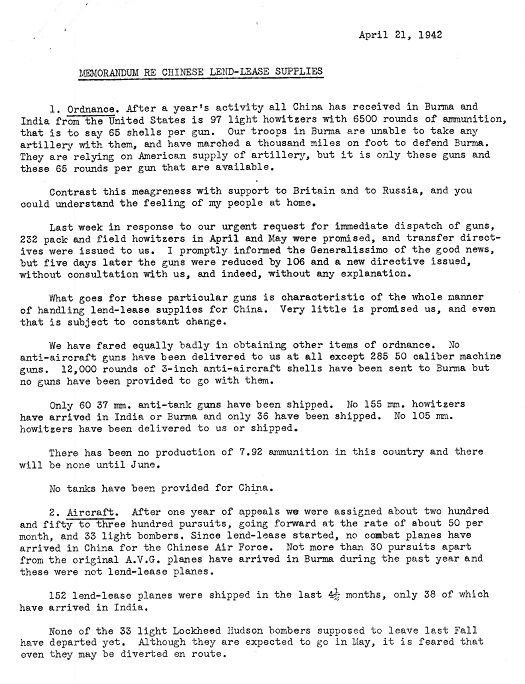 Stilwell himself acknowledged that China did not get the needed aid from the Lend-Lease. On pages 180-181 of FF Liu's "A Military History of Modern China", Liu pointed out that "The British influence was strong in the ranks of the combined chiefs of staff, however, and Chinese stockpiles rapidly diminished while material was reallocated to other recipients. When aircraft originally intended for the Chinese theater was reallocated by Washington, Stilwell complained, "Now what can I say to G-mo [Chiang Kai-shek]? We fail in all commitments and blithely tell him to just carry on, old top."
To build the roads and airfields, China issued unbacked bonds. (In November 1944, Kong Xiangxi, at Chiang Kai-shek's order, demanded with Morgenthau that the U.S. pay back the 0.6 billion U.S. dollar cost China incurred in building the airfields for the American bombers. Morgenthau, knowing black market rate of 120 against 1 U.S. dollar, refused to pay China. Roosevelt agreed to pay 0.1 billion U.S. dollars in cash.)
The huge loss of the Chinese forces in the Kachin Hills (I.e., Kumenling/Yerenshan), and Kumon-Gaoligong Mountains, as a result of the British betrayal in the Burma Campaign, had yielded only one good thing: Sun Liren (Sun Li-Jen), against Chiang Kai-shek and Du Yuming, retreated to India.
Among General Sun Liren (Sun Li-Jen)'s entourage on the exodus to Assam from Burma would be a prince of Sikkim, a Sino-Tibetan brotherly mountain state that was first stolen from Manchu China by the British in 1890 and then annexed by the post-WWII India through a bloody military intervention in the mid-1970s.
In India, the British realized that the Chinese could be used for defending India. Stilwell thought about making Sun Liren's 38th Division into his private army. The Expedition Army was rebuilt into the New 1st Corps. Stilwell agreed to equip the Chinese armies with the American weapons. Chiang Kai-shek's future crack force, as commonly known, were the remnants of Stilwell's X-force from India and the Y-force from Yunnan-Guangxi provinces. However, in 1942, Stilwell had tried to take over the Chinese force by implanting 200 American officers. From 1943 to 1944, Stilwell attempted at the assassination of Chiang during a planned Ramgarh inspection, made up several schemes including poisoning to kill Chiang Kai-shek, and instigated the Chinese army junior officers, with the communist elements included of course, for mutiny during Chiang's absence from China for the Cairo Conference.
When China was attacked by Japan in the No. 1 Campaign, Stilwell refused to direct the X-force against the Japanese from south or allow the Y-force to back off from Burma border.
Stilwell wasted the Y-force needlessly in attacking the Japanese positions on perpendicular hills, refused to reroute the Y-force to China during the Japanese Ichigo Campaign, deliberately parked the X-force for two months while the Y-force was fighting the uphill battles at the Mt. Songshan hills, refused to allow the American 14th Air Force to render aid to China during the Japanese Ichigo Campaign, denied Chennault the fuel to fly the planes, and fought Chiang Kai-shek for control of the Chinese army with Marshall's acquiesce. If you want to know how much the U.S. did for China, I would say that's basically all before Stilwell was recalled in October 1944. Stilwell had no interest in giving aid to China other than the direct control over the Chinese army, and giving aid to the Chinese communist army.
Chiang Kai-shek's relationship with Britain and America never progressed before WWII. There were hiccups during WWII, especially so when Stilwell could be implicated in assassinating Chiang Kai-shek in early 1944.
The Communist-China-published books repeatedly claimed that "in November 1943, with possibly Stilwell acquiesce and encouragement, 600 Chinese officers plotted to assassinate Chiang Kai-shek on December 12th. Kong Xiangxi could be implicated in the plot. Long Yun as well. 16 generals [????? whom??? ] were executed upon Chiang's return from Egypt."
Jay Taylor sorted through the riddles, pointing out that the mutiny was a plan to capture and kill Chiang Kai-shek at airport upon Chiang's return from the Cairo Conference (November 22-26, 1943), which Dai Li had thwarted.
The Communist records further claimed that the assassination was under Stilwell's order, code-named the "Blue Whale", scheduled for the time period of March 1944 when Chiang Kai-shek was expected to inspect on the Chinese army in India. The truth was that Roosevelt dispatched a WWI-era ace with the assassination order to Stilwell who passed it on to Frank Dorn. Though Roosevelt did not give the go-ahead order, Stilwell and his cronies apparently took advantage of every possibility to sabotage the cause of Chiang Kai-shek. James Liley, in memoirs about his brother, hinted a continuous American plot against Chiang Kai-shek through 1946 in collusion with the local Chinese military leaders.
The Communist-published writings painted the assassination as something shrouded in mystery. The origin of all the rumors should still be ascribed to Stilwell and Dorn's scheme in assassinating Chiang Kai-shek, not something to do with the Kung family.
Reading through the years of 1944-46, there was no trace to show that Chiang had lost confidence in H H Kung over the purported implication in Stilwell's assassination against Chiang Kai-shek. James Liley's alternative account had shown that the assassination, possibly suspended by Stilwell, had gone forward under the umbrella of the American collaboration with the Southwestern military generals like Long Yun.
Conflicting records, which dated from the Comintern-instigated Stilwell assassination against Chiang Kai-shek of 1943-1944, claimed that both Mms Chiang and Mme Kung were kicked out of China due to implication in the assassination. The truth was that the Associated Press bureau in Chungking reported Mrs. Chiang has been under the care of Commander Frank Harrington, assistant U. S. naval attaché there, for four months; Dr. Harrington said that Mrs. Chiang's condition was aggravated by the intense, humid heat of Chungking and that she needed a change badly, i.e., a leave for treatment in Brazil; and that President Chiang and a group of close friends bade her farewell at the airport.
Mme Chiang's absence from China till September 1944 could possibly be related to the rumors spread by the communists or pro-communist foreign reporters, saying that Chiang had a mistress. According to Chen Jieru's memoirs, she was escorted to Chungking from Shanghai after the eruption of the Pacific War, and dwelled in a place arranged under Chiang Kai-shek's order. It was possible that Chiang might have paid a visit to his former wife, over which the innuendo was made, which led to the possible misunderstanding on the part of Mme Chiang.
Wedemeyer continued on with Stilwell's training by promising to equip 39 Chinese divisions, with actual numbers trained uncertain. Stilwell controlled the Lend-Lease program, and refused to even replenish Chennault’s Flying Tiger airforce, not to mention Chiang Kai-shek's ROC troops. Wedemeyer continued the Stilwell line in controlling the Lend-Lease program direct. On page 193 of FF Liu's book, Liu stated that "The Chinese even agreed to Wedemeyer's insistence that Americans supervise the purchase of food locally when paid for with lend-lease funds." This shows that China had no control over the lend-lease materials or funds, with the conclusion that there was not much for the Chinese to embezzle during WWII.
The China Story by Freda Utley
Chapter 2, Too Little, Too Late --
The Facts About "Aid to China"
****
Summaries from
The China Story by Freda Utley
Chapter 2, Too Little, Too Late --
Lend-lease assistance was extended to China to assist her in fighting the Japanese, and later to fulfill our promise to assist in re-occupying the country from the Japanese. Assistance took the form of goods and equipment and of services. Almost half the total made available to China consisted of services, such as those involved in air and water transportation of troops. According to the latest figures reported, lend-lease assistance to China up to V-J Day totaled approximately $870,000,000. From V-J Day to the end of February [1946], shortly after General Marshall's arrival, the total was approximately $600,000,000 -- mostly its transportation costs.
Following Japan's surrender, shipments of Lend-Lease supplies to China from India were stopped, and large quantities of munitions and equipment intended for China were destroyed, or thrown into the sea. Smaller caliber ammunition was blown up, and 120,000 tons of larger caliber dumped into the Indian Ocean.2/ This "Operation Destruction" cost the lives of twenty-five Americans and one hundred and twenty-five Indians. Yet, these destroyed munitions are to be found included in the total of "pre-V-J Day Lend-Lease" charged to China's account.
Japan's Continuing Conflicts With Britain & America
In Southeast Asia, the Japanese already took over northern Vietnam, further dealing China a blow in the continental blockade. Worldwide, the Axis powers, i.e., Germany & Japan, had a contradictory agenda as to their wars against the U.S.S.R. and America. On April 13th, 1941, Japan signed a neutrality pact with the U.S.S.R. for sake of concentrating its efforts to the south. While Japan orchestrated the military exercises in Manchuria, Comintern agent [Richard Sorge, i.e., Zuo-e-ge], close to Japan's prime minister [Hotsumi Ozaki & Kimkazu Saionji], had already disclosed Japan's true intent to the U.S.S.R. This Comintern agent was said to have later prewarned the Russians of Germany's blitz attack.
On April 25th, the U.S. and Britain agreed to give China loans, namely, a confidence-boosting offer of support to prop up China's exchange rate and the foreign reserves. On May 16th, Britain banned the export of rubber to Japan from Malaysia. On June 6th, the Japanese ambassador to Germany reported home the coming onslaught on the U.S.S.R. Japan re-examined its policy and decided to concentrate efforts in the south. On June 22nd, Germany attacked the U.S.S.R.
This was after Hitler got angry with Stalin's appetite for grabbing more territory in Europe after months of talks at striking a four-country Axis alliance among Germany, Italy, Japan and the Soviet Union. (In Yenan, communist leader Mao Tse-tung, hearing of the talks between the aggressors, applauded the pending four-country AXIS alliance.)
The Communists claimed that Yan Baohang, a YMCA agent at Mukden, was responsible for providing the tips to the Soviets about the pending German attack, for which the Soviets purportedly gave Yan a posthumous medal dozens of years later. Yan Baohang, i.e., head of the YMCA Mukden gang, had his application for membership in the CCP personally overturned and struck down by Stalin, which exhibited the extent of the Soviet early 1920s infiltration into the worldwide YMCA organization [which later mutated into the IPR institution], after a Soviet setback in the anti-Christian coalition strategy.
Yan Baohang, who entered the nucleus of the KMT operations through the YMCA cloak and the New Life Movement activities, had obtained the info from the ROC officials who were given advance knowledge in Berlin. The ROC embassy was not rescinded till Hitler and Germany later in the year acknowledged the puppet Nanking government.
China's embassy staff in Berlin had obtained the advance information about the German attack against the USSR, and or in another sense, as a result of the historical Sino-German contacts, the ROC officials were given the ambiguous advance notice from NAZI Germany in the hint that the ROC officials should consider making the trip before the Siberian Railway was to be shut down.
The validated story is like this:
Secretary Wang Pengsheng, who assumed Section 5 Chief for a short time period, was authorized to establish the "International Issue Research Institute", i.e., an espionage collection agency against Japan. Wang Pengsheng had once attended the nine-power Washington Conference in 1922 as well as took charge of investigation into the Japanese massacre at Ji'nan. After September 18th, 1931 Japanese invasion of Manchuria, Wang followed Jiang Zuobin to Japan as one of the diplomatic staff, and on basis of two time overseas studies in Japan in early life, Wang Pengsheng had accumulated extraordinary knowledge about Japan. Using intuition, Wang Pengsheng, on May 20th, 1941, presented a document to Chiang Kai-shek with a prediction that Germany would launch a war against the USSR within 1.5 months. Chiang Kai-shek promptly relayed the information to Currie who was visiting Chongqing at the time. Washington was impressed by China's prediction after Germany attacked the Russians on June 22nd. The story behind the prediction was like this: one Chinese agent under Wang Pengsheng often frequented two German media representatives in China, i.e., Schenke & Truendel. In mid-May, this agent encountered a household of Germans who were gathering with the two German emissaries who complained about their delays in the USSR and Chinese Turkistan. When asked to spend more time visiting Chongqing and China, those German emissaries claimed that they had to return to Berlin no later than June 20th. Other than the prediction as to the German attack on the Russians, Wang Pengsheng's research institute had obtained a copy of Japan's war plan against the U.S. Pacific interests and Southeast Asia about 3 weeks ahead of the Pearl Harbor Attack. Chiang Kai-shek promptly relayed the information to the U.S. The Americans had no basic caution against Japan. At the time the American consul Zhuang-lai-de [i.e., Everett Francis Drumright 1906-1993, later U.S. ambassador to Taiwan] relocated to Shanghai from Chongqing, Shao Yulin joked about the possibility of the American to become a prisoner of the Japanese.
Indeed Everett Francis Drumright was put under arrest by the Japanese for one year after the eruption of the Pacific War.
On June 25th, Japan made a final decision to attack south. On July 2nd, the Japanese emperor instructed that Japan must control Vietnam for sake of subjugating China even at the price of going to war with Britain and America.
On July 5th, 1941, departing the Sanya Harbor of the Hainan Island, Japan organized the 25th Corps for Vietnam as well as a southern fleet for controlling the Vietnamese coast. On July 21st, the French accepted Japan's ultimatum.
On July 24th, 1941, Roosevelt ordered an economic embargo on Japan. This was for the purpose of entering the war through the backdoor so as to rescue 'mother Russia' as Roosevelt's decision-making was controlled by the Soviet agents.
On 26th, the U.S. froze Japan’s assets and established a Far East Command Center in Manila. Britain followed suit and moreover rescinded the "navigation treaties with Japan." On the 27th, the Dutch East Indies froze Japan's assets as well. Japan, in need of 12000 tons of oil daily, had been cornered. Note that the powers could stop Japan's war on China in 1937 by imposing the oil embargo.
By the 28th, Japan took control of the whole Vietnam.
On Aug 1st, the U.S. further ordered an oil embargo on Japan. On Aug 5th, 1941, the British reinforcements arrived in Manila. On Aug 5th & 7th, Japan tried to negotiate with the U.S., and on Aug 16th, Japan tried to negotiate with Britain. Meanwhile, Japan prepared for the military solutions no later than late Oct. On September 18th, Japan planned for 20% of its ground forces for actions against the U.S. & Britain in Southeast Asia. On October 18th, 1941, Toyo Hideki took on the new cabinet as a result of previous prime minister's failure in striking a diplomatic breakthrough with the U.S.A.
The Code Breaking Efforts
On November 1st, Japan set December 1st as deadline for reaching a diplomatic breakthrough with the U.S. while secretly preparing attacks against the Pearl Harbor, Singapore, Guam, and HK.
Hirohito decided on war with the United States and Britain at an imperial conference on November 5th.
On November 6th, the U.S. time, Nomura presented 'Proposal A' to Hull, which was a partial Japanese troop withdrawal from China.
The U.S. side, according to Pike, rejected the proposal, knowing from the deciphered wire that Japan had a 'Proposal B' to follow. Nomura presented 'Proposal B' on November 20th, which was a withdrawal of troops from southern Indochina and the cancellation of troop deployments in Southeast Asia in exchange for the United States' lifting the oil embargo against Japan and terminating aid to China.
On November 26th, Admiral Nagumo Chuichi departed the Hitokappu Bay on Iturup, i.e., the largest of the Kurile Islands, for the North Pacific. Among the Japanese strike force of thirty-two ships would be flagship Akagi, another battleship Hiei, and carriers Kaga, Soryu, Hiryu, Shokasu and Zuikazu. Twenty-seven C-Class submarines already departed for Oahu, with more to follow.
On December 1st, two PURPLE messages were intercepted, with the first suggesting a feasible way to destroy codes and etc., and another message claiming that embassies in London, Hongkong, Singapore and Manila had been instructed to abandon the use of the code machines, i.e., destruction of the code and machines.
On December 2nd, at 8 p.m., Nagumo received the authorization to attack, namely, Niitaka Yama Nobore (climb mount Niitaka, i.e., 12,956-feet elevation Mount Morrison in Formosa).
In this month, Xu Mingcheng of HK's "Da Gong Bao" [grand justice newspaper – later "Wen Hui Bao Newspaper"], per XZC, wired to both Chungking and Yan'an about the impending Japanese campaigns which were tips from the Korean-ethnic and Taiwan-ethnic comrades.
Prior to the eruption of the Pacific War, Kurusu Saburo, i.e., a Japanese career diplomat, was sent to Washington D.C. as a special envoy to negotiate peace with the United States. The smoke screen was pierced by Chi Buzhou after a secret telegram was successfully deciphered five days before the attack.
Chi Buzhou, working on deciphering Japan's foreign ministry radiograms since 1939, alerted the Chinese government of an intercepted special telegram from Japan's foreign ministry as to destruction of all code books.
The main contents of this secret telegram included the orders to immediately burn all kinds of special cryptographic codebooks, leaving only one ordinary codebook, to burn all confidential documents, and to notify the Japanese depositors concerned to transfer money to the neutral countries' banks. The telegram mentioned that the imperial Japanese government already decided to take decisive measures in accordance with the diet meeting. Huo Shizi, after reading the telegram, commented to Chi Buzhou that Japan must have decided to start a war against the United States as this was exactly what Japanese ambassador Kawagoe Shigeru sent to the Japanese consulates in China on the eve of the August 13th Battle of Shanghai.
The Chinese code team immediately linked Japan's foreign ministry order to a similar order issued prior to the 1937 Shanghai War, with a conclusion that Japan could possibly attack the U.S. targets by Sunday.
Huo Shizi took the deciphered telegram to director Mao Qingxiang who immediately sent this secret information to Chiang Kai-shek in person. According to what Mao Qingxiang told Huo Shizi afterwards, Chiang Kai-shek immediately informed the U.S. representatives in Chungking of the contents of the secret telegram. Unfortunately, the U.S. underestimated China 's research achievements on Japanese cryptographic telegrams and failed to pierce the Japanese special envoy's smoke screen tactic as a scam set up by the Japanese government.
ROC's military attaché to the U.S.A., i.e., Guo Dehua, promptly relayed the information to the U.S. government, but the U.S. government accused China of sowing dissension between the U.S. and Japan.
After the eruption of war, Mao Qingxiang requested with the Americans for the pictorial showing awkward and shamefaced Kurusu and Nomura standing outside of the United States Secretary of State's office.
(Comintern agent Richard Sorge, who was close to Japan's prime minister [Hotsumi Ozaki & Kimkazu Saionji], had made similar discoveries as to Japan's true intent against the U.S.A. as well as Germany's planned attack against Russia in June. Also see China's relaying to the U.S. information in regards to the decoded "Japanese foreign ministry notice to the consulate in Honolulu".)
Wen Yuqing, i.e., an American returnee-student, was responsible for setting up the telegram decoding team in the 1930s, that was responsible for breaking the Japanese diplomatic cables in 1937 before the Japanese upgraded their cipher systems.
In early 1935, Wen Yuqing started collecting the Japanese diplomatic secret cables sent from Tokyo to various Japanese embassies and consulates in Asia. By the end of April 1935, Wen Yuqing's team finished the compiling of the Japanese foreign ministry's code books that used the five-digit Morse code-based encoded characters and the English alphabetic coding array with sub-vowels.
The Japanese code upgrade in late 1937 dealt Wen Yuqing's team a blow.
For the next two years, various Chinese decoding and deciphering agencies worked fruitlessly.
Li Zhifeng, i.e., an undercover communist and head of the second confidential group of the Central Statistics Bureau, led whole China's decoding and deciphering on a stray path, with all resources poured into debugging three Japanese infantry army's codebooks donated by communist spy master Zeng Xisheng.
Wei Daming, who later in Taiwan was responsible for destroying Whang Shenghe couple's Chita-based Soviet wireless station prior to the 1950 Korean War, hired over Yardley in late 1939; however, Yardley could not break it.
The three codebooks were made into some sensational matter of the KMT-CCP collaboration to cover up the hideous nature of undercover communist Li Zhifeng's visit to and liaison with Yenan after extracting approval with Mao Qingxiang.
The fruitless work led to the high command's order to merge on April 1, 1940,
the decoding and deciphering office of all departments into one central office subordinate to the presidential attaché office, named the Technical Research Office of the Military Commission that would include
the Secret Radiograms Research Group against the Imperial Japanese Field Army of the Military Commission,
the Secret Telegrams' Group of the Confidential Unit of the Military Commission,
the Secret Telegrams' Inspection and Decoding Institute of the Telecommunications Administration Bureau of the Ministry of Telecommunications,
the Special Technology Research Office or formerly the secret telegrams' section of the Military Statistics Bureau, and
the Research and Decoding Office of the Ministry of Military Affairs and Administration.
The Central Statistics Bureau, with its International Secret Telegrams' Office infiltrated by the communists, already gave up its decoding and deciphering function to the Secret Radiograms Research Group against the Imperial Japanese Field Army in 1938. Undercover communist Yang Si was to become head of Group Three or the "Japanese military code" group of the new Technical Research Office.
(Concurrently, Yang Si infiltrated into the Military Statistics Bureau where in 1943 Yang Si was promoted to a director of the Special Technical Research Office with the rank of major general. Communist records claimed that while mainly engaged in decoding and deciphering telegrams of the Japanese naval aviation, Japanese naval fleets, and Japanese infantry armies, Yang Si achieved the cryptographic breakthroughs, deciphered 12 secret codes of the Japanese Pacific fleets, 17 secret codes of the Japanese Kwantung Army, and secret codes of the Japanese Eleventh Army and Thirteenth Army with multiple channels, and stealthily handed over carbon copies of important messages to the underground communists.
Working in the Military Statistics Bureau, Yang Si could have a chance to get exposure to the secrets and codebreaking techniques of SACO, i.e., a collaboration project between Dai Li and Milton Miles of the American Navy.)
It was Chi Buzhou, who resigned from the International Secret Telegrams' Office of the Central Statistics Bureau to join the Voice of China before being poached by the Research and Decoding Office of the Ministry of Military Affairs and Administration, who made breakthrough in March 1939 against the Japanese diplomatic cables.
After the breakthrough by Chi Buzhou through the ten Arabic numerals of 0, 1, 2, 3, 4, 5, 6, 7, 8, 9 and ten Japanese case auxiliary characters of ga, no, ni, o, de, e, to, kara, made, and yori, the Ministry of Military Affairs and Administration officially established the Research and Decoding Office.
The Research and Decoding Office was subsequently merged into the Technical Research Office of the Military Commission.
The Chinese broke the Japanese codes through painstaking work while the British and Americans relied on the cloned cipher machines.
Chi Buzhou broke the Japanese foreign ministry codes through the Japanese radiograms' reports on the Chinese military units' numbering and order of battle, the same way as Alan Turing's deciphering the German navy's Enigma codes via the repeat words 'Heil Hitler', a technique built on top of the Polish Cipher Bureau's work on the Germany's military ciphers. The other method used was by detecting the Japanese case auxiliary characters. And, the jumble-purpose character was filtered through the comparison of odd versus even fractionating transposition of the two-letter code groups.
Make note here that China had decoded both the general purpose and special purpose code books of Japan's foreign ministry years back, while the U.S. was still in the initial stages of Project Magic, and the U.S. might have obtained the input from the Chinese side in decoding the Japanese telegraph codes.
As pointed out by the American cryptologic agency, the Japanese navy upgraded their codes three times, with a 'Red' code in the 1920s, a 'Blue' code in the early 1930s -that was deciphered no later than 1932, and a 'Purple' code after 1939 that was similar to the Germans' Enigma that used a machine-generated code to jumble the texts.
Apparently, the Japanese, right after the eruption of the July 7, 1937 war, in upgrading their navy codes, changed their diplomatic codes as well and might have caused the Chinese side difficulty to continue to read the Japanese radiograms.
However, the British overcame it.
The most sensitive Japanese diplomatic cables followed a similar cipher approach, which the British cloned in August 1935 under the headline of 'J Machine.' This purportedly allowed the British to read the Japanese diplomatic cables up to the spring of 1939 when Japan introduced a cipher machine called by the angoo-ki taipu b, namely, the American 'Purple' cipher.
The Japanese code upgrade in the spring of 1939 stopped the British and the Americans from reading the Japanese messages.
However, the Americans in January 1941 offered the raw 'Purple' cipher machine to the British which re-enabled the British to utilize the old technology to break the Japanese diplomatic telegrams.
(Chi Buzhou stated that during the Anti-Japanese War, there were five types of Japanese secret diplomatic codes that could be classified into the general purpose and special purpose types. The first and second types of cipher texts, i.e., the general purpose type, maintained the original order of characters, which constituted what was called the "character state", while the latter three were ciphertexts that used different methods to disrupt the original character status.
The 1939 code, that both the British and Americans failed to read, belonged to a kind of codebook that mainly used two English letters, i.e., romanji, to represent one, two, or even three or four Chinese characters (kanji), such as operation as two kanji and division commander as three kanji -in lieu of the former set that followed the general Japanese composition of four kana representing two Chinese kanji characters.)
Michael Smith pointed out that the Americans gave the British some gifts including a cipher machine -that allowed the British to read into the Japanese diplomatic cables throughout 1941.
Michael Smith claimed that it was American Frank Rowlett, not cryptanalyst William Friedman, who broke the Japanese diplomatic cables termed
angoo-ki taipu b in 1940.
Namely, the general purpose Japanese diplomatic cables.
However, the Americans did not make use of this so-called Magic cipher machine but merely gave it away to the British as a gift, while the British utilized the gift to make a breakthrough but not sharing the fruits with the Americans.
This was the general purpose diplomatic codes that Chi Buzhou deciphered back in March 1939.
As acknowledged by the Americans, the Americans, after failing to read the upgraded Japanese diplomatic messages in the spring of 1939, first worked the Japanese cipher in early 1939 but did not get translations until the fall of 1941.
Apparently, the Anglo-American technical collaboration was intermittent, with no constant exchange of information prior to the Pearl Harbor.
The British, who read the same coded weather message of "higashi no kaze, ame" (easterly wind, rain, i.e., attacking the U.S.) as the Chinese did, apparently left the Americans in the dark or wished to see the Americans to enter the war through the back door in contrast with the Chinese who immediately relayed the danger from the Tokyo-Honolulu wires that the Japanese could attack the U.S.
Captain Malcolm Kennedy, who was notorious for his repeating words in The Kennedy Diaries of cursing the Chinese as worth less than animals and touting the Japanese as the British-equivalent noble race of the Orient throughout his term of service in the Far East, denied that the British ever knew in advance of the Japanese raid on the Pearl Harbor.
Francis Pike further claimed that in tandem with Alwyn (Alvin D. Kramer)'s Op20GZ naval section, Friedman's unit could decrypt 97 percent of the PURPLE messages by the spring of 1941, including the finding on July 4th, 1941, that the Japanese decided on a strike-south strategy.
Per Smith,
after failing to read the upgraded Japanese diplomatic messages in the spring of 1939, the Americans first worked on the Japanese cipher in early 1939 but did not get translations until the fall of 1941.
Here, decryption, decyphering and translation were three different things.
On December 2nd, the Japanese embassy used J19 to relay Tokyo's instructions about destruction of all telegraph codes except one copy each of the o [PA-K2] (with disarranged
codegroups but less extensive and less disarranged than J19) and the L [LA] abbreviating codes.
On December 3rd, another Purple message from Tokyo gave the same instruction as to the Japanese embassies in London, Hongkong, Singapore and Manila, i.e., destruction of all telegraph codes but retaining those currently in use plus one copy each of the o [PA-K2] and the L [LA] codes.
Roosevelt was alerted to this new development.
The U.S. military and naval attachés were instructed to destroy the codes and ciphers in the area under the Japanese control.
On December 4th, the Japanese Navy changed the JN25's superencipherment, which made Rochefort unable to keep up with the spotty 10 per cent of the JN25 naval messages that he was used to read per David Khan.
Francis Pike claimed that the decrypted PURPLE message allowed the Americans to read the "infamous Fourteen Part Message received by the Japanese Embassy on 7 December 1941."
The Japanese separated the transmisson into three parts,
first 13 parts (that rejected Hull's offer) on Saturday, December 6, Washington time,
fourteen hours later
the 14th part sent after midnight Washington time or 4 p.m. Tokyo time about breaking off negotiations,
and
an hour and a half later,
the 1 p.m. delivery message that was written in Japanese -- that did not get translated by the SIS till the morning, Washington time.
After reviewing the complete history of the MAGIC decyption, it could be very much ascertained that the J19 code, i.e., the Honolulu-destined message "easterly wind, rain",
could be the general purpose Japanese diplomatic codes that Chi Buzhou deciphered back in March 1939.
As to the special purpose diplomatic codes referred by Chi Buzhou, they could be either the MAGIC code, or the JMA code.
What the British and Americans called by the Japanese Military Attaché code (known as JMA to the Allies) was a fractionating transposition system based on two-letter code groups -that was adopted by the Japanese in 1941.
It was not broken by John Tiltman of the British Government Code and Cypher School at Bletchley Park till sometime in 1942.
In 1944, the Anglo-American collaboration led to the breaking of the Japanese Coral code, which used a cipher that was a successor to the Japanese naval attaché machine.
Michael Smith claimed that the Japanese naval attaché code, the Purple cipher, and the Coral cipher were to contribute to the Allies' knowledge of the German military disposition in Normandy.
(Chi Buzhou pointed out that the higher-level Japanese diplomatic telegrams took the form of disordered texts, an illusory method of inserting one or several English letters into the cipher text according to certain rules to disrupt the original "text state", and dividing the messages into a number of small sections and reciprocating positions according to certain rules.
With the help of cipher machines and tabulating machines, plus rudimentary computers, the Anglo-Americans had an advantage over the Chinese who had to reply on the syntactic, grammatical and semantic analysis of the Japanese telegrams for decoding and deciphering.
However, machine learning or artificial intelligence has its drawback, namely, the Anglo-Americans, plus the Dutch, who shared the Purple cipher and the Japanese navy's 5-Num code, i.e., Kaigun JN-25, had to accumulate a sufficient number of recovery codes to fully decipher, decode and translate the Japanese messages, or
specifically to recover additive groups and assign meanings to code groups
--something Robert Stinnett failed to understand in Day of Deceit: The Truth About FDR and Pearl Harbor Day of Deceit.
From
December 1, 1941
to
January 1, 1942,
code group meaning recovery for JN-25B
jumped from
a total of 3,800 values
to
approximately 6,180 values recovered.
The illustrative example would be pinpointing the date, time and place for the Battle of Midway (June 3–6, 1942) on which occasion the naval intelligence was initially unable to decipher JN-25 codename 'AF' for the Midway Island till an unencrypted message was sent out to tease the Japanese listening post into confirming what 'AF' designated.)
China's decoding teams never deciphered Japan's infantry army telegraph code - though the communists often bragged about their contribution with citation of passing on to the Chinese central government some three codebooks captured in North China.
The three codebooks were made into some sensational matter of the KMT-CCP collaboration to cover up the hideous nature of undercover communist Li Zhifeng's visit to and liaison with the communists in Yenan.
The Americans claimed that the Japanese field army's codes, that apparently used what Chi Buzhou called by the unbreakable end-to-end (yin-sai-fu-ke-te) padding technology, was not broken by the Americans till the island hopping time period.
From the decoding work on the Japanese military attaché (JMA) code, Michael Smith pointed out that Tiltman found out in 1942 that the Japanese adopted a kind of digraph code for padding, namely, padding two English characters like 'AV' for 'message continued' to the regular kana syllables before enciphering the texts of regular and padding kana syllables with the additive letters.
The puzzle left was about China's contribution to the Americans' shooting down Admiral Isoroku Yamamoto's plane. Chi Buzhou was also puzzled why the Japanese sent out redundant telegrams, one using the Navy code and the other telegram using the revoked general purpose diplomatic code. The Americans, who received China's tip on Isoroku Yamamoto's trip, claimed to have deciphered the Japanese navy's JN-25 code sometime in the months after December 7, 1941.
Michael Smith pointed out that the Japanese, with firm belief that the JN-25 was unbreakable for the five-digit or five-figure enciphering, might have concluded their internal investigation of the Isoroku incident by putting blame on some low-level nets' divulsion of the admiral's itineraries.
(Note that a leader of China's telegram decipher team, i.e., Wen Yuqing, sought asylum in the U.S. sometime in 1940 after being accused by the Military Statistics Bureau of selling the telegram deciphering secrets and decoded Japanese cables to the British intelligence.
Wen Yuqing while in the U.S. joined T.V. Soong's team to work on the lend-lease matter and stayed in the U.S. through the late 1940s.)
The Second Changsha Battle
On August 26th, the Japanese General Staff Headquarters issued Continental Order No. 538 against Changsha. The Japanese Eleventh Army, in late August, began the stealthy troop buildup, with 45 infantry Daitai and 26 gun Daitai allotted. To distract the Chinese attention, an amphibious fake attack was launched against Changde on the western bank of the Dongtinghu Lake; and similar attacks were launched by the Japanese troops along the Nanchang-Jiujiang Railway. To clear up the Mt Dayunshan pocket, the Japanese launched a sweep campaign against Dayunshan on the morning of September 7th. On September 15th, the Japanese Eleventh Army set up a command center at Yueyang, and made the final decision to launch the general attacks on the 18th.
With the Japanese crossing Miluojiang, zone commander Xue Yue ordered the 72nd Corps to reroute southward towards Pingjiang, Xiao Zhichu’s 26th Corps to move up to Jinjing and subsequently Wengjiang from Liuyang, and Li Yutang’s 10th Corps to come south towards Gaoqiao-Jinjing from Hengshan while having the 20th Corps attack the Japanese rear north of Miluojiang. On September 20th, the Military Council, after finding out about the Japanese troop transfer from Yichang and elsewhere, issued orders to have the Third War Zone, Fifth War Zone and Sixth War Zone attack the Japanese across all fronts. On the 24th, the 3rd Shidan and 4th Shidan breached the 37th Corps’ positions after three days’ fighting; the 95th Division and 140th Division broke out of encirclement for relocation to Malin. On this day, the 40th Shidan, pushing south from east of Wengjiang, joined the 6th Shidan in battling against the Chinese 26th Corps.
On the morning of the 25th, the 3rd Shidan (reinforced division) and the 6th Shidan launched attacks against Fang Xianjue’s Preparatory 10th Division and Zhu Yue’s 190th Division of the 10th Corps. With the Japanese closing in towards the Laodaohe River, Xue Yue ordered the 79th Corps to send up its herald 98th Division from the Yuelushan hill, a brigade from the herald Temp 8th Division of the Temp 2nd Corps to Langli, and minimum two divisions from the 74th Corps to Huanghuashi (Huanghuazhen). Yu Chengwan’s 57th Division of the 74th Corps, having found out that the Japanese had taken over the Chunhuashan Hill, returned to occupy the Tianeshan Hill on the southern bank. After beating off the Japanese assault, the 57th Division crossed the river to take over Chunhuashan on the early morning of the 26th. On September 26th, the Japanese circumvented towards the southeastern area of the Changsha city, while another group of the Japanese army circumvented to the eastern area. On the morning of the 27th, at 5 am, Wang Jiaben’s 98th Division of the 79th Corps engaged with the Japanese at Sanyaotang and Baimaopu, to the north of Changsha. At 4:00 pm, on the afternoon of September 27th, plaincoated Japanese intruded into downtown Changsha. Meanwhile, the Japanese rapid-response troops began to attack Zhuzhou city of Hunan Province. The Japanese paratroopers landed behind the Chinese defense line as well.
The reinforced Chinese army crossed the Xiangjiang River, retook downtown Changsha from the Japanese hands by 4:00 pm on September 30th, and chased the Japanese out of the city. At one time, the Chinese concentrated 180 cannons to blast at the Japanese positions. On October 1st, Eleventh Army commander Anami Korechika ordered a general retreat by having the 40th Shidan move north first, followed by the 4th Shidan, 3rd Shidan and 6th Shidan in a parallel way. Xue Yue immediately ordered the Temp 2nd Corps and the 79th Corps to chase the Japanese while having the 74th Corps, 27th Group Army and 99th Corps intercept or ambush Japanese. By October 8th, the Second Changsha Battle was over with no change in territories.
Russian Volunteer Pilots & American Volunteer Pilots
Japanese planes continued to bombard China with the full control of China's skies after the Nationalist Government exhausted the badly-equipped small airforce in early years of the war and especially during the Battle of Wuhan. China only had two small contingents of airforce left in southern Jiangxi Province and eastern Sichuan Province. Back in 1939, China possessed 7 flight groups, one detached subgroup, and four Russian volunteer fighter groups. In early 1940, China had 160 miscellaneous planes, mostly ill-equipped Russian-made planes. By late 1940, China was left with 65 planes, only.
The Americans, having adopted an appeasement policy towards the Japanese, had been supplying Japan with both raw materials and monetary assistance. Whereas, the U.S.S.R. was the only country which had provided the assistance to China's resistance war. During Stalin's 60th anniversary of birth, China deliberately dispatched General Feng Yuxiang to the Russian embassy in Chungking for a celebration. The Russian volunteer groups, however, were disbanded in 1940; in early 1941, the U.S.S.R. supplied China with 100 bombers and 148 fighter planes; and in April 1941, the U.S.S.R. signed a neutrality pact with Japan. Wu Xiangxiang stated that Chennault and the Kunming academy pilots often ran into accidents when flying planes that were assembled from parts supplied by a U.S. company called Curtiss [i.e., Kou-di-si-lai] and that the Russian-made planes were in continuous usage for two years, till the spring of 1942 when the American-made planes [purchased under the U.S. Lend Lease Program] had finally arrived. (In Kunming, Chen Xiangmei, while being dispatched to interviewing Chennault by Chen Shutong of the Nationalist Government Central News Agency, got into acquaintance with the American. Chennault, to win the heart of Chen Xiangmei, organized a jeep lottery at a Christmas party, making Chen Xiangmei into the first female reporter who drove jeep by herself.)
The Japanese planes bombarded Guilin of Guangxi Province and tried to assassinate Chiang Kai-shek when Chiang Kai-shek was holding the Liuzhou Meeting on Feb 22nd, 1940. On April 15th, 1941, Roosevelt tacitly approved the American volunteer fighters, who were composed of retired or reserved airplane fliers, for service in China. In June, China ordered 100 U.S.-made P-40 planes - after the British dropped the order of this batch of planes in preference for a new model.
In June, July & August 1941, the Japanese, replaying their old trick of "summer sleepless night bombing", bombed Chungking frequently. On June 5th, the first Japanese sorties were launched with a trick: the Japanese, knowing that the Chungking citizens vacated the city during the daylight, deliberately bombed the city at night. Over 10,000 civilians swarmed into a public underground bunker, leading to the most serious incident of death of 9,992 people (including 1,151 children) due to suffocation and heat on June 5th, 1941. Bare bodies of victims, who had earlier stripped off their clothes for the overheat, were later retrieved out of the shelter, a horrendous scene comparable to the Jewish victims who died in the gas chambers of Nazi Germany. From Aug 8th to Aug 31st, the Japanese bombed Chungking within an interval of 6 hours as well as bombed the other cities. On Aug 30th, 1941, Chiang Kai-shek's Huangshan residency was bombed while Chiang Kai-shek was holding a meeting inside the bunker. Two guards were killed. Chungking's city hall auditorium was destroyed on this day.
As Chi Buzhou saw from the deciphered Japanese radiograms, the Japanese spies were in full operation across Free China. This led to the credible assertion that all the sing-song women in Guilin and other cities were in fact the undercover Japanese spies, as reported during the war.
The Japanese planes would soon meet their adversaries, namely, the American volunteer fliers organized by Claire L. Chennault at Rangoon in September 1941. This would be the American Volunteer Group (A.V.G), known as the "Flying Tigers", consisting of about 100 pilots and 200 ground crew and being equipped with obsolescent P-40B airplanes. The Republic of China bought from the U.S. over 100 81-A airplanes, too. Chennault was a retired Air Corps major who had served as special advisor to the Chinese Air Force since 1937.
On December 20, 1941, shortly after the Pearl Harbor Attack, the Flying Tigers went into action and shot down the Japanese bombers attacking Kunming. Among ten Japanese bombers, Chennault claimed to have downed three definite and additional two to three possibly downed. The Japanese bombers did not return till one year later by taking advantage of the Burma Theater warfare. By the end of 1941, China possessed 364 planes.
Stilwell soon ordered the American pilots to be reorganized into the 23rd Fighter Squadron that was subject to the 10th Air Force in India. In April of 1942, Chennault was reinstated into the American Air Force as a brigadier-general. At about the time the U.S. announced the AVG close-down, the Japanese gloated. With the pilots' one-year contract about ending or having already ended, the AVG pilots,
after hearing the Japanese radio broadcasting by Tokyo Rose, were indignant.
Chennault, prior to the July 4th Independence Day, set up a last air battle to induce the Japanese planes to bomb Guilin with decoy bamboo planes that were sprayed with kerosine.
The Japanese, thinking that the AVG had been dissolved, flew to Guilin, not knowing that Chennault's flying tigers were waiting in the high altitude air for half an hour.
Tokyo Rose, not reporting the heavy loss of Japanese bombers and fighter planes, claimed that they destroyed the AVG planes on the airfield, i.e., decoy bamboo planes.
In May of 1942, the U.S. 23rd Fighter Group began to arrive in China and the A.V.G. was dissolved on July 4 of 1942, to be under the command of the U.S. 10th Airforce Group which expanded into the 14th group on March 10th, 1943. Additionally, the U.S. bomber group 20 was deployed in Chengdu area of Sichuan Province, which bankrupted China's wartime finance.
What happened was that Chennault was left with a small air force of dozens of planes with limited aviation supply from Stilwell but had to counter 350 to 450 Japanese planes. Stilwell refused to supply Chennault's AVG unless it was to be put under the command of the 10th Air Force.
Through Currie's relay of a message about using the air power to defeat Japan, Chennault obtained Roosevelt's help to launch a Sino-Chinese 14th Air Force in 1943 while being promoted to the rank of a major-general. Chennault attended the Trident Conference in May of 1943. A first Sino-Chinese Squadron of the 14th Air Force was officially launched in October of 1943. While the Cairo Meeting was being convened, Chennault ordered a low-altitude Thanksgiving Eve bombing of the Japanese Xinzhu Airport in Taiwan. Additionally, the U.S. bomber group 20 was deployed in Chengdu area of Sichuan Province, which bankrupted China's wartime finance. The B-25 and successively B-29 bombers bombed Taiwan again on October 25th, 1944, and May 31st, 1945.
(Unlike German propagandist Axis Sally,
per Bill Yenne's Rising Sons, Tokyo Rose was a group of a dozen Nisei women who were hired by the Japan Broadcasting Corporation to run propaganda, such as Los Angeles-born Iva Toguri. Among the male Radio Tokyo war propagandists was a former Sergeant John David Provoo who was captured at the Corregidor by the Japanese.)
The Pacific Wars
In early 1941, China formed a purported military alliance with Britain. Chiang Kai-shek dispatched the "Shang Zhen military inspection delegation" to Rangoon for talks with the British commander. Sheng Zhen visited Mandalay, Myitkyina [Mi-zhi-na] & Lashio [La-xu] for two months. On July 24th, 1941, Roosevelt ordered an economic embargo on Japan, and on Aug 1st, further ordered an oil embargo on Japan. A few months back, Mao Tse-tung wrote about a possible "Eastern Munich" on the matter of 40-50 rounds of U.S.-Japan negotiations.
Mao, who was anti-Western in nature, was following the Stalin and Soviet line in pushing for the formation of an alliance among Germany, Italy, Japan and the Soviet Union.
(Germany raised protest with Japan for the close talks as well.) Encouraged by Hitler's mid-1940 success on the European Battlefield, the Japanese secretly planned for an attack of the British-American interests in the Pacific, in lieu of striking a partial truce and peace with China. Though, Japan continued the secret negotiations with China about withdrawing the Japanese army to the line somewhere close the eruption of the 1937 invasion war. On November 1st, Japan set December 1st as a deadline for reaching a diplomatic breakthrough while secretly preparing attacks against the Perl Harbor, Guam, and HK. The Japanese war preparations aroused the vigilance of Korean-ethnic and Taiwan-ethnic resistance fighters who passed on the information to Xu Mingcheng of HK's Chinese newspaper agency. After the newspaper wired to both Chungking and Yan'an about the impending Japanese campaigns, ROC's military attaché to the U.S.A., i.e., Guo Dehua, promptly relayed the information to the U.S. government, but the U.S. government accused China of sowing dissension between the U.S. and Japan. (Comintern agent Richard Sorge, close to Japan's prime minister [Hotsumi Ozaki & Kimkazu Saionji], had made similar discoveries as to Japan's true intent against the USA as well as Germany's planned attack against Russia. Also see Zhang Ling'ao writing on Wang Pengsheng's "Council of International Affairs (International Issue Research Institute)" for China's obtaining a copy of Japan's Pacific War plan three weeks ahead of the Pearl Harbor Attack. Further, China's "technical research institute" had decoded the Japanese foreign ministry's notice as to withdrawing Japanese citizens from the U.S. and destroying classified documents in consulates and embassies around the Pacific Rim nations.)
On December 8th, 1941 [Dec 7th Hawaii time], the Japanese secretly raided the Pearl Harbor of Hawaii, and launched simultaneous attacks at Hong Kong, the Philippines, Singapore and Malaysia as well as foreign settlements like the Shanghai Bund and Tientsin. At Honolulu, hundreds of Japanese planes destroyed dozens of American warships, including 'Arizona', and inflicted a casualty of over 4,000 onto the Americans. In Southeast Asia, the Japanese slaughtered ethnic Chinese without distinction, including 12 Chinese consulate officials in Manila [consul Yang and deputy consul Mo].
Southeast Asian Chinese compatriots in Singapore, numbering by hundreds of thousands, were massacred by the Japanese army near the Marina Bay.
In Burma, the British forces, being surrounded by the Japanese, pleaded with China for assistance. Chiang Kai-shek and his attaché Lin Wei made two visits to La-xu (Lasio) of Burma for coordinating with the British via a command center entitled the "tactician and inspection team of Burma-Yunnan War Zone." Shang Zhen & Lin Wei stayed on the Burma post till the Japanese took control of the whole area.
On the early morning of December 8th, Xu Zhucheng was awoken by cannons from the Kowloon direction and at first mistook it as the British military exercises. On the 9th, Chiang Kai-shek dispatched a plane for fetching renowned intellectuals and dignitaries; however, criticisms also centered on Mme Kong Xiangxi's taking up space with the cargo of a dozen foreign-bred dogs. (A pro-communist reporter could have taken pictures of Mme Kung's two dogs and then wrote articles of accusation.)
The Japanese planes dropped bombs over HK, and the Japanese artilleries extended their range across the straits. "Da Gong Bao", in combination with the rest of newspapers, continued the publications till December 13th on which day Kowloon was lost to the Japanese. Hu Zhengzhi, i.e., Xu Zhucheng's colleague, risked his life in sailing across the Guangzhou-wan Bay on a small wooden boat and then traveled to Guilin of Guangxi where he already relocated part of the newspaper staff and equipment after an inspection tour of Li Zongren's "three autonomous movements" in Guangxi Province one year earlier.
On Dec. 18, the Japanese forcefully crossed the straits to the island of Hong Kong. Japanese lieutenant general Tanaga, notorious for his killing of over 100 wounded Chinese soldiers inside Qiongya Public School on the Hainan Island in 1940, led an attack at HK with combined forces from the 38th, 18th and 104th Shidans, and took over HK within 18 days. HK Governor Mark Aitchison Young (Yang-mu-qi), a British governor for a little over three months, surrendered about 12 days after the Japanese crossed the strait per XZC. In HK, a British contingent, having failed to receive the surrender order, fought on against the Japanese, and were later massacred by the Japanese occupation forces. On December 25th, 1941, at St. Stephen's College, the Japanese pierced dead at least 60 out of over 90 wounded British soldiers, while several dozens of Chinese nurses and female doctors were openly raped on the playground. 34 women were killed by the Japanese soldiers for their resistance. Chinese nurses and female doctors initially tried to prevent the Japanese from entering the college. The Japanese stopped short of killing all British soldiers when two Japanese units fought each other for grabbing the women. Lieutenant general Tanaga personally witnessed the atrocity from a high platform. 51 remnant nurses were later shipped over to Singapore and Southeast Asia as "comfort women." On the ship, the Japanese navy intervened in gang-raping the women, inserted bullets into women's vagina, and inserted a hand grenade into a young nurse who managed to explode herself with four Japanese before she was thrown into the sea. (See Savage Christmas: Hong Kong 1941 and The Velour and the Horror for details. Prior to 1945 Japanese surrender in southeast Asia, Vietnam, and China, the Japanese army murdered all "comfort women" they could laid hands on for sake of burying their beastly acts. Note that mainland Chinese women comprised at least 67.8 of all "comfort women" throughout the Japanese occupation zones [see page 61 of Whang Hao4's "Chinese Comfort Women - A Transnational Archive", Cosmos Books Limited, HK, 1998 edition]. Remnant of the 51 HK nurses were killed by poisonous gas and buried in Southeast Asia.)
After the fall of HK, the communist activists, dramatists and actors/actresses, such as Wang Ying, Xia Yan, Jin Shan and Situ Huimin, slipped through the Japanese blockade for a return to China. The right of way was obtained through the undertable coordination between communist spy Pan Hannian and the Japanese spy agency in Shanghai.
Communist spy chief Pan Hannian, possessing a special pass, travelled in the Japan-occupied territory at will, and at one time, when Pan returned to Yenan for the communist party congress meetings, Pan took the route of travelling to Peking in lieu of the safe road through the Yellow River flood zone and told his Peking underground pal that he had the protection of the "Japanese comrades" (i.e., the Japanese spy agency).
Hu Feng, who was sent to HK by Zhou Enlai after the "January 1941 Wannan Incident", would flee HK in early Jan 1942 under the help of the communist-controlled Dongjiang [East River] Guerrilla Force. Hu Feng arrived in Guilin of Guangxi Province in early March. (In Guilin, Hu Feng and his leftist colleagues, like Mao Dun & Shen Zhiyuan, obtained special permission from Zhou Enlai to accept 500 yuan worth of money that was given by KMT official Liu Baimin as transportation fee to travel back to Chungking the interim capital. Pressured by the Nationalist Government propaganda ministry, Mao Dun left Guilin for Chungking in December 1942, and Hu Feng followed in March 1943. Three days after arrival, Hu Feng was notified by Liu Baimin that Chiang Kai-shek wanted to meet "five intellectual people"; however, Chiang Kai-shek never succeeded in winning the hearts of the leftists or undercover communists. See KMT versus Democratic Parties for details.)
In HK, some Japanese propaganda director knocked on the dormitory of the "Da Gong Bao" agency, threatening Xu Zhucheng on the matter of immediately re-launching the newspaper. Xu Zhucheng and three comrades mixed up with the refugees and fled to Canton where he stayed for seven days. (After trekking to the Shaoguan Pass of northern Guangdong Province, Xu Zhucheng wrote about his observations of Canton's "co-prosperity" under the Japanese ruling, pointing out i) that the Japanese still erected checkpoints at almost every cross-street years after sacking the city on October 21st, 1938; ii) that young men under age 30 were not seen anywhere in the city; iii) that the Japanese army, immigrants and vagrants were the actual "board of directors" of all businesses in Canton; and iv) that the Chinese who lived away from the "Japanese town" still preferred to use "fa [legalized] bi [currency]" against the Japanese "jun [military] piao [currency].")
Throughout HK, dead women bodies could be seen everywhere, including inside of the elevators. The Japanese ransacked wherever they went, and intruded into Paomadi to attack the prostitutes. In HK, Lieutenant general Tanaga also ordered the torture death of an American airforce colonel. The Japanese robbed about 30000 ancient Chinese books which were stored in the U.S. embassy. Lieutenant general Tanaga, later in Jan 1942, led his 21st Shidan against the Huizhou city of Guangdong Province and murdered over 500 civilians via live burial and bayonet thrusting. Lieutenant general Tanaga was promoted to governor of HK on December 26th, 1944, surrendered to China at Canton in Aug 1945, and was executed in Canton on March 27th, 1947. Also executed for the HK crimes would be Sakai Takashi in Nanking on September 13th, 1946.
In Shanghai, as disclosed by Chen Jieru's son-in-law, in mid-Dec 1941, Chen Jieru incidentally encountered Chen Bijun [i.e., Whang Jingwei's wife] inside an elevator in Huoluo Shopping Center of Shanghai and was later invited for a lunch or dinner in Huizhong Restaurant. Chen Jieru, being pressured by Chen Bijun for joining the puppet government, stealthily crossed the frontline for Jiangxi Province where Commander Gu Zhutong arranged escort in sending her to Chungking. Chen Jieru was said to have been assigned the dwelling inside of Wu Zhongxin's residency, something which would provoke Chiang Kai-shek & Soong Meiling disharmony.
The communists and pro-communist American media made up a fuss about some affairs of the generalissimo. Chiang Kai-shek at one time assembled reporters to rebut the rumor in a rage.
On December 9th, 1941, China officially declared war on Japan and demanded that Japan must rescind the 1895 Treaty of Shimonoseki. After the Japanese surrender in 1945, everything Japan had acquired since 1895 would be stripped, including the outlying islands other than the four Japanese homeland islands. The Japanese bombing began to wane from then on. In late 1941, Hirohito endorsed the decision of the war declaration on the allied nations at the imperial meeting. On December 22nd, 26 allied countries proclaimed that they would not make peace with Japan unilaterally.
On New Year Day of 1942, Churchill, Roosevelt, Maxim Litvinov and the Chinese ambassador signed the Joint Declaration of the United Nations, which committed all countries to the principles of the Atlantic Charter, and the next day, twenty-two other nations countersigned the declaration.
Churchill, after the Japanese attack, took risk to sail to America to see Roosevelt (i.e., Arcadia Conference) as well as visited Ottawa to converse with Governor-general Earl of Athlone and rally the anti-Axis alliance.
Roosevelt's pet project United Nations, which was run by the CPUSA Soviet spies, had the inspiration from Churchill's citation of Byron's poem Childe Harold.
The U.S., after zoning China, Burma, India and Vietnam as the "CBI Theater", dispatched Stilwell as tactician-in-general [i.e., Chief of Staff] with George Marshall's recommendation. Drum, the previous candidate, declined the mission after learning that the U.S. had no intent to support China as the Americans and the British had long decided on the Europe First strategy.
When 59-year-old Stilwell first met Chiang Kai-shek in 1942, he claimed to be a representative of the U.S. Government in lieu of tactician-in-general [Chief of Staff] for the "Chinese War Zone", and in the ensuing years, exerted pressure on Chiang Kai-shek by means of monopolizing the right over the U.S. Lease goods and equipment.
Stilwell served as a lecturer for the American garrison troops in Tianjin from 1920 to 1923, and later acted military attaché to the U.S. embassy in China from 1935 to 1939. In Wuhan, in 1939, Stilwill, who cohorted with the Soviet spies and the Wuhan gangs, often spread innuendo against China, for which Stilwell was called over to the Chinese government and given a censure. Though a West Point graduate of 1904, Stilwell barely fired a single shot during WWI. Originally, the U.S. war department planned to send Hugh Drum to China; however, Drum declined the offer after ascertaining from Marshall that the U.S. really did not intend to provide any real aid to China [page 409, Zheng Langping; page 177, FF Liu]. Stilwell, ridiculing himself as a 'small fry colonel', initially felt humiliated by Chiang's other foreign advisers like Galen, Georgy Zhukov (should be V. I. Chuikov), von Seeckt, and von Falkenhausen.
While Stalin, from all over the world, sent his agents to Wuhan, China's Madrid for beefing up the defense war against Japan, Stilwell and Mao Tse-tung appeared to be the only two guys who despised Chiang Kai-shek.
Stilwell, a sick man who suffered from Sigmund Freud's Oedipal complex symptom and who repeatedly described Mme Chiang Kai-shek as "Snow White" in his dogshit diaries (i.e., what George Creel termed by Stilwell's doggerel), apparently hated Chiang Kai-shek over jealousy and anger -- unlike General Chennault who loved Mme Chiang Kai-shek like Lancelot to King Arthur's Queen Guinevere.
American Involvement in China: Soviet Operation Snow, IPR Conspiracy, Dixie Mission, Stilwell Incident, O.S.S. Scheme, Coalition Government Crap, the Amerasia Case, & the White Paper
[Modified : Monday, 25-Feb-2013 22:00:00 EST]
The Pacific Wars would further put strains on the Japanese resources. Beginning from 1942, students in Manchuria, both the Japanese and Chinese, were ordered to work in the textile factories to replenish the labor called for military duty. Rice, a forbidden commodity in Manchuria, was allocated for the Japanese only from 1939 onward. The Japanese began to eat sorghum due to strain of resources in the aftermath of the Pacific Wars.
The "Investigation & Statistics Bureau", the CC Clique, the International Institute, the Technical Research Institute, & the Sino-American Cooperative Organization [SACO]
While the Chinese communists, under Moscow's auspice, had established the "Eastern Munich Training Academy in Yenan (Yan'an) [under the NKVD], the American Navy, in January 1943, established the Sino-American Special Technical Cooperative Organization (SACO) with Dai Li's "jun tong" (The "Investigation & Statistics Bureau" under the military commission).
Dai Li repeatedly sought cooperation with and technical assistance from the foreign countries, with establishment of the Sino-Soviet, and Sino-British intelligence agencies but ultimately found out that neither the Soviets nor the British were truly interested in helping China other than sabotage.
In 1938, via a Nationalist Government representative in the U.S., Dai Li's "MISB" agency hired a retired American decryption expert called Osborn Yardley [Herbert Yardley per YMC] for
competing with the "telegraph decoding institute" [i.e., Inspection & Decoding Office of Secret Telegrams].
However, Yardley, who purportedly broke the Japanese cables during the naval disarmament meeting of the 1920s, spent 1-2 years in China in vain.
Chi Buzhou, referring to Herbert Osborn Yardley's memoirs The American Black Chamber (published by Bobbs-Merrill in 1931), pointed out that the codebook deciphering technology of the 1920s was nothing more than a comprehensive statistic analysis on the frequency of twenty-six English letters, not comparable to the complexity and difficulty of Japan’s diplomatic cipher structure in the 1930s and 1940s.
Yardley's memoirs The Chinese Black Chamber (table of contents 1, 2), which was declassified and published in 1983, was apparently a fictional account of his unfruitful work for China from late 1939 to 1940.
Apparently, Yu Maochun, and et al., failed to pierce Yardley's fake stories.
The March 1938 Nationalist Government interim meeting promulgated the establishment of the Investigation & Statistics Bureau under the Military Commission of the National Government, i.e., "jun tong" [MISB], on basis of the special agents section of Dai Li's Resurrection Society.
Dai Li's "jun tong" (The "Investigation & Statistics Bureau" under the military commission) was built on top of the Resurrection Society.
Separately, the KMT "Central Investigation & Statistics Bureau", i.e., "zhong tong" [CISB], was established in Aug 1938. Deputy Chief Xu Enceng, from 1940 to November 1942, exerted most of its efforts in fighting the communist infiltration.
The "zhong tong" [CISB] organization, in the early war years, had dispatched Chen Jianzhong to Inner Mongolia where the KMT party members waged guerrilla war against the Japanese, and were often attacked by the Japanese and the Chinese Communists in pincer-attacks.
Chen Jianzhong, after years of battle, had to make a stealthy trek across the communist territory to return to Chungking to report on the communist treachery as all previous messengers sent to the hind were all eliminated by the communists en route.
Li Ao stated that "zhong tong", during this two year period, had arrested 8194 communists and successfully caused 11379 communists defect or surrender to the KMT.
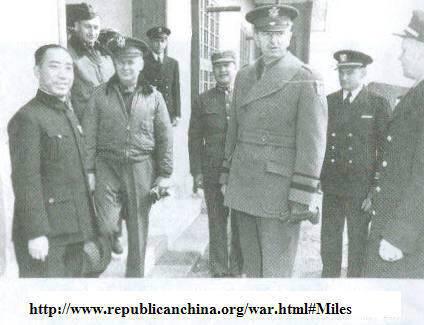 The Chinese success in decoding the general code book of the Japanese foreign ministry in the early years of the war impressed the British and the Americans to the extent that both the British and Americans sought cooperation with China in establishing the special operations.
With the British kicked out due to their sabotage against the ROC and collusion with the communists, the American Navy, which was less infiltrated by the CPUSA than the American army, established the SACO project with China.
Though, in the later years, the O.S.S., which was hijacked by the Soviet agents, began to take over the American navy's role in the SACO.
Both Chennault's 14th Flight Group intelligence operations and Miles' navy intelligence operations were hijacked by the Soviet-agents-controlled O.S.S
The Chinese success in decoding the general code book of the Japanese foreign ministry in the early years of the war impressed the British and the Americans to the extent that both the British and Americans sought cooperation with China in establishing the special operations.
With the British kicked out due to their sabotage against the ROC and collusion with the communists, the American Navy, which was less infiltrated by the CPUSA than the American army, established the SACO project with China.
Though, in the later years, the O.S.S., which was hijacked by the Soviet agents, began to take over the American navy's role in the SACO.
Both Chennault's 14th Flight Group intelligence operations and Miles' navy intelligence operations were hijacked by the Soviet-agents-controlled O.S.S
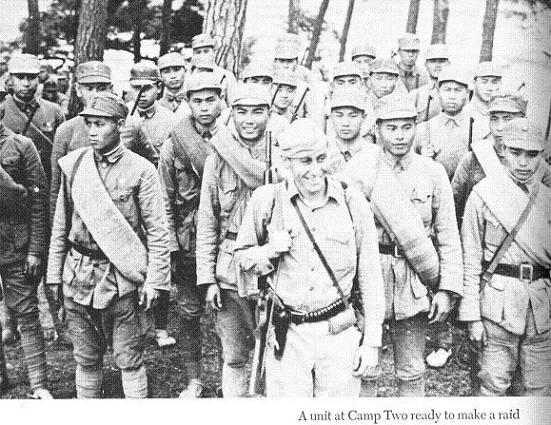
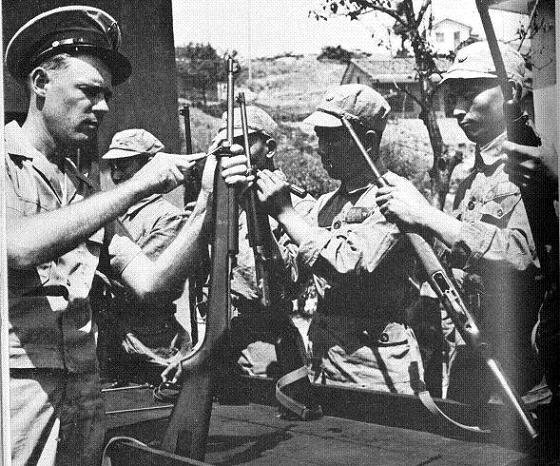
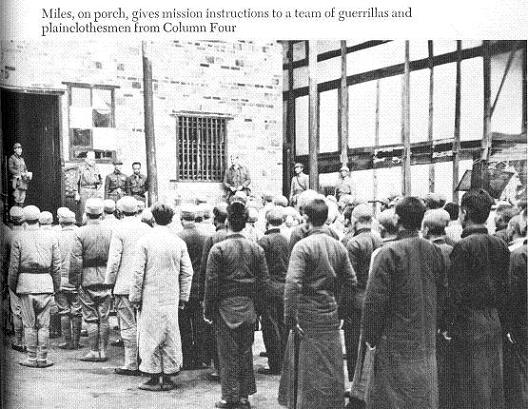
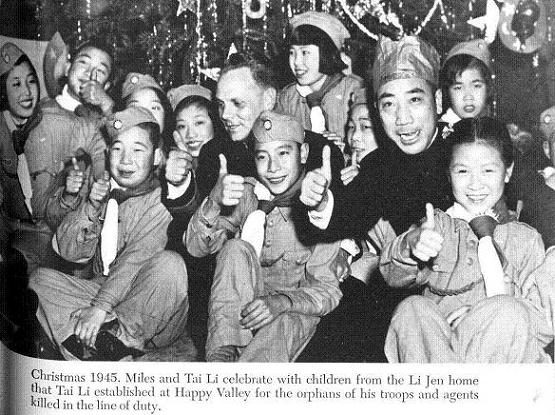
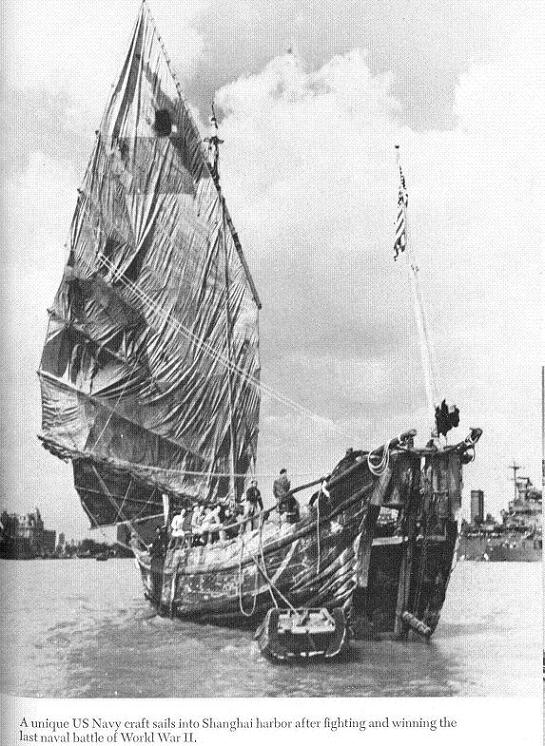
The Third Changsha Battle
Wu Xiangxiang pointed out that British newspaper "The Thames" and "Daily Post" praised the "Third Changsha Battle" as the only victory of the Allies after the eruption of the Pacific War. Prior to the Pacific War, Japan planned to launch a wholesale war against China for sake of releasing troops for Southeast Asia. Chiang Kai-shek, after the war declaration, ordered a guerrilla and siege attack at the Japanese positions across China. To lend relief to the British in HK, Chiang Kai-shek ordered that the 4th Military District attack the Japanese in the Canton area where the Japanese 38th Shidan of the 23rd army was invading HK. In southwestern China, Chiang Kai-shek dispatched the 5th, 6th and 66th corps for entry into Burma.
The 5th Corps, with China's only mechanized 200th Division included, was the strike force that took out the Japanese Ryodan of the 5th Shidan at the Battle of Kunlun'guan in late 1939.
Anami Korechika of the Japanese 11th Army, with a Ryodan relief from northern China and a flight regiment, mounted an attack at Changsha. On December 13th, 1941, Korechika ordered that the Japanese 2nd, 6th & 40th Shidans be ready for action while the 34th Shidan and the 14th detached Ryodan acted as the auxiliary force along the Nan-Xun (Nanchang-Jiujiang) Railway. On December 16th, the Japanese concentrated in southern Yueyang city area. On the 19th, the Japanese blasted the Nationalist Government positions in Yaolin & Xitang. On the 20th, the Japanese 6th Shidan moved through Yaolin and Xitang to arrive at the bank of Xinqianghe River for the river crossing.
 Beginning from December 15th, Xue Yue [Hsueh Yue], i.e., commander of the 9th Military District, had detected the Japanese movement and coolie allotment. Xue Yue concentrated his army for fighting the Japanese between the Liuyang-he River and Laodao-he River area while making preparation for defense against the Japanese along the Nan-Xun Railway in the south. Xue Yue planned to induce the Japanese towards the outskirts of the Changsha city, fight for three days along the 100-kilometer line, to the south of the river banks of Ping-jiang, Liuyang-he and Laodao-he, and then counter-attack the Japanese from west to east. Beginning from December 15th, Xue Yue [Hsueh Yue], i.e., commander of the 9th Military District, had detected the Japanese movement and coolie allotment. Xue Yue concentrated his army for fighting the Japanese between the Liuyang-he River and Laodao-he River area while making preparation for defense against the Japanese along the Nan-Xun Railway in the south. Xue Yue planned to induce the Japanese towards the outskirts of the Changsha city, fight for three days along the 100-kilometer line, to the south of the river banks of Ping-jiang, Liuyang-he and Laodao-he, and then counter-attack the Japanese from west to east.
On December 21st, 1941, Li Yutang's 10th Corps was put in charge of the Changsha city. On the 24th, the Japanese crossed the Xinqianghe River to the south and pushed forward with three columns. On the 25th, Wang Chaoying, a battalion chief under the 21st Corps, died with his soldiers at the first defense line in Fujiaqiao. On the 26th, the Japanese pushed against Guanwangqiao. On the 27th & 28th, the Japanese crossed the Miluo-jiang River. The Chinese troops then retreated to southeast and attacked the Japanese to the northwest. On the 29th, the Nationalist Government 73rd, 74th & 4th corps relocated to Hunan Province from Hubei, Guangdong and Hubei provinces. The Nationalist Government 1st cannon brigade came over to Mt Yuelushan [to the west of Changsha] with howitzer. On the 31st, the Japanese, on the south bank of the Miluojiang River, pushed further to Mt Chunhuashan, and a portion of the Japanese crossed the Liuyanghe River.
Xue Yue issued an order to launch the counter-attack at the Japanese beginning from Jan 1st, 1942. On the 1st, the Japanese attacked the city from southeast as Xue Yue had expected on basis of past two Changsha battles. The Nationalist Government 10th Corps defended the city with the assistance of howitzer cannons from the west of the city. On the 2nd, at noon, the Japanese moved northward to occupy high buildings in the northern Changsha city where one division of the Nationalist Government 73rd Corps was fetched over for defense already. Howitzer cannons blasted the high buildings to prevent the Japanese from hiding. The Chinese infantry attacked the Japanese who deployed poisonous gas against the Chinese. The Japanese mounted major attacks at the city from three directions of south, east and north. In the east, the Chinese fought against the Japanese, building by building and room by room, along the Xinjun-lu Road. By Jan 3rd, the Japanese planes dropped supplies to reinforce their armies. The Chinese forces already retrieved Japanese documents from dead bodies as to the quota of ammunition and grain that the Japanese soldiers carried with them.
At dawn, on Jan 4th, Xue Yue ordered that red light signal shots be fired into the skies for an offensive against the Japanese. The Japanese began to retreat on the 4th. The Japanese 3rd Shidan had to reroute to a different river crossing for crossing the Liuyang-he River on the night of the 5th. The Japanese 6th Shidan did not slip away till the Japanese 3rd Shidan came to their relief. On the 7th, the Japanese 40th Shidan began to retreat, and all through to the 15th, encountered attacks from the Chinese army. On Jan 8th, Chinese bombers engaged Japanese fighter planes in the air. Hundreds of thousands of Chinese civilians and soldiers paraded in Changsha for celebrating the victory.
Li Zongren memoirs stated that Xue Yue later disobeyed order in rerouting to Jiangxi Province because he was resentful of Chiang Kai-shek's making direct phonecall to his command center during the Battle of Changsha. Xue Yue claimed that he went to Jiangxi, not western Hunan Province, for avoiding Chiang Kai-shek's direct phonecall. (Li Zongren memoirs stated that he, for his seniority, never had to take phonecall instructions from Chiang Kai-shek throughout the resistance war.
Xue Yue's moving to Jiangxi happened to have thwarted Wang Zhen's communist long march to southern China for connecting with the Dong-jiang Guerrilla Army during the 1944 Japanese Ichigo Campaign.)
The Burma Expedition
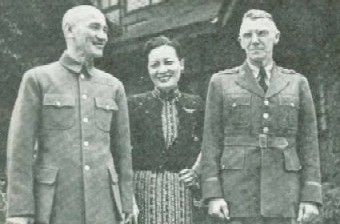 Along the Burmese eastern frontier of 2000 kilometers, thinly deployed was the British army including the 1st Burma Division commanded by Major General James Bruce Scott, which consisted of an Indian Mountain Regiment, the 13th Indian Infantry Brigade, the 1st Burma Brigade and the 1st and 5th Burma Rifles' battalions.
On December 23rd, 1941, the Japanese began to bomb Rangoon after taking over the southernmost Burmese airport of Victoria Point.
On Jan 4th, 1942, Aung Shan's Burmese Independence Army began to harass the Thai-Burmese border under the Japanese auspice. Aung Shan, like Nehru and Gandhi of India, deeply resenting the British historical conquests of Burma in 1824, 1852 and 1885, had sought for the Japanese assistance in going to the Hainan Island of China earlier.
Along the Burmese eastern frontier of 2000 kilometers, thinly deployed was the British army including the 1st Burma Division commanded by Major General James Bruce Scott, which consisted of an Indian Mountain Regiment, the 13th Indian Infantry Brigade, the 1st Burma Brigade and the 1st and 5th Burma Rifles' battalions.
On December 23rd, 1941, the Japanese began to bomb Rangoon after taking over the southernmost Burmese airport of Victoria Point.
On Jan 4th, 1942, Aung Shan's Burmese Independence Army began to harass the Thai-Burmese border under the Japanese auspice. Aung Shan, like Nehru and Gandhi of India, deeply resenting the British historical conquests of Burma in 1824, 1852 and 1885, had sought for the Japanese assistance in going to the Hainan Island of China earlier.
On February 5th, 1942, Chiang Kai-shek visited Calcutta, India, and antagonized Britain over British colonialism and Indian Independence by advocating for autonomy during a talk with the British governor in New Delhi on February 10th. After receiving a letter from Mahatma Gandhi, Chiang Kai-shek was moved to tears and demanded a personal meeting with Mahatma Gandhi. At the insistence of Chiang Kai-shek, British arranged for a meeting between him and Mahatma Gandhi on the 18th. Chiang Kai-shek commented upon British colonialism as the fundamental reason that the Burmese collaborated with the Japanese and that the Indians showed passivity in the war against Japan.
In late March 1942, the British government sent Stafford Cripps of the Labour Party to India to negotiate an agreement with the nationalist Congress Party and the Muslim League leaders for securing the Indian support during the war in exchange for a promise of elections and full self-government (Dominion status) after the war, similar to what the British politicians promised to China to return Hongkong after the war to avoid damage to the British war time morale.
The Cripps Mission failed as the Indians perceived that the British were unable to defend India against the Japanese and
the puppet Indian National Army, headed by Subhas Chandra Bose,
appealed to the Indians to end the British control of India.
Gandhi and the Indian Congress Party later in August 1942 resorted to civil disobedience, over which the leaders were put under arrest.
Muhammad Ali Jinnah and the Muslim League supported the war effort due to Cripps' offer of the right to opt out of a future union with India
From Thailand, the Japanese on January 15th took over the Burmese port of Moulmein on January 31st, and threatened Rangoon.
On February 8th, the 33rd Shidan of the Japanese 15th Army joined the 55th Army in crossing the Salween River.
On February 20th, the Japanese army under 15th Group Army commander Shofiro Iida, began the main Burma campaign against the Sittang River. The 18th and 56th Shidans, plus remainder of the 33rd Shidan, came into Burma after taking control of Rangoon on March 8th.
In early 1942, China formed a military alliance with Britain. Chiang Kai-shek dispatched "Shang Zhen military inspection delegation" to Rangoon for talks with British commander. Sheng Zhen visited Mao-tan-miao, Mandalay, Myitkyina & Lashio for two months.
On February 7th, Churchill messaged to Roosevelt in regards to having Wavell take in the Chinese troops for defending Burma
While Wavell doubted the chances of defending Java, which might imperil the defense of Burma or Australia.
In late February, Churchill sent Harold Alexander to substituting Deputy General Thomas J. Hutton for directing the Rangoon defense.
The 33rd Shidan of the Japanese 15th Army penetrated the jungles for Sittang while the retreating British-Indian armies were still congested at the Sittang River bridge on the 22nd.
The bridge destruction the next monring stranded the 16th and 46th Brigades of the 17th Indian Division on the east bank of the Sittang River, which led to surrender to the Japanese of the bulk of the more than 10,000 soldiers other than few thousands who did not get drowned in swimming across the river or slipped north to safety through the jungles.
The Japanese 15th Army mopped up the British-Indian troops on the east bank of the Sitang River and ferried across the river to take control of the railway and highway lines to the north of Rangoon.
Alexander made a decision to abandon Rangoon since the Japanese army were encircling the city and already blocked the railway to Prome.
Rangoon was lost on March 6-7th, or the 8th depending on who wrote the history. What happened was that after the herald troops had a skirmish with the Japanese blockade force at Taukkyan, the British found out the next morning that the Japanese had abandoned the roadblocks for joining the main force of the 33rd Shidan to the west of Rangoon for a purported siege battle. Luckily, the British army passed through Taukkyan for the north without a fight. The Japanese herald troops entered Rangoon at midday on the 8th.
The British retreated to Prome. Prior to the loss of Rangoon, China purportedly sold to Britain 70000 tons of merchandise in the Rangoon warehouses after successfully shipping out 44000 tons. The Americans hastily assembled 820 Ford trucks and 95 armored vehicles for the Chinese.
(What actually happened was that the Americans did not sell to Britain the goodies but counted the goodies transferred to the British as under the allocated lend-lease amount for the Chinese. Magruder purportedly ordered to destroy more than 900 trucks in various stages of assembly, 5,000 tires, 1,000 blankets and sheets, and more than a ton of miscellaneous items, in addition to transferring as much materiel to the British forces as they could take, including 300 British-made Bren guns with 3 million rounds of ammunition, 1,000 machine guns with 180,000 rounds of ammunition, 260 jeeps, 683 trucks, and 100 field telephones. Over 19,000 tons of lend-lease materiel in Rangoon still fell into the Japanese hands when the city fell on 8 March. Further, the British, who cunningly called in the Chinese army to fight the Japanese, fled in chaos, leaving behind the goodies to the Japanese, not to mention the British attempt at confiscating the lend-lease materials that were destined for China months earlier.)
The Japanese attack plan was to have the 33rd Shidan move along the Irrawaddy River against the Yenangyaung oilfields, the 55th Shidan move along the Rangoon-Mandalay road in the Sittang valley against Meiktila to the north of Pyinmana, and the 56th Shidan move northweastward along the mountain road against Taunggyi and Lashio, while retaining the 18th Shidan acting as backup.
Stilwell, who was granted the omnipotent power over directing the Burma Campaign, designed a strategy to concentrate the three Chinese army corps onto southern Burma to destroy the Japanese 55th Shidan in cooperation with the British. The British, however, procrastinated in assisting the Chinese army in the transportation of troops, while secretly making way for massive withdrawal from Burma in accordance with a clandestine decision made by Churchill and Archibald Wavell (American-British-Dutch-Australian Command) to defend India instead.
Not buying Stilwell's viewpoint, Wavell reported to Churchill on March 19th that he doubted ever holding Upper Burma for long, as well as doubted the Chinese army's competing with Japanese jungle tactics 'any more successfully' than the British did. The British secretly diverted to Ceylon the "ground and air detachments that had been assigned for Burma" and ordered that the troops still within India be kept there per Feis.
When Dai Ailan's 200th Division arrived in Toungoo, he found himself fighting the Japanese alone while the British did not even render assistance with the basic assistance as to the barracks and supplies.
On the 21st, the Japanese 55th Shidan attacked Toungoo from the Pegu direction.
The Japanese army, after the withdrawal of the British, attacked towards the center to encircle the 200th Division.
Shofiro Iida sent the newly-arrived 56th Shidan to Toungoo on March 28, increasing the Japanese military strength by four to five times against the Chinese 200th Division.
East of Toungoo, the 200th Division fought against the Japanese armored cars, plane bombing, artillery, and incendiary poisonous gas attacks.
After the Japanese from the west sent over a massive army to encircling the 200th Division,
Dai Anlan on March 28th requested with Corps Commander Du Yuming for authorization to withdraw from Toungoo, saying that for two days the troops had not eaten food.
On the 29th, Dai Anlan broke out of the Japanese encirclement for the north after battling for 12 days.
On the 29th, Dai Anlan broke out of the Japanese encirclement for the north after battling for 12 days. The British records stated that the 200th Division, after incurring half casualties and abandoning heavy equipment, broke out of Toungoo in the early hours of March 30th.
Stilwell, per Feis, realized in late March that that it would not
be possible for the British and Chinese to hold the existing line but still advocated for continuous fight, namely, to proactively engage with the Japanese from Toungoo to Mandalay, which yielded the Mandalay Campaign blueprint, for which Stilwell got the Generalissimo to authorize him to use still another division to reach three in all
On April 7th, Stilwell wrote in his duary about his meeting with Alexander and Chiang Kai-shek that it was agreed that that the Chinese forces would stand where they were and fight. A counterattack plan was devised. By April 8th, the British, Burmese and Indian army units set up positions along the Minhla, Magwe and Taungdwingyi line, to the northwest of Pyinmana. However, before Stilwell could start the counterattack plan, the Japanese were on the tails of the British again, with Stilwell called to Alexander's command on the 15th to know that the British had only "disaster and gloom" left.
On April 1st, the British abandoned Prome for Yenangyaung, and Dai Anlan's 200th Division pulled back to Pyinmana. On April 7th, the Japanese 55th Shidan attacked the Chinese 22nd Division south of Pyinmana.
On April 18th, the Chinese 22nd Division, having incurred heavy casualties, pulled out of Pyinmana and was relieved by the Chinese 96th Division. The Japanese 55th Shidan entered Pyinmana on the 19th, with the 18th Shidan taking over the battles northward. The Pyinmana Battle delayed Alexander's order to send one Chinese division to Taungdwingyi.
Around March 18th, the 213th Rentai of the Japanese 33rd Shidan skipped Taungdwingyi for Yenangyaung to the northwest for sake of reinforcing the 214th Rentai (which took over a river crossing north of Yenangyaung but came under attack by the Chinese 38th Division) and the 215th Rentai (which encirlced James Bruce Scott's Burma 1st Division south of Yenangyaung).
At about the time the Japanese attacked Pyinmana till it was lost on April 19th, the Japanese started the enveloping move to cut the Chinese army's retreat path to the Sino-Burmese border, with the Japanese 56th Shidan attacking northeastward against Taunggyi in the Shan mountains. The 56th Shidan, starting on April 1st, pushed the Chinese 55th Division towards Taunggyi, and by the 16th, defeated the 55th Division. After the loss of Pyinmana, the Chinese army was ordered to retreat north to Meiktila. En route, Dai Anlan was ordered on April 21st by Stilwell to go through the mountains to the east to recover Taunggyi and relieve the 6th Army, which delayed the 200th Division's retreat and led to the 200th Division's precarious situation of being left behind the enemy line. Taunggyi was recovered on the 24th after a battle of three days.
On April 28th, Alexander and Stilwell made a decision to abandon the defense of Burma. Alexander ordered Slim to retreat into India via the Chindwin River. Purportedly the British helped to cover the retreat of the 5th Army by having the 7th British Armored Brigade and the 17th Indian Division defend Meiktila, a city to the south of Mandalay, for a few days till the 27th before joining Slim's army in retreating northwestward.
The Japanese 18th Shidan entered Mandalay on April 1st. Slim, unable to beat back the Japanese at Monywa, on May 2nd took the reteating army on a cross-country trip to the upper Chindwin River crossing at Kalewa. The British on the 8th destroyed all heavy equipment and crossed the river on six river steamers.
Stilwell, abandoning the Chinese armies, travelled with the British for India, en route, wrote about the causes of defeat, put blames on everybody else other than him -- for which Chennault "thought he should have taken these matters into account before he pulled the Chinese armies into the campaign" per Feis, and emerged in New Delhi three weeks later with a claim "go back and retake it (i.e., Burma)."
Stilwell thought the Burma war "was the only chance to keep China as an active participant in the war ... Japan had been compelled to use in Burma forces which otherwise might have been sent toward India, Australia, or elsewhere ...This was the best way in which China could at the time contribute what it had — men — to the Allied cause." What Stilwell unnecessarily sacrificed in Burma were not just men, but China's elite army responsible for defeating the Japanese 5th Shidan at the Kunlun'guan Pass at the turn of 1939 to 1940, the so-called Japanese iron army from the Russo-Japanese War.
In the aftermath of the Burma debacles, there was pessimism everywhere, except for Churchill who was delighted at Alexander’s success in bringing the remnants of his forces to Imphal with a claim that “The road to India was barred .”
Sun Liren's 38th Division, after walking along the Chindwin River for some time, decided to turn west to enter India in lieu of going into the northern Burmese mountains. On May 12th, the monsoon hit Upper Burma. Du Yuming's main 5th Corps' troops, walking into the mountains, lost their way, and after months' hardship and death in the primitive forests, were rescued by the search parties.
With the northeastern retreat path cut off by the Japanese at La-xu (Lasio) as a result of Stilwell's idiotic Mandalay Duel strategy, Dai Anlan took over 6000 remnant troops for breaking out of the lines of the Japanese troops, two rivers and three highways.
On May 18, along the Xibao-Mogu Highway, Dai's army was ambushed by the Japanese. In the battle, Dai Anlan was wounded in the chest and stomach. Lacking medicine, Dai on May 26th died of wounds at Maobang-cun Village along the Ruili-jiang River. The troops first used the shoulder-pole to transport Dai's body back to China, and en route, had to cremate the body. After crossing the Gaoligong (Kachin) Mountain, the troops brought Dai's remains back to Tengchong, China.
General Sun Liren (Sun Li-Jen), for his audacity in rescuing 7000 British cowards from the Japanese encirclement at Yenangyaung, received King George's medal "Order of the British Empire."
The Japanese began to attack towards Yenangyaung on April 10th, with a small contingent from the 214th Rentai going to the north of Yenangyaung to have the British hind cut off.
Slim ordered the destruction of oil fields and burning of oil on April 15th. With the Japanese cutting off the hind, the British were too frightened to dare to launch a battle to retake the river crossing north of Yenangyaung. The British records claimed that the Japanese overran the Yenangyaung garrion and took the British there as captives. Alexander requested help with Stilwell who in turn sent Sun Liren's 38th Division, that was previously marked for Stilwell's Mandalay campaign.
The British, who sent a small force to guarding a river crossing north of Yenangyaung, were caught off guards, and unable to detect the Japanese army's strength, dared not counterattack the Japanese for wrestling back the river crossing.
Sun Liren sent Liu Fangwu's regiment to Yenangyaung without the approval from the superior, then went to see Luo Zhuoying for approval, and still failed to receive the approval.
After making a swear to take the full responsibility, Sun Liren rode on a jeep to chase the regiment of troops. Knowing that one regiment was not enough, Sun Liren adopted the strategy of launching a multi-prong attack to cause confusion onto the Japanese and defeated the Japanese in an audacious attack.
South of Yenangyaung, the 1st Burma Division was encircled by the Japanese 33rd Shidan from south and north. On the 18th, Scott's 1st Burma Division attacked the Japanese roadblocks while the Chinese 38th Division attacked south to lend support. Major General James Bruce Scott's request to abandon equipment and wounded for a breakout was rejected by Slim. On the 19th, taking a narrow road and abandoning the vehicles and equipment and bypassing the roadblock, Scott broke out of the encirclement for retreating northeastward to arrive at the hind of the 38th Division. North of Yenangyaung, at 7 a.m. on April 19 the 13th Indian Infantry Brigade attacked the Japanese roadblock but failed. Under the cover of Slim's leftover British tanks and artilleries, at 3 p.m. on April 19th, Sun Liren's troops resumed attack, charged across the river against the roadblock and defeated the Japanese in an audacious attack. The allied troops exited Yenangyaung on April 20th.
Later, when Sun Li-jen told British General that the Japanese who were defeated by the Chinese regiment of 800 at a self casualty of half numbered no more than 2000 to 3000 men, that belonged to the herald column and the oil field sabotage team of the Japanese rentai, British General, in shame, requested that the Chinese side keep a secret about the true Japanese troops strength for saving the face of the British army.
(Regimental commander Liu Fangwu, who later retired in the U.S., received a special visit from British prime minister Thatcher in acknowledgement of the Chinese army's audacity at Yenangyaung.)
More available at BurmaExpedition-v0.pdf (Check RepublicanChina-pdf.htm page for up-to-date updates.)
* In Commemoration of China's Fall under the Alien Conquests in A.D. 1279,
A.D. 1644 & A.D. 1949 *
U.S.S.R./Comintern Alliance with the KMT & CCP (1923-1927)
Korean/Chinese Communists & the 1931 Japanese Invasion of Manchuria
American Involvement in China: Soviet Operation Snow, IPR Conspiracy, Dixie Mission, Stilwell
Incident, O.S.S. Scheme, Coalition Government Crap, Amerasia Case & The China White Paper
* Stay tuned for "Republican China 1911-1955: A Complete Untold History" *
|
|
Zou Rong's Revolutionary Army;
Shin Kyu Sik's
Shrine (Spirit, Kunitama) of Korea
|
This snippet is for sons and daughters of China:
Heed the sons & ministers' agony and sorrow of our ancestors who died or lived through the Mongol, Manchu and Soviet-Chicom conquest
and
the Yongjia, Jingkang and Jiashen cataclysms !
Jeanne d'Arc of China:
Teenager girl Xun Guan breaking out of the Wancheng city to borrow the relief troops in the late Western Jinn dynasty;
Liu-Shao-shi riding into the barbarian army to rescue her husband in the late Western Jinn dynasty;
teenager girl Shen Yunying breaking into Zhang Xianzhong's rebels on the horseback to avenge on father's death in the late Ming dynasty.
China's Solitary and Lone Heroes:
Nan Jiyun breaking out of the Suiyang siege and charging back into the city in the Tang dynasty;
Zhang Gui & Zhang Shun Brothers breaking through the Mongol siege of Xiangyang in the Southern Soong dynasty;
Liu Tiejun breaking through three communist field armies' siege of Kaifeng in the Republican China time period;
Zhang Jian's lone confrontation against the communist army during the June 3rd & 4th Massacre of 1989.
|
|
|
The Japanese Campaign Against Zhejiang & Fujian Provinces
On March 9th, 1942, Hirohito was commented to have shown extreme pleasure at the war progress at the imperial meeting.
In April 1942, Colonel Doolittle [Du-li-de], who had spent some time in Chungking earlier, led a surprise bombing of Tokyo of Japan, an operation that the U.S. had deliberately blindfolded China.
Chiang Kai-shek, who was worried about the possible Japanese retaliation against the airports in the Free China territories of Zhejiang, objected to the U.S. plan, while the U.S. tried to hoodwink the Chinese side with a promise to transfer the bombers to China after the completion of mission. The U.S. did not tell China of the exact date and time. Hence when the raid started, the Chinese government did not have advance time to notify the air defense at the Quzhou Airfield, leading to the crash of all bombers except for two that landed in the Soviet Far East.
One bomber crashed inside of the Yellow River flood zone, with the crew discovered by John Birch during the 1944 Japanese Ichigo Campaign.
Over one dozen U.S. bombers crashed inside of China as a result of the U.S. blindfolding China, while Chiang Kai-shek was angry with the consequence of the U.S. bombing, i.e., Japan's launching the sweep campaign against the Chinese holdouts and bases in Zhejiang Province for sake of rooting out the airfields that might be used by the American pilots and airplanes.
What was being planned by the Japanese High Command at this stage was a massive one-month campaign along the Zhe-Gan (Zhejiang-Jiangxi) Railway, with
40 infantry Dadai (reinforced battalions) and 16 artillery Dadai from the 13th Army stationed in Shanghai and the 11th Army stationed in Hankou
and
augmented by the biological pathogens, in retaliation for Jimmy Doolittle's Tokyo bombing on April 18th.
The Doolittle Tokyo Raid led to Japanese showering Zhejiang Province with biological pathogens per http://www.skycitygallery.com/japan/japan.html#unit731.
The Chinese railway workers destroyed 400 kilometer long segment of the Zhe-Gan Railway, from Jinhua to Dengjiabu.
In Zhejiang Province, the Japanese took over Jinhua, Quxian, Linchuan & Nancheng.
However, the Japanese could not hold on to the railway line, and returned to the two ends of the railway after a short term occupation.
The Chinese Communists' N4A, which suffered a debacle in early 1941, did not have the luck to wait for the arrival of the Japanese sweep campaign along the Zhejiang-Jiangxi Railway; however, the communist guerrillas racked up actions in the aftermath of the Japanese campaign, conducting insurgency and trickery against the government troops and regimes in the area of no-rule-by-either-of-the-three-sides. Communist guerrillas, numbering by hundreds and more organized in Fujian Province than in Zhejiang Province, continued their insurgency till after the Japanese surrender.
Communists in Jiangxi Province suffered a setback after the government agents broke the communist provincial commissariat cells accidentally, and arrested communist Southern China bureau leader Guo Qian whose surrender to the government led to busting of the communist underground organizations in Guangdong Province and arrest of veteran communist leader Liao CHengzhi, i.e., son of Liang Zhongkai and Heh Xiangning.
By May of 1942, the Japanese military reached its peak in Southeast Asia and the Pacific Islands. Two months later, the Japanese navy suffered its first setback in the war at the Midway Island. The Battle of Midway was fought on June 3–6, 1942.
Yamamoto, to eliminate the American carrier threat, decided to invade and occupy Midway Island, codenamed the Midway invasion Operation MI.
On 25 May 1942, the First and Second Japanese Carrier Groups,
with inclusion of carriers
Kaga, Soryu, Hiryu, and Akagi,
sailed for the attack on the Midway Island, not knowing that the Japanese navy code Kaigun JN-25 had been deciphered by the U.S.
After fighting the Americans in vain for half a year around the Solomon Islands, the Japanese navy began to retreat.
From May 9th to 11th, 1943, 3000 Japanese soldiers massacred 32000 Chinese at Changjiao of Hunan Province, including some soldiers from the 73rd Corps.
In northern China, 30000 Japanese launched a sweep campaign against the communist-controlled Eight Route Army at Mt Taihangshan in May 1942. Coming from the railways of Ping-Han, Zheng-Tai & Tong-Pu, the Japanese pressed against Matian of southeastern Shanxi Province. Zuo Quan, i.e., deputy tactician-in-general for the 8th Route Army and a graduate of the Whampoa Academy 1st Session, sacrificed his life.
From Zuo Quan's death-wish letter, Zuo Quan's death was treated as a suicide for his fate of waiting to be purged by the communists as a Trotskyite.
On June 5th, the British ambassador made a speech to the British citizens in praise of the brave and persevering Chungking citizens who had withstood the Japanese "fatigue [saturation] bombing" for years.
Stilwell's Plan of Re-taking Burma, Mme Chiang Kai-shek's Futile Lobby in the U.S., the U.S. War Assistance & China's Resistance War
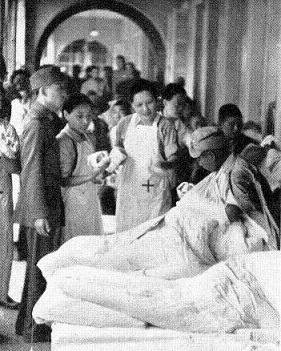 On July 21st, 1942, President Franklin Roosevelt's emissary, Launchlin Currie, arrived in Chungking a second time, for 14 rounds of talks within 17 days in regards to Chiang Kai-shek's policy towards the communists and WWII. In this month of Aug, the U.S. officially acknowledged the volunteer "flying tiger" flight group as the U.S. Airforce 10th Group. On Aug 3rd, at the Huangshan Mansion, Chiang Kai-shek rebutted Currie's viewpoint that the Americans thought that it would be a good idea to have Manchuria act as a buffer between Japan and the U.S.S.R. per Zhang Ling'ao, claiming that he Chiang Kai-shek had declined the Japanese ceasefire requests simply because he could not agree to treating Manchuria as a territory under the joint administration by Japan and China. On July 21st, 1942, President Franklin Roosevelt's emissary, Launchlin Currie, arrived in Chungking a second time, for 14 rounds of talks within 17 days in regards to Chiang Kai-shek's policy towards the communists and WWII. In this month of Aug, the U.S. officially acknowledged the volunteer "flying tiger" flight group as the U.S. Airforce 10th Group. On Aug 3rd, at the Huangshan Mansion, Chiang Kai-shek rebutted Currie's viewpoint that the Americans thought that it would be a good idea to have Manchuria act as a buffer between Japan and the U.S.S.R. per Zhang Ling'ao, claiming that he Chiang Kai-shek had declined the Japanese ceasefire requests simply because he could not agree to treating Manchuria as a territory under the joint administration by Japan and China.
In Aug 1942, the Chinese expedition forces in Ramgarh [Lan-mu-jia] of India, i.e., Sun Liren (Sun Li-Jen)'s New 38th Division & Liao Yaoxiang's New 22nd Division, were re-organized into the New 1st Corps to be under Zheng Dongguo's command. Sun Liren's New 38th Division, back in May 1942, resisted the British demand for disarmament and won the British respect for its bravery of rescuing the 7000-8000 British cowards in Yenangyaung of Burma.
Stilwell, after the debacle in Burma, proposed to have a joint British-Chinese campaign to retake Burma, and after finding out that both the British and American higher command lacked interest, shifted the focus to training of the Chinese army in Ramgarh and allocation of troops to India for a Burma operation.
Per Herbert Feis, Chiang Kai-shek, in an August 1st letter presented to Stilwell from Shang Zhen (Shang Chen), countered the U.S. War Department with demand of dispatch of one American combat division, increase of American combat air force and air transport service, and parallel British attack of the Andaman Islands and Bay of Bengal operations to echo the land war from India and China.
Stilwell got his wish from Chiang Kai-shek on September 21st. But on the 27th, Stilwell received the watered-down reply from the War Department, which was 265 combat planes, 100 transports, up to 5000 tons of supplies, but no U.S. ground troops.
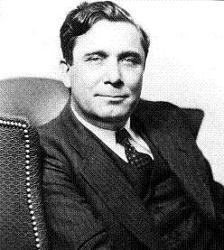 In early October of 1942, Wendell Willkie arrived in Chungking from Urumqi to receive a warm welcome arranged by Chiang Kai-shek's regime, and praised Mme Chiang Kai-shek as a good friendship ambassador for making a trip to the U.S. Lu Keng mentioned that Willkie had brought his book "One World" to China. As reporter for the Voice of China, Lu Keng made a live broadcast of the reception. Two reporters, Gardner Mike Cowles and Joseph Barnes, wrote about their captivation with Mme Chiang Kai-shek, and in 1985 book "Mike Looks Back", Mike Cowles disclosed Wendell Willkie's sudden disappearance with Mme Chiang Kai-shek during a banquet by asking him act as a distraction. Mike Cowles stated that Chiang Kai-shek was furious over the disappearance of the two. When Willkie slipped back, Mike Cowles called Willkie a fool [bastard?] and reminded him of his own wife and family back in the U.S. The next morning, Wendell Willkie asked Mike Cowles to go to the top floor of the Chungking Women and Children Hospital for dissuading Mme Chiang Kai-shek from a trip to the U.S. together with the team on October 8th. Mike Cowles suffered a long finger scratch in the hand of furious Mme Chiang Kai-shek. Chiang Kai-shek was later observed by the U.S. consulate officials to have strong abhorrence against Willkie by ordering that windows be opened up to let go the "foul smell of a fox" right after Willkie left his office. --Prof Yang Kuisong had checked the itineraries of the American entourage as well as the records concerning the Chiang Kai-shek couple, and concluded that Mike Cowles made up the episode.
(Jonathon Fenby's "Chiang Kai Shek", published in 2003, also contained similar writings.) In early October of 1942, Wendell Willkie arrived in Chungking from Urumqi to receive a warm welcome arranged by Chiang Kai-shek's regime, and praised Mme Chiang Kai-shek as a good friendship ambassador for making a trip to the U.S. Lu Keng mentioned that Willkie had brought his book "One World" to China. As reporter for the Voice of China, Lu Keng made a live broadcast of the reception. Two reporters, Gardner Mike Cowles and Joseph Barnes, wrote about their captivation with Mme Chiang Kai-shek, and in 1985 book "Mike Looks Back", Mike Cowles disclosed Wendell Willkie's sudden disappearance with Mme Chiang Kai-shek during a banquet by asking him act as a distraction. Mike Cowles stated that Chiang Kai-shek was furious over the disappearance of the two. When Willkie slipped back, Mike Cowles called Willkie a fool [bastard?] and reminded him of his own wife and family back in the U.S. The next morning, Wendell Willkie asked Mike Cowles to go to the top floor of the Chungking Women and Children Hospital for dissuading Mme Chiang Kai-shek from a trip to the U.S. together with the team on October 8th. Mike Cowles suffered a long finger scratch in the hand of furious Mme Chiang Kai-shek. Chiang Kai-shek was later observed by the U.S. consulate officials to have strong abhorrence against Willkie by ordering that windows be opened up to let go the "foul smell of a fox" right after Willkie left his office. --Prof Yang Kuisong had checked the itineraries of the American entourage as well as the records concerning the Chiang Kai-shek couple, and concluded that Mike Cowles made up the episode.
(Jonathon Fenby's "Chiang Kai Shek", published in 2003, also contained similar writings.)
On October 10th, 1942, the U.S. and Britain declared the revocation of unequal treaties they had imposed on Manchu China. Historians claimed that the U.S. and Britain revoked the privileges they already lost in China as a countering stance against Japan's "signing off" unequal treaties with the Nanking puppet government. (Li Ao, an anti-KMT and pro-CCP stud, made a big deal about the sequence of sign-off by Japan and the U.S., incidentally.)
On November 27th, 1942, Mme Chiang Kai-shek arrived in an U.S. military airport [i.e., the Mitchell Field], and spent two months in New York in the name of sickness. Chen Jieru's son-in-law Lu Jiuzhi cited Chen Jieru's arrival as the cause of the Chungking rumors about disharmony between Chiang Kai-shek and Soong Meiling. (The Chinese populace, no matter in Taiwan or on the Mainland, praised Mme Chiang Kai-shek's speech at the American Congress by claiming that Mme Chiang Kai-shek was invited for a "state visit" in "Feb 1943.")
On October 13th, 1942, Stilwell reported to Chiang Kai-shek the maximum of what the U.S. could do, increasing to 500 planes for the American air force in China, allocation of 100 transport planes to the Hump Route by early 1943, and Lend-Lease help for the Ledo Force (i.e., X-force) and application to the Chinese divisions in China (i.e., the Yoke Force or the Y-force) if brought over the Hump.
Stilwell, flying to Delhi days later, found Wavell reserved and cool to the Ramgarh training.
As pointed out by Feis, Sir John Dill of the British Joint Staff Mission to D.C. and George Marshall also had a discussion of Ramgarh, with claims that the British colonial government of India was not enthusiastic because Chiang Kai-shek was taken to be on the same side as the Indian Congress Party and that they did not want to see a contrast of the Lend-Lease-equipped Chinese army and the Indian forces, etc. Then suddenly the British agreed with the Ramgarh training plan but would only support a limited offensive against Burma with no amphibious attack against Rangoon, something Stilwell attributed to Marshall's exertion of pressure.
Here, the ultimate British design was to delay the war developments in Asia so that China would not emerge victorious to pose danger to the British interests like India and Hongkong.
The Andaman campaign, finalized at Cairo (November 22-26, 1943), was to be scraped by Churchill and Roosevelt one year later and right after the two returned to Cairo from the Tehran Meeting (November 28-December 1, 1943).
When Stilwell informed Chiang of Wavell's change of mind, Chiang agreed to commit twenty divisions for Stilwell's spring offensive on the condition that the British were to take control of the Bay of Bengal. Stilwell got the Chinese Board of Military Operations committed; however, Stilwell's unrealistic plan was soon voided as Marshall only offered some extra engineer equipment.
Stilwell in his diary likened himself and Chiang Kai-shek to be on a raft taht was drfiting away from the rescue ship.
After some haggling, the U.S. Chiefs of Staff and the Munitions Assignment Board expanded its offering of supplies plus a column of 6000 American Army Service troops, with Marshall ready to divert cargo vessels to deliver the materials and personnel under an order stamped by Roosevelt on December 8th, 1942.
On December 17th, Wavell flatly declined Stilwell's spring offensive plan (i.e., Operation Anakim), that had Marshall's backing, and suggested a timeline of a scaled-down offensive before the autumn of 1943.
While Chiang Kai-shek committed twenty divisions, with fifteen attacking Burma from inside of China, Chiang Kai-shek became aware of the situation that the Japanese had fortified the positions at the border, which would make China risk a defeat a second time in Burma.
Meanwhile, Chiang Kai-shek became convinced of Chennault's suggestion to defeat Japan via the air force in lieu of a "strenuous and costly land campaign in Burma."
That is, to drive the Japanese air force to the north of the Yangtze, and then take control of the air superiority to bomb the Japanese sea routes, i.e., ideas in a letter dated 8 October 1942 that Chennault asked Wendell Wilkie to pass on to Roosevelt, with the specifics of 105 fighter planes, 30 medium bombers, and 12 heavy bombers -- the estimate of which was later increased.
Chennault's plan was what ambassador Gauss concurred with back in July, to Stilwell's dismay.
Admiral King was an advocate for the operations in the Bay of Bengal while General Arnold shared Chennault's viewpoint, i.e., bombing Japan as soon as possible.
In December 1942, Roosevelt, Chiang Kai-shek and the British had another round of discussions as to the limited offensive but failed to reach cosensus.
When Chiang Kai-shek replied to Roosevelt on January 8th, 1943, that the Japanese were well fortified in Burma that he could not risk defeat without the amphibious British invasion, Stilwell wrote 'Black Friday' and cursed the British and Chiang Kai-shek as Limeys while blaming Chennault's "blatting" for the abortion of his plan, and claimed that since Chennault "talked so much about what he can do that now they are going to let him do it."
Roosevelt replied to Chiang Kaishek the next day that he would talk with Churchill at Casablanca (January 14-23, 1943) -- which ended up discussing support for Soviet forces and discarding Stilwell's Burma schedule -- and asked to stay the final decision.
At Casablanca, Operation Anakim was tentatively set for November 15th, to be determined by July.
Feis, not knowing the enormous Chinese casualties in the 1944 Tengchong-Songshan-Longling Campaign in Northern Burma - that lasted 127 days, sympathized with Stilwell in that should Stilwell get his way to train the Chinese troops and launch the spring 1943 offensive, including the implementation of the 30-Division Plan (first training and deployment of the first batch of 30 divisions' troops in the spring offensive and using the spring offensive as justification for the American support of training and equipping a second batch of 30 divisions's troops), China could end up in a better post-VJ position.
In a 28 January 1943 memo to Chiang Kai-shek, Stilwell suggested that Chen Cheng (Ch'en Ch'eng) concentrate on training the army; that the two batches of troop training plan be approved and implemented right away; and that absent "a definite plan, there will be difficulty in continuing the present flow of supplies from the United States, let alone increasing it materially;..."
After
Casablanca (January 14-23, 1943), Henry H. Arnold, Brehon B. Somervell, and Sir John Dill were sent to New Delhi for conversing with Wavell, and then continued on to Chungking to meet with Chiang Kai-shek and Chennault.
Chiang Kai-shek demanded that the American air force in China be made independent; that the air lift over the Hump be increased to 10,000 tons per month;
and that the American air force in China should have 500 operative combat aircraft by November when Operation Anakim was supposed to start. Arnold and Dill explained that those wishes could not be fully met.
Chiang on February 7th wrote a letter to Roosevelt, committing the Chinese army for Operation Anakim.
Roosevelt countered Chiang with the opinions of the War Department that air transport and air combat alone could not strike a vital blow to the Japanese and claimed to be sending 10,000 U.S. service troops and 25,000 tons of equipment for the Ledo Road project.
On the side, Roosevelt asked Marshall whether the War Department could have not weighed the damage the increased air effort could inflict onto the Japanese and whether Stilwell was acting unwisely in dealings with Chiang Kai-shek, something Roosevelt clearly hinted at per Feis and something more than was shown in Stilwell's previous coercive messages to Chiang Kai-shek as far as the conditions for China to receive the Lend-Lease aid or to continue to receive such aid.
Marshall, a cunning slimy, put off Roosevelt's query with assurance that he would ask Stilwell to "give all the help he could to Chennault and all practical latitude in operations", but rebutted Chennault's strategy with a claim of tremendous problem to transport enough supplies to allow Chennault to expand operations as well as an exaggeration of risk of losing the air bases (re-worded later as airdromes plus protection for the air freight route and the terminals, i.e., the Hump and departure-arrival points) that the weak Chinese army could not defend against what could be implied to be possible Japanese retaliation against the air bases from where Chennault's planes were to launch the raids.
This theme from Marshall's, which Feis interpreted to be paraphrasing of Stilwell's strategy plus piling of praise onto Stilwell for having survived the Burma campaign [debacle], i.e., a "defensive answer", "holds interest in the light of future events" in the opinion of Feis.
On Jan 11th of 1943, the U.S. and Britain, in new treaties with China, rescinded the privileges such as the extraterritoriality, military garrison, settlements or concessions, and inland navigation, etc.
What Secretary Hull renounced was special extraterritorial in Shanghai, Amoy and the Legation Quarter of Peking.
Furthermore, Hull managed to get the British agree to do the same.
"THE CHINESE EXCLUSION ACT" was revoked by the American Congress.
In year 1943, "CHINESE EXCLUSION ACT" was repealed by the American Congress, with China awarded a yearly immigration quota of 102 persons, ironically.
As cited by Feis, Chiang Kai-shek issued a statement to the Chinese army and people about an "independent China on equal footing with Great Britain and the United States has become a real friend of those two nations", and Chinese newspapers touted the two treaties as the end of one hundred years of humiliation."
Chiang Kai-shek ordered that Chen Baichuan be deprived of his director post at the Central Daily Newspaper for frustrating the Nationalist Government's secret negotiation with Britain on the matter of recovering Kowloon [and Hongkong].
(The actual theme at the time was that Britain sent numerous emissaries to talks with Chiang Kai-shek for sake of deferring the return of HK to China, with even threat of not joining the U.S. in denunciating the unequal treaties.
While Madame Chiang was visiting the U.S., the British repeatedly sent invitation for a visit to Britain. Knowing that the British were hell-bent on keeping Hongkong, Madam Chiang declined the invitation numerous times and decided to visit Canada to send a message to the British.
Using the tricks, the British lobbied Wellington Koo with a promise to return HK to China after the end of the world war, saying that the return of Hongkong during the war would cause damage to the British morale.
Chiang, with an instinct about the British and Soviet imperialists' design, steadfastly resisted the British persuasion.
Wellington Koo, a person more devoted to the diplomatic career than the interests of China, took the British bait and returned to Chungking to lobby on behalf of the British.
However, to keep HK, the British was resolved to prevent the ROC from emerging victorious from the war as a strong and victorious power, and hence colluded with the Soviets in betraying China at Tehran and Yalta.
In the eyes of the Taiwan historians, Chiang Kai-shek paid the dear price for the Manchus who sold out Hongkong in the aftermath of the 1939-1842 Opium War.
The British leased port Weihaiwei (Weiheiwei, Wei-hei-wei) was returned to China in 1930 as a result of the Northern Warlord Government's request with the Washington Conference in 1922.
This was against Churchill's strong opposition to what he called "melt down the moral capital collected by our [British] forefathers.")
On Feb 18th, 1943, Mme Chiang Kai-shek was invited to the American Congress for a speech on China's resistance war against Japan. During the speech, Mme Chiang Kai-shek mentioned the U.S. pilots' bombing of Japan in April 1942 (i.e., a U.S. retaliation attack for the Pearl Harbor) and their rescue by the Chinese. On March 2nd, Mme Chiang Kai-shek, at the accompaniment of Wendel Willkie, spoke to 20,000 audience at the Madison Square Garden. Mary E. Dillon pointed out that Mme Chiang Kai-shek captivated the Americans.
During the madam's visit in the U.S., the Soviet agents, such as Laughlin Currie, et al., were deeply worried about the madam's whirlwind. In order to mitigate the madam's influence over the U.S. congressmen as far as the priority of war in the East versus in Europe was concerned, the Soviet agents repeatedly sent messages to Wellington Koo to ask the madam to cut short the visit and return to China.
Per Feis' citation of Roosevelt and Hopkins, Mme Chiang "stressed the wish for planes and made blunt references to various past unfulfilled promises ... urged that China be included in the talks regarding the settlements after the war." Hopkins' impression was that Mme Chiang was not overimpressed by the promises she received and was "tired and a little dispirited."
Li Ao claimed that Mme Chiang Kai-shek's seven-month visit as well as Chiang Kai-shek's attendance of the Cairo Meeting (November 22-26, 1943) were all results of Wendell Willkie's lobbying.
T.V. Soong Papers showed that it was an arrangement between Soong and the White House direct.
Li Ao also pointed out that Mme Chiang Kai-shek made a gesture of "slicking throat" when President Roosevelt asked her what he should do with the U.S. miner strike led by John Lewis. At a news conference at the White House, when asked "an official visit or just a personal visit", Madame answered that "the visit was for her health" per http://www.suite101.com/article.cfm/us_history_1929_1945/98778. Li Ao blasted Mme Chiang Kai-shek for her extravagant living style during her 7 month stay in the U.S. However, Mme Chiang Kai-shek, who claimed that she was all Western except for an Oriental face, did have exerted extraordinary contributions to China's resistance wars in winning the hearts of ordinary Americans for a concerted fight against Japan. Even Lord Halifax was worried that President Roosevelt could be persuaded into doing something not beneficial to Britain.
Namely,
what Soviet spies like Currie feared as to Mme. Chiang's "Propaganda Furor" attacking the whole strategy of the war which was Germany first and the Far East second.
Mme Chiang Kai-shek, who often took the title of the "nanny" of China's airforce and Taiwan's baseball team, had been responsible for many philanthropic projects such as orphanages and schools for children of the martyrs.
On July 4th, 1943, Mme Chiang Kai-shek returned to China.
During this timeframe, Huang Zhuoqun, i.e., Wu Guozhen's wife, had acted as a kind of hostess in entertaining and receiving the foreign visitors. After staying on three years long on the mayor post for Chungking, Wu Guozhen, dismissed by Chiang Kai-shek back in December 1942 after the Sichuan people raised complaint over the bunker disaster at the National politics participation meeting, would be re-assigned to the Foreign Ministry where he exercised the real power since Soong Ziwen (T.V. Soong), who took over the foreign minister's post from Chiang Kai-shek in March 1943 while still in the U.S., spent most of the time overseas.
(Li Ao's date could be wrong since Zhang Ling'ao, i.e., Chiang Kai-shek's attaché, had described an annual attaché office gathering at the Jialing Hotel that was attended by the Chiang couple about the time of the Japanese surrender.)
Chiang Kai-shek Dealing With the Provincial Armies
In the summer of 1943, Chiang Kai-shek suddenly relocated Sun Lianzhong's 31st Corps to south of the Yangtze to be under the 6th war zone. Sun Lianzhong, commander of the 2nd group army under the 5th war zone, was in charge of the 31st & 68th corps. Li Zongren persuaded Sun Lianzhong into obeying the order by citing the prospect of "going back to the farm fields" after the war was to end soon. (Later, after the Japanese surrendered in Aug 1945, Chiang Kai-shek ordered that Sun Lianzhong be the chair of Hebei Province but prohibited Sun Lianzhong from taking his troops to the north. Sun's 31st Corps was handed over to Hu Zongnan, while Sun Lianzhong brought Gao Shuxun's troops to the north along the Ping-Han Railway. When Gao Shuxun defected to the communists, Sun Lianzhong arrived in Peking to be a "bald commander.")
Li Zongren, later in autumn of 1943, was called away from the 5th war zone by Chiang Kai-shek who offered him a nominal higher post as "director of the Hanzhong Military Headquarters." While on the way to Hanzhong, Li Zongren encountered the local gentry who surrendered tea and incense burners as if they were receiving the imperial commissioners like in ancient imperial times. Successor Liu Zhi, i.e., Chiang Kai-shek crony, was to lose Laohekou as well as Xiangyang & Fancheng to the Japanese within months. Liu Zhi's first act was to move the command center across the Xianghe River to the west, while the Japanese radio ridiculed Liu Zhi as a "ever-defeated general." Li Zongren mentioned that Liu Zhi, like many Chiang cronies, had indulged in pleasure-seeking at the times of war: Liu Zhi, while acting as garrison commander of Chungking, had taken in a concubine, which made his wife complain direct to Mme Chiang Kai-shek.
Per Li Zongren, Chiang Kai-shek, being wary of the intimacy and loyalty of miscellaneous provincial armies to Li Zongren, had concentrated his efforts at weakening his own ranks rather than the Japanese or communists. Chiang's concern, however, had grounds as Li Zongren for a dozen years harbored the communists in his staff. Li's "director of Hanzhong Military Headquarters" was nominally in charge of the 1st & 5th war zones. After Chiang Kai-shek separated the guerrilla fighting of Mt Dabieshan into the 10th war zone, Li Zongren was nominally in charge of 3 zones. However, commanders of the war zones directly reported to the Nationalist Government Central Military Committee, i.e., Chiang Kai-shek.
Knowing Chiang Kai-shek's weakness, the OSS agents later worked with the provincial armies against Chiang Kai-shek, as seen in James Liley's memoirs that the OSS agents were in collaboration with the Southwestern military generals like Long Yun as late as 1946.
Per Feis' citation of Stilwell's 15 March 1943 message to Marshall, that was collected in Sunderland-Romanus manuscripts, Still in the spring of 1943 visited Kunming to explore a way to "train and equip the Yunnan force" so as to "save the situation" as he noted that Chiang Kai-shek's central government could not and would not enforce its orders in Yunnan -- since Long Yun treated Yunnan as an independent kingdom.
After settling down in Hanzhong, Li Zongren went to Chungking for a meeting and rebutted Yang Jieshi's claims that Britain and the U.S., unable to land on the French shore, might have to lend a path from the Soviet Union. While in Chungking, Li Zongren talked twice with British military attaché Sir Adrian Carton de Wiart [i.e., General Wei-a-te, who replaced Grimsdale] and Sir Horace Seymour, the British Ambassador in Chungking, for delaying the launch of the Second Battlefield. Li Zongren, being wary of the Russian ambition for Manchuria, suggested to the two British men that they had better let Germany and Russia exhaust themselves first. The British, however, were worried that Germany might subjugate the U.S.S.R. soon or reach a truce with the U.S.S.R. Later, in May 1944, Chiang Kai-shek, for commencing the graduation ceremony of the 9th Branch of the Nationalist Government 9th Corps Academy, had stopped over in Hanzhong for seeing Li Zongren. Li Zongren gave several pertinent opinions as to dealing with the U.S.S.R. and Chinese communists in the coming post-war era, including the suggestion of dispatching armies to the Japanese-occupied territories via the "hind wave pushing against the front wave." Li claimed that Chiang Kai-shek, for preventing the "miscellaneous provincial armies" from controlling those territories, adopted the approach of relocation of his crony forces from Burma and Southeast China - which was not true other than Chiang's mistake in selecting a non-Manchurian to be in charge of Northeast China. (The selection of a non-Manchurian for Northeast China could be the result of a big conspiracy as Heh Zhuguo, a Northeastern Army cavalry commander, who was empowered with the task to receive Imai Takeo in a last-ditch Japanese peace posture and inform Imai that China would not attack the Japanese should they withdraw from China, was selected as the person to be sent to Manchuria post-WWII, but on the eve of departure for Manchuria, Heh Zhuguo was possibly poisoned and became blind.
The shipping of the Chinese army from Vietnam and Canton to Manchuria was also a better option than walking along the inland routes, where the communists, who colluded with the Japanese to keep the Tientsin-Pukow Railway open throughout the war, did their best to disrupt the transportation to prevent the government troops from going north.
As Hao Bocun, the former ROC defense minister in Taiwan, had said, the territory of Jiangsu Province did not suffer from the wrath of war as a result of the communists' taking control of the area whereas the Hunan province endured four Changsha campaigns plus the Changde, Hengyang and Xuefengshan (Xiang-xi) campaigns throughout the war.)
* In Commemoration of China's Fall under the Alien Conquests in A.D. 1279,
A.D. 1644 & A.D. 1949 *
U.S.S.R./Comintern Alliance with the KMT & CCP (1923-1927)
Korean/Chinese Communists & the 1931 Japanese Invasion of Manchuria
American Involvement in China: Soviet Operation Snow, IPR Conspiracy, Dixie Mission, Stilwell
Incident, O.S.S. Scheme, Coalition Government Crap, Amerasia Case & The China White Paper
* Stay tuned for "Republican China 1911-1955: A Complete Untold History" *
|
|
Zou Rong's Revolutionary Army;
Shin Kyu Sik's
Shrine (Spirit, Kunitama) of Korea
|
This snippet is for sons and daughters of China:
Heed the sons & ministers' agony and sorrow of our ancestors who died or lived through the Mongol, Manchu and Soviet-Chicom conquest
and
the Yongjia, Jingkang and Jiashen cataclysms !
Jeanne d'Arc of China:
Teenager girl Xun Guan breaking out of the Wancheng city to borrow the relief troops in the late Western Jinn dynasty;
Liu-Shao-shi riding into the barbarian army to rescue her husband in the late Western Jinn dynasty;
teenager girl Shen Yunying breaking into Zhang Xianzhong's rebels on the horseback to avenge on father's death in the late Ming dynasty.
China's Solitary and Lone Heroes:
Nan Jiyun breaking out of the Suiyang siege and charging back into the city in the Tang dynasty;
Zhang Gui & Zhang Shun Brothers breaking through the Mongol siege of Xiangyang in the Southern Soong dynasty;
Liu Tiejun breaking through three communist field armies' siege of Kaifeng in the Republican China time period;
Zhang Jian's lone confrontation against the communist army during the June 3rd & 4th Massacre of 1989.
|
|
|
Europe First & Asia Second (Germany First & Far East Second)
After Chiang Kai-shek suggested to Roosevelt to have Chennault come back to the U.S. for make a case for air action, Roosevelt recalled both Stilwell and Cheanault who arrived at the end of April, 1943. Roosevelt wanted to listen to two sides of the story as well as to ask Stilwell about Operation Anakim.
Both men made their cases to the president and the Joint Chiefs of Staff.
Chennault, with new telegrams from Chiang Kai-shek streaming in, made the case that the proposed meandering Ledo Road in northern Burma, unlike the old road through Rangoon, was a rough terrain to get a fast result of pavement, and that the Japanese, needing the rivers and railways, did not have the capability to cross the rivers to attack Kunming, i.e., the air base there.
Stilwell was taken to be stiff, reserved or rude, with Stimson thinking that he was still bitter from the Burma experiences.
Still emphasized that the November schedule from the Casablanca meeting could be off without giving him enough resources.
Chennault, reinforcing a message he gave to Stilwell back on February 22nd, wanted enough resources to allow an effective air force to repel a Japanese attempt at the air bases, especially the main airfields in East China.
T.V. Soong weighed in on April 29th with a message from Chiang Kai-shek, which was to request the tonnage of May, June and July to be dedicated to Chennault's air force.
On May 3rd, Roosevelt told Marshall that he supported Chennault's program, that was to go ahead without delay, and when being objected to, said he would take the risk of what Marshall claimed to be the wipeout of air bases by the Japanese.
Roosevelt told Marshall that he did not mean to abandon the Burma operation and suggested a proportional allocation.
Before making a final decision, Roosevelt wanted the British to hear what Stilwell and Cheanault would say in the subsequent Trident Conference (May 12-25, 1943).
The resource allocation was also an issue for the two other parties, i.e., British and Stalin, plus the American commands in southwestern, southern and central Pacific zones.
Stalin had been clamoring for a second front while MacArthur
This showed that Roosevelt possessed sharp perception at this stage in contrast with bad decisions taken while in his deteriorating health situation at Yalta.
En route and at sea, Churchill already sent a message that the date of November at Casablanca was a provisional one.
Churchill did not think Anakim could be possible till the winter of 1943-44 while loathing the swampy jungle wars in likening it to "going into the water to fight a shark", and suggested that the tip of Sumatra and the waist of Malay at Penang could be a better place to start.
Churchill, sarcastic as he was, discounted China's role when given sufficient arms and equipment as well as the undue American fear of an imminent Chinese collapse.
Again Stilwell was short of temper but had the support of Marshall and King, while Chennault was over-confident that he had no fear of losing the air fields, not knowing that the Japanese issued the continental order No. 621 on April 30th to launch the sweep operations in the middle of May against the Quzhou, Yushan and Lishui airfields.
At the Combined Chiefs of Staff' meeting, T.V. Soong on the 17th made a threat about China's striking "a separate peace with Japan unless adequate measures were taken to relieve it and carry out the promises made after Casablanca" per Feis's citation of Sunderland-Romanus manuscripts, with emphasis that the Generalissimo's wish should prevail in the China Theater.
The next day, Roosevelt assured Soong that Chiang's urgent needs would be met, with a promise of increasing tonnage to 10,000 tons or more by September, which already fell off to 2,500 tons in April from 3,200 tons in February.
On May 20th, the Combined Chiefs of Staff resolved to give Chennault priority, with the first 4750 monthly tons allocated to Chennault while the next 2250 tons for Stilwell.
Churchill assured Stimson that he would pull some punch in India to achieve the large and fast increase of transport capacity over the Hump.
Subsequently Roosevelt and Churchill sent a message to Chiang about "no limits, except those imposed by time and circumstance, will be placed" on the operations decided at Trident for the "relief of the siege of China" per Feis, to which Chiang replied on the 29th with seemingly incessant prattle as to the British commitment and determination to exert the navy to the Andaman Sea and retake Rangoon as well as the American plan to throw in the navy support for Operation Anakim (that was modified and called by Saucy).
In late June, Roosevelt suggested a middle-of-the-road meeting with Chiang during the autumn, to which Chiang expressed wish as early as August or September and possibly in Alaska.
At a meeting with Leahy, Marshall and Somervell, Roosevelt expressed his dissatisfaction over the whole direction of things related to China, being "greatly displeased by Stilwell's obvious hate of the Generalissimo and of other Chinese leaders" and almost on the verge of ordering Stilwell's recall per Feis.
Marshall and Stimson came to the defense of Stilwell.
Stilwell, already feeling chafed at Trident, on June 26th wrote down more loathing words in the diaries over his Y-force materials that were diverted for stopping a Japanese Yichang campaign along the Yangtze, i.e., Yokoyama Isamu's attack of Shipai (stony demarcation gateway torana) and Yuyangguan (fishermen's sunny pass).
Chennault, after claiming to Roosevelt on June 18th that his air campaign had halted the Japanese Yangzte campaign, found himself not getting the planes or equipment as promised in May to expand operations to control the air space or to destroy the Japanese shipping, over which he and Chiang were both "ready to think Stilwell was at fault" per Feis.
On July 12th, Chiang signed off on Operation Saucy, over which Stilwell, still unrealistic about the execution of the Burma counterattack plan, claimed to "have finally nailed him down" on a diary page titled "Red Letter Day."
From November 1942 to July 1943, Mme Chiang Kai-shek was in the U.S. appealing for aid to China.
Earlier, when Madame Chiang Kai-shek made a speech at the U.S. Congress and toured the United States preaching the importance of fight against Japan, Laughlin Currie, i.e., a Soviet spy who designed the United States policy of Germany First and Far East Second, was extremely worried about Madame Chiang Kai-shek's influence over the U.S. news opinion. The Soviet spies in the U.S. government passed on messages to Mme Chiang Kai-shek repeatedly, via Wellington Koo, that her extended stay in the U.S. was no longer welcome.
Soviet spy Currie had discussions with John Service.
Currie asked Service to "Help Build 'Backfire' to Counter Mme. Chiang's Propaganda Furor", namely, Mme. Chiang's whirlwind that was taken by Currie to be "a terrific furor--furor of propaganda favorable to the Kuomintang." Per Service, Currie "said that it was a real problem and something had to be done to 'build a backfire'--the phrase he used--against this publicity. She was appealing over the head of the president by going directly to Congress, stirring up a lot of sympathy for aid to China, really attacking the whole strategy of the war, which was Germany first and the Far East second. This strategy was something that a lot of the Republicans, Luce and the China group, never accepted." Here, we could see why Currie, Hopkins, Marshall, et al., and the gang, did everything for the benefits of the Soviet Union by yielding the right of way for Stalin in Europe as far as the Anglo-American landings in Europe were concerned, and as far as reserving the sphere of influence for Stalin to grab by postponing the war developments in the Asian battlefield.
Roosevelt and Churchill met again at Quebec (August 17-24, 1943, coded Quadrant) and reached a decision to invade France by May of 1944 as well as a decision to launch bolder attacks in central and southwestern Pacific.
Churchill, who told his British Chiefs of Staff on the 20th that the Burma campaign would be "most detrimental and disadvantageous" to the British interests, claimed to Roosevelt that the recapture of Burma was not necessary to defeat Japan.
Here Churchill was very much determined not to give China a chance of victory over Japan.
However, Roosevelt "once again maintained sturdily that more had to be done right away in and for China"
according to Feis, such as opening up a land route and a sea route to China.
Arnold was for China in submitting a plan for the reduction of Japan by bombardment from bases in China.
T.V. Soong was invited but only given time with Hull and Eden during the internals and after the conclusion of the meeting which deferred the Upper Burma recapture to mid-February, 1944.
For the non-representation, T.V. Soong later on September 15th again passed on Chiang Kai-shek's protest as to full admission to
the Combined Chief of Staff and Munitions Assignment Board.
In a separate discussion with T.V. Soong, Sir Aland Brooke did not want to commit the British to the spring 1944 amphibious operations either in time or in the size.
At the Quebec Conference, the British managed to extricate itself from the C.B.I theater with the creation of a Southeast Asia Command (SEAC) that covered Burma, Malaya, Sumatra, Ceylon under Lord Louis Mountbatten.
After raising objection, Chiang Kai-shek was given some ambiguous CBI Theater's right of actions in Indo-China and Siam.
Stilwell, happy with deputy chief SEAC commander as well as commander of all U.S. troops, air and ground under Marshall's mandate in addition to commander over the Chinese forces in India, adopted an even harsher attitude towards Chiang Kai-shek, that led to discussions about recall, with T.V. Soong conveying such a request to Roosevelt in September.
On September 9th, Stilwell further proposed to arm the Chinese communist 18th Group Army in Yenan, to which Mme Chiang commented to Stilwell on October 6th that he was "in Dutch over the Northwest proposal."
In early September, Stilwell suggested that the communist army take part in a government army's diversionary attack against the Japanese per Feis.
Chiang, during a KMT plenary meeting on September 13th, made a speech about the communist slandering but set the tone that the communist problem was a purely political one, not to be resolved militarily, over which Atcheson claimed credit for himself albeit continuing to cry wolf about civil wars in the future.
Here, Feis mistook the Sichuan provincial army, whose representatives missed the meeting, as the faction advocating showdown with the communists.
On the 29th, Stilwell sent another memo about military reorganization, which would be about arming both the provincial armies and the communist armies.
Stilwell's chief of staff, Hearn, contacted George Atcheson at the Chungking embassy to have the State Department intercede.
Atcheson, with Gauss absent from China, took the matter into his hands to wire the State Department to exert pressure on Chiang, as well as probed HH Kung of the Chinese Executive House, with Kung replying explicitly that the Ledo Road being of questionable value, the Anglo-American naval forces should take advantage of Italy's surrender to come into the Indian Ocean and recapture Singapore and Haiphong as stepping stones to a direct attack upon Japan.
Gauss, being authorized by the State Department to intercede, reported back what he perceived to be a case of the Chinese military's desire to sit out the war on the premise that the war in Europe would end soon and the Anglo-American forces would come to Asia after that.
According Feis, the U.S. embassy on October 16th, 1943, sent a report to the State Department about what the communists repeatedly said in July (July 9th, 13th and 17th) that the Chinese government army had strengthened troops along the border with the communists.
In light of decisions at Quebec, the surge of telegram chats as to pending Kuomingtang attacks against the Chinese communists in July of 1943 were coordinated Soviet-British activities in Moscow, London and Chungking.
--This turned out to be a change of Soviet policies to hostility towards China starting from the summer of 1943, that was confirmed by Louis Budenz of CPUSA publication Daily Worker to be observing the line drawn by Vladimir Rogov in the trade union journal War and the Working Class, with Rogov's article or excerpts carried by T.A. Bisson's Far Eastern Survey on July 14, 1943,
Louis Budenz's Daily Worker on August 12, 1943,
and
on Amerasia in September of 1943.)
Feis, not in the know about the British colonialist and Soviet design by agents in the State Department, did point out that the Chinese were justified in acting reserved since the aid promised in May was not delivered.
Chennault, by the end of September, received only one fighter squadron out of two more fighter squadrons and two more medium bomber squadrons that were supposed to be delivered by July 15th.
Feis could not find the root cause -- that he said would need an examination of vasty military records to find out, but did point out that Roosevelt again on September 27th told Marshall he was most disturbed over the lag in the expansion of the Hump route and of Chennault's forces, and Roosevelt on October 15th expressed his disgust again after hearing from Arnold that Arnold could not get the B-29s to China till March or April of 1944.
And Roosevelt contacted Churchill again for help with the air facilities in Assam.
According to Li Shoukong's Modern Chinese History (Zhongguo xiandai shi, Taipei 1973),
Stilwell in June 1943 diverted the 10th Airforce Group's bombers to Egypt,
refused to transfer two Lend-Lease transport planes of the China National Aviation Corporation to the Chinese Air Force, obstructed the transfer 500 fighter planes to China, and opposed the appropriation of 1,000 barrels of plane gasoline from the U.S. air force.
(Diversion of the 10th Airforce Group's bombers was a decision of the War Department in the aftermath of fall of Tobruk on June 21st, when "the British were in full retreat with their backs against the Suez Canal" per Feis, not Stilwell's fault.)
When T.V. Soong asked for Stilwell's recall,
Roosevelt acceded to it with a condition that Chiang was to directly make such a request.
T.V. Soong also talked with Hornbeck at the State Department on September 28th about the 'faults' and 'oughts', and made the statement that Stilwell lacked the harmony, cooperativeness and effectiveness that Chennault had achieved, which was not good for the good of China, of the United States, and of the Allied cause.
Stealthily, Marshall telegraphed the message to Stilwell with suggestion to mend the ties.
T.V. Soong, stopping by in India, told Somervell of what he discussed with Roosevelt about recalling Stilwell.
The British visited Chungking and came to Stilwell's defense.
When asked to dismiss Stilwell's deputy post at SEAC,
Somervell tried to clear up misunderstandings as to Stilwell,
and Mountbatten claimed that the British could not proceed with the Burma campaign without the man who trained the Chinese forces.
Per Feis who cited Joseph Alsop whose words were carried in Hearings: Institute of Pacific Relations, also corroborated in The Stilwell Papers, it was May (Madame Chiang) and Ella (Madame Kung) who saved Stilwell.
May and Ella reiterated that "they had put the family jewels on me (Stilwell)" according to the 17 October 1943 journal entry.
Feis cited Alsop in describing T.V. Soong's fight with Chiang in the Chiang villa for two days, with T.V. Soong "in a state of complete exhaustion" and Chiang's last-minute cancellation of the recall decision was construed by Feis as for the sake of domestic peace than the ladies' words that Chiang would not get any airplanes, or guns, or anything by throwing the American hero out of command in China.
Did the ladies' words sound similar to Stilwell's repeating coercive statements made through the years?
Feis thought Marshall was planning to replace Stilwell after this dispute but Stimson stopped Marshall from doing so with a claim that it was T.V. Soong's fault, with Roosevelt also quitting the idea of recalling Stilwell.
Apparently, Stilwell, after being tipped off by Marshall, did his homework in winning over May (Madame Chiang) and Ella (Madame Kung), bribery or not.
Stilwell's continuous machinations and T.V. Soong's absence from the Cairo Conference could have doomed China right from here.
Prior to the Cairo and Tehran meetings, Cordell Hull did something that he thought important for China, albeit the fact that Roosevelt had hijacked the State Department matters -- that was justified in Hull's opinions since they were military in nature.
Hull's work was towards the United Nations organization in which "both China and the Soviet Union were to be formative participants" per Feis who also took this as redress for declining China's representation at the Combined Chief of Staff, etc.
In light of the flaring-up Sino-Soviet hostility over Chinese Turkestan since late 1942 and inability of the two countries to engage in talks, Hull wanted to have the powers make a pledge in regards to China's post-war position.
Hull, as a career foreign affairs officer, did not know the British colonial design on China nor the ulterior Soviet motives for China.
Back on August 18th, T.V. Soong again asserted China's request for equal representation at the Combined Chief of Staff's meeting, at the Munitions Assignment Board, and at the to-be-launched inter-Allied machinery agency.
At Quebec, the British adamantly demanded that China not be given representation on mainly two pretexts, first the rest of European countries' unwillingness to have China adjudicate on their fate, and second the Chinese government's untrustworthiness to guard the essential secrecy.
The Americans and British had another excuse, which was the issue of accepting the Soviet Union should China be allowed in.
Feis cited words of the British and Australians from before the meetings for reasoning.
Eden said to Roosevelt a long time ago that the British "did not like the idea of the Chinese running up and down the Pacific", and
doubted that China could stabilize and might have to go through a revolution after the war, i.e., the exact recipe that the Soviets and British prescribed for China.
And, H.V. Evatt informed Hull as to Australian doubt whether "China was qualified for such responsibility" as a future U.N. security council member.
Per Feis, Hull's attempt to get the Soviets and China pledge to a United Nations statement of principles was to get the two parties more trustful of each other, as well as not to make the United States later regret about giving massive aid to the Soviets.
The other agenda at Quebec was the anticipated Soviet entry into the Pacific War, that was on an American military document carried to the meeting by Hopkins, an undercover Soviet spy who had numerous in-person meetings with Stalin through the years and a spy whose identity was twice mentioned by Iskhak Akhmerov, one time on May 29th, 1943, when he mentioned an Agent 19 who reported on discussions between Roosevelt and Winston Churchill, and another time in the early 1960s, when in a lecture in Moscow he identified Hopkins as the most important of all Soviet wartime agents in the United States.
Simulteneous to the British efforts of belittling China, the Soviets, in coordination with the Chinese communists, launched both the propaganda war (involving T.A. Bisson, et al.) and diplomatic maneuvers against China across Moscow, London, Chungking and Washington D.C. since the middle of 1943 and rekindled the specter of playing the Chinese communists' card and jostling for the post-war division of spoils.
On August 19th, Hornbeck informed T.V. Soong of a rumor to the effect that some official agent of another power (i.e., Soviets) told the U.S. embassy official in Chungking that the U.S. and U.K were urging Chiang to take action against the Communists.
This rumor, in addition to numerous Chinese communists' communication to the U.S. embassy officials in regards to some KMT military commanders' scheme for invading communist base Yenan, appeared to be a coordinated Soviet-CCP manipulation.
While the Soviet motive, unclear as to its synchronized intentions with the Chinese communists, could be an attempt to drive a wedge or keep a distance between the U.S. and China, the Chinese communists' motive could be explained as fear for reprisals from the government for the continuous communist attack of the government troops since 1939.
It turned out that it was Atcheson who, with feed from nobody other than communists, filed reports on September 9th and 11th, claiming that "an important element in the Kuomingtang" was planning to pass a KMT plenary resolution urging action against the Chinese communists by taking advantage of the Soviet-German wars.
All maneuvers here, the Soviets or the Chinese communists, created a cloud on Roosevelt and Hull that indeed China was not a stable country to deserve a seat at the Combined military meetings or at the future U.N. security council.
Both Churchill and Eden liked Hull's draft on the
United Nations statement of principles - contrary to what Churchill later asserted to be something nonsensical as to the Atlantic Charter when admonished on the matter of selling out the Republic of China at Yalta.
Hull informed T.V. Soong of this document as to "common conduct for enduring international cooperation", which was taken by Feis to be a basis on which Chiang made the speech of political solution of the communist problem of China.
Hull also forwarded a copy to Moscow.
The Soviets responded with objection to the Republic of China as part of the declarants or signers.
Hull had to take a personal trip (October 18-30th) to Moscow to evince the Soviets.
Molotov, still objecting to China's inclusion, got Stalin's approval few days later, for which Hull asserted in The Memoirs of Cordell Hull that to omit China could create "the most terrible repercussions, both political and military, in the Pacific area" and the American public opinion "would be hopelessly rent" by the news that the United States joined the Soviet Union to "throw China out of the war picture."
In Moscow, Hull, Eden and Molotov hashed out the final statement, to which Chiang 'hurriedly' approved per Feis.
This was made possible due to the fact that the Soviets were still looking to the Americans for massive aid to execute the war.
The Moscow Dclaration of October 30th, 1943, stated that
"their united action, pledged for the prosecution of the war against their respective enemies, will be continued for the organization and maintenance of peace security."
The rest of clauses covered acting together relating to surrender and disarmament of the common enemy;
establishing an international organization (i.e., U.N.) for the maintenance of peace and security;
promising to consult each other or other U.N. members with a view to joint action on behalf of the community of nations;
and after the termination of hostilities, employing military forces within the territories of other states except for the purposes envisaged in this declaration and after joint consultation.
For the success of the meeting, Eden flattered Molotov with recommendation as a permanent chairman of three foreign ministers's future meetings.
Hull later in the briefing to the Congress claimed that this four-nation declaration would obviate any "need for spheres of influence, for alliances, for balance of power, or any other of the special arrangements" like what happened in the past.
Before taking off, Hull was asked by Stalin to tell Roosevelt that the Soviets would enter the war against Japan once Germany was defeated, with no other conditions or a price tag attached.
When the Chinese ambassador in Moscow later probed Hull, Stalin's secret words were not confirmed by the Secretary of State, over which the Chinese side conveyed a statement to Hull that China was ready to make alliance with the Russians when Soviet Union decided to enter the war.
Per Feis, some rough and nasty exchange with Stalin in August of 1943 over the armistice with Italy led to Roosevelt's decision to have him and Churchill meet Stalin in person, which resulted in an agreement in September to have three foreign ministers meet in Moscow to prepare for the Tehran meeting.
Roosevelt agreed with Chiang Kai-shek to have a meeting in Cairo ahead of his separate meeting with Stalin.
Churchill wanted the Cairo meeting as well for averting the possibility that Roosevelt "might enter into unwarranted engagements with Chiang Kai-shek" per Feis, i.e., what China could play in the "war and peace", and further wanted the discussions concentrated on Europe rather the postponable issues in the Pacific theater.
Roosevelt went straight to Cairo to avoid the suspicions that the Americans and British were combined against the others.
For Roosevelt's "long conferences with the Generalissimo", Churchill wrote in his memoirs Closing the Ring that he failed to persuade Chiang and his wife to see the Pyramids while waiting for him and Roosevelt to return from Tehran (Teheran).
At Cairo, Chiang asked Roosevelt to send in one American army corps to the Burma campaign, over which Roosevelt increased the offer of chips to help train and equip a "third thirty divisions" to reach a total of ninety divisions instead of deploying the American field army.
This would become a number disputed through the Truman administration since Mme Chiang acted as an interpreter and no American secretary was present to record the conversations.
For this, Marshall on November 25th informed the Joint Chiefs of Staff that Roosevelt had made such promise but without a definite commitment date.
Later in September of 1945 and after consulting with Hopkins, Secretary of State Byrnes confirmed to Truman that Roosevelt did commit to equip ninety divisions of the Chinese army but the commitment was "vague and loose."
The Soviet spies in the U.S. government attempted to break Roosevelt's promise with a claim that it was conditioned on the war against Japan and it should no longer be obligated since Japan surrendered.
Roosevelt and Chiang, meeting at the Mena House that looked out at the Pyramids and with Mme Chiang as an interpreter, discussed the issues that came to be known as the Cairo Declaration, with both Roosevelt and Churchill granting Chiang's wish to recover the territories lost to Japan.
Back on March 27th, Roosevelt, with Eden, Strang (William Strang, under secretary for state at the British Foreign Office), and Lord Halifax, et al., got the British to concur with China's recovery of Manchuria and Formosa, and Korea being under an international trusteeship, and prior to Hull's Moscow meeting, Roosevelt on October 5th again repeated the same words in addition to having Indo-China and the Japanese-mandated islands put under international trustees and awarding the Kurile Islands to Russia.
As Chiang wished, Roosevelt was to inform Stalin at once of the offers made at Cairo, that was later published in a declaration on December 1st.
The declaration proclaimed the Three Great Powers
to "restrain and punish the aggressionb of Japan",
to "covet no gain for themselves",
to achieve the war purposes that "Japan should be stripped of all the islands in the Pacific" which she seized since WWI or 1914
and "the territories Japan had stolen from the Chinese",
and that Japan would be "expelled from all other territories which she has taken by violence and greed" -- which was to leave open the Soviet territorial claims and American claims for Pacific islands here,
and to have Korea "become free and independent" in due course.
Since Mme Chiang acted as an interpreter, no written memos were preserved as to what Roosevelt promised as aid for China, with the 90-division training and equipment project to become a limbo with successor President Truman.
Subsequently
at Tehran, SStalin first made objection, claiming that "he thought China had fought very badly because of poor leadership"; however, Molotov subsequently sent a note from Stalin, stating that Stalin had acquainted himself with the statement of the Cairo declaration and had "no observations at all to make in regard to it" per Feis.
When Churchill asked Stalin at the luncheon on the 30th, Stalin agreed to China's recovery of Manchuria, Formosa and the Pescadores but added that "the Chinese must be made to fight" for apparently what he thought the right to earn it.
Stalin made assurance that the Soviets would join the war against Japan but cunningly, did not put up his conditions and a price tag.
Stalin put off two American memos in regards to American military plans to launch the coordinated air and naval attacks against Japan with a claim that he would converse with Harriman.
During the Tehran Meeting, Stalin and Marshall reached some consensus to have the British abandon the Turkey, Aegean and Balkan projects for Operation Overlord.
After the Normandy landing,
Marshall further forced Churchill to divert the troops in Italy to Marseille and Toulon under the pretext that the German destruction of Port Cherbourg would render the port unusable, which was treacherous in that Marshall thwarted Churchill, General Alexander (supreme commander in Italy) and
Mark Clark (U.S. Fifth Army commander)'s plan to push
through the Pisa/Rimini Line for the Balkans and made it possible for Stalin and the Soviet Red Army to take over Central Europe and Eastern Europe.
Marshall could have another hideous reason, which to save his stepson
Clifton
from possibly dying in the Italian mountains after one stepson Allen was already killed.
In November 1943, U.S. President Roosevelt, prior to the trip to the Tehran Meeting (November 28-December 1, 1943), claimed that should he give Stalin what he wanted (i.e., the Kurile Islands & Sakhalin, etc.), then the U.S.S.R. would not grab other parts of the world.
Per Feis, the provisions and promises in the Cairo Declaration were to show that "there would be something for each of the others as well", other than China and Korea, and Roosevelt and Hull were more concerned with keeping China in the war with "a vision of future" in compensation for meagre military assistance that could be rendered to China then at present.
Churchill, on the same day he quizzed Stalin as to the texts of the Cairo Declaration, suggested to Stalin that "such a large land mass as the Soviet Union deserved access to warm-water ports", and added that although Britain opposed this in the past, "it no longer did so."
When Stalin explained the situation that Vladivostok "was only partly ice-free and was in addition exposed to the Japanese control of the straits", Roosevelt chimed in to suggest to take "Dairen as a possibility", to which Stalin said China would object.
Roosevelt then suggested to make Dairen a "free port under international guarantee", over which Stalin said "that would not be bad", an episode carried in Sherwood's Roosevelt and Hopkins.
Here, should we mitigate Roosevelt's blunder as good-intentioned for breaking the ice between China and the Soviet Union, then both Chiang Kai-shek and Roosevelt could be said to have fallen into Churchill and Stalin's traps.
The Dairen discussion appeared to be a setup pre-arranged or pre-rehearsed by the British and Soviets, especially so in light of the amity that the Soviets threw a birthday party to Churchill on November 30th.
The discussion of Dairen did happen between Chiang and Roosevelt at Cairo, which was seen in Chiang's recital to Henry A. Wallace in June of 1944 and confirmed by Hollington H. Tong through Mme Chiang Kai-shek's words that Chiang might give consideration to the idea of making Dairen a free port should the Soviets guarantee that Chinese sovereignty was not impaired.
Chiang, leaving a note handwritten by his wife on November 26th, expressed gratitude to the effect that "he could not find words adequately expressive to convey his emotions and feelings, nor to thank you (i.e., Roosevelt) sufficiently for your (Roosevelt's) friendship" -- as he was looking towards "his next meeting with you (Roosevelt)."
Chiang followed up with another note to Roosevelt about the declaration's morale-boosting among China's people and military, with a P.S. asking whether "Uncle Joe" came up to expectations, which was about Stilwell's continuous Burma campaign discussions
with Roosevelt after the return trip from Tehran.
Later Roosevelt made a Christmas speech mentioning "a democratic China, unified under Chiang Kai-shek and attached to us (i.e., the United States) in trustful friendship while acknowledging China's "growing poorer" conditions on the ground but China's "place among the nations glowed as brightly as ever."
Per Feis, there were at Tehran subsequent discussions "in the same provisional way" of Port Arthur and Chinese Eastern Railway, Korea, Kurile Islands and Sakhalin, etc.
After return to the U.S., Roosevelt summed out the main points
of Cairo and Tehran for the Pacific War Council, of which ambassador Wei Daoming was supposed to be a member.
Roosevelt explained that Stalin wanted Korea to be under a forty-year tutelage, which was apparently Stalin's scheme to divide Korea into two parts forever;
that Stalin wanted all Sakhalin as well as the
Kurile Islands for protecting the straits;
that Stalin agreed to make Dairen "a free port for all the world" which would enjoy the fruits of trade of Siberia goodies;
and that Stalin agreed that "the Manchurian railway should become the property of the Chinese government."
Feis expressed amusement as to whether Wei Daoming was present at the Pacific War Council meeting and whether any of Roosevelt's talk points were relayed back to Chiang Kai-shek, which should allow China to have sufficient time to discern the "Soviet desires in the Far East" as well as make "disposition to send representatives to Moscow to arrange a settlement."
The question for Feis would be: Did the Japanese catch wind of the contents disclosed by Roosevelt at the Pacific War Council? And if the Japanese knew in advance of the Soviet desires, could peace have existed between Japan and the Soviet Union?
The likely possibility is that Soviet spies around Roosevelt, like Hopkins, never sent an invitation to Wei Daoming (Wei Tao-ming) for the Pacific War Council's briefing.
After the Tehran meeting (November 28-December 1, 1943), the U.S. told China that the Chinese news media should synchronize with the U.S. on the matter of "Europe First and Asia Second". When Shao Yulin published an article about completely routing the Japanese via a cut-off from the Japan base, Wu Guozhen immediately reported to Chiang Kai-shek to have Shao Yulin kicked out of the Foreign Ministry at the risk of offending Chen Bulei. Thereafter, in 1944, Shao Yulin was sent to the U.S. for "The Institute of Pacific Relations" meeting in regards to the Allied countries' post-war policy over Japan, stayed on in the U.S. for the April 1945 United Nations conference in SF, and would not return till Aug 1945, at which time he was fetched to Zhijiang of Hunan Province for handling the Japanese surrender matter.
The Institute of Pacific Relations was a Soviet and Comintern apparatus of sabotage that was built in 1925 on top of the YMCA organization after the Soviets realized that it was futile to create the contra-Christianity N.G.O.s. such as the world-wide anti-Christian league and anti-imperialism league, a scheme devised by Sergi Dalin at the turn of 1910s-1920s at the instruction of Lenin.
Yu Baohang was one such YMCA-converted Soviet agent working for the I.P.R.
(The character of Wu Guozhen was someone who liked to take drastic action to make himself appear smart, which was something to do with lack of modesty.
Later, in Taiwan, Wu Guozhen, a smart ass, used the American connection to flee to the U.S. after losing the power struggle against Jiang Jingguo, not knowing that he could not have won favor from Chiang Kai-shek when on a libra as a pet minister versus a son.)
The Campaign of E-Xi [Western Hubei Province]
After routing the European-American powers in Southeast Asia, Japan concluded on May 19th, 1942 that the Japanese Southern Army had completed its southern mission. Thereafter, Japan devised a so-called "No. 5 Order", with a plan to mobilize another 230,000 men for invading China's interim capital Chungking from the north route and eastern route, respectively. The Japanese established the 5th Front Army, consisting of 10 Shidans for attacking Shaanxi Prov; and the Japanese 11th Army, in Wuhan, planned to attack the Chinese positions along the Yangtze with 5 Shidans. The American counter-attacks near the Solomon Islands and the New Guinea would force Japan into relocating partial of the "China Expedition Forces" to the Southeast Asia. By late 1942, the "No. 5 Order" was abandoned. However, the Japanese 11th Army commander still advocated for a lonely western campaign till his plane was shot down above the sky of Anhui Province.
In Jan 1943, Japanese commander Yokoyama Isamu (Hengshan Yong) of the 4th Kwantung Army was dispatched to Wuhan to head the 11th Army. Instead of relaunching a war against Changsha, the Japanese decided to test the defense of China's 6th Military District by going west. Before that, the Japanese spent half a year consolidating the control over south of the Yangtze and north of the Dongting-hu Lake. After taking over Shishou, the Japanese, in May 1943, attacked Anxiang & Nanxian for collecting grains, while another route crossed the Yangtze at Shashi for attacking Gong'an. The Japanese distraction caused the Chinese side to send reinforcement towards Changde.
On May 23rd, Japanese commander Yokoyama Isamu suddenly changed course to attack to the west. The Japanese army at Yichang attacked Shipai (stony demarcation gateway torana), while the Japanese at Yidu (Yichang) crossed the Yangtze to sack Yuyangguan (fishermen's sunny pass). Chen Cheng immediately ordered that Sun Lianzhong stop sending away the Yangtze defense army to Changde the grains area. The Japanese 11th army relocated its command center to Yichang, while Chen Cheng returned to Enshi for directing the defense war. Along the Yangtze river course, on May 27th, the Japanese caught 20,000 tonnage ships as well as considerable grain supply.
Chen Cheng relocated partial of the Burma expedition force to Shipai from Yunnan Province. Chiang Kai-shek called Shipai by so-called China's Stalingrad. Numerous memoirs pointed out that the Chinese soldiers shouldered cannons across the precarious Yangtze gorges for blasting at the Japanese positions. On May 29th, the Chinese army recovered Yuyangguan. On May 30th, the Japanese, after futile fighting over Shipai for eight days and nights, retreated across the river. At Yidu, the Japanese 13th Shidan suffered loss during the retreat.
During the Shipai defense war, Hu Lian's 11th Division was speculated to have fought the Japanese in a three-hour bayonet battle, on basis of numerous skeletons unearthed at the scene three quarters of a century later.
The Chinese martyrs' burial ground, which was destroyed by the communists after takeover of China, was rediscovered dozens of years later, exhibiting the skeletons and skulls that showed the severity of the battle.
The Japanese, to minimize its defeat in the E-xi [Western Hubei Province] Campaign, would deny it ever attempted to invade Sichuan Province along the Yangtze. Stilwell echoed the Japanese radio broadcasts by reporting to Marshall & Roosevelt that China had exaggerated its victory and that the Chinese forces moreover dared not counter-attack the Japanese. The Japanese, having failed three times at Changsha as well as the Yangtze penetration, would next target the city of Changde.
The Battle Of Changde
Changde, a city that the Japanese claimed had disappeared from the earth, was defended by Yu Chengwan's 57th Division of the 74th Corps. After 15 days of round-the-clock city-wall defense, 8,500 Chinese army had dwindled to 321 persons. Yu Chengwan retreated with remnants on December 3rd, 1943.
At first Yu Chengwan dared not abandon the city for fearing a possible court martial over dereliction of duty in retreating without a written authorization from the high command, but was forced out of the city by the subordinates.
With the Chinese reinforcements from the 5th & 9th military districts coming to the aid of Changde, the Japanese 11th Army objected to the Nanking homebase headquarters' demand of holding Chengde, and ordered a retreat. The Chinese recovered Changde on December 9th. The Japanese retreated back to its former positions on December 24th.
As described by James & Marti Hefley's The Secret File on John Birch, "supported by heavy air cover, 40,000 Japanese troops, backed by 20,000 Korean, Mongol and Chinese puppet fighters, poured out of the Bugle and moved south along the west shore of Tung Ting Lake. At Changteh, only 110 miles north of Changsha, they were met by 14,000 Chinese soldiers under the command of Marshall [division commander] Yo. With John [Birch] in the battle lines, calling in air strikes on enemy fortifications, the battle raged for eight weeks."
During the Changde Campaign, China lost 3 division commanders, while the Japanese lost two Rentai (reinforced regiment and equivalent to brigade or division) commanders at a casualty of one Shidan (reinforced division and equivalent to army corps) equivalent of troops. The 9th military district never recovered from its loss from the Changde Campaign, which would be the fundamental cause in the coming debacle during the Japanese "No. 1 Order" in 1944.
Chennault, who was constrained by Stilwell and lacked aviation oil, plane parts, bombers and pursuit planes, managed to send in planes to chase the Japanese army out of Changde at the last phase of the Changde Battle.
As described by James & Marti Hefley's The Secret File on John Birch, "the squat Liberator bombers roared in on schedule and blasted the city to rubble" after the Japanese sacked Changde, and "a wave of P-40s ... caught thousands of Japanese trying to flee the city", with Paul Frillman reporting "a hillside covered with [Japanese] bodies"..."By the end of December they [i.e., the Chinese army] had driven the Japs back into their Bugle sanctuary."
When Stilwell sent a false report to the U.S. and accused the Chinese of allowing the Japanese to enter and exit Changde at will, Chiang Kai-shek made arrangement for the foreign reporters to visit Changde to witness the severity of fighting that had occurred.
Israel Epstein was one of the reporters to visit Changde.
* In Commemoration of China's Fall under the Alien Conquests in A.D. 1279,
A.D. 1644 & A.D. 1949 *
U.S.S.R./Comintern Alliance with the KMT & CCP (1923-1927)
Korean/Chinese Communists & the 1931 Japanese Invasion of Manchuria
American Involvement in China: Soviet Operation Snow, IPR Conspiracy, Dixie Mission, Stilwell
Incident, O.S.S. Scheme, Coalition Government Crap, Amerasia Case & The China White Paper
* Stay tuned for "Republican China 1911-1955: A Complete Untold History" *
|
|
Zou Rong's Revolutionary Army;
Shin Kyu Sik's
Shrine (Spirit, Kunitama) of Korea
|
This snippet is for sons and daughters of China:
Heed the sons & ministers' agony and sorrow of our ancestors who died or lived through the Mongol, Manchu and Soviet-Chicom conquest
and
the Yongjia, Jingkang and Jiashen cataclysms !
Jeanne d'Arc of China:
Teenager girl Xun Guan breaking out of the Wancheng city to borrow the relief troops in the late Western Jinn dynasty;
Liu-Shao-shi riding into the barbarian army to rescue her husband in the late Western Jinn dynasty;
teenager girl Shen Yunying breaking into Zhang Xianzhong's rebels on the horseback to avenge on father's death in the late Ming dynasty.
China's Solitary and Lone Heroes:
Nan Jiyun breaking out of the Suiyang siege and charging back into the city in the Tang dynasty;
Zhang Gui & Zhang Shun Brothers breaking through the Mongol siege of Xiangyang in the Southern Soong dynasty;
Liu Tiejun breaking through three communist field armies' siege of Kaifeng in the Republican China time period;
Zhang Jian's lone confrontation against the communist army during the June 3rd & 4th Massacre of 1989.
|
|
|
The Second Burma Campaign & the Cairo Conference (November 22-26, 1943)
The year 1943 would see the Chinese railway system in the Hunan-Guangxi-Guizhou provinces linked together. The Qian-Gui [Guizhou-Guangxi] Railway reached Dushan of Guizhou Province. The Chinese were in control of the Chinese segment of the Yunnan-Vietnam Railway. The Xu-Kun Railway was hauling the goods airdropped from India. In southeastern China, the Zhe-Gan Railway recovered operations from Jiangshan to Shangrao.
(Communist China's farce movies and TV dramas often depicted the female Japanese soldiers or spies riding the railway to Canton from Shanghai as if the Japanese army were in control of the Zhe-Gan and Yue-Han railways.)
In October 1943, Zheng Dongguo's New 1st Corps, with soldiers of the former Honor 1st Division of the 5th Corps, consisting of troops who recovered from battle wounds, entered Burma again for the Second Burma Battle.
Per Feis, British and Chinese forces crossed the India-Burma borders in separate places to have started the "first small actions" of the Burma campaign at the time the Cairo Meeting took place.
From October 29th, 1943 to August 3rd, 1944, the Chinese expedition forces, in coordination with Joseph Stilwell, thoroughly defeated Japan's 18th Shidan and destroyed 20,000 Japanese soldiers: During the Second Burma campaign, the newly equipped Chinese troops fought a 17-month long war in Burma, advanced more than 600 miles from north Burma to central/south Burma, and destroyed over 20,000 Japanese. Under an under-table deal with the British, the Chinese side stopped marching near Mandalay so that the British force could finish up the job of recovering Southern Burma as a face-saver. (More importantly, Stilwell, on the pretext of resting the troops, sat out the most critical time in the middle of 1944 in lieu of sending the Chinese expedition forces northward against the Japanese for relieving the Japanese No. 1 Order's pressure in the mainland battleground.)
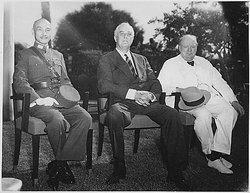 On November 18th, 1943, Chiang Kai-shek left Chungking for the Cairo Conference (November 22-26, 1943). Soong Mei-ling, per Zhang Ling'ao, had taken off one day earlier together with Wang Chonghui, Shang Zhen, Lin Wei, Zhou Zhirou, Dong Xian'guang, Yu Jishi, Huang Renlin, Yu Guohua and Chennault.
Back on July 4th, 1943, Mme Chiang Kai-shek returned to China after almost a seven-month stay in the U.S., on which occasion Lord Halifax was worried that President Roosevelt could be persuaded into doing something not beneficial to Britain, i.e., what
Soviet spy Currie feared as to Mme. Chiang's "Propaganda Furor" attacking the whole strategy of the war which was Germany first and the Far East second.
From November 22nd to 26th, 1943, Chiang Kai-shek attended the Triumvirate Conference in Cairo of Egypt.
At the conference, Roosevelt inquired with Chiang Kai-shek as to the name of General Yu Chengwan who was defending Changde.
At the end of the conference, Chiang Kai-shek made a declaration with Churchill and Roosevelt that Japan must return Manchuria, Taiwan and the Pescadores Islands (Penghu Islands) to China and that Korea must be restored independence. However, back at the Quebec Meeting, Britain and the U.S. had already decided upon the priority of the European Battleground over the Asian Battlefield.
In November 1943, U.S. President Roosevelt, prior to the trip to the Tehran Meeting (November 28-December 1, 1943), claimed that should he give Stalin what he wanted (i.e., Manchuria, Korea & Sakhalin), then the U.S.S.R. would not grab other parts of the world.
After the Tehran meeting (November 28-December 1, 1943), the U.S. told China that the Chinese news media should synchronize with the U.S. on the matter of "Europe First and Asia Second."
In Chungking, Soviet spy Owen Lattimore hoodwinked Chiang Kai-shek with a claim that it was the British who influenced Roosevelt on the matter of Europe First, China Second because the British thought that they would not afford to let India go independent with an early victory over Japan.
On November 18th, 1943, Chiang Kai-shek left Chungking for the Cairo Conference (November 22-26, 1943). Soong Mei-ling, per Zhang Ling'ao, had taken off one day earlier together with Wang Chonghui, Shang Zhen, Lin Wei, Zhou Zhirou, Dong Xian'guang, Yu Jishi, Huang Renlin, Yu Guohua and Chennault.
Back on July 4th, 1943, Mme Chiang Kai-shek returned to China after almost a seven-month stay in the U.S., on which occasion Lord Halifax was worried that President Roosevelt could be persuaded into doing something not beneficial to Britain, i.e., what
Soviet spy Currie feared as to Mme. Chiang's "Propaganda Furor" attacking the whole strategy of the war which was Germany first and the Far East second.
From November 22nd to 26th, 1943, Chiang Kai-shek attended the Triumvirate Conference in Cairo of Egypt.
At the conference, Roosevelt inquired with Chiang Kai-shek as to the name of General Yu Chengwan who was defending Changde.
At the end of the conference, Chiang Kai-shek made a declaration with Churchill and Roosevelt that Japan must return Manchuria, Taiwan and the Pescadores Islands (Penghu Islands) to China and that Korea must be restored independence. However, back at the Quebec Meeting, Britain and the U.S. had already decided upon the priority of the European Battleground over the Asian Battlefield.
In November 1943, U.S. President Roosevelt, prior to the trip to the Tehran Meeting (November 28-December 1, 1943), claimed that should he give Stalin what he wanted (i.e., Manchuria, Korea & Sakhalin), then the U.S.S.R. would not grab other parts of the world.
After the Tehran meeting (November 28-December 1, 1943), the U.S. told China that the Chinese news media should synchronize with the U.S. on the matter of "Europe First and Asia Second."
In Chungking, Soviet spy Owen Lattimore hoodwinked Chiang Kai-shek with a claim that it was the British who influenced Roosevelt on the matter of Europe First, China Second because the British thought that they would not afford to let India go independent with an early victory over Japan.
According to Feis, no written documents existed in the U.S. official archives for the talks among Roosevelt, Churchill and Chiang Kai-shek while having Mme Chiang act as the interpreter.
The three parties did not agree on an agenda in the written form, with Churchill describing Chiang as someone who changed minds more than one to two times according to Feis.
Feis alternatively described Chiang as having never relented on his conditions and demands and Churchill equally firm and not yielding, which yielded to the possibility that any orally agreed-upon matter between Churchill and Chiang could have caused the opposite parties to have misunderstanding of the matter to be taken as agreed-upon.
Churchill, to deflect Roosevelt from standing together with Chiang, indicated to Stalin that should the resources be diverted to other areas like Burma, then Operation Overlord could be delayed. This was an attempt to get Stalin exert pressure on Roosevelt.
As Robert E. Sherwood the director of the OWI Overseas Branch said in Roosevelt and Hopkins: An Intimate History, Churchill had "scant enthusiasm" for large operations in Burma, with the British Chiefs of Staff willing to go along with the Americans "if not too much was asked of them", and as Feis understood, Mountbatten was eager for action and devised several plans including Operation Buccaneer against the Andaman Islands.
For Chiang, it was the demand for the "concurrent" Anglo-American air and naval support in order to execute the land operation by the Chinese armies.
Mountbatten was told by Churchill that Chiang had no more objection on the 26th, with Mme Chiang implying to him that Mountbatten would be 'happy' since the three parties agreed to what Mountbatten wanted for the Burma campaign.
Mountbatten pointed out that there were no secretaries recording the minutes of the meeting.
The other dispute concerned with Chiang's renewed request for a seat at the allied war council.
As recalled by King, Marshall reported at the Combined Chiefs' meeting on the 22nd that Chiang wanted the Chinese represented.
Stilwell claimed that he was told by Chiang on the 27th to stay on and protest.
According to Churchill, Roosevelt endorsed a "considerable amphibious operation across the Bay of Bengal within the next few months" against his arguments, which would cramp his Overlord plan as well as the Turkey and Aegean projects, and the Italy operation.
Feis' word was that Churchill felt unobligated.
Back in Cairo, Churchill used Stalin's promise to enter the Pacific War to dissuade Roosevelt from Buccaneer.
With Marshall and King backing Stilwell in the claim that Chiang could cancel the Upper Burma campaign (i.e., Tarzan), Roosevelt told Churchill that he could not place all eggs in one basket, i.e., Stalin's basket, to which Churchill again cited the Overlord's importance to both the Russians and Americans, and expressed doubt that breaking away from the promise made to Chiang would damage China's fighting will.
Then on December 5th, prior to separation and without convening a meeting of the chiefs of staff, Roosevelt sent a 'laconic' message to Churchill that "Buccaneer is off."
As recalled by King, he was the lonely person whgo "remained obdurate" while the others concurred with Churchill.
Arnold appeared to have backed down with some promise of increased tonnage over the Hump so that Operation Matterhorn, i.e., bombing Japan but from Guam and Marianas as well - if captured by October of 1944.
Mountbatten was ordered to reroute landing crafts to Europe while assisting air and naval actions without amphibious operations.
Churchill, who repeatedly relayed a message of invitation to Mme Chiang Kai-shek [while she was touring the U.S.] to visit Britain, had a point-blank discussion with Mme Chiang Kai-shek on the sideline, with Mme Chiang sternly objecting to the British design on China.
Mme Chiang, while visiting the U.S., repeatedly declined Churchill's invitation to visit London and chose to visit Canada instead.
Both Chiang Kai-shek and Mme Chiang Kai-shek, knowing the British sinister motive to keep Hong Kong, knew very well that Britain was China's No. 1 enemy.
Back in 1942, Churchill and Archibald Wavell (American-British-Dutch-Australian Command) betrayed the Chinese Burma expedition army to pull out of the British army for defending India instead.
The British, for delaying China's recovery of Hongkong till after the Japanese surrender, repeatedly lobbied with the Chinese and especially Wellington Koo who travelled back to China to lobby on behalf of the British with a claim of returning H.K. to China after Japan was to surrender so as not to damage the British wartime morale.
This is Wellington Koo's No. 1 blunder, something that would give the British every reason to sell out the ROC at the Tehran and Yalta meetings to Stalin and the Soviet Union --something that could be tantamount to burying the fate of the Republican China. Do not forget that the British, who damaged China enormously through the two opium wars of the 19th century, forged twenty years of military alliance with Japan, that enabled Japan to build the warships and warplanes used for invading China --knowing that the Republic of China, the beacon tower, represented the last bastion against the imperialists and colonialists.
Wellington Koo, a person who took himself as "international" and paid attention to the minute diplomatic etiquette such as the layout of wine cups, fork and spoon, and napkins, did not join the KMT party till he was personally pressured by Chiang Kai-shek to submit an application.
Koo reluctantly worked for the ROC and in the late 1950s quit the ambassador job to work as an "international court" judge at the Hagues.
Churchill described Roosevelt's change of mind with a sentence to Ismay that "He is a better man that ruleth his spirit than he that taketh a city", namely, what Churchill claimed to be blood thicker than water among the British and Americans.
Roosevelt called in Stilwell to tell him about the change, and explained the reason to be that "he had not wanted the conference with Churchill to break on this issue" per Feis.
Stilwell did not care about the British participation or not, with the talks of the two described by Feis to have "bobbled about without touching bottom" -- since Stilwell apparently wanted the Upper Burma action no matter how many Chinese lives were to be lost and would not give a damn about the possible reproach from Chiang, and after the meeting with Roosevelt, wired to Chungking to suggest Chiang to go ahead with the Burma campaign anyhow.
Chiang, in the subsequent exchange with Roosevelt, pointed out the effect (i.e., damage of morale) on the Chinese army and people from the "radical change of policy and strategy" while recognizing the importance of a rapid defeat of Germany, as well as expressed concern over China's ability to hold out in light of the fact that the Japanese might take the British reneging as a signal to take advantage of the occupied energies of the British and Americans in Europe for concentrating troops to try an all-out offensive, i.e., a final solution of the China problem which was the coming Japanese Ichigo Campaign of 1944.
Chiang suggested that the U.S. provide a billion-dollar loan for stabilization of the Chinese currency (which was nominally at a ratio of 20:1 to the US dollar but 120:1 or 130:1 at the black market), increased support for the Sino-American air force, and increased tonnage over the Hump to 20,000 tons.
Back in Chungking, Stilwell encouraged Chiang on the Burma venture by belittling the Japanese army strength in Burma as five Shidans, and it turned out that Mountbatten vindicated Chiang's intelligence of eight Shidans, i.e., two armies of eight divisions (Shidans) and one independent mixed brigade (Ryodan) totaling 200,000 men by January of 1944.
Chiang on December 17th replied to Roosevelt that he would go ahead with preparation of the spring offensive in Burma.
At the Cairo conference (November 22-26, 1943), Roosevelt and his son, together with an undercover Soviet spy, had a lengthy discussion with Joe Stilwell, talking about getting rid of Chiang Kai-shek and finding someone more manageable.
VENONA scripts already showed that the Soviet spies, every step, surrounded Roosevelt and influenced Roosevelt on all decisions in favor of the Soviet Union. At the exact same time, in the presence of Roosevelt's son, James, Stilwell and the Soviet spies had been talking about killing Chiang kai-shek, with Roosevelt's full nodding approval.
There was one important episode recorded in Roosevelt's conversations with Chiang, namely, the Burma campaign and the promised aid to China. After Roosevelt left Cairo, both promises were broken. There was no amphibious landing in Burma, nor financial or military aid to the ROC, not to mention the assassination scheme. Some experts analyzed the records of Roosevelt's son, and concluded that it was within about half year before the Cairo Conference that Roosevelt had fully bought the opinions from the Soviet spies that Chiang should be rid of. Roosevelt was someone like a dowager empress, who spent 2-3 weeks in the warm springs, and then half a day dealing with the state affairs. The affairs of the United States government was run by the grand eunuch, i.e., Comintern spy Harry Hopkins. Nobody could see Roosevelt without the approval of Harry Hopkins. And, together with George Marshall, and Eleanor Roosevelt, the three were called triumvirate.
As to the billion-dollar loan, ambassador Gauss, when called to Chiang's office, and when Mme Chiang spoke of the cost to maintain the American air force, was "unmoved" per Feis.
In a despatch to the State Department on December 23rd, Gauss claimed that "China would not be helped by an American dollar alone at this time" and implied that only successful military operations to open the Ledo Road could have resolved the inflation issue with increased transport of goods.
Hull, a good man, suggested a "soft" refusal blunting the effect of a flat denial's impacting the Chinese morale as well as suggested the Treasury Department to send a fact-finding kind of mission to China.
The Treasury Department, where Soviet spy Harry Dexter White was at work,
did not support the loan either, claiming that it might "retard the decline in the value of the Chinese dollar" and slow up inflation "not much or for long" per Feis.
Morgenthau, claiming that the loan was unnecessary and undesirable, suggested some lesser measures to "reduce the volume of Chinese currency" per Feis.
Roosevelt, on January 5th, 1944, ordered that Morgenthau's memo with reasons that the loan was not justified be sent to Chiang.
Hull wanted Gauss to blunt the impact when presenting the memo to Chiang.
The disputes continued, and according to Feis, surrounded two issues: Mme Chiang insisted that Roosevelt promised to meet the full cost of constructing the American bomber base at Chengdu (Chengtu), and the American War Department was unwilling to convert the U.S. dollars at the official CNC exchange rate of 20:1, which would amount to an expenditure of 100 million dollars each month to maintain operation in China.
China claimed that if using the black market rate, let's say 130 CNC to 1 U.S. dollar, then granting such an exchange rate would ruin the Chinese currency.
On the Chinese side, Chiang thought that the loan was trivial in comparison with the outlay doled out to the British and Russians.
HH Kung suggested in January of 1944 that the Americans themselves had to "arrange to buy the supplies, labor, and construction materials" after March 1st, 1944, as seen in Gauss' despatch on January 16th.
The Americans took the Chinese threat as a blackmail, and thought that Chiang could possibly withhold the Yoke force from going into Burma as a bargaining chip.
In January of 1944, the War Department thought about curtailing operations in China.
Somervell, Marshall and Stimson were all fed up.
While Gauss was tough as the War Department was and favored a strong line, Hull
suggested in February of 1944 to avoid actions that could destabilize Chiang's government.
Hull
suggested to Roosevelt not to rupture the relations with China.
On April 19th of 1944, HH Kung reviewed the finance situation of China with the White House, touting "the powers of endurance of the Chinese people" in the past seven years of war, pointing out that "nearly 50 per cent of the [war] expenditures" were already covered by taxation in the 1944 budget, and warned that "steps that would drastically depreciate our [Chinese] currency" would bring about further inflation with grim consequences.
The War Department then "had second and softer thoughts" per Feis, and it appeared that Stimson came up with "a temporary working compromise on war costs and the exchange rate" in a memo sent to Roosevelt on May 26th, 1944, that "did little to ease the [Sino-American] tension during the spring of 1944--while the second campaign in Burma was being fought" per Feis.
Stilwell, prior to departure for India on December 19th to launch the Burma campaign that was to last ten months, was told by Chiang not to sacrifice the Chinese army to British interests.
With Chiang not exerting the Y-force from Yunnan,
Mountbatten on December 24th remarked to the British Chiefs of Staff about discontinuing supplies that would be used by Chiang for "internal political purposes", i.e., civil wars against the communists.
Mountbatten sent Wedemeyer to D.C. to expound a sea route (i.e., codename Axiom) to China, i.e., what Stilwell recorded on January 8th as to the British proposition to go the Sumatra route and then straight to Hongkong, i.e., the crown jewel that the British did not want the Chinese army to take from the Japanese.
This was against Churchill's doing nothing strategy in Closing the Ring to avoid being "sidetracked and entangled there" that "would deny us (the British) our (British) rightful share in a Far Eastern victory, which was "to contain the Japanese in Burma" or at most attack "the great arc of islands forming the outer fringe of the Dutch East Indies."
Stilwell sent Boatner and Ferris, plus John Davis, to defending his Ledo Road strategy.
Roosevelt, who cautioned Chiang about action without an amphibious British invasion till after maybe November of 1944, was gradually convinced by the Joint Chiefs that Stilwell's vigorous push through the jungle could help the case of Matterhorn in that
once the X-force from India take Myitkyina, then more B-29s could have a forward Myitkyina base to bomb Japan while self-fulfilling the myth that the bombers could bring own supplies to China without burdening the existing Hump strain.
The other benefits were a shorter air transport route, a broader corridor and more planes flying simultaneously at the lower altitude, less consumption of oil with refuel at Myitkyina, and more security with control of Upper Burma and its air space.
The British were not convinced.
From January to February of 1944, Roosevelt repeatedly exerted pressure on Chiang while offering inducement of increasing the Hump tonnage to 12,000 tons per month.
On January 14th, Roosevelt threatened to cut off the tonnage to the Y-force as well as the build-up of stock-piles in India.
Chiang stood firm, but claimed that he would change mind to commit the Y-force should the X-force take Mandalay or Lashio.
Just about this time, i.e., the turn of February-March, the Japanese launched a proactive attack against the central British-Indian front, which committed the British to fighting the Burma war.
The British joined the Americans in asking Chiang to throw in more troops for the X-force while deploying the Y-force to attack northern Burma.
Matching the American air-borne force, i.e., Merrill's Marauders,
the British threw in the Chindit Brigade under General Orde Wingate.
The British RAF Bengal Command joined the U.S. Tenth Air Force in forming the Eastern Air Command for executing the air war, with Chennault diverting the planes to bombing the Japanese sea route to Rangoon.
Per Feis, by the middle of March, Stilwell's X-force could not push on further.
On the 17th, Roosevelt, after receiving Stilwell's message, immediately wired to Chiang to seize the opportunity to inflict a decisive defeat on the Japanese by committing the Y-force. Separately, Mountbatten asked Churchill and Roosevelt to exert pressure.
Chiang replied on the same day, taken by Feis to be a message that crossed Roosevelt's same day message, that
the Japanese were about to start a new offensive, i.e., the Ichigo Campaign, with troops moved up from Manchuria;
that the communist elements were preparing a march against Xi'an (Sian);
and
that the Soviets were taking threatening action in Xinjiang (Sinkiang, i.e., Chinese Turkestan).
Ten days later and under Roosevelt and Stilwell's ultimatum, Chiang offered to send more troops to the X-force, i.e., two more divisions to make the X-force five in total.
On March 31st, without authorization, Stilwell moved the main U.S. Army Headquarters for the CBI Theater to New Delhi from Chungking.
On April 3rd, Roosevelt sent a blunt message of ceasing supply for the Y-force if not used, ending with a plea that "you can act."
When Thomas Hearn told Marshall that Roosevelt's message could be re-worded by the Generalissimo's office, Roosevelt ordered all his future messages to be taken to Chiang by a senior U.S. army officer.
Hearn followed up with threat to cancel the April tonnage for Chennault, and was asked by the Chinese to hold back the order on April 12th.
On the 14th, Heh Yingqin, i.e., China's minister of war and chief of staff, approved the Salween crossing.
Days later, on April 17, the Japanese army forcefully crossed the Yellow River flood zone via three prongs, officially starting the massive Ichigo Campaign.
Some forty thousand Chinese troops were to cross the Salween River on May 10th and 11th.
In May 1944, the Sino-American forces mounted attacks at Myitkyina [Mi-zi-na].
Myitkyina of northern Burma was an important link on the Sino-Burmese Highway.
On the Chinese side, 548 kilometer segment of the Sino-Burmese Highway were paved within 7 months by utilizing 150000 Chinese labors after the 1937 eruption of war.
A Japanese brigadier general was dispatched there with reinforcements. The total Japanese forces numbered around 3600 men at Myitkyina.
On May 17th, the X-force captured the airfield at Myitkyina at just about the time the monsoon broke out.
The Japanese reinforced Myitkyina with more troops.
The battle continued in the muddy morass.
With the Y-force pinned down by the Japanese along the high mountains next to the Salween River, Stilwell and Roosevelt's hope for a "great and decisive victory" failed per Feis.
Meanwhile, the Japanese army by late May defeated the Chinese army of the First War Zone and took over Luoyang, wrapping up
the central plains phase of the Ichigo Campaign.
Chennault, with the tonnage of the 14th Air Force mostly diverted for the months of January to March, was further restrained by the Joint Chiefs of Staff to immobilize 200 out of his 500 planes for protecting the Chengdu bombers' base and
to exert 150 planes to Stilwell's Burma campaign, as well as denied the appropriation of the oil reserved for Matterhorn.
Roosevelt, at the urging of Stilwell, chose to use the Lend-Lease coercion to force China into throwing the crack troops (Y-force) at northern Burma just prior to the Japanese Ichigo Campaign. The Chinese communists, through Pan Hannian's operations with the Japanese spy agencies, already shared information about the Chinese military deployment and strategy, and more than a few times coordinated with the Japanese in attacking the Chinese government troops from 1939 onward, such as during the Southern Henan [Yu-nan] Campaign. The British and American intelligence services, notably the O.S.S., busily smuggled in lipsticks and cosmetics for and knowingly cohorted with Guilin's dancing girls who were purportedly known as the Japanese spies. Seamlessly, all forces joined hands in making sure the cause of the Republic of China be forever damaged. The British intelligence, for example, flew out the notorious Comintern agent Chen Hansheng to India from Guilin prior to an arrest. Though, the communist forces, following the footsteps of the Japanese Ichigo Campaign, penetrated towards the Hunan-Guangdong borderline as well as the Henan-Anhui borderline, only to get hit back in the south by General Xue Yue [who stubbornly withdrew to the east of the railway instead of the west] as well as to lose the most flagrant civil-war general Peng Xuefeng in the Anhui-Henan battlefield.
On June 10th, a new wave of attack was launched against the Japanese. By mid-June, the Japanese lost 1000 soldiers. On July 12th, the Sino-American forces mounted attacks at Myitkyina again, with 127 planes dropping 754 tons of bombs. The Japanese retreated out of Myitkyina on Aug 1st. Prior to the retreat, the Japanese brigadier general ordered the extermination of 12 female prisoners of war [i.e., comfort women] via kerosene burning. (Note among hundreds of thousands of comfort women in southeast Asia, the Chinese army had rescued only one dozen or so. The beastly Japanese army never forgot to systematically destroy evidence at the end of the war.)
Chinese_Tank_Forces_and_Battles_before_1945_ed.htm stated that "Americans, such as Colonel Rothwell H. Brown, of the new Chinese tank battalion, commanded some of those Chinese units. By December of 1944, all but 800 IJA troops were destroyed in Burma; those survivors left Bhamo to fight their way to the mountains rather then surrender to the Allies."
In October 1944, British Prime Minister Churchill, against Eden's admonition, betrayed China to Stalin in the attempt to carve out the war spoils from WWII, namely, China's loss of Port Arthur and Hong Kong, etc.
At the Feb 1945 Yalta Meeting, Churchill colluded with Stalin to stamp the Yalta secret agreements, i.e., "Agreement Regarding Japan", at the expense of China.
Further, in April 1945, Churchill flatly declined Hurley's request to yield HK back to China as an international open port.
According to Stettinius' Roosevelt and the Russians, Churchill claimed that the whole position of the British Empire in the Far East might be at stake, to the effect that he was to sign the agreement "in order that Great Britain might stay in the Far East" and that "he had great faith in President Roosevelt and felt that he could rely completely on the President's judgment in this matter" - a judgment that Roosevelt, together with Marshall, Leahy and King, casually passed off when the Soviets inserted the clause of "the preeminent interests of the Soviet Union" as to Dairen and the Chinese Eastern Railway to the secret agreement at the last minute.
As pointed out by Herbert Feis, Roosevelt and Stalin never discussed "what would happen if Chiang Kai-shek did not concur" with the Yalta agreement.
"The No. 1 Order" [Ichigo]
In the spring of 1944, the Japanese, from two ends, launched a massive campaign coded "No. 1 Order" [Operation Ichi-go] in the attempt to link the railroad line from Manchuria to Vietnam, i.e., the "continental corridor", a plan first sanctioned by Hirohito on Jan 13th, 1944.
On January 24, 1944, Sugiyama Hajime, the Japanese chief of staff, presented a memorial to the Japanese emperor, explaining the rational and the strategic intent for the Ichigo Campaign, which was firstly to destroy the airfields (B-29 bases in Guilin and Liuzhou, etc.) in Southwest China so as to secure the protection of the home islands and the East China Sea, secondly to open up the transportation route on the mainland so as to enhance combat effectiveness of troops in Southeast Asia, and incidentally to acquire the tungsten mines and other important resources in the to-be-captured territories. With imperial approval, the Japanese General Headquarters on the same day issued the Continental Order 921 and the Number One Operation Outline, i.e., the Ichigo Campaign.
In May 1944, the Japanese general headquarters, to make up for the inadequacy of its troops, launched another round of domestic mobilization. The recruits from the requisition staffed 14 independent infantry Ryodans, with mission to take over the garrison of the main army which were to be exerted to the combat missions. An additional eight field battle replenishment columns were established for action along with the combat Shidans as the on-spot supplementary troops for the war casualties. The Japanese 3rd Shidan, 13th Shidan and 22nd Shidan, which were ordered to be redeployed to the Pacific War regions to the south, were retained on the Chinese battlefield.
The Japanese records claimed a mobilization of additional 510,000 troops for the eight-month campaign that could be subdivided into four regions:
Henan Province by the Japanese North China Area Army,
Changsha-Hengyang of Hunan Province by the Japanese 11th Army, the Yue-Han [Canton-Wuhan] Railway by the Japanese 23rd Army, and Southwestern China by the Japanese 11th & 23rd Armies [the 6th Front Army].
The Japanese North China Area Army was to seize the Peiping-Hankow Railway south of the Yellow River in April, followed by actions in the Hankow-Wuchang area in June;
the Japanese 23rd Army was to start actions in July-August, to be followed by pincer-attacking the Chinese army in coordination with the Japanese coming south, taking Guilin (Kweilin) and Liuzhou (Liuchow), and mopping up the Hunan-Kwangsi and Canton-Hankow railroads.
The purposes of the campaign were multifold, i.e., making up for the loss of ships at the sea route due to the American bombing, destroying the airfields in Southwestern and Central China, strategically shifting the Final Battlefield to the mainland from Japan, and destroying China's resistance will and armed forces. With the relief from Manchuria and the Japan homebase, the Japanese army upgraded or filled up their Shidans to A-class from B and C classes. Zheng Langping, in The Ever-lasting Glory, pointed out that Japan's war preparations included half a year aviation petrol, two year worth of ammunition, an armored Shidan, 67000 horses, 13000 trucks, 10000 transportation and logistics ships, and majority of its highway, railway and bridge engineers. (Per Donovan Webster, the Japanese amassed 15 full divisions and five brigades since April 1944.)
Chiang Kai-shek, at the Fourth Mt. Nanyue Military Meeting of February 1944, modified his two-stage war plan to a three-stage plan. Claiming that the second-stage resistance war, after five full years of struggle and sacrifice, had entered into a new turning point, Chiang Kai-shek put forward the argument that the third phase of the war, i.e., the stage of counterattacking the enemy, had arrived, with the change of offensive and defensive situation on the ground to the Chinese side from that of the enemy. It was at this moment of contemplating the offensive operations' plans and overall offensive plan in the frontal battlefields that the Japanese side started the massive Ichigo Campaign.
The First War Zone, with the command headquarters set at Luoyang, nominally possessed eight group armies or seventeen army corps, about 300,000 troops. Commander-in-chief Jiang Dingwen and deputy Tang Enbo had different opinions as to observing the war guidelines that were passed on from the military headquarters where Liu Fei, the communist mole, had designed the blueprint of defending the points along the railway in accordance with Joseph Stilwell's opinions that the Japanese military did not possess the strength to launch a continental campaign. Jiang Dingwen strictly observed the directives and misjudged the situation, while Tang Enbo, who was noted for launching the maneuver warfare to defeat the Japanese army in multiple campaigns throughout the war, found his hands bound by the orders from the high command. The Chinese side seriously underestimated the Japanese campaign to be of the sort like the past seasonal offensive attacks similar to the Suixian-Zaoyang Campaign, the Southern Henan Campaign and the First Zhengzhou Campaign, in that the Japanese, owning to the lack of troop strength, would quickly pull back to the original positions after making some tentative and limited excursions. The First War Zone command thought that the Japanese intended to open up the Ping-Han Railway, and nothing more, and underestimated the maximum Japanese troop level to be four to five Shidan. In fact, the Japanese had deployed eight and a half Shidan (divisions), plus attached troops, with a total of headcounts of about 150,000 men, a campaign that Takushiro Hattori, who designed the Ichigo Campaign for Tojo Hideki, called by the Great Centennial Expedition.
In April, the Japanese army amassed in Henan Province, with large troop concentration to the south of the Dao-qing Railway and near Kaifeng, as well as Yuanqu of Shanxi Province. Total troops assembled included six infantry Shidan (divisions), one armored vehicle Shidan (division), one cavalry Ryodan (brigade), and one artillery Rentai (regiment). The Japanese repaired the Zhengzhou Yellow River Iron Bridge. From the southern end of the Peiping-Hankow Railway, the Japanese deployed one Shidan in Xinyang.
On April 17, the Japanese 37th Shidan, the 7th Independent Ryodan and other units, which stationed in Kaifeng area, at the Zhongmou segment of the New Yellow River, forcefully crossed the Yellow River flood zone via three prongs. By April 19, after fighting the Chinese defenders for about two days, the Japanese breached the positions of the Chinese Temp 15th Corps. In Zhengzhou, Xinzheng, Yushi and Weichuan, the Japanese engaged with the Chinese defenders from the 28th Group Army. On April 22, the Japanese captured Xinzheng, and Yushi, etc.
The joint Sino-American air force failed to bomb the Yellow River Iron Bridge to stop the Japanese army's river crossing.
Through the month of April, on the 6th, 8th, and 10th, Chennault repeatedly warned Stilwell that with his resources diverted for the Salween River offensive and the Matterhorn operations, the 14th Air Force might not give effective air cover to the Chinese armies and warned that the American air bases could be imperiled when the Chinese army was defeated.
The Japanese, who were pushed out of Zhengzhou of Henan Province after a short period of occupation from October 4th, 1941 to October 31st, 1941, would mount another attack at Zhengzhou by crossing the Yellow River on April 18th, 1944.
From north of the Yellow River, the Japanese 62nd Shidan and 110th Shidan in northern Henan crossed the river on the morning of April 19 to attack the Chinese defenders of the 85th Corps on Mt. Mangdoushan. The Japanese breached the Yellow River defense works on the 21st, and went on to occupy Guangwu, Xingyang, and Sishui.
The Japanese took over Zhengzhou on April 22nd, utilized its former consulate in Zhengzhou as an operation center for recruiting the "comfort women", and then targeted the Luoyang city. 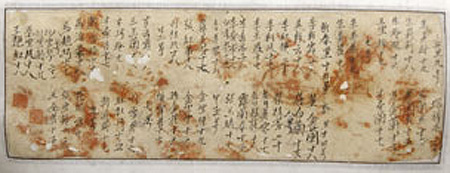 The Japanese then joined the forces coming from the Kaifeng direction to lay siege of Luoyang [Jiang Dingwen's First War Zone command headquarters].
The Chinese 4th Group Army, which was in charge of garrison from Majuling (foal ridge) to Hulaoguan (tiger lockup pass), persisted along the line, stopping the Japanese army from a continuous westward push. Meanwhile, on April 26, the 31st Group Army's main forces, under Tang Enbo's command, launched a counterattack against the Japanese at Majuling (foal ridge) and Mixian.
The Japanese then joined the forces coming from the Kaifeng direction to lay siege of Luoyang [Jiang Dingwen's First War Zone command headquarters].
The Chinese 4th Group Army, which was in charge of garrison from Majuling (foal ridge) to Hulaoguan (tiger lockup pass), persisted along the line, stopping the Japanese army from a continuous westward push. Meanwhile, on April 26, the 31st Group Army's main forces, under Tang Enbo's command, launched a counterattack against the Japanese at Majuling (foal ridge) and Mixian.
The Japanese attacked south along the Peiping-Hankow Railway, as well as west along Long-hai Railway. The enemy along the Peiping-Hankow Railway attacked south and southwest. At about the time of attacking Xuchang, the Japanese, to capture Tang Enbo's army which had launched a counterattack against the Japanese in the Mixian area, made a decision to turn northwestward.
The Chinese 28th Group and 31st Group Army attacked the Japanese forces till the 30th when the Japanese 67th Shidan, 37th Shidan, 3rd Armored Vehicle Shidan, the 7th Independent Mixed Ryodan, and the 4th Cavalry Ryodan closed in from the east and southeast in succession. From May 1 to May 4, the Japanese took over Xuchang, Linying, Jiaxian, Yuxian and Linru in rapid action. On May 5, the Japanese vanguard unit closed in towards Longmen. After breaching the Yihe River defense which was defended by Liu Kan's army, the Japanese took over Longmen, south of Luoyang, on May 7, and continued westward towards Yiyang and Haancheng.
Along the Peiping-Hankow Railway, the Japanese mounted an attack at the Xiping train station on May 8 from the south and north. At Zhumadian, on May 9, the branch of the Japanese army which continued the southern move along the Peiping-Hankow Railway, converged with the Japanese 1st Independent Infantry Ryodan that came north from Xinyang.
The Japanese, after crossing the river at Yuanqu of southern Shanxi, attacked and took over Mianchi on May 9. The Japanese surrounded Luoyang from all directions.
The Chinese 4th Group Army and the 9th Corps, after dealing the Japanese army heavy casualties in several battles, retreated west, leaving a lonely army to defend Luoyang.
On May 13, the Japanese forces from Yanshi and Longmen directions had an junction in the Cilun area. The Chinese defenders, i.e., the 9th Corps and the Temp 4th Corps., had to pull westward for the exposure to the Japanese flank attack. Meanwhile, the Chinese 36th Group Army at Mianchi also moved westward to Lushi.
At this point, the Luoyang defenders have been caught in a lone battle. Tracing after the Chinese troops, the Japanese moved west and southwest along the Longhai Road (Lianyungang [Haizhou] to Baoji), the Luoning-Lushi Road, and the road to Songxian and the west. The Japanese consecutively took over Luoning, Jiaxian and Lushi.
Tang En'bo retreated to the Lushan & Songshan mountains from Yuxian. With Jiang Dingwen retreating to Mt Funiushan, the Chinese troops were in disarray. Commander Li Jiayu volunteered to provide cover for Liu Kan, Zhang Yipeng, Hu Bohan and Xie Fusan. With the 104th Division, Li Jiayu defended Mt Yumengshan for days. After Luoyang was lost to the Japanese in May, Li Jiayu retreated to the west on May 11th.  Ten days later, at Qinjiapo, Li Jiayu was ambushed and killed by the Japanese troops who were tracing Gao Shuxun's army. Ten days later, at Qinjiapo, Li Jiayu was ambushed and killed by the Japanese troops who were tracing Gao Shuxun's army.
The Chinese army, pooling troops from the 1st, 5th and 10th war zones, launched a collaborative theater-wide counterattack against the Japanese, having recovered Suiping, Luohe, Lushan, and Songxian at one time, threatened Baofeng, and cut off the Peiping-Hankow Railway.
At Luoyang, the Japanese army, consisting of the 63rd Shidan, the 3rd Armored Shidan and the Inagaki Daitai of the 110th Shidan, launched an onslaught against Luoyang. The defenders fought bravely, until the evening of the 25th, when they split into several groups for the breakout. The loss of Luoyang, after thirty-seven days of battles, was the temporary stop of the central plains phase of the Ichigo Campaign.
On May 31st, Chiang Kai-shek, through Shang Zhen, relayed a message to Roosevelt for emergency help, mentioning the intelligence that the Japanese Kwantung Army had transferred 14 divisions to mainland China from Manchuria.
The Americans discounted this alarm as exaggeration.
On June 5th, Chiang called Stilwell to Chungking.
Chiang did not mean to order the withdrawal of the Y-force but to ask Stilwell "with intense eagerness" to follow up with Roosevelt about his message sent a few days earlier, which was to "provide the 14th Air Force with the combat means" per Feis, i.e., oil and bombs.
Stilwell purportedly told Chiang to mobilize all of China's ground and air resources, i.e., the communist army, and returned to India the next day.
The War Department did not agree to release the oil reserved for Matterhorn, thinking that the bombing of Japan would benefit China more than Chennault's, which was "faith in strategic bombardment at its highest pitch" according to the study in the Sunderland-Romanus manuscripts.
Chennault, in The Way of a Fighter, pointed out that "the supplies of fuel, bombs, and other equipment were enough for only thirty days of all-out maximum operations" after diversion of resource and planes to the Burma and Matterhorn operations; taht he had to get by through the summer and autumn by depending on "its current allowance of tnnage brought in over the Hump, and possible allocation from the reserve accumulated at Chengtu",
and that trucks that could carry supplies to the other air bases from Kunming were diverted for other uses.
* In Commemoration of China's Fall under the Alien Conquests in A.D. 1279,
A.D. 1644 & A.D. 1949 *
U.S.S.R./Comintern Alliance with the KMT & CCP (1923-1927)
Korean/Chinese Communists & the 1931 Japanese Invasion of Manchuria
American Involvement in China: Soviet Operation Snow, IPR Conspiracy, Dixie Mission, Stilwell
Incident, O.S.S. Scheme, Coalition Government Crap, Amerasia Case & The China White Paper
* Stay tuned for "Republican China 1911-1955: A Complete Untold History" *
|
|
Zou Rong's Revolutionary Army;
Shin Kyu Sik's
Shrine (Spirit, Kunitama) of Korea
|
This snippet is for sons and daughters of China:
Heed the sons & ministers' agony and sorrow of our ancestors who died or lived through the Mongol, Manchu and Soviet-Chicom conquest
and
the Yongjia, Jingkang and Jiashen cataclysms !
Jeanne d'Arc of China:
Teenager girl Xun Guan breaking out of the Wancheng city to borrow the relief troops in the late Western Jinn dynasty;
Liu-Shao-shi riding into the barbarian army to rescue her husband in the late Western Jinn dynasty;
teenager girl Shen Yunying breaking into Zhang Xianzhong's rebels on the horseback to avenge on father's death in the late Ming dynasty.
China's Solitary and Lone Heroes:
Nan Jiyun breaking out of the Suiyang siege and charging back into the city in the Tang dynasty;
Zhang Gui & Zhang Shun Brothers breaking through the Mongol siege of Xiangyang in the Southern Soong dynasty;
Liu Tiejun breaking through three communist field armies' siege of Kaifeng in the Republican China time period;
Zhang Jian's lone confrontation against the communist army during the June 3rd & 4th Massacre of 1989.
|
|
|
The Japanese, after success at defeating the Chinese First War Zone troops, continued to push west against Shenxi Province.
Hu Zongnan's troops, that stationed in the Tongguan Pass of eastern Shenxi Province, managed to stop the Japanese from encroaching throughout eight years of resistance wars. In the Battle of Lingbao, in the spring of 1944, Hu Zongnan's troops defeated the Japanese army which had amassed in Henan Province. During the Japanese attack at Zhengzhou city of Henan Province, the Long-Hai Railway shipped 79 trains of the relief army or 200000 soldiers from late April to mid-May of 1944. Trains broke through the Tongguan bombardment by the Japanese from across the Yellow River at nights. (Lacking building materials, the Tianshui-Baoji Segment of the Long-Hai Railway was not completed till the end of 1945.)
After the Japanese sacked Henan Province, they pushed against Hubei Province and linked up the Peking-Hankow Railway.
South of the Yangtze, the Japanese took over Changsha and forced Xue Yue [Hsueh Yueh] into retreat. Per Webster, Changsha was lost in the absence of General Xue Yue who was famous for defeating the Japanese three times. Xue Yue's tactics was to deploy the artillery on the mountain, which overlooked the city below. The Japanese, after learning from the previous lessons, went straight at the mountain. With the artillery taken by the Japanese on June 17th after apparently learning from three prior lessons, the Chinese inside of Changsha became a target. Changsha was lost at dusk on the 18th.
Webster cited Stilwell's fabricated claim that his shipment of 12000 tons of guns for General Xue Yue, after arriving in Kunming, was never delivered to Hengyang. Per Webster, Theodore White found out that only two regiments of the Chinese troops had been ordered to death for the defense of Hengyang, which was another big American lie. White described the Chinese soldiers as bad-nutritioned and ill-equipped, i.e., lousy guns, two grenades, straw sandals, threadbare uniforms, dry rice kernels as the only ration, and leaves on head as camouflage. Chennault, knowing the defense had only two 75-mm cannons with 200 shells, had transferred 1000 tons of weaponry to Xue Yue privately. After the breach of the Qiangzi-he River defense line, the Japanese encircled Hengyang where General Fang Xianjue staged a defense. While laying siege of Hengyang, the Japanese herald troops pushed to the Huangsha-he River bordering Guangxi Province.
On July 6th, 1944, Xue Yue, without adequate supply, was planning for a counter-attack at Hengyang. Roosevelt then believed that Chiang Kai-shek must have not transported Stilwell's "supplies." Stilwell further mocked Chennault's early claim that the airforce alone could defeat Japan.
Chennault countered it by contacting the U.S. direct.
Chennault, on an early occasion, had asked Wilkie to relay a message to Roosevelt, which forced Stilwell into making some concession.
However, during the 1944 Ichigo campaign, Stilwell refused to back down and intended to use the crisis to wrestle over the control of the Chinese army.
Stilwell failed to get Chennault sacked by the War Department. Roosevelt, having raised Stilwell to 4 star general on Aug 1st, advised Chiang Kai-shek that he should fetch Stilwell over to China for direct control of all Chinese forces. (On Aug 2nd, 1944, Stilwell received his 4th star.)
Chiang Kai-shek did not yield in face of the American ultimatum. T.V. Soong flatly denied the U.S. request in telegraph to Harry Hopkins. (Zheng Langping suspected that Stilwell, who was a friend of Edgar Snow, could be either a pro-communist, a communist sympathizer or an undercover American communist just as numerous Americans like John Service and Theodore White. True, the infamous Ledo Highway, i.e., the Stilwell Highway, could be a trap to exhaust the bulk of the U.S. wartime aid to China while giving China much less benefit than what the Hump Course had delivered.)
Yue-Han & Xiang-Gui finally ceased operations in late June 1944. The Chinese railway workers played their heroic role in sabotaging and/or repairing the railways of Yue-Han & Xiang-Gui. [The Xiang-Gui Railway, which was finished in September 1938, was first paved in 1937 by borrowing rails from the Railway Xiang-Qian, while the Railway Yue-Han was just completed in 1936. In 1939, a convenience bridge was built on the Xiang-jiang River to link up the Railway Yue-Han & Xiang-Gui at Hengyang. In Jan 1944, a solid bridge was built but had to be dismantled in June in face of the Japanese advance.]
The Chinese Communists' Atrocious Civil War against the Government Army during the Ichigo Campaign
In the mid-1944, Mao Tse-tung, who had struck a secret agreement with the Japanese, had ordered Wang Zhen's communist brigade to penetrate to Guangdong Province in the footsteps of the Japanese Ichigo Campaign.
Mao and the Chinese communists never had a northbound plan, but a southern advance one, with Wang Zhen's communist army following the footsteps of the 1944 Japanese Ichigo Campaign to reach the Hunan-Guangdong line.
Mao interrupted the Yenan Rectification Movement by ordering the second-tier commanders, like Pi Dingjun, Wang Shusheng, Haan Jun, and et al., to terminate the brainwashing meetings and womanizing activities and lead the communist forces into the Funiushan Mountain to establish an enclave by taking advantage of the Japanese Ichigo attacks.
The Communist contingents, numbering 30,000, under Pi Dingjun, Wang Shusheng & Han Jun, attacked Hu Zongnan's forces in Luoyang, Xin'an, Yiyang and Defeng areas.
Communist general Peng Xuefeng, from the Jiangsu-Anhui border, was ordered to attack the government troops in the wake of the Ichigo Campaign.
Peng Xuefeng, when attempting to invade west in the footsteps of the 1944 Japanese Ichigo Campaign, was killed in fighting the government troops. Peng Xuefeng previously evacuated to the Anhui-Jiangsu border, after setback three years earlier in the civil wars against Tang Enbo's army group -which was the leading Chinese crack army fighting the Japanese across the China domains, both the frontal battles and after the enemy line battles. Peng had a swear that it was not too late for a gentleman to take revenge [against the government troops] in three years [by taking advantage of the Japanese Ichigo Campaign].
The communist N4C, not fighting the Japanese at all, in late 1944 mounted a cross-Yangtze campaign back to the southern bank, and taking advantage of the Japanese Ichigo Campaign, fought against the government troops in an atrocious bloody civil war that lasted more than half a year, till months after the Japanese surrender, with targets set at re-establishing the Anhui-Zhejiang-Jiangxi soviet enclaves as well as taking over the puppet government's capital city of Nanking. It was Xiong Bin's relentless behind-the-enemy-line instigation against the puppet Whang Jingwei government's generals, to the extent that Sun Liangcheng's puppet troops were shipped to Nanking in early 1945 after bribing the Japanese occupation commander, that prevented the communist New Fourth Army from taking Nanking.
It would be in the spring of 1945, after the government troops repelled the Japanese campaign against Xixiakou, that the government troops counterattacked the communist army. The sudden Japanese surrender and the Soviet entry in Manchuria dramatically altered Mao's southern advance strategy but did not derail Mao's existing masterplan till the turn of September and October, at which time deputy Liu Shaoqi reoriented the Communist strategy towards Manchuria. With the help of the Soviet-hijacked American agencies in China, the communist generals, riding on the American planes, flew to various points across North China [and NOT Manchuria yet -as the Manchuria blueprint was not executed till the turn of September-October] to direct the civil wars.
The Chinese communists, prior to the Soviets' non-renewal of the neutrality treaty with Japan, had debated among themselves as to the next move, with communist Chen Yi giving Jack Service a so-called "Manchuria Plan", a document that some undercover American communist in the American military delegation had destroyed to help cover up the so-called communist masterplan --something Jack Service cited as his loyalty before the McCarthy inquisition committee.
(Jack Service, before he was recalled to the U.S. and fired by Hurley in the spring of 1945, had purportedly submitted a report to the U.S. command in China, stating that Chen Yi, a communist N4A general, had told him that the communists had a contingency plan for Manchuria. The staff at the U.S. military in China, who were pro-communist, had scraped Service's report, which made Service unable to prove his 'patriotism' to the loyalty [inquisition] board of the 1950s. Nonetheless, the communist strategy for Manchuria was not the only blueprint as Mao was more interested in going south, as he did in the 1944 Ichigo campaign, to pick fights with the national government troops than anything else.
On page 193-199 of "Foreign Relations, 1943, China", Service, in the memo entitled "Memorandum by the Third Secretary of Embassy in China (Service), Temporarily in the United States", claimed under the heading "Kuomintang-Communist Situation" that "It is now no longer wondered whether civil war can be avoided, but rather whether it can be delayed at least until after a victory over Japan (p. 193).")
The Defense Battle at Hengyang
At Hengyang, Fang Xianjue ordered his troops to peel off half of two hills overlooking the southern side of the city. For 42 days, the Chinese troops, totaling about 15-18000, inflicted a casualty of three to four times onto the Japanese, with one Japanese Rentai reduced to less than 100 from the original size of 1000 to 2000. On Aug 8th, Fang's remnants reached a "war termination" agreement with the Japanese who failed to sack the city even with an extra Kwantung 20th Army from Manchuria.
Later, Fang Xianjue, taking advantage of the Japanese "courteous" treatment, slipped out of the cordon and returned to Chungking.
(The Japanese, knowing that their end was close, had adopted a less barbaric policy than in the early years of the war, namely, no longer conducting the mass massacre of civilians and prisoners of war.)
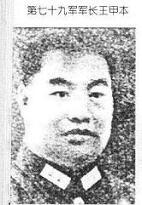 79th Corps Chief Wang Jiaben, who had thrusted to the proximity of northwestern Hengyang in July 1944, then rerouted to southern Hunan Province after Hengyang was lost on August 8th. On September 1st, the Japanese began to attack the 79th Corps at Lengshuitan of Dong'an. At dawn of September 7th, the Japanese plaincoats attacked the village where Wang Jiaben's command center was situated. Wang Jiaben and his pistol platoon soldiers died in the wrestling fights.
The Japanese took over Changsha and Hengyang of Hunan Province and threatened Guilin [Kweilin] and Liuzhou [Liuchow] of Guangxi Province.
To the south, 6000 Japanese moved out of Burma for attacking the Chinese Y-force in Lungling on Aug 26th, 1944. Chiang Kai-shek requested with Stilwell for an attack at the Japanese rear from Myitkyina, which Stilwell declined. In a rage, Chiang Kai-shek threatened to pull the Chinese Y-force out of the Burma Road for the other side of the Salween River. On September 8th, Stilwell wrote the word 'showdown' in his diary. Stilwell personally went over to deliver the ultimatum to Chiang Kai-shek on September 19th, 1944.
The Youth Army
Chiang Kai-shek launched a "Youth Corps Movement" called "100000 [educated] youths, 100000 soldiers" during the national crisis. The trigger was Chiang's discussion with Wu Tiecheng and Zhang Zhizhong to see whether the two chiefs, in charge of the KMT party and the Three People's Youth Corps, could mobilize 100,000 youth for joining the army as Chiang Kai-shek, since the eruption of war in 1937, had given the middle school students and college students the exemption from war draft.
At Zhang Zhizhong's suggestion, Chiang agreed to change the slogan to the army of the educated youth in lieu of party and youth corps' army.
Jiang Huiguo, i.e., the adopted son of Chiang Kai-shek, joined the 'youth army' as a battalion commander. Wang[1] Shichun's "Jiang Huiguo's Life Long Journey" stated that altogether 5 'youth army' divisions were organized. (In fact, over ten divisions were organized; however, most of the troops did not see battle action as the Japanese were to surrender soon.) Before this, beginning from 1939, already 3000 medical college students had participated in the war as military doctors; and in 1941, lots of engineering students had worked on highway pavement and weapon & ammunition manufacturing. (Foreign language school students would later be called as interpreters when the American pilots came to China.)
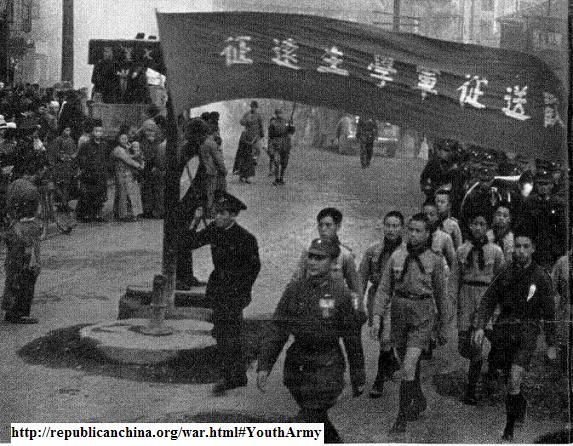
Men and women, including college students from the Politics University, etc., enrolled in the youth army, with each "youth corps" division comprising of 10,000 people. Sun Guodong had detailed descriptions of his enrolment in the "youth corps" and subsequent fighting in Burma under General Sun Liren (Sun Li-Jen).
Mme Chiang Kai-shek's Absence From China
In June 1944, the allied nations successfully landed in Normandy. In the Pacific, the debacle of Japanese navy led to the collapse of the Toyo cabinet in July.
 On June 21st, 1944, the U.S. Vice President, Wallace, came to see Chiang Kai-shek and emphasized the need of cooperation with the CCP in three rounds of talks. Wallace visits would make it possible for the U.S. "Military Observer's Mission", aka Dixie Mission, to visit Mao Tse-tung in Yan'an.
This turned out to be a Soviet scheme to turn around the events in China as the American mission, mostly pro-communist, later played the role of flying all communist commanders to the civil war battlefields from their hibernation and rectification movements in Yenan.
More, those pro-communist Americans stayed till the last minute that the Battle for Yenan was to start, serving voluntarily as human shields to make sure that the American planes would fly out all explicit-identity communists from the government-controlled areas to Yenan.
On June 21st, 1944, the U.S. Vice President, Wallace, came to see Chiang Kai-shek and emphasized the need of cooperation with the CCP in three rounds of talks. Wallace visits would make it possible for the U.S. "Military Observer's Mission", aka Dixie Mission, to visit Mao Tse-tung in Yan'an.
This turned out to be a Soviet scheme to turn around the events in China as the American mission, mostly pro-communist, later played the role of flying all communist commanders to the civil war battlefields from their hibernation and rectification movements in Yenan.
More, those pro-communist Americans stayed till the last minute that the Battle for Yenan was to start, serving voluntarily as human shields to make sure that the American planes would fly out all explicit-identity communists from the government-controlled areas to Yenan.
On July 5th, 1944, Mme Chiang Kai-shek flew to the U.S. again and then rerouted with her sister to Brazil in the same month. Two months later, Mme Chiang Kai-shek flew back to the U.S. again, possibly to see Wendell Willkie die away on October 8th, and did not return to China till September 1945. (Li Ao cited Lattimore's words, "This looked like an attempt to get away.")
The Battles Of Guilin & Liuzhou [Guangxi Province]
At Guilin, Li Jishen & Li Renren called upon people for a "donation under the national flag", and in the entertainment arena, Tian Han and Hong Shen, i.e., undercover communists, organized numerous shows. Xu Zhucheng stated that he was invited over as a "military analyst" in the capacity of a member of the "Da Gong Bao" newspaper; however, Chiang Kai-shek's agents soon intervened to disband Tian Han and Hong Shen groups for fear of the communist infiltration.
Tang Enbo's Nationalist Government Central Army was sent to Guilin for defense. Shi Jue's 13th Corps under Tang Enbo's 31st Group Army, which was the only army which had won battles against the Japanese in Dengfeng of Henan Province during the 'Central Plains' phase of the Japanese Ichigo Campaign in April of 1944, had trekked to Guizhou Province of southern China. Back in Henan Province, the communists spread the rumor of Tang Enbo army pillaging the people and listing the soundex of 'tang' [i.e., hot soup] as one of the three disasters together with the locust disaster and flood related to the Yellow River flooding. The Communists, similar to a slogan against the New 1st Corps in the civil wars, made up a sinister idiom stating that " [Henan People] would rather be killed by the Japanese than to see the 13th Corps come." Theodore White, the pro-communist American reporter, who received propaganda materials from the communist representative office direct, purportedly wrote about the famine in Henan, which was later compiled into the propaganda works "Thunder out of China."
The Nationalist Central Government dismissed the accusation after finding out that the complaint letters had come across the whole province of Henan, with most areas never inhabited or touched by the 13th Corps.
In Guilin, the leftists and under-cover communists accused Tang Enbo of adopting the "anti-people" approaches in dismissing the gentry-organized and spontaneous patriotic organizations, burning down buildings and structures for clearance of the war scenes, and forcing the Guilin people into asylum in the countryside. "Da Gong Bao" newspaper announced cessation on October 13th, and the staff began to leave Qixingyan [seven star cliff], a site that was selected by Hu Zhengzhi back in 1940. Overnight, the army came over to take over the husbandry holdings of "Da Gong Bao" and slaughtered all pigs for food. Xu Zhucheng did not specify which army took action in slaughtering their pigs.
(The truth was that Tang Enbo's army did not arrive in Guizhou Province till the end of 1944. It was the 29th Corps, not the 13th or 85th Corps, that first arrived at Southwest China by foot.)
Chiang Kai-shek, per Donovan Webster, promised to Wedemeyer that the Chinese would defend Guilin & Liuzhou for two months. The Americans claimed that "Guilin fell to Japanese on November 10th after one day's fighting." Per citation of reporter Theodore White, the Chinese army had two thousand usable guns for a unit of 14,000 soldiers and no ammunition; the rest of relief armies were in disarray as they spread across 500 miles in defense positions; however, soldiers in Guilin did not lack food as five such soldiers were observed to have been finishing up 15 bottles of wine in cheers at the northern gate, numbly waiting for the arrival of Japanese. At Guilin, local and provincial Guangxi Army had engaged Japanese in a ferocious battle that lasted days. The city fell after majority of defenders sacrificed their lives. Days later, Liuzhou, 100 miles to the south, was taken by the Japanese 11th Army.
With the coal supply cut off, locomotives on the Railway Qian-Gui had to use substitute like the tung oil for the engine. Locomotives often had difficulty climbing the steep segments of the Jinchengjiang-Dushan Railway. Wu Xiangxiang stated that lots of supplies were unable to be shipped to the west when the Japanese advanced from the east. Claiming that Frank Gleason of the O.S.S. had been blowing up bridges and everything to the west of Liuzhou, Donovan Webster stated that it was due to Frank Gleason of the O.S.S. blowing up 50,000 tons of ammunition in Dushan [i.e., Tushan, about 150 miles to the west of Liuzhou] that the Japanese herald troops called off a continuous campaign towards the west.
This was of course unfounded as the Chinese army raced to the defense of Southwest China.
From Guilin to Dushan of Guizhou Province, Xu Zhucheng and his "Da Gong Bao" staff first trekked to Liuzhou. At Liuzhou, Xu Zhucheng boarded a train that would have to pay the "checkpoint fee" at each stop for supplies like water. At a train station close to Nandan, the locomotive itself reverted to Liuzhou for coal replenishment. People then trekked to Nandan on foot and then continued on to Dushan and Guiyang. Xu Zhucheng claimed that he had heard from people who last fled Guilin that the soldiers had pillaged the city without putting up any significant fight against the Japanese. Other than the military debacle, Xu Zhucheng listed three more disasters on the road of retreat: i) a train collision at Liuzhou where editor-in-chief Zhong Qisen of "Sweeping Campaign Newspaper" died with his whole family; ii) a fire disaster at a Jinchengjiang dock of Nandan about two days after Xu Zhucheng's pass-through; and iii) the American planes' mis-dropping bombs on Liuzhai of Dushan. (Xu Zhucheng cited ancient saying: "You would rather be a dog at peace time than be a man at war time", something that would for sure apply to war-tormented Iraqi people. Xu Zhucheng was of course wrong about the Battle of Guilin, where two Guangxi Army divisions fought tenaciously and at great sacrifice.)
The Wallace Visit, the Stilwell Incident, Rifts Between the U.S. & China
John Service of the U.S. State Department at one time claimed to Roosevelt that Mao Tse-tung would be likely leader of China after the war, which purportedly led to the Wallace delegation to China on June 21st, 1944 as well as an American military mission to the communist base of Yan'an, i.e., the Dixie Mission. Henry A. Wallace later expressed concern that Chiang Kai-shek could become China's Kerensky after the war.
With the Japanese Ichigo in full swing in the spring, the Chinese communists gloated at the quick downfall of Chiang's central government, and moreover synchronized with the Japanese in making multiple-prong moves to intrude into the government-controlled area, that led to the bloodiest civil wars through the eight-year resistance war time period.
Meanwhile, the Soviets made provocations in western China in the spring of 1944.
The Soviets additionally struck an agreement with Japan
on March 30th in regards to Sakhalin fisheries, which allowed the Soviets to transfer the Siberian army to the European front and the Japanese Kwantung Army to transfer to China proper for the Ichigo Campaign.
The Americans dismissed the Chinese intelligence on the Kwantung army's movement through April-June.
"The whole range of Sino-Soviet relations had by May-June again become streaked with suspicion" per Feis, with Roosevelt and Hull both thinking that their work at Moscow, Cairo and Tehran "was about to come undone."
What happened here was that in addition to Soviet aggression in Xinjiang (Sinkiang) and rapprochement with Japan, the Soviet Red Army's planes fired on the Chinese troops pursuing the rebels at the border with Outer Mongolia on the pretext that the Chinese army crossed the border.
Chiang asked Roosevelt to intercede.
Roosevelt's reply on April 8th was noncommittal, pointing out that there were no further Soviet actions since the middle of March.
Roosevelt suggested to both parties that "... recent incidents be placed on ice" for the unity among the United Nations.
The Soviets had been demanding with China to repay the debts for the supplies it furnished China in the early years of war with Japan as well as compensation for the joint ventures it left behind in Xinjiang.
Another Soviet hostility was rejection of Harriman's request on April 22nd to allow the American air force's supplies to be transported through Soviet Central Asia.
Through the months of April-May, the Americans tried to calm the Generalissimo as to fear of the Soviet design and collusion with the Chinese communists.
Back
on March 17th and prior to the Ichigo Campaign, Chiang Kai-shek warned Roosevelt that the communist elements were preparing a march against Xi'an (Sian).
So when Harriman was in D.C. in May, Roosevelt asked Harriman to see Stalin for sake of drawing the two parties into friendly understanding.
Meanwhile, Roosevelt was to send Vice President Wallace to seeing Chiang Kai-shek.
Wallace was accompanied by John Carter Vincent, John N. Hazard and Owen D. Lattimore.
Harriman saw Stalin on June 10th, relaying the message that Roosevelt thought Chiang should be "encouraged first to seek a settlement with the Communists" and secondly "to liberalize his internal policies", according to the notes jotted down by Edward Page.
Stalin replied, "That is easier said than done", blasted Chiang as "poorish" best leader of China, who was surrounded by crooks or traitors and needed younger men who wanted to fight Japan to come to the fore, and discounted the Chinese communists as 'margarine' Communists (similar to Stalin's later adjectives like cabbage Communists or radish Communists) but "real patriots" that Chiang should rally under him to fight the Japanese together.
Stalin suggested that the Americans "should and could take the leadership" while neither Great Britain nor the Soviet Union could do much, some words which subconsciously brought out the collusion of the British and Soviets in the design on Asia and China.
Stalin warned that the Soviets would defend Outer Mongolia again, if China made provocation again, dismissed the rumored rapprochement with Japan as unfounded, and added that Soviet relations with China were guided by the same old 1924 Treaty of Friendship.
Harriman reported to Roosevelt about the Soviet stand on June 11th.
Harriman, before going to Tashkent and Alma Ata to converse with Wallace on June 15-17th, notified Molotov of what the Americans would do under Stalin's guidance which he thought would be interesting to Wallace, suggested that Wallace was to get Chiang to consent to dispatch of a small group of American observers to Yenan (i.e., the Dixie Mission), and would share information with the Soviets after the American observers reached Yenan and conducted talks with communists.
Harriman seemingly wanted to avoid Soviet suspicion as well as attempted to probe the Soviets as to intent to do the same, not knowing that the Soviets had a Vladimirov group and a telegraph set in Yenan for years.
Meanwhile,
Walter Lippman, taken by Feis to be part of the Soviet newspapermen circle, was spreading the words in the U.S. that the Soviets did not want trouble with the Americans over China though the Soviets took the area that the Chinese communists' control to be of strategic importance in the future Soviet military operations against Japan.
Without reading Harriman's report to Roosevelt yet,
the State Department, where Oliver Edmund Clubb (1901-1989) was working overload and had the endorsement of John Carter Vincent, et al., issued a motley directive to embassies in Moscow and Chungking on June 15th, with five points on the Sino-Soviet relations and U.S. views on Xinjiang, Outer Mongolia and Korea, etc., which were halfhearted and apathetic other than "Clause Four" that boldly and unscrupulously claimed that "The American government would like to see all Chinese forces--not merely part of them--used to fight Japan. Further, the American government was not committed to support the National Government of China in any and all circumstances."
Clarence Edward Gauss (1887-1960) then informed the Chinese government of the guiding principle, which was to invoke the communists for fighting the Japanese and take steps to repair relations with the Soviets.
Clubb, for his pro-communist work in the China Affairs Division, was to be picked by McCarthy in the 1950s as a culprit for "Who Lost China."
Henry A. Wallace, after touring Eastern Siberia and Outer Mongolia, came to China and held talks with Chiang through June 21st-24th.
On June 21st, Wallace claimed that the Soviets had no territorial ambitions in the Far East, which he amended two days later to acknowledge Dairen.
The second day, Chiang countered Wallace with a lengthy complaint about the communists, saying the Communists were "internationalists", and when Wallace mentioned what Harriman relayed as to what Stalin took the communists as margarine, Chiang replied that the Chinese communists were "more communistic than the Russian Communists" while using agrarian democrats as a cloak.
Chiang repeated the two conditions of united military command and united administrative command as to the communists' problem.
Wallace and Chiang talked about the communist propaganda and the American progaganda both in China and in the U.S.
For two days in a row, on the 22nd and 23rd, Chiang expressed doubts as to the usefulness of the communist army.
When Wallace expressed shock that the communists wanted to see the National Government collapse under the assault of the Japanese Ichigo Campaign, Chiang added that he meant that the communists wanted to see the Japanese defeating the government and then take it back from the Japanese; otherwise, should the Japanese be defeated, the communists would not have a chance to defeat the government and take the country.
Chiang singled out the American army as supporting the Chinese communists.
On the 23rd, Chiang, Mme Chiang and T.V. Soong prodded Wallace with Roosevelt arbitering a North Pacific conference to bring the Soviets and Chinese together.
On the 24th, while accompanying Wallace to the airport, Chiang wanted Wallace to relay to Roosevelt that he wanted a political solution.
Wallace, coming to China with Roosevelt's mandate to "get the Chinese Nationalist and Communist armies to stop fighting", persuaded Chiang into allowing the Dixie Mission to go to Yenan.
Chiang agreed to the mission on the 23rd on the condition that the group go to Yenan under the auspices of the Chinese National Military council.
In summary, Wallace reported to Roosevelt
that Chiang was sure that there was intimate association between Moscow and Yenan (i.e., Vladimirov's team);
that Chiang had confidence in his armies holding out against the rumored collapse though some troops "sometimes gave up" to no surprise as they "had been fighting for seven years under conditions of great hardship" and "felt deserted" by allies abroad - listing Roosevelt's broken promises since the Cairo conference;
that the military situation that happened in 1944 was like what he predicted to Roosevelt;
that Chiang lacked confidence in General Stilwell's judgement;
and
that Chiang though the reform measures were postponable and not "essential to keep control of China during the war or to win the war."
Chiang was very unsatisfied with Stilwell for the refusal to divert the gasoline to the air fights during the early stages of the Henan (Honan) campaign, i.e., the first stage of the Japanese Ichigo Campaign.
Stilwell took the Chinese air force's need for gasoline as a waste in his report to the War Department.
Later in the hearings of the 1950s, Wallace acknowledged that he was "deeply moved by the cry of a man in distress."
Wallace, in light of the irreconcibility between Chiang and the communists, recommended a coalition without the communists but including the elements not subservient to the landlords to bring about the semblance of a united front.
Wallace took Chiang's suggestion to station an American presidents' personal representative in Chungking like Sir Adrian Carton de Wiart, and this appointee better be done sent then before East China, together with the air bases, was to be lost to the Japanese -- which he estimated to happen in three or four weeks.
In lieu of Wallace's candidates, Roosevelt sent Patrick Jay Hurley to China.
On July 6th [July 7th per Zhang Ling'ao], 1944, Franklin Roosevelt wired to Chiang Kai-shek with a suggestion that Joe Stilwell, now promoted to four star general, be empowered as commander-in-chief of the War in the China Theater. 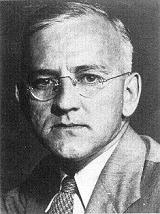 Back on July 21st, 1942, President Franklin Roosevelt's emissary, Launchlin Currie, arrived in Chungking a second time. Launchlin Currie had been authorized to investigate into the historical disputes between Chiang & Stilwell, with a decision that Stilwell concentrate on training the Chinese soldiers in India and report to Chiang Kai-shek in the name of "tactician-in-general" [Chief of Staff Strategists] for the Chinese war theater.
The conflicts between Chiang and Stilwell continued unabated.
T.V. Soong, being allowed to come to the Quebec (August 17-24, 1943) Meeting as a non-attendant, talked to numerous people including Hornbeck and Hopkins, et al., and got Roosevelt's oral approval to recall Stilwell.
However once back in China, the British threatened not to go ahead with the Burma operations with Stilwell.
Stilwell, with tips from Marshal, managed to bribe Mme Chiang Kai-shek and Mme Kong Xiangxi to ward off the dismissal request by Chiang Kai-shek; however, T.V. Soong (Soong Ziwen went into a quarrel with Chiang Kai-shek over Stilwell, claiming that he would lose his credibility with those American friends who helped to oust Stilwell.
T.V. Soong so offended Chiang that he was put in quasi-house rest through the end of the year and disqualified for the coming Cairo Meeting.
(Those 'friends' who helped T.V. Soong were no friends but Soviet spies, but Soong did not know that the top tier Soviet spies had a mandate from Stalin to keep China in the war, a mandate that was apparently different from that for the small potato spies whose job was to sabotage against the Chinese government.) Back on July 21st, 1942, President Franklin Roosevelt's emissary, Launchlin Currie, arrived in Chungking a second time. Launchlin Currie had been authorized to investigate into the historical disputes between Chiang & Stilwell, with a decision that Stilwell concentrate on training the Chinese soldiers in India and report to Chiang Kai-shek in the name of "tactician-in-general" [Chief of Staff Strategists] for the Chinese war theater.
The conflicts between Chiang and Stilwell continued unabated.
T.V. Soong, being allowed to come to the Quebec (August 17-24, 1943) Meeting as a non-attendant, talked to numerous people including Hornbeck and Hopkins, et al., and got Roosevelt's oral approval to recall Stilwell.
However once back in China, the British threatened not to go ahead with the Burma operations with Stilwell.
Stilwell, with tips from Marshal, managed to bribe Mme Chiang Kai-shek and Mme Kong Xiangxi to ward off the dismissal request by Chiang Kai-shek; however, T.V. Soong (Soong Ziwen went into a quarrel with Chiang Kai-shek over Stilwell, claiming that he would lose his credibility with those American friends who helped to oust Stilwell.
T.V. Soong so offended Chiang that he was put in quasi-house rest through the end of the year and disqualified for the coming Cairo Meeting.
(Those 'friends' who helped T.V. Soong were no friends but Soviet spies, but Soong did not know that the top tier Soviet spies had a mandate from Stalin to keep China in the war, a mandate that was apparently different from that for the small potato spies whose job was to sabotage against the Chinese government.)
On June 5th, when Chiang called Stilwell to Chungking about providing the 14th Air Force with oil that was diverted to the Burma war and Matterhorn, Stilwell told Chiang to mobilize all of China's ground and air resources, including the communist army.
Thinking that Stilwell was inclined for arming the communist forces and hijacking the Nationalist government, Chiang Kai-shek had been resisting Roosevelt's suggestion for months, even though U.S. Vice President Henry Wallace came in late June and Patrick Hurley came on September 6th with the U.S. president's message. Chiang asked Kong Xiangxi (HH Kung) mediate over the matter by contacting Hopkins, a Soviet spy, ending in the mission of special envoy Hurley to China. Patrick Jay Hurley, promoted (1944) to major general, was sent to China as envoy and proxy ambassador in Aug 1944. American ambassador Gauss [Gao-si], who was pro-communist, returned to the U.S. in Sept.
As pointed out by Herbert Feis, Roosevelt did not give Hurley an explicit mandate, nor did the U.S. State Department ever issue a guideline for Hurley, and Hurley claimed to be a personal representative of Roosevelt, and nothing more than that.
Herbert Feis, who was empowered with sorting out the mess at the U.S. State Department under authorization to review all documents and communications, concluded that employees at the State Department had numerous standgrounds, and noted John Carter Vincent (i.e., Fan-xuan-de)'s particular point that the U.S. government should keep elasticity as to support for Chiang Kai-shek so that the U.S. could have a chance to work with the Chinese communists should Chiang Kai-shek be ousted.
After receiving the American president-stamped September 18th order which was the result of the facilitation of a friend [Marshall] in the U.S. military back in D.C., Stilwell rushed to Chiang Kai-shek's office with an ultimatum without regard for the persuasion from Hurley. Hurley was telling Stilwell that they had just completed the paperwork, with Chiang's approval, to grant the military command of all Chinese armies to Stilwell.
As recalled in testimony in Joint Committee on Military Situation in the Far East, Hurley, at the porch outside, told Stilwell, "You shouldn't now because of this firm language pile it on him at the time when he had felt compelled to make every concession that we have asked. He had made them; he is ready to go; he is ready to bring troops down from the north to reinforce you on the Salween front; he is going to appoint you commander-in-chief."
Stilwell arrogantly told Hurley that he had no right to delay the U.S. President's order, saying that "Well, I am directed by the President to deliver this."
Stilwell asked Zhu Shiming (Chu Shih-ming) to translate Roosevelt's message to achieve the effect of humiliating Chiang in front of all meeting attendants. Hurley asked whether there was a Chinese version and fetched a copy to pass on to Chiang. As recalled by Hurley, Chiang was like being hit in the solar plexus, and showing no emotion, Chiang said he understood and then put tea cup on upside down to hint at the end of the meeting, to which Stilwell asked whether this meant the party was over.
Stilwell, again a sick man who suffered from Sigmund Freud's Oedipal complex symptom and who repeatedly described Mme Chiang Kai-shek as "Snow White" in his dogshit diaries, later jotted down a poem (i.e., what George Creel termed by Stilwell's doggerel) in his diaries with words:
I have waited long for vengeance,
At last I've had my chance,
I've looked the Peanut (i.e., Chiang Kai-shek) in the eye
And kicked him in the pants.
The old harpoon was ready
With aim and timing true,
I sank it to the handle,
And stung him through and through.
The little bastard shivered,
And lost the power of speech.
His face turned green and quivered
As he struggled not to screech.
For all weary battles,
For all my hours of woe,
At last I’ve had my innings
And laid the Peanut low.
I know I’ve still to suffer,
And run a weary race,
But oh! the blessed pleasure!
I’ve wrecked the Peanut’s face.
Stilwell, surrounded by the Comintern agents from the Institute of Pacific Relations, had constantly complained that Chiang Kai-shek refused to relocate Hu Zongnan's forces away from Shenxi Province where a blockade of the communist army was in effect for years. Indeed, during the Ichigo Campaign in the spring of 1944, the communist forces penetrated into the mountains where the Nationalist Army had withdrawn and attacked the compatriots instead of the Japanese. (Li Ao, i.e., a pro-communist stud in Taiwan, gloated that Chiang Kai-shek's efforts at recalling partial of the Chinese Expedition Forces from Burma antagonized Roosevelt so much that Roosevelt threatened Chiang with suspension of all [limited] U.S. military supplies in a letter that Stilwell passed on to Chiang Kai-shek on September 19th, 1944 against the objection of Hurley. With the Nationalist Army weakened by the Ichigo Campaign, the communists dispatched Wang Zhen and two brigades to the Hunan-Guangdong provincial border for launching an enclave.
Mao in 1944 interrupted the Rectification Movement to send lieutenants to Henan to launch a communist enclave, ordered Peng Xuefeng to attack west from Jiangsu-Anhui borderline, and sent Wang Zhen to southern China.
The communist N4C, in late 1944, emptied its troops in northern Jiangsu base, and mounted a cross-Yangtze campaign back to the southern bank to fight against the government troops in an atrocious bloody civil war that lasted till months after the Japanese surrender, with targets set at re-establishing the Anhui-Zhejiang-Jiangxi soviet enclaves.
All this was after the communists reached some agreement with the Japanese who extradited Li Desheng, a Sorge-related prisoner, from prison in Tokyo, for travel to the New 4th Army headquarters in Luhe to strike a deal to attack the Chinese government troops.)
Videos about China's Resistance War: China's Dunkirk Retreat (in English);
42 Video Series (in Chinese)
Stilwell, the slimy who itched "to throw down ... shovel and get over there and shoulder a rifle with Chu Teh" [i.e., the communist commander-in-chief], before his kickout from China,
paid a visit to Mme. Sun Yat-sen, the No. 1 Comintern agent in China.
George Marshall quit his job twice, J.I.T (just in time), in anticipation of some pre-arranged phonecalls from Truman to tack on the jobs as 1) first the mediator in the Chinese civil war
and ii) secondly as defense minister [by kicking out defense minister Johnson] during
the Korean War, respectively.
George Marshall returned Zhou Enlai's address book to Zhou Enlai, while never alerting Chiang Kai-shek of communist spies like Xiong Xianghui.
While Currie stopped the German weapons of the European battlefield from shipping to China and Truman dumped China's Lend-Lease weapons to the Indian Ocean, Dean
Acheson and George Marshall personally pushed for the 1946-47 arms embargo against China and imposed three ceasefire onto the Chinese government,
on Jan-10-1946, June-6-1946, & Nov-8-1946.
Marshall deliberately flew back to China in the spring of 1946 to stop the Chinese Nationalist troops from chasing the disarrayed communists north of the Sungari River. This is how CHINA WAS LOST.
At this moment, the commies had rallied henchmen against Mr. Xin Haonian's book Which Is New China by repeatedly citing the writings of John Fairbank and the sort. This webmaster, though not agreeing with the said book on all accounts, does want to point out that John Fairbank and most of the "Old China Hands", being of anti-Chinese-nationalism in nature, were the "fellow travelers" of the communists and British colonialists
since the OSS/CIA days of the 1940s-50s. The best argument against the Chi-com would lie in the continuing exposition of i) the Russian/Comintern conspiracies against China, and ii) the century-long American hypocrisy towards China &
American manipulation of Chinese politics [e.g., Stilwell's instigating General Bai Chongxi, Stuart's instigating Li Zongren, and McArthur's instigating General Sun Liren].
|
|
|
The Wuhan Gang & The Chungking Gang, including Joseph Stilwell, Agnes Smedley, Evans Carlson, Frank Dorn, Jack Belden, S.T. Steele, John Davies, David Barrett and more, were the core of the Americans who were to influence the American decision-making on behalf of the Chinese communists.
It was not something that could be easily explained by Hurley's accusation in late 1945 that American government had been hijacked by
i) the imperialists (i.e., the British colonialists whom Roosevelt always suspected to have hijacked the U.S. State Department)
and ii) the communists. At play was not a single-thread Russian or Comintern conspiracy against the Republic of China but an additional channel
that was delicately knit by the sophisticated Chinese communist "agrarian reformers".
|
|
The Chinese communist agents on international arena would include Chen Hansheng [i.e., Owen lattimore's assistant]; Mme Sun Yat-sen [who acted as the intermediary between the domestic and international communists]; Wu Kejian & Xie Weijing who orchestrated the Chinese communist relief to the Spanish Civil War; and Wang Bingnan whose German wife "physically" won over the hearts of the above-mentioned Americans by providing the wartime 'bachelors' with special one-on-one service. Though, Anna Wang [Anneliese Martens], in her memoirs, expressed jealousy over Gong Peng by stating that the Anglo-American reporters had flattered the Chinese communists and the communist movement as a result of being entranced with the goldfish-eye'ed personal assistant of Zhou Enlai.
|
|
|
After 60 years, the crap about corruption of the Chiang Kai-shek's regime was so deeply rooted in the American academics that even the publication of the VENONA scripts would not make someone to rethink.
Some American senator talked about McCarthyism, while McCarthy had been proven to be right in 99% of the cases he prosecuted. Some other U.S. senator talked about "gung ho" recently, while not knowing what "Gung ho" was meant for. Let's be clear here: "gung ho" was not Evans Carlson's marine commando team in the Pacific Islands but a Comintern scheme to launder money to Yenan, totaling 20 million USD at minimum from Chen Hansheng's operations with the U.S. communist front organizations 1939 to 1941 plus more afterward, as well as a CCP underground tunnel (to use the same word as the American Black slaves' escape route to the north prior to the north-south war), on which road the CCP agents freely travelled around FREE CHINA by riding on the "gung ho" trucks; more, in Jiangxi, the anti-Japanese war base as well as the former Red Army enclave, the "gung ho" gangs were secretly training the cooperative workers to be anti-government insurgents to echo the raging civil wars that were going on along the Yangtze and in North China, which saw the communist Eighth Route Army and New Fourth Army slaughtering hundreds of thousands of village elderlies, county magistrates, government guerrilla forces, and patriotic gentry-organized forces.
Now all this was done prior to the Pacific War. But due to Stalin's demand for maintaining the CCP-KMT collaboration scheme, Mao and the communists dared not publicly talked about civil wars. Should they secretly take out the government guerrillas, they would make sure that no messenger would live to escape from the communist territory to tell the truth. Zhao Tong, and 200+ guerrillas, including his sister and dozens of female fighters, were run down by the communist cavalry, and killed to the last person while travelling towards Jehol. Who was Zhao Tong? He was the son of double-gun Mme Zhao, whom the same Wuhan and Chungking gangs, Theodore White and Annalee Jacoby's predecessors, had interviewed and talked about in the media both in China and over the world, a war hero fighting Japanese in Jehol since 1932-1933, and a Youth party member and later a statist member.
(Note that the Jehol area used to be the guerrilla army under Youth Party leader Zhao Tong who fought against the Japanese since 1931-1932. To prevent Zhao Tong's Jehol Vanguard Army, about 200-300 men and women, from returning to Jehol from Chungking, the communist armies, with advance information from communist leader Zhou Enlai who superficially participated in the farewell ceremony for the march of the vanguard army in Chungking, pooled resources all over the military districts including Heh Long's communist army from northwestern Shanxi and Suiyuan area, and ambushed and eliminated the vanguard army in the tri-provincial area of Shanxi-Henan-Hebei around the turn of 1939-1940.
The communists, in the Chahar-Suiyuan area and around Mt. Daqingshan [the great green mountain], had conducted similar horrifying campaign against the patriotic guerrilla forces, including the fire attack that killed a 90-year-old former Northeastern Cavalry Army corps commander and his guerrilla army, and furthermore attacked and eliminated KMT party operator Chen Jianzhong's party-directly-controlled guerrilla forces and all couriers who were sent through the communist-controlled territories of Shanxi-Shenxi, with Chen Jianzhong being the sole survivor to return to Chungking in disguise.)
After the Pearl Harbor, Stalin no longer cared about China's role in WWII. So the order changed, which was to say that Comintern agents had the free hand to bad-mouth China, with no penalty as imposed before the Dec 1941 Japanese attack at the Pearl Harbor. Hence you see Theodore White and Annalee Jacoby, and the gangs, writing the venomous articles against China. Theodore White was one of the top 3-4 playboys in wartime Chungking, and like John Fairbank, enjoyed "stalking" communist mouthpiece Gong Peng, the little black widow and Zhou Enlai's secretary, on the streets of Chungking. And you have Martens, the German communist, who provided one-on-one sexual service to those wartime American bachelors. I read through the craps by Theodore White and Annalee Jacoby just to find out who those guys cohorted with, and how they went around Free China, etc. My findings are the Theodore White gang always lived near the whorehouses, or one storey above the whorehouse, and this guy Theodore White at one time had a rendezvous with some Chinese general's concubine in a vacated hotel while the Japanese planes were dropping bombs over the whole city and people were fleeing to the bunkers. And another gang member was notorious in using the Hostel, a place the KMT government subsidized the international press rascals with a maximum cost of $1 and $3 for meals and lodging daily, as a daily party room to have fun with Chinese women. What you had were passages after passages of writings about the gang's whoring, and that's probably why Miles said he had thousands of pages of details on the gangs' antics and all those materials were locked up in the U.S. Navy's underground confidential room. From Rand's book, you could tell how those guys flew back and forth, between the U.S. and China, had liaison with the Comintern and CPUSA/CCP agents, like Yang Gang and Yang Zao pseudo brother and sister, even inviting the CCP "guest" to their home in New England; and of course the gang was responsible for hiring the CCP agents as translators and interpreters to work on the OSS watch and listen posts along the southeastern Chinese coastline. What a deal.
(For example,
Larry Wu-tai Chin, i.e., the top CCP mole inside of the U.S. and the CIA since the 1940s, first worked for the American OWI in Fuzhou (i.e., John King Fairbanks' CPUSA-dominated Office of War Information) in 1944, infiltrated into the American consulate in Shanghai in 1949, relocated to Hongkong in 1950, worked as translator in the Korea POW camps in 1951, entered the CIA in Okinawa in 1952 and relocated to the CIA office in Santa Rosa, California in 1961.)
Now, more to that. Almost all gang members were reaping profit by smuggling and selling scarce commodities, utilizing the black market rate of 1 USD to 120 CNC. The gangs made a killing and reaped huge profits, smuggling lipsticks for the sing-song women of Guilin, who were known to be Japanese spies. Some gang members purportedly had a "platonic" love club, with one CCP agent joining the drunkards' club to talk about love. While Theodore White and Annalee Jacoby returned to the U.S. to write a best-seller, arguing among themselves about who should put the name on the book and who should take the credit, the other gang members thought about having some fun in the outpost China and flew to the Chinese Turkistan to bad-mouth China which was defending itself against years of harassment wars conducted by Eastern Turkistan rebels and instigated by Stalin after China kicked out the Russians by taking advantage of the German invasion of the Soviet Union.
(The creeps were not merely fooling around with the women. They were engaged in the commercial smuggling of China's antiques.
Most notable would be the 1942 Zidan-ku Bo-shu (i.e., the Chu[-di] Silk Manuscript from the bullet weapons depot.
The Zidan-ku Bo-shu silk manuscript, which was dug out by the tomb raiders who took advantage of the city wall defense work in-between the Changsha campaigns, was smuggled to the United States by John Hadley Cox of the Yali Middle School (part of the Yale-in-China school system) and his OSS accomplice Frederic D. Schultheis, at a 10% deposit money to collector Cai Jixiang.
This piece of artwork, which was against the late will of the last collector to return to China, is now with
the Arthur M. Sackler Gallery, part of affiliation with the Smithsonian Institution's national museums of Asian art.
This webmaster, to pour some cold water onto the Arthur M. Sackler museum as to the Chu[-di] Silk Manuscript's value, wants to emphasize the meaning of the 'di' [land] suffix to point out that this piece of artwork was a Han dynasty product that was excavated from the former Chu Principality's land, not an actual Eastern Zhou dynasty product.
Read this webmaster's writing on
Pre-History, Xia, Shang, Zhou, Qin, and Han dynasties for the intricacy about the stages of Sinitic cosmological, astronomical, astrological and geographical development.
The Sinitic Civilization - Book I is on
Barnes & Noble,
Amazon,
Google Play|Books
and
Nook Book.
Book II is
available now on
Amazon
and Barnes & Noble.
Refer to
Table of Contents - Book I (Index)
and
Table of Contents - Book II (Index)
for details.)
Like to ask you spend some time on E.J. Khan, Peter Rand and Theodore White's books, and see how those creeps joined hands with the Comintern and CCP agents to sabotage China, and made China what it is today, i.e., billion coolies and slaves working to death for the multi-national corporations and international banksters. And of course read Dorn's book to know Marshall and Stilwell's scheme to assassinate Chiang Kai-shek.
The American Involvement in China: the Soviet Operation Snow, the IPR Conspiracy, the Dixie Mission, the Stilwell Incident, the OSS Scheme, the Coalition Government Crap, the Amerasia Case, & The China White Paper
[Modified : Monday, 25-Feb-2013 22:00:00 EST]
|
|
* In Commemoration of China's Fall under the Alien Conquests in A.D. 1279,
A.D. 1644 & A.D. 1949 *
U.S.S.R./Comintern Alliance with the KMT & CCP (1923-1927)
Korean/Chinese Communists & the 1931 Japanese Invasion of Manchuria
American Involvement in China: Soviet Operation Snow, IPR Conspiracy, Dixie Mission, Stilwell
Incident, O.S.S. Scheme, Coalition Government Crap, Amerasia Case & The China White Paper
* Stay tuned for "Republican China 1911-1955: A Complete Untold History" *
|
|
Zou Rong's Revolutionary Army;
Shin Kyu Sik's
Shrine (Spirit, Kunitama) of Korea
|
This snippet is for sons and daughters of China:
Heed the sons & ministers' agony and sorrow of our ancestors who died or lived through the Mongol, Manchu and Soviet-Chicom conquest
and
the Yongjia, Jingkang and Jiashen cataclysms !
Jeanne d'Arc of China:
Teenager girl Xun Guan breaking out of the Wancheng city to borrow the relief troops in the late Western Jinn dynasty;
Liu-Shao-shi riding into the barbarian army to rescue her husband in the late Western Jinn dynasty;
teenager girl Shen Yunying breaking into Zhang Xianzhong's rebels on the horseback to avenge on father's death in the late Ming dynasty.
China's Solitary and Lone Heroes:
Nan Jiyun breaking out of the Suiyang siege and charging back into the city in the Tang dynasty;
Zhang Gui & Zhang Shun Brothers breaking through the Mongol siege of Xiangyang in the Southern Soong dynasty;
Liu Tiejun breaking through three communist field armies' siege of Kaifeng in the Republican China time period;
Zhang Jian's lone confrontation against the communist army during the June 3rd & 4th Massacre of 1989.
|
|
|
Hurley advised Chiang to take time to think over Roosevelt's message.
Stilwell on the 22nd and 26th wired to Marshall as to maintaining pressure.
In-between, Stilwell, over Chiang's silence, discussed with Hurley about a compromise proposal on the 23rd, namely, that Stilwell be sent to Yenan to get the Reds to acknowledge Chiang's authority, that five communist army divisions be used north of the Yellow River, and that the political matter be deferred till the Japanese were defeated.
Chiang, no longer wanting Stilwell in China, drafted a message for Roosevelt on the 19th, and sent the aide-memoire to Roosevelt via Hurley on the 25th, stating that dissension would continue as long as Stilwell remained in China and suggested to send another American commander.
A meeting was held by Chiang Kai-shek on September 28th to break away from cooperation with the U.S. since Stilwell had threatened to withdraw all U.S. personnel from the Chinese battlefield previously. Chiang Kai-shek, however, countered the insult with a demand on September 25th that Stilwell must be replaced.
On September 28th, Stilwell offered to drop the idea of using the Communist army and promised to bring back the Yoke force from Burma as soon as possible.
Soong informed Gauss that the break between Stilwell and Chiang was beyond repair.
Back in the U.S., Marshall composed a message in the name of the Joint Chiefs on the 28th for propping up Stilwell with threat that Stilwell's removal "would prejudice the American inclination to continue to help China and Chiang Kai-shek personally", a message that Roosevelt vetoed.
Stimson was sympathetic to Stilwell for being pecked at from two sides by the British and Chinese.
Soong wired to Hopkins about his fear of Sino-American relations, and asked Hopkins to intercede again as he did in 1943.
Kung, after talking with Hopkins, wired to Chiang that Hopkins said that Roosevelt would allow Stilwell to be recalled but had not discussed the matter with Marshall and would respond to Chiang's message of the 25th.
Soong informed Hurley of Kung's radiogram, and Hurley at once told Stilwell about it, as recorded in Stilwell's diaries on October 2nd.
When Hurley on October 6th inquired with Roosevelt about the accuracy, Hopkins denied it.
From September 25th to October 19th, Chiang Kai-shek was in agony per Zhang Ling'ao: Japan, after routing the Chinese forces in the Hunan-Guangxi Campaign, were threatening Guilin & Liuzhou as well as Kunming, whereas Stilwell refused to dispatch Wei Lihuang's Chinese forces (i.e., the Y-force) to Kunming or attack Bhamo of Burma from Myitkyina with the X-force as a distraction. Stilwell countered Chiang Kai-shek by claiming that Chiang Kai-shek should relocate Hu Zongnan's troops away from the encirclement of the communist forces since the communists had promised to attack the Japanese in Hankou of Hubei Province from Shanxi-Henan provinces should they receive the U.S. equipment.
The truth was that communist generals, such as Pi Dingjun, who just finished chasing women in Yenan and got married under the arranged matrimony through senior communist leaders, were en route to the areas of Henan-Shanxi provinces to launch the communist enclaves by taking advantage of the Japanese campaign.
On the night of October 10th, Hurley reported to Roosevelt the bad blood between Chiang and Stilwell through a special Navy channel that circumvented around George Marshall's War Department, with an admonition to the effect of either losing Chiang Kai-shek & China or losing Stilwell. On October 19th, Roosevelt replied to Hurley to have Stilwell recalled. Stilwell returned to the U.S. on October 25th via New Delhi after inspecting on his Chinese expedition forces in Myitkyina on October 20th. Service, B. Atkinson & Theodore White ["Bai Xiude" in Chinese], some being members of the four-person playboys in wartime Chinese capital Chungking, who accompanied Stilwell home, then blasted Chiang Kai-shek as 'peanut' in the U.S. media. Roosevelt dispatched Albert Wedemeyer as a replacement.
Chiang Kai-shek, deeply resentful over Stillwell over the monopolizing right over the U.S. Lease goods and equipment, had wrongly treated Stilwell without knowing the crony relationship between Stilwell and Marshall. 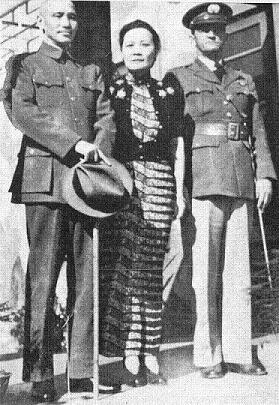 Meanwhile, Chennault was accused by Stilwell of having proposed to defeat Japan with merely 500 fighter planes. Throughout the war, Stilwell had only equipped the Chinese expeditionary forces in India [i.e., X Force] and partially equipped Stilwell's Chinese Y Force that was supposedly to come out of the Yunnan-Burmese border; however, the U.S. offer to equip 60 divisions of Chinese army never materialized.
A perusal of the American list of weapons supplied showed that the Y-force had merely received some heavy equipment from the Americans while the light weapons were mostly China-made.
With Stilwell's success in the Myitkyina Campaign against the Japanese, Chiang Kai-shek, privately thinking that it was built on top of tens of thousands of Chinese deaths, blamed the debacle of the Xiang-Gui [Hunan-Guangxi] Campaign on Stilwell's relocating the crack forces towards Burma. Chennault, after wrestling over control over the U.S. 14th Flight Group through Wilkie's mediation with Roosevelt direct, also believed that China would not suffer the Xiang-Gui debacle should Stilwell have steered enough of the U.S. Lease Act goods to his airforce in China. Per Donovan Webster, at one time during the Xiang-Gui [Hunan-Guangxi] Campaign, Stilwell was called over to Chiang Kai-shek's mansion where Chennault complained that his pilots had to moor the planes on the airfield for lack of aviation oil, but Stilwell did not even wink about it. Meanwhile, Chennault was accused by Stilwell of having proposed to defeat Japan with merely 500 fighter planes. Throughout the war, Stilwell had only equipped the Chinese expeditionary forces in India [i.e., X Force] and partially equipped Stilwell's Chinese Y Force that was supposedly to come out of the Yunnan-Burmese border; however, the U.S. offer to equip 60 divisions of Chinese army never materialized.
A perusal of the American list of weapons supplied showed that the Y-force had merely received some heavy equipment from the Americans while the light weapons were mostly China-made.
With Stilwell's success in the Myitkyina Campaign against the Japanese, Chiang Kai-shek, privately thinking that it was built on top of tens of thousands of Chinese deaths, blamed the debacle of the Xiang-Gui [Hunan-Guangxi] Campaign on Stilwell's relocating the crack forces towards Burma. Chennault, after wrestling over control over the U.S. 14th Flight Group through Wilkie's mediation with Roosevelt direct, also believed that China would not suffer the Xiang-Gui debacle should Stilwell have steered enough of the U.S. Lease Act goods to his airforce in China. Per Donovan Webster, at one time during the Xiang-Gui [Hunan-Guangxi] Campaign, Stilwell was called over to Chiang Kai-shek's mansion where Chennault complained that his pilots had to moor the planes on the airfield for lack of aviation oil, but Stilwell did not even wink about it.
James & Marti Hefley's The Secret File on John Birch proved that Stilwell from beginning to end, wanted to see China and Chiang Kai-shek defeated even at the cost of death of American pilots from the AVG and the 14th Flight Group.
Hefleys, who wrote the Birch book before the age of political correctness, cited numerous American pilots in blaming on Stilwell for the death of American pilots.
On May 1st, 1945, the War Department, under the pretext of reorganization, forced Chennault into retirement right after protector Roosevelt's death.
George Edward Stratemeyer (1890-1969) was sent by Marshall and Arnold to the replacement, depriving Chennault of the V-J glory.
Chennault (1893-1958) left China on August 8th, 1945, learning of the Japanese surrender while going half way to home in the United States, and was not invited to the Japanese surrender ceremony on the Missouri.
Later in 1946 Chennault returned to China to run a transportation company (i.e., the Civil Air Transport), and before he passed away in 1958, was honored with the rank of a lieutenant-general from President Eisenhower.
George Marshall, who conspired to force Chennault into retirement or resignation in early 1945 for avenging Stilwell's recall, later sealed the John Birch Murder file so as not to arouse the American public's indignation against the Chinese communists.
Marshall was to continue to sabotage the United States' policy during the Korean War, i.e., devising the scheme for President Truman to fire General MacArthur.
General MacArthur, however, wrongly thought it was the British communists who forced Truman to fire him.)
Both Stilwell and MacArthur had suffered from a revenge mentality over their humiliation in the loss of the Philippines and Burma, respectively. To fulfill the ego, e.g., "I shall return [to Manila]", MacArthur had overturned Admiral Nimitz's plan to attack Taiwan & Mainland China by orchestrating the campaign against the Philippines [see Gerhard L. Weinberg's "A World At Arms"].
Stilwell, who deliberately underestimated the Japanese army's military strength in Burma for sake of pushing through the Burma Campaign agenda, did draw in the Japanese army which
at the turn of February-March, 1944, launched a proactive attack against the central British-Indian front at Imphal and Kohima, and forced the reluctant British into fighting the Burma war.
Similarly,
MacArthur, insisting on a return to the Philippines, changed the developments of war in conducting an audacious Leyte Campaign in central Philippines on October 20th, 1944, rather Mindanao, that drew in Toyoda Soemu's remnants of the Japanese Combined Fleet.
The end result was destruction of three Japanese battleships, two aircraft carriers, and eighteen cruisers and destroyers.
The American submarines ambushed Kurita Takeo's Central Japanese Fleet Force in the meandering straits towards the east coast of Leyte and destroyed warships including flagship Atago and battleship Mushashi while the Japanese were attempting to sail through the Sibuyan Sea for Leyte;
Thomas Kinlaid's Seventh Fleet defeated Nishimura Shoji's Southern Japanese Fleet Force at the Surigao Strait entrance to the Leyte Gulf and destroyed the flagship Yamashiro, etc.;
Kurita's Central Japanese Fleet Force, emerging from the San Bernardino Strait to arrive at the northern approach to the Leyte Gulf, fought a bloody battle to the standstill against Clifton Sprague's U.S. Carrier Group that lacked the protection of the Third Fleet lured away by Ozawa's Northern Japanese Fleet Force, with escort carriers Gambier Bay and St. Lo destroyed or damaged;
and Bull Halsey's Third Fleet
pursued Ozawa Jisaburo's Northern Japanese Fleet Force
and destroyed aircraft carriers Zuikaku and Zuiho, among other warships.
The Stilwell Incident, per Zhang Ling'ao, would lead to Roosevelt's dark-box operation, i.e., betraying China's interests to the U.S.S.R. Zhang Ling'ao stated that the U.S. privately believed that should Japan surrender, the puppet forces might throw themselves into the communist camp, hence strengthening the communist forces; that Marshall intended to incorporate the communist forces under the omnipotent U.S. helm for fight against Japan; that the U.S. contacted Joseph Stalin in request of an airport inside the Russian territory for attacking the Japanese; and that the U.S. believed that they had better give Manchuria to the U.S.S.R. rather than seeing the penetration of the Russian Red Army into northern China via the routes of Outer Mongolia & Inner Mongolia.
Zhang Ling'ao of course did not know the truth in VENONA, namely, the U.S. government being hijacked by the Soviet agents.
Marshall's plan to strike a deal with the Chinese communists in landing the American force on the Chinese coast was a cover to provide aid to the Chinese communists. Though, the Chinese communists, after catching the wind from the Potsdam Declaration, decided to sync up with Moscow in fending off the Americans and hence renegaded on the deal with the Americans, namely, the Soviet-agents-hijacked O.S.S. and Dixie Mission.
In Chungking, Li Zongren refuted Hurley's claim that Stalin had personally told him that the CCP was no true communist but "land reformers." Li Zongren said that it was Stalin's diplomatically-worded protocol wording and assured Hurley that the CCP was 100% the Third Comintern communist members and believers of Marxism-Leninism. Hurley replied that he trusted in Stalin because Stalin was a "political leader."
Meanwhile, the Japanese launched Phase II of its campaign by dispatching forces to the Nujiang (upper Salween) River area.
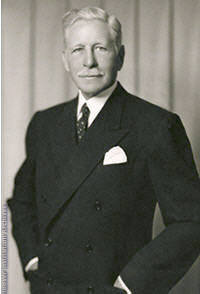 |
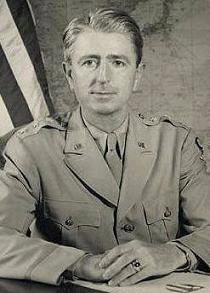 |
Before the Feb 1945 Yalta Meeting [Feb 4th-11th], Li Zongren, with Chiang Kai-shek approval, had written two memorandums to Hurley and Wedemeyer for relay to Roosevelt and Marshall, stating that the U.S. should not allow the U.S.S.R. to join the war in the East. It was reasoned that Roosevelt believed that the Japanese possessed "samurai" [bushido] fighting spirits which might lead to their fighting to the last man, while Li Zongren pointed out that Japan's national character was exactly like the Japanese marathon runners, i.e., they stopped running when they saw no hope of winning. Shortly after sending out the memo to the U.S., Li Zongren noticed the encirclement of Berlin by the allied troops and called upon Chiang Kai-shek and Wedemeyer in devising a plan of a Sino-American training center in the Philippines in the preparation of delivering the Chinese troops to southern Manchuria should WWII end abruptly. Later, after the end of WWII, before Wedemeyer's return to the U.S., Wedemeyer [Weideman] paid a visit to Li Zongren in Peking, and the two sighed about the two memos that were very much ignored, per Li Zongren.
* In Commemoration of China's Fall under the Alien Conquests in A.D. 1279,
A.D. 1644 & A.D. 1949 *
U.S.S.R./Comintern Alliance with the KMT & CCP (1923-1927)
Korean/Chinese Communists & the 1931 Japanese Invasion of Manchuria
American Involvement in China: Soviet Operation Snow, IPR Conspiracy, Dixie Mission, Stilwell
Incident, O.S.S. Scheme, Coalition Government Crap, Amerasia Case & The China White Paper
* Stay tuned for "Republican China 1911-1955: A Complete Untold History" *
|
|
Zou Rong's Revolutionary Army;
Shin Kyu Sik's
Shrine (Spirit, Kunitama) of Korea
|
This snippet is for sons and daughters of China:
Heed the sons & ministers' agony and sorrow of our ancestors who died or lived through the Mongol, Manchu and Soviet-Chicom conquest
and
the Yongjia, Jingkang and Jiashen cataclysms !
Jeanne d'Arc of China:
Teenager girl Xun Guan breaking out of the Wancheng city to borrow the relief troops in the late Western Jinn dynasty;
Liu-Shao-shi riding into the barbarian army to rescue her husband in the late Western Jinn dynasty;
teenager girl Shen Yunying breaking into Zhang Xianzhong's rebels on the horseback to avenge on father's death in the late Ming dynasty.
China's Solitary and Lone Heroes:
Nan Jiyun breaking out of the Suiyang siege and charging back into the city in the Tang dynasty;
Zhang Gui & Zhang Shun Brothers breaking through the Mongol siege of Xiangyang in the Southern Soong dynasty;
Liu Tiejun breaking through three communist field armies' siege of Kaifeng in the Republican China time period;
Zhang Jian's lone confrontation against the communist army during the June 3rd & 4th Massacre of 1989.
|
|
|
The Battle of Dushan & Chiang Kai-shek's Hardship in the Domestic & International Arenas
In Chungking the interim capital, numerous leftist or undercover communists printed their magazines, including "The Central Plains" [Guo Moruo] and "The Masses" [Qiao Guanhua, aka Qiao Mu]. Xu Zhucheng pointed out that communist [rascal-literati] Guo Moruo published the article "The Three Hundred Year Anniversary of the Fall of the Ming Dynasty [in 1644]" in 1944, and likened Chiang Kai-shek's government to the rebel Li Zicheng who exited Peking after losing the fight to traitor Wu Sangui and the Manchus on April 22nd of 1644.
In mid-Nov 1944, the Japanese linked up with the invasion forces from Indochina.
The debacle of the Xiang-Gui-Qian [Hunan-Guangxi-Guizhou] Campaign would cause a loss of airports built for the American bombers.
In the winter of 1944, the Japanese army launched an attack at Dushan of Guizhou Province as a last ditch effort of its war on mainland China. After sacking Dushan, the Japanese went on to threaten Dujun [Duyun]. People in Chungking the interim capital as well as in Guiyang the provincial capital of Guizhou were shaken. The Chungking government hinted that they would fight on by moving onto Mt E'meishan.
The Japanese, however, then rerouted southward for launching the continental corridor to Southeast Asia. Per Donovan Webster, the Japanese might have attacked Dushan for the weapon depot that was blown up by agents of the American O.S.S. In Shi Jue's opinions, the Japanese had retreated from the Dushan area after its cavalry Rentai was completely destroyed by P-51 planes of the Allied Air Force in a valley to the southwest of Dushan.
Haan Shengtao, a non-Whampoa who fought against the Japanese in Manchuria since 1931 and an officer under Shi Jue, took order from Tang Enbo direct to establish the defense positions in southwest China.
General Sun Yuanliang claimed that his contingent was responsible for hitting back the Japanese single-handedly after marching hundreds of miles to the Dushan front.
Elsewhere, in Burma, the joint armies of the Northern Burma Campaign began to coordinate with William Slim's 14th British Army from India in attacking Burma's central plains. Per Donovan Webster, first of all, Stilwell's Chinese X-force would chase the Japanese into Sino-Burmese border for a union with the Y-force.
This did not happen as Stilwell deliberately rested the X-force in lieu of aiding the Y-force.
The Chinese communist party and the "Chinese Democratic League", i.e., an undercover communist front organization that Jack Service was surprised to find out to be staffed by the same set of communists he cohorted with, called upon Chiang Kai-shek in forming a so-called "joint government" [i.e., the coalition government].
This was of course an idea derived by the communists after repeated talks with the pro-communist Americans on the Dixie Mission and the four American playboys.
Back on March 19th, 1941, with clandestine communist support, the so-called "Chinese Democratic League of Political Organizations" [i.e., Min-Ge] was established in Chungking the interim capital. Among the activists would be Deng Chumin, Huang Songling, Ma Zhemin, Zhang Nanxian, Li Shucheng & Xie Hegeng. See the KMT, CCP versus Democratic Parties for details.
The U.S. Bombing of the Japanese [Including the Collateral Damages to the Chinese]
In Manchuria, the Japanese-controlled newspapers reported Italy's surrender in the summer of 1943. By 1944, the Japanese citizens began to enroll in the army in Manchuria.
The so-called Kwangtung crack army had basically been weakened with the veteran troops either sent to the mainland Chinese battlegrounds or to the Pacific islands, with the Japanese colonizers to fill in, a fundamental cause of its debacle in the later resistance against the Soviet-Mongol armies.
On July 29th, 1944, the American B-29 bombers flew over Jinzhou. The Japanese were busy digging bunkers. Daily anti-air-raid exercises were held at schools. One friend of Jung Chang's mother was executed in the snowy field, next to the Xiaolinghe River Bay, by the Japanese military police, in front of school for accidentally triggering the siren inside of a military arsenal bunker. A female Japanese teacher was kicked and hit by the Japanese principal for crying about the execution death of an innocent Chinese girl. At about the same time, the Manchurian police ordered an extermination movement against rats and flies. Jung Chang cited one policeman's comment to her mother in pointing out that the Japanese loved to fry flies for food as a result of food shortage.
On September 14th, 1944, 31 American B-29 bombers, taking off from Chengdu, went to bomb an iron factory in Anshan of Manchuria, but dropped bombs on a residential area, killing thousands of Chinese. On October 14th, the American bombers, blindfolded by the Japanese anti-raid smoke, turned to the Shenyang city where thousands of Chinese were killed.
On December 18th, 98 American B-29 bombers dropped incendiary bombs on Hankou of Hubei Province, with fire raging on the two banks of the Yangtze River by a distance of 5 kilometers.
Per the AVG archives, it was bombing by
17 B-29 bombers followed by a second wave one hour later by 200 planes of the 14th Air Force that took off from different airfields, that bombed the Japanese airfield, the river bund district with warehouses, etc.
The bombing downed or damaged 64 Japanese planes, and paralyzed the railway system, a nexus that was constructed by Manchu governor-general Zhang Zhidong in the late 19th century, that was known as the Han Ye Ping Coal and Iron Limited Company.
Chennault commented to reporters the next day that Japan had lost the sky of China.
The Second Burma Campaign - Phase II
Elsewhere, in southwestern Burma, William Slim's 14th British Army from Imphal of India, having defeated the Japanese 15th Army, would cause a change of command in the Japanese in September 1944. Slim, having taken the Shwebo Plains in Central Burma, paused on the bank of the Irrawaddy River instead of attacking Mandalay on the other shore. At Myitkyina, 754 tons of bombs dropped on the Japanese per Webster. The Joint armies of the Northern Burma Campaign began to coordinate with William Slim's 14th British Army from India in attacking Burma's central plains. The British army, other than Slim's thrust in central Burma, mounted a coastal offensive along the Bay of Bengal, with target set at Rangoon on the other side of peninsula. Under Dan Sultan, the combined X-force and Mars Task Force linked up the Ledo Road and Burma Road by crossing the Irrawaddy to the south of Myitkyina. To the south of Myitkyina would be Bhamo which then turned westward to link up with Mongyou. The Ledo Road, going northwest to south after Myitkyina, was parallel to the ridges of the Japanese defense positions at Tengchong [Tengchung], Mangyou [Mongyu] & Lungling. Per Donovan Webster, first of all, Stilwell's Chinese X-force would chase the Japanese up the Burma Road into the Sino-Burmese border for a union with the Y-force.
In October 1944, Phase II of the Second Burma Battle began with Sun Liren (Sun Li-Jen)'s New 1st Corps attacking southern Burma from the eastern route. Sun Liren's Chinese forces, under the U.S. support, were re-organized into the cannons regiment, engineering regiment, chemical regiment, logistics regiment, armored battalion, and field-to-air cannon regiment, etc. The Chinese army fought the bloody war as the herald column while the British assumed the responsibility of administering the cities sacked by the Chinese and the Americans assumed the responsibility of providing the logistical supplies.
In northern Burma, General Sun Liren (Sun Li-Jen) assumed the corps chief's post of the New 1st Corps with command of the New 38th Division & New 30th Division, while Liao Yaoxiang assumed the post of corps chief of the New 6th Corps. (Liao Yaoxiang's New 6th Corps was recalled back to China, while leaving his 50th Division with Sun Liren.)
In synchronization with the campaigns of the Chinese X-force from India, the Chinese Y-force, having taken over Lungling in June, split into two phalanxes, for attacking the Japanese 56th division in Tengchong to the northwest and for attacking the Japanese stronghold on top of Mt Songshan [Sungshan] 15 miles to the northwest of Lungling. In Aug, the Chinese took over two sides of almost perpendicular Mt Sungshan. By Aug 20th, 1944, the last Japanese bunker was blasted off the top of Mt Songshan. The Chinese lost 7675 men against the 1500 entrenched defenders per Webster. Combined, the Chinese lost 37,133 against 13620 Japanese in the Campaign of Lungling & Songshan. Four days later, Tengchung [Tengchong] fell to the Chinese 56th Division after 51 days of siege, thanks to the 14th Airforce. Webster cited soldier Li Shi Fu in pointing out that i) the Japanese comfort women had committed suicides with pistols, and ii) the Japanese officers chained their soldiers to the defense positions.
On Jan 27th, 1945, Sun Liren (Sun Li-Jen)'s New 1st Corps (i.e., the X-force), together with China's Expedition Forces (Y-force) in Western Yunnan Province, took over Mangyou of Yunnan Province and re-linked the Burma-Yunnan Highway. In Jan 1945, after the Battle of Dian-xi [Western Yunnan Province], the Sino-Burmese Highway [aka the Stilwell Highway], from Kunming of Yunnan Province to Ledo [Lei-duo] of India, was under full control.
The American 10th Air Force began a campaign to bomb the Japanese targets in Burma and India for months, leading to the final destruction of the infamous River Kwae Bridges, both steel and wooden bridges, on April 2nd & 3rd, 1945, respectively.
Hurley and the Communists
On November 7th, 1944, Hurley flew to Yan'an for establishing a joint KMT-CCP government that would be based on the communist relinquishing the administrative and military control in exchange for assumption of cabinet posts. Mao Tse-tung countered him by stating that he would consider such a joint government on the precondition that the U.S. military aids be shared by the communists first.
Hurley was to bring back to Chungking a communist document with five points, which were mainly about establishing a coalition government of KMT and CCP, a crap sold by Jack Service and the Dixie Mission.
John Carter Vincent and the pro-CCP American embassy officials already impressed the Chinese communists that the U.S. would take an elastic approach to dealing Chiang Kai-shek and leaving a door open for the collaboration of the U.S. and CCP in a post-Chiang Kai-shek China in the future.
In Yan'an, Mao Tse-tung purportedly resented the U.S. support for Chiang Kai-shek by claiming to David Barnett that "there would be one day when you Americans could not prop up [Nationalist regime] any more." Separately Mao Tse-tung claimed to John Service that each and every American soldier should be a live advertisement of democracy in China. Earlier, on June 13th, 1944, the Communist "Liberation Daily" newspaper in Yan'an published Mao Tse-tung's propaganda article entitled "The Foretold Voice of History" ('lishi de xiansheng') which was a fake call for democracy.
Back in Chungking, T.V. Soong and Chiang Kai-shek told Hurley that he was duped by the communists, with the Chinese government countering the communists with a three-point document demanding a united military command under the National Military Council.
In the winter of 1944, the Japanese army launched an attack at Dushan of Guizhou Province as a last ditch effort of its war on mainland China. Hu Zongnan's Liu Anqi division was airlifted to Guiyang of Guizhou Province for joining the campaign.
After sacking Dushan, the Japanese went on to threaten Dujun. Claiming that the Nationalist might surrender should the Japanese invade, Zhou Enlai made arrangement for some leftists or undercover communists to prepare for entry into the mountains while having some leave for Yan'an. The Japanese, however, then rerouted southward for launching the continental corridor to Southeast Asia. Per Donovan Webster, the Japanese might have attacked Dushan for the weapon depot that was blown up by agents of the American O.S.S. Wedemeyer, as a precaution, flew two divisions of the X-force to Kunming of Yunnan Province.
This was Wedemeyer's proactive work after recall of Stilwell in that two divisions of Liao Yaoxiang's New 6th Corps were recalled to China from Burma, plus the airlifting of Liu Anqi's division from northwestern China.
As recollected by nationalist army generals, Tang Enbo's crack force raced on foot to the defense of Southwest China from the Henan battlefield. General Sun Yuanliang commanded troops to reach the scene at the fastest pace. Shi Jue's herald troops, commanded by Haan Shengtao, took order from Tang Enbo direct to establish the defense positions in southwest China.
The CCP's Relationship With the U.S.
The American Involvement in China: the Soviet Operation Snow, the IPR Conspiracy, the Dixie Mission, the Stilwell Incident, the O.S.S. Scheme, the Coalition Government Crap, the Amerasia Case, & The China White Paper
[Modified : Monday, 25-Feb-2013 22:00:00 EST]
On October 31st, Wedemeyer arrived in Chungking.
After arriving in Chungking, Wedemeyer immediately established the “chief-of-staff” office that Stilwell did not even bother to work on. In November 1944, Chiang Kai-shek adopted the American advice in reforming the "jun [military] ling [order] bu [department]" of the military commission by replacing Heh Yingqin with Chen Cheng, which led to the transformation of the military commission to the Defense Department after the Japanese surrender.
Later in early 1945, at the KMT congress, a decree was made to revoke the political indoctrination department from the National Revolutionary Army (NRA), to pave the way for the nationalization of the nation's armies.
On November 7th, 1944, T.V. Soong suggested that Hurley go to Yenan after the Russian consulate official hinted to Jiang Jingguo that Stalin might hold a meeting with Chiang Kai-shek in regards to the Russian acknowledgment of Chiang Kai-shek's regime in preference over the communists.
This was a U.S.-Soviet scheme to reconcile the Nationalist Party and the Communist Party.
Hurley flew to Yenan for establishing a joint KMT-CCP government that would be based on the communist relinquishing administrative and military control in exchange for assumption of the cabinet posts. Zhou Enlai, seeing Hurley's arrival, immediately went back to fetch Mao Te-tung for a reception at the airport. On October 8th, Hurley stated that Chiang Kai-shek was willing to acknowledge the communists and admit the communists to the high command military committee. Mao Tse-tung first rebutted Chiang Kai-shek's qualification for leading the communist troops, and then proposed to establish a joint military committee for equal-footing consultation. Zhou Enlai softened the situation by claiming that "100" million people in “liberated area” would not agree with Chiang Kai-shek. Hurley produced a stack of documents, with five points as to the CCP-KMT collaboration. Mao Tse-tung countered Hurley by having Zhu De & Zhou Enlai draft with five modified points, stating that the communists were willing to have unification of military and politics on the precondition that Chiang Kai-shek's National Government be converted to a “coalition government”.
On November 10h, Hurley brought the signed stipulations back to Chungking.
On the revised version, Clause 2 was changed to: "The present National Government is to be reorganzed into a coalition National Government... A new democratic policy providing for reform in military, political, economic and cultural affairs shall be promulgated and made effective... the National Military Council is to be reorganized into the United National Military Council..." Clause 3 was changed to the "coalition National Government" to support the principles of Sun Yat-sen for the establishment of a government of the people, for the people, and by the people, further adding two additional sentences about pursuing policies touching on the most comprehensive list of buzz words seen in the U.S. constitution concerning democracy, justice, progress, freedom of conscience, press, speech, assembly, and association, and right to petition, right of writ of habeas corpus, and right of residence, plus two additional rights as freedom from fear and want. Clause 4 was changed to the "coalition National Government and its United National Military Council" plus an additional statement in regards to supplies from foreign powers to be equitably distributed; and Clause 5 read as the "coalition National Government" to recognize the legality of the Chinese Communist Party and all anti-Japanese parties.
Zhou Enlai advised Hurley to bypass T.V. Soong in sending the document to Chiang Kai-shek. Chiang Kai-shek then countered with a three points draft, which was to emphasize the unification of command under the military commission of the National Government in exchange for the communist participation in such committee. On November 22nd, the new draft was presented to Zhou Enlai who hastily declined it by demanding the precondition of forming a coalition government. Zhou Enlai, Dong Biwu and David Barnett flew to Yenan on December 7th.
Mao and the communists had contrived the idea of a joint government as a precondition with more than likely inputs from the “leftist” or communist U.S. State Department personnel. In addition to an expectation for a coalition government, the communist side had all along received private assurance from Stilwell and the State Department personnel that the U.S. military aids could be shared between the Nationalist Army and the communist army. Mao Tse-tung certainly resented the U.S. [nominal] support for Chiang Kai-shek by claiming to David Barnett that "there would be one day when you Americans could not prop up [the Nationalist regime] any more." Separately, Mao Tse-tung claimed to John Service that each and every American soldier should be a live advertisement of democracy in China. Barnett, two days later, brought back a communist threat of taking initiative for establishing a different Chinese regime should the 'coalition government' fail to take place. In a rage, Hurley kicked Davies out of China for producing the 'coalition government' idea.
On December 15th, 1944, Hurley took over the ambassador's job from Gauss. On Jan 9th, 1945, the Chinese communists, having determined that Hurley was not on their side, contacted the Dixie Mission for relaying a letter to Franklin Delano Roosevelt direct, with a suggestion that Mao Tse-tung or Zhou Enlai could personally make a trip to the U.S.A. for such an in-person meeting with Roosevelt. Wedemeyer revoked Barrett's chief post for the Dixie delegation in mid-Jan.
Barrett in early January learnt that his promotion was rescinded because T.V Soong purportedly received some KMT secret agent's report from Yenan that Barrett offered the communists an American paratrooper division.
This rumored "offer" could be from what the government's bank and postal workers in Yenan overheard from the excited communists, or from interception of Yenan's relay to the Shandong communists about coming American paratroopers' landing.
The fallout was due to Barrett and Bird's secret mission to Yenan on December 15th, 1944, during which time Donovan's Office of Strategic Services promised to equip 25,000 communist guerrilla fighters. The communists were so excited that they offered Colonel Bird a Japanese sabre at the time the two left Yenan on the 17th. In Yenan [Yan'an], Mao Tse-tung and the communists, with full knowledge that the O.S.S. had unlimited unvouched money, had thought that they might really obtain a big sum loan from the U.S. government for purchasing weapons and ammunition from the puppet troops. The communists used opium as tender to buy weapons from the puppets. That is, the communist army never intended to fight the Japanese to wrestle weapons.
All through the time the Dixie Mission in Yenan, the OSS was actively working with the communists for the purported American penetration into Manchuria, Northern China, Korea and Japan under the promise of a loan of 20 million U.S. dollars, etc.
On Jan 23rd, Zhu De requested for a loan of 20 million U.S. dollars. Hurley consequently cautioned the embassy officials and officers that nobody should ever discuss the matter of military aid or financial aid for any Chinese party or military faction.
On December 12th, Hurley officially took over the U.S. ambassador's post from Gauss. Later, when Hurley found out about Barrett's work with the communists, Hurley demanded with Wedeymer to have Barrett's recommended promotion to brigadie-general be rescinded. Barrett and Bird made a secret mission to Yenan on December 14th, 1944, with Donovan's Office of Strategic Services promising to equip 25,000 communist guerrilla fighters. Barrett claimed it was on December 15th that flew to Yenan. Barrett made another flight to Yenan on the 27th. Barret claimed that he took Major General Robert B. McClure's words for granted that the mission had Wedemeyer's approval, and it was about coordinating with the communists in regards to 28,000 American paratroopers' landing in Shandong. Barret did not tell Hurley of his trip at a dinner on the 29th.
According to Barrett, Wedemeyer informed Chiang of Barrett's recommendation that the communists be provided "a relatively small number of rifles, machine guns, trench mortars, bazookas, and some light artillery", to which Chiang replied "You cannot arm my enemies!"
Wedemeyer revoked Barrett's chief post for the Dixie delegation in mid-January. Barrett claimed that he was relieved of the duty in the Dixie Mission in late 1944 and transferred to the China Combat Command in Kunming on January 2nd, 1945. But the roof fell on him as Barrett in early January learnt that his promotion was rescinded because T.V Soong purportedly received some KMT secret agent's report from Yenan that Barrett offered the communists an American paratrooper division.
Other than Wedemeyer's sending away Barrett, Hurley kicked out Jack Service and Ray Ludden, namely, playboys, from the U.S. embassy in Chungking. The fallout was related to Service's instigating the embassy staff into a direct report to the Washington DC in the absence of Hurley who returned to Washington DC on Feb 19th, 1945 for the Yalta Agreement briefings.
For arguments in regards to the communists after Davis made his second trip to Yenan in December, Hurley kicked Davis out of China on January 9, 1945, with Davis to go to Moscow to be first secretary under W. Averell Harriman and George Kennan from 1945 to 1947. Hurley, or Kennan, did not know Davies the resident China expert was responsible for engendering the Dixie Mission and producing the 'coalition government' crap, and had a direct channel to Currie throughout the years at CBI. For the last three months of 1944, Davies served under General Albert Coady Wedemeyer after Stilwell's recall. Other than Wedemeyer's sending away Barrett, Hurley kicked out Jack S. Service and Ray Ludden, namely, playboys from the U.S. embassy in Chungking. The fallout was related to Service's instigating the embassy staff into a direct report to the Washington D.C. in the absence of Hurley who returned to Washington D.C. on February 19th, 1945 for the Yalta Agreement briefings. This direct report, signed by political officers of the staff of the embassy, was chargé d’affaires George Atcheson's idea per Service. Service, against brother Dick and Barrett's warning that Hurley would have his scalp, had returned to Chungking on January 18.
Service just reported to Hopkins what he did as to the Dixie Mission at Yenan, giving high remarks for the Chinese communists. Like Davis' direct channel to Hopkins, Service, who wished to establish a similar channel to Currie previously, apparently took Hopkins as his line since Davis was kicked out of China by Hurley.
However, Hopkins, after listening to Service's claim
for forty minutes, including presentation of some similar map that the Chinese Communists gave to other Americans about purported communist activities in the Japan-occupied areas, merely commented that they looked very interesting, and probably mostly true, adding that "... after all, they call themselves Communists. Besides, the only Chinese that Americans know is Chiang Kai-shek." Service was disappointed and took Hopkins as too close to H.H. Kung to entertain his ideas.
Back in Chungking,
Service was warned by Hurley not to interfere with the KMT-CCP mediation, to Service's chagrins as his best communist pal Zhou Enlai was in town and not interfering proved to be very difficult. During the short stay, Service flew to Yenan to discuss the communist plenary meeting resolutions including a masterplan to intrude to Manchuria after Japan's surrender. Service stayed till early April when he was kicked out of China.
Service mentioned in the February 28 report that the Chinese communist had undertaken actions in accordance with last summer's threat, i.e., expanding their domain southward by encroaching on the Nationalist territories, including South China, with eruption of skirmishes against the Central Government troops. After receiving Service-drafted letter, the State Department attached it to a report for the Secretary of State to pass on to the U.S. President, basically stating that it was no longer a matter of choice between Chiang Kai-shek and the Chinese communists but to force Chiang Kai-shek into allowing the U.S. to arm whoever was willing to fight the Japanese, which was of course total American bullshit in today's hindsight.
Other than the U.S. State Department officials, Solomon Adler (1909-1994), some American Treasury representative under finance minister Morgenthau and Soviet agent Harry Dexter White, repeatedly attacked Hurley as someone who caused the Chinese communists to distance themselves from the U.S. Adler, who was identified by Whittaker Chambers and Elizabeth Bentley as a bona fide Soviet spy, was posted to China together with Lattimore's entourage, and brought along a Chinese CPUSA agent called Ji Chaoding who was to continue to sabotage the Chinese finance during the civil wars. Ji Chaoding was one of the Tsing Hwa University Class 1925 gang who joined the CPUSA en masse. Inside of the State Department, the China section chief, while emphasizing the American elasticity policy towards Chiang Kai-shek's regime, had suggested that i) militarily equipping the Chinese army for fighting the Japanese being the American short-term goal, any measures that would make China into a post-war strong power in Asia is unrealistic; ii) that the United States should also make it a short-term agenda to arm any Chinese fighting force whenever the American military landed on the Chinese coasts; iii) that the American long-term objective would be to help China to become a united, democratic and cooperating country, but not necessarily under Chiang Kai-shek; and iv) that an elastic relationship with Chiang Kai-shek is essential to the future U.S. cooperation with other Chinese political forces. In Service's four words, Chiang Kai-shek was not China.
Hurley, having seen Service report on March 4th, cursed Service as a s.o.b. and promised to get rid of Service even though it meant his last action on the job. Hurley obtained support from Wedemeyer and Dulles. Franklin Roosevelt, after Yalta, badly needed Hurley for fending off accusations that he had signed some 'conspiracy' agreements with Stalin.
Back at Yalta, Roosevelt and Stalin had a discussion on the need of the U.S. Congress to ratify any foreign treaty or agreement, and hence Roosevelt locked up the agreements in his drawer rather than presenting to the congressional committees.
On April 2nd, Hurley hosted a news conference and defended the U.S.'s China policy. Hurley, under Roosevelt's authorization, flew to Moscow and London consecutively for lobbying on behalf of China's interests as a makeup for the secret betrayal at Yalta. On April 3rd, Hurley went to London. Churchill flatly declined Hurley's request to yield HK back to China as an international open port. On April 15th, en route to Moscow, Hurley heard about Roosevelt's death. Unlike his bad experiences in London, Stalin cunningly assured Hurley that he would do everything possible to help China unite under the National Government.
Back in Washington D.C., Truman was summoned to the White House by Eleanor Roosevelt and informed of the news of death of her husband.
Truman, a true bumpkin with no foreign experience other than fighting WWI, inherited Roosevelt's legacy agreements without a second thought, and later arthorized dropping three atomic bombs onto Japan for the sake of ending the war without any geopolitical considerations vis-a-vis the Soviets.
After the Japanese surrender, Truman had to consult with Soviet spy Hopkins as to what Roosevelt promised to do for China, with debates going on through November by which time Hurley, who was time and again dissauded from resignation but also expressed wish to return to China immediately for the unfinished mission, made a final decison to tender the resignation after the Soviet spies leaked secret documents through AMERASIA for clouding Hurley's credibility.
AMERASIA - The Comintern/Russian Agents Hijacking the U.S. government
Inside of the U.S., on June 6th, FBI arrested six people over leakage of information by the Amerasia magazine.
http://en.wikipedia.org/wiki/Amerasia
The Legend of Mark Gayn
The Reality of Red Subversion: The Recent Confirmation of Soviet Espionage in America
Amerasia was a journal on the Far Eastern affairs, edited by Phillip J. Jaffe and Kate L. Mitchell. Classified documents concerning the U.S. policy in China were found in the possession of several defendants. The Amerasia Papers consist of documents seized by the FBI agents on June 6, 1945, in connection with the arrests of six persons, including three U.S. government officials, Andrew Roth, Emmanuel Larsen, John Stewart Service, on conspiracy and espionage charges related to possession of roughly 1000 stolen classified Government documents. This resulted in the so-called Amerasia Affair. Because the Office of Strategic Services (OSS) burglarized the office of Amerasia and the homes of several individuals, the evidence was deemed tainted and charges were reduced or dropped.
Congressional interest in the case continued however. In 1946, a House Judiciary subcommittee chaired by Rep. Samuel F. Hobbs and, in 1950, the Senate Foreign Relations Subcommittee on the Investigation of Loyalty of State Department Employees, or "Tydings Committee", investigated the Amerasia case. In 1955, the Senate Internal Security Subcommittee asked the Justice Department to deliver the Amerasia materials to them. The records were declassified and in 1956 and 1957, the Justice Department delivered 1,260 documents to the subcommittee.
The committee published The Amerasia Papers: A Clue to the Catastrophe of China (2 vols., 1970), summarizes the case.
Amerasia's chief financial benefactor was Frederick V. Field. Jaffe, a friend of CPUSA general secretary Earl Browder. Its staffers and writers included many Communists. Joseph Bernstein, a GRU contact between Soviet agents operating in the Office of Strategic Services and the Board of Economic Warfare, was one of its ex-employees.
The highest level government employee arrested in the Amerasia case was State Department official John Service, one of John Carter Vincent's "China Hands", shared living quarters with Solomon Adler of the Treasury Department when they both served in China. Service and Alder sent steady streams of dispatches from China attacking Chiang Kai-shek and urging that the U.S. government cease aid. Upon Services return to the United States, Service spent much time in the company of Jaffe, whom he attested he had just met, delivering copies of his reports, and commenting to Jaffe while under audio surveillance by FBI that, "What I said about the military plans is, of course, very secret." Andrew Roth, also arrested in the case, was the Office of Naval Intelligence (ONI) liaison officer with the Department of State.
Senator Joseph McCarthy of Wisconsin years later said that FBI Director J. Edgar Hoover believed he had an "airtight case," and Justice Department officials were ready to prosecute. The case displayed every type of security breach imaginable, and federal crime: theft of documents, policy subversion, cover-up, perjury, and obstruction of justice. Then, for some mysterious reason, the Justice Department swept the matter under the rug. Service was restored to State Department duties. Jaffe and Larsen received fines, and all others were not prosecuted. McCarthy maintained it was a security breach and cover-up of immense proportions.
The Yalta Betrayal
China had been excluded from the club of the super powers throughout the war, other than the Cairo Conference (November 22-26, 1943), as a result of the British and Russian exerting influence over the U.S. The British and Russian, for maintaining their colonial and imperialist interests in and around China, did not want to see China victorious.
T.V. Soong, after repeated protests, was allowed to go to Quebec (August 17-24, 1943) for conversations during the meeting intervals.
The British further extricated itself from the C.B.I theater with the creation of a Southeast Asia Command (SEAC).
After raising protests, China was allowed to station one official at the "Anglo-American joint chiefs of staff's meeting." In March 1944, Shang Zhen was dispatched to the U.S. for replacing Xiong Shihui as head of the Chinese military delegation to the U.S.
Shang Zhen, with Marshall's approval, got to attend the conference. Shang Zhen visited Truman in the White House at one time. Later, in August, Shang Zhen participated in the U.N. preparatory conference with two Chinese ambassadors Gu Weijun & Wei Daoming. In October 1944, the United Nations, a Soviet agents' scheme to make Roosevelt feel good about becoming a leader of the United States of Earth, was established.
Gu Weijun (Wellington Koo), i.e., China's ambassador to Britain and the U.S. consecutively, sent over a telegraph to Chiang Kai-shek from Washington D.C., stating that an American navy general, William H. Leahy [Li-hai], had disclosed that the U.S.S.R. would for sure desire for a non-frozen port like Port Arthur [Lüshun], to which Britain would not object while America might concur with. Chiang Kai-shek instructed that Gu Weijun found out about the deal between the superpowers.
At Tehran (November 28-December 1, 1943) and Yalta, the three powers sold out China.
During the Yalta Conference (February 4-11, 1945), the Soviets were promsied to take Southern Sakhalin and the Kuril Islands, the port of Dalian, the Port Arthur, and the Chinese Eastern railway, among other concessions.
Back in October 1944, British Prime Minister Churchill visited the U.S.S.R.,
i.e.,
the fourth Moscow conference (Tolstoy) from October 9-19 1944,
and on October 16th, mentioned that they expected that the war against Japan might end by the end of 1947.
At Yalta, Stalin promised to declare war on Japan in 2-3 months of Germany's defeat.
Stalin proposed to the U.S. a list of supplies for 60 divisions of the Russian Red Army, i.e., an extra 1 million tons of supplies in addition to the items covered under the Lend Lease Act, including 120,000 tons of plane fuel, 70,000 tons of truck fuel, 30,000 trucks, 1500 jeeps, 500 C47 & C54 transporters, 30 cruisers, 50 submarines, 500 locomotives, 5-6000 carriages, and 800 kilometer long railway tracks.
This American supply of the August Storm weapons and ammunition would be turned over by Stalin to the Chinese communists in the civil war that overthrew the rule of the Republic of China.
At the Crimea or Yalta Conference (February 4-11, 1945),
Churchill, against Eden's admonition, betrayed China to Stalin in the attempt to carve out the war spoils from WWII, namely, making sure that China's loss of Port Arthur was tied to loss of Hong Kong, i.e., "the whole position of the British Empire in the Far East."
While Roosevelt was dying, Churchill was a shrewd politician who knew the consequence of the Soviets' preeminent interests in Manchuria meant for the Republic of China.
What was discussed was to keep it a secret to the Chinese on the pretext that Stalin would inform Chiang Kai-shek after another twenty-five divisions were sent to the Far East.
Later, after the 'Crimea Declaration' ensuing from the Feb 1945 Yalta Meeting, Chiang Kai-shek had instructed Wei Daoming [ambassador to the U.S.] and Fu Bingchang [ambassador to the U.S.S.R.] to find out about the secret agreement.
TEN TRAINS EQUIVALENT AMERICAN LEND-LEASE WEAPONS THAT STALIN & RUSSIANS GAVE TO MAO & CHINESE COMMUNISTS;
FORTY SHIPS EQUIVALENT QUANTITY OF TANKS & CANNONS, BOTH AMERICAN-MADE & JAPAN-MADE
3300 TONS OF PETROL FROM RUSSIANS IN 1947 ALONE; PLUS 2000 TONS OF DIESEL, 1000 TONS OF PLANE FUEL, 700 TONS OF EXPLOSIVES & 2000 TONS OF MACHINERY OIL
30000 TONS OF PETROL FROM RUSSIANS IN 1948; PLUS 1000 TONS OF PLANE FUEL, 5000 TONS OF KEROSINE, 3000 HEAVY WEIGHT TRUCKS & 150 ARTILLERY TRACTORS
DEATH OF MILLIONS OF YELLOW MEN, & POSSIBLY MORE IN THE FUTURE WAR AGAINST TAIWAN !!!!!
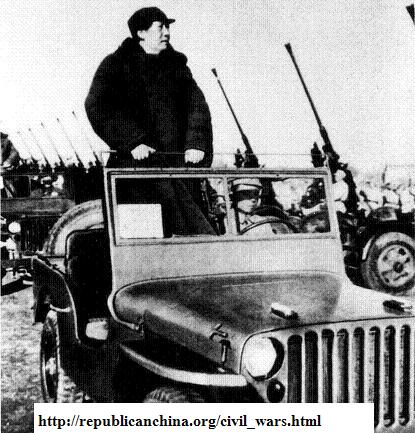
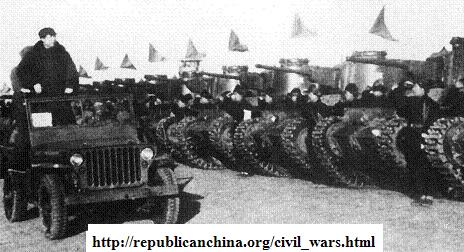
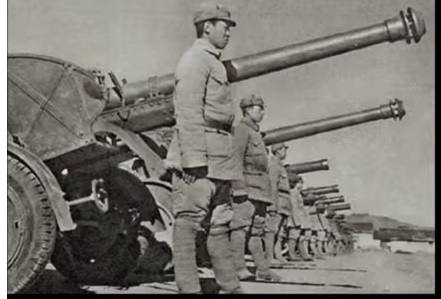 (Reference: see the writing by James Perloff China Betrayed Into Communism at
http://www.thenewamerican.com/index.php/history/world/1464
August Storm lend-lease weapons ended up in Mao's hands
"At the Teheran and Yalta wartime conferences, however, Roosevelt asked Stalin if he would break his pact with Japan and enter the Far East war. Stalin agreed, but attached conditions. He demanded that America completely equip his Far Eastern Army for the expedition, with 3,000 tanks, 5,000 planes, plus all the other munitions, food, and fuel required for a 1,250,000-man army. Roosevelt accepted this demand, and 600 shiploads of Lend-Lease material were convoyed to the USSR for the venture. Stalin's Far Eastern Army swiftly received more than twice (should be ten times -comment by this webmaster) the supplies we gave Chiang Kai-shek during four years as our ally.
"General Douglas MacArthur protested after discovering that ships designated to supply his Pacific forces were being diverted to Russia. Major General Courtney Whitney wrote: 'One hundred of his transport ships were to be withdrawn immediately, to be used to carry munitions and supplies across the North Pacific to the Soviet forces in Vladivostok.... Later, of course, they were the basis of Soviet military support of North Korea and Red China.')
Since the British did not finalize the issue of the Russian spheres of influence in the Far East, Stalin, on December 15th, 1944, called over the American ambassador, and demanded that the U.S. concur with the Russian recovery of interests prior to the 1904-5 Russian-Japanese War. Stalin told the American ambassador William Averell Harriman [Ha-li-man] that Roosevelt had agreed that the U.S.S.R. could have a non-frozen port in the Far East at the Tehran Meeting. Stalin had requested that the discussions at both the Tehran Meeting (November 28-December 1, 1943) and the December 1944 meeting be kept confidential on the pretext that i) the Chinese could not keep secrets, and ii) the Japanese might take initiative against the U.S.S.R. should they find out about the Russian attempts. The U.S., which was hijacked by the Soviet agents, of course, concurred with Britain as to the Russian interests. Roosevelt dispatched Hopkins to seeing Russian foreign minister Andrei Andreyevich Gromyko [Ge-luo-mi-ko], with a suggestion of convening the later Yalta Conference to finalize the Far East issues. Stalin requested that meeting be held in Yalta within the U.S.S.R.
On Feb 4th-11th, 1945, at the Yalta Conference, the 'U.S.S.R.-USA-UK Agreement In Regards To Japan' (i.e., "Agreement Regarding Japan") was secretly signed at the expense of China.
In addition to two ports in Manchuria, the Chinese-Eastern Railway, and the Southern Manchurian Railway, Stalin obtained the American acquiesce on the matter of making Outer Mongolia independent.
The Soviets, with the re-acquisition of Port Arthur, Dairen and the Chinese Eastern Railway, successfully implemented the China conquest scheme, with the Port Arthur and Dairen serving as Chinese communists' sanctuary, springboard, arsenals plants and weapon depots and the Chinese Eastern Railway serving as a cover to join in the Chinese civil wars.
According to the Soviets, the 'railway' tag was a guise for intervening in the Chinese civil wars, namely, the cloak of secrecy under which the Soviets orchestrated the historical Soviet conquest of China to fulfill Stalin's mantle that pro-Soviet regimes must be established in all territories that the Soviet Red Army ever stepped on, no matter Europe or Asia.
That is, the Soviet military advisers who directed the Chinese civil wars were sent to Manchuria disguised as railway operators who controlled more than 60% of the total railway tracks in the whole territory of Manchuria.

World War II, in both the East and the West, were the inducements of the British, American[, and French] interest groups and syndicates. First the Locarno Treaty in 1920s. Then in 1931, President Herbet Hoover gave Japan a free hand in the invasion of Manchuria on the pretext that Japan could not tolerate a half-Bolshevik China. Thereafter the Munich Agreement. For what? Britain and America wanted Hitler to attack the Soviet Union, and wanted Japan to suppress China's nationalist movement and counter the Soviet Union. In both cases, Stalin out-smarted the Anglo-American. Hitler attacked westward instead, and signed a non-aggression pact with Stalin to halve Poland; and Japan attacked Southeast Asia and Pearl Harbor after China, not the Soviet Union. Stalin was the evil genius of 20th century. Stalin, after the 1929 war against Zhang Xueliang over Chinese-Eastern Railway [which erupted over Russian and Chinese communist agitations in sabotaging Japan's attempt at building five additional railways in Manchuria and Inner Mongolia], quickly divested himself of the railway after Japan invaded Manchuria on September 18th, 1931. After initially calling on world communists to militarily defend the Soviet Union from 1931 to 1933, Stalin subsequently designed the united front in 1935, and ultimately in the time period of 1936-1937 successfully lit the fuse of the Sino-Japanese War by means of repeated GRU operations in northern China.
Zheng Langping, in "An Everlasting Glory", blamed Chinese casualties during First Burma Campaign on Stilwell's multiple blunders. In Zheng Langping's opinion, the "Burma Counter-attack" would become an Anglo-American scheme to bog down China & Japan in a balanced way so that China would not emerge a victor to pose a threat to the Anglo-American interests in the Far East. The infamous Ledo Highway, i.e., Stilwell Highway, could be a trap to exhaust the bulk of U.S. wartime aid to China while giving China much less benefit than what the Hump Course had delivered. Anglo-American hostility towards and subversion against China continued well into the 1940s, at which time General Wedemeyer, right after succession of Stilwell's post in 1944, reported to Washington DC in a cable, stating that "...British Ambassador personally suggested to me that a strong unified China would be dangerous to the world and certainly would jeopardize the white man's position immediately in Far East and ultimately throughout the world."
Other than the notorious Yalta Betrayal, another equally dirty deal that deeply hurt China would be the Betrayal during the "San Francisco Peace Treaty." The United States government, while still maintaining the diplomatic relations with the Nationalist government in Taiwan, had no reason to ward off the Chinese from the "San Francisco Peace Treaty" other than the ulterior motive in hurting the cause of the Chinese and China in the same cloak as the pre-war colonialists. (More available at The Century-long American hypocrisy towards China, Anglo-American & Jewish romance with the Japanese and What Foreign Powers Did To The Flowery Republic Prior To, During And After The 1911 Revolution.
Certainly, we did not have to remind the world that the Russians, after signing a neutrality pact with Japan on April 13th, 1941 [by betraying the 1937 non-aggression treaty between China and the U.S.S.R.], had sealed off China's continental exit to the north and northwest. The Russian (i.e., Soviets), who had dispatched the "volunteer fighters" to China in late 1937, could have possibly eaten their words as to an agreed-upon declaration of war against Japan within half a year of the outbreak of the 2nd Sino-Japanese War. Rather, the Russians rounded up ethnic Chinese in the Far East in a cleansing via an exile to the Siberia gulags around the turn of 1940. In contrast, the Russians deported the Koreans to Kazakhstan.)
At China's Expense
In Feb 1945, at the Yalta Meeting, Roosevelt, still resentful of Chiang Kai-shek's antagonism on the matter of Stilwell & the Chinese Expedition Forces, reached a secret deal with Churchill in rewarding Stalin with the former ownership in the Chinese Eastern Railroad and the territories of the Sakhalin Island. Stalin, back in December 1944, requested with Hopkins that a meeting be held in Yalta within the U.S.S.R.
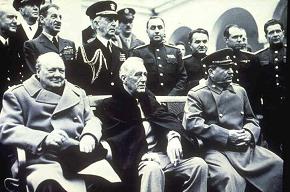
After Stalin pressured Roosevelt into the agreement on the 10th, Stalin sent the document to Churchill the second day for endorsement.
Churchill, when being advised by his assistant as to the morality in betraying China to the Soviets, declared that his putting his signature on the Yalta agreement was for safeguarding the interests of the British empire, namely, to forever keep Hongkong, the crown jewel of the Orient.
On Feb 4th-11th, 1945, at the Yalta Conference, the 'U.S.S.R.-USA-UK Agreement In Regards To Japan' was secretly signed at the expense of China.
In addition to the two ports in Manchuria, the Chinese-Eastern Railway, and the Southern Manchurian Railway, Stalin obtained the American acquiesce on the matter of making Outer Mongolia independent.
Roosevelt thereafter locked up the secret agreement in his safe till his death. China did not know the betrayal till June 1945, with the full contents not known till early 1946.
(The Americans, after Dwight David Eisenhower became president in the 1950s, declared the Yalta treaty to be invalid.
Taiwan followed through with voiding the 1945 Sino-Soviet friendship treaty.)
Wei Daoming [ambassador to the U.S.] and Fu Bingchang [ambassador to the U.S.S.R.] failed to find out about the secret agreement. The secret document was not fully known to Chiang Kai-shek till after the so-called Sino-Russian friendship treaty, i.e., Feb 11th, 1946.
(See Felix Wittmer's THE YALTA BETRAYAL.)
After the Japanese surrender, the Chinese government and the cunning British held talks in Hongkong about returning Hongkong to China throughout the 1946-1949 Chinese civil war time period.
This was on basis of the British duplicity in 1943 that they would return HK to China after the victory over Japan so as to avoid damage to the British wartime morale.
With the Chinese government embroiled in the civil war against the communists, the British repeatedly put off the subject of returning HK, and in order to procrastinate further, offered Chiang Kai-shek half a dozen warships [that were formerly the American lend-lease transfer to Britain] as bribe.
Later, after the new year day of 1950, Britain, after coordination with Acheson and the Soviet-hijacked American State Department, became the first Western power to recognize communist China diplomatically.
The British were able to reach a mutual understanding with the Chinese communists to defer the matter of the Hongkong's recovery.
(Note that the island of HK was forever ceded to Britain by the Manchus after the Opium War debacle but was promised to be returned to China after the Japanese surrender; the Kowloon Peninsula was ceded after the 2nd Opium War; and, the New Territories were on a leasehold from the 1898 "convention for the extension of the Hongkong territory." The communist China's recovery of Hongkong in 1997 was a betrayal to the British-Chinese consensus reached in 1942-1943.
That is, the communist China's sensational recovery of Hongkong in 1997 was a befuddled event that covered up the treachery in the communists' colluding with the British imperialists and colonialists in selling out China's interests, i.e., Hongkong --that was supposed to be returned after the victory over Japan, not something like the New Territories' lease due date of 1997.
The Communist government, which acquiesced with the British on the HK matter, allowed some selected multi-national corporations [including Shell, the British Chemicals, the HK-Shanghai Bank] to continue their operations inside of China. Zheng Nian, i.e., author of "Life And Death In Shanghai", had detailed description about her husband Zheng Kangqi's job as general manager at Shell and her taking charge of the Shell business operations after her husband passed away in 1957.)
Li Ao commented, via citation of an ancient saying that "a person is insulted by others only when that person insulted himself, that should China have waged a few victorious campaigns against Japan, then China would not see its interests hurt by big powers like the U.S., Britain and the U.S.S.R. However, this was incorrect.
From the start of war, Britain had time and again instructed the American counterparts that should China gain an upper hand over Japan, Britain might not recover its colonial interests, such as H.K., inside of China. In 1944, Britain told Wedemeyer that "a strong unified China would be dangerous to the world and certainly would jeopardize the white man's position immediately in Far East and ultimately throughout the world." Per Zhang Ling'ao, Britain wanted to see the Chinese troops defeated during the First Burma Campaign, not to mention its earlier decision to shut down the Burma Highway for three months.
Not to mention that Poland was betrayed by the Americans and British already.
The thousands of Polish airforce pilots and personnel, who worked in the British Royal Air Force, all died in vain to see their country sold out to the Soviets.
By March 27th, Sun Liren (Sun Li-jen)'s New 1st Corps completed the Second Burma Campaign by taking over more than 50 Burmese cities. In the spring of 1945, the Japanese army attacked Xixiakou in western Henan Province, and Hu Zongnan's 31st Corps-group fought against the Japanese for months without letting go an inch of land.
In the spring of 1945, the Japanese army began to withdraw from Southwest China.
Months before the Japanese surrender, Imai Takeo, a staff tactician at the Japanese invasion army's headquarters in Nanking, rode on the only available plane to the Yellow Flood area to meet with Chinese cavalry army commander Heh Zhuguo to explore peace.
The plane, with gunshots on the hull, was the only one that could fly. To avoid being shot down, the plane made a stealthy flight just above the earth's surface.
General Heh Zhuguo told Imai Takeo that the Chinese army would not chase to attack should the Japanese army pull back towards the homeland, but would not strike a separate peace accord with Japan since China was bound by the international alliance.
The Potsdam Declaration
In April 1945, Hurley, as a champion of Chiang Kai-shek’s Nationalist Chinese government, blamed the CCP for refusing to form a joint government and charged that officials in the U.S. Department of State had subverted the policy of U.S. support for Chiang’s government. On April 12th, Roosevelt passed away. The next day, Chiang Kai-shek received another telegraph from Gu Weijun (Wellington Koo) who stated that American Navy General Li-hai [William Leahy] had tested his response in regards to China's possible reaction to the Russian grabbing Dalian and Lüshun [Port Arthur] ports. Gu Weijun's response was that i) China would seek a peaceful solution in dealing with the possible Russian takeover of two ports and ii) the Russians could have better find a non-frozen port inside of Korea. Chiang Kai-shek promptly dispatched T.V. Soong (Soong Ziwen) to the U.S. on the pretext of condoling on Roosevelt's death. President Truman avoided any in-depth discussion with Soong, while Hopkins, namely, a high-level Soviet agent and Roosevelt's eunuch who decided who was allowed to see Roosevelt, claimed that he knew nothing about the details of the Yalta Agreement to which he was a party.
In San Francisco, on April 27th, T.V. Soong (Soong Ziwen) encountered Molotov at the ceremony of the founding of the United Nations. Soong was surprised that Molotov enthusiastically greeted him with words like "I was expecting to see you [Soong] in Moscow ... but very happy to see you [Soong] in San Francisco instead..." T.V. Soong (Soong Ziwen) promptly notified Chiang Kai-shek of the unusual Russian attitude.
The Chinese communists, who managed to pressure Chiang Kai-shek into allowing Dong Biwu sent as part of T.V. Soong's Chinese delegation to the UN General Assembly, likely got in touch with the Soviets and learnt about the items in the Yalta secret agreements, something that could become what Hurley claimed to have first heard about from the Chinese communists in China before being briefed by Roosevelt.
Or, the communists had caught wind of the Yalta betrayal way earlier, with the adamant demand to join the U.N. delegation being a way to get in touch with the Soviets and CPUSA for ascertaining the Yalta rumor.
Purportedly, Mme Sun Yat-sen (Rosamond) personally exerted pressure onto Chiang Kai-shek and her sister May (Madame Chiang) to get Dong Biwu the quota for the U.N. meeting.
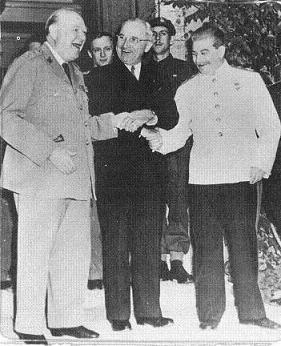 The Japanese continued their futile struggles in Luzon and Okinawa. Negotiation between China and the U.S.S.R. started on July 1st, but was adjourned due to Stalin's participation in the Potsdam Meeting inside Germany on July 14th-Aug 9th. On July 17th, Soong Ziwen (T.V. Soong) returned to China and insisted on resigning his post, and later on Aug 5th, Wang Shijie was sent to Moscow as a scapegoat. The U.S., the U.S.S.R. and Britain issued the Potsdam Declaration, calling for Japan to surrender, on July 17th, 1945. In July, Sun Liren (Sun Li-Jen)'s New 1st Corps returned to Nanning, the provincial capital of Guangxi Province. Sun Liren was invited to Europe by Eisenhower. The Japanese continued their futile struggles in Luzon and Okinawa. Negotiation between China and the U.S.S.R. started on July 1st, but was adjourned due to Stalin's participation in the Potsdam Meeting inside Germany on July 14th-Aug 9th. On July 17th, Soong Ziwen (T.V. Soong) returned to China and insisted on resigning his post, and later on Aug 5th, Wang Shijie was sent to Moscow as a scapegoat. The U.S., the U.S.S.R. and Britain issued the Potsdam Declaration, calling for Japan to surrender, on July 17th, 1945. In July, Sun Liren (Sun Li-Jen)'s New 1st Corps returned to Nanning, the provincial capital of Guangxi Province. Sun Liren was invited to Europe by Eisenhower.
The Western Hunan Campaign & the Battle of Mt Xuefengshan
Japanese Attacking Liu Ruming's Troops At Nanyang
Hu Zongnan's Xixiakou Campaign Against Japanese
Hu Zongnan Recovering Chunhua-xian Area From Yenan's Communist Encroachment
Taking advantage of the 1944 Japanese Ichigo Campaign, Mao and the communists launched a full-scale civil war against the Chinese government troops.
In the mid-1944, Mao Tse-tung struck a secret agreement with the Japanese through the New 4th Army's meeting with the Japanese agents at the mediation of a Sorge-ring communist prisoner of war extradited from the Tokyo High Police (Tekko)'s prison.
In coordination with the Japanese, Mao ordered Wang Zhen's communist brigade to penetrate to Guangdong Province in the footsteps of the Japanese Ichigo Campaign. Mao interrupted the Yenan Rectification Movement by ordering the second-tier commanders, like Pi Dingjun, Wang Shusheng, Haan Jun, and et al., to terminate the brainwashing meetings and lead the communist forces into the Funiushan/Xiongershan mountains to establish an enclave by taking advantage of the Japanese Ichigo attacks. Communist general Peng Xuefeng, from the Jiangsu-Anhui border, was ordered to attack the government troops in the wake of the Ichigo Campaign.
The communist New Fourth Corps emptied the North Jiangsu Base for a cross-Yangtze campaign to re-establish the Zhejiang-Fujian-Jiangxi soviet enclave, and fought a one-year-long atrocious civil war against the 3rd War Zone.
The most significant battles the communists undertook was in southeastern China, after the dispatch of a heavily armed N4A force across the Yangtze to reclaim the Fujian-Jiangxi enclave of the 1930s, which led to wars between the ROC army and the communists lasting from late 1944 to the spring and summer of 1945, the bloodiest civil war ever out of the eight-year-long resistance war, all a part of Mao's southern advance strategy, which was not reversed till the autumn of 1945 to become the northern advance strategy for Manchuria.
Don't forget that in Fujian and along the Southeastern coastline, where the Americans set up the watch and listen posts, the Chinese communist guerrillas launched numerous uprisings against the government throughout 1944-1945. And along the Zhejiang coastline, one communist with the background from Ding Xishan's puppet army and in possession of some credential of special training from Dai Li's Sino-British and Sino-American military collaboration programs, conducted a Sylvester Stallone-style
John Rambo war against the Chinese government till being pacified at the time of the Japanese surrender.
It would be in the spring of 1945, after the government troops repelled the Japanese campaign against Xixiakou, that the government troops counterattacked the communist army.
The communists contemplated upon conducting an uprising at Nanking at the time Japan surrendered, but aborted it as a result of Xiong Bin's bribing the Japanese commander to have Sun Liangcheng's puppet troops relocate to Nanking for the city defense.
In the early summer of 1945, the CCP refused to attend the 3rd meeting of the "participation in administration" held by the Nationalist in Chungking. Furthermore, the communists breached hundreds of miles of the pillbox blockade line.
On July 21st, Hu Zongnan's troops moved against the Chunhuaxian county.
General Hu Zongnan, after defeating the Japanese in the Xixiakou Campaign, counterattacked the communists, which led to Wedemeyer's intervention to stop the civil war in this area.
Hu Zongnan's army recovered the Chunhua-xian Area from Yenan's Communists.
Li Ao claimed that Albert Wedemeyer deliberately sent the U.S. servicemen to the region to segregate the Nationalist Government troops from the CCP.
It would be in the autumn of 1945 when Mao adopted deputy secretary Liu Shaoqi's Manchuria strategy that the communists abolished the scheme of taking the Nanking-Shanghai area for a wholesale transfer towards the north, i.e., Manchuria.
Back in early 1945, at the communist party congress, Mao and the communists, cohorting with Jack Service and the pro-communist American Dixie Mission gang, were debating whether the Soviets would renew the neutrality treaty with Japan.
While Jack Service was given a copy of the Manchurian masterplan from communist Chen Yi, Mao apparently did not endorse the Manchuria plan but continued to look south to pick fights with Chiang Kai-shek and the Chinese government.
Japan's Surrender
On May 9th, Germany surrendered.
Though the city of Jinzhou was spared bombing by the American B-29, numerous other Manchurian cities were bombed. People were holding out hope that Japan would surrender soon.
On his way home, Hurley stopped over in Moscow and misunderstood Stalin's comment as to Soviet support for CCP. On May 22nd, in Chungking, Hurley privately disclosed the main items of the Yalta Agreement to Chiang Kai-shek and requested that Chiang Kai-shek refrain from raising the issues to both the U.S.A. and U.S.S.R. Chiang Kai-shek instructed that Soong Ziwen contact Truman immediately. Soong and Truman had three meetings in regards to Port Arthur and Outer Mongolia. On June 9th, 1945, Truman officially told Soong Ziwen that he was to honor the late President's signature on the Yalta Agreement and requested that China dispatch a delegation to Moscow for stamping a Sino-Russian friendship agreement no later than July 1st. Truman rudely declined Soong Ziwen's further protest, and claimed that Hurley would officially pass on the Yalta Agreement to Chiang Kai-shek which Hurley did on June 15th. Separately, Chiang Kai-shek attempted to repair damages by calling over the Russian ambassador for a meeting on June 26th. On June 27th, T.V. Soong (Soong Ziwen)'s delegation left the Baisiyi Airport of Chungking [Chungking] for Moscow. Cunning Stalin deliberately wanted Soong Ziwen (T.V. Soong) to go to Moscow by declining Gu Weijun whom Soong had recommended for sake of avoiding an inevitable humiliation.
On June 11th, Mao Tse-tung made a speech in regards to the "Silly Old Man Bent On Moving A Mountain" and expressed opposition to the [non-existing] U.S. policy of support for Chiang Kai-shek. In July, the CCP refused to attend the 3rd meeting of the "participation in administration" held by the Nationalist in Chungking. On July 21st, Hu Zongnan's troops moved against Chunhuaxian county. Li Ao claimed that Albert Wedemeyer deliberately sent the U.S. servicemen to the region to segregate the Nationalist Government troops from the CCP. Later, on September 5th, 1944, the "participation in administration" council dispatched Fu Sinian and Hu Lin to Yan'an for inspecting on the communists.
As reporter for the Voice of China, Lu Keng was sent to the European Battlefield. On July 1st, 1945, the "War Correspondents Accredited by Supreme Headquarters of Allied Expeditionary Force" marched towards Berlin from France via planes and jeeps. Along the road, reporters only encountered handicapped German men in addition to children and women. On July 2nd, reporters first met the Russian soldiers who had the notoriety of occupying residential houses and monopolizing the German women. The Russian army had another policy in having the Germans supply food to the Red Army rather than transporting it from the U.S.S.R. The Russians put up a sign, stating that the Germans would reconstruct under the leadership of Stalin. By the afternoon of July 3rd, reporters arrived in Berlin. A German woman begged for food with the Chinese reporters by claiming that her late husband, Meng-sha, had served as adviser to Chiang Kai-shek in China. The Chinese embassy still retained 4 storeys out of the 6-storey building; however, Wang Deyin, i.e., son of traitor Wang Jitang, had already deserted the building on April 7th for his brother's embassy in Madrid. (The Puppet Nanking Government re-opened the embassy after the ROC recalled Chen Jie from Germany in July 1941.) On July 4th, Lu Keng collected cans and food for the German woman. Hordes of German women went to the outskirts for collecting wild plants for food. At the German government building, the American GIs prankishly shouted "Hi Hitler!" Inside of the building, Lu Keng located some iron crosses that the Russians failed to notice. Lu Keng went on to Vienna, and noticed that the "war correspondents", who lived in top hotel and enjoyed rationed food, often traded sex with the local women. In France, on August 25th, 1945, the Chinese reporters, having requested that Chinese ambassador protest against France, would see China's national flag flying among the "five powers." Incidentally, the overseas Chinese complained to reporters that the Chinese ambassador to Holland, Dong Lin, had "embezzled" their money which the Chinese had requested for transfer to China: Later, it was determined that those Chinese had enjoyed the protection of German General von Alexander Falkenhausen in smuggling goods and commodities during wartime.
The Chinese delegation to Moscow included T.V. Soong, Jiang Jingguo, foreign undersecretary Hu Shize, Shen Honglie and Qian Changzhao.
Talks started on the 30th.
For the impasse, T.V. Soong, a staunch nationalist, later resigned the chief negotiator's job to Wang Shijie.
In Chungking, the Soviets sent out a feeler, i.e., Soviet first embassy secretary Nikolai Fedorenko (1912-2000), who was a philologist and orientalist, to visiting Mme Sun Yat-sen on July 21st, with the madam informing the Soviets that Chiang Kai-shek was determined to improve relations with the Soviet Union; the Chinese KMT leadership all believed that solution to the Chinese Communists' problem lied in the Soviets, albeit the dissolution of the Comintern; that Chiang Kai-shek would never give up one-party dictatorship and would refuse democratization for solving the fundamental political problem of China (i.e., the communist problem); that Chiang was in support of the Soviet entry into the war in the Far East while the ruling class objected to it; and that Chiang's son Jiang Jingguo was not up to task as a politician yet but had his father's full trust.
This purportedly strengthened the Soviet position in not making concession to China.
On August 6th, U.S. Plane Enola Gay dropped the first atomic bomb [i.e., Little Boy] on Hiroshima, and three days later, the U.S. dropped a second atomic bomb [i.e., Fat Man] on Nagasaki. In between, on the night of August 8th, Molotov suddenly invited Wang Shijie & Fu Bingchang to the Russian foreign ministry, opened champagne, and read aloud the Russian declaration of war on Japan. At about the same time, in Manchuria, on August 8th, Jung Chang's mother and her whole school were ordered to go to a shrine to pray for the "Japanese victory." On August 9th, the Russian and Mongolian troops entered Manchuria. People in Manchuria talked about the atomic bombs. Schools were closed. Chiang's Presidential attaché office, on August 10th, found out from the U.S. government about Japan's surrender requests with the U.S.S.R. and Sweden, respectively. On August 12th, in Moscow, Wang Shijie & Fu Bingchang reported to Chiang Kai-shek that the Russians did not want to yield anything stipulated in the Yalta Agreement. On the same day, the Americans accepted Japan's request through the Swedish intermediary. By August 13th, people in Manchuria were talking about Japan's peace offer. Thinking that 1.5 million Russians were already inside of Manchuria, Chiang Kai-shek authorized Wang Shijie & Fu Bingchang in signing the friendship agreement (i.e., Zhong-Su [Sinio-Soviet] you-hao [friendship] tongmeng [alliance] tiaoyue [treaty]), with a minor modification as to a public referendum for Outer Mongolia [that was held later on October 20th]. The Japanese emperor officially stamped the surrender letter on the 14th.
Across China, back on the afternoon of August 10th, 1945, newspapers printed extra edition with the news. Celebrations and fireworks filled the air. Japan, in addition to the humiliation of two Atomic bomb attacks by the U.S., would be declined a 'decent surrender' by the Russians: Since the Russians were eager to invade Manchuria & Korea, Japan had to turn around to request with Sweden for relaying a message of surrender. On August 15th, 1945, around noon, hours after Chiang Kai-shek made a 15 minute radio speech about "pardoning the enemies" in Chungking of China at 9:00 am, the Japanese emperor decreed an end of war via radio, agreeing to unconditional surrender, but with a rebellious tone, asking the Japanese to "tolerate what other peoples could not tolerate and do what other peoples could not do." Earlier in the day, people in Manchuria were already circulating the news that the Japanese emperor would make an important radio address. After the announcement, puppet emperor Pu-yi abdicated. The Japanese staff were seen crying together at school by Jung Chang's mother. The next morning, dead Japanese bodies appeared on the streets. Some Japanese officers committed suicide and killed own family members. Male students sorted out the Japanese teachers and hit them in retaliation. The Japanese women often left their babies in front of Chinese households in the hope that their kids would survive, and the Japanese women cut off their hair and disguised as men. Looting, pillaging and raping went on for 8 days till the Russian arrival.
As to the ultimate defeat of the Japanese, Li Zongren ascribed to the island country's narrow-mindedness, short sight, and mis-reading of historical conquests of China. Li Zongren pierced Japan's two-faced and hypocritical national character, i.e., Japan could only conduct the "silkworm-kind eating away" against China rather than the "whale-like swallowing" of China as the Mongols did. Li Zongren, having ridiculed Japan's gradual committing 60-70 Shidans to China as dripping soy-sauce oil, commented that Japan could have won the war should it apply its 20 standing Shidans to northern/northwestern China as well as southern/southwestern Chinese coasts at the same time, and that with China conquered, Japan could very well mobilize China's manpower and resources for further conquest of the World as Genghis Khan had done.
Other than lacking factual knowledge of wars against the barbarians such as the bloody forty-five years' Mongol-Soong China wars, Li was of course wrong about the Anglo-American psychology, namely, President Wilson's point that the intactness of China was vital to the white civilization, and did not know that the Anglo-Americans would only allow the Japanese to conquer half of China, not whole China. Li Zongren further commented that Japan, with a fabricated theme of the "Mukden Incident" or the "Marco Polo Bridge Incident" directing their logic and mindset, dared not even acknowledge the invasion nature of their acts. The Japanese are still in this limbo today !!!
Note that the Americans, other than the notorious Yalta Betrayal, had another equally dirty deal that deeply hurt China and benefited Japan, i.e., the Betrayal during the "San Francisco Peace Treaty."
Legally speaking, the hostility between China and Japan did not end with the "San Francisco Peace Treaty" since neither the Nationalist Government nor the CCP was invited to the conference by the allied powers. Though, the Americans, who had authorized John Leighton Stuart in staying put during the communist takeover of Nanking the capital and further holding two talks with communist diplomat Huang Hua, suddenly decided to postpone the recognition of the emerging communist regime. Back in August 1949, 1000 page U.S. China White Paper was published by D.G. Acheson, which was widely construed as the first step of the U.S. justification for recognizing the CCP. Hence, the United States government, while still maintaining diplomatic relations with the Nationalist government in Taiwan, had no reason to ward off the Chinese from the "San Francisco Peace Treaty" other than the ulterior motive in hurting the cause of the Chinese and China in the same cloak of pre-war colonialists.
1945-1949 Civil War
Korean War: 6/25/1950 - 7/27/1953
Vietnamese War
Wu [no] Wang [forgetting] Zai [at] Ju [the Ju fort]
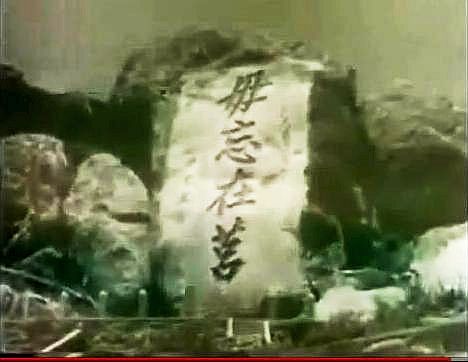
|
|
Invasion Of Manchuria, Chaha'er & Jehol 1931-34
Mukden Incident - 9/18/1931 & Battle Of Jiangqiao
Shanghai Provocation - 1/28/1932
Battles of the Great Wall
China In Crises Of Internal turmoil & Foreign Invasions
Japanese Invasion (1937-1945)
Marco Polo Bridge Incident & Battle of Tianjin-Peking
Campaign Of Nankou & Campaign of Xinkou
Air Battles Directed By Chennault & With Russian Pilots
Battles of Shanghai, Jiangyin, Si'an & Nanking Defense
Rape Of Nanking & The Great Rescue Of 1937
Eight Year Long Resistance War
Mingguang, Linyi-Tengxian, Tai-er-zhuang , & Xuzhou
Battles of Lanfeng, Wuhan, Nanchang, & Sui-Zao,
1st Changsha Battle, Kunlunguan, Wuyuan, & Zao-Yi,
Fatigue Bombing of Chungking by Japanese
Aggression Against Vietnam & Southeast Asia
Yu-nan & E-bei, Shanggao, & Mt Zhongtiaoshan
2nd Changsha Battle, & Pacific Wars
3rd Changsha Battle, Zhe-Gan, Changde, & E-xi
First, & Second Burma Campaign, & Phase II |
| [ revolution.htm & tragedy.htm] |
Communist Armed Rebellions
Second Northern Expedition
War Of Chiang Kai-shek versus Gui-xi (March 1929)
War Of The Central Plains (May 1930)
Campaigns Against Communist Strongholds
The Long March (Iron Chain Bridge)
Xi'an Incident - Turning Point of Modern History
Demise Of Red Army Western Expedition |
| [ campaign.htm & terror.htm ] |
[ default page: war.htm ] |
|
1945-1949 Civil War
Liao-Shen Campaign
Korean War
Vietnamese War
Written by Ah Xiang
|
|
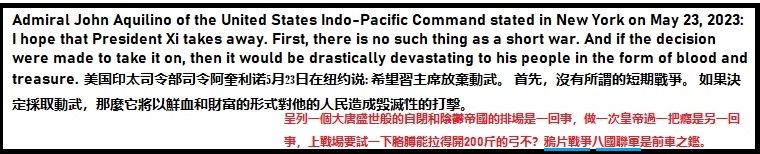
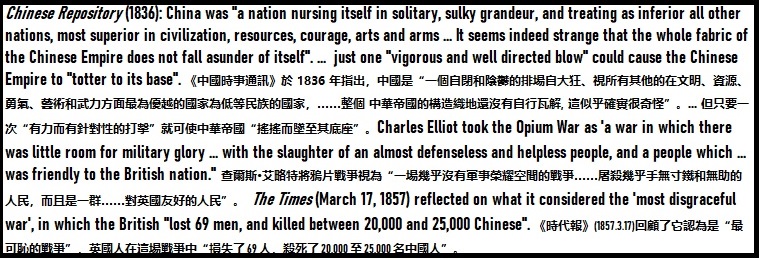
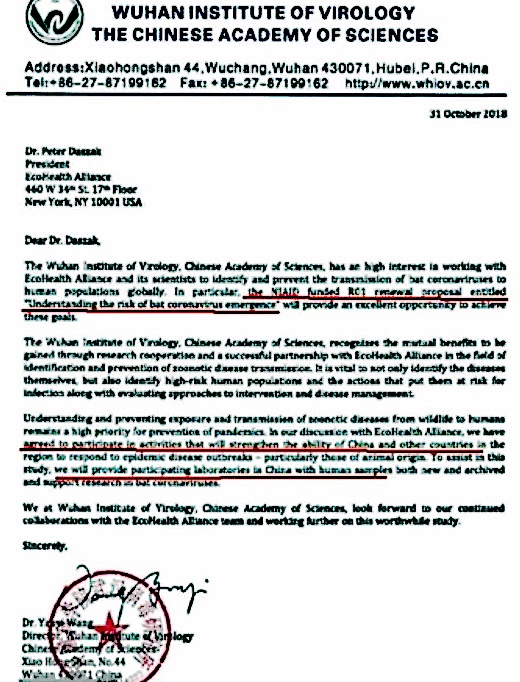

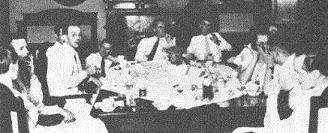
![Though, Anna Wang [Anneliese Martens], in her memoirs, expressed jealousy over Gong Peng by stating that the Anglo-American reporters had flattered the Chinese communists and the communist movement as a result of being entranced with the goldfish-eye'ed personal assistant of Zhou Enlai](GongPeng.jpg)