Sinitic Civilization-Book 1
Sinitic Civilization-Book 2
Tribute of Yu

Heavenly Questions
Zhou King Muwang's Travels
The Legends of Mountains & Seas
The Bamboo Annals - Book 1
The Scourge-of-God-Tetralogy:
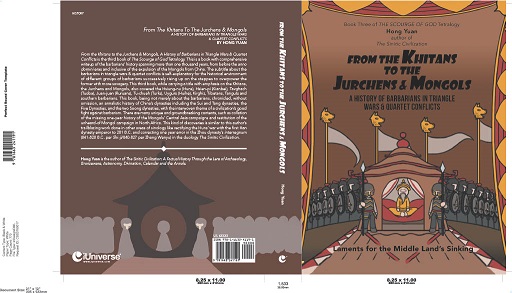
From the Khitans to the Jurchens & Mongols: A History of Barbarians in Triangle Wars and Quartet Conflicts
(available at iUniverse;
Google;
Amazon;
B&N)
|
|
America, i.e., the United States, was and is still shortsighted today, not knowing that Korea, at one time paradise of the American Evangelicals, was delivered into the hands of the Japanese imperialists as a result of the Anglo-American confrontation against Czar Russia, and in this geopolitical process, China, the land of the Great Sinitic Civilization (Barnes & Noble,
Amazon,
Google Play|Books
and
Nook Book), was made into a piggy-backed sacrificial/funereal object -the land ruled by the most evil cult called 'communism' that was an 'import' or an 'export' of Soviet Russia.
America would not learn the lesson that the geopolitical actions it is taking today would yield the 'bad fruit' 50 years or 100 years down the road.
America, and their British cousins, must have forgot the twenty-year Anglo-Japanese military alliance that allowed Japan to develop the warplanes and aircraft carriers to invade mainland China, not to mention the post-WWI ten-year arms embargo against Republic China and George Marshall's post-WWII arms embargo against Republic China 1946-1948.
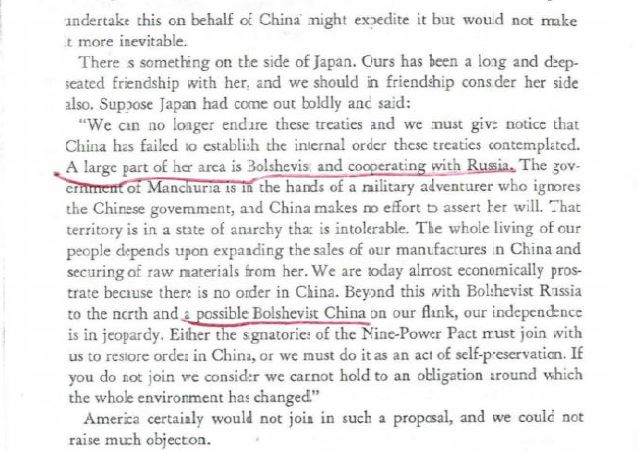
They forgot that in 1931, President Herbert Hoover gave Japan a free hand in the invasion of Manchuria on the pretext that Japan could not tolerate a half-Bolshevik China.
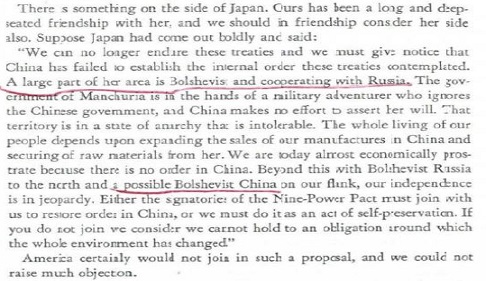 Earlier, President Hoover, who personally nipped the post-WWI communist uprisings in Germany and Hungary with the grains embargo, fed Lenin the ingenuity, i.e., the [worldwide communist revolution] road to Paris lay through Peking.
They of course forgot that
after the eruption of the 1937 Sino-Japanese War, the Americans, biased towards Japan and against China, adopted a policy of "neutrality" (what Utley called by "unpositive neutrality") against the 'belligerent' countries, namely, Japan and China, which was free and unrestrained arms sale to Japan and de facto arms embargo against China.
Note that the Japanese navy had a full blockade of China's coastline.
Note that the blockade would choke China since China did not have an industrial base to produce the basic weapons while Japan's factories could roll out the warships and airplanes on a wholesale scale.
Also note that in contrast with the Americans, the European powers, being constrained by the mediation role of the League of Nations, dared not openly sell arms to Japan.
Through 1940-1941, prior to the U.S. revocation of the 1911 U.S.-Japan Commerce Treaty, the Americans were the biggest supplier of raw material, oil, aviation oil, and weapons, to the extent that some U.S. senator called by Scott making a claim that out of every one million Chinese killed by the Japanese, 544,000 Chinese were killed by the Americans.
Thirty-one U.S. congressional members made a joint declaration to the effect that the U.S., not NAZI Germany, nor Italy, was the best ally of Japan.
Earlier, President Hoover, who personally nipped the post-WWI communist uprisings in Germany and Hungary with the grains embargo, fed Lenin the ingenuity, i.e., the [worldwide communist revolution] road to Paris lay through Peking.
They of course forgot that
after the eruption of the 1937 Sino-Japanese War, the Americans, biased towards Japan and against China, adopted a policy of "neutrality" (what Utley called by "unpositive neutrality") against the 'belligerent' countries, namely, Japan and China, which was free and unrestrained arms sale to Japan and de facto arms embargo against China.
Note that the Japanese navy had a full blockade of China's coastline.
Note that the blockade would choke China since China did not have an industrial base to produce the basic weapons while Japan's factories could roll out the warships and airplanes on a wholesale scale.
Also note that in contrast with the Americans, the European powers, being constrained by the mediation role of the League of Nations, dared not openly sell arms to Japan.
Through 1940-1941, prior to the U.S. revocation of the 1911 U.S.-Japan Commerce Treaty, the Americans were the biggest supplier of raw material, oil, aviation oil, and weapons, to the extent that some U.S. senator called by Scott making a claim that out of every one million Chinese killed by the Japanese, 544,000 Chinese were killed by the Americans.
Thirty-one U.S. congressional members made a joint declaration to the effect that the U.S., not NAZI Germany, nor Italy, was the best ally of Japan.
 Not to mention that the Japanese navy had a full blockade of China's coastline.
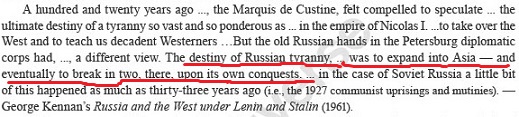
America, the 'stars' that engendered or heralded the rise of the [Japan] 'sun', long ago had the blueprint to make Japan into a stalwart against China and Russia, i.e., the source of the Yellow Peril and the source of the Half-Tartars [or the Russians], respectively, --whom the Americans could not assimilate according to George Kennan.
William Christian Bullitt Jr. (1891-1967) disclosed that the Americans' national policy or strategic aim was to see the Russians and Japanese' holding a balance of power against each other in China rather than seeing either the Russians or the Japanese overpowering the other party in taking control of China.
In making this geopolitical decision, you had victimized the 1 billion humble Chinese peasants.
(Note President Wilson's doctrine that the intactness of China was vital to the white civilization -- in the sense that the nation of China should be managed delicately, that is, should not be allowed to grow too powerful to pose threat to the white civilization, nor should it be allowed to be hijacked by a non-U.S. power since China's immense human labor could be turned against the white civilization.
The theme of China to the white civilization, morphing superficially into a ***hypocritical*** American national policy of engagement with Communist China for changing the Chinese communists' behavior, rested on the same underlying logic:
"The
China Exception: Russian Communism being wicked, the
Chinese are good communists", which is an inherent fear
of the Yellow Peril,
i.e., billion Chinese would actually enjoy real
democracy, go to college and develop their intelligence.
Now, President Biden, a stooge of Communist China, explicitly abandoned the
hypocritical American policy of engagement to change communist China to his imbecilic communist buddy and dictator Xi Jinping.
Other than the stooge Bidens who ripped communist China's financial coffer (Tony Bobulinski FULL INTERVIEW Tucker Carlson), don't forget that President Roosevelt boasted of his family's ripping the China trade money in the 19th century, i.e., the opium trade;
and President Hoover certainly got the first bin of gold from the Kai-luan coal mine in collusion with the British during the 1900-1901 boxers' incident-related invasion.)
Not to mention that the Japanese navy had a full blockade of China's coastline.
America, the 'stars' that engendered or heralded the rise of the [Japan] 'sun', long ago had the blueprint to make Japan into a stalwart against China and Russia, i.e., the source of the Yellow Peril and the source of the Half-Tartars [or the Russians], respectively, --whom the Americans could not assimilate according to George Kennan.
William Christian Bullitt Jr. (1891-1967) disclosed that the Americans' national policy or strategic aim was to see the Russians and Japanese' holding a balance of power against each other in China rather than seeing either the Russians or the Japanese overpowering the other party in taking control of China.
In making this geopolitical decision, you had victimized the 1 billion humble Chinese peasants.
(Note President Wilson's doctrine that the intactness of China was vital to the white civilization -- in the sense that the nation of China should be managed delicately, that is, should not be allowed to grow too powerful to pose threat to the white civilization, nor should it be allowed to be hijacked by a non-U.S. power since China's immense human labor could be turned against the white civilization.
The theme of China to the white civilization, morphing superficially into a ***hypocritical*** American national policy of engagement with Communist China for changing the Chinese communists' behavior, rested on the same underlying logic:
"The
China Exception: Russian Communism being wicked, the
Chinese are good communists", which is an inherent fear
of the Yellow Peril,
i.e., billion Chinese would actually enjoy real
democracy, go to college and develop their intelligence.
Now, President Biden, a stooge of Communist China, explicitly abandoned the
hypocritical American policy of engagement to change communist China to his imbecilic communist buddy and dictator Xi Jinping.
Other than the stooge Bidens who ripped communist China's financial coffer (Tony Bobulinski FULL INTERVIEW Tucker Carlson), don't forget that President Roosevelt boasted of his family's ripping the China trade money in the 19th century, i.e., the opium trade;
and President Hoover certainly got the first bin of gold from the Kai-luan coal mine in collusion with the British during the 1900-1901 boxers' incident-related invasion.)
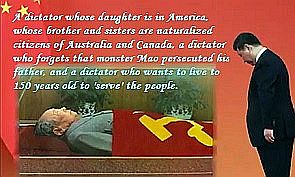 Now, you, as the midwife who delivered China into the communist hands, are morally obligated to take China [and North Korea {and Vietnam}] out of communism.
This time, you may feel your hands forced as North Korea, with its nuclear weapons, could become Communist China's cecal appendix in a repeat of history.
(The Chicoms don't understand the urgency of Trump's trade war having the roots in nuclear North Korea, nor the domino effect on North Korea and Russia after the knock-out of communist China.
Putin thought he would reap profits by sitting on the fence of the U.S.-China trade war, i.e., the Zheltorossiya dream
- revitalized by Aleksandr Gelyevich Dugin
[, and India would not be satisfied with grabbing South Tibet, Bhutan, and Sikkim alone].
Previously, this webmaster thought that the Americans could be hoodwinked by the Chicoms who might just sign any agreement just for sake of getting a red carpet at the White House in lieu of a visit to Mar-a-Lago.
With Trump's war with Communist China flaring up, this webmaster believed that China's dictator would continue to commit blunders and became the tomb digger for the Chinese communist regime.
The thuggery communists, who would not allow the millions of the Hongkong people to have autonomy, could have caused the demise of the regime over the inevitable crackdown, not knowing that the communist ascension to power had its very roots in Churchill's collusion with Roosevelt in selling out the Republic of China for sake of retaining crown jewel Hongkong after hoodwinking Wellington Koo and Chiang Kai-shek that Britain would return Hongkong to China after Japan was to surrender so as not to damage the British wartime morale.
--What happened was that Putin first jumped off the fence ahead of communist China in launching an invasion of Ukraine.)
Now, you, as the midwife who delivered China into the communist hands, are morally obligated to take China [and North Korea {and Vietnam}] out of communism.
This time, you may feel your hands forced as North Korea, with its nuclear weapons, could become Communist China's cecal appendix in a repeat of history.
(The Chicoms don't understand the urgency of Trump's trade war having the roots in nuclear North Korea, nor the domino effect on North Korea and Russia after the knock-out of communist China.
Putin thought he would reap profits by sitting on the fence of the U.S.-China trade war, i.e., the Zheltorossiya dream
- revitalized by Aleksandr Gelyevich Dugin
[, and India would not be satisfied with grabbing South Tibet, Bhutan, and Sikkim alone].
Previously, this webmaster thought that the Americans could be hoodwinked by the Chicoms who might just sign any agreement just for sake of getting a red carpet at the White House in lieu of a visit to Mar-a-Lago.
With Trump's war with Communist China flaring up, this webmaster believed that China's dictator would continue to commit blunders and became the tomb digger for the Chinese communist regime.
The thuggery communists, who would not allow the millions of the Hongkong people to have autonomy, could have caused the demise of the regime over the inevitable crackdown, not knowing that the communist ascension to power had its very roots in Churchill's collusion with Roosevelt in selling out the Republic of China for sake of retaining crown jewel Hongkong after hoodwinking Wellington Koo and Chiang Kai-shek that Britain would return Hongkong to China after Japan was to surrender so as not to damage the British wartime morale.
--What happened was that Putin first jumped off the fence ahead of communist China in launching an invasion of Ukraine.)
|
President Trump
understood the China situation and the China problem.
Should the American politicians follow the footsteps of Anson Burlingame (1820-1870),
Paul Samuel Reinsch (1869-1923)
and
Patrick Jay Hurley (1883-1963), i.e., three most prominent U.S. statemen who loved China and the Chinese people,
then the Chinese people could have a chance of salvation from the communist tyranny.
Note the historic recurrence and the repetition of similar events:
Anson Burlingame, in opposition to the anti-Chinese discriminatory whirlwinds rampant in the U.S. in the 19th century, authored the Burlingame Treaty for China and
died for China in 1870 in St. Petersburg
while still on the Manchu China's mission to the U.S. and Europe;
Paul Samuel Reinsch, who was disillusioned by President Wilson's betrayal of China over the division of WWI spoils at the Paris Peace Conference, quit the minister-to-China job to work for China and died for China in Shanghai in 1923;
and
Patrick Jay Hurley, who convinced President Roosevelt of the American moral blunders in selling out the Republic of China at Tehran and Yalta, personally travelled to Moscow and London for sake of averting and reverting China's fate of becoming a victim of WWII war spoils (i.e., the loss of Port Arthur and Hong Kong, etc.), but failed to make remedy to the secret Tehran and Yalta agreements in the aftermath of President Roosevelt's death in April 1945.
|
|
For better understanding the head-on collision between the United States and Communuist China,
refer to
the U.S.-China fatalistic conjunction through the hands of the Japanese firepower during WWII, that derived from the American unpositive neutrality;
the U.S.-China fatalistic conjunction through the hands of communist army's firepower during the 1945-1950 civil war, that derived from American-supplied Soviet August Storm weapons; and
the U.S.-China fatalistic conjunction through Joseph Stalin, Kim Il Sung and Mao Tse-ting's hands during the 1950-1953 Korean War.
|
|
|
|
More, refer to the Communist Platonic Club at wartime capital Chungking
and
The American Involvement in China: the Soviet Operation Snow, the I.P.R. Conspiracy, the Dixie Mission, the Stilwell Incident, the O.S.S. Scheme, the Coalition Government Crap, the Amerasia Case, & The China White Paper.
|
|
|
|
TRAGEDY OF CHINESE
REVOLUTION - PART I
(*** machine-translated Chinese language version:  ***) ***)
Xin Hai Revolution: External vs Internal Inducements
Manchu Army System & Northern Warlords
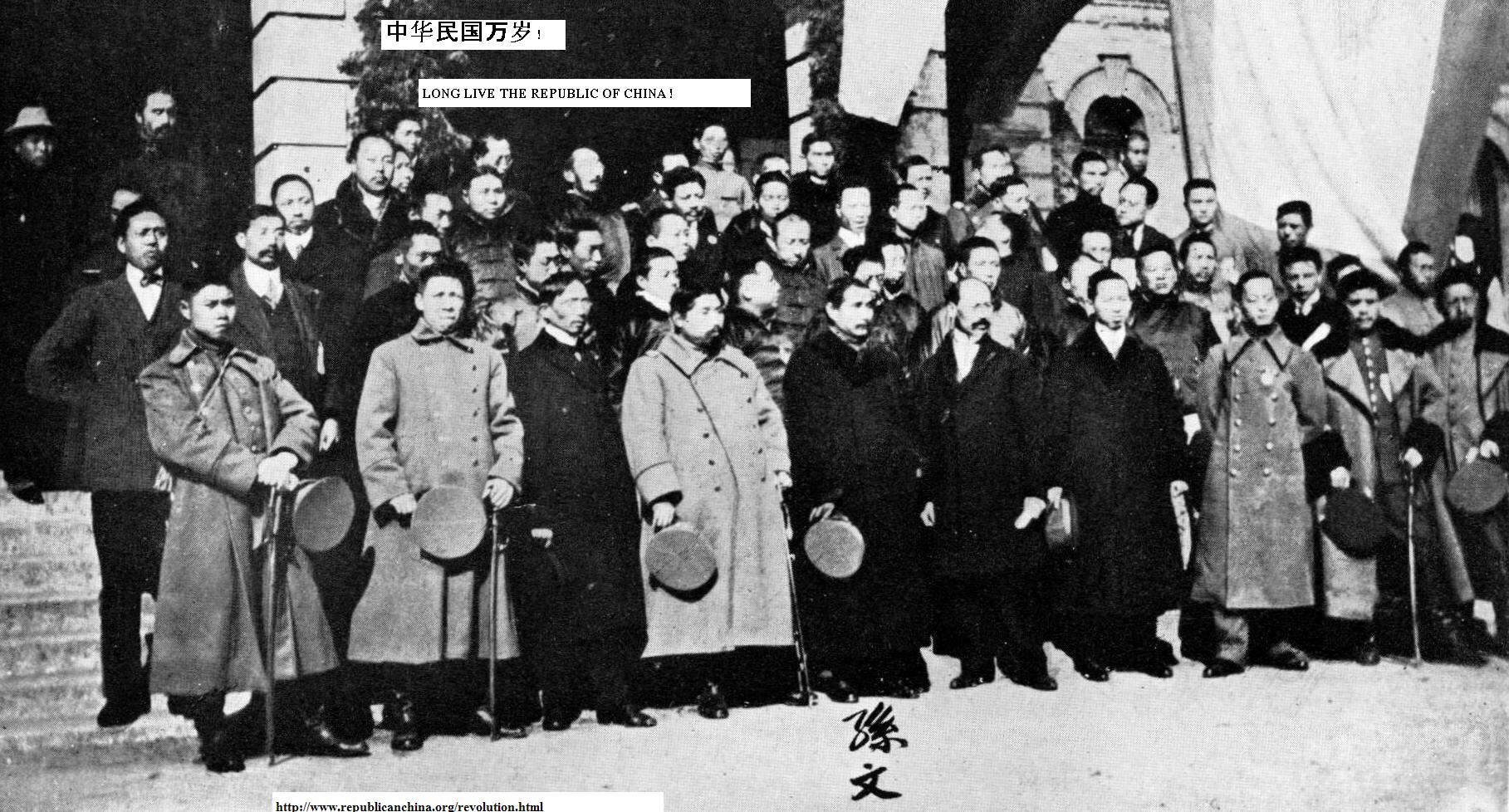
Founding Of The Republic Of China (ROC)
Yuan Shi-kai - First President of ROC
Soong Jiaoren - Re-organization of Kuomintang (KMT)
Soong Jiaoren's Assassination Death & Second Revolution
Yuan Shi-kai Trampling On Republic
First World War & China - Japan's Twenty-one Demands
Yuan Shi-kai's Imperial Enthronement
The Republic Restoration Wars
Duan Qirui's Ascension To Power, & Compromises
Re-convening of Parliament & Revival Of Parties
Duan Qirui's Premier Post vs Li Yuanhong's Presidency
Zhang Xun's Restoration Of Imperial House
Southern Government & Protecting 'Interim Agreed-Upon Laws'
Civil Wars Among Northern Warlords
Russia, Britain & Japan - Tibet, Xinjiang, Mongolia & Manchuria
Russian Revolution: Nationalism vs Internationalism
Sun Yat-sen's Return To Canton After Expelling Gui-xi
"Allying Multiple Provinces For Self-Determination"
|
Cai Yuanpei, Hu Shi, Chen Duxiu & New Culture Movement
WWI, Workers' Awakening & Their Anti-Imperialism Role
Versailles Conference & May 4th Students' Movement
USSR/Comintern Seeking & Implanting Chinese Partners
Guangdong-Guangxi War & Li Zongren's Emergence
Chen Jiongming Rebellion Against Sun Yat-sen
USSR / Comintern Alliance With KMT & CCP
KMT First National Congress (Jan 1924)
Founding of Chinese Communist Party
CCP-Organized Workers' Movements
Peasants' Poverty Is China's Poverty
Mao Zedong (Mao Tse-tung) & Peasant/Land Revolution
Borodin, Moscow & Chinese Revolution
Li Zongren Quelling Guangxi & Wars In Southwest China
Chiang Kai-shek & Whampoa Military Academy
5-30 Bloody Incident, HK-Guangdong Strike, & Boycotts
Wang Jingwei & KMT Left-Wing
Zhongshan Warship Incident
Northern Expeditions & Unification Of China
KMT Purging CCP: Tragedy of The 'Grand Revolution'
|
| [ this page: revolution.htm ] |
[ next page: tragedy.htm ] |
Excerpts of Zou Rong's "Revolutionary Army"
[translation by apparently Frank Dikötter and the sort who had no clue about "Chinese racism/nationalism" of the 1900s at which time the revolutionary forerunners had undergone several stages of cognizance as to the "social Darwinism" but adopted for the Republic of China the "Five Color National Flag" [1912-1928], which was symbolic of the union of the five ethnic groups of the Han Chinese, the Mongols, the Manchus, the Tibetans & the Hui Muslims]
"
Sweep away millennia of despotism in all its forms, throw off millennia of slavishness, annihilate the five million and more of the furry and horned Manchu race, cleanse ourselves of 260 years of harsh and unremitting pain, so that the soil of the Chinese subcontinent is made immaculate, and the descendants of the Yellow Emperor will all become Washingtons. Then they will return from the dead to life again, they will emerge from the Eighteen Levels of Hell and rise to the Thirty Three mansions of Heaven, in all their magnificence and richness to arrive at their zenith, the unique and incomparable of goals - revolution. How sublime is revolution, how majestic!
I follow thereupon the line of the Great Wall, scale the Kunlun Mountains, travel the length of the Yangzi, follow to its source the Yellow River. I plant the standard of independence, ring the bell of freedom. My voice re-echoes from heaven to earth, I crack my temples and split my throat in crying out to my fellow-countrymen: revolution is inevitable for China today. It is inevitable if the Manchu yoke is to be thrown off; it is inevitable if China is to be independent; it is inevitable is to take its place as a powerful nation on the globe; it is inevitable if China is to survive for long in the new world of the 20th century; it is inevitable if China is to be a great country in the world and play the leading role. Stand up for Revolution! Fellow-countrymen, are there any of you whether old or in middle years, in your prime of life or young, be it man or woman, who is talking of revolution or working actively for revolution? Fellow countrymen, assist each other and live for each other in revolution. I here cry at the top of my voice to spread the principles of revolution throughout the land.
Revolution is the universal principle of evolution. Revolution is the essence of the struggle for survival of destruction in a time of transition. Revolution submits to heaven and responds to men's needs. Revolution rejects what is corrupt and keeps the good. Revolution is the advance from barbarism to civilization. Revolution turns slaves into masters ...
"
Recently, I have noticed a trend among the academics to call into doubt Dr. Sun Yat-sen in regards to his thoughts on the Parliamentary versus presidential politics. Liu Xiao-bo claimed that Dr. Sun Yat-sen was no better than warlord President Yuan Shi-kai because Dr. Sun Yat-sen was against Song Jiao-ren's Parliamentarism: Liu Xiao-bo said that on December 26th, 1911, Sun Yat-sen opposed Song Jiao-ren's Parliamentary structure, adamantly advocated the presidential structure, and hence Sun was elected 'Interim President of the ROC'. Liu Xiao-bo further stated naively that after the 20 March 1913 assassination of Soong Jiaoren by Yuan Shikai, Sun decided to launch the 'Second Revolution' instead of resorting to the Parliament for impeachment of Yuan Shikai. Liu Xiaobo summarized that the success of the Xin Hai Revolution in overthrowing the Manchu rule should be ascribed to the so-called "autonomous movements" among various provinces against a centralized decadent Manchu government.
Liu Xiaobo's claim, incidentally, was related to their dilemma in finding a solution to today's totalitarian and/or neo-authoritarian communist rule in China. The solution, in their opinions, would be that of federationism or commonwealth and a revival of Parliamentarism.
Hsueh Chun-tu, in "Huang Xing & The Chinese Revolution", concluded that the Manchu dynasty's demise could be attributed to: 1) the imperialist nations' invasion against China; ii) unrest of the Chinese peasantry; iii) the rise of the Chinese bourgeoisie; and iv) the transfer of power to the Han-ethnic generals from the Manchu banners in the aftermath of the Taiping-tian'guo rebellion.
Beginning with Paul Linebarger's "Our Chinese Chances Through Europe's War" & "Sun Yat-sen & The Chinese Republic", the Americans also analyzed China's revolution from the external perspective.
American Mary C. Wright, in 1968, claimed that the secret societies under Soong Jiaoren, not Sun Yat-sen's "Allied Society", played the role of overthrowing the Manchu rule.
The Americans, of course, did not trace the roots to the synarchists' attempt at swindling China's railway for explaining the root cause of the 1911 revolution.
Jiang Yongjing, in "The Land-Sea Ebb History of the KMT", did not cover up Soong Jiaoren's dispute with Sun Yat-sen in launching an independent "Tong Meng Hui" in the Yangtze River area, which was to fulfill Soong Jiaoren's middle tactic of achieving the revolution success in the Yangtze River area against Sun Yat-sen's emphasis on southern China. The three leading Xin Hai revolutionaries with 'wu' given name, in addition to Xiong Bingkun who led the charge at the Chuwangtai Weapons Depot, were all subordinate to Soong Jiaoren.
Song Jiao-ren's contribution notwithstanding, Jiang Yongjing attributed the multiple-province members recruited and disciplined by "Tong Meng Hui" to the success of the domino-effect provincial independence during the 1911 Xin Hai Revolution. Historian Shen Yunlong called the attention to the Manchu Qing's abolition of the imperial civil services exam as a fundamental cause in re-orienting the innumerable talented revolutionaries towards services under the Manchu Qing's re-organized New Army. Shen Yunlong attributed Manchu Governor-general Zhang Zhidong's arts and military academies to the upbringing of a generation of revolutionaries who played the pivotal role in the 1911 soldier uprising at Wuchang, Hubei Province.
Criticism of Sun Yat-sen have merits. Yuan Weishi, someone affiliated with the Yuan family, blamed Sun Yat-sen's Second Revolution as a cause of the KMT's decline in the early history of China's politics and a bad example for China's modern history, and further praised Cai Er (Cai E) and Liang Qi-chao as the pillar forces responsible for capsizing Yuan Shi-kai's imperial enthronement.
Dr Sun Yat-sen's Feats & Faults
Xin Hao-nian's analysis of the Nationalist Revolutions of the early 20th century, however, showed us a true and exact Dr. Sun Yat-sen, namely, a truly patriotic, altruistic, generous and wise person. Dr. Sun Yat-sen proposed the 'Three People-ism' (i.e., Three People's Principles) as the theories guiding China's democratic revolution, and further devised the 'Five Branches Of Government', which was to add the ancient Chinese censorate or inspector system and imperial service examination system to the tripartite power structure of the West. It was Sun Yat-sen who first proposed the establishment of the Republic of China, the R.O.C., in 1903 and advocated the concept of 'national revolution' as distinction from "pingmin geming" (i.e., the 'ordinary people/banditry revolution'). Dr. Sun Yat-sen's altruism was shown in his surrendering his post of the 'interim presidency' to Yuan Shi-kai for sake of avoiding further bloodshedding, and it was not his first time to have surrendered the leadership. Dr Sun Yat-sen, for sake of unity, had personally visited Yuan Shi-kai in Peking and engaged over a dozen days of tête-à-tête discussion with Yuan Shikai. After seeing that the Xin Hai Revolution was betrayed by the warlord government, Dr. Sun Yat-sen laid out the three stages for China to evolve to democracy. Dr. Sun Yat-sen laid out the three stages of 'Jun Zheng' (the military government), 'Xun Zheng' (the KMT supervised government), and 'Xian Zheng' (the constitutional government) after reflecting on the incompleteness of the Xin Hai Revolution, i.e., the 1911 Revolution that overthrew the Manchu rule. Xin Hao-nian, in "Which Is The New China?" (copyright 1999, Blue Sky Publishing House,
http://www.ifcss.org/xin_haonian/book_chapters/toc.html
), expounded the background, context and process of three stages of 'Jun Zheng', 'Xun Zheng', and 'Xian Zheng' as practiced by the Kuomintang (KMT) Government of Chiang Kai-shek.
Dr. Sun Yat-sen, however, had his shortcomings. Like generations of people in the 20th century, Sun Yat-sen had naive and utopian fondness for the Russian October Revolution of 1917. Dr. Sun Yat-sen misunderstood Lenin's "goodwill" lip-service in nullifying the unequal treaties imposed on China by Czar Russia, and hence entered into an alliance with the Soviet Union and the Chinese Communist Party (CCP). From 1920 to 1923, the USSR continuously sent representatives to China for talks with the northern/southern warlords as well as with Dr. Sun Yat-sen and the communism activists. Joffe, a representative of Lenin, came to Shanghai, and on January 26th, 1923, promised to Sun Yat-sen in a joint declaration that they would help China to reunite under Three People-ism without implanting communism in China. Mikhail Borodin's military supplies (120,000 rifles) and a package of 2 million Mexican dollars in annual aid made Sun Yat-sen declare a new policy of 'allying with the USSR and allowing the CCP members to join the KMT individually'. (Xin Hao-nian mentioned that Dr. Sun might have mis-judged the CCP's destabilizing capabilities because the CCP possessed only 432 members by the end of 1923. Scholar Xu Zerong's claim of 120,000 Russian rifles might not be up to par in both the number and quality:
In May 1926, Chiang Kai-shek mentioned that he could allocate some of the 10,000 Russian rifles to the Guangxi Province's 7th Corps[, but Li Zongren had to remind Chiang Kai-shek several times before receiving about 1000 Russian rifles and 4 heavy machineguns]. The Russian weapons happened to be WWI-era outdated guns that were possibly caught from the Germans.)
Sun Yat-sen's decision to ally with Russia and the CCP was induced by the antagonism from the imperialistic powers. Sun Yat-sen complained to reporters of "New York Times" in July, 1923 about this kind of imperialistic antagonism towards the Chinese revolution. As pointed out by Xin Hao-Nian, Dr. Sun Yat-sen's decision to withhold surplus tax from the Canton Customs was opposed by the various imperialistic powers. In December of 1923, Britain, the U.S., France, Japan, Italy and Portugal, etc., sent their warships and gunboats to Canton to exert pressure on Sun Yat-sen for sake of protesting against the threatened customs tax withholding. It is no strange that the imperialist powers would oppose Sun Yat-sen since China's revolution was induced by the invasion of the foreign powers in the first place. From the outset of the Xin Hai Revolution of 1911, imperialist powers had opposed China's democracy process, and this is best exemplified by the U.S. minister's pressuring the Manchu government into recalling Yuan Shi-Kai for sake of cracking down on the Xin Hai Revolution.
That is what I will call here as the Tragedy of Chinese Revolution, not the same as Harold Isaacs' book Tragedy of The Chinese Revolution, i.e., the Chinese revolution failed as a result of the ideological difference between Lenin, Stalin, Bukharin and Trotsky on the matter whether China's revolution was at the stage of the Russian 1905 Revolution or the Russian 1917 Revolution.
At http://www.larouchepub.com/other/2004/3123morgan_v_dr_sun.html, Mike Billington wrote for "Executive Intelligence Review" an article entitled "How London, Wall Street
Backed Japan's War Against
China and Sun Yat Sen", pointing out the behind-the-scene manipulations as to "SYNARCHISM AND WORLD WAR".
As stated by Mike Billington, "... British synarchist banking interests, centered around Bank of England head Montagu Norman, Hongkong and Shanghai Bank director Sir Charles Addis, and J.P. Morgan chief executive Thomas Lamont, deployed militarily and politically to destroy Sun Yat Sen and his influence.
... when their subversion and looting failed to crush Sun's republican movement, the British threw their weight behind the synarchist/fascist forces in Japan, financing the Japanese military occupation of the Chinese mainland...
By 1931, J.P. Morgan had floated $263 million in loans for the Japanese borrowers, including direct loans to the government in 1930", with quite some of the funds going direct to the Southern Manchurian Railway under disguise to avert the world opinions.
The Anglo-American hostility and subversion against China continued well into the 1940s, at which time General Wedemeyer, right after succession of Stilwell's post in 1944, reported to Washington DC in a cable, stating that "...British Ambassador personally suggested to me that a strong unified China would be dangerous to the world and certainly would jeopardize the white man's position immediately in Far East and ultimately throughout the world".
More available at "Changing Alliances On the International Arena", "Century-long American hypocrisy towards China", "Anglo-American & Jewish romance with the Japanese",
"America's Unpositive Neutrality in the Sino-Japanese War",
"Joe Stilwell's Authorization To Assassinate Chiang Kai-shek", and "What Foreign Powers Did To The Flowery Republic Prior To, During And After The 1911 Revolution".
Dr. Sun Yat-sen had deficiencies, too. His "Three People's Principles" had been ambiguous. Later, Borodin modified the principles into factual policies:
Per Harold Isaacs, Borodin modified Sun Yat-sen's ambiguous Three People's Principles, like "restriction of capital" and "equalization of rights in the land", and made them into something like a "25 percent reduction in land rents" and a promise of "labor code".
Sun Yat-sen, in order to secure the imperialists' support for the 1911 Xin Hai Revolution, had been ambivalent to the foreign powers as to the unequal treaties imposed on Manchu China. Per JYJ, Sun Yat-sen had always upheld the agenda of 'quelling the internal enemies before expelling the external invaders'; as shown in his policy difference with Huang Xing et al., in 1915, Sun Yat-sen called on the revolutionaries to oppose Yuan Shi-kai's treachery rather than unite behind Yuan Shi-kai for a concerted struggle against Japan's 21 Demands. (Sun Yat-sen, in his 1925 trip to Peking for meeting with Duan Qirui, did insist that the Peking government should not acknowledge the unequal treaties with the West and Japan. Duan Qirui continued the unequal treaties in exchange for the imperialists' acknowledgement of the Peking government.) Sun Yat-sen, in order to win support from the USSR, had contacted Lenin two times in 1918 and expressed much softer stance on the Mongolia independence and the China Eastern Railroad in the 1922 correspondence with Joffe. Dr. Sun Yat-sen, after the January 26th 1923 Sun-Joffe Joint Statement, had fallen into a de facto Soviet agent, sowing the seeds of struggles and conflicts between the KMT and CCP as well as the disasters of the Chinese people in the 20th century.
More, Dr. Sun Yat-sen was commented to have possible disregard for human life and to have resorted to political assassinations as well. Scholar Yuan Weishi pointed out that Sun Yat-sen, using his followers (i.e., Zhu Zhixin, Huang Dawei, Zhang Ji, Ju Zheng and Tian Tong), were behind the assassinations and attempted assassinations of Dian-jun General Fang Shengtao in January 1918, Navy Minister Cheng Guangbi on February 26 1918, Yue-jun General Chen Jiongming in April 1922, and Deng Keng (? doubtful in light of Ding Zhongjiang's description).
One more possibly implicating event would be Chiang Kai-shek's assassination of Tao Chengzhang inside of Guangci Hospital at the order of Chen Qimei on January 14th 1912 since Tao Chengzhang, three days before, had received a letter from Sun Yat-sen demanding an explanation for Tao's 1909 accusations of 14 crimes that Sun Yat-sen had committed on the matter of funds raising and appropriation.
Xin Hao-nian's research and dissertation on modern Chinese history is incredible in that very few people inside of China could have gained extraordinary insight and judgment into the historical events that had occurred in the 20th century. According to his Foreword, he began to gain this kind of insight beginning from 1985 when the CCP declared 'national heroes' for 85 Nationalist generals who died in the Resistance Wars Against Japan.
In then China, everybody was living in the 'Dark Ages', with no knowledge of truth aside from the CCP propaganda. Short-wave radios were in no existence during the whole time period of the Cultural Revolution (CR). Occasionally, I could tune in to 'the Voice of Free China' Cantonese version via medium-wave. I remembered that one day during the CR, a truck carrying several tightly-bound 'convicts' rotated to the working unit for 'parade prosecution' by the masses: among those on the truck was a young man classified as so-called 'reactionary caught red-handed' for listening to enemy stations. In late 1970s, after the fall of the Gang of Four (ultra-leftists), CCP's 3rd Plenary of the 11th Session proposed liberalization of thoughts in late 1978. The 'Wounds Literature' popped out, describing the various persecution and torture that the communist leaders and their families had endured during the CR. The movie 'Bitter Love' described two lovers and their stories during the CR. Some movies ("Legends Of the Tianyunshan Mountains", e.g.) carried the 'Wounds Literature' further, beyond the CR, to the Anti-Rightists Movement of the late 1950s. While still in junior high school, in 1980, I read about a book called 'Ten Year History of the Cultural Revolution'. I also had access to the Chinese version of Edgar Snow's 'Red Star Over China' as well as some torn-apart old book about the communist warfare in Manchuria; I read about the traitor-general Lin Biao and his wars against the KMT in Manchuria, especially the siege of Changchun city wherein over 300,000 civilians were starved to death as a result of the communists' blockade of the city and refusal to allow the civilians to exit the city. ('Xue3 [snow] Bai [white], Xue4 [blood] Hong [red] by Zhang Zhengrong is a good reference book on this subject.) Liberal criticism of the CCP would soon end as an episode called the 'Beijing Spring'. Soon, the political control was tightened after Deng successfully overthrew Mao-designated heir (Hua Guofeng). on January 29th, 1981, Deng Xiao-ping, to justify his crackdown on the 'Xidan Democracy Wall', would launch the theory of 'Four Insistencies', namely, Insisting On Communist Dictatorship [i.e., People's Democratic Dictatorship]. A warning, related to the criticism of the Movie 'Bitter Love', was issued to the entertainment industries and propaganda ministry. Around 1983, in the college library, I could still find books like 'The Third Road' (circulation 8000 copies nationwide) written by some East European communist leader. In late 1983, a short term movement called 'Anti-Bourgeois Liberalization & Anti-Westernization' was launched, but it lasted 27 days due to lack of support. My American professor would be allowed to set up a section in the departmental library and her overseas friends kept sending over various books. Salisbury's 'New Long March' would change my perception of the communist dictatorship, and histories about the Korean War further convinced me that whatever CCP propaganda talked about would be sheer lies. In December 1986, First Students' Movement erupted in major cities like Beijing, demanding democracy as well as punishment of corrupted officials. Another 'Anti-Bourgeois Liberalization Movement' followed in early 1987, and CCP Secretary General Hu Yao-bang was forced to resign by Deng and the Politburo. Hu's death in 1989 would trigger the Second Students' Movement which ended in the June 4th Massacre of 1989.
This section could be deemed a continuation of the dynastic substitution from Prehistory to the Qing dynasty.
The Xin Hai Revolution: External vs Internal Inducements
Quite a few people had recently uncovered the facts surrounding the Boxers' Movement of 1900 and the subsequent invasion by the 'Eight Allied Nations'. A noteworthy person would be Bei Ming of 'Radio Free Asia'. The main spirits of this kind of research would be to point out that the United States had acted fairly before, during and after the crackdowns on the Boxers. Further, Bei Ming claimed that the United States had acted as the most altruistic of all in voluntarily refunding the overcharged 'war compensations' from damages caused by the Boxers, in the form of scholarships for supporting the Chinese overseas studies in America.
Bei Ming, in description of the boxers' arson of the adjacent Imperial Library and the British Legation, unscrupulously commented that the British prized Chinese classics books more than the Chinese the same way as today's foreigners giving more love to tens of thousands of baby girls whom the obnoxious Chinese communist government sells to the west for an adoption fee of US$5,000 to $20,000.
Per Ding Zhongjiang, Zhou Ziqi, a graduate of Beijing's "Tong Wen Guan" [i.e., "same language house" interpreter school] and later a Manchu Qing emissary to the U.S., had been responsible for negotiating with the U.S. in regards to refunding the 12,000,000 U.S. dollars.
According to Diana Preston's The Boxer Rebellion, Michael Hunt of Yale University in May 1972 concluded in an Journal of Asian Studies article that U.S. Secretary Hay knew at the beginning that the American claims for the boxers' indemnities were exaggerated and excessive; that Roosevelt ignored the Chinese claim for refunding the surplus and procrastinated the refund for as long as possible; and that Roosevelt approved the partial refund only after the Chinese side softened the positions to allow the refund to be used according to the American wish, namely, the Chinese side proposed the usage of funds for educating the Chinese studies in America.
Alternatively speaking, Rev. Arthur H. Smith was responsible for persuading President Theodore Roosevelt into refunding the boxers' indemnity funds back to China in the form of helping Manchu China in establishing higher education institutions and sponsoring the overseas studies in America -- which started under the Burlingame Treaty and was aborted after the passing of the Chinese Exclusion Act.
(Rev. Arthur H. Smith
was on par with
Rev. Elliot Heber Thomson (?-1917) who founded St. Luke’s Hospital
(Shanghai) [and partially founded the later Saint John’s University], where this author’s great-grandfather
studied at the male nurse school before becoming a doctor himself.)
* In Commemoration of China's Fall under the Alien Conquests in A.D. 1279,
A.D. 1644 & A.D. 1949 *
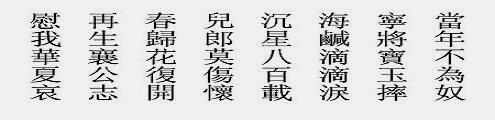 U.S.S.R./Comintern Alliance with the KMT & CCP (1923-1927)
 Korean/Chinese Communists & the 1931 Japanese Invasion of Manchuria Korean/Chinese Communists & the 1931 Japanese Invasion of Manchuria
American Involvement in China: Soviet Operation Snow, IPR Conspiracy, Dixie Mission, Stilwell
Incident, O.S.S. Scheme, Coalition Government Crap, Amerasia Case & The China White Paper
* Stay tuned for "Republican China 1911-1955: A Complete Untold History" *
|
|
Zou Rong's Revolutionary Army;
Shin Kyu Sik's
Shrine (Spirit, Kunitama) of Korea
|
This snippet is for sons and daughters of China:
Heed the sons & ministers' agony and sorrow of our ancestors who died or lived through the Mongol, Manchu and Soviet-Chicom conquest
and
the Yongjia, Jingkang and Jiashen cataclysms !
Jeanne d'Arc of China:
Teenager girl Xun Guan breaking out of the Wancheng city to borrow the relief troops in the late Western Jinn dynasty;
Liu-Shao-shi riding into the barbarian army to rescue her husband in the late Western Jinn dynasty;
teenager girl Shen Yunying breaking into Zhang Xianzhong's rebels on the horseback to avenge on father's death in the late Ming dynasty.
China's Solitary and Lone Heroes:
Nan Jiyun breaking out of the Suiyang siege and charging back into the city in the Tang dynasty;
Zhang Gui & Zhang Shun Brothers breaking through the Mongol siege of Xiangyang in the Southern Soong dynasty;
Liu Tiejun breaking through three communist field armies' siege of Kaifeng in the Republican China time period;
Zhang Jian's lone confrontation against the communist army during the June 3rd & 4th Massacre of 1989.
|
|
|
Japan, out of the boxer indemnity, established an annual sole-quota scholarship for the Chinese on the precondition that the recipient swore allegiance to Hirohito. In the late 1920s, Hu Qiuyuan yielded the Japanese Imperial Scholarship in preference for a Hubei Provincial scholarship for attending the Waseda University. Later in 1932, Mussolini offered to pay the Italian advisers with money from the overcharged boxer-related war damages in exchange of China's purchasing the Italian airplanes in the amount of several millions of U.S. dollars.
Also see century-long American hypocrisy towards China &
American manipulations of Chinese politics [e.g., Stilwell's instigating General Bai Chongxi, Stuart's instigating Li Zongren, and McArthur's instigating General Sun Liren].
The so-called 'Open Door Policy' were exalted by Bei Ming as a fundamental U.S. policy safeguarding Manchu China's territorial integrity during the various imperialist powers' games of 'water-melon partitioning'. The 'Open Door Policy' never stopped Russia from encroaching on China's territories in Manchuria and Xinjiang [New Dominion Province]. (The 'Open Door Policy', first put forward by John Hay, Secretary of State in the McKinley Administration in 1899, was supposedly accepted by Germany, Russia, Britain, France, Italy, and Japan on the solar calendar September 6th of 1899, which was to assure commercial equality for all the powers in China.
The truth was not what was believed that the United States advocated for an "open door" policy for China, which purportedly averted the fate of China of being partitioned by the powers. What happened was that a delayed response from Japan in regards to the "open door" policy helped to seal the U.S. decision to support the "open door" policy which was an idea sold to the Americans by the British career customs officer working in Manchu China's Chinese Imperial Maritime Customs Service.
Absent the Japan concurrence, the U.S. was ready to go ahead to grab a port in Fujian.)
We want to ask a question here: Was the United States a truly altruistic country which saw the Chinese people's interests more important than their own interests? The answer is 'No'.
As pointed out by
at Chinese Americans in Corvallis (Oregon), "the Opium Wars waged against China by England, with the encouragement of American President John Quincy Adams, resulted in massive suffering in the (Chinese) countryside (and the cities) as the English and American drug cartels pushed their wares into every small village in Asia (China) as a means of paying for massive imports of Chinese tea and silk." Note that John Quincy Adams had said, "The seizer of a few thousand chests of opium smuggled into China by the Chinese government was no more the cause of the Opium War than the throwing overboard of the tea in the Boston harbor was the cause of North American Revolution." (Details about the Opium War was covered in qing.htm section.)
Moreover, ensuing the 1856 Second Opium War or the Arrow War, the British and French troops compelled the Manchu government into signing the 'Treaties of Tianjin or Tientsin' (June, 1858), to which France, Russia, and the United States were also parties.
The Opium War led to an indemnity of 21 million Mexican dollars as damages for the British and the cession of the HK Island.
The Second Opium War caused Manchu China to indemnify Britain with 12,000,000 taels of silver and France with 6,000,000 taels of silver.
Furthermore, John Foster, the former U.S. secretary of State, had been the culprit in pushing through the Treaty of Shimonoseki of April 17th of 1895 by volunteering to take the treaty to Peking for the Manchu emperor's ratification, accompanying Li Jingfang to Taiwan for transferring Taiwan, and acting as the ultimate "facilitator" with a claim that the Western diplomatic protocol would allow transfer to be legalized with a signed affidavit rather than to be validated by a de facto personal ceremony on the Taiwan Island.
Also note that the U.S. government, after acquiring Hawaii in summer of 1898 and the Philippines in December 1898, applied "The Chinese Exclusion Act" to the Chinese on the two islands, and further, President Theodore Roosevelt signed into law to have "The Chinese Exclusion Act" applied throughout the U.S.-controlled islands and territories over the world.
After all, the Chinese were bundled by the Democrats with the Blacks as mongrels.
* In Commemoration of China's Fall under the Alien Conquests in A.D. 1279,
A.D. 1644 & A.D. 1949 *
U.S.S.R./Comintern Alliance with the KMT & CCP (1923-1927)
Korean/Chinese Communists & the 1931 Japanese Invasion of Manchuria
American Involvement in China: Soviet Operation Snow, IPR Conspiracy, Dixie Mission, Stilwell
Incident, O.S.S. Scheme, Coalition Government Crap, Amerasia Case & The China White Paper
* Stay tuned for "Republican China 1911-1955: A Complete Untold History" *
|
|
Zou Rong's Revolutionary Army;
Shin Kyu Sik's
Shrine (Spirit, Kunitama) of Korea
|
This snippet is for sons and daughters of China:
Heed the sons & ministers' agony and sorrow of our ancestors who died or lived through the Mongol, Manchu and Soviet-Chicom conquest
and
the Yongjia, Jingkang and Jiashen cataclysms !
Jeanne d'Arc of China:
Teenager girl Xun Guan breaking out of the Wancheng city to borrow the relief troops in the late Western Jinn dynasty;
Liu-Shao-shi riding into the barbarian army to rescue her husband in the late Western Jinn dynasty;
teenager girl Shen Yunying breaking into Zhang Xianzhong's rebels on the horseback to avenge on father's death in the late Ming dynasty.
China's Solitary and Lone Heroes:
Nan Jiyun breaking out of the Suiyang siege and charging back into the city in the Tang dynasty;
Zhang Gui & Zhang Shun Brothers breaking through the Mongol siege of Xiangyang in the Southern Soong dynasty;
Liu Tiejun breaking through three communist field armies' siege of Kaifeng in the Republican China time period;
Zhang Jian's lone confrontation against the communist army during the June 3rd & 4th Massacre of 1989.
|
|
|
Xin Hao-Nian reminded us that at the outset of the Xin Hai Revolution of 1911, touched off by the soldier rebellion in Wuchang, Hubei Province, the American minister-envoy, together with the diplomatic corps, had been responsible for pressuring the Manchu government into recalling warlord Yuan Shi-Kai just for sake of restoring the Manchu order and cracking down on the Xin Hai Revolution. Almost all imperialistic powers sailed their warships and gunboats along the Yangtze River in demonstration of their opposition to the revolutionary 'Provisional Government' in the Wuchang City.
Manchu Qing Dynasty, after the humiliation of the Second Opium War, began to devote itself to the cause of reform. It launched the 'Foreign Enterprises Movement' (i.e., "Yangwu Yundong" or "Self-Strengthening Movement" from 1874 to 1895) with the assignment of South-Sea Minister and North-Sea Minister in 1858 and the buildup of Manchu navies, earlier than Japan's Meiji Restoration of 1868.
But it would end in the destruction of the Manchu fleets inside of the Mawei Port in the hands of the French, and inside of the Weihaiwei Harbor during the 1894-1895 Sino-Japanese War. This shattered the self-strengthening dreams completely.
The 1895 Treaty of Shimonoseki incarcerated China with 230,000,000 taels of silver and cession of Taiwan (Formosa) and the Penghu Islands (the Pescadores), in addition to Japan's control and later 1910 annexation of Korea.
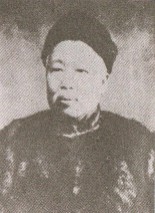 Thereafter, reformists, like Kang You-wei, persuaded Emperor Guangxu into reforming the system itself. This led to the power struggles between conservatives and reformers (i.e., monarchists) which ended in the abortion of the Hundred Day Reformation. Empress Dowager Ci-xi's plot to revenge on the foreigners [who purportedly attempted to restore Emperor Guangxi] by means of the boxers would lead to the 1900 Invasion by the Eight Allied Powers, resulting in a loss of 450,000,000 taels of silver which was to accrue to 982,000,000 tales with interests included throughout the installments for 39 years. (In 1943, 'Boxer Protocol' was nullified after a total payment of 670 million taels of silver.)
Meantime, revolutionaries, such as Dr. Sun Yat-sen (12 November 1866 – 12 March 1925), had resorted to overthrowing the Manchu rule as an alternative way to rescuing China.
Dr. Sun Yat-sen, who was denoted a doctor for his graduation from a medical college in HK and practice of medicine, organized 'Xing Zhong Hui', i.e., the 'Society For Reviving China' (Society to Revive China), in Honolulu in 1894 (Oct [lunar calendar]).
Sun Yat-sen, while visiting London in 1896, was abducted by the Manchu agents and locked up in the Manchu legation in London for a planned 'shanghai' smuggling operation to China over the seas.
James Cantlie, former dean of Hong Kong College of Medicine, intervened to get newspapers publish an article about the abduction, forcing the Manchu legation into releasing Sun Yat-sen.
In A.D. 1898. Russia forced China into leasing Port Arthur.
During the 1900 Boxer Rebellion, Russia occupied Manchuria and slaughtered Chinese in batches.
Dr. Sun Yat-sen, after the abortive First Canton Uprising In 1895, would launch the Huizhou Uprising in 1900 by taking advantage of the boxer debacle.
Further details about Dr Sun Yat-sen could be seen at Sun Yat-sen's Devotion To Armed Rebellion.
Revolutionaries had conducted numerous Assassinations & Uprisings. There were numerous uprisings and assassinations during this time period. Assassins would include Shi Jianru, Tang Caichang, Wan Fuhua, Huang Xing, Wu Yue, Hu Ying, Wang Han, Xu Xilin, Wang Zhaoming (i.e., Wang Jingwei), Huang Shuzhong and Luo Shixun, et al.
Empress Dowager Ci-xi's government, under the pressure of both reformers and revolutionaries, would murmur reform in 1901.
On January 29th, the Manchu court pronounced "xin zheng" [i.e., Manchu new administration], decreeing i) that "eight-part stereotyped essay" be abolished from 1902 onward; ii) that provincial governments should select and dispatch students for overseas studies; and iii) that grand school, middle school and elementary school be established in capitals of provincial, prefecture and county levels, respectively.
Tao Chengzhang, who entered Peking twice in 1900 and 1901 in contemplation of assassinating the empress dowager, was sponsored by Cai Yuanpei for overseas studies in Japan in 1902.
The overseas Chinese students in Japan would become the propelling force in the overthrow of the Manchu government, as expounded at the Manchu "New Administration" & the Overseas Chinese Students In Japan.
Japan, both its government and its non-governmental notables, had played a significant role in fomenting China's revolution.
The incentive behind Japan's acquiesce would be its secretive attempt to get rid of the Russian influence in Manchuria. The
Japanese newspapermen, who witnessed the Russian killing and pillaging in Manchuria in 1903, claimed that "The Han ethnic Chinese men of Manchuria would be killed off by the Russians within 3 years, the country of China would be gone within 10 years, and the race of Chinese would be gone within 100 years"
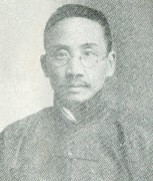 (See Chen Tianhua's Bell That Alarms China).
In March 1902, Cai Yuanpei established the "China Education Society" in Shanghai, and in Oct, established the "Patriotic Women School" and the "Patriotic Society".
In 1902, in Tokyo, Zhang Taiyan [aka Zhang Binglin] and Qin Lishan established "Guangfu-gui" (i.e., Restoration Society), also known as "Fugu-hui" (i.e., society for restoring antiquity), in commemoration of China's fall to the barbarians for 242 years.
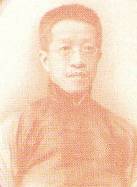 The Japanese authority, at the request of the Manchu court, prohibited the 242 year commemoration convention. Sun Yat-sen, who had a low profile invitation to a 1901 meeting held by the Guangdong Province natives for declaring provincial independence, would be invited by Zhang Taiyan to attend the aborted "242 year convention".
Su Manshu, later revolutionary-monk and a person of Sino-Japanese bloodline, enrolled in Waseda University in 1902. Earlier, Su Manshu had joined the "youth society" under the influence of Feng Ziyou who had pioneered the propaganda of liberty and freedom by publishing a magazine entitled "kai [open up] zhi [talent] lu [compilings]" in Yokohama in 1900.
In Tokyo, in April 1903, over 500 Chinese students, under Lian Tianwei [a cadet from Japan's infantry cadet academy], including 12 female students, organized a "student army" in the name of the "righteous and brave army for resisting the Russians" as a result of continuous Russian occupation of Manchuria since the 1900 boxer incident.
Manchu envoy-minister to Japan Cai June asked Japan to intervene in dismissing the band. Thereafter, Liang-bi of the Manchu infantry ministry established a so-called "Committee for the Qing Country Students Who Study Infantry Military Subjects In Japan" in cooperation with the Japanese government, culminating in the launch of the "Zhenwu [reviving martialness] Academy" [4th session onward till 1911], a military prep academy similar to the "Hu Cheng Academy" (? Cheng Cheng Academy - typo in the first character in some writings) [1st, 2nd & 3rd sessions].
While Sun Yat-sen's Cantonese gang had mainly relied on the secret societies for staging the 1895 Guangzhou Uprising & 1900 Huizhou Uprising, overseas students in Japan, i.e., the Yangtze-Anhui gang and the Hunan-Hubei gang, had resorted to penetrating and instigating the defection of the Manchu New Army.
In the section on the Manchu Qing Dynasty, we expounded upon propagation Of Revolution.
Zhang Ji proposed the armed rebellion in 1902.
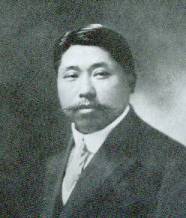 Huang Xing, who co-established the "military nation citizen society" in May 1903, left Japan for China on June 4th, 1903, with a mission for staging an armed rebellion, i.e., the aborted Changsha Uprising in October 1904.
In China, Japan returnee Chen Fan was distributor for the "Subao Newspaper" of Shanghai, which became distributor for the Japan-based monthly magazine "compilings of the translated works while studying overseas".
In May 1903, Zou Rong wrote "Ge Ming Jun" (i.e., revolutionary army or ranks) to propagate changes in Shanghai, with Zhang Binglin authoring the preface.
After the Manchu banning of the "Subao Newspaper" [i.e., Suzhou-he River Newspaper], Zhang Shizhao established "guo min ri ri bao" [i.e., the "National Citizen Daily Daily Newspaper"] to continuously attack the Manchu government.
After the closure of the "National Citizen Daily Daily Newspaper" on December 3rd, 1903, Su Manshu went to work for Chen Shaobai's "China Daily Newspaper" in HK for a short while.
Huang Xing, who co-established the "military nation citizen society" in May 1903, left Japan for China on June 4th, 1903, with a mission for staging an armed rebellion, i.e., the aborted Changsha Uprising in October 1904.
In China, Japan returnee Chen Fan was distributor for the "Subao Newspaper" of Shanghai, which became distributor for the Japan-based monthly magazine "compilings of the translated works while studying overseas".
In May 1903, Zou Rong wrote "Ge Ming Jun" (i.e., revolutionary army or ranks) to propagate changes in Shanghai, with Zhang Binglin authoring the preface.
After the Manchu banning of the "Subao Newspaper" [i.e., Suzhou-he River Newspaper], Zhang Shizhao established "guo min ri ri bao" [i.e., the "National Citizen Daily Daily Newspaper"] to continuously attack the Manchu government.
After the closure of the "National Citizen Daily Daily Newspaper" on December 3rd, 1903, Su Manshu went to work for Chen Shaobai's "China Daily Newspaper" in HK for a short while.
In 1904, the Russo-Japanese War broke out with a surprise attack on Port Arthur by the Japanese fleet.
The next year, defeated on land and sea, Russia ceded to Japan Port Arthur, the southern portion of the Manchurian Railway, and southern half of the Sakhalin Island under the terms of the Treaty of Portsmouth.
With the acquiesce of the Americans, Japan cunningly worded the treaty to make sure that no other powers could override the interests of the Russian and Japanese control of the Chinese Eastern Railway.
After all, the Sino-American priority was to have Japan check on Czar Russian, not China's sovereignty and interests.
In 1904, Tao Chengzhang returned to China and exerted his efforts in rebuilding the secret societies in Zhejiang Province.
In the winter of 1904, the Restoration Society was established in Shanghai, with Cai Yuanpei made into the president as a result of Zhang Taiyan's imprisonment. The Restoration Society proposed the slogan of "restoring our Han ethnicity and returning our mountains and rivers".
In the spring of 1905, Sun Yat-sen visited Europe. In the spring, Sun Yat-sen knocked on the door of Wu Zhihui who had refused to see him while in Japan in 1901, thinking that Sun might just be a 'Robinhood' kind of figure. With Liu Chengyu's referral letter sent from San Francisco, Sun Yat-sen obtained invitation from the overseas students in Brussels and Berlin. While Sun touted the role of secret societies, Zhu Hezhong alerted to the influences of students and soldiers in the Hunan-Hubei provinces as well as the possible unrestrained ambition of secret society members. After 3 days and 3 nights' talks, Sun Yat-sen was convinced by Zhu Hezhong.
Details could be seen at Sun Yat-sen's Establishing Contacts With Intelligentsia From Societies of the Yangtze Area.
In July of 1905, Sun Yat-sen arrived in Japan from France.
On August 13th, Sun Yat-sen made a speech at a reception held by the overseas students in Japan and called for the establishment of a republic via revolution.
On August 20th of 1905 (solar calendar), Sun Yat-sen, who reportedly had spent idle time in Japan after losing his brave men in the prior uprisings, was supported by Huang Xing for organizing "Tong Meng Hui" (i.e., the 'Allied Society of China' or the 'Revolutionary Alliance') in Japan, with a slogan calling for expelling of the Tartars and restoration of our China.
About 400 students joined the secret society.
Xiong Kewu and Dan Maoxin, i.e., Sichuan students studying military in Japan, paid a visit to Sun Yat-sen. The Sichuan natives were persuaded by Sun Yat-sen that they did not need to take action to launch revolution and uprisings till after graduation, began to learn to make bombs and weapons, and later quit school to go back to China for launching six uprisings in Sichuan.
"Tong Meng Hui", relaunching its newspaper as "Min Bao", engaged in newspaper blasting at the constitutional monarchists, and within half a year drove the monarchist newspaper into bankruptcy.
On June 29th, 1906, Zhang Binglin [Zhang Taiyan] was released from prison, and Sun Yat-sen dispatched messenger to have him fetched to Japan.
Jiang Yongjing estimated that "Tong Meng Hui" had conducted 24 uprisings from 1905 to 1911, with Sun Yat-sen participating in organization 8 times, and that prior to 1905, "Xing Zhong Hui" had conducted 2 uprisings and the rest of parties 5 times.
Revolutionaries pressed the Manchu government into declaring the Constitutional Monarchy Reform:
In 1906, the Manchu government would declare that they would adopt Japan and Britain's system (i.e., "constitutional monarchy" with a royal house and a Parliament) nine years later. They would further agree to undertaking the 'political reform' beginning from 1907.
On March 4th, 1907, the Japanese government expelled Sun Yat-sen at the request of the Manchu government.
Owing to Sun Yat-sen's monopolization of the Japanese monetary donation, Zhang Taiyan proposed a censure against Sun Yat-sen.
Meantime, Liu Shipei advocated for a re-organization of the Allied Society.
Further details could be seen at Dispute With Sun Yat-sen & Separate Military Actions By the "Guang Fu Hui" Members.
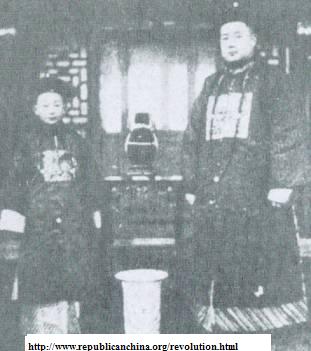 On November 14th & 15th, 1908, Empress Dowager Ci-xi and Emperor Guangxu died, consecutively.
Manchu Regent Zai-li [Zai-feng] held the actual power over three-year-old Emperor Xuantong (Aixinjueluo Pu-yi or Henry Pu Yi, later as Emperor K'ang Te of puppet state Manchukuo).
Before Aixinjueluo Pu-yi, Empress Dowager Ci-xi at one time selected another boy as a proxy emperor for substituting Emperor Guangxu, with this non-official emperor later joining Dai Li's special agency for underground work in the Yellow River Flood Zone during the resistance war.
Manchu Regent Zai-li [Zai-feng] thought that monarchism (not the same as parliamentarism) could save the Manchu monarchy.
On November 14th & 15th, 1908, Empress Dowager Ci-xi and Emperor Guangxu died, consecutively.
Manchu Regent Zai-li [Zai-feng] held the actual power over three-year-old Emperor Xuantong (Aixinjueluo Pu-yi or Henry Pu Yi, later as Emperor K'ang Te of puppet state Manchukuo).
Before Aixinjueluo Pu-yi, Empress Dowager Ci-xi at one time selected another boy as a proxy emperor for substituting Emperor Guangxu, with this non-official emperor later joining Dai Li's special agency for underground work in the Yellow River Flood Zone during the resistance war.
Manchu Regent Zai-li [Zai-feng] thought that monarchism (not the same as parliamentarism) could save the Manchu monarchy.
In April 1908, the revolutionaries launched the Hekou Uprising in Yunnan Province.
Tens of thousands of the overseas students and Chinese celebrated the Yunnan independence in Tokyo.
Later, the Manchu court suspended the government funding for those students who played an active role in the relief activity to the Hekou Uprising.
(From 1907 to 1908, the revolutionaries launched altogether eight uprisings that would include the May 1907 Chaozhou [Chao Chow] Uprising in Guangdong [by Yu Chou , Cheng Yong-bo & Yu Tong], the Huizhou Uprising in Guangdong by Deng Zi-yu,
the July 1907 Ching-Cho Uprising in Guangdong by Fung Chung,
the October 1907 Zhennan'guan [Zheng-Nan-Quang] Uprising on the Vietnam-Guangxi border by Wang Ho-shun,
and the Qin-Lian Revolt by Huang Xing [Huang Ge-qiang].)
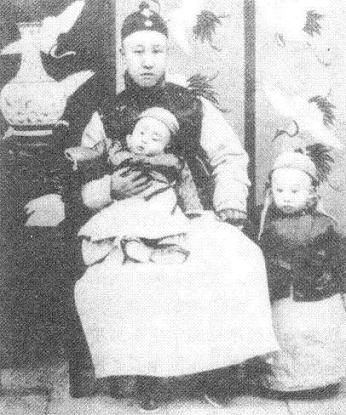
Also in 1908, the Anqing Soldier Rebellion broke out, and over three hundred revolutionaries were killed in Anhui Province.
Xiong Chengji, a member under the Restoration Society, was responsible for this action. (Xiong Chengji was an officer inside of the cannons battalion, and led his soldiers for an uprising to avenge Xu Xilin's death by taking advantage of the imperial mourning. He, later in January 1910, fled to Harbin of Manchuria where he was caught after a betrayal and at age 24, got executed [without kneeling down] in Jilin on February 27th.)
On December 1st, 1908, Tang Jiyao graduated from the Japanese Infantry Cadet Academy, with diploma conferred by the Japanese emperor at the ceremony. (198 cadets of the 6th session were Chinese, including Wang Zhaoji, Li Genyuan, Liu Cunhou, Luo Peijin, Yan Xishan, Sun Chuanfang, Lu Xiangting, Zhou Yinren, Tang Jiyao, Li Liejun, Yin Changheng, Zhang Fenghui and Cheng Qian. Among 6th session graduates of Japan Cadet, Yunnan Province would boast of Tang Jiyao, Luo Peijin, Li Genyuan, Liu Zuwu, Zhao Fuxiang, Li Hongxiang, Ye Quan, Zhang Kairu, Xie Ruyi and Gu Pinzhen.)
In 1909, Tao Chengzhang had an argument with Sun Yat-sen in Southeast Asia over the matter of fund raising and appropriation, and listed 14 crimes that Sun Yat-sen had committed. Tao Chengzhang re-organized Restoration Society with Zhang Taiyan and Li Xiehe.
In this year, two sisters, Yi Weijun and Yi Ruizhi, both students of martyress Qiu Jin, attempted assassination by going to Peking.
The Reform consultancy committees (i.e., provincial viceregal assemblies) were set up for 'show' in all provinces in 1909.
In Yunnan Province, Tang Jiyao and the returnee students from Japan took up the lecturer posts at the Yunnan Province "infantry lecturing academy" which was headed by Hu Jingyi and Gao Erdeng, respectively. Li Genyuan assumed the superintendent post at the academy.
In 1910, a military school attached to Manchu's Yunnan Province 19th Division was incorporated into Yunnan Province "infantry lecturing academy". On April 1st [lunar cal ?], Li Genyuan took over the schoolmaster post from Gao Erdeng. Tang Jiyao was transferred to 19th Division as tactician. Manchu military forces in Yunnan Province fell into the hands of the revolutionaries.
Li Genyuan and Luo Peijin recommended Cai E to Manchu Governor-general for Yunnan-Guizhou provinces.
In July [lunar cal ?] of 1910, Cai E took over the post of 37th brigade chief under 19th Division.
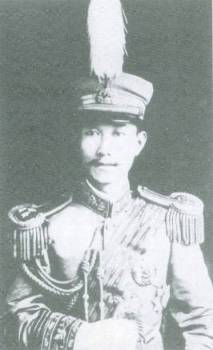
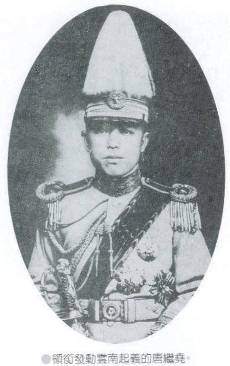
By 1910, delegates of the provincial reform consultancy committees joined in a national body at Peking, trying to hasten up parliamentary reform.
However, the new Manchu royal house still adopted a policy of absolving Han ethnic officials, and they deprived Yuan Shi-kai (Yüan Shih-k'ai) of his military post. (It was said that late Emperor Guangxu had left a will that his successor avenge on Yuan for the treachery, but Emperor Guangxu's cousins absolved Yuan by merely depriving him of his military posts. )
Also in 1910, Wang Zhaoming (i.e., Wang Jingwei from Anhui Province) returned from Japan, and Chen Bijun, after tearing apart her colonial passport, followed him to Peking. Wang Jingwei invited Huang Shuzhong and Luo Shixun in assassination of Manchu Regent Zai-li [Zai-feng].
In October, 1910, Dr. Sun launched the Second Canton Uprising.
On March 29th, 1911, Dr. Sun launched the Third Canton Uprising, i.e., Quang Chow revolt.
Fugitives Xiong Kewu and Dan Maoxin, i.e., Sichuan revolutionaries, rerouted to Canton for the scheduled uprising after they made enormous sacrifice in the uprisings of Jiang'an, Luzhou, Chengdu and Xufu in 1907 and the Guang'an and Jia-ding uprisings of 1909, with hundreds of deaths throughout the years.
Huang Xing [aka Huang Ke-qiang] pulled ahead the uprising and personally led 100 men in the revolt, including main cadres like Lin Juemin [Ling Jaio-ming], Fang Sheng-dong & Ju Zhi-xin [Zhu Zhixin].
At least 86 revolutionaries died during this battle, with the bodies of 72 revolutionaries later collected and buried on the Huanghuagang Hill [yellow flower hill] in Canton by Huang Huagong.
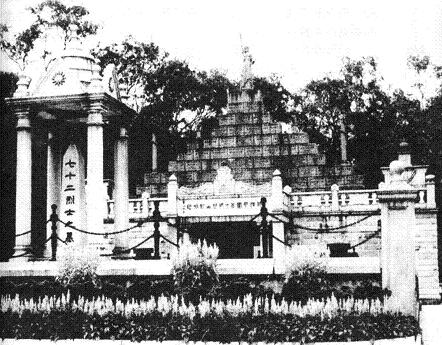 Both the Second Canton Uprising & Third Canton Uprising were executed by Huang Xing.
Jiang Yongjing stated that 29 martyrs came from the overseas and the rest came from six different provinces, with background varying from students to soldiers, merchants, intellectuals, martial arts masters, workers and peasants. Jiang Yongjing stated that the funds for this uprising and martyrdom, totaling 200,000 yuan or Chinese dollars, had mostly come from the overseas Chinese in Southeast Asia, North America and Japan.
Majority of the 500 men pre-selected for this uprising had come from HK and Southeast Asia, a reason that the KMT and Sun Yat-sen claimed that the "overseas Chinese" were the mother of revolution.
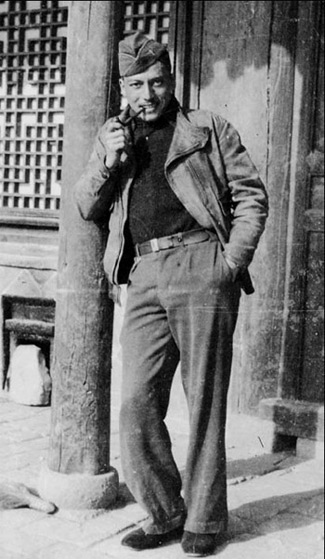 Later in the 1930s, young overseas Chinese flocked back to the country to join the airforce for resisting the Japanese invasion.
The initial war victory of the Chinese pilots in 1937 could be attributed to the great sacrifice made by the pilots of the overseas Chinese origin, especially those from Canada and America. Young overseas Chinese men [and women] in America, indignant over the racial discrimination from the Chinese Exclusion Act, longed for serving the motherland, and ever since the 1931 Japanese invasion of Manchuria and the 1932 attack at Shanghai, had volunteered for flight training in the private aviation schools across the cities of Seattle, Oakland, Chicago and Los Angeles, etc., and returned to China to join the Cantonese Air Force which was merged into the Central Air Force later in 1936.
Most famous of all the overseas Chinese pilots would be warhawk Arthur Chin.
Later in the 1930s, young overseas Chinese flocked back to the country to join the airforce for resisting the Japanese invasion.
The initial war victory of the Chinese pilots in 1937 could be attributed to the great sacrifice made by the pilots of the overseas Chinese origin, especially those from Canada and America. Young overseas Chinese men [and women] in America, indignant over the racial discrimination from the Chinese Exclusion Act, longed for serving the motherland, and ever since the 1931 Japanese invasion of Manchuria and the 1932 attack at Shanghai, had volunteered for flight training in the private aviation schools across the cities of Seattle, Oakland, Chicago and Los Angeles, etc., and returned to China to join the Cantonese Air Force which was merged into the Central Air Force later in 1936.
Most famous of all the overseas Chinese pilots would be warhawk Arthur Chin.
Furthermore, the Southeast Asian Chinese had played an important role in operating the truck service on the Burma-Chinese and Vietnam-Chinese highways.
In Haifang [Haiphong] of Vietnam, 6000 overseas Chinese organized a 'donation' committee for sending money to China. The French authorities ordered that only the merchandise purchased by China before July 13th, 1937, could pass through Haiphong. In November 1938, the French colonialists prohibited the pass-through of 1000 trucks that China purchased. The Vietnamese circumvented the restriction to allow 100 trucks drive through the border every night as an alternative. Elsewhere in Vietnam, young ethnic Chinese launched the truck driving schools for service inside of China. About 3033 drivers and technicians returned to China for serving on the Sino-Burmese Highway.
(After the victory of war over Japan, hundreds of truck drivers continued the service for the motherland, carrying the goods through the Ledo Highway to China from India, passing the high mountains of northern Sichuan, crossing the Yellow River in the Ordos area, and trekking along the Gobi Desert to arrive at Kalgan in today's Mongolia, a remarkable long distance trip that was praised by priest Raymond de Jaegher; further joined General Fu Zuoyi's Suiyuan Army as an armored [mobile] force, with a division of Fu Zuoyi's infantry army carried into Manchuria at one time for repelling a communist army attack; and stood steadfast with 35th Corps commander Guo Jingyun during the Defense Battle of Xinbao'an, till Geng Biao's communist army, with two Soviet-supplied artillery regiments, sacked the city in December 1948, on which occasion General Guo Jingyun committed suicide and 400 trucks fell into the communist hands. Furthermore, Lin Biao's Soviet artillery division was shipped to Taiyuan, i.e., the root cause for the fall of Taiyuan after years of besiegement by the communist army.)
In April, 1911, the Manchu royal house reorganized the cabinet, but they still retained 9 ethnic Manchu among altogether 14 members.
Two brothers of the Manchu regent, Zai-Xun and Zai-Tao, were both conferred the minister posts. King Qing-wang (Yi-kuang) was appointed the post of prime minister. To replace the deceased Han-ethnic officials of Sun Jia'nai, Lu Chuanlin and Zhang Zhidong would be Xu Shichang as assistant to Yi-kuang.
Numerous uprisings erupted throughout the nation.
In the Yangtze River area,
in July of 1911, Soong Jiaoren [Sung Chiao-jen 1882-1913], being unhappy over the failure of the March 29th Canton Uprising and lamenting the deaths of revolutionaries in the unconcerted uprisings (e.g., death of Xu Xilin in Anqing, Wen Shengcai in Canton and Xiong Chengji in Manchuria), organized a Shanghai Branch of "Tong Meng Hui".
The Xin Hai Revolution would be a coordinated action by the revolutionary organizations reporting to Soong Jiaoren.
Parallel to the assassination and uprisings would be a Manchu suicidal attempt at nationalizing the railways.
Manchu minister Sheng Xuanhuai's railroad naturalization led to the 'Retaining (Recovering) Railroad' Movement in the four provinces of Sichuan, Hunan, Hubei and Guangdong, and set up the stage for various southern provinces to declare independence.
The Americans, like Mary C. Wright, who analyzed China's 1911 revolution from the external perspective and in 1968 claimed that the secret societies under Soong Jiaoren, not Sun Yat-sen's "Allied Society", played the role of overthrowing the Manchu rule, did not trace the roots to the synarchists' attempt at swindling China's railways for explaining the root cause of the 1911 revolution.
Xia Zhishi led a soldier mutiny against the Manchu government in the Sichuan provincial railway protection movement, which was against the Manchu attempt at nationalizing the Sichuan-people-sponsored railway and selling the railway rights to the European and American synarchists.
The Sichuan people, back in 1904, answered governor Xi-liang's call for launching the Sichuan-Hankow Railway Company.
In May of 1911, or April of Emperor Xuantong's 3rd year, the Manchus ordered to nationalize the Sichuan-Hankow and Canton-Hankow railways for pledging with four-nation consortium to obtain a loan of 6 million British pounds.
On June 17, constitutional monarchists in Sichuan organized the railway protection society.
By August, populace in hundreds of thousands rallied against the Manchus across Sichuan.
On September 7, governor Zhao Erfeng arrested leaders such as Pu Dianjun and Luo Lun, et al.
When the Manchu governor of Sichuan cracked down on the populace's resistance to the railway nationalization, and shot dead 32 people during a rally, the Sichuan people organized militia across the province.
This military resistance was after the Sichuan revolutionaries, under the leadership of Xiong Kewu and Dan Maoxin, made enormous sacrifice in the uprisings of Jiang'an, Luzhou, Chengdu and Xufu in 1907 and the Guang'an and Jia-ding uprisings of 1909.
The Manchus ordered six provinces to send armies to Sichuan to crack down on the uprisings.
The Manchu government, in a panic, called on the garrison troops of Wuchang, Hubei, to reinforce the Sichuan army. This gave the revolutionaries among the Hubei New Army a chance to conduct a mutiny which triggered the 1911 Xin Hai Revolution (Aug 18 on the lunar calendar; October 10 on the Gregorian calendar) that overthrew the Manchu rule.
Xia Zhishi, a Japan infantry academy graduate, conducted an uprising on November 5 and led his hundreds of soldiers in an attack at the Manchu governor in the provincial capital city.
Xia Zhishi, who retired in the 1930s, was executed by the communists in the early 1950s, and was restored the reputation and rebuilt the tomb in 1988.
The Manchu Army System & the Northern Warlords
Ding Zhongjiang wrote a great book called "History of the Northern Warlords" in 1964. He thoroughly traced the warring history of China from 1912 to 1928. During this time period, there had ensued 38 cabinets, with the shortest cabinet lasting only 6 days.
This period of Chinese Republic was called Northern Warlords time period because the regimes in Peking were of the same lineage as Yuan Shi-kai cronies.
Per Ding Zhongjiang, the Northern Warlord Lineage could be traced to Manchu's Xiang-jun (Hunan Province Army) and Huai-jun (Anhui Province Army). Yong Ying (Brave Camp) System, including Xiang-jun and Huai-jun headed by Zeng Guofan and Li Hongzhang, had exhibited themselves as a better army during the crackdown on Taiping Heavenly Kingdom Rebellion & Nian Rebellion. (Manchu Banner System/Green Camp System and Yong Ying (Brave Camp) System are covered in the qing.htm section.)
After defeating the Taiping Rebellion and the Nian (Nian-jun) Rebellion, majority of Xiang-jun and Huai-jun troops were retained as garrisons in place of the Eight Banner and Green-Camp soldiers. Gradually, Zeng Guofan and Li Hongzhang and their cronies took over the posts of governors-general for Jiangsu and Jiangxi provinces, South-Sea Minister, North-Sea Minister and governor-general for Zhili Province (Beijing area).
Li Hongzhang, at age 42, took over governor-general for Zhili Province in 1901.
During the 1894 Sino-Japanese War, however, the backwardness of Huai-jun was shown by the total annihilation of Huai-jun Army's Sheng-jun column in Korea. Before the 1894 defeat, Yuan Shi-kai spent 12 years in Korea training the Korean army; after the 1895 defeat in the Sino-Japanese War, Manchu government began to recruit the so-called Xin-jun ('New Army') in accordance with the West's military system.
King Chunqin-wang (Yi-xuan), King Qingqin-wang (Yi-kuang), Weng Tonghe, Li Hongzhang and Rong-lu, et al., adamantly recommended Yuan Shi-kai for training 'Xin-jun' Army or the New Army at Xiaozhan. Yuan Shi-kai contacted Yin-chang of Tianjin's "Wubei Xuetang" Academy for referrals of talents, and Yin-chang recommended to Yuan Shi-kai "Wubei Xuetang" top students such as Feng Guozhang, Duan Qirui, Liang Huadian and Wang Shizhen. (Among the four guys, Liang Huadian accidentally drowned himself on one night, and the other three would be appointed lecturer for field or infantry battalion, cannons battalion, and cavalry battalion, respectively. The three would become the so-called 'Distinguished Three' among the Northern Warlord Armies later. Duan Qirui had at one time studied in military school in Germany.)
Yuan Shi-kai's training of the new army will be expanded to 12000 men, with eight infantry 'ying' (i.e., camps or battalions) totaling 8000 men, two cannon battalions, two battalions of cavalry totaling 1000 men, and 1000 men engineering battalion.
'Engineering Battalion' was in charge of repairing arms, building bridges, building castles, planting mines, sending telegraphs and surveying maps. German, Japanese and American lecturers were hired, and a German language school was also set up.
More available at Manchu-New-Army-New-Adm.pdf
(Check
RepublicanChina-pdf.htm
page for up-to-date updates.)
* In Commemoration of China's Fall under the Alien Conquests in A.D. 1279,
A.D. 1644 & A.D. 1949 *
U.S.S.R./Comintern Alliance with the KMT & CCP (1923-1927)
Korean/Chinese Communists & the 1931 Japanese Invasion of Manchuria
American Involvement in China: Soviet Operation Snow, IPR Conspiracy, Dixie Mission, Stilwell
Incident, O.S.S. Scheme, Coalition Government Crap, Amerasia Case & The China White Paper
* Stay tuned for "Republican China 1911-1955: A Complete Untold History" *
|
|
Zou Rong's Revolutionary Army;
Shin Kyu Sik's
Shrine (Spirit, Kunitama) of Korea
|
This snippet is for sons and daughters of China:
Heed the sons & ministers' agony and sorrow of our ancestors who died or lived through the Mongol, Manchu and Soviet-Chicom conquest
and
the Yongjia, Jingkang and Jiashen cataclysms !
Jeanne d'Arc of China:
Teenager girl Xun Guan breaking out of the Wancheng city to borrow the relief troops in the late Western Jinn dynasty;
Liu-Shao-shi riding into the barbarian army to rescue her husband in the late Western Jinn dynasty;
teenager girl Shen Yunying breaking into Zhang Xianzhong's rebels on the horseback to avenge on father's death in the late Ming dynasty.
China's Solitary and Lone Heroes:
Nan Jiyun breaking out of the Suiyang siege and charging back into the city in the Tang dynasty;
Zhang Gui & Zhang Shun Brothers breaking through the Mongol siege of Xiangyang in the Southern Soong dynasty;
Liu Tiejun breaking through three communist field armies' siege of Kaifeng in the Republican China time period;
Zhang Jian's lone confrontation against the communist army during the June 3rd & 4th Massacre of 1989.
|
|
|
Founding Of The Republic Of China (ROC)
Chinese saying goes that "the wind will be blowing through the whole storey-building at the time the mountain rain is to pour down".
Another soldier uprising, Wuchang Uprising of October 10th 1911 (termed Xin Hai Revolution), in Wuchang, Hubei Province, would terminate the Manchu rule in China.
Numerous factors contributed to the overthrow of Manchu Qing Dynasty. The important point to remember is that it was never an "accident" as the fuse appeared to be nor was it a revolution initiated by a few military platoon chiefs.
Cai Dongfan commented that Shen Xuanhuai's railroad nationalization had led the Manchu to its demise.
Jiang Yongjing, in "The Land-Sea Ebb History of KMT", attributed multiple-province members recruited and disciplined by "Tong Meng Hui" in Japan to the success of domino-effect provincial independence during 1911 Xin Hai Revolution.
Late Historian Shen Yunlong, in his book "An anthology of Events and Figures During the R.O.C. Time", attributed Manchu Governor-general Zhang Zhidong's launching innovative academies and military academies to the upbringing of a generation of revolutionaries. Shen Yunlong also called the attention to Manchu Qing's abolition of the imperial civil services exam as a fundamental cause in re-orienting lots of talented Confucian-apprentices towards services under Manchu Qing's re-organized New Army. (Manchu Qing had authorized Yuan Shi-kai in rebuilding the New Army on basis of "rightside martial defense column", the only remnant that survived the wars against the invasion of the Eight Allied Nations while the other four columns had been basically decimated.)
Shen Yunlong stated that "You planted the cucumber, but you harvested the beans [or you planted the beans, but you harvested the cucumbers instead]", which was to ridicule the Manchu court as far as establishing its New Army was concerned.
By the time the uprising broke out, the Manchu court had only fulfilled the recruitment of two thirds of the originally-planned 36 divisions, with 16 divisions and 16 mixed purpose brigades recruited.
The Wuchang Uprising was heralded by the Manchu 8th Division of the New Army in Hubei Province.
China should thank three bands of revolutionaries for the overthrow of the Manchu and the emergence of the Republic, namely, Sun Yat-sen's Cantonese Band, Zhang Taiyan & Tao Chengzhang's Zhejiang Band, and Huang Xing & Soong Jiaoren's Hubei-Hunan Band.
Looking back in history, one would have to be moved by the great sacrifice and courage of the southern Chinese, especially those of Zhejiang Province where people carried the spirits of "King Goujian Restoring the Statehood" over two thousand five hundred years ago.
(Note in the ancient times, the Zhejiang native people used to carry swords all the time in a similar belligerent fashion as the Japanese samurai.)
Armed revolution, starting with Sun Yat-sen's 1895 aborted Guangzhou [Canton] Uprising & 1900 Huizhou Uprising, would be fomenting itself after the formation of "Tong Meng Hui". Though the 1903 Changsha Uprising by "Hua Xing Hui" was aborted, the relatively independent society of "Guang Fu Hui" continued the relentless assassination and uprisings from 1905 to 1910.
At Wuchang, the 8th Division possessed 2 brigades or 4 regiments of field army, about 6000 men; 1 regiment of cannon column and 1 regiment of cavalry, about 3000 men; and 1 engineering battalion and 1 logistics battalion, about 1000 men. Other than the armies which either stationed in the provincial cities or were relocated to Sichuan Province by Duan-fang for cracking down on the railroad recovery movement, the Wuchang area boasted of 7500 New Army soldiers, including Li Yuanhong's 21st mixed purpose brigade of 4300 soldiers.
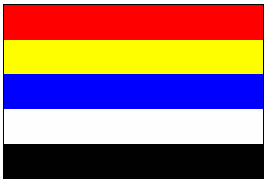 Alliance of Secret Societies In Hubei Province
Wuchang Uprising
Revolutionaries Cooperating With the "Constitutional Monarchists"
On November 13th, Chen Qimei, in Shanghai, called upon the provinces to send in representatives to Shanghai.
The Wuchang city agreed the with revolutionaries and constitutional monarchists in the Shanghai city that a system similar to the U.S.A. should be formulated.
Agreement was reached to have each province send in two representatives, with one representing the Manchu-era consultancy bureaus and the other representing the provincial governor-general offices.
With the compromise of the revolutionaries and constitutional monarchists, about 18 provinces sent in their representatives to Shanghai.
First meeting was held on November 15th [Sept 25th per lunar calendar], with a decision to have the governors-general play the role of the senate by mapping the "Continental Congress" scheme of the USA at the time of the Independence War against Britain.
At the request of Li Yuanhong & Huang Xing, the representatives split into two halves, with the group of people for Wuchang to be bestowed with the responsibility of drafting China's first constitution, i.e., the "Organization Guidelines of the Interim Government of the Republic of China" [later commonly known as the "Interim Agreed-Upon Laws"].
Representatives also devised the 18-star national flag by mapping the U.S. national flag, which was symbolic of the 18 provinces which declared independence from the Manchu court.
The 18-star national flag will then be replaced by the "five color national flag" which would be symbolic of the union of five ethnic groups of the Han, the Manchu, the Mongol, the Hui Muslim and the Tibetans.
The Domino Effect Across China
The Manchu's Invoking Yuan Shi-kai For Cracking Down On the Revolutionaries
Revolutionaries Embarking On Establishing the Republic & Stipulating the Constitution
On November 13th, Chen Qimei, in Shanghai, called upon provinces to send in representatives to Shanghai.
Wuchang city agreed with revolutionaries and constitutional monarchists in Shanghai city that a system similar to U.S.A. should be formulated.
Agreement was reached to have each province send in two representatives, with one representing Manchu-era consultancy bureau and the other representing provincial governor-general office.
With the compromise of revolutionaries and constitutional monarchists, about 18 provinces sent in their representatives to Shanghai.
First meeting was held on November 15th [Sept 25th per lunar calendar], with a decision to have governors-general play the role of the senate by mapping the "Continental Congress" scheme of the U.S.A. at the time of the Independence War against Britain.
At the request of Li Yuanhong & Huang Xing, representatives split into two halves, with the group of people for Wuchang to be bestowed with the responsibility of drafting China's first constitution, i.e., "Organization Guidelines of the Interim Government of the Republic of China" [later commonly known as "Interim Agreed-Upon Laws"].
Representatives also devised the 18-star national flag by mapping the U.S. national flag, which was symbolic of the 18 provinces which declared independence from Manchu court.
The 18-star national flag will then be replaced by "five color national flag" which would be symbolic of the union of five ethnic groups of Han, Manchu, Mongol, Hui Muslim and Tibetans.
Wu Luzhen Failing to Shake Up Yuan Shikai's Crony Forces
Historians pointed out that Yuan Shi-kai had hastened up his steps after seeing that the revolutionaries in Northern China, i.e., Wu Luzhen and Zhang Shaozeng, could have toppled the Manchu court by means of mutinies.
Right after the October 10th Wuchang Uprising, Manchu infantry official Yin-chang dispatched Li Chun's 11th Brigade under Wu Luzhen's 6th Division to the south but refused to approve Wu Luzhen's request to go to Hubei Province. (Wu Luzhen privately planned for a frontline rebellion by leading his 6th Div to Hubei.)
Subsequently, Zhang Shaozeng of the Manchu 20th Division, on October 29th, 1911, sent a public wire for the Manchu to erect constitutional monarchy. Wu Luzhen was sent to Luanzhou for pacifying Zhang Shaozeng, but was construed to be a Manchu court trick in steering Wu Luzhen away from Wu Hongchang's 12th Brigade under the 6th Division. When Shanxi Province rebelled against the court, Wu Luzhen was asked to go to Shijiazhuang for leading the 12th Brigade of the 6th Div against the rebels. At Shijiazhuang, Wu Luzhen colluded with the Shanxi rebels and demanded that the Manchu court stop war against the South on November 2nd.
Back on November 1st, Manchu Regent Zai-li [Zai-feng] conferred the post of "neige zongli" [prime minister equivalent] onto Yuan Shi-kai for cracking down on the revolution. Yuan Shi-kai, who left Zhangde on October 30th, arrived in Xiaogan of Hubei Province from Zhangde, and dispatched Zhou Fulin to Shijiazhuang with 20000 currency. On November 6th [Nov 7th per TDG], Ma Buzhou, i.e., Wu Luzhen's bodyguard chief, assassinated Wu Luzhen, tactician Zhang Shiying, and lieutenant Zhou Weizhen.
Yuan Shikai Talking 'Peace' With the Revolutionaries
On November 4th, the Manchu court agreed with Yuan Shikai in having the Manchu armies suspend action against the revolutionaries.
On November 8th, Li Yuanhong replied to Yuan Shikai's goodwill gesture by stating that he would support Yuan Shikai as the president of the R.O.C. should Yuan Shikai join the revolution.
On November 13th, Yuan Shikai arrived in Peking.
On November 15th, Yuan Shikai met with Wang Jingwei who was just released from the Manchu prison, and asked Yang Du & Wang Jingwei to host a society for the progress of state affairs.
On November 16th, Yuan Shikai completed the shuffle of the cabinet.
Yuan Shi-kai re-organized the cabinet and conferred pacifying generals for various provinces, but few candidates were willing to take the offer.
Behind the scene, Hong Shuzu, someone related to Tang Shaoyi, wrote a decree for the Manchu emperor to abdicate and have the draft sent by Tang Shaoyi sent to the dowager-empress through the Manchu king(s) or prince(s).
Hong Shuzu earlier had dissuaded Tang Shaoyi from accepting a Manchu offer to be minister of postal and transportation ministry, and was recalled by son Hong Shen to be involved in brokering peace with the southern revolutionaries from day one.
Later, when Xu Shichang revised the decree to make it appear that the Manchu emperor abdicated the throne to Yuan Shikai personally, Hong Shuzu was very unhappy as he believed that the Manchus should abdicate to the republican China government.
In Jiangsu Province, General Xu Shaozhen of the Ninth Division (i.e., "zhen") attacked Nanking's Manchu loyalists such as Zhang Renjun, Tie-liang and Zhang Xun.
Yuan Shi-kai ordered that his generals [Feng Guozhang and Duan Rugui] attack the Wuchang government.
On November 27th, Li Yuanhong appealed for relief with various provincial revolutionary armies, claiming that the Manchu forces could sack Hanyang any time after 6 days and 6 nights of fighting.
On the 28th, Li Yuanhong issued a second appeal for "experienced and trained soldiers as well as cannons" and stated that he would defend the Wuchang city to death.
Feng Guozhang and Duan Rugui, with the son of Zhang Biao rebelling against the revolutionaries inside, took over the Hanyang city.
On November 27th, Feng Guozhang counter-attacked the revolutionary army by taking over Hanyang and burning it for 3 days.
Yuan Shikai called Feng Guozhang to stop him from crossing the Yangtze.
On the 29th, Yuan Shikai agreed with Li Yuanhong for peace talks. Separately, Yuan Shikai authorized Wang Jingwei in wiring over a separate telegraph in regards to making Yuan into the president and forcing Manchu court into abdication.
Huang Xing retreated to Hanyang from Hankou.
Ceasefire began on December 1st.
The two camps faced each other across the Yangtze.
Huang Xing fled the city and left for Shanghai.
Per TDG, Huang Xing left the city as a result of slanders by Sun Wu in the aftermath of the Manchu takeover of Hanyang on November 27th.
With the loss of Hanyang, provincial representatives, who were bestowed with drafting the "Organization Guidelines of the Interim Government of the Republic of China", sought shelter inside of Shunchang Firm in the British Concession at Hankou.
Meeting participants declared the Wuchang government as the central government of the R.O.C., and stipulated three chapters and 21 clauses for the "Interim Agreed-Upon Laws" that was completed on December 3rd.
On December 1st, British consul-envoy asked Hankou consul relay a truce proposal to the Wuchang government from Yuan Shikai.
On December 2nd, the joint revolutionary force from Zhejiang-Jiangsu provinces took over Nanking.
On December 5th, Regent Zai-li [Zai-feng] resigned.
Manchu court agreed with Yuan Shi-kai in having peace talks with the Wuchang government. On December 7th, Yuan Shikai dispatched Tang Shaoyi to Wuchang with the help of the British consul in Hankou, and Li Yuanhong sent Tang Shaoyi along to Shanghai to meet Huang Xing. The Shanghai committee selected Wu Tingfang as the peace talk rep.
On December 9th, Yuan Shikai ordered a ceasefire for 15 days, and Huang Xing wired to Wang Jingwei with approval of the earlier request.
Revolutionaries Making Nanking the Capital of the R.O.C.
When Wuchang Uprising broke out, Chiang Kai-shek, at the request of Chen Qimei, immediately returned to Shanghai with Zhang Qun by faking a leave of absence and then mailing uniforms back to his Japanese officer. In Shanghai, he joined the staff of Chen Qimei (Ch'en Ch'i-mei, aka Chen Yingshi) and organized 'dare-to-die column' for recovering Shanghai from Manchu rule.
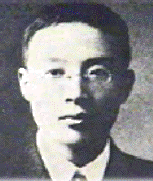 On November 3rd 1911, Chen Qimei was arrested by the Manchu while leading the attack on the Shanghai Manufacturing Bureau. (Alternatively speaking, Chen Yingshi [Chen Yin-Zhi], on September 11th, entered the "JiangNan Ordinance Factory" himself in an attempt at persuading Manchu officials into a defection.)
The next day, revolutionaries sacked the garrison and freed Chen Qimei. Chen Qimei's crony, later in a meeting, coerced the Shanghai revolutionary factions into making Chen Qimei the governor-general by means of a display of firearms at the meeting.
In Zhejiang Province, Chiang Kai-shek participated in attacking the Manchu governor-general office. Chiang also joined the Jiangsu-Zhejiang allied forces in attacking Jiangsu's provincial capital Nanking on December 2nd.
On November 3rd 1911, Chen Qimei was arrested by the Manchu while leading the attack on the Shanghai Manufacturing Bureau. (Alternatively speaking, Chen Yingshi [Chen Yin-Zhi], on September 11th, entered the "JiangNan Ordinance Factory" himself in an attempt at persuading Manchu officials into a defection.)
The next day, revolutionaries sacked the garrison and freed Chen Qimei. Chen Qimei's crony, later in a meeting, coerced the Shanghai revolutionary factions into making Chen Qimei the governor-general by means of a display of firearms at the meeting.
In Zhejiang Province, Chiang Kai-shek participated in attacking the Manchu governor-general office. Chiang also joined the Jiangsu-Zhejiang allied forces in attacking Jiangsu's provincial capital Nanking on December 2nd.
In Zhejiang Province, on the morning of November 4th, Chiang, with five columns or 100 comrades, participated in attacking Manchu Governor Zeng-yun's office.
A Manchu battalion chief, Gu Naibin, echoed the uprising.
Later in January 1912, Chiang Kai-shek could have personally assassinated Tao Chengzhang the leader of Restoration Society in Shanghai.
The next day, Zhang Taiyan told the newspapers that Chen Qimei had threatened Tao Chengzhang earlier and that Sun Yat-sen had written to Tao in regards to "settling the old debts".
In addition to Tao's death, several more leaders of "Guangfu-hui" were killed, i.e., Tao Baojun's execution death by Chen Qimei, and Xu Xueqiu & Chen Yunsheng's execution death by Chen Jiongming.
(One of the possible reasons would be Tao Chengzhang's refusal to distribute funds to Chen Qimei.
Tao Chengzhang was said to have brought back to China large amount of money he had raised in Southeast Asia at the time of the Xin Hai Revolution, and he disbursed funds to Li Xiehe and Zhang Xin for recovering Shanghai and Zhejiang, respectively.
Shang Mingxuan believed that Chen Qimei assassinated Tao Chengzhang to stop him from assuming the governor-general post of Zhejiang Province that was vacated by Tang Shouqian.
Li Ao cited Deng Wenyi's "Chairman Chiang Kai-shek" in stating that Chiang Kai-shek, on January 14th, 1912, personally shot Tao Chengzhang inside of the Guangci Hospital at the order of Chen Qimei. Three days earlier, Tao Chengzhang received a letter from Sun Yat-sen demanding an explanation for Tao's 1909 accusations of 14 crimes. At the times of Chiang Kai-shek's death in 1975 and Mao Tse-tung's death in 1975, I read about an article in regards to the Guangci Hospital murder. Shang Mingxuan pointed out that Chiang bought over a Restoration Society traitor called Wang Zhuqing for the job at 2:00 am on January 14th.
On January 28th, 1912, Zhang Taiyan, having likened Li Xiehe's recovering Shanghai to the contributions equivalent to Xu Xilin & Xiong Chengji, rebuked Sun Yat-sen's faction for killing "comrades".)
Yi Weijun and Yi Ruizhi sisters, who were heavily involved in the "Ruijun Society" (i.e., Ruijun Xueshe) under Restoration Society, participated in the attack at Zhejiang Province's governor-general office. 17-year-old Yi Weijun personally captured the governor-general alive, and later in the attack at Jiangsu provincial, captured Yuhuatai of Nanking in Jiangsu Province. (Yi Weijun was assassinated 6 years later by the northern government.)
Fu Guoyong cited Zhang Taiyan and Sun Yat-sen's correspondence in affirming the importance of the Restoration Society and Li Xiehe in recovering Shanghai, Zhejiang Province and Jiangsu Province.
In Nanking of Jiangsu Province, Zhang Xun's 18 battalions of pigtail armies fought an alliance army of 30,000 Jiangsu-Zhenjiang revolutionaries.
Zhang Xun stopped fighting after receiving Yuan Shi-kai's wire stating that no relief army was available. Zhang Xun fled the city while Tie-liang, et al., sought asylum in the Japanese consulate.
Revolutionaries took over Nanking on December 2nd, 1911.
Lin Shuqing of Zhenjiang Province was supported as the new governor-general of Jiangsu Province.
After sacking Nanking [i.e., Manchu Jiangning-fu Prefecture], provincial representatives in both Shanghai and Wuchang were so excited as to making preparations for Nanking to be the capital of the R.O.C.
In Shanghai, Huang Xing was conferred the post of 'grand marshal' and Li Yuanhong the deputy post.
On December 4h, Shanghai representatives pulled ahead in making Huang Xing as "grand marshal".
Li Yuanhong wired to rebuke the Shanghai decision as illegal.
Representatives from Wuchang-Hankou arrived in Nanking and persuaded the folks into a new election on December 15th.
Huang Xing was made into 'deputy grand marshal' while Li Yuanhong the "grand marshal" post.
Revolutionaries proclaimed that Yuan Shikai could be made into interim president should he defect from the Manchu court.
Yuan Shi-kai instructed Feng Guozhang and Duan Rugui to have a ceasefire with the Wuchang government.
Truce was to continue for three days beginning on December 3rd, and renewed thereafter.
Meanwhile, the Manchu forces were defeated in Shanxi Province.
Rui-fang (Duan-fang) was killed by the revolutionaries in Sichuan Province.
In Guangxi Province, as a result of ambivalence of former Governor-general Zhang Mingqi, revolutionary activities had become semi-public. The new governor-general, i.e., Shen Bingkun, immediately declared independence after checking with the provincial "consultancy bureau". Manchu "dao tai" [circuit inspector] Wang Zhixiang and "ti du" [general] Lu Rongting assumed the posts of governor-general and deputy governor-general for Guangxi Province. Shen Bingkun and Wang Zhixiang led two columns for a northern campaign to Wuchang for aiding the rebels, while Lu Rongting assumed the post of governor-general.
In Guizhou Province, the "constitutional government" faction and "autonomy" faction were in competition for power.
On November 1st, Cai Yue, who adopted a neutral stance, mediated between the two factions. On November 3rd, revolutionaries in the Guizhou Province "elementary military school" and Guizhou Province's New Army rose up in uprising. Manchu Governor Shen Yuqing sent messenger to the provincial consultancy bureau for peaceful solution by declaring a stepdown in exchange for guarantee of safety and property of the Manchu-era officials.
Guizhou Province hence declared bloodless independence on November 4th, 1911 without a fight.
Yang Jincheng was made into governor-general.
Unable to pacify the two factions, Yang Jincheng gave up the governor-general post to Zhao Dequan in preference for leading two regiments to Hubei Province as a relief force.
In Shanxi Province, Manchu forces took over the provincial capital. Shandong Province governor-general revoked independence.
After the success of revolution, factional fighting continued in multiple provinces, i.e., Hu Ying vs Zhang Guangjian in Shandong Province, Tang Jiyao vs Yang Jincheng in Guizhou Province, and Sun Yujun vs Li Zongyue in Anhui Province.
Sun Yat-sen Assumption of Interim Presidency of the R.O.C.
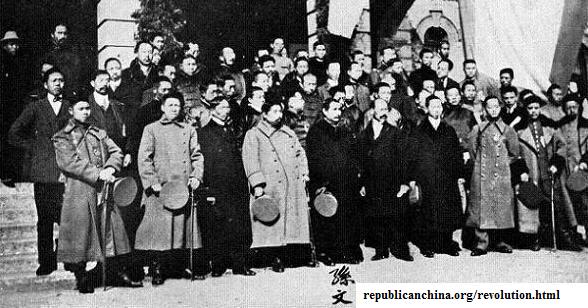
|
On December 18th, Tang Shaoyi and Wu Tingfang held the first round of talk in the British extraterritorial territory's city-hall. Tang Shaoyi sent back to Peking the revolutionary government's demand that the Manchu Qing emperor abdicate. The German consul mediated over the two parties to no vain.
On December 20th, Feng Guozhang came to Peking to replace Liang-bi's post of garrison commander for the Forbidden City.
Tang Shaoyi returned to Shanghai with Yuan Shikai's conditions.
On December 28th, Dowager Empress Long-yu-taihou agreed with Yuan Shikai in convening the "Guo [state] Hui [assembly]".
Dr. Sun Yat-sen returned to Shanghai from overseas by the end of year 1911, persuaded Hu Hanmin into making a trip to Shanghai, and arrived in Shanghai on December 25th. In Shanghai, on December 29th, Sun Yat-sen was supported as the interim president of the Republic of China which was officially founded on January 1st of 1912 (Nov 13th of 1911 per lunar calendar).
The
interim government reverted the name of Nanking back to Nanking-fu/Jiangning-fu and combined the counties of Jiangning & Shangyuan into one.
Sun Yat-sen received 16 out of 17 provincial votes.
On January 2nd, Yuan Shikai claimed that he did not recognize the Nanking government, rebuked Tang Shaoyi as to dereliction, and approved the resignation of Tang Shaoyi.
Yuan Shikai threatened the Manchu court with resignation as well.
Another trick that Yuan Shikai played was to ask the Manchu nobles in donating funds for military purposes, a measure intended to lessen the Manchu resolve in a military confrontation with the revolutionaries.
After Yuan Shi-kai asked Dowager Empress Long-yu donate her funds to supporting the troops, Yuan Shikai cheated the dowager empress with a lucrative offer from the revolutionaries, i.e., Republic of China would forever support the Manchu house with 4 million taels of silver annually should the emperor peacefully abdicate.
Yuan Shikai obtained the concurrence from Yi-kuang.
On January 3rd, Luzhou Uprising was put down with three revolutionary generals killed.
Owing to lack of financial and manpower resources as well as for sake of uniting a broad front, Sun Yat-sen's government adopted an approach of conferring ministerial posts onto "constitutional monarchists" while the deputy posts onto young members of the "Allied Society" per TDG. {Tang Degang claimed that Mao Tse-tung, in October 1949, adopted the same approach by conferring some ministry posts onto the "democratic vase parties".)
While Li Yuanhong was made into vice interim president, the three revolutionaries with 'wu' given name did not enter the cabinet.
Three prominent "constitutional monarchists", i.e., Cheng Dequan, Zhang Jian [Zhang Jizhi] & Tang Xiangming assumed the posts for Interior, Enterprises & Navy Ministries.
Tao Chengzhang, who was left out of the cabinet, was furthermore assassinated by Chiang Kai-shek on January 14th.
Per TDG, Tao Chengzhang & Zhang Taiyan's "Guangfu-hui" hence allied with "constitutional monarchists" in opposing the "Allied Society".
Huang Xing was made into "infantry minister" to be in charge of the cabinet by mapping the U.S. system of "secretary of state".
In the address made on January 1st, 1912, Sun Yat-sen claimed that he would relieve his duty once the Manchu court was toppled.
Solar calendar was adopted on the same day.
On January 2nd, Sun Yat-sen wired to Yuan Shikai about his consent with peace talks.
Dr. Sun Yat-sen moved his interim government to Nanking and stipulated the executive and legislative branches of the R.O.C., and conferred ministers' posts onto various leaders.
On January 22nd, Sun Yat-sen expressed his willingness to resign his interim presidency to Yuan Shikai should the Manchu emperor abdicate and Yuan Shikai support a "republican nation".
"Organization Guidelines of the Interim Government of the Republic of China" [i.e., "Interim Agreed-Upon Laws"], completed with seven chapters and 56 clauses on December 3rd, 1911, called for the establishment of a formal senate with three members from each province.
Senate was established in Nanking on January 28th, 1912, with Lin Sen made into the speaker.
In anticipation of Yuan Shikai's assumption of presidency of the R.O.C., the "Interim Agreed-Upon Laws" changed the government structure to the parliament per the French system as a safeguard in restraining the presidency.
Later on January 11th, Sun Yat-sen officially promulgated the "Interim Agreed-Upon Laws". (Prof Tang Degang ridiculed Mao Tse-tung for devising a sole law of "marriage" in comparison with the fast-paced legal promulgation at the time of Xin Hai Revolution.)
Yuan Shikai Pressuring Manchu Emperor Into Abdication
After Yuan Shi-kai was appointed "naige zongli" (i.e., prime minister of the Manchu cabinet) on November 1st, Regent Zai-li [Zai-feng] retired on December 5th.
Yuan Shi-kai requested for resignation with empress dowager for Manchu's refusal to convene a Parliament.
The empress dowager agreed with convening a Parliament on December 28th.
Tang Shaoyi, who already held five rounds of talks with the revolutionaries, requested for resigning the peace rep post.
Yuan Shikai approved Tang's resignation on January 2nd.
On January 14th, Yuan Shikai wired to Sun Yat-sen for confirmation as to yielding the presidency of the R.O.C.
On January 16th, three revolutionaries sacrificed their lives while attempting to assassinate Yuan Shikai outside of the Forbidden City.
It was when Yuan Shikai arrived at the Forbidden City for talks with Empress Dowager Long-yu and then left the palace by East Flowery Gate that he encountered attacks from the revolutionaries.
On the 17th, dowager empress rebuked the young Manchu nobles as to continuous fight against the revolutionaries while citing Yuan Shikai & King Yi-kuang as an alternative way to receiving special privileges for life.
On January 22nd, various legations called on the Manchu court to abdicate.
Sun Yat-sen's government further demanded that the Manchu emperor abdicate.
Seeing that Sun Yat-sen had become the first president of the R.O.C., Yuan Shi-kai hastened his efforts to secure a fortune for himself. Manchu officials were scared into concessions after a revolutionary (Peng Jiazhen) assassinated Liang-bi in front of the residence on the night of Jan. 26, 1912. Peng Jiazhen, a Sichuan Province native, was conferred the title of "infantry grand general" posthumously.
Incidentally, fake bombs wrapped with cigarette paper had liberated Wuhu of Anhui Province per TDG.
At about the same time, Duan Qirui and about 50 Manchu generals called on the Manchu court to abdicate.
It was Yuan Shi-kai who authorized Duan Qirui to demand an imperial abdication of the six year old emperor in the name of 42 Manchu generals.
In Sichuan Province, Xia Zhishi executed garrison commander Wei Chufan at Longquanyi and mobilized 100-200 New Army soldiers for a charge against the Chongqing city. Having rallied his army to 700-800 men, Xia Zhishi intruded into Chongqing and executed Manchu "garrison emissary" Tian Zhengkui. In the Chengdu city, Governor-general Zhao Erfeng was killed by Yin Changheng. Xia Zhishi supported Chengdu city's Yin Changheng as the new revolutionary governor-general of Sichuan.
In Xinjiang [i.e., New Dominion Province], Manchu General Zhi-rui was killed; in Gansu Province, Manchu governor-general Chang-geng was killed; and in Mongolia/Tibet, local ethnic peoples declared real independence.
On January 27th [solar cal] of 1912, Tang Jiyao held an oath of war for 3000 Yunnan Province northern expedition army in Kunming of Yunnan Province.
Yunnan Province's 2nd northern expedition army, while en route to Sichuan Province via Guizhou Province, was sought by elderly people of Guizhou Province for pacifying the infightings between two factions, the banditry, and armed bands of secret societies.
Cai E liaised with Sun Yat-sen's interim government as well as Guizhou Province government in regards to having Tang Jiyao's northern expedition army act as detente to banditry and infightings.
When northern troops gained an upper hand in Sichuan Province, Cai E wired to Tang Jiyao on February 7th for a halt of operations in Guizhou Province for sake of a continuous march at Sichuan.
Two subordinate generals under Tang Jiyao, i.e., Dai Kan & Zhou Hang of Guizhou Province nativity, disagreed with Cai E.
On February 13th, Cai E insisted on an immediate move to Sichuan Province by citing Sichuan Province army's fighting southern troops as well as the northern armies' threat to Xi'an of Shaanxi Province and Shouchun of Anhui Province.
Cai E did allow a small contingent to remain in Guizhou Province.
After numerous rounds of wires, Cai E, with the knowledge that Manchu emperor had abdicated on 12th, would agree to have Tang Jiyao continue operations in Guizhou Province on February 15th.
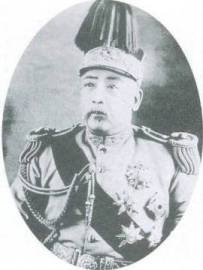 (On March 5th, Tang Jiyao defeated Guizhou Governor-general Zhao Dequan and the "autonomy" faction in collaboration Guizhou Province new army & garrison troops led by Liu Xianshi & Hu Jingtang. One day before, Tang Jiyao was made into interim governor-general by Guizhou Province consultancy bureau. Tang Jiyao enforced severe punishment and immediate executions by enacting martial law in Guizhou Province, for which he was rebuked by fleeing "autonomy" faction in front of vice president Li Yuanhong.)
Yuan Shi-kai reached a deal with Sun Yat-sen in regards to pressuring the last Manchu Emperor Xuantong (Aixinjueluo Pu-yi, r. 1909-1911) into abdication on February 12th of 1912. Zhao Bingjun, a crony, was sent to the forbidden city for extracting the abdication decree. Zhang Jian, i.e., Yuan Shikai crony, drafted the decree. Yuan Shi-kai then wired to Sun Yat-sen on February 13th to express his support for the "republican government". Sun Yat-sen resigned his post to the interim upper house on the same day. On the 15th, the upper house declared Yuan Shi-kai interim president and Li Yuanhong deputy president. Yuan Shikai hence obtained the R.O.C. presidency from Sun Yat-sen.
Details of the Wuchang Uprising and Xin Hai Revolution is also covered in the section on the "Qing Dynasty".
What the Foreign Powers Did To China Prior To, During And After the 1911 Revolution
Flowery-republic-Frederick-McCormick
a) The 1900 Boxer was incited by Dowager Empress Ci-xi whose purpose was to revenge on the European-American attempt at restoring Emperor Guangxu in lieu of Ci-xi's selecting a junior prince as the successor 'crown prince'. The foreign powers, after weighing their interests in China, let Ci-xi continue her rule in China.
b) In 1904, after the Russo-Japanese War, Theodore Roosevelt, was writing how happy he was to see the Russians defeated by the Japanese in Manchuria. This is similar to what Hoover claimed when the Japanese invaded Manchuria on September 18th, 1931, i.e., good for inhibiting the Russian communism.
c) In 1905, when Chinese boycotted American goods [due to American extension and revision of Peking treaty with discrimination against Chinese coolies], American President had mobilized 15000 marines for a planned attack at Canton.
d)
In June of 1911, the Americans instructed that China's railway restoration movement must be stopped by any means, and in Sept, one month ahead of the Xin Hai Revolution, dispatched the Asian Fleet warships to the Yangtze from the Philippines. President Taft endorsed the policy of neutrality only after the Revolutionaries in Wuchang promised to continue the Manchu unequal treaties.
e) On October 18th, 1911, Sun Yat-sen went to Washington DC for a second time in the year for requesting a meeting with the U.S. Secretary of State, in vain. In late 1911, American newspapers carried articles blasting China's republic as a joke. The U.S. State Department expressed 'worries' about the establishment of a republic in China in a rash way. Only the American missionaries, like in the resistance war in the 1930s, had supported China's efforts.
f) Both the American and British ambassador received instructions to pressure the Manchu court on the matter of invoking Yuan Shikai. The pressure was more than diplomatic, but monetary. The foreign powers controlled China's customs, and the Manchu court got paid the surplus of customs after the foreign powers got their pay first. After the October 10th Revolution, the foreign powers, in the name of 'neutrality', cut the funding to the Manchu court. This is similar to what they did in stopping the funds to the Canton government after Sun Yat-sen returned to Canton after overthrowing the Guangxi clique in 1922. With the major source of money cut, the Manchu court was in more panic than ever. Other than cutting the customs tax pay to the Manchu court, the international financial consortium refused to loan to the Manchu court, but hinted they were willing to give 3000,000 taels of silver should Yuan Shikai return to control of the army. On December 20th, at the Anglo-American-brokered south-north peace conference in Shanghai, six countries "courteously" requested the peace negotiators to reach a truce in the interests of both the Chinese and the foreigners.
g) Even after Sun tacked on interim presidency on January 1st, 1912, the American government continued to state that Sun Yat-sen was a doubtful person, and Yuan Shikai was the powerful man who could control China. When the R.O.C. Foreign Minister Wang Chonghui wired to the U.S. Government on January 17, January 19th, 1912, for the American recognition of the R.O.C., both times, the Americans did not reply. Further, the Americans instructed that no consulate should maintain contact with the revolutionaries in the south. American reporters passed on the American message to Sun Yat-sen, make a deal with Yuan, and don't count on Washington DC, and don't count on the Republic of U.S.A. as your example and source of inspiration. --- Check out Frederick McCormick: The Flowery Republic (London: John Murray, 1913), pp. 294-295.
h) After Sun Yat-sen quit the interim presidency, the U.S. Congress congratulated on China's adoption and maintenance of a Republican government, on February 29th, 1912. American was the first country to acknowledge Yuan Shi-kai's government in the aftermath of national turmoil owning to the assassination of Soong Jiaoren in March of 1913.
- Americans did the same hasty decision to give Chiang Kai-shek a badly-needed loan at the time Whang Jingwei's puppet government officially launched in Nanking in March 1940. The only reason the Americans decided to get involved in China in March 1940 was a deliberate Chiang Kai-shek rumor that his Chongqing government could merge with the puppet Nanking government, the same trick that Chiang Kai-shek used in sending the fake Soong Ziliang to HK for 'peace talks' with Japan for sake of delaying the launch of the Nanjing puppet government.
More available at "Changing Alliances On the International Arena", "Century-long American hypocrisy towards China", "Anglo-American & Jewish romance with the Japanese",
"America's Unpositive Neutrality in the Sino-Japanese War",
"Joe Stilwell's Authorization To Assassinate Chiang Kai-shek", and "What Foreign Powers Did To The Flowery Republic Prior To, During And After The 1911 Revolution".
Yuan Shi-kai - the First President of the R.O.C.
Yuan Shi-kai, seeing that Sun Yat-sen had become the first president of the R.O.C., hastened his efforts to secure a fortune for himself. Yuan Shi-kai authorized Duan Qirui to demand an imperial abdication in the name of 42 Manchu generals.
Yuan Shi-kai reached a deal with Sun Yat-sen in regards to pressuring the last Manchu Emperor Xuantong (Aixinjueluo Pu-yi, r. 1909-1911) into abdication on February 12th of 1912.
Zhao Bingjun, back in early 1912, went to see last Manchu Qing Emperor Pu-yi to relay Yuan Shi-kai's request for imperial abdication.
After Sun Yat-sen resigned on the 13th [14th per TDG], Yuan Shi-kai obtained the R.O.C. presidency from Sun Yat-sen subsequently when the interim upper house made the announcement on February 15th, 1912.
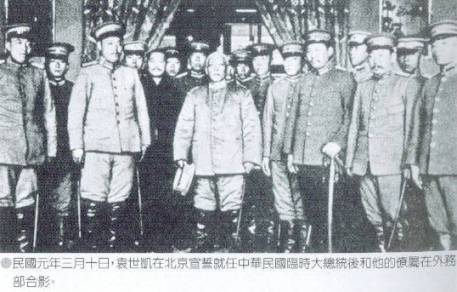 It was not the first time Sun Yat-sen had "yielded" the leadership to someone else. Jiang Yongjing pointed out that Sun Yat-sen, against the objection of Zheng Shiliang, during the course of establishing the "Xing Zhong Hui" HK branch in 1895, had yielded the HK branch president's post to Yang Quyun and did not succeed it till 1899.
(However, Chen Jieru memoirs stated that Sun Yat-sen served Yang Quyun as a secretary for one year before Yang Quyun's assassination death.
Hsueh Chun-tun pointed out that Sun Yat-sen, after the aborted 1895 Canton Uprising, had established a separate "Xing [reviving] Han [Han ethnic Chinese] Hui [society]" till Yang Quyun gave up the chair post of "Xing [reviving] Zhong [China] Hui [society]" in January 1900.
In October 1914 letter to Deng Zeru, Sun Yat-sen explained the reasons why he had yielded the 'Interim Presidency' to Yuan Shi-kai.
In 1921, Chiang Kai-shek promised to his wife Chen Jieru that he would make Sun Yat-sen the only "guardian-god" of the Republic of China should he rise to power, and later, Chiang Kai-shek tried to destroy the photos and film of Sun Yat-sen
standing behind Yang Quyun by bribing the Japanese and HK businessmen. Later, Chiang Kai-shek had conducted several nominal resignations, including the resignation in August 1927 for the party unity between Nanking and Wuhan governments and the resignation in 1931 after the September 18th Japanese Invasion of Manchuria, etc.)
The Nanking government, on February 18th, 1912, dispatched a team headed by Cai Yuanpei for fetching Yuan Shikai over to Nanking from Peking.
The team, consisting of Soong Jiaoren, Wang Jingwei, Niu Yongjian, Wang Zhengting, Liu Guanxiong, Wei Chenzu, Zeng Zhaowen & Huang Kaiyuan, left Shanghai on the 22nd by sea together with Tang Shaoyi, and arrived in Peking on the 26th.
Initially Yuan Shikai had no objection to relocation to the south; however, on the 29th, soldiers around the Dongan-men and Qian-men city gates suddenly
went into a 'mutiny', raided the guesthouse where the mission stayed, and forced the representatives into seeking asylum in the legation area.
Meanwhile, 'mutiny' spread to Tongzhou, Tianjin and Baoding.
Hence, Yuan Shikai claimed that he could not afford to relocate to Nanking.
Per TDG, Zhang Guogan had disclosed that he learnt from Xu Shichang that Yuan Keding, i.e., Yuan Shikai's son, could be the culprit in stirring up the 'mutiny' for sake of imprisoning the Manchu emperor and making Yuan Shikai into the new emperor.
Since Yuan Shikai refused to come south while Li Yuanhong & Zhang Binglin advocated for Peking as the nation's capital, Sun Yat-sen gave up the demand and ratified Yuan Shikai's oath telegraph with the Senate on March 8th, 1912.
Cai Yuanpei administered the oath on 10th in Peking.
The second day after oath, Sun Yat-sen, in Nanking, released the "Interim Agreed-Upon Laws" of the R.O.C., and adopted the French parliamentary government structure.
On March 13th, Yuan Shikai issued an order to have Tang Shaoyi work on organization of the first cabinet of the R.O.C.
Yuan Shikai promptly issued a nationwide amnesty without consultation with the Senate [as a challenge to assert his presidential power per TDG].
On the 29th, Tang Shaoyi [1860-1938] completed the cabinet shuffling, with such prominent members as Tang Shaoyi, Lu Zhengxiang [foreign ministry], Zhao Bingjun [Interior], Duan Qirui [infantry], Liu Guanxiong [navy], Xiong Xiling [finance], Wang Chonghui [justice], Cai Yuanpei [education], Soong Jiaoren [agriculture and forestry], Chen Qimei [commerce & industry], Shi Zhaoji [transportation] heading various ministries.
As pointed out by Tang Degang, foreign minister Lu Zhengxiang held more power over premier Tang Shaoyi in the spirit of inheriting the Manchu line of authority as demanded by the imperialist powers.
As to Soong Jiaoren & Chen Qimei's admission to the cabinet, Tang Degang made an analogy to Chiang Kai-shek's conferring similar 'industry' and 'enterprises' posts onto the "third parties" and Mao Tse-tung's onto the "democratic vase parties".
Chen Qimei, with his real power base in Shanghai, refused to report to Peking.
The Last Chinese Reorganization Gold Loan (Gold Bonds) of 1913
Huang Xing [1874-1916] was retained as "housekeeper" in Nanking for dismissing 300,000 soldiers of various factions from the Xin Hai Revolution.
The Republic of China, for solving financial solvency and dismissing the soldiers, had resorted to the imperialist powers for huge loans which did not get approved till after Soong Jiaoren's assassination death on March 20th, 1913.
Tang Shaoyi first initiated the loan request for 8,5000,000 taels of silver with four countries of Britain, the U.S., Germany & France whereas Japan and Russia joined in for profiteering soon.
After the restructuring of the 'aftermath loan' in 1913, the United States withdrew from the six-nation consortium.
In 1920, four powers re-established a four-nation financial consortium; however, no loan was doled out for sake of not offending Japan which claimed a primary interest in China.
The United States had never given a loan to China before 1931. The only loan was the funds of the Boxer Indemnity Fund.
(Mike Billington, in "How London, Wall Street
Backed Japan's War Against
China and Sun Yat Sen", pointed out that "the House of Morgan, functioning as an arm of British imperial policy within the United States, first became seriously involved with the formation of a bankers' Consortium for China, in 1909, consisting of banking interests from the United States, Britain, France, and Germany. The British, under Hongkong and Shanghai Bank chief Sir Charles Addis, took overall direction of the Consortium, with a J.P. Morgan representative leading the American Group. Although the Consortium did finance a Shanghai-to-Canton rail line, their primary task was to prop up the decayed Ching dynasty against the mounting republican revolutionary pressure".)
The 1913 "aftermath borrowing", commonly labeled as Yuan Shikai's reorganized gold loan and known as the "1913 Chinese Reorganization Gold Bonds", was restructured in the 1930s together with the old debts of the Qing dynasty.
The southwest China's railway loans that triggered the 1911 Xin Hai Revolution as a result of the Manchu attempt at nationalizing the railways for transfer to the international synarchists, was paid a coupon and interests again in 1928.
This loan, with the British, German and American funds, became the poster child auctioned on the EBay today.
There was a similar loan to the Hu-guang (Hukuang) loan, i.e., the Tientsin-Pukow railway loan in that they were pledged by the customs and salt revenue tax.
After the Japanese invasion of Manchuria, the salt taxes that were robbed by the Japanese made China default on the two railway loans, portion of which belonged to the Americans. The two railway loans, which were barely reorganized and reinstated in the early part of 1937, fell back again after the Japanese invaded China and seized all ports along the coast.
In the 1930s, the Nanking government of the Republic of China reorganized majority of the old debts of the Peking government of the Republic of China.
After the Sino-Japanese War, this restructured debts' payments were stopped because the payment of the external debts, which were securitized by the customs and salt taxes under the supervision of the powers, were taken over by the Japan-installed puppet governments and deposited to the Japanese Yokohama Specie Bank. Hence, there is no recourse for the Republic of China to pay the debts that were already blanketed by the two reorganizations, with various forms of the R.O.C. bills [auctioned on Ebay, etc.] carrying no enforceability.
War was called force majeure by the international law. When Europe and the United States had private agreements with the puppet Chinese regime established by the Japanese, they already lost validity and recourse for the Republic of China's reorganized loans of the 1930s, not to mention the loans of the 1910s or even earlier.
The powers, since 1938, colluded with the Japanese in depositing China's customs tax and salt tax, i.e., the funds reserved for the payment of the reorganized R.O.C. bonds, in the Japanese Yokohama Specie Bank, hence forfeiting the claim to payment of the principal and interests on the R.O.C. debts [that included the reorganized Manchu debts such as the Huguang railroad and public works debt in what's now Hebei Province].
The Republic of China announced in January 1939, after one and a half years of the Sino-Japanese War and continuous payments through this time period, that it would not be responsible for the customs duty-securitized payment, i.e., the customs duties' funds in the Japanese occupation zone. After 1938, Europe and the United States recognized the Japanese puppet regime in China and lost its qualifications with counterclaim against the Republic of China.
During WWII, because China, together with the Anglo-American and European powers, formed an alliance and fought against Japan, the old debts were cancelled as part of cancellation of the unequal treaties or rebalance of the Sino-U.S. lend-lease and inverse lend-lease arrangements.
During the peace treaty in San Francisco of 1950-1951, China and the rest of countries were asked to renounce claims against Japan.
The U.S., which again betrayed the R.O.C. in excluding the R.O.C. Taiwan government from the treaty signatory ceremony, reached a consensus with the rest of powers in relinquishing the wartime damages against Japan, which in the sense of international law nullified the claims to the R.O.C. reorganized bonds that were securitized by the customs tax and salt tax that were robbed by the Japanese.
From this point of view, alone, the European powers or the United States lost the recourse to recover debts with payments ceased due to the Sino-Japanese war.
The San Francisco Treaty of Peace of 1950-1951 required countries to abandon claims for the financial losses caused by the Japanese aggression for a blanket settlement, including the claims related to the Chinese war time loss of the customs duties and salt tax.
On March 30th, Tang Shaoyi enrolled in "Tong Meng Hui" (i.e., the Allied Society) at the encouragement of Huang Xing & Cai Yuanpei.
On April 1st, Sun Yat-sen resigned his proxy duty.
Within 3 months of the cabinet formation, Tang Shaoyi resigned his post via a sudden disappearance. Per TDG, Gu Weijun, i.e., Tang Shaoyi's son-in-law, had personally witnessed the quarrels between Yuan Shikai and Tang Shaoyi.
Yuan Shikai's cronies often joked in front of Tang Shaoyi by saying that "the Premier is coming to bully our president again..."
Sun Yat-sen, after relieving duties, went on a nationwide tour and speeches with his son and daughter, Wang Jingwei, Liao Zhongkai, Zhang Shizhao, and Miss Soong Ai-ling [i.e., later Mme H.H. Kung].
Sun traveled from Shanghai to Wuhan along the Yangtze and made stops at Nanking, Wuhu, Anqing & Jiujiang. Before going to Peking at Yuan Shikai's invitation, Sun Yat-sen made a trip to his Xiangshan hometown in Guangdong on April 27th.
Thinking that his two principles, i.e., "nationalism" and "civil rights", had been accomplished in China, Sun Yat-sen, while making a speech in mid-June in Canton, emphasized only the aspect of "people's livelihood" which was his propagating of "equalizing the land ownership rights".
Historian Tang Degang blamed China's bloody path of "state socialism" [of both Chiang Kai-shek's Nationalist Party and Mao Tse-tung's Communist Party] on Sun Yat-sen's beliefs and practice of "radical socialism" which ended in his collusion with Russian Bolshevikism in the 1920s and designation of his "principle of livelihood" as equivalent to communism.
On June 14th, Huang Xing's Nanking office was officially dismantled.
Huang Xing declined Yuan Shikai's invitation to go to Peking as "tactician-in-general".
On June 15th, Tang Shaoyi disappeared from Peking.
Tang Degang pointed out that Tang Shaoyi was indignant over Yuan Shikai for changing Wang Zhixiang's conferral of governor-general post for Zhili Province without consultation with the cabinet.
Yuan Shikai asked Lu Zhengxiang to re-organize the 2nd cabinet.
Soong Jiaoren & Chen Qimei, without the cabinet posts, then concentrated on party re-organization, i.e., making "Tong Meng Hui" into the KMT for sake of grabbing the majority seats inside of the "National Assembly", i.e., the Congress but translated into the Parliament throughout this writing.
In accordance with Clause 53 of the "Interim Agreed-Upon Laws", the Interim President must convene a Parliament within ten months.
On August 27th, Yuan Shikai ratified the "organization regulations for the Parliament of the R.O.C.", which was a combination of American, British and French systems: the Senate [i.e., the Upper House] would have ten members for most of 22 provinces and varied quota for minority provinces and the overseas Chinese; and the Congress [i.e., the Lower House] would have members on basis of a rough estimate of one congressman for a subset of 800,000 population.
Tang Degang pointed out that those 800 Parliament members had no constituents per se.
Tang Degang cited Zhang Yufa's research in pointing out that over 600 parties had popped out in the early Republic era, and that majority organizations had derived from the "Manchu Royalist Party" [i.e., Kang You-wei & Liang Qi-chao's gang] and the "Constitutional Monarchists".
Soong Jiaoren, who drafted the "Interim Agreed-Upon Laws" and the "organization regulations for the Parliament of the R.O.C.", adopted the approach of combining several revolutionary organizations with "Tong Meng Hui" (i.e., the 'Allied Society of China'), including "Tongyi Gonghe Dang" (the united republic party that was once headed by Cai E), "Guomin Gongjin Hui" (the society for people's concerted advancement), "Gonghe Shijin Hui" (the society for republic advancement), & "Guomin Gong Dang" (the people's public party).
On August 25th, Soong Jiaoren officially convened the meeting of the KMT, with 1000 participants including Sun Yat-sen who arrived in Peking one day earlier.
Though Sun Yat-sen obtained 1130 votes, he yielded the post of "chairman of the board" to Soong Jiaoren.
Scholar Yuan Shiwei rebuked Dr. Sun Yat-sen's blunders in the orientation towards the "railway construction".
In contrast, Soong Jiaoren worked diligently for building a majority KMT party inside of the Parliament. In August 1912, Soong Jiaoren united various parties and societies into the Guomindang (GMD or KMT) and supported Sun Yat-sen as director of the board. However, Sun Yat-sen declined the director of board and took on the railroad job. Soong Jiaoren advocated Parliamentarism, intending to make the KMT an incumbent party as a check on the presidency. Sun Yat-sen and Huang Xing naively persuaded Yuan Shi-kai and Yang Du et al., into a possible enrollment in the KMT in the hope that that Yuan Shi-kai could be a part of the KMT upon membership in the KMT.
During one month stay in Peking, Sun Yat-sen held 13 tête-à-tête discussions with Yuan Shikai. Presidential secretary Liang Shiyi witnessed some talks that lasted 6-8 hours on some occasions, with topics covering the state affairs and foreign relations.
Liang Shiyi commented that Sun Yat-sen, having detected Yuan's ambition, tried to pacify his opponent, while Gu Weijun later disclosed that Yuan Shikai knew nothing about the "modern political thoughts".
Sun Yat-sen claimed that "President Yuan Shi-kai being a man of great talents, I hold out extraordinary hope that should he be on the presidency's post for 10 years, China would boast an army of several millions and that by that same timeframe, I would be able to lay 200,000 li railroad tracks, with an expected revenues of 8 million yuan per year, making China strong enough to be peers of the world powers."
As a way to retain Sun Yat-sen, Yuan Shikai agreed to let Sun Yat-sen head the 'China railway construction' and furthermore appointed Huang Xing as 'railway czar' for the Wuhan-Guangdong-Sichuan areas.
Having pointed out that China still failed to have 70,000 kilometer railway tracks by the end of the 20th century, Tang Degang commented that Yuan Shikai had deliberately allowed Sun Yat-sen to tack on the railway post while knowingly understood the reality, and later accused Sun Yat-sen of "corruption" in squandering away the funds.
On September 9th of 1912, Sun Yat-sen accepted the title of 'plenipotentiary' for the China national railroads [i.e., head of the National Railroad Bureau], with a dream of laying 200,000 li distance railroad tracks. (2 li distance is equivalent to approx 1 kilometer.
Separately, Yuan Shikai attempted to kick out Chen Qimei from Shanghai by offering 60,000 silver dollar [equiv to US$60,000] travel expense for an overseas inspection of industries & commerce.
Chen Qimei, a friend of An Jung-geun, however, offered significant amount of the money to the "Korean patriots" by establishing a "New Asia Mutual Aid Society" in Shanghai.
Soong Jiaoren - Re-organization of the Kuomintang (KMT)
After the overthrow of Manchu Qing Dynasty, "Tong Meng Hui" began to disintegrate. Zhang Binglin rallied the Jiangsu-Zhejiang members for forming so-called 'United Society of the R.O.C.' which later converged with such monarchists as Zhang Jian into the 'United Party' (i.e., "Tongyi Dang").
In Hubei Province, another group of "Tong Meng Hui" allies, like Sun Wu, Lan Tianwei and Liu Chengyu, supported Li Yuanhong to become the leader of "Min She" [the "People's Society"] which later combined with anti-TongMengHui "Guomin Xiejin Hui" (i.e., the National Advance Together Society) into the 'Republican Party'.
Li Yuanhong, before his being coerced into Peking by Yuan Shi-kai at Duan Qirui's personal escort, still ruled Hubei Province. Li Yuanhong would adopt the advice from Hu Kangmin [i.e., Hu Qiuyuan's father] in establishing an audit & budget department.
Hu Kangmin resigned his auditor post after Duan Zhigui, i.e., Yuan Shi-kai's crony, came to Hubei Province as the new governor-general.
The KMT was originally a loose organization comprising of several revolutionary organizations, such as "Tong Meng Hui" (i.e., the 'Allied Society of China'), "Tongyi Gonghe Dang" (the united republic party), "Guomin Gongjin Hui" (the society for people's concerted advancement), "Gonghe Shijin Hui" (the society for republic advancement), & "Guomin Gong Dang" (the people's public party). [Tong Meng Hui", moreover, was a lunar July 20th or solar August 20th, 1905 combination of various anti-Manchu secret societies like Sun Yat-sen's original "Xing Zhong Hui", Huang Xing/Soong Jiaoren's "Hua Xing Hui" and Cai Yuanpei/Zhang Binglin's "Guang Fu Hui". In then Tokyo, Sun Yat-sen was referred to Huang Xing by Yang Du, a monarchist same as Kang You-wei and Liang Qi-chao.]
The KuoMinTang [KMT] (i.e., Guomindang [GMD] in pinyin), was commonly known as the Nationalists. Semantically, it should be termed the National Party or the Citizen Party. The KMT applied to the same group of revolutionaries during several deferent stages and under different leadership.
The KMT party which had its root in "Tong Meng Hui" was coordinated by Soong Jiaoren in Peking at the absence of Sun Yat-sen and Huang Xing, and the KMT was officially found inside of the 'Hunan-Guangdong Natives' Hall' on August 25th of 1912, the day after Sun Yat-sen arrived in Peking from Shanghai. The KMT stipulated nine board directors, including Sun Yat-sen, Huang Xing and Soong Jiaoren et al., and 29 councilors, including Hu Hanmin, Li Liejun, Jiang Yiwu, Sun Yujun, Tan Yankai, Yu Youren and Ma Junwu.
Soong Jiaoren had publicly announced that he did not have any difference of opinions from Sun Yat-sen, and Sun Yat-sen was supported as director-general of the 'board of directors' of the KMT. Sun, however, gave up the post for his dream of laying the tracks for the national railroads.
Sun Yat-sen and Soong Jiaoren differed on dealings with Yuan Shi-kai's presidency. Sun advocated that his "Tong Meng Hui" act as a challenger party against the incumbent president, while Song advocated a Parliamentarism struggle against the presidency by making the KMT a majority party. Huang Xing et al., tried to enroll Yuan Shi-kai and Yang Du as members of the KMT. Yuan Shi-kai privately ridiculed the KMT by saying to Yang Du, a monarchist, that he would be willing to be a revolutionary should the KMT abandon its attempt at exercising the Parliament's restraints over the presidency.
Under the leadership of Soong Jiaoren, the KMT occupied 123 seats out of 274 seats in the Upper House, and 269 seats out of 596 in the Lower House. The major rival to the KMT would be the 40 seats taken by "Gonghe Dang" (i.e., the Republican Party), another loosely combined organization founded on May 5th of 1912 with components like "Tongyi Dang" (the united party), "Min She" (the people's society), and Pan Hongding's three institutions of "Guo-min-dang", "Guo-min-xie-jin-hui" & "Min-guo-gong-hui".
The Republican Party had such prominent members as Li Yuanhong, Zhang Jian, Zhang Binglin, Wu Tingfang, Tang Hualong and Wang Jitang. Zhang Binglin later broke away from "Gonghe Dang" and restored his "Tongyi Dang" (the united party).
 Competing with the KMT and the Republican Party would be a new party called "Min Zhu Dang" (i.e., the Democrat Party) that was founded in October 1912 by Liang Qichao (1873-1929) with the support of remnants of the "Gonghe Dang" like Tang Hualong, Lin Zhangmin and Sun Hongyin. The Democrat Party also combined "Gonghe Baojin Dang", "Gonghe Cuojin Dang", and "Guomin Xinzheng She".
Soong Jiaoren claimed that he would form a cabinet consisting of the KMT members, only, which alienated such competitor parties as the Republican Party, the United Party, and the Democrat Party.
In mid-Oct, Soong Jiaoren made a trip to seeing his mother at Taoyuan [peach garden] hometown in Hunan Province.
On February 1st, 1913, Soong Jiaoren left hometown, traveled across Eastern China, made "radical speeches" against Yuan Shikai's government [per TDG].
Song's criticisms included accusations that Yuan Shikai was 'digging his own tomb' while making a speech in the KMT branch in Hubei Province. In Nanking, on March 9th, Song emphasized the importance of "premiership" over the presidency.
Yuan Shikai, having failed two times to bribe Soong Jiaoren, wired to Soong Jiaoren for a visit to Peking in regards to discussions about the cabinet shuffling.
Soong Jiaoren's Assassination & the Second Revolution
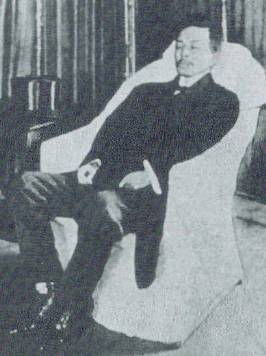 Soong Jiaoren worked diligently for building a majority KMT party inside of the Parliament. But, Yuan Shi-kai, in order to fulfill his dictator or emperor's dreams, hired an assassin to have Soong Jiaoren assassinated on March 20th, 1913.
Hong Shuzu (1855-1919) was later arrested and executed by the government using gallows as a trial, an import that was never deployed again till the execution of communist party founder Li Dazhao.
The assassination, however, was disputed by Hong Shuzu's son Hong Sen (1894-1955) who, taking the KMT as a sworn enemy, threw himself into the communist Leftish Writers' League and Leftish Dramatists' League.
Hong Shuzu, taking Soong Jiaoren as a black horse, organized a 'defamation of Soong' operation; however, some cronies in Shanghai, who claimed to have spent a fortune in going to Japan to have dug up dirts on Soong Jiaoren, decided to take out Soong Jiaoren to cover up the misdeeds in the extortion of money from Hong Shuzu.
Soong Jiaoren, who had turned down a 'blank checkbook' from Yuan Shi-kai's proxy, traveled across the country and successfully campaigned to get the KMT members elected to the majority seats in the Parliament.
Further, at the time Soong Jiaoren departed the Tang Shaoyi cabinet, Yuan Shikai offered 500,000 units of gold which Soong Jiaoren had declined.
Tang Degang pointed out i) that Soong Jiaoren had resigned from the cabinet after Lu Zhengxiang claimed that he would like to form a cabinet consisting of people with no party membership; and ii) that Yuan Shikai had at one time contemplated upon having Soong Jiaoren form a "mixed party membership cabinet" but ultimately selected Zhao Bingjun for forming the cabinet since Soong Jiaoren advocated for the "one party [KMT] cabinet".
Soong Jiaoren worked diligently for building a majority KMT party inside of the Parliament. But, Yuan Shi-kai, in order to fulfill his dictator or emperor's dreams, hired an assassin to have Soong Jiaoren assassinated on March 20th, 1913.
Hong Shuzu (1855-1919) was later arrested and executed by the government using gallows as a trial, an import that was never deployed again till the execution of communist party founder Li Dazhao.
The assassination, however, was disputed by Hong Shuzu's son Hong Sen (1894-1955) who, taking the KMT as a sworn enemy, threw himself into the communist Leftish Writers' League and Leftish Dramatists' League.
Hong Shuzu, taking Soong Jiaoren as a black horse, organized a 'defamation of Soong' operation; however, some cronies in Shanghai, who claimed to have spent a fortune in going to Japan to have dug up dirts on Soong Jiaoren, decided to take out Soong Jiaoren to cover up the misdeeds in the extortion of money from Hong Shuzu.
Soong Jiaoren, who had turned down a 'blank checkbook' from Yuan Shi-kai's proxy, traveled across the country and successfully campaigned to get the KMT members elected to the majority seats in the Parliament.
Further, at the time Soong Jiaoren departed the Tang Shaoyi cabinet, Yuan Shikai offered 500,000 units of gold which Soong Jiaoren had declined.
Tang Degang pointed out i) that Soong Jiaoren had resigned from the cabinet after Lu Zhengxiang claimed that he would like to form a cabinet consisting of people with no party membership; and ii) that Yuan Shikai had at one time contemplated upon having Soong Jiaoren form a "mixed party membership cabinet" but ultimately selected Zhao Bingjun for forming the cabinet since Soong Jiaoren advocated for the "one party [KMT] cabinet".
More available at Second_Revolution.pdf
(Check
RepublicanChina-pdf.htm
page for up-to-date updates.)
* In Commemoration of China's Fall under the Alien Conquests in A.D. 1279,
A.D. 1644 & A.D. 1949 *
U.S.S.R./Comintern Alliance with the KMT & CCP (1923-1927)
Korean/Chinese Communists & the 1931 Japanese Invasion of Manchuria
American Involvement in China: Soviet Operation Snow, IPR Conspiracy, Dixie Mission, Stilwell
Incident, O.S.S. Scheme, Coalition Government Crap, Amerasia Case & The China White Paper
* Stay tuned for "Republican China 1911-1955: A Complete Untold History" *
|
|
Zou Rong's Revolutionary Army;
Shin Kyu Sik's
Shrine (Spirit, Kunitama) of Korea
|
This snippet is for sons and daughters of China:
Heed the sons & ministers' agony and sorrow of our ancestors who died or lived through the Mongol, Manchu and Soviet-Chicom conquest
and
the Yongjia, Jingkang and Jiashen cataclysms !
Jeanne d'Arc of China:
Teenager girl Xun Guan breaking out of the Wancheng city to borrow the relief troops in the late Western Jinn dynasty;
Liu-Shao-shi riding into the barbarian army to rescue her husband in the late Western Jinn dynasty;
teenager girl Shen Yunying breaking into Zhang Xianzhong's rebels on the horseback to avenge on father's death in the late Ming dynasty.
China's Solitary and Lone Heroes:
Nan Jiyun breaking out of the Suiyang siege and charging back into the city in the Tang dynasty;
Zhang Gui & Zhang Shun Brothers breaking through the Mongol siege of Xiangyang in the Southern Soong dynasty;
Liu Tiejun breaking through three communist field armies' siege of Kaifeng in the Republican China time period;
Zhang Jian's lone confrontation against the communist army during the June 3rd & 4th Massacre of 1989.
|
|
|
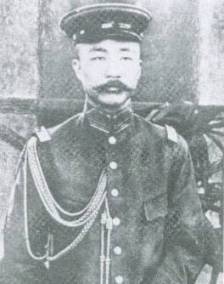 Yuan Shi-kai intended to eradicate the KMT forces altogether and dispatched his military apparatus against the southern provinces of Anhui-Jiangxi-Jiangsu-Hubei-Shanghai, etc. Yuan Shi-kai sent two columns to the south, with Duan Zhigui's First Corps in charge of two divisions in Hubei-Jiangxi battlefield and Feng Guozhang's Second Corps in charge of miscellaneous army corps against Nanking of Jiangsu Province. Duan Zhigui's First Corps included Wang Zhanyuan's 2nd Div and Li Chun's 6th Div. Yuan Shi-kai intended to have Duan Zhigui take over the governor-general's post of Hubei Province and Feng Guozhang governor-general of Jiangsu Province.
In Hunan Province, Yuan Shi-kai's agents burnt the weapons depot. In mid-July, Yuan Shi-kai dispatched two warships to Shanghai under the helm of Zheng Rucheng and Zang Zhipin.
Yuan Shi-kai intended to eradicate the KMT forces altogether and dispatched his military apparatus against the southern provinces of Anhui-Jiangxi-Jiangsu-Hubei-Shanghai, etc. Yuan Shi-kai sent two columns to the south, with Duan Zhigui's First Corps in charge of two divisions in Hubei-Jiangxi battlefield and Feng Guozhang's Second Corps in charge of miscellaneous army corps against Nanking of Jiangsu Province. Duan Zhigui's First Corps included Wang Zhanyuan's 2nd Div and Li Chun's 6th Div. Yuan Shi-kai intended to have Duan Zhigui take over the governor-general's post of Hubei Province and Feng Guozhang governor-general of Jiangsu Province.
In Hunan Province, Yuan Shi-kai's agents burnt the weapons depot. In mid-July, Yuan Shi-kai dispatched two warships to Shanghai under the helm of Zheng Rucheng and Zang Zhipin.
More available at Second_Revolution.pdf
(Check
RepublicanChina-pdf.htm
page for up-to-date updates.)
* In Commemoration of China's Fall under the Alien Conquests in A.D. 1279,
A.D. 1644 & A.D. 1949 *
U.S.S.R./Comintern Alliance with the KMT & CCP (1923-1927)
Korean/Chinese Communists & the 1931 Japanese Invasion of Manchuria
American Involvement in China: Soviet Operation Snow, IPR Conspiracy, Dixie Mission, Stilwell
Incident, O.S.S. Scheme, Coalition Government Crap, Amerasia Case & The China White Paper
* Stay tuned for "Republican China 1911-1955: A Complete Untold History" *
|
|
Zou Rong's Revolutionary Army;
Shin Kyu Sik's
Shrine (Spirit, Kunitama) of Korea
|
This snippet is for sons and daughters of China:
Heed the sons & ministers' agony and sorrow of our ancestors who died or lived through the Mongol, Manchu and Soviet-Chicom conquest
and
the Yongjia, Jingkang and Jiashen cataclysms !
Jeanne d'Arc of China:
Teenager girl Xun Guan breaking out of the Wancheng city to borrow the relief troops in the late Western Jinn dynasty;
Liu-Shao-shi riding into the barbarian army to rescue her husband in the late Western Jinn dynasty;
teenager girl Shen Yunying breaking into Zhang Xianzhong's rebels on the horseback to avenge on father's death in the late Ming dynasty.
China's Solitary and Lone Heroes:
Nan Jiyun breaking out of the Suiyang siege and charging back into the city in the Tang dynasty;
Zhang Gui & Zhang Shun Brothers breaking through the Mongol siege of Xiangyang in the Southern Soong dynasty;
Liu Tiejun breaking through three communist field armies' siege of Kaifeng in the Republican China time period;
Zhang Jian's lone confrontation against the communist army during the June 3rd & 4th Massacre of 1989.
|
|
|
 With the nodding approval of Sun Yat-sen, the KMT governors-general and generals, i.e., Li Liejun of Jiangxi, Tan Yankai of Hunan, Bai Wenwei of Anhui and Xu Chongzhi of Fujian, declared independence. Li Liejun, who had arrived in Shanghai for talks with other former KMT governors-general and Sun Yat-sen on June 15th after resignation, would leave for Hukou of Jiangxi Province on July 8th.
This would be called the 'Second Revolution'.
With the nodding approval of Sun Yat-sen, the KMT governors-general and generals, i.e., Li Liejun of Jiangxi, Tan Yankai of Hunan, Bai Wenwei of Anhui and Xu Chongzhi of Fujian, declared independence. Li Liejun, who had arrived in Shanghai for talks with other former KMT governors-general and Sun Yat-sen on June 15th after resignation, would leave for Hukou of Jiangxi Province on July 8th.
This would be called the 'Second Revolution'.
More available at Second_Revolution.pdf
(Check
RepublicanChina-pdf.htm
page for up-to-date updates.)
* In Commemoration of China's Fall under the Alien Conquests in A.D. 1279,
A.D. 1644 & A.D. 1949 *
U.S.S.R./Comintern Alliance with the KMT & CCP (1923-1927)
Korean/Chinese Communists & the 1931 Japanese Invasion of Manchuria
American Involvement in China: Soviet Operation Snow, IPR Conspiracy, Dixie Mission, Stilwell
Incident, O.S.S. Scheme, Coalition Government Crap, Amerasia Case & The China White Paper
* Stay tuned for "Republican China 1911-1955: A Complete Untold History" *
|
|
Zou Rong's Revolutionary Army;
Shin Kyu Sik's
Shrine (Spirit, Kunitama) of Korea
|
This snippet is for sons and daughters of China:
Heed the sons & ministers' agony and sorrow of our ancestors who died or lived through the Mongol, Manchu and Soviet-Chicom conquest
and
the Yongjia, Jingkang and Jiashen cataclysms !
Jeanne d'Arc of China:
Teenager girl Xun Guan breaking out of the Wancheng city to borrow the relief troops in the late Western Jinn dynasty;
Liu-Shao-shi riding into the barbarian army to rescue her husband in the late Western Jinn dynasty;
teenager girl Shen Yunying breaking into Zhang Xianzhong's rebels on the horseback to avenge on father's death in the late Ming dynasty.
China's Solitary and Lone Heroes:
Nan Jiyun breaking out of the Suiyang siege and charging back into the city in the Tang dynasty;
Zhang Gui & Zhang Shun Brothers breaking through the Mongol siege of Xiangyang in the Southern Soong dynasty;
Liu Tiejun breaking through three communist field armies' siege of Kaifeng in the Republican China time period;
Zhang Jian's lone confrontation against the communist army during the June 3rd & 4th Massacre of 1989.
|
|
|
Meanwhile, 20-year-old Song Qingling, who graduated from the Wesleyan College at Macon of Virginia, had arrived in Japan, met with Sun Yat-sen nine times for discussions, and then worked for Sun Yat-sen as secretary which sister Song Ailing had undertaken previously. Chen Jieru's memoirs stated that it was Soong Ai-ling who acted as the secretary but recommended Soong Qing-ling after encountering her future husband Kong Xiangxi in 1914.
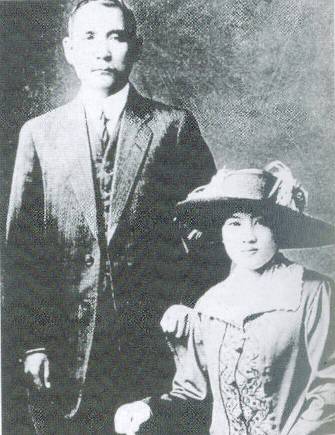 (Song Qingling (i.e., Soong Ching Ling or Mme Sun Yat-sen) was the daughter of Soong Yaoru who, a Hainan Island native, had worked as a coolie in the U.S. and then a priest in Shanghai where he assisted Sun in printing the revolutionary materials. Song Qingling, against the objection of her father in Shanghai, would later go back to Japan to marry Sun Yat-sen on October 25th, 1915. Japanese Toyama Mitsuru was surprised that Sun married a younger sister, not the elder sister. This marriage was opposed by majority of the KMT comrades. Ma Beiming pointed out that only the Japanese attended the matrimony. Sun Yat-sen's original wife Lu Muzhen agreed to a divorce after the matter of fact or never went through an official divorce. Ma Beiming also pointed out that Sun Yat-sen had adopted his pen name 'zhongshan' after a Japanese noble family name, not the ancient Chinese prefecture with the same name. Historian Tang Degang cited Mao Tse-tung's claim of "learning from Sun Yat-sen" when Xiang Ying objected to the marriage between Jiang Qing and Mao Tse-tung.)
More available at Second_Revolution.pdf
(Check
RepublicanChina-pdf.htm
page for up-to-date updates.)
* In Commemoration of China's Fall under the Alien Conquests in A.D. 1279,
A.D. 1644 & A.D. 1949 *
U.S.S.R./Comintern Alliance with the KMT & CCP (1923-1927)
Korean/Chinese Communists & the 1931 Japanese Invasion of Manchuria
American Involvement in China: Soviet Operation Snow, IPR Conspiracy, Dixie Mission, Stilwell
Incident, O.S.S. Scheme, Coalition Government Crap, Amerasia Case & The China White Paper
* Stay tuned for "Republican China 1911-1955: A Complete Untold History" *
|
|
Zou Rong's Revolutionary Army;
Shin Kyu Sik's
Shrine (Spirit, Kunitama) of Korea
|
This snippet is for sons and daughters of China:
Heed the sons & ministers' agony and sorrow of our ancestors who died or lived through the Mongol, Manchu and Soviet-Chicom conquest
and
the Yongjia, Jingkang and Jiashen cataclysms !
Jeanne d'Arc of China:
Teenager girl Xun Guan breaking out of the Wancheng city to borrow the relief troops in the late Western Jinn dynasty;
Liu-Shao-shi riding into the barbarian army to rescue her husband in the late Western Jinn dynasty;
teenager girl Shen Yunying breaking into Zhang Xianzhong's rebels on the horseback to avenge on father's death in the late Ming dynasty.
China's Solitary and Lone Heroes:
Nan Jiyun breaking out of the Suiyang siege and charging back into the city in the Tang dynasty;
Zhang Gui & Zhang Shun Brothers breaking through the Mongol siege of Xiangyang in the Southern Soong dynasty;
Liu Tiejun breaking through three communist field armies' siege of Kaifeng in the Republican China time period;
Zhang Jian's lone confrontation against the communist army during the June 3rd & 4th Massacre of 1989.
|
|
|
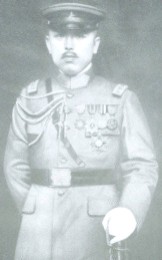 In August 1913, when Xiong Kewu rebelled against Yuan Shikai in Sichuan Province, Cai E ordered that Tang Jiyao dispatch Ye Quan's army to the aid of Sichuan Governor-general Hu Jingyi.
Though Governor-general Cai Er of Yunnan Province opposed the Second Revolution, Yuan Shi-kai issued an order on September 28th, 1913 to have Tang Jiyao assume the governor-general of Yunnan Province while Cai E came to Peking for three month medical treatment.
Cai E, together with Liang Qichao and the "Progressive Party", had appeared to be supporters of Yuan Shikai; however, Yuan Shikai intended to relocate Cai E away from the provincial post the same way as he did to vice president Li Yuanhong. (Cai E remained in Peking for three years, and had to resort to pleasure with "distinguished prostitute" Xiao-feng-xian for distracting attention from Yuan's control, an event that had caused him to delay treatment when he wrongly believed that his deadly throat disease was possibly related to the sexually-transmitted disease.
Alternative saying is that Liang Qichao and Cai E had agreed to have Cai E leave Yunnan Province on the precondition that Cai E go back to his native Hunan Province to replace Tan Yankai, which Yuan had renegaded on once Cai E arrived in Peking.
(Tang Jiyao was converted to the official governor-general of Guizhou Province on May 6th of 1912 after Cai E pacified the opposing factions in the province prior to leaving for Peking.) After Tang Jiyao vacated Guizhou Province on November 1st, Xie Ruyi tacked on Tang Jiyao's post while Liu Xianshi was conferred the post of "hu June shi". (Liu Xianshi, in early 1912, had borrowed Tang Jiyao's Yunnan Province army in killing dozens of feuds from the "autonomy" faction and the provincial consultancy bureau of Guizhou Province.)
In August 1913, when Xiong Kewu rebelled against Yuan Shikai in Sichuan Province, Cai E ordered that Tang Jiyao dispatch Ye Quan's army to the aid of Sichuan Governor-general Hu Jingyi.
Though Governor-general Cai Er of Yunnan Province opposed the Second Revolution, Yuan Shi-kai issued an order on September 28th, 1913 to have Tang Jiyao assume the governor-general of Yunnan Province while Cai E came to Peking for three month medical treatment.
Cai E, together with Liang Qichao and the "Progressive Party", had appeared to be supporters of Yuan Shikai; however, Yuan Shikai intended to relocate Cai E away from the provincial post the same way as he did to vice president Li Yuanhong. (Cai E remained in Peking for three years, and had to resort to pleasure with "distinguished prostitute" Xiao-feng-xian for distracting attention from Yuan's control, an event that had caused him to delay treatment when he wrongly believed that his deadly throat disease was possibly related to the sexually-transmitted disease.
Alternative saying is that Liang Qichao and Cai E had agreed to have Cai E leave Yunnan Province on the precondition that Cai E go back to his native Hunan Province to replace Tan Yankai, which Yuan had renegaded on once Cai E arrived in Peking.
(Tang Jiyao was converted to the official governor-general of Guizhou Province on May 6th of 1912 after Cai E pacified the opposing factions in the province prior to leaving for Peking.) After Tang Jiyao vacated Guizhou Province on November 1st, Xie Ruyi tacked on Tang Jiyao's post while Liu Xianshi was conferred the post of "hu June shi". (Liu Xianshi, in early 1912, had borrowed Tang Jiyao's Yunnan Province army in killing dozens of feuds from the "autonomy" faction and the provincial consultancy bureau of Guizhou Province.)
Yuan Shi-kai Trampling On the Republic
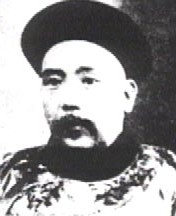 The Second Revolution helped Yuan Shikai in taking control of three provinces of Anhui, Jiangxi and Guangdong. Moreover, Yuan Shikai managed to eliminate the independence of Hunan Province [Tan Yankai], Zhejiang Province [Zhu Rui], Yunnan Province [Cai E], and Guangxi Province [Cen Chunxuan]. Li Yuanhong would later be coerced into Peking as well.
Before Li Yuanhong was coerced into Peking, he had taken drastic measures in cracking down on the KMT.
For example, Li Yuanhong requested with Yuan Shikai in having Jiang Yiwu executed:
At the time Tan Yankai declared independence for Hunan Province during the Second Revolution, Jiang Yiwu was conferred the post of "zhaohu-shi [pacifier emissary] for the Hubei-Henan provinces"; after Tan revoked independence, Jiang Yiwu was accused of rebellion and escape; Jiang Yiwu was caught in Quanzhou by Chen Bingkun the "zhenshou-shi [garrison] emissary" for Guilin of Guangxi Province; and Jiang Yiwu was executed at age 28 on a red carpet.
Tang Degang guessed that over 10,000 people could have died during and after the Second Revolution.
The Second Revolution helped Yuan Shikai in taking control of three provinces of Anhui, Jiangxi and Guangdong. Moreover, Yuan Shikai managed to eliminate the independence of Hunan Province [Tan Yankai], Zhejiang Province [Zhu Rui], Yunnan Province [Cai E], and Guangxi Province [Cen Chunxuan]. Li Yuanhong would later be coerced into Peking as well.
Before Li Yuanhong was coerced into Peking, he had taken drastic measures in cracking down on the KMT.
For example, Li Yuanhong requested with Yuan Shikai in having Jiang Yiwu executed:
At the time Tan Yankai declared independence for Hunan Province during the Second Revolution, Jiang Yiwu was conferred the post of "zhaohu-shi [pacifier emissary] for the Hubei-Henan provinces"; after Tan revoked independence, Jiang Yiwu was accused of rebellion and escape; Jiang Yiwu was caught in Quanzhou by Chen Bingkun the "zhenshou-shi [garrison] emissary" for Guilin of Guangxi Province; and Jiang Yiwu was executed at age 28 on a red carpet.
Tang Degang guessed that over 10,000 people could have died during and after the Second Revolution.
Yuan Shi-kai did not outlaw the KMT or dismiss the Parliament till after his presidency confirmation.
On October 10th of 1913, Yuan Shi-kai, having hijacked the Parliament in passing the 'election law' ahead of the Constitution and locked up the Parliament members to coerce an election, was officially elected president of the R.O.C. after barely passing the majority ballots needed after three rounds of ballot casting. On October 16th of 1913, Yuan Shi-kai proposed an amendment of the 'Interim Agreed-upon Laws' of 1912 in the attempt of aborting the birth of the official Constitution and expanding his presidential power over the Parliament. On October 22nd, he tried to have eight cronies sit in at the Parliament. On October 25th, he wired his provincial officials to have them voice opposition to drafting the official Constitution. Yuan Shi-kai's cronies, including Ni Sichong, Zhang Xun and Jiang Guiti et al., shouted about eradicating the rebels, proposed the dismissal of the Parliament, and called the Parliament members as people's enemies. On November 4th of 1913, Yuan Shi-kai, against the objection of Liang Qi-chao (the Progressive Party leader), outlawed the KMT and deprived 438 KMT members of their Parliament representative title.
In the winter of 1913, Li Zongren, after graduation from the "infantry rapid progress school", was assigned a job as an assistant lecturer at Guangxi Province's Officers Lecture & Practice School in Nanning. Governor-general Lu Rongting set up the school to help rein in and elevate his generals who were mostly of banditry background from the Manchu era. Similar to Lu Rongting, northern Chinese governors-general, like Zhang Zuolin, Zhang Zongchang, and Zhang Zuoxiang, et al., were also of banditry background from the Manchu era.
After school master Lin Bingyi squandered away funds on the Shanghai Bund, Officers Lecture & Practice School was shut down. Li Zongren returned to the countryside in autumn of 1914.
In further order on November 14th, 1913, Yuan Shi-kai demanded that the former KMT Parliament reps must provide five persons as a guarantee before departing the capital. Tang Hualong, speaker for the Lower House and a leader of the Progressive Party, expressed objections to Yuan Shi-kai's order. The Upper House, on December 3rd, rebuked Yuan Shi-kai for causing the collapse of the Parliament. Yuan Shi-kai secretly maneuvered the provinces to prevent the backup reps from filling the vacancy of the national Parliament.
In Yunnan Province, rebellion erupted against Tang Jiyao on December 8th when Yang Chunkui, chief of the secret society "ge [brother] lao [elder] hui [society]" launched a Second Revolution in the pretentious name of Sun Yat-sen and Li Genyuan.
Yang Chunkui took over the Dali city. Tang Jiyao quelled the rebellion by December 23rd. Later in April of 1914, Tang Jiyao quelled another rebellion in Lin'an-fu [Jianshui] county of Yunnan Province.
In western Henan Province & northern Hubei Province, a rebellion erupted in the autumn under the banner of "Bai [white] Lang [wolf]" which was said to be either a mutation of some peasant called Bai Lang or possibly the Chinese way of calling an 8th son of the family via "ba lang".
Tang Degang cited Tao Jueying's account in stating that possibly Bai Lang was formerly a tactician serving under martyr Wu Luzhen.
Du Chunhe's account, however, stated that Bai Lang was a semi-literate or illiterate peasant.
Alternative accounts stated that the KMT sent over emissaries to Bai Lang from southern China to assist with the rebellion.
At the time of the Second Revolution, Huang Xing did dispatch officials and officers to Bai Lang's team for a concerted fight against Yuan Shikai, and further conferred him the post of governor-general for Henan Province.
With 10,000 men at the peak, Bai Lang sacked over 50 cities across five provinces, reaching as far as Gansu Province in the northwest.
His troops then decided to go back to the hometown. Unable to control his soldiers, Bai Lang agreed to a return. The Soldiers gradually dissipated once they entered hometowns in Henan Province.
On August 5th, 1914, Bai Lang was ambushed by Yuan Shikai's army and got killed.
Tang Degang pointed out that Bai Lang's death was similar to that of Ren Gui of the Nian Rebellion during the Manchu Era.
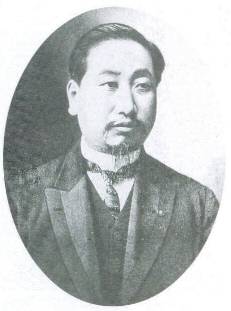 On November 5th of 1913, Xiong Xiling called upon various provinces in sending over representatives for an "administration meeting".
On the 26th, Yuan Shikai designated eight persons for preparing a politics meeting, which would include Li Jingyi, Liang Dunyan, Fan Zengxiang, Cai E, Bao Xi, Ma Liang, Yang Du & Zhao Weixi.
Tang Degang pointed out that Yuan Shikai played a trick in having his "kitchen cabinet" [i.e., a cabinet organized by Xiong Xiling, leader of the "Progressive Party", in the aftermath of outlawing the KMT] rename a scheduled "administration meeting" to the "politics assembly".
On December 15th of 1913, Yuan Shi-kai convened the 69-member 'politics assembly of senators' in the Chengguang-dian Palace.
On January 10th of 1914, Yuan Shi-kai dismissed the Parliament by invoking the 2nd enactment of the 'politics assembly of senators'.
On January 26th, a draft for "organization of the meeting for the 'agreed-upon laws'" was published.
On November 5th of 1913, Xiong Xiling called upon various provinces in sending over representatives for an "administration meeting".
On the 26th, Yuan Shikai designated eight persons for preparing a politics meeting, which would include Li Jingyi, Liang Dunyan, Fan Zengxiang, Cai E, Bao Xi, Ma Liang, Yang Du & Zhao Weixi.
Tang Degang pointed out that Yuan Shikai played a trick in having his "kitchen cabinet" [i.e., a cabinet organized by Xiong Xiling, leader of the "Progressive Party", in the aftermath of outlawing the KMT] rename a scheduled "administration meeting" to the "politics assembly".
On December 15th of 1913, Yuan Shi-kai convened the 69-member 'politics assembly of senators' in the Chengguang-dian Palace.
On January 10th of 1914, Yuan Shi-kai dismissed the Parliament by invoking the 2nd enactment of the 'politics assembly of senators'.
On January 26th, a draft for "organization of the meeting for the 'agreed-upon laws'" was published.
After that, Yuan Shi-kai began to modify the 'Interim Agreed-upon Laws' and adopted the presidential structure in place of Parliamentarism. Yuan Shi-kai had the 'Security and Policing Laws' passed for controlling the dissidents and populace.
On March 18th, 57 member "meeting for the 'agreed-upon laws'", headed by Sun Yujun & Shi Yu, was launched, which ended in the promulgation of Yuan Shikai's "New Agreed-Upon Laws" on May 1st.
On March 20th, Yuan Shi-kai proposed to build the R.O.C. in two stages: i) the stage of modification on the 'Interim Agreed-upon Laws', and ii) the stage of amending the Constitution.
On April 29th of 1914, Yuan Shi-kai passed the 'New Interim Agreed-upon Laws', with stipulations like two administrative posts of presidency and secretary of state (replacing the State Council), one-house legislature, and a presidential consultancy agency called the 'house of participating politicians'. The 'house of participating politicians' was empowered with amending the Constitution.
The 'New Interim Agreed-upon Laws' went into effect on May 1st.
Aside from the election laws which allowed Yuan to act as president for 10 years, to continue the following term in renewal, and to designate a secret name list of three succeeding candidates, the new constitution did devise some basic laws like forestry, citizenship, publication right &, etc.
Before the legislative branch was established, the 70-member 'Senate' was to act on its behalf. (Tang Degang made an analogy of Yuan's senate to Chiang Kai-shek's "national politics participation meeting" and Mao Tse-tung's "people's consultative conference".)
With proposals from Xiong Xiling's cabinet,
Yuan Shi-kai initiated a reform in 1914 by separating the governor's job from that of governor-general. The Governor-general, i.e., "du du", was renamed to "jiang jun" [i.e., general], while a separate post entitled "xun [patrol] an [pacifying] shi [emissary]" was to take charge of the civil matter in each province.
As to Yunnan Province, Yuan Shi-kai dispatched Ren Kecheng as "xun [patrol] an [pacifying] shi [emissary]", and cut year 1915's military funding to 240000 yuan from 360000 yuan in the prior year.
To curtail Yunnan Province, Yuan Shikai dispatched Cao Kun's 3rd Division & Zhang Jingyao's 7th Division to the border of Sichuan-Yunnan provinces, and sent Chen Huan [and two brigades] to Sichuan in replace of Hu Jingyi's governor-general post.
Yunnan Province was surrounded by Wang Zhanyuan of Hubei Province, Tang Xiangming of Hunan Province and Long Jiguang of Guangdong Province. Guangxi Province's Lu Rongting was the only ally of Tang Jiyao.
A second reform by Xiong Xiling's cabinet would be dividing the provincial administration into three levels of province, circuit and county.
In Shanghai, in the old days, Dr Sun Yat-sen often utilized the service of a Jewish [Silas Auron Hardon] in holding the meetings at the Hardon properties.
On the Shanghai Bund, in 1914, numerous revolutionaries converged in brothel-like entertainment centers for the "revolutionary" meetings.
Dong Zhujun's book "My One Century" (Sanlian Bookstore, Peking, China, September 1997 edition) stated that Yuan Shi-kai dispatched Zheng Rucheng, Yang Xiaochuan, Hong Shuzu and Zhu Zhanyuan to Shanghai for arresting and extraditing the revolutionary activists from the extraterritorial territories. Dong Zhujun claimed that Sichuan Province's Governor-general Chen Huan dispatched the agents to Shanghai for dealing with the revolutionaries of Sichuan Province origin.
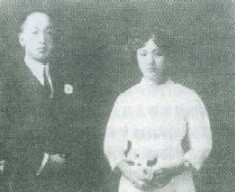 Xia Zhishi, former deputy governor-general of Sichuan Province during the 1911 Xin Hai Revolution, encountered 15-year-old Dong Zhujun at Chang-San-Tang-Zi [i.e., the No. 1 brothel, similar to Tokyo's Ginza area facilities], and before fleeing to Japan, conspired to have the little girl escape from the brothel on the eve of being pressured into prostitution.
On the ship to Japan, Dong Zhujun noticed that Soong Ching-ling [i.e., later Mme Sun Yat-sen] was on board, too.
In Japan, Dong Zhujun was called "wang[2] guo[2] nu[2]" by the Japanese, a word to mean someone who lost his or her country.
Xia Zhishi did not return to Sichuan Province till after Cai E, Li Liejun and Tang Jiyao waged the Republic Restoration War in December 1915.
Xia Zhishi, former deputy governor-general of Sichuan Province during the 1911 Xin Hai Revolution, encountered 15-year-old Dong Zhujun at Chang-San-Tang-Zi [i.e., the No. 1 brothel, similar to Tokyo's Ginza area facilities], and before fleeing to Japan, conspired to have the little girl escape from the brothel on the eve of being pressured into prostitution.
On the ship to Japan, Dong Zhujun noticed that Soong Ching-ling [i.e., later Mme Sun Yat-sen] was on board, too.
In Japan, Dong Zhujun was called "wang[2] guo[2] nu[2]" by the Japanese, a word to mean someone who lost his or her country.
Xia Zhishi did not return to Sichuan Province till after Cai E, Li Liejun and Tang Jiyao waged the Republic Restoration War in December 1915.
After the failure of the Second Revolution, Chiang Kai-shek left for Japan.
It was through Chen Qimei that Chiang Kai-shek first met Sun Yat-sen in early 1914. [Chiang Kai-shek's self accounts stated he was accorded an intimate meeting by Sun Yat-sen in Shanghai in 1913.
Li Ao pointed out that the KMT records deliberately lied in stating that Chiang Kai-shek first met Sun Yat-sen in June 1910.]
In July of 1914, Sun Yat-sen re-organized his party into the Chinese Revolutionary Party. Chen Qimei was the first to press his fingerprints on the personal allegiance form while some other revolutionaries were turned away by Sun Yat-sen's stringent demand.
Chiang Kai-shek was No. 102 on the roll among 741 members who had registered from December 1913 to July 1914.
Chiang was dispatched back to Shanghai for organizing the rebellions. After the Shanghai rebellion aborted, Chiang Kai-shek was sent to Manchuria for checking out the revolutionary movement, which turned out to be a scam by someone for obtaining the revolutionary funding.
The First World War & China - Japan's Twenty-one Demands
Tang Degang pointed out that Russia and Japan signed three secret treaties, with such clauses as dividing Manchuria & Mongolia should China's revolution lead to the national instability.
Russia and Japan, after the 1904-5 war, colluded between themselves to strike several secret agreements regarding the Northeastern territory of China. Three times, in 1907, and consecutively in 1910 and in 1912, the two countries signed secret treaties and reached some kind of compromise and coordination as to their separate spheres of influence in Manchuria and Mongolia.
Fortunately, the 1911 Xin Hai Revolution ended in a matter of less than 3 months, while the KMT Second Revolution was even shorter in duration.
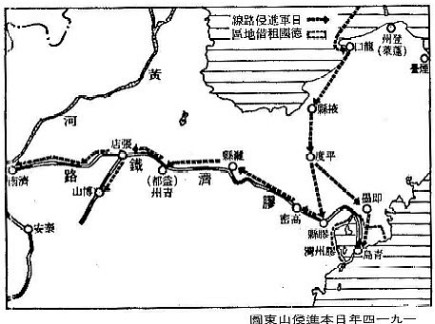 WWI broke out on July 28th, 1914.
During WWI, on January 18, 1915, the Japanese government, under prime minister Okuma Shigenobu and foreign minister Kato Takaaki and minister Hioki Eki, attempted to impose the Twenty-One Demands [under five groupings] onto the Republic of China.
On August 15th, 1914, Japan issued an ultimatum to Germany as to ceding the Jiaozhou-wan Bay to be under the Japanese management and the Chinese sovereignty no later than September 15th, 1914. The Jiaozhou-wan Bay was first leased to Germany for 99 years on March 6th, 1898 in the aftermath of death of two German missionary clergymen.
Before the one-month ultimatum was to expire, Japan, on August 23rd, 1914, attacked the German interests in China.
Twenty thousand Japanese soldiers landed in Longkou, and then attacked Qingdao.
Yuan Shikai, to maintain neutrality, had to carve out an area for the two parties to fight.
Though China designated the area to the east of the Weixian county train station, the Japanese, having declined the German request for handover of the leased territory to China, would go west to occupy the Jiao-Ji [Qingdao-Jinan] Railway on the pretext that the railway was a Sino-German venture.
On October 6th, the Japanese took over the Ji'nan train station, arrested the German staff, and expelled the Chinese staff.
Paul Reinsch, i.e., the American legation envoy who arrived in China in the wake of President Yuan Shi-kai's expulsion of the KMT members from the Parliament in 1913, "warned Washington of Japan's menacing ambitions when the Japanese army seized the German areas of influence in China, in Shandong Province" per Mike Billington.
(Paul Samuel Reinsch, supportive of Yuan's government in Peking and intent on implementing Dr. Sun Yat-sen's plan laid out in "The International Development of China", had tried to circumvent the pro-British and pro-Japan Morgan consortium by soliciting help from
Frank Vanderlip [head of National City Bank] of the American International Corporation (AIC) in 1915 and
John Abbott of the Continental and Commercial Trust and Savings Bank in Chicago.)
WWI broke out on July 28th, 1914.
During WWI, on January 18, 1915, the Japanese government, under prime minister Okuma Shigenobu and foreign minister Kato Takaaki and minister Hioki Eki, attempted to impose the Twenty-One Demands [under five groupings] onto the Republic of China.
On August 15th, 1914, Japan issued an ultimatum to Germany as to ceding the Jiaozhou-wan Bay to be under the Japanese management and the Chinese sovereignty no later than September 15th, 1914. The Jiaozhou-wan Bay was first leased to Germany for 99 years on March 6th, 1898 in the aftermath of death of two German missionary clergymen.
Before the one-month ultimatum was to expire, Japan, on August 23rd, 1914, attacked the German interests in China.
Twenty thousand Japanese soldiers landed in Longkou, and then attacked Qingdao.
Yuan Shikai, to maintain neutrality, had to carve out an area for the two parties to fight.
Though China designated the area to the east of the Weixian county train station, the Japanese, having declined the German request for handover of the leased territory to China, would go west to occupy the Jiao-Ji [Qingdao-Jinan] Railway on the pretext that the railway was a Sino-German venture.
On October 6th, the Japanese took over the Ji'nan train station, arrested the German staff, and expelled the Chinese staff.
Paul Reinsch, i.e., the American legation envoy who arrived in China in the wake of President Yuan Shi-kai's expulsion of the KMT members from the Parliament in 1913, "warned Washington of Japan's menacing ambitions when the Japanese army seized the German areas of influence in China, in Shandong Province" per Mike Billington.
(Paul Samuel Reinsch, supportive of Yuan's government in Peking and intent on implementing Dr. Sun Yat-sen's plan laid out in "The International Development of China", had tried to circumvent the pro-British and pro-Japan Morgan consortium by soliciting help from
Frank Vanderlip [head of National City Bank] of the American International Corporation (AIC) in 1915 and
John Abbott of the Continental and Commercial Trust and Savings Bank in Chicago.)
On January 8th, 1915, Japan first raised the 21 demands, which were to force China into an equivalent semi-vassal status by taking advantage of the European countries' entanglement in WWI.
The Japanese, to hoodwink the world opinion, made two copies of the draft, skipping the terms of the Group VI in the briefings with the Western reporters. Yuan Shi-kai divulged part of the Japanese scheme to presidential adviser George Morrison who contacted Henry Donald to get a dispatch sent to The Times which refused to publish the version other than the Japanese version. Wellington Koo secretly passed on the Japanese demands to the American legation. With words from the Americans, the Chinese side did not yield on the Japanese demand that China accept the Japanese as political, economic and military advisors. The Japanese government, following revision of the demands on 26 April 1915 under the pressure of the Americans, sent a final demand on 7 May 1915 to the Chinese as an ultimatum. The following day the Chinese government, aware of its inability to wage war against Japan, reluctantly agreed to Japan's demands. The end result was Yuan Shikai’s consent to the twenty-one demands, which came to be known as the May 9 National Humiliation, one of the many national humiliation days in Chinese history. The subsequent Sino-Japanese talks resulted in treaties and memorandums concluded with Japan on May 25, 1915.
With limited support from the Americans, China stood up against Japan in declining the conditions in regards to the hiring of Japanese advisers for the Chinese military and government agencies.
Though, President Wilson's China policy was what
this webmaster referred to as the 100-year American hypocrisy.
It was pivoted from the hypocritical nature of America's Open Door Policy for China, which was originally an idea sold to the Americans by the British career customs officer working in Manchu China's customs office.
The reason that China should remain open to all powers, in the opinion of the U.S. president Thomas Woodrow Wilson, was that the 'white civilization' and its domination in the world rested largely on the ability to keep China intact, in the sense that should China fall completely under the Japanese [or the Tsarist Russian or someone else's] influence, then the massive Chinese manpower could be utilized like by Genghis Khan to conquer the world. This was the theme of the Yellow Peril, which was inverse to what the British ambassador claimed to Albert Wedemeyer during WWII that a strong and unified China would pose a threat to the Whiteman's position in the Far East and immediately throughout the world.
So to say that the nation of China should be managed delicately, that is, should not be allowed to grow too powerful to pose a threat to the white civilization, nor should it be allowed to be hijacked by a non-U.S. power since China's immense human labor could be turned against the white civilization.
(During WWII, the Japanese, who was brought up by the Americans and the British, never realized that they could at most conquer half of China, not as a whole.)
More available at Japan_Twenty-one_Demands.pdf
(Check
RepublicanChina-pdf.htm
page for up-to-date updates.)
* In Commemoration of China's Fall under the Alien Conquests in A.D. 1279,
A.D. 1644 & A.D. 1949 *
U.S.S.R./Comintern Alliance with the KMT & CCP (1923-1927)
Korean/Chinese Communists & the 1931 Japanese Invasion of Manchuria
American Involvement in China: Soviet Operation Snow, IPR Conspiracy, Dixie Mission, Stilwell
Incident, O.S.S. Scheme, Coalition Government Crap, Amerasia Case & The China White Paper
* Stay tuned for "Republican China 1911-1955: A Complete Untold History" *
|
|
Zou Rong's Revolutionary Army;
Shin Kyu Sik's
Shrine (Spirit, Kunitama) of Korea
|
This snippet is for sons and daughters of China:
Heed the sons & ministers' agony and sorrow of our ancestors who died or lived through the Mongol, Manchu and Soviet-Chicom conquest
and
the Yongjia, Jingkang and Jiashen cataclysms !
Jeanne d'Arc of China:
Teenager girl Xun Guan breaking out of the Wancheng city to borrow the relief troops in the late Western Jinn dynasty;
Liu-Shao-shi riding into the barbarian army to rescue her husband in the late Western Jinn dynasty;
teenager girl Shen Yunying breaking into Zhang Xianzhong's rebels on the horseback to avenge on father's death in the late Ming dynasty.
China's Solitary and Lone Heroes:
Nan Jiyun breaking out of the Suiyang siege and charging back into the city in the Tang dynasty;
Zhang Gui & Zhang Shun Brothers breaking through the Mongol siege of Xiangyang in the Southern Soong dynasty;
Liu Tiejun breaking through three communist field armies' siege of Kaifeng in the Republican China time period;
Zhang Jian's lone confrontation against the communist army during the June 3rd & 4th Massacre of 1989.
|
|
|
Yuan Shi-kai's Imperial Enthronement
After the humiliating "21 demands" agreement, Yuan Shikai, on May 8th, 1915, had mentioned to his top ministers that "China should 'bury head to work diligently for 10 years and then raise head to face Japan' as British minister-envoy Sir John Jordan had suggested; otherwise, China could be in even worse scenario ten years from now."
However, Yuan Shikai would soon forget about the national humiliation as he was eager to be an emperor.
To further his dream of being an emperor, Yuan Shikai gradually adopted some changes to imitate imperial China. Yuan Shikai dismantled the premiership and the cabinet, designate a post of "secretary of state" [Xu Shichang] in the same fashion as Ming Dynasty's "da xue shi" or Qing Dynasty's "junji dachen", and made ministerial chiefs report to president.
Yuan Shikai restored two imperial-era organizations, i.e., "ping zheng yuan" [Manchu "du chai yuan"] and "shu zheng ting" [i.e., "yuan shi tai"], which were for the criminal prosecution and officialdom censorship.
A bribery law was made to execute any official who took in 500 yuan equivalent of the currency, which ultimately led to the death of Peking Capital Police Chief Wang Zhiqing.
After initiating the reform to separate the provincial administration from governors-general, Yuan Shikai established two military agencies, i.e., the "Generals' Office" [headed by Duan Qirui] and the "grand marshals' office".
Back in May 1914, Yuan Shi-kai first exhibited his intent to usurp the republic per "Biography of Tang Jiyao".
Tang Degang stated that Yuan had three fears, i.e., the opposition from his crony generals, the opposition from Japan, and the opposition from Western powers on the matter of economic 'blockade' like the loans.
Yuan Shikai's wariness about losing control over the cronies could be seen in the hiring of Cai E, i.e., a non-northern lineage general of Japan cadet background per TDG [whereas quite some historians treated Cai E's relocation as a way to "get the tiger away from his den"].
Yuan Keding, i.e., an elder son who crippled himself while riding a horse, would propose to his father that the Yuan family could live beyond 60 should Yuan Shikai declare himself an emperor.
Furthermore, Yuan Keding printed fake editions of the Japanese "Shuntian Shibao Daily" newspaper to make Yuan Shikai believe that his arch enemy since the Korean War, i.e., Japan, had support for Yuan's imperial enthronement.
After enthronement in December 1915, Yuan Keding's sister and brother found out about the trick and reported to their father.
Yang Du, in mid-April 1915, authored an article entitled "Theories of the Constitutional Monarchy for Salvation of the Nation".
On June 22nd, Feng Guozhang came to Peking for seeing Yuan Shikai. Yuan Shikai assured Feng that he had no ambition for imperial enthronement since his elder son Yuan Keding was handicapped, his second son Yuan Kewen was a 'fake' scholar, and his 3rd son Yuan Keliang a 'bandit'.
After Feng left the residency, Yuan Shikai angrily said, "How could Feng Guozhang do this to me?"
Privately, Yuan also assured Xu Shichang that he would retire in London should his cronies pressure him into imperial enthronement.
The American legation, in addition to collecting Goodnow's thesis, also reported to Washington D.C. that Yuan Shikai was unlikely to become an emperor.
Earlier, Yuan Shikai had hired two foreigners as politics and legal science advisers, i.e., American Gu-de-nuo [Frank J. Goodnow, 1859-1939] and Japanese Ariga Nagao, for supporting the enactment of an imperial system in China.
Ariga Nagao, to flatter Yuan, called himself by the ancient title of "wai [alien country] chen [minister]".
Frank J. Goodnow, dean of the law school at Columbia U, for his studies in the French-style "republican constitution", was invited to China under the Carnegie Endowment For Intl Peace; however, Tang Degang believed that Gu Weijun [1887-1985] & Wang Chonghui [1881-1958] could be behind it.
Invitation for the 3-year contract was before Soong Jiaoren's assassination death.
Goodnow arrived in Peking on May 3rd, 1913, but left for a schoolmaster's post of John Hopkins U in August 1914.
During this timeframe, Goodnow devised his constitution for China against the "Temple of Heaven Constitution" and support Yuan Shikai's stance against the KMT 2nd Revolution.
On November 29th, 1914, in NY, Goodnow took credit for China’s constitution reform at a politics society meeting.
In July 1915, Goodnow paid China a visit, and authored an article on the "republic vs monarchy" which was widely quoted by Yuan Shikai's cronies as something to prove that the "hereditary autocracy" was better than the non-hereditary republic".
Goodnow cited the example of Oliver Cromwell [1599-1658], two French imperial restoration & Mexican dictator Porfirio Diaz [reign 1876-1910] to prove his points.
After so-called "Latter Six Gentlemen" organized a preparatory committee for Yuan Shikai's enthronement on August 14th, Goodnow made a public announcement on the 17th, claiming that his writing was merely of academic research nature.
More, Goodnow published his original text on the "Peking Gazette" newspaper.
Yang Du advertised his "preparatory society" on August 23rd, 1915.
The "Latter Six Gentlemen" included Yang Du, Sun Yujun, Yan Fu, Liu Shipei, Li Xiehe and Hu Ying. Quite some of the organizers were previously members of the "Tong Meng Hui" alliance.
The "Theories of Constitutional Monarchy for Salvation of Nation" was published on August 26th.
Yuan Shikai, who was constantly nervous about enthronement, was pleased to know that Yan Fu [i.e., the 1st schoolmaster of Peking U] had joined the "preparatory society".
Yang Du's "preparatory society" launched a nationwide enrolment movement by mailing out the application forms, gallop forms and Goodnow's article to leaders of all provinces as well as in the capital.
In the capital, other than top leaders [like Li Yuanhong, Duan Qirui, Xu Shichang & Zhang Jian], majority folks expressed support.
Provincial leaders, other than Feng Guozhang & Zhang Xu, the rest of governors-general had expressed support as well, including the non-northern lineage people like Tang Jiyao & Yan Xishan.
By September 2nd, 19 generals made a joint petition.
Yang Du's "preparatory society" then changed its civilian status by proposing the establishment of a "citizen petition corps".
Some senators, who advocated a "national petition united society" for taking control of the petition movement, then proposed to organize a "national assembly" on the pretext that the "citizen petition corps" had submitted tons of petitions.
Tang Degang stated that the "6 gentlemen" had expanded into "13 gestapos" with the addition of opportunist senators.
On September 6th, Yuan Shikai, having known that the Senate had agreed to make him an emperor, ordered that Yang Shiqi read aloud his declination which had a reservation as to acceptance should the whole nation wish to see so.
Liang Shiyi compromised the Senate proposition by transforming Yang Du's "preparatory society" into the government-funded "constitutional monarch advancement society" in mid-Oct.
The "national assembly" then turned into a "national representative assembly" whereby provinces sent in their reps for a vote on changing the
government structure as well as the republican system.
1993 representatives voted for a change in early December of 1915.
On December 11th, Whang Daxie, shouting three "long live 10,000 years", submitted the letter of petition to have Yuan Shikai become an emperor.
(Tang Degang pointed out that Yang Du's imperial proposition to Yuan Shikai had its social background, i.e., the Chinese popular resentment over the social instability in early Republic Era. Tang cited Li Zongren's claim that the Chinese mentality in the Republic era was much worse than that in the late Manchu era, at which time all Chinese were in high spirits for the sole purpose of making China strong and prosperous.
Tang also cited Jiang Fucong of Taiwan's Central Library in pointing out that Taiwan in the late 20th century was even worse than the KMT era of the early 20th century: Jiang Fucong stated that he could not understand the widely-reported incest matter in the Taiwan media since in the late Manchu era, a county magistrate was ordered to be deprived of his duty when some man under the jurisdiction hit a birth-mother.
Using this line of thought, we could say that Communist China was even worse than the KMT of Taiwan: e.g., HK truck drivers had been able to set up the "second wives' villages" at the HK-Shenzhen border, and 82-year-old scientist Yang Zhenning had just married with a 28-year-old young woman.)
On December 12th [Dec 13th per TDG], 1915, Yuan Shi-kai proclaimed himself Emperor Hongxian.
On the 15t, Yuan conferred the title of King Wuyi-qin-wang onto Li Yuanhong who managed to put it off.
On the 21st, over 40 cronies received the ranks of duke, marquis, count, viscount and baron.
Yuan Shi-kai's imperial enthronement was even opposed by such Manchu monarchists as Kang You-wei.
Kang You-wei, in his wire, mentioned the early days when Yuan Shi-kai called Kang You-wei by 'elder brother' and supported Kang You-wei's "Self-Strengthening Society" (i.e., 'qiang xue hui').
Similarly, Liang Qichao published an article on September 3rd, 1915, on the "Jing [Peking] Bao [newspaper]", entitled "What a weird thing to talk about the National System?"
Liang Qichao, claiming to be an old-fashioned "constitutional monarchists" from the Manchu-era but having switched role with the old-time "revolutionaries", ridiculed Yang Du by questioning the wisdom of imperial enthronement with the following statement: "Why should we change the 'National System' when the Presidential Election Laws, which explicitly stipulated that the President could choose to transfer power to anybody, including either son[s] or the 'able men', appeared to be far advanced than the hereditary monarchy?"
Liang Qichao, having pointed out that he had predicted the ensuing chaos of revolution in the late Manchu era, would now predict that China would face more serious chaos 10 years from then with the advent of Yuan Shikai's imperial enthronement.
Incidentally, Liang Qichao, who wrote the article in so-called "baozi [newspaper] wen [language]", i.e., the intermediary between the classic Chinese language and the vernacular Chinese language, would portend the coming age of the New Culture per TDG.
(Tang, having naively called Mao Tse-tung's vernacular writing excellent, further likened Liang Qichao's article to Abraham Lincoln's claim that Harriet Stowe's "Uncle Tom's Cabin" had started America's civil war.)
Both KMT factions looked to Yunnan Province as a base for uprising should Yuan Shikai proclaim himself an emperor.
Sun Yat-sen's Chinese Revolutionary Party was engaged in fighting against Yuan Shikai in the Shanghai-Zhejiang area.
Huang Xing's faction, i.e., Li Liejun et al., had made an alliance with Tang Jiyao of Yunnan Province.
Liang Qichao, seeing that Yuan Shikai had no intent for the 'monarchist structure', would oppose Yuan Shi-kai as well [??? one-sided opinion should we examine Liang's article against the imperial enthronement above].
Tang Degang pointed out that anti-enthronement movement would not easily succeed without the internal discord among the northern lineage generals like Feng Guozhang.
Duan Qirui, i.e., Yuan's top general as well as Li Hongzhang's disciple, had been replaced in August after Yuan Shikai adopted his son's opinion in having retiree Wang Shizhen come back to the front stage again.
Yuan's "four friends", like Xu Shichang, Li Jingyi, and Zhang Jian et al., had exhibited lukewarm attitudes and resigned their posts once Yuan got enthroned.
Japan, on January 19th, 1915, issued a warning to Yuan Shikai.
Details about the "republic restoration war" by southwestern provinces would be covered in the section the "republic restoration war" below.
In this section, Chen Qimei & Chiang Kai-shek's activities would be covered.
Two months back, in October of 1915, Chen Qimei regrouped his forces for a rebellion against Yuan Shi-kai in Shanghai. On November 10th, Zheng Rucheng was assassinated by Chen Qimei's gang, i.e., assassin Wang Mingshan & Wang Xiaofeng.
Yang Shande succeeded Zheng Rucheng.
Chiang Kai-shek proposed an attack at both the Wusong Battery and the Longhua Battery plus control of Navy warships in the Huangpu [Whampoo] River.
On December 5th, uprising aborted when only one warship, Zhaohe-jian, echoed the rebels on the Huangpujiang River in the Shanghai Bund.
Li Dongfang claimed that Captain Huang Mingqiu of Zhaohe-jian Warship deliberately went ashore to attend a reception party for Sa Zhenbing so as to avoid the promised uprising. Hence, Yang Hu led 30 people onto the ship but had to hammer-strike to open the ammunition cabin. Revolutionaries failed to acquire the skills to launch the shelling. Another boat of revolutionaries failed to obtain the license from the Bund customs to go into the Huangpu River. Warships Yingrui & Tongji, having at first refused to shell Zhaohe, would be forced to attack Zhaohe. Later, Chen Kejun and about a dozen people who stranded on the Zhaohe Warship due to heavy injuries were killed by Yuan Shikai's cronies.
On the shore, Wu Zhongxing took over the telegraph building and one police bureau.
Chen Qimei and Chiang Kai-shek slipped away from the Yuyangli Lane headquarters when they heard Chen Guofu intentionally arguing with the French police downstairs. Chen Guofu and a few were arrested by the French.
Li Dongfang claimed that altogether 300 revolutionaries took part in action, with over twenty having sacrificed their lives.
Chen Jieru's memoirs claimed that Chiang Kai-shek believed that this aborted rebellion had helped propel the nationwide struggles against Yuan Shi-kai's imperial enthronement.
Cai Er & Tang Jiyao launched the Republic Restoration War on December 15th [?], 1915. (Note that Cai E arrived in Yunnan on December 18th via a stopover in Haiphong of Vietnam, and per TDG, arrived in Kunming on the 19th.) However, Yuan Shi-kai, against all odds, still held the enthronement ceremony on December 31st and decreed that year 1916 would be the first year of the Hongxian Era of the Empire of China.
On January 27th, Guizhou Province declared independence. On February 15th (?) [March 15th per "Biography of Tang Jiyao"], Guangxi Province declared independence.
Li Zongren memoirs stated that it was Lin Hu who made a stealthy return to Guangxi from overseas and persuaded Lu Rongting into declaring independence.
Lin Hu assumed the post of 6th Corps commander of the Republic Restoration Army where Li Zongren was a platoon commander hired for training the new recruits by means of outdated Japanese guns.
Yuan Shikai on March 22nd revoked the imperial enthronement, and the Hongxian Era the next day after 83 days of farce.
In April, the provinces of Guangdong, Zhejiang and Jiangxi followed suit by declaring independence.
The northern armies had a truce with the southern armies in Sichuan Province, and Long Jiguang was forced into independence in Guangdong Province. On April 12th, in Zhejiang Province, Tong Baoxuan, a KMT member, declared independence. On April 22nd, Yuan Shikai further conceded by naming Duan Qirui the secretary of state for sake of formation of a cabinet.
Li Dongfang stated that revolutionaries in Zhejiang Province took over Hangzhou on April 10th and proclaimed independence.
On April 14th-15th, Zhang Zhongquan, Zhang Xingli, Cai Zhengfan & Wang Shanyue, i.e., several platoon chiefs in the 149th & 150th regiments of Fang Gengsheng's 75th mixed brigade at the Jiangyin Battery, launched an uprising. Soldiers took over two batteries and two counties of Jiangyin & Jingjiang, supported Xiao Guangli as commander-in-chief of the "jiang [Yangtze] jing [quelling] June [army] of the Chinese Revolutionary Army", and dispatched a messenger to Chen Qimei.
You Min arrived in Jiangyin on April 17th, and changed the "jiang [Yangtze] jing [quelling] June [army]" to the "su [Suzhou] chang [Changzhou] June [army]".
Chiang Kai-shek, and Yang Hu were sent to Jiangyin for leading the rebellion against Yuan Shikai's warships near the Jiangyin Battery of Jiangsu Province.
On the 23rd, revolutionaries fought a battle against Feng Guozhang's army sent over from Nanking but later on April 25th, had to disband in face of attacks by the armies from Suzhou, Changzhou, Shanghai and Wuxi.
North of the Yangtze, Feng Guozhang ordered that Zhang Xun attack Jingjiang.
(You Min, after fleeing to Shanghai, led some people to Shandong where he joined the uprising by Wu Dazhou & Bo Ziming. After an internal strife, You Min's soldiers were disarmed by Bo Ziming. You Min was caught and executed on August 17th by Zhang Xun while taking train back to Shanghai from Shandong.)
On April 27th, Sun Yat-sen returned to Shanghai from Japan.
On May 8th, Yuan Shi-kai dispatched assassins to have Chen Qi-mei killed in Shanghai.
Chen Qimei was assassinated by Yuan Shi-kai's cronies after a setup by Li Haiqiu who lured Chen Qimei into a trap on the pretext of asking Chen to act as a guarantor of a mining enterprise in exchange for funding the revolutionary movement.
Chen Jieru memoirs stated that it was on May 18th, 1916 that Chen Qimei was assassinated.
Chen Jieru memoirs claimed that Chiang Kai-shek had become decadent as a result of the death of Chen Qimei.
(LI Dongfang stated that it was Zhang Zongchang who had bought over an assassin called Cheng Zi'an and killed Chen Qimei in a Japanese area residency, and that it was Chiang Kai-shek who arranged the funeral while Chen Qimei's family members were too scared to come out.)
On May 5th, Tang Jiyao established a "Southwestern China Military Council" in demand of Yuan Shikai resignation and Li Yuanhong succession.
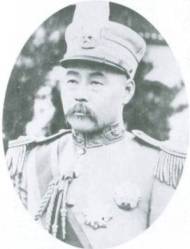 On May 17th, Feng Guozhang convened a meeting of provincial leaders in Nanking as to demanding Yuan Shikai's stepdown.
Feng Guozhang felt betrayed by Yuan Shikai because he had helped to allay rumors about Yuan Shikai enthronement after going to Peking to receive a personal assurance from Yuan Shikai.
Feng often made an analogy of Yuan Keding to Cao Pi, i.e., the son of Cao Cao during Three Kingdom time period.
On May 17th, Feng Guozhang convened a meeting of provincial leaders in Nanking as to demanding Yuan Shikai's stepdown.
Feng Guozhang felt betrayed by Yuan Shikai because he had helped to allay rumors about Yuan Shikai enthronement after going to Peking to receive a personal assurance from Yuan Shikai.
Feng often made an analogy of Yuan Keding to Cao Pi, i.e., the son of Cao Cao during Three Kingdom time period.
On May 23rd [May 22nd per "Biography of Tang Jiyao"], Chen Huan, i.e., a Yuan Shikai crony, declared Sichuan Provincial independence.
Yuan Shi-kai's crony and Governor-general of Sichuan Province also declared severance of relations from Yuan Shi-kai.
On May 27th [22nd ?], Tang Xiangming i.e. a Yuan Shikai crony, declared independence in Hunan Province. Yuan Shikai died on June 6th.
Yuan Shi-kai died of grievances on June 6th. (Li Zongren memoirs adopted June 5th as the date for Yuan Shi-kai's death.)
The Republic Restoration Wars
Duan Qirui's Ascension To Power, & Compromises
The death of Yuan Shi-kai, i.e., Emperor Hongxian, on June 6th of 1916 (lunar calendar), at age 58, could be considered a historical division point as to China's fate. Japanese Prime Minister Okuma Shigenobu wrote an article of warning or admonition nature, mentioning that Yuan Shi-kai died from his being horrified/maddened by concerted national opposition to the restoration of imperial system and the usurpation of the Republic Of China. Yuan Shi-kai acted an emperor for 83 days, only. Yuan Shi-kai's personal friend, Chen Huan, joined the trend of provincial wires stating their independence from the central government by sending a wire about severance of personal relations with Yuan Shi-kai on May 22nd. Nine governors-general had declared independence from the Peking government. When Yuan Shikai was opposed by his Northern Military Lineage generals, he revoked the emperor's title and changed the governance back to the Republic. Yuan Shi-kai commented that he had seen a star falling off the skies; that his family members had rarely lived beyond the age of 59; and that the last time he saw the meteor would be during the time when Li Hongzhang passed away in 1901. Japanese Prime Minister Okuma Shigenobu cautioned that Yuan Shi-kai's death was a matter that was key to the rise and fall of the Republic Of China and rebuked Yuan Shi-kai for not realizing that China's millennia of imperial system had been mostly occupied with pleasure-seeking and literature-decoration.
Before his death, Yuan Shi-kai, on June 2nd, wired to have 40-year-long pal, Xu Shi-chang, recalled from the retirement. Yuan Shi-kai was said to have changed his will at the last minute, deleting his son's name (Yuan Keding) from the list. Yuan Shi-kai's last few words, i.e., "He had doomed me", had been inferred to be a blame of his son for pushing through the agenda of imperial restoration. In accordance with Yuan Shi-kai's will, three persons, Li Yuanhong, Xu Shichang and Duan Qirui, were to take over the governance, with Vice President Li Yuanhong acting as the new President of the Republic Of China. The will also stated that Infantry Chief Minister be Duan Qirui, Foreign Minister & Transportation Minister be Cao Rulin, Interior Minister be Wang Jitang, Finance Minister be Zhou Ziqi, Navy Minister be Liu Guanxiong, Justice Minister and Agri-Commerce Minister be Zhang Zongxiang, and Education Minister be Zhang Guogan. Duan Qirui, initially reluctant to yield presidency to Li Yuanhong, had later insisted that Li Yuanhong be the president against the persuasion of numerous northern military lineage officers. This would be a tactic to appease the KMT and the 'Republic Restoration Armies' in southern provinces.
Succession Of the Presidency By Li Yuanhong
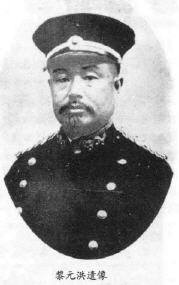 Li Yuanhong, who initially intended to give up the right for sake of not antagonizing the northern military warlords, succeeded the presidency on June 7th, with Feng Guozhang acting as vice president.
Duan Qirui, who had opposed Yuan Shi-kai's emperor enthronement the most, would now compel Li Yuanhong into the so-called Parliamentarism structure, thus limiting Li Yuanhong's presidency to nothing other than a nominal title. The Northern military warlords, having lost Yuan Shi-kai as their common master, would now be engaged in conflicts and struggles among each other.
Li Yuanhong, who initially intended to give up the right for sake of not antagonizing the northern military warlords, succeeded the presidency on June 7th, with Feng Guozhang acting as vice president.
Duan Qirui, who had opposed Yuan Shi-kai's emperor enthronement the most, would now compel Li Yuanhong into the so-called Parliamentarism structure, thus limiting Li Yuanhong's presidency to nothing other than a nominal title. The Northern military warlords, having lost Yuan Shi-kai as their common master, would now be engaged in conflicts and struggles among each other.
When Governor-general Chen Shufan of Shenxi Province revoked independence, Duan Qirui conferred Chen Shufan the title of "hanwu jiangjun" (i.e., Han martial general) and accepted him as a new member of the Northern Militarist Clique on June 10th, 1916. The KMT veteran leader, Yu Youren, wired a rebuke telegraph to Chen Shufan. Since
Governor-general Chen Huan of Sichuan Province revoked independence, Duan Qirui refused to acknowledge Chen Huan's governor-general status, thinking that Chen Huan might be of help to his Hubei native, i.e., President Li Yuanhong, and that Chen Huan might collude with an opponent called Feng Guozhang. Historians agreed that Duan Qirui treated Chen Huan as a traitor of the "Northern Militarist Clique" when Chen Huan wired over a letter stating that he had severed the personal relations with late president Yuan Shi-kai.
Duan Qirui continued Yuan Shi-kai's policy in having Cao Kun assist Zhou Jun's attack on Chen Huan.
Cao Kun was a northern government marshal in charge of Sichuan Province, Zhou June was a general in charge of the First Sichuan Division and magistrate of the Chongqing City, while Chen Huan was a governor-general stationed in Chengdu the capital of Sichuan. Zhou June dispatched brigadier general Wang Lingji and five battalions against Chen Huan. Zhou June called on Sichuan native generals under Chen Huan, like Liu Cunhou and Xiong Kewu, to rebel against Chen Huan [an alien provincial ruler]. Chen Huan requested with Governor-general Cai E of Yunnan Province for relief. Cai E, being sick himself, petitioned with Tang Jiyao for sending the relief to Chen Huan. Chen Huan originally possessed three mixed (enlarged) brigades; however, brigadier general Li Bingzhi was retained in Chongqing by Cao Kun, and Wu Xiangzhen and Feng Yuxiang were not enthusiastic about defending Chen Huan. Before Cai E & Tang Jiyao's relief armies came to Chengdu, Chen Huan had surrendered his city to Wang Lingji on June 25th, 1916.
Long Jiguang revoked independence to show affinity with Duan Qirui on June 9th without consulting with "jun wu yuan", i.e., the Southwestern China Military Council.
Long Jiguang intended to drive out the Guangxi/Yunnan armies.
On June 21st, Duan Qirui conferred the post of "xun an shi" onto Long Jiguang and dispatched the Northern Warlord lineage armies to the relief of Long Jiguang.
Duan Qirui sent Governor-general Li Chun of Jiangxi Province and Governor-general Li Houji of Fujian Province to the border areas with Guangdong Province as well as the navy fleet to Canton.
Reinstatement of the 'Interim Agreed-upon Laws'
Tang Jiyao and Cen Chunxuan in southwestern China wired over demands that the new Peking government i) restore the 'Interim Agreed-upon Laws' of 1912 in place of the 'New Agreed-upon Laws' of 1914, ii) assemble the Parliament with members of the 1913 Parliament, iii) fill in the post of Vice Presidency, iv) institute the State Council, v) punish the 13-member clique responsible for pushing through Yuan Shi-kai's imperial enthronement, and vi) convene a special military meeting for governors-general or generals of all provinces to attend in Shanghai. The 13-member clique would include the so-called 'Latter Six Gentlemen': Yang Du, Sun Yujun, Yan Fu, Liu Shipei, Li Xiehe and Hu Ying. (The 'Former Six Gentlemen would be those who were betrayed to Empress Dowager Ci-xi by Yuan Shi-kai during the Hundred Day Reformation.)
More available at Interim-Agreed-upon-Laws.pdf
(Check
RepublicanChina-pdf.htm
page for up-to-date updates.)
* In Commemoration of China's Fall under the Alien Conquests in A.D. 1279,
A.D. 1644 & A.D. 1949 *
U.S.S.R./Comintern Alliance with the KMT & CCP (1923-1927)
Korean/Chinese Communists & the 1931 Japanese Invasion of Manchuria
American Involvement in China: Soviet Operation Snow, IPR Conspiracy, Dixie Mission, Stilwell
Incident, O.S.S. Scheme, Coalition Government Crap, Amerasia Case & The China White Paper
* Stay tuned for "Republican China 1911-1955: A Complete Untold History" *
|
|
Zou Rong's Revolutionary Army;
Shin Kyu Sik's
Shrine (Spirit, Kunitama) of Korea
|
This snippet is for sons and daughters of China:
Heed the sons & ministers' agony and sorrow of our ancestors who died or lived through the Mongol, Manchu and Soviet-Chicom conquest
and
the Yongjia, Jingkang and Jiashen cataclysms !
Jeanne d'Arc of China:
Teenager girl Xun Guan breaking out of the Wancheng city to borrow the relief troops in the late Western Jinn dynasty;
Liu-Shao-shi riding into the barbarian army to rescue her husband in the late Western Jinn dynasty;
teenager girl Shen Yunying breaking into Zhang Xianzhong's rebels on the horseback to avenge on father's death in the late Ming dynasty.
China's Solitary and Lone Heroes:
Nan Jiyun breaking out of the Suiyang siege and charging back into the city in the Tang dynasty;
Zhang Gui & Zhang Shun Brothers breaking through the Mongol siege of Xiangyang in the Southern Soong dynasty;
Liu Tiejun breaking through three communist field armies' siege of Kaifeng in the Republican China time period;
Zhang Jian's lone confrontation against the communist army during the June 3rd & 4th Massacre of 1989.
|
|
|
Re-convening of Parliament & Revival Of Parties
On August 1st of 1916, the Parliament was reconvened in Peking, with Wang Jiangxiang and Wang Zhengting in charge of 138 attendants in the Upper House, and Tang Hualong and Chen Guoxiang in charge of 318 in the Lower House. Li Yuanhong swore his allegiance to the Constitution as the new president of the R.O.C.
Cabinet ministers like Duan Qirui (field army), Chen Jintao, and Cheng Biguang (navy), et al., also participated in the opening ceremony.
In Guangdong & Shanghai area, the KMT still retained its influence even though Chen Qimei was assassinated by Yuan Shi-kai's cronies. After the republic restoration war, the 'Progressive Party' extended its influence into Guangdong Province when Lu Rongting invited over Liang Qichao.
In Sichuan-Guizhou-Yunnan provinces, Liang Qichao's Progressive Party were active in its expansion. The KMT already split into two factions, i.e., Sun Yat-sen's Chinese Revolutionary Party and the 'KMT European War Research Society'. Huang Xing et al., opposed Sun Yat-sen's new party for its stringent requirements like i) the fingerprinted membership and ii) the oath of personal loyalty to Sun Yat-sen. (The KMT European War Research Society, before the outbreak of WWI, had called for a cessation of struggles against Yuan Shi-kai for sake of concerted efforts in countering Japan's 21 Demands. It would be Li Genyuan who led the call in the name of 28 senior ex-KMT leaders, including Cheng Qian, Chen Jiongming and Zhang Shizhao et al. Huang Xing had left Japan for the U.S. by that time after Sun Yat-sen requested with him for a time period of 2 years to go the way of the "Chinese Revolutionary Party".)
Progressive Party members advocated no partisanship after the death of Yuan Shi-kai. After the Parliament reconvened, the Progressive Party split into Tang Hualong's constitutional discussions society and Liang Qichao's constitutional research society. The two factions later converged into the 'Research Clique'.
The KMT European War Research Society transformed into Zhang Ji's constitutional consultative society which split into three more factions headed by Zhang Ji, Sun Hongyi and Lin Sen/Ju Zheng, respectively. Out of the four ex-KMT organizations would ensue the "politics studies society" (Gu Zhongxiu/Zhang Yao), the "people's friends society", and the "politics leftover club".
On August 10th, Li Yuanhong called upon all factions and parties to possess same heart as well as uphold the governance.
Also in August Cai E assumed the posts of both governor-general and governor of Sichuan Province.
On October 30th, the Parliament added Feng Guozhang [i.e., military leader of the Zhi-xi faction] as the vice-president of the R.O.C.
In October of 1916, Japan had a cabinet change, and the new prime minister purportedly advocated for friendship with China. The Japanese foreign minister invited China's minister-envoy Zhang Zongxiang for a secret talk and promised to give loans to China. Zhang Zongxiang relayed the message to Cao Rulin, and Cao Rulin persuaded Duan Qirui into the new policy of 'pacifying the outsider before quelling the internal enemies'.
Duan Qirui hence reversed Yuan Shi-kai's policy of befriending the remote powers like Britain and the U.S., in preference for friendship with Japan. China's State Council, without notifying the president, dispatched Cao Rulin to Japan as a special emissary. When Cao Rulin presented to Li Yuanhong a paper for conferring the lordship onto the Japanese emperor, Li Yuanhong rebuked the treachery and adopted Zhang Guofu's advice in having the Parliament debate the issue. Duan Qirui, for sake of obtaining the secret Japanese loans, would compromise with the Parliament as well as Japan in dispatching a non-Japanophile minister to Japan on February 27th of 1917.
Duan Qirui's Premier Post vs Li Yuanhong's Presidency
Li Yuanhong, sort of self-righting doll or roly-poly, was used by Duan Qirui as a rubber stamp. Duan Qirui had a higher ranking over brigadier Li Yuanhong at the Manchu times and often took Li Yuanhong as someone who enjoyed 'free lunch'. The two never liked each other. Duan Qirui had personally traveled to Wuchang of Hubei Province to escort Li Yuanhong to Peking for serving as a puppet vice president under Yuan Shi-kai. Duan Qirui's secretary, Xu Shuzheng, often brought a list of new personnel conferrals to Li Yuanhong for the rubber stamping without any consultation with Li Yuanhong as to qualifications of those personnel, and moreover, Xu Shuzheng often exhibited disrespect for Li Yuanhong.
Li Yuanhong and Duan Qirui had some common ground, though. When Yuan Shi-kai was in reign, Li Yuanhong had been ordered to send decree to various governors-general to enforce the separation of the military posts from the civil posts and to reduce the military staff at the provincial level. Duan Qirui, however, intended to cut down the military personnel of southern provinces, only; Duan Qirui also intended to maintain the control over the national military forces at the Ministry of Field Armies. Duan Qirui made a plan for retaining 40 infantry divisions and 20 independent brigades nationwide, with a division containing 10,000 men and a brigade containing 5000 men, and at the provincial level, Duan Qirui made a plan apportioning 200 battalions of provincial guards, with each battalion containing 500 men.
When Duan Qirui refused to pull out his northern lineage armies from Sichuan/Hunan provinces, the southern provincial governors-general did not follow the arms reduction order at all. In addition to the southern provincial governors-general, Liang Qichao had been mobilizing his supporters in Sichuan-Guizhou-Yunnan provinces for making his newly-found 'Progressive Party' an armed band.
Conflicts In Sichuan Province After Cai E's Vacation
Cai E, who has assumed the posts of both governor-general and governor of Sichuan Province in August 1916, would request for a sick leave for treating throat in Japan. Cai E arranged for Luo Peijin to assume his posts, for Dai Kan [member of the Progressive Party] to assume the "military superintendent", and for Liu Cunhou to tack on the corps chief of the 1st Corps.
Cai E died shortly after he arrived in Japan. Three factions, i.e., Luo Peijin [Yunnan native] Dai Kan [Guizhou native] and Liu Cunhou [Sichuan native], would be engaged in the power struggles.
Liang Qichao dispatched emissary to Chongqing of Sichuan Province for sake of assisting Dai Kan over Luo Peijin.
Dai Kan secretly contacted Liu Cunhou for a cooperation in fighting against Luo Peijin.
Liu Cunhou, chief of the Sichuan native army's first corps, with Duan Qirui's support, would take advantage of the rift between Luo Peijin of the Yunnan army and Dai Kan of the Guizhou army in order to expel the two out-of-state guys who acted as governor-general and governor of Sichuan province, respectively.
Liu Cunhou colluded with Jin Yun'e [i.e. infantry ministerial chief of the Peking government] in dealing with the Yunnan Province army.
In Sichuan Province, the Sichuan army possessed five divisions and one mixed brigade, the Yunnan army two divisions, and the Guizhou army one mixed brigade.
In January 1917, the Peking government dispatched Wang Zhixiang to Sichuan Province for compressing the army.
Luo Peijin agreed to compress the Sichuan resident armies to three divisions and one mixed brigade for Sichuan, one division and one mixed brigade for Yunnan, and one mixed brigade and one detached regiment for Guizhou as well as to make the resident Yunnan-Guizhou armies subordinate to the Peking government.
Luo Peijin suggested to Duan Qirui in having Liu Cunhou relocate to Peking, but Duan Qirui intentionally disclosed it to Liu Cunhou.
In March Luo Peijin published the military shrinkage plan to which Liu Cunhou opposed immediately.
Duan Qirui secretly maneuvered to have Luo Peijin and Liu Cunhou escalate into open conflicts on April 18th of 1917.
Meanwhile, Dai Kan instigated Luo Peijin in solving the problem of Liu Cunhou militarily.
On April 13th, Luo Peijin arrested his former subordinate Chen Zepei, i.e., Sichuan provincial army 4th Div chief.
On the 15th, the 4th Div was disbanded; however, soldiers were collected by Liu Cunhou right away.
On the 18th, at the north gate of Chengdu, Liu Cunhou's army attacked the convoy carrying the guns of the dismissed 4th Div.
For one week, the two sides engaged in lane to lane fighting.
The Peking government pretended to mediate over the conflict by having Dai Kan take over the posts from Luo Peijin.
The end result is that Luo Peijin retreated out of Chengdu for a compromise with the Sichuan army.
Dai Kan antagonized Liu Cunhou by eating his promise of yielding the post of Sichuan military superintendent.
Liu Cunhou assassinated a Dai Kan crony and sent troops to the outskirts of Chengdu.
At this time, pigtail general Zhang Xun, having driven away Li Yuanhong in Peking, restored last Manchu Emperor Pu-yi onto the throne.
Zhang Xun sent an order to confer the post of the "Manchu Governor of Sichuan Province" onto Liu Cunhou.
Dai Kan, utilizing Zhang Xun's conferral, petitioned with Tang Jiyao [Yunnan Province] & Liu Xianshi [Guizhou Province] in quelling the "traitor to the Republic".
By July 5th, the Sichuan army began to attack Dai Kan who had the 5000-men Guizhou army.
Alternatively speaking, "Biography of Tang Jiyao" [by Zheng Xuetao - Cheng Yuechong - Li June - Xu Hongjun: PO Box 3652, Hongkong, March 1979 edition]] claimed that Dai Kan ordered that Xiong Qixun's brigade launch a surprise attack at Liu Cunhou on the night of July 5th.
Fighting continued for half a month.
On the 17th, Dai Kan retreated out of the south gate of Chengdu.
At the border of Renshou county Dai Kan
would be killed by the Sichuan army in an ambush on July 21st.
In Peking, Liang Qichao, saddened by the loss of his party member Dai Kan, rebuked Duan Qirui for supporting the Sichuan army. Sichuan would undergo further rounds of tripartite wars.
In mid-July 1917, the Sichuan Province army continued to engage with the Yunnan & Guizhou armies in the Battle of Qing-Mei, and in Aug-Sept, the Battle of Zi-Nei.
Having realized that the Sichuan fighting was the attempt of the northern government in exercising total control of the province, Tang Jiyao joined Sun Yat-sen in launching the movement of "safeguarding the interim agreed-upon laws".
China's Declaration Of War On Germany (1917)
Dong Zhujun's "My One Century" stated that Duan Qirui and Li Yuanhong had quarrels in regards to China's declaration Of war on Germany.
The declaration of war was more an infighting between the two factions than a Chinese attempt at asserting its role in the international arena.
Sun Yat-sen, who opposed the war participation, wrote
in his 1917 book The Vital Problem of China, questioning: "Is it right for England to rob China of Hong Kong and Burma, to force our people to buy and smoke opium and to mark out portions of Chinese territory as her sphere of influence?. . . If one really wants to champion the cause of justice today, one should first declare war on England, France and Russia, not Germany and Austria. . . . When another country is strong enough to be utilized, Britain sacrifices her own allies to satisfy its desires, but when that country becomes too weak to be of any use to herself, she sacrifices it to please other countries."
(As records showed, Sun was bribed by the Germans in opposing China's entry to WWI.)
The KMT critics, including Li Ao, had attributed the foresight to the northern government, though.
In Peking, Duan Qirui obtained the support of Liang Qichao's "Progressive Party" in countering Li Yuanhong.
While Duan Qirui obtained the support of Japan, Li Yuanhong threw himself into the camp of Britain and the U.S.
(The role of the U.S. was dubious as Paul Reinsch, one of the very few Americans with sympathy for China and the Chinese people, appeared to be urging China to join the war as a way to reap the fruits of the post-war world reorganization while the U.S. state department had no such endorsement.
Note that till we fully appreciate the help of good-hearted and sympathetic Americans such as Paul Reinsch, Arthur Young, Claire Lee Chennault, Milton Miles and Albert Wedemeyer, and build the ever-lasting and eternal monuments in remembrance of them, there would not be another American who would follow their footsteps.
Note that Reinsch, after leaving the minister-to-China's post, continued to work on behalf of China and died of illness while working for China.
The Chinese should forever pay respect to Reinsch and his descendants.)
Li Yuanhong obtained support from Zhang Ji's KMT "constitution consultative society".
In March 1917, Duan Qirui organized a so-called "du jun [governor-general] tuan [delegation]" to exert pressure on Li Yuanhong for sake of having China declare war on Germany.
Li Yuanhong, though a roly-poly, refused to cooperate with Duan Qirui on the war declaration.
Few months later, there was divulsion of Duan Qirui's secret agreements with Japan for the bank loans.
Taking advantage of this notorious event, on May 23rd, Li Yuanhong ordered the deprivation of Duan Qirui's premier post.
After Li Yuanhong revoked the premier post of Duan Qirui, Duan Qirui would travel to Tianjin where he instigated the governors-general for a declaration of "independence" from the Peking government.
On May 29th, Ni Sichong declared independence for Anhui Province. Manchuria, Shandong, Shaanxi Henan and Shanxi provinces followed suit.
Tang Jiyao declared allegiance to Li Yuanhong's presidency, advised against Ni Sichong's "rebellious" independence, cautioned Liu Cunhou as to Sichuan Province's tripartite wars, and petitioned for cooperation among the Southwestern governors-general.
In June, Duan Qirui established a so-called "general tactics department" for independence-declared governors-general in Tianjin.
Hence, Li Yuanhong invited pigtail general Zhang Xun into Peking for mediation.
At the demand of Zhang Xun, Li Yuanhong dismissed the parliament on June 12th.
Tang Jiyao called upon the southwestern generals for a "Second Campaign For Restoring The Republic".
Zhang Xun then forced Li Yuanhong into resignation.
In cooperation with monarchist Kang Youwei, Zhang Xun took advantage of the chaos in restoring Aixinjueluo Pu-yi back to the throne in the Forbidden City on July 1st, 1917.
Zhang Xun's Restoration Of the Imperial House
On April 10th, 1917, in southern China, Lu Rongting assumed the post of "xuan [visiting] yue [monitoring] shi [emissary]" which would be above governor-general ["du jun"]. Lu Rongting designated Chen Bingkun and Tan Haoming as governor-general ["du jun"] for the Guangdong-Guangxi provinces, respectively.
Together with Tang Jiyao & Liu Xianshi, i.e., governor-general ["du jun"] for the Yunnan-Guizhou provinces, the four guys comprised the power base of southwestern China.
On July 1st, Zhang Xun fetched the last Manchu emperor from the forbidden city for an imperial restoration and declared the Era of the 9th Year of Manchu Emperor Xuantong.
Li Yuanhong resigned his presidency in Peking and sought asylum inside of the Japanese legation, while vice president Feng Guozhang assumed the R.O.C. presidency in Nanking.
Tang Jiyao, for a "Second Campaign For Restoring The Republic", organized 8 corps of "jing-guo-jun [the army that pacifies the country]" and devised a strategy of a four-route campaign.
Duan Qirui held an oath of war at Machang and cracked down on the Zhang Xun imperial restoration by organizing a 50000-men "tao [campaigning against] ni [rebel] June [army]".
On July 12th, Zhang Xun fled, and Fu-yi abdicated for a second time in his life.
Duan Qirui invited Feng Guozhang to Peking for acting as proxy president on the excuse that Li Yuanhong had legally resigned his presidency already.
Duan Qirui, after re-asserting his role as premier and infantry minister, refused to re-convene the parliament or safeguard the "interim agreed-upon laws".
Tang Jiyao, in collaboration with Lu Rongting, declared that Southwestern China do not acknowledge the Duan Qirui cabinet.
Tang & Lu requested for the return of Li Yuanhong presidency.
Sun Yat-sen called upon the parliament representatives in going south.
Since Duan Qirui intended to set up a new Parliament, Sun Yat-sen called upon the former parliament members and the Navy officers for a move to Canton on July 17th.
On July 22nd, 1917, Navy General Cheng Guangbi declared a defection to the south as an echo for Sun Yat-sen's call.
Per Zhang Yufa, those parliament members who went to the South would be mostly KMT members from the 1913 Parliament and the "constitution consultancy society" faction of the 1916 Parliament.
On August 5th, the Parliament representatives flocked to Canton in the south where they convened a special session.
On August 11th, Tang Jiyao insisted upon the "interim agreed-upon laws" in a public wire.
On August 18th, 130 Parliament members declared the extraordinary session of the Parliament.
Sun Yat-sen convened a special session of the Parliament on August 25th.
On 30th, the Extraordinary Parliament passed the organization guideline for the transitionary military government.
On September 1st, the Special Session of the Parliament selected Sun Yat-sen as the "Grand Marshal for infantry and navy" of the military government. On October 3rd, Sun Yat-sen wired to express opposition to Peking's convening the upper house of the Parliament. Armies of the south and north went into conflict in Hunan Province.
The Southern Government & Protecting the 'Interim Agreed-Upon Laws'
Kuomintang [KMT] (i.e., Guomindang [GMD] in pinyin), commonly known as the Nationalists, was formed on basis of a loose organization comprising of several revolutionary organizations, such as "Tong Meng Hui", "Tongyi Gonghe Dang", "Guomin Gongjin Hui", "Gonghe Shijin Hui", & "Guomin Gong Dang". KMT was coordinated and founded by Soong Jiaoren in Peking on August 25th of 1912. The KMT stipulated nine board directors, including Sun Yat-sen, Huang Xing and Soong Jiaoren, et al., and 29 councilors, including Hu Hanmin, Li Liejun, Jiang Yiwu, Sun Yujun, Tan Yankai, Yu Youren and Ma Junwu. Soong Jiaoren publicly announced that he did not have any difference of opinion from Sun Yat-sen. Sun Yat-sen was supported as chairman of the 'board of director' of KMT. Sun Yat-sen, however, later gave up the 'board of director' post for his dream of laying railroads. Soong Jiaoren worked diligently for building a majority KMT party inside of the Parliament. But, Yuan Shi-kai, in order to fulfill his dictator or emperor's dreams, would hire an assassin to have Soong Jiaoren assassinated on March 20th, 1913. (Historian Tang Degang, who had befriended the grandson of Yuan Shikai, had proposed an alternative explanation as to the culprit behind the assassination.)
In the Guangdong Province, Chen Jiongming, with the assistance of Yuan Shi-kai, had robbed Hu Hanmin of the governor-general post. Hu Hanmin, who was made into governor-general of Guangdong after the 1911 revolution, had first resigned the post to be secretariat secretary of Sun Yat-sen's interim presidency in Nanking around the turn of 1911-1912; after Yuan Shi-kai's succession of the interim presidency in Peking, Hu Hanmin returned to Guangdong Province to serve as governor-general, till Chen Jiongming took over the post.
Inside of Guangdong Province army, a division chief by the name of Zhong Dingji struggled with Chen Jiongming for power. A brigade chief by the name of Su Shenchu fought against Zhong Dingji. Another brigade chief by the name of Zhang Woquan fought against Su Shenchu.
After the assassination of Soong Jiaoren on March 20th 1913, revolutionary leaders had changes of mind as to fighting Yuan Shikai. Huang Xing, having first proposed an armed opposition, would later advocate for legal means in fighting Yuan Shi-kai. The discord had caused the KMT a loss of time in taking initiatives while Yuan Shikai, with an international consortium loan that was suddenly approved by ill-motivated Anglo-American bankers, decided to take heavy-handed action against the KMT. KMT, for sake of maintaining peace, had surrendered governor-general posts of several southern provinces. But Yuan Shi-kai intended to eradicate the KMT forces altogether and dispatched his military against the southern provinces of Anhui-Jiangxi-Jiangsu-Hubei-Shanghai, etc. With the nodding approval of Sun Yat-sen, KMT governors-general and generals, like Li Liejun of Jiangxi, Tan Yankai of Hunan, Bai Wenwei of Anhui and Xu Chongzhi of Fujian, declared independence.
Sun Yat-sen, in July 1913, issued a proclamation to the Chinese citizens in regards to 'campaigning against Yuan Shikai for treason'.
On July 23rd of 1913, Yuan Shi-kai revoked Sun Yat-sen's title of "plenipotentiary" for China national railroads, a job Sun Yat-sen accepted on September 9th of 1912 to fulfill his dream of laying 200,000 li distance railroad tracks. On the same day, Yuan Shi-kai declared Huang Xing, Chen Qimei and Bai Wenwei as 'traitors'.
Second Revolution ended with the defeat of Li Liejun by Yuan Shi-kai's army and the loss of Nanchang in Jiangxi Province on August 18th of 1913. In Anhui Province, Yuan Shi-kai's crony, Ni Sichong, took over governor-general post on August 28th of 1913. In Jiangsu Province, Zhang Xun sacked Nanking on September 1st 1913.
Cai Er first proclaimed neutrality on behalf of three provinces of Yunnan-Guizhou-Sichuan, and then claimed to supply three divisions to aid Yuan Shikai.
In Guangdong Province, Long Jiguang assumed governor-general post, and Chen Jiongming fled on August 5th.
Sun Yat-sen left for Guangdong on August 2nd, with an intention to treat Guangdong Province as homebase; en route, at a stopover in Mawei of Fujian Province, a Japanese consulate official informed Sun Yat-sen of the possible Long Jiguang conspiracy in Canton; Sun Yat-sen, together with Hu Hanmin, then changed ship to Taiwan; and thereafter, Sun Yat-sen secretly arrived in Japan and stayed in the home of Toyama Mitsuru, i.e., Japanese spiritual leader of "black dragon society", the successor to Genyosha a secret society.
Documents dating to September 27th 1913 had shown that Sun Yat-sen was already contemplating on his new party.
Chiang Kai-shek, i.e., Jiang Zhiqing, signed the enrolment form from Shanghai on October 29th.
In July of 1914, Sun officially re-organized KMT into the so-called "Zhonghua Geming Dang", i.e., Chinese Revolutionary Party.
Yuan Shi-kai did not outlaw KMT or dismiss the Parliament till after his presidency confirmation.
On October 10th of 1913, Yuan Shi-kai, having hijacked the Parliament in passing the 'election law' [on October 4th] ahead of the Constitution and locked up the Parliament members to coerce an election, was officially elected the president of the R.O.C. after barely passing the majority ballots needed, ensuing three rounds of ballot casting.
Parliament members passed Yuan Shikai after over 1000 rascals surrounded the building in the name of "citizen corps".
Fireworks erupted thereafter to celebrate Yuan Shikai's election.
On October 16th of 1913, Yuan Shi-kai proposed an amendment of the 'Interim Agreed-upon Laws' of 1912 in the attempt of aborting the birth of the official Constitution and expanding his presidential power over the Parliament.
Yuan Shikai, being not happy over the October 3rd 1913 "Constitution of the Temple of Heaven", would order a revision of "Interim Agreed-Upon Laws".
On November 4th of 1913, Yuan Shi-kai, against the objection of Liang Qi-chao (Progressive Party leader), outlawed KMT and deprived 438 KMT members of their Parliament representative title.
On December 15th of 1913, Yuan Shi-kai convened the 69 member 'politics assembly of senators', and on January 10th of 1914, Yuan Shi-kai dismissed the Parliament by invoking the 2nd enactment of the 'politics assembly of senators'.
In July of 1914, Sun Yat-sen formed "Zhonghua Geming Dang", i.e., the Chinese Revolutionary Party, in the attempt of reviving the spirits of the former "Tong Meng Hui".
Huang Xing, et al., opposed Sun Yat-sen's new party for its stringent requirements of i) fingerprinted membership and ii) oath of personal loyalty to Sun Yat-sen.
Sun Yat-sen's new party was boycotted by senior KMT leaders like Li Liejun, Bai Wenwei, Tan Renfeng, Chen Jiongming and Zhang Ji.
(Also in year 1914, Liu Sifu established a so-called anarchist communism society in Shanghai, and March of this year, Li Shumeng, aka Jiang Qing, i.e., Mao Zedong's future unofficial wife, was born in Shandong Province.)
On August 15th 1914, Japan issued an ultimatum to Germany as to ceding Jiaozhou-wan Bay to Japan management and Chinese sovereignty by the deadline of September 15th. (Later, on May 25th 1915, Japan forced China into signing a secret agreement which was to incorporate "Twenty One Demands" raised previously.)
Short History Of Southern Revolutionary Movement
Tripartite Wars In Sichuan Province
Movement For Protecting the 'Interim Agreed-Upon Laws'
'Law Safeguarding Wars'
Sun Yat-sen Departing 'Grand Marshal' Post For Shanghai
Continuing 'Law Safeguarding Wars' Between South & North
Sun Yat-sen's Activities In Shanghai
Versailles Peace Conference & May 4th 1919 Students' Movement
New Round Of Wars In Sichuan Province (1920) & Tang Jiyao's Exile
Civil Wars Among Northern Warlords
Imperialists & Supplanting Proxies Among Warlord Generals:
War Between Zhi-xi/Feng-xi & Wan-xi (1920)
First War Between Zhi-xi & Feng-xi (1922)
Cao Kun Bribery of Elections (Oct 5th 1923)
First Jiangsu-Zhejiang War (i.e., War Between Zhi-xi & Wan-xi, 1924)
Second War Between Zhi-xi & Feng-xi (1924)
Second Jiangsu-Zhejiang War (i.e., War Between Zhi-xi & Feng-xi, 1924-1925)
War Between Sun Chuanfang & Feng-xi, 1925)
War Between Guo Songling (Feng-xi) & Zhang Zuolin (Feng-xi), 1925
War Between Feng Yuxiang & Li Jinglin (Zhi-xi) /Zhang Zongchang (Shandong Province), 1925
War Between Feng Yuxiang & Wu Peifu (Zhi-xi) / Zhang Zuolin (Feng-xi) / Li Jinglin (Hebei Province)-Zhang Zongchang (Shandong Province), 1926:
Intra-Provincial Wars Among Warlords
Russia, Britain & Japan - Tibet, Xinjiang, Mongolia & Manchuria
Per Scholar Yang Yuqing, the Sino-USSR relations could never have a breakthrough on the matter of i) Mongolia, and ii) the Zhong-dong Railroad of Manchuria (i.e., the Chinese Eastern Railway).
In 1910 and 1911, Russia and Japan had reached secret treaties in regards to their 'spheres of influence' in Mongolia and Manchuria. (Tang Degang pointed out that Russia and Japan, after the 1904-5 war, became friends overnight, and signed the secret treaties on July 30th, 1907 and July 4th, 1910 for subdividing Manchuria into two spheres of influence. The line of division would be in present Jilin Province, from the Russian-Korean border to Gunchun, to the Jingbo Lake [Bi-er-teng Lake], to Xiushuidian.)
When the Xin Hai Revolution broke out in 1911, the Mongolian lama, under the instigation of Czarist Russia, expelled the Manchu officials and declared the Mongolia independence on November 30th (lunar calendar).
http://www.un.int/mongolia/histdoc.htm claimed that in July 1911, the Khalkha princes, high functionaries and lamas had already discussed the separation of Mongolia from Manchuria.
On December 28th (lunar calendar), the Mongolian lama declared the era of Gongdai, i.e., 'supporting together'.
http://www.un.int/mongolia/histdoc.htm claimed that "on 29 December Jebtzundamba Khutukhtu YIII was proclaimed Bogd Khan, head of the religion and the State."
Jebtzundamba Khutukhtu (Khutu) and Changkya Khutukhtu (Khutu) were two lamas sanctioned by the Manchus to rule Outer Mongolia and Inner Mongolian, on a similar par as the Dalai and Panchen lamas' rule in Frontal and Hind Tibetan territories.
Changkya Khutukhtu (Khutu), who later retreated to Taiwan, was taken by the Republic of China as a state preceptor.
Russia tried to force Manchu China into acknowledging the Mongolia independence. The Russia emissary also visited London to have an agreement on acknowledging Britain's interests in Tibet in exchange for Britain’s reciprocal acknowledgement of Russia's claim in Outer Mongolia.
Tang Degang pointed out that Russian governor for Siberia, Nikolai Muraviev, back in 1854 proposed to Czar a suggestion to wrestle Outer Mongolia from China.
On July 8th, 1912, Russia and Japan signed the 3rd secret treaty over Inner Mongolia.
Russian S.D. Sazonov and Japanese Honno Ichiro [[Benye Yilang]] signed the secret treaty in St Petersburg to subdivide Inner Mongolia into two halves.
On October 3rd of 1912 (lunar cal), the Russian minister-envoy to China, Ivan Korostovets, went to the Mongolia capital for signing a "Russo-Mongolia Treaty", making Mongolia a puppet protectorate of Czarist Russia.
The Russians recruited 40000 Mongols from four banners for organizing a Mongol Army, and supplied 40000 rifles, 4000 cases of bullets, 8 cannons, and 2 million Russian currency.
R.O.C. foreign minister Liang Ruhao resigned at the news of the Russian-Mongolian treaty.
Yuan Shikai ordered that Lu Zhengxiang succeeded the post for negotiating with the Russians in November 1912.
Only America expressed opposition to the Russian attempts in Outer Mongolia but softened its stance due to its colonialism in the Philippines, while Japan & Britain kept silence over their secret treaties.
Yuan Shi-kai's Cabinet tried very hard to retain Mongolia and exchanged wires with the Mongolian lama several times. The Mongolia lama expressed his opinions of trying to have self-protection rather than following the suit of Korea, Vietnam and Taiwan.
Meantime, Yuan Shi-kai ordered that Zhang Shaozeng meet the banner leaders of two Inner Mongolian tribal alliances and successfully solidified China's control over Inner Mongolia.
On the other side of the border, the imperialists had been probing into Tibet incessantly.
Back in 1845, two French priests were caught in disguise of merchants and expelled from Tibet; two more French priests were killed in 1851 & 1854 by the locals while penetrating into the Cha-yu-he river valley from India; and in 1861, the French priests encountered resistance from the Tibetan lamaists in Lhasa and the entire southwestern China.
The British, after colonizing India, never let loose its eyes on Tibet.
Historian Tang Degang pointed out that Britain, which had supported the U.S. in propagating the 'Open Door Policy' in the aftermath of the 1900 Boxer Incident, never intended to have anyone else share its interests in Tibet.
Prior to the Xin Hai Revolution, Britain had coerced Manchu China into five unequal treaties on Tibet, i.e., in the years of 1890, 1893, 1904, 1906, 1908.
The British swindled the Sino-Tibetan-Burmese mountain states of Nepal, Sikkim and Bhutan --all vassals of Tibet which was under the Chinese suzerainty.
Sikkim was stolen from Manchu China by the British in 1890 and then annexed by the post-WWII India through a bloody military intervention in the mid-1970s, for example.
During WWII, the Sikkim prince, who was pro-China and enthusiastic about China's war efforts against Japan, was among General Sun Liren's entourage in the retreat to Assam from Burma.
(Burma escaped the fate of being piggybacked to India as a province as a result of the British extricating the country from India by giving it a separate Constitution and administrating it directly from London starting from April 1937.
Pakistan and Bengladesh separated themselves from India for Muhammad Ali Jinnah and the Muslim League's supporting the war effort against Japan in taking Stafford Cripps' offer of the right to opt out of a future union with India.)
Tang Degang further pointed out that it was not Manchu's skillful diplomacy but the British cunningness that allowed Manchu China to claim suzerainty over Tibet as a way to defray the possible Russian encroachment.
Indeed, the 13th Dalai Lama received the Russian conferral of "emperor for safeguarding the Buddhist laws".
However, taking advantage of the 1904 Russian-Japanese War, Britain, under Sir Francis Younghusband, invaded Lhasa in the summer.
Francis Younghusband, a colonel at the time, wrote to the Times that the earth was too small "to permit the Chinese keeping China to themselves".
The 13th Dalai Lama fled to Qinghai and then Kulun for seeking the Russian help.
The British erected the 9th Panchen [Panchan] Lama as a puppet.
Britain tried to extract 500,000 pounds as war compensation. The
Manchu resident-minister to Tibet was dismissed.
Tang Shaoyi of the Tientsin customs office was sent to India for negotiating with the British.
Dalai Lama, however, requested for a visit to the Forbidden City before Dowager Empress Ci-xi and Emperor Guangxu died.
Yuan Shikai & Zhang Zhidong proposed that the Sichuan Province army escorted Dalai back to Tibet.
In 1909, Tibet was pacified by Governor-general Zhao Erfeng who, two years later, was killed by the revolutionaries for his loyalty towards the Manchu court.
The British secretly coerced Dalai to India.
The 13th Dalai Lama was deprived of his title by the Manchu court in 1910.
After the 1911 Xin Hai Revolution, in June 1912, the British escorted Dalai Lama back to Lhasa, expelled the Manchu-era officials, and slaughtered the pro-China folks.
(At the time, the Dalai lama was in charge of 3550 monasteries or 302,500 monks and 1201,438 households of serfs, while the Panchen lama 327 monasteries or 13700 lamas & 6752 households of serfs.)
After the Tibetan lamas attacked Sichuan Province, the new governor-general for Sichuan Province, i.e., Yi Changheng, counter-attacked the Tibetan army.
The Tibetans retrieved Dalai Lama in 1911 for declaring the independence after the Xin-hai Revolution that overthrew the Manchu rule.
The British escorted Dalai back to Tibet.
On the matter of Tibet, Yuan Shi-kai ordered that Yunnan Governor-general Cai E and Sichuan Governor-general Yi Changheng quell the Tibetan independence rebellion in the Tibet/Sichuan areas.
Sichuan Governor-general Yi Changheng dispatched General Zhong Ying as "xing zheng shi" or administrator to Tibet.
In July of 1911, Yuan Shi-kai reached a compromise with the British minister-envoy in restoring the title of the 13th Dalai Lama in exchange for Britain's acknowledgement of the Republic of China.
On April 6th of 1912, the Tibetans, under instigation of the British, drove off the Chinese army and intruded into Sichuan Province; on September 1st, Dalai Lama requested for peace; and on October 28th, Dalai Lama was restored his title.
In October 1913, Yuan Shikai's government dispatched a delegation to the Simla Conference which ended in July 1914 to no avail.
The British intended to divide Tibet into two parts, i.e., Outer Tibet and Inner Tibet [Qinghai, and parts of Sichuan & New Dominion Province].
The British first proposed the McMahon Line in the attempt of cutting part the Tibetan territory south of the Himalaya ridge for India.
Sir Henry McMahon planned to grab a territory three times the size of the Taiwan Island.
The Chinese delegation refused to acknowledge the McMahon line.
The British and the Tibetan lama secretly struck an agreement on the McMahon line --which was used by today's India to encroach on the Chinese territory, as seen in the Indian annexation of 'Southern Tibet' (what the Indians called by Arunachal Pradesh) and Sikkim, all land belonging to the Sino-Tibetan-Burmese population.
In the mid-1910s, fortunately, Britain had to exert its efforts to WWI, hence suspending its ambition against Tibet for the time being.
(The McMahon dispute would lead to the Sino-Indian Border War in 1962. When Tang Degang visited India in the name of Columbia University, he noticed that the Indian women and beggars were busy going through the military exercises for recovering the "lost" McMahon territories.
Tang Degang ridiculed the Indians' inheriting the WWI-WWII "nationalism" eras by likening it to i) the Thai royal family's collusion with the Japanese [for expanding the Thai influence throughout southeast Asia and southwestern China during WWII], and ii) Communist China's making up in southwestern China a so-called Zhuang-zu Minority, the name of which Li Zongren of the Guangxi nativity had never heard of since birth.
Communist China, busy with the purge of the cultural revolution of the 1960s, gave Indian a free land to invade the mountain states and conduct the bloody massacre and ethnic cleansing against the Tibetan-Burmese cousins.
Most notorious of all would be traitor-son party-secretary Jiang Zemin's wholesale giving-away of all disputed territories to India, Russia and whoever in the years around 2005.)
Yuan Shi-kai's Cabinet, headed by Zhao Bingjun, conferred the foreign minister post onto Lu Zhengxiang. China and Russia, after eight months' negotiation, reached an agreement on February 7th of 1913, with the nominal Chinese sovereignty over Outer Mongolia.
http://www.un.int/mongolia/histdoc.htm mentioned that "one of the documents to prove this is the Sino-Russian declaration of October 23, 1913, whereby Russia recognized China's suzerainty over Mongolia. In fact the 1915 agreement confirmed China's suzerainty status. Some historians tend to interpret the agreement as if Bogd Khan's Mongolia was an autonomous part of China."
Zhao Bingjun's Cabinet collapsed after Soong Jiaoren was assassinated; Lu Zhengxiang's cabinet negotiated for five months with the Russians since November 1912, but the draft was disapproved by the Senate; and the new foreign minister, Sun Baoqi, re-negotiated with Russia for another four months. By November 4th [Nov 5th per TDG] of 1913, Sun Baoqi signed the treaty with Russia after Yuan Shi-kai incapacitated the Congress by expelling 360 Nationalist (KMT) members due to Sun Yat-sen's launch of the Second Revolution.
On June 7th, 1915, Russia, China & Mongolia signed the 22-clause trilateral treaty in Kyakhta.
The treaty, in four languages, did acknowledge China's nominal suzerainty over Outer Mongolia as well as China's territorial integrity with the inclusion of Outer Mongolia.
Tang Degang pointed out that the Russians yielded the suzerainty issue for fear that Japan might take advantage of WWI to partition China on the matter of Southern Manchuria, the Shandong Peninsula and Eastern Inner Mongolia.
Later, Chiang Kai-shek, after establishing his control over China in 1927, established a Mongolia-Tibet Committee, but did not have the chance to dispatch any official to Tibet till 1934 when the Tibetan religious factions were having a dispute over the heir of the 13th Dalai Lama.
Huang Musong of the Mongolia-Tibet Committee was dispatched to Lhasa to enforce the Emperor Qianlong tradition that was established in 1792 after the Manchu defeated and expelled the Gurkha mercenaries from Tibet.
On February 23rd, 1940, Wu Zhongxing came to Lhasa for hosting the heir pick, and left Kong Qingxiang in Tibet as administration department chief of the Mongolia-Tibet Committee of the R.O.C.
Tibetan Regent Rizhen Hutuketu (Khutu), to express his affinity with the Chinese, had dispatched a solicitude delegation with 10000 sheep skin and 500,000 silver dollars to Chongqing as support for the Chinese generals and soldiers who were resisting the Japanese aggression.
In spring of 1944, taking advantage of the British weakness in the India turmoil, Chiang sent Shen Zonglian to Tibet with huge amounts of gold, silver and foreign currency.
In New Delhi, Shen Changhuan & Shen Zonglian argued with Sir Olaf Caroe as to the difference of territorial ownership and suzerainty over Tibet.
Sir Basil Gould followed the path of Shen Zonglian in bringing over gifts for the Tibetan lamas and nobles.
A grandiose National Day reception was held in Lhasa on October 10th, 1944.
On August 14th, 1945, the Tibetans and the Chinese celebrated the victory over Japan.
At the urge of Shen Zonglian, Tibet dispatched two representatives to the "National Representative Assembly" in 1946-7.
To rein in the Tibetans, Shen managed to have the son of Dalai Lama's brother sent to China for studies.
After WWII, China was imposed a worldwide arms embargo by the powers after the Soviet-agents-hijacked U.S. government colluded with the Soviet Union and Britain in promulgating the three foreign ministers' declaration, which was to forbid any assistance to the Republic of China should China continue the civil wars.
Britain, to renegade on the promise made in 1942-3 to return Hong Kong to China after the defeat of the Japanese, did its best to sabotage China's cause throughout the resistance war time period.
After the Japanese surrender, to postpone the Chinese demand for HK, the British transferred a dozen American lend-lease warships to China.
When the nationalist government lost the war to the Soviet-backed communist army, the pro-communist American State Department began to instigate the Tibetan independence, commented that the Chinese communists should attack and take out Taiwan before invading Southwestern China, and in coordination with Owen Lattimore [who had adopted the Mongols and Tibetans, possessed an unofficial desk in the U.S. State Department, and harbored the CPUSA gang from the Qinghua University class 1925 in the Institute of Pacific Research], issued visas to the Tibetans through the American consulate in Hongkong.
In 1959, the communists cracked down on the Tibetan rebellion, that saw Dalai Lama fleeing to India.
The communists, who invaded Changdu (Changdo) in 1950 and signed a seventeen-clause "peaceful liberation" agreement with Tibet on May 23, 1951, started the "land reform" in the Tibetan areas since 1956, with recorded massacres starting from 1955 in the Frontal Tibet area, like Qinghai, Gansu, and Sichuan.
The land reform led to uprisings and bloody crackdowns in both Frontal and Hind Tibet through the late 1950s and early 1960s.
By 1959, the communist army controlled the Hind Tibet area as well.
The communists sent Zhang Guohua's 18th Army into Hind Tibet for crackdowns.
Dalai Lama fled to the southern mountains when the communists sent an invitation to a PLA army troupe show in Lhasa on March 10th, 1959, with the show taken as a ploy of abduction as the communists instructed Dalai to attend the show by just one person.
From late 1950s till 1961, the communist armies purportedly launched
15,000 bloody wars and campaigns against the Tibetans, with estimated deaths of Tibetans at over 450,000.
The Russian Revolution: Nationalism vs Internationalism
Russian Revolution, per Harold Isaacs, could be divided into stages: internationalism under Lenin (till his death in 1925) and Russian nationalism under Stalin. This division might have some merit in the early years of Lenin's revolution, at which time Soviet Russia, blockaded in all directions by imperialist powers under the helm of Great Britain, had sought reconciliation with and sympathy from Chinese.
Lenin had offered such lip-service as to nullifying all unequal treaties imposed on China by Czar Russia. Should China's Northern (Warlord) Government, under the leadership of Yuan Shi-kai's disciples, seek for breakthroughs in relations with Russia, maybe something could have been achieved. (Whereas today, Communist China, under Jiang Zemin, had accepted status quo with Russia and reportedly had signed secret treaties giving up territories taken over by Russia and USSR.)
In the Russian Far East, on November 18, the Bolsheviks under Konstantin Aleksandrovich Sukhanov (1894 - 1918) seized power in Vladivostok.
On June 29th 1918, Czarist loyalists, with the help of the Czech Legion, defeated the Bolshevik rule in Vladivostok. The Allied Forces, commanded by the Japanese Lt Gen Otani Kikuzo and joined by Chinese [together with contingents from Canada, France, Italy, Poland, Rumania, Serbia, the UK and the US], helped to end the Soviet authority in the rest of the area. A so-called Supreme White Russian authority was claimed by the Provisional Government of Autonomous Siberia under Pyotr Yakovlevich Derber.
The Soviets did not reclaim control till January of 1920 when pro-Soviet partisans created three "non-Bolshevik" administrations to serve as a buffer zone against Japan.
At the risk of being arrested by Japanese and China's northern government, Chinese communism activists, like Liu Shaoqi, had to slip through the frontier to get onto the train for Moscow.
Soviets did not take control of the Far East till after Japan, on October 25 1922, withdrew from the coast. Japan was to retain control over the Northern Sakhalin till 1925.
On July 4, 1918, Georgy Vasilyevich Chicherin, commissar for USSR Foreign Affairs, declared that Bolshevik Russia had unilaterally renounced all Czarist unequal treaties with China as well as Czarist agreements with Japan and other countries relating to China. This policy was again set forth in a manifesto issued on July 25, 1919 by deputy commissar Leo Karakhan.
* In Commemoration of China's Fall under the Alien Conquests in A.D. 1279,
A.D. 1644 & A.D. 1949 *
U.S.S.R./Comintern Alliance with the KMT & CCP (1923-1927)
Korean/Chinese Communists & the 1931 Japanese Invasion of Manchuria
American Involvement in China: Soviet Operation Snow, IPR Conspiracy, Dixie Mission, Stilwell
Incident, O.S.S. Scheme, Coalition Government Crap, Amerasia Case & The China White Paper
* Stay tuned for "Republican China 1911-1955: A Complete Untold History" *
|
|
Zou Rong's Revolutionary Army;
Shin Kyu Sik's
Shrine (Spirit, Kunitama) of Korea
|
This snippet is for sons and daughters of China:
Heed the sons & ministers' agony and sorrow of our ancestors who died or lived through the Mongol, Manchu and Soviet-Chicom conquest
and
the Yongjia, Jingkang and Jiashen cataclysms !
Jeanne d'Arc of China:
Teenager girl Xun Guan breaking out of the Wancheng city to borrow the relief troops in the late Western Jinn dynasty;
Liu-Shao-shi riding into the barbarian army to rescue her husband in the late Western Jinn dynasty;
teenager girl Shen Yunying breaking into Zhang Xianzhong's rebels on the horseback to avenge on father's death in the late Ming dynasty.
China's Solitary and Lone Heroes:
Nan Jiyun breaking out of the Suiyang siege and charging back into the city in the Tang dynasty;
Zhang Gui & Zhang Shun Brothers breaking through the Mongol siege of Xiangyang in the Southern Soong dynasty;
Liu Tiejun breaking through three communist field armies' siege of Kaifeng in the Republican China time period;
Zhang Jian's lone confrontation against the communist army during the June 3rd & 4th Massacre of 1989.
|
|
|
Comintern was established in March of 1919. After the failures of communist revolution in Germany and Hungary, Lenin turned his attention to the east.
The July-Aug 1920 Second Meeting of Comintern spelled out clauses in regards to instigating revolution in the Orient.
On September 27, 1920, the Soviet government, per Harold Issac, "reiterated its denunciation of all previous treaties, renounced all Czarist annexations of Chinese territory, and returned to China free of charge and forever all that was ravenously taken from her by the Czar's government and by the Russian bourgeoisie."
However, Soviet missions to China, under M. I. Yurin and A. K. Paikes, tried fruitlessly from 1920 to 1922 to negotiate a new treaty with China due to Western and Japanese pressure on the Peking government.
(Harold Issac mentioned that "there were some significant equivocations, relating to the Chinese Eastern Railway in particular, which strongly suggested second thinking by at least some Russians in policy-making positions at the time.")
Per Scholar Yang Yuqing, Northern (Warlord) Government, headed by Duan Qirui's Wan-xi Cabinet, initially refusing to acknowledge USSR as legal government of Russia, had allowed Czarist Russian embassy to continuously operate in Peking and remitted the 'Boxer Protocol' indemnity payments to the Czarist Russian embassy. In May of 1918, Northern (Warlord) Government and Japan signed two so-called 'Sino-Japanese Military Agreement In Regards To Jointly Defending Against Enemy (i.e., USSR)'. USSR was threatened both by Czarist Russian White Army remnants in Outer Mongolia / Russian Far East as well as extra Japanese army deployment which was invited over to Manchuria.
On March 7th of 1918, Duan Qirui's Wan-xi Cabinet set up the pro-Japanese Anfu Club (i.e., Anfu Clique), with 'an' meaning safe and 'fu' meaning happy. Th Anfu Clique, built on top of the Zhonghe Club with the support of Xu Shuzheng, had leading members such as Wang Jitang and Wang Yinchuan et al. The Anfu Clique won 330 seats in the new election for the Parliament. Five provinces declined participation in the election of the Parliament members, three provinces were unable to participate due to the raging civil wars, and 14 provinces participated. Next to the Anfu Clique would be 120 seats taken by the 'Old Transportation Clique' and 20 seats taken by the 'Research Clique'. On August 12th of 1918, the Upper House of the Parliament was dismissed, and the New Parliament, nicknamed the Anfu Parliament, was instituted, with Wang Jitang as the speaker (i.e., "yi zhang).
The first batch of Soviet agents, who were sent to China by the Chita government and by the Irkutsk Bureau of the Comintern, failed to reach any deal with the Wan-xi government at Peking.
When the Soviet October Revolution broke out, China invaded Mongolia.
Tang Degang pointed out that the reason that the Mongolians had invited the Chinese back by taking advantage of the Russian turmoil would be the economic benefits that imperial Chinese dynasties had historically bestowed upon the nomadic regimes in contrast with the "economically exploiting" imperialists like the Russians.
The Mongolians, whose chieftains enjoyed the rankings as king under Manchu Qing Dynasty, had historically dwelled in Peking after the Mongol banner army joined the Manchu banner army in conquering China in 1644. Hence, hundreds of years later, the Mongols had assimilated into the Chinese society by the time of the 1911 Xin Hai Revolution, with no intention of returning to the northern plains.
http://www.un.int/mongolia/histdoc.htm mentioned that "thus, under the pretext of protecting Mongolia from the Bolshevik danger, Kuomintang [wrong ! the Northern Government] troops led by Hsu Shu-cheng [Xu Shuzheng] invaded Mongolia from the South in 1919, while Baron Ungern von Sternberg, a fugitive of the October Revolution, infiltrated into the country from the North in 1920."
Xu Shuzheng utilized an ancient military tactic adopted by Dong Zhuo of Han Dynasty and created a false impression that his soldiers kept rolling into Ulan Bator from the south: Xu Shuzheng had soldiers hide inside trucks, drive away at night, and come back standing on the truck at daylight. Twenty-two days later, the Outer Mongolians agreed to be re-united with China. On November 26th, 1919, Dr Sun Yat-sen congratulated Xu Shuzheng from Shanghai, praising him as comparable to Ban Chao, Fu Jiezi & Chen Tang of Han Dynasty.
In August of 1920, Duan Qirui's Wan-xi Cabinet was overthrown by Wu Peifu's Zhi-xi Cabinet. Wan-xi meant for Duan Qirui's origin in Wan or Anhui Province, while Zhi-xi meant for Wu Peifu's military power based in Zhili or Hebei Province. (Wu Peifu was a Shandong native.)
Wu Peifu revoked the Czarist Russian embassy, allowed the delegation of the USSR Far Eastern Republic (i.e., the Chita Government) to visit Peking, and nullified the military agreements with Japan. The Irkutsk Bureau of the Comintern, the USSR Foreign Relations Ministry as well as USSR Far East Republic all tried to have breakthroughs in relations with China.
Per Harold Isaacs, "when Wu did seize the government in Peking in 1920 and set up a puppet civilian cabinet of his own, the Far Eastern expert V. Vilensky wrote in Izvestia: Wu P'ei-fu has hung out his flag over the events which are taking place in China and it is clear that under this flag the new Chinese cabinet must take an orientation in favor of Soviet Russia."
In early 1921, the Soviets assisted Mongolian revolutionaries, Qiao-ba-shan [Kh. Choibalsan] and Su-ha-ba-tuo-e [S. Sukhbaatar], in establishing the Mongolian People's Party (renamed to People's Revolutionary Party in 1925).
http://www.un.int/mongolia/histdoc.htm mentioned that "this time the revolutionary struggle was led by Ts. Bodoo, S. Sukhbaatar, Kh. Choibalsan and their comrades-in -arms. The Mongolian People's Party established by them, seized political power, expelled foreign aggressors from the country with the assistance of Soviet Russia, and protected its independence and established a limited monarchy with People's Government in 1921."
The Soviet Red Army intruded into Outer Mongolia in May of 1921 (June per solar calendar) without Chinese approval. In June of 1921, the Soviet Far East Republic Army and Mongolian People's Army occupied Kulun (Ulan Bator).
The Soviets, throughout the 1920s and 1930s, purged the ethnic-Mongol puppet communist leadership and similar to what was done in Russia, destroyed religious facilities including the lamaseries and killed the monks.
On May 20th, 1921, the Northern Government signed the first equal treaty with a Western power (i.e., Germany) in modern history. (Li Ao eulogized the Peking government for its foresight in joining the WWI while the KMT elements had mostly objected to China's war participation, for which the Italians chimed in to grab part of the German bounty that was due to China at the end of WWII.)
On June 15th of 1921, commissar for the Soviet foreign relations committee, Chicherin (Qie-qi-lin in Chinese), pretentiously notified China that the Red Army would withdraw soon after quelling the White Army rebels.
About 25000 Russians fled to Shanghai after the fall of Vladivostok in 1920 and 1922, separately,
and 17000 Czarist Russian White Army, with amour vehicles included, joined the army of Manchurian Warlord Zhang
Zuolin, with 2000 dead in the battles with other warlords & the nationalist
KMT government. (A couple of thousand Russian White Army soldiers and their family fled to Xinjiang under General Annenkov [?].)
The Soviets set up a Parliamentary royal house in Mongolia in June (July per solar cal) and transformed it to a Mongolian People's Republic in October (Nov per solar cal).
On November 5th of 1921, the Soviets and Mongolia signed a treaty, with such terms as acknowledging the independence of Mongolia as well as retaining the Red Army as garrison forces in Mongolia indefinitely.
Wu Peifu, in 1922, further defeated pro-Japan Warlord Zhang Zuolin [Chang Tso-lin], i.e., Feng-xi of Manchuria. Wu Peifu, a staunch Chinese nationalist, never compromised with the Soviets or Russians on the matter of Mongolia.
* In Commemoration of China's Fall under the Alien Conquests in A.D. 1279,
A.D. 1644 & A.D. 1949 *
U.S.S.R./Comintern Alliance with the KMT & CCP (1923-1927)
Korean/Chinese Communists & the 1931 Japanese Invasion of Manchuria
American Involvement in China: Soviet Operation Snow, IPR Conspiracy, Dixie Mission, Stilwell
Incident, O.S.S. Scheme, Coalition Government Crap, Amerasia Case & The China White Paper
* Stay tuned for "Republican China 1911-1955: A Complete Untold History" *
|
|
Zou Rong's Revolutionary Army;
Shin Kyu Sik's
Shrine (Spirit, Kunitama) of Korea
|
This snippet is for sons and daughters of China:
Heed the sons & ministers' agony and sorrow of our ancestors who died or lived through the Mongol, Manchu and Soviet-Chicom conquest
and
the Yongjia, Jingkang and Jiashen cataclysms !
Jeanne d'Arc of China:
Teenager girl Xun Guan breaking out of the Wancheng city to borrow the relief troops in the late Western Jinn dynasty;
Liu-Shao-shi riding into the barbarian army to rescue her husband in the late Western Jinn dynasty;
teenager girl Shen Yunying breaking into Zhang Xianzhong's rebels on the horseback to avenge on father's death in the late Ming dynasty.
China's Solitary and Lone Heroes:
Nan Jiyun breaking out of the Suiyang siege and charging back into the city in the Tang dynasty;
Zhang Gui & Zhang Shun Brothers breaking through the Mongol siege of Xiangyang in the Southern Soong dynasty;
Liu Tiejun breaking through three communist field armies' siege of Kaifeng in the Republican China time period;
Zhang Jian's lone confrontation against the communist army during the June 3rd & 4th Massacre of 1989.
|
|
|
After Wu Peifu's defeat, the Soviets abandoned Wu Peifu in preference for Dr. Sun Yat-sen's revolution movements in Southern China. The Soviets' national interests certainly outweighed its internationalism as shown by their futile attempt to have Wu Peifu acknowledge the puppet Mongolian government. In addition to supporting Sun Yat-sen, the Soviets decided to support and implant the Chinese communist agents who were required to have allegiance to the Comintern under a slogan that the 'proletarian have no motherland'.
Sun Yat-sen's Return To Canton After Expelling Gui-xi
In Southern Chinese Province of Guangdong, Sun Yat-sen and Chen Jiongming would be entangled in the power struggles. (Liu Xiaobo mistakenly eulogized Chen Jiongming's support for so-called "allying multiple provinces for self-determination" as heralding China's forerunner federationist movement.)
Yue-jun (i.e., Guangdong native army), headed by Chen Jiongming, was organized in December of 1917 on basis of Zhu Qinglan's police/guard battalions . To make Chen Jiongming into a real military pillar, Sun Yat-sen originally dispatched Hu Hanmin and Wang Zhaoming to Governor Zhu Qinglan for making Chen Jiongming into the so-called "commander of governor's bodyguard column". Governor Zhu Qinglan was forced into resignation by Governor-general Chen Bingkun of the Gui-xi faction (i.e., Guangxi Province native army that stationed in Guangdong after the republic restoration war). Sun Yat-sen asked Cheng Biguang negotiate with Lu Rongting for relocation of Chen Bingkun and assignment of twenty battalions of Zhu Qinglan's police/guard army into the 'marines' under the command of Cheng Biguang's navy.
On December 2nd of 1917, Chen Jiongming was conferred the post of "commander of Guangdong army for aiding Fujian Province" and was ordered to lead 4000-5000 'marine' army towards neighboring Fujian Province where he expanded his army and developed it into his private warlord or militarist forces. (Meanwhile, Sun Yat-sen ordered that five navy warships attacked the Chaoshan area for assisting Chen Jiongming's attack on Fujian Province. The Navy action aborted after Long Jiguang landed from across the Hainan Island Straits.) From 1918 onward, Chen Jiongming refused to answer Sun Yat-sen's calls and stationed in the Shantou area for self development. On February 26th of 1918, Canton military government experienced another power struggle as Cheng Biguang went through an assassination. (Scholar Yuan Weishi claimed that Sun Yat-sen could be behind the assassination of navy minister since Cheng Biguang had objected to Sun Yat-sen's demands in bombarding the Gui-xi army headquarters. Cheng Biguang, a Guangdong native, had earlier defected from the Peking government and escorted Sun Yat-sen to the south with the warships under his command.)
Per Ding Zhongjiang, Sun Yat-sen, having become so wary of the ambition and disobedience of Chen Jiongming, contemplated on the upbringing of a new military strategist, i.e., Chiang Kai-shek. Sun Yat-sen first wired to Chiang Kai-shek on March 2nd of 1918, and Chiang Kai-shek arrived in Canton from Shanghai 3 days later. Chiang Kai-shek was asked to see Chen Jiongming, Deng Keng and Xu Chongzhi in the coastal Shantou area of Guangdong Province on March 11th.
Chiang Kai-shek then served Chen Jiongming as director of tactics department for the Guangdong army on March 15th of 1918.
Chen Jieru memoirs claimed that Chen Jiongming, who always trusted the Cantonese only, had assigned Chiang Kai-shek a post as tactician for sake of avoiding offence against Sun Yat-sen.
More available at Guangdong-Guangxi_War.pdf
(Check
RepublicanChina-pdf.htm
page for up-to-date updates.)
* In Commemoration of China's Fall under the Alien Conquests in A.D. 1279,
A.D. 1644 & A.D. 1949 *
U.S.S.R./Comintern Alliance with the KMT & CCP (1923-1927)
Korean/Chinese Communists & the 1931 Japanese Invasion of Manchuria
American Involvement in China: Soviet Operation Snow, IPR Conspiracy, Dixie Mission, Stilwell
Incident, O.S.S. Scheme, Coalition Government Crap, Amerasia Case & The China White Paper
* Stay tuned for "Republican China 1911-1955: A Complete Untold History" *
|
|
Zou Rong's Revolutionary Army;
Shin Kyu Sik's
Shrine (Spirit, Kunitama) of Korea
|
This snippet is for sons and daughters of China:
Heed the sons & ministers' agony and sorrow of our ancestors who died or lived through the Mongol, Manchu and Soviet-Chicom conquest
and
the Yongjia, Jingkang and Jiashen cataclysms !
Jeanne d'Arc of China:
Teenager girl Xun Guan breaking out of the Wancheng city to borrow the relief troops in the late Western Jinn dynasty;
Liu-Shao-shi riding into the barbarian army to rescue her husband in the late Western Jinn dynasty;
teenager girl Shen Yunying breaking into Zhang Xianzhong's rebels on the horseback to avenge on father's death in the late Ming dynasty.
China's Solitary and Lone Heroes:
Nan Jiyun breaking out of the Suiyang siege and charging back into the city in the Tang dynasty;
Zhang Gui & Zhang Shun Brothers breaking through the Mongol siege of Xiangyang in the Southern Soong dynasty;
Liu Tiejun breaking through three communist field armies' siege of Kaifeng in the Republican China time period;
Zhang Jian's lone confrontation against the communist army during the June 3rd & 4th Massacre of 1989.
|
|
|
Movement of "Allying Multiple Provinces For Self-Determination"
The movement of "allying multiple provinces for self-determination" originated from Tan Yankai and Zhao Hengti's aspiration for Hunan Province to be ridden of the armies of the northern warlord lineage. Hunan was ruled by Zhang Jingyao the notorious northern lineage general whose armies had killed civilians, robbed rich people, and raped women throughout their garrison time period. Tan Yankai, after recovering Hunan Province in 1920, declared the Hunan autonomy in the name of commander-in-chief of Xiang-jun Army (i.e., Hunan native army) on July 17th. Tan Yankai intended to ride above the south-north conflicts into which Hunan, being the center of China, had been invariably drawn on each and every occurrence.
Zhao Hengti, i.e., governor of Hunan from 1921 to 1926, continued the line of "allying multiple provinces for self-determination".
Hunan Province passed its own provincial constitution, and Mao Zedong, i.e., a later communist leader who had at one time joined Hunan's army in the aftermath of 1911 revolution, would vehemently support the Hunan independence movements in his writings.
Being in similar boat as Hunan Province would be Sichuan Province which also stood out as the conflict zone between the north and the south.
Other than Hunan & Sichuan provinces, Chen Jiongming of Guangdong Province had his thoughts about "provincial self-determination" which, per Mike Billington [http://www.larouchepub.com/other/2004/3123morgan_v_dr_sun.html], was also the "SYNARCHISM" work of imperialists and capitalists. (In "How London, Wall Street
Backed Japan's War Against
China and Sun Yat Sen", Mike Billington pointed out that "British refusal to work with Sun Yat Sen was transformed into overt military operations against him in 1922. The British Consul General in Shanghai, after reviewing Sun's International Development of China, accused Sun of trying to supplant colonial Hongkong as a trans-shipping center by Canton, and linked Sun to Bolshevik activities in the South. The British, under Addis' direction, provided Chen Chung-ming, a warlord in the Canton region, with a $500,000 loan to conduct a military assault on Sun and his KMT base in Canton, which nearly succeeded. At the same time Addis began making direct economic and military deals with other regional warlords, encouraging them to act independently of either Peking or Canton.")
* In Commemoration of China's Fall under the Alien Conquests in A.D. 1279,
A.D. 1644 & A.D. 1949 *
U.S.S.R./Comintern Alliance with the KMT & CCP (1923-1927)
Korean/Chinese Communists & the 1931 Japanese Invasion of Manchuria
American Involvement in China: Soviet Operation Snow, IPR Conspiracy, Dixie Mission, Stilwell
Incident, O.S.S. Scheme, Coalition Government Crap, Amerasia Case & The China White Paper
* Stay tuned for "Republican China 1911-1955: A Complete Untold History" *
|
|
Zou Rong's Revolutionary Army;
Shin Kyu Sik's
Shrine (Spirit, Kunitama) of Korea
|
This snippet is for sons and daughters of China:
Heed the sons & ministers' agony and sorrow of our ancestors who died or lived through the Mongol, Manchu and Soviet-Chicom conquest
and
the Yongjia, Jingkang and Jiashen cataclysms !
Jeanne d'Arc of China:
Teenager girl Xun Guan breaking out of the Wancheng city to borrow the relief troops in the late Western Jinn dynasty;
Liu-Shao-shi riding into the barbarian army to rescue her husband in the late Western Jinn dynasty;
teenager girl Shen Yunying breaking into Zhang Xianzhong's rebels on the horseback to avenge on father's death in the late Ming dynasty.
China's Solitary and Lone Heroes:
Nan Jiyun breaking out of the Suiyang siege and charging back into the city in the Tang dynasty;
Zhang Gui & Zhang Shun Brothers breaking through the Mongol siege of Xiangyang in the Southern Soong dynasty;
Liu Tiejun breaking through three communist field armies' siege of Kaifeng in the Republican China time period;
Zhang Jian's lone confrontation against the communist army during the June 3rd & 4th Massacre of 1989.
|
|
|
Disputes Between Sun Yat-sen And Chen Jiongming
Sun Yat-sen, after assuming
the extraordinaire presidency post on May 5th of 1921, also expressed concurrence with "allying multiple provinces for self-determination", stating that for sake of uniting the country, autonomy in each and every province could be sought after initially by having provinces enact "provincial constitution", elect governors, and push power-sharing onto county levels.
However, the movement of "allying multiple provinces for self-determination", conducted by Guangdong Province's Chen Jiongming, was also translated into so-called 'federationist' movement in English language.
Also wrongly translated into English would be the term "coalition government" for the government of allied provinces.
Few scholars, including Liu Xiaobo, had mis-interpreted Chen Jiongming.
An article by Leslie H. Chen entitled "Nationalism, Federalism and China's Search for Modernization
- An Historical Perspective" (chen-jiongming.com/English/material/paper/chen_paper1.htm) extolled Chen Jiongming. Should we examine the context of Chen Jiongming's rebellion (not a mutiny) against Sun Yat-sen as well as the assassination of Deng Keng by Chen's cousin, then we could even claim that it was Chen who frustrated Sun so much that Sun finally accepted Maring [Henricus Sneevliet]'s offer of the Soviet aid and CCP's individual enrolment in the KMT.
Not to mention Chen Jiongming's collusion with the Peking government, something that would prove that Chen's grandiose talk about "allying multiple provinces for self-determination" was something covering up his ulterior motives.
Scholar Yuan Weishi pointed out that Dr. Sun Yat-sen was commented to have possible disregard for human life and to have resorted to political assassination as well and that Sun Yat-sen, using his follower Zhu Zhixin, Huang Dawei, Zhang Ji, Ju Zheng and Tian Tong et al., were behind the assassination and attempted assassination of Dian-jun Army General Fang Shengtao in January 1918, Navy Minister Cheng Guangbi in February 26 1918, Yue-jun Army General Chen Jiongming in April 1922, and Deng Keng (? doubtful). After Chen Jiongming showed antagonism, Sun Yat-sen was recorded to have instructed Huang Dawei in eliminating Chen via a pistol at the time Chen came to Guangxi for meetings with Sun.
Disputes between Sun Yat-sen and Chen Jiongming were about difference of personal ambition: Sun Yat-sen was looking towards uniting China militarily while Chen Jiongming was more interested in being a warlord-like ruler of one province.
As to Chen Jiongming's opposition on the matter of Sun Yat-sen's "extraordinaire presidency", it was more to do with Chen Jiongming's unhappiness over Sun Yat-sen's control over Guangdong Province as a president of the nation.
Conflicts between Sun Yat-sen and Chen Jiongming, as expounded in the section "Chen Jiongming Rebellion Against Sun Yat-sen", was very much a trickery by Chiang Kai-shek.
Tang Jiyao's Seeking Alliance With Canton Government
Election of 'Extraordinaire President' of the R.O.C.
Sun Yat-sen's Attempt At Routing Guangxi Province For Clearing The Rear
* In Commemoration of China's Fall under the Alien Conquests in A.D. 1279,
A.D. 1644 & A.D. 1949 *
U.S.S.R./Comintern Alliance with the KMT & CCP (1923-1927)
Korean/Chinese Communists & the 1931 Japanese Invasion of Manchuria
American Involvement in China: Soviet Operation Snow, IPR Conspiracy, Dixie Mission, Stilwell
Incident, O.S.S. Scheme, Coalition Government Crap, Amerasia Case & The China White Paper
* Stay tuned for "Republican China 1911-1955: A Complete Untold History" *
|
|
Zou Rong's Revolutionary Army;
Shin Kyu Sik's
Shrine (Spirit, Kunitama) of Korea
|
This snippet is for sons and daughters of China:
Heed the sons & ministers' agony and sorrow of our ancestors who died or lived through the Mongol, Manchu and Soviet-Chicom conquest
and
the Yongjia, Jingkang and Jiashen cataclysms !
Jeanne d'Arc of China:
Teenager girl Xun Guan breaking out of the Wancheng city to borrow the relief troops in the late Western Jinn dynasty;
Liu-Shao-shi riding into the barbarian army to rescue her husband in the late Western Jinn dynasty;
teenager girl Shen Yunying breaking into Zhang Xianzhong's rebels on the horseback to avenge on father's death in the late Ming dynasty.
China's Solitary and Lone Heroes:
Nan Jiyun breaking out of the Suiyang siege and charging back into the city in the Tang dynasty;
Zhang Gui & Zhang Shun Brothers breaking through the Mongol siege of Xiangyang in the Southern Soong dynasty;
Liu Tiejun breaking through three communist field armies' siege of Kaifeng in the Republican China time period;
Zhang Jian's lone confrontation against the communist army during the June 3rd & 4th Massacre of 1989.
|
|
|
Tang Jiyao's Recovering Control Over the Yunnan Province Army Stationed In Guangxi
In Yunnan Province, Gu Pinzhen had first administered the province by separating the civil from military affairs after ousting Tang Jiyao on February 8th, 1921. Later, Gu Pinzhen took over the governor's job, reversed many of Tang Jiyao's reform measures as to education, and further implemented county-level officials with his military cronies.
While Tang Jiyao had pacified two banditry chiefs [Yang Tianfu & Wu Xuexian],
Gu Pinzhen induced Yang Tianfu into an execution, which led to a rebellion of Yang Tianfu's followers. Separately, Wu Xuexian rebelled by amassing over 10000 bandits.
On August 1921, 58 counties petitioned with Gu Pinzhen for quelling the rampant banditry and rescinding governorship.
The Yunnan Province armies which originally stationed in Hunan-Guizhou provinces, i.e., the troops led by Hu Ruoyu, Zhu Peide & Yang Yiqian, had a total headcount of about 20000 at Guilin of Guangxi Province.
Li Youxun & Long Yun, who came to the fight from Mengzi of Yunnan Province, had expanded to 7000-8000 soldiers at Liuzhou of Guangxi Province.
Since Gu Pinzhen refused to provide any assistance to the Yunnan Province armies which answered Sun Yat-sen's call for the northern expedition, Tang Jiyao decided to stage a comeback to Yunnan Province to topple Gu Pinzhen.
Around mid-autumn, Tang Jiyao dispatched emissaries to Liuzhou for seeing Li Youxun & Long Yun.
Emissaries, i.e., Wang Jiuling & Gao Xiangchun, then went to see Zhu Peide, Yang Yiqian, Hu Ruoyu & Zhang Ruqian in Guilin.
Tang Jiyao further pacified Wu Xuexian's banditry inside of Yunnan Province.
Then, Tang Jiyao conferred the corps chief's post onto Yang Yiqian, Li Youxun & Hu Ruoyu, and ordered that the Guilin armies converge to Liuzhou.
In the spring of 1922, Tang Jiyao departed HK for Liuzhou of Guangxi Province. After arriving in Liuzhou, Tang Jiyao added Tian Zhonggu as a corps chief of the "jing guo jun" [army that pacifies the country].
Zhu Peide, at the persuasion of Li Liejun, returned to Sun Yat-sen's camp.
Tang Jiyao ordered a two-prong attack at Yunnan Province via Baise of Guangxi Province and Xingyi of Guizhou Province.
Sun Yat-sen dispatched Li Shizeng to Liuzhou for dissuading Tang Jiyao from a campaign against Yunnan Province.
Tang Jiyao requested a leave of absence for three months so that he could quell the Yunnan Province before joining the northern expedition.
Li Youxun died of an attack by the Guizhou Province army shortly after entering Yunnan Province. Long Yun was upgraded to chief of the 1st Corps of the "Jing guo jun" Army.
On February 20th, Tang Jiyao army reached Sicheng of Yunnan Province.
On the 23rd, Sun Yat-sen rebuked Tang Jiyao as to "violating the order of northern expedition", and ordered that Guizhou-Yunnan-Guangxi provinces stop Tang Jiyao.
Gu Pinzhen dispatched Yang Ximin & Zhang Kairu against the two prong attack by Tang Jiyao.
At Shizong, Yang Zhen's followers rebelled against Yang Ximin and declared neutrality.
On March 7th, Tang Jiyao's army took over Kaihua of Yunnan Province and forced Zhang Kairu into retreat to Mengzi.
In cooperation with Wu Xuexian banditry, Tang Jiyao's army forced Zhang Kairu into a retreat to Ami.
On the 13th, Gu Pinzhen counter-attacked Tang Jiyao's army at Mengzi.
After a defeat, Gu Pinzhen retreated to the Tianshengguan pass.
On March 25th, Wu Xuexian's soldiers launched a sudden attack at Gu Pinzhen and killed him.
In May, Tang Jiyao returned to Kunming of Yunnan Province.
At about the same time,
Yuan Zuming's "ding [quelling] qian [Guizhou] June [army]", from western Hunan Province, came to Guiyang of Guizhou Province to drive off Wang Wenhua & Lu Tao in April 1922. However, Yuan Zuming refused to accept his former boss Liu Xianshi and furthermore threw himself into the camp of the northern government.
Yuan Zuming also declined to support Tang Jiyao as commander-in-chief of three provinces of Yunnan-Guizhou-Sichuan.
At the turn of summer-autumn, Hu Guoxiu's brigade under Hu Ruoyu's Yunnan Province army obtained the approval from Yuan Zuming for a homecoming to Yunnan Province via the Guizhou domain. However, Wang Tianpei's Guizhou Province army broke the promise by disarming Hu Guoxiu's brigade. In mid-Feb 1923, Tang Jiyao & Tang Jiyu cousins supported Liu Xianshi & Liu Xianqian brothers in campaigning against Yuan Zuming. By Dec, Tang Jiyu took over Huiyang and restored Liu Xianshi's governorship. Yuan Zuming fled to Sichuan Province.
With the restoration of his throne in Yunnan Province in May 1921 [by disrupting Sun Yat-sen's northern expedition layouts], Tang Jiyao abandoned Sun Yat-sen's cause of the northern expedition.
Tang Jiyao issued a second proclamation as to rescinding the governor-general post and advocated the movement of "Allying Multiple Provinces For Self-Determination".
On August 1st, 1922, Tang Jiyao re-organized the provincial government with the passage of 22-clause regulations.
In the autumn of 1923, Tang Jiyao devised the "new regulations as to county governance". Subsequently, Tang Jiyao issued regulations in regards to autonomy in town and country of Yunnan Province.
In comparison with the rest of the country, Tang Jiyao exerted extraordinary efforts into the construction, education & infrastructure projects. Tang Jiyao, since 1913, had built highways and city parks, constructed railroads, developed mining industries, encouraged silk industry development, founded schools and colleges, opened an aviation school, built electricity generation stations, and built water treatment plants.
After quelling the Yunnan Province, Tang Jiyao rezoned Yunnan Province into five military districts, to be controlled by Hu Ruoyu, Tian Zhonggu, Long Yun, Zhang Ruji & Li Xianting, respectively.
Military subdividing and separation of civil from military administration would sow the seeds of future rebellion.
Similar to Gu Pingzhen's mutiny after an aborted Sichuan campaign, Tang Jiyao would be toppled by his followers as a result of the aborted Guangxi campaign [Feb-Aug 1925]. (Refer to "Li Zongren Frustrating Tang Jiyao's Attempt At Canton Usurpation By Defeating Yunnan Province Army".
Shortly afterward, Tang Jiyao passed away at age 44 on May 23rd, 1927. After Tang Jiyao's death in 1927, Long Yun built a grandiose tomb incorporating the Italian Gothic & Greek architecture designs. Li Zongren's memoirs sarcastically called Tang Jiyao a Roman-emperor equivalent for the ancient-Medieval European uniforms worn by Long Yun's bodyguards. [Long Yun, a Yi-zu aboriginal, had enrolled in the Yunnan Jiangwu-tang or Military Lecture Academy at the same time as Lu Han in the aftermath of the 1911 Xin Hai Revolution. Long Yun was promoted to a regimental commander-equivalent due to his martial arts skills displayed during a fight with a French boxer.])
Wu [no] Wang [forgetting] Zai [at] Ju [the Ju fort]
Xin Hai Revolution: External vs Internal Inducements
Manchu Army System & Northern Warlords
Founding Of The Republic Of China (ROC)
Yuan Shi-kai - First President of the R.O.C.
Soong Jiaoren - Re-organization of Kuomintang (KMT)
Soong Jiaoren's Assassination Death & Second Revolution
Yuan Shi-kai Trampling On Republic
First World War & China - Japan's Twenty-one Demands
Yuan Shi-kai's Imperial Enthronement
The Republic Restoration Wars
Duan Qirui's Ascension To Power, & Compromises
Re-convening of Parliament & Revival Of Parties
Duan Qirui's Premier Post vs Li Yuanhong's Presidency
Zhang Xun's Restoration Of Imperial House
Southern Government & Protecting 'Interim Agreed-Upon Laws'
Civil Wars Among Northern Warlords
Russia, Britain & Japan - Tibet, Xinjiang, Mongolia & Manchuria
Russian Revolution: Nationalism vs Internationalism
Sun Yat-sen's Return To Canton After Expelling Gui-xi
"Allying Multiple Provinces For Self-Determination"
|
Cai Yuanpei, Hu Shi, Chen Duxiu & New Culture Movement
WWI, Workers' Awakening & Their Anti-Imperialism Role
Versailles Conference & May 4th Students' Movement
USSR/Comintern Seeking & Implanting Chinese Partners
Guangdong-Guangxi War & Li Zongren's Emergence
Chen Jiongming Rebellion Against Sun Yat-sen
USSR / Comintern Alliance With KMT & CCP
KMT First National Congress (Jan 1924)
Founding of Chinese Communist Party
CCP-Organized Workers' Movements
Peasants' Poverty Is China's Poverty
Mao Zedong (Mao Tse-tung) & Peasant/Land Revolution
Borodin, Moscow & Chinese Revolution
Li Zongren Quelling Guangxi & Wars In Southwest China
Chiang Kai-shek & Whampoa Military Academy
5-30 Bloody Incident, HK-Guangdong Strike, & Boycotts
Wang Jingwei & KMT Left-Wing
Zhongshan Warship Incident
Northern Expeditions & Unification Of China
KMT Purging CCP: Tragedy of The 'Grand Revolution'
|
| [ this page: revolution.htm ] |
[ next page: tragedy.htm ] |
Written by Ah Xiang
|
|
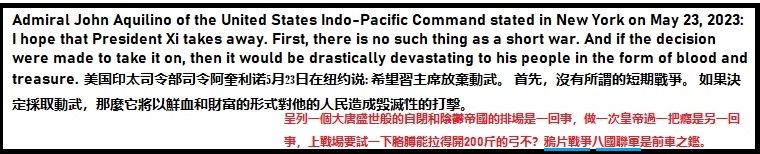
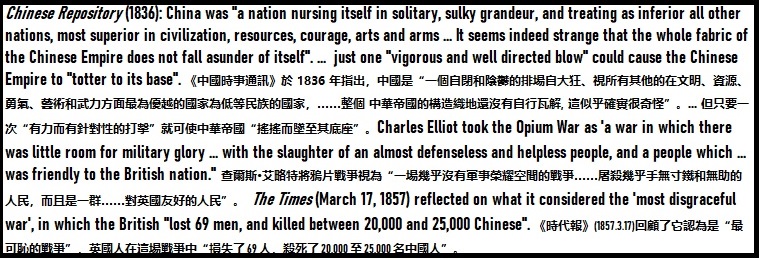
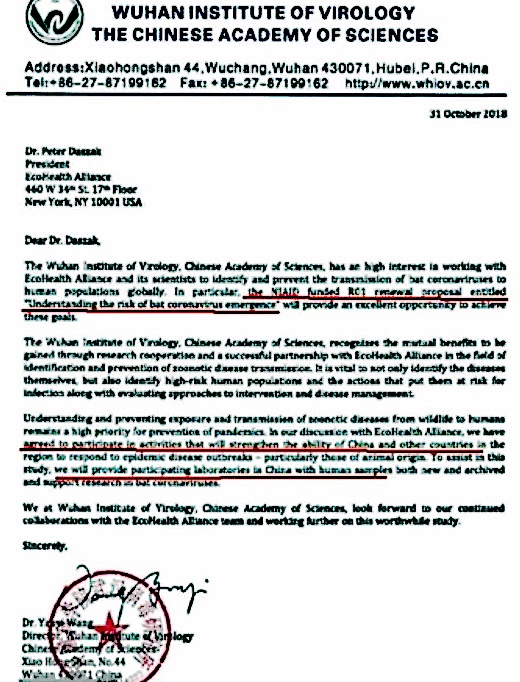


![Though, Anna Wang [Anneliese Martens], in her memoirs, expressed jealousy over Gong Peng by stating that the Anglo-American reporters had flattered the Chinese communists and the communist movement as a result of being entranced with the goldfish-eye'ed personal assistant of Zhou Enlai](GongPeng.jpg)