For twenty years, this webmaster had been telling the world that
Alan Greenspan, possibly the smartest American but bedazzled by the "conundrum" of long term interest rates, does not know that this webmaster's countryside cousins, mostly women, had been going to Guam, Samoa and other Pacific islands for a decade as the export of labor: what is coming to the U.S. market is merely a tag stating something not "made-in-China" but made-by-the-Chinese in nature.
The smartest American turned out to be Professor Peter Navarro, and it might not be some coincidence that his books "The Coming China Wars" and "Death by China" are similar to what this website wrote about for the last 20 years.
What this webmaster does not know is that the Chinese were going to Italy as well, where they worked as coolies and slaves for the "Made in Italy [by Chinese]" brands, and spread the coronavirus in Italy today.
What a farce Communist China gave the world, and what a disaster Communist China caused to the world!
Don't forget that France (Alain Merieux of bioMerieux - sarcastically-related to Moderna, the other side of a coin) and the United States (Anthony Fauci of CDC & Peter Daszak of EcoHealth) acted as the 'enablers' in designing and constructing the P4 virus research center in Wuhan, as well as in providing the funds.
And don't forget what happened today was because the Americans served as the midwife who delivered China into the communist hands as i) Roosevelt, in collusion with Churchill and Stalin, sold out China at Tehran and Yalta; and ii) George Marshall forced three truces [Jan-10-1946, June-6-1946, & Nov-8-1946] onto the Republic of China and further imposed the 1946-47[48] arms embargo while the commies were equipped by the Stalin-supplied American August Storm weapons and augmented by the mercenaries including the Mongol cavalry, the Japanese 8th Route Army troops, the Soviet railway army corps, and the 250,000-strong [Kwantung Army-converted] Korean diehards.
(Refer to
"The Italian fashion capital being led by the Chinese";
"Coronavirus Hits Heart of Italy's Famous Cheese, Wine, Fashion Makers" for further reading.
Military Documents About Gain of Function Contradict Fauci Testimony Under Oath:
EcoHealth Alliance approached DARPA in March 2018 seeking funding to conduct gain of function research of bat borne coronaviruses...
According to the documents, NAIAD, under the direction of Dr. Fauci, went ahead with the research in Wuhan, China and at several sites across the U.S.)
Robert Marquand
of "The
Christian Science Monitor", in its June 03, 2004
edition, wrote an article entitled "New story emerges of
an infamous massacre", which was to play into the
Chinese Communists' denial of massacre on the Square.
The CCP clandestinely thought that should the Square be
cleared of any massacre, then the massacre of the Peking
city would become a myth. Indeed, they thought they
could get away from it with the acquiesce of the US,
Russia and Japan. Henry Kissinger claimed that the
Chinese communists were most tolerant since no
government in this world would allow the mobsters to
take over a capital city for so long. And, George
Bush Sr was certainly eager to send brother
Prescott and secret emissary Brent Scowcroft to renew
relations with the butchers. A
reactionary communist regime, which is bent on
destroying China and the Chinese people, would
certainly meet the American criteria of "containing
so-called Sleeping Lion", i.e.,
a 1850s policy that passed down from merchant-turned
naval general Matthew
Perry as well as revived in the US transfer of
the Diaoyutai Islands, i.e., Senkaku Gunto [Pinnacle
Islands], to Okinawa [Ryukyu]
of Japan in 1971. The underlying logic
behind "The
China Exception: Russian Communism being wicked, the
Chinese are good communists" is an inherent fear
of the Yellow Peril,
i.e., billion Chinese would actually enjoy real
democracy, go to college and develop their intelligence.
(The Christian Science Monitor, like numerous pro-CPUSA publications in WWII, was responsible for China's fall into the communist hands for the propaganda work on behalf of the communists.
For example, The Monitor commissioned a series of ten articles under the general title 'Inside the War',
with Hugh Dean claiming that "it [KMT] had no mass support and was on its way out. ... wound up by saying that the Communists had won the battle for the minds of the peasants, and ... suggested that this was going to be the decisive factor."
Hugh Dean, a graduate of Lingnan University, one of the cradles of the Soviet G.R.U. spies same as Yenching University, passed through HK where Comintern (G.R.U.) agents Gunther Stein and Chen Hansheng briefed him as to how to launch the sabotage propaganda work in Chungking.
Refer to The Wuhan Gang & The Chungking Gang for the hideous work by The Christian Science Monitor, and etc.
More, refer to the Communist Platonic Club at wartime capital Chungking
and
The American Involvement in China: the Soviet Operation Snow, the IPR Conspiracy, the Dixie Mission, the Stilwell Incident, the OSS Scheme, the Coalition Government Crap, the Amerasia Case, & The China White Paper.)
The Tian'an'men Massacre on 4 June 1989 may not be the sole atrocity that had occurred on the square. Zheng Nian mentioned that the ultra-leftist militia under Peking Mayor Wu De had inflicted a bloody crackdown on the mourners on the TAM Square on April 5th, 1976. http://museums.cnd.org/China89/ stated a commonly perceived mythical fallacy that "Mao Zedong labeled the April 5 [1976] event a 'counter-revolutionary riot' and ordered to 'use military force if necessary, but do not open fire'."
Zhang Liang, the alias name author of "Truth About Tian'an'men" [i.e., THE TIANANMEN PAPERS, reviewed by Andrew J. Nathan, Perry Link & Orville Schell], claimed that on April 5th, 1976, 13 years earlier, the CCP mobilized 10,000 militia, 3,000 police and 5 battalions of garrison troops, arrested 388 people, but killed nobody
[??? a myth or a continuous cover-up while Zhang Liang, per Jin Zhong,
could very well be Wu Jiaxiang].
Throughout the summer evenings of 1976, this webmaster had heard, from the neighboring people, about numerous horrific stories to the effect that the Peking militia pierced the mourners with spears, dumped the passed-out victims to the crematorium, or spared death some woman victim who climbed out of the dead corpses. Most of the stories had come from the "business clerks of working units" who travelled out of town, incidentally.
Over 20 years ago, Qian Jiaju wrote that hundreds of Peking citizens were killed by the Peking militia in 1976, and some 50 bodies were shipped to Shanghai for cremation.
While the April 5th, 1976 crackdown was related to mourning late premier Zhou Enlai, the Tian'an'men Massacre on 4 June 1989 [massacre of the Peking city to be exact] would be related to mourning late CCP general secretary Hu Yaobang.
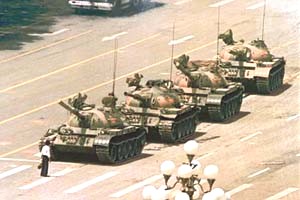
The significant difference of the 4 June 1989 Massacre from that on April 5th, 1976 would be the fact that reporters from the news media all over the world, who had converged upon Peking for the Gorbachev visitation and the World Bank meeting, had witnessed the communist killing machines, i.e., tanks, machine guns, bayonets and dumdum bullets. By daybreak of 4 June 1989, following advice from some wise ass at the CCP Central, the people's "Liberation" army, which had prohibited the medical staff from rescuing the wounded people or retrieving the dead corpses overnight, had cleaned up the streets and the Tian'an'men Square for sake of preventing the satellites from taking snapshots of atrocious scenes.
Note the communist slaughter on the Tian'an'men Square was not its first act of terror in history, and it won't be the last.
China and the Chinese lived in terrors since Peng Pai and Mao Tse-tung launched the rascal-proletariat peasant movements in 1927. Peng Pai at one time claimed that the communist law would be simply the execution of landlords once they were caught. Mao Tse-tung, who could have murdered his New Citizen Society co-founder Peng Huang over 20,000 silver dollars and were directly responsible for the rascal movement in Hunan Province in 1927, would be the red-handed culprits in the Purge of Anti-Bolshevik League during 1930-1931, the Purge of Trotskyists during 1937-1941, and the Rectification Movement during 1942-1945.
After obtaining power in 1949, the Chinese Communists (CCP) launched the "Suppression of Reactionaries Movement" in addition to the "Land Reform" that would see 2 million landlords and relatively wealthy peasants executed, not to mention the raging banditry-quelling wars in the early 1950s that saw millions of anti-communism guerrillas killed by the communists.
(The CCP Bloody Land Reform, however, already started in 1947. See Fanshen: A Documentary of Revolution in a Chinese Village that was first recorded by William Hinton [Han Ding] whose daughter, Carma Hinton, made the documentary The Gate Of Heavenly Peace with Richard Gordon.)
The "Elimination of Counterrevolutionaries" was further launched in 1955 with the advent of 'Hu Feng Reactionary Clique'. In between, the CCP never stopped its terror campaign as exhibited by the execution death of the 1911 Xin Hai Revolution veteran Xia Zhishi together with elder brother, junior brother [4th son in order] and a nephew in the spring of 1951 in Hetongxian county of Sichuan Province.
The communists launched separate movements of "Three Anti & Five Anti" in 1951 and 1952, respectively.
With the changes in the international arena, i.e., Stalinism being negated in the USSR in 1956 and the horrors of the Purge being exposed by Nikita Khrushchov, Mao launched the 'Rectification Movement' on April 27th, 1957. Mao said he had successfully induced the snakes out of their hibernation and officially launched the 'Anti-Rightist Movement' in June 1957.
The Lushan Meeting of July 2-August 16 1959 declared the 'Peng Dehuai Anti-Party Clique'. After 1959 Lushan Meeting, Mao went on to launch a movement against the Anti-Rightist Trend to rout another 3,800,000 people.
Mao Tse-tung's terror reached its climax during the Cultural Revolution. Only the death of Mao in 1976 would see China enjoy a short respite from the political persecutions conducted by the Cult, i.e., the CCP.
The evil nature of communism and its Chinese practitioners never changed, ending in the horrendous massacre in the city of Peking on June 4th, 1989.
Following will be links to websites with a vault of pictures about the 4 June 1989 Massacre:
1989 was a turbulent year for China.
In January 1989, Fang Lizhi, the former university vice president of China Science & Technology University in Anhui Province, wrote an open letter to Deng Xiaoping in demand of the release of Wei Jingsheng [i.e., a Democracy Wall activist]. In the following months, more intellectuals joined Fang Lizhi, demanding the political reform.
In the section on the "Enlightened Intelligentsia" below, we will cover the parallel thread to the student movement.
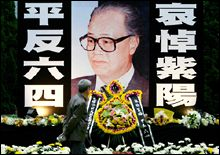
On April 15th, 1989, deposed CCP Party General Secretary Hu Yaobang passed away. On the campus of Peking University, big character posters showed up with the calls for political reform.
On April 17th, ten thousand students swarmed onto Tian'an'men Square to show respect for the late leader. The next day, tens of thousands of students converged upon the square and in front of the "People's Great Wall" for a demonstration against the CCP Central's deliberate low-tone mourning arrangement.
The students raised "seven demands". This would be what this webmaster termed here as the Second Students' Movement in the communist era, not counting the "red guards" movements that were officially sanctioned and launched by the CCP.
The intellectuals, students and ordinary people across China began to show respect for this open-minded rectifier of communist faults and torts with various articles or publications.
Newspaper across the country, including the "World Economic Herald", began to publish series of articles extolling Hu Yaobang's feats for which he was sacked by "paramount" leader Deng Xiaoping in early 1987 in the aftermath of the First Students' Movement of December 1986.
Hu Yaobang [1915-1989] was a veteran communist cadre who joined the Red Army Long March as a Hunan Province teenager in 1934. By 1952, Hu Yaobang was apparently serving the PLA's Second Field Army in Sichuan Province as some kind of propagandist whom writer Bai Hua likened to the short statured instigator, Lenin. (I had at one time thought short statured Deng Xiaoping might have picked Hu Yaobang for the same physique.)
Some writer pointed out that Hu Yaobang differed from most other communists on the matter of "hiding or revealing the emotions", e.g., crying sadly upon the news of his father's death, something that was a deviation from the communist iron-fist style. Bai Hua's article at http://www.secretchina.com/news/articles/4/4/2/62703.html, however, showed that Hu Yaobang was not much different from the General Heh Long gang who were notorious for monopolizing the detached houses and villas as well as holding twice-weekly dancing parties with the skillful women dancers [i.e., those women who were purportedly selected by KMT spy chief Dai Li for serving the American military observers and American officers of "Sino-American Cooperation Office" which was a collaboration project with the US navy information bureau.]
Bai Hua, i.e., the party organizer and dancer picker in Sichuan Province in 1952, stated that only Deng Xiaoping did not like to dance with the women but play bridge card game. (Though, Deng was ascertained to be a womanizer as well among the communist ruling clique, and said to have an affair with a nurse in a hospital.)
Not long time ago, in 1945, the CCP was accusing the KMT of taking custody of five 'zi' suffixed commodities including fang-zi [houses], nü-zi [women] and jin-zi [gold] from the collaborators with the Japanese invaders. General Heh Long was commonly known as a monster of lust, by the way. And, first CCP Sichuan provincial secretary Li Jingquan or his pal Yan Hongyan could possibly be the executor who decapitated Wang Shiwei on the bank of the Yellow River in 1947. In Sichuan Province, Gao Wenjun witnessed the execution of two classmates as a warning to 3000 KMT Whampoa 23rd Session cadets who were sold out to the PLA by the schoolmaster. Throughout the early 50s, the People's "Liberation" Army had engaged in banditry quelling, often slaughtering the KMT [more precisely anti-communism resistance fighters] captives in hordes. http://www.secretchina.com/news/articles/4/5/14/65096.html carried an eyewitness recollection of the PLA officers [from Qin Jiwei's unit] eating livers from the KMT captives.
Hu Yaobang, who was sent to Sichuan Province, hence bonded his relations with the communist leaders of Sichuan Province nativity, including Deng Xiaoping.
After Deng Xiaoping re-asserted his control over the CCP by toppling Mao-designated heir Hua Guofeng in 1981, both Zhao Ziyang and Hu Yaobang were selected as the right-hand and left-hand men. [To gain a historical review of Zhao Ziyang, check Li Dali's comment on Zhao Ziyang's implication in the "each and every village must have blood-letting" movement in Guangdong Province in the early 1950s. Also check Jin Zhong's writing on the execution death of Zhao Ziyang's father [Zhao Wenbin] while Zhao Ziyang was the CCP deputy regional secretary for Puyang of Henan Province.)
In 1977, Wang Juntao was set free after spending nine months in prison for participating in the April 5th, 1976 movement.
Also in 1977, Ba Hua first drafted a drama entitled "The Twilight" to criticize the leftist catastrophe of the 1930s, and paralyzed CCP former public security minister Luo Ruiqing, for his red-handed role in the 1930 persecution as well as his victim role in the cultural revolution, had doubts about exposing the communist darkness.
In late 1970s, after the fall of the Gang of Four (ultra-leftists), the CCP's 3rd Plenary of the 11th Central Committee proposed liberalization of thoughts in late 1978.
Hu Yaobang, acting as deputy schoolmaster of the CCP Party Academy, advocated for "practice being the sole measure for validating the truth".
By 1979, Hu Yaobang, as the CCP Propaganda Department chief / CCP Secretariat secretary-in-chief, rectified hundreds of thousands of communist persecutions dating to the 1955 Hu Feng Clique.
Hu Yaobang had been responsible for rehabilitation and rectifying the CCP faults and torts beyond the cultural revolution. Bai Hua stated that initially Hu Yaobang was furious over one scholar when the said scholar gave an inverse question: "Don't you think there exists one case that should not be rehabilitated since the founding of the country?"
The 'Wounds Literature' popped out, describing various persecutions and tortures that the communist leaders and their families had endured during the CR.
The movie 'Bitter Love' described two lovers and their stories during the CR. Some movies ("Legends Of Tianyunshan Mountains", e.g.) carried the 'Wounds Literature' further, beyond the CR, to the Anti-Rightists Movement of late 1950s.
The Democracy Wall movement, which was built on top of a public poster area near the 38th Route Bus stop, would erupt in 1978.
Deng Xiaoping, for the poster's targeting Huan Guofeng's observing "two whatever Mao Tse-tung said or did", would alert the foreign reporters to the presence of the "Xidan Democracy Wall".
Soon, Wei Jingsheng publicly criticized Deng Xiaoping as someone who would become the second dictator and called for democracy [i.e., the 5th modernization] in addition to the "four modernizations".
Inside of Beijing University, Wang Juntao & Zhou Weimin launched the "Beijing Spring" magazine, while Wei Jingsheng participated in the "Search" magazine.
Hou Xiaotian mentioned that Wang Juntao, during a visit to secretariat-secretary Hu Yaobang in July 1979, was told: "Old brother, as to playing politics, the skillset of you guys was not up to par yet." (Hu Yaobang, in reference to Song Dynasty reformer Wang Anshi's failure, mentioned to Wang Juntao that he and 14000 soldiers could not defeat 3000 government army commanded by General Fu Zuoyi [see first shot of communist civil war for Fu Zuoyi's feats].)
Liberal criticisms of the CCP, heralded by the "Xidan Democracy Wall" activists, would end as an episode called the 'Beijing Spring' by late 1979.
Wang Juntao stopped publishing the "Beijing Spring" magazine in 1980.
Political control was tightened after Deng successfully overthrew Mao-designated heir (Hua Guofeng) on January 29th, 1981.
A woman worker, by the name of Fu Yuehua, was arrested for carrying a poster on the Square in protest of 15-year sentence that Wei Jingsheng received.
In 1980, Wang Juntao, Hu Ping and Chen Ziming participated in the first wave of "free elections" on the university campuses for the Peking district representatives of the National People's Congress. (For the active role in the grassroot democracy movement, they were almost kicked out of the Peking city at graduation in 1982.)
Also in 1980, the "bodily-system [i.e., structure] reform institute" was established, with members being mostly young scholars who were influenced by the Western economic theories. Nicknamed the "peasant party", young scholars, from 1980 to 1986, first proposed the "contractual system" for peasants to develop agriculture.
As a reward for Hu Yaobang's proactive role in blasting Hua Guofeng [for the "leftist" mistakes, including attempts at making himself an icon similar to Mao], Deng Xiaoping made
Hu Yaobang into general secretary of the Communist party in 1980 and party chairman in 1981. Zhao Ziyang tacked on the premier post in 1980. At the 6th Plenary of the CCP 11th Central Committee in June 1981, Deng Xiaoping himself changed seat to the CCP Military Committee chair in lieu of the rubber-stamp post at the People's Political Consultative Conference.
Deng Xiao-ping, to justify his crackdown on the 'Xidan Democracy Wall', would launch the theory of 'Four Insistencies', namely, Insisting On the Communist Dictatorship [i.e., the People's Democratic Dictatorship]. A warning, related to the criticism of the Movie 'Bitter Love', was issued to the entertainment industries and the propaganda ministry.
Bai Hua said that Hu Yaobang had protected him on the matter of "Bitter Love" though Hu Yaobang refused to watch the movie himself in January 1981.
On April 20th, 1981, the "People's 'Liberation' Army Newspaper" issued a commentary stating that "four insistencies should not be violated". (The "People's 'Liberation' Army Newspaper", the "Peking Daily" and the "Peking TV Station" were said to be controlled by the most conservative faction of the CCP.)
Throughout 1981, Hu Yaobang, on numerous occasions and during several meetings, tried to compromise between the "enlightened" writers [i.e., Bai Hua and Ba Jin et al.,] and the conservative [i.e., reactionary] communists.
In late 1983, a short term movement called 'the Anti-Bourgeois Liberalization & Anti-Westernization' was launched, but it lasted 27 days due to lack of support. The CCP devised a term called the "spiritual contamination" for the Westernized thoughts.
On December 29th, 1985, the Chinese Writers' Association, per Bai Hua, held a liberalized meeting to which senior CCP leaders, like Hu Yaobang, Wan Li, Xi Zhongxun, Hu Qili and Bo Yibo et al., attended.
In 1984, Wang Juntao and Chen Ziming both courageously resigned their jobs at the government agencies for launching non-governmental research institutes, respectively.
Societies and associations flourished both in societies across the country and on the campuses.
Various science & technology development companies were established across the country, leading to formation of the so-called "China-Silicon Valley" in Zhongguancun of Beijing where the Sitong [Stone] Computer Company would be labeled a 'black hand' after the massacre for its sympathy with and donations to the student movement.
German "superman philosopher" Friedrich Nietzsche writings revived as happened during the "new culture movement" of 1910s, and young students, like me, nevertheless felt lofty after reading a few pages about the "superman". (Incidentally, at about this time, entering China's market would be Christopher Reeve's 1978 3-D movie "Superman" which college students watched as part of so-called "communist youth league" entertainment activity.)
Coinciding events would be the publication of Bai Yang's "The Ugly Chinaman" in 1985.
Also prevalent among the college students would be ideas of the "futurologist school of thought", Alvin Tofler, and "The Third Wave" that were propagated by Wen Yuankai.
Su Xiaokang, i.e., a then cultural-national nihilist in my present opinion, presided over a six-part anti-tradition/anti-culture TV serial entitled the "River Elegy" ("He [Yellow River] Shang [mourning]). (What Su Xiaokang did not know, by embracing the wholesale Westernized "blue sea civilization", would be something more disturbing: Su Xiaokang may never realize a racial weakness among the Chinese people.)
In the summer of 1986, Deng Xiaoping proposed "hastening up political reform".
Fang Lizhi toured the colleges and universities with preaching of democracy.
With Zhao Ziyang and the "bodily-system [i.e., structure] research institute" in charge of economic reform, Hu Yaobang sought the assistance of Chen Ziming and Min Qi in establishing a separate "China Politics & Administration Research Institute".
Wang Juntao was hired over from the Wuhan city by Chen Ziming.
After Hu Yaobang's loss of job,
the "China Politics & Administration Research Institute" was renamed to the "Social, Economical & Scientific Research Institute of Peking".
(Chen Ziming, Min Qi & Wang Juntao claimed to herald "economic positivism" in China beginning from 1987.)
Zhao Ziyang was to become the "interim CCP General Secretary" while Li Peng tacked on the premier post.
Another 'Anti-Bourgeois Liberalization Movement' followed in early 1987. Three prominent intellectuals, i.e., Fang Lizhi, Liu Binyan and Wang Ruowang, were singled out by the CCP Central, to be stripped of party membership.
Soon, Zhao Ziyang himself began to act in a "liberal" [or bourgeoisie] way, wearing the Western suits and sun-glasses, playing golf, and executing on sensitive politics without consultation with the "paramount" leader.
(Lin Mu cited Li Honglin's May 17th, 1989 conversation in pointing out that Zhao Ziyang disbanded Deng Liqun & Xiong Fu's conservative CCP organs right after assumption of the CCP general secretary's post, and further protected Bao Tong, Li Honglin & Yu Haocheng et al., from being put on Deng Liqun's blacklist.)
The First Students' Movement
In December of 1986, the First Students' Movement erupted in major cities of China, demanding democracy as well as punishment of corrupt officials.
Li Bei pointed out, at http://www.secretchina.com/news/articles/4/6/2/66074.html, that it was the result of Fang Lizhi rotating visitation to major universities that led to the 1986 student movement across the country in 1986. Fang Lizhi visited the Shanghai campuses around Nov. Several newspapers, including the 'World Economic Herald' reported on the speeches.
(However, this webmaster had also heard from my highschool classmate that Fang Lizhi might have tried to stop the students from going out of the campus of the China Science & Technology University, which impressed me as something similar in behavior to Fang Lizhi's seeking asylum inside of the U.S. embassy in Peking after the 1989 massacre.
Zeng Huiyan's 1988 book, "Records Of Student Movements In Mainland China" [Jan 1989 edition, Globe Publishing House, HK], pointed out that deputy schoolmaster Fang Lizhi pleaded with 2000 students for 'rationality' in front of the library of the Chinese Science & Technology University [CSTU] on December 5th, 1986.)
2500 students left the library for the streets at about 1:15 pm on December 5th, with slogans such as "Long Live The Republic!", "Reform The Election System", "We Want Democracy, Not Cracy-demo (i.e., ruling the people)". The First Student Movement's trigger started with December 1st campus poster in regards to the communist party branch secretary's secretive internal assignment of regional candidates for the western Hefei city district of the National People's Congress [NPC]. Days later, on December 4th, inside of the CSTU auditorium where student leaders proposed their NPC regional candidacy, Fang Lizhi made a speech about democracy; however, the second day, Fang Lizhi cautioned against going to the streets. Wen Yuankai, at the auditorium, also made an encouraging speech, and mentioned NPC chief Wan Li's comment as to the "democratic administration of CSTU" [a comment made in Wan Li's November 30th visit to the campus]. Anhui University heard about the commotion inside of CSTU, and coordinated for the second day parade with students of CSTU. On December 5th, the CSTU students converged with Anhui U & Hefei Industrial U in front the municipality building, causing a firestorm across the nation when the students in Wuhan, Kunming, Nanking, Shanghai, Jinan, Tianjin, Haerbin, Hangzhou, Suzhou, Shenzhen, Guangzhou & Beijing echoed their support.
On December 9th, in commemoration of the 12-9-1935 student movement, CSTU launched another protest.
The Wuhan students in Wuchang of Hubei Province went on the street on the same day.
Two days later, the CSTU poster appeared on the campus of Beijing University.
In Shanghai, then mayor Jiang Zemin [i.e., later CCP secretary-general after 1989 massacre], was hush-hushed off the stage of auditorium of Shanghai Jiaotong University when he tried to rein in the student protesters. Before leaving the stage, Jiang Zemin exhibited his ugly 'mouth & face" by threatening a student: "Dare you tell me your name and your department?"
Note that Jiaotong University did not participate in the protest movement till one of their students was hit by the gymnasium picketing staff on the night of December 9th: The gymnasium workers hated to see those Chinese, especially the Chinese girls, jump onto the stage to dance with the American "Jan & Dean" rock'n roll team. (The Chinese populace were not used to the kind of racial "openness" in the old days, whereas today it could be said to be an ironic and ludicrous fad.)
After the newspapers refused to report on the violence, the Jiaotong U students wrote a public poster on campus on the 15th [which was not related to the December 10th poster in regards to CSTU student movement].
After the campus security staff tore apart the poster, students came up with a new batch of posters on the 16th, this time, talking about the political agenda in lieu of punishment of the gymnasium culprits.
Students representatives held an unsuccessful dialogue with the city police.
After the "Youth Newspaper" scrapped 40,000 pieces of printouts with the "reader's response" covering the gym matter, Jiaotong U, together with Tongji U, decided on a demonstration on the night of December 17th.
On the morning of December 18th, the Jiaotong U students were said to engaged in zigzag wars with the campus security in re-posting the notices after being torn apart.
Jiang Zemin suddenly made a decision to see the students for the "dialogue"; however, the students refused to go to the 400 person hall inside of the Bao-zaolong Library.
Surprised that the library was quiet but bragging that he feared nothing as a 'senior student leader of the 1940s', Jiang Zemin was then steered to the auditorium.
Dialogue ended up to be held inside of the 4000 person auditorium where Jiang Zemin rushed to the stage, received a round of applause at the introduction of schoolmaster Weng Shilie, talked about three notable figures [like him] who graduated from Jiaotong, and hoped that a 4th person would derive from the ranks of 'listening [to communist party]' students. When Jiang rebuked liberty as something first proposed in the West 200 years ago, the students were offended. Jiang's order to stop hush-hush was ignored. 25 students and one teacher came up to the stage to raise questions. Jiang ultimately lost his face after entanglement for 4 hours.
While Jiang Zemin rushed to Jiaotong, municipal party secretary Rui Xinwen went to CENU where he failed to see any student activity.
2000 students from Tongji started the parade after noon without advance knowledge of the Jiaotong University dialogue with the mayor.
After wrestling with 300 teachers for one hour, about 1000 students, with banners, broke out of the campus gate.
The Tongji U students, however, changed course towards Fudan U, scaring the gatekeepers into a closure. The students marched through the campus of Fudan, but failed to rally any support. The Tongji students were steered back to the campus after i) college-sanctioned "student society" leader took control of the banner and ii) 500 students were persuaded off the parade by the teachers.
After checking out the 'treachery' of Jiaotong U, the college students of Shanghai coordinated for the December 19th massive demonstration.
On December 19th, the Shanghai students mounted a massive protest, with impact seen near the municipality building on the Bund as well as the NPC building at the People's Square.
2000 police were deployed against the sitting-in students in front of the municipality under Jiang Zemin's order.
Yang Wei, a student who returned from U.S., was arrested.
Both Tongji U and Fudan U held banners claiming to be supportive of i) Deng Xiaoping and ii) the reform. China Eastern Normal University [CENU] also joined in after the initial student activity was repressed by the campus party secretaries in mid-Oct. Some radicals climbed over the fence of the NPC building on December 19th.
The police bureau of the Shanghai Municipality put up "six rules as to public security" at the square as a detente on December 23rd.
Rumors of the police barbarity against a Tongji student in Shanghai spread to Hefei, leading to a 3rd wave of protests among the CSTU students on December 23rd. The CSTU students demanded a dialogue with the city, ending in a petition letter submitted to the city by the CSTU leaders. The students dispersed at night when the city agreed to make a response to the student demands within 3 days.
The Hefei Municipality backed down by delaying the voting to December 29th and allocating an extra four quotas for CSTU.
The CSTU students then organized the 'NPC election campaign speech corps" for propaganda both on campus and on the streets.
Both Fang Lizhi and Wen Yuankai, plus a student called Sha Ma, were elected.
The world media descended upon Fang Lizhi for reporting on the NPC election and the student protest.
Voice of America poured gas onto the fire by alerting the communist conservatives to the democracy activities.
On December 29th, 1986, the People's Daily published an editorial, with a claim that "talking democracy does not mean departing from the path of four insistencies", and hinted "a handful of conspirators..."
By late Dec, there were rumors in Peking stating that Hu Yaobang would be sacked. On New Year Day 1987, the students again swamped onto the Peking streets. Two weeks later, in January 1987, CCP General Secretary Hu Yao-bang was forced to resign by Deng and the Politburo. Numerous memoirs pointed to Hu Yaobang walking out of the politburo meeting with tears, still unconvinced that some of his politburo allies had lodged untrue accusations against him for the soft stance on the students and intellectuals.
(Per Wu Jiaxing's writing, Zhao Ziyang had nothing to do with Hu Yaobang's sacking, and later took in the followers of Hu Yaobang.)
The CCP's Economic Crimes
During the ensuing two years, the political liberalization enhanced the economic corruption among the "prince and princess gang", with Zhao Dajun [i.e., Zhao Ziyang's son] and Deng Pufang [Deng Xiaoping's son] becoming the prime targets of the students.
Hu's death in 1989 would trigger the Second Students' Movement which ended in the June 4th Massacre of 1989.
During the Second Students' Movement, the students mounted attacks at the phenomenon of "guan dao" [i.e., the commodity resale by governmentally sponsored organizations] and blamed it on the princeling party.
Complicating the corruption issue would be price hike of major consumer products around the turn of the year. Yuan Mu, i.e., some speaker of CCP Central, would become the most hated communist cadre for his TV-broadcasted message of "price adjustment".
http://www.secretchina.com/news/articles/4/5/29/65847.html carried an article in regards to the nature of "guan dao", stating that it was the CCP Central's evil "two track system" that led to "guan dao", not the princeling party. The CCP Central, at the time of economic reform in mid-1980s, distributed the "production & consumption materials" to the "state enterprises" at planned-economy price and to the "non state enterprises" at market-determined price. The category of the "non state enterprises" would include mostly sub-regional factories or working units, like the shire-township enterprises [i.e., "xiang-zhen"].
(In section on the 'All-People Registers' vs 'Collective Registers', we used Ma Hong's Economic Annals to define the "inferior" Collective Register Enterprises as those that did not enjoy the government subsidy.)
Similar to the agri-industrial scissor differential that discriminated against the peasant entity [non-privileged class] versus the city dweller entity [privileged class], the CCP Central's "two track system" served the only purpose of differentiating further between the privileged class and the lesser-privileged class.
The princeling party or the "prince and princess gang", with firm grip of the Nation's "production & consumption materials", could easily make a living by signing "referral letters" or selling the "surplus materials" for a market gain.
After the Tian'an'men Square Massacre, the communists found another game, i.e., the land enclosure movement that would see the peasants deprived of their fields at non-market rate in the name of urbanization and industrialization as well as saw the city dwellers forced to relocate on the pretext of "remodeling on the dilapidated houses". The Communist leadership, in collaboration with world capitalists, had been making windfall profits in selling land development permits or sub-contracting construction projects like skyscrapers, so-called 'noble' district for single-family residences, high-rise luxury condominiums and shopping centers.
Land, a resource owned by the State [i.e., CCP], was always a taboo topic prior to Deng Xiaoping's post-massacre "relaunching economic reform with a southern tour of the SEZs [special economic zones]".
Having brought to the U.S. the newspaper clips from the "World Economic Journal" spanning multiple years, this webmaster finally threw them away. Nobody had really been able to predict the massive "land enclosure movement" that occurred in China after the 1989 massacre.
Neither did Wang Juntao's "Economics Weekly" make a good forecast on the subject.
Heralding "economic positivism" since 1987, Chen Ziming, Wang Juntao and their "Social, Economical & Scientific Research Institute of Peking" played two constructive roles, i) calling attention to the social, economic & political crises, and ii) transplanting the Western economic theories and concepts, including stagflation, development economics, corporations as legal entity [i.e., "economic person"], existence of economic cycle in socialist economies, welfare system, and income distribution, government subsidy to city-dwellers.
Wang Juntao, in 1988-1989, was wrongly pointing to the "economic interests" as the barrier to internal reform by the communists, not "political conservativism".
15 years later, at a forum (http://www.epochtimes.com/gb/4/6/4/n558888.htm), Wu Renhua, with Wang Juntao & Wang Dan, would have to agree on the fact that China's path to democracy and freedom could be even more tenuous due to a mutant communist party built on top of the "economic interests" rather than the "ideological perseverance".
15 years after the massacre, against the context of world-wide rising price in copper, scrap metals, oil and cement [pulled by the strong demand from China] would be the following scenes: the state-owned enterprises had been dissipating into the hands of a handful; young or middle-aged workers were terminated the employment in exchange for one-time payout; peasant migrant workers succeeded the most hazardous jobs in mines and factories; and hundreds of thousands of peasant children swamped to coastal economic zones as slave labor or child labor.
In the background would be breaking-down families, a predatory and selfish human character, and the morally degenerate society.
The Enlightened Intelligentsia & Petition Movements
Bao Zunxin, author of "Insider Stories of June 4th: An Unfinished Nirvana" [Wind & Cloud Publishing House, April 1997 edition, Taipei, Taiwan], gave recollection of the parallel thread to the student movement. (Bao Zunxin, similar to the majority Chinese folks, including the communists, had been either shy or timid, i.e., omitting the word "massacre", in giving name to his book.)
"Insider Stories of June 4th" started with his January 28th, 1989 attendance of the "New Enlightenment Salon" gathering inside of the Dule Bookstore at the invitation of the female proprietary owner Yu Yansha. Yu Yansha, who had a same name bookstore in the Shenzhen Special Economic Zone, was a sociable woman capable of liaising with the "distinguished" people both inside and outside of the "system" [i.e., government].
The Saturday gathering was originally intended for Wang Yuanhua's "new enlightenment book series" which did not look solid in the eyes of Bao Zunxin. Both Wang Yuanhua & Wang Ruoshui were the hosts. (Wang Yuanhua & Bao Zunxin, in 1988, adopted the term "new enlightenment" on basis of a term first proposed by the CCP propagandists, Chen Boda & Heh Ganzhi, in the 1930s.)
At the scene, Bao Zunxin encountered Jin Guanshou & Liu Qingfeng couple who claimed that CCP leader Hu Qili had warned them in regards to a speech by Jin Guanshou that "the failure of some socialist countries was one of the two major events of the 20th century". Jin Guanshou was the organizer of the "21st Century Research Institute" and brought along his members like Zhang Gang and Jia Xinmin.
Semi-retired communist theorists, like Li Rui, Dong Dalin, Qin Chuan, Hu Jiwei & Li Chang, also came.
Together with the people "inside of the "system" would be those guys who had lost favor with the communist leadership, including Su Shaozhi, Li Honglin, Yu Haocheng, & Wu Mingyu.
Representing Chen Ziming's "Social, Economical & Scientific Research Institute of Peking" would be Min Qi, and representing Li Shengping's "Social & Scientific Development Research Institute of Peking" would be Zhang Xianyang, Li Ming & Yan Jiaqi.
To the surprise of Bao Zunxin, Fang Lizhi, the former university vice president of China Science & Technology University in Anhui Province, suddenly descended upon the salon, with almost simultaneous photo sessions by a few foreign reporters who had been waiting at the scene with advance knowledge, of course.
Fang Lizhi stated that recently he wrote an open letter to Deng Xiaoping demanding the release of Wei Jingsheng [i.e., the Democracy Wall activist] in accordance with the U.N. "human rights declaration" that China [R.O.C.] had signed in 1948.
Fang Lizhi further stated that in the past, he had adopted the approach of "fighting the communists inside of system" by requiring that all staff members of his research institute at China Science & Technology University enroll in the CCP.
Fang Lizhi claimed that he had now decided to "fight the communists from outside of system".
After Fang Lizhi dropped the bomb, silence reigned in the salon. With the impasse, Wang Yuanhua announced the dismissal of the gathering shortly afterward. Bao Zunxin was disappointed that nobody at the salon had mentioned the term "new enlightenment".
Three days after the salon event, Bao Zunxin received a call from a friend "inside of the system", i.e., a warning in regards to Fang Lizhi's subversive activities. Bao Zunxin realized that he could be on a blacklist by then. In Hubei Province, Long Yuequn of Hunan Education Publishing House was interrogated by the public security bureau for attending the salon event. In Shanghai, Wang Yuanhua received assurance from CCP deputy branch secretary Rui Xinwen in regards to the salon gathering. (Rui Xinwen belonged to the moderate CCP leadership, by the way.)
After the massacre, Bao Zunxin asked Wang Juntao repeatedly whether any "black hands" were behind the student movement. Wang Juntao mentioned that some intellectuals did give opinions and ideas to the students. However, Bao Zunxin stated that only Fang Lizhi had made visits to Peking University while Wang Ruoshui, after the 1987 purge, had shunned himself from campuses.
Bao Zunxin likened Fang Lizhi's inflammatory speech to writer Lun Xun's description of "the Chinese populace who were sound asleep in a dark house with no windows".
In the following months, more intellectuals joined Fang Lizhi, demanding the political reform.
On February 12th, Sunday, poets Bei-dao [northern island] and Lao-mu [old wood] visited Bao Zunxin at his house. (I am not sure whether it was Bao Zunxin's new residency inside of "ti-zhi [bodily-system] gai-ge [reform] yan-jiu [research] suo [institute]". Do note the communists played game with terminology in differentiating between ti-zhi [bodily-system] and zhi-du [system].) Bei-dao, who claimed he just returned to China but would leave for Britain again soon, produced an open letter for Bao Zunxin to sign, which was a followup to Fang Lizhi's call for the general amnesty on two occasions: i) the 40-year anniversary of the founding of the PRC on October 1st, and ii) the 70th anniversary of the May 4th Student Movement.
It turned out to be the 33-signature open letter, with the first signatory being Bai-dao and the last one being Chen Jun.
Bao Zunxin did not get to know the involvement of Chen Jun till he heard about a denunciation by a judicial ministry official on radio on February 22nd.
In the following days, Bao Zunxin was shown a government-printed bulletin by Zhang Gang as well as received a copy in the mail about the 33-signature open letter.
Senior female writer Bing-xin [icy heart] published a clarification letter on a HK newspaper on February 21st, claiming she did not know who Chen Jun was. Also in HK, the CCP underground agents published an article about Wei Jingsheng's crimes on "Da [grand] Gong [justice] Bao [newspaper]".
The CCP then transcribed the two HK newspapers onto semi-internal party newspaper "News For [Your] Reference" as a propaganda war, ironically without carrying the contents of the original 33-signature open letter.
Jing Jun of Peking University asked whether Bao Zunxin would be willing to be interviewed by the American Broadcasting Corp. Bao Zunxin suggested Wang Ruoshui as a candidate for the interview.
Chen Jun, a contributor to the U.S.-based "China Spring" magazine, had been engaged in anti-government activities via following covers, i.e., possibly possessing a U.S. permanent residency status, participating in the "Chinese Modern Arts Exhibition" in Peking, and operating a "Jie Jie Bar" sort of business in Peking.
Chen Jun, often rebuking the Chinese intellectuals as "cowards", subsequently organized the "work panel for general amnesty in 1989" by assembling a group of artists and intellectuals inside of his bar for signatures.
By early March, Bao Zunxin was contacted by Taiwan's "xin xin wen" [i.e., New News] for comments on Chen Jun's signature collection activity.
It is clear that both the communists and the activists were utilizing the same trick of "exporting for sake of re-importing news reports".
While some professor at Peking University wrote a self-criticism, Bao Zunxin authored an article for a Taiwan newspaper clarifying his standground on the open letter.
Synchronizing with Bai-dao and Chen Jun's signature collection activities would be that by Xu Liangying who took advantage of Hu Jiwei's "forum on democracy issues" held on February 26th inside of "Research & Development Company of Capital Steel & Iron Corporation [CSIC]". (The 60-participant "forum on democracy issues" was an activity organized by the "democracy series" editorial committee and "Research & Development Company of CSIC".)
With Wu Jiwei absent from signature activity due to the People's National Congress membership, Xu Liangying assembled Li Honglin, Yu Haocheng, Zhang Xianyang, Wu Jiaxiang and Cao Siyuan et al., for drafting and revising a declaration that was attentioned to the top 4 CCP leadership, i.e., Zhao Ziyang, Wan Li, Li Xiannian & Li Peng.
About 42 people, mostly scientists, signed the petition which was published on HK's "Jing [mirror] Bao [newspaper]".
Thereafter, the CCP clamped down on dissent by prohibiting the scheduled convention on "comparing the May 4th Movement & the French Revolution" in Hubei Province.
On March 14th, the opening ceremony of Chen Kuide & Wang Yan's "Thinker" magazine was cancelled when Qianmen [front citygate] Hotel and subsequently Nanhua [southern China] Hotel declined them at the intervention of the state security ministry.
At the lobby of Nanhua Hotel, Dai Qing, i.e., some adopted daughter of senior CCP leader Ye Jianying, took advantage of the stranded crowd in launching a new 43-signature petition movement which Bao Zunxin declined.
Dai Qing later claimed that she, Su Wei and Chen Kuide signed their names out of the fury over the meeting cancellation.
One week later, Dai Qing, in the name of HK-Taiwan intellectuals, requested for Bao Zunxin in launching another petition movement which both Bao Zunxin and Yan Jiaqi did not concur with. Someone from HK, by the name of Zhang Langlang, called Bao Zunxin as to the refusal.
Bao Zunxin further mentioned that the New China News Agency announced on March 28th that some HK visitor was banned from entry into China at the Tianjin airport. (Never underestimate the communist infiltration abilities !!!)
The Second Students' Movement
Students at Peking University seemed to be the propelling force behind the assembly of meetings and demonstrations. They demanded the political reform and "democracy civilization". Unlike Qinghua University, Peking University was noted for the democratic spirits that went back as far as the "new culture movement" of the 1910s. In contrast, Mao Tse-tung's communist regime had a tradition of trashing "curriculum of arts" and emphasizing on "curriculum of sciences" [for sake of Atomic Bomb Project, e.g.] since taking over power in 1949, yielding the sarcastic result that majority of CCP Politburo members were graduates of Qinghua University no matter their diplomas were real or faked.
After the death of Hu Yaobang on April 15th, 1989, at Peking University, big character posters showed up with calls for the political reform. Some memoirs pointed out that the "big character posters" followed the first appearance of the "small character posters" on campus.
Top two issues raised by the students would be: i) restoring the reputation of Hu Yaobang; and ii) reversing the CCP Central Committee's decision in regards to the 1987 'Anti-Bourgeoisie Liberalization Movement'.
Inside of Peking University, student leader Wang Dan, who had obtained a permission to establish the "democracy salon" at a corner near the Cervantes Statute, was said to have constant contacts with the Fang Lizhi couple.
Graduate student Feng Congde, who claimed to have no interest in politics, dropped off to read the big character posters in the "triangle area" when his computer at the lab broke down. Feng Congde claimed that Chai Ling, i.e., his ex-wife, was a woman interested in going to the U.S. via 'F-2 spouse visa' for material pursuits but nevertheless got involved in the student movement because of him.
On the 16th, Bao Zunxin received a call from Sun Changjiang stating that Hu Yaobang's son, i.e., Hu Deping, had set up an altar at the Hu residency.
At the time Bao Zunxin planned to go to Hu Yaobang's house, a Taiwan female reporter called him with information about the "big character posters" inside of Peking University. (Bao Zunxin had a habit of often riding in Wang Limei's car in exchange for tips and news to the Taiwan newspaper.) Bao Zunxin rode on the reporter's car for the university, and stopped by to express condolence to Hu Deping who allowed the public access to his house where people lined up around the building already.
Bao Zunxin managed to go inside Peking University by claiming to visit an acquaintance, and observed lots of big character posters, poems and eulogies at the San-jiao-di [i.e., triangle area].
Bao Zunxin then visited the People's University where he located an acquaintance called Yu Shuo for information.
Yu Shuo pointed out that the students had been going to dance parties and other entertainment activities while writing the big character posters in commemoration of Hu Yaobang simultaneously.
Bao Zunxin later visited the two universities two more times, on the 18th & the 24th, respectively.
On April 17th, in Shanghai, students from Eastern China Normal University, per Shi Tao, also went onto the streets.
In Peking, ten thousand students swarmed onto the Tian'an'men Square to show respect for the late leader. The next day, tens of thousands of students converged upon the square and in front of the "People's Great Wall" for a demonstration against the CCP Central's deliberate low-tone mourning arrangement.
Students raised the "seven demands".
Bao Zunxin pointed out that the students first proposed the "five demands" on April 17th, that Wang Dan of Peking University proposed the "nine demands" on April 18th, that Qinghua University proposed their demands on the 19th, that Wang Dan revised on top of Politics & Law University's demands to derive the "seven demands" on the 19th, and that the People's University proposed the "ten demands" on the 18th.
(The CCP did authorize commemoration activity but did not offer the usual elegy of calling Hu Yaobang "a great Marxist". Lin Mu, who wired a condolence message to Li Zhao, came back to Peking on May 9th to join the 'Hu Yaobang Life' writing panel at the CCP Party History Publishing House.)
Students First Beaten By the Police During Confrontation
On April 19th, 1989, students from colleges and universities of Peking were in confrontation with the police on the Tian'an'men Square, near the Zhong-nan-hai [middle southern lake] CCP Party Apparatus. The students briefly breached the police cordon and called the name of Li Peng, i.e., China's premier. By the night, the police attempted to dispel the crowd by force at the Xin-hua-men [New China] Gate. News soon spread, leading to the widespread support from students across the country. Next day, escalated confrontations were classified as the "April 20th Xinhuamen Incident".
On the campus of Beijing University, Xiong Yan claimed to be the first student who jumped out of the crowd to make a public speech in calling for formation of the "autonomous student union".
Students organized a "preparatory committee of the student movement of Peking University" when nobody from the communist party or youth league organizations came out to assume the leadership.
Bao Zunxin stated that he, like other intellectuals, deliberately kept a low profile for avoidance of being "a handful of conspirators" in the eyes of the CCP Central. Thus, during two initial visits, Bao Zunxin could not locate the big character posters at the People's University.
On April 20th, Bao Zunxin declined the proposal from Wei Qun of the "China Youth" magazine in lending support to the students who were beaten up by the police the previous night.
In the afternoon, Yuan Zhiming called Bao Zunxin in regards to the student demonstration, and Bao Zunxin agreed to meet with Yuan Zhiming at the People's University. Having called over his [Taiwan female reporter] driver, Bao Zunxing went to the campus where they, together with Wang Runsheng, Chen Xuanliang and Rong Jian, convened a meeting inside of Xie Xianjun's house.
They decided upon a draft calling for a dialogue between the government and the students. (Here comes an important criticism of the Chinese intellectuals as a whole: acting as "mediators", not leaders.)
Then, they made arrangement for the signature collection on the east side and west side of Peking the next day.
The next day, the 21st, on the east side of the city, Bao Zunxin brought the letter into the "Academy of Social Sciences" and obtained signatures from the History Institute, the Marxism Institute, and etc., including those of Yan Jiaqi and Yu Haocheng. (Cao Siyuan declined to sign.) Bao Zunxin sent along the college student to the homes of Su Shaozhi and Wu Zuguang for signatures.
By 6:00 pm, on April 21st, the intellectuals with progressive thoughts, i.e., Bao Zunxin and Yan Jiaqi et al.,, numbering 47, who were mostly counsellors in Zhao Ziyang's "wise brain nucleus", published, on the poster area of both Peking University and People's University, an open letter to the CCP Central with a call for heeding the students' demands.
In early morning of April 22nd, Zheng Yi brought the open letter to the Square and read it to over 10,000 sitting-in students.
Zhao Ziyang's "wise brain nucleus" would include Wu Jiaxiang, i.e., the top representative of the school of thought on "neo-authoritarianism": Wu Jiaxiang was bent on likening China's dictatorship to the autocracy under Singapore's Li Guangyao. (Wu Jiaxiang purportedly tendered his resignation letter on the morning of June 4th.)
Throughout the late 1980s, numerous scholars and intellectuals published articles on the Shanghai-based "World Economic Herald", touching on mostly economic reforms that would include sub-contracting, stock-holder ownership, and reform measures on salvaging the state enterprises.
The death of Hu Yaobang would shift the focus of those scholars and intellectuals to the taboo topic of "political reform" instead of "economic reform".
The Dramatic Act of Students Kneeling Down To Present a Petition To the CCP
On April 22nd, 1989, the CCP Central held a funeral for late Hu Yaobang, with high remarks for his feats albeit omitting the reason why he was sacked in January 1987.
Millions of Pekingers lined up on the boulevard to see the funeral van pass by.
The funeral somehow pacified the students.
However, a dramatic event kicked up again when three students, including Guo Haifeng, knelt down on the steps in front of the People's Hall with a petition.
When the communist leadership refused to receive the students, the students were in tears.
On April 23rd, the students at Peking University, who had overthrown the party-sanctioned student union, would convene a "joint meeting" in the name of the "Peking Interim Consolidated Student Union" [i.e., 'bei gao lian'] and called for a general strike on May 4th, 1989.
Student activist Zhou Yongjun tacked on the "chair" post of the "Consolidated Student Union of Colleges & Universities in Peking" from April 23 to April 27th, to be followed by Wu-er-kai-xi [i.e., on the April 28 & 29th] and Feng Conde successively.
Feng Congde claimed that he did not know Wang Dan nor heard about the "democracy salon" at the beginning.
On April 23rd, the CCP Peking Branch Commissar Committee convened a meeting for party branch secretaries of colleges and universities in Peking. The CCP leaders, such as Li Tieying, Heh Dongchang & Liu Zhongde attended the meeting. Later in the evening, an expanded meeting was held by Li Ximing & Heh Dongchang for both principals and branch secretaries of 67 colleges and universities.
Also on April 23rd,
Chen Mingyuan stood out at the "Triangle Area" of Peking University by blasting at the CCP Central's name-calling on radio on the 19th & 20th. Chen Mingyuan denied that any "unidentified people with ulterior motives" were behind the students.
On April 24th, 200 college teachers and professors called on the CCP Central to conduct a dialogue with the students in the spirits of the CCP Central's 13th Central Committee resolutions.
Politics and Law University cautioned against the crackdown by force.
On the afternoon, the CCP Peking Branch Commissar Committee convened a meeting for standing committee members, claiming to the CCP Central that they had the "methods" to solve the student "turmoil" which was result of the 'Bourgeois Liberalization' flooding with implication of reactionaries from both inside and outside of the party as well as from both inside and outside of the country.
The Crackdown On the "World Economic Herald", & the "People's Daily" Commentary
Meanwhile, the CCP General Secretary made a scheduled official visit to North Korea, which turned out to be a bad decision at the time of turmoil: the CCP Central issued the April 26th Commentary on the "People's Daily" in the absence of Zhao Ziyang.
Wu Jiaxiang disclosed that Zhao Ziyang, before leaving for N Korea on April 21st, had instructed that no politburo meeting should be held in his absence but Yang Shankun & Li Peng immediately convened a "CCP Expanded Politburo Meeting", then reported to Deng Xiaoping with meeting opinions, and then borrowed Deng Xiaoping's mouth in stating that the CCP "should not fear bloodshed".
Zhao Zhiyang's self account, recorded by Yang Jisheng, claimed that it was li Ximing & Chen Xitong who contacted Wan Li on the night of April 21st in request of convening a commissar meeting; that Wan Li relayed the info to Li Peng. Hence, Li Peng convened the meeting on the night of the 24th, reported it to Deng Xiaoping on the 25th, and was authorized to relay Deng's opinions to the communist cadres; and that Li Peng took advantage of the occasion to draft a newspaper commentary for publication on April 26th.
On April 25th, 1989, CCP's secretary in Shanghai, i.e., Jiang Zemin, cracked down on the dissent by ordering a re-organization of Qin Benli's "World Economic Herald".
This independent herald action by Jiang Zemin would later pave the way for him to assume the role as the CCP general secretary in place of Zhao Ziyang after the massacre.
Several writings exposed hatchetman Jiang Zemin, a student of puppet Central University in Nanking in the early 1940s, had wavered between pro-Deng and pro-Zhao camps during this interval. Indeed, the communist bureaucrats all over the country, who had observed the developments on the Square for discerning the wind's direction, would pay for their wrongly choosing the side after the massacre.
In Peking, "paramount" leader Deng Xiaoping listened to the reports by Li Peng and Chen Xitong in regards to the student movements. (Bao Zunxin cited Chen Xitong's reports in pointing out that it was Hu Qili & Li Ximing who had reported to Deng Xiaoping on the morning of April 25th.) Deng Xiaoping made a decision that this student movement, being a turmoil [i.e., rebellion], should be dealt with under the "conspicuous flags" [i.e., the straightforward CCP guidelines].
On April 26th, the CCP's throat and tongue, i.e., the "People's Daily", published an editorial [authored by Hu Qili & Yang Shangkun] against the "student riots", claiming that the riots should be dealt with under the "conspicuous flags". In Shanghai, Jiang Zemin's CCP Shanghai Committee announced the dismissal of Qin Benli's editor-in-chief post. (Qin Benli was renowned for his constant claim of playing ping-pong ball by the edge of the table. It was said that Jiang Zemin, on the New Year Day of 1989, had pretentiously assisted Qin Benli in passing the scolding by the CCP Propaganda Department in regards to the publication of Su Shaozhi's sensitive article that Zhang Weiguo had privately obtained for relay to Shanghai's newspaper agency. Before the series of articles in commemoration of Hu Yaobang, Qin Benli had allied with Taiwan "United Newspaper" in publishing Qian Jiaju's article. After the April 15th death of Hu Yaobang, Qin Benli published scripts of a forum discussion that Zhang Weiguo had co-hosted with the "Observer" panel against the objections from Wang1 Daohan & Jiang Zemin. It was Zeng Qinghong & Chen Zhili who had raised the issues.)
The Central TV Station first broadcast the "People's Daily" editorial on the night, about 7:00 pm, accusing the student movement of being "anti-Party and anti-socialism". (Bao Zunxin stated that it was Xu Weicheng who drafted the editorial, for which Xu was promoted to the post of deputy minister for the CCP's Propaganda Department after the massacre.)
At about 9:00 pm, the students from major universities called Bao Zunxin with their plan for a massive street protest the next morning.
Bao Zunxin immediately contacted Tao Siliang [i.e., daughter of Tao Zhu and a deputy bureau chief under the CCP's United Front Ministry] for mediation. Bao Zunxin requested for Tao Siliang to relay a "restraint" message to the CCP Central in the name of 100 intellectuals. Meanwhile, the teachers and professors were trying to stop the students from leaving campuses.
The Massive Demonstration On April 27th
On April 27th, tens of thousands of students went on the street to protest against the "People's Daily" editorial, claiming that the student movement was patriotic. Students again breached the police cordon. The CCP-controlled State Council, headed by premier Li Peng, promised to conduct a dialogue with the students.
(Government records, per Chen Xiaoya, stated that after the "April 26th Editorial", in the timeframe of April 27th to May 5th [per Zhang Liang], for a second time, army units from the 38th group army, i.e., the 6th tank division, the engineering regiment and the communications regiment, about 5100 soldiers, were sent to the Great Hall in Peking via 234 trucks in the name of a "preparatory force for stopping the turmoil". The "preparatory force for stopping the turmoil", later withdrawn, would apparently serve as the sweeping force again on June 3rd, which clearly invalidated the claims that blindfolded soldiers from the remote areas were employed for the bloody crackdown.)
Later on April 29th, during a "Modern Culture Research Society" meeting inside of the Academy of Social Sciences, Tao Siliang claimed that everybody had passed April 27th peacefully, with "college students behaving 'lovely' and the communist party successfully withstanding a test of democracy".
At the meeting, Dai Qing suggested that Bao Zunxin wrote a letter to the CCP in appreciation of the restraint.
On this day, Bao Zunxin attended a "May 4th 1919 Movement" forum hosted by the Asian Pacific Times at the Lu Xun Museum.
At the meeting, Yuan Zhiming rebutted neo-authoritarianism, and pointed out the lagging-behind of political reform versus economic reform. Xie Xianjun claimed that this student movement did not have the behind-the-scene manipulators in contrast with the KMT-era student movements in which the CCP played a role.
Bao Zunxin criticized the April 26th commentary as well as Yuan Mu's speech.
Fei Yuan of the "Economics Weekly" stated that the April 20th news report as to police brutality on the night of the 19th by the Xinhua News Agency was untrue.
Chen Mingyuan displayed photos about the students' kneeling with petition after the April 22nd funeral.
The Hunger Strike & the Student-CCP Dialogue
On May 1st, the Peking students issued a letter to the HK compatriots.
On 2nd, the Shanghai students, numbering hundreds of thousands, paraded on the streets and marched to the gate where the CCP Shanghai Committee was located. Shanghai students demanded the freedom of press and revocation of restrictions on demonstrations.
On May 3rd, Ding Shisun, i.e., the schoolmaster of Peking University, expressed sympathy for students but advised against parading outside of campus.
Elsewhere in the country, the college students had already taken advantage of the May 1st Labor Day for liaison and travels.
Some students travelled to Peking on their own accord, while some students were dispatched to Peking as "relief".
The May 4th Youth Day was utilized as a rallying opportunity.
At http://www.epochtimes.com/gb/4/5/31/n554809.htm, Pan Qiang of Shandong University stated that the Shandong University students secretly made preparations for their May 4th demonstration on the evening of May 3rd, 1989.
(In the communist so-called "sacred land", Yan'an University launched a demonstration on May 15th, 1989.)
On May 4th, CCP General Secretary Zhao Ziyang, during a meeting with the Asian Bank board, expressed his opinion that the students, "still supportive of the CCP and the reform", had their grounds in expressing dissatisfaction over corruption and the CCP's mistakes and blunders. (Bao Tong authored the World Bank speech for Zhao Ziyang.) The next day, at the same meeting, Premier Li Peng stated that the government did not approve "some" actions of the students who had caused disruption and havoc with strike and protests on the Chinese continent.
Hunger Strike
After May 4th, 1989 parade, the students returned to campuses, and classes resumed.
Chai Ling claimed that it was Zhou Yongjun who proclaimed a return to school by betraying the student movement.
Feng Congde claimed that he had hence resigned the "chair" post of the "Consolidated Student Union of Colleges & Universities in Peking" on May 6th and returned to school for preparation of the graduation thesis.
Feng Congde's professor was happy to see him back in lab and commented that China, with so many patriotic youths, again had hope now.
However, the computer broke down again, and Feng Congde returned to the Tian'an'men Square.
Li-zi-jing, at
http://www.secretchina.com/news/articles/3/10/16/53075.html
stated that it was Li Xiannian & Bo Yibo who proposed to Deng Xiaoping on May 6th that the CCP Central must take "drastic measures" against the student movement. Deng Xiaoping convened an interim meeting the next day and demanded a concerted understanding within the Politburo.
Li-zi-jing further stated that Deng Xiaoping went to Wuhan of Hubei Province on May 8th for rallying the army support, and had meetings with commanders of various military districts from the 8th to the 12th.
(Chen Xiaoya concurred with the May 8th-12th timeframe.)
On May 9th, over 200 reporters and media workers walked to the "National Reporter Association" to present a petition bearing 1000 reporters and representing over 30 agencies.
Zheng Yi & Su Xiaokang also participated, and later called Bao Zunxin for a meeting on December 12th.
Reporters requested for a dialogue with the CCP Propaganda Department.
Over thousand students rode bikes in accompaniment of the reporters.
Bao Zunxin claimed that the May 9th reporter petition movement rekindled the student movement.
On May 12th, 1989, the People's National Congress published a notice on newspaper stating their intent to discuss the issues raised by the students. (Here is another communist compromise that was ignored by the students.)
Hating Zhou Yongjun of the Peking Consolidated Student Union for aborting the student movement, Chai Ling talked about a hunger strike at Peking University. When Wang Dan organized the hunger strike, Chai Ling joined in immediately.
Past 10:00 pm, Gao Shan [i.e., deputy chief of the "political bodily-system reform bureau"] informed Bao Tong that a comrade from the CCP branch commissar committee at Peking Normal University had disclosed that the students were planning for hunger strike beginning on the 13th.
Bao Tong immediately instructed Qian Liren that the notice from the People's National Congress must be re-printed in the most conspicuous spot of major newspapers by the 13th. Bao Tong asked Gao Shan write an article appealing for calmness on the part of the students.
On May 12th, Bao Zunxin made a speech at Wang Dan's democracy salon inside of the Peking University.
Bao Zunxin met with Zheng Yi & Su Xiaokang at 6:00 pm as scheduled at the "solidarity lake park".
They, including Liu Zaifu and Li Tuo, et al., changed to a nearby hotel for the meeting.
With over 40 participants, Zheng Yi & Su Xiaokang drafted the "May 16th Declaration" in the name of the whole intellectual arena.
Initially, Bao Zunxin advised against a planned May 15th demonstration by the intellectuals, claiming that it might complicate the scheduled student hunger strike or disrupt the coming Gorbachev state visit.
Intellectuals set the time at 2:00 pm May 15th and the locality of the Fuxing-qiao Overpass area.
They contacted Yan Jiaqi for revision of the declaration at the end of the meeting.
On May 13th, 1989, at about 2:00 pm, three thousand students began a hunger strike petition on the Tian'an'men Square.
College teachers and professors organized the "teacher corps to the relief of students".
At night, Yan Mingfu of the United Front Ministry somehow persuaded Wuer Kaixi into relocating the hunger strike, which Chai Ling et al., declined. (Radical student leader Li Lu proposed immolation, i.e., a self-burning, on a later occasion for sake of being the first to die in lieu of the fellow students.)
On this day, per Li-zi-jing, Deng Xiaoping relayed the army commanders' allegiance to about 15 senior CCP advisory committee members and bragged he was confident that "nobody else [other than Deng Xiaoping] could mobilize a division, or a regiment, or a garrison battalion".
Deng Xiaoping ordered that the military district of Jinan of Shandong Province dispatch troops to Peking.
Dai Qing Brokering Mediation Between the CCP & the Students
On the night of May 13th, Dai Qing called Bao Zunxin with an invitation to the CCP's "Guangming [Shining] Daily" newspaper, claiming that CCP leader Hu Qili had requested for assistance in mediating over the students' hunger strike.
At 2:00 pm, May 14th, Bao Zunxin arrived at the newspaper headquarter and found out major initiators of the "May 16th Declaration" were all invited over by Dai Qing.
Separately, on May 14th, Zheng Yefu of the Academy of Social Sciences paid a visit to Wang Juntao & Chen Ziming at the "Economics Weekly" agency, claiming that Yan Mingfu of the CCP United Front Department had requested for mediation.
Wang Juntao & Chen Ziming hence got involved in the student movement.
At the meeting, student leader Wang Chaohua was sent over by the CCP United Front Ministry, with an urgent appeal to mediating over the students' hunger strike.
After Dai Qing talked over the phone with the United Front Ministry, Bao Zunxin and his gang were given a meeting place inside of the Tao-ran-ting Park for a meeting with the students.
Wen Yuankai, Su Xiaokang and Yan Jiaqi drafted an appeal on behalf of the CCP but added a clause stating the Chinese intellectual's determination to be in the same trench as the students should the CCP eat their words.
Bao Zunxin, having failed to discern the political standground of the "Guangming [Shining] Daily" editor-in-chief, left the scene with doubts about the authority behind this mediation request.
At the park, the folks pressured Dai Qing into signing her name in the first spot, which would become something to implicate her with a prison term after the massacre. Dai Qing, like many other opportunists, merely used her imprisonment for gaining the international prestige after the massacre.)
After a short meeting with about 20 students, the mediators were trucked away to the CCP United Front Ministry by Dai Qing.
Dai Qing claimed to the students that whatever the "intellectual mediators" had talked about at the newspaper agency would be published by tomorrow. After winning applauses from the students, the crowd went to the Tian'an'men Square for sake of persuading students into stopping the hunger strike.
When they arrived at the scene, it was already darkness.
Wen Yuankai, Li Honglin and Yan Jiaqi, went to the square to express support for the hunger strike students.
With Dai Qing's suggestion, Wen Yuankai requested that the hunger students stop their action should the intellectuals successfully obtain two conditions from the CCP, including the appearance of Zhao Ziyang & Li Peng onto the Square.
Students answered with a roar, demanding that Zhao Ziyang & Li Peng must say something instead of just appearing at the square.
Dai Qing counter-offered by asking the students whether it would be OK for Zhao Ziyang & Li Peng to state one sentence that the "students were patriotic". Students answered 'Yes'.
Having returned to the CCP United Front Ministry [UFM], CCP UFM chief Yan Mingfu just stated, "Thank you folks. I will find cars to send you guys home in a while."
Bao Zunxin realized that the demand that Zhao Ziyang & Li Peng say the "students were patriotic" did not pass.
Before they left, Li Tieying came in and commented that "history would have its verdict" when Bao Zunxin questioned the reluctance of the CCP leadership in meeting with the students.
(Hou Xiaotian pointed out that on the night of May 14th, Wang Juntao & Chen Ziming, who did not know any student leader personally, participated in the mediation that failed as a result of i) lack of equipment for the direct broadcasting, & ii) refusal of the "hunger strike corps" in having a dialogue with Yan Mingfu & Lie Tieying.)
About the 13th-14th, Hu Qili told Bao Tong that he had responsibility in drafting the April 26th Commentary with a harsh tone.
The CCP media, like the Central TV Station and the "People's Daily" carried large amount of footage about the hunger strike.
Across the nation, college students organized into the "hunger strike expedition teams" for Peking.
Donation activities were held throughout the country for sake of aiding the students on the Tian'an'men Square.
On May 15th, over 100,000 intellectuals participated in the May 15th demonstration [per Zheng Yi's speech on May 16th].
Bao Zunxin, having failed to abort the parade, joined in by taking the subway for the concentration spot. One day earlier, Bao Zunxin had questioned the campus posters which announced the parade in the names of Yan Jiaqi, Su Xiaokang and him.
Bao Zunxin stated that Zhao Yu was the general director of the parade, with Zheng Yi and Zhang Boli acting as deputy directors.
By the time the intellectuals arrived at the Square, some 40,000 people had converged together.
Yan Jiaqi, Bao Zunxin, Zheng Yi and Xu Gang paid respect to the hunger strike students.
On this day, per Li-zi-jing, over 40 senior CCP leaders contacted Deng Xiaoping for expressing worries and demanding actions.
Deng Xiaoping supposedly replied with the "martial law enaction" after the scheduled Gorbachev visit.
The Russian & American Implication & Complicity
The British were in the know about the planned massacre two weeks in advance as
Sir Alan Ewen Donald, Britain's ambassador to China
was told by Stuart Schram of the secret communist meeting resolution.
http://www.epochtimes.com/gb/4/6/3/n557562.htm provided an interesting point as to the Russian implication, i.e., the extraordinary visit by Gorbachev on May 15th, 6 hour long secret talk between Deng Xiaoping & Gorbachev on the same day, and most importantly, the acquiesce of the Russians as to the "June 4th Massacre".
Quite some people had speculation that Jiang Zemin, i.e., the handpicked CCP secretary after the massacre, could be a KGB-hire agent. Indeed, Jiang Zemin's politburo cronies were mostly Russian-trained "technocrats".
On May 16th, Deng Xiaoping had a meeting with Soviet leader Gorbachev. On the afternoon, at the turn of Zhao Ziyang's meeting with the Russian, Zhao Ziyang made a public comment in regards to a non-secret, i.e., the CCP Central had an agreement that Deng Xiaoping should be the ultimate helmsman of the Chinese communist party, a remark that was interpreted in different perspectives up to today. (The CCP Central, after the massacre, accused Zhao Ziyang of "disclosing the state secret".)
Now back to the American implication & complicity. James Liley, the American ambassador to China, disclosed that he had first reported to Washington D.C. on May 21st, 1989, that China's communist leaders would likely crack down on the demonstrations. Liley, who had authorized his spies to lease a hotel room at a hotel near the TAM Square, intended the U.S. Government to step in to exert some pressure on the Chinese communist leadership so that no blood would be shed. However, after his return to D.C., Liley would find out that President George Bush had claimed that he never received the ambassador's report. Embassy officials, Larry Wortzel & Bill McGiven, had firsthand information on the death toll of the June 4th Massacre which the U.S. government deliberately skipped the same as what it did to the John Birch Murder of 1945. -- Like John Birch, James Liley, whose brother Frank Liley committed suicide in Japan in 1946 over the Atomic horrors in Hiroshima, appeared to be one of the very few Americans who had sincere sympathy with the Chinese cause.
In the last 2-3 decades, the ludicrous and idiotic communist nation enslaved one billion humble Chinese peasants as coolies for the multinational corporations and international banksters, and moved the mountains of China to the United States in the form of rare earths (REE), marble and granite stones, at the cost of death of innumerable Chinese men from silicosis, and imported megatons of the American wastes to China, the beautiful and divine country, for recycling, burning or pure landfill, while resettling their wives, concubines, mistresses, and children [and bastards] to the U.S., Canada, Australia, and Europe.
At the same time, they began the process of Africanizing the Chinese continent with the import of Africans by hundreds of thousands and up to a million, under the idiotic "one road and one belt" program (i.e., a replica of Han China's bribery for the Huns), and made China the land of "Aids Danger Zone No. 1".
Mind you all 77 Belt & Road countries: Your ripping USD 1 trillion from Communist China, i.e., one third of China's 3T foreign exchange reserves [on paper], is equivalent to ripping the life and blood of one billion poverty-stricken Chinese people with monthly income of no greater than 2000RMB or US$300.
(Communist premier Li Keqiang claimed that 0.6 billion Chinese, i.e., this webmaster's humble peasant Chinese, had a monthly income of less than 1000RMB or $150, or de facto zero income.)
*** ARE YOU STILL GOING TO COMMUNIST CHINA TO "STUDY" WITH SCHOLARSHIPS [AND FREE MEDICARE/WOMEN] BUT WITHOUT ADMISSION TESTS, WITHOUT ENTRANCE EXAMS, WITHOUT QUIZZES, WITHOUT MIDTERM TESTS, WITHOUT EXAMS, WITHOUT SEMI-FINALS & WITHOUT FINALS ? ***
Note Barack Hussein Obama's half brother 'adopted' China or was adopted by communist China, setting an example for numerous Africans who came to China and worked as coyotes engaged in the operation of smuggling the illegal Africans to China --not knowing that China was prone to dynastic cycles of violence that could lead to death of 60-90% of the population, such as eradication of the Arab-Persian paramilitary regime and settlement in Canton in the 9th century
and
in Zalton in the 14th century.
(South Korea, Japan, Vietnam, Thailand, and the rest of Asian countries: Don't take this lightly.
The mingled Chinese-Africans, in less than 50 years, will spill over and sweep into your countries.
First, you need to guard against the "African Swine Fever" virus that is killing all the hogs and wild boars in mainland China now --an import from Russia again and a collateral casualty of Trump's trade war.)
The sinisterness of communist China lied in its bribing the world leaders, including the U.S. vice president Joe Biden (i.e., Lunch Bucket Joe -who ate free lunches on both the American people and the humble Chinese peasants), and in bribing the United Nations leaders.
For details, check out
Robert J. Wicks' video
Riding the Dragon: 10 Lessons for Inner Strength in Challenging Times; and
Google book.
Communist China, in addition to the work on the Obamas and the Bidens, set up illicit affairs for Neil Bush in Bangkok and Hongkong, that could have led to the latter's divorce.
(The Americans apparently forgot how the Chinese communists murdered the American missionaries in the 1920s and 1930s, such as John and Betty Stam.)
The Chicoms turned filthy rich, and became more barbaric towards their own people.
The capitalists (synarchists) of the West are now horrified that the Chi-coms [and the lewd female Chicoms] accumulated the same amount of wealth or more within the last 20-30 years, that took the capitalists (synarchists) of the West 300-500 years of Black slaves' trade, opium trade and the Chinese coolie trade, etc., to achieve; and that the Chi-com, who killed off the landlords, had unlimited land to sell to make more money and could easily surpass the wealth accumulated by the capitalists (synarchists) of the West in no time.
Even worse, the Chi-com dared to challenge the only superpower in this world with the building of more aircraft carriers and financially challenge the U.S. Dollar settlement system.
The consequence of the Chi-com's reckless behavior could cause even more disasters to the Chinese people who were bound to the communist war chariots.
(There is no "profound mystery [in Chinese]" ECON 101 as to the Chi-com's filthy richness and the "Crazy Rich Asians" but immiserizing growth and a replay of the Chicom's Soviet Bank scheme: The Chicoms enslaved one billion peasants as the slave labor of the world factories, the slave labor in the mines, and the slave labor in the construction of skyscrapers and ghost towns/cities across the country;
the Chicoms then forced the exporters to convert the "foreign exchange" trade gain into the worthless RMB, i.e., "people's dollars" that were printed on the astronomical scale;
then the Chicoms laundered the "foreign exchange" to the banks in HK, the U.S., Canada, Europe, and the Caribbeans, escaping the hell they created in the expectation that the billion slaves one day will rise up and smash the communist apparatus, i.e., the historical cycle of China's dynastic violence that saw 60-90% of the population killed;
and to absorb the overprinted "people's dollars", the Chicoms conducted the violent land acquisition and enclosure movements, reaped enormous profit in the land sale, and sold the real estate bubble to the city "accomplice" citizens [whose I.D. actually carried the print of residents with no jus soli rights].)
America, i.e., the United States, was and is still shortsighted today, not knowing that Korea, at one time paradise of the American Evangelicals, was delivered into the hands of the Japanese imperialists as a result of the Anglo-American confrontation against Czar Russia, and in this geopolitical process, China, the land of the Great Sinitic Civilization, was made into a piggy-backed sacrificial/funeral object -the land ruled by the most evil cult called 'communism' that was an 'import' or an 'export' of Soviet Russia.
America would not learn the lesson that the geopolitical actions it is taking today would yield the 'bad fruit' 50 years or 100 years down the road.
America, and their British cousins, must have forgot the twenty-year Anglo-Japanese military alliance that allowed Japan to develop the warplanes and aircraft carriers to invade mainland China, not to mention the post-WWI ten-year arms embargo against Republic China and George Marshall's post-WWII arms embargo against Republic China 1946-1948.
They forgot that in 1931, President Herbert Hoover gave Japan a free hand in the invasion of Manchuria on the pretext that Japan could not tolerate a half-Bolshevik China.
Earlier, President Hoover, who personally nipped the post-WWI communist uprisings in Germany and Hungary with the grains embargo, fed Lenin the ingenuity, i.e., the [worldwide communist revolution] road to Paris lay through Peking.
They of course forgot that
after the eruption of the 1937 Sino-Japanese War, the Americans, biased towards Japan and against China, adopted a policy of "neutrality" (what Utley called by "unpositive neutrality") against the 'belligerent' countries, namely, Japan and China, which was free and unrestrained arms sale to Japan and de facto arms embargo against China.
This neutrality, which William Christian Bullitt Jr. (1891-1967) felt bedazzled about,
was de factor arms embargo against China and free arms sale to Japan.
Note that the arms embargo would choke China since China did not have an industrial base to produce the basic weapons while Japan's factories could roll out the warships and airplanes on a wholesale scale.
Also note that in contrast with the Americans, the European powers, being constrained by the mediation role of the League of Nations, dared not openly sell arms to Japan.
Through 1940-1941, prior to the U.S. revocation of the 1911 U.S.-Japan Commerce Treaty, the Americans were the biggest supplier of raw material, oil, aviation oil, and weapons, to the extent that some U.S. senator called by Scott making a claim that out of one million Chinese killed by the Japanese, 544,000 Chinese were killed by the Americans.
Thirty-one U.S. congressional members made a joint declaration to the effect that the U.S., not NAZI Germany, nor Italy, was the best ally of Japan.
America, the 'stars' that engendered or heralded the rise of the [Japan] 'sun', long ago had the blueprint to make Japan into a stalwart against China and Russia, i.e., the source of the Yellow Peril and the source of the Half-Tartars [or the Russians], respectively, --whom the Americans could not assimilate according to George Kennan.
William Christian Bullitt Jr. (1891-1967) disclosed that the Americans' national policy or strategic aim was to see the Russians and Japanese' holding a balance of power against each other in China rather than seeing either the Russians or the Japanese overpowering the other party in taking control of China.
In making this geopolitical decision, you had victimized the 1 billion humble peasant Chinese.
(Note President Wilson's doctrine that the intactness of China was vital to the white civilization -- in the sense that the nation of China should be managed delicately, that is, should not be allowed to grow too powerful to pose threat to the white civilization, nor should it be allowed to be hijacked by a non-U.S. power since China's immense human labor could be turned against the white civilization.
The theme of China to the white civilization, morphing superficially into a ***hypocritical*** American national policy of engagement with Communist China for changing the Chinese communists' behavior, rested on the same underlying logic:
"The
China Exception: Russian Communism being wicked, the
Chinese are good communists", which is an inherent fear
of the Yellow Peril,
i.e., billion Chinese would actually enjoy real
democracy, go to college and develop their intelligence.
Now, President Biden, a stooge of Communist China, explicitly abandoned the
hypocritical American policy of engagement to change communist China to his imbecilic communist buddy and dictator Xi Jinping.)
Now you, as the midwife who delivered China into the communist hands, are morally obligated to take China [and North Korea {and Vietnam}] out of communism.
This time, you may feel your hands forced as North Korea, with its nuclear weapons, could become Communist China's cecal appendix in a repeat of history.
The Chicoms don't understand the urgency of Trump's trade war having the roots in nuclear North Korea, nor the domino effect on North Korea and Russia after the knock-out of communist China.
Putin thought he would reap profits by sitting on the fence of the U.S.-China trade war, i.e., the Zheltorossiya dream[, and India would not be satisfied with grabbing South Tibet (i.e., what India calls by Arunachal Pradesh), Bhutan and Sikkim alone].
Though, the Americans could be hoodwinked by the Chicoms again. The Chicoms might just sign any agreement just for sake of getting a red carpet at the White House in lieu of a visit to Mar-a-Lago, but won't change its sinister nature and will default on any trade agreement.
(Previously, this webmaster thought that the Americans could be hoodwinked by the Chicoms who might just sign any agreement just for sake of getting a red carpet at the White House in lieu of a visit to Mar-a-Lago.
With Trump's war with Communist China flaring up, this webmaster believed that China's dictator Xi Jinping would continue to commit blunders and became the tomb digger for the Chinese communist regime.
The thuggery communists, who would not allow the millions of the Hongkong people to have autonomy, could have caused the demise of the regime over the inevitable crackdown, not knowing that the communist ascension to power had its very roots in Churchill's collusion with Roosevelt in selling out the Republic of China for sake of retaining crown jewel Hongkong after hoodwinking Wellington Koo and Chiang Kai-shek that Britain would return Hongkong to China after Japan was to surrender so as not to damage the British wartime morale.
--What happened was that Putin first jumped off the fence ahead of communist China in launching an invasion of Ukraine.)
President Trump
understood the China situation and the China problem.
Should the American politicians follow the footsteps of Anson Burlingame (1820-1870),
Paul Samuel Reinsch (1869-1923)
and
Patrick Jay Hurley (1883-1963), i.e., three most prominent U.S. statemen who loved China and the Chinese people,
then the Chinese people could have a chance of salvation from the communist tyranny.
Note the historic recurrence and the repetition of similar events:
Anson Burlingame, in opposition to the anti-Chinese discriminatory whirlwinds rampant in the U.S. in the 19th century, authored the Burlingame Treaty for China and
died for China in 1870 in St. Petersburg
while still on the Manchu China's mission to the U.S. and Europe;
Paul Samuel Reinsch, who was disillusioned by President Wilson's betrayal of China over the division of WWI spoils at the Paris Peace Conference, quit the minister-to-China job to work for China and died for China in Shanghai in 1923;
and
Patrick Jay Hurley, who convinced President Roosevelt of the American moral blunders in selling out the Republic of China at Tehran and Yalta, personally travelled to Moscow and London for sake of averting and reverting China's fate of becoming a victim of WWII war spoils (i.e., the loss of Port Arthur and Hong Kong, etc.), but failed to make remedy to the secret Tehran and Yalta agreements in the aftermath of President Roosevelt's death in April 1945.
Fingers Pointing Direct At the Paramount Leader
With Zhao Ziyang making the helmsmanship remark, students and teachers then pointed their finger direct at Deng Xiaoping in a likening to the "dowager emperor".
Per Bao Zunxin, some graduate student by the name of Xing, who had part time studies under Chen Ziming's research institute, had suggested on the night of May 16th that Bao Zunxin lead a new campaign against Deng Xiaoping.
Bao Zunxin and Xu Gang then went to the square to have a discourse with the student leaders after passing four student cordon lines.
While some student leader agreed that Deng Xiaoping was the obstacle, nobody really believed that "targeting Deng Xiaoping" was a good idea.
After returning home, Bao Zunxin received a note left by Chen Ziming, but did not get to ask him again what the purpose of Chen Ziming's visit was.
Bao Tong claimed that it was him who had suggested that Zhao Ziyang disclose to Gorbachev the matter of helmsmanship.
Apparently,
Zhao Ziyang's "wise brain nucleus", whether intentional or unintentional, fomented the student movement in the direction of forcing Deng Xiaoping into a resignation.
At about 5:25 pm, on May 16th, Yan Minfu arrived at the Square for a dissuasion of the students, was allowed to go to the student command center at the center of the Square alone, promised to the students that he had been authorized to inform the students that no reprisal would come from the government, obtained the concurrence from Wang Dan & Wuer Kaixi, but was rebutted by the radical students.
In another perspective, the students did not have good understanding of nor coordination with the "democratic elements" inside of the government per Su Shaozhi.
At 6 pm, on May 16th, presidents of ten colleges and universities issued a call for the student-government dialogue after seeing that 400 students were sent to the hospitals due to fatigue from the hunger strike and that some Peking U teachers joined the ranks of hunger strike students.
On the same day, Bao Tong, i.e., Zhao Ziyang's secretary, convened a "law specialist meeting" inside of the "Political Bodily-system [i.e., structure] Reform Institute" in regards to ten Peking municipality regulations on demonstrations and rules as to explicit registration of societies and associations.
At the night, the CCP Central standing committee leadership held a meeting that lasted 2 hours past midnight, with topics covering how they were to respond to the hunger strike students in written form.
Millions of Peking citizens echoed their support for the hunger strike by mounting protests and demonstrations.
All over the city, radios, both short wave and medium wave, were tuned to broadcasts from the BBC, VOA and Taiwan stations. Songs like the National Anthem and the communist classics "Internationale" were in play.
Vendors gave out soft drinks to students and teachers for free, and parks around the Tian'an'men Square were open for trespassing without the need of a ticket. Thieves claimed to have stopped their action for the occasion. Motorcyclists organized a "flying tiger" band for relaying messages.
Almost every single government bureau, division, department or entity sent in their delegation of protesters to the Tian'an'men Square.
200 professors and teachers of Peking University made a visit to the hunger strike students on May 15th.
Newspapers, magazines, radio stations and TV had either softened their stance or expressed sympathy with or support to the student movements.
Later, on the morning of May 17th, Bao Zunxin noticed that a lot of people surrounded a truck near the International Hotel. It turned out to be a truck from some college, carrying a sign "Deng Xiaoping, Quit The Job".
Also in the morning, Zhao Ziyang had issued a written notice to the students in the name of "himself, Li Peng, Qiao Shi, Hu Qili, and Yao Yilin", again emphasizing that the government would not "settle the debts in the autumn".
The Intelligentsia's May 16th Declaration
On May 16th, at about 4:00 pm, during the scheduled "news conference" at the "triangle area" of Peking University, Zheng Yi read aloud the "May 16th Declaration" of Chinese intellectuals.
(One day earlier, on May 15th, they already proclaimed the declaration on the Square.)
After Zheng Yi's speech, Bao Zunxin protested against the "Shining Newspaper" appeal dated May 15th, and Zhang Boli announced an appeal from top 10 professors from Peking University.
Bao Zunxin rebutted a HK report as to "toppling the Li Peng government", and Li Tuo explained from the medical perspective how students had agreed to taking milk for lengthening the hunger strike.
After the massacre, Chen Xitong, i.e., then Peking mayor, accused the intellectuals of conspiracy on the 12th, 14th & 16th.
The "May 16th Declaration" cautioned the CCP against the shame of various student movement crackdown in the 20th century, admonished the CCP of its wrongdoings in various persecution movements, criticized the CCP Shanghai's closure of "World Economic Herald" newspaper, and promulgated the responsibility of Chinese intellectuals in the political participation.
260 signatures collected included Li Zehou, Ji Xianlin, and Wen Yuankai et al.
(Lin Mu stated that he did not join the May 16th declaration by distinguished leaders in theories [i.e., the CCP theory], news media and arts arena inside of Peking University. However, Lin Mu called two top CCP theorists, i.e., Hu Jiwei & Li Honglin, for updated news about the situations and status quo. Lin Mu mentioned that he had heard the conflicting slogans, with some people equating Zhao Ziyang and Li Peng together for a replacement of Deng Xiaoping. Further, Lin Mu mentioned that during the May 17th visit to Li Honglin's house, he was told that PLA 38th Corps Chief Xu Qinxian had antagonized the CCP Central on the matter of refrainig from military crackdown. Xu Qinxian, wrongly said to be son of General Xu Haidong, was said to have been arrested after massacre. Lin Mu then went to the square to give a support declaration for which he would go through the investigation after massacre.)
The CCP Politburo Decision On the Martial Law, & the "May 17th Declaration"
On May 17th, the CCP Politburo held a meeting inside of Deng Xiaoping's residency.
Deng Xiaoping proposed the "Martial Law" enaction in Peking; however, Zhao Ziyang opposed it by requesting for a resignation.
Zhao Ziyang, on this day, promised to the students that the CCP would not launch a "post-autumnal persecution" should the students stop the demonstration.
In post-massacre 'self-criticism' style confession, Bao Tong stated that Zhao Ziyang called him over to the Zhao residency during supper time and disclosed that they had a meeting inside Deng Xiaoping's residency at noon [May 17th]. Zhao Ziyang mentioned that the decision made at noon [i.e., the martial law] was a secret that he could not divulge but did tell Bao Tong that he was criticized for the May 4th talk.
Zhao Ziyang first asked Bao Tong to draft a resignation letter, and admonished Bao Tong as to "keeping secrets" because some people [i.e., Li Peng] already complained that Bang Tong had a loose mouth. (Bao Tong stated that Li Peng had intentionally excluded Bao Tong from auditing the CCP standing committee meetings on April 24th & May 16th, respectively. After return to his office, Bao Tong assembled his 12 colleagues, claimed that this might be the last gathering together, and advised them against being a Juda.)
On this day, in the morning, Bao Zunxin already noticed a truck carrying a sign "Deng Xiaoping, Quit The Job".
When Bao Zunxin arrived at the "politics institute" at the invitation of Yan Jiaqi, he was shown a so-called "May 17th Declaration" which was a denunciation of Deng Xiaoping's old man politics in a likening to "Manchu dowager empress Cixi". Seeing that the "May 17th Declaration" called Deng Xiaoping a dictator, Bao Zunxin asked Yan Jiaqi what the opinions of the rest of folks were like. Yan Jiaqi replied that Yu Haocheng, Li Honglin and Wang Shuren et al., said they needed time to think it over. After Bao Zuxin signed the declaration, the rest of people followed.
Though two colleagues [Wang Yan & Sun Yuesheng] expressed restraint, Bao Zunxin would take the declaration direct to the students' broadcasting station on the Square, and subsequently accepted an interview by the American Broadcasting Corp again at the referral of Jing Jun.
Thereafter, they observed the massive May 17th Demonstration, with participants from workers from the "Capital Iron & Steel", peasants from the Haidian District, students from the Police Academy, reporters from the New China News Agency, and monks, elementary and middle school students.
Slogans at the parade, however, contained attacks at Deng Xiaoping from then onward.
On two campuses of Qinghua U & Peking U, big character posters from professors also directly accused Deng Xiaoping of being above the 0.7 billion people, above the 40-million member communist party, and above the law. (After being released from prison, Bao Zunxin did acknowledge that the name calling was against the Confucian and Mencian ethics though he denied being a radical. Bao Zunxin cited the simulataneous "name calling" on May 17th as something not restricted to the intelligentsia circle. Citing the fact that the army was first mobilized on May 16th, Bao Zunxin treated the excuse of the "May 17th Declaration" as merely a blood-mopping cloth of the Li Peng clique.
Bao Zunxin ascribed the aborted movement as a contribution to Deng Xiaoping's resigning the CCP Military Committee Chair post in November 1989 and rescinding the CCP Adviser Committee during the CCP 14th Central Committee in 1992.)
On early morning of the 18th, Zhao Ziyang, Li Peng, Hu Qili & Qiao Shi visited the hunger strike students at the Xiehe [Peking Union Medical College] Hospital and Tongren [St Lukes] Hospital respectively.
Around noon, Li Peng, Li Tieying & Li Ximing went to the Great Wall for meeting with representatives of the hunger strike students.
(Xiao He, also an "alias" [i.e., the right-hand and left hand of Han Dynasty Emperor Gaozu], who claimed to be one time "co-author" with alias Zhang Liang, rebuked Zhang Liang's "Tiananmen Papers" by claiming that Zhao Ziyang & Li Peng, who visited the students in hospitals, would not appear in a second place at about the same time for the so-called "martial law" discussion meeting as covered in next paragraph, not to mention the authenticity of scripts from the so-called May 17th secret meeting inside of Deng Xiaoping residency.)
Also on May 18th, as disputed by "Xiao He",
the CCP Politburo and the CCP senior leaders decided on enacting the martial law beginning from midnight of May 19-20th. Zhao Ziyang requested for a break to avoid concurrence.
Hu Qili requested for a personal appearance by Deng Xiaoping, while Rui Xinwen & Yan Mingfu expressed reservation as to Deng Xiaoping's opinion per Li-zi-jing.
Yang Shangkun relayed Deng Xiaoping's three points.
On the afternoon of May 18th, Deng Xiaoping accused Zhao Ziyang of splitting the party, suggested that Zhao Ziyang be relieved of his duties, and mandated the "martial law enaction" from the 19th onward.
(Chen Xiaoya cited the government documents in stating that Yang Shangkun hosted the CCP military commission meeting in the afternoon, issued the deployment order and established the 'martial law office'. The 77th Division of the 26th Group Army arrived in the outskirts of Peking at 10:00 pm on May 18th [???]. Check Chen Xiaoya's timeline of three stages of the military deployment below, i.e., April 22-May 5th, May 19th-May 22nd, and June 3rd-June 4th, for details.)
However, per Bao Tong, Zhao Ziyang retrieved the resignation letter as a result of Yang Shangkun's criticism: Yang Shangkun cautioned Zhao Ziyang that the students might very well turn into further turmoil should they find out about his resignation.
Per Chen Xiaoya, on the night of the 18th, Yang Shangkun dispatched Zhou Yibing to the Baoding city for replacing 38th corps chief Xu Qinxian.
The CCP, in face of massive protests across Peking and the Nation, would then adopt a conciliatory approach by superficially agreeing to a dialogue with the students.
In Shanghai, Chen Zhili allowed the deposed editor-in-chief Qin Belin to appear in public again, and later dispatched secret emissaries to beg for a "self-criticism" from Qin Belin in exchange for restoring the editor-in-chief post. (Qin Belin refused to do self-criticism and further participated in parades on May 22nd.)
In Jinan the provincial capital of Shandong Province, the CCP provincial secretary, Jiang Chunyun, held a dialogue with students inside of Shandong University on May 18th.
Pan Qiang of Shandong University claimed that the relationship between the students and provincial leaders had improved hence.
At the night, Pan Qiang and about 20 representatives departed for Peking under the escort of 2000 students. At Jinan Train Station, 2000 students managed to board the train as well.
Also on the 18th, Bao Zunxin attended a meeting at Jimen Hotel and discussed whether it was appropriate to name Deng Xiaoping. One person pointed out that everybody could tell who the dictator named was.
The meeting attendants signed a new declaration, but Bao Zunxin managed to destroy it after the massacre.
Wang Juntao & Chen Ziming also attended the Jimen Hotel Meeting, and Hou Xiaotian mentioned that a "negotiation & liaison meeting for loving the country and safeguarding the constitution" was established.
Hou Xiaotian further said that student leader Wang Dan attended the "negotiation & liaison meeting" on the 19th.
On the 19th and later on the 22nd, at the "negotiation & liaison meeting", Wang Juntao & Chen Ziming were said to have advocated for the students to adopt the approach of rationality and restraint.
The Martial Law Enaction In Peking
Million people in HK were in constant parades. On the Taiwan Island, Chinese compatriots were in full swing to lend support to the students on the Tian'an'men Square. Donations from around the world, especially those from Taiwan, came into the Tian'an'men Square. On the square, tens of thousands of tents were set up during the hunger strike week. Ambulances had been shuttling to and from hospitals, carrying the students who need an IV once and a while.
In the background, the CIA agents, said to be supported by the U.S. ambassador, had been accused of liaising with the Fang Lizhi couple and student activists for escalating the student movement. (Should we examine the fact that Fang Lizhi refused to be China's Sakharov, then there is ground to believe that the Chinese communists might actually hold evidence of such a collusion.)
On the early morning of May 19th, at about 4:50 am, Zhao Ziyang, Li Peng, Qiao Shi, Hu Qili and Yang Shangkun, riding in two vans and without bodyguards, went to the Square for a visit to the hunger strike students. (Wen Jiabao, for his role of accompanying Zhao Ziyang to the Square, had been mistaken as sympathetic to the student movement.)
Zhao Ziyang, with tears, asked the students to stop the hunger strike, stating that the "students, who had gone into the 7th day of hunger strike, should live on healthily" and emphasizing the "due process" for answering the issues raised by the students rather than an immediate decision by the government.
In the morning, Zhao Ziyang expressed a desire to see Deng Xiaoping in person and requested for a vacation; however, office director Wang Ruilin from Deng Xiaoping residency replied that "decision made could not be reversed" per Li-zi-jing.
On the same day, the CCP Central convened a meeting in regards to the crackdown, and Yang Shangkun and Li Peng first renamed the "turmoil" as a "pao [mobster] luan [rebellion]".
On the night, Zhao Ziyang was said to have tendered his resignation, which might not be true per Chen Xiaoya. (Chen Xiaoya pointed out that when Zhao Ziyang returned to office 3 days later, i.e., May 22nd, his power base was completely gone, only to become another tragic victim like Qing Emperor Guangxu who was put under house arrest by dowager empress Cixi.) Alternative recollection pointed out that Zhao Ziyang had, in fact, merely requested for a three-day sick leave but refused to attend the "CCP meeting of cadres from the party, administration and army" which, being an occasion for declaration of the martial law, decided to pull ahead the curfew to 10:00 am of May 20th from the scheduled midnight of May 21st for fear of divulsion-related unpredictables.
Li Peng, with a stern face, read aloud the order on the CCTV. (Li Peng's declaration of the martial law could be seen at http://www.tsquare.tv/chinese/archives/jieyan.html.)
The Student-CCP Dialogue
Female student leader Wang Chaohua located, on the square, another 'radical' student leader by the name of Wu'er kaixi [Uygur ethnic] who was said to have slipped out of the hospital bed with patient gown. Wang Chaohua stated that the government finally agreed to a dialogue.
Across the Nation, the TV would broadcast alive the dialogue as demanded by the students. (Here is an incredible back-down on the part of the communist leadership who had butchered their way to power and never hesitated to butcher more to maintain their power. FYI: Communist China mandated a delay by at least one minute for all phone calls to the hotlines on TV and radio stations for sake of censorship. It would be a suicide to think you could call in, shout a slogan, and get away. Text of the dialogue is available at http://www.tsquare.tv/chinese/archives/jiejian.html.)
Around noon time of 11-12, the people of the Nation watched the communist leaders stepping into the Hall for a meeting with the students. Premier Li Peng blamed the traffic congestion for his late coming by five minutes. (Feng Congde pointed out that the CCP Central deliberately withdrew the traffic police during the student movement for creating havoc.)
Li Peng, having first stressed to the students that his son [i.e., Li Xiaopeng] never was involved in "reselling the government-controlled commodities, would get disrupted by Wuer Kaixi.
Wu-e-kai-xi, after checking with student leader Wang Dan, disrupted Li Peng by pointing out that Li Peng was not late for five minutes, but one whole month, apparently referring to the demand for meeting with Li Peng on April 17th.
Further, Wu-er-kai-xi, still wearing the patient gown from the hospital, demanded that it would be up to the students who were to determine the topics, not Li Peng.
Xiong Yan rebutted Li Peng's claim as to the claim of social turmoil.
Meeting was disrupted when Yan Minfu passed on a note from the hunger strike committee as well as when Wuer Kaixi had a passout.
Wang Zhixin then emphasized to Yan Minfu that this encounter was merely a face-to-face meeting, not an official dialogue.
(Up to today, the bullying attitude by Wu-er-kai-xi still rang fresh on my mind, while the majority Chinese had simply concluded that Wu-er-kai-xi was a patriotic student without a slight doubt for the possibility that a good Uygur was first of all a "Zionist" who dreamt for an independent Eastern Turkestan nation.)
The breakdown of the Student-CCP Dialogue left no room for a compromise between the two camps.
However, people still held out hope that no bloodshed would need to happen.
Lin Mu, in his continuous liaisons with senior CCP cadres, visited Wang[1] Feng who assured him that the troops would not shoot at the students. Lin Mu mistook Wang[1] Feng's words as representative of Yang Shangkun's stance.
(Wang[1] Feng and Yang Shangkun had been friends since after the Zhiluozhen Battle in 1935.)
At 9:00 pm, on May 19th, the students announced an end to the hunger strike.
At 10:00 pm, Li Peng convened a meeting, officially declaring the student movement as a riot.
The next day, May 20th, Li Peng issued the martial law order, effective at 10:00 am.
From May 20th to May 22nd, the Army failed to get to the center of Peking.
However, small groups of army troops sneaked into the city or came in through the special underground tunnels by May 24th.
On May 25th, the army took over TV and radio stations as well as newspapers.
Army Coming Into the Town
Per Chen Xiaoya, earlier, on the morning of the 19th, for a third time, army units from the 38th group army at Baoding, i.e., the 112 & 123th divisions, the 6th tank division, the cannons brigade, the engineering regiment and the communications regiment, about 15099 soldiers, came towards Peking via 851 trucks, 213 APCs and 33 tanks. Other than 6700 soldiers who successfully entered the army barracks from Wukesong to the Military Museum, the bulk of troops were impeded at Dajingcun, Bajiaocun, Jiaojiakou & Liuliqiao.
Meanwhile, the 27th Corps at Shijiazhuang departed at about 8:00 am on a four route advance, to be impeded at Fengtai, Daxing & Babaoshan.
Except for small contingents sent to the train station, telegraph building and TV stations, the rest of troops were impeded from May 22nd to June 2nd.
On May 20th, in the morning, Chen Yizi and his followers [from the "bodily-system reform institute"] visited Bao Tong for half an hour to one hour and mentioned that the army had been impeded by the Peking people.
In an outrage, Bao Tong exposed several "notorious events" about Li Peng's son and wife, which the "bodily-system [i.e., structure] reform institute" disclosed to outsiders shortly for printing on leaflets.
On this day, the CCP ordered that the military take control of TV stations, radio stations and newspapers.
Students across the country immediately blocked the railway tracks for preventing the army from being dispatched to Peking. The Shandong Province students lied down on tracks at the Baimashan Train Station of Ji'nan city on May 20th.
The student command center on the Tian'an'men Square announced the start of a new hunger strike.
Over 200,000 students again converged upon the Square, and millions of Peking citizens went on the streets for sake of stopping the army from entry into the city.
Student representatives were sent to the major road intersections for assisting the Peking citizens. Pan Qiang stated that the Shandong Province students, having left behind the wills, participated in road blockade operations.
Road blocks were set up, and buses and trolley buses were aligned onto the streets. In HK, a mass parade was held to echo support for the Peking students.
Chen Ping of Peking University stated that he had been transporting water and food to the students at various intersections, going as far as the Changxindian Train Station and Lugouqiao Bridge [about 30 kilometers to the west of Peking] to check with railway workers who were guarding against the trainloads of troops there.
Chen Xiaoya cited the government records in stating that an army corps under chief Zang Wenqing and commissar Cao Heqing was impeded at Mt Xishan to the west of Peking on May 20th; that the Peking railway bureau had 30 carriages of Train No. 1417 on May 21st for secret transport of the "Crack Force No. 24" to Peking overnight; and that a battalion of soldiers from the mountain area in eastern Liaoning Province was impeded at the Anqian Train Station of Hebei Province at 1:00 am of May 22nd morning.
On May 21st, eight senior CCP leadership, i.e., Deng Xiaoping, Li Xiannian, Peng Zhen, Deng Yingchao, Yang Shangkun, Bo Yibo, and Wang Zhen convened another meeting inside of Deng Xiaoping's house and discussed the new candidacy for the CCP general secretary. Jiang Zemin, for his henchman role in heralding the crackdown, was mentioned as a likely candidate.
(Zhang liang pointed out that on May 21st, Jiang Zemin received an invitation call to go to Xishan of Peking. Chen Xiaoya pointed to May 28th as the date when the communist seniors discussed candidacy.)
Later, the CCP leadership blamed Bao Tong for disclosing the "state secret", i.e., CCP leadership's collective criticisms of Zhao Ziyang, and put Bao Tong into house arrest status on May 28th.
On May 22nd, 1989, the troops came into conflict with the demonstrators.
At about the same time, retired or semi-retired senior generals and marshals, such as Xu Xiangqian and Nie Rongzhen, assured the visiting students that the people's "Liberation" army would never shoot at the students. (Back on the 18th, the students on the Square had read out a purported support letter from the "young army officers", and 38th Corps Chief Xu Qinxian was sacked on the night of the 18th. And on the 20th, seven retired senior generals, including Zhang Aiping, Xiao Ke, Ye fei, Li Jukui, Yang Dezhi, Chen Zaidao and Song Shilun, wrote a letter to the CCP Military Commission to express opposition to military crackdown.)
Deng Xiaoping convened another "old men & women" meeting on the 22nd per Li-zi-jing.
Inside of Zhao Ziyang's compound, Bao Tong's protege, i.e., Gao Shan, acknowledged his mistake in joining the gang at the "bodily-system [i.e., structure] reform institute" back on May 19th. Bao Tong rebuked Gao Shan's individual action as something that might be construed to be representing his "political reform research institute". (After the massacre, Bao Tong made self-criticism in stating that he did not link Gao Shan's action to equivalent like a "serious political issue" at the time.)
On May 23rd, over 2 million people held a massive demonstration inside of Peking, with participants from almost all walks of life.
At about 2:00 pm, three brave youths from Hunan Province, i.e., Yu Zhijian, Yu Dongyue & Lu Decheng, mixed up eggs with black ink, and then threw them onto "Chairman Mao Tse-tung" Portrait on the Tian'an'men Rostrum [Gate Tower]. The three came over from Hunan Province and joined the "patrolling & picketing force for protecting the students" three days before, with full readiness to sacrifice their lives for the nation. However, the students from the "Peking Autonomous Consolidated Student Union of Peking Colleges and Universities", who had conflicting agenda as well as maintained a "non-violent" or "peaceful" appearance for the student movement, would arrest the three as "reactionaries" for handover to the CCP Security Bureau. After the massacre, Yu Zhijian, Yu Dongyue & Lu Decheng received life sentence, 20 year sentence and 16 year sentence, respectively.
On the night of May 23rd, the students voted to establish the "Command Center For Defending the Tian'an'men Square", with Chai Ling [i.e., a leader of hunger strike team] tacking on the "general director" post.
The Peking Consolidated Student Union, per Pan Qiang, hence yielded the leadership to the "Command Center". The "Command Center" leadership consisted of Chai Ling, Feng Congde, Li Lu, Zhang Boli, and Guo Haifeng et al.
(Chai Ling, in her May 28th interview, repeatedly blasted at the "Peking Consolidated Student Union" as well as intellectual-organized "joint meeting" for causing havoc to the student movement. The CCP, in its prosecution, erroneously accused Wang Juntao & Chen Ziming of i) renaming the "Command Center" under the umbrella of the "joint seat meeting" and ii) organizing four picket columns of students, workers, citizens, and dare-to-die citizens.)
On 23rd & 24th, hundreds of CCP leaders wrote to Deng Xiaoping to express allegiance by demanding a restoration of the "socialist normal order" per Li-zi-jing.
Yang Shangkun was said to have convened a CCP military commission expanded meeting on the 24th on which occasion Yang Shangkun heavily criticized Zhao Ziyang per Chen Xiaoya's citation of Zhang Liang's book.
On May 24th, Bao Tong was asked by Zhao Ziyang to write up a last report covering the time period from Hu Yaobang's death to present.
Wan li, i.e., commissar-in-chief [i.e., speaker] of the National People's Congress, cut short his visit to the U.S. and returned to China with first stop in Shanghai. (Per Chen Xiaoya, Wan li returned home from Canada after Zhao Ziyang sent an urgent request on May 21st; however, Deng Xiaoping subsequently wired to Wan li for returning to Shanghai from U.S. and stopping over in Shanghai in lieu of further trip to Peking.)
The Shanghai students organized a massive protest in the center of the city, i.e., the People's Square, with a call for Wan Li to convene a National Congress for impeaching Li Peng.
Rumor went that Wan Li was restricted the "personal freedom" and prohibited from a trip to Peking.
(Zhang liang pointed out that because
57 members of the National People's Congress discussed the martial law validity, the CCP Central had assigned Jiang Zemin a special job of keeping Wan Li restricted to Shanghai for one week till Wan Li agreed to the "martial law" on May 27th.)
Also implicated would be Shanghai Mayor Zhu Rongji who was said to have peacefully dealt with the Shanghai student movement with a low profile, hence averting a possible military entry into the city. (That's a fallacy since Canton, Xi'an, and Wuhan did not see troops even though those cities were paralyzed by the student demonstrators.) In Shanghai, the students and the CCP-organized Shanghai worker patrolling force engaged in zigzag struggles, with students moving the traffic separators to the center of the roads in early mornings and workers cleaning up the road blocks shortly afterward.
Also on May 24th, intellectuals in Peking established the "United Association of Peking Intellectuals" similar to 5 other autonomous organizations like the "student consolidated union" and the "workers' autonomous union".
Bao Zunxin claimed that the "United Association of Peking Intellectuals" merely held one parade on May 25th.
On May 25th, Li Peng gave the "martial law troops" a consolation letter, calling on the army to fight against "a handful of conspirators".
Li Peng hosted the politburo meeting from 9:00 am to 7:00 pm per Li-zi-jing.
Millions of Peking citizens continued to hold protests, calling for Wan Li to return to Peking for impeaching Li Peng.
On May 25th and later on May 28th, the students held two city-wide demonstrations.
Pan Qiang stated that Shandong Province students, who dwelled inside of the "Square University Village", participated in both actions.
On May 26th, Chen Yun, in the name of the CCP Central Advisory Committee, expressed support for Yang Shangkun & Li Peng's May 19th speech.
Deng Xiaoping hosted a joint seat meeting of the Politburo and the CCP Advisory Committee on the 26th per Li-zi-jing and accused the CIA and other overseas organizations of involvement in the student movement.
The next day, on the 27th, in Shanghai, Li Xiannian, i.e., chairman of the CCP's Chinese People's Political Consultative Conference, and Wan li, also expressed support for the May 19th speech by Yang Shangkun & Li Peng.
On the 27th, Yang Shangkun announced i) that Zhao Ziyang be relieved of all duties "within and outside the party" and ii) that Hu Qili be relieved of duties as well per Li-zi-jing.
From May 26th to May 27th, the Communist party had rallied its base by invoking the two rubber-stamp governing bodies.
Wavering elements among the communist bureaucrats were also re-assessing the political perils.
(Zhang liang pointed out Jiang Zemin, having finished the assignment of converting Wan Li, would fly to Peking on May 30th, this time, to stay till June 23-24 when the CCP Central's 4th Plenary of the 13th Central Committee declared him the new general secretary.)
On May 27th, miscellaneous student and democracy organizations held a "joint seat meeting" for a concerted fight.
The "joint seat meeting" denied the involvement of the CCP or government factions and claimed that the movements were "purely spontaneous, extraordinarily patriotic & democratic mass movement which is unprecedented since the era of the 4 May 1919 Movement".
Hou Xiaotian stated that at the "negotiation & liaison meeting", student leaders like Chai Ling, Feng Congde & Li Lu had agreed to withdrawal from the Square but did not make it happen. (After the massacre, Hou Xiaotian, in defence of her husband, claimed that Wang Juntao & Chen Ziming had no more contacts with the student leaders after the May 27th meeting while the student leaders no longer attended the "joint seat meeting" [i.e., the "negotiation & liaison meeting"] either.)
On the Tian'an'men Square, the student leadership from the "Peking Consolidated Student Union" and the "Square Command Center" had disagreement over withdrawal or persistence.
Moreover, the "Peking Consolidated Student Union" had conflicts with the "Out-Of-Peking Consolidated Student Union".
Bao Zunxin, having failed to mediate between the two associations on the 28th, concluded that the students from out-of-Peking had created more problems than "relief" for the Peking students.
On May 28th, Chai Ling gave an interview to Philip Cunningham, blasting the "negotiation & liaison meeting for loving the country and safeguarding the constitution" for its call for a planned withdrawal from the Square on the 30th, dreaming that a few survivors out of coming bloody crackdown on the masses could push China's democracy fight to a new level after awaking the people with blood-letting, and naively hinting that she might not join the martyrs at all since she could be too important to the cause of China to die on the Square. (See http://www.tsquare.tv/chinese/archives/chailin89528.html.)
Also on the same day, the Hunger Strike Command Center announced a continuance of "nonviolent sitting-in" till June 20th when the Eighth Plenary of the People's Congress was supposed to be convened.
Heh Weiling made a speech inside of Peking University calling for students' evacuation from the Square.
(Per Bao Zunxin, Heh Weiling, who had connection with Deng Xiaoping's son, had conducted an unsuccessful mediation between the students and the army. Heh Weiling proposed to Bao Zunxin on May 29th that the students compromise with the army by holding a "joint celebration party" on the Square.)
Overseas Chinese across the Globe expressed support for the Peking students.
On May 30th, the Peking students erected the statute of the "Goddess of Freedom & Democracy" on the Square.
On May 30th, 1989, Deng Xiaoping convened a second "joint seat meeting".
On this day, the CCP organized a peasant rally in support of Li Peng on the outskirts of Peking.
(This was a dirty trick first adopted by Mao Tse-tung in attacking the intellectuals with workers during the 1957 Anti-Rightist Movement. Peasants in the Fangshan area, per Bao Zunxin, had done their job in refusing to provide supplies to the armies and hindering the march of the army. Note that "revisionist" school of thoughts gloated at the miseries of peasants in past decades by claiming that it was a punishment for not joining the workers and students in the 1989 demonstration.)
On June 1st, Deng Xiaoping and Yang Shangkun expressed consolation to the martial law troops.
The student movement came to another low tide by this time.
Liu Xiaobo, who had teased Bao Zunxin for a hunger strike on May 30th, made arrangement at the "joint seat meeting" for a new round of hunger strike by the intellectuals. (Liu Xiaobo, who just returned to China, must be kicking himself for missing the actions in the previous 45 days.)
On the afternoon of June 1st, Wang Juntao, Gan Yang and Lao-mu visited Bao Zunxin, with the news that Liu Xiaobo, Hou Dejian, Zhou Tuo and Gao Xin would start a hunger strike on June 2nd.
On the next day, Wang Juntao & Gan Yang instigated Bao Zunxin for participating in the 2nd or 3rd round of the "intellectuals' hunger strike".
Bao Zunxin, who had advocated for the student withdrawal earlier, would reluctantly agree to have his name added to the second batch's list.
On the opposite side, on June 2nd, Deng Xiaoping called upon the army to clear the Square within two days per Chen Xiaoya.
In the afternoon, Yang Shangkun was said to have issued order to the troops on the outskirts in entering the city for pre-arranged targets beginning at midnight of June 3rd.
At 4:00 pm, on June 3rd, Yang Shangkun convened an urgent meeting attended by army generals and commissars and adopted the "whatever measures" to eliminate the obstacles.
Chen Xiaoya stated that political commissar Wang Fuyi of 38th Corps received the "whatever measures" order around 5:00 pm on June 3rd.
June 3rd, 1989: The Setup, Framing & Smear Campaign
On June 3rd, in early morning, the secret police knocked on the doors of foreigners who stayed in hotels around the Tian'anmen Square area.
A. Christian Van Gorder recalled that he was roused from sleep by police at 5:00 am. Two hours later, foreigners boarded a train for Ulaan Bataar, the capital of Outer Mongolia.
Van Gorder pointed out that the "train was jammed with foreigners. There were some VIPs from the U.S. Embassy on board..."
The Communist machine never stopped functioning as it appeared on the surface. Bao Tong was put under house arrest days ago, and numerous prominent intellectuals had disappeared from the public as well.
In the following, this webmaster will tentatively reconstruct the events on basis of relevant witness writings on the June 3rd-4th Massacre:
On June 2nd, 1989, the People's "Liberation" Army [PLA] sent in a vehicle to Peking, and the vehicle bumped dead three people and wounded one. Peking citizens were enraged by the incident without detecting that it was part of unscrupulous setup.
"SS.UNO.EDU's Recollection" stated that it was a fast-running military jeep that killed four people at ten o'clock on the night of June 2nd.
"Yi-da-qi's Recollection" pointed out that government announced that it was CCTV which had loaned the military vehicle that killed two people and seriously one other at the Fuxing-men City Gate.
People ridiculed the government by saying that the police uniforms, batons and daggers must be the "stage purpose items" loaned by the TV station.
On the early morning of June 3rd, about 2:30 am, soldiers entered the city from the two directions of east and west, but had to withdraw in face of the massive protests.
"Yi-da-qi's Recollection" wrongly assumed that the army dispatched soldiers from the east while the weapons were shipped from the west.
Both routes were apparent setup, but not complimenting each other.
From the east,
"SS.UNO.EDU's Recollection" mentioned that
"a very large contingent of soldiers ..., most of them wearing the white shirts and military pants, jogged about eight miles to just east of the Square..."
At about 3:00 am [June 3rd], several thousands of soldiers [6000-7000 ?], wearing miscellaneous shirts only, were stopped by the people at the Dong-chang-an-jie [Eastern Forever Peace] Street, near the Beijing Hotel. Soldiers deliberately left behind the iron rods, reinforcing bars, daggers, nylon cords and kitchen knives. "Yi-da-qi's Recollection" ridiculously stated that the soldiers could have dropped the weapons out of scare, not a setup.
From the west,
"SS.UNO.EDU's Recollection" pointed out that three vehicles carrying the plain clothes soldiers were stopped at Xidan [about one mile to the west of Square] by the people around midnight and that "machine guns, military knives, and helmets" were found inside of three tourist buses.
"Yi-da-qi's Recollection" pointed to a 24-seat van that came to a stop near the musical hall.
"SS.UNO.EDU's Recollection" stated that at Liubukou, a van was deliberately left (? stopped) with rifles and a machinegun, but no bullets.
The military vehicles and the van surrounded by the people at Muxidi had no license plates. (Hei-ma stated that the vehicles, not the van, carried the 'military police' plates.)
"Yi-da-qi's Recollection" gave more detailed account of the findings inside of van: about ten personnel, iron hooks, steel rings, daggers, automatic rifles, machineguns, ammunition, and two civilian license plates.
Students and the Pekingers took over the weapons, and mounted a machinegun on top of the van for a parade.
Gao Wenqian observed that the students were displaying helmets and bayonets.
One young man slapped an officer commanding the van, and the people did escort the soldiers to the toilet inside the music hall nearby.
"Yi-da-qi's Recollection" stated that the students climbed to the top of van with three rifles and one machinegun.
Hei-ma stated that the students from Politics & Law University, acting as picketing, had brought the van to the front of the Xinhuamen CCP headquarter where only two policemen were guarding the gate.
Hei-ma stated that he, hearing about the interception of altogether three vehicles, then went a short distance to Liubukou and saw two tourist buses in the front of the musical hall.
Some students had fetched weapons from bags under soldiers' seats and climbed on top the bus to display bayonets.
The CCP plain clothes agents clandestinely shot photos of the student activists and democracy activists at the scene.
After the massacre, the CCP accused the 'rioters' of robbing the army of loaded machineguns at 7:00 am.
Students and the Peking citizens proposed a mass parade at 2:00 pm to protest against the sneaky action by the army on that day.
By noon, the Chang'an Street was full of people, making a parade impossible.
Wu Renhua stated that the "joint seat meeting" held its last gathering in No. 29 Building of Beijing University at noon on June 3rd, with such participants as Wang Juntao, Wang Dan, Lao-mu, Gan Yang, Liu Suli and Yang Tao et al.
The "joint seat meeting", for protecting the four gentlemen, decided upon sending to the Square a special picket team to be organized by Wu Renhua & Liu Suli among 40 Politics & Law University students.
"Yi-da-qi's Recollection" claimed that it was the army's action that revived the people's fighting spirits that had been subsiding since May 23rd.
("Yi-da-qi's Recollection" cited the "People's Daily July 26th edition in pointing out a robber's logic, i.e., that the CCP did not back down because the students and "rioters" would not suffice to stop where the CCP might have compromised, whether or not reversing the April 26th editorial, reversing the May 20th martial law order, or reversing the June 3rd military action.)
Wu Jiaxiang, at http://www.secretchina.com/news/articles/3/4/16/39890.html, disclosed that he, at lunch time, had encountered dozens of Shaanxi Province policemen with martial arts skills at the canteen of the CCP headquarter inside of Zhong-nan-hai.
After the lunch, the Shaanxi police exited the west gate of Zhong-nan-hai on the Fuyou Avenue,
shot tear gas at the demonstrators near the Xidan commerce center and the Xin-hua-men Gate,
waved the batons, and retrieved the van and guns.
Gao Wenqian pointed out an additional weapon called the "triangle iron rod" used by the police.
Hei-ma stated that the military police were initially behind the traffic police, shouting the CCP slogans with loud speakers, shot the tear gas, attacked the people who were ordered to get off the top of the bus, and then called over separate vehicles for shipping the weapons. Slogans included Mao Tse-tung's blatant instructions in a robber's logic while attacking the Nationalist army during the Huangqiao Battle in July 1940, i.e., "I will not offend you should you not offend me, but I will for sure offend you if you offend me..."
(Tear gas shells, 4.5 cm in diameter and about 20 cm in length, were collected by the people at scene as evidence. Tear gas was also shot into the alleys, after the people who fled inside.)
Some German reporter was hit by bloody batons, and some pregnant woman did not get exempted, either.
"Yi-da-qi's Recollection" fixed the timestamp at 2:00 pm.
"SS.UNO.EDU's Recollection" stated that the policemen were
carrying the electric clubs and some were wearing the gas masks, vindicated by an eyewitness recollection as follows: "At Xinhuamen (near Liubukou) about three o'clock, the riot [armed] police used
tear gas. They hit a young girl's leg and broke it. Some young kids were hiding behind a
tree; they used sticks to beat them. One of the kid's heads was split open, the stick was
full of nails. The kids' mother went to help her son; she wore a white skirt--they pulled it
up and kicked her like she was an animal."
The policemen returned to Zhong-nan-hai via the Xin-hua-men Gate after retrieving the weapons.
Per Hei-ma, hundreds of army soldiers with helmets suddenly jumped out of the Xinhuamen gate of Zhongnanhai, attacked the people surrounding the van with batons, formed an arch line, and then retrieved the van.
(The Army, aside from the Great Hall, had occupied the Zhongshan Park, i.e., next door to the Zhongnanhai CCP headquarter. Chen Xiaoya pointed out that the army had also taken up positions inside the Laborer Cultural Palace and the Public Security Bureau, and moreover, conducted 32 mock crackdown exercises, and devised 12 schemes of urgent response.)
One recollection stated that at about the same time, a large column of military vehicles was stopped by the people at Jianguomenwai, an area about three kilometers to the east of the Square.
"Yi-da-qi's Recollection" pointed out that it would be about 3:30 pm that hundreds or several thousands of barehand soldiers, who were transported there through the underground tunnel, came out of the west gate of the Greal People's Hall and deliberately allowed themselves to be surrounded by hundreds of thousands of people to the west of the Hall.
("SS.UNO.EDU's Recollection" gave a different timestamp, stating that "in the early afternoon [June 3rd], at Liubukou, people were still surrounding the buses and displaying the weapons as a large number of soldiers came out of the Music Hall [???] ...At around 2:00 P.M. several thousand troops emerged from the west doors of the Great Hall of the People.")
While "SS.UNO.EDU's Recollection" claimed that fortunately no violence was inflicted on those militarymen,
"Yi-da-qi's Recollection" pointed out that the soldiers from the Great Hall, wearing the white shirts and green pants, were very ferocious, and had several scuffles with the people. (renminbao.com/rmb/articles/2003/6/4/26610.html pointed out that some soldiers carried the walkie-talkie with long antennas.)
The soldiers who came out of the Great Hall later returned to the building in few hours.
Per "Yi-da-qi's Recollection", an officer promised not to come out again within next 48 hours.
Per "SS.UNO.EDU's Recollection", "a column of troop trucks carrying approximately one thousand soldiers had also been stopped at Qianmen, an area just to the south of the Square."
More, when this column of soldiers retreated, rocks were thrown at the soldiers, and one wounded soldier was picked up by a CBS cameraman.
In the afternoon, the Beijing TV Station [not CCTV] continuously broadcast an "urgent announcement" in the name of the martial law troops, stating that whoever went outside of their home should bear full responsibility for any consequence on his or her own accord.
"Yi-da-qi's Recollection" stated that later at 7:00 pm, the CCTV did not carry this announcement at all in its nationwide broadcast.
Hours later, at about 4:00 pm, Yang Shangkun, Li Peng, Qiao Shi and Yao Yilin convened a meeting attended by army generals and commissars [Qin Jiwei, Li Ximing, Hong Xuezhi, Liu Huaqing, Chi Haotian, Yang Baibing and Zhao Nanqi], Peking city [Chen Xitong], State Council secretary [Luo Gan]. Zhou Yibing [commander of the PLA Peking military district] and Liu Zhenhua [political commissar of the PLA Peking military district] also attended the meeting.
Yang Shangkun, the host of the meeting, announced the decision of "square clearance".
Li Peng stated that the reactionary mobsters must be quelled by the night.
Chen Xitong claimed that the mobsters intercepted the army, set up the road blocks at dozens of intersections, beat the soldiers, pricked the tires of military trucks, and wrestled the weapons and ammunition.
Zhou Yibing mentioned that a column of plain clothes soldiers were chased and beaten by the Pekingers at Hufangqiao.
Li Peng further added that the mobsters mounted a machine-gun on a van at Liubukou and attacked the west gate and Xin-hua-men gate of Zhong-nan-hai where the police had to shoot the tear gas in self-defence.
The Blood Path From Wukesong to Muxidi
Chen Xiaoya had listed the three stages of military deployment, i.e., April 22-May 5th, May 19th-May 22nd, and June 3rd-June 4th.
Chen Xiaoya stated that after the "April 20th Xinhuamen Incident", army units from the 38th group army, i.e., the 112th Division, the 6th tank division, the engineering regiment and the communications regiment, about 8986 soldiers, had been sent to Peking via 409 trucks on April 22nd in the name of assisting the police and military police with security on the occasion of Hu Yaobang's state funeral.
An alternative recollection stated that
the 77th Division of the 26th Group Army arrived in the outskirts of Peking at 10:00 pm on May 18th (???).
Zhang Liang pointed out that the 11 Army Corps, about 118,000 soldiers from the 3 military districts of Peking-Shenyang-Jinan, entered Peking for clearing the streets and the Square.
Alternative records, per Chen Xiaoya, would include as much as 350,000 soldiers from 7 military districts on basis of July 1989 report by HK's "Ming Bao" newspaper.
(http://www.secretchina.com/news/articles/3/9/7/50300.html mentioned i) that the 12th Corps flew into Peking's Nanyuan Airport the last, on June 4th, but the soldiers were allocated 130 bullets while the rest of army had only 10 bullets per person; and that while the 12th Corps was the last to enter Peking, the 38th Corp was probably the first to be dispatched to Peking after the April 20th martial law order.
[Note that nowhere was the 12th Corps mentioned in either Chen Xiaoya's research or Zhang Liang's book.])
Zhang Liang, relying mainly upon the post-massacre government documents, stated that merely 241 persons were killed during the crackdown, with 5000 wounded. Zhang Liang's numbers being a fallacy, Chen Xiaoya, years ago, had pointed out Zhang Liang's omission of and inaccuracy in military deployment.
Chen Xiaoya, at http://www.epochtimes.com/gb/2/6/1/n193647.htm [URL purged?], had provided a corroborating account of the total army units mobilized for the massacre, i.e., the 15th Corps, the 20th Corps, the 24th Corps, the 27th Corps, the 26th Corps, the 28th Corps, the 38th Corps, the 39th Corps, the 40th Corps, the 54th Corps, the 63rd Corps, the 65th Corps and the 67th Corps, plus possibly the 23rd Corps mentioned in another communist document.
[Note Zhang Liang's claim of "authentic" government source could be a convenient compiling of non-governmental reports since the government publications pointed toat minimum 13-14 army corpsand possibly more troops that were deployed for checking against the various military units in the course of crackdown.]
Yang Shangkun's "Whatever Measures" Order [Issued At 4:00 pm]
In previous section, we mentioned that at 4:00 pm, on June 3rd, Yang Shangkun convened an urgent meeting attended by army generals and commissars and adopted the "whatever measures" to eliminate the obstacles. Chen Xiaoya stated that political commissar Wang Fuyi of the 38th Corps received the "whatever measures" order around 5:00 pm on June 3rd.
"Yi-da-qi's Recollection" carried an important episode that not many eyewitnesses had written: i.e., in early evening of June 3rd, a company of soldiers, from the southwest direction, ran to the Square along the Qianmen-xi-dajie Western Street.
About few hundred meters away from the Square, 6-7 soldiers fell down en route due to fatigue, but the rest of soldiers continued to run towards the Square without letup. Quite some fatigued soldiers, upon arriving at the Square, fell down and had to receive assistance from the students.
Half an hour later, seeing no other military units around, this company of soldiers peacefully retreated back to the southwest.
"Yi-da-qi's Recollection" claimed that this incident, being the last victory of non-violence, alerted the students to calling for relief.
Public buses were stuffed at the Qianmen area to the south for sake of preventing the army from another sudden descent. The PLA "southwestern contingent" would mount a second march later.
Similarly, Shi-jian touched upon the arrival of PLA soldiers at the southern end of the Nan-chi-zi [southern pond] Da-jie [grand avenue], about hundred meters away from the Square at around 10:00 pm on June 3rd. Like herald troops of the PLA southwestern contingent, those soldiers turned back in face of the wall consisting of protesters and bicycles.
Hours earlier, a plain clothes soldier was caught by the students and delivered to Wu Renhua's special picket team around 6:00 pm, and another plain clothes identified himself for sake of convincing the students that they should withdraw from the square to avert bloodshed. (Wu Renhua's special picket team came to the Square at 3:40 pm.)
"Wu Renhua's Recollection" stated that the CCTV (??? conflicting with "Yi-da-qi's Recollection") and the Central People's Broadcasting Station (??? conflicting with "Yi-da-qi's Recollection") announced the same notice as the Beijing TV Station beginning from 6:30 pm.
"Lin Bin's Recollection" stated that people ignored the notice, packed the eight-lane boulevard of the Fuwai Street [i.e., Fuxingmen Wai (outer) Dajie (boulevard)] in the Muxidi area, moved the cement dividers against the street vertically, and pushed Bus 320 and Trolley 114 onto the street.
Per Lin Bin, thousands of bicycles parked on the two sides, which pointed to the fact that people had come over from a distance.
Student leaders held a news conference at 7:00 on the Square as to injuries sustained by the students and citizens. Zheng Lubin of the Surveyor Publishing House denounced the army who hit him with belts around 3:15 pm at the southern flank of the Great Hall.
By 7:00 pm, Wu Renhua's team failed to obtain food supply from the 'student command center' but later obtained soft drink and bread from the HK-donated supply center.
By 7:00-8:00 pm (???) of June 3rd, the student-controlled broadcasting on the Tian'an'men Square mentioned the possibility that the army would come in soon.
"Yi-da-qi's Recollection" stated that the student broadcasting also talked about the founding of the "Square Democracy University" as well as a session of "singing songs with the Taiwan students" via long distance calls. (Radical student leader Li Lu held a matrimony on the Square sometime [?].)
At about 9:00 pm, Chen Ping and his father joined the crowd on the Chang'an Street in moving the cement dividers onto the streets.
Quite some Peking citizens had worn the sports shoes and brought along towels in preparation for emergency and the tear gas attacks.
"SS.UNO.EDU's Recollection" pointed out that the "word that troops were stopped at Muxidi reached the Bei [Peking] Hang [aviation] University at around
9:00 P.M.", which led to the student reinforcement.
By 9:50 pm, the government announced a 2nd round of warning notices.
Wu Renhua mentioned the people continued to swamp onto the Square for watching i) the Statute of Democracy Goddess and ii) singer Hou Dejian. Wu Renhua mentioned that innocent people were still in high spirits, demanding the appearance of the singer from the hunger strike tent.
The "Square Democracy University" was pronounced by the Democracy Goddess Statute around 10:00 pm under the blessing of Yan Jiaqi & Zhao Yu.
At 10:16, the government announced a 3rd round of warning to the effect that "any hindrance to the martial law troops would be eliminated".
The Blood Path - From Wukesong to Muxidi
"Lin Bin's Recollection" stated that the army had been staying for close to two weeks at government agencies on two sides of the Fuxing-lu Road which was to the west of the Fuwai Street [i.e., Fuxingmen Wai (outer) Dajie (boulevard)] in the Muxidi area.
Lin Bin stated that at around 6:00 pm, several military helicopters flew to Muxudi from the east, circled for a while, and then flew towards the west.
Per "Wu Renhua's Recollection", the army, at Wukesong, i.e., the westernmost of the bloody path, over 40 tanks rushed past the people, with one victim killed instantly.
Military doctor Jiang Yanyong of the PLA 301 Hospital also pointed out that a motorcycle athlete was shot to death at Wukesong. (Philip Pan of "Washington Post Foreign Service", at http://www.washingtonpost.com/wp-dyn/articles/A28014-2004Jul4.html, wrote an article about Jiang Yanyong's imprisonment by the communists for demanding a re-appraisal of 6-4-1989 incident.)
By 8:00 pm, the army had apparently pushed past Gongzufen (princess tomb). Lin Bin cited a "flying tiger" motorist messenger in stating that more people were needed for impeding the army in the west. Many people rode their bikes towards the west.
Eyewitness Mu-ji-ren, at http://www.epochtimes.com/gb/4/5/5/n529619.htm, stated that around 8:30 pm, when he stepped out of the Agriculture Department at Wanshoulu, soldiers with helmets and AK-47 were going east on armored vehicles from the Shijingshan [stone scenery mountain] direction.
Mu-ji-ren stated that at about 9:00 pm, shots were fired at the people along the path of Wanshoulu to Cuiweilu to Gongzufen;
possibly some ammunition truck exploded; and some armoured vehicles caught fire as a result of soldier's sabotage on their own accord.
At Guzufen, tens of thousands of people surrounded the military convoy.
People threw stones at the soldiers, and the soldiers shot at people on the two sides of the road. Every once a while people silently fell down after receiving gunshots, to be carried away to hospitals by tricycle carts.
Bao Zunxin's book mentioned that Wang Juntao called him three times on the night of June 3rd, mentioning that the army and the people fought against each other at Wukesong; fierce shots were heard in Wanshoulu; and intense fighting occurred in Gongzufen.
Military doctor Jiang Yanyong of the PLA 301 Hospital stated that from past 10:00 pm to 12:00 midnight, 18 surgery rooms at the 301 Hospital treated 89 wounded people, with at least seven dying from dumdum bullets.
Jiang Yanyong of the 301 Hospital also treated a PLA colonel-equivalent officer who was shot down together with an old man and a boy in front of the Military Museum, about one block past Gongzufen. (Victims who died of dumdum bullets, per Cao Changqing, would include Zhang Runing of the Peking International Broadcasting Station.)
After 9:00 pm, Lin Bin, standing in the tenth storey of a building, could hear waves of shouting from the west.
Seeing that wounded people were brought to the Fuxing Hospital down below, Lin Bin came down the building and went to the west of the Muxidi Overpass.
At a distance of about 300 meters from the Overpass, hundreds of thousands of people, who had formed a human wall as thick as 200-300 meters, were in confrontation with the army.
Per Lin Bin, human crowds moved forward and backward by one step while shouting slogans.
When Lin Bin managed to sneak to the gate of the Peking Railway Bureau from the sidewalk, he was already on the right [south] side of the army.
About one hundred riot police, followed by tanks, armored personnel carriers [APC], and military vehicles, led the army column against the crowd.
In front of the crowd were students, including female students, who had their arms in arms.
Some people threw stones at the riot police from behind the student wall, and the police hit back. (Lin Bin went back to the tall building, by the way, and did not die on the street.)
"Lin Bin's Recollection" pointed out that the army had pushed to the west side of the Muxidi Overpass by 10:00 pm.
With several buses on the road, the tanks went ahead of the riot police to ram the buses. Under the command of a young man, thousands of people counter-pushed the bus by counting 1-2-3.
With tanks failing to gain an inch after several rounds of futile attempts, the army shot tear gas at the crowds.
When people ran away from the tear gas, the tanks hit the trolley buses and sliced a space of about two meters.
Then, the people rushed forward again, pushed the buses back together, and sustained the strike of the tank against the buses.
The army fired another round of tear gas. The people and the tanks contested with each other again.
Suddenly, the tanks stopped motor, and shots were fired.
Lin Bin stated that the people at the overpass dissipated right away to seek shelter.
Hundreds of soldiers, wearing helmets and pointing submachine-guns [i.e., AK-47 assault rifles], marched onto the pedestrian lane on the Overpass, shooting to the front indiscriminately.
Two tanks then bumped apart the buses for the army vehicles to come forward.
One trolley bus caught fire and was pushed to the side of the overpass.
Lin Bin put the timestamp at 10:40 pm.
"SS.UNO.EDU's Recollection" gave a different order of events: first, "suddenly several troop trucks started on fire... behind the army area ... army began to march on both sides of
the street ... a student from Shi Da [Beijing Normal University]
went forward to talk to the officers. I heard a shot and the student fell to the ground. People ran to
him and took him to Fuxingmen Hospital--he died. . ."
Eyewitness recollection at http://www.secretchina.com/news/articles/4/3/10/61277.html stated, from the angle of the Fuxing Hospital [i.e., Muxidi area], that around 10:00 pm, gunshots erupted, and in a matter of dozen minutes, hundreds and up to thousand wounded people and rescue workers swamped into the hospital. Blood soaked the 20-30 meter long corridor to the hospital's surgery rooms.
Ding Zilin, i.e., the later renowned Tian'an'men Mother, lost her 17-year-old son Jiang Jiesheng [Jiang Jielian?] at Muxidi.
(Doctors and leaders of the Fuxing Hospital, with connection to the CCP nucleus, had already been talking about the "planned shooting by the army" early in the day. The Fuxing Hospital was located in an area designated as the "residential buildings of government key departments" which included Dormitory Buildings No. 22 and No. 24 [i.e., Ministry Chiefs' Building].
56 corpses were retained at the hospital, including a graduate student from China Science & Technology University [Anhui Prov] and a reporter [Zhang Runing] from the China International Broadcasting Station.
Later, on June 6th, in Muxidi, the CCP Military Committee staged a hoax in luring the people onto the streets to welcome the so-called "38th Corps" against the "murderer 27th Corps".)
"SS.UNO.EDU's Recollection" stated that "... Then after 11:30 a lot of shooting began ... Soldiers were
also shooting at buildings. A seventy- to eighty-year-old woman, a nine-year-old child, and a
thirty-year-old pregnant were killed by the side of the road. I saw lots of people just lie on the
ground; if they stood up, the soldiers shot at them. A boy was hiding in the bushes; he had been
shot in the hand and in the leg. A girl--maybe his girlfriend--went to help him but the soldiers saw
them and the boy was killed and the girl was hurt very bad. I was very scared and ran too . . ."
The Qianmen-xi-dajie Confrontation
A bit earlier, at about 10:15 pm of June 3rd, per "Yi-da-qi's Recollection", two tanks [APC???] rushed forward along the Qianmen-xi-dajie Western Street.
Tanks overran the road blockades, cement dividers, and iron fences, and then hit the bus at Qianmen, i.e., the southern frontal gate to the Square. Tanks, after bumping the bus few times, went around it to intrude onto the Square.
(??? Did the two tanks enter the Square before midnight? And, did it roll forward after entering the Square? Note that "Wu Renhua's Recollection" stated that it would be about 0:30 am of June 4th that two tanks entered the east and west boulevards of the Square from the Qianmen area.
"Shi-jian's Recollection" stated a different timeframe of 11:30 pm [???] when an armoured personnel carrier was burnt by the angry people who stopped the vehicle near the East Chang'an Street by inserting an iron rod into the caterpillar tread. My guess is that Shi-jian could mean that the APC ran wild around the Square around 11:30 pm before coming to a halt after mid-night.)
"Yi-da-qi's Recollection" stated that the people were in tears upon seeing the ferocious tanks but managed to push some public buses and trolley buses onto the streets at Qianmen again.
Half an hour later, the PLA "southwestern contingent", lifting guns upside down, ran over in battle formation.
When people threw rocks and softdrink bottles at the army, the soldiers hit back with same stuff, but not bullets.
The student picket force came over, formed a human wall, and stopped the scuffling.
The Army "southwestern contingent" relocated to the vacant land to the south of Mao Tse-tung's Memorial Hall.
"Yi-da-qi's Recollection" pointed out that this army unit, which first arrived at the Square, would be the last batch of troops to enter the Square.
At this time, the people on the Square could hear gun shots from remote places, and at 9:00 pm, the student broadcasting, with students raising their right hands, swore an oath to "defend the Square and the republic with young life".
HK student representatives, i.e., Lin Yaoqiang, Li Lanju (Liane Lee, 李蘭菊), Chen Qinghua & Chen Zongyi, visited the student leaders after destroying records and documents at the Peking Hotel.
The "Square Democracy University" was pronounced by the Democracy Goddess Statute around 10:00, with Zhang Boli made into the president of the said university.
Messengers with blood swarmed onto the square to report the massacre on the two ends of the "Chang'an [forever peace] Boulevard".
At 0:30 am, Wuer-kaixi cried about the loss of a female classmate and then passed out [again].
At about 1:00 am, the HK students, at the west side of the square, witnessed the fight between a tank and the people.
Students repeatedly sang aloud Heh Dejian's song "The Descendants of Dragon".
Near the History Museum, HK student Li Lanju (Liane Lee, 李蘭菊) failed to talk with the army while Chen Qinghua was beaten for taking pictures of a burning tank around 2 pm.
At this time, a column of soldiers came over from the west, while a bus drove towards the soldiers.
Bus suddenly stopped; two people jumped off the bus at the end; and soldiers shot dead the two right away.
Soldiers then dragged the driver out of the vehicle, and shot dead people who tried to go forward to rescue the driver.
HK students Lin Yaoqiang and Cheng Zhen lifted up someone to find out that the said person was already dead after being shot at for throwing a bottle at the army.
By 2-3 am, the students moved their command center at the foot of the monument.
Chai Ling talked about the story of ants rolling into a ball to escape the fire on a hill in an analogy to surviving the coming massacre.
The students kept on singing the Internationale, a song acquired after of course 10-20 years of communist brainwashing.
The students came to hug Wu Renhua in tears and asked him to depart the Square for safety.
Student leaders asked the HK students to leave for their safety, but the HK students refused.
The Fuxingmen Overpass & Xi-chang'an-jie Confrontation
Eyewitness recollection, at renminbao.com/rmb/articles/2003/6/4/26610.html, stated that at about 11:00 pm, the PLA soldiers were already charging around the Fuxingmen area, about four blocks to the west of the Square.
With the red and green signal flare rising all over the sky, people fell down at the sound of gun shots.
Hearing the gun shots from the direction of Muxidi, students and people fled towards the underneath of the Fuxingmen Overpass.
When soldiers got on the Fuxingmen overpass, they shot at the students and people singing songs below.
Details as to the Xi-chang'an-jie Confrontation would be described below in the section on the
Xidan-Liubukou Intersections
On the Square, "Wu Renhua's Recollection" pointed out that they heard the first wave of gun shots from the Western Chan'an Street around 11:00 pm.
Soon, gun shots erupted all over the city and turned into intensity like firecrackers.
And, fire shot up to the sky to the direction of the Xi-chang'an-jie [Western Chan'an Street].
"Wu Renhua's Recollection" stated that around midnight, the student broadcasting station on the Square announced the name of a college student killed on the Xi-chang'an-jie.
At midnight, some student from the musical institute sang Chopin's "elegy".
Students, being in tears, had just realized one hour ago that the PLA soldiers were not firing the "rubber bullets".
The Chegongzhuang Confrontation
At Chegongzhuang, http://www.zhongguohun.com/viewpoint/64/003.html, per Yu-yuan, mentioned that a column of army trucks were stopped by the people, but the soldiers there did not carry weapons.
Later at about mid-night, when the bloody people ran over to the south from the Er-huan-lu ["City 2nd Loop"] with news of the shooting, the people at Chegongzhuang began to topple the army trucks and threw stones at the soldiers. The soldiers jumped off to flee towards the subway station.
The people and students lit the dozen trucks and burt them.
Students were persuaded into giving up their school banners before going towards Fuxingmen, an event that might have saved the lives of those students since the army would shoot at any people carrying banners.
This group of students rode their bikes onto the Chang'an Street, following the trace of the first column of the PLA western contingent.
By the time they arrived at Liubukou, some army convoys came from the rear and shot at them, slightly wounding one of them.
They managed to move eastward along the southern edge of the Chang'an Avenue, passed the Xinhuamen gate, and converged with a few dozen people stranded there.
For about half an hour, another column of military vehicles passed them, from west to east, and occasionally shot at them.
Some people proposed a continuous march towards the Square for "rescuing the students", and with arms in arms, singing songs, they walked to the proximity of about 100 meters away from the People's Great Hall.
Yu-yuan recalled that the army suddenly shot at them and killed quite some of them. The crowd fled to a distance of 200 meters away from the troops, and then regrouped for a march. The crowd of people engaged with the army at least 4-5 times till daybreak.
A note of caution:
Students and the Pekingers might not understand why the soldiers were ruthless in killing. The communist iron-fist control over the army, including both brain washing and material control such as bullets and guns, was not the only factor.
The bloody crackdown could be said to be an illustrative example of the regime's utilization of a "slave" or "mercenary" army.
Recent economic reforms had led to a phenomenon of the "mercenary" type of army recruiting in China. At about year 2003 or earlier, the People's "Liberation" Army endorsed a policy of one time payout of about RMB20,000 [approx US$2,500] for recruiting the countryside youths with high school graduation. Apparently, the government was having difficulty recruiting soldiers without offering some incentives. With or without the incentive, the peasant kids had always comprised of the bulk of the army.
In one sense, the communists had employed the peasant background army as some sort of "mercenary" army in the same way as historical dynasties in China and elsewhere in the world, including Tang Dynasty's hiring the Shatuo Turks and the Tanguts, Han Dynasty's hiring the Qiangs and Yuezhi, American's hiring the French vs British's hiring the Germans during the independence war, the Ottoman Empire's hiring the young Greeks, the Egyptian's hiring the Mamluks, and ancient Spain's hiring the Slavs [i.e., slaves], and of course the United States' prevalent policy of hiring legal or illegal migrant boys today.
See the "Social Ladder For Countryside Kids".
Massacring All The Way To Tian'an'men Square
Starting from 6:00 pm of June 3rd, the people's "Liberation" army started pushing towards the Square from the major routes of west, east, north, northeast, south and southwest.
Chen Xiaoya pointed out, on basis of the communist bragging of crackdown [including the self-account by political commissar of the 38th Corps], that the 38th Corps under proxy chief Zhang Meiyuan and commissar Wang Fuyi, with the 112th & 113th divisions or 10800 soldiers, departed the military camps at Wanshoulu around 8:00 pm on June 3rd.
The 115th & 116th divisions of the 39th Corps under Fu Bingyao marched from the eastern city district of Bawangfen [No. 8 Prince's tomb], Jianguomen and the Peking Train Station.
Early in the afternoon, at 3:35 pm, the 118th & 119th divisions of the 40th Corps under Wu Jiaming, from the northeast corner, departed Peking's Capital Airport for the Dongzhi-men City Gate.
From north to south, the 23rd Corps under deputy corps chief Liu Shuming departed the Shahe [sandy river] Airport for the Desheng-men City gate.
The 43rd & 44th brigades of the 15th Corps under deputy corps chief Zuo Yinsheng, at 5:00 pm, departed the Nanyuan [southern garden] Airport in the south.
The 127th Division of the 54th Corps under deputy commissar Zhang Kun departed Fengtai at 9:50 pm from southwest.
The 63rd Corps [the 188th Division under Corps Chief Qi Lianyun] and the 28th Corps [the 82nd & 85th Div] followed the route of the 38th Corps, i.e., from west to east.
The 27th & 65th corps already stationed inside the Great Hall via the underground tunnel transportation days ago.
The PLA soldiers, with tanks, pushed their way into the city, with target of "clearing the scene" by daybreak.
A policeman from the sub-bureau at the Western Chang'an Street, per
http://www.secretchina.com/news/articles/4/5/29/65836.html, had disclosed that they were ordered to bury the corpses before 7:00 am of June 4th because some satellite would move across the sky of Peking by then. (Lin Bin's recollection confirmed that the PLA buried dead corpses underneath the 28th High School [that was opposite to the Greal Hall of the People] overnight.)
Around 6:00 pm of June 3rd, several military helicopters flew along the Chan'an Street.
At Wukesong, per "Wu Renhua's Recollection", over 40 tanks rushed past people, crushing one victim instantly.
By 8:00 pm, the army had apparently pushed past Wanshoulu & Gongzufen.
Eyewitness Mu-ji-ren, at http://www.epochtimes.com/gb/4/5/5/n529619.htm, stated that around 8:30 pm, when he was stepping out of the Agriculture Department at Wanshoulu, the soldiers with helmets and AK-47 were going eastward on armored vehicles from the Shijingshan direction.
Mu-ji-ren stated that at about 9:00 pm, shots were fired at the people along the path of Wanshoulu to Cuiweilu to Gongzufen.
After 9:00 pm, the army was close to Muxidi-Fuxingmen which was after the Military Museum.
The army pushed to the Muxidi Overpass by 10:00 pm, and were charging towards the Fuxingmen Overpass by 10:40 pm.
People on the Square could hear the waves of gun shots from the Western Chan'an Street around 11:00 pm.
The Xidan-Liubukou Intersections
The PLA "western contingent", having pushed past Muxidi & Fuxingmen, attacked the people at the Xidan intersection.
Eyewitness recollection, at renminbao.com/rmb/articles/2003/6/4/26610.html, stated that about 200 people concentrated near the Telegraph Building in Xidan.
The army randomly shot at the people, and sometimes chased the people into alleys to kill, with two such corpses lying in an alley to the west of the Telegraph Building. (Victims who died of chasing soldiers, per Cao Changqing, would include 20-year-old Xiong Zhiming and his classmate from the Economics Department of the Peking Normal University.)
"Wu Renhua's Recollection" stated that at about 0:30 am, past midnight, Wu'er Kaixi announced on the student broadcasting station that a female student from the Chinese Language Department of the Beijing Normal University, who followed him to the Square, was killed by the army.
After midnight, Deputy Square Student Leader Li Lu called on the students to concentrate towards the People's Hero Monument.
Wu Renhua estimated that about 10,000 students were around the monument while another 70000-80000 Peking citizens surrounded the square.
One 11 year old boy came to report to Wu Renhua that his brother, a "peasant contractor-worker", was killed by the army around the Hufangqiao area.
"Wu Renhua's Recollection" stated that at the Xidan Intersection, about one hundred students, waving the two flags of Beijing Aerospace & Aviation University and Nanking Chinese Medicine College, faced the army, arms in arms and shoulder to shoulder, shouting that they were ready to die for the motherland.
The soldiers, one minute after shooting to the sky, leveled their weapons and shot dead the students in batches.
The Peking citizens on the curbs, seeing the atrocity, repeatedly cursed the army as 'bastards'.
With China's TV and radio stations taken over by the military already, Li Dan, i.e., director of the English broadcasting department of "Rado Peking" [i.e., the China International Broadcasting Station] broke the news to the world about the ongoing massacre. Soldiers rushed into the recording room to have Li Dan arrested. Li Dan's whereabouts is still unknown at this time, and could have been executed shortly after the arrest by the army.
The Courageous Rescue Activities
The army and the military police took action in all directions of the Square.
The students and the citizens ran over to report the horrific and savage killings going on the two ends of the Chang'an [Forever Peace] Street, to the north of the Square.
Zhang Xianling, i.e., one of the Tian'anmen Mothers, lost her 19-year-old son Wang Nan at Nankou [southern end] of the Nan-chang-jie Street, to the west of the Square.
Gun shots erupted all over the city, causing confusion as to discerning the distance and direction of conflicts.
"Shi-jian's Recollection"
pointed out that he managed to send to the Peking Hotel, via tricycle, an injured foreign reporter who was hit by the military police near the History Museum which was to the east of the Square.
Shi-jian further stated that after return to the Square, he would send to the Xiehe Hospital an injured student who was hit by bullet that came from inside of the People's Great Hall to the west of the Square.
Per Wu Renhua, one tank rolled forward from the West Chang'an Street at about 0:15 am on June 4th, and continued on to pass the Rostrum towards the east.
A second tank followed through.
Tens of thousands of people tried to stop the tanks by throwing stones at the tank or whipping the tanks with sticks in a Quixotic way. (Note that the tanks mentioned here could be armored personnel carriers since the Chinese people often confused them as tanks.)
"Wu Renhua's Recollection" stated that at about 0:30 am of June 4th, two additional tanks [or APCs] entered the east and west boulevards of the Square from the Qianmen area and began to rotate around the Square multiple times.
(Note that "Yi-da-qi's Recollection" stated that two tanks, possibly from the PLA "southwestern contingent", had already passed the blockade at Qianmen at about 10:15 pm of June 3rd, and entered the southern frontal gate of the Square.)
Wu Renhua stated that one tank broke down at the northeastern corner of the Square while ramming the iron fences and cement dividers.
People courageously charged at the tank, pricked the machine with sticks and iron rods, threw the cotton bed sheets on the tank, and lit a fire.
Three soldiers or officers climbed out of the tank. The Peking citizens hit the three guys, but the students rushed to protect them and sent them along to a clinic at the History Museum. (After the massacre, the CCP Central praised the three soldiers and officer as the "national heroes". "Shi-jian's Recollection" stated a different timeframe of 11:30 pm [???] when an armoured personnel carrier was burnt by the angry people who stopped the vehicle near the East Chang'an Street by inserting an iron rod into the caterpillar tread. My guess is that Shi-jian could mean that the APC ran wild around the Square around 11:30 pm before coming to a breakdown after mid-night.)
After return to the Square from the Xiehe Hospital, Shi-jian noticed that 2-3 APCs were on fire near the Square while people retreated from the west in crowds.
Shi-jian, whose mother embroidered two red crosses on his clothes the previous night, claimed that he lacked experiences to pinpoint the entry of dumdum bullets on wounded people by relying upon the flash of the lights at night.
By this time, i.e., 0:50 am, tracers and signal shots lit the Square from all four directions.
Wu Renhua pointed out that the enraged Peking citizens cursed and blamed the students for continuing the policy of non-violence as "sitting down and waiting for the time of death".
One college student rushed to the Monument, demanding a machine-gun, while student leader Chai Ling, at one time, called on the students to go to the edge of the Square for self-defence and resistance by means of "whatever weapons available".
Li Lu and Chai Ling dropped the idea of resistance after the persuasion of moderate student leaders and the intellectuals and teachers on the Square.
Qi Zhiyong, seeing that a tank drove around the Square at high speed, would run away from the Square for hiding in the Xirong Alley at Liubukou [i.e., the area to the southwest of Zhongnanhai] where he parked his bicycle.
Later, at about 1:20 am, several soldiers with submachineguns shot at the people inside of the alley.
After Qi Zhiyong was sent to the clinic and then shipped to a hospital, he would have to wait for two more hours to get surgery. His left leg was to be amputated [see http://www.epochtimes.com/gb/4/7/9/n591439.htm].
To the west of the Square, at about 1:00 to 2:00 am, on June 4th,
"Shi-jian" retreated with the crowd to the front gate of the Public Security Bureau that was located to the western end of the Nan-chi-zi-Da-jie Avenue.
Seeing a bus with the Red Cross sign coming over from the east, Shi-jian boarded the bus with the wounded people; however, the bus soon encountered the soldiers who shrouded it with rains of bullets lasting minutes.
A young man, out of dozen or so volunteer caretakers, climbed forward inside the bus, dislodged the white flag with the Red Cross sign, and waved to the army through the shattered glasses. Shi-jian shouted towards the Army: "Don't Shoot! We are caring for the wounded."
Thinking that the army had acquiesced, the bus started rolling, only to sustain another round of bullets.
A wounded man with a bullet hole in the belly crawled towards Shi-jian, but Shi-jian had only a handkerchief left.
Shi-jian then asked, "Who knows how to drive? Go back. Go to the Xiehe Hospital [to the east of the Square]."
At the Xiehe Hospital, Shi-jian obtained some bandage, was told that the hospital ambulances were forbidden from going to the rescue, and rallied a dozen people for going back to the Square.
The Zhushikou & Qianmen City Gate
At about 1:15 am, June 4th, 1989, intensive gun shots came over from the Zhushikou intersection to the south of the Square.
Tracer shells lit the southern sky into a patch of redness.
"Yi-da-qi's Recollection" stated that 15 minutes after the gunshots, the army [airforce units] had been pushing to the Kentucky Fried Chicken shop at Qianmen.
While the people hit back with bottles and stones, the soldiers shot at layers of people with submachineguns without hesitation, leaving the wounded and dead along the streets. Inside of a pavilion in the Kentucky Fried Chicken's parking lot, one old man lied dead, with brain spilled all over the place.
"Yi-da-qi's Recollection" mentioned that the PLA "southern contingent", having arrived at the east gate of the Great People's Hall, blasted an array of bullets and tracer shells onto the "People's Hero Monument" under which students and the "Square Command Center" resided.
Killing Under the Rostrum & In Front Of the Rostrum
"Wu Renhua's Recollection" stated that the PLA "western contingent" finally arrived at the Jinshui-qiao Bridge [golden water bridge] under the Tian'an'men Rostrum at about 1:30 am.
Wu Renhua pointed out that this column of soldiers, belonging to the so-called "Red Army Regiment" of the PLA 38th Group Army, indiscriminately shot at people near the western part of the "parade reviewing stand", on the Chang'an Street [i.e., in front of the Rostrum] and the northern edge of the Square, forcing people into a flight to the underground tunnel. (Should we count the Chang'an Street, the Rostrum, and the northern edge of the Square as part of the Square? Yes !!!)
At about the same time, over thousand soldiers approached the southside of the People's Hall from the Yongding-men, Xuanwu-men and Qian-men city gates, per Wu Renhua. In face of the army, the people and students retreated towards the Monument in the center. Considerable people had fallen down during this timeframe on the Square, per Wu Renhua. (See the Zhushikou & Qianmen City Gate confrontation above for killings through the Kentucky Fried Chicken shop, and also compare the following Zhang Jian's recollection of a victim who was shot near the Mao Memorial Hall.)
This snippet is for sons and daughters of China:
Heed the sons & ministers' agony and sorrow of our ancestors who died or lived through the Mongol,Manchu andSoviet-Chicom conquestand
theYongjia,Jingkang andJiashen cataclysms !
Jeanne d'Arc of China:
Xun Guan breaking out of the Wancheng city to borrow a relief army in the late Western Jinn dynasty;
Liu-Shao-shi riding into the barbarian army to rescue her husband in the late Western Jinn dynasty;
Shen Yunying breaking into Zhang Xianzhong's rebels on the horseback to avenge on father's death in the late Ming dynasty;
China's Solitary and Lone Heroes:
Nan Jiyun breaking out of the Suiyang siege and charging back into the city in the Tang dynasty;
Zhang Gui & Zhang Shun Brothers breaking through the Mongol siege of Xiangyang in the Southern Soong dynasty;
Liu Tiejun breaking through three communist field armies' siege of Kaifeng in the Republican China time period
;
Zhang Jian's lone confrontation against the communist army during the June 3rd & 4th Massacre of 1989.
At
http://www.epochtimes.com/gb/4/6/7/n561083.htm, Zhang Jian, an 18 year old student from the Athletic School, was acting as part of the student picket force at the Square that was opposite to the eastern part of the "parade reviewing stand" [i.e., dong guanli-tai].
At
http://www.epochtimes.com/gb/4/6/7/n561083.htm, Zhang Jian, an 18 year old student from the Athletic School, was acting as part of the student picket force at the Square that was opposite to the eastern part of the "parade reviewing stand" [i.e., dong guanli-tai].
Not long ago, Zhang Jian, i.e., the picket force commander, was at the southern end of the Tian'anmen Square, where he single-handedly charged forward with a pole, and kneeled down with the pole in front of the army troops, which caused the soldiers to walk around him and the pole, with the soldiers then peacefully relocating to the museum building area for a massing.
Seeing that the situation had stabilized in the south, Zhang Jian then moved to the north of the square, where he led the picket force in a charge towards the west-to-east-marching army troops which shot to clear their way forward by enveloping the road about 50-70 meters ahead with bullets.
The bullets, that rebounded off the asphalt and cement road, hit the picket force personnel, giving them a false idea that they were rubber bullets for the light injuries caused onto their legs --till their fellow members fell down with blood gushing out their bodies.
People on the rostrum, including an overseas student, had witnessed the army troops' move-in with the flashing of the roadpath with gunshots, the shooting of the brave confronter, and the shooting of a bus and its busdriver into a honeycomb.
When Zhang Jian approached an army officer and stated, "the People's Army Loves the People", the officer pulled out a pistol and shot him in the leg three times at a distance of 10 meters.
The students promptly rescued Zhang Jian for shipping onto Bus 121. On the way to the Tongren [formerly St. Lukes] Hospital, Zhang Jian noticed that three other wounded people all died en route. Among the three killed, some was shot near the Mao Tse-tung Memorial Hall.
(Victims who died of the pistol shooting at short distance, per Cao Changqing, would include 24-year-old student of the Chemistry Department of Qinghua University, i.e., Duan Changrong, whose grandfather Duan Qirui bore responsibility for crackdown on the communist-agitated "28 March 1926 student movement" 63 years earlier.)
After the massacre, the communist government repeatedly tortured the people who dared to talk truth.
Gao Wenqian, at http://www.epochtimes.com/gb/4/6/7/n561548.htm, pointed out that a post-doctoral student of the CCP Propaganda Dept was
tortured for sake of forcing a denial of truth.
Killing On the East Chang'an Street & Near the History Museum
Back at the Square from the Xiehe Hospital, Shi-jian noticed that people were confronting the army at the "Square Minor" to the north of the History Museum but so far the soldiers had not reached the segment of the East Chang'an Street to the east of Nan-chi-zi [i.e., southern pond, the area to the front of the Rostrum].
The range of space from Nan-chi-zi to north of the History Museum, in Shi-jian's words, had become the killing field.
Several times, people tried to charge towards the Square for lending relief to the students; however, rains of bullets impeded the crowds.
People shouted aloud slogans: "Down With Li Peng!", "Down With The Fascists!", "Oppose the Crackdown On the Students!"
Each round of slogan shouting would solicit one round of bullets. However, the brave people there, after taking care of the wounded and dead, would garner another charge at the army, relentlessly.
"Shi-jian" stated that by this time, medical staff and rescuers retreated to Nan-he-yan [edge of southern river or pond], i.e., an area to the east of Nan-chi-zi and to the north of the East Chang'an Street.
Shi-jian and a student from the Peking Medical University remained close to the square, however.
The two called upon the people to sit down instead of shouting slogans.
People sat down on the road and on the curb side to face off with the troops.
Suddenly, a woman in black skirt stood up and walked towards the army.
Shi-jian pointed out that this young woman had just lost her brother.
People then stood up and followed the woman.
People, in hundreds of thousands, shouting slogans, ran up towards the army.
The sound of gunshots being buried by the sound of slogans, Shi-jian kept running till the people in the front had reversed course.
People just died to the two sides of Shi-jian.
Shi-jian examined a teenager boy to find out the brains were flowing out from the back of the skull.
The woman who led the charge was covered in blood, with multiple bullet holes on the skirt.
Shi-jian claimed that the people had confronted the army a dozen times over the span of several hours at Nankou of the Nan-chi-zi-Da-jie Avenue.
http://www.secretchina.com/news/articles/4/5/12/64993.html carried a Chinese version of the article written by a CCN reporter who cited eyewitness Lewis Simons of the "Washington Post" in pointing out that the army, using machineguns, shot three rounds at the back of about 400 fleeing crowds at the northeastern corner of the Square on the early morning of June 4th, leaving dead corpses numbering 5, 6 and 20, respectively. The Chinese Red Cross, which gave an initial count of 2600 deaths, shut up its mouth about the death toll soon.
The Tian'an'men Square Proper
"Yi-da-qi's Recollection" stated that wounded people kept rolling into the medical clinic on the Square.
Wu Renhua recalled how Hongkong student representative Li Lanju (Liane Lee, 李蘭菊), near the History Museum, stopped a teenager from rushing towards the army for vengeance of the death of a brother, only to find out the dead boy in blood thereafter at about 3 am.
Li Lanju (Liane Lee, 李蘭菊) then personally went to the History Museum, kneeled down in front of an officer, and pleaded for the army to stop killing.
Around 1:00 am, a survivor worker of the 30-member picket force came to report to Wu Renhua that his pals had all sacrificed their lives at the Western Chang'an Street.
Two female workers then followed the survivor to the confrontation scene, stating that they could not be cowards to live on alone.
Also killed on the Square around 1:30 am would be graduate student Cheng Renyu of the East European Research Institute of the Chinese People's University.
When HK students called the British embassy for help, they were told to stay put.
Beginning from 1:30 am, June 4th, high-powered government loudspeakers mounted on top of the Great Hall had been announcing repeatedly an "urgent notice", stating that a "serious reactionary rebellion... had started tonight [the night of June 3rd] in the capital".
However, more people came to the Square than had left, with tens of thousands converging onto the center.
At this time, student leader Chai Ling announced that "the final moment had come", and students began to sign the "Internationale" over and over again.
Unable to get inside of the Great Hall where thousands of army soldiers [the 27th Corps] took refuge since the abortive action on the afternoon of June 3rd, the PLA "southern contingent" established positions on the stairs of the Great Hall, occasionally firing some shots to scare the people.
Per Wu Renhua, the PLA "southern contingent", around 2:00 am, fired multiple barrages at the Monument.
To the east of the Square would be the "Historical Museum of Chinese Revolution" from which the army units streamed out to echo the "western contingent", the "southern contingent" and the "southwestern contingent".
Wu Renhua mentioned that the students and citizens failed to get close to the thousand soldiers at the History Museum for persuasion.
Wu Renhua also mentioned that between the Mao Memorial Hall and Qianmen would be the PLA "southwestern contingent" equipped with tanks and APCs, i.e., about 3000-4000 soldiers whom "Yi-da-qi" referred to as the most civil and peaceful of all troops.
Hence, the army surrounded the Square from the east, south, north and west.
Suddenly, the gates of the Great Hall burst open, and tens of thousands of soldiers jumped out like a sea of tides.
Wu Renhua could only discern the flashing of innumerable helmets under army's flashlight.
The thousands of army soldiers inside of the Great Hall, now ascertained to be from the PLA 27th Corps [that once upon a time fought at Mt Laoshan in Vietnam in 1979], would later organize a 205 soldier "delta force" to storm the center of the Square for sake of taking down the loud speakers of the student organizations and arresting the student leaders.
Wu Renhua noticed continuous casualties among the students and citizens. Two wounded college students were sent to the clinic in front of the History Museum.
At the urge of students from the Politics & Law University, Wu Renhua went to inspect tents on the Square and ordered that all students immediately vacate the tents for the Monument.
Wu Renhua claimed that many other students were still sleeping in tents which scattered around the Square.
Wu personally woke up two such fatigued students.
At about 2:00 am, the army units in the "Golden Water Bridge" area of the Rostrum dispatched a special force to the northern edge of the Square. The army burnt the tents of the "Peking Autonomous Workers' Union" which had relocated there from the "western parade stand" before the army's arrival at the square.
A survivor worker came over to see Wu Renhua with a box for safe-keeping.
Wu Renhua asked the worker to leave the Square with the box.
After routing the "Peking Autonomous Workers' Union", the army pushed towards the Statute of Democracy Goddess.
Wu Renhua pointed out that the monument became a lonely island.
The student hunger strike command center moved to the radio station to the southeast of the monument from northeast.
The student radio station continuously appealed to the army by stating that "We [students] are peaceful petitioners for the democracy and freedom of the motherland, and for the wealthy-being and strengthening of the Chinese nationalities..."
Students, meanwhile, prepared towels and water for countering the coming crackdown at the center of the Square.
At about 2:30 am, Feng Congde broadcasted a message about the non-violent struggle.
Liu Xiaobo and the rest of four hunger strike gentlemen, consecutively, called upon the students in putting down bottles, rocks and sticks.
All of a sudden, a patrol came to report that some workers had mounted a machinegun [dislodged from the APC] at the foot of the monument and moreover, refused to allow anyone to get close.
Hou Dejian immediately went over to diffuse the situation when the workers cried about vengeance on behalf of dead pals.
Another worker surrendered a bullet-less rifle.
Liu Xiaobo trashed the guns in front of one foreign reporter.
Hou Dejian Negotiating With the Army
At 3:00 am, four hunger strike gentlemen consulted with teachers and medical stuff about preserving the students. Two doctors of the Red Cross suggested that they could accompany Hou Dejian on a negotiation mission with the army.
At about 3:30 am, without prior consultation with the student leaders, Hou Dejian and Zhou Duo [Zhou Tuo] rode on an ambulance towards the army. Ambulance had to stop at the northeastern corner of the Square. The negotiators stepped off the vehicle and walked towards the army.
Soldiers immediately threatened the visitors with the sounds of pulling the bolts and screamed at them with questions and curses.
Doctors called out with identities and claimed that Hou Dejian was coming to talk with the commanders.
An officer with three stars, together with 4-5 militarymen, came up to meet with Hou Dejian.
The officer demanded that 'the hunger strike must end'. Hou & Zhou claimed they had ended it already.
The officer said he needed to report to the headquarters.
Five minutes later, all lights on the Square were turned off.
(4:25 am [4:20 am per Wu Renhua] was said to be the moment when the lights were turned off at the Square; however, majority eyewitness recollections fixed the timestamp for lights' turnoff at 4:00 exact.)
The four person negotiating team were scared by the sudden turn-off of lights. The soldiers at the opposite end again displayed impatience, pulling the bolts, screaming, kicking the broken glasses, and throwing the bottles.
At the northeastern corner of the Square, one doctor of the four-person negotiating team raised his hands above head and called for the officer to return to the scene.
Three minutes later, the middle-aged officer returned to instruct that the students evacuate to the direction of southeast, disclosed that he was commissar Ji from a certain unit, and encouraged the team by claiming that the team would do a great accomplishment should they persuade the students into a withdrawal.
Around the Monument Of the People's Heros
At the center, the students were singing "Internationale" after taking the light as a signal of final crackdown. Liu Suli told Wu Renhua that it was worthwhile to die together as brothers on the day.
Foreign reporters left the monument. Some students and citizens went towards Qianmen to the south.
About 5000-6000 students, and some teachers, remained at the northside of monument per Wu Renhua.
Twenty meters to the west of the monument, people lit bonfire with bedsheets and tents.
There was another fire far away to the northeastern corner.
After the lights were off, Wu Renhua could hear the motors of tanks and APCs rolling towards the Square from the direction of the Golden Water Bridge of the Rostrum.
The Statute of Democracy Goddess fell under the strikes by tanks.
Tanks then continued on to roll over the tents.
Wu Renhua was worried about the possibility of students still sleeping inside the tents since he personally had to force two such students into a relocation.
Wu Renhua also cited the later military report in stating that soldiers had awoken a student by the name of Wu Bin from sleep inside a tent.
Soon, one such tank rolled over to the monument and broke one thick iron-made flag pole.
Wu Renhua did not notice the coming of the tank till the iron rod fell.
At this time, about 10 minutes after the lights were turned off, Hou Dejian returned from the talk with the army.
Hou Dejian requested with the students for leaving the scene.
About 4:40 am [4:30 am per Wu Renhua], the lights came back on.
The army broadcasted a message: "Now is time to clear the Square. [We] Approve the appeal from the classmates to vacate the Square."
Wu Renhua recalled that the army, from northeast, north, northwest and south, had been converging upon the center right after the lights were turned on.
Hou Dejian, [at 4:32 am per Wu Renhua], made an appeal on radio and explained his negotiation with the army.
Some students cursed Hou Dejian as a coward, a traitor, and a soft-boned guy, and some students rushed into the radio station, wrestled over the microphone, and tried to hit Hou Dejian.
At this moment, tanks rolled over from east, and soldiers at the History Museum shouted in applauses, "Leave Fast! Leave Fast!"
Teacher Chen Po of Peking Univ encouraged the students by swearing to die with the students under the monument.
Wu Renhua, moved by Chen Po, called for the students to maintain calmness.
Army soldiers, wearing fatigue, walked to the monument with bowed waists and submachineguns, to be followed by a small number of riot police, and the tanks and APCs.
Students waved to the army with V-shaped fingers.
The first row of soldiers crawled onto the floor at about ten meters away, and mounted 20 machineguns at the students.
The second row of soldiers were in squat positions, while the hind rows standing, all pointing submachineguns at the students.
Student leaders, like Feng Conde, finally adopted an oral vote for deciding upon the "stay" or "leave" motion. The "stay" sound overwhelmed the "leave" sound.
Wu Renhua pointed out that the students to the north of the monument did not utter "leave" at all.
Feng Conde made a decision of "leave" by claiming that the students were ashamed of saying it aloud.
Students to the south of the monument might have begun to retreat with Feng Conde's authorization at this time.
At this time, about 4:40 am [per Wu Renhua], 40 soldiers, i.e., part of the "Delta Force", shooting to the sky, rushed onto the steps of the monument from the north side; and another dozen or so soldiers rushed onto the steps from the east side.
HK student Lin Yaoqiang pointed out that the soldiers rushed over right after Feng Conde made the decision as to which voice was louder, i.e., "leave" against "stay".
Soldiers hit the students with gun butts, shot at the speakers, and pulled down the banners.
Lin Yaoqiang pulled another student Cheng Zhen who refused to move, and the two relocated to the 2nd level of the monument. Next, they would yield the 2nd level as well as the top level to the army by going to the base level.
When gunshots erupted to the southeast of monument, Wu Renhua was worried about the safety of student leaders, only to find out later that Chai Ling et al had mixed up with the students to the south of the monument and then left for the southeast. Soldiers were said to have continued the shooting at the monument when the students tried to stop it.
Soldiers kicked Wu Renhua and his picket students who were sitting at the lowest step of the monument on the north side, and shot into the skies to create detente.
A young captain, about age 30, repeatedly pleaded with the students for a leave and disclosed that their order was to clear the Square at any cost.
Meanwhile, the soldiers were violently pushing at and hitting the students [mostly from out-of-town per Wu Renhua] sitting in the area away from the steps of the monument.
Students were screaming all over the place, but continued sitting tight instead of helping those who fell. The army and riot police continued pouring in.
An alternative analysis by Chen Xiaoya stated that via three routes,
the "special task force" soldiers from the 27th Corps, under tactician Zhao Yongming, at about 4:25 am [per Chen Xiaoya's citation of government records - 4:40 am per Wu Renhua], arrived at the People's Hero Monument without any confrontation, i.e., an event that the communists marked as the climax of its crackdown operation but was left out by Zhang Liang's purported "THE TIANANMEN PAPERS". Since the timestamp of 4:25 am [4:40 am per Wu Renhua] was said to be the moment when the lights were turned off at the Square, Chen Xiaoya might have wrongly fixed the initialization timestamp of 4:25 am for the "delta force" operation as the timestamp when the soldiers pricked through the crowds to the monument.
(Per Chen Xiaoya, the "special task force" aborted its attempt to capture alive the student leaders at the scene.
After the Massacre, the PLA wrote special sections on its military accomplishments, with great compliments for the 27th Corps. However, at the home base of the 27th Corps, i.e., Shijiazhuang, people and 300 students stormed the army camp and surrounded the headquarters in denunciation of the massacre.
The 27th Corps, which claimed that they never had to fire a shot at the people, would lodge a complaint with the CCP Military Commission in regards to being a scapegoat on behalf of the PLA 38th Corps [i.e., the 38th Group Army].)
At about 5:00 am [per Wu Renhua], Hou Dejian & Zhou Duo came over to the north side of the monument, and pulled up students for a move. Wu Renhua stated that only students sitting to the northeast of the movement left with Hou Dejian & Zhou Duo while the rest just sat motionless.
With day breaking, the commandos from the 'Delta Force' around the base level and two higher levels of the monument suddenly went into a competition in shooting out. Wu Renhua could not tell exactly where the soldiers were shooting.
Students sitting on the 2nd and 3rd steps of the monument stood up in panic, and left the scene for the southeast around 5:10 to 5:20 am.
Wu Renhua and his picket force stood up from the stairs on the north side, and left the same direction while the "delta force" soldiers shot their guns every once a while.
After turning around the southeast corner of the monument, Wu Renhua noticed that the students away from the stairs of the monument still failed to move themselves.
This is because the student column was still streaming through towards the southeastern corner.
Gunshots raged on at the monument.
The "southeastern passage" was supposedly a guaranteed safety exit by the army, but the students, when exiting, continuously fell down at the sound of gunshots per Wu Renhua.
One student got a hit in the head, and towels could not stop the blood from flowing down.
Wu Renhua stated that at the "southeastern passage", the army used gun butts and sticks to hit the students mostly but shot at those students who went into astray towards the direction of the History Museum. Female students who tripped over often exclaimed aloud. Students were in disarray exiting the monument area.
Comparatively speaking, the students who vacated to the south might have fared better per Wu Renhua.
After passing the Mao Memorial Hall, the students managed to form a neat line.
"Wu Renhua's Recollection" pointed out that some 400-500 students, waving flags, including that of the Peking Aviation & Aerospace University, were standing steadfast between the Hero Monument and Mao Memorial Hall.
Some students from Wu Renhua's retreating column went over to join the 400-500 students.
Further between the Mao Memorial Hall and the Qianmen City Gate area would be thousands of soldiers that might belong to the so-called "civil-behavior" PLA southeastern contingent.
Upon arriving at the Qianmen City Gate area, the Peking citizens, in thousands, sent over their condolence and support.
One old man, in tears, told the students that he had lost his son, and wanted the students to never forget about the 'blood debt'.
When Wu Renhua's retreating column turned to the west at the embrasured watchtower area of the Qianmen City Gate, they could hear intense gunshots back on the Square that were mixed with shouting slogans and singing of the song "International".
Later, some catching-up students told Wu Renhua that the batch of students who refused to leave the Square were gunned down by the army. (I could not ascertain whether Wu Renhua meant for the out-of-town students who stayed to the north of the monument or the 400-500 students who stayed between Monument and Mao hall. Most likely the former in light of the 20 minute machinegun gunfire detailed below. I will tend to believe the eyewitness recollections that 1000 among the last batch of 3000 students at the center of the square were gunned down.)
Was There Massacre Around The "Goddess of Freedom & Democracy" Statute?
Liu Nianchun, at
http://www.secretchina.com/news/articles/4/6/4/66155.html, cited a female doctor's statement in pointing out that the PLA soldiers, at about 4:00 am, had shot dead four remaining rows of students who guarded the "Goddess of Freedom & Democracy" Statute.
This would be a female doctor from the Beijing University Hospital who had told her colleagues what she witnessed on the morning of June 4th, 1989.
The eyewitness recollection pointed out that the remnant students, mostly from out of town, encircled the statute although the main body of students around the Hero Monument had been evacuating.
Stranded inside of the ambulance at the northwestern corner of the Square, this female doctor observed how the army shot dead the first row of arm-in-arm students who refused to obey the order to leave. After the army gunned down the front row, the students at the 2nd row shouted 'Down With The Fascists!" and marched towards the army. The 2nd and 3rd rows of students were gunned down consecutively. When the army shot at the 4th row, a few students escaped; however, the army chased to kill them. One such student fell down after running close towards the ambulance. When the doctors and nurses pleaded with the army for rescuing the wounded student, the army shot at the ground as a warning. The doctors and nurses pulled their legs back into the ambulance, and the wounded student finally stopped moving.
Innumerable number of students might have died from this massacre.
When the twilight appeared, the ambulance driver started the engine in the attempt of leaving the Square.
Soldiers hit the vehicle with gun butts and ordered them to stay put for further order.
The eyewitnesses inside of the ambulance then noticed that the army pulled corpses together into seven clusters, sprayed gas, pointed the flamethrower, and burnt the bodies. Helicopters circled around from above and dumped the gas. After everything was burnt, the helicopters landed, and soldiers used the spades to fill the ash and remains into the wooden cases. Helicopters conducted several sorties of clearance operations and flew away.
With the approval of a colonel equivalent, the ambulance was allowed to drive away.
The female doctor stopped talking about her eyewitness recollection after watching the June 5th TV reports, i.e., i) the sentencing of 10 year imprisonment for someone who claimed that the blood flew like a river on the Tiananmen Square and ii) CCP cadre Zhang Gong's claim that "not a single shot was fired and not a single person was killed on the Square".
(Liu Nianchun claimed that the troops who conducted the massacre around the Statute would be the soldiers who came out of the bunkers under the People's Hall [??? 27th Corps].)
http://www.alternativeinsight.com/Tiananmen.html, carrying sympathetic tone to the killer communists, made a big deal out of the dispute in regards to any killing on the Square Proper.
Similarly, Robert Marquand of "The Christian Science Monitor" wrote an article entitled "New story emerges of an infamous massacre" in June 03, 2004 edition [
http://www.csmonitor.com/2004/0603/p01s04-woap.html], which was to play into the CCP's denial of massacre on the Square via so-called "investigative reporting". The CCP clandestinely thought that should the Square be cleared of any massacre, then the massacre of the Peking city would become a myth. (Indeed, they thought they could get away from it with the acquiesce of the U.S., Russia and Japan. Henry Kissinger claimed that the Chinese communists were most tolerant since no government in this world would allow the mobsters to take over a nation's capital for so long. And, George Bush Sr was certainly eager to send secret emissary to renew relations with the butchers. A reactionary communist regime, which is bent on destroying China and the Chinese people, would certainly meet the American criteria of "containing the so-called 'sleeping lion' of the Orient", i.e., an 1850s policy that passed down from Matthew Perry as well as revived in the U.S. transfer of the Diaoyutai Islands, i.e., Senkaku Gunto [Pinnacle Islands], to Okinawa [Ryukyu] of Japan in 1971.)
From 4:00 am to 9:00 am, killing never stopped on or near the Square.
"Shi-jian" pointed out that after the bulk of students vacated the Square, the massacre continued.
Around 5:00 am, on June 4th, a column of tanks and APCs rolled westward along the East Chang'an Street and upon arriving at the Square, shot at people on the two sides continuously.
All lights on the Square and along the Chang'an Street were knocked out by the army.
Thunder of gunshots raged on at the Square for over 20 minutes.
Twenty Minutes of Machinegun Gunfire
Numerous eyewitness recollections talked about the 20-minute machinegun gunfire but failed to get a glimpse of the reality. The reason was simple: Those who actually got shot at by the machineguns during the interval would most likely not been able to survive to tell the story. Both "Shi-jian" and Wu Renhua had been away from the center of the Square at the time when the machinegun gunfire was heard. Though, we could somehow piece together the details as to what happened during the said interval.
Han-san-bi's "History's Wounds" [East & West Culture Co,, August 1989 edition, HK] compiled an anthology of eyewitness recollections, invariably endorsing the number of 3000 for the last batch of people still stranded at the center of the square by the army's evacuation deadline of 5:00 am.
Chen Xiaoya pointed out another omission by Zhang Liang's purported "THE TIANANMEN PAPERS", i.e., the army effecting a junction by the 38th & 15th Corps at the Square for the clearance push.
The 15th Corps, which marched onto the Square from the south, was guarding the area between the southeastern corner of the Monument and the Qianmen-Da-jie Avenue to the south of the Square.
At 4:30 am, on June 4th, the 15th Corps decided to push towards the center of the Square, and one hour later, at 5:30 am, had the union with the 38th Corps at the center of the Square.
With the bulk of the students gone already, why would the army take a whole hour to walk to the center of the Square????? Note that the "special task force" from the 27th Corps were already guarding the monument at the center since 4:25 am [4:40 am per Wu Renhua].
The answer could be found in the mystery of twenty minutes of machinegun gunfire.
Cheng-ying, on pages 136-137 of Han-san-bi's "History's Wounds", discussed about the massacre that started at 4:40 am when the lights were turned on, and tracer shots were fired to the square.
Apparently after Wu Renhua and the students [other than to the north side of the monument] had left the square, the army took drastic actions against the stranded students.
Per Cheng-ying, the soldiers on the monument hit the students to force those on the lower levels into descending onto the Square level while the soldiers on the Square shot at the students in a leveled orientation.
Those soldiers who mounted the guns, machineguns and submachineguns on the floor had hit the students right on.
Tanks and APCs rammed against the dozens and hundreds of tents on the Square, and the soldiers chased the students, killed them along the way, and pierced them with bayonets.
Another eyewitness, on pages 186-187 of Han-san-bi's "History's Wounds", stated that at about 4:45 am, before the deadline of 5:00 am, the army turned off the lights again, mounted 100 machineguns at the students, rolled dozens of tanks and APCs against the corpses, the wounded and the remnant people.
Machinegun gunfire could be heard for a duration of twenty minutes.
A student from Qinghua University, on pages 159-162 of Han-san-bi's "History's Wounds", also confirmed the fact that the soldiers on the floor had shot direct at the chests of students who were driven off the base level of the monument.
Further, about 30 APCs, running down the students, converged together to have the stranded students completely surrounded.
Students, in batches, rushed forward to push apart the APCs.
With innumerable students killed, finally one APC was pushed apart. Students, about 1000 left, ran towards the History Museum to the east where they converged with the remnant Pekingers.
Students then fled towards the direction of the "Peking Hotel" on the East Chan'an Street.
By the time the students arrived at the turn of the East Chang'an Street, gunshots from the trees fired on the students.
The remnants now changed direction to the south.
When they approached the Qian-men area, an army of soldiers with sticks jumped out to beat the students.
The Pekingers, for rescuing the students, rushed towards the army.
Students, with the cover provided by the entanglement between the Army and the Pekingers, then fled to the direction of the Peking Train Station.
At this time, machinegun gunfire had lessened in intensity, but sporadic shots were incessant across the Square.
About 5:30 am, helicopters were seen encircling around the Square.
Tanks, APCs and military trucks rolled in from the two directions of east and west.
Hundreds of thousands of soldiers poured in to have the Square surrounded by a human wall as thick as 4 rows.
Those who climbed onto the trees invariably spotted rows of corpses filling up the pedestrian xing of the Square.
The sorties of helicopters blew apart the canvas, exposing the layers of corpses which the army was busy cramming.
Cheng-ying, on page 139 of Han-san-bi's "History's Wounds", stated that some Pekingers had spotted army lifting wounded onto the trucks.
The same Qinghua U student, with two other classmates, returned towards the Square at about 6:30 am, but failed to go beyond the Mao Memorial Hall.
Rows of APCs lined up at the edge of the Square, while the soldiers stood in rows of human wall.
The said student climbed onto a tall tree, and found out that the soldiers on the Square were wrapping up the corpses with plastic bags and then covered them up with canvas.
Numerous students mentioned that their wounded classmates were still on the Square, and some Pekingers said that the corpses had lined up the pedestrian xing of the Square.
Eyewitness Cheng-ying cited a HK news reporter's observation from the Peking Hotel in stating that the army had probably burnt the corpses on the Square, with the rising smoke lasting a long time.
To dispel the people who converged upon the southern end of the Square, the army suddenly fired tear gas around 7:30 am.
All crematoriums of the Peking city had already been taken over by the military.
Continuous Resistance At the West Chang'an Avenue Yu-yuan and his group of people regrouped at least 4-5 times till daybreak to engage with the army.
They intended to march towards the Square for "rescuing the students". At about 100 meters away from the People's Great Hall, they were repelled by gunshots. With every regrouped charge at the army, they lost a few folks at the sound of gunshots. (Yu-yuan could tell that majority of the soldiers might have fired to the skies while a few shot direct at them; otherwise, he himself might very well be dead during the half a dozen charges at the army.)
By daybreak, they found out that the army was about 50 meters away from the crowd in the center of the street, while the people on the two ends were moving faster, about 20-30 meters from the soldiers who were waving the white batons.
Daylight might have impeded the soldiers from indiscriminate shooting as had happened at night.
First, the two parties fought a psychological war by singing songs against each other.
Half an hour later, rows of tanks came up from behind the soldiers.
When one guy lied down on the street, hundreds more followed the suit.
Tanks stopped just 5-6 meters away, with one such tank almost hitting the people with the inertia.
Soldiers jumped out of the tanks and threw the poisonous bombs.
Irritated by the pungent smell and the yellow smoke, Yu-yuan and the rest of the people jumped up and fled the scene.
Yu-yuan's classmate tried to pick up the bomb to throw it back at the army.
Soldiers waved their guns and jumped around in jubilation.
Passing through Xinhuamen, Yu-yuan noticed that the soldiers stood at the gate with hands tied to the back, motionless.
By the time yu-yuan reached Liubukou, the tanks had caught up to be ahead.
Students and people began to pause for vomiting due to the tear gas.
Hearing of crying opposite to Liubukou, Yu-yuan circumvented around a tank for inspecting on the scene, only to find five dead students who were just rammed by the tanks.
People borrowed some door panels for carrying the corpses back to colleges so that the army could not exterminate the evidence.
A female student ID was saved as evidence.
Yu-yuan barely escaped a tank by throwing down a door panel which was stricken to pieces by the said tank.
Meantime, Yu-yuan's classmate helped a student [who lost an arm to the tank] to leave the scene.
Further details could be seen at the "Tank Ramming Students At Liubukou" below.
At this time, a truck driver volunteered to send the corpses to the Politics & Law University by taking the routes of alleys and lanes.
The driver claimed that he had been rushing to preserve the corpses throughout the night.
At the Politics & Law [i.e., Administrative Law] University, the five corpses were received by professors and students who were all in tears.
Tens of thousands of Peking citizens came to the Politics & Law University to witness the horrific scene.
Tank Ramming the Students At Liubukou
At http://www.secretchina.com/news/articles/4/5/30/65882.html, Gao Xin, one of the "four hunger strike gentlemen", gave an recollection of the tanks' crushing and pulverizing about one dozen people at Liubukou.
Zhang Boli, i.e., deputy commander of the Hunger Strike Command Center, stated that a tank suddenly rushed up to catch the tail of the retreating students.
Per Wu Renhua, retreating students turned onto the West Chang'an Street around 7:00 am on June 4th, 1989. (At about the same time, Yang Yansheng of the "Chinese Athletic Newspaper" was killed by a dumdum bullet when rescuing an wounded person on the Zhengyi Road.)
Students walked on the southern side of the bike lane along the 70-80 meter wide avenue when three tanks chased over from the direction of the Square, shooting the tear gas that permeated the air with a yellow smoke. (Wu Renhua pointed out that the Chinese tear gas caused coughing, not tears.)
Students, in a panic, jumped over the blue arrowheaded fence for the sidewalk while the female students, unable to climb over the 1.2 meter high fence, were scared.
After the tanks passed through, 11 students were killed already at Liubukou, with two other students losing both legs, respectively.
Alternative recollections, cited by Cao Changqing, stated that the tank killed 21-year old Wang Peiwen of the Chinese Youth Politics Institute at the front of the student column, while another tank killed 19-year-old Dong Xiaojun.
23-year-old Fang Zheng of the Peking Athletic Institute lost legs in the course of rescuing a female student, and would be denied a right of participation in the sports contest as paralyzed sportsman five years later.
A Peking citizen managed to send five corpses to the Chinese Politics & Law University. Wu Renhua stated that among the five victims would be one from the Central Youth League School [Chinese Youth Politics Institute], one from the Peking Iron & Steel Institute [Peking Technological University ?? possibly 22-year-old Tian Daoming of the Peking Technological Management University], and one from the Peking Aviation Institute.
Retreating students then turned at the Xidan intersection for the north, and split into two columns at the Xinjiekou intersection for respective colleges and universities.
(Reporter Chen Tianquan of HK's "Ming Bao" cited a report as to tanks killing 11 Qinghua U students at the intersection of Xidan.)
Wu Renhua returned to the campus around 10:00 am, received hugs from the waiting colleagues and students, and kneeled down in front of five corpses.
Soldiers, passing by the campus, sent a carbine of bullets to the skies above the Chinese Politics & Law University.
In the afternoon of June 4th, near the broadcasting station of Peking U, a HK student, who had brought HK$20k to Peking on May 23rd, met student leaders Feng Congde, Li Lu, Chai Ling and et al.
Students, who had prepared bottles and bricks for fear that the army could come into campuses, would then disband after Peking U President Ding Shisun announced the start of an immediate summer vacation.
Soldiers began to station in the college park district of Haidingqu on June 12th.
The Post-64 Massacre & Crackdown
"Shi-jian" pointed out that the massacre continued for the next few days, till the night of June 8th at minimum.
Shi-jian pointed out that at about 6:00-7:00 am, the army shot at the crowds from the three angles of the History Museum, the Public Security Bureau, and the Rostrum.
People retreated to the Nan-chi-zi-Da-jie from the Chang'an Street.
Thereafter, at about 8:00 to 9:00 am, on June 4th, 1989, soldiers followed through to Nankou [southern end] of the Nan-chi-zi-Da-jie Avenue, and some soldiers picked up bicycles and chased the people with sub-machineguns.
Soldiers on bicycles went all the way to the Nan-chi-zi Grain Shop where Shi-jian spotted a wounded old man lying on the ground.
Medical staff, students and people, who survived the early killings, would be either beaten or shot at when passing through Nan-chi-zi after fleeing away from the Square.
Los Angeles Times reporter, i.e., Jia-gan, pointed out that at around 10:25 am, on June 4th, in front of the Peking Hotel, the army had shot at about 60 protesters who pleaded with the soldiers for stopping the massacre. After the death of a dozen people, more protesters rushed forwards against the guns.
Jia-gan estimated that there were 50 casualties.
Three French airline workers and one Portuguese calculated that the army had killed the group in four batches of shooting that lasted about one minute.
Around noon, at the hospital where HK student Li Lanju (Liane Lee, 李蘭菊) stayed, the doctors issued an instruction that all wounded people must leave the hospital becuase the army would be coming over by the night.
Li Lanju (Liane Lee, 李蘭菊) heard from a doctor that the army had shot dead two doctors at another hospital as well as those who ventured outside for fetching the blood supply.
At the hospital, a wounded person told Li Lanju (Liane Lee, 李蘭菊) that at the perimeter of the Square, he witnessed the soldiers shooting dead a woman who was holding a kid, and then shot to kill the people who tried to rescue the kid as well as the kid himself.
A student, with a broken leg and a gunshot in the chest, returned the money to HK student Chen Qinghua, stating that he had no chance to walk away from the hospital.
By the night of June 4th, the army marched eastward along the Chang'an Street, shouting slogans in the rain and shooting indiscriminately every once a while.
Victims who died of indiscriminate shooting after the massacre, per Cao Changqing, would include: 1) 21-year-old Qian Hui who was killed by the army convoy in front of the Peking Broadcasting College in the early morning of June 5th, 1989; 2) 19-year-old Xiao Jie [Chinese People's University] who was shot at the back at Nan-kou of Nan-chi-zi, near the Rostrum, in the afternoon of June 5th; 3) three civilian deaths on the Fuxingmen-wai-dajie Street on June 6th; 4) three civilian deaths on the Nan-li-shi Street on the evening on June 6th; 5) two civilian deaths including An Ji [the "Town & City Construction" magazine] in front of the Peking Children's Hospital on the night of June 7th; and 6) 20-year-old Wang Zhengsheng who was shot near the Children's Hospital at about 11:00 pm on June 7th.
Li Xuewen, i.e., one of the Tian'anmen Mothers, pointed out that during the half-month-long search for her missing son Yuan Li, she had spotted at least 400 corpses in 44 hospitals. Tian'anmen Mother Ding Zilin, in 1995, published a book with a list of 96 victims who died in the crackdown after strenuous visitation of victims' families in Peking.
(For testimonies of victims' families, please refer to http://www.hkhkhk.com/64name/64.html.)
Ah Xiang (re-edited on top of an archived file)
COMMENT
On January 17th, 2005, reformer Zhao Ziyang, after 15 years of house arrest, passed away.
Before his passaway, Zhao Ziyang was said to have commented that there was "no cure " for China.
People who had hoped for a change at this juncture might be disappointed should no significant mourning-related activity or political loosening happen in China.
Note that in history, China's dynastic substitution was mostly the results of mutiny or foreign invasion, except for Yellow Turbans of Eastern Han Dynasty and Red Turbans of Yuan Dynasty: mutiny applied to Li Zicheng & Zhang Xianzhong rebellion in late Ming Dynasty, and Xin Hai Revolution in late Qing Dynasty, as well as applies to the scenario of 1927 Communist Revolution against the Nationalist Government; hence, one would have to pessimistically expect that the Chinese communists would commit suicide by themselves one way or the other [e.g., attacking Taiwan] in order to see a revolution similar to the Xin Hai Revolution that had overthrown Manchu rule in 1911.
After we have closely examined the historical context of China's reforms from 1979 to 1989, we would understand that in today's China, i.e., year 2005, there will be void of any chance of change. This is because the "Enlightened Intelligentsia" we discussed above had been routed since June 4th 1989 Massacre, while no significant regenerating force had ever emerged.
The damage to China's fortune was many times worse than the abortion of late Manchu-era "Hundred Day Reformation" at which time incessant foreign invasions had sustained the fighting spirits and martialness of the Chinese people, as seen in Assassinations & Uprisings.
China's fate, i.e., a continuous down-sloping in the context of past 500 years, continues unabated in the same line. Any Chinese technological advancement, no matter space rockets or atomic bombs, would look pale in comparison with accelerating speed of industrialized countries, not to mention the lost spirits among today's Chinese people.
This website expresses the personal opinions of this webmaster (webmaster@republicanchina.org, webmaster@imperialchina.org, webmaster@communistchina.org, webmaster@uglychinese.org: emails deleted for security's sake, and sometime deleted inadvertently, such as the case of an email from a grandson of Commander Frank Harrington, assistant U. S. naval attache, who was Mme Chiang Kai-shek's doctor in the 1940s). In addition to this webmaster's comments, extensive citation and quotes of the ancient Chinese classics (available at http://www.sinica.edu.tw/ftms-bin/ftmsw3) were presented via transcribing and paraphrasing the Classical Chinese language
into the English language. Whenever possible, links and URLs are provided to give credit and reference to the ideas borrowed elsewhere.
This website may be used or reproduced in any form or by any means, with or without the prior written permission, on the pre-condition that an acknowledgement or a reciprocal link is expressively provided. This acknowledgment was for preventing future claims against the authorship when the contents of this website are made into a book format.
For validation against authorship, https://archive.org/, a San Francisco-based nonprofit digital library, possessed snapshots of the websites through its Wayback Machine web snapshots.
All rights reserved.
WARNING: Some of the pictures, charts and graphs posted on this website came from copyrighted materials. Citation or usage in the print format or for the financial gain could be subject to fine, penalties or sanctions without the original owner's consent.
This snippet is for sons and daughters of China:
Heed the sons & ministers' agony and sorrow of our ancestors who died or lived through the Mongol,Manchu andSoviet-Chicom conquestand
theYongjia,Jingkang andJiashen cataclysms !
Jeanne d'Arc of China:
Teenager girl Xun Guan breaking out of the Wancheng city to borrow the relief troops in the late Western Jinn dynasty;
Liu-Shao-shi riding into the barbarian army to rescue her husband in the late Western Jinn dynasty;
teenager girl Shen Yunying breaking into Zhang Xianzhong's rebels on the horseback to avenge on father's death in the late Ming dynasty.
China's Solitary and Lone Heroes:
Nan Jiyun breaking out of the Suiyang siege and charging back into the city in the Tang dynasty;
Zhang Gui & Zhang Shun Brothers breaking through the Mongol siege of Xiangyang in the Southern Soong dynasty;
Liu Tiejun breaking through three communist field armies' siege of Kaifeng in the Republican China time period;
Zhang Jian's lone confrontation against the communist army during the June 3rd & 4th Massacre of 1989.
For this webmaster, only the ancient history posed some puzzling issues that are being cracked at the moment, using the watershed line of Qin Emperor Shihuangdi's book burning to rectify what was the original history before the book burning, filtering out what was forged after the book burning, as well as filtering out the fables that were rampant just prior to the book burning, and validating against the oracle bones and bronzeware.
There is not a single piece of puzzle for this webmaster concerning the modern Chinese history.
This webmaster had read Wellington Koo's memoirs page by page from 2004-2007, and read General Hu Zongnan's biography in the early 1990s, which was to have re-lived their lives on a day by day basis.
Not to mention this webmaster's complete browsing of materials written by the Soviet agents as well as the materials that were once published like on the George Marshall Foundation's website etc., to have a full grasp of the international gaming of the 20th century.
The unforgotten emphasis on "Republican China", which was being re-outlined to be inclusive of the years of 1911 to 1955 and divided into volumes covering the periods of pre-1911 to 1919, 1919 to 1928, 1929 to 1937, 1937 to 1945, and 1945-1955, will continue.
This webmaster plans to make part of the contents of "Republican China, A Complete Untold History" into publication soon. The original plan for completion was delayed as a result of broadening of the timeline to be inclusive of the years of 1911-1955.
For up-to-date updates, check the RepublicanChina-pdf.htm page.
Due to constraints, only the most important time periods would be reorganized into some kind of publishable format, such as the 1939-1940, 1944-1945, and 1945-1950 Chinese civil wars, with special highlight on Kim Il Sung's supplying 250,000 North Korean mercenaries to fighting the Chinese civil war, with about 60,000-70,000 survivors repatriated to North Korea for the 1950 Korea War, for example --something to remind the readers how North Korea developed to threaten the world with a nuclear winter today.
Note the fundamental difference between the 250,000 ethnic-Korean Japanese Kwantung Army diehards and the ethnic-Korean Chinese living in China.
The communist statistics claimed that altogether 65,000 ethnic-Korean Chinese minority people, or the Korean migrants living in China, joined the communist army, with approximately
60% coming from the Jirin subprovince,
21% from the Sungari subprovince, and
15% from the Liaodong subprovince.
The objectives of this webmaster's writings would be i) to re-ignite the patriotic passion of the ethnic Chinese overseas; ii) to rectify the modern Chinese history to its original truth; and iii) to expound the Chinese tradition, humanity, culture and legacy to the world community.
Significance of the historical work on this website could probably be made into a parallel to the cognizance of the Chinese revolutionary forerunners of the 1890s: After 250 years of the Manchu forgery and repression, the revolutionaries in the late 19th century re-discovered the Manchu slaughters and literary inquisition against the ethnic-Han Chinese via books like "Three Rounds Of Slaughter At Jiading In 1645", "Ten Day Massacre At Yangzhou" and Jiang Lianqi's "Dong Hua Lu" [i.e., "The Lineage Extermination Against Luu Liuliang's Family"].
Revolutionary forerunner Zhang Taiyan (Zhang Binglin), a staunch anti-Manchu revolutionary scholar, invoked Xin Shi (The History [Book] of Heart, a book written by Soong loyalist Zheng Sixiao who sank it in a tin-iron box into a well in the late 13th century A.D., and rediscovered about three and half centuries later), for rallying the nationalist movements against the Manchu rule.
Additionally, revolutionaries in Sichuan often invoked 17-year-old prodigy-martyr Xia Wanchun's Xia Jiemin [Quan-]Ji (Complete anthology of Xia Wanchun's poems and prose) for taking heart of grace in the uprisings against the Manchus.
This webmaster intends to make the contents of this website into the Prometheus fire, lightening up the fuzzy part of China's history.
It is this webmaster's hope that some future generation of the Chinese patriots, including the to-be-awoken sons and grandsons of arch-thief Chinese Communist rulers [who had sought material pursuits in the West], after reflecting on the history of China, would return to China to do something for the good of the country.
This webmaster's question for the sons of China: Are you to wear the communist pigtails for 267 years?
And don't forget that your being born in the U.S. and the overseas or your parents and grandparents' being granted permanent residency by the U.S. and European countries could be ascribed to the sacrifice of martyrs on the Tian-an-men Square and the Peking city in 1989.
(If you were the Chi-com hitting this site from the Bank of China New York branch or from the party academy in Peking, spend some time reading here to cleanse your brain-washed mind.)
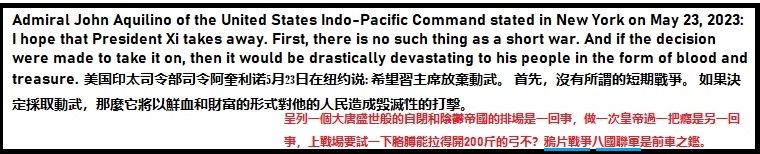
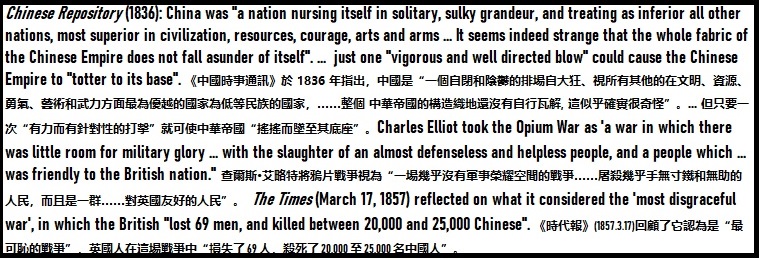
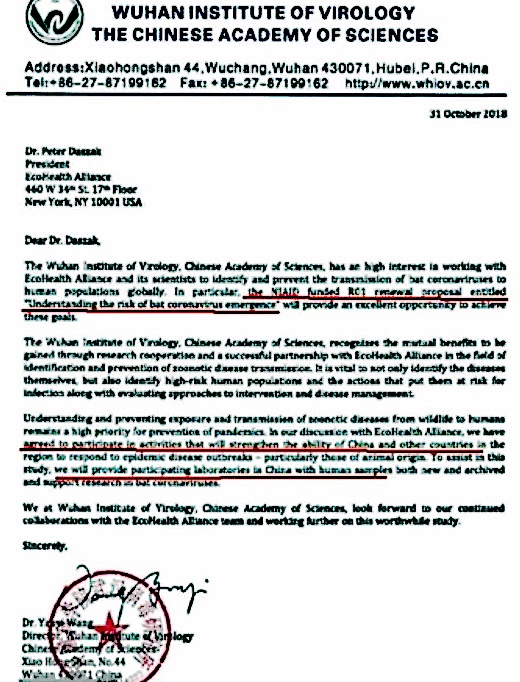
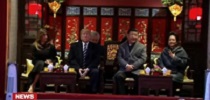
 ***
***

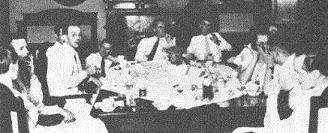
![Though, Anna Wang [Anneliese Martens], in her memoirs, expressed jealousy over Gong Peng by stating that the Anglo-American reporters had flattered the Chinese communists and the communist movement as a result of being entranced with the goldfish-eye'ed personal assistant of Zhou Enlai](GongPeng.jpg)

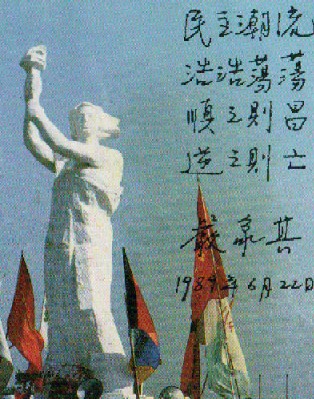 Note the communist slaughter on the Tian'an'men Square was not its first act of terror in history, and it won't be the last.
China and the Chinese lived in terrors since Peng Pai and Mao Tse-tung launched the rascal-proletariat peasant movements in 1927. Peng Pai at one time claimed that the communist law would be simply the execution of landlords once they were caught. Mao Tse-tung, who could have murdered his New Citizen Society co-founder Peng Huang over 20,000 silver dollars and were directly responsible for the
Note the communist slaughter on the Tian'an'men Square was not its first act of terror in history, and it won't be the last.
China and the Chinese lived in terrors since Peng Pai and Mao Tse-tung launched the rascal-proletariat peasant movements in 1927. Peng Pai at one time claimed that the communist law would be simply the execution of landlords once they were caught. Mao Tse-tung, who could have murdered his New Citizen Society co-founder Peng Huang over 20,000 silver dollars and were directly responsible for the 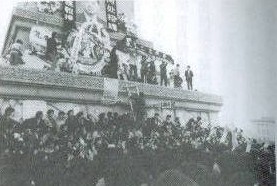 On April 15th, 1989, deposed CCP Party General Secretary Hu Yaobang passed away. On the campus of Peking University, big character posters showed up with the calls for political reform.
On April 17th, ten thousand students swarmed onto Tian'an'men Square to show respect for the late leader. The next day, tens of thousands of students converged upon the square and in front of the "People's Great Wall" for a demonstration against the CCP Central's deliberate low-tone mourning arrangement.
The students raised "seven demands". This would be what this webmaster termed here as the Second Students' Movement in the communist era, not counting the "red guards" movements that were officially sanctioned and launched by the CCP.
The intellectuals, students and ordinary people across China began to show respect for this open-minded rectifier of communist faults and torts with various articles or publications.
Newspaper across the country, including the "World Economic Herald", began to publish series of articles extolling Hu Yaobang's feats for which he was sacked by "paramount" leader Deng Xiaoping in early 1987 in the aftermath of the First Students' Movement of December 1986.
On April 15th, 1989, deposed CCP Party General Secretary Hu Yaobang passed away. On the campus of Peking University, big character posters showed up with the calls for political reform.
On April 17th, ten thousand students swarmed onto Tian'an'men Square to show respect for the late leader. The next day, tens of thousands of students converged upon the square and in front of the "People's Great Wall" for a demonstration against the CCP Central's deliberate low-tone mourning arrangement.
The students raised "seven demands". This would be what this webmaster termed here as the Second Students' Movement in the communist era, not counting the "red guards" movements that were officially sanctioned and launched by the CCP.
The intellectuals, students and ordinary people across China began to show respect for this open-minded rectifier of communist faults and torts with various articles or publications.
Newspaper across the country, including the "World Economic Herald", began to publish series of articles extolling Hu Yaobang's feats for which he was sacked by "paramount" leader Deng Xiaoping in early 1987 in the aftermath of the First Students' Movement of December 1986.

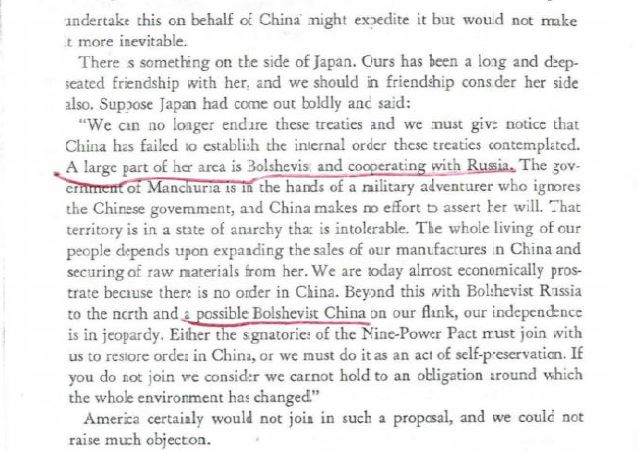
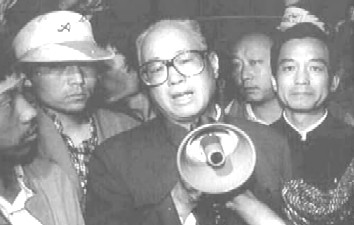 On the early morning of May 19th, at about 4:50 am, Zhao Ziyang, Li Peng, Qiao Shi, Hu Qili and Yang Shangkun, riding in two vans and without bodyguards, went to the Square for a visit to the hunger strike students. (Wen Jiabao, for his role of accompanying Zhao Ziyang to the Square, had been mistaken as sympathetic to the student movement.)
Zhao Ziyang, with tears, asked the students to stop the hunger strike, stating that the "students, who had gone into the 7th day of hunger strike, should live on healthily" and emphasizing the "due process" for answering the issues raised by the students rather than an immediate decision by the government.
On the early morning of May 19th, at about 4:50 am, Zhao Ziyang, Li Peng, Qiao Shi, Hu Qili and Yang Shangkun, riding in two vans and without bodyguards, went to the Square for a visit to the hunger strike students. (Wen Jiabao, for his role of accompanying Zhao Ziyang to the Square, had been mistaken as sympathetic to the student movement.)
Zhao Ziyang, with tears, asked the students to stop the hunger strike, stating that the "students, who had gone into the 7th day of hunger strike, should live on healthily" and emphasizing the "due process" for answering the issues raised by the students rather than an immediate decision by the government.

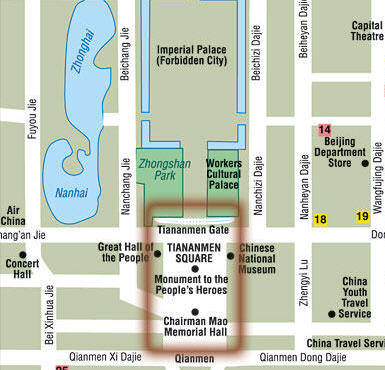 The army and the military police took action in all directions of the Square.
The students and the citizens ran over to report the horrific and savage killings going on the two ends of the Chang'an [Forever Peace] Street, to the north of the Square.
Zhang Xianling, i.e., one of the Tian'anmen Mothers, lost her 19-year-old son Wang Nan at Nankou [southern end] of the Nan-chang-jie Street, to the west of the Square.
Gun shots erupted all over the city, causing confusion as to discerning the distance and direction of conflicts.
The army and the military police took action in all directions of the Square.
The students and the citizens ran over to report the horrific and savage killings going on the two ends of the Chang'an [Forever Peace] Street, to the north of the Square.
Zhang Xianling, i.e., one of the Tian'anmen Mothers, lost her 19-year-old son Wang Nan at Nankou [southern end] of the Nan-chang-jie Street, to the west of the Square.
Gun shots erupted all over the city, causing confusion as to discerning the distance and direction of conflicts.