Sinitic Civilization-Book 1
Sinitic Civilization-Book 2
Tribute of Yu

Heavenly Questions
Zhou King Muwang's Travels
The Legends of Mountains & Seas
The Bamboo Annals - Book 1
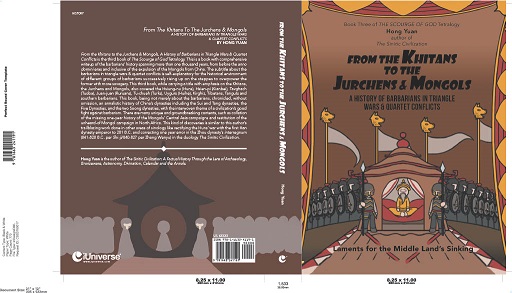
The Scourge-of-God-Tetralogy:
From the Khitans to the Jurchens & Mongols: A History of Barbarians in Triangle Wars and Quartet Conflicts
(available at iUniverse;
Google;
Amazon;
B&N)
|
|
QING DYNASTY: PART II
Founding Of 'Da Jin' (Grand Gold Dynasty)
Eight Banner System
Twenty Five Years Of War Against China
Battle Of Mountain & Sea Pass
Entering China Proper
Infamous Queue-Related Slaughters
Solidifying Rule Over China
Qing Emperor Shunzhi (Qing Shizu, Aixinjueluo Fu-lin, r. 1644-1661):
Qing Emperor Kangxi (Qing Shengzu, Aixinjueluo Xuan-ye, r. 1662-1722):
1689 Treaty of Nerchinsk
Recovering Taiwan:
Qing Emperor Yongzheng (Qing Shizong, Aixinjueluo Yin-zhen, r. 1723-1735):
Qing Emperor Qianlong (Qing Gaozong, Aixinjueluo Hong-li, r. 1736-1795):
Qing Emperor Jiaqing (Qing Renzong, Aixinjueluo Yong-yan, r. 1796-1820):
|
The Opium War (1839-1842) & Nanking Treaty
"Wangxia Treaty" [U.S.] & Whampoa Treaty [France]
Second Opium Wars (1856–60) & Arson of Summer Palace
Taiping (Grand Peace) Heavenly Kingdom Rebellion
Foreign Enterprises Movement (Self-Strengthening)
Manchu Military System: Brave-Camp Army & New Army
Russian Encroachments [1847-1900]
1876 Anglo-Chinese Yantai Treaty
1884-1885 Franco-Chinese War
Imperialist Encroachments On Korea
1894 Sino-Japanese War
Rise of Yuan Shi-kai
Start Of Water-Melon Partitioning
Hundred Day Reformation
The Boxers & Invasion by Eight Allied Nations
Rise of Yuan Shi-kai (Continued)
Russo-Japanese War Over Manchuria
Assassinations & Uprisings
'Retaining Railroad' Movement
Wuchang Uprising & Xin Hai Revolution
|
| [ last page: manchu.htm ] |
[ this page: qing.htm ] |
Continuing from Qing Dynasty: Part I:
The Manchus were both a blessing and a disaster for China. The blessing would be its early territorial expansion which somehow prepared China proper for buffering the Czarist eastward expansion that would inevitably come in the last couple hundreds of years. The disaster would be its policy of 'closing off the seashore' for segregation of the Ming Dynasty remnants in Taiwan and Southeast Asia from mainland China.
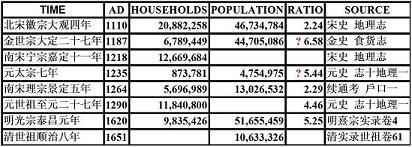 (The Manchu's territorial gain was at the expense of China's population drop from 51.66 million people in 1620 to 10.63 million people in 1651, a tragic loss from the Manchu invasion, which also exhibited the fact that China was not a country that could be easily conquered and that China's brave men were always willing to fall martyrdom in the resistance to the foreign invasion.
* In Commemoration of China's Fall under the Alien Conquests in A.D. 1279,
A.D. 1644 & A.D. 1949 *
Li Ao, a critic of the K.M.T. party on Taiwan, echoed Li Hongzhang's comments that Manchu China's confrontation with 'red-hair devils' (i.e., the British) was an extraordinary event not foreseen by China for 3000 years and that Britain, with its military might and fire-power, was an enemy China could not match during the course of past 1000 years.
Wrong ! The cousins of 'red-hair devils', i.e., the Dutch, had arrived at Java in A.D. 1595 and the Chinese coast in A.D. 1602. From A.D. 1603 to 1624, Ming China exerted hundreds of ships and thousands of soldiers to repelling the Dutch from the Chinese coasts and the Pescadores Islands. Oftentimes, numerous small Ming ships encircled the big Dutch warships for sake of winning the fight. Ming China mobilized a huge field army for landing on the Penghu Islands (i.e., Pescadores) and after a fierce fighting, forced the Dutch into withdrawal. Dozens of years later, Zheng Chenggong, i.e., son of pirate-turned Ming General Zheng Zhilong, would first adopt the approach of "defeating the aliens by means of the aliens' weapons". Zheng Chenggong, whose merchant fleets sailed to the four corners of the seas, actively purchased weapons, firearms and cannons from the Dutch. In February of A.D. 1662, Zheng Chenggong successfully expelled from the Taiwan Island the Dutch who, having colonized the island from 1624 to 1662, already latinized the aboriginals' language to the extent that the aboriginals no longer remembered their own native language. Before the Dutch, Ming China waged two wars against the Portuguese during the time periods of 1521-1522 and 1547-1549 for securing the territorial integrity.
(Ming China, after Zheng Heh's 7 Naval Expeditions and Zheng He's death, destroyed the 'bao chuan' or "treasure ships" [that were 440 feet long and possessed nine masts] and the diagrams, and closed off the seashore till Ming Emperors Rongqing [Ming Muzong] & Wanli [Ming Shenzong], and after a short time period of loosening, completely closed off the seashore beginning from Emperor Jiajing's 2nd year, i.e., A.D. 1523.
In ancient China, the 'gui' [ghost] word had no derogatory connotation as known in the modern equivalent word of 'devil' that was cited by Li Ao.)
Manchu Qing China, in the ensuing hundreds of years, had been mostly occupied with "pleasure-seeking (hedonism) and literature-decoration" (inquisitions), a 1916 comment by Japanese Prime Minister Okuma Shigenobu in regards to Yuan Shi-kai's death and its influence on the rise and fall of the Republic Of China. (The worst thing is that today's decadent Communist China is not any better
than the Manchu rulers.
Note that the "1957 Anti-Rightists Movement" had doomed China's fate for 20 years after finishing off China's half-century worth of elites and conscience,
and the June 4th, 1989 Massacre had routed China's elites & conscience once again and doomed China since 1989.
China, in addition to losing tons of gold, silver & wealth that were accumulated over the span of 5000 years, would lose almost one century worth of good souls for nothing.
Red alerts !!!)
The Opium War (1839-1842)
 Per Cai Dongfan, opium, literally meaning dark slices, first reached China during Ming Emperor Shenzong's reign. Emperor Shenzong (Zhu Yijun, r. 1573-1620) was addicted to it and named it 'Fu Shou Gao'.
It is likely that the opium first reached China in the 8th century under different names.
The Dutch had conducted the opium trading from the 17th century onward.
The opium taking, for its delicate method of preparation in the early times, was not in popular usage till it was taken as a fad among the rich people after an innovative way of using pipe to inhale opium like a connoisseurship was invented and introduced to China from Java and Taiwan in the early 18th century and after the Qing government abandoned the policy of banning tobacco smoking around A.D. 1726.
The Qing government banned opium in A.D. 1729 per Lovell.
What Lovell meant by tobacco ban was likely not true tobacco, and
the original tobacco ban was about opium-mixed tobacco smoking, which was less potent for the vaporing-to-the-air effect.
Tobacco was introduced to China from the Americas at the turn of the 16th and 17th century, was at one time banned by the Qing government but was rescinded the enforcement around A.D. 1726 per Lovell.
Though, John Barrow of the Macartney mission in A.D. 1793 noted that opium was still restricted to use by the opulent for its high price and scarce quantity.
While Portugal had swindlingly leased Macao (Macau) and used it for trading with Ming China, Manchu Qing China had no policy of commerce with Britain at the time.
The Qing dynasty, which reduced trading ports to one from four in A.D. 1757 and limited foreign trades to Canton where the 'Hong' (i.e, hang or firms) merchants ran a guild of thirteen warehouses, allowed foreigners to leave Macao to stay at the 'Hong' warehouses for the winter trading season of a few months, like Gregorian September to January.
Per Cai Dongfan, opium, literally meaning dark slices, first reached China during Ming Emperor Shenzong's reign. Emperor Shenzong (Zhu Yijun, r. 1573-1620) was addicted to it and named it 'Fu Shou Gao'.
It is likely that the opium first reached China in the 8th century under different names.
The Dutch had conducted the opium trading from the 17th century onward.
The opium taking, for its delicate method of preparation in the early times, was not in popular usage till it was taken as a fad among the rich people after an innovative way of using pipe to inhale opium like a connoisseurship was invented and introduced to China from Java and Taiwan in the early 18th century and after the Qing government abandoned the policy of banning tobacco smoking around A.D. 1726.
The Qing government banned opium in A.D. 1729 per Lovell.
What Lovell meant by tobacco ban was likely not true tobacco, and
the original tobacco ban was about opium-mixed tobacco smoking, which was less potent for the vaporing-to-the-air effect.
Tobacco was introduced to China from the Americas at the turn of the 16th and 17th century, was at one time banned by the Qing government but was rescinded the enforcement around A.D. 1726 per Lovell.
Though, John Barrow of the Macartney mission in A.D. 1793 noted that opium was still restricted to use by the opulent for its high price and scarce quantity.
While Portugal had swindlingly leased Macao (Macau) and used it for trading with Ming China, Manchu Qing China had no policy of commerce with Britain at the time.
The Qing dynasty, which reduced trading ports to one from four in A.D. 1757 and limited foreign trades to Canton where the 'Hong' (i.e, hang or firms) merchants ran a guild of thirteen warehouses, allowed foreigners to leave Macao to stay at the 'Hong' warehouses for the winter trading season of a few months, like Gregorian September to January.
As noted by http://www.ctrl.org/boodleboys/boddlesboys2.html, in A.D. 1689, the English began trading at Canton and by the early 1770's they surpassed the Portuguese, Dutch and French to "became the leading supplier" to China.
corvalliscommunitypages.com/asia_pacific/china/whether_corvallis_was_the_land_o.htm pointed out that "the Opium Wars waged against China by England, with the encouragement of American President John Quincy Adams, resulted in massive suffering in the (Chinese) countryside (and the cities) as the English and American drug cartels pushed their wares (opium) into every small village in Asia (China) as a means of paying for massive imports of Chinese tea and silk. "
According to Diana Preston's The Boxer Rebellion, Americans specialized in selling the Turkish opium to the effect that the Chinese thought Turkey was part of the U.S.A., and that American William Hunter's fortune in the 1830s was a staggering $25,000,000.
http://historyliterature.homestead.com/files/extended.html
noted that "in 1820, 9,708 chests of opium
were smuggled in per year. 15 years later, the smuggled opium rose to 35,445 chests, a growth of 400%."
Per Sterling Seagrave, opium sold to China increased to 39000 cases in 1837 from 5000 cases in 1821.
Julia Lovell, in The Opium War: Drugs, Dreams, and the Making of Modern China, cited Frederick Wakeman Jr's discussion on the Opium trade in the Cambridge history and stated that the British, in face of British "£28 million debt left over from the conquest of India" (i.e., the crackdown on the Indian uprisings) while "the combined returns of the India and China trades failed to make even a £2 million" from 1780 to 1790, the British had to find a solution, i.e., selling the Indian opium, which allowed the British to reverse the silver outflow of a net 105 million silver dollars (approximately £26.25 million)" between 1752 and 1800.
After the Indian uprisings, the British government purportedly rescinded the East India Company's hold over the India colony, and furthermore in 1833, "the Free Trade lobby terminated the East India Company's monopoly on the tea trade", which allowed more British "private merchants hungry for tea and profits" to come to China to engage in trades with "Opium -- in even greater quantities was the barter."
http://www.ctrl.org/boodleboys/boddlesboys2.html traced the history of opium trade as follows:
The Dutch began trading opium in the 1610s, and not just as a profitable trade item. They used opium "as a useful means for breaking the moral resistance of Indonesians who opposed the introduction of their [Dutch] semi-servile but immensely profitable plantation system." In 1689, the English began trading at Canton and by the early 1770's they surpassed the Portuguese, Dutch and French to "became the leading supplier" to China. Because the Spaniards were allies of the America during the U.S. War of Independence and thus no Spanish silver was available to pay for Chinese tea, the British monopolized the source of opium (India) and became the major trafficker...
Many historians discount the American activity in the opium trade, generally concentrating on the British and their mercantilist trading syndicate, the British East India Company. Because of the Navigation Act of 1651, Americans "were not permitted to sail their own ships to the Orient," they were required as colonists and subjects to buy all their Chinese goods in London from the East India Company. The East India Company’s monopoly on the tea trade was more of a reason for the American Revolution than the cost of the tax. Through a political arrangement the tea was actually coming in for less than it could be bought in England. But the agitation of Samuel Adams, Ben Franklin and others had led to situation where ships were sent back to England unloaded, some cargoes rotted other shipments were destroyed—ala, the Boston Tea Party...
Until 1792 part of the Perkins family shipping business, along with their Cabot relations was the slave trade. In 1789 Thomas H. Perkins first went to China with Elias Derby from Salem, Massachusetts. A "loyalist" cousin, who fled America during the War of Independence, George Perkins was a merchant in Symrna. With a solid "connection," a strong family framework and firm financial backing Perkins & Company became the leader in the American pack. It was a family affair. Thomas H. was brother-in-law of Russell Sturgis, an uncle to J.P. Cushing and brothers John M. and Robert B. Forbes. Joshua Bates, a partner in Baring Brothers Bank, handled the family business in London. He was married to a Sturgis. Russell Sturgis's grandson later became Chairman of the Board of Barings.
Perkins & Co. found that illegality both in nature and operation discouraged competition and used sporadic attempts by the Chinese Government to enforce their opium prohibition, "to [build] the machinery that allowed it to control the Canton market for Turkish opium." Perkins & Company became the first American firm to operate a "storeship" at Lintin (Lingting) in a new smuggling procedure.
Samuel Russell and Phillip Ammidon came to Canton in 1824, Russell having first been there in 1818 as a business representative for a merchant house out of Providence R.I. Ammidon went on to India to serve as the firm's opium buyer. In "a series of accidents and coincidental decisions" Russell & Company acquired a "virtual" monopoly on the American portion of the trade in the 1830's. Other eastern merchants failed, died, or retired like John Jacob Astor. Perkins & Company, resident partner in Canton, Thomas T. Forbes was drowned in August of 1829, and he carried a letter which gave Russell "charge of the firm's [Perkin's] business."
In the 1830's the price of opium went down and shipments of opium to China went up. The decade started out with four times the shipments of 1820 and by 1838 over ten times. The opium clipper—introduced by the Americans—with its ability to sail against the monsoons made three round-trip journeys within one year instead of taking up to two years. Profits were huge and there was a large flow of silver being introduced from China into booming western economies. In early 1837 there was a price-crash in the opium market and the speculators losses reverberated around the world in a financial panic in which specie became scarce both in Britain and the US.
August Belmont came to New York City in 1837, a stopover on his way to Havana, but stayed on in Gotham, buying securities, debts and property during the "Panic of 1837." Many say he was acting as an agent for the Rothschilds. Also in 1837 George Peabody, an old "China" trader—among other ventures—settled in London and brought into his sphere JS Morgan, progenitor of JP Morgan. Many Bonesmen were partners and principals in Morgan-related firms.
Certainly, the imperialists had been blaming Manchu China's closed door policy for the eruption of the opium war.
Furthermore, going against the wind would be
a professor of the "Modern History of China" at the School of Oriental and African Studies, University of London, by the name of Frank Dikötter, who had written a ludicrous article on "Narcotic Culture. A Social History of Drug Consumption in China".
(Frank Dikötter had written another seemingly astute but ludicrous article entitled "Race in China" at
http://cio.ceu.hu/courses/CIO/modules/Module08Dikoetter/print.html
- Frank Dikötter and the sort had no clue about the "Chinese racism/nationalism" of the 1900s at which time the revolutionary forerunners had undergone several stages of cognizance as to "social Darwinism" but finally adopted for the Republic of China the "Five Color National Flag" [1912-1928], which was symbolic of the union of the five ethnic groups of Han, Mongol, Manchu, Tibetan & Hui Muslim ethnic people.)
The Portuguese, the British & Macao
In A.D. 1514, i.e., the 9th Year of Ming Emperor Wuzong's Zhengde Era, the first Portuguese ship arrived at the Guangdong Province coastline. Ming China, as a result of bribery and collusion of the Portuguese with the local officials, mis-identified the Portuguese as the same as the Malacca merchants.
In A.D. 1520, Ming Dynasty verified that Folangji (falconetto, i.e., Portugal) had incorporated the land of Malacca that was considered a Ming vassal.
By 1521, Emperor Shizong (Zhu Houcong, r 1522-1566) issued the decree of expulsion right after enthronement. The Portuguese interpreter was executed, while Portuguese emissary Thomas Pirez was driven to the Guangdong coast from Peking. Thomas Pirez, retained as a hostage for restoring the Malacca Kingdom, later died in prison in Guangdong Province.
During the 1521-1522 Sino-Portuguese War, the Ming army climbed up two Portuguese ships, killed about 35 Portuguese, captured 43 Portuguese alive, caught about 10 men and women (Portuguese captives?), and caused numerous others to fall off the ships and get drowned in the seas.
From 1547 to 1549, Ming Governor Zhu Wan, also the imperial commissioner for the coastal defense of Fujian and Zhejiang provinces, launched three attacks at the Portuguese, wiping out the Portuguese strongholds at Shuangyu (Ningbo, Zhejiang), and killed and captured over 239 Portuguese at Wuyu (Zhuangzhou, Fujian) and Zoumaxi (Shaoan, Fujian).
Later, the Portuguese came back to the Xiangshan'ao area. As a result of the Portuguese bribery and collusion with the Ming local officials, in A.D. 1553, the Portuguese, who discarded the old name of Falangji [Folangji], swindled the land of Macao by first pretending to dry their wet merchandise above the island. Ming China, however, continuously restricted the Portuguese activities by dismantling their church and city walls.
On May 29th, 1622, two British ships joined fifteen Dutch warships in attacking Macao.
In A.D. 1635, the British, who had assisted the Portuguese in shipping copper and metals to Goa one year ago but were refused entry into Macao, dispatched 6 warships to Macao for trading with China.
When the British moored near Macao on June 25th, 1637, the Portuguese refused entry to the British. The British, however, sailed along the Pearl River towards Canton, bombarded the Humen [tiger gate] Battery when the Chinese tried to stop them, and did not retreat till the Chinese allowed some of their goods to be transferred to Canton.
Thereafter, the British, pretending to provide cover to the Portuguese in passage through the Dutch-blockaded Malacca Strait, gained access to Macao. Only after the Chinese intervention did the British leave Macao.
Lovell cited Tan Chung's China and the Brave New World in pinpointing a British merchant by the name of John Weddell who forcefully forced his way up to Canton.
Around A.D. 1743, the county magistrate for the Dongguan county, i.e., Yin Guangren, boarded two British warships that were blown to the Siziyang [lion] Sea near the Humen Battery and forced the British into releasing 299 Spanish captives to the Portuguese in Macao before providing food, repairmen and other logistics.
On another occasion, in A.D. 1784, when a British vessel Lady Hughes accidentally killed a Chinese with its salute guns, the British were forced to hand over a culprit for execution.
The succeeding Manchu Dynasty inherited Ming China's policy and granted the Portuguese access to the markets the same way as to the Arab, Muslim & Southeast Asian traders.
The British warships returned to Macao after Britain, in A.D. 1801, grabbed Goa from Portugal by taking advantage of the Portuguese defeat in the Portuguese-Franco War.
The Portuguese governor sought help with Manchu China. After China refused to trade with Britain and cut off supply to the British, the British ships left in June 1802.
Meantime, the pirates who were given safe haven by the Vietnamese and hired by the Vietnamese for harassing the Chinese coastline, also attacked Macao in A.D. 1804, under the helm of a female pirate called Zheng Yisao (Ching Shi, Madam Zheng-yi-sao), a figure seen in Pirates of the Caribbean - who was later pacified by Qing Liang-guang (Guangdong & Guangxi) Governor-general Zhang Bailing in A.D. 1810.
The Vietnamese just in A.D. 1788 evicted the Manchu Qing invasion force.
By late 1807, Lisbon fell into the French hands. The British governor in India pretended to help Macao defend against France, and dispatched 10 ships to Macao on Sept 11th, 1808.
About 760 British soldiers occupied Macao.
 Manchu China forbade trade with Britain, cut off the supply of foods to Macao, and dispatched 80000 soldiers against the British.
On the date of ultimatum, i.e., December 18th, the British evacuated from Macao.
In April of 1809, Manchu governor-general Han Feng inspected Macao for the defense fortifications.
Manchu China forbade trade with Britain, cut off the supply of foods to Macao, and dispatched 80000 soldiers against the British.
On the date of ultimatum, i.e., December 18th, the British evacuated from Macao.
In April of 1809, Manchu governor-general Han Feng inspected Macao for the defense fortifications.
The Opium War & Trafficking Of the Coolies & Sex Slaves
Prof Yen Ching-hwang had authored a book entitled "Chinese Coolies Overseas & the Manchu Officials" [i.e., Coolies and Mandarins] and pointed out that the British Opium War of 1839-1842 had coincided with the prosperity of slave-nature trafficking of the Chinese coolies overseas, a trade that was first started by the Dutch in the 17th century.
Yen Ching-hwang stated that Xiamen (Amoy), a port which had replaced the historical Quanzhou port, would become the first port to see the Chinese coolie sold overseas. In 1847, some British governor claimed that the British revenues from Amoy was 72,000 pounds, about 3 times the combined value from all other ports, a manifestation of the slave trade in trafficking the Chinese coolie to British Guana, Trinidad and Jamaica.
Yen Ching-hwang stated that Macao would take the place of Amoy beginning from November 1852 when the riots broke out as a result of the Chinese attacking a British smuggler and his coolie-trafficking Chinese henchman.
From 1847 to 1875, 150,000 Chinese coolies were sold to Cuba as 'zhu zai' [i.e., the piggy coolie].
The coolie trade continued till the early 20th century as evidenced by the fact that the father of Li Zongren was hired by the British in HK for years of indentured coolie work in Malay where they obtained freedom after conducting strikes lasting years.
Peru, the Pacific Islands, the West Indies, North Africa, South Africa, and Australia had all engaged in the Chinese coolie slave trade.
The Chinese coolies built the Panama Railway.
America was no exception. The Chinese coolies built the U.S. railroads and highways across the Western U.S. territories.
Per Ah Ying, the Chinese were first "shanghai'ed" to California in 1847 in the aftermath of the American annexation of the Mexican province.
The second wave of coolies came in 1865 when the U.S. began the construction of continental railways and highways.
(http://memory.loc.gov/ammem/award99/cubhtml/cicTitles12.html contained a dossier of files on "The Chinese in California, 1850-1925".
"Chinese Exclusion Act" was based on an 1879 California state law which discriminated against the Chinese as scapegoats for the 1877 economic recession.
The Peking Treaty of 1880 buried inside such clauses as allowing the U.S. government to take measures against the Chinese coolies.
See cprr.org/Museum/Fusang.html for the Chinese Railroad Men working as coolie in America.
In California, the Chinese coolies dug the canal, built the dykes, and turned 400,000 acres of the Sacramento marsh land into agricultural land.
Also see SAN LUIS OBISPO'S CHINESE for the context of the 1882 Chinese Exclusion Act.
The U.S. government, after acquiring Hawaii in summer of 1898 and the Philippines in December 1898, applied the "Chinese Exclusion Act" to the Chinese on the two islands, and further, President Theodore Roosevelt signed into law to have the "Chinese Exclusion Act" applied throughout the U.S.-controlled islands and territories over the world, making the Chinese the lowest caste, a fundamental cause in the Chinese suffering in the ethnic cleansing which occurred in the Philippines, Indonesia and Malaysia etc.
There had occurred an anti-American boycott in 1905 in reaction to the racially discriminating U.S. policies toward the Chinese coolie workers inside the United States.
Leftist writer Ah Ying pointed out that the anti-American boycott originated from China's opposition to the 1904 American attempt at renewing the 1880 Peking Treaty, by citation of which the U.S. had expanded the excluding-Chinese constraints to as many as 61 clauses.
In 1943, the CHINESE EXCLUSION ACT was repealed by the American Congress, with China awarded a yearly immigration quota of 102 persons.)
More, the Portuguese specialized in selling Chinese women and Chinese girls overseas as sex slaves throughout the latter half of the 19th century. One Jesuit's A.D. 1563 account stated that he had taught Christianity to two batches of 450 and 200 Chinese women slaves before they were sold to the Portuguese merchants and officials in Goa as sex slaves; Archbishop at Goa, Dom Ignacis De Sama Terez, stated in 1725 that the Chinese women slaves were often cruelly killed by the wives of the Portuguese merchants & officials and that the Portuguese women encouraged their sons in sexually abusing the Chinese women and girls; and in 1855, A British ship, Englewood, carried over 40 Chinese girls around age 7-8 [abducted from the Ningbo area of coastal Zhejiang Prov] for transfer to a Portuguese called Martinez in the Amoy port.
(The prosperity of sex slave trafficking could perhaps be vindicated by the huge population of Chinese-looking Indians in Goa of India. One would have to pity those men and women, whom the creator Jewish & Christian God had decided to deliberately left out as the "non-chosen".)
The British Resentment Over the Manchu Trading System
In A.D. 1725, the Manchu prohibited the non-Portuguese foreigners (i.e., the Westerners) from dwelling in Macao.
Consecutively, in A.D. 1746, the Portuguese King issued a decree that the non-Portuguese Westerners could not stay or do business in Macao, causing those Westerners to relocate to Canton. The Xiangshan county magistrate reported this event to the provincial official. The Manchu court notified the Macao authority that those Westerners who received the Manchu approval could still dwell in Macao.
The Manchu court was worried that the Westerners would spread to Canton.
In A.D. 1743, the county magistrate for Dongguan, i.e., Yin Guangren, boarded two British warships that were blown to the Siziyang [lion] Sea near the Humen Battery and discovered that 299 Spanish were taken as prisoners by the British.
Yin Guangren forced the British into releasing the Spanish to the Portuguese before providing the logistical supply to the British.
In A.D. 1757, a British merchant went to Tianjin to accuse the Manchu customs official at Canton of corruption and bribery. The Manchu court dismissed the customs official, but put this British under arrest in Macao for three years and then expelled him.
In A.D. 1759, the Manchu governor-general for Guangdong-Guangxi provinces ordered that the Western merchants could not stay for the winter in China. Those merchants all went to Macao. The Consul officials of the Western powers set up residencies in Macao as a result of the Manchu order that no Western women should be allowed to enter Canton.
In A.D. 1792-1793, the British government, at the request of the East India Company (which already established itself as a monopoly in India by 1740) and over its trade deficit with China, sent in a delegation to Canton for opening up the trading under Lord George Macartney (1737-1806).
Lord George Macartney was said to have played the trick by inducing provincial Manchu officials into dispatchment of the British delegation to Peking and onward to the imperial Chengde's "summer palace" in Jehol in the name of congratulating Emperor Qianlong on his birthday.
Emperor Qianlong (Qing Gaozong, Aixinjueluo Hong-li, r. 1736-1795) purportedly expelled Macartney for the emissary's refusal to kneel down on both legs instead of one leg as well as the refusal to acknowledge England as a "tribute nation" to China.
Two knees' kneeling, i.e., kowtow, being a Jurchen and Mongol practice, was not an inherent Chinese practice, with Macartney having likely compromised himself with the exercise of this humiliating protocol but still being declined the British request to be an equal with the exchange of embassies.
Qianlong's main concerns in restricting trade, according to Lydia H. Liu's The Clash of Empires: The Invention of China in Modern World-Making, was his worry about the British naval supremacy among the pirates and all western trading nation as well as bloody British conquest of India as the Manchu emperor doubted that his descendants could hold the multi-ethnic Qing empire together should the British take advantage of the slack southern Chinese coast to encroach on China.
Back in the 17th century, Emperor Kangxi, after using the Jesuits like Ferninand Verbiest for manufacturing the cannons in 1673, banned the Catholics on the pretext that worship for Jesus Christ was not comparable with ancestor worshipping of the Chinese -- as the Manchu emperor took it as vigilance over the majority Chinese that could get weakened by introduction of alien thoughts -- a same concern of today's decadent communist China in erecting the Great Firewall so as to make the Chinese subjects unintelligent and ignorant.
Kangxi was worried about rebellion by the majority Chinese while thinking enemies were all around, such as the Eluths (Oirats, Eluts) at the steppe, Russians in Siberia, Portuguese and Dutch in Southeast Asia.
The Manchus, in the extreme of their xenophobia, prohibited the Chinese from teaching the Chinese and Manchu languages to the eager Europeans, something opium trader William C. Hunter complained about.
On his return trip via land, Lord George Macartney had clandestinely checked out the Manchu China's societal weaknesses, something that Britain later utilized in exerting the military coercion against Manchu China in the next century.
A cited by Jonathan Spence's citation, China was "an old crazy first rate man-of-war" fated to be "dashed to the pieces on the shore" in Macartney's opinion.
As pointed out by Manchu official Hong Liangji in 1793, China's crises had to do with the national households increasing 20 folds during the preceding 100 years while the officialdom corruption had become prevalent under minister He-shen and his cronies. This would lead to the White Lotus Rebellion in 1796. (Emperor Jiaqing [Qing Renzong, Aixinjueluo Yong-yan, r. 1796-1820] arrested He-shen in 1799.
Financially, Qing China was said to have declined as a result of the decreasing silver inflow in the aftermath of the independence wars and revolution against the Spanish in Latin Americas and successively the Mexican Revolution (1810-1821).
(Lovell expressed doubt about the silver's effect on Manchu China's economy with citation of co-existence of a large quantity of opium and increased inflow of silver to China in the latter part of the 19th century, stating that
"From 1856 to 1886, the Chinese economy was once more in credit, with some $691 million flowing back to the empire."
What Lovel missed that the increased silver inflow was a result of the Gold Rush of the United States and the subsequent
adoption by the US, Germany, and France of the gold standard, in the
1870s, which made silver worthless and only good for dumping to China in exchange for more valuable commodities such as tea and silk.
Britain already instituted the first gold standard in
1821 as a result of silver outflow to China.)
Though Britain failed to set up an embassy in Peking, the trading with Britain continued at Guangzhou (Canton) without the government sanctions.
Beginning from Sept 1802, the British laid their eyes on Macao (Macau), and attacked and occupied Macao twice, in 1802 and 1808.
In July 1808, six British warships, under admiral Drury, forcefully entered Macao. On August 2nd, the British took over several batteries. The Manchu governor-general for Guangdong-Guangxi, Wu Xiongguang, demanded that the British withdraw from Macao. When the British refused, Governor-general Wu Xiongguang ordered a cessation of trade with Britain. Admiral Drury led the soldiers to the "Thirteen Foreign Firms Guesthouse" and demanded a talk with Wu Xiongguang.
The British compromised by exiting in Dec, while Wu Xiongguang was deprived of his post by the Manchu court for mishandling the crisis.
William Pitt Amherst (1773-1857) was sent to China in 1816 as ambassador extraordinary but ultimately failed to meet Manchu Qing Emperor Jiaqing over the barbarian Manchu protocols of kneeling and kowtowing.
The British had another confrontation with the Manchu in 1829 over the unpaid interests that the Chinese "gong hang" (i.e., the 'public' firms) owned to the British merchants. The British sailed numerous warships to the Zhujiang River (i.e., the Pearl River). Governor-general Li Hongbing assigned defense along the Macao and Xiangshan coastlines. The British compromised by withdrawing the warships months later.
In A.D. 1830, Williams Baynos, i.e., chairman for the British East India Company, brought his wife and a Portuguese maid to Canton against the Manchu stipulations in regards to residency. When Governor-general Li Hongbing demanded the expulsion of the women, Williams Baynos mounted cannons in his merchant ship. Williams Baynos conceded when Li Hongbing brought along the Manchu troops.
More conflicts followed.
In A.D. 1832, British prime minister, Lord Grey, hired William Napier (1786-1834) as the Superintendent of British trade for China, a post turned down by Lord Auckland (1784-1849) who was to take the post of Governor of India.
In A.D. 1833, Lord Napier was sent to Canton to replace the 'big ben', i.e., the monopolization of the British East India Company.
Lord Napier, claiming that "The Empire of China is my own" in diary and determined to break the modus vivendi with Manchu China with force, sailed to Canton on July 25, 1834 (Gregorian) but was asked by Governor-general Lu-kun to return to Macao for breaking the protocols that could number by six including lack of passport or pass.
Together with Napier would be Charles Elliot (1801-1875) as "Master Attendant" to Napier.
Charles Elliot, after being in the navy in his early life, switched to the Foreign Office and stationed as "Protector of Slaves" in British Guiana before going to China with Napier.
When Napier went to Canton for seeing Governor-general Lu Kun, Lu Kun refused to see him and dispatched the subordinate officials to the meeting with Napier. Napier insulted those officials. Lu Kun ordered a cut of trade with Britain, which was September 2, 1834 (Gregorian) per Lovell. Hence, Napier ordered that two British warships (frigates) sailed to Canton and bombarded the Manchu positions. The Manchu reinforced defense along the Pearl River banks and dispatched the troops to Macao (Macau) for assisting the Portuguese.
Per Lovell, two British sailors were killed in the fire exchange.
Lu Kun ordered boats sunken to strand the British frigates.
Napier backed down after the Manchu promised to resume trade.
Per Lovell, Napier abandoned "the British factory" in Canton and was further forced to float in the Pearl River for one week before being allowed to sail to the coast and ocean.
Weeks later, Napier died of malaria and fever in Macao. Before death,
Napier claimed to British foreign secretary Lord Palmerston (1784-1865) in a letter that "three or four frigates and brig ... would settle the thing..."
Napier claimed in Barbarian Eye that he could achieve the goal of opening up China without the loss of a single soul and took himself as an emancipator of the enslaved Chinese and doing an act of Charity.
Four years later, in A.D. 1838, British Navy Commander Frederick Maitland sailed two warships to Macao for protecting the opium trade. When the Manchu officials refused to see him, Frederick Maitland demonstrated his warships at the Cuanbiyang [piercing nose] Sea. Frederick Maitland sailed away when the Manchu official deployed a defense army.
The Napier Incident, as well as the Maitland Incident, could have been used as a fuse for waging a war against Manchu China according to Lovell; however, the British and American traders apparently sufficed to conduct the opium trade in a covert way, which was superficially hands-free in allowing the East India Company take responsibility for planting and packaging opium in India rather the colonial office itself, then in having the East India Company hand off the tasks of shipping opium to Canton in the hands of private British merchants, and then in having the private merchants, like Jardine Matheson & Co, offload the opium to Chinese smugglers at Lintin (Lingting), an island in the Pearl River and between the coast and Canton, with acquiesce of the Qing officials whose gunboats staged fake chasing to see off the clippers.
As Chinese Repository stated in 1836, China was "a nation nursing itself in solitary, sulky grandeur, and treating as inferior all other nations, most superior in civilization, resources, courage, arts and arms ... It seems indeed strange that the whole fabric of the Chinese Empire does not fall asunder of itself". According to the newsletter, just one "vigorous and well directed blow" could cause Manchu China to "totter to its base". (Today's decadent Communist China is unfortunately worse than Manchu China.)
The British Trading Opium
Beginning from the eighteenth century, Europe and America had grown insatiable appetite for the Chinese tea, silk and porcelain while the Chinese had treated the Western products as mere 'toys'. To offset an unfavorable balance of trade, the Westerners, mainly the British, developed a third-party trade, exchanging their merchandise in India and Southeast Asia for the Chinese goods. (The Americans, including some company called Perkins & Company
[Po-jin-si], had been engaged in selling the Turkey opium to China. The Persian opium was said to have been sold to China by the West without the exclusive control by either the British or American. Some American merchant claimed that the Americans did not have any less guilt than the British in drug trafficking to China. Indeed, the Americans built some kind of specialty trafficking ships entitled the "opium flying cutter ship" per Ah Ying. The opium that was surrendered to and burnt by Lin Zexu at the Humen Battery of Canton had consisted of lots of the
American-owned possession faking the British ownership per Ah Ying.
Per Sterling Seagrave, in the 1820s, the Americans joined in to sell opium to China, with such firms as Penkins [Po-jin-si], and Boston's Russell & Co [La-sai-er], using the high-speed junk cutters for shipping the opium in competition with the British boats.)
By the early nineteenth century, cotton and opium from India had become the staple British imports into China through the connivance of the profit-seeking British merchants who colluded with the corrupt Manchu bureaucracy.
corvalliscommunitypages.com mentioned a Hong merchant by the name of Wu Ping-Chien and known as Howqua II in the West, who profiteered from trade with the West, "had an old mining region, mountains and a river in Australia named after him, and ... invested a great deal of money in American railroads."
Trading with the foreign countries were initially restricted to Canton. All foreign ships, under the "Canton Trade System", must sail to the Canton customs for inspection before unloading cargo. The foreign merchants had to deal with "Gong Hang" ("the officially authorized firms") first.
When Manchu Qing Emperor Daoguang (Qing Xuanzong, Aixinjueluo Min-ning, r. 1821-1850) got enthroned, he decreed a ban on the opium import. Various inspection checkpoints were set up along the coast to prevent the opium from slipping through to the inland areas. But the traitor merchants, who would officially become the so-called comprador [i.e., "kang bai du" or broker-dealers in English] after the Opium War, took in the bribes from the British, and the opium still flooded China, leading to a physically-weakened Chinese race and depletion of silver in the measure of 10 million Chinese ounces or taels on a yearly basis.
Manchu China's finance system, which was based on a domestic conversion rate of one tael silver to 800-1000 copper coins [that was a legacy of the Qin Dynasty currency], would be derailed when one tael silver had to be converted from 1800 copper coins or more before the tax revenues could be surrendered to the court.
Do note that the British laws, by the imperial decree, prohibited entry of opium into Britain itself.
The British East India Company, however, "planted from hill to hill" in Bengal, Madras, Bombay, Patna, Benares and Malwa, and then shipped the opium to China.
Opium War, 1839-42 exhibited good historical records about the opium trade, including a letter from Manchu Imperial Commissioner Lin Zexu (1785-1850) to the British Royal House as well as
excerpts from the Bombay Telegraph and Courier dated May 17, 1852. The Bombay Telegraph and Courier mentioned that "from the skillful management and cultivation of about 100,000 acres of land, the East
India Company produces an article which, sold at
a profit of several hundred per cent., yields to
them a net revenue, annually, of nearly three mil-
lions sterling. We do not here include the
Malwa opium seventh of the whole revenue of
the country, raised from an extent of more than a
million of square miles."
The Manchu Banning the Opium Trade
Zhu Chenglie (a Manchu "yu shi" [inspector or censor]) and Huang Jueci (a Manchu "shi qing" [minister]) petitioned with Emperor Daoguang for adopting serious measures to ban the opium.
Xu Naiji (a Manchu "shao qing" [deputy minister]) proposed a legalization of opium to Emperor Daoguang. Censor Yuan Yulin opposed the suggestion.
Lin Zexu (1785-1850), governor-general for Hu-Guang (Hunan, Hubei and Guangdong), warned the emperor that should the opium rattle for another ten years, no more taxes could be raised and no more soldiers could be recruited.
Emperor Daoguang called Lin Zexu over to the capital for eight discussions successively.
In 1838, after decades of unsuccessful anti-opium campaigns and two years of court debates, Emperor Daoguang adopted the drastic prohibitory laws against the opium, issuing 39 articles and decreeing that whoever sold opium or took opium could be executed. Emperor Daoguang conferred Lin Zexu the post of "qin cai da chen" [the emperor-dispatched grand minister], i.e., imperial commissioner, and dispatched him to Canton. Lin arrived in Guangzhou on March 10, 1839.
After Lin Zexu arrived at Guangzhou, Lin discussed matters with Deng Tingzhen (1776-1846) the governor-general for Liang-guang (i.e., the Guangdong-Guangxi provinces). Deng had caught numerous opium vendors and parlor operators.
As Lovell pointed out, the Chinese smugglers at Lintin (Lingting) carried off the opium from the clippers with acquiesce of the Qing officials whose gunboats staged fake chasing or sham pursuit; and in case some serious-minded Qing officials closed in to the smuggling ships, the British would threaten to blow off the Qing boats, such as the case of Dr. Karl Gützlaff, a Pomeranian missionary, confronted six Qing boats and warned against mooring nearby, which made the Qing troops into acknowledging that they did not see anything.
Lin suggested that they should solve the problem at the root by confiscating the opium on board the 22 foreign ships that were moored at the Lingding-yang Sea. Lin ordered that both the field army and navy blockade the entrance to Canton (Guangzhou) to prevent the opium from being smuggled ashore. Lin then called on the managers of the thirteen foreign firms, i.e., under Howqua and et al., for a meeting in regards to opium confiscation, and demanded that they surrender the opium within 3 days. Those managers in turn passed on the order to their consuls. British commerce consul Elliot, i.e., the British Superintendent of Trade, however, deliberately went to Macao to avoid the confrontation.
Charles Elliot, after Napier's death, was promoted to the Superintendent's post in A.D. 1836.
Elliot purportedly claimed to Palmerston that he "steadily discountenanced it (i.e., opium trade) by all the lawful means in my (i.e., his) power" but understood that "The interruption of the opium traffic ... must have the effect ... of crippling our (i.e., British) means of purchasing in this market ...", and as far back as 1837 suggested to cousin Auckland in India to resort to a 'man-of-war' to enforce the trade without committing, namely, involving the British government.
Elliot returned to Canton from Macao and defiantly raised the British flag at the wharf, with his heroic act reported back to the Foreign Office in London.
The news of opium ban did not reach Britain till six months later.
A British opium ringleader, by the name of Lancelot Dent [Dian-di], was caught while fleeing under disguise and put under some kind of house blockade.
Per Lovell, Elliot, who back in 1838 reviled the opium disgrace including the opium traffickers, then took action to protect Dent and took Dent as the most respected British merchant.
Dent, together with his partner Beale, per Sterling Seagrave, was the fiercest competitor of the Jardine [Za-dian] & Matheson [Ma-xi-sen] opium conglomerate, i.e., "Jardine Matheson & Co" [i.e., the Yi-he Firm].
Jardine [Za-dian, 1784-1843], a prominent opium trading doyen, obtained the first fortune of 175 pounds through a trade to Canton nevertheless enduring a typhoon attack near Canton and becoming a French captive, ascended to the management level of the East Indies trading in India, and subsequently moved his operations to China.
James Matheson (1796-1878), also an Edinburg graduate as Jardine, joined Jardine's firm in A.D. 1825.
Three days later, the foreign firms refused to surrender their opium. The Manchu soldiers lay siege of all foreign ships, detained the foreigners, stopped the trading activity, arrested the Chinese 'mai ban' (comprador, i.e., broker-dealers) who were employed by the foreigners, and ordered the Chinese workers to stop working at the thirteen wharf firms.
About 350 British and 30 American opium vendors lacked food and supplies under the Manchu blockade.
Secretly, the Chinese accomplice merchants shipped food and water to the foreigners.
Per Lovell, the Hong merchants purportedly joined in the surveillance and stationed in large chairs by the old India Company building.
Elliot then notified Governor-general Lin Zexu that they were willing to surrender 1037 chests of opium. Deng Tingzhen told Lin Zexu that each ship was capable of loading 1000 chests of opium. Lin Zexu then ordered a siege of the foreigner guesthouse and dispatched the navy to the Lingding-yang Sea to have the merchant ships encircled. By this time, the late April of 1839, Elliot had no choice but to surrender altogether 20283 [21,823 chests per Wang Jianji, Wang Yuanchao & Zou Falin] chests of opium.
Lovell claimed that Elliot yielded three days into the siege.
Sending back his rational in an April 2 (Gregorian) despatch, Elliot claimed that Lin's aggressive measures were "against the British life, liberty and property, and against the dignity of the British Crown...".
Elliot was said to have told the merchants to surrender the opium to him first by promising an eventual reimbursement by the British government, hence making the conflicts between China and the merchants into that between Britain and China.
(bartleby.com/67/1416.html stated that some 3 million pounds of raw opium were destroyed. Lovell claimed the cost of surrendered opium was 2 million pounds.)
Ships were ordered to sail to the Humen [tiger gate] Battery for surrendering the opium. At Humen, on June 3rd (May on the Gregorian calendar), 1839, Lin Zexu, together with Deng Tingzhen and Yi-liang (governor for Guangdong), held an opium surrender ceremony. After that, Lin Zexu reimbursed the foreign merchants with five Chinese 'jin' (grams) of tea for each chest of opium burnt, and had all merchants sign the affidavit stating that they would never trade in opium again. The affidavit had two more clauses stating that whoever violated laws would have their ships confiscated and personnel executed. The British commerce consul, i.e., Elliot, refusing to sign the affidavit, led his family and another 57 British families to Macao from Canton on May 23 (Gregorian).
All foreign merchants, except for the British consul and merchants, signed the affidavit. Lin then reported to Emperor Daoguang about the event and asked whether he should send in the opium to the capital. Emperor replied that opium could be burnt outside of the Humen Battery. Lin had two ponds dug, poured salt into the water, mixed up water with plaster, dumped the opium into the ponds, opened the ditch to the sea and scattered the opium ashes to the sea. From June 3rd to 25th, large crowds of people including the foreigners witnessed the opium burning event.
Lin Zexu, for the opium ban and burning, was to be promoted to the post of Governor-general for Liang-Jiang (Jiangxi & Jiangnan).
In addition to opium, a British sailor killed a villager called Lin Weixi on June 23rd at the Jiansha [protruding sandbeach] Village. The armed conflicts started with this incident after Elliot refused to surrender the culprit(s).
What happened was that the smuggling changed scene to an anchorage to the north of today's Hongkong, forty miles to Borge, i.e., the Humen Battery.
Per Lovell, the British and American, for this new berth's lack of supplies and water, intruded onto the Kowloon Peninsula on July 7 (Gregorian), where they demolished a temple and killed a Chinese called Lin Weixi at the Jianshazui Village while drunken.
Elliot bribed the family of the dead Chinese directly and reported the incident to Palmerston; however, Lin Zexu received a report, and after consulting with an American doctor on Swiss law regarding manslaughter, posted notice to Macao on August 2 (Gregorian), in demand for surrender of culprits as well as mentioning the hush money paid.
Under pressure, Elliot did a mock trial of six sailors, convicted five, and sent them home, where they were to be set free for Elliot's lack of judicial authority.
Lin Zexu ridiculed Elliot's failed justice for Elliot's checking on the crime twice, ordered Macao to enforce an embargo of the British ships, and when Lin took 2000 troops towards Macao on August 15 (Gregorian), Elliot and the fifty-seven British families fled Mcao for the merchant ships that moored near today's Hongkong Island.
Subsequently, the two sides began armed conflicts.
Some British merchant ships at the Jianshazui mouth called on the British warships to attack Jiulong (Kowloon). One ship was sunken by Manchu general Lai Enjue.
At the site of the "Kowloon City Castle" would be Manchu China's Jiulong-zai Battery. On July 27th [lunar calendar] of 1839, Elliot led five British ships for an attack.
Manchu officer Lai Enjue resisted the British, sunk one British ship, and later retrieved 15 bodies of the dead British sailors. Liang Binhua stated that Elliot, looking for food on the Jianshazui Sea after departure from Canton, was harassing the Kowloon coast at the time.
In Lin Zexu's report to the emperor, Elliot was recorded to have attacked Guanyong of Jianshazui for six times in a matter of days.
Lin Zexu claimed that the British ships could only be victorious at sea and that the British infantry, for their tightly-bound legs and feet by military trousers and shoes, lacked maneuverability to fight ashore.
On August 15th, Lin Zexu and Deng Tingzhen dispatched the troops to the various passes and ordered that foreigners cut off supply to the British.
On August 22nd, Elliot left Macao (Macau).
On August 24th, Lin Zexu and Deng Tingzhen, together with the Portuguese, expelled all British from Macao.
On Sept 3rd, 1839, imperial commissioner Lin Zexu toured Macao for banning the opium trading and made a census check which showed that Macao had 727 households or 5612 Portuguese as well as 1772 households or 7033 Chinese. Lin Zexu was accorded the 19 gun salutes by the Portuguese batteries when he visited Macao with Governor-general Deng Tingzhen on Sept 3rd, 1839.
After the tour, Lin Zexu permitted the renewal of trade at Macao.
Per Lovell, Elliot, with three ships, sailed to Kowloon on September 4th, sometime in August on the lunar calendar, to confront the Qing junks which were enforcing a blockade.
After failing to get Karl Gützlaff (1803-1851) to deliver letters to Lin Zexu, Elliot ordered bombardment after the deadline passed, with the Qing hunks returning fire.
When the Qing junks pulled over to be alongside the British ships, Eliott ordered a new round of fire, i.e., broadsides, that damaged the Qing junks.
Per Lovell, Elliot and a few British were allowed to return to Macao on September 15th, with some communications exchanged with Lin Zexu for one month, ending in a compromise that would allow the search and confiscation of new British ships to come into the harbor.
Meantime, the Americans already signed affidavits or bonds, and moreover reloaded the British goods for sale to Canton.
The Portuguese mediated over the matter on behalf of Elliot by having Lin Zexu agree to take out the clause in regards to "personnel executed" should they [the British] violate the opium-banning laws. Lin Zexu consulted with Emperor Daoguang about taking out the clause. Emperor Daoguang stated that no leniency should be shown to the British. Thus, Elliot ordered that the British warships line up at the port entry to stop the other foreign merchant ships from entering the harbor. Lin Zexu dispatched navy general Guan Tianpei against the British. Guan Tianpei's 5 ships were first fired upon by the British. Guan responded by damaging one British ship. Guan chased the British vessels to the Jianshazui mouth and further drove them off to the Laowanshan Outer Sea. Emperor Daoguang decreed that Britain alone should be prohibited from trading with China.
Per Lovell,
on October 14th (lunar September), an East India Company ship, the Thomas Coutts, came to Canton from Singapore, bypassing Elliot at Hongkong, and signed the bond to Elliot's dismay.
The next day, with Volage and Hyacinth, a frigate and a sloop, that arrived from India not long ago, took off for Chuanbi to disrupt the fleet of British merchant ships lining up there for bond signature and opium searching.
Elliot arrived at the spot on November 2nd, after five days' beating against the winds.
With the Chinese side declining to accept a letter from Volage captain Henry Smith, the British fired upon Guan Tianpei's Qing junks.
Guan Tianpei fired back.
The British side claimed to have damaged or destroyed numerous Qing junks but had to discontinue fire and retreat.
Lin Zexu's report to the emperor claimed that Elliot was attempting to stop British ship Royal Saxon from entering the port for search.
Elliot then reported to Britain about the severance of diplomacy and trade. There were no formal treaty relations between the two countries and hence no formal diplomatic relations, either. The British Parliament, with an extra 9 votes pro vs con, approved the war against China in regards to restoring the Opium Trade.
Per Sterling Seagrave, Britain declared war on China on October 1st, 1839.
The British claimed that "armed with a petition signed by hundreds of traders and businessmen both in Asia and in England, Jardine successfully persuaded parliament to wage war on China, giving a full detailed plan for war, detailed strategic maps, battle strategies, the indemnifications and political demands from China and even the number of troops and warships needed. This plan was known as the 'Jardine Paper'."
Per Lovell, without consulting with the Parliament, Palmerston, later British prime minister during the Second Opium War, with seven other ministers, never bothered to discuss moral justification for China against China but discussing who would foot the bill and whether this mission could be accomplished.
Palmerston
wrote to Charles Elliot on October 18th that a British fleet would arrive the next year, i.e., 1840, to fight Manchu China.
Palmerston, per Lovell, procrastinated the despatch of a squadron for another six months in consulting with Lord Auckland in India as to mobilization of a land force, with special attention paid to not disrupting the trade, namely, an order to fight the war between March and September of 1840, which were the closing and reopening of trading with China.
Jardine, i.e., head of the House of Jardine, Matheson & Co, returned to London in A.D. 1839, lobbied for war against China, and took on the post of 'military adviser on China' for Palmerston, for the war feats of which Jardine was awarded a seat in the House of Commons in A.D. 1841.
Among other notable warmongers would be Hugh Hamilton Lindsay, a veteran of the East India Company.
Per Lovell, on the Christmas Day of 1839, The Times circulated a pamphlet of the terms to conclude the conflict with China, which were: "compensation for the opium and for the insult of the blockade; a commercial treaty; the cession of Lantao."
Throughout early 1840, Palmerston repeatedly put off the parliament's request for explanations on the rumored war against China, till the French disclosed in March that they were sending a warship to observing the coming war and mentioned that Auckland had declared war on China with preparation of 40,000 tons of shipping and 16,000 men.
The newspapers attacked the British government for the opium traffic that was bolstered up by a flagitious and murderous war.
When asked by the Parliament, such as Robert Peel, to show her Majesty's message of endorsement, Palmerston put it off as well.
On April 7th, the Tories brought a vote of no-confidence, with William Gladstone calling the planned war as one that was "to cover this country with permanent disgrace ..."
On April 9, Palmerston, with the help of the Whigs, purportedly put through his arguments of war through enumeration of grievances starting from Napier's aborted mission of 1834.
In June of 1840, Britain ordered that the British governor in India mobilize a 15,000 army for campaigning against China, with George Elliot in command.
The British governor in India was Lord Auckland from 1835 to 1949, with Auckland being a cousin to Admiral George Elliot who was in turn a cousin to Charles Elliot, which exhibited the nature of British cronyism at the British court.
This British punitive expedition would be termed the first Anglo-Chinese War or the Opium War (1839-42).
The British Launching the First Opium War
The British fleet under Admiral George Elliot, consisting of 48 ships and 4000 soldiers, reached Macao in June of 1840.
George Elliot's title was joint plenipotentiary with Charles Elliot who was Superintendent of Trade in China in replacement of late Lord Napier.
The Chinese Repository in late June wrote that "All the world must rejoice that such a force is here".
After picking up Charles Elliot, the British took Jardine's suggestion to skip Canton for Zhoushan so as to blockade the eastern seaboard and render maximum damages to the Qing empire.
Lin Zexu had full preparation for the British with the work of fortifying the existing batteries, adding the Weiyuan and Jingyuan batteries on two banks of Humen [Tiger Gate], implementing the iron chains and hidden poles at the 3rd Humen defense line, and recruiting thousands of fishermen fighters.
In June (Gregorian July), well after the main British fleet departed for Amoy and Zhoushan,
Lin Zexu, not knowing the British military power and took the squadron as another opium smuggling fleet, purportedly reported to the emperor that his people had burnt 36 British ships, and that the British
rerouted majority of its navy northward to Zhoushan and Tianjin (Tientsin) after failing to penetrate the Tiger Gate river mouth.
Lin continued to file reports with false claims that the British ships were only good for open waters but would be like fish in a cauldron once they came into the rivermouth.
Not knowing that it was Jardine's trick, the Chinese side wrongly claimed that the British
rerouted towards Amoy at the suggestion of a Chinese traitor after encountering fierce resistance from the Humen Batteries under the leadership of Lin Zexu & Guan Tianpei.
On August 6th, the Chinese soldiers caught a British in Macao. The Portuguese, to fawn on the British, demanded that this British be released.
On August 19th, the British attacked the Chinese soldiers at the Guanzha [pass gate] Pass bordering Macao and Guangdong, and took over the pass with the assistance of bombardment by the warships.
The Chinese re-established garrison at Qianshan [the frontal mountain].
The Portuguese declared a pretentious neutrality.
The British, treating Macao as a home base, sent over their wounded for treatment. It was said that Winston Churchill's grandfather was buried in Macao.
Macao was also used as the ground for peace talks between Britain and China. The Portuguese pretended to mediate between the two parties.
Per Lovell, the British, through Robert Thom of the Jardine-Matheson, delivered a letter to Amoy on July 2nd (Gregorian; lunar June).
The Chinese side purportedly claimed that Governor-general Deng Tingzhen at Amoy sank a large British warship; and that
after encountering resistance at Amoy, George Elliot, with 26 warships, rerouted to the Zhoushan Island and occupied the Dinghai city of the Zhoushan Island.
Per Lovell, the British, with 3,600 infantry on 22 copper-plate hull warships and 27 transports, arrived in Zhoushan on July 4th (Gregorian), a same stop that Macartney made back in 1793.
The British sent a Captain Fletcher with Lord Jocelyn to issuing an ultimatum of surrender to the Qing junks' commander, with the commander replying that the British should make war on Canton instead. The next morning, the British lined up fifteen warships, and in the afternoon, blasted the Qing junks to pieces as well as bombarded the fort and buildings ashore.
Two hours later, the Madras artillery regiment pounded
the Dinghai city with four guns.
The Qing junks' commander was wounded and later died, and the Dinghai governor committed suicide.
Days later, Charles Elliot and George Elliot played the same routine at Zhenhai, a city on the mainland, that was opposite to Dinghai.
With the Dinghai official refusing to accept Palmerston's letter,
Elliot led 8 warships to Tianjin in the north.
It took more than two weeks for Emperor Daoguang to receive a report that the British had occupied Zhoushan, for which the emperor dismissed the local official and sent Yu Buyun, a Turkestan war veteran, to the replacement.
The British arrived at Beihe (north river), i.e., the Tanggu coastline a few days later, and found no significant signs of war preparations on the Chinese side other than some workmen repairing the dilapidated forts and digging entrenchments.
Upon arriving in the Dagukou Battery on July 16th, 1840, i.e., August on the Gregorian calendar, Elliot went to see Governor-general Qi-shan of Zhili Province with a letter from British prime minister Po-mai-si (Palmerston), with terms such as war indemnities, island secession, and port opening.
A letter was delivered to the local official on August 11th (Gregorian).
Zhili Governor-general Qi-shan, after giving a banquet to the British on August 13th (Gregorian), two days later informed the British that he had relayed the letter to the emperor and that it would take ten days to get a response.
The Manchu rulers, for convenience, promised that all terms could be possible should the British return to Canton.
On August 30th (Gregorian), Qi-shan agreed with all the British complaints about Lin Zexu, heaped praise on both Charles Elliot and George Elliot, and personally assured Elliot that a satisfactory settlement could be reached with a new commissioner to be sent to Canton by the emperor who might change his mind as to compensation for the British financial loss of opium.
The British fleet, after enjoying months of luxury reception, including birds-nest soup, beef and mutton, gifts, compliments etc., left Bai-he [the White River] on August 20th (lunar calendar; Gregorian September) for the south. Qi-shan, together with treacherous minister Muzhang'a, petitioned with Emperor Daoguang for revoking Lin Zexu's commissioner post in October of 1840. Emperor Daoguang empowered Qi-shan as the "imperial commissioner" for peace talks with Elliot at Canton.
When Elliot sailed back to Canton and stopped over en route, the Manchu minister in Shandong Peninsula claimed that Elliot was courteous when passing through his domain. Manchu minister in Zhejiang claimed that the British navy at Dinghai said that they were willing to give back the Zhoushan Island once Elliot reached peace with Qi-shan.
Emperor Daoguang dismissed the Zhejiang and Fujian officials' request for military funding as unnecessary as the British had struck agreement with Qi-shan to have returned to Canton.
The British returned to Macao on November 20th (Gregorian; lunar November).
It took Qi-shan nearly two months to arrive in Canton.
En route, Qi-shan hired Bao Peng, a former running dog under Dent and then a fugitive hiding in Shandong, as an interpreter.
Qi-shan, after taking over control in Canton, set free Vincent Stanton to show goodwill.
Per Lovell, Elliot, after receiving feists, etc., first threatened action on December 28th (Gregorian; lunar November) for Qi-shan not agreeing to opening up the trading posts, etc., and one week later, sailed up the Pearl River to attack the Bogue that had three lines of defense, with Taikoktow and Chuanbi the first, and Wangton and Anunghoy the second, all fortified by commander Guan Tianpei after the Napier Incident.
In January of 1841 (lunar calendar; December of 1840 on the Gregorian), the new Manchu imperial commissioner to Canton, Qi-shan, dismantled defense to show his sincerity in peace talks. Qi-shan ordered that Guan Tianpei dismantle the iron chains and hidden poles as well, in addition to dismissal of the "fishermen fighters" who were former opium business employees and now changed fence again to the British side to either provide food or provide services.
Lovell, however, claimed that accusation against Qi-shan was staged by Lin Zexu's followers as Qin-shan at the turn of the year sent in some 8000 reinforcements to beefing up the Pearl River defense, with the forts' soldiers packing full the limited space - which led to bloody carnage under the British cannonade.
The British took over Dajiao [big horn] and Sha-jiao [sandy horn] in January of 1841 in a sudden attack and offered to have the Manchu cede HK & Kowloon in exchange for Dajiao.
When Charles Elliot (whom Qi-shan claimed he had met in Tianjin) added one more clause to have China cede the Hongkong Island in addition to indemnity of 6,000,000 currency, Qi-shan was hesitant somewhat. Qi-shan prepared two versions of offers for Bao Peng to take to Elliot, but instructed Bao Peng to produce the refusal letter should Elliot be over-demanding and arrogant. The British sacked two auxiliary batteries near Humen to exert pressure on Qi-shan.
On January 7th (Gregorian; December on the lunar calendar), 1841, William Hall's 184-by-29-feet iron steamer Nemesis, having just arrived at Macao from Britain over one month ago, took lead of a fleet, and attacked the Qing batteries.
Some 1400 British marines attacked the rear of the batteries per Lovell.
The British took over Chuanbi after twenty-five minutes of steamers' blasting.
The British attacked the batteries as a result of Qi-shan's deliberate warding off as to what he had promised to Elliot at Tianjin (Tientsin).
At the island's next promontory,
battery commander Chen Liansheng, his son and majority of 600 soldiers sacrificed their lives defending the first Humen line, which was described by the British as "a frightful scene of slaughter".
The British, after securing the forts on both riverbanks, then sailed north and took out the Qing junks north of Chuanbi.
The next day, Qi-shan sent an old woman on a small boat to Elliot for talks.
On January 21st (Gregorian; December on the lunar calendar), Elliot sent over a draft treaty.
On January 27th (Gregorian; early January on the lunar calendar), Qi-shan invited Elliot to a banquet on the riverbank against Emperor Daoguang's order of ceasing peace talks for counterattack instead after the emperor was enraged by Elliot's demands which were ceding Hongkong, indemnity of six million silver dollars, and equal diplomatic relations plus re-opening the trade with the British.
(Deng Kaisong stated that Qi-shan did not sign the "Chuanbi ['pierce nose' sea] Treaty" in regards to HK. Chuanbi Sea is a bay in Macao.)
Though no signature or seal was on the Chuanbi Treaty, the British already took over the HK Island in January of 1841.
The British put out a notice back on January 7th (lunar calendar) that they were to take over HK.
Two days earlier, on January 5th (lunar calendar), Qi-shan (1790-1854) gave a reception to the British, including Elliot and Morrison, et al., at Lianhua-cheng (lotus) city, next to the Sizi-yang (lion) Bay, which was taken to be the date that Qi-shan sanctioned the secret treaty with the British, i.e., an accusation from Qi-shan's political enemies to get the emperor's censure.
John Morrison, who had apprenticed Harry Parkes who in turn came to China through referral of cousin who married Karl Gützlaff, was serving the British as an interpretor and later in 1842 went to Nanking for negotiating the Treaty of Nanking.
Qi-shan still attempted to explore with the British whether the British had vacated Zhoushan, which was the emperor's demand before anything could be done.
After Yi-shan stalled off Elliot with the banquet,
Qi-shan soon found himself notified by the emperor that he was to be replaced by Yi-shan and an elderly Turkestan war veteran by the name of Yang Fang (1770-1846).
Meantime, Elliot sent a follow-up letter on February 13th (Gregorian; lunar January).
One week later, Elliot sent one more backup copy.
Elliot asked for ten days' grace period.
Elliot subsequently declared war again.
(The Chinese side claimed that Qi-shan, who refused to send relief to Guan Tianpei, met Elliot in Macao on Feb 10th (? calendar), 1841 for peace talks, which could be the riverside banquet that he reported to the emperor to be an incidental encounter.)
Manchu official Yi-liang secretly rebuked Qi-shan in a likening of the British demand for HK to the Portuguese' swindling of Macao from Ming China. On January 27th, 1841, Emperor Daoguang decided that the British in Guangdong & Zhejiang provinces must be punished for their pirate acts, ordered that Qi-shan be deprived of his grand scholar title and the commissioner's post, and dispatched Yi-shan [a nephew], Yang Fang [a general from Hunan Province] and Rong-wen to Guangdong Province for confrontation with the British.
(Qi-shan, who was later sentenced to death in June, was given amnesty in early September. The reason that he was spared had something to with his origin from the Mongol Boerjite (Borjigid/Borjigin) clan, i.e., a yellow banner tribe which had intermarriage with the Manchus and inherited the marquisdom ranking.
The emperor's wife, i.e., Empress Xiaojingcheng-huanghou, was a Mongol Boerjite, and one of the emperor's concubines was from the Manchu embedded blue banner tribe of Guojia-shi, from which minister Muzhang'a came.
Yi-shan was given the title of General Jing-ni [i.e., quelling the rebels].
Lin Ze-xu (Lin Tse-hsü) was disgraced and exiled to Yili [Ili] of Chinese Turkestan.)
Before the new Manchu ministers arrived, Elliot mounted an attack at the Humen Battery.
On February 25th (Gregorian), 16 British warships, in two echelons of eight, repeatedly attacked the 2nd line and blasted at Guan Tianpei's Jingyuan Battery which was equipped with 60 cannons.
Per Lovell, the British the next day went ashore to attack the Anunghoy and Wangtung fortresses, other than 1000 Qing soldiers taken captives, the rest were either killed or died while fleeing downhill, or.
got drowned in the river.
On the 27th (Gregorian),
General Guan Tianpei, i.e., navy general for Guangdong Province since 1834, sacrificed his life in fighting against the invaders in the ensuing blade-bayonet wrestling battle, white-bearded.
The Chinese side could have found a pretext about defeat, stating that Guan Tianpei's battery repelled the British till a thunderstorm made the powder wet.
The British took over about 200 cannons that Lin Zexu had purchased from the Portuguese earlier. The British next attacked the town of Wuyong and sacked it after a fight for almost two days.
Per Lovell, the British killed 600 Chinese, captured 460 cannons as well as innumerous prisoners of war, with only five British wounded in action.
Chinese Repository claimed that 2000 Qing troops were killed while the British suffered the casualty of one death due to wounds and three by friendly fire.
The British pushed along the river to Canton in the next three weeks, and arrived in Canton on March 18th (Gregorian), six days earlier of which Qi-shan, together with his interpreter, were arrested and forwarded to Peking.
At this time, Yang Fang led few thousand Hunan Province soldiers to Canton and arranged the defense of the Zhujiang (Pearl) River banks. The Chinese side claimed that the British warships charged towards Yang Fang's positions few times with rising tides and retreated when the tides receded. Lovell stated that Yang Fang arrived at Canton on March 6th (Gregorian), which meant that Yang Fang's military action was an aborted proactive attack after Elliot arrived at the Thirteen Wharf area on March 18th (Gregorian).
Yang Fang commented that China might have no peace from now on in face of extremely ferocious aliens in confrontation.
Elliot restrained his deputy (Major-General Huge Gough)'s urge to pillage the Canton city, with his main concern being to maintain the normal trade while acknowledging later as 'a war in which there was little room for military glory ... with the slaughter of an almost defenseless and helpless people, and a people which ... was friendly to the British nation" (cited in Nish's British Documents).
Back in March (Gregorian) 1840, Elliot agreed to truce with the Qing troops to allow the season's tea to be shipped out of Canton, and in the January-March conflicts of 1841, Elliot struck truce with Qi-shan to allow Jardine Matheson & Co's good to go through the fire line in January (Gregorian) to have shipped out one and half million pounds of tea, over which Elliot took himself to be contributing to the British Crown's revenues that far offset the military cost of the expedition.
Elliot was to find out soon that he was sacked for being too lenient towards the Chinese.
Scholar Liang Binhua pointed out that British prime minister Palmerston ordered in June of 1841 that British General Henry Pottinger [Pu-ding-cha, 1789-1856] occupy Jianshazui for sake of 'neutralizing' the peace talks.
For the Canton city defense, Yang Fang, a veteran who caught Turkistan chieftain Jehangir and fought the White Lotus rebels, mistook ghost-extirpating witchcraft, such as women's chamber toilet buckets, straw effigies and Taoist rites against the British.
With Yang Fang tacitly agreeing to Elliot's ultimatum about unrestrained trade, no further military action ensued.
On April 3rd (Gregorian), Yang Fang acknowledged to the Qing emperor that trade was going on against the emperor's order while sending a messenger to Elliot for maintaining truce with promise of informing his enemy of any attack order to come from the Qing emperor who was to sack Yang Fang few weeks later and put him on probation.
By April (Gregorian), Yi-shan, after enjoying some luxury treatment en route for months, finally arrived in Canton.
After delay, the new Qing commissioner Yi-shan and new governor-general Qi Gong arrived with the emperor's hawkish orders of expulsion and extermination of the British and ban of trading.
The emperor had allocated 3 million ounces of silver and ordered altogether 17000 troops to the recovery of Hongkong.
With the new Qing commissioner agreeing to trade,
While Yang Fang found excuse for the mission impossible on the loss and defeat by his predecessors, the unfitness for the naval warfare of the new reinforcements from inland as well as his lack of knowledge as to the local terrain, Yi-shan attributed the debacles to traitors and suggested to the emperor that the main enemy was the restless locals who were gloating at the Qing defeat so as to resume the unhindered opium trade, not the British.
Indeed the Cantonese then flocked to British-occupied Hongkong for trades, as reported by the newly-minted British Gazette of Hongkong.
On April 5th (Gregorian), Yi-shan ordered a general counter-attack with 18,000 soldiers from seven to eight provinces, which was a total disaster.
Yang Fang on numerous times warned Elliot that the British were outnumbered.
Yi-shan and Yang Fang hired the non-Cantonese soldiers for the counterattack, knowing that the Cantonese could not be trusted.
Yi-shan purportedly
blindfolded Yang Fang as to the time of attack.
The British, with advance knowledge, ordered all foreign residents at the Thirteen Wharfs to vacate before the night of April 21st (Gregorian) while secretly deploying the warships in the river segment between the Bogue and Canton to support the five ships at the Canton wharfs.
Per Lovell, 50-odd Qing fireboats tried to attack the British ships while the batteries from within Canton fired at the ships as well.
The British repelled the Qing attack, and after a pause on May 24th (Gregorian), cleared the Qing army south of the city and pushed to west and northwest of the city the next day.
The British sacked the Qing batteries on the hills overlooking Canton to the north of the city, and further hauled the British guns onto the hills for blasting at the cities from both directions of south and north.
British cannon blasting caused panic and carnage in the city.
Fightback lasted for only seven days.
On May 27th, Elliot called off Hugh Gough's general attack of Canton and ordered the British troops not to enter Canton after negotiating with Yi-shan, with truce reached at the terms of an indemnity of six million silver dollars and the Chinese side pulling out the non-Cantonese troops to station at a distance of sixty miles to the north of Canton within six days.
The Chinese side claimed that the British exited the Humen Battery on April 19th (lunar calendar) after an immediate payment of 6 million currency.
By May 27th (Gregorian), the British, after penetrating to the Canton citywall, forced Yi-shan into signing a so-called "Canton Peace Treaty" with a withdrawal of the Manchu forces from Canton. The
British then raided the Canton outskirts for pillaging.
On May 29th (Gregorian), 1841, a small band of the British, departing from the Sifang Battery earlier, intruded into the Sanyuanli Village, about 2.5 kilometers to the north of Canton. Vegetable growers like Wei Shaoguang killed three British for sexual attempt at Wei Shaoguang's wife.
The next day, the Sanyuanli villagers assembled the nearby villagers, miners and workers for an attack at the British-controlled battery.
At the Guandi-miao Monastery, villagers raised the "three star black flag".
Thousands of villagers from 103 shires converged upon the British the next morning.
Lovell claimed that the villages numbered 5000 and gathered behind Hugh Gough's camp on May 30th (Gregorian).
British commander, Wu-gu (Hugh Gough), counter-attacked with 1000 soldiers, a detachment (the 37th Regiment) sent to scatter the peasants.
Villagers induced the British into a trap at the Niulan'gang hill, three miles away from the battery,
and when a rain storm dampened the powder of British rifles, the peasants charged ahead to surround the British in an area of paddy rice fields, and fought a melee battle, after which the British reassembled to find a company of soldiers missing.
A thunderstorm caused the British firearms to malfunction.
The peasants caught a dozen alive, and caused a casualty of over 50 British, including the death of a colonel by the name of Bi-xia [Bishop?].
The Chinese side claimed that the British lost over 100 soldiers, including two officers.
Elliot and his relief army were surrounded as well.
Lovell claimed that the British rescued the missing company, and tallied the loss to be one private dead and fifteen other wounded.
On May 31st (Gregorian), 1841, villagers from 400 shires in Fanyu, Nanhai, Huaxian, Zengcheng and Conghua counties converged upon the Sifang Battery.
The
British had to seek for help with Manchu Official Yi-shan.
Hugh Gough demanded with Yi-shan to have the militia disperse or else he would sack Canton and erase all nearby villages.
The Chinese side claimed that
Yi-shan dispatched Yu Baochun, i.e., magistrate for the Canton city, to the battery for guiding the British out of the encirclement.
Lovell claimed that Yi-shan sent 800 coolies to help moving the British guns off the Yuexiu Hill to the ships.
While Lovell attributed the incident to the British army soldiers' confession of desecration of the Chinese tombs, Lovell also noted that Chinese Repository implied that the British committed crimes more than foraging, i.e., "doings of which it is a shame even to speak", such as rape of local women.
Elliot and Yi-shan reached a tacit agreement that there would be no war against Canton, and subsequently Elliot departed for India for mobilizing reinforcements.
Meanwhile, Yi-shan continued to dupe the Qing emperor about his controlling the situation, the victory over the British army, etc.
Emperor Daoguang made a decision to release the non-Cantonese troops back to their respective provinces.
In June (lunar; Gregorian mid-July) of 1841, Emperor Daoguang, with no more plan for fighting the British, wrongly dismissed the inner-provincial soldiers from the coastal defense.
Zhejiang's request for retaining the troops was dismissed by the emperor as well.
Per Lovell, Elliot, who estimated around 5000 soldiers had perished, on June 5th and July 15th (Gregorian) told Yi-shan that the British would take the fight elsewhere. In between, Elliot went to India.
Days after Elliot returned to Macao with the reinforcements from India, on July 20 (Gregorian), Ellliot and Gordon Bremer, going on to Hongkong, suffered a shipwreck near Sanchuen due to typhoon. Nevertheless carrying a Qing government bounty of 100,000 dollars for his head, Elliot and the survivors were rescued by a Macao boatman and slipped through the Qing patrol boats in the locals' civilian clothing and wearing.
Back in Macao, it was learnt that the British government revoked Elliot's post, with the new expedition commander on the way.
The British replaced Elliot with Henry Pottinger for sake of extracting further gains from China. Further reinforcement was sent to China.
Per Lovell, the media in Britain blasted at Elliot's treaty with Qi-shan that was reached at the turn of 1840-1841, ridiculing the small amount extracted and the uselessness of a barren Hongkong island, and Queen Victoria took Palmerston's words for granted that Elliot "completely disobeyed his instructions and tried to get the lowest terms he could" (citing Hoe and Roebuck's The Taking of Hong Kong).
Prime minister Lord Melbourne purportedly did not concur with Palmerston's militaristic approach of blasting the Qing empire into the line.
Anti-Whig paper like Freemen's Journal and Daily Commercial Advertiser (April 12, 1841) blasted the renewing war and asserted that "No More European money, or Oriental blood, is to be expended this year in the promotion of immorality, and extension of colonial empire."
British plenipotentiary Henry Pottinger arrived in Macao on August 12th (Gregorian) in the company of deputy William Parker, an admiral.
Three days later, Pottinger sent his secretary Malcom to Canton with a letter to be passed on the Qing emperor, which was to enforce the terms stipulated in Palmerston's demands.
Yi-shan sent prefect Yu Baochun to Macao for returning a visit; however, Pottinger declined to meet Yu.
Yi-shan, to cover up his treacheries and lies to the Qing emperor about his terminating war with the British, sent Yu to seeing Malcolm on likely a second trip, which was to beg the latter to request with Pottinger for turning back to Canton.
On August 21st (Gregorian), Pottinger departed for Amoy (Xiamen).
Y-shan frantically wrote to the Qing emperor for hoodwinking, with a claim that Elliot did not tell Pottinger about his agreement with Elliot over some kind of complaint and revenge as to recall.
Pottinger from the British India Army, a veteran colonialist who implemented taxation in Sind and Baluchistan for funding the later disastrous Afghanistan war, led the British navy along the Chinese coast, capturing the coastal cities in Fujian, Zhejiang and Jiangsu provinces.
At Amoy, local governor-general Yan Botao did not disperse the soldiers against the emperor's order, and beefed up defense with 400 cannons and 15,000 soldiers.
In July (lunar calendar; Gregorian August 26th), the British attacked Xiamen [Amoy] of Fujian Province, and sacked the fort.
The next day, the British entered the city, and then then exited the city to station at the Gulangyu port before taking off for Zhoushan where the new Manchu general Yu-qian (1793-1841) had rebuilt the defense works since taking over the assignment half a year ago.
Yu-qian, during his term, dug up the British cemetery for desecration as well as arrested and killed few British.
Per Lovell, the hundred tombs belonged to about quarter of the 1000 or so British occupation forces who died of fever or dysentery.
The British, in accordance with agreement with Qi-shan, pulled out of Zhoushan on February 27th (Gregorian).
The British captain Stead who came to Zhoushan to resupply the British without knowledge of the evacuation was sliced to death per Lovell.
Rather what Yu-qian and the Chinese side said as to six days' battles, the British side conducted surveillance for five days before launching the attack on October 1st (Gregorian) with seven warships and four steamers, inflicting heavy casualties onto Yu-qian's 5000 troops.
After taking the fort on the hills, the British blasted at the Dinghai city.
The Chinese side stated that
in August (lunar calendar), Pottinger demanded that all terms promised at Bai-he of Tianjin must be satisfied by the Manchu government; and that
in mid-August (lunar calendar), the British, who had exited Dinghai and Zhoushan of Zhejiang Province back on February 24th (Gregorian), retook the coastal city.
At Dinghai, General Ge Yunfei, together with two more "zong bing" adjutant generals, sacrificed their lives.
On October 10th (Gregorian), the British moved against Zhenhai on the mainland, i.e., Yu-qian's headquarters,
sacked the forts on the hills and then blasted at the city.
On the northern riverbank, Yu-qian's commander Yu Buyun, hoisting a white flag, fled the city through the west gate of the city, with the British becoming constantly impatient with the white flag and true and more determined to kill all the Qing troops on sight in lieu of fighting the same soldiers in another battle.
To finish off Yu-qian's 1500 troops stranded on the southern bank, Major General Hugh Gough stealthily sent the right and left flanks to encircle the Qing soldiers. Per Lovell, at a loss of at most sixteen British out of Gough's 2000-strong army, the British annihilated the Qing troops, taking out those who tried to flee upriver in lieu of crossing the blood-soaked river, with Gough laconically observing the collateral civilian damages as "unavoidable miseries of war" (citing Bingham's Narrative).
At Zhenhai, the Manchu commissioner as well as governor-general for Liang-Jiang, Yu-qian, died after committing suicide three times, with the Qing defeat blamed on the battery commander by the name of Yu Buyun who abandoned the defense.
The British next attacked and occupied Ningbo of Zhejiang Province.
On October 13th (Gregorian), Parker, with four warships and four steamers, sailed fifteen miles upriver to attack Ningbo but found the city ungarrisoned and abandoned.
The Royal Irish 18th Regiment took credit for hoisting the British flag on the citywall.
The British put Karl Gützlaff (Chinese name Guo-shili/Daddy Guo) in charge as the magistrate, who since the opium wars started and managed a network of spies across China, a network he cultivated since 1832 and on the payroll of the East India Company per Lovell.
Pottinger sent two letters for relay to the Qing government in vain.
The Chinese side claimed that
local fishermen organized the "black water party" to wage guerrilla attacks on the British,
and that
the "black water party" retrieved the bodies of Ge Yunfei and Zheng Guohong.
The guerrilla forces of the "black water party" was said to have abducted and killed the captain (i.e., William Hall) of British warship Nemesis as well as ambushed Pottinger.
Throughout the seven-month British occupation of Ningbo, the "black water party" kept on harassing and killing the British.
Per Lovell, Gützlaff received information on February 5th (Gregorian) that a band of robbers had left Hangzhou for Ningbo with a mission of assassinating Pottinger, Parker and Gough;
and throughout the winter, likely forty-two among the British troops at Ningbo were either killed or taken as hostages.
Emperor Daoguang sent Yi-jing (1791-1853), a nephew, to replacing the dead Qu-qian.
Yi-jing, loitering in the Suzhou and Hangzhou area, did not counterattack the British till the 12,000 nationwide reinforcements slowly walked their way to the coast overland, including 700 Tibetan fighters from Sichuan.
The locals ridiculed Yu-jing's cowardice and whoring with a ballad to the effect that the Hangzhou prostitutes would soon bear little imperial commissioners next year,
the Shaoxing prostitutes the little Qing soldiers,
and the Ningbo the prostitutes the little foreign devils.
By February, the British were getting so many informants' reports of a pending attack that they no longer took for granted per Lovell.
Yi-jing selected March 10th (Gregorian), a tiger day of a tiger month in a tiger year, and the time of a tiger two-hour interval, for the attack, taking the Tibetans' tiger tunics as a sign of good omen.
Yi-jing originally planned to storm all three British strongholds at the same time, with
36,000 men against Ningbo,
15,000 men against Zhenhai, and
10,000 men against the Zhoushan Island. But the Qing flotilla under Zheng Tingchen meandered along the coast for one month and aborted the attack against Zhoushan, knowing that it would be a suicide mission.
At Ningbo, the Chinese stormed and breached the south and west gates, with southern attack force pushing to the market place at the center of the city before being repelled by the British.
At the west gate, 3000 Qing soldiers fought melee battles against the British and were destroyed by the British howitzer
by dawn.
The Tibetans, in the debacle of counterattacks, were all blasted to death to the last person in charging against the British on a narrow street.
Yu Buyun, who was ordered to launch a second attack at Ningbo, fled the scene.
Per Lovell, the Qing army remnants of 8000 who survived the Ningbo massacre, were surrounded by the British on a hill at Ciqi, eighteen miles to the north of the city, and
destroyed at the cost of three Britons killed and twenty wounded.
Per Lovell, the British at the end of Cixi Battle, were battle-drunk, with the British picking off the helpless Chinese troops with musket fire (p. 206, Lovell).
Subsequently the British, after repelling a Qing counterattack against Ningbo and Zhenhai in March (Gregorian) of 1842, attacked Zhapu.
In late March (lunar calendar) or May 7th (Gregorian), the British exited Ningbo for attacking further northward.
Emperor Daoguang, after receiving Yi-jing's report, mistook it as victory and further acknowledged the sacrifice of troops at Ningbo, Zhenhai and Cixi.
Back in July (Gregorian) of 1840, the British fleet under Elliot already fired some cannon shots at Zhapu, which made the Manchu banner army strengthen the defense works hence.
On May 17th (Gregorian), the British, now with an increased headcount of 10,000 troops including the Indians, attacked Zhapu a second time.
The next day, the British landed ashore.
At Zhapu, the Manchu banner army garrison, which stationed here since the conquest of China in the 1640s, boasted of a presence of 8000 families per Lovell, and after being attacked by the British, chose mass suicide.
The British blew up a temple where the banner soldiers and monks took as a stronghold after the fall of the city wall.
Per Lovell,
Captain William Hall sighed over the Zhapu countryside that was marred by the dead bodies floating along the canals.
After sacking Zhapu in mid-May (Gregorian), the British arrived at the Yangtze river mouth by late April (lunar calendar; Gregorian late April).
On the early morning of June 16th (Gregorian), nine British warships attacked the east battery and west battery of Wusongkou which was equipped with 170 cannons.
General Chen Huacheng, on the west battery, inflicted multiple hits onto the British warships.
After Niu Qian (Nu Jian), i.e., governor-general for Liang-jiang, abandoned the east battery, the British concentrated on the west battery by noon.
Chen Huancheng and his over 200 soldiers, at one time, induced the British into landing for a wrestling fight. By dusk, Chen Huacheng and his soldiers all sacrificed their lives defending the battery.
The British, after sacking Shanghai's Wusong [Wosong] Battery, went into Shanghai, still a village at the time, and then sailed along the Yangtze.
Granville Loch, a Royal Navy captain who just arrived from Britain and missed the action at Zhapu, witnessed the British sacking of Shanghai on June 19th (Gregorian), with the British soldiers described to be plundering the well-to-do families of the town of Shanghai.
The British must have found the Whampoo River to be reminiscent of the Thames.
Along the Yangtze,
Lü Dengying abandoned the Jiangyin Battery, which was situated at the southern bank of the narrowest segment of the Yangtze.
On July 17th (Gregorian), the British arrived at the more affluent metropolitan city of Zhenjiang which boasted of another Manchu banner army of 3300 Bannermen plus the Fujian Yong-ying (brave camp) troops under the command of Hai-ling.
Per Lovell, in lieu of making preparations for fighting the British, Hai-ling concentrated his efforts on stemming out traitors, i.e., the non-Manchu Chinese.
The British cannonaded the city on the 17th, and after three days, the British mounted attack against the Manchu soldiers who were starving of hunger due to the closed city gates for three days.
By July 21st (Gregorian), the British took over the Zhenjiang city.
Pottinger landed 7000 British troops. The out-of-area non-Manchu Qing reinforcements outside of the city dissipated without a fight.
The west gate quickly fell into the British hands.
At the north gate, the mixed British-Indian army fought a hard battle against 1,500 Banner soldiers, which contributed to the majority of 39 British deaths, 130 wounded and 3 missing.
After the fall of city gates, the survivor Banner troops went back to their families to kill family members for avoiding disgrace in the hands of the British.
Hai-ling committed suicide with his family.
Granville Loch personally observed the massacre scene at Zhenjiang.
Per Lovell, Gough expressed thought "I am sick at heart of war" (citing Wakeman's The Canton Trade).
For three years, the British gunboats, with increasing reinforcements from India and Britain, attacked the Chinese coastal cities of Guangdong, Fujian, Zhejiang & Jiangsu, penetrated the Yangtze River course, harassed the capital district area of Tianjin, and sacked the Zhoushan Islands and Taiwan Island.
On August 6th, 80 British warships, with 720 cannon and 8000 strong army, lined up the banks at the Xiaoguan Wharf of Nanking [i.e., known as Nanking to the west but renamed to Jiangning after the Manchu conquest of China in the 17th century].
By August (Gregorian) of 1842, the Manchu royal house failed to counter the British with the old-style weapons & artillery and finally gave in to the British.
What happened was that the Qing emperor sent approval to Qi-ying (1787-1858) with the
plenipotentiary power to deal with the British as demanded by the British after the Zhapu and Zhenjiang atrocities were known to the emperor, and per Lovell, the emperor's approval arrived on August 1st (Gregorian), and Qi-ying and Yi-li-bu fabricated some formatted document for signing the Sino-British agreement without going over details in the clauses stipulated by the British.
The negotiations took a few days through the shuttling of Zhang Xi, someone who flunked the imperial examination and followed Yi-li-bu all his life as a hangar-in guest.
Yi-li-bu, on probation for mishandling the British for the 1840 occupation of Zhoushan, was sent back to southern China just months ago, arrived at Hangzhou together with Qi-ying, and with a few British hostages as a bargaining chip, was one step late to stop the British war on Zhapu and so on.
The Qing officials mistook the continuing British war as coercion to wrestle back the prisoners of war.
Zhang Xi just arrived in Nanking on August 5th (Gregorian) when the urgent task fell on him to diffuse the British ultimatum that the city would be bombarded on the 7th (Gregorian) unless the Manchu agreed to the terms from Palmerston's letter plus a ransom.
On the 8th (Gregorian), Yi-li-bu sent Zhang Xi onto Cornwallis. Through Karl Gützlaff and John Morrison, et al., Zhang Xi figured out what the British wanted, i.e., an amount of ransom for the Nanking city to be spared, indemnities for opium and wars, and the opening of ports, equal diplomatic status, etc.
The British delayed the bombing for a ransom of 3 million silver dollars which was ten times the amount offered to Niu Qian (Niu Jian).
The British troops meanwhile continued to land ashore and put up four howitzers targeted at the city wall.
The Manchu officials, i.e., Qi-ying, Yi-li-bu, and Niu Qian (Niu Jian), were persuaded to talk peace with the British.
On the midnight of the 10th (Gregorian), the British issued an ultimatum for attacking the city on the morning of the 11th.
On the 11th, Qi-ying also arrived in Nanking, with Zhang XI authorized to be sent to the British camp again with a note of agreement with the British terms.
On the 12th, Zhang Xi had a third meeting with the British, with the meeting held inside a temple, with details ironed out, such as consular rights, customs tax and amnesty for the Chinese accomplices, etc.
On the 13th (Gregorian), the British asked Zhang Xi for Qi-ying and Yi-li-bu's certificates, and threatened to attack by daybreak the following day.
The Chinese side claimed that the British specifically requested for Qi-ying and Yi-li-bu as the Manchu representatives who arrived in Nanking around August 11th (Gregorian).
Yi-jing, Qi-ying and Yi-li-bu scrambled to work on a forged certificate (i.e., Daoguang's edict) for Zhang Xi to present to the British after midnight.
Thereafter, with both side's accreditations confirmed, with Malcolm producing the Royal Patent,
a treaty was agreed to on the 14th (Gregorian).
On the 19th (Gregorian),
Manchu officials, i.e., Qi-ying and Yi-li-bu, met with the British counterparts, and then
boarded Pottinger's warship Cornwallis.
The Chinese side claimed that Qi-ying and Yi-li-bu boarded the ship on August 20th (Gregorian) to personally witness the 72-gun firepower.
Per Lovell, Qi-ying and Yi-li-bu bowed towards Queen Victorian's portrait, and that the British made a return visit to the commissioner's office on the 24th (Gregorian).
Per Lovell, Pottinger made a visit ashore for the banquet on August 26th, on which occasion the basic demands were cleared, including 21 million silver dollars' indemnity, British residency in the five port cities, the setting of tariffs, and the abolition of the Hong merchants' monopoly, etc., and Pottinger blamed the opium trade on the weak-minded Chinese themselves, and left with impression that the Qing officials would like to see him off as soon as possible rather than discussing the treaty clauses for the meanings.
The Chinese side claimed that
two Manchu imperial commissioners boarded the British vessel Cornwallis in Nanking, and on August 29th, signed with the British plenipotentiary the Treaty of Nanjing (August, 1842). The Treaty of Nanjing [i.e., The Treaty of Jiangning] and the supplementary treaties (the British Supplementary Treaty of the Bogue, July and October 1843) would be the first of numerous humiliating "unequal treaties" to come.
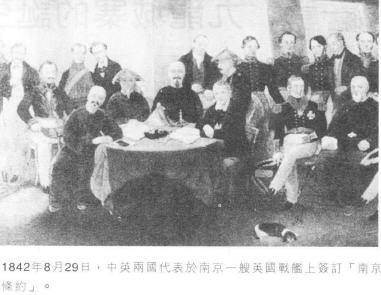 The treaties opened five ports of Guangzhou (Canton), Fuzhou (Foochow), Xiamen (Amoy), Ningbo (Linbou) and Shanghai, rendered an indemnity of 21 million Mexican dollars as damages for the British, ordered the cession of the HK (Xianggang) Island, granted Britain the 'most favored nation' status (i.e., enjoying the privileges extorted from China by any other country), lowered the import duties from 65% to 5% A.D. valorem, exempted the British nationals and their Chinese employees from the Chinese law via 'extraterritoriality', and allowed the British merchants to establish residency in the treaty ports (which led to the later concession areas such as the Shanghai Settlement).
The Treaty of Nanjing (i.e., The Jiangning Treaty) also set an example for the other foreign powers to invade China. France and the United States, in the ensuing two years, signed similar treaties with China. Russia began to encroach on the Chinese territories in the west, north and northeast.
In London,
The Times and Illustrated London News applauded the opening-up of China.
Later in an edition on March 17th, 1857, The Times reflected on what it considered the 'most disgraceful war', in which the British "lost 69 men, and killed between 20,000 and 25,000 Chinese".
The British hauled some Qing junk there for making into a museum-kind of exhibition, which struck Charles Dickens as a floating toyshop and a symbol of 'the waste and desert of time' (citing Patrick Wright's The Great Exhibition and London's Chinese Junk).
The treaties opened five ports of Guangzhou (Canton), Fuzhou (Foochow), Xiamen (Amoy), Ningbo (Linbou) and Shanghai, rendered an indemnity of 21 million Mexican dollars as damages for the British, ordered the cession of the HK (Xianggang) Island, granted Britain the 'most favored nation' status (i.e., enjoying the privileges extorted from China by any other country), lowered the import duties from 65% to 5% A.D. valorem, exempted the British nationals and their Chinese employees from the Chinese law via 'extraterritoriality', and allowed the British merchants to establish residency in the treaty ports (which led to the later concession areas such as the Shanghai Settlement).
The Treaty of Nanjing (i.e., The Jiangning Treaty) also set an example for the other foreign powers to invade China. France and the United States, in the ensuing two years, signed similar treaties with China. Russia began to encroach on the Chinese territories in the west, north and northeast.
In London,
The Times and Illustrated London News applauded the opening-up of China.
Later in an edition on March 17th, 1857, The Times reflected on what it considered the 'most disgraceful war', in which the British "lost 69 men, and killed between 20,000 and 25,000 Chinese".
The British hauled some Qing junk there for making into a museum-kind of exhibition, which struck Charles Dickens as a floating toyshop and a symbol of 'the waste and desert of time' (citing Patrick Wright's The Great Exhibition and London's Chinese Junk).
After the war, the opium trade more than doubled in the ensuing 30 years.
homestead.com/files/extended.html discussed the economic effects of the Opium War: rising food rice as a result of Chinese farmers' abandoning the production of food for silk and tea industry, and the dismantling of home textile industry (Chinese hand-made cloths) in face of the rushing-in of cheap Western machine-made products.
The "Wangxia Treaty" [U.S.] & the Whampoa Treaty [France]
http://www.ctrl.org/boodleboys/boddlesboys2.html pointed out:
During that first Opium War, the Chief of Operations for Russell & Co. in Canton was Warren Delano, Jr., grandfather of Franklin Roosevelt. He was also the U.S. vice-consul and once wrote home, "The High officers of the [Chinese] Government have not only connived at the trade, but the Governor and other officers of the province have bought the drug and have taken it from the stationed ships … in their own Government boats."
The powers, including the European nations and the United States, since the Paris news media broke the news of an impending British expedition against China in the spring of 1840, had been murmuring about sending their fleets to China as observers of war and expressed eagerness in the sharing of war spoils.
The Americans, who first sailed two gunboats to Macao during the opium burning session, dispatched a fleet to Macao in April 1842. On the pretext that a sailor was killed, one American warship sailed along the Pearl River to demonstrate force. In 1843, the Americans, in the name of war mediation, obtained similar privileges as the British. An American emissary was sent to China on Feb 24th, 1844 for extracting a treaty.
From June 17th to July 3rd, 1844, the Americans imposed the Peace, Amity and Commerce "Wang Hsia Treaty" onto Manchu China, dated July 3rd (Gregorian), 1844, ratified by the U.S. president in 1845 and proclaimed in 1846. Wang Hsia (Wangxia) was a village in Macao.
One month later, the French, wielding the power of 8 warships, forced Manchu China into signing the "Whampoa Treaty".
The Americans, bundling the Chinese with the Blacks as Mongrels, believed that only force worked with Manchu China.
It would be in the 1860s when President Abraham Lincoln designated Burlingame minister to China, that the Americans began to restructure the Sino-Western relations on an equal footing.
Anson Burlingame, during his stay in China, came to like and love China and the Chinese people,
and accepted the Manchu emperor's invitation to be China's first envoy to the Western powers.
Anson Burlingame
in opposition to the anti-Chinese discriminatory whirlwinds rampant in the U.S. in the 19th century, authored the Burlingame Treaty for China and died for China in 1870 in St. Petersburg while still on the Manchu China's 1868-1870 mission to the U.S. and Europe.
(The Democrats of the 19th century, not the political corrective party of the 20th-21st centuries, led the charge against the Chinese coolies, and even called Lincoln's Republican Party by the Mongrel Party.
The Democratic Party's World publication claimed that the only way to deal with China was force;
only force really worked since "it is not 'because the Western nations have reversed
their old doctrine of force' that she (i.e., Manchu China) responds, for it was by the assertion of
the Western nations of their 'old doctrine of force' that the presence of
Mr. Burlingame as an American Envoy in Pekin was made possible.")
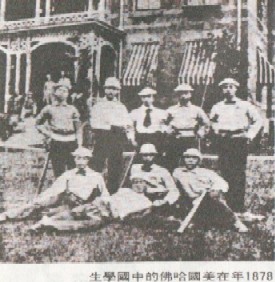 The beneficial consequence of the "Burlingham Treaty" would be Manchu's dispatchment of overseas students to America.
It was said that Manchu China had agreed to send young kids to America for studies after listening to the opinions from Yung Wing [Rong Hong] who graduated from Yale University in 1854.
At the suggestion of Yung Wing [Rong Hong, 1828-1912], Zeng Guofan, in 1871, dispatched the Chinese children to America for overseas studies.
Four batches and altogether 120 students were sent to America in the 1870s.
14-year-old Tang Shaoyi [1860-1938], who was studying in HK since he had an uncle working for Jardine Matheson & Co, was admitted to the 3rd session for studies in America in 1874.
In 1881, Tang Shaoyi, after a stay of 7 years in America, was recalled back before graduation from Columbia College as a result of Manchu fear of "westernization" among the young overseas students, and in the ensuing year, Tang Shaoyi was sent to Korea together with P.G. von Mollendorff, a German customs official working for Manchu China in Korea.
About one to two dozen kids survived in America and mingled there before the "Chinese Exclusion Act" was formulated to delay the development of Chinese in the American continent for the next 75 years.
Among the ninety plus students who returned to China would be one to two dozen who served in the Manchu navy, with quite a few sacrificing their lives during the 1894 Sino-Japanese War, and a few others sacrificing their lives during the French raid on Manchu China's southern fleet.
The beneficial consequence of the "Burlingham Treaty" would be Manchu's dispatchment of overseas students to America.
It was said that Manchu China had agreed to send young kids to America for studies after listening to the opinions from Yung Wing [Rong Hong] who graduated from Yale University in 1854.
At the suggestion of Yung Wing [Rong Hong, 1828-1912], Zeng Guofan, in 1871, dispatched the Chinese children to America for overseas studies.
Four batches and altogether 120 students were sent to America in the 1870s.
14-year-old Tang Shaoyi [1860-1938], who was studying in HK since he had an uncle working for Jardine Matheson & Co, was admitted to the 3rd session for studies in America in 1874.
In 1881, Tang Shaoyi, after a stay of 7 years in America, was recalled back before graduation from Columbia College as a result of Manchu fear of "westernization" among the young overseas students, and in the ensuing year, Tang Shaoyi was sent to Korea together with P.G. von Mollendorff, a German customs official working for Manchu China in Korea.
About one to two dozen kids survived in America and mingled there before the "Chinese Exclusion Act" was formulated to delay the development of Chinese in the American continent for the next 75 years.
Among the ninety plus students who returned to China would be one to two dozen who served in the Manchu navy, with quite a few sacrificing their lives during the 1894 Sino-Japanese War, and a few others sacrificing their lives during the French raid on Manchu China's southern fleet.
|
President Trump
understood the China situation and the China problem.
Should the American politicians follow the footsteps of Anson Burlingame (1820-1870),
Paul Samuel Reinsch (1869-1923)
and
Patrick Jay Hurley (1883-1963), i.e., three most prominent U.S. statemen who loved China and the Chinese people,
then the Chinese people could have a chance of salvation from the communist tyranny.
Note the historic recurrence and the repetition of similar events:
Anson Burlingame, in opposition to the anti-Chinese discriminatory whirlwinds rampant in the U.S. in the 19th century, authored the Burlingame Treaty for China and
died for China in 1870 in St. Petersburg
while still on the Manchu China's mission to the U.S. and Europe;
Paul Samuel Reinsch, who was disillusioned by President Wilson's betrayal of China over the division of WWI spoils at the Paris Peace Conference, quit the minister-to-China job to work for China and died for China in Shanghai in 1923;
and
Patrick Jay Hurley, who convinced President Roosevelt of the American moral blunders in selling out the Republic of China at Tehran and Yalta, personally travelled to Moscow and London for sake of averting and reverting China's fate of becoming a victim of WWII war spoils (i.e., the loss of Port Arthur and Hong Kong, etc.), but failed to make remedy to the secret Tehran and Yalta agreements in the aftermath of President Roosevelt's death in April 1945.
|
|
For better understanding the head-on collision between the United States and Communuist China,
refer to
the U.S.-China fatalistic conjunction through the hands of the Japanese firepower during WWII, that derived from the American unpositive neutrality;
the U.S.-China fatalistic conjunction through the hands of communist army's firepower during the 1945-1950 civil war, that derived from American-supplied Soviet August Storm weapons; and
the U.S.-China fatalistic conjunction through Joseph Stalin, Kim Il Sung and Mao Tse-ting's hands during the 1950-1953 Korean War.
|
|
|
|
In November of 1842, Henry Pottinger's British army attempted to enter Canton in accordance with the Nanking Treaty, but encountered resistance. The British did not attempt to enter the city till July 1843, at which time they encountered resistance from the populace again. Manchu official Qi-ying persuaded the British into delaying the entry.
It would be in January of 1846 that Manchu official Qi-ying allowed the British soldiers to enter Canton.
The Canton people intruded into the Manchu prefecture office and lit a fire.
Hence, Qi-ying negotiated with the British for an entry in 1849.
The above procrastination was taken to be Qi-ying's plots to use the people as excuse for delaying the British entry into Canton for residency and commerce.
In 1849, new British envoy-minister demanded with new Manchu governor-general Xu Guangjin for entry into Canton by sailing the warships into the Pearl River.
100000 village fighters converged onto Canton for resisting the British.
Hence, Manchu Governor-general Xu Guangjin declined the British request again.
This was also taken to be Xu Guangjin's plots.
In May [lunar calendar?] of 1846, Manchu official Qi-ying authorized the build of the "Kowloon City Castle" (i.e., jiu-long cheng) that would later become a thorn in the British's flesh during the expansion towards the Kowloon Peninsula and the "New Territories".
The southern portion of the Kowloon Peninsula was later ceded to the British in 1860 in the aftermath of the Second Opium Wars. However, China still retained the "Kowloon City Castle" as a symbol of territorial ownership and administrative sovereignty.
Around 1898, Li Hongzhang adamantly demanded the retention of the "Kowloon City Castle" even at the expense of the lease of entire Kowloon Peninsula.
Historian Liang Binghua stated that the Manchu court treated the "Kowloon City Castle" as a thorn the same way as the retention of the Jinzhou-cheng city inside of the Russian-leased Lüshun [i.e., Port Arthur] and another Chinese-controlled castle inside of the British-leased Weihaiwei harbour.
In contrast with the antagonism from the Cantonese, Shanghai was much more hospital to the Europeans and Americans.
First British consul Ba-mo-er [Pei-er-fu, i.e., George Balfour, a captain from the Madras Cannons Regiment] arrived in Shanghai in 1843 as a consul. George Balfour first negotiated with Manchu "dao tai" [i.e., magistrate] Gong Mujiu for leasing about 130 acres of land between the Whampoo (Huangpu) River and the Shanghai county capital.
By 1846, through bribery with Gong Mujiu, the British expanded its consulate territory to 1080 acres as well as wrestled over the right to lease direct from the Chinese landowners within the said domain.
In 1845, the British cunningly signed a lease agreement with the Shanghai prefecture, with over 23 clauses stating to the effect that the Chinese side could not terminate the lease at will and that the British had the right to build bridges, construct roads, erect light poles, plant trees, set up the fire department, and take charge of irrigation.
The leased territory hence mutated into an independent kingdom.
Foreign merchants expanded to 140 by 1848.
The British leased land increased to 2800 acres.
While the British established their domain on the south bank of Suzhou-he River,
American Wu-li-guo erected a flag pole on the north bank.
At Hongkou, to the north of the British leased land, the Americans established its domain in 1848.
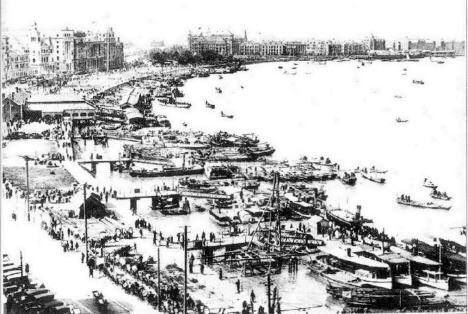 In 1854, the British, French and American revised the charters of their settlements to allow the Chinese to live inside.
The settlements would have their own police, judges and city council.
By 1863, the American-leased territory increased to 8000 acres.
The French obtained their leased land as well, first 500 acres and then 1200 acres.
In 1863, the British and Americans, i.e., innate cousins, merged their leased land into the so-called "International Settlement" which eventually expanded to 80,000 acres by the 1930s. The French settlement expanded to 20000 acres at the same timeframe.
The "big ben" established a Britishmen's Club at the intersection of the Suzhou-he and Huangpu rivers, which would be the predecessor of today's Seamen's Club.
Opposite to the club, on the other side of the Suzhou-he River, would be a Whangpoo (Whampoo) Park of the Bund where an insulting sign was said to be hung at the gate, with words stating that "the Chinese and dogs not allowed in the park".
Shanghai, alternatively called the 'Whore of the Orient', was to become the paradise of foreign venturers, where you could expect to "buy a nine year girl at no cost" per Sterling Seagrave in addition to "688 whorehouses" that had at one time in 1927 incapacitated Dr. McDonald's entire regiment via venereal disease as a result of "everything [including sex] was so [dirty] cheap".
The founder of American International Group (AIG) claimed that he obtained his first bin of gold in Shanghai.
The American companies involved in the opium trade would include Russell [La-sai-er] & Company, Heard [He-de] & Company, Wetmore's [Wei-te-mo-er Company], Olyphant's [Ao-li-fen-te Company], and Wolcott [Wo-er-ke-te], Bates [Bei-ci? Joshua Bates] & Company per Sterling Seagrave.
The Boston Russel [La-sai-er] Company had connections with Roosevelt, Delano [Warren Delano, Jr., i.e., the grandfather of Franklin Roosevelt] and Forbes [Robert Bennett Forbes] families. -- Those names should be inscribed on the "Pillar of Shame".
In 1854, the British, French and American revised the charters of their settlements to allow the Chinese to live inside.
The settlements would have their own police, judges and city council.
By 1863, the American-leased territory increased to 8000 acres.
The French obtained their leased land as well, first 500 acres and then 1200 acres.
In 1863, the British and Americans, i.e., innate cousins, merged their leased land into the so-called "International Settlement" which eventually expanded to 80,000 acres by the 1930s. The French settlement expanded to 20000 acres at the same timeframe.
The "big ben" established a Britishmen's Club at the intersection of the Suzhou-he and Huangpu rivers, which would be the predecessor of today's Seamen's Club.
Opposite to the club, on the other side of the Suzhou-he River, would be a Whangpoo (Whampoo) Park of the Bund where an insulting sign was said to be hung at the gate, with words stating that "the Chinese and dogs not allowed in the park".
Shanghai, alternatively called the 'Whore of the Orient', was to become the paradise of foreign venturers, where you could expect to "buy a nine year girl at no cost" per Sterling Seagrave in addition to "688 whorehouses" that had at one time in 1927 incapacitated Dr. McDonald's entire regiment via venereal disease as a result of "everything [including sex] was so [dirty] cheap".
The founder of American International Group (AIG) claimed that he obtained his first bin of gold in Shanghai.
The American companies involved in the opium trade would include Russell [La-sai-er] & Company, Heard [He-de] & Company, Wetmore's [Wei-te-mo-er Company], Olyphant's [Ao-li-fen-te Company], and Wolcott [Wo-er-ke-te], Bates [Bei-ci? Joshua Bates] & Company per Sterling Seagrave.
The Boston Russel [La-sai-er] Company had connections with Roosevelt, Delano [Warren Delano, Jr., i.e., the grandfather of Franklin Roosevelt] and Forbes [Robert Bennett Forbes] families. -- Those names should be inscribed on the "Pillar of Shame".
The Coolie Trade
The Second Opium Wars (1856–60) & Arson of the Summer Palace
Revisionist history books claimed that the Second Opium War was not about opium but the Manchu refusal to implement the 1842 treaty of opening up the five ports, etc.
What the revisionists forgot was that the war was undertaken under the pretext that a British flag opium smuggling ship was seized by China and that Lord Elgin (1811-1863) made sure an extra clause to make opium dutiable was inserted into the Peking treaty in 1860, which was 30 taels of silver for each chest.
Furthermore, the Manchus officially still upheld the policy of prohibition of opium, which the British kept on pestering for sake of having the Qing government officially lift in a decree.
In 1856, the British, French and American representatives contacted Liang-guang Governor-general Ye Mingshen (1807-1859) the 1842 and 1844 treaties of peace, amity and commerce in accordance with a clause in the treaty as to review in twelve years.
This was after the Manchu government repeatedly created obstacles to prevent the foreigners from dwelling in the five ports that were opened by the British through the Opium War.
Ye Mingshen undertook a tactic of dodging the foreigners.
After failing to get in touch with Ye, the foreign nations went to Shanghai to talk to local official Jiangsu Governor Ji-er-hang-e who asked them to go back to Ye Mingshen.
Further attempt at Tientsin failed as well.
According to Lovell, even though Pottinger made sure that the treaty documents bind together with ribbons so as to prevent the Manchu officials from taking out any unfavorable page before presentation to the Manchu emperor, the Chinese tranlation, which was handled by no other person that British missionaries like Morrison, had deviation in meaning, with Article II spelling out "permanent residency" for the British in the treaty ports but "temporarily" for the trading seasons in the Chinese version, something noted in John Nolde's The False Edict of 1849 (Journal of Asian Studies 20.3, 1960, p. 299).
Meantime, in early 1856, the French found an incident of a French priest by the name of Ma-lai (Auguste Chapdelaine) killed in Guangxi by Xining magistrate Zhang Mingfeng, and later in 1856, i.e., October 8th (Gregorian), the Qing junks in Guangdong detained a smuggling ship by the name of Ya-luo (Arrow) that flew the British flag but owned by a young Irish by the name of Thomas Kennedy.
Per Lovell, consul Parkes personally rushed to rescue the detained Chinese pirates as if they were British citizens.
Arrow was a piracy ship with a Chinese owner and crew, but it was flying the British flag after the captain obtained a one-year license from the HK authorities on Sept 27th of 1855.
Parkes issued to Ye Mingshen (Ye Mingchen) a threat of attack by the British Commodore of H.M. Navy, as well as communicated to Hongkong governor Sir John Bowring as to China's disrespect for British flag and British register.
In 1856, the Second Opium War [i.e., the Arrow War] broke out following an allegedly illegal search of a British-registered ship, the Arrow, in Guangzhou [Canton] on October 8th of 1856 [Gregorian].
The British sought the search of Arrow and the lowering of the British flag as a pretext even though the pirates' license had expired on September 27th (Gregorian).
Consul to Canton, i.e., Parkes, demanded that the Canton government release the pirates, pay reparation, and make apologies.
Governor-general Ye Mingshen declined it.
British minister-envoy Bowring [Bao-ling-he] and Canton consul Parkes hence used it as a pretext for war.
According to Lovell, Bowring, who suffered from a string of business failures, intended to escalate the incident for securing his position and reputation in the British government.
British Consul Harry Parkes (1828-1885) and HK Governor Sir John Bowring (1792-1872) demanded redress, with the two warmongering through October (Gregorian) even though Ye promised to return most of the sailors per Lovell.
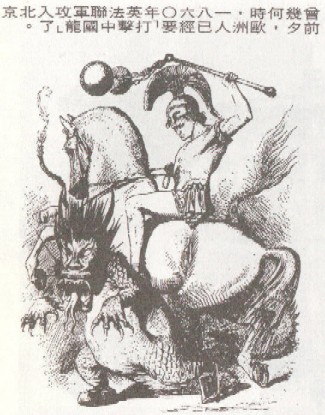 The French joined the British in using as their excuse the murder of a French missionary in interior China. On Feb 29th of 1856 [Gregorian], French Catholic missionary Auguste Chapdelaine intruded into interior China illegally and was beheaded. Zhang Mingfeng, a county magistrate in Xilin of Guangxi Province failed to provide an investigation report that satisfied the French.
The fundamental cause of British-French Second Opium War against China would be related to violation of both the Treaty of Nanjing and the Treaty of Wangxia, i.e., 1) persisting refusal, from 1842 to 1856, by the Guangdong Province populace in allowing the British to enter the Canton [Guangzhou] city; and 2) deliberate put-off by the Manchu court in re-negotiating the clauses of the Nanking Treaty and Wangxia Treaty etc., in regards to commerce.
The war continued for several years as a result of the Manchu opposition to an additional demand of stationing a minister or ambassador at Peking for the unexplained fear which was abolition of the Manchu kowtow protocol, a custom that passed down from the barbarian Mongol Yuan dynasty but was wrongly attributed by today's Chinese to a millennial practice of China.
This was because the barbarians like the Mongols and Manchus treated the Chinese as slaves, and the Manchu emperor did not want to see the Europeans breaking the master-slave protocol to set an example for the enslaved Chinese.
(The Second Opium War was a result of the British feeling "incensed by what they felt was clear treaty
violations" and the Chinese feeling angered by "the wholescale export of Chinese nationals to America and the Caribbean to work at what was no better than slave labor". See Richard Hooker analysis.)
Per Lovell, three months after the 1842 Treaty of Nanking, there erupted a major incident in Canton involving an Indian soldier, that led to burning of foreign factories outside of gates of Canton.
The British failed to enter Canton in A.D. 1845, with commissioner Qi-ying putting off the request with claim of mobsters' threat to foreigners.
Another row involving the British occurred in 1846, with the British retaliated by storming of riverside forts by a gunboat.
In December 1947, six Britons were dead in conflicts with villagers west of Canton.
Palmerston, who was to become prime minister, claimed that half-civilized governments required a dressing every eight or ten years.
The British, with four more ports opened, still failed to maintain trade balance, with year 1848 exports lower than in 1843 and the balance of payments in year 1854 more than 8 million pounds in red and ticking to 9 million the following year per Lovell, and looked to opening up the Chinese hinterland as answer.
Palmerston querried consuls in China in a push for revising the Treaty of Nanking.
In 1856, the British had some fighting in Canton.
According to Lovell, Parkes, who was newly-appointed consul to Canton, had conversations with Palmerston twice, and was ordianed to find a pretext to force the question of revising the Treaty of Nanking and opening up Canton for residency by the British.
On October 16th (Gregorian), Parkes ordered the capture of a Qing military junk.
On October 23rd, the British, under navy general Xi-ma-mi-ge-li, sailed along the Zhujiang River (i.e., Canton River or Pearl River) and bombarded the Humen Battery.
The British attacked and sacked the Canton forts for sake of pressuring Governor-general Ye Mingshen.
Battery general Wu Yuanyou abandoned the battery under the no-fight-back order.
The British then sailed into the inner river and bombarded the Liede Battery which fired back.
Ye Mingshen, who believed in superstition, claimed ludicrously that the British would retreat by sunset.
The British closed in to the Thirteen Firm Wharf, to the southwest of Canton.
The next day, Ye Mingshen continued to ignore the British at the time the British was attacking the Fenghuang-gang Battery.
After sacking Fenghuang-gang, the British took over the Haizhu Battery on the 25th.
The British had a break on Sunday.
On the 27th, the British sent over a request for entering Canton.
Since Ye Mingshen continued to ignore the British, the British mounted guns at the governor-general office and blasted one shot every ten minutes for the afternoon.
On the 29th (Gregorian), the British blasted apart the Canton citywall.
Staff and soldiers fled the governor-general office. Only Ye Mingshen was sitting in with prayers to the divine spirits.
Then, Ye Mingshen issued an order to resist the British at a reward of 30 "grand silver dollar" for each British head.
On the 28th, the British blasted open a corner on the citywall.
On the 29th, the British entered Canton and intruded into the governor-general office right after Ye Mingshen vacated it.
By sunset, the British exited Canton.
On November 3rd (Gregorian), the British shelled the old southern city of Canton per Lovell.
Through December-January, "regular British bombardment" turned the southern Canton district into ruins smoldering with smoke per Lovell.
On November 7th [Gregorian], William B. Reed was sent to HK by U.S. President Buchanan for mediating between China and Great Britain, but later in the month the Americans revenged with an attack by capturing three Manchu forts.
Per Lovell, the British since September 1856 (Gregorian) secretly held talks with the French, Americans and Russians for a joint military action against China, and by November 27th (Gregorian), reached the principles of military cooperation with the French.
The British mounted skirmishes with the Chinese continuously and blasted at the Canton city till January of 1857.
On January 20th, the British warships exited towards the Humen Battery for relief to come.
Ye Mingshen reported the news to the emperor.
Emperor Xianfeng instructed that peace should be sought with the British.
What the Chinese side did not know was that the British and French already sent a march order without parliamentary approval.
In early February (Gregorian), the British, as in the case of the First Opium War, sent order to India for mobilization.
The British specifically ordered that the war objective would be to open up China's hinterland and legalize the opium.
On March 10th (Gregorian), which was seven days after loss of the war vote, Lord Elgin, i.e., former governor of Jamaica and Canada, was appointed the post of plenipotentiary for the expedition.
Per Lovell, in Britain, both Houses debated war with China in March 1857 (Gregorian).
The Lords disapproved Parkes and Bowring's behavior.
In the Commons, there was the Tory's opposition to Palmerston's war.
Palmerston claimed that Ye Mingshen was a monster who executed 70,000 Chinese in the last year alone.
There was a vote of no confidence by the House of Commons, with Richard Cobden's motion carried by sixteen votes including that of Sir Francis Baring who advocated for war seventeen years prior.
The warmongers lost the vote in early March (Gregorian).
Per Lovell, it was the Protestant missionary lobby who resuscitated Palmerstonians.
After months of propaganda, including Palmerston's claim that Ye Mingshen displayed British merchants' head on the walls of Canton, Richard Cobden, et al., were voted out on April 7th, 1857 (Gregorian).
In March of 1857 [Gregorian], the British relief troops arrived from Madras and England, and Lord Elgin, an earl, was appointed minister-envoy.
In October, the French dispatched Jean Baptiste Louis Gros [Ge-luo] on an expedition against China.
On December 12th, 1857, the British-French joint armies issued a ten-day ultimatum to Ye Mingshen.
Ye Mingshen intended to negotiate for peace by offering the monetary concession.
With rebellion in neighboring province, Ye dared not relocate the Qing troops to Canton.
After the superstitious bamboo slip came back with the words that "disaster would be gone 15 days later", Ye Mingshen took it as divination and ordered that the subordinates do nothing for the next 15 days.
On December 24th, the British-French sent notice to Ye Mingshen again.
On the 27th, Ye Mingshen held a birthday party.
On December 28th [Gregorian], the allied forces bombarded Canton again even though Ye Mingshen (Yeh Ming-ch’en) revised a treaty and promised to resume trade.
The British-French bombarded Canton and the governor-general office.
Per Lovell, Canton was shelled into submission on December 29th (Gregorian).
Ye Mingshen fled to the Yuehua Academy after the British-French cannon balls splashed across the city.
At the east gate, Deng Anbang resisted the British with 1000 village fighters from the Dongguan county, while dozens of Manchu soldiers fired the cannon balls on the Donggu Battery.
Half a day later, Deng Anbang sacrificed his life.
On the 29th, the British-French attacked five batteries at the north gate. After failing to sack the batteries guarded by Za-pu, the British-French attacked the north gate.
After taking over Mt Guanyinshan, the British-French sacked both the north gate and east gate by firing from the mountain top.
On December 30th, Governor Bai-gui [Bo-gui] dispatched merchants Ren Chongyao & Liang Lunshu to Mt Guanyinshan for peace talk.
The British-French insisted that Ye Mingshen must come personally.
Ye Mingshen was located from his hiding place, fetched to Mt Guanyinshan, and then shipped to HK.
Ye Mingshen's subordinate, Jiang Sheng, suggested that Ye jump into the sea to commit suicide, which Ye refused.
When Ye repeatedly made drawings for the British, Jiang Sheng reminded him not to stamp his name on the drawings.
Ye Mingshen hence likened himself to the ancient Chinese emissary to the Huns by signing himself "Su Wu At Sea".
Governor-general Ye Mingshen (Yeh Ming-ch’en), one year later, died in custody in Calcutta, India.
With Ye Mingshen (Yeh Ming-ch’en) personally tracked down and exiled to India, Parkes took over the governor's postion in Canton where the French were accused of more savage plungering than the British.
After a respite, during which the British fleet and Lord Elgin returned to India for cracking down on the local Indian rebellion, the British would renew its campaign against China for the purpose of "ratifying the treaty".
In May of 1858 [Gregorian], Lord Elgin and Jean Gros sent fleets northward with United States envoy William Bradford Reed and the Russian envoy Admiral E. V. Putiatin onboard.
The Russians and Americans supposedly acted as intermediaries at the request of the conflicting parties.
On April 28th, Emperor Xianfeng dispatched Governor-general Tan Yanxiang to Dagukou, but the British & French declined him for bearing no "full authorization" from the Manchu court.
Tan Yanxiang then ordered that 3000 soldiers under Zhang Dianyuan defend the port.
Another 2000 soldiers, with 30 cannons, were sent to the coast from the capital. Thousands of village fighters were recruited.
One Manchu official set up a reception stand on the battery for the British-French negotiation team to enjoy good food and fresh fruits. While the reception team greeted the British-French with courtesy words like "whoever met each other over 1000 li distance away must have good destined fate", Tan Yanxiang deliberately displayed the cannons to the invaders for exhibiting the Manchu power. Zhang Dianyuan objected to disclosure of military preparations.
On May 20th, the coalition force issued an ultimatum for the possession of the battery that was good for two hours.
Under bombardment, Tan Yanxiang ordered a fight-back which sank four coalition ships. 50 wooden boats carrying fire failed to cause any damage to the coalition ships.
The coalition troops landed on the beach and intruded into the battery.
On May 20th [Gregorian], the allied fleet sacked the Pei-ho (Bei-he) forts and the Taku (Dagu) forts (near Tianjin).
Governor-general Tan Tingxiang and General Tuo-ming-a were defeated by the allied forces.
Zhang Dianyuan jumped into river to commit suicide.
Soldiers rescued him.
Under attacks by the Anglo-French fleets, the Manchus agreed to the Treaty of Tienstin which allowed revision to the Treaty of Nanking to incorporate the British demands.
Meanwhile, Russia attacked northernmost Manchuria.
In May of 1858, Manchu General for Heilongjiang [the black dragon river, i.e., the Amor/Amur River], Yi-shan (?-1878), signed the Treaty of Aigun (Aihui) ceding to Russia the 600,000 square kilometers of land between the northern bank of the Amor River and the Outer Xing'an Ridge, and gave the joint possession of the land between the Ussuri River and the sea. (In 1859, the Manchu court rejected the Treaty of Aigun signed by the Manchu commissioner for Manchuria.)
The British and French troops, after capturing the fort of Dagukou after heavy fighting, threatened to advance on the Tianjin city along the banks of the Bai-he River. The
Coalition forces stopped at Wanghailou, at the outskirts of Tianjin, in anticipation of a peace talk.
The British-French soldiers raided the merchant ships on the Bei-he River, but were repelled by the locals when they attempted to tour the city of Tianjin.
On May 29th, the Manchu court dispatched Kuei-liang [Gui-liang, Grand Scholar] and Hua-sha-nai [Hua-sha-na, Officialdom Secretary] to Tianjin for truce talk beginning on June 5th [Gregorian].
Senior official Qi-ying, who participated in the Nanking Treaty and often offered Parkes candies, was fetched to Tianjin; Qi-ying returned to Peking after failing to see the British-French. The emperor ordered Qi-ying to die for dereliction.
Elgin sent Wei-tuo-ma & Li-tai-guo, and Gros sent Ma-ji-shi.
The British-French demanded that minister-envoys [i.e., ambassadors] be allowed to station in Peking. The Manchu court, having originally objected to the stationing of foreign legations, finally agreed to the terms of the "Tianjin Treaty" for sake of getting the invasion forces off the back.
The British and French troops compelled the Manchu government into signing the Treaties of Tianjin [Tientsin] (June, 1858), to which France, Russia, and the United States were also parties.
On June 13th [Gregorian], a Sino-Russian treaty was signed; on June 18th [Gregorian], a U.S.-China treaty for "peace, amity, and commerce" was signed;
and on June 26th [Gregorian], the 56-article Anglo-Chinese treaty was signed by Lord Elgin / Baron Gros and Gui-liang [Kuei-liang];
and on June 27th [Gregorian], a similar Sino-French treaty was signed, opening up Nanking as a trade port.
In Nov, a further treaty of tariff and trade regulations, consuls, and emigration with the United States was signed.
Later in the year, in further negotiations in Shanghai, the opium importation was legalized.
Manchu China, simultaneously being boiled down in its wars with the "Taiping Heavenly Kingdom Rebellion", had to agree to opening up 11 more ports (including Newchwang, Tengchow, Taiwan, Swatow, Kiungchow), opening up the Yangtze River water-course, revising tariffs and permitting the foreign legations in Beijing in addition to sanctioning the Christian missionary activity inside of China, allowing the British to travel to the interior, indemnifying the allies for the expenses of the war, and stopping the application of the "Yi" barbarian designation to the Europeans.
The treaty ratification was set for the next year.
Manchu King Senggelinqin [of the Mongol Ka-er-qin Tribe] and his Mongol cavalry, who had won victories over the Taiping and Nian rebels in Henan/Shandong provinces, were put in charge of the Dagukou Battery near Tianjin.
Emperor Xianfeng assigned King Senggelinqin, a cousin, to the coastal defense in 1859 after the king had expressed opposition to signing the Tianjin Treaty one year before.
King Senggelinqin expanded the Dagukou battery to 3000 soldiers, in addition to deployment of 5000 cavalry, and built additional batteries to the south and north of the Dagukou river mouth. The
Manchu emperor, one month before the dispatchment of Senggelinqin, had secretly ordered that King Senggelinqin harass the British-French emissary via disguise of bandits should the "barbarians" disobey the scheduled route: the Manchu emperor wanted the British-French circumvent to Tianjin via Beitang, with stringent demands that no weapons should be brought ashore, no more than 20 soldiers should accompany the respective diplomatic missions, and the entry path of diplomats into Beijing be changed to overland.
The British-French warships, about one dozen and extra, arrived in the river mouth on June 16th of 1859.
Frederick Bruce, i.e., Lord Elgin's brother, came for the mission of ratifying the treaty agreed to the previous year.
Seeing that the British warships sailed towards Dagukou, King Senggelinqin sent messenger to request for their re-routing via the north side (Beitang) of the bay, about 15 kilometers from the Dagukou Battery.
King Senggelinqin notified the joint fleet as to the new route on June 22nd.
(http://www.secretchina.com/news/articles/5/4/10/91871.html cited Guo Songtao's diaries in pointing out that King Senggelinqin disregarded the imperial decree, i.e., sailing to the British-French warships for notification of the scheduled circumvential route, even though the British-French had moored in the river for nine days.)
The Americans travelled to Peking via the land route, while the British-French insisted on sailing along the Bai-he River [White River].
Gros believed that the Manchu emperor must ratify the treaty under coercion.
On June 20th, the coalition fleet sent boats ashore for detecting the Chinese defense.
On the 21st, British Admiral He-bo demanded that the wood and iron chains and fences at the river mouth be dismantled.
On the early morning of the 25th, Governor-general Huan-fu for Zhili Province sent over the Manchu notice to the British-French as well.
13 coalition fleet closed in to the river mouth.
A British captain, who happened to be the brother of British plenipotentiary, refused to change course, and he led the British/French/Russian warships straight forward.
Western records stated that "on June 25th of 1859 [Gregorian], British envoy Bruce was stopped in the River Pei-ho by the Chinese".
British Admiral Hope and the French attempted to force a passage of the Tagukou forts by dismantling the iron chains. The
Coalition fleet, with red flags, spent the whole morning and afternoon dismantling the obstacles.
By 3:00 pm, the coalition fleet, with clearance of obstacles, began to bombard the battery.
On the south bank, General Shi Rongchun of Zhili Province was in charge; and on the north bank, deputy battery general Long Ruyuan was in charge.
Both personally lit the fuse till they sacrificed their lives. The Coalition fleet commander was wounded during the battle, and had to change ships twice, first to another ship from his flagship and then to a French warship.
Numerous warships were damaged, and some became live targets of the Manchu battery fire after failing to retreat with the tide.
The rest of warships rolled up the white flags, sailed downstream, and then sailed back to bombard the Chinese positions from behind the damaged warships.
The British/French were repulsed, and were said to have been "saved from annihilation by the United States ships".
The Americans, whose emissary did change course and successfully ratified the articles of the treaty, would come along to pull the damaged British-French warships away.
However, the American envoy, Ward, refusing to submit to the degrading ceremonies, did not see the Emperor in person.
At about 5:00 pm, over twenty sailboats carrying 1000 soldiers attempted a landing.
For hours till dusk, the Manchu army pinned the landing forces to the muddy beach.
About 60 officers and soldiers made a stealthy trek to the foot of the battery but had to retreat with a few survivors by midnight when no relief came along.
Among 13 warships, five British-French warships were sunken, and six warships damaged, with casualty amounting to 500 onto the British and 14 onto the 60-member French force.
According to Lovell, the British suffered a casualty of 519 killed and 456 wounded.
In October of 1859 [Gregorian], the English and French decided to launch a new expedition against China.
Elgin, who had remorse over Palmerstin's war against China and was working as Postmaster-General, was sent back to China to finish the job, with specific order to take Peking.
Britain sent over reinforcements of the 99th (Lanarkshire) Regiment under the command of Lt Col Day in February of 1860.
The total British forces amounted to 18,000.
On April 26th, 1860 [Gregorian], Lord Elgin and Baron Gros sailed from England for China, and after a shipwreck near Point de Galle of Ceylon on May 23rd [Gregorian], arrived in Shanghai on June 29th [Gregorian].
By June, 100 British ships sailed to the Bohai Sea. The French army had 4000 men [7000 per http://www.secretchina.com/news/articles/5/4/10/91871.html]
By mid-late July of 1860, the British-French, having occupied Yantai & Dalian [Dairen], encircled the Bohai Bay.
King Senggelinqin reinforced the defense of Dagukou as well as planted the mines at Beitang.
King Senggelinqin had no clue that the British-French had just renovated their weaponry in both the rifles and cannons, i.e., the technology of firing the bullets and cannon balls from the hind of guns and cannons.
The British-hired Chinese traitors learnt of the mining at Beitang. After secretly debugging the mines at night, the British and French forces, totaled 18,000 men, circumvented through to the inner harbor.
On August 1st [Gregorian], the allies landed at Beitang (Pei-t’ang) and took over the Beitang town, about 3 kilometers away from Dagukou.
On August 12th, 1860 [Gregorian], the British, commanded by Sir Hope Grant, and the French by General Montauban, defeated the Chinese near Bei-he [Pei-ho].
The Chinese soldiers had mostly fought to the last person. The British-French memoirs repeatedly mentioned that the "Tartar soldiers" fought to the death even with the joint army getting close to them, with one such cannon soldier single-handedly loading the cannon and firing it about 35 kilometers from the Dagu fort.
On the morning of the 21st, the British-French bombarded the north batteries of Dagu.
The Chinese soldiers fought on even after the invasion force had broken into the battery.
The North Battery of Dagukou was taken over by the joint forces, and "ti du" (general) Le-shan died with his soldiers on August 21st.
Thousands of bodies of the Chinese soldiers were found inside of the battery.
At the South Battery, King Senggelinqin (San-ko-lin-sin) waited for the British/French soldiers to get on the beach for a duel, and then ordered a calvary charge against the joint invasion forces. Only 7 out of the 3000 Manchu cavalry survived the firearms of the invasion forces.
On August 21st, 1860 [Gregorian], the allies took over the Taku forts.
(Alternative saying states that 8000 cavalry were decimated by the British fire-power. This number could be mixed up with either Rui-lin's relief army or Sheng-bao's relief army around the Tongzhou area later.)
King Senggelinqin retreated to Zhangjiawan (Zhang family's bay), and converged with "da xueshi" (grand scholar) Rui-lin's 9000 banner soldiers from the capital. They retreated then to Tongzhou [Tongxian county] while the Manchu court dispatched ministers Wen-jun, and Heng-qi [? Huan-qi, governor-general for Zhili] to Tianjin for peace talk with the British/French.
The British/French took over Tianjin and refused to see Wen-jun and Heng-qi.
Parkes then talked with the Manchu representatives but stopped peace talks with Gui-liang, Heng-fu & Heng-qi.
The joint army [let's coded it by the "coalition forces" in the George Bush fashion] dispatched 3000 herald troops towards Tongzhou.
The Manchu court selected Gui-liang as imperial commissioner for another visit on August 31st.
The key term was whether to allow the coalition force take soldiers to Peking, to which emperor rejected at first.
With ministers suggesting fight or peace, wavering Emperor Xianfeng, who often enjoyed stay with four concubines from his late father's era at the imperial garden, then dispatched King Yiqin-wang (Zai-yuan) and Army Secretary Mu-yin to the replacement of Gui-liang.
Huan-fu, as imperial commissioner, was sent to Tianjin from Tongzhou.
The British/French forces then went north to threaten Beijing, and reached a place called Hexiwu.
On Sept 14th, Elgin and the coalition troops arrived in Hexiwu. Parkes was sent to Tongzhou, and held an eight-hour talk with Zai-yuan.
Zai-yuan and Mu-yin first wanted the coalition force to return to Tianjin and then agreed to allow the invasion forces to stay at Hexiwu.
Peace talk was to be held at Tongzhou.
Elgin agreed to stop at Hexiwu so that he could fetch more relief troops over.
"Consul Parkes, Captains Anderson and Brabazon, M. de Norman, Mr. Bowlby (the Times correspondent), abbe de Luc, and 13 others (Europeans and Sikhs-total of 39)" went to Tongzhou (Tung-chow).
By Sept 12th-14th, the two parties had reached agreements after days of talks, with an understanding that a formal treaty be stamped after Elgin's arrival in Tongzhou and that the joint armies stay put to the south of Zhangjiawan.
British plenipotentiary E-er-jin (Elgin) and Consul Ba-xia-li (Parkes) demanded the opening-up of Tianjin etc.; Gui-liang and Huan-fu reported to Emperor Xianfeng (Hsien Feng); and Emperor Xianfeng rejected the demand.
Then, Zai-yuan basically agreed with whatever Parkes had raised back in Tianjin.
Parkes, a British rascal who travelled to Macao [i.e., a crime-filled city that once possessed more prostitution-related White women population than the White men] for dependency on his sister at age 15, had picked up the Chinese language while working as a servant on a merchant ship, ultimately finding his language skills in the employment of the British foreign ministry: Parkes participated in the negotiations of the Nanking Treaty, acted as British consul to Amoy in 1856, manufactured the Arrow Incident, received a lord conferral from the British royal house in 1862, assumed the envoy post to Japan at one time, and died in Peking in 1885.
When Parkes returned to Tongzhou on Sept 17th, Zai-yuan and Mu-yin held a grand reception at the Dongyue-miao Monastery.
The turn of events came on the 17th when Parkes proposed a demand of personally submitting the British Queen's letter to Emperor Xianfeng.
For one day, the Manchu officials tried to obtain a compromise by asking Parkes to stand a certain distance from the emperor, which Parkes refused.
Zai-yuan insisted on the British kneeling down on both legs at the imperial reception, while Mu-yin suggested the compromise of having a third person relay the letter to the emperor.
On the early morning of the 18th,
British consul Parkes intruded into Zai-yuan's bedroom and threatened to leave the scene since the Manchu court had declined to allow him to submit the Queen's letter in person.
When Parkes took off, Zai-yuan sent a message to Senggelinqin to have Parkes detained at Zhangjiawan.
The subsequent taking custody of 39 diplomats and reporters by Manchu General Senggelinqin would lead to the invasion of Beijing.
The Manchu imperial instructions mentioned the necessity of detaining the emissaries like Parkes because Parkes was considered to be a chief tactician in the war against China.
King Senggelinqin got enraged, chased and arrested the British and French entourage.
When Gui-liang, Manchu "zhong tang" (minister of foreign affairs), requested for release of the 'friendlier' French, King Senggelinqin agreed to it. Gui-liang escorted the French plenipotentiary away.
Emperor Xianfeng ordered that King Yiqin-wang (Zai-yuan) go to Tongzhou for further peace talks, and then fled to the 'Yuan Ming Yuan' palace in the northwestern outskirts of Peking.
Xianfeng was dissuaded from a flee to Jehol by Mu-yin whom the emperor refused to see till Mu-yin threatened to jump into the river for a suicide.
For days, King Gong-wang and King Dun-wang, in tears, dissuaded the emperor from taking a 'vacation'. An official by the name of Bi Boyuan claimed that since the ancient times, no emperor would travel remotely at the time of defending the kingdom.
On Sept 12th, Kng Gongqin-wang Yi-xin had to assemble all civil and military officials for dissuading the emperor from a flee.
On the 13th, King Dun-wang objected to the relocation with tears.
General Sheng-bao proposed to kill those who advised the emperor on a flee.
King Gong-wang, King Dun-wang and King Chun-wang grabbed the emperor's legs, pleading for a return to the forbidden city.
Minister Wen-xiang kowtowed his head to bleeding.
The Emperor decided not to go to Jehol. Yi-xin and Su-shun conflicted with each other as to disbanding the logistics for the trip to Jehol.
After talks broke down on Sept 17th, Emperor Xianfeng consulted with ministers like Mian-yu, Zai-yuan, Duan-hua & Su-shun, and ordered that Senggelinqin and Zai-lin be in charge of defense.
On the 18th, the Manchu emperor ordered the detention of Parkes and a duel with the coalition forces.
Hearing of the abduction, the British plenipotentiary ordered a northern campaign against Peking [Beijing].
Senggelinqin failed to coerce Parkes into writing a letter to Elgin.
By noon of Sept 18th, the joint armies approached Zhangjiawang from Hexiwu.
30,000 Manchu forces resisted for half a day till Senggelinqin's cavalry was beaten back by the British-French firepower.
Seeing the loss of Zhangjiawan, the Manchu Green Standard Army abandoned Tongzhou.
King Senggelinqin and Rui-lin fled to Baliqiao [about 15 kilometers to Beijing] from Tongzhou without further fighting with the British and French.
In report to the emperor, Senggelinqin mentioned that his cavalry was pushed back by the "fire arrows" of the joint invasion forces.
Along the retreat, Captain Brabazon and abbe de Luc were beheaded, with "their bodies ... thrown into the canal while the others are carried into Peking".
Parkes et al., first being fetched to the "Yuan Ming Yuan" palace, were later transferred to the prison at the Justice Ministry where Secretary Zhang Guang allocated additional 50 taels of silver for feeding the special foods.
On the early morning of Sept 21st, the coalition forces pushed towards Baliqiao where the Manchu forces numbered around 30,000, including Sheng-bao's 4000 banner soldiers, 1000 Manchu shouldered-raw-gun soldiers from the "Yuan Ming Yuan" garden, and Rui-lin's Green Standard Army.
At 7:00 am, the joint armies attacked Baliqiao from three directions of Tongzhou, Zhangjiawan & Guojiafen.
Senggelinqin's cavalry was to attack the western route, Rui-lin's Green Standard Army was to attack the eastern route, and Sheng-bao's banner soldiers were to attack the southern route.
The Mongol cavalry, at one time, claimed to habe caused a casualty of 1000 onto the allied army after fighting for two hours, which was a Manchu fake military report.
On the Baliqiao Bridge, Sheng-bao met the French invasion forces.
The French cannon brigade then bombarded the Baliqiao Bridge, and engaged with the Manchu forces in face-to-face wrestling.
General Sheng-bao, riding on horse with a yellow banner, fought against the southern route of the joint army.
After two hours, Sheng-bao's army claimed to have inflicted a casualty of 1000 onto the French, again a fake report. Sheng-bao was targeted by waves of cannon blasts and rifle shots and got wounded in the buttock area by a shrapnel which pierced the horse.
Sheng-bao was further wounded by the collapsing dead horse, and then transported back to the capital where he had to be lifted to the citywall.
Cousin-Montauban [1796-1878], for the victory of the joint Anglo-French expedition at Baliqiao [Pa-li-ch'iao (French: Palikao)], was appointed to the French Senate in December and named comte de Palikao by Napoléon III in 1862, despite the worldwide indignation as to the pillage and burning of the summer palaces. Charles Cousin-Montauban, later from August to September of 1870, had tacked on the post of premier ministre for a short while.
Sengelinqin tried to lend help to Sheng-bao by ordering his cavalry to charge at the linkage of the western and southern routes of the coalition force.
When the British dispatched a circumvential column to the back of Senggelinqin's cavalry at 9:00 am, Senggelinqin's armies collapsed under the firearms of the invasion forces.
Rui-lin's army did not actively engage with the eastern route invasion force at all.
The allies went on to defeat the Manchu troops at Baliqiao (Pa-li-chiau).
The Manchu army, with 25000 soldiers and local gentry-organized forces, had mostly sacrificed their lives at Baliqiao.
About nine boats were used to carry the dead bodies of invasion forces to the coast.
The coalition forces, having suffered heavy casualties, decided not to attack the Peking city but to pillage the imperial recreation garden at the northwestern outskirts.
At the capital, King Ruiqin-wang Duan-hua [? Rui-hua] and "shang shu" (secretariat) Su-shen again petitioned with the emperor to have a relocation to the Mulan hunting field in Rihe (Jehol) for sake of avoiding the turmoil.
On Sept 22nd [Gregorian],
Emperor Xianfeng left the 'Yuan Ming Yuan' Palace and ordered that King Gongqin-wang (Yi-xin), a brother, be the omnipotent commissioner in charge of the capital.
Since Yi-xin had ordered the dismissal of the logistics days earlier, the emperor and his cronies had to flee desperately; the next day, en route, at the Shicao village of Miyun County, they had to dispatch officials back to Peking for fetching the grains.
Emperor Xianfeng was to stay at Jehol with four Chinese concubines till his death in August of 1861 even though Yi-xin had ratified the Peking Treaty back in Peking: Why? Emperor had no home for placing the Chinese concubines since the garden was burnt down by the coalition force while the Manchu ancestral rule forbade the Chinese women from entry into the forbidden city.
King Gongqin-wang Yi-xin dispatched Heng-qi to prison for seeing Parkes.
Parkes et al., were released from prison for preferential treatment at the Desheng-men City Gate.
Elgin, after receiving Parkes' letter, demanded that the Chinese side must release the prisoners before peace talk was to start.
Sheng-bao threatened the British with execution of Parkes should the coalition force refuse to back off from Peking.
The British threatened to burn the city should Parkes be killed.
At one time, Heng-qi went to see Parkes for serving the notice of execution.
The coalition forces closed in towards the Anding-men and Desheng-men gates on October 5th.
On October 6th, the coalition defeated Senggelinqin's cavalry again.
Yi-xin fled to Wanshou-shi.
On October 6th [Gregorian], the French infantry and British cavalry drove off the remnant guards at the Summer Palace garden.
The French first ravaged the Summer Palace.
Per Lovell, the French first reached the garden on October 7th (Gregorian).
On October 7th, Elgin ordered the removal of whatever could be moved and the destruction of whatever could not be moved.
Heng-qi suggested to Yi-xin to have Parkes (Ba-xia-li) released for appeasing the invasion forces.
On October 8th (Gregorian), the Manchu officials relayed a message to the British to have prisoners released.
Over the next few days,
Parkes, Loch, altogether nineteen Europeans and Sepoy soldiers, according to Lovell, were released alive, with the rest in coffins.
The British found out that about 20 of the diplomats and reporters, including Captain Anderson, M. de Norman, were validated to have been killed by the Manchu prison guards, with some of them cut into body parts.
There was confusion as to the sequence of events in regards to Parkes' release.
Alternatively speaking, Parkes was released much earlier.
Parkes, with a Chinese traitor called Gong Xiaogong as a guide and an interpreter, intruded into the Summer Palace (Yuan Ming Yuan).
Yi-xin sent Heng-qi to the 'Yuan Ming Yuan' for seeing Parkes, but Parkes demanded that the rest of hostages be released before peace talk could continue.
After being set free, Parkes suggested the arson of the imperial garden right away, i.e., what Parkes claimed to be "exemplary punishment."
In revenge, the British plenipotentiary (Elgin) and commander-in-chief (Lt General Sir Hope Grant) burned the imperial palace (Yuan ming yuan) on October 18th (Gregorian).
This was after the British debated with the French who intended to burnt down the forbidden city instead. The British claimed that the coalition army entered the Peking city under an arrangement for the Qing army to vacate and hence they should not damage the palace.
On lunar September 5th (Gregorian October 16th), Elgin put out a notice in Chinese that they were to punish the shameless Manchu emperor with destruction of the emperor's personal property at Yuanmingyuan, knowing that the Chinese people were not at fault for this.
Lord Elgin ordered the ransack of the summer palace, and two days later, burnt the palace to cover up the looting.
Elgin told Yi-xin that they were to burn the garden as revenge for the deaths of prisoners.
Fire raged on, and by October 19th, the imperial garden was completely destroyed.
Felix Beato, who followed the Anglo-French army as a wartime reporter, was the first person who used the camera to record the war crimes, with specific requests to keep the Qing dead and wounded in place for preserving true history for posterity.
Beato caught the Pavilion of the Spirit of Literature on the film before the garden palaces were burnt down.
(Cai Dongfan claimed that Gong Xiaogong was to blame for introducing the idea of arson; the British plenipotentiary's letter stated that he deliberately burnt the palace or the emperor's private property to cause personal pain onto the emperor; the Chinese history books stated that the British/French burnt the palace to cover up the traces of the palace pillage.
Gong Xiaogong was hired from Shanghai, a place termed either the 'Whore of the Orient' or the 'Paris of the Orient', for producing: 1) the pidgin English, 2) the parasite "mai ban" [broker-dealers] associated with the foreign colonialists, and 3) the 'xian (salty) shui (water) mei (women)' kind of sex industry related to the foreigners. During the early years of economic reform, in early 1980s, numerous pidgin English Shanghaiian still had good memories of 'three gold bowls' such as jobs at the foreign customs office and banks.)
While the coalition succeeded in sacking the imperial garden, a small contingent met deadly resistance from the hunters at the Xiezhuang Village, about 5 kilometers away from the garden.
There were 100 households at Xiezhuang.
Feng Shanbao, i.e., a Shandong Province native, was selected as the chief of village fighters.
The hunters ambushed about 100 invaders and inflicted a casualty of about half onto the enemies.
Villagers were ecstatic about the victory. The 19-year-old daughter of Feng Shanbao, by the name of Xie Wanzhen, was worried about the coming retaliation.
Since her father did not heed the call, Xie Wanzhen organized dozens of teenagers for another ambush in a forest area.
When the British-French came back with over 500 soldiers and 5 cannons, Xie Wanzhen led a sudden charge at the invaders with blades. Xie Wanzhen instructed that her teenagers kept closely intertwined with the British-French. From noon to dusk, the blade and bayonet fighting continued till the coalition force retreated with loss of about 100 soldiers and all the cannons.
At the advice of Heng-qi, Yi-xin requested that Gui-liang contact the French plenipotentiary for mediation. With the help of the French, the British plenipotentiary agreed to talk peace with an immediate payment of 500,000 taels of silver as indemnity.
By Sept 9th (lunar calendar) or in October [Gregorian], all parties sat down at the Ministry of Protocol and added the additional clauses to the original Tianjin Treaty, including the ceding of Kowloon in exchange for Chusan (Zhoushan).
A large indemnity was paid immediately for compensating the families of the murdered prisoners.
Two days later, on October 24th [Gregorian] (or Sept 11th? per lunar calendar), Lord Elgin and Yi-xin (I-hsin) signed and ratified the treaty of Tianjin or Tien-tsin (1858) and apologized for the June 1859 attack at Pei-ho, with additional terms like indemnifying Britain with 12,000,000 taels of silver, opening up Tianjin as a trading port, and allowing the British consuls to station at all open ports. The next day, Yi-xin invited the French over and offered 6,000,000 taels of silver as indemnity.
Conventions were signed with the French who obtained the right for missionaries to hold property in China.
Aside from the British and French, the Russians, who previously promised to protect Yi-xin from the British/French during the peace summits, came to Yi-xin for cession of the land east of the Wu-su-li River (River Ussuri). Back in 1853, the Russians, taking advantage of the Taiping Rebellion, had intruded into Heilongjiang Province of Manchuria and occupied the land north of the Heilongjiang River via the unequal Treaty of Ai'hui (Aigun). A few months back, in May of 1860, taking advantage of the Manchu entanglement with the British/French at Dagukou Battery, Russia had forced China into signing a 'Special Tianjin Treaty' to enjoy the same privileges as granted to Britain/France.
On November 14th [Gregorian], the Sino-Russian Supplementary Treaty of Peking was signed with Russian envoy General Nicholas Ignatiev to confirm the Treaty of Aigun, giving Russia the Maritime Province (Vladivostok), free trade, and extra territories including the Ussuri Province.
At the site of pillage, the coalition forces put on women's banner clothes, worn Chinese hats, and could not hold all treasures, ending in throwing away silver for gold or throwing away gold for diamonds per Thames report on October 7th.
Gros recalled that coalition forces later were busy auctioning the treasures at Tianjin, with booty amounting to 30,000,000 francs.
http://history.farmersboys.com/Battle_Honours/pekin_1860.htm had good description of the pillaging:
"The allied advance went on with artillery opening up and the enemy attempting a stand, finally being defeated by the 99th advancing in skirmishing order. Pekin now lay only 6 miles ahead. On 5th October a move forward was made with the 99th covering the British left. The famous Summer Palace stood outside the walls of Peking, full of immense riches, which were eventually all stripped in retaliation for the torture and murder of prisoners. The looting of the Palace must not be confused with its final destruction, which occurred later under the direct orders of the allied chiefs.
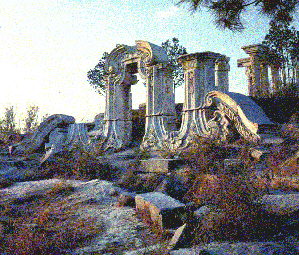 There appears to be very little doubt about the commencement of this wholesale looting, for when Sir Hope Grant arrived at the palace to see things himself, between the hours of 8am and 9am, the whole palace was in a state of hopeless confusion, and the French troopers were taking anything of value they could lay their hands on. Sir HOPE had previously dispatched a squadron of British cavalry to the palace to see if the French cavalry were still there. It was clear that to allow the troops of one of the allied armies to loot and restrain those of the other allied army would cause discontent, so the collection by British troops of what remained was sanctioned, the treasures thus collected were sold by auction among the officers and men of the force by a specially selected committee of officers.
The money realized at this auction was divided among the members of the British force at the ratio of one third to the officers and two thirds to the men, each private soldier receiving about £4 as his share."
There appears to be very little doubt about the commencement of this wholesale looting, for when Sir Hope Grant arrived at the palace to see things himself, between the hours of 8am and 9am, the whole palace was in a state of hopeless confusion, and the French troopers were taking anything of value they could lay their hands on. Sir HOPE had previously dispatched a squadron of British cavalry to the palace to see if the French cavalry were still there. It was clear that to allow the troops of one of the allied armies to loot and restrain those of the other allied army would cause discontent, so the collection by British troops of what remained was sanctioned, the treasures thus collected were sold by auction among the officers and men of the force by a specially selected committee of officers.
The money realized at this auction was divided among the members of the British force at the ratio of one third to the officers and two thirds to the men, each private soldier receiving about £4 as his share."
Note: Yuanmingyuan, i.e., Round-shaped Splendor Garden, shown as ruins in the picture, was commonly termed the 'Garden of Perfect Splendor'. The garden composed of three parts: the Garden of Perfect Splendor, the Garden of Eternal Spring and the Garden of Ten Thousand Spring Seasons. It was first built in 1709 and completed after 150 years of continuous renovations. It was mistaken as the 'Summer Palace', a lake-side palace which was actually located to the west of Yuanmingyuan. The real summer palace was first named 'Garden of Clear Ripples' and it was burnt down in 1860 by the allied forces of Britain and France at the same time. 25 years after the arson, the summer palace, now termed 'Yi-he-yuan' (harmonious and happy garden), was rebuilt and it was completed in year 1895.
The Taiping (Grand Peace) Heavenly Kingdom Rebellion
Manchu China, while being attacked by the foreign countries, began to experience waves of the internal rebellion which included the Nian (Nien Fei [Nien Banditry]) Rebellion (1853-1868) in Anhui-Jiangsu-Shandong-Shanxi, several Muslim [Panthays] rebellions in the Southwest of Yunnan Province (1855-1873) and northwest (1862-1877), the Miao tribe revolt in Guizhou (1855-1881), and the Taiping Rebellion (1851-1864). The Taiping Rebellion, with remnants lasting for close to twenty years, caused the loss of lives in the number of almost twenty to thirty million. For the time period of 1850 to 1873, the rebellion, drought, and famine cut the population of China by over sixty million people.
* In Commemoration of China's Fall under the Alien Conquests in A.D. 1279,
A.D. 1644 & A.D. 1949 *
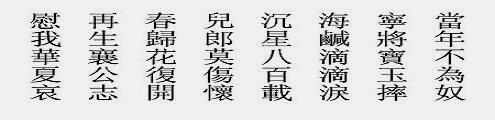 U.S.S.R./Comintern Alliance with the KMT & CCP (1923-1927)
 Korean/Chinese Communists & the 1931 Japanese Invasion of Manchuria Korean/Chinese Communists & the 1931 Japanese Invasion of Manchuria
American Involvement in China: Soviet Operation Snow, IPR Conspiracy, Dixie Mission, Stilwell
Incident, O.S.S. Scheme, Coalition Government Crap, Amerasia Case & The China White Paper
* Stay tuned for "Republican China 1911-1955: A Complete Untold History" *
|
|
Zou Rong's Revolutionary Army;
Shin Kyu Sik's
Shrine (Spirit, Kunitama) of Korea
|
This snippet is for sons and daughters of China:
Heed the sons & ministers' agony and sorrow of our ancestors who died or lived through the Mongol, Manchu and Soviet-Chicom conquest
and
the Yongjia, Jingkang and Jiashen cataclysms !
Jeanne d'Arc of China:
Teenager girl Xun Guan breaking out of the Wancheng city to borrow the relief troops in the late Western Jinn dynasty;
Liu-Shao-shi riding into the barbarian army to rescue her husband in the late Western Jinn dynasty;
teenager girl Shen Yunying breaking into Zhang Xianzhong's rebels on the horseback to avenge on father's death in the late Ming dynasty.
China's Solitary and Lone Heroes:
Nan Jiyun breaking out of the Suiyang siege and charging back into the city in the Tang dynasty;
Zhang Gui & Zhang Shun Brothers breaking through the Mongol siege of Xiangyang in the Southern Soong dynasty;
Liu Tiejun breaking through three communist field armies' siege of Kaifeng in the Republican China time period;
Zhang Jian's lone confrontation against the communist army during the June 3rd & 4th Massacre of 1989.
|
|
|
In the first lunar month of 1850, Emperor Daoguang's health worsened. A will was left stating that the fourth prince, Aixinjueluo Yi-zhu, be the succeeding emperor. This would be Emperor Xianfeng (Aixinjueluo Yi-zhu, Qing Wenzong, r. 1851-1861). Emperor Daoguang was said to have special fondness for Yi-zhu because Yi-zhu's birth-mother (Empress Xiaoquan) died likely from the poisoning by emperor's mother dowager-empress. During one hunting session, Yi-zhu impressed his father-emperor with benevolence by deliberately refusing to kill the animals on the pretext that the animals should have the chance to breed during the spring time. The refusal to hunt the animals was a play that Yi-zhu learnt from a minister called Du Shoutian; hence, after enthronement, Emperor Xianfeng conferred the title of "Da Xue Shi", i.e., Grand scholar, onto Du Shoutian. Emperor Xianfeng deprived the posts of two corrupt officials responsible for the bad advice to Emperor Daoguang during the Opium War, i.e., Muzhuang'a and Qi-ying. Emperor Xianfeng further recalled Lin Zexu from retirement in Fuzhou of Fujian Province for quelling the banditry rebellion in western Guangdong Province.
Lin Zexu, after being exiled to the New Dominion Province as the scapegoat for the Opium War, had first been re-assigned the job of governor-general for Shen-Gan [Shenxi-Gansu provinces] in A.D. 1845 and then governor-general for Yun-Gui [Yunnan-Guangxi provinces] in A.D. 1847.
Back in 1848, the two provinces of Guangdong and Guangxi endured a famine. The southwestern Guangxi province became the strongholds of bandits, with such leaders as Zhang Jiafu and Zhong Yachun of the Qingyuan-fu prefecture, Chen Yakui and Chen Dongxing of the Liuzhou-fu prefecture, Xie Jiangdian of the Xunzhou-fu prefecture, Qu Zhenzu of the Xiangzhou prefecture and Liu Guansheng and Liang Yajiu of the Wuxuan-xian county. Manchu governor Zheng Zushen, failing to rein in the banditry, deliberately ignored the bandits. In the village of Jintian, Guiping County, Guangxi Province, a Confucian, by the name of Hong Xiuquan (Hung Xiuquan, 1812-1864), would lead the biggest rebellion in the modern history.
Hong Xiuquan & the Lord Jesus Christ's Religion
Scholar Hu Qiuyuan treated the Taiping rebellion as a fight between the "landlords" of Guangdong-Guangxi provinces and the "landlords" of Hunan Province. Hu Qiuyuan further claimed that the Taiping leaders, other than Yang Xiuqing and Li Xiucheng, were mostly landlords and/or opium smugglers. The core cadre components of the rebellion, in the viewpoint of Hu Qiuyuan, were the former "righteous and brave gentry-organized fighters" from the Sino-British Opium War.
Jian Youwen, in "Complete History of the Taiping Heavenly Kingdom", pointed out that it might not be true that the British cannons had brought about the rise of the Taiping rebels but that the British cannons had contributed to the demise of Taiping, with the common understanding that the same "righteous and brave gentry-organized fighters" from the Sino-British Opium War had fled to Guangxi Province after the Manchu government's crackdown in the aftermath of the dissipation of the British threat.
Hong Xiuquan (1814-1864, Hung Hsiu-ch'uan) was born in Huaxian County of Guangdong Province during the 18th year of Emperor Jiaqing's era [on lunar calendar December 10th of A.D. 1813 or January 1st of Gregorian A.D. 1814].
A descendant of Hong Hao [i.e., the Southern Soong Dynasty patriot who was detained by the Jurchens for 15 years], Hong Xiuquan was initially reported by the Manchu court as someone surnamed either Zhu or Zheng, i.e., the remnants from Ming Dynasty royal house or Zheng Chenggong's resistance movement in Taiwan.
Hong failed to pass the civil service exams several times, at age 16, age 24 [1836] and age 25, respectively. During the 2nd try at the provincial capital of Canton, Hong received a set of Christianity books from Robert Morrison and Liang Fa [of the London Missionary Society] on the street per the extrapolated speculation by Jian Youwen.
Hong, however, went into a psychic status after the failure of the 3rd test in A.D. 1837, and for months, had hallucination related to the experience of encountering the European priest and the Chinese interpreter.
After recovery from hallucination, Hong continued the job as a countryside teacher for 5-6 years, but after another exam failure at age 31 in A.D. 1843, Hong began to trash all Confucius altars and claimed that he would someday launch the "imperial exam" himself.
Hong preached his version of Christianity by recruiting cousin Hong Ren'gan as well as Feng Yunshan.
Together with Li Jingfang, Hong studied the Christian ideas earnestly, with apparently the only textbook being Liang Fa's translation entitled "quan [admonishing] shi [world] liang [beneficial] yan [speeches]".
Trashing the Confucian altars and recruiting the followers in hometown caused a rift with the local seniors.
Hong Xiuquan & Feng Yunshan, being cousins per Jian Youwen's interpretation of the generations of cross marriages between the two Hakka families, then decided to leave hometown in search of a land for preaching the newly-found religion, in a similar fashion to Jesus Christ's leaving hometown.
The two, together with another two Feng-surnamed cousins, left for the neighboring Guangxi Province after checking out the societal conditions in several surrounding counties.
Rumor said the entourage made a living via necromancy or 'milfoil divination' and travelled between the two provinces of Guangxi and Guangdong.
The truth, per Jian Youwen, could be seen in what Jian Youwen had expounded as to the single-handed organization efforts by Feng Yuanshan.
Cai Dongfan claimed that Hong Xiuquan, hearing that Zhu Jiutao had set up a religion called 'Shang Di Jiao' (the Lord Jesus Christ's Religion), brought along his pal Feng Yunshan for a visit to Zhu Jiutao, and both converted to this quasi-Christianity; that after the death of Zhu Jiutao, Hong Xiuquan succeeded as the master; that Hong Xiuquan bought several biblical books, including the "Gospels of Matthews," etc., and incorporated the Christian doctrines into the 'Shang Di Jiao'; and that Hong Xiuquan claimed that he was a brother of Jesus Christ.
Hu Qiuyuan pointed out that
it was Hong Xiuquan who utilized the strong discipline of the Christian "alien ideas" that were propagated by Liang Fa the first Chinese priest [who was the second convert, after a Macao Chinese called Cai Gao].
Having completely refuted the Zhu Jiutao rumor, Jian Youwen, however, traced the history of Hong Xiuquan to have derived a conclusion that it was Hong Xiuquan & Feng Yunshan themselves who had studied Liang Fa's Christian translation works to derive the idea of the "Taiping Heavenly Kingdom".
Preaching Christianity In Guangxi Province
Hong Xiuquan and Feng Yunshan, after passing through the mountainous land of the Yao-zu & Dong-zu natives, decided to go to the Cigucun Village of Guixian county in the Guiping-fu Prefecture for assistance from the family members of Hong's Wang-surnamed birth-mother.
While Feng Yunshan and his cousins were to go elsewhere for development, Hong stranded behind for taking care of a lawsuit of the Wang family's cousin.
Hong's assisting in the lawsuit won over the heart of his cousin, and converted the whole population of the wang-surnamed village to be his disciples.
Hong Xiuquan, after failing to locate Feng Yuanshan in the neighboring area, went back to Guangdong Province after a trek of eight months.
For the next two years, Hong Xiuquan, at hometown, would be busy writing poems, songs, rules, and articles about his Christianity, and occasionally conferred with cousin Hong Rengan as to his efforts to launch a revolution to overthrow the Manchu "dogs".
Meanwhile, Feng Yunshan, by late A.D. 1864, after months of heavy labor for making a living, obtained the recognizance of a landlord by the name of Zeng Kuiying at Gulinshe inside of Mt Zijingshan.
Then, Feng went on to work as a family teacher for another landlord called Zeng Yuezhen in A.D. 1846.
Soon, Feng Yueshan baptized all family members and relatives of the relative, and organized the "Lord Jesus Christ's Religion" entitled "bai [adoration] shang-di [God] jiao [religion]", with members reaching 3000 within two years.
Sometime in A.D. 1847, with the recommendation of Zhou Daoxing, Rev J.J Roberts [i.e., Luo-Xiaochun] of the American Southern Methodist Church invited Hong Xiuquan for a visit at Canton. Hong Xiuquan and Hong Rengan stayed in Canton for one month.
Roberts dispatched two Christian converts on accompanying Hong Xiuquan home for a physical inspection.
The two reported to Roberts that Hong was a person of good character; however, the Chinese peers under Roberts, out of envy, induced Hong into a request with Roberts for a relatively high stipend as well as an immediate baptism, which Roberts declined by misjudging Hong as a possible "rice Christian". It would take Rev Roberts quite sometime to figure out the trickery by the Chinese peers; nevertheless, Rev Roberts still treated Hong Xiuquan as a good man, and paid a visit to the Taiping Heavenly Kingdom in Nanking later.
With financial assistance from Zhou Daoxing, Hong Xiuquan left for Guangxi Province for a second time on June 10th of the Daoguang emperor's 27th year [i.e., A.D. 1847].
Walking to the Zaoqing-fu area, Hong Xiuquan was robbed of his belongings by the bandits, and had to lodge a complaint with the prefecture officials, for which he was reimbursed some money.
On the ship to Wuzhou, Hong received assistance from four passengers. Back at the Cigucun Village, Hong Xiuquan found out about Feng Yunshan's accomplishments. Together with a nephew, Hong Xiuquan went to Mt Zijingshan for a reunion with Feng Yunshan after an elapse of three years.
Inside of the mountains of the Guiping county were mostly descendants of the Hakka immigrants from Guangdong Province during Manchu Emperor Kangxi's reign.
Yang Xiuqing, i.e., one of the future prominent Taiping rebel leaders, was the uncle-in-law of Zeng Yuezhen.
Across a river, opposite to Gulinshe, would be another village called Jintian [golden fields] where Wei Zheng [i.e., Wei Changhui] dwelled.
Yang Xiuqing and Wei Changhui of the Guiping county, Shi Dakai and Qin Rigang of the Guixian county, and Xiao Chaogui of the Wuxuan county all flocked to Hong. Hong Xuan'qiao, i.e., Xiao Chaogui's wife, claimed that ten years ago, she had a dream that a saint would come to preach ten years later.
Hong Xiuquan set up churches and enrolled both men and women (termed brothers and sisters without regard for age) at a membership fee of five ounces or taels of silver. Hong Xiuquan, with the help of Xiao Chaogui, faked a death and then claimed to be reborn 7 days later. Hence, Hong captivated the populace's heart via the religious charisma and expanded membership considerably. While Hong returned to Guangdong for recruiting comrades, Feng Yunshan was arrested by the county officials; Zeng Yueheng spent a huge sum of money to get Feng released; Feng was ordered to be expelled from Guangxi Province. Hong and his entourage met Feng on the road, and they went to see a local wealthy landlord called Hu Yihuang at the Pingnan County of Guangxi Province. At the Jintian Village, the folks were waiting for Hong's return, and they dispatched some messenger to have Hong and Feng fetched over. Hong was delighted to meet several new comrades at the village, including Lin Fengxiang of the Guixian County, Luo Dagang of the Jieyang County and Hong Daquan of the Hengshan County. They held an oath party, swearing to be blood brothers, with Hong Xiuquan as No. 1 Chief and Yang Xiuqing as No. 2 Chief. The rebels hence decided to cut the pigtails, save hair on the skull, and change to the Han-ethnic clothing.
Several times, the Guiping county magistrate dispatched henchmen for catching Hong & Yang but the government forces got either killed or driven off. The Guiping County reported to the official in charge of prefectures, and the prefecture official reported the rebellion to provincial governor Zheng Zushen. Governor Zheng Zushen petitioned with the emperor for dispatching a commissioner to Guangxi Province. Hence, Emperor Xianfeng, at the advice of Du Shoutian, dispatched Lin Zexu as "qincai dachen" (imperial commissioner) and Xiang-rong as "ti du" (general) for Guangxi.
Governor Zheng Zushen led a few thousand green-camp soldiers to the Pingle-fu Prefecture and then stopped for the arrival of Lin Zexu, while Xiang-rong went ahead to attack the rebels in the Liuzhou, Qingyuan, Ensi and Nanning area. Lin Zexu, who was said to have given Zuo Zongtang the military maps of the New Dominion Province with high expectation that Zuo Zongtang would someday go west to defeat the Russian encroachment, arrived in the Puning county of Chaozhou for replacing impotent governor Zheng Zushen. Unfortunately, Lin Zexu died of illness shortly thereafter, and Governor-general Li Xingyuan was ordered to replace Lin as the imperial commissioner.
Founding Of the Taiping Heavenly Kingdom
In early 1851, Hong Xiuquan hence declared an uprising with a proclamation authored by Hong Daquan stating that the populace's lives had been exhausted as a result of Manchu Qing's heavy taxation, officialdom corruption, and cession of the land and monetary indemnities to the foreign powers. Hong Xiuquan's army, with red turbans wrapped around the heads, marched out of the Jintian Village, stationed at Dahuangjiang, and then launched the multi-prong attacks at the Guiping, Wuxuan, Guixian and Pingnan counties. The Manchu government conferred Zhou Tianjue the post of governor and governor-general for Guangxi Province for assisting Li Xingyuan, and ordered that Governor-general Xu Guangjin for the Guangdong-Guangxi provinces dispatch the armies for assisting Xiang-rong.
Xu Guangjin sent Wu-lan-tai to Guangxi Province.
At Maluling, opposite to Dahuangjiang, Xiang-rong defeated the rebels and chased them to Wuxuan; Xiang-rong defeated the rebels at Wuxuan and chased them to Zijingshan. Li Xingyuan died of indignation as a result of disobedience among the Manchu armies led by Xiang-rong, Zhou Tianjue and Wu-lan-tai. Emperor Xianfeng hence deprived Zhou Tianjue of the post and assigned the governor post for Guangxi Province onto Zou Minghe. Emperor Xianfeng also dispatched grand scholar Saishang'a to Guangxi Province with 4000 forbidden banner soldiers from the nation's capital city.
The Manchu armies launched attacks at the rebels and drove them out of the Zijingshan Mountain. The rebels fled to the Yong'an Prefecture where Hong Xiuquan declared the dynastic title of 'Tai Ping Tian Guo' where Taiping (T'ai-p'ing or Taeping) meant for the Grand Peace and Tianguo meant for the heavenly kingdom.
Hong Xiuquan called himself by 'tian wang' or the Heavenly King, and conferred 'dong wang' or the Eastern King onto Yang Xiuqing, 'xi wang' or the Western King onto Xiao Chaogui, 'nan wang' or the Southern King onto Feng Yunshan, 'bei wang' or the Northern King onto Wei Changhui, 'yi wang' or the Wing King (i.e., Assistant King) onto Shi Dakai, and 'tian de wang' or the King of Heavenly Virtues onto Hong Daquan.
Jiang Zhongyuan: the Confucian Gentry Antagonism Against the Taiping
The Manchu armies converged under the city-wall of Yong'an where they fought against the rebels for several months. Again, Xiang-rong and Wu-lan-tai failed to coordinate with each other, while one Manchu officer under the grand scholar died of illness.
One Manchu officer under Wu-lan-tai, by the name of Jiang Zhongyuan, mediated between the Manchu generals, and at one time admonished against Xiang-rong's letting loose the north-gate, stating that the rebels, numbering about 10,000, should not be allowed to escape and that the Manchu armies just needed to cut off the water supply to the city. Jiang Zhongyuan resigned after Xiang-rong refused to listen to him.
Hong Xiuquan ordered a break-through of the siege from all city gates, with Yang Xiuqing and Shi Dakai departing from the north gate, Hong Daquan and Qin Rigang from the east gate, Xiao Chaogui and Wei Changhui from the south gate, and Lin Fengxiang and Luo Dagang from the west gate. At the east gate, Wu-lan-tai captured Hong Daquan, but Qin Rigang got rescued by Xiao Chaogui and Wei Changhui.
At the north gate, Hong Xiuquan defeated Xiang-rong with the assistance of Lin Fengxiang and Luo Dagang who already broke through the west gate's siege line.
Wu-lan-tai, thinking that the rebels converged towards the north for possibly attacking the provincial capital of Guilin, would swear his army for a close chase of the rebels. Wu-lan-tai, against the advice of his subordinate officers, was trapped and killed by the bullets of the rebels at Liutangxu.
At the Guilin city, Hong Xiuquan failed to take over the city guarded by Governor Zou Minghe.
R.O.C. General Li Zongren's memoirs pointed out that his ancestors and villagers, fond of the Manchu's civil service exams, did not join the Taiping rebels during the siege of Guilin.
Meanwhile, Feng Yunshan fell into a trap in chasing the Manchu 'village fighters' organized by Jiang Zhongyuan who had come to the relief of Guilin and was hit by a cannon ball at the Suoyidu Crossing. (Jiang Zhongyuan, a Hunan native, being worried that the rebels might break through Yong'an one day and then harass his native Hunan province, had made preparations for fighting the rebels by recruiting 1000 village fighters.) At the suggestion of Shi Dakai, Hong Xiuquan withdrew from the siege of Guilin and campaigned northward towards Hunan Province and the Yangtze River.
Having arrived at the Suoyidu Crossing, Hong Xiuquan intended to avenge the death of the "Southern King". Jiang Zhongyuan secretly planted the tree trunks in the middle of the river and then fired upon the rebel boats with fire arrows, burning numerous rebel boats. Hong Xiuquan suffered the heaviest casualties since his uprising. Seeing that the rebels continued on towards the east, Jiang Zhongyuan notified "grand scholar" Saishang'a of the rebels' approach towards Yongzhou; however, Saishang'a, fearing a confrontation with the rebels, deliberately avoided fighting the rebels. Hong Xiuquan sacked Daozhou without a fight, and after a month, continued on to take the Jianghua, Yongming, Jiahe and Lanshan counties. Thereafter, Hong Xiuquan entered Guiyangzhou and Chenzhou which were inside of Hunan Province, threatening the Hunan provincial capital of Changsha which happened to be guarded by Hong Xiuquan's childhood classmate and pal, i.e., Hunan Governor Luo Bingzhang.
Taiping Sweeping Through the Hunan-Hubei-Anhui-Jiangsu Provinces
Hearing that Hunan Provincial Governor Luo Bingzhang was replaced by Zhang Liangji, Xiao Chaogui, against the caution of Hong Xiuquan, led an attack on the Changsha city after taking over Yongxing. At Changsha, Luo Bingzhang, who had not relieved his post yet, assembled the local Hunan armies for defense.
Meanwhile, the Manchu court dispatched Xu Guangjin and Xiang-rong to Hunan Province.
Jiang Zhongyuan came to the relief the earliest and drove Xiao Chaogui off a hill. When Xiao Chaogui led an attack at the south gate, a cannon ball killed the Western King of the Taiping Rebels.
Zhang Liangji dispatched a messenger to the mountains for fetching Zuo Zongtang. At the urge of Guo Songtao & Guo Kuntao brothers, Zuo Zongtang left the safe mountain haven for the provincial capital where he was lifted over the northern citywall on August 24th, 1852 [Gregorian October 7th].
Zuo Zongtang proposed to assemble all available Manchu forces for a duel with the Taiping rebels at the western outskirts of Changsha.
Zhang Liangji pointed out that his order could not reach the imperial commissioner, two other governors, and ten generals from multiple provinces.
Manchu General Chang Cun & Ma Long failed to cross the Xiangjiang River for fear of the Taiping rebels; Xiang-rong was ambushed by the rebels after crossing the river to the west; and Fu-xing procrastinated in staying behind at Xiangtan.
At the urge of Hong Xuanqiao who intended to avenge the death of her husband, Hong Xiuquan ordered a northward march at Changsha where both camps converged for a duel. Having encountered 50,000 more relief army led by Zhang Liangji and Xiang-rong, the Taiping rebels retreated westward 80 days later, after failing to attack the city, including schemes like the tunnel digging through the city wall. Hong Xiuquan then went northwest to Yiyang by crossing a convenience bridge on the Xiangjiang River, northeast to Xiangyin, near the bank of the Dongting Lake, and sailed along the lake to the Yueyang city where the Yangtze River flowed downstream. Manchu General Xiang-rong did not know the Taiping retreat and sacking of Ningxiang till three days later.
Zuo Zongtang, as councilor for Governor Zhang Liangji, ordered that Jiang Zhongyuan quell the Zhengyitang rebellion in Liuyang.
The Yueyang city was already deserted by the Manchu governor-general. Hong Xiuquan acquired a huge arsenal which was the leftover from turncoat Ming General Wu Sangui of the 17th century.
Hong Xiuquan then confiscated over 5000 merchant ships, sailed northeastward along the Yangtze River towards Hanyang of Hubei Province. At Hanyang, Manchu prefecture magistrate Dong Zhenduo died with his family, and bodyguard soldiers in the lane-by-lane fighting after 3 days of resistance. Manchu county magistrate Liu Honggeng committed suicide. Hong Xiuquan then sacked Hankou, and pillaged and burnt Hankou for 5 days and 5 nights. Next, Hong Xiuquan lay siege of the Wuchang city with ships linked together on the frozen water, all the way from Hanyang to Wuchang. Xiang-rong came to the relief of Wuchang which was guarded by Manchu governor Chang Dachun [Chang-chun?] and stationed his army on Mt Hongshan, to the east of the city. Zhang Jiaxiang (aka Zhang Guoliang), a Taiping rebel who turned over to Xiang-rong after the failure of a dissension scheme, would stampede Yang Xiuqing's camp for avenging the death of his family in the hands of Yang Xiuqing. However, by December 1852, the rebels successfully sacked Wuchang by bombing the citywall through the underground tunnel. Governor Chang Dachun and his men, including Manchu general Shuan-fu, all sacrificed their lives.
The Taiping Rebellion (1851-1864) broke out in 1851 and lasted over a dozen years. Hong Xiuquan marched towards Nanking where he established a capital from 1853-64 at the advice of a Confucian scholar called Qian Jiang [who, a native of Gui'an of Zhejiang Province, claimed to be a former counsellor of Lin Zexu and travelled over a thousand league distance to serve the rebels].
Qian Jiang's proposal included: i) the top tactic - attacking south of the Yangtze River; ii) the middle tactic - attacking He-nan (south of the Yellow River), and iii) the last tactic - attacking Shan-dong (the area next to the capital). Hong Xiuquan hence led his army down the Yangtze stream on lunar calendar January 1st of 1853, with 500,000 captured civilians moving together. At Shouchun of Anhui Province, Hong Xiuquan defeated and killed Manchu officer En-zhang who tried to intercept the rebel fleet with 2000 soldiers from Songjiang. The rebels sacked Jiujiang of Jiangxi Province on January 9th [lc], forced Manchu Governor Jiang Wenqing to commit suicide at Anqing of Anhui Province on January 17th and took over the custody of 300,000 taels of silver plus 400,000 units of grain. The rebels continued to flow down the stream, ransacking all the way, and arrived at Jiangning (Nanking of Jiangsu Province) on January 29th, surrounding the city with 24 linked army camps. By April 10th, Governor Lu Jianying committed suicide after exhausting all his Green-camp soldiers and volunteer fighters. The rebels sacked Nanking and killed over 40,000 people.
Cai Dongfan commented that Hong Xiuquan had made a mistake in circumventing around Changsha of Hunan Province, which later produced such ferocious Confucian-turned Xiang-jun [Hunan Province native army] generals as Zeng Guofan and Zuo Zongtang et al, all disciples of Luo Bingzhang.
Hunan Province, other than producing the military leaders like Zeng Guofan and Zuo Zongtang, would see later the reform propellers such as Wei Yuan, Guo Songtao and Zeng Jize.
Some wise guy also commented that the Taiping rebels' failure to penetrate into the north with full force had cost the loss of their cause by making an analogy to peasant rebel Li Zicheng's success in taking over Peking in the late Ming Dynasty time period.
Northern Expedition & Western Campaigns By the Taiping Rebels
At Nanking, Hong Xiuquan, at Yang Xiuqing's encouragement, decided to make Nanking his capital and renamed it Tianjin (i.e., the Heavenly Capital). Hong Xiuquan renovated the Manchu governor office into a palace, formulated the official ranking system, implemented laws, revoked Manchu's kneeling-down protocol, hired the women clerks for managing books and records as a measure of sex equality, adopted 365 days as one year, promulgated the seven-day week as well as a weekly mass, built platforms for the religious services, and decreed the bans as to concubine, prostitution, foot-binding, buy-sell of slaves and opium in the same fashion as the Moses' Ten Commandments.
At the urge of Qian Jiang who proposed that the important cities north of the Yangtze, like Yangzhou and Zhenjiang, must be taken to consolidate the rule of Nanking, Yang Xiuqing, who earlier claimed that the area south of the Yellow River had not enough grains for supplying the rebels, agreed to launch a Northern Expedition. Lin Fengxiang, the so-called 'cheng xiang' (i.e., prime minister) for the Taiping Rebels, volunteered for the mission, and Luo Dagang, Li Kaifang and Zeng Lichang followed Lin Fengxian.
By Feb 21st, Lin Fengxiang sacked Zhenjiang, and by 23rd, sacked Yangzhou. Lin Fengxian left Zeng Lichang at Yangzhou, and proposed to continue on his Northern Expedition. Qian Jiang advised Hong Xiuquan that the additional relief should be provided to Lin Fengxian for the success of his thrust towards the north, and Yang Qiuqing dispatched Ji Wenyuan, the son of Wei Changhui's sister, to the north. (Yang Qiuqing intended to divert the influence of the "Northern King".)
At this time, the Manchu court had ordered that Qi-shan (imperial commissioner), Chen Jinshou (governor-general for Zhili Province) and Sheng-bao (scholar) lead the field armies and cavalry of Zhili-Shenxi-Heilongjiang for attacking the Taiping from the north. To the south, Xiang-rong followed the rebels to Nanking and stationed near the eastern Nanking city gate area where the Xianlingwei Ming Royal Tombs were.
Qian Jiang advised i) that the Taiping rebels did not have to fight Xiang-rong in the south but to defend the city till the Manchu soldiers loosened their guidance and spirits, and ii) that the Taiping should launch a Western Campaign to disrupt Anhui-Jiangxi provinces, i.e., the upperstream provinces of the Yangtze River.
Again, Yang Xiuqing, for sake of diverting the competitors away from Nanking, ordered that Wing-King Shi Dakai attack Anhui and Northern-King Wei Changhui attack Jiangxi Province.
Yang Xiuqing himself, like Hong Xiuquan who staffed the Taiping sisters into a harem, indulged in locating the beauties for his palace in Nanking. Yang Xiuqing held the Taiping Civil Service Exams, with the male and female sessions opened. The No. 1 scorer, i.e., female 'zhuang yuan' (i.e., No. 1 scorer), Fu Shanxiang, was hired by Yang Xiuqing as his mistress.
Lin Fengxiang and Li Kaifang sacked Chuzhou of Anhui Province on May 16th, 1853. On the 18th, the Taiping Northern Expedition army sacked the Linhuaiguan Pass and pushed against the Fengxiang city.
Meanwhile, Ji Wenxiang attacked Bozhou of Anhui Province from Pukou, and converged with Lin Fengxiang's column.
Manchu Governor Li Jiarui called upon Li Hongzhang and et al., i.e., Anhui Confucians, to aid the defense of Fengxiang. Li Jiarui also petitioned with Emperor Xianfeng for the relief armies from the Jiangxi-Hubei provinces. On May 28th, the Taiping army sacked Fengxiang before the Li Jiarui gang arrived at the spot.
On June 10th, the Taiping Northern Expedition army sacked Bozhou of Anhui Province.
Lin Fengxiang and Li Kaifang, without rest, marched further on towards Henan Province. Before Manchu Scholar Sheng-bao entered Henan Province, the Taiping army had sacked the Guide city. When Manchu Governor Lu Yinggu left the capital for aiding Guide, the Taiping army circumvented towards Kaifeng the provincial capital. With the new reinforcements led by Tuo-ming-a, the Manchu official at Kaifeng, Shen Zhaoyun, fought off the siege after fighting with the Taiping rebels for two days and two nights. Lin Fengxian hence rerouted towards Hebei Province.
On June 10th, Taiping Herald-General Hu Yihuang, part of the Western Campaign army of the Taiping Rebels, penetrated into Anhui Province and once again sacked the Anqing city. Using Anqing as a base, the Western Campaign army launched an attack at Jiangxi Province to the south.
Zuo Zongtang Defending Hubei Prov
In early 1853, the Manchu court relocated Zhang Liangji as the new governor-general for Hubei Province and retained Luo Bingzhang as the governor for Hubei Province.
Four months later, the Taiping rebels, after establishing the capital in Nanjing of Jiangsu Province, would launch a western campaign to recover the Wuchang city with thousand ships.
The rebels sacked Pengze & Hukou, and approached Nanchang of Jiangxi Province.
About two months later, the Taiping rebels closed in to the Xiaogan & Macheng area of Hubei Province.
Zuo Zongtang, who had relocated all available provincial army of 3000 soldiers, would march 65 kilometers to ambush the rebels.
After several battles, including a battle at Tuanfengzhen, the Taiping rebels, who happened to be the rear echelon that failed to catch up with Taiping Northern Expedition, retreated out of Hubei Province with heavy casualties.
One month later, Zhang Liangji was relocated to Shandong Province. Zuo Zongtang resigned for hometown after Wu Wenrong took over the governor post.
Dozen days later, the Taiping rebels came back to Hubei Province with hundreds of ships, and sacked Tianjiazhen, Hankou and Hanyang.
Li Hongzhang & the Defense Of Anhui Prov
While the rebels flowed down the Yangtze River towards Nanking, Anhui Province, i.e., the native province of Li Hongzhang, incurred deep losses. On January 24th of 1853 [lc], the Taiping rebels sacked the Anhui provincial city of Anqing and killed governor Jiang Wenqing. (Cai Dongfan stated that Jiang Wenqing committed suicide at Anqing on January 17th, lunar calendar.)
At this time, Li Hongzhang, who scored No 13 in the imperial exam in 1847 and was assigned an academic job at the Peking's imperial library of Han-lin-yuan, was invited by Lü Xianji as an assistant for organizing the "native shire defense soldiers" of Anhui Province under an imperial decree.
Li Hongzhang, born on January 5th, 1823 (Gregorian Feb 15, 1823), had his ancestry in the Hukou area, but later his ancestor relocated to Hefei of Anhui Province, to the north of the Chaohu Lake. Li's eighth great grandfather, Xu Yingxi, transferred his junior son to a village pal by the name of Li Xinzhuang. Li's grandfather, Li Dianhua, encouraged his four sons to study the classics for officialdom, with two sons passing the shire-level civil exam to enjoy the title of 'xiu cai' (i.e., smart talent); however, both sons, including Li's father Li Wenhua, failed the provincial exam held in Nanking in 1825. Li's father, Li Wenhua, however, continued his pursuits, finally passed the provincial exam to enjoy the title of 'ju ren' (i.e., upheld person) in 1834 and passed the national test to enjoy the title of 'jin shi' (i.e., scholar who entered the palace) in 1838. Li Wenhua, who spent 18 years working at the Criminal & Law Ministry, encouraged all his six sons in seeking officialdom via the civil service exams. Li Hongzhang, at age 18, became 'xiu cai' in 1840, and subsequently 'you gong' (i.e., excellent recommendee for 'ju ren') of the Luzhou Prefecture in 1843. At the urge of his father, Li Hongzhang arrived in the nation's capital, dwelled in Anhui Province Native Guesthouse, befriended the intelligentsia, and paid homage to the senior scholars and officials like Zeng Guofan (1811-1872). In 1844, Li Hongzhang passed the three rounds of exams to become the 48th scorer 'ju ren'. After failing the 1845 imperial exam, Li scored No. 13 'jin shi' during the 1847 imperial exam and entered 'Han Lin Yuan' the imperial academy where the examinees enjoyed the ranking of the 7th level minister privilege and acted as the literature attendee to the emperor. (Details could be seen at Yuan Shiyi's "Biography of Li Hongzhang", People's Publishing House, Beijing, China, 1991 edition.)
Lü Xianji and Li Hongzhang departed for Anhui Province. In Suzhou of Anhui Province, Zhou Tianjue, who was made into the new governor, requested for relocation of the provincial capital to Luzhou. Li Jiarui was dispatched to Anhui for taking the place of governorship, and three Manchu officials failed to coordinate the campaigns against the Taiping rebels to the south and the Nian rebellion internally. Nian (aka Nien), which first started in the early years of Qing Dynasty, had extended influence across the provinces of Henan-Anhui and Shandong by the time the Taiping Rebellion erupted. Nian literally meant for a thread or a band. In the report sent to the emperor in May 1853, Li Jiarui stated that the whole Anhui province was full of banditry, either in hundreds or in thousands, whereas the provincial army that could be mobilized numbered no more than 4000 men, with only 50 soldiers guarding the Luzhou city. Hence, the local landlords, at the suggestion of Li Hongzhang's father, organized the local shire-level self-defense armies on their own accord, with such figures as Ma Sanjun in Tongcheng, Wu Tingxiang and Wu Changqing in Lujiang, plus Zhang Shusheng/Zhang Shushan, Zhou Shengbo/Zhou Shengchuan, Liu Mingchuan, Pan Dingxin, Xie Guangliang and Li Hezhang in Hefei.
In March of 1853, Zhou Tianjue and Li Hongzhang quelled the Nian rebellion led by Chen Xuezeng and Ji Heizhuang in the Yingzhou and Bozhou areas.
In April, Zhou Tianjue and Li Hongzhang successfully quelled the Nian band led by Lu Xialing who, having been released from Anqing's Manchu prison by the Taiping rebels, had returned to his hometown Dingyuan in March to organize the rebellion under the title of 'Sui Tian Da Wang' (i.e., king that follows the Taiping's Heaven King). Earlier, Li Hezhang, i.e., Li Hongzhang's brother, had quelled, at the Xianchun village near Hefei, the rebellion by Xia Jinshu who intended to answer the Lu Xialing rebellion at Dingyuan.
* In Commemoration of China's Fall under the Alien Conquests in A.D. 1279,
A.D. 1644 & A.D. 1949 *
U.S.S.R./Comintern Alliance with the KMT & CCP (1923-1927)
Korean/Chinese Communists & the 1931 Japanese Invasion of Manchuria
American Involvement in China: Soviet Operation Snow, IPR Conspiracy, Dixie Mission, Stilwell
Incident, O.S.S. Scheme, Coalition Government Crap, Amerasia Case & The China White Paper
* Stay tuned for "Republican China 1911-1955: A Complete Untold History" *
|
|
Zou Rong's Revolutionary Army;
Shin Kyu Sik's
Shrine (Spirit, Kunitama) of Korea
|
This snippet is for sons and daughters of China:
Heed the sons & ministers' agony and sorrow of our ancestors who died or lived through the Mongol, Manchu and Soviet-Chicom conquest
and
the Yongjia, Jingkang and Jiashen cataclysms !
Jeanne d'Arc of China:
Teenager girl Xun Guan breaking out of the Wancheng city to borrow the relief troops in the late Western Jinn dynasty;
Liu-Shao-shi riding into the barbarian army to rescue her husband in the late Western Jinn dynasty;
teenager girl Shen Yunying breaking into Zhang Xianzhong's rebels on the horseback to avenge on father's death in the late Ming dynasty.
China's Solitary and Lone Heroes:
Nan Jiyun breaking out of the Suiyang siege and charging back into the city in the Tang dynasty;
Zhang Gui & Zhang Shun Brothers breaking through the Mongol siege of Xiangyang in the Southern Soong dynasty;
Liu Tiejun breaking through three communist field armies' siege of Kaifeng in the Republican China time period;
Zhang Jian's lone confrontation against the communist army during the June 3rd & 4th Massacre of 1989.
|
|
|
Zeng Guofan & The Emergence Of Xiang-jun (Hunan Province Native Army)
Zeng Guofan was said to have declined Russia's offer of military supplies in lieu of American in 1853.
Zuo Zongtang's War Contributions
Li Hongzhang's War Performance
In northern Anhui Province, Li Jiarui dispatched Zhang Yintang and Li Hongzhang to Jixianguan, Yuncao and Dongguan for defending Luzhou, Chaohu and the imperial grain supply line as well as cutting off the contacts between the Taiping Western Campaigns and the Taiping Northern Expeditions. After the Taiping Western Campaigns army took over Yunchao, Li Hongzhang retreated to Dongguan. While at Yunchao, Li Hongzhang fled at one time when he mistook as rebels some people holding lights at the river. At Dongguan, Li Hongzhang's soldiers fled after being defeated by the Taiping and subsequently impacted the Manchu camps at Caoxian, leading to the loss of Caoxian.
When Taiping Wing-King Shi Dakai arrived in Anqing, a new strategy was adopted for attacking Jixianguan and Tongcheng of northern Anhui Province.
Taiping Rebel General Qin Rigang was ordered to attack Shucheng and Tongcheng.
Lü Jixian, who had cried about his possible death with his mother at Peking before departing to Anhui, was guiding the Shucheng city without any military force. Li Hongzhang, who had earlier hurried towards Shucheng for a meeting with Lü Jixian, fled the scene when he saw the Taiping soldiers approaching Shucheng. In November 1854, Lü Jixian committed suicide by jumping into a river.
In Dec, Hu Yihuan went on to attack Luzhou which was guarded by Manchu veteran Jiang Zhongyuan who had arrived at the city two days earlier under the order of Zeng Guofan. Jiang Zhongyuan, who was conferred the post of governor for Anhui, was ordered to aid Luzhou together with Zeng Guofan. Jiang Zhongyuan, eager to arrive in Luzhou, would depart for Luzhou from Hubei Province with over 1000 soldiers. Leaving 1000 men to guard Luhe (Liuhe), he entered Luzhou with few hundred soldiers, only. Outside of Luzhou, Manchu official He-chun was in charge of Shu-xing-a and Li Hongzhang for delivering the aid to Luzhou. Jiang Zhongyuan altogether assembled 3000 men for defending Luzhou.
Shu-xing-a commended Li Hongzhou for his expression of initiative to fight the rebels.
However, on two fronts, the Taiping army defeated the Manchu relief army as well as sacked Luzhou. Taiping General Qin Rigang, with additional 100,000 relief army led by Hu Yihuang, mounted a renewed siege of Luzhou.
Inside Luzhou, Manchu magistrate Hu Yuanwei colluded with the Taiping rebels in letting open the south city gate.
Jiang Zhongyuan tried to commit suicide, but his servant grabbed his blade and put Jiang Zhongyuan on his shoulder for a breakthrough. Jiang Zhongyuan bit the ear of his servant to get off the back, fought against the Taiping rebels, incurred seven wounds from the spear, and jumped into the river to commit suicide.
In January 1855 (?), Luzhou (around today's Hefei of Anhui) was lost and Jiang Zhongyuan committed suicide. The Taiping solidified its grip of Anhui Province by linking up with Shucheng and Tongcheng to the south and Hexian and Chaoxian (today's Chaohu) to the east.
The Manchu court dispatched Fu-ji as the new governor for Anhui Province. After failing to fight the Taiping at Luzhou, Fu-ji adopted the tactic of attacking the surrounding cities to the south and east. Li Hongzhang again expressed his initiative to lead the fight.
In Feb 1855, Fu-ji ordered that Li Hongzhang lead a circumvention attack at Hanshan and killed Taiping Officer Luo Xiaoguang. Li Hongzhang was ordered to attack Caoxian in July when his father passed away.
Details of the rebellion will be covered in the section taiping.htm
Li Hongzhang Organizing the Huai-jun With Zeng Guofan's Endorsement
* In Commemoration of China's Fall under the Alien Conquests in A.D. 1279,
A.D. 1644 & A.D. 1949 *
U.S.S.R./Comintern Alliance with the KMT & CCP (1923-1927)
Korean/Chinese Communists & the 1931 Japanese Invasion of Manchuria
American Involvement in China: Soviet Operation Snow, IPR Conspiracy, Dixie Mission, Stilwell
Incident, O.S.S. Scheme, Coalition Government Crap, Amerasia Case & The China White Paper
* Stay tuned for "Republican China 1911-1955: A Complete Untold History" *
|
|
Zou Rong's Revolutionary Army;
Shin Kyu Sik's
Shrine (Spirit, Kunitama) of Korea
|
This snippet is for sons and daughters of China:
Heed the sons & ministers' agony and sorrow of our ancestors who died or lived through the Mongol, Manchu and Soviet-Chicom conquest
and
the Yongjia, Jingkang and Jiashen cataclysms !
Jeanne d'Arc of China:
Teenager girl Xun Guan breaking out of the Wancheng city to borrow the relief troops in the late Western Jinn dynasty;
Liu-Shao-shi riding into the barbarian army to rescue her husband in the late Western Jinn dynasty;
teenager girl Shen Yunying breaking into Zhang Xianzhong's rebels on the horseback to avenge on father's death in the late Ming dynasty.
China's Solitary and Lone Heroes:
Nan Jiyun breaking out of the Suiyang siege and charging back into the city in the Tang dynasty;
Zhang Gui & Zhang Shun Brothers breaking through the Mongol siege of Xiangyang in the Southern Soong dynasty;
Liu Tiejun breaking through three communist field armies' siege of Kaifeng in the Republican China time period;
Zhang Jian's lone confrontation against the communist army during the June 3rd & 4th Massacre of 1989.
|
|
|
The Ever-Victorious Army
Huang Yuhe (J.Y. Wong), in his book "Truth of Kidnapping of Sun Yat-sen In London" (lianjing publishing house, Taipei, Taiwan, October 1998), had detailed description of a Manchu legation clerk in London, known as Sir Halliday MaCartney, who defended the Manchu legation's taking custody of Sun Yat-sen during October 17-Oct 23rd time period. Halliday Macartney, aka Ma-ge-li in Chinese, was a descendant of the first Macartney dispatched to China in 1792. Macartney joined the 99th Regiment for dispatchment to India and relocated to China for the Arrow War which burnt the Yuanmingyuan Palace. After the war, Macartney's army was sent to Canton where he picked up the Chinese language. In 1862, Macartney's regiment was transferred to Shanghai for fighting the Taiping Rebellion. In October of same year, Macartney resigned post in the British army for joining the mercenary army known as 'chang sheng jun' or the Ever-Victorious Army under Li Hongzhang's Huai-jun Army. On Sept 22nd, Commander Ward of the Ever-Victorious Army was killed by the Taiping rebels. Another mercenary officer, Bai-ji-wen, assumed the commander post but he had arguments with Li Hongzhang and at one time intended to lead 30 ships for a defection to the Taiping camp.
MaCartney was said to have been responsible for keeping Bai-ji-wen, but Li Hongzhang's wish to have Macartney assume the commander post was superseded by the British choice of Gordon. Macartney played more mediation role over the dispute between the Manchu army and Gordon's rifle column. Macartney proposed to Li Hongzhang to have a musketeer and cannon weapon factory launched in Songjiang. This factory, later moved to Nanking, was named the Jinling Machinery Bureau. Macartney married a Chinese woman from Suzhou, but his career serving Manchu China was disrupted after the cannons produced by the factory exploded and killed the firing soldiers on January 5th of 1875. In late 1875, Macartney was offered a post as a Manchu consul/interpreter for the newly opened Manchu legation in London. Macartney was retained by all Manchu minister-envoys, and he had accompanied Zeng Jize on July 30th, 1880 trip to St Petersburg for recovering China's northwestern territories from Russia.
Dowager Empress Ci-xi Staging A Coup Against Eight Ministers
The Foreign Enterprises Movement (Self-Strengthening)
Before Emperor Xianfeng died in August of 1861, eight ministers, including Zai-yuan, Duan-hua, Su-shun, Jing-tao, Mu-yin, Kuang-yuan, Du Han and Jiao Youying were made into regents equivalent for inhibiting the possible ambition of Empress Ci-xi, i.e., Xi-tai-hou of the West Palace against Empress Dong-tai-hou of the East Palace.
The six-year-old Zai-chun [Qin Muzong, r. 1862-1874)
The Opium War of 1840s pierced the 'paper tiger' of the Manchu Qing Dynasty. The subsequent 'Taiping Heavenly Kingdom Rebellion' would disrupt middle China for a dozen years and substantially shortened the Manchu life expectancy.
Hsueh Chun-tu, in "Huang Xing & The Chinese Revolution", concluded that the Manchu Dynasty's demise could be attributed to: 1) the imperialist nations' invasion against China; ii) unrest of the Chinese peasantry; iii) the rise of the Chinese bourgeoisie; and iv) the transfer of power to Han-ethnic generals from the Manchu banners in the aftermath of the Taiping rebellion.
The Manchu court, however, did try to resuscitate itself by reforms and reformation.
The so-called 'Foreign Enterprises Movement', i.e., "Yangwu Yundong", starting with the assignment of the South-Sea Minister and the North-Sea Minister in 1858 and the buildup of the Manchu navies, would end in the defeat of the Manchu fleet inside of the Mawei Harbor during the Sino-French War and the Weihaiwei Harbor during the 1894 Sino-Japanese War, the loss of the Korean vassalage and the cession of the Taiwan Island.
While Lin Zexu and Wei Yuan called it "Yi [Alien] Yu [Affairs or Enterprises]", the Second Opium War would force the Manchu court into revocation of the 'Yi' designation, hence transforming the movement into the so-called "Yang [Oceanic or Foreign] Yu [Affairs or Enterprises]".
The 'Foreign Enterprises Movement', originally restricted to the buildup of ammunition enterprises and the establishment of infantry and navy, would later incorporate everything that had to do with "oceanic", including diplomacy and treaties, overseas students dispatchment and study of foreign technology, purchasing foreign guns and cannons, opening mines and utilizing the European machinery, and hiring the European and American military lecturers and training the new army.
(Japan had emerged out of Japan's Meiji Restoration of 1868 to be ahead of Manchu China as a result of its change of governing philosophy and system in addition to adoption of the Western technology and arms.)
Lin Zexu had been corresponding with his friend Wei Yuan (1794-1856) about the "Self-Strengthening" before and after the opium wars.
In 1825, We Yuan edited a book entitled "An Anthology of Articles For Assistance of Imperial Management".
Wei Yuan shared the same viewpoints as Gong Zizhen and Lin Zexu as to banning opium.
Lin Zexu and Wei Yuan saw the "Western technology, arms, and methods of warfare" as directions that China should follow.
Lin Zexu, while banning opium at Canton, had edited a book entitled "Records of Four Continents", and provided clips of Macao-published articles and publications to Wei Yuan.
In 1842, Wei Yüan published a 50 volume book called "Hai Guo Tu Zhi" (i.e., The Illustrated Gazetteer of Maritime Countries) which mainly argued, per Richard Hooker, that "the Europeans had developed technologies and methods of warfare in their ceaseless and barbaric quest for power, profit, and material wealth. Civilization, represented by China, was in danger of falling to the technological superiority of the Western powers. Because China is a peaceful and civilized nation, it can overcome the West only if it learns and matches the technology and techniques of the West."
Wei Yuan, in the same year, had another book called "Records of Saintly Military".
"Hai Guo Tu Zhi" was expanded to 60 volumes in 1847 and 100 volumes in 1852, consecutively.
Wei Yuan proposed that to learn more about the aliens, translation and interpretation schools must be first set up; that only those who could learn from the aliens could subdue the aliens; and that the overseas trade and private investment in mining and manufacturing should be encouraged.
"Hai Guo Tu Zhi" spread to Japan in 1851, contributing to the Meiji Reformation.
This drive for modernization would serve as the basis for the "Self-Strengthening" from 1874 to 1895.
The "Self-Strengthening" had its essence as "Zhong Xue Xi Yong", namely, beholding the Chinese classics and Confucianism as the creed while adopting the Western technologies as mere tools.
The crises of the mid-nineteenth century did push the Manchu regime into pursuing the course of reform.
At the court, the Manchu princes and officials, such as Yi-xin and Wen-xiang, had been adamant about adoption of the European technology and techniques.
But conservative scholars and officials still believed that the Chinese political institutions and traditions, per Richard Hooker, which were "dedicated ideologically to the welfare of the common person (min)", were the "strongest and most moral form of government in the world", while "in contrast to this, the Western powers were characterized by conflict, aggression, selfishness, anarchy, and disunity."
governors-general, such as Zeng Guofan (Tseng Kuo-fan), Li Hongzhang (Li Hung-chang), Zhang Zhidong (Chang Chih-tung), and Zuo Zongtang (Tso Tsung-t'ang), during the crackdown on Taiping rebellion, had been building up armies and arsenals in the 1860's
and commercial industries in the 1870's.
These regional governors-general were the primary practitioners of the self-strengthening movements.
Lin Zexu was the forerunner for Manchu China's self-strengthening movement.
The most representative of those practitioners would be Zeng Guofan, Li Hongzhang & Zuo Zongtang.
Lin Zexu influenced Zuo Zongtang when he met with the latter in Changsha in 1849, while he was retiring for home province Fujian from his job in Kunming.
Lin Zexu, who was recalled from his exile in the New Dominion, was assigned this new job in Southwestern China; however, Lin Zexu did not get the permission from the emperor for a meeting -possibly to do with the emperor's guilt about the way the whole Opium War was handled.
Zuo Zongtang took special note of Lin Zexu's foresight that Czar Russia would be China's top enemy, the New Frontier territory needed to be made into a province, and the northwestern frontier defense must be strengthened.
After Zuo Zongtang returned from his military campaign in the New Dominion Province, he took the assignment of defending the Southeastern Chinese coast, and obtained the permission from the emperor to build the navy yard and launch the navy academy in Fujian.
Zeng Guofan, in 1861, built the Anqing Internal Weapons Factory.
Li Hongzhang had been noted for his extraordinary interests in the Western technologies. Li Hongzhang's military talents could be seen in his leading 6000 Huai-jun by means of a riding of foreign ships for a breakout of the Taiping blockade in the Lower Yangtze River to reach Shanghai. In Shanghai, Li Hongzhang built the Chinese weapons factories in Suzhou & Shanghai.
Over 24 such weapon manufacturing factories sprang up across provincial China, with the largest being Li Hongzhang's 1865 Shanghai Musketeer Manufacturing Bureau (i.e., the predecessor of "Jiangnan [Kiangnan] Zhizao Ju") after observation of Ward's weapons.
At Fuzhou of Fujian Province, Zuo Zongtang established a shipyard for manufacturing the seafaring ships after he established the Fuzhou Ship Administration Bureau in 1866.
With Zuo Zongtang's recommendation, Shen Baozhen, i.e., Lin Zexu's son-in-law, was to launch the Shanghai Jiang-nan (south of the Yangtze) Zhizao (manufacturing) Ju (bureau) for building ships.
Beginning from 1878, Li Hongzhang began to build up the northern fleet by buying eight small British warships.
Li Hongzhang also adamantly advocated for buying the iron-plated warships.
However, three German iron-plated warships, Dingyuan [7400 tons], Zhenyuan [7400 tons] & Jiyuan [3000 tons], costing 4.25 million taels of silver, did not arrive till after the 1884-1885 Franco-Chinese War.
France, back on August 23rd, 1884, had launched a "Pearl Harbor" style attack at the Fujian Province Fleet inside of the Mawei-gang Port by sinking 11 Manchu warships and 19 merchant ships.
According to Lovell, 521 Manchu navy men were killed during the one-hour bombardment.
In June of 1885, the Manchu court fully adopted Li Hongzhang's opinions in buying more iron-plate ships from Britain and Germany.
King Chunqin-wang Yi-xuan was appointed the post as head of the Navy Office.
In 1886, Deng Shichang, a captain who graduated from Fuzhou's Ship Administration Academy, four iron-plated warships from Britain, i.e., Zhiyuan [3300 tons], Jing4-yuan [3150 tons], Jing1-yuan [3200 tons], & Laiyuan [2950 tons].
In 1888, Ding Ruchang, i.e., Li Hongzhang's Anhui Province crony, was appointed commander for the northern fleet.
A German iron-plated warship, Pingyuan [3100 tons], was purchased in 1888, and one more, Anyuan [3900 tons], was to follow in 1889.
By 1890, the Northern Fleet possessed 16 high tonnage warships and 24 torpedo ships, in addition to dozens of logistics ships.
Other than the Northern Fleet, governor-general for Liang-jiang was in charge of the Fujian Province Fleet, and governor-general for Liang-guang was in charge of the Guangdong Province Fleet.
Li Hongzhang, who nominally controlled the Northern Fleet as governor-general for Zhili Province, had organized two navy military exercises in 1891 and 1894, respectively, which impressed the Manchu princes and officials as something that would guarantee the Manchu throne for thousands of years to come.
One year after that, in 1895, Japan, in order to inhibit China's growth, took the pre-emptive strike by provoking a war in Korea, and eliminated Manchu China's fleet altogether.
Also in the 1860s-70s, the newly-arising bureaucrats adopted the "government-supervised & merchants-operated" approach for economic development.
Li Hongzhang had contributions in modernizing China's industries, including railroad, steel factory, weaponry factory and navy.
There would ensue a flurry of innovations.
Over twenty civil enterprises sprang up, including the Commerce Development Bureau of Ships, the Kaiping Cola Mine, the Tianjin Telegraph General Bureau, the Shanghai Machinery Textile Factory, and the Hanyang Iron Works.
A rice-cleaning mill was built in Shanghai in 1863.
Li Hongzhang, against the conservative 'feng shui' experts' objections, supported laying the cable between Dagukou and Tianjin, which led to the establishment of a telegraph company.
The first telegraph company was established in 1876, and the Kaiping Coal Mine was established and began operation by 1878.
After that would be railroad and cotton factories.
Li Hongzhang had personally written about the locomotive engine and its mechanisms. Li Hongzhang supervised the establishment of first civil coastal transportation company [i.e., the China Merchants Steam Navigation Company] in 1872. (Li Hongzhang's family had produced three governors-general, 150 Manchu officials, 2570000 Chinese acres of land in Anhui Province, and huge stake in China's industrial and commercial enterprises in coastal cities. Liang Qichao later commented on Li Hongzhang's family wealth, stating that it was nothing extraordinary in comparison with other families of fame.)
Xin Hao-nian drew a strikingly similar parallel between the Manchu 'Foreign Enterprises Movement' and the CCP's Economic Reforms heralded by Deng Xiao-ping. The Manchu 'Foreign Enterprises Movement', aside from the buildup of Navy, would bring about the development of various industries such as railroad, telegraph, mining, textiles, machinery and trading. Shanghai's concession territories would act as the so-called 'special economic zones' as today's Shenzhen and Zhuhai. However, dictatorship invariably brought about corruption as well. The navy funds would be appropriated by Empress Dowager for building her private gardens, and among the bureaucrats, we would see the later founders of China's major enterprises, who fed themselves via cut-corner work or embezzlement.
This movement would end in the defeat of the Manchu fleet inside of the Weihaiwei Harbor during the 1894 Sino-Japanese War, which shattered the self-strengthening dreams completely.
There were also radical calls for reform, such as from an independent scholar named Wang T'ao (1828-1897). Wang T'ao, per Richard Hooker, had once worked as a journalist in Hongkong and Shanghai under the British. Wang T'ao had been to the West and Japan, and he argued that "it was not enough to imitate Western technology; China needed to reform its society from the ground up by adopting Western ideas and social norms."
The defeat in 1894 Sino-Japanese War would lead to the emergence of i) revolutionaries and ii) constitutional monarch reformers. See the Hundred Day Reformation below for details.
The Manchu Military System: the Brave-Camp Army & the New Army
Ding Zhongjiang wrote a great book called "History of Northern Warlords" in 1964.
Per Ding Zhongjiang, the Northern Warlord Lineage could be traced to the Manchu's Xiang-jun (Hunan Province Army) and Huai-jun (Anhui Province Army).
The Manchus originally applied the so-called Eight Banner System, with a total force of 24 banners and a headcount of 280,000.
The Manchus later set up the Green-Camp (Lu-ying) Standard Battalion of about 500,000 comprising of ex-Ming turncoat armies. The Green-Camp armies, controlled by the Manchu Military Ministry, had units of 500 men as one 'ying' (i.e., camp).
By the time of the Taiping Rebellion, both the Banner and the Green Camp armies had rotten so much that they could not put up a fight.
To reform the banner armies, the Manchu court dispatched their princelings overseas for studying the Western technologies and military system. Among the overseas students would be Liang-bi and Yin-chang. Revived banner regiments would have sub-categories such as the 'musketeer field battalion' and 'musketeer cavalry battalion,' etc.
Additional recruits of village and street fighters led to the emergence of Xiang-jun, Chu-jun, Chuan-jun and Huai-jun during the Taiping Heavenly Kingdom upheaval. Xiang-jun, Chu-jun, Chuan-jun and Huai-jun were entitled 'Yong Ying', i.e., the Brave Camp Army. Xiang-jun was also a corrupt army and it was recorded that the soldiers pillaged Nanking after cracking down on the Taiping and killed over 100,000 residents and Taiping soldiers within 3 days.
Xiang-jun, which was fresh from the victory over the Taiping rebels, was sent to Northwest China for cracking down on the Muslim rebellion. Thereafter, Zuo Zongtang led the Xiang-jun into Chinese Turkestan to quell rebellion stirred up by the British and Russians.
Serving under Li Hongzhang's Huai-jun would be future Republic of China's president Yuan Shi-kai who was sent to Korea for training the Korean army.
Yuan Shikai stayed in Korea for about ten years and pulled out just prior to the 1894-5 Sino-Japanese War.
Xiang-jun (Hunan Province Army) and Huai-jun (Anhui Province Army) were headed by Zeng Guofan and Li Hongzhang, respectively. Zeng Guofan assigned the officer posts onto his hometown pals, relatives, friends, teachers and students, and recruited soldiers via corresponding nepotism. Military analysts commented that the Xiang-jun soldiers and officers saw each other as brothers and uncles. Li Hongzhang followed the suit of Zeng Guofan. After defeating the Taiping Rebellion and the Nian (Nian-jun) Rebellion, part of the Xiang-jun and Huai-jun troops were retained as garrisons in place of the Eight Banner and Green-Camp soldiers. Gradually, Zeng Guofan and Li Hongzhang and their cronies took over the posts of governors-general for Liang-jiang (Jiangnan and Jiangxi provinces), the South-Sea Minister, the North-Sea Minister and governor-general for Zhili Province (Beijing area).
Li Hongzhang, moreover, employed a British called Gordon for establishing a musketeer army. Gordon was empowered with purchasing weapons, and German officers were hired as lecturers at Tianjin's "Wubei Xuetang" Academy. At the academy, Manchu official Yin-chang acted as "zong ban" or the school-master.
By the 1894-5 Sino-Japanese War, the backwardness of Huai-jun was shown by the defeat of Zuo Baogui's column in Pyongyang, Korea. Huai-jun's Sheng-jun column was basically annihilated in Korea. Before the 1895 defeat, Yuan Shi-kai spent 12 years in Korea training the Korean army. After the 1895 defeat in the Sino-Japanese War, the Manchu government began to recruit the so-called Xin-jun ('New Army') in accordance with the West's military system.
King Chunqin-wang (Yi-xuan), King Qingqin-wang (Yi-kuang), Weng Tonghe, Li Hongzhang and Rong-lu recommended Yuan Shi-kai for training 'Xin-jun' or the New Army at Xiaozhan while Hu Yufen was assigned the job as a railroad official.
Yuan Shikai trained five columns of armies that were deployed in the capital district.
After the aborted Wuxu Reform by Emperor Guangxu, Yuan Shikai was deprived of the command of four columns, and ordered to the Shandong peninsula, where Yuan Shikai's army confronted the Germans prior, during and after the 1900-1902 Boxer Incident.
The future Northern Warlord lineage generals had origin in Yuan Shikai's army.
Governor-general Zhang Zhidong for the Liang-jiang provinces established an academy in the Wusong port of Shanghai, hired German officers as lecturers and trained the Manchu Qing army in the same fashion as the German army.
In northern China, at Xiaozhan the old camp of Sheng-jun, Manchu governor-general for Zhili Province (Wang Wenshao) ordered that Hu Yufen (a salt management official) to train ten camps of the Dingwu-jun army. Hu Yufen used a German (Han-na-gen) as lecturer. Xiaozhan (Xinnong-zhen town) was a small train station between Tianjin and Dagukou, about 70 li distance from the Tianjin city. Li Hongzhang's Huai-jun had previously stationed here for 20 years, with tilling of fields and planting of the paddy rice.
Various provinces were required to train "xun-fang-ying" (the patrolling and defense camps), with part of the soldiers hired from the outdated Green-camp and Brave-camp armies. After the 1911 Xin-hai Revolution, "xun-fang-ying" were converted to "jing-bei-dui" and "bao-an-dui" (the local security forces), with its name surviving as long as 1932 in Xinjiang (Chinese Turkestan).
In October of 1895, five Manchu ministers petitioned with the emperor for recruiting the so-called 'New Army'.
Further details will be covered in the section 'Rise of Yuan Shi-kai' below.
The Russian Encroachments [1847-1900]
Back in Sept of 1847, the Russian Czar, while touring Tura [Tuva], had promoted governor Nikolai Muraviev [Mu-la-wei-ye-fu] to the new post of Governor for Eastern Siberia.
Nikolai Muraviev dispatched a navy officer, Ni-wei-er-si-ke-yi, to the inspection of Heilongjiang [Amor] river mouth as well as the Sakhalin Island in 1849.
In the summer of 1850, Ni-wei-er-si-ke-yi renamed Miaojie to Nikolayevsk, and then crossed the sea to take possession of the Sakhalin Island on behalf of the Czar.
In May of 1854, Muraviev, with 70 warships, intruded into the Amor River.
At the Ya-ke-sa garrison site, Muraviev kneeled down to mourn the Russian deaths at the hands of Manchu Emperor Kangxi who had ratified the 1689 Treaty of Nerchinsk with the Russians as to the boundary at the Outer Xing'an Ridge between China and Russia.
[The First wave of Russian incursion occurred in the 17th century when the Cossacks
established the settlements of Okhotsk (1647), Anadyrsk (1649), Nerchinsk (1654), and Udsk (1679) etc.]
At Aigun, Muraviev ignored the protest by Manchu officer Hu-sun-bu as to sailing in China's inner river of Amor, and then sailed to Miaojie [Nikolayevsk].
Nikolai Muraviev, in 1854, had proposed to Czar a suggestion to wrestle Outer Mongolia from China as well.
The next year, Muraviev, with 130 ships and 3000 troops, intruded into the Amor River again, and established multiple Cossack settlements along the river.
In Sept of 1855, Manchu representative Fu-ni-yang-a went to Kuotundun for talks as to observing the Treaty of Nerchinsk.
Muraviev claimed the Amor River by citation of the origin of the said river inside of the Russian territories, and threatened another armed roaming the next year.
In January of 1856, Manchu General Jing-zhun for Jilin failed to petition with emperor for a recall of 2000 soldiers from southern China.
Muraviev intruded into the river again and continued to build up settlements along the north bank.
In 1857, Muraviev and the Cossacks intruded into the river a fourth time, occupied Hailanpao [Blagoveschensk], mounted guns at the Aigun city, and declared that those Chinese north of the Amor River should move to the southern bank should they disobey the Russian administration.
* In Commemoration of China's Fall under the Alien Conquests in A.D. 1279,
A.D. 1644 & A.D. 1949 *
U.S.S.R./Comintern Alliance with the KMT & CCP (1923-1927)
Korean/Chinese Communists & the 1931 Japanese Invasion of Manchuria
American Involvement in China: Soviet Operation Snow, IPR Conspiracy, Dixie Mission, Stilwell
Incident, O.S.S. Scheme, Coalition Government Crap, Amerasia Case & The China White Paper
* Stay tuned for "Republican China 1911-1955: A Complete Untold History" *
|
|
Zou Rong's Revolutionary Army;
Shin Kyu Sik's
Shrine (Spirit, Kunitama) of Korea
|
This snippet is for sons and daughters of China:
Heed the sons & ministers' agony and sorrow of our ancestors who died or lived through the Mongol, Manchu and Soviet-Chicom conquest
and
the Yongjia, Jingkang and Jiashen cataclysms !
Jeanne d'Arc of China:
Teenager girl Xun Guan breaking out of the Wancheng city to borrow the relief troops in the late Western Jinn dynasty;
Liu-Shao-shi riding into the barbarian army to rescue her husband in the late Western Jinn dynasty;
teenager girl Shen Yunying breaking into Zhang Xianzhong's rebels on the horseback to avenge on father's death in the late Ming dynasty.
China's Solitary and Lone Heroes:
Nan Jiyun breaking out of the Suiyang siege and charging back into the city in the Tang dynasty;
Zhang Gui & Zhang Shun Brothers breaking through the Mongol siege of Xiangyang in the Southern Soong dynasty;
Liu Tiejun breaking through three communist field armies' siege of Kaifeng in the Republican China time period;
Zhang Jian's lone confrontation against the communist army during the June 3rd & 4th Massacre of 1989.
|
|
|
In the spring of A.D. 1858, Muraviev intruded into the Amor River a fifth time, and demanded that Manchu China send representatives for acknowledging the Russian occupation.
Manchu General Yi-shan for Heilongjiang came to Aigun from Qiqihar, but Muraviev refused to see him till after the British-French sacked the Dagukou fort near Tianjin.
At this time, the British and French troops captured the fort of Dagukou after heavy fighting in May and threatened to advance on the Tianjin city.
Russia, taking advantage of the British/French wars against China, threatened Yi-shan with the boundary on basis of the Amor and Ussuri rivers and on the pretext of warding off the possible British ambition in the said area.
After several rounds of futile talks, Muraviev issued an ultimatum on May 26th, 1858.
Yi-shan countered by asking Muraviev whether the Russians would allow Chinese to cross the E-er-gu-na-he River to reach Nerchinsk as the Russians had demanded to occupy the Chinese territories for warding off the British.
Muraviev exited the meeting in a rage. On the night, Muraviev began the ethnic cleansing at Hailanpao [Blagoveschensk].
Hearing of the gunshots and cannon blasting, Yi-shan signed the Aigun Treaty on May 28th, ceding to Russia the northern bank of the Amor [Amur] River, about 600,000 square kilometers, and gave joint possession of the land between the Ussuri River and the sea.
On June 2nd, Muraviev named Hailanpao by Blagoveschensk, meaning "reporting good news"; Protestant Church Pope Innocent arranged a 'thanksgiving' session for Muraviev's robbery accomplishments; and Muraviev was conferred the title of Baron Amore-sky [i.e., to General-Governor Murav'ev-Amursky] on Sept 7th, 1858.
After that, Muraviev sailed his warships into the Ussuri River, and within the next two days, would officially annex the 400,000 square kilometers of territory to the Japan Sea.
In 1859, the Manchu court rejected the Treaty of Aigun signed by the Manchu commissioner for Manchuria.
In May of 1860, taking advantage of the Manchu entanglement with the British/French at Dagukou Battery, Russia had forced China into signing a 'Special Tianjin Treaty' to enjoy the same privileges as granted to Britain/France.
On November 14th [Gregorian], the Sino-Russian Treaty of Peking was signed with Russian envoy General Nicholas Ignatiev to confirm the Treaty of Aigun, giving Russia the Maritime Province (Vladivostok), free trade, and extra territories including the Ussuri Province.
Treaty of Peking acknowledged the Russian annexation of the territory between the Ussuri River and the Sea of Japan.
As for the Chinese living to the north of the Amor River, i.e., in Hailanpao and 64 settlements to the north and east of the Amor River, they were either slaughtered or driven into the river in July of 1900.
Taking advantage of the Boxer turmoil,
the Russians undertook an ethnic cleansing to the north bank of the Amur River, i.e., the Heilongjiang River [Black Dragon River in Chinese), and slaughtered all Chinese, men and women, adults and children.
On July 16th, 1900,
the Russians assembled all Chinese around Hailanpao [Blagoveschensk], killed them at random while herding them to the bank, wrapped hair together, chained the Chinese through their shoulder blade bones, drove them into the river, and killed them all.
After robbing off the Chinese wealth in shops and residencies, the Russians, including police officers and deputy police chief, went to the Amor River to search the Chinese corpses for the gold and silver decorations.
Then, the Russians crossed the river to kill the Chinese at Heihe [black river] town.
Other than the residents and merchants, the Russians also killed off the miners and railway workers whom the Russians had hired from China earlier.
When the Manchu soldiers of Aigun County, from July 18th to 20th, assisted the ethnic Chinese from 64 settlements in crossing the river, the Cossacks came along to kill the Chinese on the bank and shoot those in the river.
After that, the Cossack cavalry raided into the settlements, killed the remnant Chinese, and burnt down the villages.
Throughout the Russian territory, including Irkutsk, Khabaroysk [Boli], Nerchinsk [Nibuchu], Vladivostok [Haishenwai] and, the Sakhalin Island [Kuyedao], over 200,000 Chinese were killed by the Russians.
Later, in the name of cracking down on the Boxer rebellions, the Russians crossed the border and continued to slaughter the Chinese. In Aigun county alone, the Russians slaughtered 24 Chinese settlements.
Penetrating deep into the Manchurian territory, the Russians slaughtered the Chinese in Niuzhuang, Harbin, Haicheng, Tieling and Shuangchengzi.
[Note that the Russian ethnic cleansing occurred again in 1937-1938 when Stalin, at the same time of sending the "volunteer pilots" to the Chinese skies against the Japanese, rounded up the ethnic Chinese in the Far East via an exile to the Siberia gulags. To see Stalin's ulterior motives, note that Stalin
after signing a neutrality pact with Japan on April 13th, 1941 [by betraying the 1937 non-aggression treaty between China and the USSR], had sealed off China's continental exit to the north and northwest.
Heed the history as it might very well happen again in the future.)
This again proven the barbarity of one racial group against another, which was also the case with the genocides against aboriginals in the American and Australian continents.
The genocide by the Spanish Conquistadors, as shown at http://www.bbc.co.uk/history/genes/population/proof.shtml, clearly proved the case. Note that in today's Colombia, Iberian Y chromosomes and Amerindian mtDNA are the prevalent components, piercing the historical fallacy that "European Infectious Disease" had caused the massive death of Amerindians since disease would not discriminate against one of the two sexes only.
The Russian, like the British, had taken the genocide one step further by killing off even the women.
The 1876 Anglo-Chinese Yantai Treaty
The 1876 Anglo-Chinese Yantai Treaty had nothing to do with coastal Yantai on the Shandong Peninsula but southwestern China. In A.D. 1874, British interpreter Ma-jia-li [Macartney] travelled to Burma from Peking, via inland through Yunnan Province.
In Feb [Gregorian?] of 1875, two hundred British soldiers, led by officer Po-lang, followed Ma-jia-li [Macartney] back to China.
Inside of the Dehong prefecture of Yunnan Province, the British came into conflict with minority peoples like Jipo-zu, Dai-zu [Thai], and Ah-chang-zu, and killed several people.
Locals, including the Han-ethnic people, counter-attacked the British and killed Ma-jia-li [Macartney], et al.
The British retreated back to Burma.
Under the pressure of Britain, the Manchu government cracked down on the rebels, and arrested and killed 23 jingpo-zu minority people.
Further, the Manchu Qing government signed the Anglo-Chinese Yantai Treaty as compensation for the British loss.
Later in A.D. 1890, the British dispatched two "exploration" team into Yunnan Province.
The southern route, escorted by 500 British soldiers under Si-ge-de [Scott?], intruded into the Yunjinghong and Mengzhe areas via Mt A-wa-shan and Menglian.
Local chieftains, including those from Che-li, Wa-zu and Dai-zu, refused to provide supplies to the British, harassed the British with brandishing of weapons and firing gunshots, and taking down a British flag pole.
The British retreated to Burma thereafter.
However, in 1897-1899, the British pressured the Manchu into ceding some Longchuan-Jingkan territories to Burma via bribery of Manchu official Liu Wansheng. When the British pushed border 30-35 kilometers inside of the Chinese territories, local minorities resisted the British.
The British time and again mounted border surveys and road constructions, but encountered resistance from the local minority people in A.D. 1899, 1910 and 1934, respectively.
Similarly, the French encountered resistance in 1895, 1898 and 1907 in the course of border surveys and the Sino-Vietnamese railway construction.
The 1884-1885 Franco-Chinese War
France, whose priests were killed in the struggle with the Tibetan lamaists in Tibet from 1845 to 1861, mounted invasions against Vietnam and Guangxi-Yunnan provinces of southwestern China since the 1860s-70s.
From 1858 to 1862, France obtained the control of Southern Vietnam from the Nguyen Dynasty.
In A.D. 1873, a French expeditionary force attacked Hanoi of Vietnam. The Vietnamese King requested for relief with "hei qi jun" [i.e., the "seven star black flag" army] led by a Chinese rebel called Liu Yongfu.
The "black flag army" originated from the Wu Lingyun & Wu Yazhong Zhuang-zu minority rebellion in Xinning prefecture of Guangxi Province, consisting of people from Shangsi, Ningming, Chongzuo, Jingxi, Mubian and Qinzhou.
It was part of the uprisings conducted by the "Tian [heaven] Di [earth] Hui [society]" to echo the Taiping Heavenly Kingdom Rebellion.
While seeking asylum inside of Vietnam, Liu Yongfu got the opportunity to fight for Vietnam and China.
In December of 1873,
The "black flag army", about 1000 strong, after trekking through the mountains, suddenly descended upon the outskirts of Hanoi, defeated the French to the west of Hanoi, and expelled them out of the Red River Delta.
The French lost about 200 soldiers, including a commander by the name of Francis Garnier [An-ye].
The Vietnamese King conferred the title of "deputy general" onto Liu Yongfu.
The Vietnamese king was coerced into a so-called 1874 Franco-Annamese Philastre Treaty.
The French claimed that Liu Yongfu [Liu Yung-fu, spelled Lü Vinh Phuc in Vietnamese], i.e., Vietnamese King's "deputy general" was to blame for the Sino-French War because
Liu Yung-fu obstructed the "French trade in Vietnam".
In 1875, the "black flag army" continued to engage the French around Hanoi, Nanding and Zhiqiao area.
In A.D. 1882, France attacked Hanoi and northern Vietnam again.
The French took over Hanoi and Nanding.
The Vietnamese King called for help with "black flag army" again.
In Tianjin, Li Hongzhang held a talk with French minister-envoy Bao-hai and agreed to withdraw the Chinese forces from the Sino-Vietnamese border.
France then asked its minister-envoy to Japan, Te-li-gu, to have a meeting with Li Hongzhang in Shanghai for another revision of agreements in regards to Vietnam.
The next year, 1883, the French launched a campaign against the area to the north of Hanoi.
At the request of the Vietnamese King, Liu Yongfu led his "black flag army" down the Red River.
On May 19th, 1883, at the western outskirts of Hanoi, the "black flag army" defeated the French again, inflicting a casualty of 30 French officers and 200 soldiers.
A French colonel by the name of Henri Riviere [Li-wei-ye] was killed.
The French retreated back to Hanoi.
In late 1883, France conferred the commander post onto Courbet, Amede'e Anatole Prospor [Gu-ba, 1827-1885].
About 6000 French attacked the Manchu Qing Army and the "black flag army".
The "black flag army" resisted the French for five days and exited Shan-xi area of Vietnam.
The "black flag army", with soldiers from Yao-zu, Zhuang-zu and Han-ethnic people, would fight against the French in Huaide & Danfeng area of northern Vietnam.
In May of 1884, Li Hongzhang reached an agreement with French Fu-lu-nuo in Tianjin, which basically yielded China's suzerainty over Vietnam to France.
However, the French government raised a new demand in having China reimburse 250,000,000 francs [equivalent to 38 million taels of silver] to France via a threat of naval attacks at China's coastline.
In Vietnam, the French launched a two prong attack at the Manchu Qing Army and "black flag army" in May of 1884.
On the sea, France launched a sudden attack at Jilong [Keelung] and Tanshui of Taiwan, and occupied the Keelung battery at one time.
On August 5, 1884, Admiral Courbet's fleet bombarded Keelung [Jilong] and occupied the port.
Governor Liu Mingchuan resisted the French invasion.
Lin Chaodong, a southern Taiwan gentry, led a few thousands of natives to Keelung to render relief to Liu Mingchuan.
The fight against the French lasted through the next year.
The French army suffered casualties of more than few thousands, with over 400 French buried in one cemetery alone.
Courbet himself died In April 1885.
For the victory over the French, the Manchu court granted the Lin family monopolization rights over the camphor trade.
(The French, who were still interested in the rubber and camphor resources of Taiwan, later in the early 20th century explored with the Japanese as to purchase of the Taiwan island.
The Americans, back in the 1850s, had a plan to purchase Taiwan as well.)
One month back,
in mid-July of 1884, 12 French warships and 9 auxiliary ships sailed into the Mawei-gang Port in Fuzhou of Fujian Province.
Though being equipped with seven batteries, the Manchu government allowed the French to moor side by side for 40 days without taking any action other than providing luxury reception to the invaders.
Zhang Peilun, i.e., son-in-law of Li Hongzhang, had received instruction that China should not fire the first shot, again using the bookish Confucian mindset.
On the morning of August 23rd, French consul at Fuzhou suddenly notified Manchu China of a war declaration.
Meantime, the French warships, within one hour, sank 11 Manchu warships and 19 merchant ships, in addition to destruction of the shipyard of the Fuzhou Ship Administration Bureau.
This is what I called here as a "Pearl Harbor" style attack at the Fujian Province Fleet by the French.
Manchu China hence officially declared war on France.
(Before any Chinese talk about the Sino-French friendship, pause for a few seconds to reflect what had happened to China here, termed by Galerie de l'Institut Francais as a Forgotten War.)
In Vietnam, the western prong of the French Army was hindered by the "black flag army", while the eastern prong pushed the Manchu Qing Army towards the Chinese border.
In late 1884, at the western prong, the "black flag army", in cooperation with the Manchu Qing Army, surrounded about 1000 French in Xuanhua city.
Additionally, the "black flag army" ambushed about 500 French relief army from Hanoi via buried powder in the path of the French army.
By December of 1884, the eastern French prong took over Mount Liangshan and approached the Zhennanguan Pass, at the Sino-Vietnamese border, and sacked the pass on December 23rd.
In Feb of 1885, the Manchu Governor for Guangxi Province fled to Longzhou.
To counter the French attacks, the Manchu government dispatched General Feng Zicai to Longzhou & the Zhennanguan Pass.
Per Wang Zhonghan, minority peoples, numbering 100 battalions or 50000, joined the anti-French armies.
At about 5 kilometer inside of the Zhennanguan Pass, Feng Zicai constructed a 1.5 kilometer wall at Guanqianai as well as five batteries on the two ridges overlooking the entry of the mountain ranges.
On the early morning of March 23rd, 1885, the French launched two prong attacks at the eastern ridge and one prong attack at the Guanqianai Wall. The French overlook three batteries on the ridge and blasted at the Guanqianai Wall.
General Feng Zicai mounted a counter-attack at the Zhennanguan Pass.
By late afternoon, two batteries were recovered from the eastern ridge.
The next day, the French mounted another three prong attacks, with 2000 and hundreds of cannons on each front.
When the French climbed up the Guanqianai Wall, Feng Zicai and his two sons led the soldiers out of the gate for a wrestling fight with the French.
On March 25th, after two days and two nights fighting, Feng Zicai ordered a general attack.
The French left about 1500 corpses behind.
The Chinese took over the Zhennanguan Pass, chased the French, and thereafter took over Mt Liangshan.
The Manchu army killed a dozen French officers and over 2000 soldiers.
While General Feng Zicai re-took the pass and chased the French to the east, the "black flag army" defeated the French at Lintao to the west.
After victory in Lin-tao, the "black flag army" recovered over 10 counties and prefectures.
With the French Army defeated in both Vietnam and in Taiwan, the French in Paris mounted an anti-war protest.
The Jules Ferry [Ru-fei-li] Cabinet collapsed on April 6th, 1885.
By March of 1885, the French navy had control of the Penghu archipelago and northwestern Taiwan's Tamsui [Danshui] River.
Taking advantage of two victories on east and west sides in Vietnam, Li Hongzhang, on April 7th, issued an order of ceasefire.
In April 1885, Courbet died on the Penghu Island.
In June of 1885, Li Hongzhang, in Tianjin (Tientsin), signed a peace treaty with the French minister-envoy, i.e., the Sino-French Vietnam Treaty of 1885, and ordered that all soldiers and troops return inside of China.
NOTES:
France occupied Cambodia and Annam in the late 'sixties and "legalized" its acquisitions by a brief war against China in 1884-85. The next year Britain added Burma to its Indian Empire.
The Imperialist Encroachments On Korea
The European-American powers first intruded into Japan before touching Korea for a reason, i.e., Korea was a vassal of the 100-leg Manchu China centipede while Japan, having closed off its seashore in A.D. 1633, had exhibited its weakness to the predators.
In June 1853, Commodore Matthew Perry of the American East India Fleet sailed into the Eto Bay [Tokyo Bay] of Japan with four black-coated warships, and threatened Japan with an ultimatum good till the spring of 1854.
Japan was forced into a treaty with the Americans and had to open up two ports.
The Russians, the British, and the Dutch followed suit.
The Americans threatened Japan into another treaty for opening up a consulate in A.D. 1857 by taking advantage of the British-French's 2nd Opium War against China.
More treaties followed in A.D. 1858, termed the "Treaties With Five Nations", which opened up 4 ports and two cities [Osaka, Eto] as the "international cities".
The Shogunate's weak stance against the European-American powers led to a power struggle within the Japanese ruling class.
After several power struggles, the royalists pressured the shogunate into provoking the foreign warships in A.D. 1863.
The Americans and French counter-attacked the Japanese.
The next year, four nations launched a punitive attack at Japan.
The Shogunate and the rival factions fought against each other in multiple civil wars.
By A.D. 1868, the Tokugawa Shogunate was overthrown.
All unequal treaties with the European-American powers were ratified.
On October 12th, 1868, Emperor Muren declared the Era of "Ming Zhi" [Meiji].
By A.D. 1870, Ito Hirobumi and Yamagata Aritomo, on basis of the Prussian military experience, established an imperial army system that was nominally subject to the emperor but retained some replica of the shogunates which enjoyed a history of 700 years already.
In A.D. 1864, the Korea King of the Yi Dynasty died without a son, and a royal family member by the name of Li Xi was selected as king. The young king Li Xi made his birth father into "da yuan jun" (i.e., the grand court gentleman or the regent). The Korean Regent had a deep dislike for the Japanese practice of wearing the Western suits and hence cut off the trade relations with Japan. The Korean agent's niece, concubine Min-fei, would somehow collude with the Regent's enemies in depriving the regent of his power. Japan, feeling insulted by the Regent's anti-Japan policies, planned to attack Korea. Japan first explored with the Manchu government for testing the extent of vassalage between China and Korea as well as detecting the willingness of Manchu China in protecting Korea. Similar to the Manchu ambiguity on the matter of Taiwan aboriginals' killing of the Ryukyu fishermen, the Manchu government left an impression that it had no particular interest in suzerainty over either Taiwan or Korea. In 1874, Japan attacked Taiwan for a short occupation. In 1875, Japan sailed its warships into the Jianghua Bay of Korea (in the same fashion as Matthew Perry's sailing two warships into the Tokyo Bay), and the next year, Japan compelled Korea into signing a so-called 'equality' treaty, a treaty which purportedly elevated Korea into an equal and non-Manchu-vassal status as the rest of countries.
In June of 1882, about 5000 Korean soldiers, under the support of the Korean Regent, rebelled against concubine Min-fei for the unpaid military stipends. In July, the mobsters raided into the palace, and Min-fei fled to seek asylum with a family member in the Zhongqing-dao circuit. The Mobsters then attacked the Japanese embassy and burnt it, and the Japanese fled to Inchon. The Korean regent re-assumed his power. Two Korean ministers, Jin Yunzhi and Yu Yunzhong, who were visiting Tianjin of China, requested aid with Zhang Shusheng the Manchu governor-general for Zhili Province. Zhang dispatched Qing-jun army brigadier general Wu Changqing and six "ying" (battalions or detachments) troops across the sea to quell the Korean rebellion. Yuan Shi-kai followed Wu Changqing to Korea.
Yuan Shi-kai, under orders, had the Korean Regent arrested during a diplomatic meeting, sent to Tianjin via a warship overnight, and fetched to Baoding of China to be under the house arrest. Yuan Shi-kai was further ordered to crack down on the Dong-xue-dang or the Tonghaks (i.e., the Eastern Learning Party), to restore the Korean king to his throne, and to negotiate with the Japanese about Korea's reimbursement for the property damages and human losses. On Sept 1st, Yuan Shi-kai was conferred a Manchu 'flowery hat' as appreciation for his accomplishments in Korea. After the withdrawal of some Chinese troops, Wu Changqing retained three detachments in Korea and petitioned with Li Hongzhang to have Korea train the 'New Army'; but, Li Hongzhang ignored Wu Changqing's opinion. Years later, Li Hongzhang withdrew the three remaining Manchu detachments from Korea. After the defeat of the Sino-Japanese War of 1894-1895, Zhang Jian had submitted a rebuke of Li Hongzhang's blunders to the emperor.
Wu Changqing's army stationed in Korea for maintaining peace. Wu Changqing had Yuan Shi-kai take charge of military affairs and Zhang Jian (a Manchu "zhuang yuan" examinee from Nantong of Jiangsu) in charge of civil affairs. Yuan Shi-kai was noted for his harsh disciplining in Korea, such as personally executing Manchu soldiers who robbed the Koreans, raped the Korean women, bullied the Koreans, and hid in the Koreans' residency to smoke opium, etc., with no relatives and bodyguards of Wu Changqing spared. Korean King Li Xi obtained approval from Li Hongzhang to conduct the Korean 'self-strengthening movement': A German, Mollendorff [Mu-lin-de], was hired as taxation and customs magistrate, a Manchu "shang shu" (Ma Jianchang) was hired as counsellor for the foreign affairs, and Yuan Shi-kai was retained as military adviser. Li Xi personally went to the Manchu camp to see Wu Changqing and hired Yuan, after several requests, for training the Korean 'New Army'. Yuan Shi-kai, being invited over to the Korean military ministry for dwelling, had trained two armies of Qinwei-jun (royal bodyguard column) and Zhenhu-jun (quelling and pacifying columns) for Korea.
The Korean King retrieved the asylum-seeking concubine (Min-fei) who was originally speculated to have perished during the rebellion, and moreover, made Min-fei's brother (Min Yongjun) into prime minister. Min-fei cronies now became pro-Manchu, while other ministers either became pro-Japan or pro-Russia.
In Vietnam, the French and Chinese troops had been in fighting for 2-3 years. In A.D. 1884, Wu Changqing was recalled from Korea for the post at Liaodong in southern Manchuria, while the Manchus dispatched extra manpower to Vietnam. Yuan Shi-kai would be in charge of one of the three detachments, i.e., Qing-zi-ying, while Wu Zhaoyou and Zhang Guangqian were in charge of the other two detachments.
In Korea, Japan had been implanting proxies in the Korean government. Min-fei and his brother had become pro-Manchu, while the so-called reformists ('kai-hua-dang' or Western-awakened party), including Hong Yingzhi and Pu Yongxiao, became pro-Japan. A minority group, like Han Guiji, Li Zuyuan and Zhao Dingxi, were pro-Russia.
On October 15th of 1884, pro-Japan ministers planned to assassinate the three Manchu officers in a planned ceremony for the completion of the Korean postal services building. Wu Zhaoyou and Zhang Guangqian refused to attend, while Yuan Shi-kai, with a dagger hidden, took Pu Yongxiao's hands all through his stay at the ceremony. Two days later, Hong Yingzhi and Pu Yongxiao invited Min Yongjun, taxation officer (a German), various minister-envoys and a Manchu business attache (Chen Shuchang) to a banquet. During the banquet, some Korean students, who had returned from Japan, set fire and attacked Min Yongjun with blades. Min Yongjun fled to the German's home for asylum. Yuan Shi-kai led 200 soldiers to the German's home for protection of Min Yongjun; in front of the house, Yuan Shi-kai, for the first time, met a youth by the name of Tang Shaoyi who was guarding the gate with a pistol. (Tang Shaoyi, originally from the Zhongshan-xian county of Guangdong and later a Yale University [? Columbia College per Tang Degang] graduate, worked as assistant to the taxation officer in Korea.
In 1881, Tang Shaoyi, after a stay of 7 years in America, was recalled back before graduation from Columbia College as a result of the Manchu fear of over-"westernization" among the young overseas students, and in the ensuing year, Tang Shaoyi was sent to Korea together with P.G. von Mollendorff. Tang Shaoyi hence bonded himself with Yuan Shikai, and would assume various posts under Yuan Shikai, reaching the peak of his career as governor for Fengtian [Liaoning Prov] before retiring at the time Yuan Shikai was deprived of his posts by Regent Zai-li in the 1910s.)
Min Yongjun requested Yuan Shi-kai for rescuing the Korean king. During the coup d'etat, King Li Xi and his queen (i.e., concubine Min-fei) were both under arrest in the Jinghu-gong Palace, and pro-Japan 'reformists' slaughtered several senior Korean ministers. Yuan Shi-kai, stating to Wu Zhaoyou that there was no time to report to the Manchu government for instructions, would lead the three columns (equiv to battalions) of the Manchu Qing army against the Korean palace. Yuan Shi-kai personally led the middle column and defeated the Japanese soldiers. Hong Yingzhi and Pu Yongxiao abducted the king to Guandi-miao (i.e., Guan Yu's monastery, a martialness deity in China in commemoration of the sworn brother of Shu Han Emperor Liu Bei) near the north palace gate. Yuan Shi-kai retrieved the king who disclosed that the pro-Japan ministers had tried to take him to Japan. The Japanese burnt the Japanese embassy and fled to Inchon, and pro-Japan ministers changed clothing and fled to Japan as well. The Korean King later invited Yuan Shi-kai to a stay at a palace next to the king's bedroom. Yuan Shi-kai, a youth of 26 at the time, would attend daily meetings with the king, and he would cooperate with two other officers in arranging the defense at the Han-jiang (Seoul) River when the news came that the Japanese army had assembled at Inchon.
Japan, while increasing its army presence at Inchon, protested to the Manchu government about Yuan Shi-kai's 'creating turmoil'. On November 3rd of 1884, two Manchu ministers, Wu Dacheng and Xu-chang, arrived in Korea. On the 17th, the two ministers met the Korean king and passed on the Manchu opinion that China did not wish to fight a war with Japan while the Sino-French conflicts in Vietnam still persisted. Wu Dacheng and Xu-chang requested with the Korean king to have tolerance, apologized to Japan, and ordered a pull-back of the Manchu troops from the Korean palace. Yuan Shi-kai was rebuked, and he went home for 'vacation' in December of 1884; while passing through Tianjin (Tientsin), he went to see Li Hongzhang as to the Korea matters, but Li did not buy Yuan Shi-kai's opinions.
Yuan Shi-kai provided two recommendations: i) that the Manchu government take over Korea as a province or ii) that China declare Korea a 'Open Door' country to hamper the territory encroachment by Russia or Japan. Cai Dongfan mentioned that China's emissary to Europe, Liu Ruifang, had already asked Li Hongzhang relay similar recommendations to the Manchu court.
The Japanese emissary, however, led over one thousand troops to the west palace gate, and then entered the Korean court, with 200 guards, for trilateral negotiations. Since the Korean foreign affairs were a Manchu matter under the suzerainty relationship, the Sino-Japanese talk was relocated to Tianjin for continuance on January 18th of 1885. From Feb 27th to March 4th, Li Hongzhang and Ito Hirobumi reached the 'Tientsin Convention of 1885' whereby the two parties agreed to: i) withdrawing respective troops from Korea in four months; ii) stopping the training of the Korean New Army by both parties; and iii) notifying the respective parties in case of dispatching troops to Korea for emergency purposes. This treaty, in addition to the 'Jianghua Treaty' between Japan and Korea, made Japan's control over Korean just a matter of time.
Historians blamed Li Hongzhang for his weakness in dealing with Japan on the matter of Korea, which sowed further seeds of disaster for Korea itself and China as well.
The Manchu government, who made a stupid mistake in arresting the pro-Manchu Korean Regent years ago, would now commit another blunder by releasing the Korean regent. In the summer of 1885, the Manchu troops returned to Lüshun from Korea. Manchu navy general (ti du") Ding Ruchang was ordered to escort the Korean regent home with both the navy and a land army. When Japan questioned the intent of China, Li Hongzhang recalled Yuan Shi-kai as a special emissary. On August 19th, one day after announcement of the release of the regent, Yuan Shi-kai and the regent boarded the ship at the Dagukou port, with two ships as support, and the party arrived at Inchon on August 25th.
After Yuan Shi-kai rebuked the Korean king and queen for not receiving the party, the party was escorted to Seoul on the second day.
By this time, Russian emissary Wei-ba had already arrived in Seoul one day ahead of Yuan Shi-kai. The Russian had come under the guide of German guy Mollendorff whose taxation magistrate post had been replaced by Li Hongzhang with an American called Mo-xian-li. Mollendorff persuaded Min-fei into adopting a policy of allying with Russia for countering the Korean regent. Yuan Shi-kai, hearing of the Russian plot, forced the Korean king into dismissing Mollendorff from Korea. Li Hongzhang praised Yuan's talents and recommended him for replacing the retiring Chen Shuchang as Manchu China's business attache to Korea. Yuan Shi-kai hence arrived in Korea for a third time on October 7th of 1885.
The pro-Russia ministers, like Jin Jiazhen and Zheng Qinxia, secretly went to Russia for requesting for being a protectorate. When Yuan Shi-kai inquired into this matter, the Korean king and queen made Jin Jiazhen, Zhao Cundou and Jin Heyu scapegoats. The Russian emissary denied involvement, too.
In April of 1887, an American by the name of Fu-jiu, colluded with the Korean ministers (Hong Yingzhi, Jin Yuejun, Jin Liangmo and Zheng Bingxia, et al.) in making Korea autonomous. Yuan Shi-kai protested against this act by leaving for Inchon, and the Korean King contacted the American minister-envoy for recalling Fu-jiu back to the U.S.
Min-fei's cousin, Min Yongyi, had already reached secretive agreement with the two Americans (Mo-xian-li and Fu-jiu) in mine development with foreign loans to be funded by the customs taxation. The Korean king dispatched Pu Dingyang as plenipotentiary to the U.S. and Zhao Tingxi as plenipotentiary to Europe. Yuan Shi-kai rebuked the king and demanded that the emissaries be recalled. When the king said it was too late to recall, Yuan Shi-kai demanded that the Korean emissaries must visit the Chinese embassies first before talking with the Western countries.
As of 1888, Korea tried to play games among various powers for sake of 'self-strengthening'. Korea challenged China's suzerainty in the areas of diplomacy and customs. When the Korean people attacked the Catholic converts, Russia, France, the U.S., and Japan dispatched soldiers to Korea for self-defense. When Yuan Shi-kai called in the Manchu navy soldiers to Seoul, the Korean king invited the other four countries to Seoul as well. Yuan Shi-kai notified Manchu minister Zheng Zhong to have the Korean king rebuked. When Pu Dingyang the Korean plenipotentiary to the U.S. returned to Seoul the second year, the Korean king, at the urge of Min-fei, decided to use Pu Dingyang as foreign minister. Yuan Shi-kai, to safeguard Manchu China's suzerainty in regards to Korea's foreign affairs, would find Min-fei's life saver to stop Min-fei from conferring the post onto Pu Dingyang.
In 1890, Korean Queen Dowager (Zhao Tai-fei), who experienced four generations of the Korean kings, passed away at the age of 80. Min-fei began to assert her power over the Korean court by asking her husband-king to step aside for following the Confucian requirement of 3-year filiality. Min-fei played a trick in empowering Pu Dingyang with a post in charge of the state affairs. Yuan Shi-kai, in order to impress the various imperialist powers as to what the Manchu suzerainty was, would demand that Korean King Li Xi meet the Manchu special mourning ceremony emissary at the outskirts of Seoul, where a historical gate for the Korean kings' receiving the Chinese emperor's emissary was built. The Korean King, against the advice of various minister-envoys, went to the outskirts for seeing the Manchu minister.
In 1891, Yuan Shi-kai's step-mother passed away, and Yuan Shi-kai recommended Tang Shaoyi to Li Hongzhang for replacing his post in Korea. By April of 1892, Yuan Shi-kai returned to Korea after a vacation of 100 days. In Korea, Tang Shaoyi struck down Russia's plan to build a railroad from Vladivostok to Yuanshan of Korea as well as Japan's plan to lay a phoneline between Pushan and Seoul. Yuan Shi-kai agreed with Tang Shaoyi by insisting that Korea's postal system was a matter of China's sovereign rights. When Korea ran out of royal savings, Yuan Shi-kai made arrangement for a Guangdong Province merchant to lend a big sum of money to Korea in lieu of a loan request with the foreign powers.
1894 Sino-Japanese War
Japan, having closed off its seashore in A.D. 1633 in the aftermath of Eto Shogunate's banning Catholics in 1612, would prohibit trade with Portugal in A.D. 1639, and restrict trade with the Dutch by relocating the Dutch mission to Nagasaki in A.D. 1641.
However, by 1804, the Russians began to harass the Japanese in the north after Japan refused to allow the Russians dock at Nagasaki.
The British warships pillaged Japan in A.D. 1808 and 1818.
Japan issued the expulsion order against the European and American ships in 1825; however, Japan loosened its ban after hearing of the British Opium War against China in 1839-1842.
The American whale hunting ships, numbering 700 and more, had often intruded into Japan for supplies.
In A.D. 1849, American naval general Green proposed an attack at Japan after picking up the shipwrecked whale hunters.
In June 1853, Perry of the American East India Fleet sailed into Eto Bay [Tokyo Bay] of Japan with four black-coated warships, and threatened Japan with an ultimatum good till the spring of 1854.
Japan was forced into a treaty with the Americans and had to open up two ports.
The Russians, the British, and the Dutch followed suit; however, the Russians and the Japanese left open the issue of the Sakhalin Island.
The Americans threatened Japan into another treaty for opening up a consulate in A.D. 1857 by taking advantage of British-French's 2nd Opium War against China.
More treaties followed in A.D. 1858, termed the "Treaties With Five Nations", which opened up 4 Japanese ports and two cities [Osaka, Eto] as "international cities".
Shogunate's weak stance against the European-American powers led to a power struggle with the Japanese royal house and the samurai ruling clans.
After several power struggles, the royalists pressured the shogunate into provoking the foreign warships in A.D. 1863.
The Americans and the French counter-attacked the Japanese.
The next year, four nations launched a punitive attack against Japan.
Shogunate and rival factions fought against each other in multiple civil wars.
By A.D. 1868, the Tokugawa Shogunate was overthrown.
All unequal treaties with the European-American powers were ratified.
On October 12th, 1868, the Japanese Emperor declared the Era of "Ming Zhi" [Meiji].
Japan went through the 1868 Meiji Restoration whereby the Western political system was adopted and Western technologies and military system were implemented for modernizing its nation.
The Meiji Restoration was a result of Japanese reaction to Matthew Perry's demonstration of the American military might in July 1853.
Japan's reform movement produced rapid changes in society and fueled unprecedented industrial and military growth.
The Americans, both military and non-military, and both official and non-official, involved themselves in the management of Japan, which dozens of years later led to the Japanese claim that the [American] stars heralded the rise of the [Japan] sun.
Hirobumi Ito (? 1841-1909), an adopted son of the Choshu samurai, count and a samurai himself in 1863, after his return from Britain, served various Japanese ministries pushing for Japan's militarist expansion. Ito established a cabinet in 1885 and acted as the first Prime Minister, replacing the Dajokan as the decision-making organization. And, in the same year, Ito negotiated the 'Convention of Tientsin' with Li Hung-chang. (In 1889, Ito supervised the drafting of a constitution. Between 1885 and 1900, Ito acted as prime minister four times. In November 1905, Japan, following the Russo-Japanese War, occupied Korea under the Protectorate Treaty. Ito became the first 'Resident General' of Korea in 1906 after annexing Korea. In 1907, Ito forced the Korean king, Kojong, to abdicate in favour of Sunjong and forced Korea in signing the Korean-Japanese Convention. In December 1909, Ito was assassinated at Harbin in Manchuria by Korean nationalist An Chongwen [An Jung-geun], which led to the annexation of Korea in 1910 under the Japan-Korea Annexation Treaty. An Jung-geun and his assistant Jin Baifan [i.e., Jin Jiu, were friends of Chinese revolutionaries like Huang Xing [Huang Hsing] & Chen Qimei. Jin Jiu, caught by Japanese in 1910 and released in 1919 via Japanese imperial amnesty, returned to Korea to join the March 1st 1919 Korean Student Movement against Japan and later came to China to take charge of "interim Korean government", i.e., "Da Haan Minh Guo", an entity that was sabotaged by USA after it implanted pro-American Syngman Rhee.)
In Korea, a Confucian by the name of Cui Shiheng, renovated on the Dong-xue-dang (Tonghak, i.e., 'Eastern Learning') and made it into a semi-religion combining elements of Confucianism and Buddhism. In 1894, uprisings broke out after the Korean king ordered a crackdown on the movement. Tonghak rebels took over Quanluo-dao circuit and then attacked Zhongqing-dao circuit. The Korean king appealed to the suzerainty power (China) for aid. Yuan Shi-kai, who stationed in Korea, contacted the Manchu government for instructions.
On May 3rd of 1894 (lunar calendar), Li Hongzhang obtained the imperial approval to have Ye Zhichao (governor-general for Zhili Province) and Nie Shicheng (zong bing" for Taiyuan-zhen garrison) lead four detachments to Korea.
The Korean King conferred the post of quelling rebellion onto Hong Qixun who borrowed Chinese ships [Pingyuan-jian Warship and Canglong transport ship] for carrying 800 soldiers to Quanzhou from Inchon.
Korean government troops were repeatedly defeated by the rebels. The Rebels threatened to attack Gongzhou, Hongzhou and the Korean capital.
The Manchu government sent to Inchon a ship with 200-300 soldiers, and ordered "ti du" Ye Zhichao to act as a backup with 1000 more soldiers. Nie Shicheng's 800 forerunner soldiers arrived in Korea on May 6th (lunar calendar), and Ye Zhichao joined him two days later. Manchu troops stationed in Yashan, to the south of Renchuan (Inchon), a place in the domain of Qingzhong-dao Circuit, about 150 li distance from Seoul.
Tonghak rebels dispersed themselves when Yuan Shi-kai asked Ye Zhichao issue an announcement of rebellion dismissal on their own.
In accordance with the Sino-Japanese Tianjin Convention, i.e., fore-warning the other party of any dispatchment of troops to Korea, China notified Japan by having China's minister-envoy to Japan (Wang[1] Fengzao) relay the message. Ito promptly dismissed the Japanese Parliament for its possibility of voting against the Korean deployment. Ito ordered that Japanese minister-envoy to Korea ride on a warship (Ba-chong-shan or Eight Overlapping Mountain) to Inchon and then march on Seoul with 400 soldiers.
Ito ordered another six warships to the Hanjiang-kou river mouth of Korea. Japan sent over 7000 soldiers to Inchon, Fushan (Pusan) and Chemulpo. By mid-May (lunar calendar), Japan had 8000 soldiers in Korea, in and around the Korean capital, for the control of Korea. In contrast, China possessed only 3000 soldiers in and around coastal Yashan for quelling the Tonghak rebellion.
(Japanese claim at wikipedia.org that "following the aassassination of a pro-Japanese reformist in 1894, a Korean religious sect, the Tonghak, began a rebellion" was unfounded. Tonghak had nothing to do with pro-Japanese reformist. The so-called pro-Japanese reformists would be Jin Yujun and Pu Yongxiao who fled to Japan. Hong Zhongyu and Li Yizhi went to Japan for assassinating the two. Hong Zhongyu befriended Jin Yujun, followed him to Shanghai where he killed the feud to avenge the father's death. Japan was unhappy about China's transferring Hong Zhongyu and Jin Yujun to Korea. Meantime, Japan sentenced Li Yizhi to death for killing Pu Yongxiao.)
* In Commemoration of China's Fall under the Alien Conquests in A.D. 1279,
A.D. 1644 & A.D. 1949 *
U.S.S.R./Comintern Alliance with the KMT & CCP (1923-1927)
Korean/Chinese Communists & the 1931 Japanese Invasion of Manchuria
American Involvement in China: Soviet Operation Snow, IPR Conspiracy, Dixie Mission, Stilwell
Incident, O.S.S. Scheme, Coalition Government Crap, Amerasia Case & The China White Paper
* Stay tuned for "Republican China 1911-1955: A Complete Untold History" *
|
|
Zou Rong's Revolutionary Army;
Shin Kyu Sik's
Shrine (Spirit, Kunitama) of Korea
|
This snippet is for sons and daughters of China:
Heed the sons & ministers' agony and sorrow of our ancestors who died or lived through the Mongol, Manchu and Soviet-Chicom conquest
and
the Yongjia, Jingkang and Jiashen cataclysms !
Jeanne d'Arc of China:
Teenager girl Xun Guan breaking out of the Wancheng city to borrow the relief troops in the late Western Jinn dynasty;
Liu-Shao-shi riding into the barbarian army to rescue her husband in the late Western Jinn dynasty;
teenager girl Shen Yunying breaking into Zhang Xianzhong's rebels on the horseback to avenge on father's death in the late Ming dynasty.
China's Solitary and Lone Heroes:
Nan Jiyun breaking out of the Suiyang siege and charging back into the city in the Tang dynasty;
Zhang Gui & Zhang Shun Brothers breaking through the Mongol siege of Xiangyang in the Southern Soong dynasty;
Liu Tiejun breaking through three communist field armies' siege of Kaifeng in the Republican China time period;
Zhang Jian's lone confrontation against the communist army during the June 3rd & 4th Massacre of 1989.
|
|
|
After rebellion died down, the Japanese refused to leave Korea. Yuan Shi-kai went to see Japanese minister-envoy (Dadao Guijie) to suggest that two countries withdraw troops to avoid unnecessary confrontation. At Inchon port, seeing that the Japanese had continued the deployment of army contingents, Manchu Captain for Warship Jiyuan-jian, notified Yuan Shi-kai that he would sail home for avoiding conflicts with Japan. After the evacuation of the Manchu warship, Japanese soldiers flooded Inchon and Seoul. Yuan Shi-kai wired to Li Hongzhang, requesting plans for both Manchu South-Sea Navy and North-Sea Navy to come to Korea; Yuan Shi-kai also asked Manchu field armies to be deployed in southern Manchuria. Li Hongzhang repeatedly asked Yuan Shi-kai to pacify the matter.
Li Hongzhang also instructed the foreign affairs office to contact the Japanese legation to China (Xiaochun Shoutailang) for peaceful solution. Manchu's Foreign Affairs Office, dominated by ethnic Manchu kings and princes, still looked down upon Japan as a small island statelet.
At this time, Japan had already decided to fight a war in Korea.
Japan demanded that China and Japan jointly initiate reforms within Korea before agreeing to the withdrawal of troops. But China insisted that they would talk about the Korean reforms only after Japanese troop withdrawal.
Li Hongzhang tried to play the card of having the Russians or the rest of Western powers intervene. Li Hongzhang also proposed to reimburse Japan with 3 million taels of silver for pacifying the matter. But the Japanese had secretly promised to Russia and the rest of Western powers that Japan had no ambition for the Korean territories and that Japan only intended to have Korean reform itself --the same cunningness that Japan had resorted to in the 1931 invasion of Manchuria.
Li Hongzhang requested that the Russians intermediate between Japan and China. The Russians replied that they would only persuade Japan via friendship, not by military threat --sounding similar to the neutrality the SOviets declared in 1931.
Li Hongzhang probably knew that China could not wage a war against Japan. Beginning from 1888, Navy funds had been appropriated for building the Ye-he-yuan Garden by Empress Dowager Cixi (Tzu Hsi), and in between 1888 and Feb of 1894, no more warships were purchased from the West.
Navy General Ding Ruchang's request to renovate the cannons of Warship Zhenyuan-jian and Dingyuan-jian, estimated at 613,000 taels of silver, was never approved.
(There had been writings about Japanese agents secretly manipulating the Chilean government in the resale of big gunboats that Manchu China intended to buy for sake of a possible war with Japan.)
In Korea, a pro-Japan group, headed by Korean Regent, mounted cannons at the Chinese embassy and announced that they would kill Yuan Shi-kai. Yuan Shi-kai requested for a war with Japan, but Li Hongzhang still tried to pacify the matter. After Yuan Shi-kai explained his scenario to Li Hongzhang through a friend, Li Hongzhang recalled Yuan Shi-kai back to China. On June 17th (lunar calendar), Yuan Shi-kai rolled down the Manchu flag and left Korea for China after a stay of about 12 years in Korea. On June 21st (Gregorian July 23rd), the Japanese intruded into the Korean palace, killed the guards, and abducted King Li Xi.
Pro-Japan ministers forced the Korean king into issuing a decree that Korea was no longer a Manchu vassal but an independent statelet.
Japanese minister-envoy, with the Ninth Japanese Brigade, supported the ex-regent (i.e., "da yuan jun") as the Korean ruler.
Two days later, puppet Korea declared full autonomy and rejected its tributary status to Manchu China. The day after that, the Korea court issued a decree requesting that the Japanese army expel the Manchu soldiers at Yashan of Qingzhong-dao Circuit. (The Japanese claim that Manchu Qing army was defeated at Seoul, at wikipedia.org, was unfounded since Chinese armies were stationed only in Yashan, not in Seoul.)
Upon hearing Yuan Shi-kai's reports, on June 22nd, Li Hongzhang ordered the reinforcements to Korea via the Yalu-jiang River of another 14,000 Manchu soldiers, comprising of 29 battalions from Ma Yukun's Yi-jun Column, Zuo Baogui's Feng-jun Column, Wei Rugui's Huai-jun and Sheng-jun Columns, and Feng-sheng-a's Sheng-jun Column. (Manchu 'column' was equivalent to brigade, and Manchu 'ying' was equivalent to 'battalion' with 500 soldiers.)
The Japanese intended to attack the Manchu Qing army in Yashan [Asan]. Ye Zhichao requested for relief. On June 22nd, Li Hongzhang contacted the British merchants for leasing a transport ship to carry two battalions of soldiers from Beitang (north lagoon) of Dagukou to Korea.
On June 23rd (Gregorian July 25rd),
without declaring war, three Japanese ironclad cruisers warships (Jiye [British-made Yoshino, 4,180 tons, equipped with four 6-inch and eight 4.7-inch guns ], Liangsu [British-made Naniwa, 4,150 tons, equipped with two 10.2-inch and six 5.9-inch guns, four torpedo tubes and fourteen machine guns], and Qiujinzhou [Akitsushima, Japan-made, 3150 tons]) under Captain Heihachiro Togo, secretly attacked Gaosheng (British-registered) and Caojiang Warship, i.e., two ships carrying the Manchu Qing troops for Yashan [Asan] of Korea, which were escorted by Manchu Warship Jiyuan-jian [Tsi Yuen, below 3000 tons, 2355 tons per Japanese records, with two 8.2-inch and one 5.9-inch guns] and Guangyi-jian [Kwang Yi, a lightly armed sloop].
Guangyi-jian was damaged, while Jiyuan-jian fled the scene.
The Japanese next turned to the two ships carrying the Chinese relief forces for Yashan.
The three Japanese ships captured ship Caojiang [sloop Tsao Kiang], and with torpedo, sank Gaosheng [2,134-ton Kowshing] on which the Manchu field army refused to be taken alive.
Gaosheng was operated
by the Indochina Steam Navigation Company of London and commanded by Captain T. R. Galsworthy.
1200 soldiers and sailors on Gaosheng perished at sea.
Japanese records claimed that the ship "had on board 1,500 Chinese soldiers, fourteen field guns and their ammunition and a German artillery officer, Captain C. von Hanneken".
Japan merely made an apology to British who, instead of using the provocation for possibly three equivalent Opium-War-style campaigns against Japan, had already recruited the Japanese as the "chosen" yellow-race ally in destroying China the nurturer or the mother-carrier of the Japan nation. (Gao Wenjun stated that the Japanese shot dead about 170 Chinese soldiers floating on the sea. http://www.russojapanesewar.com/yalu1894.html claimed that "only Captain Galsworthy, his chief officer, his boatswain, Captain von Hanneken and 41 Chinese survived".)
This would be called the 'Sea Battle of Fengdao Island', an attack at the sea near the said island.
Chinese film "Jia Wu Hai Zhan", with Da Shichang starring Captain Deng Shichang, had blamed Ding Ruchang's American advisers for disclosing the transport ship scheme, which was to have belittled the Japanese espionage activities in China: One scholar had claimed that Japanese spies, in the disguise of merchants who sell a kind of medicine called 'ren dan', had walked through all Chinese cities, towns and villages, pasting the two characters in different orders for hinting the later invasion forces as to the turn of the streets and lanes.)
Meanwhile, the Japanese began to advance on Yashan where Nie Shicheng and Ye Zhichao had garrisoned for close to a month.
On June 24th (lunar calendar), Nie Shicheng requested with Ye Zhicaho for guarding Chenghuanyi, about 25 kilometers away from Yashan.
Knowing that the relief army of two battalions had died at sea, Ye Zhichao and Niw Shicheng were on their own.
Nie Shicheng, a "zong bing" under Ye Zhichao, requested for a charge. Nie Shicheng, at Chenghuanyi, had defeated the Japanese forerunner troops after a battle for two hours. When the news came that Ye Zhichao had vacated Yashan, Nie Shicheng was fighting the second wave of Japanese attack.
On June 26th, Ye Zhichao came to aid Nie Shicheng but got defeated by the Japanese.
On the 27th, the Japanese took over Chenghuanyi and blasted at Nie Shicheng's army.
Ye Zhichao abandoned the Gongzhou position for a flee.
Nie Shicheng retreated to have a union with Ye Zhichao.
After circumventing around the mountain and river areas in Korea, Ye Zhichao and Nie Shicheng crossed Hanjiang and Datongjiang for a conversion with the relief army at Pyongyang.
On July 1st (Gregorian August 1st), the two countries officially declared war simultaneously. The next day, four columns of the Manchu field army reached Pyongyang.
Half a month later, Ye Zhichao and Nie Shicheng came to Pyongyang.
Ye Zhichao, i.e., a Li Hongzhang crony, boasted to the Manchu government about his bravery, which was Nie Shicheng's first battle at Chenghuan.
The Manchu court sent over 20,000 taels of silver for congratulating Ye, and made Ye into so-called "tong shuai" (i.e., marshal) in charge of all generals in Korea. Nie Shicheng was promoted to "ti du" (i.e., brigadier general equivalent).
Ye Zhichao's bragging failed to rein in the Manchu generals in Pyongyang.
By early August, the Japanese closed in to Pyongyang.
On Sept 4th [Gregorian], Zuo Baogui suggested a concentration of army for attacking one of the four Japanese columns.
However, half a day later, Ye Zhichao recalled all forces back to the city when the news came that the Japanese had arrived at Chengchuan, about 50 kilometers away from Pyongyang.
On Sept 14th, the Japanese surrounded the city.
With 18000 soldiers, Ye Zhichao passively arranged for a city defense in having Zuo Baogui guard at the north gate, Wei Rugui at the south gate and southwest, and Ma Yukun at the east gate and the east bank of the Datongjiang River.
On August 16th (Gregorian Sept 15th), the Japanese began to attack Pyongyang and sacked the city within one day.
Before the Japanese advanced on Pyongyang, Zuo Baogui, rebutting Ye Zhichao's cowardice and monitoring Ye Zhichao's movements, volunteered for a confrontation with the Japanese outside the city. Zuo Baogui's army fought against one third of total Japanese force of 14000 by defending the summit Mudantai (peony terrace) outside of the north gate. Zuo Baogui personally executed few soldiers who could not fire their rifles, only to find out that the new recruits of his column had rusty German rifles.
After the loss of the Mudantai summit, Zuo Baogui defended the Xuanwumen north gate by personally firing 36 cannon balls. The Japanese cannons repeatedly blasted at the city gate.
14 hours after the fight broke out, Zuo Baogui sacrificed his life in defending Pyongyang.
General Ma Yukun and General Zuo Baogui were among the bravest, fighting the other two Japanese siege forces.
When Ye Zhichao heard of the death of Zuo Baogui, Ye ordered a white flag be raised at the city-wall. Ma Yukun hastily went inside the city to rebuke Ye Zhichao.
("Qing Shi Gao" claimed that Ma Yukun retreated after Wei Rugui fled around noon.)
Ye Zhichao told Ma Yukun that Zuo Baogui had died and Wei Rugui had fled the city, and questioned Ma Yukun as to how Ma and Feng-sheng-a could reverse the scenario. Nie Shicheng, while defending the city, still tried to ask Ye change his decision.
The Japanese, seeing that Manchu soldiers had withdrawn inside and a white flag was flying on the city-wall, stopped their attack for the time being. Ye Zhichao secretly opened a small city gate and led his army northward.
Subsequently, Nie Shicheng failed to persuade Ye Zhichao into defending Anzhou.
With 3000 casualties or 2000 deaths, the 12000 remnant Manchu armies fled back towards the Yalu River for straight 500 li distance. The Japanese Brigade advanced northwest towards Manchuria.
Two days after the loss of Pyongyang, on August 18th (Gregorian Sept 17th), the "Sea Battle of Huanghai (Yellow Sea)" broke out. The sea battle lasted half a day. Manchu warships, with no renovation for half a dozen years, were badly equipped with thin steel plates, slow engines and small calibre cannons. On the Yellow Sea, under the command of Ding Ruchang, a Huai-jun veteran from the Taiping Rebellion Crackdown era, the Manchu fleet, totaling 12 ships, marched in the inverse-Y shape while the Japanese fleet of 11 ships formed a horizontal line. Ding Ruchang, seated on Dingyuan-jian Warship, ordered a firing at the Japanese fleet before the cannons could reach their range. The Japanese fleet, under command by Yidong Youheng, circumvented around Manchu ships and concentrated their firing on specific Manchu warships, sinking Chaotong-jian in the initial round of bombardment.
Zhiyuan-jian captain Deng Shichang fought against the Japanese ship of Langsu when the Japanese ship Jiye ["Yoshino"] joined in. Deng Shichang personally fired the cannon at Jiye's command cabin, chased Jiye, and when running out of shells, ordered a full-speed crash with Jiye. Jiye ["Yoshino"] fired a torpedo which sank Zhiyuan-jian. (The legend said that Deng Shichang, floating wounded with support of two dogs, was later rescued from the sea by a merchant ship, but Deng Shichang jumped into the sea again, with the two dogs following him.)
Jing1-yuan-jian, under the helm of Lin Yongsheng, fought against Japanese ship Chicheng. Lin Yongsheng personally extinguished fire, and bombarded Chicheng into a retreat. When chasing Chicheng, Jing1-yuan-jian was hit by a torpedo. Lin Yongsheng and his crew sacrificed their lives.
Jiyuan-jian's Fang Boqian, when fleeing the scene, bumped into Yangwei-jian and sank it. (Fang Boqian was later executed per emperor's order.) Guangjia-jian and Guangbing-jian fled, too. Guangjia-jian, one of the three 'Guang'-prefixed guest warships from the Guangdong Province Fleet, capsized on a rock.
Flag-ship, Dingyuan-jian, under Ding Ruchang, sank Japanese ship Xijingwan and damaged Japanese ship Songdao. Dingyuan-jian itself received 5-6 hits and left the scene. Laiyuan-jian, Pingyuan-jian and Jing4-yuan-jian, also damaged, left the scene, too.
The rest two ships, Dingyuan-jian and Zhenyuan-jian, fled towards Port Lushun (later Port Arthur).
Within four hours, the Japanese fleet sank Chaoyong-jian, Zhiyuan-jian, Jing1-yuan-jian and Guangjia-jian, and captured Guangbing-jian. The Manchu fleet lost five ships. Historian Cai Dongfan lamented the loss of Zuo Baogui, Deng Shichang and Lin Yongsheng under Li Hongzhang's mediocre command.
In southern Manchuria, Ye Zhichao was arrested and Song Qing (a Xiang-jun veteran) was in command of 70 miscellaneous detachments around the Qiulian-cheng city, a fort between the Yalu River and today's Mukden, and along the ancient Chinese Great Wall defense line. Song Qing did not made arrangements for defending the Yalu River. On Sept 26th (Gregorian October 24th of 1894), the Japanese crossed the Yalu River. Song Qing abandoned Qiliu-cheng. One Japanese column then crossed the Liao-he River.
The Japanese went on to take over Fenghuang-cheng (phoenix) City and the Motian-ling Ridge, while another column crossed river at Xinyi-zhou of Korea to sack Andong, Xiuyan-zhou and Ximu-cheng for sake of taking over the Hai-cheng city and cutting off the withdrawal path of the Manchu armies.
This Japanese prong would be directed at the Liaotung or Liaodong Peninsula.
After landing at Xiuyan-zhou, the Japanese sent one army at Dadonggou and another army at Piziwo. In October, retreating Manchu soldiers pillaged the logistics stations, and Yuan Shi-kai, being empowered with the logistics position, had to execute several mobster soldiers to stop the pillaging. Yuan Shi-kai commented on the tactics of the Western and Japanese armies in his telegraph to Sheng Xuanhuai, stating that Western tactics was to adopt four rows of soldiers for attack and defense while Manchu generals only selected brave soldiers for a charge at the enemies and that Manchu tactic of using the brave soldiers for charge only led to awkward situation of possible friendly fire at those soldiers as well as loss of those brave soldiers should they be needed for defense positions. Yuan Shi-kai further reported that Liu Shengxiu's army only knew how to pillage, Nie Shicheng's army had already lost the elite soldiers, and Lu Daosheng's army were cut in half; Yuan recommended that Song Qing's army could act as guerilla soldiers around the Motian-ling Ridge; and Yuan suggested that the Manchu government had better negotiate with Japan for a ceasefire.
The Japanese navy, led by Dashan Yan, led an army against Dalian and Lushun on the Liaodong Peninsula. At Lushun, Manchu "ti du" Jiang Guiti and Cheng Yonghe were in charge of the new recruits while the original Lushun garrison troops had relocated to Qiulian-cheng. On October 9th, the Japanese navy sacked Jinzhou, and within one month, took over Lushun and Dalian. (Lushun was sacked on November 21 per Gregorian.)
By Dec, Governor-general Liu Kunyi was relocated for Manchuria military affairs. Yuan Shi-kai wrote to Liu Kunyi as to the performance of various generals.
On December 25th (Gregorian January 10th of 1894), the Japanese landed at the Rongcheng area and went westward to attack the hind of the Weihaiwei Harbor on the Shandong Peninsula. 20 days later, on Gregorian January 30th, the Japanese sacked Weihaiwei Harbor's battery while 25 Japanese warships blockaded the mouth of the port. The Japanese bombarded at the Manchu fleet moored at the Liugong-dao Island via sea and land, sinking Dingyuan-jian and Laiyuan-jian with torpedo and sinking Jingyuan-jian with cannon.
Li Hongzhang was picked by the Japanese for a ceasefire talk. However, Li Hongzhang refused to go to Japan and furthermore suggested that a German (who had worked at the customs office in Peking for 20 years) go to Japan instead. Japan refused to see this German and further expanded its war in southern Manchuria.
On December 23rd [Gregorian], John Watson Foster received the Manchu invitation for acting as China's mediator in talks with Japan.
John Watson Foster met Japan's minister-envoy to the U.S. before departing for Japan, and met with Japanese foreign minister before meeting with Chinese delegates.
On January 30th, at Kobe, John Watson Foster told Zhang Yinheng and Shao Youlian that their Manchu certification did not conform with the international diplomatic protocol.
On Feb 1st, Zhang Yinheng and Shao Youlian were dispatched to Yokohama for peace talk, but Ito later sent them to Nagasaki, claiming that the two officials did not have full authorization from Manchu Qing Dynasty.
Ito inquired with Wu Tingfang as to reasons why Manchu King Gongqingwang or Li Hongzhang did not come to Japan.
On February 2 (?) per Gregorian, Manchu navy general Ding Ruchang committed suicide when foreign military counsellor pressured him on the matter of surrender to the Japanese, and the remaining 30 warships surrendered to the Japanese. (LiuKungTau or Liugong-dao was a strip ten miles broad along the whole coastline of the WeiHaiWei Bay).
With the loss of navy, the Manchu court had no choice but to dispatch Li Hongzhang to Japan.
John Watson Foster accompanied Chinese delegates back to China.
The Chinese masses, who had previously adamantly demanded war with Japan, now blamed China's defeat on Li Hongzhang's using his Huai-jun [Anhui Prov] crony generals like Wei Rugui and Ding Ruchang. Li Hongzhang, being afraid of being called a traitor, refused to take the task. When the Japanese threatened to attack Liaoyang and the Shanhaiguan Pass, the Manchu government would force Li Hongzhang into a trip to Maguan (Shimonoseki) for a peace talk. The Japanese side had designated Li Hongzhang as acceptable representative as well.
In Feb of 1895 (Gregorian March), Yuan Shi-kai went to see Nie Shi-cheng. The Japanese sacked Niuzhuang and Yingkou of Manchuria.
Li Hongzhang arrived in Peking on Feb 22nd. Knowing that Japan intended to have land ceded, Li Hongzhang demanded that Manchu Qing Emperor Guangxu give him full authorization and stated that he should not bear responsibility for loss of territories. On Feb 23rd, at the court, the emperor's teacher suggested monetary reimbursements in lieu of land, while King Gongqingwang stated that peace would not be obtained without ceding land.
Li Hongzhang failed to obtain any support from legation officials of the Western powers in Peking.
Emperor Guangxu issued the decree on Mar 4th in making Li Hongzhang a plenipotentiary. Li Hongzhang left for Japan on March 13th on a German ship, with former U.S. secretary of state John Watson Foster on board as a counsellor, and arrived in Shimonoseki on March 19th.
On March 20th, Li Hongzhang and Ito began their talk at a restaurant, and the two had private talk for three hours first.
On March 21st, Li Hongzhang declined Japan's demands to have their troops station at the Shanhaiguan Pass, Tianjin and Dagukou Battery, while Ito secretly dispatched the Japanese troops against the Taiwan Island.
Three days later, at about 4:00 pm on March 24th, 73-year-old Li Hongzhang was shot in the face by a Japanese assassin. Li Hongzhang, with bullet still in the bone under the eye, refused to see doctor for sake of wrapping up peace talk.
Li Hongzhang asked his attache to retain the bloody clothes, stating that this blood could prove his requital for the country.
German & French doctors agreed to have the bullet remain inside the bone.
The Japanese side, having previously procrastinated the talk for sake of further military gains in China and Taiwan, finally agreed to the peace after the Li Hongzhang aassassination by pretending a truce of 21 days.
On March 28th [sl], Ito paid respect for Li Hongzhang and relayed a message that the Japanese emperor had agreed to a ceasefire. The ceasefire agreement was signed on March 30th.
On April 1st, Japan proposed ten clauses which Li Hongzhang told Foster he could not accept.
Foster took charge in negotiating with Japan for some minor concessions and pressured Li Hongzhang into accepting them.
On lunar calendar March 23rd (April 17th of 1895 per Gregorian), after eight months of war, the Treaty of Shimonoseki was signed between China (Li Hongzhang and Li Jingfang) and Japan (Ito Hirobumi and Mutse Munemitsu), with terms as follow: i) Full independence for Korea; ii) Cession of Liaodong Peninsula, Taiwan (Formosa), and Penghu Islands (the Pescadores); iii) 200,000,000 taels of silver (£25 million ?); iv) opening-up of the cities like Shashi, Chongqing, Suzhou, and Hangzhou as the trading ports and allowing Japan to establish consulates and factories in these ports; and v) extending to Japan special privileges that other Western countries enjoyed.
On April 24th, Foster volunteered to take the treaty to Peking for Manchu emperor's ratification when Li Hongzhang dared not do so.
Foster mobilized the Western embassies and legations in Peking in claiming to the Manchu foreign affairs office that the Treaty of Shimonoseki was the best deal ever.
On May 8th, the Manchu court finally gave in.
On May 30th, Foster accompanied Li Jingfang to Taiwan for transferring Taiwan. When Li Jingfang was afraid of landing on Taiwan, Foster claimed that the Western diplomatic protocol would allow transfer to be legalized with a signed affidavit rather than to be validated by a de facto personal ceremony on the Taiwan Island.
On June 2nd, the transfer agreement was signed aboard a warship instead, with John Foster acting as the ultimate "facilitator" from beginning to end.
America, the stars that engendered the rise of the [Japan] sun, long ago had the blueprint to make Japan the stalwart against China and Russia, i.e., the source of the Yellow Peril and the source of the Half-Tartars [or the Russians].
Li Hongzhang wrote a poem after the 1895 Treaty of Shimonoseki:
Having never released horse saddles or left chariots, I painstakingly worked out;
Till the reckoning of disaster did I find out that it was not easy to simply die.
For 300 years, the foot-steps of my motherland had been staggering;
Along the road of 8000 li distance were scenes of hardship-stricken mourning populace.
In the sober autumn winds, I, a minister in solitude, was in tears beside my treasured sword;
With the sun setting, I now stand by the campaigning flag on the generalissimo's altar;
Dusts of war are still floating over all seas, with no sign of settling down;
Gentlemen, please not look upon the developments of our country as a disinterested bystander.
|
Li Hongzhnag later passed away on November 7th of 1901 (Gregorian), after finalizing the concession treaty related to the 'boxer rebellion' and invasion by the eight allied nations. Empress Dowager Cixi and Emperor Guanxu, still on the way from Xi'an to Peking, would all be in tears upon the news.
Russia objected to the terms of the Treaty of Shimonoseki, and contacted France and Germany for an interference.
Six days after the Treaty of Shimonoseki, Russian Czar NIcholas II [Nikolay II] protested against Japan's control over Southern Manchuria.
After grabbing China's territories north of the Heilongjiang [Black Dragon] River and east of the Usuli [Ussuri] River via the May 1858 Aigun [Aiguin] Treaty and November 1860 Supplemental Peking Treaty, the Russians eyed China's Lüshun & Dalian on the Liaodong Peninsula as their future non-frozen ports in the Far East.
The fleets of the three powers concentrated towards the East whilst the Russian army in the Amur Maritime Province was mobilized.
On Gregorian April 20th of 1895, the three powers presented their objections in Tokyo.
Japan suggested that Britain could take over the Zhoushan Islands, Russia could take over northern Manchuria, and Germany could take over another coastal island of China. Russia, with intent for southern Manchuria, vehemently objected to the Japanese compromise.
Japan, which thought it already was a lottery winner, agreed to evacuate the Liaodong Peninsula at further reimbursement of additional 30,000,000 taels of silver (£5 million) from China.
The Lünshun Massacre By the Japanese Army
At Lüshan [Port Arthur], the Japanese slaughtered the whole Chinese population, i.e., the infamous Lüshun Massacre.
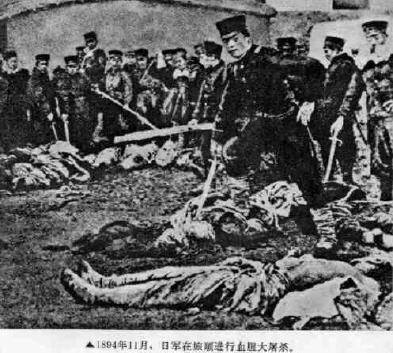
The Rise of Yuan Shi-kai
Yuan Shi-kai, born on August 20 of 1859, was from Henan Province. Yuan Shi-kai was adopted by an uncle who brought him along to Shandong and Jiangsu provinces during this uncle's officialdom tenure. Upon the death of his uncle in 1874, his uncle's friends, Wu Changqing and Liu Minzhuan, escorted the coffin and Yuan Shi-kai back to Henan Province. Wu Changqing's father was a comrade of Yuan Shi-kai's family during the crackdown on Nian Rebellion. Yuan Shi-kai married in 1876 at age 18 and bore son Yuan Keding in 1878. Yuan Shi-kai, in 1877, gave financial support to 25-year-old Xu Shichang for taking the imperial exam in Peking. Yuan Shi-kai, asked by Xu Shichang to leave hometown for ambition outside, would leave for Shanghai where he sold his 'shirts' and family antique for maintaining relationship with a 'distinguished prostitute'. Yuan Shi-kai was rescued by his family-teacher Wang Yanchen who happened to identify the antique which was sold into the custody of Circuit Governor for Shanghai. Wang Yanchen bought back the antique, supported Yuan Shi-kai for a trip home, and recommended Yuan Shi-kai to Wu Changqing. Yuan Shi-kai, with high military ambitions, led a dozen hometown kids to Wu Changqing in April of 1881 for joining the coastal defense army of Shandong Province. Wu Changqing dismissed his band home, but retained Yuan Shi-kai. Wu Changqing asked Yuan Shi-kai to call a counsellor (Zhang Jian) by the honorary title of teacher. Zhang Jian and Yuan Shi-kai later had dozen years' unhappiness for Yuan Shi-kai's changing the way of calling teacher after Yuan Shi-kai rose in power. Ding Zhongjiang commented that Yuan's behavior and thoughts were similar to Cao Cao of Three-Kingdom time period, a so-called 'xiao xiong' [i.e., predatory-eagle kind of hero].
Yuan Shi-kai adopted the same nepotism approach as Zeng Guofan. While being dispatched to Korea, he had assembled a team of cronies. Yuan Shi-kai had been bestowed with 4 Korean beauties during his stay in Korea, among whom one woman was a royal princess.
King Chunqin-wang (Yi-xuan), King Qingqin-wang (Yi-kuang), Weng Tonghe, Li Hongzhang and Rong-lu recommended Yuan Shi-kai for training 'Xin-jun' or the New Army at Xiaozhan while Hu Yufen was assigned the job as a railroad official. Yuan Shi-kai would devise a title of "Xin Jian Lu Jun" ('newly built field army'), and expanded original 4000 men New Army into 7000 men. The petition to the emperor mentioned that monthly budget for army training was like 70,000 taels of silver.
Yuan Shi-kai would hire over scholar Wang Xiuzhi who had translated some British emissary's military tactics books into Chinese for Hu Yufen. Yuan Shi-kai became kind of blood brothers with Wang Xiuzhi cronies, and entertained Wang Xiuzhi with 'distinguished prostitutes' such as 'Sai Jinhua' (i.e., the woman who was said to have affairs with German commander [General Field Marshal] Alfred Graf von Waldersee [Wa-de-xi] after 1900 boxer incident). Yuan Shi-kai, to win favor from Rong-lu, would recite European tactics books and explain to Rong-lu. While training armies, Yuan Shi-kai wrote a military book himself. Yuan Shi-kai hired over Xu Shichang as a counselor and Tang Shaoyi as a secretary. Yuan Shi-kai contacted Yin-chang of Tianjin's "Wubei Xuetang" Military Preparation Academy for referrals of talents, and Yin-chang recommended to Yuan Shi-kai "Wubei Xuetang" top students such as Feng Guozhang, Duan Qirui, Liang Huadian and Wang Shizhen. (Among the four guys, Liang Huadian accidentally drowned himself on one night.
Duan Qirui had at one time studied in military school in Germany.
Feng Guozhang, a classmate of Duan Qirui, had once inspected on Japan's military system.
The other three would be appointed lecturer posts for field army battalion, cannons battalion, and cavalry battalion, respectively.
The three would become the so-called 'Distinguished Three' among the Northern Warlord Armies later.)
Yuan Shi-kai's training of the new army will be expanded to 12000 men, with eight camps or 8000 field army, two camps of cannons, 1000 men or two camps of cavalry, and 1000 men engineering camp. The new army was equipped with 2400 foreign-made tents, in addition to raincoats, hats, blankets, watches, binoculars, compasses and radios. A military supervision office was set up and it was staffed with 13 interpreters for 13 foreign lecturers. The soldiers and horsemen were recruited from various provinces. Yuan Shi-kai also standardized the weapons at the new army. 'Engineering Camp' was in charge of repairing arms, building bridges, building castles, planting mines, sending telegraphs and surveying maps. German, Japanese and American lecturers were hired, and a German language school was also set up.
After Admonition official (Hu Jinggui) rebuked Yuan Shi-kai for wasting funds in 1896, Rong-lu was dispatched to Xiaozhan for an inspection. Rong-lu gave very favorable report to Cixi and Guangxu.
In Feb of 1899, Rong-lu inspected Xiaozhan again and told Yuan Shi-kai that he was empowered with building a brand new Manchu Qing army mapping Yuan Shi-kai's scheme. Three days later, Yuan Shi-kai re-devised his army into five 'jun' (equiv to regiments), with eight 'ying' or camps (equiv to battalions) under each regiment, including five field or infantry battalions, one cannon battalions, one cavalry battalions, one engineering battalions and one student army battalions. Rong-lu, at the advice of Yuan Shi-kai, named his new Manchu army by 'Wuwei-jun Army', (martial defense) with five 'jun' (equiv to divisions), like frontal, hind, left, right and middle. Rong-lu would act as 'marshal' as well as general in charge of the middle division, Ma Yukun in charge of the frontal division, Nie Shicheng the leftside division, Yuan Shi-kai the rightside division, and Dong Fuxiang the hind-side division. Yuan Shi-kai's rightside army or "wuwei-you-jun" would comprise of his Xiaozhan army, Rong-lu's middle division or "wuwei-zhong-jun" would comprise of new recruits from the banner people, and the rest three divisions would be converted from existing Brave-camp armies in Hebei and Gansu provinces. Rong-lu's 'Wuwei-jun Army' should be considered Zhi-li or the Peking provincial army, only; later, Zhang Xun blamed his abortive 1917 restoration of the Manchu throne on his lonely fight in an analogy to the Zhi-li army's resistance to the eight allied powers.
Start Of the Water-Melon Partitioning
The Manchu Qing debacle in the 1894-5 Sino-Japanese War once again exposed China's weaknesses to the rest of the world.
Manchu China, instead of self-reflection and reformation, would wrongly look to the Russians as the balance of power against the Japanese. In March of 1896, Li Hongzhang was invited to St Petersburg for attending Nicholas II's coronation, on which occasion Li Hongzhang was induced into signing a secret treaty that would allow the Russians to extend the Siberian Railway to Vladivostok [Haishenwai] via the Chinese northeastern provinces of Heilongjiang & Jilin and moor the warships in all Chinese ports. This would become the "Dong [Eastern] Qing [Manchu Qing] Railway", i.e., China Eastern Railway. One year later, the Russians, having instigated the German occupation of the Jiaozhou-wan Bay, echoed the Germans to swindle the port of Lüda [i.e., Lüshun or Port Arthur].
The Germans, like the Russians, had extracted two concession territories in Hankou & Tianjin from the Manchu court as a reward for pressuring Japan into abandonment of the Liaodong Peninsula.
With the Russian encouragement, the German emperor, through German minister-envoy Hai-jing, relayed a request for Jiaozhou-wan with Manchu Qing's foreign affairs office in December of 1896. In 1897, Kaizer Wilhelm II obtained an understanding from Nicolas the Second as to obtaining a port inside of China during a state visit to Russia. Taking advantage of the death of two priests on the Shandong Peninsula, Kaizer Wilhelm II immediately dispatched warships to China with a notice to the Russians. Though Russian foreign minister Mu-la-wei-fu replied with an ambivalent opinion, the Germans intruded into the Jiaozhou-wan in November of 1897 [i.e., October of Emperor Guangxu's 23rd year]. Per Historian Hu Sheng's citation of German documents, Russian minister-envoy to China had suggested that the Russians impress Manchu China as a mediator by continuing with the original plan of mooring Russian warships in Jiaozhou-wan for the winter. Li Hongzhang, still blindfolded by the Russians, dispatched inspectors to Jiaozhou-wan almost on a daily basis for the arrival of Russian warships. Instead, the Russians sailed to Dalian-wan and Lüshun-kou ports.
The pretext of the death of two German priests were related to the priests' involvement in the local Chinese disputes.
Records showed that over 3000 priests, Catholics, Protestants and Eastern Orthodox, had been preaching in China in late 19th century. Among 108 counties and prefectures of Shandong Province, over two thirds had Christian activities, with over 1300 churches and more than 150 priests. Often, priesthood had ill-willed and ill-intentioned staff, and the Chinese converts, termed "rice Christians", happened to be rascals and priesthood proxies. Back on November 1st, 1897 (Gregorian), in Juye County of Caozhou-fu Prefecture of Shandong Province, two German priests, Franz Nies and Richand Heule, were killed by locals for getting involved in disputes between the Chinese converts and the local people. Governor Li Bingheng caught the culprits and notified the German embassy. However, Germany, under Prime Minister Bismark, took German minister-envoy's advice to extract interests in China on this pretext. Under order by German Kaizer Wilhelm II, three German warships sailed into the Jiaozhou Bay, and on November 14th (Gregorian), bombarded the Chinese battery.
Manchu China signed the 'Jiaozhou Bay Lease Treaty' with Germany on March 6th of 1898 (Gregorian), which allowed the Jiaozhou-wan Bay to be leased for 99 years and compensated Germany with few million taels of silver.
The Russians, after taking over Lüshun, announced that they were there to protect the port from possible German ambition, and moreover claimed that they would evacuate from the port once the Germans withdrew from the Jiaozhou-wan Bay.
Since the Germans had no intent to leave and further coerced Manchu China into a lease treaty, the Russians, having issued an ultimatum to the Manchu court, extracted the "Lüda Lease Treaty" from Manchu China on March 27th, 1898.
Hu Sheng cited Russian documents in pointing out that Li Hongzhang and Zhang Yinhuan might have received a kickback of 500,000 taels of silver, respectively.
This treaty would allow the Russians to extend the "Eastern Qing Railway" southward to Dalian from Harbin, i.e., "Nan [Southern] Man [Manchurian] Railway", which linked up the Russian Trans-Siberian Railway that was first built in A.D. 1891.
France invaded the Guangzhou-wan Bay.
By December 29th of 1898 (Gregorian), France invaded China's Hainan Island. Newspaper report showed that France's actions were a result of the British instigation after Britain demanded more concessions of lands around the HK island. Britain's demand came after the heels of Russia's leasing the Port Arthur (Lüshun-gang).
Britain took over Weihaiwei in addition to Kowloon.
As George Kennan stated, "at the end of 1897 and the beginning of 1898 there was a real and justifiable fear that China would be partitioned." (More, refer to republicanchina.org/COMMUNISTS-AND-JAPAN-INVASION-MANCHURIA.pdf.)
The Hundred Day Reformation
Yuan Shi-kai was liked by both conservatives and reformists in the Manchu court. Manchu reformists included Guo Songtao, Zeng Jize, and Xue Fucheng. Six months after the Shimonoseki Treaty, five Manchu ministers were in charge of recruiting the so-called 'New Army'. They were King Chunqin-wang (Yi-xuan), King Qingqin-wang (Yi-kuang), Weng Tonghe, Li Hongzhang, and Rong-lu. Li Hongzhang adamantly recommended Yuan Shi-kai for training 'Xin-jun' or the New Army at Xiaozhan.
Numerous intellectuals demanded a system reform. A student of Lin Zexu, i.e., Feng Guifeng, proposed the revocation of 'ba gu wen' (i.e., stereotyped imperial exam format). Hong Kong's newspaper, "Xun Huan Ri Bao" eulogized Japan's parliamentary system. Zheng Guanying wrote "Sheng Shi Wei Yan", i.e., 'alarming words in a satiable society'. Heh Qi and Hu Liyuan wrote a series of 'new governance' books. (Heh Qi had previously studied medicine in Britain for many years and later built in HK the Alice Hospital and Western Medicine School where Dr Sun Yat-sen had once studied.) Chen Qiu wrote numerous books advocating the parliamentary system. Some British priest also went to see Manchu ministers for a persuasion of the court in adopting Western sciences and hiring foreign advisers.
Kang You-wei [K'ang Yu-wei] submitted proposals to Emperor Guangxu [Kuang Hsu] eight times.
The 1897 occupation of the Jiaozhou Bay by Germany and the Dalian Bay by Russia would prompt some intellectuals into propagating reform of the political system. Kang You-wei proposed to Emperor Guangxu for political reform again.
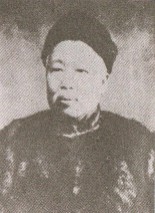 Kang You-wei, born on Mar 19th of 1885 in Nanhai of Guangdong, was from a Confucian gentry family, and he once possessed an ambition for being a great Confucian saint. Kang You-wei visited many places across the nation and translated many Western books into Chinese. In order to counter the conservatives, Kang You-wei wrote two books to expound the theories that Confucius was after all a reformist who had intended to change the Zhou Dynasty principalities by means of eulogizing the virtues of three dynasties of Xia-Shang-Zhou.
Kang You-wei first submitted a reform blueprint to puppet Emperor Guangxu (Qing Dezong, Aixinjueluo Zai-tian, r. 1875-1908) in 1888. Kang You-wei set up Wanmu Academy in Canton in 1891. In 1895, Kang You-wei, in the context of the defeat of the Manchu North-sea Fleet by Japan, would organize a petition movement comprising of over 1300 Imperial Exams candidates (from 18 provinces), i.e., so-called 'Gong Che Shang Shu'.
Kang You-wei, being against signing the Shimonoseki Treaty, had proposed a relocation of the nation's capital for sake of further fighting against the Japanese.
Kang You-wei's demands included the revocation of privileges for the Manchu, free press, simplifying governmental apparatus, government budgeting, encouraging railroad and mining, launching postal service, building musketeer armies, reforming the Imperial Exam System, and encouraging overseas studies.
Kang You-wei's petition did not reach the emperor.
Kang You-wei, born on Mar 19th of 1885 in Nanhai of Guangdong, was from a Confucian gentry family, and he once possessed an ambition for being a great Confucian saint. Kang You-wei visited many places across the nation and translated many Western books into Chinese. In order to counter the conservatives, Kang You-wei wrote two books to expound the theories that Confucius was after all a reformist who had intended to change the Zhou Dynasty principalities by means of eulogizing the virtues of three dynasties of Xia-Shang-Zhou.
Kang You-wei first submitted a reform blueprint to puppet Emperor Guangxu (Qing Dezong, Aixinjueluo Zai-tian, r. 1875-1908) in 1888. Kang You-wei set up Wanmu Academy in Canton in 1891. In 1895, Kang You-wei, in the context of the defeat of the Manchu North-sea Fleet by Japan, would organize a petition movement comprising of over 1300 Imperial Exams candidates (from 18 provinces), i.e., so-called 'Gong Che Shang Shu'.
Kang You-wei, being against signing the Shimonoseki Treaty, had proposed a relocation of the nation's capital for sake of further fighting against the Japanese.
Kang You-wei's demands included the revocation of privileges for the Manchu, free press, simplifying governmental apparatus, government budgeting, encouraging railroad and mining, launching postal service, building musketeer armies, reforming the Imperial Exam System, and encouraging overseas studies.
Kang You-wei's petition did not reach the emperor.
Kang You-wei organized the "Self-Strengthening Society" ('qiang xue hui') for propagating reforms. Yuan Shi-kai participated in the activities.
Kang You-wei, later in his 1916 wire against Yuan Shi-kai's imperial enthronement, mentioned the early days when Yuan Shi-kai called Kang You-wei 'elder brother' and supported Kang You-wei's "Self-Strengthening Society" (i.e., 'qiang xue hui').
Yuan Shi-kai earned the fame of sitting over the fences of two camps of conservatives and reformists. This would give Kang You-wei and Tan Sitong et al., a false impression that Yuan Shi-kai could be relied upon for pushing through the reforms, something that would lead to the abortion of the Hundred Day Reformation when Yuan Shi-kai betrayed the reformists to the dowager empress.
Hunan Province natives played an important role during the reform movement.
Tan Sitong, i.e., head of "nan [Hunan] xue [studies] hui [society]", published the first newspaper entitled "Xiang [Hunan] Xue [studies] Bao [newspaper]".
A so-called "Current Affairs Academy" was established in Hunan Province in the autumn of 1897. Liang Qi-chao, i.e., student of Kang You-wei, had been invited over as a lecturer.
Cai E, having failed the imperial exam, would attend "Current Affairs Academy" at age 15.
Governor-general Zhang Zhidong also advocated for studies of Western subjects. Annually, over 200 Students from both Hunan and Hubei provinces attended Zhang Zhidong's "Liang [two] Hu [Hunan-Hubei] Shuyuan [academy]" where subjects like Confucian classics, history, Confucian ethics, literature, math and economics were offered. Among professors teaching at the academy would be Yang Rui and Wang1 Kangnian.
Zhang Zhidong revamped curricula in 1897-1898 to have natural sciences, astronomy, physical exercises and military strategy included.
On May 5th, 1898, Zhang Zhidong proposed to Emperor Guangxu the notion of the "Chinese classics being the body and western sciences being the means".
Attending the academy would be later revolutionary Huang Xing who admired both Tan Sitong and Tang Caichang.
Emperor Guangxu finally accessed Kang You-wei's article after the empress dowager abandoned the 'curtain regency'.
On June 11th, 1898, Emperor Guangxu decreed that Kang You-wei be responsible for carrying out the reforms. Over one hundred laws and regulations passed thereafter.
One hundred days later, on Sept 21st, Empress Dowager Cixi [Tz'u Hsi], with the help of Yuan Shi-kai, staged a coup by imprisoning Emperor Guangxu and executing the Six Gentlemen of Tan Sitong, Kang Guangren, Lin Xu, Yang Shenxiu, Yang Rui & Liu Guangdi.
china.org.cn has a good translation of Tan Sitong's execution day poem:
I am yet determined to kill my enemies,
But I cannot escape my fate.
For the sake of ideals have been striving for
I shall die joyfully!"
This is the so-called 'Bai Ri Wei Xin', i.e., the Hundred Day Reformation.
Kang Youwei, after fleeing to Singapore, often produced the emperor's decree as his 'political capital'.
Emperor's decree pleaded with Kang Youwei for "rescuing the emperor".
Kang You-wei & Liang Qi-chao [Liang Chi-chao] fled overseas. Note that Kang Youwei first fled to Singapore where the British governor gave him a house that was named 'grand asylum house'.
Dowager Empress's hatred of foreigners was said to have stemmed from British assistance in Kang & Liang's escape.
The Manchu court issued a so-called 'gou [investigate] dang [party] ling [decree]".
Zhang Taiyan, in the Yangtze River area, fled to Taiwan for implication in the activities in the "Self-Strengthening Society" branch of the constitutional monarchists.
Later, when Empress Dowager Cixi intended to dethrone puppet Emperor Guangxu, foreign embassies expressed their opposition.
Intellectuals, especially those in Shanghai, opposed Cixi's plan to depose the elder prince for a junior prince.
At the time the news spread that Emperor Guangxu was ill, the British minister-envoy sent a French doctor to seeing Guangxu. Empress Dowager Cixi hence secretly supported the Boxers in their attacks on the foreigners and embassies in and around Peking and on the Shandong Peninsula, leading to the 1900 invasion by the 'Eight Allied Nations'.
When the coalition army attacked Peking, Empress Dowager Cixi fled to Xi'an and would not return to the capital till next year.
In 1900, Kang You-wei & Liang Qi-chao funded an uprising by taking advantage of the boxer turmoil and foreign invasion.
In Wuchang of Hubei Province, Tang Caichang orchestrated an unsuccessful rebellion against the Manchu government.
The monarchists, like Kang You-wei, intended to restore Emperor Guangxu by taking advantage of the boxer debacle.
Tang Caichang organized five columns of rebels in Hankou.
Cai E was said to have returned to China from Japan for the uprising.
Wu Luzhen [i.e., 1st session Chinese student of Japan's infantry cadet] made a stealthy return to China to be in charge of the rebellion.
Wu Luzhen & Qin Lishan led the Datongqian-jun column, and fought lane-to-lane battles for days.
Huang Xing was said to have participated in this action, but did not get implicated; and in May 1902, Huang Xing was sent to Japan for studies.
Tang Caichang was caught and executed by the Manchus.
Qin Lishan [1877-1906] fled to Japan, accused Kang You-wei of misappropriation of funds, first worked in Liang Qi-chao's "Qing [Manchu Qing] Yi [debate] Bao [newspaper]" in Yokohama, and then participated in the first revolutionary newspaper "Guo-min [national citizen] Bao [newspaper]" that was launched on May 10th, 1901, among overseas Chinese students in Japan.
Wu Luzhen, after fleeing back to Japan, did finish his studies, and later in April 1902, returned to China to serve as lecturer in Wuchang's "Wu Putong Zhong Xuetang" military academy.
Cai E fled back to Japan, too, and in 1904, finished the studies in Japan's cavalry class, and graduated together with Jiang Baili.
(Liang Qi-chao, after "Qing [Manchu Qing] Yi [debate] Bao [newspaper]", would publish "Xin-Min [New Citizen] Ye Bao" newspaper in Japan.
Cai E had written articles for the newspaper. Later, in the early R.O.C. era, Kang You-wei was granted amnesty by Yuan Shi-kai at the intervention of Liang Qi-chao; however, Kang You-wei, a true monarchist, participated in the aborted Zhang Xun restoration of Manchu imperial house in 1917, taking another blow of defeat and humiliation.)
The Boxers & the Invasion by Eight Allied Nations
In the Hollywood entertainment area, there existed the movie entitled "Fifty Five Days In Peking" starring by Charlton Heston. Recently, Jack Chan's new movie "Shanghai Knights", in the trite style of exhibiting the skills of martial arts as well as prototyping Chinese woman's fall in love with a White man [also see 1922 film "The Toll of the Sea" by Anna May Wong], would crookedly assign a contingent of boxers as assassins of the British royal house under the Big Ben. Jack Chan, in the name of patriotism, had only served the interests of Hollywood by vilifying the boxers.
More ludicrous would be Huayi Brothers's 45 million U.S. dollars shot of "The Legend of Sai Jinhua [Choi Gum Fa]" to praise the slut as a show of "patriotic act".
Quite a few people had recently re-examined the Boxers' Movement of 1900 and the subsequent invasion by 'Eight Allied Nations'.
A noteworthy scholar would be Bei Ming of 'Radio Free Asia'. The main spirits of this kind of research would be to point out that the United States had acted fairly before, during and after the crackdowns on the Boxers. Further, the United States, in 1908, had acted as the most altruistic of all in voluntarily refunding the overcharged 'war compensations' from damages caused by the Boxers, in the form of scholarships for supporting talented Chinese' overseas studies in America.
Bei Ming, in description of boxers' arson of the adjacent Imperial Library and the British Legation, unscrupulously commented that the British prized the Chinese classics books more than the Chinese the same way as today's foreigners giving more love to tens of thousands of baby girls whom the Chinese government sell to the west for an adoption fee of US$5,000 to $20,000. (Increasing interest in Chinese baby girls had encouraged a new form of human smuggling business in China, with a Chinese news report of an interception of a truck carrying 28 baby girls wrapped up in cloth. Note that in the U.S., revenue services would offer as much as $10k as annual adoption tax exemption.)
Per Ding Zhongjiang, Zhou Ziqi, a graduate of Beijing's "Tong Wen Guan"" interpreter school and later a Manchu Qing emissary to U.S., had been responsible for negotiating with the U.S. in regards to refunding the 12,000,000 U.S. dollars.
It was never a spontaneous act of the U.S. in the refund. Japan, out of boxer indemnity, established an annual sole-quota scholarship for the Chinese on the precondition that recipient swore allegiance to Hirohito. In late 1920s, Hu Qiuyuan yielded the Japanese Imperial Scholarship in preference for a Hubei Provincial scholarship for attending Waseda University. Later in 1932, Mussolini offered to pay Italian advisers with money from overcharged boxer-related war damages in exchange of China's purchasing Italian airplanes in the amount of several millions of U.S. dollars.
The U.S. government, often cited as a 'friend' of Manchu China, actually pushed the anti-China agenda one step further: after acquiring Hawaii in summer of 1898 and the Philippines in December 1898, the U.S. government applied the "Chinese Exclusion Act" to the Chinese on the two islands, and further, President Theodore Roosevelt signed into law to have the "Chinese Exclusion Act" applied throughout US-controlled islands and territories over the world.
Also see century-long American hypocrisy towards China &
American manipulations of Chinese politics [e.g., Stilwell's instigating General Bai Chongxi, Stuart's instigating Li Zongren, and McArthur's instigating General Sun Liren], with the main cause of its ambivalent China policies being a fundamental fear of the Yellow Peril.
* In Commemoration of China's Fall under the Alien Conquests in A.D. 1279,
A.D. 1644 & A.D. 1949 *
U.S.S.R./Comintern Alliance with the KMT & CCP (1923-1927)
Korean/Chinese Communists & the 1931 Japanese Invasion of Manchuria
American Involvement in China: Soviet Operation Snow, IPR Conspiracy, Dixie Mission, Stilwell
Incident, O.S.S. Scheme, Coalition Government Crap, Amerasia Case & The China White Paper
* Stay tuned for "Republican China 1911-1955: A Complete Untold History" *
|
|
Zou Rong's Revolutionary Army;
Shin Kyu Sik's
Shrine (Spirit, Kunitama) of Korea
|
This snippet is for sons and daughters of China:
Heed the sons & ministers' agony and sorrow of our ancestors who died or lived through the Mongol, Manchu and Soviet-Chicom conquest
and
the Yongjia, Jingkang and Jiashen cataclysms !
Jeanne d'Arc of China:
Teenager girl Xun Guan breaking out of the Wancheng city to borrow the relief troops in the late Western Jinn dynasty;
Liu-Shao-shi riding into the barbarian army to rescue her husband in the late Western Jinn dynasty;
teenager girl Shen Yunying breaking into Zhang Xianzhong's rebels on the horseback to avenge on father's death in the late Ming dynasty.
China's Solitary and Lone Heroes:
Nan Jiyun breaking out of the Suiyang siege and charging back into the city in the Tang dynasty;
Zhang Gui & Zhang Shun Brothers breaking through the Mongol siege of Xiangyang in the Southern Soong dynasty;
Liu Tiejun breaking through three communist field armies' siege of Kaifeng in the Republican China time period;
Zhang Jian's lone confrontation against the communist army during the June 3rd & 4th Massacre of 1989.
|
|
|
Empress Dowager Cixi placed puppet Emperor Guangxu under the house arrest after the crackdown on 'Hundred Day Reformation'. Manchu "zhong tang" Rong-lu instigated Yang Chongyi in petitioning for Empress Dowager Cixi's return to politics and government. Though Emperor Guangxu was deprived of his rights, Empress Dowager Cixi and Emperor Guangxu did attend the daily imperial sessions together still. Cixi intended to replace Emperor Guangxu with a Manchu prince called Fu-juan (the great grandson of Emperor Daoguang and the son of King Ruijun-wang Zai-yi). Zai-yi asked Chongqigong, some ministers (da xueshi" Xu Tong and "shang shu" Qi-Xiu) and his wife to maneuver about erecting a new emperor. Qi-Xiu went to see Rong-lu (zhong tang" or prime minister) for assisting Zai-yi in the erection of the new emperor, and Qi-Xiu hinted at the consequence of the rise of dethroned Emperor Guangxu should Cixi pass away. Rong-lu declined the Qi-Xiu's request and refused to see Qi-xiu and Chongqigong again. Qi-xiu, et al., submitted a petition to Empress Dowager Cixi in regards to erecting a new emperor. Cixi asked her ministers whether she could change the emperor via citation of Ming Emperor Jingtai-di's return of throne to his brother. Xu Tong concurred by saying that Emperor Guangxu could be downgraded to Duke Hunde-gong (duke who lost virtues) via citation of Jurchens' downgrade of Song emperor. Sun Jianai, "da xueshi" and "junji dachen", objected to the sudden change, claiming that it might stir trouble in southeastern China. Cixi got enraged, saying the change of emperor was her familial matter, nothing to do with Han ethnic ministers.
Cixi spread a rumor about Emperor Guangxu getting seriously ill.
Foreign embassies expressed their opposition to Cixi's intention to dethrone Emperor Guangxu.
When the news spread that Emperor Guangxu was ill, foreign embassies jointly went to see Yi-kuang for inquiring about the emperor's health. The British minister-envoy sent a French doctor to see Guangxu, and French doctor's health report enraged Cixi. Further enraging Cixi would be the asylum of Kang You-wei granted by Britain and the asylum of Liang Qi-chao granted by Japan.
At the advice of Rong-lu, Cixi decided to change the throne via two steps and asked Emperor Guangxu decree that Prince Fu-juan be conferred the title of crown prince ("da a ge" or elder brother) for inheriting the line of Qing Emperor Tongzhi (Qing Muzong, r. 1862-1874). (Emperor Guangxu, before enthronement at 1875, had agreed to erect his to-be-born son as heir of Emperor Tongzhi should he bear a son.) Prince Fu-juan was assigned Palace Hongde-dian inside of the Forbidden City.
In Shanghai, Jing Yuanshan and Cai Yuanbei submitted a letter with 2000 signatures against the crown prince erection. King Ruijun-wang and Empress Dowager Cixi held a celebration party, with invitations extended to the wives of minister-envoys, but foreign embassies did not show any appreciation. Cixi was recorded to have thrown her jade tea pot to the floor when a Manchu official sent in a letter claiming that British intended to send in forces to help return power to Emperor Guangxi.
Empress Dowager Cixi hence secretly supported the Boxers in their attacks on the foreigners and embassies in and around Beijing, leading to the 1900 invasion by 'Eight Allied Nations'.
Origin of the Boxer Movement
Boxers Entering Peking The Capital
Seymour's Forcing His Way To Peking
Empress Dowager Cixi Declaring War On Twelve Nations
Nie Shicheng Fighting Eight Allied Powers To Death
At Dugu-kou (Taku), "ti du" or general Luo Rongguang was defeated by the Eight Allied Nations. Luo Rongguang fled to Tientsin.
navyandmarine.org/ondeck/1900boxerrebellionmarines.htm stated that "at Taku, Vice Adm. Sir Edward H. Seymour formed an international rescue force of 2,056 troops, including 112 U.S. Marines, to move inland by train on 10-11 June (solar/Gregorian calendar). However, the relief column met heavy resistance from the Boxers northwest of Tientsin (Tientsin)."
What were not counted among the allied forces would be hundreds of the British-trained Weihaiwei mercenaries, termed the "Hua [Chinese] Yong [brave]" who acted as the forerunner troops in the battles all the way to the Peking citywall, a force that gave the 21st century Chinese a wwong impression that the Chinese actually assisted the eight allied invasion forces in mounting the ladders to ascend to the Peking city walls and trundling cannons onto the Tartar Walls via ladders for blasting at the Imperial City and Forbidden City.
.
(It took the British merely one to two years to fully train a French-legion style mercenary army consisting of Chinese only.
Later during WWI, the British, in Weihai-wei, hoodwinked hundreds of thousands of Chinese laborers into signing on to a non-battle labor contract, which was in fact an indenture to work on the European battlegrounds, i.e., a war zone indenture.
It would be at the turn of the 20th and 21st centuries that the Chinese 'laborers' and their valiant acts as quasi-soldiers on the European War battlefields were acknowledged by the West.
The 1918
Spanish flu pandemic was speculated to have the influenza virus source in the 96,000 Chinese
WWI trench laborers passing through Canada in hopper rail cars.)
Battle of Tientsin
Eight Allied Powers Attacking Peking
War Not Over With The Fall Of Peking
Hoover, who spent his early life in China, was possibly involved in swindling the Chinese mine enterprise of Kailuan in collusion with the British by taking advantage of the allied invasion of Peking in 1900.
Later, when Hoover, with the fortune made in China, ran for a political career in the U.S., he fended off the attacks of political enemies by having Tang Shaoyi authorize an article clearing his 'corruption' charges in China and showcasing his valiant behavior of saving the lives of Tang Shaoyi's family during the 1900 boxers' turmoil.
After Japan's invasion of Manchuria in 1931, Hoover took Chiang Kai-shek as a half-Bolshevik, with his memory still set in the 1920s, when Chiang Kai-shek took the reign of the northern expedition as a 'Red' general.
Note that the damages done to China, not merely the loss of the Kailuan coal mine, was that
President Hoover, in 1931, gave Japan a free hand in the invasion of Manchuria on the pretext that Japan could not tolerate a half-Bolshevik China.
(Hoover, a staunch anti-communist, claimed that he suffocated the Hungarian and German communists' rebellion in the 1920s, with the end result being that Lenin changed strategy to communize China.
Namely, the express train to Paris was a detour through Peking.
This led to a strange phenomenon that the Soviet agents completely abandoned the Moscow division of the U.S. State Department, leaving Bullitt and Kennan where they were, and infiltrated the Far Eastern Division for sake of capsizing the Republic of China.)
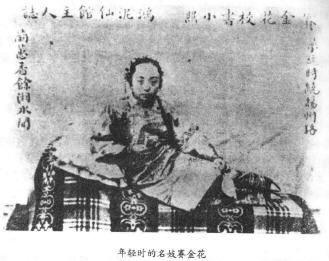 Ransacking and pillaging never stopped till the evacuation the second year.
Both legation officers and allied forces participated in the "massacre contest" [as Japanese did during Nanking Rape].
http://www.secretchina.com/news/articles/4/8/14/70203.html pointed out i) that allied forces killed 1700 "boxers" at King Zhuang-wang Residency; ii) that French had driven a crowd of Chinese into an alley where they shot to kill for 15 continuous minutes; and iii) that allied forces massacred the Chinese who were hired to bury the dead bodies.
Ransacking and pillaging never stopped till the evacuation the second year.
Both legation officers and allied forces participated in the "massacre contest" [as Japanese did during Nanking Rape].
http://www.secretchina.com/news/articles/4/8/14/70203.html pointed out i) that allied forces killed 1700 "boxers" at King Zhuang-wang Residency; ii) that French had driven a crowd of Chinese into an alley where they shot to kill for 15 continuous minutes; and iii) that allied forces massacred the Chinese who were hired to bury the dead bodies.
In Peking, the allied forces swelled to a total of 100,000 as a result of German reinforcements.
German Emperor [Kaizer] Wilhelm II and Alfred Graf von Waldersee, in order to loot China further, declared that war was not over with the fall of Peking.
On August 19th 1900 [Gregorian], Alfred Graf von Waldersee departed Berlin; on Sept 18th [Gregorian], arrived in HK; and on October 17th [Gregorian], Alfred Graf von Waldersee entered Peking with a grand ceremony by the allied force.
Days earlier, while in Tianjin, Alfred Graf von Waldersee refused to see Manchu minister Li Hongzhang for truce talks.
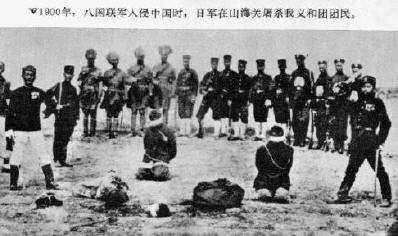 German Commander Alfred Graf von Waldersee, who was said by Chinese lackey to have restrained German army's pillage as a result of sleeping with a 'distinguished prostitute' called Sai Jinhua [Choi Gum Fa], organized sweeping campaigns throughout the Peking outskirts, reaching as far as Shanhaiguan Pass and Qinhuangdao in the northeast, Baoding & Zhengding areas, and Shanxi Province border areas to the west.
On Sept 30th 1900 [Gregorian], Alfred Graf von Waldersee led allied forces, mostly from his 20000 German soldiers, to Shanhaiguan Pass and Qinhuangdao for sake of frustrating Russian's ambition as well as securing the coastal city as logistics center.
Near Shanhaiguan Pass, Germans and Japanese were shot into photos in their executions of Chinese "boxers".
In Tianjin, on October 12th [Gregorian], Alfred Graf von Waldersee mobilized French, British and Italian armies for a campaign against Baoding to the south, and occupied Baoding 10 days later.
Alfred Graf von Waldersee ordered ransacking throughout Baoding city, with pillaging extended to Zhengding, Wanxian, Yongqing, Laishui and Yizhou counties.
To the north, Alfred Graf von Waldersee organized Austrian and Italian armies in campaigning against Zhangjiakou, pillaging Zhangjiakou and through the counties of Changping, Huailai, Yan'qing, and Xuanhua for over 20 days.
To the west, Alfred Graf von Waldersee mounted a campaign against Shanxi Province in Jan-April [Gregorian] of 1901.
With French participating, Alfred Graf von Waldersee attacked Guangchang, Wutai, Niangziguan and took over the two passes of Niangziguan and Guguan.
German Commander Alfred Graf von Waldersee, who was said by Chinese lackey to have restrained German army's pillage as a result of sleeping with a 'distinguished prostitute' called Sai Jinhua [Choi Gum Fa], organized sweeping campaigns throughout the Peking outskirts, reaching as far as Shanhaiguan Pass and Qinhuangdao in the northeast, Baoding & Zhengding areas, and Shanxi Province border areas to the west.
On Sept 30th 1900 [Gregorian], Alfred Graf von Waldersee led allied forces, mostly from his 20000 German soldiers, to Shanhaiguan Pass and Qinhuangdao for sake of frustrating Russian's ambition as well as securing the coastal city as logistics center.
Near Shanhaiguan Pass, Germans and Japanese were shot into photos in their executions of Chinese "boxers".
In Tianjin, on October 12th [Gregorian], Alfred Graf von Waldersee mobilized French, British and Italian armies for a campaign against Baoding to the south, and occupied Baoding 10 days later.
Alfred Graf von Waldersee ordered ransacking throughout Baoding city, with pillaging extended to Zhengding, Wanxian, Yongqing, Laishui and Yizhou counties.
To the north, Alfred Graf von Waldersee organized Austrian and Italian armies in campaigning against Zhangjiakou, pillaging Zhangjiakou and through the counties of Changping, Huailai, Yan'qing, and Xuanhua for over 20 days.
To the west, Alfred Graf von Waldersee mounted a campaign against Shanxi Province in Jan-April [Gregorian] of 1901.
With French participating, Alfred Graf von Waldersee attacked Guangchang, Wutai, Niangziguan and took over the two passes of Niangziguan and Guguan.
Meanwhile, the Russians dispatched six columns of cavalry through Manchuria.
Alfred Graf von Waldersee, after weighing the Russian ambition for Manchuria, objected to water-melon partitioning as well as called off Kaiser Wilhelm II's original plan for securing coastal Yantai as the German sphere of influence.
German commander Alfred Graf von Waldersee was said to have quit the idea of conquering China after measuring the size of Chinese males going through a city gate to derive a conclusion that still too many physically-fit Chinese were available to cause trouble for the invasion forces.
Chinese lackies and traitors still cited prostitute Sai Jinhua [Choi Gum Fa] as a "patriotic" woman who dissuaded the German from partitioning China - without understanding the behind-the-back workings of the British career customs officers who recommended to the British and American government the policy of safeguarding the Open Door Policy, a policy that the new Japanese prime minister adopted in September 1900 -- which subsequently aborted the American secretary of state's order to have the Americans grab a port in Fujian as part of the planned partitioning scheme.
Li Hongzhang relied upon the Russians in exerting pressure on the Germans.
On the night of April 17th [Gregorian], Alfred Graf von Waldersee and prostitute Sai Jinhua were said to have jumped out of their bed when fire broke out in the Yiluandian Palace inside of the Forbidden City. Alfred Graf von Waldersee's attache tactician was said to have died inside of asbestos-made mosquito tent during the fire.
In May [Gregorian], Alfred Graf von Waldersee reported to Germany for a termination of the "allied force command center" as well as evacuation of the "German Relief Expedition Force".
Alfred Graf von Waldersee left Peking on June 3rd [Gregorian] and later died in Hanover three years later.
Boxers' turmoil, concluded by the 'Xin Chou Treaty' or the 'Boxer Protocol of 1901' on Sept 7th of 1901 (Gregorian) with 11 (not 8) countries, would cause China a loss of 450,000,000 taels of silver which was to accrue to 982,000,000 taels with interests included throughout the installments for 39 years.
(In 1943, 'Boxer Protocol' was nullified after a total payment of 670 million taels of silver.) The damages to China's spirits were unsurpassed in history, and the Chinese people had to endure 39 years of hardship and disasters, only to sustain another round of sufferings during the 1937-1945 Japanese Invasion. Details of boxers movements and allied invasions will be covered in the section boxers.htm
The 'Boxer Protocol of 1901' also spelled out the terms i) allowing foreign military forces to be stationed in the nation's capital and the coastal area; ii) prosecuting Manchu government officials for their role in the boxer rebellion; iii) suspending the arms imports into China for two years; iv) dismantling the batteries at Dagukou and fortifications along the Tianjin-Peking line; v) suspending examinations for implicated ministries for five years; vi) dispatching special emissaries to Japan and Germany for condoling the deaths of respective legation personnel; vii) rebuilding the foreigners' tombs; viii) decreeing that no anti-foreign acts or speech be allowed. The figure of 450,000,000 taels of silver was imposed on China by the allied powers to mean an insult: every one single Chinese, as a member of the 450,000,000 population, must pay one tael or ounce of silver.
The Russo-Japanese War Over Manchuria
Being forced to give back the Liaodong Peninsula in Southeastern Manchuria, Japan hastened its steps in strengthening its military capabilities for confrontation with Russia. Japan, with more than double its previous army recruits, planned to launch an attack at the Russians in 1903.
The Russians, taking advantage of the 1900 boxer turmoil, launched an ethnic cleansing against the Chinese to the north and east of Amor River, and killed well over 200,000 Chinese.
After that, the Russians, with six columns, intruded into Manchuria and continued the slaughter policy.
In 1902, under pressure of other imperialist countries, the Russians agreed to Manchu re-acquisition of Manchuria in a multiple-phase withdrawal agreement.
When the Russians stopped at phase one in 1903, the Japanese secretly supported overseas Chinese students in exerting pressure on the Russians.
In Shanghai, on April 27th, 1903, over 1000 Chinese, including Zou Rong, organized a "National Society" for defending Manchuria; and in Tokyo, on April 29th, Lan Tianwei and over 500 students organized a duel column for fighting the Russians.
In Feb 1904, the Russo-Japanese War broke out with a surprise attack on Port Arthur by the Japanese fleet.
Three days later, on Feb 12th, Dowager Empress Cixi, in the name of Emperor Guangxu [i.e., Aixinjueluo Zai-tian], declared neutrality, with decree conveyed to various legations on the 17th.
Japan defeated the Russians both on land and on sea.
In Manchuria, Japan took over Port Arthur (Lüshun) from Russia, and in the Tsushima Straits, Japan defeated the Russian fleet. Further, Japan invaded the Sakhalin Island [Kuyedao].
Manchu military officers, like Wu Peifu, were ordered to collaborate with the Japanese in going to Manchuria for espionage against the Russians. The Russians employed the Chinese as spies as well, with one such spy execution documentary being played in the medical college where Lu Xun was attending in Japan.
The next year, in Sept 1905, defeated on land and sea, Russia ceded to Japan the Port Arthur, the southern portion of the Manchurian Railway, and the southern half of the Sakhalin Island under the terms of the Treaty of Portsmouth.
At http://www.larouchepub.com/other/2004/3123morgan_v_dr_sun.html, Mike Billington wrote for "Executive Intelligence Review" an article entitled "How London, Wall Street
Backed Japan's War Against
China and Sun Yat Sen", pointing out that "Japan also established a special relationship with the British, in league with several allied New York banking houses. Kuhn Loeb's Jacob Schiff, for instance, was issued a Japanese Royal Order for his role in financing Japan's war with Russia in 1905, a war fought in part over areas of control within China".
The Rise of Yuan Shi-kai (Continued)
In 1901, Yuan Shi-kai succeeded the posts of North-Sea Minister and Zhili Province Governor-General that were historically held by Li Hongzhang.
After taking over Li Hongzhang's posts, he built an army that knew only following Yuan's order, not Manchu's.
Among his protege would be: i) his relatives and pals, including Yuan Naikuan and Zhang Zhenfang, ii) Li Hongzhang disciples graduated from "Beiyang Wubei Xuetang" (i.e., North-Sea Military Academy), including the Big Three (Wang Shizhen, Duan Qirui and Feng Guozhuang) and second-level generals (Duan Zhigui, Cao Kun, Li Chun, Wang Zhanyuan, Lu Jianzhuang, Yang Yongde, Lu Yongxiang, Bao Guiqing and Zhang Huaizhi); and iii) Huai-jun officers, including Jiang Guiti, Zhang Xun, Ni Sichong and Meng Enyuan.
Yuan Shi-kai set up various military schools for training officers, and out-of-province officers or overseas-graduated (Japan, e.g.) students were rarely recruited.
By 1906, Baoding Officers' Academy was established. Graduates staffed all six 'zhen' (i.e., division) of North-Sea (Northern) Armies. Other than military posts, Yuan Shi-kai referred Zhu Jiabao, Qi Yaolin, Sun Baoqi, Zhang Xiluan, Zhao Bingjun and Yang Shiqi, et al., for various important cabinet-level minister posts or provincial-level military posts. Yuan Shikai's best pal, Xu Shichang, was recommended for the posts of "shang shu" (secretariat) and "junji dachen" (minister in charge of army) and governor for three provinces of Manchuria, etc. North of the Huai River would be under Yuan's direct control.
Beginning from 1905, Yuan Shi-kai identified himself with the 'constitution proponents' and pressured Manchu government into adopting this approach. In 1906, Zheng Xiaoxu, Zhang Jian and Tang Shouqian declared the founding of 'public society for preparation of constitutional government' in Shanghai and called upon Manchu government to adopt constitutional government. Yuan Shi-kai expressed support for the movement and recommended Yang Du to Empress Dowager Xitaihou (Ci-xi) for interpreting the meaning of constitutional government. Newspapers across the nation praised Yuan Shi-kai as the 'giant hand opening up China for civilization'.
Even though Yuan was deprived of his posts in 1908, he indirectly influenced the Manchu court through his cronies. When Wuchang Uprising broke out, Manchu Regent had to recall Yuan Shi-hai for sake of mobilizing the armies to crack down on the revolutionary government in Wuchang.
Assassinations & Uprisings
"
Sweep away millennia of despotism in all its forms, throw off millennia of slavishness, annihilate the five million and more of the furry and horned Manchu race, cleanse ourselves of 260 years of harsh and unremitting pain, so that the soil of the Chinese subcontinent is made immaculate, and the descendants of the Yellow Emperor will all become Washingtons. Then they will return from the dead to life again, they will emerge from the Eighteen Levels of Hell and rise to the Thirty Three mansions of Heaven, in all their magnificence and richness to arrive at their zenith, the unique and incomparable of goals - revolution. How sublime is revolution, how majestic!
I follow thereupon the line of the Great Wall, scale the Kunlun Mountains, travel the length of the Yangzi, follow to its source the Yellow River. I plant the standard of independence, ring the bell of freedom. My voice re-echos from heaven to earth, I crack my temples and split my throat in crying out to my fellow-countrymen: revolution is inevitable for China today. It is inevitable if the Manchu yoke is to be thrown off; it is inevitable if China is to be independent; it is inevitable is to take its place as a powerful nation on the globe; it is inevitable if China is to survive for long in the new world of the 20th century; it is inevitable if China is to be a great country in the world and play the leading role. Stand up for Revolution! Fellow-countrymen, are there any of you whether old or in middle years, in your prime of life or young, be it man or woman, who is talking of revolution or working actively for revolution? Fellow countrymen, assist each other and live for each other in revolution. I here cry at the top of my voice to spread the principles of revolution throughout the land.
Revolution is the universal principle of evolution. Revolution is the essence of the struggle for survival of destruction in a time of transition. Revolution submits to heaven and responds to men's needs. Revolution rejects what is corrupt and keeps the good. Revolution is the advance from barbarism to civilization. Revolution turns slaves into masters ...
"
* In Commemoration of China's Fall under the Alien Conquests in A.D. 1279,
A.D. 1644 & A.D. 1949 *
U.S.S.R./Comintern Alliance with the KMT & CCP (1923-1927)
Korean/Chinese Communists & the 1931 Japanese Invasion of Manchuria
American Involvement in China: Soviet Operation Snow, IPR Conspiracy, Dixie Mission, Stilwell
Incident, O.S.S. Scheme, Coalition Government Crap, Amerasia Case & The China White Paper
* Stay tuned for "Republican China 1911-1955: A Complete Untold History" *
|
|
Zou Rong's Revolutionary Army;
Shin Kyu Sik's
Shrine (Spirit, Kunitama) of Korea
|
This snippet is for sons and daughters of China:
Heed the sons & ministers' agony and sorrow of our ancestors who died or lived through the Mongol, Manchu and Soviet-Chicom conquest
and
the Yongjia, Jingkang and Jiashen cataclysms !
Jeanne d'Arc of China:
Teenager girl Xun Guan breaking out of the Wancheng city to borrow the relief troops in the late Western Jinn dynasty;
Liu-Shao-shi riding into the barbarian army to rescue her husband in the late Western Jinn dynasty;
teenager girl Shen Yunying breaking into Zhang Xianzhong's rebels on the horseback to avenge on father's death in the late Ming dynasty.
China's Solitary and Lone Heroes:
Nan Jiyun breaking out of the Suiyang siege and charging back into the city in the Tang dynasty;
Zhang Gui & Zhang Shun Brothers breaking through the Mongol siege of Xiangyang in the Southern Soong dynasty;
Liu Tiejun breaking through three communist field armies' siege of Kaifeng in the Republican China time period;
Zhang Jian's lone confrontation against the communist army during the June 3rd & 4th Massacre of 1989.
|
|
|
Excerpts of Zou Rong's "Revolutionary Army"
[translation by apparently Frank Dikötter and the sort who had no clue about Chinese "racism/nationalism" of 1900s at which time revolutionary forerunners had undergone stages of cognizance as to "social Darwinism" but finally adopted for the Republic of China the "Five Color National Flag" [1912-1928], which was symbolic of the union of five ethnic groups of Han, Mongol, Manchu, Tibetan & Hui Muslim]
China should thank three bands of revolutionaries for the overthrow of the Manchu and emergence of the Republic, namely, Sun Yat-sen's Cantonese Band, Zhang Taiyan & Tao Chengzhang's Zhejiang Band, and Huang Xing & Song Jiaoren's Hubei-Hunan Band. Looking back in history, one would have to be moved by the great sacrifice and courage of southern Chinese, especially those of Zhejiang Province where people carried the spirits of "King Goujian Restoring Statehood" [over 2500 years ago].
Note in ancient times, Zhejiang people used to carry swords all the time in the similar belligerent fashion as Japanese samurai.
After the 1911 revolution, both Hubei Province sub-band and Zhejiang Province sub-band suffered "persecutions" from 'mainstream' revolutionaries, constitutional monarchists and Yuan Shikai's northern lineage government: Tao Chengzhang being assassinated by Chiang Kai-shek, Jiao Dafeng murdered by Tan Yankai faction, and Zhang Zhenwu & Jiang Yiwu dying from the hands of Li Yuanhong & Yuan Shikai.
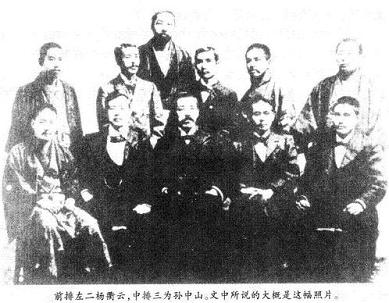 Sun Yat-sen's Devotion To Armed Rebellion
Yang Quyun & Sun Yat-sen Establishing Xingzhong-hui In HK
Monarchist Rebellion Led By Tang Caichang
Manchu "New Administration" & Overseas Chinese Students In Japan
Establishment of Guangfu-hui Among Zhejiang Province Natives
"The Subao Newspaper" Incident
propagation Of Revolution
Huang Xing's "Hua Xing Hui" Society & the Aborted Changsha Uprising
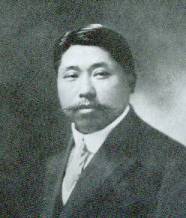 Huang Xing, while staying in Shanghai, encountered another Japan returnee Hu Yuantan who invited Huang Xing & Zhang Ji to the Mingde School in Changsha of Hunan Province as teachers.
En route, at his old school of the "Liang-hu Academy" in Wuhan of Hubei Province, Huang propagated the revolutionary ideas and distributed Zou Rong's book.
Hubei Province expelled Huang Xing.
Huang Xing, while staying in Shanghai, encountered another Japan returnee Hu Yuantan who invited Huang Xing & Zhang Ji to the Mingde School in Changsha of Hunan Province as teachers.
En route, at his old school of the "Liang-hu Academy" in Wuhan of Hubei Province, Huang propagated the revolutionary ideas and distributed Zou Rong's book.
Hubei Province expelled Huang Xing.
In Changsha, Huang Xing was reported to the governor as an instigator, and had to resign his job shortly after he took the teaching post in the autumn of 1903.
On November 4th, 1903, Huang Xing, after the homecoming of another Japan returnee Liu Kuiyi, would organize "Hua [China] Xing [prospering] Hui [society]", claiming that the secret societies of Hunan Province were ready to strike and his gang would just need to lit the fuse of the powder bin.
Majority of the 30 early activists of "Hua-xing-hui" were the Japan returnees.
With Liu Kuiyi's help, Huang Xing established contacts with "ge lao hui" chief Ma Fuyi, and held a three-person drinking gathering in a cave near a mine in Xiangtan in the spring of 1904.
Huang Xing established a separate "tong [common] chou [feud] hui [society]" for organizing rebellion on the lunar calendar October 10th, 1904.
Elsewhere, in Wuchang of Hubei Province, Song Jiaoren & Hu Ying participated in organizing "kexue [science] buxi [makeup study] suo [institute]" in June-July 1904 for the preparation of an armed uprising.
Members of "kexue [science] buxi [makeup study] suo [institute]" expressed the willingness to echo Huang Xing's planned uprising in Changsha of Hunan Province.
Prior to the uprising, Huang Xing dispatched two comrades to Sichuan Province, Chen Tianhua to Jiangxi Province, and Zhang Shizhao & Yang Shouren to Shanghai for coordination.
However, the Manchu agents found out about the plot, and a warrant was issued for Huang Xing on October 24th.
Huang Xing & Zhang Ji fled to Shanghai, and onward to Japan.
Hearing of a possible uprising by Ma Fuyi, Huang Xing & Liu Kuiyi made a stealthy return to Hanyang, Wuhan of Hubei Province but had to abandon 43 guns and ammunition after a gun battle with a Manchu smuggling prevention checkpoint.
Shanghai's Orient" magazine ridiculed the uprising with the ancient claim that the "Confucian apprentice would never succeed in rebellion at the time span of 3 years".
Huang Xing fled to Japan again after finding out that Ma Fuyi was arrested by the Manchu court.
In Japan, the Japanese notables, like Toten Miyazaki (Gongqi Yinzang), located Huang Xing, and subsequently introduced Sun Yat-sen to be an acquaintance with Huang Xing when Sun came back to Japan and arrived in Yokohama on July 19th, 1905.
Sun Yat-sen's Establishing Contacts With the Intelligentsia From Societies of the Yangtze Area
Sun Yat-sen, while preaching to the overseas Chinese in Hawaii in December 1903, cited the humiliation of the Boxer Protocol and the 1900 defeat of the Manchu government by 20,000 foreign soldiers. Sun Yat-sen called upon replicating the U.S.A.'s system in China.
In the autumn of 1904, Sun Yat-sen adopted the combination of the republic and China in an article.
Also in autumn, Tang Jiyao, as one of 100 Yunnan Province overseas students, arrived in Japan where he changed his major to 'infantry' from 'sciences'.
In 1904, Tao Chengzhang returned to China and exerted his efforts in rebuilding the secret societies in Zhejiang Province.
Tao Chengzhang & Gong Baoquan travelled across Zhejiang Province prefectures, and in August 1904, planned with Huang Xing & Cai Yuanpei for an uprising on November 16th [the birthday of Dowager Empress Cixi].
In October 1904, Tao, together with Gong Baoquan & Cai Yuanpei, established "Guang Fu Hui".
Tao took charge of liaison in the five provinces of Southeast China.
In Changsha of Hunan Province, Huang Xing and Zhang Ji persuaded Su Manshu into staying as an English language teacher at the "Enterprise School".
Su Manshu just returned from a pilgrimage trip to SouthEast Asia, with financing from his English language teacher Zhuang-xiang, i.e., a Spaniard priest who, at age of seventy year plus at the time, intended to marry his 20 year old daughter to the revolutionary-monk.
Also in Feb 1904, the Russo-Japanese War broke out with a surprise attack on Port Arthur by the Japanese fleet. The
Manchu military officers, like Wu Peifu, were ordered to collaborate with the Japanese in going to Manchuria for espionage against the Russians.
The Russians employed the Chinese as spies as well, with one such spy execution documentary being played in a Japanese medical college where Lu Xun was attending.
The next year, in Sept 1905, defeated on land and sea, Russia ceded to Japan Port Arthur, the southern portion of the Manchurian Railway, and the southern half of Sakhalin Island under the terms of the Treaty of Portsmouth.
In the winter of 1904, the Restoration Society was established in Shanghai, with Cai Yuanpei made into president as a result of Zhang Taiyan's imprisonment. The Restoration Society proposed the slogan of "restoring our Han ethnicity and recovering our mountains and rivers".
In the spring of 1905, Sun Yat-sen visited Europe. In the spring, he knocked on the door of Wu Zhihui who had refused to see him while in Japan in 1901, thinking that Sun might just be a robinhood kind of figure.
With Liu Chengyu's referral letter sent from San Francisco, Sun Yat-sen obtained invitation from the overseas students in Brussels and Berlin.
While Sun touted the role of the secret societies, Zhu Hezhong alerted to the influence of students and soldiers in Hunan-Hubei provinces as well as the possible unrestrained ambition of secret society members.
After 3 day and 3 night talks, Sun Yat-sen was convinced by Zhu Hezhong. About 30 students held an oath, and later in 1905, called themselves the European Branch of "Allied Societies", with the inclusion of the students from Berlin and Paris area.
In March of 1905, Shanghai Cathay University was dissolved over foreign lecturers' change of curriculum.
The Manchu government dispatched five ministers on an inspection trip across the European nations in 1905.
On the original departure date, a revolutionary by the name of Wu Yue (from Tongcheng of Anhui Province) died by exploding himself in the attempt of assassinating the five ministers at the train station. In the same year, Hu Ying (from Hunan Province) and Wang Han (from Hubei Province) followed Manchu minister "qin cai" [imperial inspector] Tie-liang all the way to the north. Wang Han committed suicide after failing to find a chance to assassinate Tie-liang.
Formation Of the "Allied Societies"
In July of 1905, Sun Yat-sen arrived in Japan from France.
On July 28th, Huang Xing and Sun Yat-sen had a meeting in Fengleyuan Restaurant with the brokering by Japanese Toten Miyazaki (Gongqi Yinzang). Per Song Jiaoren's diaries, Sun expressed worries about China falling into the chaos similar to the post-Qin or post-Yuan eras.
"Huang Xing Hui" held another meeting in regards to cooperation with Sun Yat-sen the next day.
On the 30th, 70 students went to Japan's black dragon society for a preparatory meeting during which Sun Yat-sen & Huang Xing made speeches.
The meeting, at Huang Xing's suggestion, changed the society naming to the "Chinese Allied Societies" from the "Chinese Revolutionary Allied Societies".
(Wang1 Rongzu stated that the Japanese government had demanded that the word 'revolution' be taken out.) Toten Miyazaki (Gongqi Yinzang) presented a roster form for meeting attendants to sign. Cao Yabo, a Hunan native, broke the participants' hesitation by signing his name first. Sun Yat-sen's oath called for expelling of the Tartars and restoration of our China.
On August 13th, Sun Yat-sen made a speech at a reception held by about 700 overseas students in Tokyo and called for the establishment of republic via revolution.
On August 20th of 1905 (Gregorian), Sun Yat-sen, who reportedly had spent idle time in Japan after losing his brave men in the prior uprisings, was supported by Huang Xing for organizing "Tong Meng Hui" (i.e., the 'Allied Society of China' or the 'Revolutionary Alliance') in Japan.
30 clauses were chartered.
Among 30 commissars, only two, including Sun Yat-sen, belonged to the former "Xing Zhong Hui".
Sun, age 39, was made into "premier", while Huang Xing, age 31, was secondary. Hu Hanming [age 26], Song Jiaoren [age 23], and Wang Jingwei [21] tacked on the prominent posts.
About 400 students joined the secret society.
"Min Bao Newspaper" [i.e., The People's Journal] was launched on November 26th, 1905.
Li Ao, a critic of the KMT, claimed that it was Huang Xing who had saved Sun Yat-sen's political career in 1905. Do note that back in 1902, Zhang Taiyan & Gong Baoquan had visited Sun at Yokohama and later formed a rudimentary alliance.
Li Dongfang's "Complete Biography of Chiang Kai-shek" pointed out that the "Tong Meng Hui" society expanded upon "Xing Zhong Hui" but incorporated Huang Xing & Song Jiaoren's "Hua Xing Hui", absorbed members from Cai Yuanpei & Gong Baoquan's "Guang Fu Hui" as well as "Ri [sun] Zhi [knowledge] Hui". ("Ri [sun] Zhi [knowledge]" apparently derived from Ming Dynasty remnant Gu Yanwu's article "Ri [sun] Zhi [knowledge] Lu [records]" in the early Manchu Qing Dynasty.)
Li Dongfang indiscriminately ascribed the uprisings and assassinations by various organizations to "Tong Meng Hui", including: Wu Yue's attempted assassination of five ministers in Peking in August 1905, Zhu Zhilong's death in Changsha in October 1906, Xu Xilin's aassassination of En-ming in Anqing in May 1907 as well as the Pingxiang-Liling-Liuyang Uprising in 1906, Huanggangzhen [Raoping of Guangdong] Uprising, Qinuuhu [Huizhou of Guangdong] Uprising, Qinzhou Uprising and Zhennanguan Uprising in 1907.
Tang Jiyao and about 40 Yunnan Province students also joined the "Tong Meng Hui".
Tang Jiyao, who actively participated in the revolutionary publication and societies, also joined Huang Fu's "Iron & Blood Great Men Society"" ['zhang fu hui'], i.e., a small circle of 41 cadet students who later became the nucleus of provincial military leaders during the 1911 uprising. (Sun Yat-sen was said to have special instruction that the 'zhang fu hui' membership be restricted and hidden for sake of infiltration into the Manchu military establishment.)
Three months later, on November 26th, Sun first expounded his Three People-ism (i.e., Three People's Principles in regards to nationalism, the civil rights and populace life) on newspaper "Min Bao".
Sun Yat-sen first adopted the term "guomin geming" or the 'national revolution' for distinction from "pingmin geming" or the 'ordinary people/banditry revolution'.
With "Tong Meng Hui", Sun Yat-sen incorporated Huang Xing/Song Jiaoren's Hubei comrades and Zhang Binglin's Zhejiang comrades and made the revolution a multi-province movement.
For the first time, the revolutionary ranks included the overseas students and intellectuals spanning multiple provinces other than the professional chivalry fighters. "Tong Meng Hui", with the requirement of an oath to the heaven, had been touted as the turning point in China's revolution.
Jiang Yongjing attributed the multiple-province members recruited and disciplined in Japan to the success of the domino-effect provincial independence movement during the 1911 Xin Hai Revolution.
Per Jiang Yongjing (page 41 of "Hundred Year Land-Sea Ebb History of the KMT", 1993 edition, zhuanji wenxue publishing house, Taipei, Taiwan), "Tong Meng Hui" possessed 956 recorded names in the timeframe of 1905-1906, with majority members at age 20-25, and members came from all Chinese provinces except for Gansu Province.
(Fu Guoyong claimed that Zhang Binglin's Zhejiang comrades joined the Allied Society of China on the individual basis since the leaders of the Restoration Society were all in Shanghai.
"Tong Meng Hui", on Sept 8th, 1905, dispatched Feng Ziyou to H.K. for taking over "China Daily" from Chen Shaobai.
Chen Shaobai, i.e., a prominent member of the "Xing ZHong Hui" who launched the newspaper in 1899, left the political scene.)
The Revolutionaries vs the Constitutional Monarchists
In Japan, "Tong Meng Hui", i.e., the Allied Society or the Revolutionary Alliance, engaged in newspaper debates with monarchist Liang Qichao and, within half a year, drove the monarchist newspaper into bankruptcy.
In Singapore and HK, the revolutionaries outweighed monarchists in the propaganda field, too.
(At http://www.larouchepub.com/other/2004/3123morgan_v_dr_sun.html, Mike Billington wrote for "Executive Intelligence Review" an article entitled "How London, Wall Street
Backed Japan's War Against
China and Sun Yat Sen", pointing out that "Liang's ideological evolution directly parallels the synarchist movement of the 18th and 19th Centuries. He began as a student of Giuseppe Mazzini, praising the British asset Mazzini as a prophet and the principal theorist and ideologue of patriotic movements in Europe. Liang translated Mazzini's works, and in 1900 wrote an essay called "Ode to Young China," seeing himself as the Chinese spokesman for the Young Europe movement created by Mazzini [which was in fact British Lord Palmerston's operation to prevent any influence of the American Revolution from spreading in Europe]...
Liang traveled to the United States in 1903, sponsored by the Protect the Emperor Society. While primarily addressing the Chinese communities in the United States and Canada, he also met with President Theodore Roosevelt and J.P. Morgan.")
In late January of 1905, Huang Xing won back Chen Tianhua who almost converted to the school of the Constitutional Monarchists.
Zhang Ji, for the first five editions, became editor-in-chief of the "Min Bao" newspaper, i.e., a publication originally named the "20th Century China" that had to change name few times, to the current name on Sept 19th, 1905, under the Japanese censorship.
On November 26th, the 1st edition published Sun Yat-sen's Three People Principles that was authored by Hu Hanmin.
Liao Zhongkai, who grew up in San Francisco, would translate Henry George's "Progress & Poverty" into Chinese for publication on the 1st edition.
Among 26 editions, Zhang Ji was responsible for 6, Zhang Binglin 15, Tao Chengzhang 3, and Wang Jingwei 2, till the Japanese banned it on Feb 1st, 1910. (Before that, the Japanese banned Zhang Taiyan's 24th edition on October 19th, 1908.)
In November of 1905, Japan announced the revocation of regulations in regards to the overseas students from China and Korea.
Chinese students mounted protests for Japan's lumping China together with enslaved Korea. Some radical students proposed a return to China. Tang Jiyao advocated for restraint for sake of finishing studies while seeking a peaceful solution to Japan's reversing its discriminatory policy.
On December 8th, Chen Tianhua jumped into the Yokohama Bay in protest of the Japanese government's revoking the Chinese overseas students' privilege. Over 200 students returned to China.
On May 30th, 1906, Tang Jiyao graduated from the Zhenwu Military School, and in June, went into practical training in a cannons unit of the Japanese 9th division-conglomerate. One year later, Tang Jiyao, as a 6th session cadet, would continue on with his studies in cannons at the Japanese Infantry Cadet Academy.
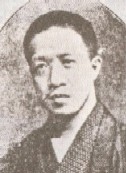 On June 29th, 1906, Zhang Binglin was released from prison, and Sun Yat-sen dispatched messenger to have him fetched to Japan.
Zhang Binglin was put in charge of the "Min Bao" newspaper 6th-18th editions.
In 1906, on the first year's anniversary, "Tong Meng Hui" proclaimed the slogan of 'Long Live The Republic of China !"
In Sept 1906, Su Manshu [aka Su Xuanying] travelled to Japan, with Chen Duxiu on the same ship.
In this year, Zhang Jingjiang and Wu Zhihui established the 'world society' in France and introduced writings by various Western thinkers including Marx.
Also in this year, Tao Chengzhang was supported as "da du du" (i.e., the grand governor-general) for the five Yangtze Delta provinces in preparation for an uprising.
On December 6th of 1906, in the Ping-Liu area of Jiangsu Province, Gong Chuntai rebelled against the Manchu rule in the name of the "Nanking Vanguard Column of the Army of the Republic of China", with the term ROC officially pronounced inside of China.
On June 29th, 1906, Zhang Binglin was released from prison, and Sun Yat-sen dispatched messenger to have him fetched to Japan.
Zhang Binglin was put in charge of the "Min Bao" newspaper 6th-18th editions.
In 1906, on the first year's anniversary, "Tong Meng Hui" proclaimed the slogan of 'Long Live The Republic of China !"
In Sept 1906, Su Manshu [aka Su Xuanying] travelled to Japan, with Chen Duxiu on the same ship.
In this year, Zhang Jingjiang and Wu Zhihui established the 'world society' in France and introduced writings by various Western thinkers including Marx.
Also in this year, Tao Chengzhang was supported as "da du du" (i.e., the grand governor-general) for the five Yangtze Delta provinces in preparation for an uprising.
On December 6th of 1906, in the Ping-Liu area of Jiangsu Province, Gong Chuntai rebelled against the Manchu rule in the name of the "Nanking Vanguard Column of the Army of the Republic of China", with the term ROC officially pronounced inside of China.
Revolutionaries Pressuring the Manchu Into the Constitutional Monarch Reform
Jiang Yongjing estimated that "Tong Meng Hui" had conducted 24 uprisings from 1905 to 1911, with Sun Yat-sen participating in organization 8 times, and that prior to 1905, "Xing Zhong Hui" had conducted 2 uprisings and the rest of parties 5 times.
In 1906, the Manchu government would declare that they would adopt Japan and Britain's system (i.e., "constitutional monarchy" with a royal house and a Parliament) nine years later. They would agree to the 'political reform' beginning from 1907. In 1907, the Huanggang Uprising broke out and over two hundred revolutionaries were killed.
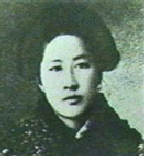 In this year, Xu Xilin (from Shanyin of Zhejiang Province) assassinated Manchu governor En-ming and later was executed at age 35 with heart torn out in front of En-ming's sacrificial altar. Famous heroine, Qiu Jing, from Shaoxing of Zhejiang Province, died in the same wave of uprisings.
Both Xu Xilin and Qiu Jin belonged to the Restoration Society. Fu Guoyong claimed that Xu Xilin refused to join Sun Yat-sen's Allied Society and differentiated himself from Sun Yat-sen during the Manchu interrogation.
Xu Xilin, son of a wealthy merchant, had at one time obtained the 'xiu cai' prefecture level top scorer in the imperial exam and later established two schools for men and women respectively. During a visit to Japan, he got acquainted with Tao Chengzhang. In 1904, he was admitted into the Restoration Society at the invitation of Cai Yuanpei and Tao Chengzhang.
In 1905, Xu Xilin and Tao Chengzhang established the Datong Normal College.
After return from Japan, he obtained a post as a police lecturer under Governor En-ming in spring of 1907.
With the exposed scheme, he pulled ahead the uprising in the name of the Republic Era 2752th Year (dating from Zhou Dynasty Duke Zhougong & Duke Zhaogong Era), with Chen Bopin killed in action and Ma Zonghan captured at the same time.
Qiu Jin was a chivlric woman who wrote numerous poems expressing her desire for sacrifice on behalf of China, and she often carried a Japanese saber whenever she went while in Japan.
Qiu Jin arrived in Japan in 1904 after a divorce and participated in numerous organization activities.
After Chen Tianhua's suicide in late 1905, Qiu Jin and all Chinese students departed for China under Japan's order of "Regulations In Regards To Termination of the Manchu Overseas Students".
In 1906, Qiu Jin published "China Women Newspaper" in Shanghai. She organized eight columns of the "Guangfu-jun" [restoration] army, i.e., the Restoration Army.
On July 13th, 1907, she refused to seek asylum after hearing of Xu Xilin's failure in the Anqing Uprising.
On July 15th, Qiu Jin was executed in Shaoxing of Zhejiang Province, and the county magistrate later committed suicide to show his admiration for her.
Dispute With Sun Yat-sen & Separate Military Actions By the "Guang Fu Hui" Members
Back in Sept 1905, Tao Chenzhang and Xu Xilin established the "Datong Normal College" in Shaoxing of Zhenjiang Province.
Tao and his pals had bought the quotas to study in Japan, but were deliberately disoriented away from the military schools by a Manchu envoy.
In June 1906, Zhang Taiyan was fetched to Japan by Sun Yat-sen on the same day of being released from prison in Shanghai.
In 1906, Tao Chengzhang returned to China to assume commander of the five provinces when Qiu Jing organized the "Guangfu-jun" army.
After the Hangzhou Uprising scheme was divulged, Tao fled to Japan.
On March 4th [Feb per lunar cal] 1907, the Japanese government "expelled" Sun Yat-sen at the request of the Manchu government.
Arrangement was made for Sun Yat-sen & Hu Hanmin to leave together, while Huang Xing & Wang Jingwei travelled as another pair.
Prior to departure, Sun & Huang held their first disagreement in regards to the adoption of the ROC "national flag" that was first designed by martyr Lu Haodong. Huang Xing believed that the "blue sky & white sun" was too similar to the Japanese flag, and Sun merely compromised by changing to the red color. After the 1911 revolution, the ROC adopted the "five color flag" to represent the union of five major Chinese nationalities till Chiang Kai-shek revoked it with the "blue sky & white sun flag" after the 1928 northern expedition.
Another dispute ensued when Zhang Binglin [Zhang Taiyan] was maddened by Sun Yat-sen's leaving merely 2000 Japanese yen to his newspaper while rumor flew around that Sun Yat-sen had received more than the 17000 yen from the Japanese government and merchants.
Owing to Sun Yat-sen's monopolization of the Japanese "private" (?) donation, Zhang Taiyan proposed a censure against Sun Yat-sen.
(Wang1 Rongzu pointed out that the Japanese government might intentionally give 10000 yuan currency to Sun Yat-sen as an under-table deal; however, Zhang Taiyan, being not really indignant about Sun's leaving 2000 yuan behind, could be indignant about Sun's praising Japan's courtesy rather than raising a protest. Further, Japan could have intentionally sowed dissension when it disclosed to the Chinese that they gave Sun a "huge" amount of money which Sun Yat-sen never explicitly clarified with his comrades.)
Meantime, Liu Shipei [Liu Guanghan] advocated for a re-organization of the Allied Society.
Sun refused to send money over to Japan, and later tried to prohibit Tao Chengzhang from raising money in Southeast Asia.
Zhang Taiyan continued on with the "Ming Bao" newspaper on their own till the Japanese banned the 24th edition on October 19th, 1908.
Zhang claimed that the newspaper operation was in dire condition when the newspaper failed to reach the Chinese audience after the Manchu put down the December 1906 Pingxiang Uprising.
Zhang Taiyan recalled that Song Jiaoren often intoxicated himself over poverty and even resorted to the Japanese female staff for loans.
Owning to poverty, Zhang Taiyan, without telling junior daughter, married elder daughter Zhang Li to Gong Baoquan after a dinner at a restaurant.
With the failure of uprisings in Guangdong Province in May & June 1907, dissent grew further.
Zhang Binglin, finding out on June 17th that Japanese Xuanye Changzhi had bought the outdated guns for the Chinese revolution, would obtain the help of Zhang Ji & Song Jiaoren in holding a special meeting against Sun Yat-sen.
Liu Kuiyi refused to convene the meeting, claiming that it would be a suicide for the armed revolution inside of Guangdong Province should they have dissension.
Zhang Ji & Liu Kuiyi had a scuffle inside of the newspaper agency.
Liu Kuiyi wrote to Huang Xing and Hu Hanmin. Sun Yat-sen refused to apologize as suggested by Liu Kuiyi. Huang Xing wrote back for suggesting the party unity.
Sun Yat-sen accused Zhang Taiyan of "divulging the military secret' as to the Meiji Era 18th year model guns.
In this year, Zhang Taiyan wrote a review against Edward Jenks' "History of the Politics" which was translated into Chinese by Yan Fu, and blasted Yan Fu for the viewpoint that nationalism was a backward tribal thought.
Yan Fu, a former student of the Royal Naval College (1877–79) in Greenwich, translated into Chinese Adam Smith's Wealth of Nations,
J.S. Mill's On Liberty,
and
Montesquieu's L'Esprit des Lois.
In April 1907, with possibly the Japanese operations, an "Asian Friendship Society" [i.e., the Asiatic Humanitarian Brotherhood] was established in Tokyo. The Asians from close to one dozen countries participated in the activity.
Zhang Taiyan, Zhang Ji, Liu Shipei, Su Manshu, Chen Duxiu, Lü Fu and Luo Xiangtao also joined.
After both Xu Xilin and Qin Jing sacrificed their lives, Tao fled to Southeast Asia.
In the autumn, Tao Chengzhang, who joined "Tong Meng Hui" one year ago, would organize a separate "Allied Societies Of 10000 Countries of East Asia", and made Zhang Binglin [Zhang Taiyan] the president.
Tao Chengzhang also joined Zhang Ji's "Socialism Research Society" in the winter.
Around 1907, the Manchu government established "tongguo [nationwide] lujun [infantry] sucheng [fast track] xuetang [academy]" in Baoding of Hebei Province which both Zhang Qun & Chiang Kai-shek attended.
Per Zhang Ling'ao, back in 1905, 17-year-old Shang Zhen was admitted to the "Baoding infantry fast-track academy" but was dismissed because of his liaison with revolutionary Jiang Mutan; thereafter, Shang Zhen went to attend the Fengtian military academy in Manchuria.
In Yunnan Province, preparation for the "infantry lecturing academy" was first conducted.
In autumn of 1907, the Japanese briefly intruded into the Yanji area by crossing the Yalu River bordering Korea.
Wu Luzhen was dispatched to the border in Sept for an investigation.
From April 1908 to October 1911, Zhang Taiyan hosted a Chinese classics school, with hundreds of students including Zhou Shuren [Lu Xun], Xu Shoutang, Zhu Xizu, Qian Xuantong, Huang Kan, Wang1 Dong, Ma Youyu, Shen Jianshi & Zhou Zuoren et al.
Topics included "Shuo Wen", "Er Ya", "Han Shu", "Mao Shi", "Wen Xin Diao Long", "Chu Ci", and "Wen Shi Tong Yi".
In March 1908, Tao took over the editor post from Zhang Ji.
Later in 1908, Tao Chengzhang travelled to Southeast Asia where he competed with Wang Jingwei for donation among the overseas Chinese.
Sun refused to endorse Tao, and accused Tao of being a spy for monarchist Kang Youwei.
Tao then exposed Sun's so-called notoriety.
In Southeast Asia, Tao Chengzhang, together with Li Xiehe, wrote to Tokyo for a petition to have Huang Xing replace Sun Yat-sen as the leader.
In Japan,
the "Ming Bao" newspaper 24th edition was banned by the Japanese on October 19th, 1908.
The Japanese court fined Zhang Taiyan 180 yen, which Xu Shoutang & Zhou Zuoren helped to cover.
In early 1909, Tao established Guangfu-hui in Java.
In Sept 1909, Tao Chengzhang wrote an article ridiculing Sun Yat-sen in the name of the "Tong Meng Hui" members from seven provinces.
When Tao Chengzhang went to Tokyo to see Huang Xing, Huang Xing refused to rebuke Sun, and moreover, travelled to Southeast Asia to mitigate the damages caused by Li Xiehe.
Huang Xing orchestrated a support letter for Sun Yat-sen.
In 1909, Sun played a trick in having Wang Jingwei publish the "Ming Bao" newspaper 25th edition in Tokyo, but with a heading stating that the publication place was in Paris, France.
Zhang Taiyan lodged a public censure against Sun Yat-sen, Wang Jingwei & Hu Hanmin by claiming that the "Ming Bao" newspaper 25th edition was a fake.
Zhang doubted Sun as to the actual funds devoted to the April 1908 Hekou Uprising, Zhennanguan Uprising, and Sept 1907 Qin-Lian uprisings.
Later, in Feb 1910, Tao & Zhang re-established the general office of Guangfu-hui in Tokyo.
Wang1 Rongzu pointed out that Sun Yat-sen, from 1910 onward, no longer used the name "Tong Meng Hui" till after October 10th, 1911 Xin Hai Revolution.
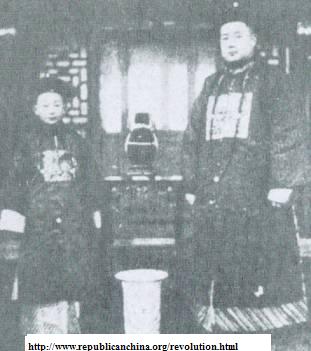 On November 14th & 15th, 1908, Empress Dowager Cixi and Emperor Guangxu died, consecutively. (Emperor Guangxu was said to have been poisoned by Empress Dowager Cixi before her death. http://www.secretchina.com/news/articles/4/8/26/70931.html carried a list of reports by Shanghai's "Shen Bao" newspaper in regards to emperor's health ranging from June 14th to November 16th.) Manchu Emperor Xuantong (Aixinjueluo Pu-yi, r. 1909-1911) got enthroned. Zai-li [Zai-feng] acted as the Regent.
In April 1908, revolutionaries launched the Hekou Uprising in Yunnan Province.
Tens of thousands of overseas students and Chinese celebrated the Yunnan independence in Tokyo.
Later, the Manchu court suspended government funding for those students who played an active role in the relief activity to the Hekou Uprising.
(From 1907 to 1908, revolutionaries launched altogether eight uprisings that would include the May 1907 Chaozhou [Chao Chow] Uprising in Guangdong [by Yu Chou , Cheng Yong-bo & Yu Tong], Huizhou Uprising in Guangdong by Deng Zi-yu,
July 1907 Ching-Cho Uprising in Guangdong by Fung Chung,
Oct 1907 Zhennanguan [Zheng-Nan-Quang] Uprising on Vietnam-Guangxi border by Wang Ho-shun,
and Qin-Lian Revolt by Huang Xing [Huang Ge-qiang].)
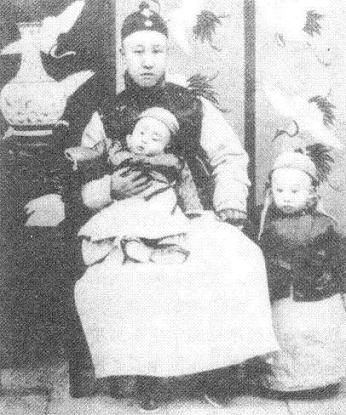 Also in 1908, the Anqing Soldier Rebellion broke out, and over three hundred revolutionaries were killed in Anhui Province.
Xiong Chengji, a member under the Restoration Society, was responsible for this action.
(Xiong Chengji was an officer inside of the cannons battalion, and led his soldiers for an uprising to avenge Xu Xilin's death by taking advantage of the imperial mourning. He, later in January 1910, fled to Harbin of Manchuria where he was caught after a betrayal and got executed while refusing to kneel down in Jilin on Feb 27th at age 24.)
Also in 1908, the Anqing Soldier Rebellion broke out, and over three hundred revolutionaries were killed in Anhui Province.
Xiong Chengji, a member under the Restoration Society, was responsible for this action.
(Xiong Chengji was an officer inside of the cannons battalion, and led his soldiers for an uprising to avenge Xu Xilin's death by taking advantage of the imperial mourning. He, later in January 1910, fled to Harbin of Manchuria where he was caught after a betrayal and got executed while refusing to kneel down in Jilin on Feb 27th at age 24.)
On December 1st, 1908, Tang Jiyao graduated from the Japanese Infantry Cadet Academy, with diploma conferred by the Japanese emperor at the ceremony. (198 cadets of the 6th session were Chinese, including Wang Zhaoji, Li Genyuan, Liu Cunhou, Luo Peijin, Yan Xishan, Sun Chuanfang, Lu Xiangting, Zhou Yinren, Tang Jiyao, Li Liejun, Yin Changheng, Zhang Fenghui and Cheng Qian. Among 6th session graduates of Japan Cadet, Yunnan Province would boast of Tang Jiyao, Luo Peijin, Li Genyuan, Liu Zuwu, Zhao Fuxiang, Li Hongxiang, Ye Quan, Zhang Kairu, Xie Ruyi and Gu Pingzhen.)
In 1909, Tao Chengzhang had an argument with Sun Yat-sen in Southeast Asia over the matter of fund raising and appropriation, and listed 14 "crimes" that Sun Yat-sen had committed. Tao Chengzhang re-organized the Restoration Society with Zhang Taiyan and Li Xiehe.
In Paris, Zhang Jingjiang [Chang Ching-chiang], in 1909, gained Sun Yat-sen's confidence by donating half of his Paris assets.
In this year, two sisters, Yi Weijun and Yi Ruizhi, both students of martyress Qiu Jin, attempted an aassassination by going to Peking.
In late 1909, Sun Yat-sen complained to Wu Zhihui in a letter that Zhang Taiyan was even more "mean" than Tao Chengzhang in lodging attacks against Sun: Sun Yat-sen, per Wang1 Rongzu, had taken the funds to Southeast Asia where he set up "Zhongxing [reverse of Sun's "xing {reviving) zhong (China) society"] Newspaper"; further, Sun, having claimed that he would re-launch "Min Bao" [which collapsed in 1908] in Paris, would secretly authorize Wang Jingwei in printing papers in Tokyo still. (Sun had repeatedly instructed that Wu Zhihui attack Zhang Taiyan for ridding of Zhang Taiyan's fame among the revolutionaries, and utilized revelation by Heh Zhen [i.e., Liu Shipei's wife] to accuse Zhang Taiyan of collusion with Manchu Prince Duan-fang (Rui-fang). -- Wang1 Rongzu pointed out that Heh Zhen, hating Zhang Taiyan for exposing her adultery with Wang1 Gongquan in Tokyo, would reveal Zhang Taiyan's correspondence with Liu Shipei [Liu Guanghan] in which Zhang suggested that he had contacted an acquaintance of Governor-general Zhang Zhidong for going to India should the Manchu government fund the trip.)
The Manchu reform consultancy committees (i.e., provincial viceregal assemblies) were set up for 'show' in all provinces in 1909.
In early 1910, the Manchu princelings, like Tie-liang and Liang-bi, relocated Wu Luzhen to Peking for checking on Yuan Shi-kai cronies.
By 1910, delegates of the provincial reform consultancy committees joined in a national body at Peking, trying to hasten up the parliamentary reform.
Wu Luzhen borrowed 20000 taels of silver from Huang Kaiyuan for buying from King Yikuang the post of Manchu Field Army 6th Division Chief on December 23rd, 1910.
However, the new Manchu royal house still adopted a policy of absolving Han ethnic officials, and they deprived Yuan Shi-kai (Yüan Shih-k'ai) of his military post.
Wu Luzhen conducted several rounds of manipulation for eliminating Yuan Shi-kai appointees like Li Chun & Zhou Fulin but failed to control the 6th Division completely.
(It was said that late Emperor Guangxu had left a will that his successor avenge on Yuan for the treachery, but Guangxu's brother absolved Yuan by merely depriving him of his military posts.)
In July of this year, Jiang Ang'hu authored an anarchism booklet in Belgium, and Mao Zedong first read Liang Qi-chao's "Xin Min Ye Bao" newspaper and began to revere Kang You-wei/Liang Qi-chao as well as Zeng Guofan.
In Nanking, on June 1st, Manchu China held China's First World's Fair for six months, while some American, without knowing Manchu China sitting on top of a fire, wrote that "the education of hundreds of Chinese students in America and Europe, with their constantly increasing numbers, and such significant enterprises as this Nanking exposition, are more vitally related to permanent things. They are among the real factors in the healthy development of international relations, and are a promise of a mutual understanding and a cordial cooperation between China and the Western nations that will result in substantial advantage to both."
In 1910, Tao Chengzhang re-organized the Restoration Society among Zhejiang Province natives and supported Zhang Taiyan [aka Zhang Binglin] as the president.
In Guangdong Province, on the 3rd day after the Spring Festival, Ni Yingdian orchestrated a soldier uprising with a cannons battalion under the 1st brigade of the Guangdong Province New Army.
Also in 1910, Wang Zhaoming (i.e., Wang Jingwei from Anhui Province) returned from Japan, and he invited Huang Shuzhong and Luo Shixun in the assassination of Manchu Regent Zai-li. Wang Zhaoming et al, arrested by the Manchu agents on the lunar calendar March 7th, were absolved from death by the Manchu regent, and while at prison, Chen Bijun often saw him and they later got married. Wang Jingwei conducted this aassassination as a countering stance as to accusation that Sun Yat-sen's clique knew only to push the young men to death. Chen Bijun, daughter of a rich Southeastern Asian Chinese merchant, tore apart her British passport in Japan and followed Wang Jingwei back to China.
The Second Canton Uprising & Third Canton Uprising
Both the Second Canton Uprising & Third Canton Uprising were executed by Huang Xing. Though, Sun Yat-sen took the credit as the leader.
In October, 1910, Dr. Sun launched the Second Canton Uprising. This uprising was financed by the funds of a HK merchant/comrade called Li Haiyun. (Jiang Yongjing stated that the funds for the revolutionary activities between 1907 and 1908 were from the overseas Chinese in Southeast Asia.)
On March 29th, 1911 [lunar calendar], Dr. Sun launched the Third Canton Uprising, i.e., Quang Chow revolt. Huang Xing [aka Huang Ge-qiang] pulled ahead the uprising and personally led 130 men in the revolt, with main cadres including Ling Jiao-ming, Fang Sheng-dong & Ju Zhi-xin [Zhu Zhixin].
Huang Xing's fighters took over Governor-general Zhang Fengqi's office at one time.
86 revolutionaries died during this battle, with the bodies of 72 revolutionaries later collected and buried on the Huanghuagang Hill [yellow flower hill] in Canton by Huang Huagong [Pan Dawei per Li Dongfang].
Implicated in the total death toll would be 104 comrades per Li Dongfang.
 (Jiang Yongjing stated that 29 martyrs came from the overseas and the rest came from six different provinces, with background varying from the students to soldiers, merchants, intellectuals, martials arts masters, workers and peasants. Jiang Yongjing stated that the funds for this uprising and martyrdom, totaling 200,000 yuan or dollars, had mostly come from the overseas Chinese in Southeast Asia, North America and Japan.
Majority of the 500 men pre-selected for this uprising had come from H.K. and Southeast Asia, a reason that the KMT and Sun Yat-sen claimed that the "overseas Chinese" were the mother of revolution.)
(Jiang Yongjing stated that 29 martyrs came from the overseas and the rest came from six different provinces, with background varying from the students to soldiers, merchants, intellectuals, martials arts masters, workers and peasants. Jiang Yongjing stated that the funds for this uprising and martyrdom, totaling 200,000 yuan or dollars, had mostly come from the overseas Chinese in Southeast Asia, North America and Japan.
Majority of the 500 men pre-selected for this uprising had come from H.K. and Southeast Asia, a reason that the KMT and Sun Yat-sen claimed that the "overseas Chinese" were the mother of revolution.)
In April, 1911, the Manchu royal house reorganized the cabinet, but they still retained 9 ethnic Manchu among altogether 14 members.
Two brothers of the regent, Zai-Xun and Zai-Tao, were both conferred the minister posts. King Qing-wang (Yi-kuang) was appointed the post of prime minister. To replace deceased Han-ethnic officials of Sun Jia'nai, Lu Chuanlin and Zhang Zhidong would be Xu Shichang as assistant to Yi-kuang.
Song Jiaoren's Establishing the "Tong Meng Hui" Yangtze River Branch
Numerous uprisings erupted throughout the nation.
Back in late 1910, Tan Renfeng, Song Jiaoren, Zhao Sheng and Ju Zheng had criticized Sun Yat-sen for not giving financial support to the Yangtze area revolution.
When Tan Renfeng came to see Huang Xing in HK, he presented their plan to establish a Yangtze branch of "Tong Meng Hui". Hu Hanming objected to it, and Tan Renfeng severed his relationship with Hu Hanming.
The huge death toll from March 29th 1911 Canton Uprising would cause so much indignations and pains among the revolutionaries of the Yangtze River area that everyone was eager for actions.
Zhao Sheng was saddened to death. Huang Xing & Hu Hanming segregated themselves.
On July 13th 1911, Song Jiaoren, being unhappy over the failure of March 29th Canton Uprising and lamenting the deaths of revolutionaries in uncoordinated uprisings (e.g., death of Xu Silin in Anqing, Wen Shengcai in Canton and Xiong Chengji in Manchuria), had organized a Shanghai branch of "Tong Meng Hui".
Tan Renfeng, Song Jiaoren, and Chen Qimei were appointed department heads but the post of president was deliberately left out.
Ju Zheng was put in charge of Hubei Province, while Jiao Dafeng Hunan Province.
On October 6th, Huang Xing wrote to the Shanghai branch about the importance of having one low-quality general than two high-quality generals for uprising preparation.
Song Jiaoren had disagreement with Sun Yat-sen as far as Sun's heavy emphasis on southeastern Chinese coast was concerned, having proposed at one time three options for rebellions: top option around the Manchu capital, second option around the Yangtze River, and last option in Southeastern China. Shanghai branch of "Tong Meng Hui", with Song Jiaoren etc., acting as five directors, would establish branch societies in Jiangsu, Anhui, Hunan and Hubei provinces.
Xin Hai Revolution of October 10th 1911 [Aug 19th per lunar calendar], in Wuchang, Hubei Province, would mark the end of the Manchu rule in China. 16 provinces echoed Wuchang revolution by declaring independence and erecting a provisional ROC government in Nanking by late 1911.
(Mao Zedong, who came to attend high school at Changsha early in the spring, would read Yu Youren's "Min Li Bao" newspaper and later joined the New Army in Hunan Province in the aftermath of Xin Hai Revolution.)
The 'Retaining Railroad' Movement
Sheng Xuanhuai, i.e., Manchu minister in charge of the post and transmission services, proposed to the Manchu Regent to have three major privately-financed railroads nationalized. Under Emperor Guangxu, the railroad industry was undertaken by the populace privately beginning from 1896. Sheng, previously the so-called King of Railroads, with dozens of concubines and children, intended to embezzle the funds by obtaining the foreign loans in the purchase of the railroads. Sheng negotiated with Britain, the U.S., Germany and France for loans, obtained the loans in May 1911, and deposited the kickbacks and commission into his own pocket.
Sheng forcefully nationalized the railroads with minimal reimbursements to the public. The Sichuan people convened for sake of 'bao lu', i.e., retaining or recovering the railroad in 1910.
This was against the European and American synarchists' attempt at swindling China's railway.
The 'Society of Bao-lu Comrades' was set up in the four provinces of Sichuan, Hunan, Hubei and Guangdong, which was against the Manchu attempt at nationalizing the Sichuan-people-sponsored railway and selling the railway rights to the European and American synarchists.
In the months of August & Sept of 1911, the organized petition movements swamped across Sichuan Province.
The slogan was 'executing Sheng Xuanhuai for pacification of the people'.
When the Manchu governor of Sichuan cracked down on the populace's resistance to the railway nationalization, Xia Zhishi, a Japan infantry academy graduate, conducted an uprising and led his hundreds of soldiers in an attack at the Manchu governor in the provincial capital city.
Xia Zhishi fired the first shot against the Manchu government in the Sichuan provincial railway protection movement of 1910.
The Manchu government, in a panic, called on the garrison troops of Wuchang, Hubei, to reinforce the Sichuan army. This gave the revolutionaries among the Hubei New Army a chance to conduct a mutiny which triggered the 1911 Xin Hai Revolution that overthrew the Manchu rule.
So to say the European and American synarchists actually triggered the 1911 Xin Hai Revolution that overthrew the Manchu rule when they colluded with the Manchu government in the attempt at having the Manchu government nationalize the privately-funded Sichuan railways so as to sell the railway rights to the European and Americans.
Xia Zhishi, who retired in the 1930s, was executed by the communists in the early 1950s, and was restored the reputation and rebuilt the tomb in 1988.
Sichuan Governor-General Zhao Er'feng (nicknamed 'butcher') reported the turmoil to Peking. Sheng managed to have the Regent dispatch a Manchu official by the name of Duan-fang (Rui-fang) to the south for pacifying the Sichuan people as "tielu zongban" (i.e., omni-official in charge of the railroad). At Wuchang, Duan-fang (Rui-fang) obtained two battalions of soldiers from the governor of Hubei Province and then marched westward to Sichuan. Duan-fang (Rui-fang) stationed his troops (the First Brigade of the New Army) at the Zizhong county of Sichuan. In Sichuan, schools and shops were closed under the 'retaining railroad' movement organized by Pu Dianjun and Zhang Lan et al. Governor-General Zhao Er'feng arrested the five gentlemen including Pu Dianjun and Zhang Lan, hence angering the populace into attacks at the governor-general office. Five civilians were killed when Zhao ordered that the musketeer army fired at the crowd. Across Sichuan Province, people stormed the various county magistrate offices.
The Manchu regent promptly ordered that Cen Chunxuan go to Sichuan to help Duan-fang (Rui-fang) & Zhao Er'feng. Zhao replied to have Cen stopped for sake of keeping his governor-general's post. Cen Chunxuan stayed put at Wuchang and did not leave (for Shanghai) till the Wuchang Uprising broke out.
Pressured by the populace as well as Duan-fang (Rui-fang), Zhao Er'feng negotiated with the Sichuan people for making an autonomy of Sichuan beginning from the lunar month October of 1911. Zhao surrendered his civil seal to Pu Boying (chief of the Sichuan consultancy committee) and the military authorization to Zhu Qinglan (officer in charge of the first brigade of the Sichuan New Army). On October 18th, the Chengdu city underwent a rebellion, and Zhao re-asserted himself as "zong du" (i.e., governor-general) and got killed later. Cai Dongfan commented that Shen Xuanhuai's railroad nationalization had led the Manchu to its demise.
Aside from the synarchists' attempt at swindling the Sichuan railway, one more important event would be the lawlessness across the nation as evidenced by the "Robbing the Government Grains" in Changsha of Hunan Province in April 1910.
Mao Tse-tung, still a student in the countryside of the Xiangtan county, had heard from the fleeing people about the decapitated heads that were hung on the city rostrums of Changsha after the Manchu cracked down on the rebels who had sacked the governor office and stormed the foreign settlements at one time.
The Wuchang Uprising & the Xin Hai Revolution
A Chinese saying goes that "the wind will be blowing through the whole storey-building at the time the moutain rain is to pour down".
Numerous factors contributed to the overthrow of the Manchu Qing Dynasty.
Cai Dongfan commented that Shen Xuanhuai's railroad nationalization had led the Manchu to its demise.
Jiang Yongjing, in "The Land-Sea Ebb History of the KMT", attributed the multiple-province members recruited and disciplined by "Tong Meng Hui" in Japan to the success of the domino-effect provincial independence during the 1911 Xin Hai Revolution.
Late Historian Shen Yunlong, in his book "An anthology of Events and Figures During the ROC Time", attributed Manchu Governor-general Zhang Zhidong's launching the renovative academies and military academies to the upbringing of a generation of revolutionaries. Shen Yunlong also called the attention to the Manchu Qing's abolition of the imperial civil services exam as a fundamental cause in re-orienting lots of talented Confucian-apprentices towards services under the Manchu Qing's re-organized New Army. (Manchu Qing had authorized Yuan Shi-kai in rebuilding the New Army on basis of the "rightside martial defense column", the only remnant that survived the wars against the invasion of the Eight Allied Nations while the other four columns had been basically decimated.)
At the Wuchang city, numerous Hubei Province secret societies were actively engaged in preparations for rebellion. This will include the Rizhi-she (Sun Awareness) Society (a subordinate of the Allied Society of China) and numerous allies like the societies of Gongjin-hui (together advancement), Qunzhi-xueshe (public government), Zhenwu-xueshe (reviving martialness), Wenxue-she (literature) and Gonghe-hui (republican).
On Feb 4th, 1911, in H.K., Huang Xing gave Tan Renfeng 2000 yuan currency for going to Hubei Province to instigate an uprising as an echo for the planned Canton Uprising.
Tan Renfeng got in touch with the "Gong Jin Hui" society via Ju Zheng and the "Wen Xue She" society via Hu Ying.
Tan Renfeng gave Ju Zheng 600 yuan and Sun Wu 200 yuan, funds that would be used for establishing the secret offices in the French & Russian settlements as well as the Wuchang city.
The huge death toll from the March 29th, 1911 Canton Uprising would cause so much indignation and pains among the revolutionaries of the Yangtze River area that everyone was eager for actions.
All through the lunar calendar months of July and August of 1911, leaders from "Gongjin-hui", "Wenxue-she" and the Shanghai branch of "Tong Meng Hui" held meetings for preparations of an uprising. Dozens of officers from the various regiments of Hubei Prov's New Army attended the meeting.
Revolutionaries originally scheduled the Mid-Autumn Festival of August 1911 for uprising. Since Huang Xing, Song Jiaoren and Ju Zheng were late in coming to Wuchang, the uprising was rescheduled for mid-night of the lunar calendar August 18th but it was disrupted after Sun Wu was arrested by the Russian patrol for mis-firing of a bomb during a test in the Hankou's concession territory. On the same night, in Wuchang, the Manchu broke into Zhang Tingfu's home and arrested and executed several leaders; only Jiang Yiwu barely escaped. The Manchu executed three leaders (Peng Chufan, Liu Yaocheng and Yang Hongsheng) in front of Governor-general Duan-cheng (Rui-cheng)'s office, and it made revolutionaries inside of the Manchu's New Army units anxious for action.
The next day, August 19th (i.e., Gregorian October 10th of 1911), around 7 pm, in the camp of the Eighth Engineering Column (i.e., Battalion), a platoon leader (Tao Qisheng) rebuked a subordinate deputy squad leader (Jin Zhaolong) and a soldier (Cheng Dingguo) for their loading bullets into the rifles. In a rage, Cheng shot Tao, and then soldiers shouted "Uprising !" A group leader (squad leader equivalent), Xiong Bingkun, shot several officers and led 300 soldiers in taking over the Chuwangtai [terrace looking towards the Chu Principality land or sky] weapons depot. Soldiers supported an officer (lieutenant major equivalent under the battalion chief) by the name of Wu Zhaolin as the 'revolutionary general-director'.
* In Commemoration of China's Fall under the Alien Conquests in A.D. 1279,
A.D. 1644 & A.D. 1949 *
U.S.S.R./Comintern Alliance with the KMT & CCP (1923-1927)
Korean/Chinese Communists & the 1931 Japanese Invasion of Manchuria
American Involvement in China: Soviet Operation Snow, IPR Conspiracy, Dixie Mission, Stilwell
Incident, O.S.S. Scheme, Coalition Government Crap, Amerasia Case & The China White Paper
* Stay tuned for "Republican China 1911-1955: A Complete Untold History" *
|
|
Zou Rong's Revolutionary Army;
Shin Kyu Sik's
Shrine (Spirit, Kunitama) of Korea
|
This snippet is for sons and daughters of China:
Heed the sons & ministers' agony and sorrow of our ancestors who died or lived through the Mongol, Manchu and Soviet-Chicom conquest
and
the Yongjia, Jingkang and Jiashen cataclysms !
Jeanne d'Arc of China:
Teenager girl Xun Guan breaking out of the Wancheng city to borrow the relief troops in the late Western Jinn dynasty;
Liu-Shao-shi riding into the barbarian army to rescue her husband in the late Western Jinn dynasty;
teenager girl Shen Yunying breaking into Zhang Xianzhong's rebels on the horseback to avenge on father's death in the late Ming dynasty.
China's Solitary and Lone Heroes:
Nan Jiyun breaking out of the Suiyang siege and charging back into the city in the Tang dynasty;
Zhang Gui & Zhang Shun Brothers breaking through the Mongol siege of Xiangyang in the Southern Soong dynasty;
Liu Tiejun breaking through three communist field armies' siege of Kaifeng in the Republican China time period;
Zhang Jian's lone confrontation against the communist army during the June 3rd & 4th Massacre of 1989.
|
|
|
First to answer the Eighth Engineering Battalion Uprising would be 2000 more rebels, comprising of the
29th & 30th regiments under the 15th brigade,
31st & 32nd regiments under the 16th brigade,
41st regiment under the mixed brigade,
the Eighth Cannon 'biao' (equiv to regiment under a brigade), students from the Measuring Military school, a platoon from the 29th Regiment Field Army, and two columns of the logistics army outside of the citywall. When the cannon balls fell on the governor-general office, Governor-General Duan-cheng (Rui-cheng), a grandson of Qi-shan [who signed the 1st Opium War Treaty], broke through his backyard and fled onto the Warship Chuyu on the Yangtze River. The officer in charge of the Eighth 'zhen' (equiv to corps or division) of the Hubei New Army, Zhang Biao, major general equivalent, hearing that the governor-general office was taken by 5 am of August 20th (Oct 11th), planned to seek asylum in the Hankow's concession territory; when a colonel-equivalent officer reported that the Eighth Logistics Battalion outside of the Pinghu-men city gate was still loyal, Zhang Biao fled there and then led this column of army away from downtown Hankou to avoid the turmoil. At daybreak, the city of Wuchang, one of the three waterfront triplet-cities of Wuhan, would be under the control of the revolutionaries.
Two revolutionaries, Ma Rong and Yang Qifa, went to invite Li Yuanhong (brigadier equivalent officer in charge of the 21th Mixed Brigade) for joining revolution. (Li Yuanhong, a graduate of the North-Sea Navy Academy or the "Beiyang Navy Academy", had at one time jumped into the sea to commit suicide at the defeat of the Chinese Eastern Railway War, i.e., Manchu fleet's defeat in Manchuria and the Yellow Sea. After returning to southern China from the Shandong navy base, he was appreciated by Zhang Zhidong who later succeeded the governor-general post for the Hunan-Hubei provinces. Zhang Zhidong offered Li Yuanhong the post as brigadier general.) They located Li Yuanhong at a counsellor's home where Li was seeking for asylum. Under the pressure, Li Yuanhong reluctantly followed Ma Rong and Yang Qifa to the Chuwangtai Weapons Depot, and rebuked Wu Zhaolin (Li's one-time classmate) about rebellion against the Manchu rule. Wu Zhaolin persuaded Li Yuanhong into accepting the post of leadership. Wu Zhaolin assured Li Yuanhong that the revolutionary forces in the number of 100,000 were amassing under the leadership of Liu Ying at the Jingshan Mountain and that Jiao Dafeng was to stage the uprising in Hunan Province correspondingly. Xiong Bingkun assured Li Yuanhong that there were enough grains and money in the governor-general's office for spending. Li Yuanhong agreed to lead the rebels after he made the rebels agree to rulings like no random killing of the Manchu and no raping of women etc.
Meanwhile, Tang Hualong, assembly chief for the Hubei Consultancy Committee, dispatched a messenger to invite Li Yuanhong et al., for a meeting to organize the new military government. At 11:30 am, revolutionaries went to the consultancy committee office to meet Tang Hualong and other local gentlemen. Li Yuanhong again reluctantly accepted the post of governor-general for Hubei Province. Under the pressure of guns, Li Yuanhong issued a pacification notice to the populace. For days, Li Yuanhong procrastinated in making orders and he was nicknamed 'Li Buddha' for the passivity. By August 21th (Oct 12th), Chen Rui and Gan Jixi pressured Li Yuanhong into cutting the pigtail and Li Yuanhong, at the gun point, agreed to cut the hair by the next day. By August 26th (Oct 17th), Li Yuanhong held a ceremony of the Sacrificial Proclamation to the Yellow Emperor, with the elderly white-hair Tan Renfeng personally handing over the sword and flag to Li Yuanhong. (Tan Renfeng, an old member of 'Tong Meng Gui', was dispatched to Hubei from Hunan by the order of Sun Yat-sen.) In the name of Sun Yat-sen, Tang Hualong and Ju Zheng made a decree of the military government. The decree stated that the governor-general was the highest post for both the civil and military affairs of the province; that the government was to have two departments, with Governor-general Li Yuanhong in charge of the military affairs and Tang Hualong in charge of the civil affairs; that the military department was to have the Division of Counsellors (headed by Yang Kaiji and Wu Zhaolin),
the Division of Orders (headed by Du Xijun), and the Division of Tasks (headed by Sun Wu, Jiang Yiwu, Zhang Zhenwu and Cai Shaozhong); that the civil department was to have the Division of Admin Affairs (headed by Tang Hualong and Zhang Zhiben), the Division of Diplomacy (headed by Hu Ying and Wang Zhengting), and the Division of Finance (headed by Hu Ruiling).
The Wuchang military government re-organized its army into four 'xie' (i.e., brigades), with following persons in charge, respectively: Wu Zhaolin, Li Zuodong, Cai Jimin and Xu Daming. Separately, the tactics division and talents' guesthouse were set up, and soon the talents' guesthouse became the secretariat for the military government, with Yang Yueru as director and Rao Hanxiang as deputy director.
The Wuchang military government then issued orders to take the sister cities of Hanyang and Hankou.
The Wuchang military government re-organized its army and took over the sister cities of Hanyang and Hankou.
Li Yuanhong ordered that Lin Weixin, a "tong dai" (colonel equivalent), cross the Yangtze to take over the weapons factory and the town of Hanyang. The Manchu "zhi fu" (magistrate) fled without a fight. Lin Weixin then crossed the river to take over the town of Hankou. The Wuchang military government sent diplomatic messages to consuls of the various concession territories requesting for their neutrality in exchange for protection by the military government.
After securing the triplet-cities, the military government sent a wire across the nation, proclaiming the founding of the Republic of China as of the date of 4,609th year of China.
Various provinces echoed the Wuchang Uprising by declaring the independence from the Manchu government. The Manchu Governor for Guangxi, Shen Bingkun, consulted with Aboriginal Official (i.e., "fan si") Wang Zhixiang and General (i.e., "ti du") Lu Rongting, and with the support of the consultancy committee, declared independence and resigned his post of general-general to Wang Zhixiang/Lu Rongting. Wang Zhixiang wired to Governor-general Zhang Mingqi of Guangdong Province, and Zhang Mingqi, under the pressure of the consultancy committee, fled the scene. General (i.e., "ti du") Long Jiguang suggested that Hu Hanmin be the governor-general of independent Guangdong Province. In Anhui Province, Governor Zhu Jiabao fled and an official of the Jiujiang City, Ma Yubao, was supported as the governor-general of independent Anhui Province. In Fujian Province, New Army General Sun Daoren defeated Manchu general Pu-tao while Manchu Governor-general Song-tao committed suicide.
In Shandong Province, Zai-li's son-in-law, Governor-general Sun Baoqi, requested with the Manchu court for approval to declare a fake independence.
The Manchu warships in the Yangtze River, with most of Manchu captains fleeing in dessertation, surrendered to the revolutionaries.
Yin-chang dispatched Li Chun's 11th Brigade under Wu Luzhen's 6th Division to the south but refused to approve Wu Luzhen's request to go to Hubei Province.
Wu Luzhen privately planned for a frontline rebellion by leading his 6th Division to Hubei.
Zhang Shaozeng of the Manchu 20th Division, on October 29th, sent a public wire for the Manchu to adopt the constitutional monarchy.
Wu Luzhen was sent to Luanzhou for pacifying Zhang Shaozeng, but was construed to be a Manchu court's trick in steering Wu Luzhen away from Wu Hongchang's 12th Brigade under his 6th Division.
When Shanxi Province rebelled against the court, Wu Luzhen was asked to go to Shijiazhuang for leading the 12th Brigade of 6th Division against the rebels.
At Shijiazhuang, Wu Luzhen colluded with the Shanxi rebels and demanded that the Manchu court stop war against the South on November 2nd.
Manchu Regent Zai-li [Zai-feng] recalled Yuan Shi-kai for cracking down on the revolution.
Yuan Shi-kai arrived in Xiaogan from Zhangde, and dispatched Zhou Fulin to Shijiazhuang with 20000 currency.
On November 6th, Ma Buzhou, i.e., Wu Luzhen's bodyguard chief, assassinated Wu Luzhen, tactician Zhang Shiying, and lieutenant Zhou Weizhen.
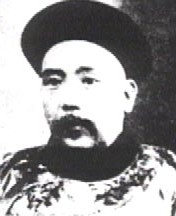 Yuan Shi-kai, after deliberate procrastination, arrived in Peking. Yuan Shi-kai asked Dowager Empress Rongyu to donate her funds to supporting the troops. Yuan Shi-kai re-organized the cabinet and conferred the pacifying generals for the various provinces, but few candidates were willing to take the offer. In Jiangsu Province, General Xu Shaozhen of the Ninth Corps (i.e., "zhen") attacked Nanking's Manchu loyalists such as Zhang Renjun, Tie-liang and Zhang Xun.
Yuan Shi-kai dispatched Rongyu's funds to the front and ordered that his generals, Feng Guozhang and Duan Rugui, attack the Wuchang government. Feng Guozhang and Duan Rugui, with the son of Zhang Biao rebelling against the revolutionaries inside, would take over the Hanyang city; Huang Xing fled the city and left for Shanghai.
Meanwhile, the Manchu forces were defeated in Shanxi Province. Duan-fang (Rui-fang) was killed in Sichuan Province. Yuan Shi-kai instructed Feng Guozhang and Duan Rugui to have a ceasefire with the Wuchang government.
Yuan Shi-kai, after deliberate procrastination, arrived in Peking. Yuan Shi-kai asked Dowager Empress Rongyu to donate her funds to supporting the troops. Yuan Shi-kai re-organized the cabinet and conferred the pacifying generals for the various provinces, but few candidates were willing to take the offer. In Jiangsu Province, General Xu Shaozhen of the Ninth Corps (i.e., "zhen") attacked Nanking's Manchu loyalists such as Zhang Renjun, Tie-liang and Zhang Xun.
Yuan Shi-kai dispatched Rongyu's funds to the front and ordered that his generals, Feng Guozhang and Duan Rugui, attack the Wuchang government. Feng Guozhang and Duan Rugui, with the son of Zhang Biao rebelling against the revolutionaries inside, would take over the Hanyang city; Huang Xing fled the city and left for Shanghai.
Meanwhile, the Manchu forces were defeated in Shanxi Province. Duan-fang (Rui-fang) was killed in Sichuan Province. Yuan Shi-kai instructed Feng Guozhang and Duan Rugui to have a ceasefire with the Wuchang government.
When the Wuchang Uprising broke out, Chiang Kai-shek, at the request of Chen Qimei, immediately returned to Shanghai with Zhang Qun by faking a leave of absence and then mailing the uniforms back to his Japanese officer. (Also see the contradicting account in Li Dongfang's "Complete Biography of Chiang Kai-shek".) In Shanghai, he joined the staff of Chen Qimei (Ch'en Ch'i-mei, a.k.a. Chen Yingshi) and organized a 'dare-to-die column' for recovering Shanghai from the Manchu rule.
On November 3rd, 1911, Chen Qimei was arrested by the Manchu while leading the attack on the Manchu's Shanghai Manufacturing Bureau. The next day, revolutionaries sacked the garrison and freed Chen Qimei. Chen Qimei's crony, later in a meeting, coerced the Shanghai revolutionary factions into making Chen Qimei into the governor-general by means of displaying the firearms at the meeting.
In Zhejiang Province, on the morning of November 4th, Chiang, with five columns or 100 comrades, participated in attacking Manchu Governor Zeng-yun's office.
A Manchu battalion chief, Gu Naibin, echoed the uprising.
Later in January of 1912, in Shanghai, Chiang Kai-shek could have personally assassinated Tao Chengzhang, leader of the Restoration Society.
The next day, Zhang Taiyan told the newspapers that Chen Qimei had threatened Tao Chengzhang earlier and that Sun Yat-sen had written to Tao in regards to "settling the old debts".
In addition to Tao's death, several more leaders of "Guangfu-hui" were killed, i.e., Tao Baojun's execution death by Chen Qimei, and Xu Xueqiu & Chen Yunsheng's execution death by Chen Jiongming.
(One of the possible reasons would be Tao Chengzhang's refusal to distribute the funds to Chen Qimei.
Tao Chengzhang was said to have brought back to China a large amount of money he raised in Southeast Asia at the time of the Xin Hai Revolution, and he disbursed funds to Li Xiehe and Zhang Xin for recovering Shanghai and Zhenjiang, respectively.
Shang Mingxuan believed that Chen Qimei assassinated Tao Chengzhang to stop him from assuming the governor-general post of Zhejiang Province that was vacated by Tang Shouqian.
Li Ao cited Deng Wenyi's "Chairman Chiang Kai-shek" in stating that Chiang Kai-shek, on January 14th, 1912, personally shot Tao Chengzhang inside of the Guangci Hospital at the order of Chen Qimei. Three days earlier, Tao Chengzhang received a letter from Sun Yat-sen demanding an explanation for Tao's 1909 accusation of Sun Yat-sen's 14 crimes. At the times of Chiang Kai-shek's death in 1975 and Mao Tse-tung's death in 1975, this webmaster read about an article in regards to the Guangci Hospital murder. Shang Mingxuan pointed out that Chiang bought over a Restoration Society traitor called Wang Zhuqing for the hit job at 2:00 am on January 14th.
Wang1 Rongzu, pointing out that Sun Yat-sen had personally visited Tao's tomb in 1916, stated that Sun's implication in Tao's death could be the reason that Sun had treated Chiang Kai-shek as his most loyal disciple throughout the years.)
In Nanking, Zhang Xun's 18 battalions of the pigtail armies fought an alliance of 30,000 Jiangsu-Zhejiang revolutionaries.
Zhang Xun stopped fighting after receiving Yuan Shi-kai's wire stating that no relief army was available. Zhang Xun fled the city while Tie-liang et al., sought asylum in the Japanese consulate. Lin Shuqing of Zhenjiang was supported as the new governor-general of Jiangsu Province.
In Shanghai, Huang Xing was conferred the post of 'grand marshal' and Li Yuanhong the deputy post.
The Manchu court agreed with Yuan Shi-kai in having the peace talks with the Wuchang government. Yuan Shi-kai dispatched Tang Shaoyi to Wuchang with the help of the British consul in Hankou, and Li Yuanhong sent Tang Shaoyi along to Shanghai to meet Huang Xing.
The foreigners took on the job of collecting the corpses of the dead troops on the both sides of the war in Wuchang.
The Shanghai committee selected Wu Tingfang as the peace talk rep. The two held first round of talk in the British concession territory's city-hall.
Also participating in the peace talk would be brothers Liao Zhongkai & Liao Fengshu in two opposite camps.
Tang Shaoyi sent back to Peking the revolutionary government's demand that the Manchu Qing emperor abdicate. The German consul mediated over the two parties to no avail.
In Shanxi, the Manchu forces took over the provincial capital. The Shandong governor-general revoked independence.
Dr. Sun Yat-sen returned to Shanghai from the overseas by the end of year 1911. Sun, a naturalized U.S. citizen, was working in some Chinese restaurant in Colorado when the uprising broke out.
In Shanghai, Sun Yat-sen was supported as the interim president of the Republic of China which was officially founded on November 13th of 1911 (or January 1st of 1912 per the Gregorian). Dr. Sun Yat-sen moved his interim government to Nanking and stipulated the executive and legislative branches of the ROC, and conferred the ministers' posts onto the various leaders.
After Yuan Shi-kai was appointed "naige zongli" (i.e., prime minister of the Manchu cabinet), Zai-li [Zai-feng] retired.
Tang Shaoyi requested that the Manchu convene a Parliament as soon as possible and resigned the peace rep post when his request was turned down.
In Sichuan Province, Zhao Erfeng was killed; in Xinjiang, Manchu General Zhi-rui was killed; in Gansu Province, Manchu Governor-general Chang-geng was killed; and in Mongolia/Tibet, the local ethnic people declared real independence.
Yuan Shi-kai requested for resignation with the empress dowager over the Manchu's refusal to convene a Parliament.
Seeing that Sun Yat-sen had become the first president of the ROC, Yuan Shi-kai hastened his efforts to secure a fortune for himself. Sun Yat-sen's government further demanded that the Manchu emperor abdicate. The Manchu officials were scared into concession after a revolutionary (Peng Jiazhen) assassinated Liang-bi in front of the residence on the night of Jan. 26, 1912. Peng Jiazhen, a Sichuan Province native, was conferred the title of "infantry grand general" posthumously. Yuan Shi-kai authorized Duan Qirui to demand an imperial abdication in the name of 42 Manchu generals.
Yuan Shi-kai reached a deal with Sun Yat-sen in regards to pressuring the last Manchu Emperor Xuantong (Aixinjueluo Pu-yi, r. 1909-1911) into abdication on February 12th of 1912.
After Sun Yat-sen resigned on the 13th, Yuan Shi-kai obtained the ROC presidency from Sun Yat-sen subsequently when the interim upper house made the announcement on February 15th, 1912.
Details of the Wuchang Uprising and Xin Hai Revolution will be further covered in the section on "The Tragedy Of Chinese Revolution".
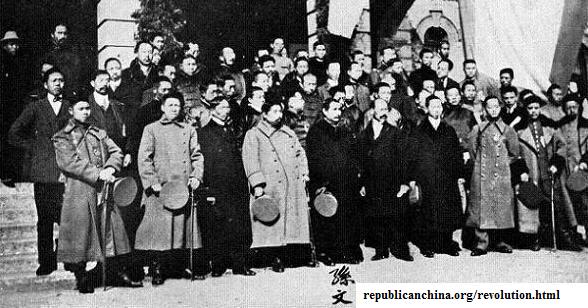
|
Founding Of 'Da Jin' (Grand Gold Dynasty)
Eight Banner System
Twenty Five Years Of War Against China
Battle Of Mountain & Sea Pass
Entering China Proper
Infamous Queue-Related Slaughters
Solidifying Rule Over China
Qing Emperor Shunzhi (Qing Shizu, Aixinjueluo Fu-lin, r. 1644-1661):
Qing Emperor Kangxi (Qing Shengzu, Aixinjueluo Xuan-ye, r. 1662-1722):
1689 Treaty of Nerchinsk
Recovering Taiwan:
Qing Emperor Yongzheng (Qing Shizong, Aixinjueluo Yin-zhen, r. 1723-1735):
Qing Emperor Qianlong (Qing Gaozong, Aixinjueluo Hong-li, r. 1736-1795):
Qing Emperor Jiaqing (Qing Renzong, Aixinjueluo Yong-yan, r. 1796-1820):
|
The Opium War (1839-1842)
"Wangxia Treaty" [U.S.] & Whampoa Treaty [France]
Second Opium Wars (1856–60) & Arson of Summer Palace
Taiping (Grand Peace) Heavenly Kingdom Rebellion
Foreign Enterprises Movement (Self-Strengthening, 1874-1895)
Manchu Military System: Brave-Camp Army & New Army
Russian Encroachments
1876 Anglo-Chinese Yantai Treaty
1884-1885 Franco-Chinese War
Imperialist Encroachments On Korea
1894 Sino-Japanese War
Rise of Yuan Shi-kai
Start Of Water-Melon Partitioning
Hundred Day Reformation
The Boxers & Invasion by Eight Allied Nations
Rise of Yuan Shi-kai (Continued)
Russo-Japanese War Over Manchuria
Assassinations & Uprisings
'Retaining Railroad' Movement
Wuchang Uprising & Xin Hai Revolution
|
| [ last page: manchu.htm ] |
[ this page: qing.htm ] |
Written by Ah Xiang
|
|
|
|
|
|
|
Sovereigns & Thearchs;
Xia-Shang-Zhou dynasties;
Zhou dynasty's vassalage lords;
Lu Principality lords;
Han dynasty's reign years
(Sexagenary year conversion table-2698B.C.-A.D.2018; 247B.C.-A.D.85)
|
|
The Sinitic Civilization - Book I is
available now on
iUniverse,
Barnes & Noble,
Amazon,
Google Play|Books
and
Nook.
The Sinitic Civilization - Book II is
available at
iUniverse,
Amazon and Barnes & Noble.
Check out the 2nd edition preface that realigned the Han dynasty's reign years strictly observing the Zhuanxu-li calendar of October of a prior lunar year to September of the following lunar year, and the 3rd edition introduction that had an overview of Sinitic China's divinatory history of 8000 years.
The 2nd edition preface had an overview of the epact adjustment of the quarter remainder calendars of the Qin and Han dynasties, and the 3rd edition introduction had an overview of Sinitic China's divinatory history of 8000 years.
The 2nd edition realigned the Han dynasty's reign years strictly observing the Zhuanxu-li calendar of October of a prior lunar year to September of the following lunar year.
Stayed tuned for Book III that is to cover the years of A.D. 86-1279, i.e., the Mongol conquest of China, that caused a loss of 80% of China's population and broke the Sinitic nation's spine.
Preview of annalistic histories of the Sui and Tang dynasties, the
Five Dynasties, and the two Soong dynasties
could be seen in
From the Khitans to the Jurchens & Mongols: A History of Barbarians in Triangle Wars and Quartet Conflicts
(The Barbarians' Tetralogy - Book III: available at iUniverse;
Google Play|Books;
Amazon;
B&N).
(A final update of the civilization series is scheduled for October of 2022, that would put back the table of the Lu Principality ruling lords' reign years, that was inadvertently dropped from Book I during the 2nd update.)
|
|
Now, the Scourge-of-God-Tetralogy.
Book III of
The Barbarian Tetralogy, i.e., this webmaster's barbarism series, is released in October of 2022 by iUniverse. This barbarism series would be divided into four volumes covering the Huns, the Xianbei, the Turks, the Uygurs, the Khitans, the Tanguts, the Jurchens, the Mongols and the Manchus.
Book I of the tetralogy would extract the contents on the Huns from
The Sinitic Civilization-Book II,
which rectified the Han dynasty founder-emperor's war with the Huns on mount Baideng-shan to A.D. 201 in observance of the Qin-Han dynasties' Zhuanxu-li calendar.
Book II of the Tetralogy would cover the Turks and Uygurs.
And
Book IV would be about the Manchu conquest of China.
From the Khitans to the Jurchens & Mongols: A History of Barbarians in Triangle Wars and Quartet Conflicts
, i.e., Book III of
the Scourge-of-God-Tetralogy,
focused on the Khitans, Jurchens and Mongols, with the missing one-year history of the Mongols' Central Asia campaigns rectified.
This webmaster, other than the contribution to the Sinology studies in rectifying the Huns' war to 201 B.C., and realigned the missing one-year history of the Mongol Central Asia war, had one more important accomplishment, i.e., the correction of one year error in the Zhou dynasty's interregnum (841-828 B.C. per Shi-ji/840-827 per Zhang Wenyu) in
The Sinitic Civilization-Book I, a cornerstone of China's dynastic history.
|
The Scourges of God: A Debunked History of the Barbarians (available at iUniverse|Google Play|Google Books|Amazon|B&N)
From the Khitans to the Jurchens & Mongols: A History of Barbarians in Triangle Wars and Quartet Conflicts
(The Barbarians' Tetralogy - Book III)
Epigraph,
Preface,
Introduction,
Table of Contents,
Afterword,
Bibliography,
References,
Index
|
|
|
|
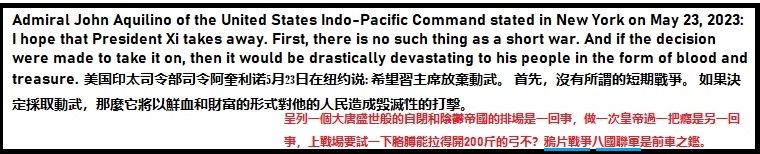
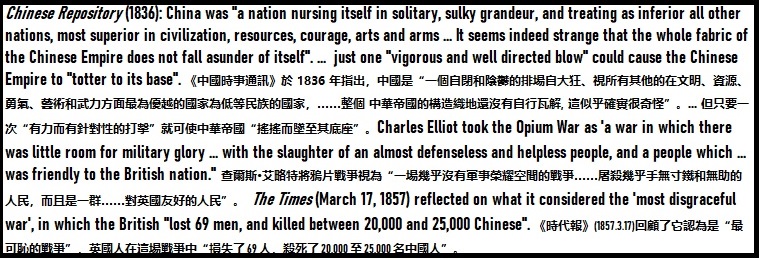
 ***
***


![Though, Anna Wang [Anneliese Martens], in her memoirs, expressed jealousy over Gong Peng by stating that the Anglo-American reporters had flattered the Chinese communists and the communist movement as a result of being entranced with the goldfish-eye'ed personal assistant of Zhou Enlai](GongPeng.jpg)