Sinitic Civilization-Book 1
Sinitic Civilization-Book 2
Tribute of Yu

Heavenly Questions
Zhou King Muwang's Travels
The Legends of Mountains & Seas
The Bamboo Annals - Book 1
The Scourge-of-God-Tetralogy:
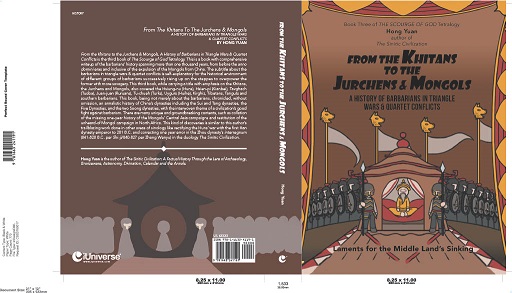
From the Khitans to the Jurchens & Mongols: A History of Barbarians in Triangle Wars and Quartet Conflicts
(available at iUniverse;
Google;
Amazon;
B&N)
|
|
America, i.e., the United States, was and is still shortsighted today, not knowing that Korea, at one time paradise of the American Evangelicals, was delivered into the hands of the Japanese imperialists as a result of the Anglo-American confrontation against Czar Russia, and in this geopolitical process, China, the land of the Great Sinitic Civilization (Barnes & Noble,
Amazon,
Google Play|Books
and
Nook Book), was made into a piggy-backed sacrificial/funereal object -the land ruled by the most evil cult called 'communism' that was an 'import' or an 'export' of Soviet Russia.
America would not learn the lesson that the geopolitical actions it is taking today would yield the 'bad fruit' 50 years or 100 years down the road.
America, and their British cousins, must have forgot the twenty-year Anglo-Japanese military alliance that allowed Japan to develop the warplanes and aircraft carriers to invade mainland China, not to mention the post-WWI ten-year arms embargo against Republic China and George Marshall's post-WWII arms embargo against Republic China 1946-1948.
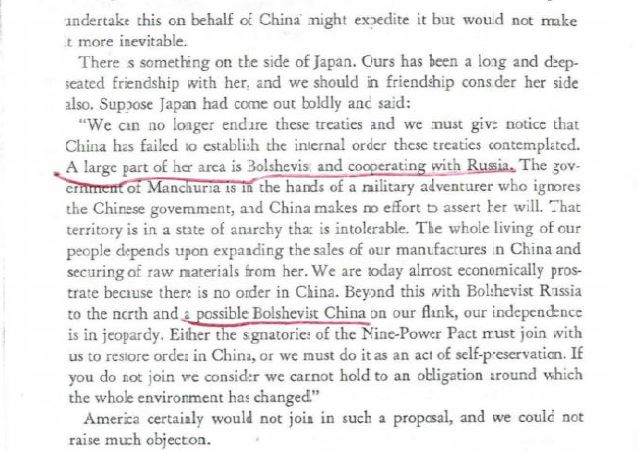
They forgot that in 1931, President Herbert Hoover gave Japan a free hand in the invasion of Manchuria on the pretext that Japan could not tolerate a half-Bolshevik China.
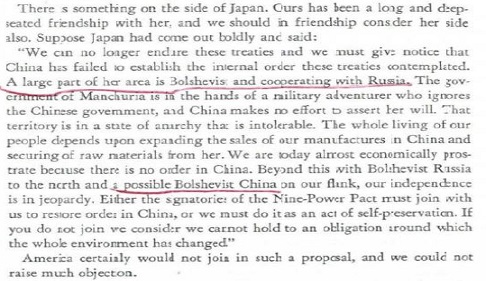 Earlier, President Hoover, who personally nipped the post-WWI communist uprisings in Germany and Hungary with the grains embargo, fed Lenin the ingenuity, i.e., the [worldwide communist revolution] road to Paris lay through Peking.
They of course forgot that
after the eruption of the 1937 Sino-Japanese War, the Americans, biased towards Japan and against China, adopted a policy of "neutrality" (what Utley called by "unpositive neutrality") against the 'belligerent' countries, namely, Japan and China, which was free and unrestrained arms sale to Japan and de facto arms embargo against China.
Note that the Japanese navy had a full blockade of China's coastline.
Note that the blockade would choke China since China did not have an industrial base to produce the basic weapons while Japan's factories could roll out the warships and airplanes on a wholesale scale.
Also note that in contrast with the Americans, the European powers, being constrained by the mediation role of the League of Nations, dared not openly sell arms to Japan.
Through 1940-1941, prior to the U.S. revocation of the 1911 U.S.-Japan Commerce Treaty, the Americans were the biggest supplier of raw material, oil, aviation oil, and weapons, to the extent that some U.S. senator called by Scott making a claim that out of every one million Chinese killed by the Japanese, 544,000 Chinese were killed by the Americans.
Thirty-one U.S. congressional members made a joint declaration to the effect that the U.S., not NAZI Germany, nor Italy, was the best ally of Japan.
Earlier, President Hoover, who personally nipped the post-WWI communist uprisings in Germany and Hungary with the grains embargo, fed Lenin the ingenuity, i.e., the [worldwide communist revolution] road to Paris lay through Peking.
They of course forgot that
after the eruption of the 1937 Sino-Japanese War, the Americans, biased towards Japan and against China, adopted a policy of "neutrality" (what Utley called by "unpositive neutrality") against the 'belligerent' countries, namely, Japan and China, which was free and unrestrained arms sale to Japan and de facto arms embargo against China.
Note that the Japanese navy had a full blockade of China's coastline.
Note that the blockade would choke China since China did not have an industrial base to produce the basic weapons while Japan's factories could roll out the warships and airplanes on a wholesale scale.
Also note that in contrast with the Americans, the European powers, being constrained by the mediation role of the League of Nations, dared not openly sell arms to Japan.
Through 1940-1941, prior to the U.S. revocation of the 1911 U.S.-Japan Commerce Treaty, the Americans were the biggest supplier of raw material, oil, aviation oil, and weapons, to the extent that some U.S. senator called by Scott making a claim that out of every one million Chinese killed by the Japanese, 544,000 Chinese were killed by the Americans.
Thirty-one U.S. congressional members made a joint declaration to the effect that the U.S., not NAZI Germany, nor Italy, was the best ally of Japan.
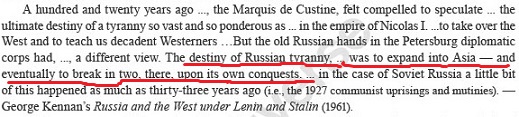 Not to mention that the Japanese navy had a full blockade of China's coastline.
America, the 'stars' that engendered or heralded the rise of the [Japan] 'sun', long ago had the blueprint to make Japan into a stalwart against China and Russia, i.e., the source of the Yellow Peril and the source of the Half-Tartars [or the Russians], respectively, --whom the Americans could not assimilate according to George Kennan.
William Christian Bullitt Jr. (1891-1967) disclosed that the Americans' national policy or strategic aim was to see the Russians and Japanese' holding a balance of power against each other in China rather than seeing either the Russians or the Japanese overpowering the other party in taking control of China.
In making this geopolitical decision, you had victimized the 1 billion humble Chinese peasants.
(Note President Wilson's doctrine that the intactness of China was vital to the white civilization -- in the sense that the nation of China should be managed delicately, that is, should not be allowed to grow too powerful to pose threat to the white civilization, nor should it be allowed to be hijacked by a non-U.S. power since China's immense human labor could be turned against the white civilization.
The theme of China to the white civilization, morphing superficially into a ***hypocritical*** American national policy of engagement with Communist China for changing the Chinese communists' behavior, rested on the same underlying logic:
"The
China Exception: Russian Communism being wicked, the
Chinese are good communists", which is an inherent fear
of the Yellow Peril,
i.e., billion Chinese would actually enjoy real
democracy, go to college and develop their intelligence.
Now, President Biden, a stooge of Communist China, explicitly abandoned the
hypocritical American policy of engagement to change communist China to his imbecilic communist buddy and dictator Xi Jinping.
Other than the stooge Bidens who ripped communist China's financial coffer (Tony Bobulinski FULL INTERVIEW Tucker Carlson), don't forget that President Roosevelt boasted of his family's ripping the China trade money in the 19th century, i.e., the opium trade;
and President Hoover certainly got the first bin of gold from the Kai-luan coal mine in collusion with the British during the 1900-1901 boxers' incident-related invasion.)
Not to mention that the Japanese navy had a full blockade of China's coastline.
America, the 'stars' that engendered or heralded the rise of the [Japan] 'sun', long ago had the blueprint to make Japan into a stalwart against China and Russia, i.e., the source of the Yellow Peril and the source of the Half-Tartars [or the Russians], respectively, --whom the Americans could not assimilate according to George Kennan.
William Christian Bullitt Jr. (1891-1967) disclosed that the Americans' national policy or strategic aim was to see the Russians and Japanese' holding a balance of power against each other in China rather than seeing either the Russians or the Japanese overpowering the other party in taking control of China.
In making this geopolitical decision, you had victimized the 1 billion humble Chinese peasants.
(Note President Wilson's doctrine that the intactness of China was vital to the white civilization -- in the sense that the nation of China should be managed delicately, that is, should not be allowed to grow too powerful to pose threat to the white civilization, nor should it be allowed to be hijacked by a non-U.S. power since China's immense human labor could be turned against the white civilization.
The theme of China to the white civilization, morphing superficially into a ***hypocritical*** American national policy of engagement with Communist China for changing the Chinese communists' behavior, rested on the same underlying logic:
"The
China Exception: Russian Communism being wicked, the
Chinese are good communists", which is an inherent fear
of the Yellow Peril,
i.e., billion Chinese would actually enjoy real
democracy, go to college and develop their intelligence.
Now, President Biden, a stooge of Communist China, explicitly abandoned the
hypocritical American policy of engagement to change communist China to his imbecilic communist buddy and dictator Xi Jinping.
Other than the stooge Bidens who ripped communist China's financial coffer (Tony Bobulinski FULL INTERVIEW Tucker Carlson), don't forget that President Roosevelt boasted of his family's ripping the China trade money in the 19th century, i.e., the opium trade;
and President Hoover certainly got the first bin of gold from the Kai-luan coal mine in collusion with the British during the 1900-1901 boxers' incident-related invasion.)
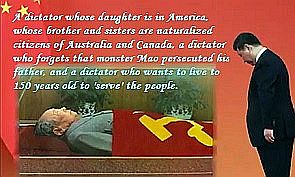 Now, you, as the midwife who delivered China into the communist hands, are morally obligated to take China [and North Korea {and Vietnam}] out of communism.
This time, you may feel your hands forced as North Korea, with its nuclear weapons, could become Communist China's cecal appendix in a repeat of history.
(The Chicoms don't understand the urgency of Trump's trade war having the roots in nuclear North Korea, nor the domino effect on North Korea and Russia after the knock-out of communist China.
Putin thought he would reap profits by sitting on the fence of the U.S.-China trade war, i.e., the Zheltorossiya dream
- revitalized by Aleksandr Gelyevich Dugin
[, and India would not be satisfied with grabbing South Tibet, Bhutan, and Sikkim alone].
Previously, this webmaster thought that the Americans could be hoodwinked by the Chicoms who might just sign any agreement just for sake of getting a red carpet at the White House in lieu of a visit to Mar-a-Lago.
With Trump's war with Communist China flaring up, this webmaster believed that China's dictator would continue to commit blunders and became the tomb digger for the Chinese communist regime.
The thuggery communists, who would not allow the millions of the Hongkong people to have autonomy, could have caused the demise of the regime over the inevitable crackdown, not knowing that the communist ascension to power had its very roots in Churchill's collusion with Roosevelt in selling out the Republic of China for sake of retaining crown jewel Hongkong after hoodwinking Wellington Koo and Chiang Kai-shek that Britain would return Hongkong to China after Japan was to surrender so as not to damage the British wartime morale.
--What happened was that Putin first jumped off the fence ahead of communist China in launching an invasion of Ukraine.)
Now, you, as the midwife who delivered China into the communist hands, are morally obligated to take China [and North Korea {and Vietnam}] out of communism.
This time, you may feel your hands forced as North Korea, with its nuclear weapons, could become Communist China's cecal appendix in a repeat of history.
(The Chicoms don't understand the urgency of Trump's trade war having the roots in nuclear North Korea, nor the domino effect on North Korea and Russia after the knock-out of communist China.
Putin thought he would reap profits by sitting on the fence of the U.S.-China trade war, i.e., the Zheltorossiya dream
- revitalized by Aleksandr Gelyevich Dugin
[, and India would not be satisfied with grabbing South Tibet, Bhutan, and Sikkim alone].
Previously, this webmaster thought that the Americans could be hoodwinked by the Chicoms who might just sign any agreement just for sake of getting a red carpet at the White House in lieu of a visit to Mar-a-Lago.
With Trump's war with Communist China flaring up, this webmaster believed that China's dictator would continue to commit blunders and became the tomb digger for the Chinese communist regime.
The thuggery communists, who would not allow the millions of the Hongkong people to have autonomy, could have caused the demise of the regime over the inevitable crackdown, not knowing that the communist ascension to power had its very roots in Churchill's collusion with Roosevelt in selling out the Republic of China for sake of retaining crown jewel Hongkong after hoodwinking Wellington Koo and Chiang Kai-shek that Britain would return Hongkong to China after Japan was to surrender so as not to damage the British wartime morale.
--What happened was that Putin first jumped off the fence ahead of communist China in launching an invasion of Ukraine.)
|
President Trump
understood the China situation and the China problem.
Should the American politicians follow the footsteps of Anson Burlingame (1820-1870),
Paul Samuel Reinsch (1869-1923)
and
Patrick Jay Hurley (1883-1963), i.e., three most prominent U.S. statemen who loved China and the Chinese people,
then the Chinese people could have a chance of salvation from the communist tyranny.
Note the historic recurrence and the repetition of similar events:
Anson Burlingame, in opposition to the anti-Chinese discriminatory whirlwinds rampant in the U.S. in the 19th century, authored the Burlingame Treaty for China and
died for China in 1870 in St. Petersburg
while still on the Manchu China's mission to the U.S. and Europe;
Paul Samuel Reinsch, who was disillusioned by President Wilson's betrayal of China over the division of WWI spoils at the Paris Peace Conference, quit the minister-to-China job to work for China and died for China in Shanghai in 1923;
and
Patrick Jay Hurley, who convinced President Roosevelt of the American moral blunders in selling out the Republic of China at Tehran and Yalta, personally travelled to Moscow and London for sake of averting and reverting China's fate of becoming a victim of WWII war spoils (i.e., the loss of Port Arthur and Hong Kong, etc.), but failed to make remedy to the secret Tehran and Yalta agreements in the aftermath of President Roosevelt's death in April 1945.
|
|
For better understanding the head-on collision between the United States and Communuist China,
refer to
the U.S.-China fatalistic conjunction through the hands of the Japanese firepower during WWII, that derived from the American unpositive neutrality;
the U.S.-China fatalistic conjunction through the hands of communist army's firepower during the 1945-1950 civil war, that derived from American-supplied Soviet August Storm weapons; and
the U.S.-China fatalistic conjunction through Joseph Stalin, Kim Il Sung and Mao Tse-ting's hands during the 1950-1953 Korean War.
|
|
|
|
More, refer to the Communist Platonic Club at wartime capital Chungking
and
The American Involvement in China: the Soviet Operation Snow, the I.P.R. Conspiracy, the Dixie Mission, the Stilwell Incident, the O.S.S. Scheme, the Coalition Government Crap, the Amerasia Case, & The China White Paper.
|
|
|
|
THE CHINESE CIVIL WARS
(*** machine-translated Chinese language version:  ***) ***)
|
|
The Japanese Invasion Of Manchuria, Chaha'er & Jehol 1931-34
The Mukden Incident - 9/18/1931 & Battle Of Jiangqiao
The Shanghai Provocation - 1/28/1932
The Battles of the Great Wall
China In Crises Of Internal Turmoils & Foreign Invasions
The Japanese Invasion (1937-1945)
The Marco Polo Bridge Incident & The Battle of Tianjin-Peking
The Campaign Of Nankou & The Campaign of Xinkou
Air Battles Directed By Chenault & With Soviet Pilots
The Battles of Shanghai, Jiangyin, Si'an & Nanking Defense
The Rape Of Nanking & The Great Rescue Of 1937
The Eight Year Long Resistance War
The Battles of Lanfeng, Wuhan, Nanchang, &
Sui-Zao,
The 1st Changsha Battle, Kunlunguan, Wuyuan, & Zao-Yi,
Saturation Bombing of Chongqing by the Japanese
The Aggression Against Vietnam & Southeast Asia
Yu-nan & E-bei, Shanggao, & Mt Zhongtiaoshan
The 2nd Changsha Battle, & Pacific Wars
The 3rd Changsha Battle, Zhe-Gan, Changde, & E-xi
The Second Burma Campaign, & Phase II
|
| [ revolution.htm & tragedy.htm] |
The Communist Armed Rebellions
The Second Northern Expedition
War Of Chiang Kai-shek versus Gui-xi (March 1929)
War Of The Central Plains (May 1930)
Campaigns Against Communist Strongholds
The Long March
Xi'an Incident - the Turning Point of Modern History
Demise Of the Red Army Western Expedition
|
| [ campaign.htm & terror.htm ] |
[ default page: war.htm ] |
|
1945-1949 Civil War
The Liao-Shen Campaign
The Korean War
The Vietnam War
Continuing from Tragedy of Chinese Revolution, Campaigns & Civil Wars, White Terror vs Red Terror, & Resistance Wars:
1) World War II, in both the East and the West, was the result of the inducement of the British, American[, and French] interest groups and syndicates, as well as the result of the scheme by Soviet Russia. First there was the October 1925 Locarno Treaties which, per Polish foreign minister Jozef Beck, led to the opinion that "Germany was officially asked to attack the east, in return for peace in the west." Poland, as a country, was anti-Republic of China since birth, as it colluded with Japan at the 1919 Paris Conference, at the post-1931 League of Nations' conference, and at the post-1937 League of Nations' conference, in the attempt at encouraging Japan in the invasion against China to ultimately war with the Soviet Union.
In 1931, President Herbert Hoover gave Japan a free hand in the invasion of Manchuria on the pretext that Japan could not tolerate a half-Bolshevik China.
After the eruption of the 1937 war, the Anglo-Americans, still biased towards Japan and against China, adopted a policy of "neutrality" (what Utley called by "unpositive neutrality") against the 'belligerent' countries, namely, Japan and China, which was free and unrestrained arms sale to Japan and de facto arms embargo against China.
Note that the Japanese navy had a full blockade of China's coastline. Note that the blockade would choke China since China did not have an industrial base to produce the basic weapons while Japan's factories could roll out the warships and airplanes on a wholesale scale.
Thereafter the September 1938 Munich Agreement. For what? Britain, France and the United States wanted Hitler to attack the Soviet Union, and wanted Japan to suppress China's nationalist movement and counter the Soviet Union. In both cases, Stalin out-smarted the Anglo-American and the French. Hitler attacked westward instead, and signed a non-aggression pact with Stalin to halve Poland; and Japan attacked Southeast Asia and the Pearl Harbor after China, not the Soviet Union.
Half a year before the Russo-Japanese Neutrality Treaty of April 1941 and one year ahead of the Pacific War, Japan already reached a secret deal with the U.S.S.R. to halve China, mapping the "Poland partition" scheme by the U.S.S.R. and Nazi Germany, as evidenced by the clauses of the Dec 1940 negotiation and treaty between Wang Ching-wei's puppet R.O.C. government and Japan in regards to the reserved territories for the Chinese communists and the hinted Western China's boundary between the U.S.S.R. and Japan.
(More available at "Changing Alliances On the International Arena", "Century-long American hypocrisy towards China", "Anglo-American & Jewish romance with the Japanese",
"America's Unpositive Neutrality in the Sino-Japanese War",
"Joe Stilwell's Authorization To Assassinate Chiang Kai-shek", and "What Foreign Powers Did To The Flowery Republic Prior To, During And After The 1911 Revolution".)
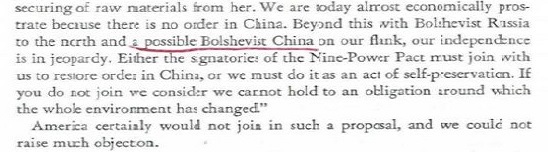
A rather simple explanation for the ultimate American intervention in China in March 1940, i.e., the Americans' hastily giving Chiang Kai-shek a badly-needed loan, would be to prevent Japan and China from reaching a truce since Chiang Kai-shek deliberately spread a rumor that his Chongqing government could merge with the puppet Nanking government.
As Paul Reinsch and Arthur Young repeatedly said, the United States of America could have done just a little to help China in WWI or WWII, but chose to do nothing during WWI other than a Lansing-Ishii Agreement [which was to acknowledge that Japan had its special interests (in the specified areas of China specified by the secret memorandum)], chose to do lip-service to Wu Peifu's ROC government while the Soviets equipped Feng Yuxiang and Sun Yat-sen's military factions with free guns; chose to do nothing after making sure China was to stay in the Second World War by merely granting the currency stabilization loan of 1940; and chose to use the Lend-Lease coercion to force China into throwing the crack troops at northern Burma just prior to the Japanese Ichigo Campaign in 1944.
2) Stalin was the evil genius of the 20th century. Stalin, after the 1929 war against Zhang Xueliang over the Chinese-Eastern Railway [which erupted over the Soviet Russian and Chinese communist agitation in sabotaging Japan's attempt at building five additional railways in Manchuria and Inner Mongolia], quickly divested himself of the railway when Japan invaded Manchuria on Sept 18th, 1931. After initially calling on the world communists to militarily defend the Soviet Union from 1931 to 1933, Stalin subsequently designed the united front and popular front in 1935, and in the time period of 1936-1937 successfully lit the fuse of the Sino-Japanese War by means of repeated G.R.U. operations in northern China and Manchuria.
To thwart the Anglo-American attempts at using Japan against the U.S.S.R., Stalin hijacked the American government policies by utilizing agents, saboteurs, provocateurs and sympathizers from the Institute of Pacific Relations. "16 out of 17 of the AMERICANS that were involved in creating the U.N. were later identified, in sworn testimony, as secret communist agents." The whole United States government was in fact taken over by the Comintern agents, including: Alger Hiss; Harry Dexter White; Lauchlin Currie; Laurence Duggan; Frank Coe; Solomon Adler; Klaus Fuchs; and Duncan Lee."
John Fairbank and Owen Lattimore, i.e., two "Old China Hands" who were repeatedly cited by the Chi-com for substantiation of the cause and success of the Chinese communist revolution, had merely been the Soviet Russian and/or Chicom tools. (Most of the Comintern spies of the European and American background had been recruited during their stay in China during the turbulent 1920s. Note that 95% of the Comintern agents sent to China were American Jews and 100% of the Soviet Red Army G.R.U. agents sent to China were German Jews. Owen Lattimore's belief and orientation should have been shaped during his early years in Peking in the 1920s. John King Fairbank, who had done everything Agnes Smedley had asked him to do other than putting his name on the roster of the G.R.U. (Main Intelligence Directorate of the General Staff of the Armed Forces of the Russian Federation), was a member of the Chinese League for the Protection of Civil Rights in late 1932 and early 1933, and further rafted with Comintern agent Harold Isaacs on the Jehol River in 1934 before the latter switched to the Trotskyite path. Working directly under Lattimore would be two Chicom spies called Chi Chao-ting and Chen Han-sheng who designed America's China policies.)
3) It was the century's misfortune for China to have to see the Anglo-American interest groups and Russian/Comintern agents colluding with each other in subverting Nationalist China
--
the last bastion against the imperialists and colonialists and
the beacon tower
for the independence of all Asian countries and people
, colonized or semi-colonized by the West,
as "...British Ambassador personally suggested to me [Albert Wedemeyer]
that a strong unified China would be dangerous to the world and certainly would jeopardize the white man's position immediately in Far East and ultimately throughout the world."
No matter it was the 1904-05 Russo-Japanese War, or the Japanese invasion of Manchuria in 1931, or the 1937-1945 Sino-Japanese War, the aforesaid parties, plus the Chinese communist henchmen, were the ONLY people who wanted Japan to invade China, albeit for different reasons and agenda at different stages and times.
In another word, the Japanese never realized that they had been brought up and used as a tool since Matthew Perry's timeframe, first as a tool against Russia in 1904-5 and then used by the Soviets as a tool against China.
"When other nations tried to bar ... [Japan] progress or slur ... [Japan] reputation," as commented by Inazo Nitobe:
"America always stood for ... [Japan] ...[America's] Stars heralded to the world the rising of ... [Japan] Sun..."
The warships and planes built and used against China in 1931/2 were the products of twenty years of military alliance between Britain and Japan,
following the American support of the Japanese ventures against Ryukyu and Taiwan in the late 19th century.
(Do not forget the post-WWI ten-year arms embargo against Republic China and George Marshall's post-WWII arms embargo against Republic China 1946-1948, as well as
the synarchists' backing Japan's war against China and Sun Yat Sen.)
4) There is no truth in Stalin and Truman racing against each other as suggested by Tsuyoshi Hasegawa. While Truman was blindfolded as to the making of the Atomic Bomb, the Russians had been receiving ships of the uranium ore throughout the war, which was to make sure that the United States was not to become the nuclear monopoly. Stalin's American proxies already had Truman agree to the terms reached by Roosevelt at Yalta. The United States had utterly no preparation for racing its army to Japan or Korea. "It was after the U.S. dropped two bombs onto Japan, on Aug 6th & 9th, respectively, that Rusk & Bonesteel, drew up the 38th Parallel on the map as an artificial division line separating the U.S. sphere of influence from the U.S.S.R.
(The Japanese, of course, don't know that they were used as a tool against China.
Working as a secretary of the Japanese prime minister Konoye Fumimaro as one of the five brain trusts, Stalin's spy Ozaki,
likening Japanese prime minister Konoe to Alexander Kerenski (head of the 1917 transitionary Russian government),
wanted to turn Japan into a replay of the Soviet revolution.
How brilliant it was to hit two birds (China and Japan) with one stone!
It was the Tokyo Special Higher Police, 'tokko' or 'tokubetsu', who broke the Sorge-Ozaki spy rings in China and Japan, not the Japanese military kempeitai or the Japanese military that was permeated with the JCP and Tobun [same language] Academy spies.
Do you Japanese know that?)
5) Japan already explored with the Soviets for surrender. But the Soviets declined it. Otherwise, what's the need to enter Manchuria and Korea? Since the Russians were eager to invade Manchuria & Korea, Japan had to turn around to request with Sweden for relaying a message of surrender.
Japan was in self-denial over the prospect of the Russian entry into war. Intelligence already poured into Japan as to the Russian complicity at Yalta. Back on June 9th, 1945, Truman officially told TV Soong (Soong Ziwen) that he was to honor the late President's signature on the Yalta Agreement and requested that China dispatch a delegation to Moscow for stamping a Sino-Russian friendship agreement no later than July 1st. The Chinese were busy repairing the damages. Japan knew about it. Japan sent secret negotiators to Chiang Kai-shek multiple times in July-August of 1945 for the peace talks. Looking in hind sight, China, separately, should have struck a partial peace with Japan to ward off the Soviets.
(When the Soviet Red Army invaded Manchuria, Japan, who had issued orders to its armies to surrender across the battlefields of China and Southeast Asia, had to make a special order to the Kwantung Army to resist the Soviet Red Army in Jehol, Manchuria, and the Sakhalin for about 20 days for sake of stopping the Soviets from landing in Hokkaido.)
6) Though, the Japanese emperor played a trick in surrender. He signed a "truce" order to his army and listing Britain, American and China and etc., but when he made the announcement on radio, he changed China to Chungking [Chongqing] the Chinese interim capital. We know Japanese have a problem with saving face. But the truth is known no matter how the professor wanted to discount the atomic bombs and gave weight to the Russian entry into the war. Professor Tsuyoshi Hasegawa, who skipped the name of China in his book title and ignored the death toll of 1 million Japanese on mainland China, should spend more time researching into the fate of half of the 500-600,000 Kwantung Army that had perished in Russian Siberia.
Konoe Fumitaka, i.e., son of imbecilic Japanese prime minister Konoe Fumimaro who designed the policy of "Shokaiseki o aite to sezu", was exiled to Siberia by the Soviets
and just days before repatriation in the late 1950s, could have been killed by the Soviets.
(From the memoirs related to some Taiwan native who joined the Japanese Kwantung Army and was later exiled by the Soviet Red Army to Siberia for the coolie labor, the Soviets, to help Mao Tse-tung and Kim Il Sung, on a wholesale scale, in 1947 repatriated the Korean-ethnic Japanese Kwantung Army prisoners of war to North Korea and the Taiwan-ethnic Japanese Kwantung Army prisoners of war to Manchuria, as fodder of war, which probably explained why there was no accounting of some huge numbers of the Japanese Kwantung Army troops in the later repatriation to Japan and the Republic of China's generals kept mentioning that the Koreans and the Japanese were manning the guns and the tanks of the Chinese communist army.)
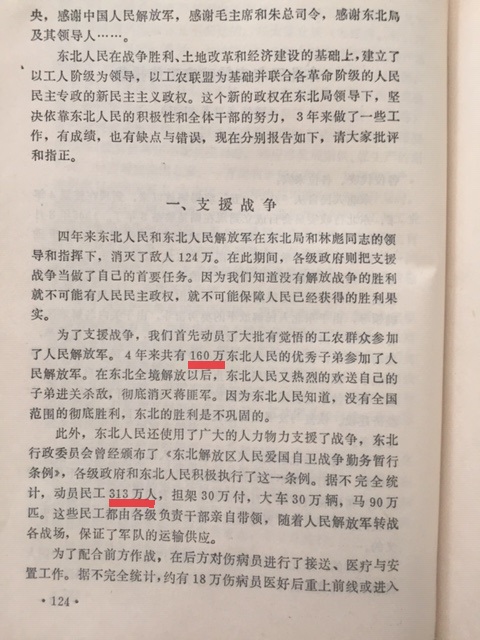
The Soviets sorted out at least 30,000 Japanese artillery troops, medical Kwantung Army staff, a full airforce contingent with generals and crewmen under Hayashi Yayichiro, and no less than two full Korean-ethnic divisions for deployment by the Chinese communists in the civil war against the Nationalist Chinese Government, not to count the Outer Mongolian Cavalry and 100,000 fully-trained Korean mercenaries sent to China in 1947, with about 60,000-70,000 remnants [out of the total headcount of 250,000 Korean mercenaries] shipped back to Korea prior to the Korean War of June 1950. According to Kim Il-sung, altogether 250,000 Korean mercenaries took part in the 1945-1950 civil war against the Nationalist Government, with 60,000-70,000 remnants surviving the bloody Chinese civil war to return to Korean for the 1950 Korean War.
Note the fundamental difference between the 250,000 ethnic-Korean Japanese Kwantung Army diehards and the ethnic-Korean Chinese living in China.
The communist statistics claimed that altogether 65,000 ethnic-Korean Chinese minority people, or the Korean migrants living in China, joined the communist army, with approximately
60% coming from the Jirin subprovince,
21% from the Sungari subprovince, and
15% from the Liaodong subprovince.
7)
Stalin and the Soviets were behind each step of monster Mao Tse-tung in making sure that no peace could have a chance from the day Japan surrendered. Cumulatively, the Soviet Russians acknowledged in the 1970s that they had given the Chinese communists 700,000 guns, with North Korea's arsenals open for free pickup throughout the Chinese civil wars. (On the 1947 anniversary date of the Russian Revolution, the Soviet Russians already disclosed that they had given the Chinese communists massive military aid - which the Americans refused to acknowledge.) At about the same time the Republican Party forced through the China Aid Act in 1948, Stalin officially stamped a loan for the Chinese communists of an equivalent amount allocated by the China Aid Act, with no strings attached.
Stalin understood that the generations of brave Chinese during first part of the 20th century were the flower that China ever had in the whole history of 5000 years, a force that must be destroyed so that the Soviet Russian scheme at world domination could succeed.
Didn't know the Russian cold-bloodedness? Read into the Katyn Murder of 20,000+ Polish officers, and Stalin's plan to shoot 50,000 German officers- which Roosevelt echoed by lessening to 49,500.
Separately, Stalin disclosed to the son of Chinese president that he wanted to imprison 500,000 to 600,000 Japanese lower-level officers and 12,000 Japanese generals for preventing the Japanese from rising up again to pose threat to the Soviet Union.
Likely, Stalin passed on a suggestion to McArthur to arrest 8000 to 12,000 Japanese generals.
(Numerous nationalist army generals, who survived the valiant wars against the Japanese invasion, would be imprisoned and executed by the communists from 1949 to 1975. E.g.,
Lu Shiyang was executed by the communists in 1951 simply because he was a former Nationalist Army company commander even though he left the army after the VJ (victory over Japan) day in 1945 and never ever fought against the communist army.
Wu Dehou, released by the CCP's amnesty on Dec 15th, 1975, returned to his impoverished Shanxi Province countryside as a peasant.
Du Yuming, the war hero on the Burma Theater, was released from over 10-year long prison sentence on Dec 4th, 1959 in accordance with the CCP's 17 Sept 1959 First Amnesty Order for sake of having him show off at a diplomatic meeting in April 1960 with former British General Montogomery as well as for sake of instigating the return of his son-in-law, i.e., noble prize winner Yang Zhenning.
The Nationalist Army colonel-level officers, about one tenth of the total captives rounded up in the communist provincial quasi-prisons since the 1950s, survived the execution, torture and hunger to get amnesty in 1975.
It would be in 1985 that the CCP first declared the title of 'national heroes' for 85 Nationalist generals who sacrificed their lives in the Resistance Wars Against Japan.)
As this webmaster had elaborated on the battles and campaigns in Civil Wars section,
the Chinese Civil War of 1945-1950 [using the Korean War as a breakpoint rather than the PRC's proclaimed date of founding] is the "Last Duel of the Middle Earth"
involving millions of the fighting-to-death Yellow Men,
with the outcome determined on the battlefields by means of a) the military tactics and strategies,
b) political conspiracy and plots, c) economic manipulation and sabotage, c) societal disruption and coercion,
and d) international alliance and betrayal, never ever the free choice of the Chinese people or the 'Mandate of Heaven' as John Fairbank and Owen Lattimore
[and their student-sinologists in the American colleges and universities] wanted you to believe in.
|
The brave R.O.C. soldiers against the armed-to-the-teeth Japanese Army
After squandering the 1st tier troops of 1st-20th Shidans and 2nd tier troops of 100th-120th Shidans in the "yocho" (penalizing) action against China, the Japanese sent the demoralized Shidans
to the Pacific War graves, to the extent that by the time Japan surrendered, the Japanese homeland soldiers of 1-2 million new recruits possessed bamboo sticks and spears
for defense, while the Soviet/Comintern agents inside of the Japanese government/military, in the name of moving the duel battlefield to the mainland, hoarded large cache of weapons in Manchuria/Korea for free pickup by the Soviets and the
Chinese/Koreans.
Working as a secretary of Konoye Fumimaro the Japanese prime minister as one of five brain trusts, Stalin's spy Ozaki,
likening Japanese prime minister Konoe to Kerenski (head of the 1917 transitionary Russian government),
wanted to turn Japan into a replay of the Soviet revolution.
(It was the Tokyo Special Higher Police, 'tokko' or 'tokubetsu', who broke the Sorge-Ozaki spy rings in China and Japan, not the Japanese military kempeitei or the Japanese military that was permeated with the JCP and Tobun [same language] Academy spies.
Do you Japanese know that?)
|
|
|
The brave and victorious National Revolutionary Army (NRA) of the Republic of China chased the remnant communists to the north bank of the Sungari River.
|
|
The Americans sold out China in Tehran, Yalta and Potsdam. In late 1944, American navy general Leahy was probing China about the Soviet demand for Dairen, Port Arthur and the railways. Roosevelt locked up the secret treaties in his drawer till his death. Both Hurley and Leahy merely knew part of the Roosevelt's secret deals with Stalin. Truman pressured China numerous times demanding that China sign an agreement with the Soviets no later than July 1st, 1945. Late 1945, George Marshall and the Americans continued to sell out China on the matter of the Soviet pillage of Manchuria, and held a U.S.-U.K.-U.S.S.R. three-country foreign ministers' meeting, to demand that the Republic of China must talk peace with the communists --namely, the imposition of a worldwide arms embargo against the Republic of China.
Marshall, in the spring of 1946, flew back to China to stop the Chinese army from moving beyond the Sungari River.
As disclosed by the documents at the George Marshall foundation, George Marshall, possibly the most hideous agent working on behalf of Stalin and the Soviet Union, saved the ass of the Chinese Communists with a threat to withhold the economic aid that was supposedly coming from the U.S. export-import bank, which never materialized.
|
|
|
|
G Marshall, from 1946 to 1948, repeatedly probed numerous Chinese officials and generals as to who could be Chiang's successor.
The U.S. Department of State, run by the Russian agents, were repeatedly sending out rumors about getting a successor for Chiang. Marshall's hands had the blood of millions of Chinese killed in the civil wars.
G Marshall, as Wedemeyer said, first armed China and then disarmed China.
This was what Wedemeyer, after taking over Stilwell's job, began as the 30-division training place in the spring of 1945 --that did not get fully started before it was scrapped, with Shi Jue's 13th Corps going into Manchuria in the spring of 1946 with one third of the American-supplied training ammunition, for example.
The U.S. arms embargo continued till the China Aid Act of 1948, and ammunition did not get released till Nov of 1948.
After weapons were shipped
out, Acheson and the undercover Russian agents further attempted to order the ships to turn around at Guam, Saipan and Okinawa.
In Oct 1949, Acheson pleaded with the British, where the Cambridge Soviet Spy Ring was at work, for recognition of Communist China, which Britain did on Jan 1st, 1950.
After that, Acheson declared the Aleutian curvature, which directly led to the eruption of the Korean War.
The Korean War and the Vietnam War, invariably, were the extension of the Chinese Civil War of 1945-1950.
|
The 1945-1950 Civil War
At the Potsdam Conference (July 17-Aug 2 1945), President Truman, without consultation with the Republic Of China and without respect for the will of the Korean people, offered the U.S.S.R. the right of occupying Manchuria & Northern Korea in exchange for the Soviet declaration of war against Japan.
Back on June 9th, 1945, Truman officially told Soong Ziwen (T V Soong) that he was to honor the late President's signature on the Yalta Agreement and requested that China dispatch a delegation to Moscow for stamping a Sino-Soviet friendship agreement no later than July 1st.
Earlier, in February 1945, at the Yalta Conference, President Roosevelt seemingly underestimated the height of the American military might and had offered the U.S.S.R. their former interests in the Chinese Eastern Railroad as well as the Sakhalin Island.
Ignoring the hypocrisy-based Hull "ultimatum" of November 26th, 1941, Roosevelt signed off to the Soviets, on behalf of China, the lease of Lüshun [Port Arthur], the internationalization of Dalian [Dairen], the Manchurian Railways and the Chinese "pre-eminent rights".
Even earlier, in November 1943, U.S. President Roosevelt, prior to the trip to the Tehran Meeting, claimed that should he give Stalin what he wanted [i.e., Manchuria, Korea & Sakhalin], then the U.S.S.R. would not grab other parts of the world.
Li Ao cited George Creel in stating that Chiang Kai-shek did not get to know that China was betrayed by Roosevelt & Churchill till June 1945.
(Roosevelt, who was like working for a few hours a week, was surrounded by 'eunuch' Harry Hopkins and the Soviet spies who made the call as to who could get to see Roosevelt.)
The Americans, after Dwight David Eisenhower became president in 1953, declared the Yalta secret agreement to be invalid.
Taiwan followed through with voiding the 1945 Sino-Soviet friendship treaty, something that Stalin was initially reluctant to replace with the Mao-proposed 1950 USSR-PRC friendship treaty for the befuddled legality that it was built on top of Churchill and Roosevelt's Yalta endorsements.
(Note this webmaster jotted down this intricacy about two Sino-Soviet "friendship" treaties for the sons of China. China, who else cares?)
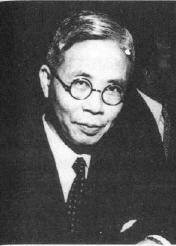 Soong Ziwen (TV Soong) & Wang Shijie were sent to Moscow for repairing the damages. After the Soviets intruded into Manchuria, Chiang Kai-shek agreed to give up Outer Mongolia on the precondition that a referendum be held by the Mongolian people and that the U.S.S.R. guarantee China's territorial integrity as to Manchuria and withhold support for the CCP.
Chiang Kai-shek hence took for granted the Soviet pledge that the U.S.S.R. would "render to China moral support and aid in military supplies and other material resources, such support and aid to be given entirely to the National Government as the Central Government of China" [page 6, Freda Utley's The China Story].
To Li Ao's dismay, Historian Xu Zhuoyun praised Wang Shijie's withstanding the national humiliation. This treaty, per Li Ao, was a betrayal to 31 May 1924 Sino-Soviet Treaty signed by the Northern Warlord Government in regards to rescinding the unequal treaties imposed by Czarist Russia.
(What the Chinese side did not and does not understand about the Yalta Betrayal is that two factions of the Anglo-American interest groups, i.e., the ranks of innate cousins of British colonialists and the ranks of American doctrinists with advocacy for the "China containment", had joined hands with the Soviet/Comintern agents in subverting China. In another sense, the invisible hands in the Far Eastern Division of the U.S. State Department had found an alternative way to advance the agenda of strengthening the Chinese Communists and weakening the Chinese Nationalists after what Freda Utley called a "temporary setback" ensuing from the recall of Joseph Stilwell in November of 1944.
More available at Century-long American hypocrisy towards China, Anglo-American & Jewish romance with Japanese,
"American's Unpositive Neutrality in the Sino-Japanese War",
"Joe Stilwell's Authorization To Assassinate Chiang Kai-shek",
and What Foreign Powers Did To The Flowery Republic Prior To, During And After The 1911 Revolution.)
Soong Ziwen (TV Soong) & Wang Shijie were sent to Moscow for repairing the damages. After the Soviets intruded into Manchuria, Chiang Kai-shek agreed to give up Outer Mongolia on the precondition that a referendum be held by the Mongolian people and that the U.S.S.R. guarantee China's territorial integrity as to Manchuria and withhold support for the CCP.
Chiang Kai-shek hence took for granted the Soviet pledge that the U.S.S.R. would "render to China moral support and aid in military supplies and other material resources, such support and aid to be given entirely to the National Government as the Central Government of China" [page 6, Freda Utley's The China Story].
To Li Ao's dismay, Historian Xu Zhuoyun praised Wang Shijie's withstanding the national humiliation. This treaty, per Li Ao, was a betrayal to 31 May 1924 Sino-Soviet Treaty signed by the Northern Warlord Government in regards to rescinding the unequal treaties imposed by Czarist Russia.
(What the Chinese side did not and does not understand about the Yalta Betrayal is that two factions of the Anglo-American interest groups, i.e., the ranks of innate cousins of British colonialists and the ranks of American doctrinists with advocacy for the "China containment", had joined hands with the Soviet/Comintern agents in subverting China. In another sense, the invisible hands in the Far Eastern Division of the U.S. State Department had found an alternative way to advance the agenda of strengthening the Chinese Communists and weakening the Chinese Nationalists after what Freda Utley called a "temporary setback" ensuing from the recall of Joseph Stilwell in November of 1944.
More available at Century-long American hypocrisy towards China, Anglo-American & Jewish romance with Japanese,
"American's Unpositive Neutrality in the Sino-Japanese War",
"Joe Stilwell's Authorization To Assassinate Chiang Kai-shek",
and What Foreign Powers Did To The Flowery Republic Prior To, During And After The 1911 Revolution.)
During WWI, President Wilson, who was in the shoes and mindset of the British colonialists, believed that the U.S. had to keep China intact for securing the fate of the white civilization, while during WWII, the British impressed the Americans with the inverse of the former doctrine to state that a victorious Republic of China, which was to emerge from WWII, would pose a threat to the white civilization.
President Wilson's China policy was what
this webmaster referred to as the 100-year American hypocrisy.
It was pivoted from the hypocritical nature of America's Open Door Policy for China, which was originally an idea sold to the Americans by the British career customs' officers working in Manchu China's customs offices.
The reason that China should remain open to all powers, in the opinion of the U.S. president Thomas Woodrow Wilson, was that the 'white civilization' and its domination in the world rested largely on the ability to keep China intact, in the sense that should China fall completely under the Japanese [or the Tsarist Russian or someone else's] influence, then the massive Chinese manpower could be utilized like by Genghis Khan to conquer the world. This was the theme of the Yellow Peril, which was inverse to what the British ambassador claimed to Albert Wedemeyer during WWII that a strong and unified China would pose a threat to the Whiteman’s position in the Far East and immediately throughout the world.
So to say that the nation of China should be managed delicately, that is, should not be allowed to grow too powerful to pose a threat to the white civilization, nor should it be allowed to be hijacked by a non-U.S. power since China's immense human labor could be turned against the white civilization.
(During WWII, the Japanese, who were brought up by the Americans and the British, never realized that they could at most conquer half of China, not as a whole.)
Videos about China's Resistance War: China's Dunkirk Retreat (in English);
42 Video Series (in Chinese)
Stilwell, the slimy who itched "to throw down ... shovel and get over there and shoulder a rifle with Chu Teh" [i.e., the communist commander-in-chief], before his kickout from China,
paid a visit to Mme. Sun Yat-sen, the No. 1 Comintern agent in China.
George Marshall quit his job twice, J.I.T (just in time), in anticipation of some pre-arranged phonecalls from Truman to tack on the jobs as 1) first the mediator in the Chinese civil war
and ii) secondly as defense minister [by kicking out defense minister Johnson] during
the Korean War, respectively.
George Marshall returned Zhou Enlai's address book to Zhou Enlai, while never alerting Chiang Kai-shek of communist spies like Xiong Xianghui.
While Currie stopped the German weapons of the European battlefield from shipping to China and Truman dumped China's Lend-Lease weapons to the Indian Ocean, Dean
Acheson and George Marshall personally pushed for the 1946-47 arms embargo against China and imposed three ceasefire onto the Chinese government,
on Jan-10-1946, June-6-1946, & Nov-8-1946.
Marshall deliberately flew back to China in the spring of 1946 to stop the Chinese Nationalist troops from chasing the disarrayed communists north of the Sungari River. This is how CHINA WAS LOST.
At this moment, the commies had rallied henchmen against Mr. Xin Haonian's book Which Is New China by repeatedly citing the writings of John Fairbank and the sort. This webmaster, though not agreeing with the said book on all accounts, does want to point out that John Fairbank and most of the "Old China Hands", being of anti-Chinese-nationalism in nature, were the "fellow travelers" of the communists and British colonialists
since the OSS/CIA days of the 1940s-50s. The best argument against the Chi-com would lie in the continuing exposition of i) the Russian/Comintern conspiracies against China, and ii) the century-long American hypocrisy towards China &
American manipulation of Chinese politics [e.g., Stilwell's instigating General Bai Chongxi, Stuart's instigating Li Zongren, and McArthur's instigating General Sun Liren].
|
|
|
The Wuhan Gang & The Chungking Gang, including Joseph Stilwell, Agnes Smedley, Evans Carlson, Frank Dorn, Jack Belden, S.T. Steele, John Davies, David Barrett and more, were the core of the Americans who were to influence the American decision-making on behalf of the Chinese communists.
It was not something that could be easily explained by Hurley's accusation in late 1945 that American government had been hijacked by
i) the imperialists (i.e., the British colonialists whom Roosevelt always suspected to have hijacked the U.S. State Department)
and ii) the communists. At play was not a single-thread Russian or Comintern conspiracy against the Republic of China but an additional channel
that was delicately knit by the sophisticated Chinese communist "agrarian reformers".
|
|
The Chinese communist agents on international arena would include Chen Hansheng [i.e., Owen lattimore's assistant]; Mme Sun Yat-sen [who acted as the intermediary between the domestic and international communists]; Wu Kejian & Xie Weijing who orchestrated the Chinese communist relief to the Spanish Civil War; and Wang Bingnan whose German wife "physically" won over the hearts of the above-mentioned Americans by providing the wartime 'bachelors' with special one-on-one service. Though, Anna Wang [Anneliese Martens], in her memoirs, expressed jealousy over Gong Peng by stating that the Anglo-American reporters had flattered the Chinese communists and the communist movement as a result of being entranced with the goldfish-eye'ed personal assistant of Zhou Enlai.
|
|
|
After 60 years, the crap about corruption of the Chiang Kai-shek's regime was so deeply rooted in the American academics that even the publication of the VENONA scripts would not make someone to rethink.
Some American senator talked about McCarthyism, while McCarthy had been proven to be right in 99% of the cases he prosecuted. Some other U.S. senator talked about "gung ho" recently, while not knowing what "Gung ho" was meant for. Let's be clear here: "gung ho" was not Evans Carlson's marine commando team in the Pacific Islands but a Comintern scheme to launder money to Yenan, totaling 20 million USD at minimum from Chen Hansheng's operations with the U.S. communist front organizations 1939 to 1941 plus more afterward, as well as a CCP underground tunnel (to use the same word as the American Black slaves' escape route to the north prior to the north-south war), on which road the CCP agents freely travelled around FREE CHINA by riding on the "gung ho" trucks; more, in Jiangxi, the anti-Japanese war base as well as the former Red Army enclave, the "gung ho" gangs were secretly training the cooperative workers to be anti-government insurgents to echo the raging civil wars that were going on along the Yangtze and in North China, which saw the communist Eighth Route Army and New Fourth Army slaughtering hundreds of thousands of village elderlies, county magistrates, government guerrilla forces, and patriotic gentry-organized forces.
Now all this was done prior to the Pacific War. But due to Stalin's demand for maintaining the CCP-KMT collaboration scheme, Mao and the communists dared not publicly talked about civil wars. Should they secretly take out the government guerrillas, they would make sure that no messenger would live to escape from the communist territory to tell the truth. Zhao Tong, and 200+ guerrillas, including his sister and dozens of female fighters, were run down by the communist cavalry, and killed to the last person while travelling towards Jehol. Who was Zhao Tong? He was the son of double-gun Mme Zhao, whom the same Wuhan and Chungking gangs, Theodore White and Annalee Jacoby's predecessors, had interviewed and talked about in the media both in China and over the world, a war hero fighting Japanese in Jehol since 1932-1933, and a Youth party member and later a statist member.
(Note that the Jehol area used to be the guerrilla army under Youth Party leader Zhao Tong who fought against the Japanese since 1931-1932. To prevent Zhao Tong's Jehol Vanguard Army, about 200-300 men and women, from returning to Jehol from Chungking, the communist armies, with advance information from communist leader Zhou Enlai who superficially participated in the farewell ceremony for the march of the vanguard army in Chungking, pooled resources all over the military districts including Heh Long's communist army from northwestern Shanxi and Suiyuan area, and ambushed and eliminated the vanguard army in the tri-provincial area of Shanxi-Henan-Hebei around the turn of 1939-1940.
The communists, in the Chahar-Suiyuan area and around Mt. Daqingshan [the great green mountain], had conducted similar horrifying campaign against the patriotic guerrilla forces, including the fire attack that killed a 90-year-old former Northeastern Cavalry Army corps commander and his guerrilla army, and furthermore attacked and eliminated KMT party operator Chen Jianzhong's party-directly-controlled guerrilla forces and all couriers who were sent through the communist-controlled territories of Shanxi-Shenxi, with Chen Jianzhong being the sole survivor to return to Chungking in disguise.)
After the Pearl Harbor, Stalin no longer cared about China's role in WWII. So the order changed, which was to say that Comintern agents had the free hand to bad-mouth China, with no penalty as imposed before the Dec 1941 Japanese attack at the Pearl Harbor. Hence you see Theodore White and Annalee Jacoby, and the gangs, writing the venomous articles against China. Theodore White was one of the top 3-4 playboys in wartime Chungking, and like John Fairbank, enjoyed "stalking" communist mouthpiece Gong Peng, the little black widow and Zhou Enlai's secretary, on the streets of Chungking. And you have Martens, the German communist, who provided one-on-one sexual service to those wartime American bachelors. I read through the craps by Theodore White and Annalee Jacoby just to find out who those guys cohorted with, and how they went around Free China, etc. My findings are the Theodore White gang always lived near the whorehouses, or one storey above the whorehouse, and this guy Theodore White at one time had a rendezvous with some Chinese general's concubine in a vacated hotel while the Japanese planes were dropping bombs over the whole city and people were fleeing to the bunkers. And another gang member was notorious in using the Hostel, a place the KMT government subsidized the international press rascals with a maximum cost of $1 and $3 for meals and lodging daily, as a daily party room to have fun with Chinese women. What you had were passages after passages of writings about the gang's whoring, and that's probably why Miles said he had thousands of pages of details on the gangs' antics and all those materials were locked up in the U.S. Navy's underground confidential room. From Rand's book, you could tell how those guys flew back and forth, between the U.S. and China, had liaison with the Comintern and CPUSA/CCP agents, like Yang Gang and Yang Zao pseudo brother and sister, even inviting the CCP "guest" to their home in New England; and of course the gang was responsible for hiring the CCP agents as translators and interpreters to work on the OSS watch and listen posts along the southeastern Chinese coastline. What a deal.
(For example,
Larry Wu-tai Chin, i.e., the top CCP mole inside of the U.S. and the CIA since the 1940s, first worked for the American OWI in Fuzhou (i.e., John King Fairbanks' CPUSA-dominated Office of War Information) in 1944, infiltrated into the American consulate in Shanghai in 1949, relocated to Hongkong in 1950, worked as translator in the Korea POW camps in 1951, entered the CIA in Okinawa in 1952 and relocated to the CIA office in Santa Rosa, California in 1961.)
Now, more to that. Almost all gang members were reaping profit by smuggling and selling scarce commodities, utilizing the black market rate of 1 USD to 120 CNC. The gangs made a killing and reaped huge profits, smuggling lipsticks for the sing-song women of Guilin, who were known to be Japanese spies. Some gang members purportedly had a "platonic" love club, with one CCP agent joining the drunkards' club to talk about love. While Theodore White and Annalee Jacoby returned to the U.S. to write a best-seller, arguing among themselves about who should put the name on the book and who should take the credit, the other gang members thought about having some fun in the outpost China and flew to the Chinese Turkistan to bad-mouth China which was defending itself against years of harassment wars conducted by Eastern Turkistan rebels and instigated by Stalin after China kicked out the Russians by taking advantage of the German invasion of the Soviet Union.
(The creeps were not merely fooling around with the women. They were engaged in the commercial smuggling of China's antiques.
Most notable would be the 1942 Zidan-ku Bo-shu (i.e., the Chu[-di] Silk Manuscript from the bullet weapons depot.
The Zidan-ku Bo-shu silk manuscript, which was dug out by the tomb raiders who took advantage of the city wall defense work in-between the Changsha campaigns, was smuggled to the United States by John Hadley Cox of the Yali Middle School (part of the Yale-in-China school system) and his OSS accomplice Frederic D. Schultheis, at a 10% deposit money to collector Cai Jixiang.
This piece of artwork, which was against the late will of the last collector to return to China, is now with
the Arthur M. Sackler Gallery, part of affiliation with the Smithsonian Institution's national museums of Asian art.
This webmaster, to pour some cold water onto the Arthur M. Sackler museum as to the Chu[-di] Silk Manuscript's value, wants to emphasize the meaning of the 'di' [land] suffix to point out that this piece of artwork was a Han dynasty product that was excavated from the former Chu Principality's land, not an actual Eastern Zhou dynasty product.
Read this webmaster's writing on
Pre-History, Xia, Shang, Zhou, Qin, and Han dynasties for the intricacy about the stages of Sinitic cosmological, astronomical, astrological and geographical development.
The Sinitic Civilization - Book I is on
Barnes & Noble,
Amazon,
Google Play|Books
and
Nook Book.
Book II is
available now on
Amazon
and Barnes & Noble.
Refer to
Table of Contents - Book I (Index)
and
Table of Contents - Book II (Index)
for details.)
Like to ask you spend some time on E.J. Khan, Peter Rand and Theodore White's books, and see how those creeps joined hands with the Comintern and CCP agents to sabotage China, and made China what it is today, i.e., billion coolies and slaves working to death for the multi-national corporations and international banksters. And of course read Dorn's book to know Marshall and Stilwell's scheme to assassinate Chiang Kai-shek.
The American Involvement in China: the Soviet Operation Snow, the IPR Conspiracy, the Dixie Mission, the Stilwell Incident, the OSS Scheme, the Coalition Government Crap, the Amerasia Case, & The China White Paper
[Modified : Monday, 25-Feb-2013 22:00:00 EST]
|
|
* In Commemoration of China's Fall under the Alien Conquests in A.D. 1279,
A.D. 1644 & A.D. 1949 *
 U.S.S.R./Comintern Alliance with the KMT & CCP (1923-1927)
 Korean/Chinese Communists & the 1931 Japanese Invasion of Manchuria Korean/Chinese Communists & the 1931 Japanese Invasion of Manchuria
American Involvement in China: Soviet Operation Snow, IPR Conspiracy, Dixie Mission, Stilwell
Incident, O.S.S. Scheme, Coalition Government Crap, Amerasia Case & The China White Paper
* Stay tuned for "Republican China 1911-1955: A Complete Untold History" *
|
|
Zou Rong's Revolutionary Army;
Shin Kyu Sik's
Shrine (Spirit, Kunitama) of Korea
|
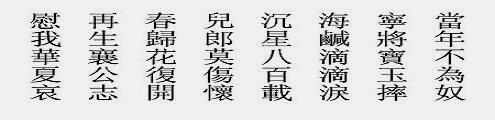
This snippet is for sons and daughters of China:
Heed the sons & ministers' agony and sorrow of our ancestors who died or lived through the Mongol, Manchu and Soviet-Chicom conquest
and
the Yongjia, Jingkang and Jiashen cataclysms !
Jeanne d'Arc of China:
Teenager girl Xun Guan breaking out of the Wancheng city to borrow the relief troops in the late Western Jinn dynasty;
Liu-Shao-shi riding into the barbarian army to rescue her husband in the late Western Jinn dynasty;
teenager girl Shen Yunying breaking into Zhang Xianzhong's rebels on the horseback to avenge on father's death in the late Ming dynasty.
China's Solitary and Lone Heroes:
Nan Jiyun breaking out of the Suiyang siege and charging back into the city in the Tang dynasty;
Zhang Gui & Zhang Shun Brothers breaking through the Mongol siege of Xiangyang in the Southern Soong dynasty;
Liu Tiejun breaking through three communist field armies' siege of Kaifeng in the Republican China time period;
Zhang Jian's lone confrontation against the communist army during the June 3rd & 4th Massacre of 1989.
|
|
|
Around the turn of 1944-1945, Li Zongren sent two memos to Hurley and Wedemeyer, advising against the Russian participation in war against Japan. Li Zongren, after noticing the encirclement of Berlin by the allied troops, called upon Chiang Kai-shek and Wedemeyer in devising a plan of setting up a Sino-American training center in the Philippines for possibly delivering the Chinese troops to southern Manchuria so as to segregate the Russians from the Chinese Communists. Li Zongren of course did not know a thing about the Yalta betrayal, nor the truth that the Soviet agents had hijacked the American government.
On Aug 10th, 1945, Li Zongren was in mixed thoughts when the delegations and organizations visited him in the Hanzhong Military HQ with congratulation on the final victory over Japan.
Li Zongren mentioned that with dozens of millions of casualties, including millions in his 5th War Zone, China and the Chinese people then entered the stage of uncertainty.
After the loss of China, Li Zongren blamed Chiang Kai-shek for not adopting his advice in dispatching the miscellaneous provincial armies to the Japanese-occupied territories: Li Zongren suggested that Huang Shaohong or some prestigious general of the Manchuria nativity be dispatched to Manchuria; however, Chiang Kai-shek selected a 'Political Studies Clique' leader called Xiong Shihui for the job. Further, Li Zongren blamed Chen Cheng for issuing the order in i) having the Japanese troops concentrate onto the big cities or designated sites for surrender & ii) dismissing all the puppet troops [as well as the locally-organized anti-Japan resistance forces]: Li Zongren suggested retaining the Japanese and puppet troops as the policing forces in the various towns and counties to safeguard against the Communist infiltration. - Li Zongren's viewpoints were partially correct.
The debacle in Manchuria was more to do with the Soviet scheme in splitting up Manchuria as its spheres of influence, as well as the communist scheme to cause the instability via dismissal of the puppet troops and de-drafting of the government troops ensuing from collusion between George Marshall and the Chinese Communists.
Further, cavalry general Heh Zhuguo, who was empowered with receiving the Japanese emissary Imai Takeo for peace talks in the Yellow River flood zone just weeks ahead of the Japanese surrender, was designated for the Manchurian assignment, prior to his going blind in a mysterious poisoning incident.
Nationalist China secured the Northern China as a result of Xiong Bin's relentless behind-the-enemy-line instigation against majority of the generals of the puppet Whang Jingwei government, to the extent that Sun Liangcheng's puppet troops were shipped to Nanking as the garrison troops in early 1945 after bribing the Japanese occupation commander, which thwarted the communist New Fourth Army's attempt at launching an 'uprising' to take over Nanking [and Shanghai] after the Japanese surrender.
The communists, during the 1944 Japanese Ichigo Campaign, dispatched a heavily armed N4A force across the Yangtze to reclaim the Fujian-Jiangxi-Anhui enclave of the 1930s, which led to wars between the ROC army and the communists lasting from late 1944 to the spring and summer of 1945, the bloodiest civil war ever out of the eight-year-long resistance war, all a part of Mao's southern advance strategy, which was not reversed till the autumn of 1945 to become the northern advance strategy for Manchuria.
Ding Xishan, a former puppet army commander who once took charge of the south-of-Whampoo guerrilla war for the Loyal and Righteous Army but was infiltrated and hijacked by the communists since 1938 and was betrayed to the Japanese over a scheme to defect back to the Chinese government side by his apparent undercover communist brigade commander, managed to escape prison at Zhenjiang under an apparent communist scheme and setup, and then twice returned to the area south of the Yangtze under the communist directives, one time before the Japan was to surrender in 1945 and another time before the communist army was to cross the Yangtze for the conquest of Shanghai.
Don't forget that in Fujian and along the Southeastern coastline, where the Americans set up the watch and listen posts, the Chinese communist guerrillas launched numerous uprisings against the government throughout 1944-1945. And along the Zhejiang coastline, one communist with the background from Ding Xishan's puppet army and in possession of some credential of special training from Dai Li's Sino-British and Sino-American military collaboration programs, conducted a Sylvester Stallone-style John Rambo war against the Chinese government till being pacified at the time of the Japanese surrender.
Li Zongren unwittingly
was used by the Soviet-hijacked U.S. State Department as the so-called 'democratic' force to replace Chiang Kai-shek.
For the root cause of the loss of China to the blood-thirsty Soviet proxies, see
this webmaster's notes on the "criticisms of Li Zongren's criticisms of Chiang Kai-shek"
for sake of historical clarification.
(If you had come to this website in search of the 'white terror', please look no further than the 'red terror' conducted by
Comintern agent
Yang Xiufeng who in 1947/1948 ran the communist People's University to vivisect live R.O.C. government army captives
[including
one young Burma battle veteran who walked to the west from coastal Zhejiang as a teenager during the 1937
China's Dunkirk Retreat
and did not return home to see his mother for next 12 years]
.)
The National Revolutionary Army (NRA) of the R.O.C. Entering H.K.
(left below)
The brave and victorious National Revolutionary Army (NRA) of the Republic of China, the flower China ever had in the whole history of 5,000 years, entered Hong Kong amid the applause from the H.K. Chinese residents who, after a short respite of freedom, were to revert back to living under the British colonialist rule.
The cunning British, from 1942 to 1943, repeatedly lobbied with Chiang Kai-shek for sake of retaining the H.K. colony,
to the extent of dispatching large embassies to China to extract a deal in having China put aside the H.K. matter till after WWII,
and threatening to derail the joint Sino-British and Sino-American proclamations in regards to nullifying the unequal treaties and the "Chinese Exclusion Act",
while conspiring with Stalin of the Soviet Union to sell out China through the stipulations of the Yalta Treaty.
Further, to delay the H.K. matter further, Britain in 1945 bribed the Republic of China with transfer of dozens of warships while at the same time,
the Comintern and Soviet spies in the United States state department and United States treasury department choked the Republic of China by imposing the 1946-1948 arms embargo,
including the bullets that R.O.C. had ordered prior to the Japanese surrender, as well as stalling on the post-war rehabilitation loans.
|
|
|
|
The National Revolutionary Army (NRA) Chasing the Communists to North Bank of the Sungari River (right above)
The brave and victorious National Revolutionary Army (NRA) of the Republic of China, after routing the communist crack forces of the New 4th Corps and the 8th Route Army at Sipingjie, chased the remnant communists to the north bank of the Sungari River, where Sun Liren left a battalion of soldiers to guard the beachhead for 2.5 years, till late 1948. There were rumors saying that N1C commander Sun Liren liked to go to Harbin but regional commander Du Yuming restrained the action out of jealousy. Wellington Koo's memoirs, however, showed that Du Yuming had a plan to push to Qiqihar, and Chiang Kai-shek was planning to retain the defeated communist army within the border with the Soviet Union but beyond the Qiqihar. George Marshall stopped Chiang Kai-shek from pushing further north on the pretext that the Soviets might intervene. Wellington Koo visited Du Yuming in Changchun, where Du Yuming explained his plan to push the troops to Qiqihar to the northwest and Dairen to the south.
At a news conference, Du Yuming said his worry was a ceasefire to be coming from George Marshall, which did come days later. (Li Zongren, in his memoirs,
accused Chiang Kai-shek of letting go Lin Biao's communist army because it was Bai Chongxi who proposed to chase the communists to the end. Li Zongren, knowing nothing about George Marshall's trickery,
was used by the Chinese Communists and pro-communist Americans as the so-called 'democratic' force to replace Chiang Kai-shek.)
Americans sold out China in Tehran, Yalta and Potsdam. In late 1944, Leahy was probing China about the Russian demand for Dairen, Port Arthur and the railways. Roosevelt locked up the secret treaties in his drawer till his death. Both Hurley and Leahy merely knew part of the Roosevelt deals with Stalin. Truman pressured China numerous times regarding signing an agreement with Russians no later than July 1st, 1945. Late 1945, George marshall and the Americans continued to sell out China on the matter of the Russian pillage of Manchuria. Marshall's treachery then followed.
As disclosed by the documents at the George Marshall foundation, George Marshall, possibly the most hideous agent working on behalf of Stalin and the Soviet Union, saved the ass of the Chinese Communists with a threat to withhold the economic aid that was supposedly coming from the U.S. export-import bank, which never materialized.
Lin Biao, after rebuilding his army with new supplies from the Soviet-controlled depots in North Korea, mounted the so-called
"Three Attacks to the South of Sungari", "Four Campaigns to Linjiang from the Sino-Korean Border", and "Two Sieges of Sipingjie".
Scared of the blood-bath from the sieges of Sipingjie, Lin Biao loitered for half year of 1948 between Sipingjie and Jingzhou till 900+ Soviet artillery pieces were shipped over
via railway tracks constructed by the Soviet Army Corps. (In 1950, Lin Biao again showed his cowardice in declining the job to go to Korea.)
Meanwhile,
George Marshall, from 1946 to 1948, repeatedly probed numerous Chinese officials and generals as to who could be Chiang's successor.
The U.S. Department of State, run by Russian agents, were repeatedly sending out rumors about getting a succesor for Chiang. Marshall's hands had the blood of millions of Chinese killed in civil wars.
G Marshall, as Wedemeyer said, first armed China and then disarmed China. The U.S. arms embargo continued till the China Aid Act of 1948, and ammunition did not get released till Nov of 1948.
After weapons were shipped
out, Acheson and the undercover Russian agents further attempted to order the ships to turn around at Guam and Okinawa.
In Oct 1949, Acheson pleaded with the British, where the Cambridge Soviet Spy Ring was at work, for recognition of Communist China, which Britain did on Jan 1st, 1950.
After that, Acheson declared the Aleutian curvature, which direcly led to the eruption of the Korean War.
|
The Soviet Entry into Manchuria
Two days after the U.S. dropped A-bomb onto Japan, i.e., Aug 8th, the U.S.S.R. declared war on Japan. The next day, over 1.5 million Soviet Red Army soldiers poured into Manchuria from three directions.
The Japanese, with 700,000 Kwantung army (actual number much lower due to relocation of the core Japanese troops to China proper and the Pacific islands) and 300,000 puppet Manchukuo army, retreated without putting up a fight. In face of the Russians, the Japanese buried evidence of germ warfare and poisonous weapons and quickly retreated towards Korea where their guinea pig and germ experts were offered sanctuary by the American occupation forces.
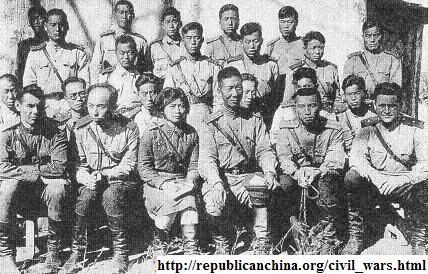 The Chinese Communist guerrilla remnants, who had been forced by the Japanese into seeking asylum inside of the U.S.S.R., came back wearing the Russian military uniforms.
Zhou Baozhong & Li Zhaolin, i.e., brigade chief and deputy brigade chief respectively, returned to Manchuria with the Russians via train.
A top CCP cadre, Lu Dongsheng, came back to Manchuria in September to assume the post of deputy commander for the CCP Song-jiang River military district.
Kim Il-sung left for Pyongyang in September.
The Chinese Communist guerrilla remnants, who had been forced by the Japanese into seeking asylum inside of the U.S.S.R., came back wearing the Russian military uniforms.
Zhou Baozhong & Li Zhaolin, i.e., brigade chief and deputy brigade chief respectively, returned to Manchuria with the Russians via train.
A top CCP cadre, Lu Dongsheng, came back to Manchuria in September to assume the post of deputy commander for the CCP Song-jiang River military district.
Kim Il-sung left for Pyongyang in September.
Kim Il-sung, who arrived at North Korea under an alias after the Japanese surrender, did not publish his name and was not officially acknowledged by Stalin and the Soviet Union to be a North Korea communist party leader till two-three months after the arrival in North Korea.
According to Kim Il-sung's memoirs, Kim Il-sung, who was always known as 'Cheng [accomplished, pronounced by 'sung' in the Sinicized Korean language] zhu [pillar]', adopted the name of a dead Korean martyr to enter Korea and ordered his lieutenants to fan out to solicit and build support.
The Soviets did not zero down on a communist figurehead for North Korea till two to three months after the Japan surrender.
Months after the Japanese surrender, at a meeting in an auditorium, with a Soviet Red Army colonel equivalent being present, Kim Il-sung announced him to be the legendary 'Cheng zhu', a name known among the Koreans for Kim Il-sung's maverick communist activities among the Korean nationalists and Korean communists.
This is the origin of the accusation that Kim Il-sung was an impostor.
The Chinese Communist guerrillas in Manchuria, having no consistent contact with either Ruijin's Chinese Soviet or Yenan and being always in subordination to Moscow and the Comintern direct from 1932 to 1942, had apparently ceased hostility against Japan in observance of the April 1941 Russo-Japanese Neutrality Treaty.
Prior to 1943, the Russians had already taken custody of the remnants of the "Northeast Allied Army For Resisting the Japanese Invasion" [i.e., the Northeast Anti-Japanese Coalition Army - the successor of the Youth-Party-dominated "Northeastern Volunteer Righteous & Brave Fighters" & the "People's Revolutionary Army Of Northeast China" ensuing from the 1931 Japanese invasion of Manchuria], including Kim Il Sung, and re-organized it into the so-called "Russian Field-battle Teaching Brigade".
http://times.hankooki.com/lpage/opinion/200406/kt2004060817432954140.htm
pointed out that Kim Il-sung, from 1942 onward, then "a Soviet captain and battalion commander, was stationed in Viatsk where he served in the Soviet 88th Brigade, the personnel of which consisted of Chinese and Korean guerrillas."
At Viatsk, Kim Jong-il, called Yuri, was born instead of fabricated birthdate and birthplace of Feb. 15, 1942 in a guerrilla camp on Paektu Mountain.
(The guerrilla resistance in Manchuria lasted till about 1941 when the Soviets, who had signed the neutrality treaty with Japan,
instructed an end to active resistance and recalled the volunteer fighters back to the Soviet Union for training.
The Soviet order was to wait out for the coming of some new international development, namely, a war between Japan and the U.S.A. or the Pearl Harbor attack.
The Chinese Communists were able to survive the nationalist-communist civil wars in Manchuria in 1931-1932 as a result of the maverick activities of Kim Il Sung
who managed to legalize his small band of army under Red Spear Society leader Yu Xianrui, a band under Wang Delin's salvation army, and further called on his Korean pals to copycat the model in the counties
at the Sino-Korean border.
This was the result of Kim Il-sung's communist-nationalist dual-identity which could be traced to the origin of Kim Il-sung's father from the evangelical Christian school, a cradle of the Korean nationalists fighting for the independence of Korea since the 1910 Japanese annexation of Korea.)
Back On Aug 14th, 1945, Foreign Minister Wang Shijie was pressured into signing the "Sino-Soviet Friendship & Alliance Treaty", a treaty to be rescinded by Taiwan after Eisenhower requested with the U.S. Congress for rescinding the secret treaties with the Soviets on February 20th, 1953.
Originally, the Sino-Soviet agreement called for the Russian occupation of Manchuria for three months, but later China requested for a delay of the Russian withdrawal twice, which gave the Russians a pretext for procrastination till 8 months long.
In Manchuria, the Russians dismantled 5 billion worth of industrial equipment and shipped back to the U.S.S.R. Li Ao claimed that the U.S.S.R. had robbed resources and materials equivalent to over 8 billion U.S. dollars. Freda Utley, endorsing the number of 8 billion, pointed out that the Russians had pillaged Manchuria after the Republic of China refused to sign a comprehensive agreement to develop Manchurian mines and industries jointly. Chinese foreign minister Wang Shijie declined Freda Utley's suggestion to publicize the Russian demands, incidentally.
Li Shenzhi recalled a massive nationwide protest movement against the U.S.S.R. in early 1946 over the Russian [in fact, the Chinese Communists'] killing of Chinese engineer Zhang Xinfu (Zhang Shenfu) in Manchuria. Per Gao Wenjun's eyewitness statement, during their eight month stay, the Soviet Red Army soldiers, nicknamed 'lao [old] mao[hairy] zi[son]' or 'da [big] bi [nose] zi [son]', had taken in the stranded Japanese women as 'comfort women' as well as openly raped the Chinese women on the streets, to the extent that the Chinese women could not escape from the Russians by disguising as men due to the Russians' groping breasts.
On December 14th, 1945, Communist cadre Lu Dongsheng, who ordered a Russian soldier to stop robbing him in the Russian language, was shot to death in the back.
"Time Magazine", at http://www.time.com/time/archive/preview/0%2C10987%2C934539%2C00.html, reported on the rampage by "Big Noses", as follows:
Jun. 2, 1947
The Nanking Government, always ready to take a poke at its enemies, the Chinese Communists, is more cautious about provoking the big Communist bear to the north. Last week the bonds of caution snapped.
Before the People's Political Council, advisory body to Chiang Kai-shek's Government, impetuous, energetic Pan Chaoying, director of the influential Catholic Social Welfare newspaper chain in China, let out an anti-Russian blast. Thundered Pan: "According to the Sino-Soviet Treaty of 1945, China and Russia should respect each other's sovereignty and territory. But Russia hasn't kept her word. . . .
"Responsible authorities [in Manchuria] say that Soviet pilots and artillerymen have been in action with Chinese Communist troops . . . Russian soldiers of occupation have been guilty of terror and rape—more than can be told. The Manchuria lao pai hsing [common people] told me: 'Everything lao pai hsing won't do, the Russian ta pi tzu [big noses] have done.'
"I urge the Government: 1) to take action for the quick recovery of Dairen and Port Arthur; 2) to petition U.N. for the return of Russian loot from Manchuria; and 3) to declare null & void the Sino-Soviet treaty."
Yeh Shu-tang from Szechwan chimed in: "We must be strong, not weak. If someone offers us a friendly hand, we should clasp it warmly. But if someone slaps us, we should slap back twice."
The watchful Russian Embassy, near Nanking's Drum Tower, heard the hot words and the enthusiastic applause. An Embassy subscriber visited Pan's Social Welfare Daily, asked for five copies of the issue carrying Pan's speech. Asked why he wanted so many, the Russian replied: "Oh, for our public libraries."
(The Soviet Red Army soldiers did the same to the German women.)
 By the end of 8-month Russian occupation, the Chinese Communists would absorb 300,000 puppet Manchukuo army and develop into half million strong forces from the original contingent of less than 20,000.
Li Zongren memoirs stated that Xiong Shihui, per Chen Cheng's order, had dismissed 400,000 Manchukuo puppet army which then turned to the Communist camp. Wang Tiehan rebutted the popular claim as to the number of 400k by pointing out that the puppet troops, after the Russians came, had been ordered to hide in the mountains by the puppet Manchukuo minister, with portion of them to escape the Communists for service under the Nationalist Government.
By the end of 8-month Russian occupation, the Chinese Communists would absorb 300,000 puppet Manchukuo army and develop into half million strong forces from the original contingent of less than 20,000.
Li Zongren memoirs stated that Xiong Shihui, per Chen Cheng's order, had dismissed 400,000 Manchukuo puppet army which then turned to the Communist camp. Wang Tiehan rebutted the popular claim as to the number of 400k by pointing out that the puppet troops, after the Russians came, had been ordered to hide in the mountains by the puppet Manchukuo minister, with portion of them to escape the Communists for service under the Nationalist Government.
Xiong Shihui arrived in Changchun with about 100 entourage on October 2nd, 1945, but he was basically restrained in office by the Russians who guarded his office. Li Zongren memoirs claimed that Xiong Shihui dared not even receive the delegates of patriotic people of Manchuria, which encouraged the Russians in hindering the KMT government from taking over Manchuria.
Per Zhang Zhenlong's citation of the CCP 16 September 1945 briefing, Zeng Kelin's forerunner Communist force developed into 4000 soldiers from four companies in a matter of one week after arrival at the Shenyang (Mukden) city, and moreover, absorbed over 10,000 puppet constabulary forces; about 10000-20000 coolies, who were formerly captives from the Chinese Armies, were organized into guerrilla columns for entry into the Changchun city; in Shenyang (Mukden), Zeng Kelin reported that weapon depots were packed with 100,000 guns and thousands of cannons; and the puppet Manchukuo forces were in waiting mode for re-organization.
Jung Chang's "Wild Swans" stated that her father, Zhang Shouyu, resorted to the puppet army and puppet police for staffing and equipping his guerrilla force after yielding Chaoyang to the Nationalist army on January 14th, 1946.
The Chinese communists, prior to the Soviets' non-renewal of the 13 April 1941 neutrality treaty with Japan, had debated among themselves as to Stalin's next move, with communist Chen Yi giving Jack Service a so-called [explorative] "Manchuria Plan", a document that some undercover American communist in the American military delegation had destroyed to help cover up the so-called communist masterplan --something Jack Service cited as his loyalty before the McCarthy inquisition committee.
The truth was that Mao and the Chinese communists never had a northbound plan, but a southern advance one, with Wang Zheng's communist army following the footsteps of the 1944 Japanese Ichigo Campaign to reach the Hunan-Guangdong line, for example.
The Chinese communists launched a massive campaign against the Chinese government troops that lasted almost a whole year: namely, Peng Xuefeng's attacking Anhui-Henan from the Anhui-Jiangsu border; Wang Shusheng's intruding into Mt. Funiushan and Xiongershan from the Shenxi base; Wang Zheng's trek towards the Hunan-Guangdong border for connecting with the communist East River Guerrilla; and the New Fourth Corps' emptying the North Jiangsu base for a cross-Yangtze campaign to re-establish the Zhejiang-Fujian-Jiangxi soviet enclave.
The communist N4C, not fighting the Japanese at all, in late 1944 mounted a cross-Yangtze campaign back to the southern bank, and taking advantage of the Japanese Ichigo Campaign, fought against the government troops in an atrocious bloody civil war that lasted a year, till months after the Japanese surrender, with targets set at re-establishing the Anhui-Zhejiang-Jiangxi Soviet enclaves as well as taking over the puppet government's capital city of Nanking.
It was Xiong Bin's relentless behind-the-enemy-line instigation against the puppet Whang Jingwei government's generals, to the extent that Sun Liangcheng's puppet troops were shipped to Nanking in early 1945 after bribing the Japanese occupation commander, that prevented the communist New Fourth Army from taking Nanking and Shanghai in a purported post-Japan-surrender "uprising".
It would be at the turn of September-October of 1945, when Mao was in Chungking for the peace talks, that communist deputy chief Liu Shaoqi changed Mao's southern advance masterplan to the Manchuria plan.
Confrontation Between the Russians (i.e., the Soviets) and the Nationalist Chinese Government
Li Zongren memoirs stated that Xiong Shihui had asked the Russians to delay evacuation twice. Li Zongren said that Xiong Shihui had dereliction of duty as director for the "Northeast Military Office" because Xiong Shihui had fully observed the Russian request to stay inside of his office which was guarded by the Russian patrols all the time:
Xiong Shihui dared not even receive the delegates of patriotic people of Manchuria, which encouraged the Russians in hindering the Nationalist government from taking over Manchuria.
However, Xiong Shihui should not take the full blame. China had shown its weak position to the Americans who passed on the signal to Moscow.
On April 13th, 1945, the second day after Roosevelt passed away, Gu Weijun reported that American Navy General Li-hai [Admiral William Leahy] had tested his response in regards to China's possible reaction to the Russian grabbing Dalian and Lüshun [Port Arthur] ports.
Gu Weijun's response was that i) China would seek a peaceful solution in dealing with the possible Russian takeover of two ports and ii) the Russians could have better find a non-frozen port inside of Korea.
More available at Russians-in-Manchuria-v0.pdf
(Check
RepublicanChina-pdf.htm
page for up-to-date updates.)
* In Commemoration of China's Fall under the Alien Conquests in A.D. 1279,
A.D. 1644 & A.D. 1949 *
U.S.S.R./Comintern Alliance with the KMT & CCP (1923-1927)
Korean/Chinese Communists & the 1931 Japanese Invasion of Manchuria
American Involvement in China: Soviet Operation Snow, IPR Conspiracy, Dixie Mission, Stilwell
Incident, O.S.S. Scheme, Coalition Government Crap, Amerasia Case & The China White Paper
* Stay tuned for "Republican China 1911-1955: A Complete Untold History" *
|
|
Zou Rong's Revolutionary Army;
Shin Kyu Sik's
Shrine (Spirit, Kunitama) of Korea
|
This snippet is for sons and daughters of China:
Heed the sons & ministers' agony and sorrow of our ancestors who died or lived through the Mongol, Manchu and Soviet-Chicom conquest
and
the Yongjia, Jingkang and Jiashen cataclysms !
Jeanne d'Arc of China:
Teenager girl Xun Guan breaking out of the Wancheng city to borrow the relief troops in the late Western Jinn dynasty;
Liu-Shao-shi riding into the barbarian army to rescue her husband in the late Western Jinn dynasty;
teenager girl Shen Yunying breaking into Zhang Xianzhong's rebels on the horseback to avenge on father's death in the late Ming dynasty.
China's Solitary and Lone Heroes:
Nan Jiyun breaking out of the Suiyang siege and charging back into the city in the Tang dynasty;
Zhang Gui & Zhang Shun Brothers breaking through the Mongol siege of Xiangyang in the Southern Soong dynasty;
Liu Tiejun breaking through three communist field armies' siege of Kaifeng in the Republican China time period;
Zhang Jian's lone confrontation against the communist army during the June 3rd & 4th Massacre of 1989.
|
|
|
The Communist Absorption of Two Ethnic-Korean Divisions under the Japanese Kwantung Army
In Manchuria, the Communists forces retained at least two Korean ethnic divisions of the Japanese Kwantung Army, in addition to hordes of Japanese soldiers, air force generals and crewmen under Hayashi Yayichiro, artillery soldiers and military doctors and nurses.
Though, tens of thousands of Japanese troops, who were retained by the communists at Tonghua for special operations, rebelled against the communist rule in early February of 1946 under the command of Fujita Sarehiko, ending in the communist massacre of the city of Tonghua which was far worse than the so-called 1937 Tongzhou Massacre that the Japanese ultranationalists cited as the cause of deepening of the Sino-Japanese war and conflicts. It was reported that the Japanese doctor and nurses conducted a mass-kill of the communist wounded at the hospital of Tonghua during the rebellion.
During the initial 4-5 campaigns against the Communist troops, General Sun Liren's army constantly engaged with the Koreans and the Japanese. Don't forget Sun Liren's herald troops also killed lots of stranded Soviet Red Army soldiers who were busy rampaging than catching up with the retreating Soviet army.
The communists, after the Sipingjie (Szepingkai) debacle in the spring of 1946, fled all the way to Northern Manchuria, while in southeastern Manchuria, the communists fled to Soviet-controlled Dairen and Port Arthur for asylum.
The Chinese Communists also moved their women and wounded to Korea for asylum, for which Mao Tse-tung, in 1950, adamantly insisted on sending the Chinese armies to the Korean War as a show of requital.
Zhou Baozhong, his wife, and many communists were sent to North Korea for facilitating the communist army's asylum-seeking, as well as the communist troops transfer between northern and southern Manchuria.
Zhu Lizhi and Li Fuchun were sent to North Korea as plenipotentiary with an embassy-equivalent representative office in Pyongyang.
In Kim Il-sung's opinions, Mao Tse-tung was obliged to help him out for the hundreds of thousands of Koreans sent to the Chinese civil war.
In 1947, during the peak of the Eastern Manchurian Campaign, the Russians dispatched 100,000 Koreans to China to assist with Xiao Hua's Communist 3rd & 4th "zongdui" as well as the Li-Hongguang [Korean] Detachment.
Per Utley,
General Chen Cheng, the Chinese Chief of Staff, charged on June 24 (1947) that at least thirty-one Russian advisers were known to be with the Communist forces fighting at Szepingkai, the important railroad point seventy miles from Mukden.
According to the Soviets, the Russians joined the Chinese civil wars in the name of railway staff.
As Freda Utley pointed out, "in March 1947, Lieutenant General John R. Hodge, a U.S. commander in North Korea, stated that Chinese Communist troops were participating in the training of a Korean army of 500,000 in Russian-held North Korea. The Chinese Central News Agency stated in June [1947] that more than 100,000 Russian-trained Koreans plus a cavalry division from Outer Mongolia were in action against the Chinese Nationalist forces".
From the memoirs related to some Taiwan native who joined the Japanese Kwantung Army and was later exiled by the Soviet Red Army to Siberia for the coolie labor, the Soviets, to help Mao Tse-tung and Kim Il Sung, on a wholesale scale, repatriated the Korean-ethnic Japanese Kwantung Army prisoners of war to North Korea and the Taiwan-ethnic Japanese Kwantung Army prisoners of war to Manchuria, as fodder of war, which probably explained why there was no accounting of some huge numbers of the Japanese Kwantung Army troops in the later repatriation to Japan in the 1950s.
Kim Il-sung claimed that altogether 250,000 Koreans joined the Chinese Communists in the civil war.
The Korean generals commanding the mercenary army included Kang Kon, Park Rakkwon (Piao Luoquan), and Choe Kwang (Cui Guang). Choe Kwang, not following Kim Il Sung who returned to Korea via sea in September 1945, was a regimental commander in the Chinese communist's Eastern Jirin military subdistrict before returning to North Korea in 1946 to be in charge of constabulary army's training. Kang Gen, who returned to North Korea with Kim Il Sung in September 1945, apparently returned to China for the Manchuria civil war before he was to return to North Korea again sometime in 1946.
The Koreans did not die away. They were sorted out in 1950, about 3-4 months ahead of the eruption of the Korean War. Those who fought in the Korean War in 1950 comprised of the bulk of the 250,000 Korean troops sent to China by Kim Il-sung, including the Korean-ethnic Japanese Kwantung Army repatriated from Siberia, not the Koreans who fought the guerrilla war against the Japanese under the CCP.
(Only two Koreans, who were cadets of the Whampoa Academy, followed the communist Long March to Yenan, with one surviving the later wars to go back to North Korea. The hundreds of CCP-controlled Koreans, who returned to Korea in 1945-1946, came from the steering-away of a portion of the Korean Restoration Army that were trained by the Chinese nationalists at the war-time capital Chungking, but were steered away to the communists possibly under a scheme of the American OSS which was hijacked by the Russian spies.)
Note the fundamental difference between the 250,000 ethnic-Korean Japanese Kwantung Army diehards and the ethnic-Korean Chinese living in China.
The communist statistics claimed that altogether 65,000 ethnic-Korean Chinese minority people, or the Korean migrants living in China, joined the communist army, with approximately
60% coming from the Jirin subprovince,
21% from the Sungari subprovince, and
15% from the Liaodong subprovince.
Purportedly, archives from the Yonbyon (Yanbian) Korean Autonomous Prefecture claimed that 34,855 Koreans from five Jirin counties joined the Chinese communist army, with additional 100,000 ethnic Koreans serving as police and militia in the area that was known as Jiandao (sandwiched [triangular] island-shaped territory) under the Japanese, also known as Yanbian (Yonbyon). The communists' wholesale recruiting of the ethnic-Koreans in the three Manchuria subprovinces of Jirin, Sungari and Liaodong (Liao-tung), that bordered with North Korea, the Soviet Maritime Province (a land stolen from Manchu China during the Second Opium War) and the Japan Sea, could only have happened at the turn of 1947-1948 --when the communists charged out of the hideouts in Port Arthur and North Korea to counter-attack the Chinese government troops.
Chiang Kai-shek's Futile Attempt At Restraining the CCP
On Aug 15th, 1945, at 9:00 am, Chiang Kai-shek made a 15-minute radio speech about "pardoning the enemies [Japanese]" in Chongqing of China.
On the 16th, Shao Yulin flew back to the Jiulongpo Airport of Chongqing from a visit to the U.S. Zhang Ling'ao was ordered to pick up Shao Yulin who was anxious about the Japan surrender matter.
The next day, at 9:00, Zhou Hongtao made a call for Shao to see Chiang Kai-shek.
Shao Yulin, i.e., an expert on the Japan matter like Gao Zongwu & Dong Daoning, was sent to Heh Yingqin's office in Zhijiang in the name of lieutenant general counselor of the ROC infantry command center.
At Zhijiang, Shao Yulin met with Xiao Yisu & Leng Xin through Heh Yingqin's introduction.
At Shao's suggestion, over 20 officers fluent in Japanese were fetched over from Chongqing.
On the 21st, Japanese deputy tactician-in-general Imai Takai [Jinjing Wufu] flew over to Zhijiang from Nanking.
Chiang Kai-shek's Nationalist government, in its race against the Communist for control of China, issued an order that was delivered on Aug 21st by Xiao Yisu to the Japanese forces, demanding that the Japanese army should not surrender to anybody else other than the Nationalist government troops.
On the 22nd, the Japanese flew back to Nanking where they still possessed an army of 70,000.
On the 27th, Leng Xin and Shao Yulin flew to Nanking for talks on taking over Nanking.
At the airport, the Japanese disclosed that Okamura Yasuji could commit suicide at any time.
Shao Yulin countered by saying that this was not a time to talk about suicide.
At the meeting, Shao pointed out that Okamura Yasuji should bear responsibility for doing the good deeds to pay back crimes against China and the Chinese people rather than thinking about suicide.
Shao relayed Chiang's instructions as to the Japanese surrendering to the Government troops, only.
On Aug 30th & 31st, Shao and Okamura Yasuji held more talks.
In late August of 1945, the Japanese forces in Tianjin resisted the Communist forces at the request of Heh Yingqin.
On September 8th, Okamura Yasuji officially signed the surrender paper, and later recalled in memoirs that it was a magic moment to have surrendered the Japanese army to Heh Yingqin, i.e., a good friend of his as well as a pro-Japan Chinese official.
Ceremony was held on September 9th.
Zhang Ling'ao blasted Heh Yingqin for paying back a bow courtesy when Okamura Yasuji surrendered. (Heh later corrected the popular accusation by pointing out that the table separating the two was so wide that he had to lean forward to accept the Japanese surrender paper.)
In the diary, Okamura Yasuji recalled that what Heh Yingqin had displayed was an "Oriental Virtue".
At this time,
China possessed only a company of soldiers under Liao Yaoxiang, that was ready for deployment in Nanking per ZLA.
However, 400000-500000 best trained troops were just returning to southern China from the mountains of Vietnam, Burma and Yunnan Province at the time of the 1945 Japanese surrender.
Chiang Kai-shek was accused by Li Zongren of refusing to allow the miscellaneous provincial armies to march northward to Northern China and Manchuria for accepting the Japanese surrender. Li Zongren's accusation could be wrong as we saw that the communist army, whose commanders flew to various districts on the Dixie Mission planes, began to attack the government troops immediately, including the attack on Sun Lianzhong's army which was to take the surrender in Peking. Sun Lianzhong's army, as was the case with most of the group armies reorganized in the early 1940s, had been deliberately padded together, with the group army commander controlling the former direct-subordinate provincial troops as well as the central government troops.
This deliberate attempt at disrupting the former provincial army chain of command could be a ploy that was recommended to Chiang Kai-shek by the undercover communist agent working in the military commission.
(However, Chiang Kai-shek did disarm some provincial army, i.e., Du Yuming's surrounding Long Yun's Yunnan Province army at Mt Wuhuashan with the Burma expedition army, which forced Long Yun into resignation of the governorship. Though, Long Yun was implicated in Stilwell, American and Chinese Communist' conspiracy to overthrow Chiang Kai-shek's rule in 1944, a plot that continued till 1946 per James Liley's memoirs.)
After Chiang Kai-shek, per Li Ao, gave up the idea of using the Japanese against the Communist as suggested by the Japanese military commander & rebutted by the U.S. allies, the Nationalist government had mobilized thousands of ships, equiv to 300,000 tons, for dispatching well over 2 million Japanese occupation forces and their families to Japan within ten months (i.e., November 1945-July 1946).
The Japanese prisoners, called the "barehanded soldiers", were even allowed to carry some light weapon for self-protection prior to boarding the ships.
In late 1940s, China's 10 local military courts sentenced a total of 145 Japanese war criminals to death, including four Taiwanese Japanese war criminals.
Okamura Yasuji returned to Japan with about 259 war criminals via an American ship John Vicks on January 30th, 1949.
Well over 2000 Japanese war criminals being set free, including all of the 1,000+ war criminals who were handed over to the Chinese Communists by the Soviets in the 1950s, and set free by the Chinese communists.
(Japan occupation commander-in-chief Okamura Yasuji, renamed the "liaison commander" for the "Remaining Problem Liaison Center of the Japanese in the China Battlefield", reached a deal with the Chinese government to get spared the trial of war crimes. Note that Okamura Yasuji, acquitted on January 16th, 1949, was responsible for i) provoking the September 18th 1931 Incident in Manchuria [Mukden Incident] and ii) orchestrating the 22 January 1945 'continental order' for invading Sichuan Province, and he later sent in gifts to Chiang Kai-shek for help in petitioning with MacArthur for the U.S. acquittal of his war crimes.
In October and December 1945, Heh Yingqin and Chiang Kai-shek had accorded a private meeting with Okamura Yasuji, respectively.
To protect Okamura Yasuji from extradition to the American war criminal courts, Okamura Yasuji was allowed to stay on in China till January 1949, with a farce trial conducted in Aug 1948.
After Li Zongren took over the proxy president post, Per LK, Tang Enbo secretly released Okamura Yasuji on January 26th, 1949, against the noise from the Li Zongren presidency and the communist propaganda.
Later, in 1956, Heh Yingqin paid a visit to Okamura Yasuji while visiting in Japan, emphasizing his amiability relationship with the Japanese guy, as shown in the 1933 negotiations of the Tang-Gu Truce Agreement and in the November 1935 invitation for a private dinner in his Nanking home, and Okamura Yasuji was said to have appreciated Heh Yingqin's 1933 foresight into the CCP's ascension to power and Japan/China's demise should Japan continue its invasion agenda.)
After the Japanese surrender on Aug 15th, Mao Tse-tung issued 7 orders to the Communist-controlled forces in the race against the government for control of China.
Zhang Zhenglong pointed out that the CCP Central issued the order the second day after the Russian entry into Manchuria, and by the 3rd day, the CCP Central had issued the 7th order.
Though, those so-called orders could be later fabrication.
The communist policy to relocate the forces northward district by district was a decision taken by Liu Shoqi in Mao's absence: the Communist guerrilla forces south of the Yangtze River were to retreat to Jiangsu Province, Chen Yi's New Fourth Army was to enter Shandong Province, Shandong's Eight Route Army was to enter Hebei Province, and Hebei's New Fourth Army was to enter Manchuria. --This northern approach was in fact a myth as it was Liu Shaoqi who reversed the communist "southern excursion" order in the absence of Mao who was forced to go to Chungking to talk peace after Stalin sent over a wire about the support for the Chinese national government in the aftermath of China's being coerced into signing a Sino-Soviet friendship treaty. As Vladimirov disclosed, Mao and the communists were shocked by the Japanese surrender and could not come to senses for days, and even after the Soviets invaded Manchuria, Mao and the communists were accusing the Soviets of failure to invade Inner Mongolia, which the Soviets did undertake. Vladimirov further disclosed that Mao and the communists in mid-August were busy contacting the Japanese military in Nanking in the attempt of staging an "uprising" to take over Shanghai and Nanking. After the communists reversed the direction to go north at the turn of September-October, the communists were just one step ahead in secretly instructing the Communist guerrillas of Zhejiang Province in crossing the Yangtze to the north, including a contingent which was sent across the Yangtze to the south earlier for the Nanking-Shanghai "uprising". The Communist guerrillas of Zhejiang, in a hurry, crossed the Hangzhou Bay by boats before the Government troops could attempt to block the way, and shocked the innocent peasants by walking through the paddy-rice countryside of Shanghai for the Yangtze river bank.
Earlier, in the mid-1944, Mao Tse-tung, who had struck a secret agreement with the Japanese, had ordered Wang Zheng's communist brigade to penetrate to Guangdong Province in the footsteps of the Japanese Ichigo Campaign. Mao interrupted the Yenan Rectification Movement by ordering the second-tier commanders, like Pi Dingjun, Wang Shusheng and et al., to terminate the brainwashing meetings and lead the communist forces into the Funiushan Mountain to establish an enclave by taking advantage of the Japanese Ichigo attacks. Communist general Peng Xuefeng, from the Jiangsu-Anhui border, was ordered to attack the government troops in the wake of the Ichigo Campaign.
Communist general Peng Xuefeng, when attempting to invade west in the footsteps of the 1944 Japanese Ichigo Campaign, was killed in fighting the government troops.
Peng Xuefeng previously evacuated to the Anhui-Jiangsu border, after setback three years earlier in the civil wars against Tang Enbo's army group -which was the leading Chinese crack army fighting the Japanese across the China domains, both the frontal battles and after the enemy line battles.
Peng had a swear that it was not too late for a gentleman to take revenge [against the government troops] in three years [by taking advantage of the Japanese Ichigo Campaign].
It would be in the spring of 1945, after the government troops repelled the Japanese campaign against Xixiakou, that the government troops counterattacked the communist army.
The sudden Japanese surrender and the Soviet entry in Manchuria dramatically altered Mao's southern advance strategy but did not derail Mao's existing masterplan till the turn of September and October, at which time deputy Liu Shaoqi reoriented the Communist strategy towards Manchuria.
With the help of the Soviet-hijacked American agencies in China, the communist generals, riding on the American planes, flew to various points across North China [and NOT Manchuria yet -as the Manchuria blueprint was not executed till the turn of September-October] to direct the civil wars.
(Jack Service, before he was recalled to the U.S. and fired by Hurley in the spring of 1945, had purportedly submitted a report to the U.S. command in China, stating that Chen Yi, a communist N4A general, had told him that the communists had a contingency plan for Manchuria. The staff at the U.S. military in China, who were pro-communist, had scraped Service's report, which made Service unable to prove his 'patriotism' to the loyalty [inquisition] board of the 1950s. Nonetheless, the communist strategy for Manchuria was not the only blueprint as Mao was more interested in going south, as he did in the 1944 Ichigo campaign, to pick fights with the national government troops than anything else.
Jack Service, who purportedly reconciled with wife back in the trip to the U.S. and ended his adulterous affairs with a 'leftist' [or actually communist] communist woman by the name of Yun-Ju, offloaded the communist woman to military attaché Willie Hanen who had a daughter born in 1946 with this woman whose full name was Zhao Yunru.
This young baby was in 1949 sent back to communist China where she went through extremely torturous life under the communist rule, was rescinded the college admission in 1964 for refusal to denounce her never-met American father, sent to Chinese Turkestan where she was attacked by a rifle gun butt and dumped onto the desert where she regained consciousness in three days, was time and again obstructed in accessing the newly-setup U.S. foreign liaison office in Peking, and was able to leave communist China in 1978 through the direct intervention of President J. Carter, Secretary of State Cyrus Vance and consul C. Ogden. This would be Teresa Buczacki (Haan Xiu), author of Refraction: An American Girl in Mainland China.)
The First Shot Of the 1945-1949 Civil War & Peace Talks
Back in late April, 1945, Mao Tse-tung, at the Communist 7th central committee meeting, pointed out that the four provinces of Northeast China were very important ... Even if we [Communists] lost all enclaves, we could still build a solid base for the Chinese revolution by relying on Northeast China alone..." [Per Zhang Zhenlong's citation of a Communist internal document at the Memorial Hall of the Liao-Shen Campaign].
The Communists never stopped its friction warfare with the Government troops. Hu Zongnan had fought several wars with the Communists in Henan Province in April-May 1945. Taking advantage of the Japanese attacks, the Communist contingents, numbering 30,000, under Pi Dingjun, Wang Shusheng & Han Jun, attacked Hu Zongnan's forces in Luoyang, Xin'an, Yiyang and Defeng areas.
More available at CCP-attacks-on-KMT-v0.pdf.
(Check
RepublicanChina-pdf.htm
page for up-to-date updates.)
* In Commemoration of China's Fall under the Alien Conquests in A.D. 1279,
A.D. 1644 & A.D. 1949 *
U.S.S.R./Comintern Alliance with the KMT & CCP (1923-1927)
Korean/Chinese Communists & the 1931 Japanese Invasion of Manchuria
American Involvement in China: Soviet Operation Snow, IPR Conspiracy, Dixie Mission, Stilwell
Incident, O.S.S. Scheme, Coalition Government Crap, Amerasia Case & The China White Paper
* Stay tuned for "Republican China 1911-1955: A Complete Untold History" *
|
|
Zou Rong's Revolutionary Army;
Shin Kyu Sik's
Shrine (Spirit, Kunitama) of Korea
|
This snippet is for sons and daughters of China:
Heed the sons & ministers' agony and sorrow of our ancestors who died or lived through the Mongol, Manchu and Soviet-Chicom conquest
and
the Yongjia, Jingkang and Jiashen cataclysms !
Jeanne d'Arc of China:
Teenager girl Xun Guan breaking out of the Wancheng city to borrow the relief troops in the late Western Jinn dynasty;
Liu-Shao-shi riding into the barbarian army to rescue her husband in the late Western Jinn dynasty;
teenager girl Shen Yunying breaking into Zhang Xianzhong's rebels on the horseback to avenge on father's death in the late Ming dynasty.
China's Solitary and Lone Heroes:
Nan Jiyun breaking out of the Suiyang siege and charging back into the city in the Tang dynasty;
Zhang Gui & Zhang Shun Brothers breaking through the Mongol siege of Xiangyang in the Southern Soong dynasty;
Liu Tiejun breaking through three communist field armies' siege of Kaifeng in the Republican China time period;
Zhang Jian's lone confrontation against the communist army during the June 3rd & 4th Massacre of 1989.
|
|
|
On Aug 13th, 1945, the Communist party committee for Hebei-Rehe (Jehol)-Liaoning regions, at a meeting held in Fenglunxian county, made a decision to dispatch to Manchuria 8 regiments, 1 battalion, and two contingents, totaling 13,000 men or 2/3rd of the regional force, to be commanded by four commanders for military sub-districts, four CCP regional secretaries and 2500 cadres.
Li Yunchang, i.e., commander-in-chief of the Hebei-Rehe (Jehol)-Liaoning district, was put in charge of the "Eastward March Work Committee".
In Aug, on the 14th, troops of the 15th & 16th military sub-districts under Li Yunchang exited the passes of the Great Wall for Manchuria.
Zeng Kelin & Tang Kai, with the 12th & 18th regiments, the Korean contingent & Lin Fuchang's contingent, circumvented the Shanhaiguan Pass by exiting the Jiumenkou gate.
Note Zeng Kelin had only four companies' strength, not a regiment, and the Korean contingent could be the portion of the Korean Restoration Army that were steered to the communist side from Chungking by the Soviet-hijacked American OSS.
Upon meeting the Soviet Red Army, Zeng Kelin's ragged communist army were disarmed by the Soviets as bandits.
(Note that the Jehol area used to be the guerrilla army under Youth Party leader Zhao Tong who fought against the Japanese since 1931-1932. To prevent Zhao Tong's Jehol Vanguard Army, about 200-300 men and women, from returning to Jehol from Chungking, the communist armies, with advance information from communist leader Zhou Enlai who superficially participated in the farewell ceremony for the march of the vanguard army in Chungking, pooled resources all over the military districts including Heh Long's communist army from northwestern Shanxi and Suiyuan area, and ambushed and eliminated the vanguard army in the tri-provincial area of Shanxi-Henan-Hebei around the turn of 1939-1940.
The communists, in the Chahar-Suiyuan area and around Mt. Daqingshan [the great green mountain], had conducted similar horrifying campaign against the patriotic guerrilla forces, including the fire attack that killed a 90-year-old former Northeastern Cavalry Army corps commander and his guerrilla army, and furthermore attacked and eliminated KMT party operator Chen Jianzhong's party-directly-controlled guerrilla forces and all couriers who were sent through the communist-controlled territories of Shanxi-Shenxi, with Chen Jianzhong being the sole survivor to return to Chungking in disguise.)
After meeting 5 trucks of the Russian troops, the Communist forces proposed an attack at the Japanese guarding the Shanhaiguan Pass.
The first echelon, together with 50 Russian soldiers, fought the Japanese at the Shanhaiguan Pass and took control of the link.
The 16th military district, separately, already entered Rehe (Jehol) and Manchuria, forcefully taking over Fangezhuang, Haiyang, Liumen & Shimenzai from the Japanese and puppet Manchukuo forces along the way.
At coastal Huludao, a city about 15 kilometers away from Jinzhou, the Communist forces successfully drove back the Nationalist Army which had landed ashore with the help of American transporters.
In Benxi city, i.e., the Japanese-controlled coal mine, Heh Juemin [a KMT colonel captive], Xing Fangyin [a CCP New Fourth Army deputy regiment chief captive], and Tao Shouchong [a CCP Shandong District cadre captive] staged an uprising against the Japanese on the night of Aug 14th; however, with the arrival of Zeng Kelin's Communist forces, the KMT elements were soon purged and executed.
About 50,000 American marines took charge of controlling the major railways around Peking-Tianjin and the Shanhaiguan areas.
According to Liu Tong, a professor at the Chinese Communist army college, the CPC troops, when exiting the Sea and Mountain Pass at the end of 1945, possessed the following weapons: 39641 rifles, 1139 light machine guns, 105 heavy machine guns, 59 grenade launchers, and 64 mortar, and almost no heavy weapons such as howitzers, tanks, aircraft, ... nothing. A few months later, the communist army acquired 160,881 rifles, 4033 light machine guns, 749 heavy machine guns, a variety of artillery pieces numbering 556.
In late September of 1945, when Zeng Kelin's herald communist troops, a small force of four companies from the Jehol district, exited the Sea and Mountain Pass and arrived in Shenyang [Mukden], the Soviet Army had transferred arsenals in Shenyang (Mukden), Fushun, Liaoyang, Benxi and other places, in addition to the military clothing warehouses. The Soviets handed over to Zeng Kelin's communist army the largest of the Japanese Kwantung Army depot in Sujiatun. After a protest from the R.O.C., the Soviet Army in late September had a temporary freeze order on these warehouses. However, Zeng Kelin's communist army still managed to ship out of the warehouses 20,000 rifles, 1000 light machine guns, and 156 various artillery pieces.
In a matter of months, the various communist units, before and after, had a net gain of more than 120,000 rifles, 3,500 light machine guns, thousands of grenade launchers, and a variety of artillery in the amount of 492 pieces.
The continuous Soviet military supplies not only equipped the communists in Manchuria, but also lent support to the follow-up communist forces, local communist guerrillas, as well as the communist army units in their liberated areas [in China proper].
Zeng Kelin's communist army in October 1945 pulled out of the warehouses for delivery to [Wang Zheng's] 359th Brigade [in Yenan - should be part of Li Xiannian's Central Plains communist army in Henan, that got wiped out in early 1947 while attempting a breakout under the kmt-ccp-u.s.a. truce monitoring], the communist army in central Shandong and eastern Shandong, the 1st Teaching Brigade from Yan'an and other troops.
Over the sea, the communists shipped to Longkou of Shandong a batch of weapons, ammunition, of which there were 500 million rounds of ammunition, and artillery shells.
On September 21, 1945, the CCP Central [in Yenan] reported to the Chongqing delegation [i.e., Mao Tse-tung], stating that Nie Rongzhen's Jinn-Cha-Ji District had telegrams stating that the Soviet-Mongol armies, before pulling out of Chahar [[and of course Jehol - my addition]] that was scheduled for the end of the month, had transferred and would transfer some military goods to me [i.e., the communists], and promised to provide assistance to me [i.e., the communists] in the future.
There were quite some telegrams from Nie Rongzhen's Jinn-Cha-Ji District and the Shanxi-Suiyuan communists to the effect that they had acquired weapons from the Soviet Army.
As Zeng Kelin recalled, in September and October 1945, his [communist] unit had more than once shipped massive amount of weapons and ammunition, from Shenyang (Mukden) and Jinzhou [in Manchuria], to the communist brotherly forces within the Sea and Mountain Pass and the communist forces of Shandong [i.e., Chen Yi and Su Yu's communist army].
The first shot of the civil war
Li Zongren memoirs stated that the first shot of the civil war was fired at Fu Zuoyi's troops in Shanxi Province by the Communist forces. The Communist documents treated the Battle of Handan in Hebei Province as the first shot.
Communist secretary Hu Yaobang, in reference to Soong Dynasty reformer Wang Anshi's failure, mentioned that he and 14000 communist ragtag soldiers could not defeat 3000 government army commanded by General Fu Zuoyi.
The Chinese Communists, throughout the years of resistance wars, had attempted to cross the North Yellow River Bend for linking up with Outer Mongolia and the U.S.S.R.
The communists, who bought over some generals from Deng Baoshan's camp, were able to cross the East Yellow River Bend for opium trafficking and troop maneuver; and possibly, the communists were able to get some limited
arms supply from the Soviets in Outer Mongolia through the ancient Gobi transportation road at Dingyuanyingzi in Ningxia.
However, General Fu Zuoyi, with two corps of his 12th War Zone, had been able to defend his territories of Inner Mongolia against both the Japanese and the Communists.
The other reason that Japan ceased the push into the Yellow River sheath area was likely to do with some undertable deals between the Japanese and Soviets in dividing China in a similar scheme to Stalin and Hitler's Poland partition scheme.
Fu Zuoyi, before the 1937 war outbreak, had enjoyed good reputation as a resisting general: On November 24th, 1936, Fu Zuoyi's Suiyuan Province army sacked Bailingmiao from the "Inner Mongolia puppet army". Fu Zuoyi retook Wuyuan in 1940 and defended western Suiyuan and Mt Daqingshan against the Japanese throughout the resistance war. The Battle of Wuyuan, like the Battle of Lanfeng, should be counted as successful recovery of a city by the Chinese forces, something that soundly beat the national-nihilists' claim that the Chinese troops, which did not possess artilleries and siege weapons, never ever retook a city from the Japanese during WWII.
American Involvement in China: Soviet Operation Snow, IPR Conspiracy, Dixie Mission, Stilwell Incident, OSS Scheme, Coalition Government Crap, the Amerasia Case, & the White Paper
[Modified : Monday, 25-Feb-2013 22:00:00 EST]
The KMT-CCP "Peace Talks"
Chiang Kai-shek, in order to control the Communist expansion, called out to the CCP for peace talks three times, on Aug 14th, Aug 20th and Aug 23rd.
Chiang exerted pressure on Mao by publishing his peace calls on major newspapers across China.
Li Ao pointed out that Stalin also urged Mao for talk on Aug 22nd by telegraph. Stalin's scheme was to extract concessions from the ROC as betrayed by Roosevelt at Yalta, for which Stalin decided to use the Chinese Communists
as chips to bargain with the Republic of China.
By promising a purported withdrawal of military support for the Chinese Communists, Stalin basically extracted from China what he was promised by Roosevelt.
On Aug 23rd, Mao Tse-tung made arrangement for Liu Shaoqi to act as the interim CCP chairman should Mao have to go to Chongqing.
Liu Shaoqi, together with Zhu De, Zhou Enlai and Peng Dehuai, were designated vice chair for the CCP Central Military Committee.
Mao, who had replied to have Zhou substitute him for the peace talk, would have to reluctantly accept the invitation on Aug 24th.
On Aug 27th, Mao issued decrees across the CCP organizations in regards to Liu Shaoqi's acting as chair in his absence, and the two held talks together for one whole day.
On Aug 28th, Mao Tse-tung, Zhou Enlai and Wang Ruofei et al., under U.S. Ambassador Hurley and Zhang Zhizhong's escort and protection and by riding on the American military plane,
flew over to Chongqing for 43-day peace talks with Chiang Kai-shek.
Chiang Kai-shek and Mao Tse-tung held altogether 9 rounds of talks.
Li Ao cited Tang Zong (i.e., Chiang Kai-shek's personal attaché) in stating that Chiang Kai-shek believed
that his invitation of Mao had thwarted the Communists' original plan for control of 'hua bei', i.e., northern China.
The matter of fact was that the peace talks had aborted Mao and the Chinese Communists' plan for a so-called "uprising" in the Nanking-Shanghai area by utilizing the puppet troops which the communists had infiltrated into
over the course of the resistance war years. (Should the communists had actually executed the "uprising", the history would be rewritten right there.)
During the peace talks, Mao Tse-tung initially mentioned that he had 140000 to 150000 broken guns --which was exactly what VLADIMIROV DIARIES had repeatedly tallied about the communist strength of a little over 300,000 men at the time Japan surrendered.
After receiving the telegrams from Liu Shaoqi in regards to the massive Soviet military assistance, Mao Tse-tung changed tune about the communist army's real strength.
Mao Tse-tung also concurred with Liu Shaoqi about changing Mao's grand strategy of re-launching the Soviet enclaves in southern China to go full in to Manchuria.
In Europe, Lu Keng & Mao Shuqing, as war correspondents, continued to travel around via military vehicles. The two visited Florence, Verona, Rome, and the Vatican.
Pope, hearing of Japan's surrender on Aug 10th, would grant a next day "private audience" to the two reporters as well as Chinese ambassador Xie Shoukang.
When Pope expressed worries about the possible civil war in China, Lu Keng adamantly insisted that the Chinese people would desire for peace after eight year long disasters.
Lu Keng claimed that Pope's niece later attended the dancing party hosted by Xie Shoukang.
After Rome, the two reporters went on to Belgium where they visited former foreign minister Lu Zhengxiang who went into a monastery since January 14th, 1928 after his Belgian wife passed away on April 16th, 1926.
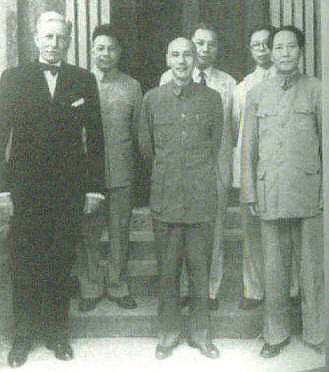 While in Chongqing, Mao Tse-tung impressed China's bourgeoisie class as someone embodying China's future, and one such Democratic League member privately claimed to Mao in saying that Chiang Kai-shek dared to bully his party simply because they possessed no army of their own.
In late Aug of 1945, Mao Tse-tung, who knew no democracy and politics other than tricks and plots of China's twenty-four history chronicles, had given to Liu Yazi a poem [timestamped February 1936] entitled the "Scenery of Northern China" [i.e., Qin Yuan Chun - Xue: Bei Guo Feng Guang] that supposedly had captivated the hearts of the democratic league members. (At the end of the long march, Mao had written another poem which likened himself to the tyrants in China's history, and Mao instructed his top agent in Shanghai, i.e., Li Kenong, in purchasing a complete set of Cai Dongfan's history romance writings.
Caveat: The poems could be back-dated, and some low-level communist cadres, such as Hu Qiaomu, et al.., could be the real authors of Mao Tse-tung's works.)
While in Chongqing, Mao Tse-tung impressed China's bourgeoisie class as someone embodying China's future, and one such Democratic League member privately claimed to Mao in saying that Chiang Kai-shek dared to bully his party simply because they possessed no army of their own.
In late Aug of 1945, Mao Tse-tung, who knew no democracy and politics other than tricks and plots of China's twenty-four history chronicles, had given to Liu Yazi a poem [timestamped February 1936] entitled the "Scenery of Northern China" [i.e., Qin Yuan Chun - Xue: Bei Guo Feng Guang] that supposedly had captivated the hearts of the democratic league members. (At the end of the long march, Mao had written another poem which likened himself to the tyrants in China's history, and Mao instructed his top agent in Shanghai, i.e., Li Kenong, in purchasing a complete set of Cai Dongfan's history romance writings.
Caveat: The poems could be back-dated, and some low-level communist cadres, such as Hu Qiaomu, et al.., could be the real authors of Mao Tse-tung's works.)
On September 4th, 1945, Hu Feng, a follower of Li Dazhao in Peking in the 1920s as well as a member of the JCP in the 1930s, entered the Chongqing city for a dancing party that was supposed to be held for Mao Tse-tung.
Hu Feng had two brief talks with the monster who would launch the "Anti-Hu Feng Movement" in the early 1950s.
Later, Hu Feng also attended Zhang Zhizhong's banquet for seeing Mao Tse-tung off as well as went to the Jiulongpo Airport for seeing Mao Tse-tung's flying back to Yenan.
(Mao Tse-tung returned to Yenan on October 11th, 1945.)
The Communists declined Chiang Kai-shek's demand for the "united military command" and the "united administrative orders", claiming that they were for the 'peace' and 'democracy' while Chiang Kai-shek intended for the 'civil war' and 'dictatorship'. Mao Tse-tung merely agreed to concession of the Communist-controlled untenable areas of Guangdong Province, Zhejiang Province, southern Jiangsu Province, central Anhui Province, southern Anhui Province, Hunan Province, Hubei Province and Henan Province. Militarily, Mao Tse-tung agreed to compress to 48 and consecutively 43 divisions, so that the Communist forces would be amounting to 1/6th and consecutively 1/7th the size of 263 government troops divisions. Chiang Kai-shek stated that they intended to compress the army to 120 divisions, but the Communists refused to lower to 20 divisions.
Mao Tse-tung, at one time, agreed to contract to 28 divisions instead of 12 divisions [which they possessed on paper only, as we already pierced the myth that the Communists ever possessed 300,000+ troops at the time of the
Japanese surrender], but later demanded that he maintained 48 divisions and that the Nationalist Government provide the funding.
The CCP accused the government troops of possessing more officers than soldiers in a division size of 6000 men, bragging that the Communist soldiers of 1.2 million could be equivalent to 200 divisions per the government troops' standards.
Mao Tse-tung further demanded that in the CCP-"liberated" areas, the CCP had the right to recommend their men for the jobs like provincial governor, county magistrate and city mayor.
FYI:
At the end, when Japan surrendered, the communists possessed an army of merely 300,000 and the total number of 140,000 rotten guns --Mao's words.
The Soviet archives, which tracked the actual communist army troops throughout the 1920s to 1940s, pierced the communist myth.
Mao Tse-tung's claim of 1.2 million Communist forces was a crap. The Communists did not have a third of it till well after the Japanese surrender in 1945. The only motive of exaggerating the fake number would be to claim a non-existent Mandate, i.e., support from the peasants, which was fallacious since the Jiangxi Soviet of the 1930s. The popular claim of 900k regulars and 2 million irregulars was made up as well.
Again, remember only this webmaster, who thoroughly browsed historical records in multiple languages from both inside and outside of China, holds the key to truth.
Don't get obfuscated by the fake number of 1.2 million communist troops [such as Li Yunchang's ragtag puppets-staffed 40,000 troops which were reduced to 5000 men after the 1945 Battle of Jinzhou], that Mao wanted Chiang Kai-shek to reorganize into 16 army corps or 48 divisions at the Chungking peace conference.
Hurley's Resignation, and Marshall's Dupe Mission to China
Hurley, seeing that the Communists deliberately refused to concede, threatened to go back to America. Hurley tried to persuade the CCP into giving up the military control in exchange for assumption of ministry and provincial posts within the KMT government.
Without reaching agreements on the "united military command" and the "united administrative orders", Chiang Kai-shek and Mao Tse-tung reached a Double Ten Agreement requiring that the KMT discontinue "xun zheng' (i.e., the KMT supervised administration) and convene a political consultative meeting for "xian zheng" (i.e., the constitutional government).
Hurley, during stopover in Moscow back in April 1945, saw Stalin who misled the U.S. opinion in stating that the CCP were not a true Communist party (but the "Margarine Communists") and the U.S.S.R. had no particular connection with the CCP.
On November 27th, Hurley, who were already fed up with the State Department reinstating the pro-communist staff he fired from the American embassy in Chungking, resigned his posts under attacks by the pro-commie U.S. statesmen.
On the 24th, Truman asked George Marshall to go to China.
Marshall was said to have tendered resignation in August 1945 but did not officially retire till successor Dwight Eisenhower returned from Germany in November.
On November 26th, Marshall delivered a farewell speech at the courtyard of the Pentagon and the next day, drove to his home in Leesburg, which just took hours, and upon reaching home, answered a "pre-arranged" call from Truman while his wife was walking halfway the front stairs for a nap at the bedroom.
Without telling wife Katherine beforehand what he likely discussed with Truman already and defintely talked about with Byrnes on November 26th as to Hurley's possible or forced resignation, Marshall accepted Truman's request with merely three words "Yes, Mr. President" but chose to let the radio announce the news of Marshall's acceptance as the President's "Special Ambassadorial Envoy to China" to his wife at dinnertime.
Purportedly, Truman made the Marshall appointment decision with a curse of Hurley during a luncheon on the 27th, which was just after seeing Hurley at 11:30 a.m., on which occasion Hurley assured Truman that he would return to China after winding up a few personal matters. What happened was that Truman was given a scrap of yellow news copy torn off the White House ticker tape machine, or per Soviet spy Henry Wallace's recollection, purportedly Truman glanced at some news flash and read Hurley's letter of resignation that was released to the press timestamped the prior day, in which Hurley accused the "career men" in the State Department of undermining the Republic of China by siding with "the Chinese Communist armed party" and "the imperialist bloc of nations" (i.e., the British and Soviets), as well as warned of "a third world war in the making". (See pp. 375-376, George Marshall, Defender of the Republic by David L. Roll).
Apparently the fishy matter is: Hurley, who was fed up with Dean Acheson and John Carter Vincent, et al., was talking about resignation like for days, or weeks, or months since September 26th (if not counting the unsent August 25th letter) when he found out that Jack Service and the Soviet agents published internal documents about his China peace efforts on Chicago Sun and Daily Worker, changed mind to promise to Truman that he would go back to China at the 11:30 a.m. meeting on the 27th (as he was busy with James Byrnes on the 26th), but changed mind within one hour to release an annoucement at 12:30 noon,
that was said by David L. Roll to be a resignation letter on a scratched piece to the press timestamped the 26th (if not impromptu on the 27th),
which led to his being "sacked" by Truman in a quick cabinet meeting during or after the luncheon on the 27th.
(Per Russel D. Buhite, Hurley, who left the resignation letter with Byrnes on the 26th but changed mind after repeated meetings with Byrnes who showed a department letter of no-change in the support policies for China, on the 27th read the prior day's evening newspaper to find Congressman Hugh DeLacy's accusation of the Hurley-Wedemeyer gang with stories reminiscent of what transpired in the Amerasia affair, which led to his calling the press headquarters for a press conference at 12:30 p.m.
The press conference did not go ahead the same day as described by Russel D. Buhite but went ahead the second day after what David L. Roll described to be a last meeting with Truman at 11:30 noon.
Per David L. Roll, there was no record that Truman met Hurley at 11:30 on the 27th as he claimed in the memoirs but Truman called Marshall two or three hours after he glanced at the news flash as Wallace recalled and that on the following day (i.e., the 28th) Hurley "gave a press conference at the National Press Club at which time he named names.")
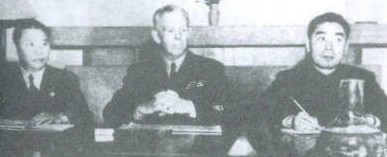 George Marshall was sent to China by Truman on December 16th, a trip taking six days with stopover in Tokyo for a meeting with MacArthur, and accompanied by James Shepley and colonel Henry Byroade.
Marshall could have chosen to leave the United States for avoiding the continuous testimony before the Joint Committee of the Congress, that was investigating the dereliction related to the Japanese attack on Pearl Harbor.
George Marshall had brought with him the "carrot and stick", namely, the U.S. would purportedly support China with huge financial aid should China stop its civil war
whereas the U.S. would rescind any aid should China engage in the civil war.
Namely, a policy to offer U.S. economic and military assistance conditioned on the criteria to be determined or qualified by Marshall that "China moves towards peace and unity".
This was a mandate drafted by Acheson and Vincent but revised by Marshall to stress through the point that the U.S. would not interfere militarily to influence "Chinese internal strife" in addition to stated objectives of brokering a cease-fire, inducing a national conference, bringing about a coalition government, etc., which also served as a memorandum for Wedemeyer to expatriate the Japanese and withdraw the 50,000 U.S. Marines.
Plus what David L. Roll termed two provisos of continuing U.S. support for the Republic of China should Marshall's mediation fail and Chiang Kai-shek's Nationalist government being the only legal government in China.
The two empty-worded provisos' leak was mistaken by Roll to be some determinant in strengthening Chiang's bargaining stance versus the communists.
George Marshall was sent to China by Truman on December 16th, a trip taking six days with stopover in Tokyo for a meeting with MacArthur, and accompanied by James Shepley and colonel Henry Byroade.
Marshall could have chosen to leave the United States for avoiding the continuous testimony before the Joint Committee of the Congress, that was investigating the dereliction related to the Japanese attack on Pearl Harbor.
George Marshall had brought with him the "carrot and stick", namely, the U.S. would purportedly support China with huge financial aid should China stop its civil war
whereas the U.S. would rescind any aid should China engage in the civil war.
Namely, a policy to offer U.S. economic and military assistance conditioned on the criteria to be determined or qualified by Marshall that "China moves towards peace and unity".
This was a mandate drafted by Acheson and Vincent but revised by Marshall to stress through the point that the U.S. would not interfere militarily to influence "Chinese internal strife" in addition to stated objectives of brokering a cease-fire, inducing a national conference, bringing about a coalition government, etc., which also served as a memorandum for Wedemeyer to expatriate the Japanese and withdraw the 50,000 U.S. Marines.
Plus what David L. Roll termed two provisos of continuing U.S. support for the Republic of China should Marshall's mediation fail and Chiang Kai-shek's Nationalist government being the only legal government in China.
The two empty-worded provisos' leak was mistaken by Roll to be some determinant in strengthening Chiang's bargaining stance versus the communists.
Marshall arrived in Shanghai on the 20th and
was told by Wedemeyer of the impossibility to achieve the mission's goals, over which Wedemeyer was rebuked by Marshall with assertion that he Marshall was going to accomplish the mission and he Wedemeyer was going to help him.
Wedemeyer took Marshall's displeasure towards him and resistance to advice as foul mood from travel fatigue and WWII-related wear and tear, something Roll disputed as another apologist.
Marshall's arrival brought about
birth of the so-called trilateral truce panels comprising of the CCP, KMT and U.S. representatives.
Chiang, wary of George Marshall as a personal friend of Joe Stilwell, had to submit to the U.S. demands.
The first major concession by Chiang Kai-shek would be to abandon Jehol and the city of Chihfeng to the Communists after Marshall called on Chiang Kai-shek and Zhou Enlai
for a midnight session on January 9th, 1946.
Zhou Enlai, who was in the know about the Chinese communist agents working under CPUSA, at one time commented that Marshall reminded him of Stilwell.
At the PCC meeting, Chiang Kai-shek announced that China would adopt the democratic principles of the West, with the communist Liberation Daily newspaper applauding it.
Walter S. Robertson was appointed high commissioner for the "Committee of Three" while Henry Byroade chief of staff, with 125 U.S. officers and 350 men assigned to the headquarters set at the Peking Union Medical College.
In early February, George Marshall drafted a plan for "complete reorganization of Chinese military forces"
that a total of 250 KMT and CCP divisions would be demobilized, which ultimatelly led to the two armies "reorganized and integrated into a total of sixty divisions--fifty KMT and ten CCP".
According to David L. Roll, the communists agreed to reduce troops in Manchuria to "a fraction of what they had been when Marshall first introduced his integration proposal", and furthermore relunctantly signed the KMT-CCP agreement in the capacity of an "advisor" with assertion to the effect that he would hang with Zhou Enlai and Zhang Qun if they were "going to be hung". Being flattered as a professor and a midwife of unification, Marshall was to embark on a 3500-mile tour of troubled spots in northern China, purportedly to "explain the terms of the cease-fire and integration agreements to the principal army commanders on both sides" per Roll. The climax was visiting Mao Tse-tung at Yenan on a day, that was U.S. time March 5th, 1946, when former British prime minister Winston Churchill was invited to Fulton, Missouri by President Truman to make the Iron Curtain speech.
Truman already recalled George Kennan to D.C. and decided on a path of confrontation against Stalin but still chose to sacrifice the Republic of China to communism.
George Marshall, a person who had personally pushed for the 1946-47 arms embargo against China and imposed three ceasefires onto the Chinese government [Jan-10-1946, June-6-1946, & Nov-8-1946], could not explain his behavior by merely "naivety". At one time, on February 28th, 1946, Marshall offered to establish a Chinese "West Point" Military Academy for the Communist forces in exchange for Zhou Enlai's signing an agreement for a united forces under a coalition government. As Freda Utley's The China Story [page 14] pointed out, Dean Acheson told the U.S. House Committee on June 19th, 1946 that "the Communist leaders have asked, and George Marshall has agreed, that integration with the other forces be preceded by a brief period of United States training [69 American army officers] and by the supply of minimum quantities of equipment [400 tons]."
Judging by Marshall's September 1950 testimony before the U.S. Senate Armed Services Committee, i.e., pretext that he was merely observing Truman's instructions and policy without personal entanglement, Freda Utley called Marshall's mission as either a 'tool' or a 'dupe'.
Marshall, appearing to be a man who could not live without wife at his side, wrote to
family friend Rose Page Wilson in a January 1946 letter
with confession as to how "downright miserable" he was (p. 314, General Marshall Remembered, Prentice-Hall, 1968), with Rose Page Wilson concerned about the "pressure of the terrible responsibilities he bore".
(It appears that Marshall got acquainted with his future biographer Rose Page Wilson in a suspicious setting of inside an elevator while the latter was a shy teenager.
Rose Page Wilson, being a Marshall apologist for accusation as to Marshall's surrender of Manchuria to the Soviets which caused China to be "lost to us", claimed that the whole Anglo-American echelon was counting on the Soviet efforts to defeat Germany and Japan, citing MacArthur's claim to Forrestal that "a minimum of sixty Red Divisions" could be a forcible campaign in Manchukuo and "free the United States to reserve its strength for the Japanese mainland".
Rose Page Wilson took Marshall as modest in not penning a biography; however, Katherine wrote one during Marshall's absence, i.e., Together: Annals of an Army Wife.)
Per Rose Page Wilson,
in April (should be early March), a self-admitting "unhappy and homesick" Marshall returned to the United States, apparently for fetching his wife but ostensibly "to seek the loan for China", i.e., a loan of 500 million U.S. dollars that was never granted because of what Rose Page Wilson claimed to be Chiang Kai-shek's vehement back-to-arms speech before the American "negotiations with the Chinese ambassador here were completed" (p. 312).
Per Roll, Marshall on April 2nd received Madame Chiang's telegram of "I hate to say 'I told you so.'"
Marshall, after some quick meeting with Stimson one Saturday afternoon, a business meeting Sunday morning, and congressional hearings the following week, rushing-through visits to the State Department and the White House, returned to China on April 18th.
But no record of Marshall's visiting the Treasury Department concerning this loan which should be with the Export-Import Bank per Wellington Koo.
While Marshall was scheming to impose an arms embargo against the Republic of China, the Soviets hastened up their military support for the Chinese communists.
On May 20, 1946, the CCP Northeast Bureau reported to the CCP Central that the Soviet Russian Army firmly supported the communist Northeast Field Army to make a stand at Siping (Szepingkai), for a duel, and they had directed the Soviet Army in [North] Korea to render the immediate emergency shipment of ammunition [to the Chinese Communist armies], and further suggested that the Chinese Communists, for taking off the pressure of the government troops' assault [on Siping and] within the Northeast, [proactively - I added] launch the battlefields within the China proper, organize the maritime transport for the delivery of weapons and ammunition to the Shandong peninsula from the northeast. The Soviets claimed that no matter how much weapons and ammunition the Chinese Communists demand, they would be satisfied. Immediately afterwards, the Soviet Army in Communist North Korea provided the first batch of weapons and ammunition to the communist North China Field Army. On May 28, 1946, the first batch of 82 light machine guns, 32 heavy machine guns, 43 million rounds of ammunition and one million boxes of explosives and a large number of electrical materials, were shipped to Shandong over the sea. Already in early June to late in the month, there were three deliveries. Afterwards, the delivery became more frequent, the numbers even greater. By August, the rifles had reached tens of thousands, up to thousands of machine guns, and at the height [till August 1946], the Soviet Army in North Korea provided hundreds of train carriages of weapons and ammunition.
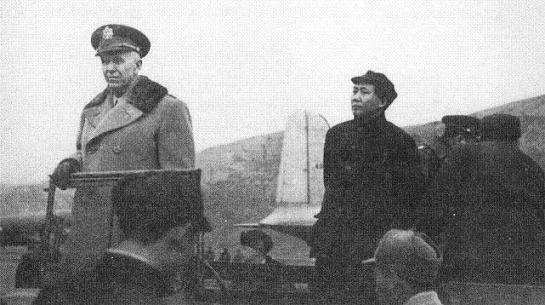
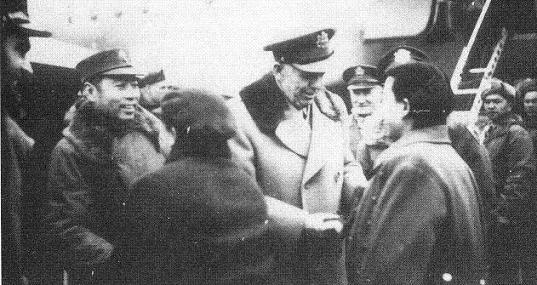
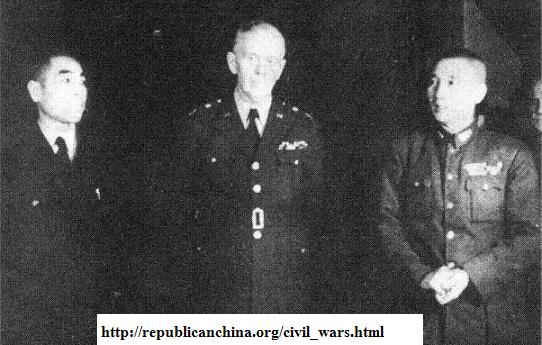
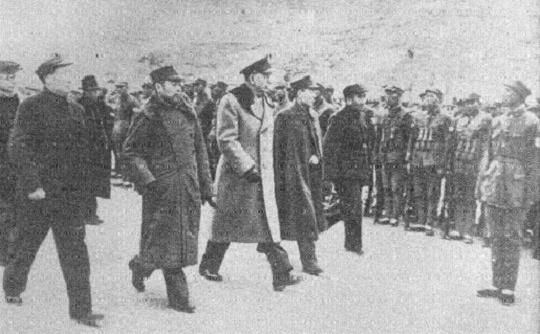
The Nationalist Government's Military & Economic Blunders
Gu Zhutong's troops as well as Wang Yaowu & Tang Enbo's front armies, i.e., the ROC's crack army, totaling 300,000, stayed on for ten months in the Nanking-Shanghai area, facing the Communist New Fourth Army across the Yangtze, and doing nothing till July 1946 --all because of George Marshall's truce orders.
The government troops, on the other hand, suffered a hit in moral when undergoing the military shrinkage, with numerous officers and generals staging protests and committing suicides in Nanking, the nation's capital.
Chiang Kai-shek's Nationalist Government had apparently overestimated the capabilities of the Communist troops whose so-called 'crack' force had in fact embarked on a long distance journey to Manchuria throughout late 1945.
Chiang Kai-shek did not have the courage to launch a civil war after the eight-year-long devastating resistance war, albeit issuing a hollow order to the Communist-controlled 18th Group Army [i.e., the Eighth Route Army] in cease-and-desist as to acceptance of the Japanese surrender. The "exclusive surrender acceptance" order was just a copy of MacArthur's Supreme Command Center order, which the Communist side had reason to object to. The Communist routing of Sun Lianzhong's three Corps of miscellaneous provincial army nature, facilitated by Gao Shuxun's defection, did not ring a bell on Chiang Kai-shek's mind, not to mention a necessitated investigation as to why Liu Fei of the Defense Department had ordered the doomed troops to move through the Communist-dominated Ping-Han Railway in lieu of a circumvential trip via the Long-Hai and Jin-Pu Railways.
Owing to Xiong Bin's efforts, the Nationalist Government had begun the process of pacifying the puppet troops since the spring of 1945. The puppet troops in Manchuria, however, were not specifically included for the pacification projects. Right after the sudden surrender of Japan in Aug 1945, the majority of the puppet troops in Northern and Central China immediately took initiatives in policing and defending the major provincial cities against the Communist troops, with the end result that only a few cities like Shijiazhuang and Yantai (Chefoo) fell into the Communist hands. (The communists took over Kalgan, as a result of Marshall's pressure on Chiang Kai-shek.
The takeover of Chefoo and Kalgan allowed the communists to use the nexus to ship a huge amount of the Soviet weapons and ammunition to the communist armies in China proper.)
In towns and counties, the "huan-xiang-tuan", i.e., the gentry-organized brigands, managed to return before the government troops. In the atmosphere of massive post-war confusion as well as the government's passivity to sub-provincial towns and counties, the gentry-organized brigands would be wiped out by the Communist troops in a matter of months.
The mandatory Currency Conversion Rate
Chen Lifu's recollections pointed out that Finance Minister Soong Ziwen (Tse Vung Soong)'s assistant was an undercover Communist who had Soong Ziwen adopt several predatory currency, bond and security conversion policies.
This would be the CPUSA spy Ji Chaoding, one of the Tsing Hua (Qinghua) University class 1925 gang who worked in the U.S. and Cuba under CPUSA and designed the United States' China policy while being harbored by Owen Lattimore in the Institute of Pacific Relations, a Baltimore University professor without a college degree, whom the Chinese communists lovingly called Professor La-ti-mo-er.
Finance Minister Soong Ziwen (TV Soong)'s assistant, an undercover Communist, devised the mandatory currency conversion rate for the populace in Occupied China to convert to the ROC legal tender, which was taken as a measure robbing the people of wealth.
The mandatory currency conversion rate threw the Chinese people in the former Japanese-occupied territories into across-the-board bankruptcy.
(Suzanne Pepper et al., i.e., John Fairbank's disciples, only saw the surface of the issue by repeatedly touting the 'political' factor of Nationalist China's collapse without a slight regard for the Russian and Anglo-American conspiracies against the Republic of China. Pepper's perspective could best be seen in her description of the Shen Chong 'Rape' Incident.
As Shen Chong, who emigrated to the U.S. under an alias, had confessed, the Chinese communists staged the American marine's 'rape' to fan up the anti-American protests across the nation.
Shen Chong, after the communists' taking power, admitted in the early 1950s that she was an undercover communist.
That is, the whole matter as a set-up to fan the anti-American movement.)
Blunders of the Nationalist Government "Take-over" Officials and Officers
The Nationalist government "take-over" officials and officers often mechanically enforced the confiscation policies against the Japanese-robbed and the puppets' properties and assets.
While the communist propaganda often accused the "take-over" officials and officers of embezzlement, the truth was that the properties and assets, that were taken from the Japanese and the puppets, were often slapped with 'feng [sealed] tiao [slips]', i.e., the rubber-stamped slips of paper that were pasted onto the doors of the properties and assets.
Numerous memoirs talked about the status of the properties and assets in the sealed status years after the Japanese surrender.
This in an alternative way shed some light on the so-called corruption of the nationalist government officials as over-exaggerated.
E.g., the Peking Steel & Iron Works was ordered to be shut down against the Japanese engineer's objection, which led to the two furnaces being frozen with raw iron till after the Communist takeover of the Peking city in 1949.
The nationalist government's 'take-over' officials simply enforced the take-over or the assumption order in a mechanical way.
The economic blunders, i.e., in the form of freezing all assets (i.e., factories), had the effect of stopping production, which led to the economic stagflation and depression that was exacerbated by the raging civil wars.
By 1948, the nationalist government had another economic blunder, namely, the Golden Yuan currency reform, with the victims being the faithful and loyal ROC government officials and citizens in the cities.
Why so?
Because Republican China, by 1948, had already lost control of the legal tender ('fa bi'), with no paper money in circulation in the small towns or the countryside.
The civilian life across the country was back to the primitive barter economy, without the usage of the paper money, and often resorting to the copper coins of the early Republican or the Manchu eras.
The faithful and loyal ROC government officials and citizens in the cities, who surrendered the gold, hence became the only victims.
The above gold became part of Republican China's only hard currency at the time of the defeat on mainland China, with some
transported to Taiwan. The total amounts, per Chiang Kai-shek's attaché's recollection, would be:
2,600,000 ounces of gold in Taipei;
900,000 ounces of gold in Amoy;
380,000 ounces of gold in the U.S.A.;
200,000 ounces of gold in Shanghai;
and
another 400,000 ounces of gold as the turnover funds in Shanghai.
The Race For Control of Manchuria
On Aug 9th, 1945, Mao Tse-tung, who had engaged in over four year long political purge movements in Yenan, i.e., Rectification Movement (1942-1945), quickly gave a speech entitled "The Final Battle Against Japanese". On Aug 10th, Zhu De, Communist commander-in-chief for the Eight Route Army, issued No. 1 Order, calling on the Eight Route armies, New Fourth armies, Communist militia, and Communist guerrillas to attack the Japanese and the puppets and to recover the territories. On the 11th, Zhu De issued Order No. 2, with instructions that Lü Zhengcao attack Cha-ha-er and Re-he from Shanxi and Suiyuan, that Zhang Xuesi (i.e., Zhang Xueliang's brother) attack Re-he and Liaoning from Hebei and Cha-ha-e, that Wan Yi attack Liaoning from Shandong and Hebei, and that Li Yunchang relocate to Liaoning and Jilin from Re-he (Jehol) and Liaoning. (Note that Lü Zhengcao, Zhang Xuesi and Wan Yi, et al., were all former Manchurian army generals who were undercover communists). Should Chiang Kai-shek not commit the personal blunder in putting Zhang Xueliang under house arrest, the CCP would not easily win over former Manchurian militarymen. Though, Zhang Xueliang recalled that his brother had already fallen into a Communist prior to the Xi'an Coup.
Per Zhang Zhenlong, the CCP Central's 2nd order to Lü Zhengcao, Zhang Xuesi and Wan Yi, though published on the CCP's "The Liberation Daily" on the 12th, were all fakes to deceive the nation. The internal Communist order was that Li Yunchang's loyal Communist troops immediately depart for Manchuria. Wan Yi would not board ship at Huangxian of the Shandong Peninsula for Manchuria till September 24th, 1945.)
The only communist army that was sent to Manchuria would be Li Yunchang's Jehol district force, which had an enclave north of the Peking city, an area that the communists had secured after amassing the troops from several military districts to ambush and annihilate Zhao Tong's Jehol Vanguard Army in the Hebei-Henan border area.
On Aug 13th, the Communist party committee for Hebei-Rehe (Jehol)-Liaoning regions sorted out the following for Manchuria dispatchment: 8 regiments, 1 battalion, and two contingents, totaling 13,000 men or 2/3rd of the regional force, to be commanded by four commanders for military sub-district, four CCP regional secretaries and 2500 cadres. The first echelon, comprising of the 14th, 15th & 16th military sub-districts, and the second echelon, comprising of the Hebei-Rehe (Jehol)-Liaoning main military district, exited the Great Wall and entered Rehe (Jehol) and Manchuria in late Aug of 1945.
Using the headcount of 13,000 men or 2/3rd of the regional force for a major communist army lieutenant like Li Yunchang, you could roughly derive a total communist army of about 300,000 at the time of the Japanese surrender, by estimating the figure of the communist divisional commanders in total.
The 16th military sub-district, at the Shanhaiguan Pass [aka the Mountain & Sea Pass], fought the Japanese who were under order to surrender to the Allied Army & Nationalist Government Army. Note that on Aug 15th, 1945, the Japanese emperor already decreed an end of war via radio, agreeing to unconditional surrender and that the surrender ceremony was held on battleship Missouri on September 2nd. The Communists, per the wording Mao Tse-tung used in his accusation of Chiang Kai-shek, were merely hastening up for the "peach", i.e., the fruits of war victory.
Per Zhang Zhenlong, Zeng Kelin & Tang Kai of the 16th military sub-district of the Ji-Re-Liao [Hebei-Jehol-Liaoning] Military District arrived in Shenyang (Mukden), & Benxi in early Sept, while Li Yunchang's troops arrived in the Shanhaiguan Pass, Jinzhou & Shenyang (Mukden).
The 16th military sub-district troops, within two months, developed into over 100,000 forces on basis of the original 13,000 army.
Li Yunchang, in late 1945, suffered a complete debacle in the hands of the nationalist 52nd Corps and the 13th Corps, with his 40,000-strong fake communist army reduced to 5000 men after the Battle of Jinzhou.
On September 7th, Liu Shaoqi ordered that the Communist cadres in the Hua-zhong [Central China] Bureau sort out the staff of Manchurian origin for Manchuria.
This was already like one month after the Japanese surrender, something undertaken communist deputy Liu Shaoqi in Mao's absence.
On September 11th, Liu Shaoqi ordered that the Communist Shandong Province Sub-bureau sort out 30,000 people or 12 regiments for crossing the sea to Manchuria under Xiao Hua's command. (Per Zhang Zhenlong's citation of the PLA Archive Bureau document, the CCP Central's order was for Shandong to sort out 4 divisions after the Shandong Sub-bureau reported findings from spies sent to Manchuria.)
In Yenan, top cadres like Zhang Qilong, Cheng Shicai, and Wu Jinnan, who were originally destined for the New Fourth Army in the south and guerrilla forces in Guangdong, changed course for Manchuria.
On September 14th, a rep of the Russian commander at Changchun [Rodion Yakovlevich Malinovsky (i.e., Ma-li-nuo-fu-si-ji)] arrived in Yenan with Zeng Kelin the head of the CCP contingent dispatched to Manchuria in August 1945.
The CCP Central held a whole night meeting, with a decision to prepare 100 regiments worth of Communist cadres for Manchuria.
On September 17th, Liu Shaoqi wired to Mao Tse-tung who was still in Chongqing, proposing his policy of "pushing northward and defending southward". Liu Shaoqi proposed that the CCP's New Fourth Army in Zhe-dong, Su-nan & Wan-nan cross the Yangtze back to the north bank, the CCP's New Fourth Army in Wan-bei & Su-bei enter Shandong, and 100,000 New Fourth Army & Eight Route Army in Shandong-Hebei relocate to eastern Hebei Province and Manchuria. Alternatively, Liu Shaoqi proposed to have the CCP's New Fourth Army fill the vacancy of Shandong while the Shandong Communist forces relocate 100,000 men to eastern Hebei Province and Jehol [Rehe] Province.
Mao Tse-tung, in subsequent wires, concurred with Liu Shaoqi.
Liu Shaoqi officially drafted the "pushing northward and defending southward" document on the 19th, which was a reverse of the Communist direction in a matter of 40 days Per Zhang Zhenlong.
Per Zhang Zhenlong, after the announcement of the Sino-Russian friendship treaty on Aug 26th, 1945, the CCP Central studied the intricacies and then decided to send a cadre corps to Manchuria, consisting of 145 people led by Lin Feng.
On October 1st (?), 300 Communist cadres, including the "Rectification Movement" offenders, walked their way towards Manchuria.
Among them, immediately dispatched to Manchuria would be about 100 "serious offenders" of the Yenan Rectification Movement that Chen Gang [aka Liu Zuohu] and Chen Long brought along on their barefoot trip to Manchuria on November 9th, 1945 [??? arrival date or departure date].
(The remainder of "serious offenders" of the Yenan Rectification Movement, about hundred, including Wang Shiwei, were executed on the way of fleeing the government troops' attack in 1947.
The Shanxi communist district conducted a round of killings as well.
Among the same batch of killings would be four foreigners, i.e., three Russians and one Serbian(?), who were caught by the CCP in early 1944 while trekking through the communist territory, with the corpses buried in a well in Yongping of Shanxi Province.
Another 300-400 captives, deemed "less-than-serious offenders", were freed in 1946 and re-assigned jobs.)
In Chaoyang, the Communist guerrilla had been dispatched from the Jinzhou city for capturing and executing the Nationalist government's county leader who opened up a competing office against the Communist elements the second day after the Russian Red Army's arrival.
Zhang Shouyu took charge of the county affairs till being ordered to yield the town to the Nationalist government on January 14th, 1946 [i.e., after the Truce [that covered China proper, not Manchuria - since the Soviets and the Chinese communists denied activities in Manchuria] took effect on January 13th].
After the Nationalist Army came, Zhang Shouyu went into the guerrilla warfare till the Communists' victory in the bloody Jinzhou Campaign on October 15th, 1948. Certainly, the Chaoyang town was recovered earlier, i.e., in the spring of 1947, when the Communists acquired the control over the vast countryside and isolated the Nationalist armies in three major cities of Jinzhou, Changchun and Shenyang (Mukden).
The communists, after the debacle at the April 1946 Battle of Siping (Szepingkai), had resorted to the land reform to kill the landlords for sake of recruiting the peasants, as the red-handed accomplices and murderers, to build the 'crack' 8RA/N4A armies that were decimated.
Lin Biao, at first seeing the Northeasterners' reluctance to join the communist army, commented that the Northeasterners were so meek and like sheep, till the 1947 land reform stirred up the animal spirits of the Northeasterners in killing the landlords.
The communists claimed to have recruited an army of 1.6 million within four years in addition to mobilization of a logistic auxiliary support horde of 3.13 million civilians in Manchuria, namely, the fodder that the communists never hesitated to push against the fire power of the nationalist army during the civil war.
 A new round of the land reform and eliminating the "class enemies" [i.e., landlords who either organized the local gentry force or collaborated with the Nationalist army] were conducted for sake of assuring the peasants that those landlords would not become "huan-xiang-tuan", i.e., the landlord gentry-organized brigand who returned to home village for retaliation against the peasants who ate the grains from the landlords' barn.
One such landlord, by the name of Jin Tingquan, was executed via burning alive at the Liujiazi Village in the Chaoyang county.
Through December 1947-February 1948,
Kai-feng (Heh Kaifeng), who took over the CCP Northeastern Bureau's land reform in the absence of Gao Gang who travelled to Jehol to censure Cheng Zihua's purported leftism and rightism mistakes, was responsible for executing and murdering over 100,000 people in merely several counties alone near Harbin of northern Manchuria per Li Rui.
The large scale over-killing was halted with the advent of the Communist decree in February 1948.
(Shi Zhe's Memoirs carried a dialogue in 1948 between Mao Tse-tung and Heh Long in regards to the 1947 whole-sale massacre of landlords across the communist-controlled territories, in which Mao Tse-tung claimed that the prior year's over-kill could be a leftist mistake while Heh Long rebutted Mao, saying: "Isn't it a good thing to do it [killing] as a side job to the land reform?" See how the mass murderers treated the human life !)
A new round of the land reform and eliminating the "class enemies" [i.e., landlords who either organized the local gentry force or collaborated with the Nationalist army] were conducted for sake of assuring the peasants that those landlords would not become "huan-xiang-tuan", i.e., the landlord gentry-organized brigand who returned to home village for retaliation against the peasants who ate the grains from the landlords' barn.
One such landlord, by the name of Jin Tingquan, was executed via burning alive at the Liujiazi Village in the Chaoyang county.
Through December 1947-February 1948,
Kai-feng (Heh Kaifeng), who took over the CCP Northeastern Bureau's land reform in the absence of Gao Gang who travelled to Jehol to censure Cheng Zihua's purported leftism and rightism mistakes, was responsible for executing and murdering over 100,000 people in merely several counties alone near Harbin of northern Manchuria per Li Rui.
The large scale over-killing was halted with the advent of the Communist decree in February 1948.
(Shi Zhe's Memoirs carried a dialogue in 1948 between Mao Tse-tung and Heh Long in regards to the 1947 whole-sale massacre of landlords across the communist-controlled territories, in which Mao Tse-tung claimed that the prior year's over-kill could be a leftist mistake while Heh Long rebutted Mao, saying: "Isn't it a good thing to do it [killing] as a side job to the land reform?" See how the mass murderers treated the human life !)
Collusion With the Russian Red Army in Manchuria
On September 5th, soldiers from the communist 16th military sub-district, consisting of the 12th regiment and 2000 men ethnic Korean contingent, arrived in the Shenyang (Mukden) city where they were first forbidden from leaving train by Russian commander Ka-fu-dong.
The 2000 men ethnic Korean contingent could be very likely the ROC-trained-and-funded Korean Restoration Army that was steered to the communist side from Chungking, i.e., the result of the Soviet-agent-hijacked American OSS's scheme to purportedly equip the Koreans for the behind-the-enemy operations in Manchuria and Korea.
After CCP cadre Zeng Kelin negotiated with the Russian three times, the Communist forces were allowed to station in Sujiatun, about 15 kilometers away from Shenyang (Mukden). While the Communist forces were marching on the streets of Shenyang (Mukden) with two Russian armored vehicles leading the way, hundreds of thousands of Chinese citizens, not knowing the KMT-CCP rivalry, swamped onto the streets to show their welcome. Daunted by the Chinese fervor, the Russian commander changed order to allow the Communist forces stay at Xiaohe district, next to the former Manchurian palaces in the center of the city. On the afternoon of September 7th, Col. Gen. A. G. Kravchenko [Ke-la-fu-qin-ke, i.e., the Russian commander for the 6th Guards Tank Army of the Trans-Baikal Front:
Hind Lake Baikal Flank Army & 6th Tank Group Army) invited the CCP over for a talk after receiving instructions from Stalin and Molotov.
Thereafter, the Communists set up the "Shenyang (Mukden) Garrison Command Center", with Zeng Kelin as commander and Tang Kai as commissar.
Feng Zhijun, in "Mao Tse-tung & Liu Shaoqi" (Huangfu International Publishing House, HK, April 1998 Edition), pointed out that Zeng Kelin's contingent lost contact with the CCP's Yenan headquarters as a result of low power of the telegraph set.
On September 14th, the Russian commander at Changchun, Malinovsky, wished to contact the CCP. Hence, the Russian dispatched a representative for flying to Yenan together with Zeng Kelin.
The Russian colonel told Zhu De that the Russian Red Army wished that the CCP forces exit the cities occupied by the Russians and that the CCP could resolve their internal disputes with the Nationalist government after the Russian Red Army vacate Manchuria.
To appease the Russians, Liu Shaoqi instructed that the CCP forces evacuate from big cities like Shenyang (Mukden), Changchun, Shanhaiguan, Yingkou and Dalian nominally, fake evacuation by leaving cities noisily and re-entering the cities noiselessly, and uphold a banner other than the Eighth Route Army.
The CCP, with the absence of Mao Tse-tung who earlier flew to Chongqing for peace talk with Chiang Kai-shek under Hurley's personal escort and protection, decided to establish the CCP Northeastern Bureau, comprising of senior leaders like Peng Zhen, Chen Yun, Lin Pei, Cheng Zihua, Wu Xiuquan and Ye Jizhuang. CCP leader Liu Shaoqi struck a deal with the Russian rep in having the CCP forces take over the Jinzhou prefecture of 14 counties in western Liaoning Province as well as Rehe (Jehol) Province from the Russian custody. The CCP also made a strategy of dispatching reinforcements to Manchuria.
On the night of September 15th, Liu Shaoqi also ordered that the CCP enclaves of Hua-zhong [central China], Shandong, Jinn-Cha-ji [Shanxi-Chahar-Hebei], Jinn-Cha-lu [Shanxi-Chahar-Shandong] surrender officers from platoon chief to regiment chief, making up a number who would be enough to command 100 regiments.
With the Russian acquiesce, the CCP second echelon entered the Shenyang (Mukden) train station on September 16th, encountering a welcome party of 300 Russians. The CCP received Japanese weapons from the Russians, i.e., about 100,000 guns and thousands of cannons in Shenyang (Mukden)'s weapon depots.
On September 17th, the CCP Northeastern Bureau commissars flew back to Manchuria with Zeng Kelin on the same Russian plane. On the 19th, the CCP Northeastern Bureau stipulated plans for establishing a 'democratic' government at various levels as well as launching the rent reduction movements in the Manchurian countryside.
Liu Shaoqi ordered a blockade of Zhangjiakou [Kalgan] and Shanhaiguan for sake of stopping the Government troops from entry into Manchuria.
Liu Shaoqi additionally instructed that 50,000 Communist forces control coastal Manchuria, from Yingkou to Dalian and Lüshun, in the attempt of preventing the Government troops from amphibious landing along the coast.
Liu Shaoqi called for a total of 150,000 personnel to be relocated to Manchuria as well as 200,000 soldiers to be recruited inside of Manchuria.
In his wire to Mao, Liu stated i) that Jinn-Cha-ji [Shanxi-Chahaer-Hebei] and Jin-Sui [Shanxi-Suiyuan] possessed enough forces against Fu Zuoyi & Ma Zhanshan; ii) that Shandong would dispatch 30000 for clearing eastern Hebei, Rehe (Jehol) and Jinzhou of Liaoning Province; iii) that Shandong dispatch another 30000 to Manchuria; iv) that the New Fourth Army in eastern China district dispatch 80000 to Shandong & eastern Hebei; v) that the CCP forces in eastern Zhejiang relocate to southern Jiangsu and the CCP forces in southern Jiangsu and southern Anhui cross the Yangtze, with an aim of 30-35,000 men; vi) that seven divisions in central and southern Anhui Province could dispatch 20000 men for avoiding the incoming Nationalist government troops [Gui-xi occupation forces]; and vii) that Jin-Ji-Lu-Yu [Shanxi-Hebei-Shandong-Henan] encumber the northbound Government troops and dispatch 30000 for eastern Hebei and Manchuria by Nov.
Liu further stated i) that he had established the CCP Ji-Re-Liao [Hebei-Rehe (Jehol)-Liaoning] Bureau, with Li Fuchun acting as secretary and Lin Biao acting as commander; ii) that the CCP Shandong Bureau renamed to the Hua-dong [eastern China] Bureau, with Chen Yi & Rao Shushi in charge; and iii) that the CCP Hua-zhong [central China] Bureau be downgraded to sub-bureau to be under the Hua-dong [eastern China] Bureau.
The Hua-dong [eastern China] Bureau would take charge of 5 military districts. The CCP Hua-zhong [central China] Bureau would be under Zhang Dingcheng, Deng Zihui and Zeng Shan.
On September 20th, Liu Shaoqi pressed on the Shandong Bureau in organizing 200-300,000 men for Manchuria within 2.5 months and another 50-100,000 men for placement in between Hebei and Manchuria.
On September 29th, Liu Shaoqi changed order to have the communist Shandong troops cross the Bohai Sea against American warships' patrolling.
Wu Xiuquan was dispatched to Lüshun for negotiations with the Russian Red Army, while Wan Yi, Wu Kehua, Wu Dapeng and Xiao Hua were ordered to cross sea immediately for logistics.
Liu Shaoqi, after finding out that the Americans had landed in Tianjin, would order that the Communist forces to cross the sea for Manchuria at nights.
Per Zhang Zhenlong, the Communists did not disclose the destination of Manchuria but to the regiment level commanders.
Other than the Communist Ji-dong [eastern Hebei] district, most of the army were blindfolded till half way or boarding ships at the coastline.
At Linyi of Shandong, Chen Yi assembled company level officers and relayed a Mao Tse-tung notice that the place they were going would be a "colorful" world where there were light bulbs, storey houses, gold and silver but he added that "Chairman Mao did not tell him [Chen Yi] where that place was".
Qu Bo, a communist writer of novels such as Shan-Hu Hai-Xiao (wuthering mountains and tsunami) and Lin-Hai Xue-Yuan (sea of forests and plains of snow), boarded the ship in October 1945 for Manchuria, for example, later joined the 1947 'banditry' quelling campaign (a communist effort to stamp out the anti-communist forces throughout Northern Manchuria -which gave Qu Bo the raw data to write his novel 'sea of forests and plains of snow', and broke his right leg in the 1948 siege of Jinzhou.
--Qu Bo, in novel Shan-Hu Hai-Xiao which depicted a Shandong middle school principal who led his students into a guerrilla war against the Japanese, talked about the split of the classmates into two camps, with the communist taking over the student army in the fight against 'wan [stubborn] jun [army]', i.e., the government troops.
Like forger Mo Yan (Guan Moye), i.e., year 2012 Nobel literature prize winner with the novel Red Sorghum, Qu Bo fell into the same brainwashed communist mindset and covered up the Chinese Communists' bloody purge of the patriotic guerrilla armies throughout the Shandong peninsula.
Using the communist coined term 'wan [stubborn] jun [army]' for the government troops, the communist army, during the resistance war, systematically massacred the gentry-organized guerrilla army, the government guerrilla army, the village elderlies and the government behind-the-enemy-line officials, not to mention the communist self-inflicted purge of the communists who were accused of being Trotskyites.
The most heinous notoriety included the communist campaigns against the government war zone troops in Shandong and Jiangsu provinces, with the end result being that the communists acted as railway guards for the Tientsin-Pukow Railway in peaceful co-existence with the Japanese army.
The communists fabricated a so-called railway guerrilla force that was centered around Zaozhuang of Shandong Province, with main activities like 'ba1' or stripping the trains, namely, pilfering the Japanese supplies transported on the trains --that was made a movie and a TV series for the entertainment of the buffooned populace.
(This webmaster once had a dream about high school teacher leading the classmates into the guerrilla war.
After reading about the communist purge of the patriotic student army in Mt. Daqingshan, near the Chahar-Jehol area, this webmaster realized that what Qu Bo depicted in novel Shan-Hu Hai-Xiao, a schoolmaster leading the students in a guerrilla war against the Japanese, happened exactly at Mt. Daqingshan or the ancient Mt. Yinshan the Huns' habitat, and had happened across the country.
Namely, patriotic schoolmasters and their student army all fell victims to the communists' killing which was solely for control of the armed forces and people, not for fighting the Japanese.)
Along the way to Manchuria, innumerable Communist soldiers and officers deserted the army.
On September 25th, Lin Biao & Xiao Jingguang, in a wire to Luo Ronghuan, emphasized the importance of preventing the 100,000 Shandong Province Communist army from dessertation.
An example of the extent of dessertation would be Zhang Zhenglong's citation of Huang Kecheng's 15 November 1945 telegraph in which Huang disclosed that the 3rd Division of Northern Jiangsu Province army had retained about 28,000 soldiers out of the original size of 32500 upon arrival at eastern Hebei Province.
Zhang Zhenglong cited the CCP Central order of secrecy dated September 2nd as another cause, which was to avoid divulsion of the scheme to the Nationalist government.
On October 1st, 300 Communist cadres, including the "Rectification Movement" offenders, walked their way towards Manchuria.
On October 7th, Liu Shaoqi ordered that Lin Biao, who was originally dispatched to eastern Hebei Province, depart for Manchuria immediately.
(Lin Biao, back in 1942, during a stopover in Xi'an while coming home from the medical treatment in the Soviet Union, had a meeting with Hu Zongnan, i.e., a Whampoa classmate.
Hu Zongnan secretly called over spy chief Dai Li to Xi'an, where Lin Biao, Wen Qiang and Dai Li had an undisclosed meeting, something that Taiwan was to find out after the news of Lin Biao's death in a plane crash in Mongolia in the early 1970s.
Lin Biao's communication line with Dai Li was apparently lost after Dai Li's death in the plane crash.
Taiwan deputy spy chief Weng Yanqing confirmed that Lin Biao sent three letters to Chiang Kai-shek in 1966 through former Whampoa classmate Xiao Zhengyi's relay to retired KMT general Zhou You in Hongkong.
The liaison between Lin Biao and the government agents was not restricted to this secret meeting. In 1948, Chen Gongshu had asked a retired Whampoa classmate to travel to Manchuria to meet with Lin Biao and Tao Zhu, which could be cause of Lin Biao's loitering between Sipingjie and JInzhou for half a year as well as Lin Biao's request with Mao to go west to Jehol --an accusation that was widely published in Communist China during the later cultural revolution time period.
Tao Zhu purportedly obtained Lin Biao's agreement and sent a letter to Taiwan during the cultural revolution.
Tao Zhu, who was detained on the Whampoa island during the April 1927 KMT-CCP split, was not killed as the communist propaganda said about the batch of Whampoa cadets under detention on the Whampoa Island, and en route of returning north from Canton, met Chen Gongshu on a train.)
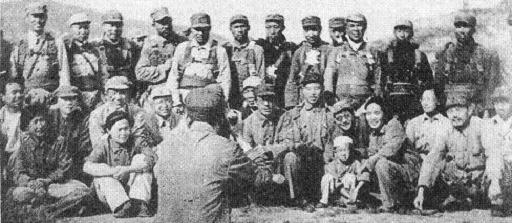
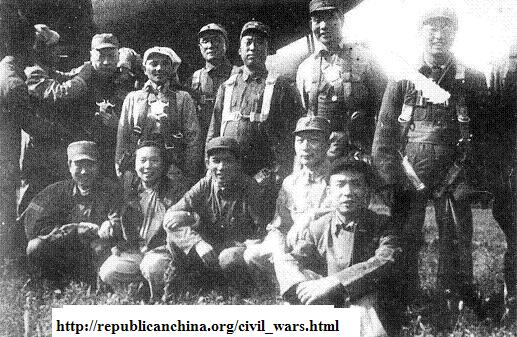 Prof Chen Yongfa produced a photo showing that Lin Biao, wearing a parachute, had flown to the east to fight the civil wars on board of the American advisers' airplanes.
Mao, from 1942 to 1945, launched a three-year "political study" to root out the Moscow influences. The first-tier CCP generals, one by one, were recalled to Yenan for studies, to the extent that they were stuck in Yenan when Japan surrendered and had to rely on the Americans for flying them out.
(However, Lin Biao's original task was not to go into Manchuria, but to lead the civil wars in northern China.)
Prof Chen Yongfa produced a photo showing that Lin Biao, wearing a parachute, had flown to the east to fight the civil wars on board of the American advisers' airplanes.
Mao, from 1942 to 1945, launched a three-year "political study" to root out the Moscow influences. The first-tier CCP generals, one by one, were recalled to Yenan for studies, to the extent that they were stuck in Yenan when Japan surrendered and had to rely on the Americans for flying them out.
(However, Lin Biao's original task was not to go into Manchuria, but to lead the civil wars in northern China.)
Mao Tse-tung returned to Yenan on October 11th.
Zhang Zhenglong pointed out that by early Oct, Xiao Hua, with the administrative staff of the Communist Shandong Military District, arrived at Andong [Dandong], i.e., the Yalu River mouth; that Sha Ke's 31st regiment of Ji-zhong [Central Hebei Province] arrived in Jinzhou; Wan Yi, with the Northeast Penetration Contingent of about 3500 soldiers, came to Panshi, Hailong, Dongfeng & Xifeng; and Lü Zhengcao arrived at Shenyang (Mukden) with a regiment of about 600 soldiers.
Further, Per Zhang Zhenlong, by late Oct, Wu Kehua & Peng Jiaqing, with two regiments of the 6th & 5th Division of the Communist Shandong Military District, arrived in Yingkou with 8000 soldiers; Yang Guofu's Shandong 7th Div or 6000 soldiers, arrived at the Shanhaiguan Pass; Liu Qiren's 6000 soldiers arrived at the Gubeikou Pass; Liu Zhuanlian & Yan Fusheng's 359th brigade or 3000 soldiers arrived at Benxi & Hushun; Deng Keming's regiment from Ji-Lu-Yu [Hebei-Shandong-Henan] arrived in Shenyang (Mukden); Wen Niansheng's constabulary brigade from Shaan-Gan [Shenxi-Gansu] came to Jinzhou with 3000 soldiers.
The so-called communist 'crack' forces, which did not fight the Japanese but the government troops during the resistance war, would soon be spent at the Battle of Sipingjie.
On October 30th, at the suggestion of Liu Shaoqi, the CCP established the "Northeastern People's Autonomous Army", with Lin Biao conferred the post of commander-in-chief the next day and Lü Zhengcao, Li Yunchang, Zhou Baozhong and Xiao Jingguang as deputy commanders. Peng Zhen, Luo Ronghuan and Cheng Zihua acted as the CCP Bureau Commissars. Ten military districts were set up in Manchuria.
Lin Biao, who returned to China from Moscow on October 20th, was recorded to have picked the Communist cadres for Manchuria.
The reason that the Communists had to dispatch a large number of cadres to Manchuria was that the Manchurian people, who were under 15 years of Japanese colonial rule, had straightforward longing & loyalty for the Nationalist government without knowing any Nationalist evil while the Communists had basically perished under the stringent Japanese crackdown.
Per Zhang Zhenlong, in early Nov, Luo Ronghuan led 4000 Shandong district army to Andong; and Luo Huasheng led 7500 soldiers from the Shandong 2nd Division to Shenyang (Mukden).
In mid-Nov, Liang Xingchu's Shandong 1st Div, about 7500 soldiers, came to Jinzhou, and Tian Song's 1000 soldier contingent arrived at Mudanjiang.
By mid-late Nov, Huang Kecheng led the 3rd Division of the New Fourth Army, about 32,000 soldiers, to Jinzhou.
In late Nov, Huang Yongsheng, with 3000 teaching brigade soldiers from Yenan, arrived at Rehe (Jehol).
In early Dec, Luo Shunchu's Shandong 3rd Div, and the police 3rd brigade from Lu-zhong [central Shandong Province], about 9000 soldiers, came to Shenyang (Mukden) & Anshan.
1000 students from Yenan's "Resistance Military & Political University" and 1000 students from the Yenan Cannons Institute came to southern Manchuria.
Feng Zhijun stated that in total, the CCP possessed 110,000 troops in Manchuria, comprising of Luo Ronghuan's 60,000 Shandong army and Huang Kecheng's New Fourth Army 3rd Division of 35,000 army.
Zhang Zhenglong estimated the number at about 107,000.
In addition, over 20,000 cadres entered Manchuria.
The KMT-CCP Antagonism, Negotiation & Confrontation
Elsewhere in the country, the Chinese Communist forces withdrew from Guangdong Province with the help of the American Marines. The Guerilla forces in Zhejiang Province, which were dispatched across the river for the scheduled Shanghai-Nanking "uprisings", were ordered to cross the Yangtze for relocation back to Jiangsu Province. The Communist armies, i.e., the Eight Route Army & New Fourth Army, relocated northward district by district for sake of sending the contingents into Manchuria.
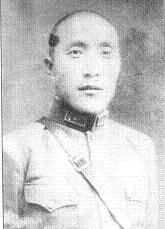 In northern China, the Communist forces mounted several campaigns against the Nationalist Government's herald forces. The notable success would be the routing of Sun Lianzhong's army.
Back in the summer of 1943, Chiang Kai-shek suddenly relocated Sun Lianzhong's 31st Corps to south of the Yangtze to be under the 6th War Zone. Sun Lianzhong, commander of the 2nd group army under the 5th War Zone, was in charge of the 31st & 68th corps. Li Zongren persuaded Sun Lianzhong into obeying the relocation order by citing the prospect of "going back to the farm fields" after the war was to end soon.
After the Japanese surrendered in Aug 1945, Chiang Kai-shek ordered that Sun Lianzhong be the chair of Hebei Province but prohibited Sun Lianzhong from taking his troops to the north. Sun's 31st Corps was handed over to Hu Zongnan, while Sun Lianzhong brought Gao Shuxun's troops to the north along the Ping-Han Railway.
The troops subject to Sun Lianzhong's command included the former Northwestern Army troops, such as Lu Chongyi's 30th Corps, Ma Fawu's 40th Corps (formerly Pang Bingxun's troops), and Gao Shuxun's 29th Group Army (which included part of formerly Shi Yousan's troops); Li Wen's group army which was previously subject to Hu Zongnan's command; the 92nd Corps and 94th Corps from the Sixth Military Zone, commanded by Shangguan Yunxiang and transported to Tientsin over the seas; and the puppet-turned North China constabulary army under the command of Meng Zhizhong.
In northern China, the Communist forces mounted several campaigns against the Nationalist Government's herald forces. The notable success would be the routing of Sun Lianzhong's army.
Back in the summer of 1943, Chiang Kai-shek suddenly relocated Sun Lianzhong's 31st Corps to south of the Yangtze to be under the 6th War Zone. Sun Lianzhong, commander of the 2nd group army under the 5th War Zone, was in charge of the 31st & 68th corps. Li Zongren persuaded Sun Lianzhong into obeying the relocation order by citing the prospect of "going back to the farm fields" after the war was to end soon.
After the Japanese surrendered in Aug 1945, Chiang Kai-shek ordered that Sun Lianzhong be the chair of Hebei Province but prohibited Sun Lianzhong from taking his troops to the north. Sun's 31st Corps was handed over to Hu Zongnan, while Sun Lianzhong brought Gao Shuxun's troops to the north along the Ping-Han Railway.
The troops subject to Sun Lianzhong's command included the former Northwestern Army troops, such as Lu Chongyi's 30th Corps, Ma Fawu's 40th Corps (formerly Pang Bingxun's troops), and Gao Shuxun's 29th Group Army (which included part of formerly Shi Yousan's troops); Li Wen's group army which was previously subject to Hu Zongnan's command; the 92nd Corps and 94th Corps from the Sixth Military Zone, commanded by Shangguan Yunxiang and transported to Tientsin over the seas; and the puppet-turned North China constabulary army under the command of Meng Zhizhong.
In October 1945, the three army corps began to enter the former communist district of Shanxi-Hebei-Shandong-Henan, an area the communists abandoned to the Japanese following Mao Tse-tung's 1941 order to cease all operations against the Japanese.
Namely, what Vladimirov claimed that Mao abandoned the 1937 politburo decision as to "mobile guerrilla war".
Lu Chongyi's 30th Corps, Ma Fawu's 40th Corps, and Gao Shuxun's troops would soon be surrounded by the Communist forces.
In late October, the troops intruded into the Cixian-Handan area, where they faced Liu Bocheng and Deng Xiaoping's communist army. The communist leaders were just flown over from Yenan by the planes of the American Dixie Mission. On October 30, Gao Shuxun secretly initiated a mutiny, defected to the Communists with his 29th Group Army or the New 8th Corps, and yielded the right of way and the flanks to the communists. On the 31st, Ma Fawu's 40th Corps, about 20,000 men, was attacked and routed by the communist army at Qiganzhang, Xinzhuang and Maying (horse camp), north of the Zhanghe River. Lu Chongyi's army, which was also attacked by the communist army, suffered heavy casualties and later reverted to Hu Zongnan's command for reorganization.
As recalled by Jin Dianrong, a former exile student ensuing from the Japanese invasion of Manchuria in 1931, Sun Lianzhong took the advice of military zone's chief secretary Xu Huailie to have the troops push north using the "crawl" tactics, namely, moving slow. Xu Huailie, a nephew of KMT leftist Xu Qian, was called a Trotskyite by the communists in the 1930s for his association with estranged communist Zhang Jinren in the organization of the Chahar Allied Army in 1933. Jin Dianrong blamed the debacle on the communist mole at the military headquarters in Chungking, especially Liu Fei, for the setup. In Jin Dianrong’s opinion, the troops could travel by train unimpeded by detouring along the eastern section of the Long-hai Railway and the Tientsin-Pukow Railway, which remained largely intact as a result of the undertable wartime collusion between the Japanese military and the Chinese Communists.
Other than a small segment north of Tai'an, Shandong, that was sabotaged by the communists after the Japanese surrender, the whole railway was intact.
(As Hao Bocun, the former ROC defense minister in Taiwan, had said, the territory of Jiangsu Province did not suffer from the wrath of war as a result of the communists' taking control of the area whereas the Hunan province endured four campaigns throughout the war.
The Chinese communists, who took out the Hebei Populace Army and the government guerrillas on the Ji-zhong [central Hebei] plains in 1939-1940, yielded the territory to the Japanese and retreated back to the mountains of Shanxi. Similarly, the communists took out the government troops in the Jiangsu Province in 1939-1940, and became the "railway guards" for the Japanese invasion army, allowing the unfettered railway traffic along the Tientsin-Pukow Railway throughout the resistance war.)
After Gao Shuxun defected to the Communists, and the communists destroyed Ma Fawu's army and mauled Lu Chongyi's army,
Sun Lianzhong became a "bald commander" in Peking.
However, Sun Lianzhong, directing the central army lineage troops, still managed to repel the communist attacks for years, till October 1947 when Luo Lirong's army was routed by Yang Dezhi's communist army at the Battle of Qingfengdian. Throughout the years, Sun Lianzhong had retained communist mole Yu Xinqing, a red priest in Feng Yuxiang's army since the early 1920s, as his counsellor and politics department director.
Additionally, Xie Shiyan, a tactician under Sun Lianzhong, liaised with the communists on the trilateral truce panel in Peiping (Peking), and was responsible for divulging the Kalgan military campaign in autumn 1946 and so on.
Guangdong Province
Anhui Province
Henan Province
Pi Dingjun, Wang Shusheng and Han Jun were ordered to attack Luoyang of Henan Province for sake of hindering the Government troops from eastern relocation as well as assisting Liu Bocheng and Chen Yi's communist forces in campaigns in eastern China.
Hu Zongnan promptly sent the 53rd & 61st Divisions and the 27th Corps to Luoyang on Aug 25th. On October 5th, Hu Zongnan ordered a siege of the Communist forces in the area south of Mt Songshan. Hu Zongnan's 15th Corps defeated the Communist forces, and the remnant Communist forces fled southward to Changbu, Daying and Nanzhao areas.
In northern Henan Province, Liu Bocheng's Communist forces, numbering 50,000, attacked Tangyin county on Aug 29th. On October 13th, in collaboration with the communist forces under Yang Yong [western Shandong Province] and Nie Rongzhen [southern Hebei Province], Liu Bocheng mounted an attack at Anyang in the attempt of cutting off the Ping-Han Railroad.
On October 4th, Hu Zongnan ordered that Sun Dianying's newly-organized 4th Army attack Liu Bocheng's communist army.
On October 10th, i.e., the National Day, Hu Zongnan, at age 50, was conferred the Medal of Resistance War Hero.
Hu Zongnan sent the 232nd regiment of the 78th division to Anyang via airlift.
After incurring a casualty of 8000, communist commander Liu Bocheng withdrew the siege of Tangyin on the 16th.
By October 17th, Hu Zongnan's 110th division of the 85th corps successfully took control of the railway segment between Zhengzhou and Anyang of Henan Province by defeating the Communists in Yuanwu, Huoyi and Huixian.
The Communist forces under Liu Bocheng stationed in Lucheng and Changzhi of Shanxi Province, while Yang Yong's communist force stationed to the north of Qixian and Tangyin of Henan Province.
On October 20th, Hu Zongnan dispatched four prongs against the Communist forces.
Separately, Hu Zongnan went to Chongqing for a military meeting on November 8th, and attended the military demobilization meeting on the 11th. On November 15th, Hu Zongnan requested with Chiang Kai-shek for an inspection trip to the field for reviving the morale, pointed out that the soldiers would unlikely desert should the soldiers' food ration not be cut by half, and further expressed worries over the situation of the 2nd Military District in Shanxi Province.)
Shanxi Province
The Communist forces managed to grow to 250,000 (i.e., fake communist number) in northern Shanxi Province and 150,000 (i.e., fake communist number) in southern Shanxi Province as a result of Yan Xishan's regionalism approach. When the Japanese surrendered on Aug 15th, Yan Xishan declined Chiang Kai-shek's offer to dispatch the Nationalist government Central Army to Shanxi. Nevertheless, Hu Zongnan dispatched the 167th Division of the 1st Military District to southern Shanxi Province. Additionally, 16th Corps Chief Cao Rehui went to Taigu for contacting Yan Xishan in vain. Li Wen, whose 34th Group Army passed through Shanxi Province for Shijiazhuang of Hebei Province, reported to Hu Zongnan on September 16th that Yan Xishan would run out of grains in three months and that at least 5 Central Army Corps equivalent of troops would be needed to prevent Shanxi from falling into the fate of a second Jiangxi Soviet.
In Shanxi Province, Yan Xishan retained the Japanese commander and Japanese army in maintaining security in Shanxi, and moreover, established a so-called "Asian National Revolutionary Comrade Society". George Marshall, with the tip from the communists apparently, paid a special visit to Shanxi to investigate the incident, forcing Yan Xishan into cutting back on the scale of hirings as to the Japanese troops. When the Communists later fought the Battle of Taiyuan, part of the Japanese mercenary army were still among the defenders on behalf of Yan Xishan.
Marshall also visited the communist base of Yenan, on which occasion an unamed American general gave Wen Qiang a Browning pistol as a gift for accompanying the Americans on the trip to Yenan, with the pistol becoming an incriminating piece of evidence that would cause Wen Qiang's wife to lose her job and ultimately commit suicide in 1955 for failure to produce the swag confessed by her husband at the prison.
Xu Dixin and the communist propaganda stated that on Aug 29th, i.e., the second day of Mao's arrival in Chongqing for the peace talk, Chiang Kai-shek had instructed Yan Xishan in attacking the CCP's "liberated area" in the Shangdang area of Shanxi Province.
It is certainly not true that Chiang Kai-shek and Yan Xishan would have any coordination should we examine Yan Xishan's history to derive a conclusion that whatever actions Yan Xishan took had to do with his regionality policy.
Xu Dixin further said that Liu Bocheng and Deng Xiaoping defeated the two prong attacks by Yan Xishan's 13 divisions or 38,000 men, and that the CCP destroyed the bulk of the enemy, about 35000 men, and captured several of Yan Xishan's generals, including Hu Sanyu and Shi Zebo, and caused Peng Shubin to commit suicide.
(Ledovsky claimed that Mao Tse-tung told the Soviets that the communists proactively launched the civil war against Yan Xishan's Shanxi provincial army to score some victories in order to exert pressure on Chiang kai-shek as bargaining chips for the Aug-Oct peace talks.)
Shandong Province
Li Yannian's 2nd Corps returned to Shandong from Wuhu via the Jin-Pu (Tientsin-Pukow) Railway in September 1945. From the sea, Li Mi's 8th Corps arrived at Qingdao in the footsteps of the American Marines in early October.
While the Nationalist government set the provincial capital at Ji'nan, the Communist Shandong Military District and provincial government decided to set their capital and base at Linyi which was once defended by Pang Bingxun during the 1938 Battle of Taierzhuang. In early September, right after the Japanese Yizhou Division-conglomerate of the 43rd Army evacuated Linyi for the provincial capital, Luo Ronghuan's Communist forces descended upon the city.
One regiment of the puppet Shandong constabulary managed to defend against the Communist onslaught for twenty days till the 40-Chinese-feet citywall was blasted apart. After the Communist takeover, Xiao Hua & Luo Ronghuan's Communist Eight Route Armies were called for duty in Manchuria, yielding the control to Chen Yi, Rao Shushi & Zhang Yunyi's Communist New Fourth Army. Linyi, i.e., the Communist "second Yenan", became a liaison and diplomatic nexus for the American military advisers and mediators to frequent from coastal Qingdao.
In Shandong Province, the Communists already penetrated the puppet army led by Hao Pengju [who surrendered to the Japanese in 1941 to be governor of puppet Huai-hai Province under Whang Jingwei]. Per Zhang Zhenlong, by 1942, two division commanders out of four in Hao Pengju's puppet army were undercover Communists.
In January 1945, the Americans and the Chinese Communists held a talk in regards to a loan of 20 million U.S. dollars in exchange for the Communist lease to the Americans of the Lianyungang Harbor.
When the Yalta Agreement stipulated that the U.S.S.R. was to lease Port Arthur and Dalian (Dairen), the Chinese Communists backed off from the offer of Lianyungang to the U.S. so as to the sync up with the Soviets.
Further, the Communists declined Wedemeyer’s request to facilitate the U.S. agents' travel to the Shandong Province.
(Chinese communists, who managed to send a representative as a member of the R.O.C. delegation to the San Francisco preparatory meeting for the founding of the United Nations, were secretly briefed by the Soviets as to partial contents of the Yalta secret agreements.)
After the Japanese surrender, puppet Hao Pengju nominally accepted Chiang Kai-shek's conferral as commander of the 6th Route Army, but secretly reported to Communist general Chen Yi and secretary Rao Shushi.
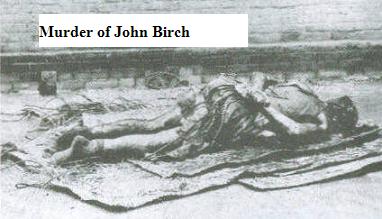 When Wedemeyer sent agent John Birch [Bo-qi] to Shandong, Hao Pengju turned over Chiang Kai-shek's telegraph to the Communists.
The Communist forces, which had sabotaged the Lung-Hai Railway tracks beyond Dangshan, intercepted Birch's team which used the manual power to move a train carriage towards Suchow (Su4zhou of Anhui), and later on Aug 25th, murdered him in cold blood.
Lieutenant Tung Fu-kuan, who served as a liaison officer for Birch, was fortunately found alive by the peasants and pulled out of the pit of the corpses with multiple bayonet wounds and a dumdum wound to one leg, survived to tell the horrific story -something similar to the Chinese communists' bayoneting Zhang Xinfu (Zhang Shenfu) and the engineering team in Manchuria.
When Wedemeyer sent agent John Birch [Bo-qi] to Shandong, Hao Pengju turned over Chiang Kai-shek's telegraph to the Communists.
The Communist forces, which had sabotaged the Lung-Hai Railway tracks beyond Dangshan, intercepted Birch's team which used the manual power to move a train carriage towards Suchow (Su4zhou of Anhui), and later on Aug 25th, murdered him in cold blood.
Lieutenant Tung Fu-kuan, who served as a liaison officer for Birch, was fortunately found alive by the peasants and pulled out of the pit of the corpses with multiple bayonet wounds and a dumdum wound to one leg, survived to tell the horrific story -something similar to the Chinese communists' bayoneting Zhang Xinfu (Zhang Shenfu) and the engineering team in Manchuria.
 Tung Fu-kuan was a Chinese government army officer from the army corps that was trapped in the Yellow River flood zone since 1943 but was discovered by John Birch while on a mission to organize the behind-the-enemy-line observation posts for General Chennault's Chinese Air Task Force or the 14th Flight Group during the 1944 Japanese Ichigo Campaign.
Tung Fu-kuan lost one eye and one leg from the communist barbarity.
The consecutive execution against Birch and consecutively eyewitness Tung Fu-kuan exhibited the incident as a deliberate communist murder plot, rather an accidental event.
Before the communists murdered Birch, Birch, who witnessed the communists' breaking the dikes to inundate the Nationalist army area during the 1944 Ichigo Campaign and deeply resented the communist treachery throughout the war, naively claimed to Tung Fu-kuan that should the communists kill him, then the American atomic bombs could be dropped onto Yenan.
Birch, upon arrival in China in 1939, was briefed by high-aged missionary Mother Sweet of Wisconsin as to the murder of American missionaries such as John and Betty Stam by Xun Huaizhou and Nie Hongjun's communist Red Army 19th Division.
Mother Sweet spent over 40 years in China.
Birch did not know or forgot how General Chennault, i.e., his mentor, had been forced out of China by George Marshall.
Tung Fu-kuan was a Chinese government army officer from the army corps that was trapped in the Yellow River flood zone since 1943 but was discovered by John Birch while on a mission to organize the behind-the-enemy-line observation posts for General Chennault's Chinese Air Task Force or the 14th Flight Group during the 1944 Japanese Ichigo Campaign.
Tung Fu-kuan lost one eye and one leg from the communist barbarity.
The consecutive execution against Birch and consecutively eyewitness Tung Fu-kuan exhibited the incident as a deliberate communist murder plot, rather an accidental event.
Before the communists murdered Birch, Birch, who witnessed the communists' breaking the dikes to inundate the Nationalist army area during the 1944 Ichigo Campaign and deeply resented the communist treachery throughout the war, naively claimed to Tung Fu-kuan that should the communists kill him, then the American atomic bombs could be dropped onto Yenan.
Birch, upon arrival in China in 1939, was briefed by high-aged missionary Mother Sweet of Wisconsin as to the murder of American missionaries such as John and Betty Stam by Xun Huaizhou and Nie Hongjun's communist Red Army 19th Division.
Mother Sweet spent over 40 years in China.
Birch did not know or forgot how General Chennault, i.e., his mentor, had been forced out of China by George Marshall.
There are many kinds of Americans, like those sharing the British colonial and colonialist sentiments, like those who were Soviet spies, like those who unconsciously worked as the communist fellow travelers, and like those [Kerr] who despised Chiang Kai-shek's background and personality. There are last two categories, i.e., missionary Americans and true sympathizers of the Chinese cause, including John Birch who devoted his life to the missionary duty in China and whose aspiration was to preach Lord Jesus Christ's gospels in Tibet and Chinese Turkestan.
Till we fully appreciate the help of good-hearted and sympathetic Americans such as
Anson Burlingame,
Paul Samuel Reinsch,
Patrick Jay Hurley,
Claire Lee Chennault, Milton Miles and Albert Wedemeyer,
Arthur Young, and John Birch,
and build the ever-lasting and eternal monuments in remembrance of them, there would not be another American who would follow their footsteps.
Note that
Anson Burlingame, in opposition to the anti-Chinese discriminatory whirlwinds rampant in the U.S. in the 19th century, authored the Burlingame Treaty for China and died for China in 1870 in St. Petersburg while still on the Manchu China's mission to the U.S. and Europe.
And Reinsch, after leaving the minister-to-China's post, continued to work on behalf of China and died of illness while working for China.
The Chinese should forever pay respect to Reinsch and his descendants.
(A good Hollywood movie could be shot in regards to Birch's behind-the-enemy-line work along the Southeast China coast, along the Yangtze, along the Peking-Hankow Railway, and along the Yellow River flood line. Another movie could be made for the behind-the-enemy-line collaboration efforts by Milton Miles and Dai Li.
Both Chennault's 14th Flight Group intelligence operations and Miles' navy intelligence operations were hijacked by the Soviet-agents-controlled O.S.S.)
Before John Birch [Bo-qi] Incident, the Communists, in May 1945, detained 4 American agents in Fuping.
After Wedemeyer protested against Mao Tse-tung & Zhou Enlai, the Communists released the team on September 8th.
Separately, another U.S. team sent to the Bohai Bay was detained by the Communist forces on Aug 31st, 1945.
What happened was that when Wedemeyer heard about the communist August 25th murder of John Birch, he immediately broke into Hurley and Mao's meetings in Chungking to raise protests.
Zhou Enlai, who purportedly acted as interpreter to pass on Wedemeyer's protest to Mao, assured Wedemeyer that they would ask communist commander-in-chief Zhu De to conduct an investigation.
There was no punishment of communist culprits.
On the United States' side, George Marshall, who conspired to force Chennault into retirement or resignation in early 1945 for avenging Stilwell's recall, sealed the John Birch file so as not to arouse the American public's indignation against the Chinese communists.
What a cunning fish who was to continue to sabotage the United States' policy during the Korean War, i.e., devising the scheme for President Truman to fire General MacArthur.
(General MacArthur, however, wrongly thought it was the British communists who forced Truman to fire him.)
The Trilateral Truce Panel & People's Political Consultative Conference
The Trilateral Truce Panel, comprising of Zhang Qun (KMT), Zhou Enlai (CCP) and Marshall (U.S.), held its first meeting on January 7th, 1946 and issued the First Truce Order on January 10th demanding that all parties stop actions on the midnight of January 13th, with an exception that the Government troops continue to march on to Manchuria for taking over custody of the land from the Russians.
The first major concession by Chiang Kai-shek would be to abandon Jehol and the city of Chihfeng [Chifeng] to the Communists after Marshall visited Chiang Kai-shek and then called on Zhou Enlai for a midnight session on January 9th, 1946.
By retaining Chifeng of Jehol and Tolun [Duolun] of Chahar, Zhou Enlai successfully kept open the linkage of the Communists in North China and Manchuria.
Zhou Enlai's excuse for wrestling over Chihfeng was that the Communist troops were already in control of the city. Later, it was discovered that no Communist troops were present before the offer. Zhang Zhenglong, in "Snow White, Blood Red", repeatedly touted the term of the "last battle" before the midnight of January 13th and emphasized that the Nationalist government troops and CCP troops, in one place of Manchuria, had engaged in the "last battle" 1-2 days beyond the midnight of January 13th. Possibly, the Communist soldiers and troops in Manchuria had misread the order of the First Truce as being applied to the entire nation. Indeed, there was no "last battle" in Manchuria since the Communist troops, after Chihfeng, moved into Jining & Yingkou.
Four trilateral truce panels with an American colonel each were dispatched on January 14th. In Peking area, the CCP and Government troops were ordered to pull back by 30 kilometers, respectively.
Xu Zhen wrote that once the Government troops pulled back, the Communist insurgents filled in the vacuum.
(The Russians, per original agreement, had promised to stay in Manchuria for only three months and should begin withdrawal beginning from the 6th week onward, but they delayed their departure for sake of pillaging as well as providing cover for the CCP. The pretext to prolong their stay was exacerbated by the Chinese request for a delay so that the Russians would not hand over control to the Communists. To create an artificial friendship, Jiang Jingguo suggested that his stepmother, i.e., Mme Chiang Kai-shek, pay a solicitude visit: on January 22nd, Mme Chiang Kai-shek flew over to Changchun via the presidential plane piloted by Yi Fuen, and visited the Russians the second day.)
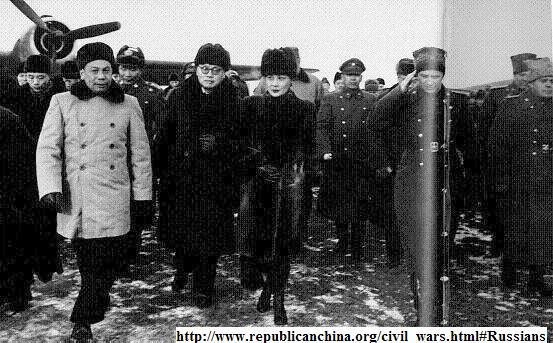
Also on January 14th, 1946, under the pressure of Marshall, the Chinese People's Political Consultative Conference [CPPCC] was held in Nanking, with participants from the KMT, CCP, Youth Party, Democratic League, and various social activists. The CPPCC, by the end of Jan, reached five resolutions. Chiang Kai-shek's statement of observing the CPPCC resolutions was published on the Central Daily Newspaper on February 1st, in which he promised to reorganize the joint government [i.e., coalition government] and accused the regional powers and private armies of being pseudo-democracy and anti-democracy.
During and after the CPPCC, Chiang Kai-shek's secret agents purportedly intruded into the residencies of Huang Yanpei & Zhang Shenfu (i.e., leaders of the Democratic League - either sympathizers to the Communist cause or undercover Communist agents), disturbed the populace celebration of the CPPCC resolutions, inflicted some physical injuries to the celebration meeting assemblers, including Guo Moruo, Ma Yinchu, Shi Fuliang, and Li Gongpu et al. The KMT agents also sabotaged the CCP's New China Daily Newspaper agency as well as the Democratic League's Min-sheng [People's Livelihood] Newspaper agency.
On February 23rd, Zhang Lan wrote to Chiang Kai-shek with a request that the KMT agents be disbanded, while Chiang Kai-shek, per Tang Zong's Diaries, instructed that the Democratic League was CCP's running dog.
Dai Li (Tai Li), i.e., chief of the secret agents, died in a plane crash accident shortly thereafter.
One month before the plane crash, Dai Li accompanied Chiang Kai-shek, Mme Chiang and Albert Wedemeyer on a visit to the Chinese navy in Qingdao.
Before that, Chiang Kai-shek had already decided to shrink the secret service, forcing Dai Li into seeking an alternative career which was rumored to be some position in the Chinese Navy through liasion with Milton Miles who was accused by Jack Service and the pro-CPUSA gang of having received from Dai Li the stack of thousands of pages of report on the antics of the American wartime playboy reporters.
Many of those Democratic League leaders, i.e., undercover communists, would suffer from the Communist persecutions during the Anti-Rightist Movement later.
Hearing of Dai Li's death, Milton Miles insisted on coming back to China for the funeral, over which he was ridiculed by George Marshall and other pro-communist Americans as "moving the mountains" to get permission to fly back to China for attending the funeral, not knowing the life and death friendship that the two forged through the years of war.
After Dai Li's death,
Tang Zong purportedly discovered a vault of gold nuggets and U.S. dollars in Dai Li's residence.
Wen Qiang, who was taken in by Dai Li in the early 1930s, exited the special services and later worked for Hunan provincial strongman Cheng Qian before being poached by Du Yuming as the chief of staff during the 1948 Xuzhou-Bengbu Campaign and became a communist war of prisoner, which led to the tragedy of death of his wife who left Taiwan with three young children for the mainland for rescuing her husband.
The woman spent months shuttling through the communist-controlled villages and prison camps but had to return to Shanghai after exhausting money and selling valuable belongings.
Over a Browning pistol that was likely gifted by
Marshall during a 1946 visit to the communist base of Yenan, Wen Qiang's wife was deprived of a teacher's job at the Lixin Accountant School, was forced to work as a janitor, and ultimately committed suicide in 1955, a third death according to son Wen Guanzhong after dystocia which was at the cost of the woman's mother bearing the twins, and after a faked drowning death to escape from her family-arranged marriage.
Marshall set up a separate Military Panel comprising of KMT rep Zhang Zhizhong and CCP rep Zhou Enlai.
On February 24th, Marshall had the two parties agree to contracting the Government troops to 90 divisions and the CCP to 18 divisions within 12 months, to be followed by the Phase II Compression.
The Phase II Compression would supposedly compress the total national army to 60 divisions or 20 corps, with the Government troops reduced to 50 divisions and the CCP forces to 10 divisions. A limitation of no more than 14,000 staff and soldiers was set for each division. Other than the army, the Nationalist government wartime training schools and academies were ordered to be shut down. Hu Zongnan’s 7th Branch of the Whampoa Military Academy, which had trained 7 sessions of the 15th-22nd or about 25,014 cadets in addition to 12,303 graduates for 33 Nationalist government military units and organizations, forwarded the last class of students to the Whampoa Academy's headquarters in Chengdu of Sichuan Province. Liu Ruming was called to Chongqing (Chungking) for the military shrinkage meeting at which General Wedemeyer made a speech. Shortly after returning to his garrison, Liu Ruming received an order to dismiss one third of his army. The Nationalist government initiated the "Phase I Downsizing" on March 16th, 1946, with a target of compression to ten corps for the First Military District. The First Military District, which enjoyed 5 group armies or 13 corps at the peak, had already downsized since the Japanese surrender, with i) the 16th & 3rd Corps of the 34th Group Army assigned to the 11th Military District in Hebei Province and ii) three divisions of the 89th Corps reorganized into the 15th Corps for subordination to the 5th Military District. During the resistance war, hundreds of thousands of soldiers from Hu Zongnan's army had been allocated to the Burma Expedition Forces. Hu Zongnan's First Military District of 4 group armies [the 4th, 31st, 37th & 38th] or 10 corps revoked 26 regiments, with about 27,500 soldiers dispatched home with monetary allowances.
Xu Zhen wrote that while the Government troops were contracting, the CCP continued to expand their army ranks by hiring former puppet Wang Jingwei government soldiers.
 In Manchuria, the Russian soldiers killed Chinese engineer Zhang Xinfu (Zhang Shenfu) in the process of dismantling the equipment. Alternative writings pointed out that the Chinese Communists, with the Russian arrangement, deliberately expelled Zhang Xinfu (Zhang Shenfu) and his team out of Lüshun (Port Arthur) and then murdered them with bayonets at the Lishizhai train station, halfway to Shenyang (Mukden). Zhang Xinfu (Zhang Shenfu) was stabbed eighteen times. Altogether, the barbaric Communist troops bayoneted eight Chinese engineers and mining industry officials near Lüshun, after sparing the platoon of railway police whom the Russians claimed belonged to the Southern Manchurian Railway.
 Zhang Xinfu (Zhang Shenfu), before his death, condemned the Chinese communists for the internecine killing after what he claimed to be a survivor of the eight year long resistance war.
Li Shenzhi, recalling a massive nationwide protest movement against the U.S.S.R. in early 1946, pointed out that elementary and middle school students in the countryside of Chengdu-Chongqing waved flags denouncing the Russian barbarity.
Meantime, the CCP-controlled "New China Daily Newspaper", in its Chongqing edition, published an article entitled "Patriotism Is Not Equal To Excluding the Foreigners [i.e., the Russians]".
The Communist students, who had launched December 1st, 1945 student protest in Kunming just one month ago, would refrain from denouncing the Russian killing, pillaging and raping in Manchuria.
Zhang Xinfu (Zhang Shenfu), before his death, condemned the Chinese communists for the internecine killing after what he claimed to be a survivor of the eight year long resistance war.
Li Shenzhi, recalling a massive nationwide protest movement against the U.S.S.R. in early 1946, pointed out that elementary and middle school students in the countryside of Chengdu-Chongqing waved flags denouncing the Russian barbarity.
Meantime, the CCP-controlled "New China Daily Newspaper", in its Chongqing edition, published an article entitled "Patriotism Is Not Equal To Excluding the Foreigners [i.e., the Russians]".
The Communist students, who had launched December 1st, 1945 student protest in Kunming just one month ago, would refrain from denouncing the Russian killing, pillaging and raping in Manchuria.
The Nationalist Government Troops Recovering Manchuria
For Manchuria, Chiang Kai-shek had conferred the post of director for the "Northeast Military Office" onto Xiong Shihui, the post of security commander onto Du Yuming and deputy post onto Zheng Dongguo.
Xiong Shihui arrived in Changchun with about 100 entourage on October 2nd, 1945, but he was basically restrained in office by Russians who guarded his office.
However, Government troops did not get to take control of Manchuria as a result of Russian interference and eight month Russian occupation.
Pseudo-history website like http://www.nationmaster.com/encyclopedia/Chinese-Civil-War and pseudo-encyclopedia website like wikipedia claimed that "later in the year [1945] Chiang Kai-shek came to the painful realization that he lacked the resources to prevent a CCP takeover of Manchuria following the scheduled Soviet departure, he therefore made a deal with the Russians to delay their withdrawal until he had moved enough of his best-trained men and modern materiel into the region."
Original agreement called for Russian withdrawal by November 14th, 1945 [Dec 3rd Per ZLA].
Truth is that Stalin had at one time demanded that both the U.S.S.R. and U.S. withdraw from China at the same time. Stalin told Jiang Jingguo, i.e., Chiang Kai-shek's son, that not a single American soldier could remain on the Chinese soil.
(The pseudo-encyclopedia website like wikipedia also made the fallacious claim that would the Chinese communists laugh to the teeth:
"However, the nearly nonexistent Soviet help proved not to be a problem for the Communists; in the meantime, the huge Communist need was filled by an unexpected source: their adversaries, the Nationalists. Due to the fatal mistake the Nationalists made in their demilitarization, the Communists were able to pinpoint nearly every Japanese secret depot with the help of former Nationalist troops in their ranks, and the total amount of Japanese weaponry recovered was enough to sustain the Communists for 2 years before relying on captured American weaponry from the Nationalists in the later stage of the war. For example, a single secret depot typically contained as much as 150,000 artillery rounds. By February 1947, hundreds of artillery pieces were recovered by the communists, including: 49 howitzers, 300 heavy mortars, 137 anti-aircraft artilleries, 141 anti-tank guns, 108 mountain guns, 97 cannons, and many other smaller artillery pieces, almost one-third of the Nationalist weaponry.")
After Chiang Kai-shek, on November 7th, dispatched several planes to Changchun to pick up stranded Chinese officials as a protest against the Russians, China and U.S.S.R. reached an agreement, and announced the new deadline of January 3rd for final Russian withdrawal.
The Russians approved the air delivery of Chinese troops to Changchun & Shenyang (Mukden), acknowledged Xiong Shihui's "Military HQ" office and agreed to station a liaison officer inside of the office building, at the expense of Chinese concession that industries in Manchuria were Russian bounty.
Vehicles were provided to Chinese, a train was allocated for fetching coal from Jiutai county, and a command center was set up in the airport for preparation of Chinese troop arrival.
The CCP harassed the Ping-Han [Peking-Wuhan] railroad lines and raided the Nationalist army positions in the Shanxi, Henan, Hebei and Shandong provinces, effectively bringing down the communication and railways in northern China.
Lüshun & Dalian being leased to the Russians, the seaport available to the Government troops would be Yingkou and Huludao which the American Navy, under Vice Admiral Daniel E. Barbey, had abandoned to the Communists since on November 2, 1945.
Claiming that Manchuria did not belong to truce area, CCP mounted major campaigns in Manchuria, taking over Yingkou on the coast, Sipingjie, Changchun (Mukden), Harbin, Andong, Jilin and Qiqihar [Qiqihaer], etc.
The CCP forces refused the American marines and American transport ships with the Nationalist army soldiers from going ashore. The CCP received Japanese weapons depot from the Russians and established various governments, including the Russian-restricted areas inside of Dairen & Port Arthur.
Apparently fallacious would be Zhang Zhenglong's Snow White, Blood Red repeatedly-mentioned term "Last Battle", a battle call which was relayed to each and every Communist fighting unit in Manchuria for wrestling over control of positions from the Nationalist Army inside of Manchuria.
The Campaign of Linyu & the Shanhaiguan Pass
General Liu Yuzhang, who had been dispatched to Haiphong of Vietnam for accepting the Japanese surrender, received instructions that his 2nd Division, together with the 25th Division at Haiyang and the 195th Division at Jianjun, would be going to Manchuria by riding on the American Seventh Fleet warships. The actual trip was delayed several times when the Americans first failed to obtain the Russian approval to dock at Dairen [Dalian] and then were obstructed by the Chinese Communist troops at Yingkou.
On November 4th, 1945, Liu Yuzhang went ashore at Qinhuangdao, a coastal resort just to the south of the Mountain & Sea Pass and the Great Wall. At about the same time, Shi Jue's 13th Corps also arrived at Qinhuangdao.
The 25th Division of the 52nd Corps joined the 13th Corps in launching a circumvential attack at the pass.
On November 22nd, Du Yuming convened a military meeting to appraise the campaign accomplishments of five government divisions from the 13th & 52nd Corps and congratulated the 2nd Division on taking over three cities in one single day.
Two days after taking over Jinzhou, the 52nd Corps was ordered to attack Heishan and Beizhen.
From then onward, the 52nd Corps, which was later augmented by a Youth Army division, fought against the communists coming from the North Korea direction throughout the civil war time period, and became the only army troops which withdrew over the seas and survived the Manchuria wars.
The 13th Corps, which alone fought against communist U-lan-fu and the Outer Mongolia cavalry in Jehol, was later betrayed to the communists in Peking when Fu Zuoyi defected to the communists in 1949.
The Battle of Qianwei-Suizhong
Battle of Huluodao
The Battle of Jinzhou
Li Yunchang, in late 1945, suffered a complete debacle in the hands of the nationalist 52nd Corps and the 13th Corps, with his 40,000-strong fake communist army reduced to 5000 men after the Battle of Jinzhou.
On November 19th, the Russian Red Army notified the CCP Northeastern Bureau that the Soviets intended to hand over the cities to the Chinese Nationalist government once the Government troops arrived.
With Mao Tse-tung falling being ill since return from Chongqing on October 11th, Liu Shaoqi took charge again by ordering on November 20th that Lin Biao yield the right-of-way along the major railroad lines and cities. On November 28th, Liu emphasized again the importance of establishing the Communist bases in eastern, northern and western Manchuria.
On December 6th, Jiang Jingguo & Zhang Jiaao held another round of talks with the Russian generals, including Malinovsky. The Russians emphasized that they had retained the puppet Manchukuo railway management and employees [including the Japanese board of directors], and [unilaterally] re-established the railway company [on September 22nd] per the Sino-Russian friendship treaty that stipulated a time period of 30 years of the Sino-Russian mutual administration.
Zhang Lingao claimed that Jiang Jingguo had been reaffirmed what the Russians had agreed upon while in Moscow.
Zhao Junmai, under the Russian escort, went over to the Changchun cityhall for establishing authority. The Communist forces withdrew from the Changchun city center on the Russian demand.
Subsequently, Dong Wenqi assumed the mayor post at Shenyang (Mukden), and Yang Chunan at Harbin. Though, the Russians refused to allow the Chinese officials enter Port Arthur [Lüshun] and Dalian. At the pressure of the Communist forces,
Dong Wenqi and Yang Chunan soon fled their posts once the Russians exited towards northern Manchuria.
In mid-December, Jiang Jingguo flew to Changchun with Du Yuming & Wang Shuming, and held another talk with the Russian commander.
The Russians claimed that they, having withdrawn from Shanhaiguan-Yingkou-Huludao-Jinzhou, now began the phase of withdrawing from Shenyang (Mukden)-Changchun-Harbin.
The Russians agreed to allow one Chinese mechanized division airlifted to the outskirts of Changchun.
Per ZLA, Jiang Jingguo instructed Du Yuming, et al., that China should befriend the Russians so that the Chinese Communists would not be able to find a crack in between. Having dismissed the economic loss to the Russians as merely the Japanese operations, Jiang Jingguo stated that Qi Shiying, i.e., an anti-USSR party official, was sent back to Chongqing at his request as a warning to the other stubborn anti-USSR people [e.g., Xiong Shihui & Jin Zhen].
As an appreciation of Jiang Jingguo's cooperation [and hospitality in hosting the luxurious banquets on daily basis], the Russians sent over four cases of Brandy & French wine, and bragged that they obtained them from the Germans who in turn looted from the French.
On December 7th, Liu Shaoqi warned Lin Biao and Cheng Zihua Per FZJ, and on December 24th, Liu Shaoqi warned Peng Zhen against attempt at controlling the big cities like Shenyang (Mukden) (Mukden), Changchun and Harbin.
On December 28th, Mao Tse-tung, having recovered from illness a bit, reaffirmed Liu Shaoqi's standgrounds.
By late 1945, the CCP military forces amounted to 220,000 in Manchuria Per FZJ.
The Battle of Beining-Heishan-Beizhen
Battle of Chaoyang
Battle of Huxin-Haizhou
On December 25th, Liu Yuzhang's 2nd Division converged upon Anbao [Zhenanbao] of Beizhen, i.e., former beacon tower of Ming Dynasty's great wall against Manchu. After that, Liu Yuzhang's troops were trucked to Nuerhe of Jinzhou for deployment to Rehe (Jehol) to the west.
Li Zefen, i.e., 5th Div Chief under the Nationalist government 94th Corps, inspected the Changchun Airport, and then told Jiang Jingguo that he would rather go to Tianjin than delivering himself to the mouth of the Communists.
Xiong Shihui, seeing that the Government troops refuse to come over, then ordered that two regiments of the constabulary forces [led by Xu Genyang & Liu Defu] be delivered to Changchun from Peking.
At the time the Russians withdrew from Changchun, the Nationalist government officials fled the city for a second time.
Two regiments of soldiers, who were formerly puppet forces around Peking, were disarmed by the Communists.
The Battle of Lingyuan-Pingquan
The Battle of Jianping
Truce In Rehe (Jehol) & the Communist Siege of the Nationalist Army 5D of 13C At Guozangzi
The Battle of Xiushuihezi
Nevertheless the truce order of January 10th,
the communist 3rd Division under Huang Kecheng, on January 12th, 1946, took over Tongliao after defeating what the communists branded as the "bandits" who set up the security rule in the wake of the Soviet Red Army's vacating the city, and found the city to have supply of grains that could last one year.
Lin Biao and Huang Kecheng took the initiative to take the city as a coutermeasure against the government army's taking Zhangwu, which rendered Huang Kecheng's 20,000 communist troops with no exit towards the deserts to the northwestern direction, where there were Mongol nomads and no villages.
The 89th Division took over Xinmin and Zhangwu on the 26th under coordination with the Soviet Red Army.
Purportedly, the Soviets warned the communists not to conduct provocative actions in Yingkou and Manchuria, that might harm the Americans to provoke the Americans into a full-scale involvement in the Chinese civil wars.
Liu Shaoqi on January 26th advised Huang Kecheng to give reception to government officials but make preparations for resisting the government army when attacked.
The next day, Liu Shaoqi replied to Peng Zhen's telegram with authorization of military action against the government troops in a psychological sense, i.e., scoring one big victory or a "last battle" in lieu of multiple battles as a detente.
Communist commander Lin Biao hence worked to select a target of attack, which culminated in the Battle of Xiushuihezi.
Note that before Marshall-brokered truce was to take effect, the communist armies already received directives to fight the "last battles" across China and in Manchuria.
On February 12th,
the communist 1st Division (under Liang Xingchu and commissar Liang Biye), the 7th Brigade (under Peng Mingzhi and commissar Guo Chengzhu) of the 3rd Division, and the 1st Regiment of the 1st Constabulary Brigade
launched the Battle of Xiushuihezi (beautiful water river) in Faku
against five battalions of Shi Jue's government army 13th Corps.
Purportedly, the 89th Division of the 13th Corps, as the northern route in the Huxin-Zhangwu area, was sweeping into Xiushuihezi of Faku and Gongzhutun of Xinmin, with one reinforced regiment at Xiushuihezi, or the 266th Regiment having junction with part of the 265th Regiment at Xiushuihezi on February 11th.
According to communist historian Liu Tong,
the government troops started sweeping moves along the railways on February 9th, with the 22nd Division of the New 6th Corps as the southern route against panshan, Tai'an and Liaozhong;
the 2nd Division of the 52nd Corps as the middle route along the Bei-Ning (Peking-Mukden) Railway and against the east of Xinmin;
and
the 89th Division of the 13th Corps, as the northern route against Xiushuihezi, Gongzutun and Mahuanchi.
This is a town along the Zhangwu-Faku Highway, with the communist records making a claim as the spot of the first elimination battle victory in Manchuria.
The communists claimed to have killed and wounded more than 500 government soldiers in addition to more than 900 prisoners of war at Xiushuihezi,
that belonged to
the 266th Regiment,
the 1st Battallion of the 265th Regiment of the 89th Division of the National Army, plus the division-direct mountain artillery company and trucking company.
On the morning of February 14th, about five kilometers away from the Xiushuihezi town, the communists claimed to have repelled the relief from the 6th Regiment of the 2nd Division of the 52nd Corps coming from Xinglongdian[-zhan], a train stop along the Mukden-Shanhai'guan Railway line, about 100 kilometers from Xinmin.
In total, the communists' complete military history book Zhongguo renmin jiefangjun quan-shi (2000, military science press) claimed to have annihilated a total of
more than 1,600 government troops,
and seized a booty of 12 cannons, 100 light and heavy machine guns, more than 780 rifles and pistols, and 30 cars.
The Battle of Shaling
On February 10th, 1946, the New 6th Corps (i.e., New Sixth Army) took over Tai[2]an and Xinmin;
on the 18th
took over Faku, Dahushan, and Liaozhong.
Lin Biao's communists from the Liao-dong Military Region concentrated along the Liao-he River for ambushing the New 6th Corps.
On February 19th,
the New 22nd Division (N22C), with two battalions of the 66th Regiment, the division-subordinate machine gun battalion and the teaching battalion, advanced to Shaling (sandy ridge), a village south of the Liao-he River, becoming a prominent point in the entire defense line of the New Sixth Army.
After battling for
for two days and three nights, the New 22nd Division defeated the communist army and inflicted heavy casualties onto the communist 3rd zong-dui and 4th zong-dui.
Soon after Marshall left China with a claim that it was an opportune time to come back to the U.S., tension flared up in Manchuria.
Marshall earlier told Truman that he met with Mao Tse-tung and obtained the communist full cooperation on ceasfire and coalition government,
and Truman,
right after Churchill's March 5th Fulton speech at Westminister College, wired to Marshall about Churchill's wish to meet Marshall.
Lin Biao's communist army, about 50,000, took over Shenyang (Mukden) after the Soviets suddenly pulled out.
As acknowledged by
Marshall,
he later told Truman that
he was too diplomatic in not insisting that Mao made correction to a CCP press statement "to the effect that Manchuria was not within the scope" of the cease-fire agreement per Roll, which was a deliberate fabrication.
Marshall said that "he did not wish him to respond" per Roll while enjoying folk dancing and a communist film with Mao.
Back in December, after protests against the Soviets,
the Soviets approved the air delivery of Chinese troops to Changchun & Shenyang (Mukden), consisting of
two regiments of Xu Genyang and Liu Defu's the constabulary forces.
Purportedly,
after Jiang Jingguo's talks with the Soviets in December,
the Soviets agreed to allow one Chinese mechanized division airlifted to the outskirts of Changchun.
Per David L. Roll,
the Nationalist army entered Shenyang (Mukden) on March 13th under the "Manchuria exception" mandate; however, Mao Tse-tung and the communists changed stance and
"decided in late March to 'use maximum strength to control' key cities in Manchuria."
(David L. Roll, in stating that "The Nationalists entered Mukden on March 13" in the Chapter "Great Hope of China," likely copied and pasted some materials that this webmaster posted to the internet since year 2000, that originally stated that "It was on March 13th, 1946 that the Nationalist 52nd Corps took over custody of Shenyang (Mukden) from the Russians and began to push on towards the Sipingjie city."
Roll mistook the army that entered Shenyang to be VMI graduate Sun Liren's "Nationalist New First Army" which was to "block their (communist) entry" and further "drove the Communists ten miles out of the city" after fierce street fighting.
The 52nd Corps then took the mission to attack east against Hushan while
the N1C and N6C were to attack to the north and south respectively.)
Hearing of the fight, Marshall asked Alvan Gillem to fly to Shenyang (Mukden) to stop the fighting and took charge while he spent the next four weeks in the U.S.
On March 27th, the "Committee of Three" organized four implementation teams for the Northeast (Manchuria) to carry out mediation work.
By late March, Sun Liren's New First Corps arrived at Qinhuangdao from Southeast Asia & Southern China via American warships.
Then the Government troops pushed towards Changchun along the railroad.
Prior to this relocation, Dong Zhujun managed to bribe the Nationalist Army contacts to have his son return home for a visit, hence escaping the fate of being dispatched to Manchuria.
The Russian Red Army first withdrew from Changchun on April 14th, 1946. 30,000 Communist forces promptly took over positions from the Russians.
Per Roll,
Soviet general Fedor Karlov notified the Communists’ Eighth Route Army of the Soviet Red Army's withdrawal while
Marshall was still in the air, i.e., what Roll termed by "leisurely" flight, and would would not return to Chungking till April 18th, which was after a visit to the U.S. for six weeks.
The communist siege of Changchun was described by Roll as a communist army of 20,000 against "4,000 poorly equipped regular army troops" plus "a few thousand local conscripts and Japanese soldiers" while the Red Army's train had not left the city yet.
The siege went on for three days and nights as reported by American correspondents such as Henry Lieberman of The New York Times, ending with "an Alamo-type defense" at five-story Central Bank Building that was destroyed by what Roll termed by
Japanese (and possibly Soviet) artillery and tanks manned by the Communists.
The truth was that the defenders were the constabulary force and a mechanized division airlifted to Changchun while the communist artillery and tanks were manned by the Japanese.
Changchun fell on the day Marshall returned to Chungking.
Since Marshall was soft on the communists, Zhou Enlai claimed that the communists would agree to restore truce on the condition of keeping Changchun while an agreement was to be negotiated by the two parties.
While Yang Kuisong claimed that Chiang asked Marshall to have relayed a message on the 29th that demanded the CCP's withdrawal from Changchun before restarting negotiation for other issues,
Roll gleaned from Marshall's archives to find Chiang's much lenient offer of
establishing a cease-fire line north of the Changchun city as long as the communists were to evacuate Changchun, which would allow the Communists to have what Roll thought "de facto control of all of northern Manchuria", i.e.,
what Marshall characterized as a "great concession."
Marshall implored Zhou to accept Chiang's offer in vain.
Per Yang Kuisong, Zhou Enlain made a public annoucement as to Chiang Kai-shek's inflaming the war in Manchuria into a full-scale civil war throughout China.
On May 24th, at Shenyang (Mukden), Chiang Kai-shek had Soong Meiling authorize a letter to Marshall in regards to renewing the peace talk with the CCP with three conditions which CCP leader Zhou Enlai had basically accepted.
In June, a truce of fifteen days was reached by the two sides, with Marshall selling the point to Chiang Kai-shek that "the Nationalists could not defeat the Communist forces, particularly since the Russians would most likely come in to held the Reds" per Rose Page Wilson.
Simply, as relayed by Rose Page Wilson, Marshall made the point clear to Chiang Kai-shek that "there was no way to defeat Mao and the Russians ... unless the Americans intervened on a large scale to help him, and to this the United States would never consent."
Even "for all the tea in China would Americans have agreed to entering another war and running the almost certain risk of large-scale involvement with the Russians" per Wilson who atributed the American political sentiment against the Reds to the cause that the Chinese Communists accused Marshall or America of duplicity.
It would be after the communist debacle at the Battle of Siping on May 19th, which caused the communists to abandon Changchun and the fortifications for fast retreat towards north of the Sungari River, that the government troops recovered Changchun unopposed on May 23rd-24th, 1946.
On May 3rd, 1946, the Russian Red Army left Manchuria with full loads of bounty.
By the end of 8 months (against the U.S.S.R.'s original stipulation of 3 weeks to 3 months), the Chinese Communists had already absorbed 300,000 puppet Manchukuo army and developed into half million strong forces from the original contingent of less than 20,000.
However, the communists would soon lose their crack forces during the Battle of Sipingjie, with the newly-built army, comprising of the puppets, defecting to the government side. Only the Korean diehards stayed with the communists after the Battle of Sipingjie.
The communists, to rebuild the army, launched a massive 'land reform' movement in northern Manchuria, forcing the people into joining the communist army via the old practice of killing a certain percentage of the local population as landlords. The communists, utilizing the truce brokered by Marshall, at the same time conducted a sweeping campaign against the pro-government forces and brigands to consolidate the hold in northern Manchuria before striking south in the so-called Three Campaigns of Crossing the Sungari River.
In whole area of Manchuria, the Government troops possessed the New 1st Corps, New 6th Corps, and 52nd Corps. To counter the Communists, Chiang Kai-shek ordered that Sun Du lead the 60th Corps & 92nd Corps of Dian-jun [Yunnan Province native army] to Manchuria.
Sun Du was the group army commander of Lu Han's Dian-jun which was shipped over from Haiphong of Vietnam.
However, Du Yuming broke apart the 60th Corps & 92nd Corps to make Sun Du a nominal commander by dispatching Zhang Chong's corps to Jilin Province.
Li Ao, a critic of the KMT in Taiwan, commented that Chiang Kai-shek's toppling Yunnan Province chair Long Yun had cost him the later defection of the Dian-jun army to the Communists in Manchuria. (Li Ao also commented that Chiang Kai-shek had time and again declined Roosevelt's offer of making Vietnam a trustee country to be controlled by China while frustrating Long Yun and his Dian-jun's ambition in Vietnam & Burma where they fought the Japanese valiantly. Chiang Kai-shek also declined the U.S.'s request for dispatching 50000 Chinese occupation forces to Japan -which could be true at one point as Sun Liren's army was preparing for the mission in Japan.)
Manchuria was to become the graveyard for the Nationalist Army's best-trained and best-equipped armies which had been the most valiant forces fighting the Japanese aggressors in the Burma-Vietnam Theater.
The locality of Manchuria, surrounded by the Soviet-Mongol armies along three sides, doomed the fate of any defense war, as could be seen in the debacle of the Japanese Kwantung Army during the
August 1945 Soviet August Storm invasion as well as the debacle of the Chinese National Revolutionary Army during the 1947-48 campaign against the communists.
Chiang Kai-shek, after loss of Manchuria, once complained that it was the Americans who had pushed Chiang Kai-shek into Manchuria for counter-balancing the U.S.S.R., stating that the original intention was to retain control of Jinzhou city only.
--Whether it was wise for the Nationalist Troops to enter Manchuria at all could be validated by the Russian link. Should Manchuria be abandoned to the CCP in the very beginning, the CCP would very well be able to mobilize millions of armies in a matter of months to pose a threat to China Proper instead of years later. As the Communist documents ascertained, the more landlords they killed in the 'land reform', the more army they could recruit, no matter it was the populace's belief in guaranteeing the fruits of victory voluntarily or the populace's involuntary action of taking up the arms against the opposite class for fear of reprisals by the "brigands who returned to hometowns". Kai-feng (Heh Kaifeng), who took over the CCP Northeastern Bureau's land reform, was responsible for executing and murdering over 100,000 people in merely several counties alone near Harbin of northern Manchuria from November 1947 to January 1948. Chiang Kai-shek's faults lied in the incompetent generals like Du Yuming and treacherous generals like Wei Lihuang.
* In Commemoration of China's Fall under the Alien Conquests in A.D. 1279,
A.D. 1644 & A.D. 1949 *
U.S.S.R./Comintern Alliance with the KMT & CCP (1923-1927)
Korean/Chinese Communists & the 1931 Japanese Invasion of Manchuria
American Involvement in China: Soviet Operation Snow, IPR Conspiracy, Dixie Mission, Stilwell
Incident, O.S.S. Scheme, Coalition Government Crap, Amerasia Case & The China White Paper
* Stay tuned for "Republican China 1911-1955: A Complete Untold History" *
|
|
Zou Rong's Revolutionary Army;
Shin Kyu Sik's
Shrine (Spirit, Kunitama) of Korea
|
This snippet is for sons and daughters of China:
Heed the sons & ministers' agony and sorrow of our ancestors who died or lived through the Mongol, Manchu and Soviet-Chicom conquest
and
the Yongjia, Jingkang and Jiashen cataclysms !
Jeanne d'Arc of China:
Teenager girl Xun Guan breaking out of the Wancheng city to borrow the relief troops in the late Western Jinn dynasty;
Liu-Shao-shi riding into the barbarian army to rescue her husband in the late Western Jinn dynasty;
teenager girl Shen Yunying breaking into Zhang Xianzhong's rebels on the horseback to avenge on father's death in the late Ming dynasty.
China's Solitary and Lone Heroes:
Nan Jiyun breaking out of the Suiyang siege and charging back into the city in the Tang dynasty;
Zhang Gui & Zhang Shun Brothers breaking through the Mongol siege of Xiangyang in the Southern Soong dynasty;
Liu Tiejun breaking through three communist field armies' siege of Kaifeng in the Republican China time period;
Zhang Jian's lone confrontation against the communist army during the June 3rd & 4th Massacre of 1989.
|
|
|
The Nationalist government declared a return to Nanking the capital on May 5th, 1946.
The Battle of Sipingjie
The new order from the Northeast Military Headquarters was for the N1C and N6C to attack to the north and south respectively, while the 52C to attack Hushun to the east beginning from March 19th. In Manchuria, the Government troops, i.e., the New 1st Corps and 71st Corps, under Liang Huashen, began attack at Sipingjie in early April.
On April 3rd, the N1C arrived at Changtu. Near Quandou, the Communist forces had dug in, from the Hushizi area to the east to the Xinglongling Ridge to the west, and Jijialing and Hongshanbao to the south. Facing the 50D of the N1C would be the so-called Communist crack force 7th Brigade of the 3rd Division, consisting of the 19th, 20th and 21st Regiments, while the Communist force facing the N38D of the N1C would be the Communist 10th Brigade. Every Communist brigade had Japanese mountain guns, every regiment had five mortars, every battalion four heavy machineguns, and every company six light machineguns.
On the 7th, the 113th Regiment of the N38D took over Xinglongquan. By 4:00 pm, over ten thousand Communist soldiers appeared in front of Sun Weimin's battalion. Meanwhile, Zhong Shan's battalion was completely surrounded by the Communist troops. After midnight, the N38D HQ, which was about eight kilometers to the south of Xinglongquan, was attacked by the Communist force from the east. After beating off the Communist assaults overnight, Sun Weimin's battalion gunned down altogether seven waves of Communist "human sea attacks" from three directions, with each wave consisting of three consecutive echelons of about one hundred men or one company formation in each direction. It was soon discovered that the people charging at machineguns of the government troops were mostly plaincoated civilians wearing the cart-driver coats, melon-shaped hats and black pants.
(The Communist records fallaciously claimed that Lin Biao directed the Battle of Quandou with Wan Yi's "zongdui", 1st Division, 8th & 10th Brigades of 3rd Division, totaling twelve regiments. Skipping the "human wave" attack, the Communist records claimed to have 'merely' destroyed four whole companies of the N38D as a result of the slack encirclement. )
By 9:00 am, on April 8th, the Northeast Military HQ passed on information that Lin Biao had come south with three Communist "zongdui" or 40,000 men in the attempt of wiping out the N1C; that two "zongdui" were attacking the government troops in Xinglongquan and one "zongdui" pushing through the railway between Xin-changtu and Jiu-changtu; that the uniformed Communist troops belonged to Lin Biao's troops from Northern China or the Koreans; and that the Japanese prisoners of wars were manning the Communist machineguns.
 With the 113th Regiment in perilous situation, Li Hong ordered that the 112th Regiment come to the aid from east of the Liao-he River, while Li Hong himself led the 114th Regiment head-on towards the Communist troops that came through the crack between Xin-changtu and Jiu-changtu.
On the 10th, the N1C pushed towards Shuangmiaozi, with the N30D and N38D moving side by side. With Zhang Jiezhi's Regiment attacking the Communist flank to the west, the Communist forces retreated on the morning of April 10th.
Luo Ronghuan purportedly obtained eight trains of munitions and medicine from the Russians in Dairen, shipped the goods to Korea by sea, and then transported via the international railway to Meihekou where the CCP Northeast Bureau was seated. However, the government airplanes bombed 260 carriages of supplies to ashes on April 28th per Communist records. (The Soviet order was to have the Chinese communists make a stand at Siping with promise of unlimited military aid.
On May 20, 1946, the CCP Northeast Bureau reported to the CCP Central that the Soviet Russian Army firmly supported the communist Northeast Field Army to make a stand at Siping (Szepingkai), for a duel, and they had directed the Soviet Army in [North] Korea to render the immediate emergency shipment of ammunition [to the Chinese Communist armies], and further suggested that the Chinese Communists, for taking off the pressure of the government troops' assault [on Siping and] within the Northeast, [proactively - I added] launch the battlefields within the China proper, organize the maritime transport for the delivery of weapons and ammunition to the Shandong peninsula from the northeast.)
On April 21st, at dawn, the N30D launched an attack at Sipingjie City by treading over the open paddy rice fields and incurred heavy casualty under the blasting of Communist cannons from the blockhouses and trenches inside the city which was rising towards the northeast in multiple gradients. On May 3rd, the Northeast Military HQ approved a suspension of the campaign against Sipingjie. Zheng Dongguo was at one time dispatched to the Sipingjie frontline for directing the campaign in vain. At the suggestion of Du Yuming, Chiang Kai-shek sent four consecutive wires to the U.S. for recalling Sun Liren back to China.
At the Northeast Military HQ, Du Yuming informed Sun Liren that Lin Biao's Communist forces possessed a total of seven "zongdui" (i.e., army corps equivalent), two Korean-ethnic armies which were formerly the Japanese Kwantung Army, one Japanese heavy machinegun division, and one Japanese 38-model cannons "Daitai".
On April 24th, the New 38th Division of the New 1st Corps launched an attack with artillery barrage
that the communists claimed to number by more than 3,000 shells in one day
 Sun Liren, upon return to the N1C, held a meeting with Deputy Corps Chief Jia Youhui and Tactician-in-chief Shi Shuo. With order to encircle and destroy the Communist force to the north of Sipingjie in collaboration with the 71C to the left and the N6C to the right, Sun Liren revised the layout of the 50D, N30D and N38D. Pan Yukun's 50D was ordered to launch a frontal attack at Hafutun; Tang Shouzhi's N30D was to attack the northside of Sipingjie as the right flank; and Li Hong's N38D was to circumvent to the hind of the Communist forces as the left flank.
Battle was to start on the 16th, with a deadline to securing Sipingjie within four days.
On May 15th, the New 6th Corps and the 196th Division of the 52nd Corps joined the Siping battle to launch an attack against Yougouquan (right hook fist).
On the 18th, the New 1st Corps attacked the communist army's positions in Haifangtun (seaside village), Poluolinzi (Poluo forests), Nan-yapaohu (south duck lake) and Bei-yapaohu (north duck lake), and Sandaolinzi (three layers of forests) to the southwest and south of Siping.
Sun Liren led the siege of Sipingjie, and sacked the city by May 19th.
(The Communist records fallaciously claimed that Sipingjie was an empty city when Sun Liren sacked it, in the same way as Yenan was claimed to be when it was sacked by Hu Zongnan's army in March 1947.
Communists claimed that on the night of May 18th, communist commander Lin Biao purportedly abandoned Siping for Gongzhuling.)
Sun Liren, upon return to the N1C, held a meeting with Deputy Corps Chief Jia Youhui and Tactician-in-chief Shi Shuo. With order to encircle and destroy the Communist force to the north of Sipingjie in collaboration with the 71C to the left and the N6C to the right, Sun Liren revised the layout of the 50D, N30D and N38D. Pan Yukun's 50D was ordered to launch a frontal attack at Hafutun; Tang Shouzhi's N30D was to attack the northside of Sipingjie as the right flank; and Li Hong's N38D was to circumvent to the hind of the Communist forces as the left flank.
Battle was to start on the 16th, with a deadline to securing Sipingjie within four days.
On May 15th, the New 6th Corps and the 196th Division of the 52nd Corps joined the Siping battle to launch an attack against Yougouquan (right hook fist).
On the 18th, the New 1st Corps attacked the communist army's positions in Haifangtun (seaside village), Poluolinzi (Poluo forests), Nan-yapaohu (south duck lake) and Bei-yapaohu (north duck lake), and Sandaolinzi (three layers of forests) to the southwest and south of Siping.
Sun Liren led the siege of Sipingjie, and sacked the city by May 19th.
(The Communist records fallaciously claimed that Sipingjie was an empty city when Sun Liren sacked it, in the same way as Yenan was claimed to be when it was sacked by Hu Zongnan's army in March 1947.
Communists claimed that on the night of May 18th, communist commander Lin Biao purportedly abandoned Siping for Gongzhuling.)
On June 4th, the 50th Division crossed the Sungari River and the next day captured the concrete and iron Taolaizhao Fort that was built by the Japanese Kwantung Army. It was at this time, when Sun Liren's army was only 60 kilometers away from Harbin, that Marshall and Chiang Kai-shek's ceasefire order was issued. The Communists in Harbin were already in the process of retreating towards Manzhouli and the Soviet Union for asylum. The communists claimed that Marshall successully coerced Chiang into a ceasefire with the leverage of possible United States iad package of a US$500 million loan to aid China.
After reading the newspaper reports that the N6C had taken over Sipingjie, Sun Liren called over reporters for a rebuke, saying, "Are you guys seeking for a chaos of the land under the Heaven?" Sun Liren Biography pointed out that at the Battle of Sipingjie, the N1C, facing a Communist army group of over 100,000, had killed 25,000 enemies and captured alive 623 at a self death toll of 45 officers and 1025 soldiers as well as 249 missing troops, 95 officers and 2002 soldiers wounded.
Lin Biao's Communist troops consisted of the 7th, 8th & 10th Brigades of the 3rd Division; three regiments from the 1st Division; the 12th, 24th, 19th and 22nd Brigades; the Independent 1st & 7th Brigades; the Constabulary 20th & 1st Brigades; and the Righteous & Brave Regiment of the 7th Division. On basis of the "Military Documentation Regarding Three Years Of Liberation War In The Northeast", the Communist 7th Brigade of Huang Kecheng's 3rd Division had 3000 soldiers left after the Sipingjie Campaign; Wan Yi's 3rd Division had 4-5000 soldiers left out of the original 13,000; Liang Xingchu's 1st Division had 5000 left; Luo Huasheng's 2nd Division still retained the fighting capability; Deng Hua's Constabulary 1st Brigade was heavily damaged; the 8th & 10th Brigades of the 3rd Division [? constabulary] were badly mauled as well; and Yang Guofu's 7th Division suffered heavy casualty, too.
(Here was a list of the communist second-tier commanders in charge of the so-called communist core and crack armies, i.e., the Eighth Route Army and the New Fourth Army, who were to set on the path of civil wars, with their glorious biographies or auto-biographies depicting hundreds of pages of curriculum vitae on the civil wars and merely pages on the resistance war against Japan.
Deliberately off-the-records would be the Korean & Japanese mercenaries of the former Japanese Kwantung Army that was sorted out by the Russians for deployment against the Chinese government troops. Two so-called "Inner-Mongolian Cavalry Divisions" would appear later in the October 1948 Jinzhou Campaign.)
Prof Chen Yongfa explained the reasons that the Communist forces resisted the Nationalist Army fiercely at Sipingjie instead of following the policy of "yielding the main road and occupying the two sides": the CCP intended to retain big cities as a bargaining chip with the Nationalist government.
(However, Fang Zhijun's writings on Liu Shaoqi pointed out that Lin Biao had refused to obey the order as to yielding the main cities.
Communist records were all craps and made up if you don't know already.)
The Government troops took over Benxi, Sipingjie and Gongzuling consecutively.
The Government troops, i.e., the New 1st Corps and the 71st Corps, under Liang Huashen, began attack at Sipingjie in early April. The siege battles lasted more than one month, that started on April 17th when Zheng Dongguo's New 1st Corps took over the southeastern part of the city.
Sun Liren, who was recalled home by Chiang Kai-shek from attending the UN conference in the U.S., personally led the siege of Sipingjie, and sacked the city by May 19th.
Prof Chen Yongfa explained the reasons that the Communist forces resisted the government troops fiercely at Sipingjie instead of following the policy of "yielding the main road and occupying the two sides": the CCP intended to retain some big cities as a bargaining chip with the KMT.
Fang Zhijun's writings on Liu Shaoqi pointed out that Lin Biao had refused to obey the order as to yielding the main cities.
(The order to have the communist army defend Sipingjie like Madrid was probably to do with helping the Soviets to gain more time for further looting of China's resources.)
Jiang Jingguo's "diplomatic special commissar" office moved to Shenyang (Mukden) where they set up an office to handle the million Korean 'colonists'. The diplomatic mission was over after the Russian withdrawal, and later in October 1946, Jiang Jingguo sent over a telegraph authorizing the return of staff members to Nanking the capital.
On May 24th, at Shenyang (Mukden), Chiang Kai-shek had Soong Meiling authorize a letter to Marshall in regards to renewing the peace talk with the CCP with three conditions which CCP leader Zhou Enlai had basically accepted.
In late May, Lu Keng, wearing the American uniform, attended Chiang Kai-shek's lecture to hundreds of officers in the auditorium of the Northeast Constabulary HQ.
Chiang Kai-shek pointed out that the militarymen's duty was to fight the battles while the rest of people would take care of the other matter.
After discerning the presence of Lu Keng, Chiang would allow Lu Keng, i.e., the director of the KMT's "Central Daily Newspaper", to board the Mme Mei-ling Plane for a continuous news coverage of Shenyang (Mukden), Changchun, and Peking.
Lu Keng interviewed Sun Liren in Changchun where Zheng Dongguo & Sun Liren were in charge.
In Peking, Li Zongren and Fu Zuoyi were in charge.
On June 3rd, Chiang Kai-shek's plane returned to Nanking.
Battle of Hushun
Battle of Benxi
Communist Anshan-Haicheng Campaign
Xiao Hua & Cheng Zihua's Communist 4th "zongdui", which had fled Benxi in early May, launched the Anshan-Haicheng Campaign by attacking 184th Division of 60th Corps along the Southern Segment of China Eastern Railway on the night of May 23rd.
Total communist troops included Communist 3rd zong-dui and Communist 4th zong-dui.
With 184th Division besieged by Communist force in Southern Manchuria, Du Yuming ordered that N30D & N38D of N1C immediately go south on the night of May 24th. With Chiang Kai-shek approval, Sun Liren obtained a break of three days for N38D by citing the non-stop feats at Sipingjie and Changchun.
On the afternoon of 25th, Haan Xianchu's Communist forces sacked Anshan. On May 28th, the Communist force surrounded Haicheng. 184th Division Chief Pa Shuoduan, with some remnant of one regiment, defected to the Communist camp. On June 2nd, Haan Xianchu took over Dashiqiao. (Communist records claimed to have killed 1200 government troops, caught alive 2104, and instigated Pan Shuoduan and 2700 soldiers into an uprising.)
On June 5th, i.e., the day that the New 1st Corps' troops (absent N30D & N38D), that did not go to southern Manchuria, took over the Taolaizhao Fort on the northern Sungari riverbank, about sixty kilometers south of Harbin, a truce of fifteen days was announced.
Sun Liren left one battlation at Taolaizhao, with the troops defending the fort well past of the fall of Changchun on October 17th, 1948 and the only place with the airial surveillance showing the flag of the Republic of China flying.
On June 8th, the N38D went to Gongzuling where they took train for Anshan.
In southern Liaoning Province, the Communist forces, with a purported troop strength of 80,000 (a fake number to be pierced by the actual troops listed under the lower level communist commanders show below), including "Li Hongguang Korean Detachment" and Zhang Xuesi's column. Zhang Xuesi, i.e., a brother of Zhang Xueliang, had his base in Haicheng, while Li Hongguang, in charge of two ethnic-Korean Divisions under the former Japanese Kwantung Army, was pushing their way northward.
After the Japanese surrender, Li Yunchang's communist Jehol district army purportedly sent the troops of the 15th & 16th military sub-districts to Manchuria, including Zeng Kelin & Tang Kai, with the 12th & 18th regiments, the Korean contingent & Lin Fuchang's contingent.
Zeng Kelin had only four companies' strength, not a regiment.
Li Yunchang, in late 1945, suffered a complete debacle in the hands of the nationalist 52nd Corps and the 13th Corps, with his 40,000-strong fake communist army reduced to 5000 men after the Battle of Jinzhou.

The Korean contingent, which was later renamed to the Li Hongguang Detachment, was named after a Korean communist who died in 1935, possibly hinting at the members of this force to be consisting of part of the Korean Restoration Army that was steered to the communist side by the Soviet-agents-infiltrated American O.S.S.
(Deliberately off-the-records would be the Korean & Japanese mercenaries of the former Japanese Kwantung Army that was sorted out by the Russians for deployment against the Chinese government troops.
What could have happened was that the cadres of the Korean Restoration [Liberation] Army, now controlling the "Li Hongguan [Korean] Detachment", were to become the military leaders of 250,000 Korean mercenaries [including the ethnic-Korean Kwangtung Army prisoners of war repatriated to North Korea from Siberia], with 60,000-70,000 survivors to return to Korea in 1950 to be the driving force for the invasion of South Korea, namely, the ultimate Yenan faction that Kim Il-sung destroyed in the late 1950s to consolidate the hold of power over the Kim Dynasty.)
The Campaign of Western Rehe (Jehol) & Eastern Chahar
The Battle of Chifeng
The Battle of Andong
The Second & Third Truce Orders
Stalin had at one time demanded that both the U.S.S.R. and the U.S. withdraw from China at the same time.
On April 14th, 1946, the Russian Red Army first withdrew from Changchun after a delay. 30,000 Communist forces promptly took over the Changchun positions from the Russians.
After the capture of Changchun, the Communists, with the cooperation of the Soviet army, successfully occupied important cities such as Harbin and Qiqihar in late April. As a result, the communists controlled all of Northeastern and Northern Manchuria and part of Southern Manchuria, while the government troops only controlled a section of the railway line from Jinzhou to Shenyang in southern Manchuria and some towns nearby.
On May 3rd, 1946, the Russian Red Army left Manchuria with full loads of bounty.
By May 23rd, 1946, the Chinese Government troops, pushing against the Communist forces, took over Changchun while the "trilateral truce panel", comprising of the CCP, KMT and U.S. representatives, was sitting in at Shenyang (Mukden).
The communist army, after the Sipingjie debacle, abandoned Changchun and retreated across the Sungari River en masse.
On May 24th, at Shenyang (Mukden), Chiang Kai-shek had Soong Meiling authorize a letter to Marshall in regards to renewing the peace talk with the CCP with three conditions which CCP leader Zhou Enlai had basically accepted.
Communist China's crony from Taiwan,
Li Ao, commented that Chiang Kai-shek had no clue as to what adversary he was facing and should know that he was no opponent of Mao Tse-tung since the KMT, never having destroyed the CCP ten years ago with a strength ratio of 10:1, would be doomed in fighting against relatively well-equipped Communists at a ratio of 3-4:1.
Li Ao concluded that Chiang Kai-shek had too much superstition in his U.S.-equipped armed forces, airforce and navy.
Li Ao of course had no clue about the U.S. arms embargo against China, not knowing that the Soviet agents controlled the U.S. state department and treasury department, etc.
When the State Department refused to issue an export license to the ROC government's order to buy one-and-a-half billion rounds of small-arms ammunition in the summer of 1946, the British followed the same suit.
Marshall's Arms Embargo & End of the American Involvement In China
On May 9th, Dwight Eisenhower, i.e., chief of staff, came to visit Marshall with a secret message from Truman to have Marshall succeed Secretary of State Byrnes, to which Marshall accepted with a relief stating that "I would take any job in the world to get out of this place. I'd even enlist in the Army."
The two blindfolded Chiang Kai-shek.
On April 29th, the communists declined Chiang's offer of establishing a cease-fire line north of the Changchun city, a great concession extracted by Marshall.
The communists abandoned Changchun after the debacle at the Battle of Siping.
Government troops took over Changchun on May 23rd.
Marshall stopped the Nationalist troops from chasing the Communists north of the Sungari River.
According to Roll, Marshall and Chiang held a three-hour meeting on the morning of June 4th without minutes or other contemporaneous records, with Marshall informing Truman that Chiang agreed to a ceasefire which was "his final effort".
On May 29th, in southern Liaoning Province, the Communists mounted an offensive, and part of Dian-jun's 184th Division of the 50th Corps defected to the Communists in Haicheng.
Chiang Kai-shek did not return to Nanking till June 5th on which day he promised to have a truce for 10-15 days, i.e., fifteen days' truce as mentioned by Rose Page Wilson in General Marshall Remembered.
Numerous Chinese generals and politicians failed to see the nature of the truce issued on June 6th, 1946, something to be followed by immediate annoucement of American arms embargo.
On the 30th, Marshall did a five-hour session with Chiang, according to Roll's citation of John Robinson Beal, on which occasion Marshall warned Chiang of "decreeing war against the will of the people" with citation of demise of militaristic Japan, to the effect that Chiang "quoted the Bible" and "almost wept" in response.
Truce was to be extended to the turn of September and October when the government troops launched a campaign to recover Kalgan that served as a nexus for the Soviet weaponry to be shipped to the communist armies in China proper and Yenan.
Marshall, per Prof Chen Yongfa, had ordered a cessation of military supplies for ten months in June of 1946. Freda Utley stated that "at the end of July 1946 General Marshall clamped an embargo on the sale of arms and ammunition to China... On August 18, 1946, President Truman issued an executive order saying that China was not to be allowed to acquire any 'surplus' American weapons 'which could be used in fighting a civil war'..." [page 13].
About this time, on June 28th, Acheson made a speech in New York, stating that "too much stress cannot be laid on the hope that our economic assistance be carried out in China through the medium of a government fully and fairly representative of all important Chinese political elements, including the Chinese Communists." [page 15]
In July, Mme Sun Yat-sen (i.e., Soong Qingling), who was a Comintern agent possibly personally sworn in by Pavel Mif in Shanghai in 1931, made a declaration for a KMT-CCP coalition government, which was a scheme sold by Jack Service and the Dixie Mission since 1944.
Madam Sun, from Shanghai, organized commercial fleets in sending supplies to the communist armies on the Shandong peninsula.
Marshall's embargo did not merely last for ten months but going well into late 1948 when the weapons from the 1948 China Aid Act were shipped out after overcoming the CPUSA agents' obstruction through the procuring process and longshoremen's strike at the docks. The ships carrying the China Aid Act weapons, however, were ordered to be turned around by Acheson after the fall of North China to the communists, with the allocated funding rolling over to the China Area Aid that was squandered in Indochina in the 1950s and 1960s, instead.
Per Freda Utley, George Marshall's embargo on the sale of American arms and ammunition to the Nationalist forces in China was not lifted until July 1947, "when the State Department allowed the Chinese Government to purchase some three weeks' supply of 7.92 mm. ammunition -- 130 million rounds."
Namely, the ammunition that was ordered by China during the resistance war time period, "which could not be sold to anyone else because it had been made during World War II according to Chinese specifications."
More, "the 'surplus' ammunition made available to China in January 1948 consisted mainly of types useless to the Chinese Nationalist forces", and "Only 52,500 cartridges of the .30 caliber they required for their American rifles and machine guns were to be found, accounting for one-fortieth of one per cent of the total supplies made available to them."
KMT party official Chen Lifu, in an interview with the Americans, claimed that the American weapons, that were supplied to the X-force or the Y-force, were locked up, which was for the apparent reason that there were no bullets available.
Freda Utley pointed out that "the standard Chinese Nationalist rifle ammunition was the same as the German 7.92 mm... The supply of German light arms and ammunition to China was urgently recommended by General Wedemeyer following V-E Day, and shipment was approved by the Joint Chiefs of Staff. A first consignment of twenty thousand rifles had actually left a German port for China, but was stopped en route by an order signed by Lauchlin Currie on White House stationery, forbidding any such aid to China."
(The Soviet spies in the White House also ordered all the China-destined weapons, that were still in India, to be dumped to the Indian Ocean, namely, "Operation Destruction" that cost the lives of twenty-five Americans and one hundred and twenty-five Indians.)
The communist ragtag army, to defeat the nationalist army [which was equipped with Chiang Kai-shek Model rifles using the German 7.92 mm bullets], resorted to the barbaric human wave attacks to exhaust the limited supply of bullets of the nationalist army, often throwing in innocent civilians in the fire's path.
Freda cited Colonel L. B. Moody who stated that "the Chinese Communist admissions concerning their own casualties disproved the popular assumption that the Nationalist forces lost because of poor morale. For the Chinese Communist command reported that in the three years of civil war from July 1946 to July 1949, the number of their killed and wounded was 1,233,600. This is greater than the total of American casualties in World War II."
The communist human wave attack was exactly what the barbaric Mongols employed in the conquest of the world.
According to MENGDA SHILU (The Factual Notes on the Black Dadan), the Mongols, who were termed the black Dadan barbarians for the extremely uncivilized status versus the white Dadan barbarians, had a custom of having each horseman round up ten non-Mongol villagers as fodder to fill moats and sack forts.
* In Commemoration of China's Fall under the Alien Conquests in A.D. 1279,
A.D. 1644 & A.D. 1949 *
U.S.S.R./Comintern Alliance with the KMT & CCP (1923-1927)
Korean/Chinese Communists & the 1931 Japanese Invasion of Manchuria
American Involvement in China: Soviet Operation Snow, IPR Conspiracy, Dixie Mission, Stilwell
Incident, O.S.S. Scheme, Coalition Government Crap, Amerasia Case & The China White Paper
* Stay tuned for "Republican China 1911-1955: A Complete Untold History" *
|
|
Zou Rong's Revolutionary Army;
Shin Kyu Sik's
Shrine (Spirit, Kunitama) of Korea
|
This snippet is for sons and daughters of China:
Heed the sons & ministers' agony and sorrow of our ancestors who died or lived through the Mongol, Manchu and Soviet-Chicom conquest
and
the Yongjia, Jingkang and Jiashen cataclysms !
Jeanne d'Arc of China:
Teenager girl Xun Guan breaking out of the Wancheng city to borrow the relief troops in the late Western Jinn dynasty;
Liu-Shao-shi riding into the barbarian army to rescue her husband in the late Western Jinn dynasty;
teenager girl Shen Yunying breaking into Zhang Xianzhong's rebels on the horseback to avenge on father's death in the late Ming dynasty.
China's Solitary and Lone Heroes:
Nan Jiyun breaking out of the Suiyang siege and charging back into the city in the Tang dynasty;
Zhang Gui & Zhang Shun Brothers breaking through the Mongol siege of Xiangyang in the Southern Soong dynasty;
Liu Tiejun breaking through three communist field armies' siege of Kaifeng in the Republican China time period;
Zhang Jian's lone confrontation against the communist army during the June 3rd & 4th Massacre of 1989.
|
|
|
Meanwhile, the Communists re-designed their spheres of influence into the military districts. With the balance tilted to the Communist side, the Communist newspaper in Yenan, i.e., The Liberation Daily, published an article against the Americans on June 5th, 1946 by demanding that America should stop fomenting the civil wars in China. In early June, Chen Geng's Communist Tai-yue [Mt Taiyueshan] Military District of Southern Shanxi Province, with 9 brigades, launched a general strike at the Nationalist government army positions in southern Shanxi. On June 19th, the Communist side declined the Nationalist Government's proposal for military organization in Manchuria. On June 22nd, Lin Biao, i.e., Communist commander-in-chief for Manchuria, declined the request of the Three Person Military Panel to enter the Communist-controlled territory in Manchuria.
The Communists' record claimed that Chiang Kai-shek declared on June 25th that the Nationalist government military would take action within 24 hours, and the next day, on June 26th, the Nationalist military pushed against the Communist "Central Plains Liberated Area".
Alternative Communist records cited by Yang Bichuan, however, pasted a picture of resourceful Li Xiannian who faked illness in the presence of the Three-Person Truce Panel and then jumped up to issue the order of a western expedition right after the American and Nationalist representatives left the scene. Also touted by the Communist side would be Zhou Enlai's personal visit of Li Xiannian's camp for the arrangement of shipping out over 2000 Communist wounded, cadres and family members. On June 26th, 1946, Li Xiannian's Central Plains Communist Forces secretively converged upon Xuanhuadian of northeastern Hubei Province for a western breakout. On June 29th, Li Xiannian's Zhongyuan [Central Plains] Military District attacked the Nationalist army positions in the Hubei-Henan-Shaanxi borderline area. The communists, to secure the western move of the bulk of the troops, sent Pi Dingjun on an eastern excursion with a small force as diversion. On the 29th, Li Xiannian breached the Nationalist Army's defense line for the west. Hu Zongnan's troops, after 53 days of fierce fighting along 700 kilometers of mountain roads and paths, reduced Li Xiannian's 16000 troops and Wang Zhen's 3000 troops to 200 remnants, respectively.
The communist unit moving east, after a long trek along which they mercilessly killed their own wounded comrades, reached the communist enclave in Jiangsu Province.
Chiang Kai-shek, by the truce expiration date of June 29th, insisted one more concession from the Communists, namely, the CCP withdrawal from northern Jiangsu Province, per Lu Keng.
By June 30th, 1946, ceasefire over Manchuria, which Chiang Kai-shek had agreed to under the pressure of Marshall, expired. On July 1st, Zhou Enlai proposed to Marshall to have the dual talks over the political and military issues. At the insistence of Marshall, a five person truce panel continued to work on a resolution on July 2nd. On July 2nd, Chiang Kai-shek called over Zhou for talks. Shao Lizi, Wang Shijie & Chen Cheng were present. Lu Keng pointed out that the KMT-CCP peace talk had broken down over the "administrative ownership" of northern Jiangsu Province. Marshall suggested that the United Nations take over northern Jiangsu Province as a buffer zone, which Chiang Kai-shek declined as a violation of China's sovereignty. Chiang cursed Wang Shijie for this UN proposal. (Lu Keng naively made a discourse on the UN referral proposal while the Communist side believed the conflict of Li Xiannian's Central Plains Communist Forces with the Government troops had officially lit the fuse of a civil war per Yang Bichuan.
Ledovsky, i.e., Stalin's China matter man, who personally attended Hurley-organized Chungking peace talks of 1945, claimed that Mao Tse-tung stated that the communists proactively launched the civil war against Yan Xishan's Shanxi provincial army to score some victories in order to exert pressure on Chiang kai-shek as bargaining chips.
That is, the communists knew they started the civil wars but the Soviets helped to cover it up.)
On July 7th, the Communists issued a July 7th Proclamation in Yenan, demanding i) that America withdraw all its troops from China and ii) that Britain, the U.S. and the Soviet Union re-assert the policy of non-interference in China's internal affairs. The next day, the Communists sent over a protest to Nanking with rejection as to convening the National Assembly.
In Aug, Liu Bocheng, with purportedly 150,000 Communist troops, harassed the areas of western Shandong Province and northern Henan Province.
Marshall’s Eight Trips to Kuling at Mt Lushan, and Zhou Enlai's Fake Tears
John Leighton Stuart was retained by Marshall as an adviser.
Marshall followed Chiang Kai-shek onto Mt Lushan on July 14th. Marshall made nine trips to Mt Lushan from July to September 1946, sometimes with Stuart as a companion.
While Katherine Marshall stayed at the 3,500 feet mountain resort, George Marshall split his week at Kuling and Nanking.
According to Marshalls' family friend Rose Page Wilson, Marshall stayed through the autumn and winter as an observer at the request of Truman while Marshall himself already declined Chiang kai-shek's goodwill gesture to have Marshall take a position as adviser to the Republic of China, with a wild claim that there were strong anti-American elements within the KMT government.
Rose Page Wilson claimed that Marshall failed to persuade Chiang Kai-shek into abandoning northern China and Manchuria, with Marshall having strong conviction that Chiang's "confrontation with the Communists would be disatrous" (p. 316); and that Marshall asked Truman to recall him with a claim that his stay in China was useless because his advice was not heeded by Chiang Kai-shek.
Marshall was furious when the Central News Agency announced on September 30 that the Nationalist army had begun a three-pronged offensive to capture Kalgan.
When Marshall threatened Chiang with an ultimatum,
Chiang offered a ten-day cease-fire with a halt of the Kalgan campaign while Stuart was to explore with the communists for deciding on the number of CCP delegates for the National Assembly and Marshall to get the communists to implement the military organization.
Zhou Enlai, refusing to come to Nanking for meeting Marshall, declined the truce offer.
Marshall in frustration called Gillem to arrange an encounter in Gillem's house and on October 9th flew to Shanghai for 'ambushing' Zhou Enlai.
Marshall was humiliated by Zhou Enlai's accusation as to his integrity and impartiality, with Marshall threatening to quit and telling Zhou He was leaving "immediately" for Nanking.
On the same day, Chiang anounced to the nation that the National Assembly would be convened in one month for completing the drafting of a national constitution.
The government generals and soldiers, for the occasion of celebration of the anniversary day of the Republic of China, reinforced the battles against Kalgan, sacked the city and inflicted a casulaty or death toll of more than 100,000 onto the communists.
Raymond de Jaegher, who happened to arrive in Kalgan to greet the truck convoy coming from the Ledo Highway, noticed blood seeping through the melting snowy ground of a school where the trucks parked and discovered innumerable corpses of communist soliders buried underground.
Fifteen days later, government troops recovered Antung.
After taking Antung, Chiang informed Marshall that he was ready to talk again.
Marshall, while telling John Melby that he was too old and tired to try again, did not want to give up.
Militarily defeated, the communists came back to negotiations.
The predicament was averted by Stuart who purportedly worked with two "democratic" parties to exhort Zhou Enlai into returning to Nanking for talks.
However, Zhou Enlai demanded that the National Assembly be postponed for one month for negotiation over
the number of voting members of the assembly.
The democratic parties did a last-ditch effort to get the communists come to the assembly, which led to Zhou Enlai's renouncing ten years of friendship with democratic parties' leaders in tears.
The National Assembly convened on November 15th without the communists and pro-communist vase parties.
On the 16th, Zhou Enlai told Marshall he was to return to Yenan.
Marshall asked Zhou to check with Yenan whether the communists needed his continuous service and told him yes or no without worrying about saving his face or not.
Privately, Marshall burst into anger against Chiang in front of John Robinson Beal
to the effect that Chiang could go to hell if Chiang thought that he could get a loan from America.
More available at GeorgeMarshall-mediation-v0.pdf
(Check
RepublicanChina-pdf.htm
page for up-to-date updates.)
* In Commemoration of China's Fall under the Alien Conquests in A.D. 1279,
A.D. 1644 & A.D. 1949 *
U.S.S.R./Comintern Alliance with the KMT & CCP (1923-1927)
Korean/Chinese Communists & the 1931 Japanese Invasion of Manchuria
American Involvement in China: Soviet Operation Snow, IPR Conspiracy, Dixie Mission, Stilwell
Incident, O.S.S. Scheme, Coalition Government Crap, Amerasia Case & The China White Paper
* Stay tuned for "Republican China 1911-1955: A Complete Untold History" *
|
|
Zou Rong's Revolutionary Army;
Shin Kyu Sik's
Shrine (Spirit, Kunitama) of Korea
|
This snippet is for sons and daughters of China:
Heed the sons & ministers' agony and sorrow of our ancestors who died or lived through the Mongol, Manchu and Soviet-Chicom conquest
and
the Yongjia, Jingkang and Jiashen cataclysms !
Jeanne d'Arc of China:
Teenager girl Xun Guan breaking out of the Wancheng city to borrow the relief troops in the late Western Jinn dynasty;
Liu-Shao-shi riding into the barbarian army to rescue her husband in the late Western Jinn dynasty;
teenager girl Shen Yunying breaking into Zhang Xianzhong's rebels on the horseback to avenge on father's death in the late Ming dynasty.
China's Solitary and Lone Heroes:
Nan Jiyun breaking out of the Suiyang siege and charging back into the city in the Tang dynasty;
Zhang Gui & Zhang Shun Brothers breaking through the Mongol siege of Xiangyang in the Southern Soong dynasty;
Liu Tiejun breaking through three communist field armies' siege of Kaifeng in the Republican China time period;
Zhang Jian's lone confrontation against the communist army during the June 3rd & 4th Massacre of 1989.
|
|
|
During the 27th session of the communist commissar meeting in 1953, Mao Tse-tung cursed Liang Suming as someone murdering the people with pens the same way as Chiang Kai-shek murdering people with the gun barrels, to which Zhou Enlai concurred by slamming Liang Suming with an accusation as to Liang's sabotaging the peace talks between the KMT and the CCP in 1946-7.
What Zhou Enlai was referring to was a last ditch effort by the democratic parties to draft a resolution for the KMT and CCP so as to avert an outright civil war; however, Zhou Enlai and the communists, no longer interested in the peace talks, had no intent to work on a draft resolution, and hence broke off the efforts by the democratic parties, saying in tears that he was to break the dozens of years of friendship with the democratic party members for the democratic parties' efforts at maintaining peace. After that, the Youth Party and the other democratic parties, which were less infiltrated by the communists, exited the league of democratic parties and announced to participate in the National Assembly in the absence of participation by the pro-communist democratic parties and the communist party.
George Marshall Mediation & Zhou Enlai's Fake Tears
[Modified : Thursday, 11-May-2006 01:16:33 EDT]
Henry Byroade claimed that it was because "a stream of elderly Chinese people" begged Marshall not to leave, that prolonged Marshall's stay in China.
In late November, Marshall decided on a time to leave China, with Katherine informing her children and stepchildren that it would be soon.
There was what Melby described as an "endless" session of Marshall's meeting with Chiang Kai-shek at the latter's residence, on which occasion Marshall stated that the only way Chiang could bring back the communists to the table would be
adoption of a constitution with proportionate CCP representation in the National Assembly and cessation of all offensive military operations, with a claim that the Nationalist armies could never defeat the communist army in guerrilla war.
According to Melby, a communist fellow traveler
who
compiled the 1,054-page The China White Paper,
Marshall claimed that Mao "was one of the great guerilla strategists of all time" - apparently referencing to what he read about Mao from the stories carried in Edgar Snow's Red Star over China.
Marshall claimed that he rebuked Chiang Kai-shek with breaking agreements and would not be "a modern George
Washington" to the Chinese people, something he wanted Madame Chiang decide as to translation or not.
On December 18th, Truman issued another statement, insisting that "peace" and "unity" were the conditions for Republican China to receive the American financial aid, and furthermore emphasized that Byrnes, Molotov and Bevin, three foreign secretaries from the U.S., Britain and Russia, had a consensus that China must be organized into a "coalition government" with the Chinese Communists.
While the Chiangs threw a Christmas party to infatuate the Marshalls, Marshall secretly wired to Truman about the arrangement to make public annoucement to recall him, emphatically claiming that he Marshall did not want to be used by
the Generalissimo to stay on as a special adviser for China's sake of obtaining the U.S. aid
and be a figurehead symbolizing the U.S. backing of the Kuomintang Government.
On January 3rd, 1947, the State Department wired Marshall with Truman's letter to the effect he wanted Marshall to return for consultation on China, etc., with Marshall officially presenting the message to Chiang three days later.
While the Chiangs prepared a dinner at the Generalissimo’s residence
on the evening of January 7th, Marshall made secret arrangement
for setting the text and release time of four-page General Marshall’s Statement, that excused himself for the China mission's failure.
Chiang, worried that Marshall could be against him like Stilwell after Marshall was to return to the U.S., commented to Marshall that "it will be a success for me (Chiang) if he (Marshall) leaves China without holding any grudges against me (Chiang), an entry seen in Chiang Kai-shek's Diaries dated January 7th.
In the farewell statement of January 7th, 1947, Marshall expressed regret that the Chinese Communists "did not see fit to participate in the [National] Assembly" but understood that the Communists as having "'good excuse' for their distrust of the Kuomintang leaders" [page 23].
Marshall was to take over Jamese F. Byrnes' job as the U.S. Secretary of State, an announcement made by Truman while Marshall was still in the air over the Pacific.
On the early morning of January 8th, as noted by Frank Rounds of U.S. News & World Report,
Marshall took off with innumerable
"suitcases, swords and mementos of many kinds" that had to be crated.
This was like
Sir Claude MacDonald and
Lady MacDonald's hauling 87 or 135 cases of boxers' lootings to London,
or American minister Edwin Conger's hauling dozens of cases of lootings back to the U.S.
While still in the air and before reaching
Okinawa, pilots heard the announcement that the president nominated Marshall as secretary of state,
which was released ahead of agreed-upon time for the leak of
Marshall's nomination to The New York Times.
While the plane was to land in Hawaii where Katherine was already there, the State Department released Marshall's
four-page statement, which the American press characterized as "a blistering plague on both your houses" (United Press dispatch to Los Angeles Times, January 8, 1947) and the Chinese side misconstrued as Marshall's curse on China.
The Marshalls took ten days off in Hawaii before George Marshall was to start work at the State Department.
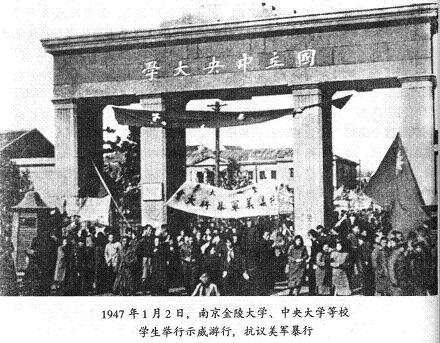
 In Peking, students launched a massive anti-America demonstration on December 30th under the communist leadership.
The protest was purportedly organized by Yuan Yongxi (Yuan Yung-hsi), a communist student leader who was sent back to Peking to beef up the communist Jinn-Cha-Ji (Shanxi-Hebei-Chahar) bureau's city work after the Southwest Union University was dismantled in May 1946.
Yuan Yongxi, i.e., communist husband of a daughter of Chen Bulei who later committed suicide to petition Chiang Kai-shek for pardoning his daughter Chen Lian and son-in-law Yuan Yongxi, was an early communism activist in Peking in the early 1930s, a communist party branch secretary responsible for setting up a communist cell in the Southwest Union University, and a communist student leader in Kunming in November-December 1945.
Nationwide, students echoed in support. The fuse was the purported American G.I.s' or specifically two marines' rape on December 24, 1946 (i.e., the Christmas eve) of a female leftist student by the name of Shen Chong. Multiple reporters interviewed Shen Chong the victim and published conflicting accounts as to the 'rape'. While Marshall found himself 'mission over' finally, the communist side no longer saw any utility in retaining the service of Americans, either.
In Peking, students launched a massive anti-America demonstration on December 30th under the communist leadership.
The protest was purportedly organized by Yuan Yongxi (Yuan Yung-hsi), a communist student leader who was sent back to Peking to beef up the communist Jinn-Cha-Ji (Shanxi-Hebei-Chahar) bureau's city work after the Southwest Union University was dismantled in May 1946.
Yuan Yongxi, i.e., communist husband of a daughter of Chen Bulei who later committed suicide to petition Chiang Kai-shek for pardoning his daughter Chen Lian and son-in-law Yuan Yongxi, was an early communism activist in Peking in the early 1930s, a communist party branch secretary responsible for setting up a communist cell in the Southwest Union University, and a communist student leader in Kunming in November-December 1945.
Nationwide, students echoed in support. The fuse was the purported American G.I.s' or specifically two marines' rape on December 24, 1946 (i.e., the Christmas eve) of a female leftist student by the name of Shen Chong. Multiple reporters interviewed Shen Chong the victim and published conflicting accounts as to the 'rape'. While Marshall found himself 'mission over' finally, the communist side no longer saw any utility in retaining the service of Americans, either.
The communists and the Soviets' scheme, as well as John King Fairbank's scheme, was to kick out the Americans from China.
Months back, on July 11th, 1946, secret agents purportedly assassinated Li Gongpu, one of the Democratic League leaders, and four days later, assassinated another leader, Wen Yiduo, who had just attended Li Gongpu's funeral.
The fishy part of Li Gongpu's assassination could be seen in John King Fairbank's role in the commotion surrounding the sequence of events prior to, during and after the assassination. Days before Li Gongpu's death, Fairbank personally visited communist Guo Moruo with a warning that the United States government could yield to pressure to offer aid to Chiang Kai-shek's nationalist Chinese government unless something was to be done to stop it. John King Fairbank's role was like a successor to Owen Lattimore, running the pro-communist American O.W.I.
(According to Hao Xinqing's research, communist Zhu Jieqin of Yunnan University's Arts College personally disclosed to his student Zhang Junda that the communists orchestrated the assassination of both Li Gongpu and Wen Yiduo for stirring up the Americans' public opinions against the R.O.C. government. Zhang Junda, who fled to Hongkong during the cultural revolution, disclosed that Zhu Jieqin was an agent and division-level cadre of the communist social department.)
Japan's Revival Under MacArthur
In Japan, MacArthur, for making his control over Japan smooth and easy, had retained the Japanese emperor as a symbol after nominally depriving him of deity and the administrative power in the new constitution released on November 3rd, 1946.
To deflect criticisms by the American politicians and the Chinese government, MacArthur organized several "inspection delegations" for visiting his experiment with 'democracy' in Japan.
The Chinese officials, believing that the Japanese really wanted a 3rd world war, commented that MacArthur's intent was merely against the U.S.S.R. in reviving Japan.
Lu Keng pointed out that China's occupation force for Japan was hindered by MacArthur.
The Chinese embassy was also hindered by MacArthur from being re-established in Japan.
Similarly, MacArthur obstructed Shao Yulin from going to Korea to establish a Chinese legation.
Ambassador John Stuart Leighton's personal adviser Fu Jingbo later disclosed that Stuart had passed on the Chinese resentment over to MacArthur.
After the visit of the Roy Howard delegation, MacArthur asked Zhu Shiming to relay an invitation to China.
(MacArthur, with the communist fellow travelers working in his Tokyo office, had adopted a policy of disarming South Korea to make it a prey to the Soviets and the communists, and later devised a policy of supporting a Third Force in Taiwan to replace Chiang Kai-shek, as well as making Taiwan a so-called trustee country.)
From February 26th to March 15th, 1947, Lu Keng participated in the tour of Japan.
Gong Debai of "The Salvation Daily" tried in vain to get a quota for visiting Japan on the same trip, and blasted the Nationalist government propaganda ministry over Lu Keng's obtaining the quota to visit Japan.
Lu Keng noticed that the Japanese were extremely obedient to MacArthur, and bowed towards the delegation's train and the American train with 90 degree courtesy.
By Feb, the Japanese exports had reached US$190,000,000 while imports 320,000,000, with the bulk of trade with the U.S. but threatening HK's cotton product market already.
On February 28th, MacArthur gave a reception to the Chinese media people. Mrs. MacArthur talked about her appreciation of a jade cauldron that Xu Shichang gave her at the Japanese surrender ceremony, and further praised General Wu Peifu as patriotic.
The Japanese expressed their sentiment at a news conference held by "Asashi News" on March 9th, with the editor-in-chief offering the Chinese only the black coffee on the pretext that Japan no longer had sugar after Taiwan was returned to China.
When Lu Keng asked the Japanese what they thought about the war, the Japanese mostly expressed repentance and furthermore expressed the only wish that China could help Japan on the matter of signing the peace treaty as soon as possible.
After visiting Hiroshima, the Chinese delegation went to Korea, and met with Jin Jiu [Kin Kau] who once expressed a wish to commit suicide so that both the Russians and the Americans would withdraw from Korea.
The Chinese had raised the demand in making Korea an independent country at the 1943 Cairo Meeting.
However, Stalin and the Soviet-hijacked U.S. government had another design for the division of the world.
After return to China, Lu Keng's report on the affairs between Zhu Shiming and Li Xianglan [YAMAGUCHI Yoshiko] led Chiang Kai-shek into angrily rescinding Zhu Shiming's post of delegation chief of the Chinese representative to Japan. (Zhang Ling'ao pointed out that Chiang Kai-shek had dismissed Zhu Shiming after Zhu's wife raised a complaint with Chiang Kai-shek.)
Later, in 1948, Chiang Kai-shek rescinded successor Shang Zhen's post for his impregnating a Japanese maid.
(Zhang Ling'ao claimed that Shang Zhen resigned his post in March 1949 for going into business in Japan.)
Thereafter, Zhu Shiming resumed the post in Japan till he was dismissed again after his subordinates, like female writer Bing Xin, went back to Communist China.
Zhu Shiming was later killed in a mysterious circumstance in Japan over implication with the matter of the communists versus the nationalists.
Manchuria, The Graveyard of Nationalist government Troops
Du Yuming established 11 security columns and 9 security centers as the local auxiliary forces, while Lin Biao was said to have hired hundreds of thousands of former Manchukuo puppet government soldiers.
In January 1947, Lin Biao, after half year of respite, crossed the Songhuajiang [Sungari] River to the south with 12 divisions, and purportedly destroyed three Sun Liren regiments within two months, including the 113th regiment which was noted for accomplishments in Burma. - Sun Liren's fear since the 1937 Battle of Shanghai and the 1942 Burma Campaign had always been the piecemeal disposition of his troops.
From June 1946 to February 1947, the Government troops took over hundreds of cities from the CCP; however, the Government troops would be weakened as a result of spreading across multiple isolated cities.
By March of 1947, Chiang Kai-shek had to adjust his strategy to "key attacks" from "wholescale attacks", i.e., campaigns against the Communist forces on the Shandong Peninsula and in the Shenxi communist Home Base.
(Communist records claimed that Hu Zongnan led 140,000 army against Yenan on March 13th.
Feng Zhijun claimed that Hu Zongnan's "Xi'an Pacifying Military Office" possessed 34 brigades or 250000 soldiers, i.e., a Communist rhetoric.
Actual deployment of government troops by Hu Zongnan was explicitly detailed in Hu Zongnan's biography.)
In occupied territories of Manchuria, the Nationalist government failed to revive the economy after most of the equipment had been dismantled by the Russians.
In China proper, with the government troops in standby mode till early 1947, the fighting spirits of the army had degraded.
The Nationalist government officers and officials were said to be busy looking for women as wives or concubines.
Corruption ran rampant when the officers and officials, with the Chinese Communist infiltrators included, embezzled properties from collaborators with the Japanese as well as engaged in trade with the Chinese Communists.
Chiang Kai-shek devised so-called "da [hit] hu [tiger] dui [special force]" for dealing with the corrupt officials.
Smuggling became a means for the corrupt Nationalist government agents to get rich when the Communist guerilla had to obtain commodities through blockades from the cities.
Though, schools and colleges were re-opened.
Campaign of Northern Liaoning Province - the Defense Battle At Sipingjie
By the middle of May 1947, the Communist forces mounted a summer campaign against southern Manchuria and took over the Huaide city. The Nationalist government army's 88th Division of the 71st Corps was destroyed while en route to the relief of Huaide. On May 26th, the communists sacked Faku, and on the 29th, sacked Changtu, posing direct threat to Siping-jie and Shenyang (Mukden).
With four "zongdui" of Communist troops, Lin Biao mounted a siege campaign against Sipingjie.
On May 30th, Chiang Kai-shek flew to Shenyang (Mukden) and adopted a defensive strategy.
In mid-June, the Communist forces, numbering 200,000, surrounded Sipingjie the midpoint between Shenyang (Mukden) and Changchun in a surprise move.
Defending the city would be Chen Mingren's 71st Corps [lacking the 91st Division] and the 54th Division [lacking the 162nd Regiment] of Shi Jue's 13th Corps. Initially, Chen Mingren ordered that Song Bangwen defend the old district to the east of the railway, with an order that no soldiers from the 54D should cross the railway in any case. Under Lin Biao's intensive attacks, the 71C fell back to the east side of the railway, and lost his brother to the Communist captivity. Song Bangwen, together with two regiment chiefs, defended the city house by house, and spread the beans on the field to create difficulty for the Communist troops to charge.
The Nationalist government army dispatched the 53rd Corps to Shenyang (Mukden). The New 1st Corps, and New 6th Corps also came to the relief. The 54D, i.e., part of Shi Jue or Tang Enbo's crack force that fought against the Japanese across China throughout WWII, launched a counter-offensive from Sipingjie and successfully beat back Lin Biao's Communist troops at the Siege Battle of Sipingjie.
Taking advantage of the Communist debacle at the Battle of Sipingjie, Chen Cheng authorized the counter-attacks which recovered the northern Jilin territories of Gongzuling, Lishu, Bamiancheng, Shangyang & Yitong and the northern Liaoning city of Xifeng.
By August 1947, Chiang Kai-shek ordered that Chen Cheng replace Xiong Shihui as director for the Northeast Military District.
Chen Cheng relocated the 49th Corps to Manchuria from northern Jiangsu Province; shortly afterward, however, the 105th Division of the 49th Corps was destroyed by the Communists to the north of Jinzhou.
Chen Cheng re-organized Du Yuming's local security forces into the New 3rd Corps, New 5th Corps, New 7th Corps and New 8th Corps.
In October 1947, the Shanghai-San Francisco direct flight commenced.
The Chinese Aviation Company invited notables and reporters for a pilot flight, which included Zhao Minheng ["news newspaper"], Zhang Guoxun ["continental newspaper"], Fei Yimin ["grand public newspaper"], and Lu Keng ["central daily newspaper"], et al.
The group visited the Pearl Harbor, SF, NY, & DC.
Marshall was back in the U.S. as secretary of state, and replied to Lu Keng on November 21st, with the following hints as to the U.S. aid: "... the United States Government continues to regard with concern the difficulties faced by the Government and people of China and is constantly considering what assistance it can appropriately extend which would be effective in lessening those difficulties..."
With the U.S. having already cut aid to China, Tao Xisheng immediately published Marshall's letter on the Nationalist government "Central Daily" for propping up the fighting spirits of the Nationalist government troops.
Though, Tao Xisheng would not know that Marshall was bent on destroying the Republic of China.
By mid-Oct, the Communist troops, i.e., the so-called "Northeast Democratic Allied Army", totaling 500,000, mounted a 50-day "autumn campaign" and purportedly destroyed about 70,000 Government troops. Chiang Kai-shek flew to Shenyang (Mukden) again, and Chen Cheng acknowledged his dereliction.
Chiang Kai-shek recalled Wei Lihuang back to China in October 1947 for sake of replacing Chen Cheng. However, Wei Lihuang, who was deprived of the post of deputy infantry commander and sent on a European tour in November 1946, had already contacted the Chinese Communist agents in Europe and expressed wish not to engage in fighting with the Communists. Recent revelation claimed that Wei Lihuang intended to enroll in the CCP, but the CCP instructed that Wei Lihuang could contribute more to the CCP cause should he remain inside the Nationalist government. Zhang Fuxing & Wang Yunfa's anthology, "Rise & Fall Of KMT Defeated Generals" (Military Science Publishing House, Beijing, China, 2002 edition), claimed that Wei Lihuang instructed Wang[1] Dezhao in sending telegraph to the CCP while still in Paris.
Wang[1] Dezhao was husband to a remote in-law nephew of Wi Lihuang wife's aunt.
Communists, through, already infiltrated into Wei Lihuang's 2nd War Zone in 1938 as the "battlefield work corps" staffed by communist resistance war university of Yenan.
The Communist "Northeast Democratic Allied Army" then renamed itself to the Northeast Field Army and launched a "winter campaign", with the 2nd, 3rd, 6th & 7th "zongdui" [corps equivalent] and three artillery regiments.
Chen Xinda's New 5th Corps, after sacking Paoziyan & Wenjiatai on January 3rd, 1948, pushed forward against 200,000 Communist troops around Gongzhuling and surrounded the Communist 7th "zongdui". Along the way, the Communist 6th "zongdui" put up fight-and-retreat. On January 5th, 1948, the Communist troops, comprising of the 2nd & 7th "zongdui" from Zhangwu to the north and the 3rd "zongdui" from Shezishan to the east, initiated a counter-encirclement, whereas the Nationalist government army New 6th Corps failed to receive order to go to the aid of the New 5th Corps by the deadline of January 5th. Lin Biao separately assigned the 1st, 4th & 10th "zongdui" to impeding the Nationalist government army relief from Shenyang (Mukden).
Chen Xinda's troops, about 20,000 in total, fought on against the Communist troops through the villages of Gongzutun, Wangdaotun, Wenjiatai and Huangjiashan. By the 7th, the 5th Corps Command Center at Wenjiatai Village fell under the Communist cannons. Chen Xinda, together with 43rd Division Chief Liu Guangtian and 195th Division Chief Xie Daizheng, would be caught alive by the Communists.
Four Campaigns to Linjiang from the Sino-Korean Border
From the memoirs related to some Taiwan native who joined the Japanese Kwantung Army and was later exiled by the Soviet Red Army to Siberia for the coolie labor, the Soviets, to help Mao Tse-tung and Kim Il Sung, on a wholesale scale, in 1947 repatriated the Korean-ethnic Japanese Kwantung Army prisoners of war to North Korea and the Taiwan-ethnic Japanese Kwantung Army prisoners of war to Manchuria, as fodder of war, which probably explained why there was no accounting of some huge numbers of the Japanese Kwantung Army troops in the later repatriation to Japan in the late 1950s.
According to Kim Il-sung, altogether 250,000 Korean mercenaries took part in the 1945-1950 civil war against the Nationalist Government.
Out of Kim Il Sung's supply of 250,000 North Korean mercenaries to fighting the Chinese civil war, about 60,000-70,000 survivors repatriated to North Korea for the 1950 Korea War, for example --something to remind the readers how North Korea developed to threaten the world with a nuclear winter today.
Note the fundamental difference between the 250,000 ethnic-Korean Japanese Kwantung Army diehards and the ethnic-Korean Chinese living in China. The communist statistics claimed that altogether 65,000 ethnic-Korean Chinese minority people, or the Korean migrants living in China, joined the communist army, with approximately 60% coming from the Jirin subprovince, 21% from the Sungari subprovince, and 15% from the Liaodong subprovince.
The communists' wholesale recruiting of the ethnic-Koreans in the three Manchuria subprovinces of Jirin, Sungari and Liaodong (Liao-tung), that bordered with North Korea, the Soviet Maritime Province (a territory robbed from Manchu China during the Second Opium War of the 19th century), and the Japan Sea, could only have happened at the turn of 1947-1948 --when the communists charged out of the hideouts in Port Arthur and North Korea to counter-attack the Chinese government troops.
Back the spring of 1946, Marshall stopped the Chinese Nationalist troops from chasing the disarrayed communists north of the Sungari River.
Per Rose Page Wilson, Mrs. Marshall accompanied her husband on the second trip to China in April of 1946, which made Marshall no longer an unhappy person as he confessed to Rose Page Wilson in a January letter.
The communists, utilizing the truce brokered by Marshall to conduct a sweeping campaign against the pro-government forces and brigands in 1946-1947, consolidated the hold in northern Manchuria, and then struck south in the so-called "Three Campaigns of Crossing the Sungari River" and struck west in the so-called "Four Campaigns to Linjiang from the Sino-Korean Border".
In January 1947, Lin Biao, after half year of respite, first crossed the Songhuajiang [Sungari] River to the south with 12 divisions.
Lin Biao, after rebuilding his army with new supplies from the Soviet-controlled depots in North Korea, mounted the so-called "Three Attacks to the South of Sungari", "Four Campaigns to Linjiang from the Sino-Korean Border", and "Two Sieges of Siping-jie".
(After witnessing the bloodbath from the two siege campaigns against Sipingjie (Szepingkai), declined Mao's order to attack Jinzhou for half a year in 1948, similar to communist general Chen Yi's comment on the communist Menglianggu casualties in saying that this was not a job for a man born by a mother, hinting at the huge loss the communist side incurred.)
Linjiang (by the river) was a small town on the northern bank of the Yalu-jiang River, facing Zhongjiang (middle river) on the Korean side.
Kim Il-sung's father in the 1920s organized the anti-Japanese Korean nationalist movement from the two riverside towns.
Wei Lihuang's Treacheries
After Wei Lihuang declined the post numerous times, even after Zhang Qun and Gu Zhutong et al., personally visited him at the residency, Wei Lihuang suddenly agreed to taking on the task. Chiang Kai-shek made five promises, including 1) no dereliction accusation should Wei Lihuang fail to quell the Communists, 2) Chen Cheng helping Wei Lihuang in controlling the troops, 3) dispatchment of one more corps-conglomerate to Manchuria, 4) full airforce support, and 5) 3-4 more Corps for Manchuria by 1948.
On January 17th, Wei Lihuang officially assumed the post for the "Northeast Banditry Quelling General Command Headquarters", and arrived in Shenyang (Mukden) on January 22nd, 1948.
In Manchuria, the Nationalist government army still possessed the New 7th Corps and 60th Corps in Changchun, the 9th Corps-Conglomerate [commanding the New 1st, New 3rd, New 6th, and 49th Corps] in central Liaoning Province, the 52nd Corps and one corps of Zhou Fucheng's 8th Corps-Conglomerate in southern Liaoning Province and Shenyang (Mukden), and Dian-jun's 93rd Corps in Jinzhou. Other than that, there was Xiang Fengwu's 71st Corps under Liu Anqi's 7th Corps-Conglomerate.
By the time Wei Lihuang arrived in Shenyang (Mukden), the "Communist winter campaign" was at the peak. The Communist forces purportedly destroyed one Nationalist Corps and eight divisions, totaling 156,000 men, and sacked 18 cities. One Nationalist army division defected to the Communists.
Citing the Communist losses in the siege of Sipingjie, Wei Lihuang deliberately adopted a strategy of "sitting out" by having his troops defend the major cities like Shenyang (Mukden), Changchun, Jinzhou and Huludao.
Wei Lihuang regrouped the four corps-conglomerates of the fourteen army corps or 44 divisions, making Zheng Dongguo's 1st corps-conglomerate (about 6 divisions or 100,000 men) in charge of Changchun in the north, Fan Hanjie's 6th corps-conglomerate (about 14 divisions or 150,000 men) in charge of Jinzhou in the west, and the 8th & 9th corps-conglomerates, etc (about 300,000 men) in charge of Shenyang (Mukden), Benxi, Fushun, Tieling and Xinmin in the middle.
Though Wei Lihuang still possessed [nominally] 550,000 men, they were dispersed in separate cities cut off from each other, with the city of Changchun to be under the Communist siege till October 1948, where starvation led to death of hundreds of thousands of people under the communist blockade. The Communist forces deliberately shot at the civilians with machine guns for stopping the civilians from leaving Changchun. The siege of Changchun city would cause over 300,000 civilians starved to death as a result of the Communists' blockade of the city. ('Xue3 [snow] Bai [white], Xue4 [blood] Hong [red] by Zhang Zhenglong is a good reference book on this subject. Zhang Zhenglong cited multiple eyewitness accounts in pointing out that the Communist army would only allow those Nationalist army soldiers to defect through the blockade line with gun as a pass or allow the relatives and families of undercover Communist agents or colluding Nationalist army officers and officials to exit the vacuum belt. At the vacuum belt, innocent civilians who had died would echo with the sound of crack of the bloated bellies in the hot sunlight.
Endo Homare, who verified that the Japanese foreign ministry during WWII funneled over 3 billion yens of funds to the communists through Pan Hannian, equivalent to 25 million U.S. dollars, was the only survivor of her family from the 1948 communist siege and blockade of Changchun that led to the starvation death of at minimum 300,000 civilians.)
With coastal Yingkou taken and the Bei-Ning [Northern Liaoning; Mukden-Peiping {Peking}] Railway cut off by the Communists, Shenyang (Mukden) and Changchun had to rely upon airdrop for survival.
Liu Yuzhang's 52nd Corps, later during the Jinzhou-Dahushan campaign time period, retook Yingkou from the communists.
Wei Lihuang's Refusal To Evacuate From Shenyang (Mukden) and Changchun
With the purported American nodding approval [which was another communist-published misinformation], Chiang Kai-shek began to implement the policy of retreating to Jinzhou and/or inside of the Shanhaiguan Pass.
However, Wei Lihuang repeatedly rebutted Luo Zekai & Li Shuzheng of the Nationalist government National Defense Department, claiming that should his forces leave Shenyang (Mukden), the Communists would utilize the three rivers of Liao-he, Daling-he and Raoyang-he in ambushing them. Wei Lihuang dispatched Zheng Dongguo to Nanking for dissuading Chiang Kai-shek from the order of retreat from Shenyang (Mukden). Chiang Kai-shek, however, insisted that Shenyang (Mukden) must be abandoned and added that Changchun could be abandoned as well for preserving the Nationalist government army strength.
Wei Lihuang then held a military meeting with his generals and dispatched Zhao Jiaxiang and Luo Youlun to Nanking for relaying the opinions of the Northeastern Nationalist government army generals.
Chiang Kai-shek gave in to Wei Lihuang for the time being. Wei Lihuang requested that the Government troops be sent to Huludao, a coastal city to the south of Jinzhou, and ordered recruitment of soldiers in and around Jinzhou and Shenyang (Mukden).
Being afraid of the Nationalist government forced recruitment, Gao Wenjun and his classmates stayed inside the school most of the time.
Gao Wenjun, who wrote the "Memoirs of the Korea War" (Shengzhi Culture Enterprises Publishing House, http://www.ycrc.com.tw, Taipei, Taiwan, July 2000 edition), was attending the Liaoning Provincial High School in Shenyang (Mukden). Later, in June 1948, 6000 students took exam for the Whampoa Academy 23rd Session, with Gao Wenjun among 600 examinees accepted. Gao Wenjun left for Sichuan Province in August, with his parents walking him to the airport hands in hands. Gao Wenjun was never to see his parents again the rest of his life.
The Sichuan Whampoa class was later betrayed to the communists by the schoolmaster.
In March 1948, Chiang Kai-shek changed mind and ordered that Wei Lihuang fly to Nanking. On March 22nd, Wei Lihuang flew to Nanking and still objected to withdrawal from Shenyang (Mukden) & Changchun, claiming that he would contact the Americans direct for help in airdrop of supplies. Wei Lihuang then ordered that Liu Yanhan contact David Barr [Ba-da-wei], the U.S. director of JUSMAG, for assistance. On May 11th, Barr and the U.S. Delegation flew to Shanyang & Changchun and purportedly promised to Wei Lihuang in supplying equipment for 10 divisions.
Note that the U.S. government did not ship out any military aid till late 1948.
When Chiang Kai-shek renewed his call for withdrawal from Shenyang (Mukden), Wei Lihuang dispatched Liao Yaoxiang to Nanking for dissuasion on the pretext that should the Nationalist government army withdraw from Shenyang (Mukden), then the Nationalist government army soldiers in Changchun would lose the fighting spirits.
While Chiang Kai-shek and Wei Lihuang were entangled in the disputes, the CCP forces, which were equipped by Stalin-supplied American August Storm weapons, launched the Liao-Shen Campaign on the evening of September 17th, 1948.
The CCP Liao-Shen Campaign
Economy collapsed inside the cities when the Nationalist government currencies rolled out to replace the old version. Ten year old girl could be bought for 10 kilograms of rice. One teacher of the Jinzhou Normal College picked up a rotten meat on the street, cooked it and ate it, and died shortly afterward.
Xia Dehong, as chairwoman of the autonomous student union, organized a raid into a banquet for collecting donations.
In February 1948, with the Communist agent's support, Xia Dehong entered the Medical College of Jinzhou's "Northeastern Exile University".
After reflecting on the mistake of over-killing the wealthy landlords and business owners of northern Manchuria, the Communists issued an instruction in winning over the hearts of the students of the exile university.
In late June, a shipload of Exile University students traveled south to Tianjin [Tientsin] under the encouragement of the Nationalist government authorities.
However, at Tianjin (Tientsin), under the dissension by undercover Communist students, the Exile University students mounted a protest against the Tianjin garrison troops in demand of food and lodging while turning down a Nationalist government request that the students joined the army under a slogan "Fighting Back To Hometown".
Several were shot dead according to Xia Dehong.
When the crackdown news spread to Jinzhou, Xia Dehong took charge of a joint student union of Jinzhou in protest of the massacre, for which she was later arrested as a Communist suspect and went through an execution session while standing blindfolded with a real Communist.
Wei Lihuang maneuvered to have his crony Chen Tie assemble all generals for an objection to the high command's retreat order, and at a private banquet, Wei Lihuang maneuvered to have Liao Yaoxiang propose to Gu Zhutong a different path: 1) the Nationalist government army dispatch relief northward to Jinzhou from Huludao; the Jinzhou & Huludao relief forces break through eastward to converge with the Shenyang (Mukden) army; and the combined forces go north to the relief of Changchun; 2) the Shenyang (Mukden) forces go south to attack coastal Yingkou and then attack the Communist forces to the east of Jinzhou, with another possibility of dispatching relief to Huludao from Yingkou by crossing the Liaodong (Liao-tung) Bay of the Bohai Sea.
After Gu Zhutong submitted Liao Yaoxiang's proposals, Chiang Kai-shek telephoned Gu Zhutong with order of executing the original plan. With Liao Yaoxiang finally giving in, Wei Lihuang managed to get Gu Zhutong leave for Nanking by ordering that Liao Yaoxiang make preparatory works in the Xinmin city, to the northwest of Shenyang (Mukden).
Lin Biao's Communist forces made a stealthy march towards the south for the Jinzhou city. General Fan Hanjie, with Shen Xiangkui's N8C and Lu Junquan's 93C, failed to contract the defense line. The Communists first concentrated the heavy artillery against Yixian to the north of Jinzhou, and two days later, on October 1st, took over the Yixian county. The Communist forces then attacked Jinxi and Xingcheng to the southwest of Jinzhou. With assurance from Fan Hanjie as to his determination to persist at Jinzhou in lieu of a retreat to coastal Huludao, Chiang Kai-shek planned to call over reinforcements from Shenyang (Mukden) for a duel with the Communists. To reinforce Jinzhou, Chiang Kai-shek air-lifted the 49th Corps to Jinzhou for assistance with the city defense. Thereafter, the Communist force totally surrounded Jinzhou.
On October 2nd, Chiang Kai-shek personally flew over to Shenyang (Mukden), but Wei Lihuang threatened him with resignation. Chiang Kai-shek assembled all officers above the division level and reminded them that they could be caught by the CCP bandits (i.e., the so-called People's Liberation Army) should they still disobey his order.
Wei Lihuang privately claimed to Chen Tie & Peng Jieru that Chiang Kai-shek intended to abandon Shenyang (Mukden) for Jinzhou in accordance with the American instruction and that Chiang Kai-shek would later punish him as a scapegoat for losing Shenyang (Mukden).
On October 8th [Oct 6th per Jung Chang], Chiang Kai-shek flew to Huludao to organize an expedition force for converging with the Shenyang (Mukden) evacuation troops after dividing the Shenyang (Mukden) forces into Liao Yaoxiang's Liaoxi Group and Zhou Fucheng's Garrison Group.
Hou Jingru, another government army's commander and an estranged communist of the 1920s but reconnected with the communists, was also scheming to disrupt Chiang Kai-shek's Huludao operations.
(Per Jun Chang, Wei Lihuang did not follow the order till October 9th, and merely dispatched Liao Yaoxiang's Liaoxi Group.)
* In Commemoration of China's Fall under the Alien Conquests in A.D. 1279,
A.D. 1644 & A.D. 1949 *
U.S.S.R./Comintern Alliance with the KMT & CCP (1923-1927)
Korean/Chinese Communists & the 1931 Japanese Invasion of Manchuria
American Involvement in China: Soviet Operation Snow, IPR Conspiracy, Dixie Mission, Stilwell
Incident, O.S.S. Scheme, Coalition Government Crap, Amerasia Case & The China White Paper
* Stay tuned for "Republican China 1911-1955: A Complete Untold History" *
|
|
Zou Rong's Revolutionary Army;
Shin Kyu Sik's
Shrine (Spirit, Kunitama) of Korea
|
This snippet is for sons and daughters of China:
Heed the sons & ministers' agony and sorrow of our ancestors who died or lived through the Mongol, Manchu and Soviet-Chicom conquest
and
the Yongjia, Jingkang and Jiashen cataclysms !
Jeanne d'Arc of China:
Teenager girl Xun Guan breaking out of the Wancheng city to borrow the relief troops in the late Western Jinn dynasty;
Liu-Shao-shi riding into the barbarian army to rescue her husband in the late Western Jinn dynasty;
teenager girl Shen Yunying breaking into Zhang Xianzhong's rebels on the horseback to avenge on father's death in the late Ming dynasty.
China's Solitary and Lone Heroes:
Nan Jiyun breaking out of the Suiyang siege and charging back into the city in the Tang dynasty;
Zhang Gui & Zhang Shun Brothers breaking through the Mongol siege of Xiangyang in the Southern Soong dynasty;
Liu Tiejun breaking through three communist field armies' siege of Kaifeng in the Republican China time period;
Zhang Jian's lone confrontation against the communist army during the June 3rd & 4th Massacre of 1989.
|
|
|
On October 9th, Chiang Kai-shek, riding on the Chongqing (Chungking) Warship, launched a futile attack at coastal Tashan with the support of Zhou Zhirou's airforce.
250,000 Communist troops launched the siege on October 8th.
Xia Dehong managed to send in explosive to Jinzhou's Nationalist government army arsenal. Colonel Ji had doubts about Xia Dehong's possible involvement after the blast but was assured that the Communist government would not punish him.
At this time, Lin Biao's communist army of over one dozen 'zongdui' or army corps equivalent, possessed one complete artillery army corps in addition to artillery divisions, artillery brigades and artillery regiments under each and every 'zongdui' column.
The communists, according to the four-volume communist compiling of Northeast Economics and Finance, possessed over one million civilian logistic support personnel as well as a full railway administration and police army after the Soviet railway army corps fully repaired the westernmost Manchuria railway trunk line, a line that was parallel to the Chinese Eastern Railway.
Cannon balls began to fly into the city indiscriminately. The whole city was on fire.
One such bomb pierced into the floor of a table inside of Xie Dehong's residence but did not explode.
Black markets disappeared, and people could no longer buy food anywhere.
The Nationalist government army soldiers retreated into the city from the outskirts on October 13th.
At one time, dozens of soldiers asked for food at Xia Dehong's residence, but soon the iron wok was hit by the Communist shelling.
On October 14th, 900 cannons, per Jung Chang, shelled at the city. 14 cats sought asylum inside of Xia Dehong's residency.
The next day, the Communist and Nationalist soldiers fought the street battles.
Soldiers from the two camps visited Xia Dehong's residency consecutively during the lane-to-lane battles.
The Communist soldiers, with white towels on the left arms, knocked on the door.
The Nationalist government army soldiers sought for plaincoats.
Stepping out of the door, Xia Dehong could only see scenes of broken body parts lying everywhere on the streets.
A pregnant woman in the neighborhood was killed by communist shelling, and lots of neighbors also perished.
Per Jung Chang, 20000 government army soldiers were killed, and 80000 caught captives.
Commander Fan Hanjie was caught alive while fleeing the city.
(Lin Biao delayed the Jinzhou campaign for about half a year.
After the downfall of Lin Biao in 1971, communist propaganda from the cultural revolution claimed that Lin Biao intended to attack westward towards Jehol instead of Jinzhou.
Back in February of 1942, when Lin Biao passed through Xi'an,
Hu Zongnan, learning that Lin Biao had stayed at the guest house of the 18th Group Army (i.e., the CCP's Eight Route Army) in Xi'an, drove over for a two-hour meeting with Lin Biao as a courtesy of the Whampoa 1st Session elder brother to the 4th Session younger brother. The next day, Hu Zongnan secretly requested that KMT espionage chief Dai Li fly over to Xi'an from Chongqing for a meeting with Lin Biao. Hu Zongnan and Dai Li, claiming to be the "martial and civil dogs" of Chiang Kai-shek, never revealed the contents of their meetings with Lin Biao.
Wang Wei, in the biography on Hu Zongnan, stated that Lin Biao had promised to the Whampoa classmates that he would play some role in the future, namely, switching loyalty for Chiang Kai-shek.
The significance of the meeting lied in the fact that Lin Biao never reported the secret meeting with Dai Li to the CCP Central.
On October 15th, Chiang Kai-shek flew to Shenyang (Mukden) again with Du Yuming. Du Yuming privately told Wei Lihuang that the President (i.e., Chiang Kai-shek) had dropped letters to Zheng Dongguo [in Changchun] and Fan Hanjie [in Jinzhou] with authorizations of a breakout.
Note that government army generals dared not leave their posts without written order from Chiang Kai-shek himself.
After Jinzhou, Changchun was lost to the CCP consecutively, when the Yunnan provincial army colluded with the communists in selling out the city which was under a communist blockade that saw 300,000 civilians starved to death.
 After receiving the breakout order, Zheng Dongguo ordered that New 38th Division push to the position.
On the night of October 17th, Zeng Zesheng's 60th Corps, i.e., Yunnan provincial army from southwestern China, declared an uprising for the Communist camp, and cut the Changchun city into two parts.
Zheng Dongguo sent a telegraph to Chiang Kai-shek about his readiness to sacrifice life with Changchun, which was published on the government Central Daily on October 24th.
However, the subordinate officers, i.e., Yang Youmei, 3 days ago, had already disarmed Zheng Dongguo to prevent him from committing suicide.
The communist records, i.e., a four-volume compiling of Northeast Economics and Finance, claimed that there were only 100,000 people left out of 600,000 people at Changchun after the siege. While claiming that 100,000 people died of starvation [and cannibalism] and 400,000 people fled the city, the communists obfuscated the records on the fate of those 400,000 civilians who were trapped between the city wall and the communist blockade line, something vividly recorded by Zhang Zhenglong's Snow White, Blood Red.
The Communist army would only allow those Nationalist army soldiers to defect through the blockade with gun as a pass or allow the relatives and families of undercover Communist agents or colluding Nationalist army officers and officials to exit the vacuum belt. At the vacuum belt, i.e., the scene of a Hell, innocent civilians from among as high as 400,000 unaccounted people fleeing the city could have died, with their corpses emitting the sound of cracking of the bloated bellies in the hot sunlight.
The same communist publication, in a passage on reconstruction of the city, claimed that the following spring, about early March to mid-April 1949, communist mayor Zou Dapeng located and buried or cremated an additional 34,056 corpses, i.e., victims from the communist siege of Changchun half a year ago.
Changchun used to boast of a population of 800,000 at the time of the Japanese surrender.
Zou Dapeng, an early communism activist in Manchuria, at one time infiltrated into Deng Tiemei and Ma Zhanshan's Northeast Loyal & Righteous Army in the early 1930s
before returning to Yenan to be a career communist Social Department agent and after the communist victory acted as assistant to communist spymaster Li Kenong and consecutively spymaster Kang Sheng, a job he held till 1967 when he committed suicide with wife during the cultural revolution and under duress from Kang Sheng.
After receiving the breakout order, Zheng Dongguo ordered that New 38th Division push to the position.
On the night of October 17th, Zeng Zesheng's 60th Corps, i.e., Yunnan provincial army from southwestern China, declared an uprising for the Communist camp, and cut the Changchun city into two parts.
Zheng Dongguo sent a telegraph to Chiang Kai-shek about his readiness to sacrifice life with Changchun, which was published on the government Central Daily on October 24th.
However, the subordinate officers, i.e., Yang Youmei, 3 days ago, had already disarmed Zheng Dongguo to prevent him from committing suicide.
The communist records, i.e., a four-volume compiling of Northeast Economics and Finance, claimed that there were only 100,000 people left out of 600,000 people at Changchun after the siege. While claiming that 100,000 people died of starvation [and cannibalism] and 400,000 people fled the city, the communists obfuscated the records on the fate of those 400,000 civilians who were trapped between the city wall and the communist blockade line, something vividly recorded by Zhang Zhenglong's Snow White, Blood Red.
The Communist army would only allow those Nationalist army soldiers to defect through the blockade with gun as a pass or allow the relatives and families of undercover Communist agents or colluding Nationalist army officers and officials to exit the vacuum belt. At the vacuum belt, i.e., the scene of a Hell, innocent civilians from among as high as 400,000 unaccounted people fleeing the city could have died, with their corpses emitting the sound of cracking of the bloated bellies in the hot sunlight.
The same communist publication, in a passage on reconstruction of the city, claimed that the following spring, about early March to mid-April 1949, communist mayor Zou Dapeng located and buried or cremated an additional 34,056 corpses, i.e., victims from the communist siege of Changchun half a year ago.
Changchun used to boast of a population of 800,000 at the time of the Japanese surrender.
Zou Dapeng, an early communism activist in Manchuria, at one time infiltrated into Deng Tiemei and Ma Zhanshan's Northeast Loyal & Righteous Army in the early 1930s
before returning to Yenan to be a career communist Social Department agent and after the communist victory acted as assistant to communist spymaster Li Kenong and consecutively spymaster Kang Sheng, a job he held till 1967 when he committed suicide with wife during the cultural revolution and under duress from Kang Sheng.
On October 18th, Chiang Kai-shek flew to Shenyang (Mukden) again, and ordered a recovery of Jinzhou by taking advantage of the casualty of 60,000 that the CCP forces had suffered in attacking Jinzhou.
Zhao Jiaxiang repeated Wei Lihuang's opinion that recovery of Jinzhou was not a good idea since the CCP forces might have outweighed the Government troops by more than twice as much. Zhao Jiaxiang stated that the CCP could have as many as 800,000 men in Manchuria, with at least 11 "zongdui" and several detached divisions, numbering 600-700k, around the areas of Jinzhou, Heishan [black mountain] and Dahushan [big tiger mountain], while the CCP forces in Changchun area, numbering another 100,000, could come southward to the siege of Shenyang (Mukden) at any time.
The next day, Chiang Kai-shek, from Peking, called over Wei Lihuang and Du Yuming, and blamed everything on George Marshall when Fu Zuoyi declined to offer opinions.
Communist fake propaganda claimed that Chiang Kai-shek blamed Marshall for forcing the Republic of China to enter Manchuria.
With Fu Zuoyi's backing, Wei Lihuang antagonized Chiang Kai-shek on the matter of recovering Jinzhou. Still one more day later, Du Yuming proposed an alternative approach of using Yingkou as a base for defending Shenyang (Mukden) as well as attacking Heishan and Dahushan. However, Du Yuming refused to replace Wei Lihuang as the commander, and furthermore, cited the ancient tactics to advise against attacking the CCP forces in the Jinzhou area.
On October 20th, Du Yuming and Wei Lihuang flew back to Shenyang (Mukden), with order that Liao Yaoxiang's Army Group, with addition of the 207th Division of the 6th Corps, attack Heishan and that Liu Yuzhang's 52nd Corps attack Yingkou for securing the withdrawal route of Liao Yaoxiang's armies.
Secretly, Wei Lihuang instructed Shenyang (Mukden) garrison division chief Wang Lihuan in guaranteeing the peaceful transfer of Shenyang (Mukden) and its 2 million citizens to the CCP.
In this month, the communists dispatched agent Yu Bingran to Mukden for visiting Wei Lihuang.
Wei Lihuang originally had no plan to leave Shenyang (Mukden); however, Chiang Kai-shek's order to have Wei Lihuang send away his wife made him hesitate.
In the end, it was Du Yuming who lobbied with Chiang Kai-shek to fly out Wei Lihuang.
Wei Lihuang, who later fled to Hongkong after Li Zongren tacked on the acting presidency, pretentiously stayed in HK for some years before returning to Peking to be with the communists.
 On the afternoon of October 25th, Liao Yaoxiang sent an urgent message over to Wei Lihuang, stating that his army group had fallen into the CCP forces' encirclement. At the urge of Shenyang (Mukden) garrison commander Hu Jiaji who wished to save those soldiers who had fought valiant wars in the Burma Theater, Wei Lihuang telegraphed Liao Yaoxiang for a speedy return to Shenyang (Mukden). Liao Yaoxiang was surrounded by the CCP forces in the Daheishan area. With the whole army column cut into segments by the communist cavalry, Liao Yaoxiang used the explicit telegrams to instruct all army units to break out in free actions.
The communist cavalry forces, i.e., the Mongol mercenaries, sliced into Liao Yaoxiang's army columns, completely cut off the contacts of the government troops, and made Liao Yaoxiang's army into isolated pockets.
By October 28th, Liao Yaoxiang was captured by the communists.
Gone with Liao Yaoxiang would be the New 1st Corps, i.e., war heroes of the Burma Theater. Chiang Kai-shek later blamed Wei Lihuang for not dispatching relief forces to Liao Yaoxiang.
On the afternoon of October 25th, Liao Yaoxiang sent an urgent message over to Wei Lihuang, stating that his army group had fallen into the CCP forces' encirclement. At the urge of Shenyang (Mukden) garrison commander Hu Jiaji who wished to save those soldiers who had fought valiant wars in the Burma Theater, Wei Lihuang telegraphed Liao Yaoxiang for a speedy return to Shenyang (Mukden). Liao Yaoxiang was surrounded by the CCP forces in the Daheishan area. With the whole army column cut into segments by the communist cavalry, Liao Yaoxiang used the explicit telegrams to instruct all army units to break out in free actions.
The communist cavalry forces, i.e., the Mongol mercenaries, sliced into Liao Yaoxiang's army columns, completely cut off the contacts of the government troops, and made Liao Yaoxiang's army into isolated pockets.
By October 28th, Liao Yaoxiang was captured by the communists.
Gone with Liao Yaoxiang would be the New 1st Corps, i.e., war heroes of the Burma Theater. Chiang Kai-shek later blamed Wei Lihuang for not dispatching relief forces to Liao Yaoxiang.
With western Liaoning Province settled, the CCP Northeastern Field Army dispatched the 1st & 2nd "zongdui" against Shenyang (Mukden) and the 7th, 8th & 9th "zongdui" against Yingkou.
Du Yuming was dispatched to Shenyang (Mukden) for assisting Wei Lihuang & Zhou Fucheng in city defense. Shenyang (Mukden) still possessed 53rd Corps, 6th Corps and 207th Division. Meantime, Gui Yongqing's navy was sent to Yingkou for rescuing remnant Government troops.
Du Yuming flew on to Huludao for arranging retreat.
 As a caution against Wei Lihuang's possible defection, Mme Chiang Kai-shek retrieved Wei Lihuang's wife [Han Quanhua] to Nanking from Shenyang (Mukden).
On October 30th, Du Yuming was advised against landing in Shenyang (Mukden)'s Beiling Airport in northern outskirts. Wang Shuming, airforce deputy commander, flew to Peking from Shenyang (Mukden), leaving one airplane inside of Shenyang (Mukden) civil airfield for Wei Lihuang.
As a caution against Wei Lihuang's possible defection, Mme Chiang Kai-shek retrieved Wei Lihuang's wife [Han Quanhua] to Nanking from Shenyang (Mukden).
On October 30th, Du Yuming was advised against landing in Shenyang (Mukden)'s Beiling Airport in northern outskirts. Wang Shuming, airforce deputy commander, flew to Peking from Shenyang (Mukden), leaving one airplane inside of Shenyang (Mukden) civil airfield for Wei Lihuang.
On the afternoon of October 30th, Wei Lihuang and his cronies flew away via a transport plane at Dongta Airport after Zhao Jiaxiang cheated the stranded officers that more planes were coming.
Zhao Jiaxiang later in the 1950s died of communist bombardment of Quemoy.
Wei Lihuang, ordered to be investigated for dereliction on November 10th, would stealthily fly to Canton in December for a fleeing to HK; Nationalist government's secret agents caught Wei and put him under house arrest in Nanking; Wei Lihuang would refuse to go to Taiwan after Li Zongren replaced Chiang Kai-shek as "proxy president"; and Wei Lihuang slipped away to Shanghai and onward to HK prior to CCP's crossing of the Yangtze River. Wei Lihuang was invited back to China on March 15th, 1955 and was appointed on the board of the Chinese People's Political Consultative Committee, with the hononary title of deputy chair of the communist national defense committee.
* In Commemoration of China's Fall under the Alien Conquests in A.D. 1279,
A.D. 1644 & A.D. 1949 *
U.S.S.R./Comintern Alliance with the KMT & CCP (1923-1927)
Korean/Chinese Communists & the 1931 Japanese Invasion of Manchuria
American Involvement in China: Soviet Operation Snow, IPR Conspiracy, Dixie Mission, Stilwell
Incident, O.S.S. Scheme, Coalition Government Crap, Amerasia Case & The China White Paper
* Stay tuned for "Republican China 1911-1955: A Complete Untold History" *
|
|
Zou Rong's Revolutionary Army;
Shin Kyu Sik's
Shrine (Spirit, Kunitama) of Korea
|
This snippet is for sons and daughters of China:
Heed the sons & ministers' agony and sorrow of our ancestors who died or lived through the Mongol, Manchu and Soviet-Chicom conquest
and
the Yongjia, Jingkang and Jiashen cataclysms !
Jeanne d'Arc of China:
Teenager girl Xun Guan breaking out of the Wancheng city to borrow the relief troops in the late Western Jinn dynasty;
Liu-Shao-shi riding into the barbarian army to rescue her husband in the late Western Jinn dynasty;
teenager girl Shen Yunying breaking into Zhang Xianzhong's rebels on the horseback to avenge on father's death in the late Ming dynasty.
China's Solitary and Lone Heroes:
Nan Jiyun breaking out of the Suiyang siege and charging back into the city in the Tang dynasty;
Zhang Gui & Zhang Shun Brothers breaking through the Mongol siege of Xiangyang in the Southern Soong dynasty;
Liu Tiejun breaking through three communist field armies' siege of Kaifeng in the Republican China time period;
Zhang Jian's lone confrontation against the communist army during the June 3rd & 4th Massacre of 1989.
|
|
|
The Yingkou Retreat
The communists had conquered China owning to the key battle success in Manchuria, which was the result of treacheries on the part of Wei Lihuang, i.e., the government troops' commander-in-chief in Manchuria, a treachery that was comparable to Soong Dynasty prime minister Jia Sidao's abandoning to the Mongol the Xiangyang city [which was under siege for 4-5 years] and Ming Dynasty general Wu Sangui's betrayal of the Mountain and Sea Pass to the Manchus.
 Wei Lihuang, with the communist mole by his side from the days of the resistance war, overrode General Wang Tiehan's proposal and made the government army into the sitting ducks in the isolated pockets and cities of Manchuria, for the communist army to attack.
Namely, Wei Lihuang allowed the communist army to take the transcendental secret maneuver to ship thousands of artillery pieces to the foot of the Jinzhou city wall under the assistance of the Soviet railway army corps.
According to the Soviets, the 'railway' tag was a guise for intervening in the Chinese civil wars, namely, the cloak of secrecy under which the Soviets orchestrated the historical Soviet conquest of China to fulfill Stalin's mantle that pro-Soviet regimes must be established in all territories that the Soviet Red Army ever stepped on, no matter Europe or Asia.
Ivan V. Kovalev, as Stalin and All-Union Communist Party (Bolsheviks)'s plenipotentiary to the Chinese Communist Party (CCP), was sent to China for directing the civil war as a railway czar.
Wei Lihuang, with the communist mole by his side from the days of the resistance war, overrode General Wang Tiehan's proposal and made the government army into the sitting ducks in the isolated pockets and cities of Manchuria, for the communist army to attack.
Namely, Wei Lihuang allowed the communist army to take the transcendental secret maneuver to ship thousands of artillery pieces to the foot of the Jinzhou city wall under the assistance of the Soviet railway army corps.
According to the Soviets, the 'railway' tag was a guise for intervening in the Chinese civil wars, namely, the cloak of secrecy under which the Soviets orchestrated the historical Soviet conquest of China to fulfill Stalin's mantle that pro-Soviet regimes must be established in all territories that the Soviet Red Army ever stepped on, no matter Europe or Asia.
Ivan V. Kovalev, as Stalin and All-Union Communist Party (Bolsheviks)'s plenipotentiary to the Chinese Communist Party (CCP), was sent to China for directing the civil war as a railway czar.
 General Wang Tiehan suggested that the Changchun garrison troops could break out towards Mukden to the south as intelligence had shown that the communist army had disappeared along the trunk line of Changchun-Jirin-Mukden.
In and around Changchun, the communists claimed to have deployed the second-line army, i.e., the civilians, the logistic columns, militia, and the trainees while exerting the communist regular army, i.e., Lin Biao's field army which boasted of 1.6 million-strong recruits from 1945 to 1949, to the Jinzhou-Liaoxi Campaign.
Only the 52nd Corps, that was hoodwinked by Wei Lihuang into attacking towards Shenyang [i.e., Mukden] as the relief troops but were impeded by the communist army halfway for lack of coordination between Wei Lihuang and the communist army, managed to return to wrestle back the Yingkou port to escape the Manchurian battleground via sea.
Part of the Youth Army troops, breaking out of the communist Mukden siege, arrived at the Shanhaiguan Pass.
General Wang Tiehan suggested that the Changchun garrison troops could break out towards Mukden to the south as intelligence had shown that the communist army had disappeared along the trunk line of Changchun-Jirin-Mukden.
In and around Changchun, the communists claimed to have deployed the second-line army, i.e., the civilians, the logistic columns, militia, and the trainees while exerting the communist regular army, i.e., Lin Biao's field army which boasted of 1.6 million-strong recruits from 1945 to 1949, to the Jinzhou-Liaoxi Campaign.
Only the 52nd Corps, that was hoodwinked by Wei Lihuang into attacking towards Shenyang [i.e., Mukden] as the relief troops but were impeded by the communist army halfway for lack of coordination between Wei Lihuang and the communist army, managed to return to wrestle back the Yingkou port to escape the Manchurian battleground via sea.
Part of the Youth Army troops, breaking out of the communist Mukden siege, arrived at the Shanhaiguan Pass.
Shenxi-Shanxi-Henan-Hubei Battleground
Li Xiannian's 16000 Troops & Wang Zhen's 3000 Troops Reduced to 200 Remnants Each
On June 26th, 1946, Li Xiannian's Central Plains Communist Forces secretively converged upon Xuanhuadian of northeastern Hubei Province for a western breakout. The Communists' Central Plains forces, other than Li Xiannian's troops, also included Wang Zhen's two brigades which made their stealthy march to the Guangdong-Hunan borderline in the wake of the 1944 Japanese Ichigo Campaign but had to return north after failure to connect with the Communist-controlled Dong-jiang Guerrilla Force of the Guangdong Province.
Alternative Communist records cited by Yang Bichuan pasted a picture of resourceful Li Xiannian who faked illness in the presence of the Three-Person Truce Panel and then jumped up to issue the order of a western expedition right after the American and Nationalist Army representatives left the scene.
Note that Communist Zhou Enlai personally visited Li Xiannian's camp for the arrangement of shipping out over 2000 Communist wounded, cadres and family members, i.e., a communist conspiracy to attack the government troops after offloading the non-combat staff.
On the 29th, Li Xiannian breached the Nationalist Army's defense line and arrived at Suixian & Zaoyang from Guangshui & Huaxian. Wang Shusheng, with a contingent, then split apart to cross the Han-shui River for Zhuxi from the Nanzhang & Fangxi direction, bypassing Mt Wudangshan and today's Danjiangkou Lake to the north. Meanwhile, Li Xiannian's bulk of the Communist troops, about 16,000, scurried towards the Shaanxi-Henan borderline through the Dengxian county [Dengzhou city of Henan Province].
The communists, to secure the western move of the bulk of the troops, sent Pi Dingjun on an eastern excursion with a small force as diversion.
The communist unit moving east, after a long trek along which they mercilessly killed their own wounded comrades, reached the communist enclave in Jiangsu Province.
On July 12th, Li Xiannian passed by the northside of the Danjiang to arrive at Xichuan of Henan Province, an area to the south of the Zijingguan (violet thorn) Pass and Xixiakou (west valley pass). To prevent Li Xiannian from establishing a Communist enclave on the Qinling Ridge and posing threat to the Guan-zhong area [to the west of the Tongguan Pass], Hu Zongnan, ignoring the simultaneous attacks at the Tong-Pu Railway by Chen Geng's 9 brigades of the Communist troops in Jiangxian & Wenxi of southern Shanxi Province, on July 8th relocated the 61st Brigade of the 90th Division towards Xiping on the Shaanxi-Henan-Hubei borderline.
En route of escaping towards Yenan, at Zhen'an which was the Shangluo mountain area of the Qin-ling Ridge to the south of Xi'an, Wang Zhen, being impeded by Hu Zongnan's 61st Division at Jiangkou, sent liaison and telegraph director Zhang Wenjin and a team to probing the blockade line with a purported letter of peace talks.
Not knowing the identity of the communist soldiers, the communist entourage was ordered by a regimental commander of the 61st Division to be executed on the spot via live burial.
Executed together with Zhang Wenjin could be Mao Chuxiong, i.e., Mao Tse-tung's nephew and Mao Zetan's son.
What happened was that when Wang Zhen's 359th Brigade intruded into Hunan for connecting with the Dong-jiang (east river) communist guerrillas in 1944, the communists had a side order to pick up their teenager nephews and nieces, such as Mao Chuxiong and Peng Qichao.
After 53 days of fierce fighting along the 700 kilometers of mountain roads and paths, Li Xiannian's 16000 troops and Wang Zhen's 3000 troops were reduced to 200 remnants, respectively. The Nationalist Army side incurred a casualty of 961 in comparison with 10,000 casualties for the Communist side, in addition to 2000 Communist prisoners of war [including a Communist-assigned provincial chair by the name of Yang Jingyuan]. Bounty included 50 machineguns, thousands of rifles and 130 horses and mules.
When Wang Zhen's remnants arrived in Yenan, Robert Shapiro was among the communists to greet them and was surprised to find out that Wang Zhen's army was a group of ragtag teenagers, including Peng Qichao, i.e., Peng Dehuai's nephew.
That is, Wang Zhen's original 359th Brigade of "peace-observing" opium-planting army of the Nanni-wan (southern mud pond) was no longer there, apparently having perished after the 1944 trek to the Hunan-Guangdong border in the footsteps of the Japanese Ichigo Campaign or having perished in the Central Plains Breakout debacle.
Communist military leader Li Xiannian hence lost his chips for the civil wars and forfeited the chance to become a founding "marshal" of the PRC.
Wang Zhen's rebuilt 359th Brigade later became the army which was dispatched to Chinese Turkestan for military farming.
* In Commemoration of China's Fall under the Alien Conquests in A.D. 1279,
A.D. 1644 & A.D. 1949 *
U.S.S.R./Comintern Alliance with the KMT & CCP (1923-1927)
Korean/Chinese Communists & the 1931 Japanese Invasion of Manchuria
American Involvement in China: Soviet Operation Snow, IPR Conspiracy, Dixie Mission, Stilwell
Incident, O.S.S. Scheme, Coalition Government Crap, Amerasia Case & The China White Paper
* Stay tuned for "Republican China 1911-1955: A Complete Untold History" *
|
|
Zou Rong's Revolutionary Army;
Shin Kyu Sik's
Shrine (Spirit, Kunitama) of Korea
|
This snippet is for sons and daughters of China:
Heed the sons & ministers' agony and sorrow of our ancestors who died or lived through the Mongol, Manchu and Soviet-Chicom conquest
and
the Yongjia, Jingkang and Jiashen cataclysms !
Jeanne d'Arc of China:
Teenager girl Xun Guan breaking out of the Wancheng city to borrow the relief troops in the late Western Jinn dynasty;
Liu-Shao-shi riding into the barbarian army to rescue her husband in the late Western Jinn dynasty;
teenager girl Shen Yunying breaking into Zhang Xianzhong's rebels on the horseback to avenge on father's death in the late Ming dynasty.
China's Solitary and Lone Heroes:
Nan Jiyun breaking out of the Suiyang siege and charging back into the city in the Tang dynasty;
Zhang Gui & Zhang Shun Brothers breaking through the Mongol siege of Xiangyang in the Southern Soong dynasty;
Liu Tiejun breaking through three communist field armies' siege of Kaifeng in the Republican China time period;
Zhang Jian's lone confrontation against the communist army during the June 3rd & 4th Massacre of 1989.
|
|
|
Hu Zongnan Routing Chen Geng's 40,000 Communist Troops in the Southern Shanxi Province
In early June, right after the June 7th Truce Order, Chen Geng's Communist Tai-yue [Mt Taiyueshan] Military District of Southern Shanxi Province, with 9 brigades, launched a general strike at the Nationalist Army positions in southern Shanxi, sacked Xiaoyi, and encircled Fenyang. By late July, Chen Geng sacked Jiangxian and Wenxi, paralyzed the southern segment of the Tong-Pu Railway, and continued the attacks towards both directions of the railway.
Hu Zongnan originally planned two tiers of armies for aiding the Second Military District of Shanxi Province. Only the simultaneous thrust to Lushi of Henan Province and the Qin-ling Ridge by Li Xiannian's "Central Plains Military District" had disrupted Hu Zongnan's plan of dispatching multiple reorganized divisions including the 1st, 30th & 90th in a timely manner. On Aug 4th, the 167th Brigade of the Re-organized 1st Division converged upon Anyi & Yuncheng, facing Wenxi direct to the north. Separately, the 78th Brigade crossed the Yellow River at Chaoyi, next to the river inflexion point. The 47th Brigade of the 27th Division converged upon the Maojindu Crossing. Hu Zongnan also called over the 30th Division towards the Long-Hai Railway from northern Henan Province. After obtaining approval from provincial chair Yan Xishan, Hu Zongnan established a southern Shanxi political affairs supervisory committee of the First Military District, with Gu Xiping, Wang Dazhong and a dozen cadres assigned.
On Aug 7th, the 47th Brigade defeated Chen Geng's Communist troops at Zhangdian-zhen, and restored the Zhangdianzhen-Maojindu Highway. On the 8th, the 31st Brigade and the 167th Brigade pushed north in parallel from Xiayi [Xiaxian], Anyi and Yuncheng. By the 11th, the 167th Brigade sacked Wenxi.
On September 1st, Hu Zongnan devised the campaign against Linfen. On the 3rd, the R1D [reorganized 1st Division], and the R30D continued to push northward. The 47th Brigade of the R27D pushed north along the Tong-Pu Railway. On the 4th, the 27B of the R30D took over Dajiao-zhen, the 78B of the R1D took over Yicheng, and the 47B of the R27D took over Zhaoqu-zhen. On the 6th, the 78B entered Linfen. Phase I of the campaign for securing the southern segment of the Tong-Pu Railway was completed. The Communist forces retreated towards Hongdong, Zhaocheng, Huoxian [Huozhou] and Lingshi.
(Later, about two years later, on March 8th, 1948, the communist army of 100,000 men breached the high-walled Linfen city which was defended by a government army of 30,000 men.
Xiao Ruolin, a telegraph agent under Dai Li, escaped the city by swimming across the icy-cold Fen-he River.)
On the 23rd, en route to Fushan, the 2R of the R1B was ambushed by the Communist troops, and the headquarters of the R1B was ambushed at the Chenyancun Village as well while en route to the relief. The R1B's loss was comparable to that incurred by the 31B at the Battle of Wenxi. On the same day, the 167B of the R1D and the 47B of the R27D took over Fushan which was to the southeast of Linfen.
On October 3rd, Hu Zongnan arrived at Linfen for the Campaign of Hongdong-Zhaocheng-Huoxian-Lingshi. On the 5th, the R90D attacked the front along the Tong-Pu Railway, while the 167B of the R1D and the 47B of the 24D pushed against Subao & Hongdong on the left side and the R30D covered the frontal attack on the right side. The 167B took over Qiaolizhuang on this day, and the Dingting-zhen town on the 6th. On the 7th, the 27B of the R30D took over Hanluue-zhen, the 47B of the R27D took over Subao, and the 52B of the R90D sacked Hongdong, a major city of the Tong-Pu Railway which runs parallel to the Fen-shui River.
On October 9th, the 61B of the R90D tool over Zhaocheng, and on the 15th, took over Huoxian [Huozhou].
On October 21st, Hu Zongnan's army was expecting an injunction with Yan Xishan's provincial 34th Corps at Nanguan-zhen but found out later that the 34th Corps had retreated northward to Jiexiu from Lishi. The 167B of the R1D continued on against Lishi, and converged with the 34th Corps at Jiexiu. The Communist troops crossed the Fen-shui River at Nanguan-zhen for fleeing to Mt. Lüliangshan in western Shanxi Province.
Liu Bocheng Attacking the Long-Hai Railway
Relief To the Yulin City in Northern Shenxi Province
On October 12th, 1946, the Communist troops launched an attack at Yulin of northern Shenxi Province, a lonely city inside of the Yellow River sheath but sitting right on the Great Wall line. The Communist forces which withdrew from southern Shanxi Province also came across the East Yellow River Bend and attacked the Yulin area together with 20,000 militia.
Taking advantage of the Communist Yulin Campaign, Hu Zongnan suggested to airforce commander Wang Shuming and Chief of Staff Chen Cheng to initiate a direct raid into the Communist base Yenan. However, when Hu Zongnan went to Nanking on October 21st, the Defense Department, where communist mole Guo Rugui was in charge, instructed that Hu Zongnan's First Military District should consolidate the control in southern Shanxi Province and then pincer-attack Liu Bocheng's Communist troops in the Changzhi area.
Pacification Of the Qinling Ridge
In western Henan Province, the Communist forces moved from Nanzhao on the east end of Mt. Funiushan to Lushi the west end. Multiple bands of the Communist forces were in the areas of Taoping & Manzhuang, including those under Huang Lin, Wang Shizhen, Mao Kai & Gong Defang.
The communists, under Mao's order, terminated the rectification movement and intruded to the Funiushan and Xiongershan area during the 1944 Japanese Ichigo Campaign.
Hu Zongnan, to dispel the Communist threats from Mt. Funiushan and Mt. Xiongershan, ordered that Wen Chaoji of the Shangxian Command Center take charge of the 84th, 17th, 135th and 24th Brigades in sweeping the area. From early September to mid-November, dozens of engagements ensued, resulting in the death toll of over 5000 for the communist forces. However, by late November, the Communist forces re-assembled into 10,000 and more.
Communist forces had been able to scurry around without worries about supply and recruitment as a result of strict implementation of "neighborhood watch", i.e., a collective punishment system, designed to punish the family members or neighbors should they fail to supply grains or provide recruits. Stephen R. Mackinnon and Oris Friesen, in China Reporting, pointed out what John Fairbank had confessed in the 1980s as one of the weaknesses of the American reporters in then China, namely, they did not speak Chinese and never got a chance to access a Chinese peasant to observe what the Communist revolution was like in the countryside. Stephen R. Mackinnon and Oris Friesen, like John Fairbank, probably never knew that the Communists had a system of using kids or the so-called 'young pioneers' as sentry to the extent that no stranger could slip into the Communist-held territory without detection. Nor did they know that in the Communist-controlled area, all able-bodied males were drafted into war efforts, with only women running show, including restaurants and hotels where the Chinese tradition used to bar women from such service.
Raid Into Yenan
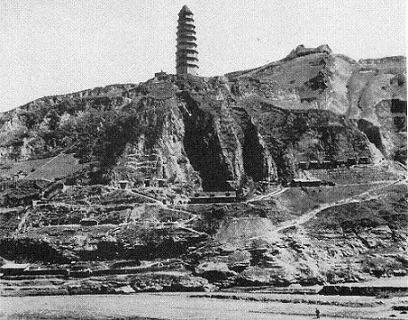 Hu Zongnan had been contemplating an attack at the Communist base Yenan several times. The only hurdle lies in the presence of American military observers in Yenan. With the "Three-Person Military Truce Panel" dissolved on January 30th, both the Communists and the Nationalists no longer had any restraints. On January 31st, 1947, Communist troops suddenly attacked the blockade line again and defeated four columns of the Shenxi Provincial Constabulary Regiment. The 2nd Battalion of the 268th Constabulary Regiment incurred heavy loss. The January 31st attack was construed as pre-meditated since the Communist troops at Tongguan-zhen boasted of four regiments, and those at Malan-zhen possessed the numbering of 3 separate divisions.
In northern Shenxi Province, the Communist side possessed about 70,000 militia and 60,000 troops in total, including the 8th, 10th & 39th Brigades, and the Garrison 1st, 2nd, 3rd, 4th & 11th Brigades. Additionally, Communist troops which could easily cross the Yellow River Bend from Shanxi Province would be Wang Zhen's two brigades of the 358th & 359th [rebuilt] or 7000 men, Chen Geng's three brigades of the 10th, 12th & 24th or 15000 men, and Heh Long's three brigades or 10000 men.
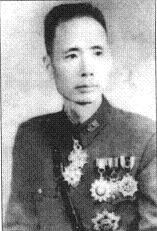 On February 28th, Hu Zongnan moved his command center northwestward to Binzhou from Sanyuan for a planned attack at Qingyang of Gansu Province. On the same day, Hu Zongnan and Sheng Wen were called over to Nanking to brief Chiang Kai-shek on the 'Raid Into Yenan' campaign.
On March 1st, at 10:00 am, in the Defense Department, Liu Fei [Liu Weizhang], a Communist mole, expressed satisfaction with the campaign plan. At night, at 9:00 pm, Hu & Sheng visited Chiang. Consensus was reached for halting attacks at Qingyang-Heshui of Gansu Province, and general attacks would be delayed to March 14th. Hu Zongnan returned on March 3rd. (Sheng Wen's recollections claimed that he had deliberately kept Liu Fei in the dark about the details of the "Raid Into Yenan", for which Liu Fei had expressed deep resentment thereafter. One more trick played by Hu Zongnan and Sheng Wen would be the recall of the 1st Corps to Shenxi Province in the aftermath of the later Wazijie Battle while pretending to Liu Fei that they had no clue where the 1st Corps was in Henan Province.)
On February 28th, Hu Zongnan moved his command center northwestward to Binzhou from Sanyuan for a planned attack at Qingyang of Gansu Province. On the same day, Hu Zongnan and Sheng Wen were called over to Nanking to brief Chiang Kai-shek on the 'Raid Into Yenan' campaign.
On March 1st, at 10:00 am, in the Defense Department, Liu Fei [Liu Weizhang], a Communist mole, expressed satisfaction with the campaign plan. At night, at 9:00 pm, Hu & Sheng visited Chiang. Consensus was reached for halting attacks at Qingyang-Heshui of Gansu Province, and general attacks would be delayed to March 14th. Hu Zongnan returned on March 3rd. (Sheng Wen's recollections claimed that he had deliberately kept Liu Fei in the dark about the details of the "Raid Into Yenan", for which Liu Fei had expressed deep resentment thereafter. One more trick played by Hu Zongnan and Sheng Wen would be the recall of the 1st Corps to Shenxi Province in the aftermath of the later Wazijie Battle while pretending to Liu Fei that they had no clue where the 1st Corps was in Henan Province.)
On March 4th, the Communist troops, ahead of the government troops' action, launched an attack at the 48th Brigade at Xihuachi. Brigade commander Heh Qi was killed by an artillery shell that struck the train carriage which served as a command post.
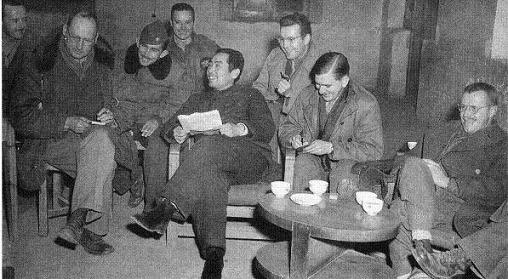 To scare away the Americans [who served as voluntary human hostages --the same sense the "human shields" as used by Saddam Hussein or Mohammed Kaddafi] from Yenan, about 94 planes were called over from Shanghai, Xuzhou & Xi'an for bombing the Communist positions around Yenan on the 13th. General attack was launched at dawn of the 14th as planned.
The Americans did not leave Yenan till the last minute, i.e., the 12th/13th, after the completion of the mission of serving as the voluntary Communist 'hostages' for sake of having all Communist cadres in Shanghai, Nanking and Peking fly back to Yenan.
Flying above Yenan, the last members of the Dixie Mission witnessed the blow-up of the Yenan airport as promised by the Communists, with one complaining that they would have nowhere to land should they run into the engine trouble.
The Dixie Mission, which served as the Chinese Communists' charter planes, had completed its mission of assisting the Chinese communists with flying out the military commanders to fight the civil wars after the Japanese surrender, as well as the mission to facilitate the Chinese communists' shuffling of political cadres across the country during the initial years of the civil war.
To scare away the Americans [who served as voluntary human hostages --the same sense the "human shields" as used by Saddam Hussein or Mohammed Kaddafi] from Yenan, about 94 planes were called over from Shanghai, Xuzhou & Xi'an for bombing the Communist positions around Yenan on the 13th. General attack was launched at dawn of the 14th as planned.
The Americans did not leave Yenan till the last minute, i.e., the 12th/13th, after the completion of the mission of serving as the voluntary Communist 'hostages' for sake of having all Communist cadres in Shanghai, Nanking and Peking fly back to Yenan.
Flying above Yenan, the last members of the Dixie Mission witnessed the blow-up of the Yenan airport as promised by the Communists, with one complaining that they would have nowhere to land should they run into the engine trouble.
The Dixie Mission, which served as the Chinese Communists' charter planes, had completed its mission of assisting the Chinese communists with flying out the military commanders to fight the civil wars after the Japanese surrender, as well as the mission to facilitate the Chinese communists' shuffling of political cadres across the country during the initial years of the civil war.
(Jung Chang's labeling Hu Zongnan as a Communist spy being a fallacy, historians' pointing to the Communist mole Xiong Xianghui had no merit either. As illustrated above, the Communist mole Liu Fei had been responsible for having Hu Zongnan halt the Qingyang-Heshui Campaign in February and then personally went over the Yenan campaign draft with Hu Zongnan.
The only reason that Mao Tse-tung had to hastily vacate Yenan was his over-confidence in his garrison troops. Though the Communist side always called it a fake as to Hu Zongnan's claim of taking about 9000 Communist prisoners of war, the one-week battles between the two sides, being never a blitz raid in nature as claimed in the history books, were not merely a strategic retreat war for the Communists but a premeditated attack-and-defense engagement involving hundred thousand troops on two sides, respectively.)
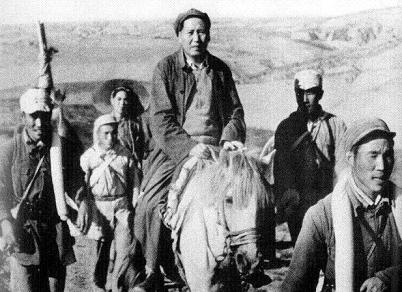
Jung Chang called four names, Zhang Zhizhong, Shao Lizi, Hu Zongnan and Wei Lihuang, as communist spies.
She was right on Wei Lihuang, not the others.
This webmaster considers Wei Lihuang's treachery to be comparable to Soong Dynasty prime minister Jia Sidao's abandoning to the Mongol the Xiangyang city [which was under siege for 4-5 years] and Ming Dynasty general Wu Sangui's betrayal of the Mountain and Sea Pass to the Manchus.
As numerous people recalled in their memoirs, Zhang Zhizhong appeared to be the only person daring to call Chiang Kai-shek by "Mr. Chiang" in post-1949 Communist China.
However, Zhang Zhizhong, taking himself to be an erudite, repeatedly fell short of expectations. At the Battle of Shanghai in 1937, Zhang rode on a bike to the front to avoid the
Japanese plane bombing, and later found an excuse to go to the hind to report to Chiang Kai-shek while people were looking for him at the front, which led to a rebuke from Chiang Kai-shek over the phone.
Zhang then further had the dereliction of duty while being empowered as chair of Hunan Province, under whose jurisdiction the scorched-earth policy was mal-executed in Changsha.
However, we could not blame Zhang Zhizhong 100% for his being blindsided by the communist propaganda. The agriculturalist Liang Su-ming, i.e., China's last Confucian, for another example, was
hoodwinked by the communists even though he himself walked across Japan-occupied territories to have witnessed the communist brigands' killing of his student-disciples who were waging the
guerrilla war against the Japanese behind the enemy's line.
(Yang Xiufeng, an Europe/Moscow-returnee who later in 1947/8 ran the communist People's University to vivisect the live government army captives
[including
one young Burma Battle veteran who walked to the west from coastal Zhejiang as a teenager during the 1937 China's Dunkirk Retreat
and did not return home to see his mother for next 12 years],
was one such most notorious dupe who in 1935 returned to China to instigate the anti-government activities in Tientsin, took advantage of the Ho-Umezu Agreement to rebuild the communist cells in North China,
and from 1937 onward was responsible for the communist administration in the Japan-occupied territories of North China. Unfortunately for numerous R.O.C. officials and officers,
their cognizance of the monstrous nature of the communists and communism came too late, often at the time of massive executions in the 1950s.)
For further comments on the validity of accusations against the "four moles", please see Jung Chang's accusations against
Zhang Zhizhong, Shao Lizi, Hu Zongnan and Wei Lihuang.
* In Commemoration of China's Fall under the Alien Conquests in A.D. 1279,
A.D. 1644 & A.D. 1949 *
U.S.S.R./Comintern Alliance with the KMT & CCP (1923-1927)
Korean/Chinese Communists & the 1931 Japanese Invasion of Manchuria
American Involvement in China: Soviet Operation Snow, IPR Conspiracy, Dixie Mission, Stilwell
Incident, O.S.S. Scheme, Coalition Government Crap, Amerasia Case & The China White Paper
* Stay tuned for "Republican China 1911-1955: A Complete Untold History" *
|
|
Zou Rong's Revolutionary Army;
Shin Kyu Sik's
Shrine (Spirit, Kunitama) of Korea
|
This snippet is for sons and daughters of China:
Heed the sons & ministers' agony and sorrow of our ancestors who died or lived through the Mongol, Manchu and Soviet-Chicom conquest
and
the Yongjia, Jingkang and Jiashen cataclysms !
Jeanne d'Arc of China:
Teenager girl Xun Guan breaking out of the Wancheng city to borrow the relief troops in the late Western Jinn dynasty;
Liu-Shao-shi riding into the barbarian army to rescue her husband in the late Western Jinn dynasty;
teenager girl Shen Yunying breaking into Zhang Xianzhong's rebels on the horseback to avenge on father's death in the late Ming dynasty.
China's Solitary and Lone Heroes:
Nan Jiyun breaking out of the Suiyang siege and charging back into the city in the Tang dynasty;
Zhang Gui & Zhang Shun Brothers breaking through the Mongol siege of Xiangyang in the Southern Soong dynasty;
Liu Tiejun breaking through three communist field armies' siege of Kaifeng in the Republican China time period;
Zhang Jian's lone confrontation against the communist army during the June 3rd & 4th Massacre of 1989.
|
|
|
While Westad, who read Freda Utley, concurred with the number of 9000 Communist prisoners of war, his common friends, i.e., Jung Chang and Jonathan Fenbie, were apparently left in the dark. All three definitely have no clue as to Hu Zongnan's battles against the Communists, like the Campaign of Jing-he & Wei-he Rivers, Campaign of Ankang, Campaign of Wugong.
Dozen years later, Nationalist government officials were still debating whether Liu Fei was a Communist and/or when Liu Fei had become a Communist [since Zheng Jiemin confirmed that Liu Fei had attempted to instigate him for the Communist camp in HK in 1949], not knowing that Liu Fei had been converted while having overseas studies in Japan. This webmaster does not know how Liu Fei was converted, but does point out in Terror how Communists had married a 15-year-old girl to General Yang Hucheng, corrupted Xu Enceng [via Qian Zhuangfei's sex arrangement], and sent a young nurse to General He Yaozu, a practice adopted as recently as in 1971-2 when Mao Tse-tung repeatedly offered Henry Kissinger any number of Chinese women the American emissary might desire. Off the record would be how Wang Bing-nan's German wife seduced the American reporters [i.e., John Fairbank and Joe Stilwell gang] in Wuhan the "China's Madrid" in 1938. Up to year 2005, Li Wangshu, at huanghuagang.org/issue11/index_big5.htm, still put blame on Li Zongren & Bai Chongxi for having recommended Lie Fei for overseas studies and subsequent service under Chiang Kai-shek. See this webmaster's comments on "criticisms of Li Zongren's criticisms of Chiang Kai-shek". Should you ask what's the big deal here about Liu Fei, then this webmaster want to remind you that dozens of millions of Chinese had died in vain in 20th century, and many more will continue to become victims absent a correct cognizance of true historical events.)
Videos about China's Resistance War: China's Dunkirk Retreat (in English);
42 Video Series (in Chinese)
Stilwell, the slimy who itched "to throw down ... shovel and get over there and shoulder a rifle with Chu Teh" [i.e., the communist commander-in-chief], before his kickout from China,
paid a visit to Mme. Sun Yat-sen, the No. 1 Comintern agent in China.
George Marshall quit his job twice, J.I.T (just in time), in anticipation of some pre-arranged phonecalls from Truman to tack on the jobs as 1) first the mediator in the Chinese civil war
and ii) secondly as defense minister [by kicking out defense minister Johnson] during
the Korean War, respectively.
George Marshall returned Zhou Enlai's address book to Zhou Enlai, while never alerting Chiang Kai-shek of communist spies like Xiong Xianghui.
While Currie stopped the German weapons of the European battlefield from shipping to China and Truman dumped China's Lend-Lease weapons to the Indian Ocean, Dean
Acheson and George Marshall personally pushed for the 1946-47 arms embargo against China and imposed three ceasefire onto the Chinese government,
on Jan-10-1946, June-6-1946, & Nov-8-1946.
Marshall deliberately flew back to China in the spring of 1946 to stop the Chinese Nationalist troops from chasing the disarrayed communists north of the Sungari River. This is how CHINA WAS LOST.
At this moment, the commies had rallied henchmen against Mr. Xin Haonian's book Which Is New China by repeatedly citing the writings of John Fairbank and the sort. This webmaster, though not agreeing with the said book on all accounts, does want to point out that John Fairbank and most of the "Old China Hands", being of anti-Chinese-nationalism in nature, were the "fellow travelers" of the communists and British colonialists
since the OSS/CIA days of the 1940s-50s. The best argument against the Chi-com would lie in the continuing exposition of i) the Russian/Comintern conspiracies against China, and ii) the century-long American hypocrisy towards China &
American manipulation of Chinese politics [e.g., Stilwell's instigating General Bai Chongxi, Stuart's instigating Li Zongren, and McArthur's instigating General Sun Liren].
|
|
|
The Wuhan Gang & The Chungking Gang, including Joseph Stilwell, Agnes Smedley, Evans Carlson, Frank Dorn, Jack Belden, S.T. Steele, John Davies, David Barrett and more, were the core of the Americans who were to influence the American decision-making on behalf of the Chinese communists.
It was not something that could be easily explained by Hurley's accusation in late 1945 that American government had been hijacked by
i) the imperialists (i.e., the British colonialists whom Roosevelt always suspected to have hijacked the U.S. State Department)
and ii) the communists. At play was not a single-thread Russian or Comintern conspiracy against the Republic of China but an additional channel
that was delicately knit by the sophisticated Chinese communist "agrarian reformers".
|
|
The Chinese communist agents on international arena would include Chen Hansheng [i.e., Owen lattimore's assistant]; Mme Sun Yat-sen [who acted as the intermediary between the domestic and international communists]; Wu Kejian & Xie Weijing who orchestrated the Chinese communist relief to the Spanish Civil War; and Wang Bingnan whose German wife "physically" won over the hearts of the above-mentioned Americans by providing the wartime 'bachelors' with special one-on-one service. Though, Anna Wang [Anneliese Martens], in her memoirs, expressed jealousy over Gong Peng by stating that the Anglo-American reporters had flattered the Chinese communists and the communist movement as a result of being entranced with the goldfish-eye'ed personal assistant of Zhou Enlai.
|
|
|
After 60 years, the crap about corruption of the Chiang Kai-shek's regime was so deeply rooted in the American academics that even the publication of the VENONA scripts would not make someone to rethink.
Some American senator talked about McCarthyism, while McCarthy had been proven to be right in 99% of the cases he prosecuted. Some other U.S. senator talked about "gung ho" recently, while not knowing what "Gung ho" was meant for. Let's be clear here: "gung ho" was not Evans Carlson's marine commando team in the Pacific Islands but a Comintern scheme to launder money to Yenan, totaling 20 million USD at minimum from Chen Hansheng's operations with the U.S. communist front organizations 1939 to 1941 plus more afterward, as well as a CCP underground tunnel (to use the same word as the American Black slaves' escape route to the north prior to the north-south war), on which road the CCP agents freely travelled around FREE CHINA by riding on the "gung ho" trucks; more, in Jiangxi, the anti-Japanese war base as well as the former Red Army enclave, the "gung ho" gangs were secretly training the cooperative workers to be anti-government insurgents to echo the raging civil wars that were going on along the Yangtze and in North China, which saw the communist Eighth Route Army and New Fourth Army slaughtering hundreds of thousands of village elderlies, county magistrates, government guerrilla forces, and patriotic gentry-organized forces.
Now all this was done prior to the Pacific War. But due to Stalin's demand for maintaining the CCP-KMT collaboration scheme, Mao and the communists dared not publicly talked about civil wars. Should they secretly take out the government guerrillas, they would make sure that no messenger would live to escape from the communist territory to tell the truth. Zhao Tong, and 200+ guerrillas, including his sister and dozens of female fighters, were run down by the communist cavalry, and killed to the last person while travelling towards Jehol. Who was Zhao Tong? He was the son of double-gun Mme Zhao, whom the same Wuhan and Chungking gangs, Theodore White and Annalee Jacoby's predecessors, had interviewed and talked about in the media both in China and over the world, a war hero fighting Japanese in Jehol since 1932-1933, and a Youth party member and later a statist member.
(Note that the Jehol area used to be the guerrilla army under Youth Party leader Zhao Tong who fought against the Japanese since 1931-1932. To prevent Zhao Tong's Jehol Vanguard Army, about 200-300 men and women, from returning to Jehol from Chungking, the communist armies, with advance information from communist leader Zhou Enlai who superficially participated in the farewell ceremony for the march of the vanguard army in Chungking, pooled resources all over the military districts including Heh Long's communist army from northwestern Shanxi and Suiyuan area, and ambushed and eliminated the vanguard army in the tri-provincial area of Shanxi-Henan-Hebei around the turn of 1939-1940.
The communists, in the Chahar-Suiyuan area and around Mt. Daqingshan [the great green mountain], had conducted similar horrifying campaign against the patriotic guerrilla forces, including the fire attack that killed a 90-year-old former Northeastern Cavalry Army corps commander and his guerrilla army, and furthermore attacked and eliminated KMT party operator Chen Jianzhong's party-directly-controlled guerrilla forces and all couriers who were sent through the communist-controlled territories of Shanxi-Shenxi, with Chen Jianzhong being the sole survivor to return to Chungking in disguise.)
After the Pearl Harbor, Stalin no longer cared about China's role in WWII. So the order changed, which was to say that Comintern agents had the free hand to bad-mouth China, with no penalty as imposed before the Dec 1941 Japanese attack at the Pearl Harbor. Hence you see Theodore White and Annalee Jacoby, and the gangs, writing the venomous articles against China. Theodore White was one of the top 3-4 playboys in wartime Chungking, and like John Fairbank, enjoyed "stalking" communist mouthpiece Gong Peng, the little black widow and Zhou Enlai's secretary, on the streets of Chungking. And you have Martens, the German communist, who provided one-on-one sexual service to those wartime American bachelors. I read through the craps by Theodore White and Annalee Jacoby just to find out who those guys cohorted with, and how they went around Free China, etc. My findings are the Theodore White gang always lived near the whorehouses, or one storey above the whorehouse, and this guy Theodore White at one time had a rendezvous with some Chinese general's concubine in a vacated hotel while the Japanese planes were dropping bombs over the whole city and people were fleeing to the bunkers. And another gang member was notorious in using the Hostel, a place the KMT government subsidized the international press rascals with a maximum cost of $1 and $3 for meals and lodging daily, as a daily party room to have fun with Chinese women. What you had were passages after passages of writings about the gang's whoring, and that's probably why Miles said he had thousands of pages of details on the gangs' antics and all those materials were locked up in the U.S. Navy's underground confidential room. From Rand's book, you could tell how those guys flew back and forth, between the U.S. and China, had liaison with the Comintern and CPUSA/CCP agents, like Yang Gang and Yang Zao pseudo brother and sister, even inviting the CCP "guest" to their home in New England; and of course the gang was responsible for hiring the CCP agents as translators and interpreters to work on the OSS watch and listen posts along the southeastern Chinese coastline. What a deal.
(For example,
Larry Wu-tai Chin, i.e., the top CCP mole inside of the U.S. and the CIA since the 1940s, first worked for the American OWI in Fuzhou (i.e., John King Fairbanks' CPUSA-dominated Office of War Information) in 1944, infiltrated into the American consulate in Shanghai in 1949, relocated to Hongkong in 1950, worked as translator in the Korea POW camps in 1951, entered the CIA in Okinawa in 1952 and relocated to the CIA office in Santa Rosa, California in 1961.)
Now, more to that. Almost all gang members were reaping profit by smuggling and selling scarce commodities, utilizing the black market rate of 1 USD to 120 CNC. The gangs made a killing and reaped huge profits, smuggling lipsticks for the sing-song women of Guilin, who were known to be Japanese spies. Some gang members purportedly had a "platonic" love club, with one CCP agent joining the drunkards' club to talk about love. While Theodore White and Annalee Jacoby returned to the U.S. to write a best-seller, arguing among themselves about who should put the name on the book and who should take the credit, the other gang members thought about having some fun in the outpost China and flew to the Chinese Turkistan to bad-mouth China which was defending itself against years of harassment wars conducted by Eastern Turkistan rebels and instigated by Stalin after China kicked out the Russians by taking advantage of the German invasion of the Soviet Union.
(The creeps were not merely fooling around with the women. They were engaged in the commercial smuggling of China's antiques.
Most notable would be the 1942 Zidan-ku Bo-shu (i.e., the Chu[-di] Silk Manuscript from the bullet weapons depot.
The Zidan-ku Bo-shu silk manuscript, which was dug out by the tomb raiders who took advantage of the city wall defense work in-between the Changsha campaigns, was smuggled to the United States by John Hadley Cox of the Yali Middle School (part of the Yale-in-China school system) and his OSS accomplice Frederic D. Schultheis, at a 10% deposit money to collector Cai Jixiang.
This piece of artwork, which was against the late will of the last collector to return to China, is now with
the Arthur M. Sackler Gallery, part of affiliation with the Smithsonian Institution's national museums of Asian art.
This webmaster, to pour some cold water onto the Arthur M. Sackler museum as to the Chu[-di] Silk Manuscript's value, wants to emphasize the meaning of the 'di' [land] suffix to point out that this piece of artwork was a Han dynasty product that was excavated from the former Chu Principality's land, not an actual Eastern Zhou dynasty product.
Read this webmaster's writing on
Pre-History, Xia, Shang, Zhou, Qin, and Han dynasties for the intricacy about the stages of Sinitic cosmological, astronomical, astrological and geographical development.
The Sinitic Civilization - Book I is on
Barnes & Noble,
Amazon,
Google Play|Books
and
Nook Book.
Book II is
available now on
Amazon
and Barnes & Noble.
Refer to
Table of Contents - Book I (Index)
and
Table of Contents - Book II (Index)
for details.)
Like to ask you spend some time on E.J. Khan, Peter Rand and Theodore White's books, and see how those creeps joined hands with the Comintern and CCP agents to sabotage China, and made China what it is today, i.e., billion coolies and slaves working to death for the multi-national corporations and international banksters. And of course read Dorn's book to know Marshall and Stilwell's scheme to assassinate Chiang Kai-shek.
The American Involvement in China: the Soviet Operation Snow, the IPR Conspiracy, the Dixie Mission, the Stilwell Incident, the OSS Scheme, the Coalition Government Crap, the Amerasia Case, & The China White Paper
[Modified : Monday, 25-Feb-2013 22:00:00 EST]
|
|
* In Commemoration of China's Fall under the Alien Conquests in A.D. 1279,
A.D. 1644 & A.D. 1949 *
U.S.S.R./Comintern Alliance with the KMT & CCP (1923-1927)
Korean/Chinese Communists & the 1931 Japanese Invasion of Manchuria
American Involvement in China: Soviet Operation Snow, IPR Conspiracy, Dixie Mission, Stilwell
Incident, O.S.S. Scheme, Coalition Government Crap, Amerasia Case & The China White Paper
* Stay tuned for "Republican China 1911-1955: A Complete Untold History" *
|
|
Zou Rong's Revolutionary Army;
Shin Kyu Sik's
Shrine (Spirit, Kunitama) of Korea
|
This snippet is for sons and daughters of China:
Heed the sons & ministers' agony and sorrow of our ancestors who died or lived through the Mongol, Manchu and Soviet-Chicom conquest
and
the Yongjia, Jingkang and Jiashen cataclysms !
Jeanne d'Arc of China:
Teenager girl Xun Guan breaking out of the Wancheng city to borrow the relief troops in the late Western Jinn dynasty;
Liu-Shao-shi riding into the barbarian army to rescue her husband in the late Western Jinn dynasty;
teenager girl Shen Yunying breaking into Zhang Xianzhong's rebels on the horseback to avenge on father's death in the late Ming dynasty.
China's Solitary and Lone Heroes:
Nan Jiyun breaking out of the Suiyang siege and charging back into the city in the Tang dynasty;
Zhang Gui & Zhang Shun Brothers breaking through the Mongol siege of Xiangyang in the Southern Soong dynasty;
Liu Tiejun breaking through three communist field armies' siege of Kaifeng in the Republican China time period;
Zhang Jian's lone confrontation against the communist army during the June 3rd & 4th Massacre of 1989.
|
|
|
Peng Dehuai's Three Minor Victories
On the 19th, the 167th Brigade pushed towards Yenan at dawn, and took over Mt Baotashan [treasure pogoda mountain] by 7:00 am. the 78th Brigade took over the high hill on the southern bank of the Yan-he River. A commando company of the 1st Brigade, together with the 167th Brigade, walked across the Yan-he River, defeated the communist defenders at the citywall, and penetrated into Yenan. The Communist troops retreated towards the Wayaobao and Ansai directions. The Communist "Radio of Handan" in Hebei Province first acknowledged the loss of Yenan on the 21st. The bulk of the Communist forces hid themselves in Ganguyi-Qinghuabian area, to the northeast of Yenan.
Hu Zongnan made a wrong judgment call, thinking that the Communist troops went to the northwest of Yenan, i.e., the Ansai direction.
Hu Zongnan's biography claimed to have inflicted a total casualty of 16606 onto the Communist side and further captured 9625 Communist soldiers. Bounty included 30 machineguns, 2243 rifles, and 29 grenade-throwers. The Communist side subsequently discounted the Nationalist claim and claimed that they had abandoned Yenan strategically on March 19th. Mao Tse-tung himself, with about 200 staff and 3 companies of garrison troops organized themselves into a 'Kunlun Detachment', parted with Liu Shaoqi's half of the CCP Central which crossed the Yellow River for the Shanxi-Hebei Provinces.
Mao's half CPC Central staff trekked towards Wangjiacun Village of Jingbian near the Ordos desert.
The communists, who were overconfident of the defense of Yenan, did not get enough time to prepare for the pullout, with Mao's stuff still left in the cave house.
* In Commemoration of China's Fall under the Alien Conquests in A.D. 1279,
A.D. 1644 & A.D. 1949 *
U.S.S.R./Comintern Alliance with the KMT & CCP (1923-1927)
Korean/Chinese Communists & the 1931 Japanese Invasion of Manchuria
American Involvement in China: Soviet Operation Snow, IPR Conspiracy, Dixie Mission, Stilwell
Incident, O.S.S. Scheme, Coalition Government Crap, Amerasia Case & The China White Paper
* Stay tuned for "Republican China 1911-1955: A Complete Untold History" *
|
|
Zou Rong's Revolutionary Army;
Shin Kyu Sik's
Shrine (Spirit, Kunitama) of Korea
|
This snippet is for sons and daughters of China:
Heed the sons & ministers' agony and sorrow of our ancestors who died or lived through the Mongol, Manchu and Soviet-Chicom conquest
and
the Yongjia, Jingkang and Jiashen cataclysms !
Jeanne d'Arc of China:
Teenager girl Xun Guan breaking out of the Wancheng city to borrow the relief troops in the late Western Jinn dynasty;
Liu-Shao-shi riding into the barbarian army to rescue her husband in the late Western Jinn dynasty;
teenager girl Shen Yunying breaking into Zhang Xianzhong's rebels on the horseback to avenge on father's death in the late Ming dynasty.
China's Solitary and Lone Heroes:
Nan Jiyun breaking out of the Suiyang siege and charging back into the city in the Tang dynasty;
Zhang Gui & Zhang Shun Brothers breaking through the Mongol siege of Xiangyang in the Southern Soong dynasty;
Liu Tiejun breaking through three communist field armies' siege of Kaifeng in the Republican China time period;
Zhang Jian's lone confrontation against the communist army during the June 3rd & 4th Massacre of 1989.
|
|
|
To the northeast of Yenan, the 92nd Regiment of the 31st Brigade was ambushed and surrounded in a valley around 10:00 am on the 25th while en route to Qinghuabian, with Regiment Chief Xie Yangmin and Brigade Chief Li Jiyun taken prisoners of war by the Communist side. The Battle of Qinghuabian would be the first Communist victory which was achieved by Peng Dehuai [the CCP Central's Deputy Chair for the Military Committee] & Xi Zhongxun [the CCP Northwestern Bureau Secretary] by combining the forces of the Independent 4th Brigade, the Teaching Brigade, the New 4th Brigade, and Wang Zhen's 358th Brigade of the 1st Echelon and the 359th Brigade of the 2nd Echelon. The Communist side claimed to have destroyed about 2900 Nationalist Army soldiers while their Independent 1st Brigade was set aside as reserves during the battle.
On the 6th, at Yongping-zhen, the R30D was ambushed by the Communist troops of the 359th Brigade, Teaching 1st Brigade & Independent 1st Brigade. After 24 hour fighting, the Communist troops retreated at dawn of April 7th.
On the 8th, Hu Zongnan's 1st Corps converged towards Qinghuabian while the 29th Corps converged towards Panlong, i.e., two towns to the southwest of Yongping-zhen. On the 12th, the 1st Corps pushed against Mudanchuan [peony village]. On the 14th, the 1st Corps and 29th Corps fought against the Communist troops from morning to 9:00 pm at night. Meantime, four brigades of the Communist troops, headed by Wang Zhen & Zhang Xianyue, ambushed the 135th Brigade at Sanlangcha & Yangmahe while Heh Bingyan & Liao Hansheng's Communist troops were ordered by Peng Dehuai towards the Panlong area for impeding Hu Zongnan's relief army. 135th Brigade Chief Mai Zongyu and two regiment chiefs hence went missing in battle. The Communist side claimed to have destroyed about 2000 Nationalist Army soldiers at the Battle of Yangmahe per Yang Bichuan.
On April 15th, the 1st Corps and 29th Corps defeated the Communist troops led by Heh Bingyan & Liao Hansheng, and then pushed against Lijiacha & Wayaobao, respectively. On the 16th, the two corps of the Nationalist Army troops retook Wayaobao and Lijiacha subsequently. On the 18th, the two corps returned southward for grain supply.
On the 19th, the 29th Corps, en route to Yongping, met with Peng Dehuai's Communist troops in the Xinch[]he-Cuishudou-Da(s)guicun area. The Communist troops consisted of Zhang Zongxun's 1st Echelon [the 358th Brigade, the Independent 1st Brigade & the Garrison 3rd Brigade] and Wang Zhen's 2nd Echelon [the 359th Brigade, the New 4th Brigade, the Independent 4th Brigade & Teaching 2nd Brigade]. Hu Zongnan's 1st Corps came to the aid of the 29th Corps. Fighting continued from 8:00 am of the 19th to 7:00 pm of the 20th. Altogether seven Communist attacks were repelled. Hu Zongnan claimed to have killed 1984 Communist troops.
During the Campaign of Suide, Wang Zhen led a circumvential attack at the Nationalist Army 84th & 167th Brigade at Qinghuabian and Panlong-bao in the south, respectively.
First attack at Panlong-bao occurred at the night of May 2nd.
Peng Dehuai was said to have invoked a Communist "military democracy" by holding soldier meetings for discussions on ways to breach the defense ditches around Panlong. The Nationalist Army relief army from Ganquan in the north was impeded at Qinghuabian.
By the midnight of May 4th, Li Kungang's 167th Brigade had used up the ammunition. Li Kungang went missing after he and his remnants broke through the siege. With Panlong lost, the Nationalist Army troops lost a major logistics center. The Communist side claimed to have destroyed 6700 troops of the 167th Brigade per Yang Bichuan, which was possibly exaggerated since the defenders were merely a reinforced regiment.
Continuous Campaigns In Northern Shenxi Province
On June 4th, the 1st Corps retook Ansai, and the 29th Corps arrived at Zhanmengou. On the 5th, the 1st Corps took over Gaoqiao to the southwest of Ansai, and the 29th Corps retook Panlong. On the 7th, the 1st Corps arrived at the south-north division point of Pass Shengrenyaoxian [Xinyaoxian], and the 29th Corps arrived near Yanjiatai. On the 8th, the 1st Corps attacked the Communist troops near Bao'an, and the 29th Corps pushed towards the Communist troops at Qingyangcha. On the 9th, the 29th Corps took over Woniucheng. Hu Zongnan's troops took over Bao'an [Zhidan], inflicted a casualty of 5000 onto the Communist troops, captured 9 mountain guns, 200000 rounds of bullets and 40 bundles of cotton.
Those Communist troops who went northwest then trekked towards the Huanxian county of Gansu Province.
Hu Zongnan then organized the campaign on the two banks of the Luo-he River.
From the 14th onward, the 1st & 29th Corps sifted through mountains and valleys on the two banks of the Luo-he River. By the 15th, the bulk of the Communist troops, after a minor loss, dissipated for the northwest direction.
Meantime, on the 14th, the Communist siege of Huanxian county of Gansu Province started. The next day, the Communist siege troops converged into 10000 or more.
On June 26th, Hu Zongnan implemented his traditional "regional sweep campaign" by carving up areas for his troops, with the 1st Corps in charge of the areas of Panlong-Longan-Longmianshi-Gaoqiao-Yenan, the 29th Corps in charge of the areas of Gaoqiao-Dingbianji-CHenjiazhifang and Dingbianji-Zhangjiawan-Fuxian-Ganquan, the R90D in charge of Heishuishi-Taibaizhen, and the 24B of R76D in charge of Wayaobao-Yanchuan-Qingjian.
By the middle of July, the new approach of "using the Nationalist Army troops' stillness against the moving Communist troops" worked out after the Communist troops vacated Qingjian-Anding-Bao'an for Suide-Mizhi in the north.
Xu Zhen, after discussions with deputy division chief Xu Liangyu, confirmed that the April loss of Panlong was due to Nanking's instructions even though 1st Division Chief Luo Lie repeatedly objected to a deep push towards Suide-Mizhi. The Political affairs committee came in to stabilize the villages and towns. Hu Zongnan made a visit to Yenan on July 16th and Ganquan on the 19th for firsthand observation of the revitalized communities and businesses in the pacified area, and attributed the accomplishment to efforts of 17th Division Chief Heh Wending.
The Siege of Yulin & the Battle of Shadian
Hu Zongnan then devised a three phase attack against the Communist troops, with an intent to have a duel by the West Yellow River Bend by pushing towards Longan-Liangdaowan-Jingbian for phase one, Anding-Lengyaobao-Longzhou for phase two, and Qilinzhen-Hengshan for phase three. Campaign started on Aug 3rd. Two days later, Peng Dehuai’s Communist troops took initiative in laying siege of Yulin & Xiangshuibao in the north with a combined force of 40000 consisting of the 1st, 3rd, 4th & 6th Brigades as well as the communist militia from Xinglin, Kelan [Shanxi], Huanglong & Tianshui [Gansu].
On the 12th, the R36D arrived at Baoningbao, and by previous midnight, the herald troops already arrived at Yulin. The Communist troops then withdrew the siege of Yulin on the 12th and went for the area of Shuanglinbao-Zhenchuanbao-Mizhi on the 13th.
Hu Zongnan ordered that Zhong Song led the R36D southward towards Guidebao, about half way between Yulin and Yuhebao.
On the 19th, Peng Dehuai submitted the battle plan to Mao Tse-tung, i.e., surrounding and attacking the R36D around Shadian [Shajiadian]. At dawn of the 20th, the 165th, 55th & 123rd Brigades under Zhong Song were ambushed by the Communist troops at Longchuanbao-Shadian-Liupo-Shaping-Wulong. The three Nationalist Army brigades, cut off from each other by the Communist troops, fought their way out. Zhong Song and his 123rd & 165th Brigades fled to the east, while portion of the troops fled south. Till dusk, the Communist side claimed to have destroyed about 6000 Nationalist Army troops. By the time the Nationalist Army 29th Corps arrived at Shadian, the Communist troops had dissipated.
Hu Zongnan, who wrote in his diary on the night of the 20th that he was worried about the fate of Zhong Song and his division command center, would be extremely delighted after receiving a telegram from Zhong Song on Aug 22nd. Zhong Song reported that he and the 84th Regiment were blocking Communist troops from fleeing across the Wuding-he River on the west bank, between Zhenchuanbao and Mizhi.
The Ambush Battle At Wazijie & the Siege of Yichuan
On January 25th, 1948, the Defense Department ordered that Hu Zongnan's pacification office
moved to Luoyang of Henan Province, with a deadline of February 5th for launching a campaign against the Communist troops in Henan Province.
Hu Zongnan, in order to put off Liu Fei's high order, would have Pei Changhui head a 5th Army Group in lieu of a move of the pacification office away from Xi'an. Pei Changhui, sitting in Shanzhou, would be in charge of the 78th & 167th Brigades of the R1D and the 123rd & 165th Brigades of the R26D. The 1st Brigade of the R1D and the 28th Brigade of the R36D would station in-between Shanzhou and Lingbao. Another three constabulary regiments were to be organized by Henan Province for defending the Yellow River line.
 Jung Chang's "Mao The Unknown Story", which was built on top of Zhang Zhenglong's "Snow White, Blood Red" in the section on wars in Manchuria, had claimed to have dug out page 39 of Xu Zhen's writing on General Hu Zongnan. On page 39, Xu Zhen talked about the friendship of Hu Zongnan and Hu Gongmian during the early days of the Whampoa Military Academy; however, Hu Zongnan, like Dai Li, happened to be only two Chiang Kai-shek cronies who had set up the "disabled militarymen funds", which was illustrative of the human compassion the two had for their acquaintances no matter friend or foe. During the chase of the Red Army Fourth Flank, Hu Zongnan often inquired with the Communist prisoners of war as to the status of Red Army General Cai Shenxi, i.e., another Red who once served as a subordinate in the Whampoa times. It would not be strange that someone else who had perused pages of Xu Zhen's book had mentioned this matter before Jung Chang picked it up for her book. Hu Gongmian, who was possibly responsible for saving Chiang Kai-shek during the 1926 Zhongshanjian Warship Incident and had renounced the Communist membership during 1927 Purge, was fetched by the Communists for a persuasion against Hu Zongnan before the Ankang Campaign which would be hundreds of battles and campaigns ignored by the history and historians up to today. Though Jung Chang had provided an impressive bibliography of hundreds of books, this webmaster is utterly convinced that Jung Chang did not read Xu Zhen's book on Hu Zongnan but just the specific pages. Jung Chang's bibli, however, had listed the Chinese Communist side of the boastful and untruthful claims as to Peng Dehuai's three victories against Hu Zongnan as well as the so-called empty Yenan at the time Hu Zongnan sacked the Communist base. The fallacy of Luding Iron Chain Bridge being refuted by this webmaster separately, Jung Chang had committed the same mistake as the rest in repeating and ascertaining a so-called American 3 billion aid to Nationalist China, which this webmaster had discounted as "Acheson 2 Billion Crap", as well as the fake numbers of the Communist troops at the time of Japan surrender.
Jung Chang called four names, Zhang Zhizhong, Shao Lizi, Hu Zongnan and Wei Lihuang, as communist spies.
She was right on Wei Lihuang, not the others.
This webmaster considers Wei Lihuang's treachery to be comparable to Soong Dynasty prime minister Jia Sidao's abandoning to the Mongol the Xiangyang city [which was under siege for 4-5 years] and Ming Dynasty general Wu Sangui's betrayal of the Mountain and Sea Pass to the Manchus.
As numerous people recalled in their memoirs, Zhang Zhizhong appeared to be the only person daring to call Chiang Kai-shek by "Mr. Chiang" in post-1949 Communist China.
However, Zhang Zhizhong, taking himself to be an erudite, repeatedly fell short of expectations. At the Battle of Shanghai in 1937, Zhang rode on a bike to the front to avoid the
Japanese plane bombing, and later found an excuse to go to the hind to report to Chiang Kai-shek while people were looking for him at the front, which led to a rebuke from Chiang Kai-shek over the phone.
Zhang then further had the dereliction of duty while being empowered as chair of Hunan Province, under whose jurisdiction the scorched-earth policy was mal-executed in Changsha.
However, we could not blame Zhang Zhizhong 100% for his being blindsided by the communist propaganda. The agriculturalist Liang Su-ming, i.e., China's last Confucian, for another example, was
hoodwinked by the communists even though he himself walked across Japan-occupied territories to have witnessed the communist brigands' killing of his student-disciples who were waging the
guerrilla war against the Japanese behind the enemy's line.
(Yang Xiufeng, an Europe/Moscow-returnee who later in 1947/8 ran the communist People's University to vivisect the live government army captives
[including
one young Burma Battle veteran who walked to the west from coastal Zhejiang as a teenager during the 1937 China's Dunkirk Retreat
and did not return home to see his mother for next 12 years],
was one such most notorious dupe who in 1935 returned to China to instigate the anti-government activities in Tientsin, took advantage of the Ho-Umezu Agreement to rebuild the communist cells in North China,
and from 1937 onward was responsible for the communist administration in the Japan-occupied territories of North China. Unfortunately for numerous R.O.C. officials and officers,
their cognizance of the monstrous nature of the communists and communism came too late, often at the time of massive executions in the 1950s.)
For further comments on the validity of accusations against the "four moles", please see Jung Chang's accusations against
Zhang Zhizhong, Shao Lizi, Hu Zongnan and Wei Lihuang.
* In Commemoration of China's Fall under the Alien Conquests in A.D. 1279,
A.D. 1644 & A.D. 1949 *
U.S.S.R./Comintern Alliance with the KMT & CCP (1923-1927)
Korean/Chinese Communists & the 1931 Japanese Invasion of Manchuria
American Involvement in China: Soviet Operation Snow, IPR Conspiracy, Dixie Mission, Stilwell
Incident, O.S.S. Scheme, Coalition Government Crap, Amerasia Case & The China White Paper
* Stay tuned for "Republican China 1911-1955: A Complete Untold History" *
|
|
Zou Rong's Revolutionary Army;
Shin Kyu Sik's
Shrine (Spirit, Kunitama) of Korea
|
This snippet is for sons and daughters of China:
Heed the sons & ministers' agony and sorrow of our ancestors who died or lived through the Mongol, Manchu and Soviet-Chicom conquest
and
the Yongjia, Jingkang and Jiashen cataclysms !
Jeanne d'Arc of China:
Teenager girl Xun Guan breaking out of the Wancheng city to borrow the relief troops in the late Western Jinn dynasty;
Liu-Shao-shi riding into the barbarian army to rescue her husband in the late Western Jinn dynasty;
teenager girl Shen Yunying breaking into Zhang Xianzhong's rebels on the horseback to avenge on father's death in the late Ming dynasty.
China's Solitary and Lone Heroes:
Nan Jiyun breaking out of the Suiyang siege and charging back into the city in the Tang dynasty;
Zhang Gui & Zhang Shun Brothers breaking through the Mongol siege of Xiangyang in the Southern Soong dynasty;
Liu Tiejun breaking through three communist field armies' siege of Kaifeng in the Republican China time period;
Zhang Jian's lone confrontation against the communist army during the June 3rd & 4th Massacre of 1989.
|
|
|
 Meantime, Peng Dehuai's 50,000 Communist troops, after two months' political studies, made stealthy march towards Yichuan on February 23rd. The plan was to lay siege of the Nationalist Army 24th Brigade at Yichuan while ambushing Hu Zongnan's relief armies of four brigades at the Wazijie Valley next to Yichuan. The Communist troops, totaling 80,000, including troops from Shanxi Province across the Yellow River, dealt a total defeat onto Hu Zongnan's troops of about 28000. By March 2nd, the campaign was over with the fall of Yichuan which was defended by the newly-organized Nationalist Army 24th Brigade which nevertheless inflicted a casualty of close to over 6000 onto the Communist troops. Hu Zongnan, absent his 1st Corps [which was routed to the Henan battlefield under the order of the undercover communist tactician at the defense department in Nanking], could merely wait to watch in agony the annihilation of Liu Kan's 29th Corps by the Communist troops. 27th Division Chief Wang Yingzun and two brigade chiefs escaped alive.
Campaign of the Jing-he & Wei-he Rivers
To build on top of the Yichuan Campaign, the Communist troops consecutively launched the Campaign of Jing-he & Weihe Rivers. Hu Zongnan promptly withdrew the 17th Division from Yenan. Two brigades of the Nationalist Army R65D were airlifted to Xi'an from Shandong Province. The Youth Army, which was disbanded at the time of the Japanese surrender, was invoked for defending the Jing-he River. The armies which were sent to Henan Province per undercover communist agent Liu Fei's order were recalled.
After seventeen days of fighting, Hu Zongnan's army inflicted a casualty of 27000 onto Peng Dehuai's communist troops and captured 3800 prisoners of war. The situation in eastern Gansu Province and southern Shenxi Province hence stabilized.
Tactician Sheng Wen, being called to Nanking, was cleared of the wrongdoings after Chiang Kai-shek ascertained i) that it was the Defense Department which had relocated three divisions to Henan Province and ii) that it was the Defense Department which ordered the defense and relief of Yichuan. At one time, Chiang Kai-shek rebuked Sheng Wen as to the accusation that Liu Fei had acted like a Communist spy, saying how could his tactician of 11 years be a Communist.
Fu Zuoyi's Campaigns of Suiyuan, Datong, Jining, Ji-zhong & Zhangjiakou (Kalgan)
At the time General Fu Zuoyi recovered Zhangjiakou, Belgian priest Raymond de Jaegher, who lived in China most of his life and considered himself a naturalized Chinese citizen, happened to arrive at the spot.
Surprisingly, Raymond ran into the truck convoy which parked at the playground of a school.
While the priest was chatting with the drivers who were acquaintance and friends, the convoy exclaimed upon finding the blood seeping through the melting snow playground.
It was soon discovered that the communist army buried their hundreds and up to thousands of their dead troops under the playground of the school.
(This convoy of trucks had just delivered goods that were carried all the way from India.
After the victory of war over Japan, hundreds of truck drivers, with a significant portion being the overseas Chinese who first started service on the Vietnamese-Chinese and subsequently the Burmese-Chinese highways, continued the service for the motherland, carrying the goods through the Ledo Highway to China from India, passing the high mountains of northern Sichuan, crossing the Yellow River in the Ordos area, and trekking along the Gobi Desert to arrive at Kalgan in today's Mongolia, a remarkable long distance trip that was praised by priest Raymond de Jaegher.
After arriving in Kalgan, the truck drivers joined General Fu Zuoyi's Suiyuan Army as an armored [mobile] force, with a division of Fu Zuoyi's infantry army later carried into Manchuria at one time for repelling a communist army attack.
This mobile division stood steadfast with 35th Corps commander Guo Jingyun during the Defense Battle of Xinbao'an, till Geng Biao's communist army sacked the city in December 1948, on which occasion General Guo Jingyun committed suicide and 400 trucks fell into the communist hands.)
After taking over the Chahar province, General Fu Zuoyi managed to establish a railway blockade line along the Peiping-Suiyuan Railway.
Later, Mao Tse-tung, who intended to travel to Outer Mongolia for hitchhiking a plane so as to visit Stalin in Moscow, contemplated about breaking through the blockade line numerous times.
The Jiangsu-Shandong Battleground
With the June 1946 eruption of war resulting from Li Xiannian's scurrying for the Qin-ling Ridge from Henan-Hubei Provincial borderline, the Nationalist government issued a general attack by pushing northward towards the Long-Hai Railway from the Yangtze River, from Hankou of Hubei Province to Nanking-Shanghai. Per Mao Sen, Chiang Kai-shek personally went to Zhenjiang for directing the campaign. Tang Enbo, empowered as the commander of the 1st Army Group, was ordered to push across the Yangtze into Communist-held northern Jiangsu Province on July 12th. The troops consisted of those formerly from Gu Zhutong's 3rd War Zone [the 25th Division] and Wang Yaowu's 4th Front Army [the 73rd, 83rd & 11th Divisions], not Tang Enbo's original 3rd Front Army.
The communists, who had sent the so-called crack 8RA and N4A troops to Manchuria in 1945, had rebuilt the troops in Shandong and Jiangsu by utilizing the one-year truce time, including the relocated guerrilla force of Dong-jiang (east river) from Gyangdong.
Prior to the start of military conflicts in the Shandong-Jiangsu battlefield, Mme Sun Yat-sen's China Welfare Foundation in May of 1946 arranged to dispatch 700 ships of supplies to the communist New Fourth Army by flying the flag of UNRRA (United Nations Relief and Rehabilitation Administration).
Mme Sun Yat-sen, who launched the China Defense League in June 1938 to launder money to the communists during WWII, established the China Welfare Foundation in December 1945 for funneling money to the communist cause.
* In Commemoration of China's Fall under the Alien Conquests in A.D. 1279,
A.D. 1644 & A.D. 1949 *
U.S.S.R./Comintern Alliance with the KMT & CCP (1923-1927)
Korean/Chinese Communists & the 1931 Japanese Invasion of Manchuria
American Involvement in China: Soviet Operation Snow, IPR Conspiracy, Dixie Mission, Stilwell
Incident, O.S.S. Scheme, Coalition Government Crap, Amerasia Case & The China White Paper
* Stay tuned for "Republican China 1911-1955: A Complete Untold History" *
|
|
Zou Rong's Revolutionary Army;
Shin Kyu Sik's
Shrine (Spirit, Kunitama) of Korea
|
This snippet is for sons and daughters of China:
Heed the sons & ministers' agony and sorrow of our ancestors who died or lived through the Mongol, Manchu and Soviet-Chicom conquest
and
the Yongjia, Jingkang and Jiashen cataclysms !
Jeanne d'Arc of China:
Teenager girl Xun Guan breaking out of the Wancheng city to borrow the relief troops in the late Western Jinn dynasty;
Liu-Shao-shi riding into the barbarian army to rescue her husband in the late Western Jinn dynasty;
teenager girl Shen Yunying breaking into Zhang Xianzhong's rebels on the horseback to avenge on father's death in the late Ming dynasty.
China's Solitary and Lone Heroes:
Nan Jiyun breaking out of the Suiyang siege and charging back into the city in the Tang dynasty;
Zhang Gui & Zhang Shun Brothers breaking through the Mongol siege of Xiangyang in the Southern Soong dynasty;
Liu Tiejun breaking through three communist field armies' siege of Kaifeng in the Republican China time period;
Zhang Jian's lone confrontation against the communist army during the June 3rd & 4th Massacre of 1989.
|
|
|
The Campaign of Northern Jiangsu Province
On the 13th, Hu Lian's 11th Division, departing from Nantong in the east, engaged in fierce battles with the Communist troops at Baipu, while Huang Baitao's 25th Division fought against the Communist troops at Shaobo, about 15 kilometers to the north of Yangzhou. Shaobo, termed the "Iron Southern Heavenly Gate" by the Communists, was sacked by Huang Baitao in collaboration with Chen Shizhang per Mao Sen. On the 14th, Zhang Lingfu's 74th Division, i.e., the middle prong, encountered the Communist troops at Taixing. The first round of battles cost the Nationalist armies the defeat of the 118th [?brigade] from the 11th Division [formerly Chen Cheng's 18th Corps] and two regiments of the 56th Brigade from the 83rd Division.
 After Shaobo, Huang Baitao's 25th Division parted with the 83rd Division for Xinghua to the northeastern direction, while the 83rd Division continued north along the Canal. By late July, the 83rd Division arrived at Gaoyou after a small battle.
By the middle of August, Ding Zhipan's 6th Division incurred half loss at several villages to the east of Rugao, while two transportation police contingents, with trucks and motorcycles, were completely overwhelmed by the Communist troops.
After Shaobo, Huang Baitao's 25th Division parted with the 83rd Division for Xinghua to the northeastern direction, while the 83rd Division continued north along the Canal. By late July, the 83rd Division arrived at Gaoyou after a small battle.
By the middle of August, Ding Zhipan's 6th Division incurred half loss at several villages to the east of Rugao, while two transportation police contingents, with trucks and motorcycles, were completely overwhelmed by the Communist troops.
After passing the Gaoyou-Xinghua-Dongtai line, the Nationalist troops no longer encountered any significant Communist forces. Near Liucang and Wuyou towns, to the south of Yancheng, the 25th Division fought against the Communists for half a month.
While the 25th Division sacked Yancheng to the east, the 74th Division pushed against the Canal city of Huaiyin to the west. On September 6th, Zhang Lingfu's 74th Division began to attack the heavily-fortified and trenched city. Then, two brigades of the 74th Division detached to attack Lianshui to the northeast. Lianshui was held at a casualty of about half on the part of the two brigades. Meanwhile, Huaiyin fell after ten days' bombardment, with a few Communist prisoners caught alive. Mao Sen, in his recollections, pointed out that Zhang Lingfu had replenished his troops with few thousands of Communist soldiers who had turned their guns at the Battle of Menglianggu in May 1947.
At Huaiyin, Tang Enbo's Army Group celebrated the October 10th National Day.
Battle of Caozhou
Li Mi's Campaign Along Qingdao-Jinan Railway
Battle of Laiwu
Ou Zhen's army group, with about eight divisions, pushed north against Linyi from Taierzhuang, Xinan-zhen and Chengdou.
From the north, the Nationalist troops departed Ji'nan the provincial capital, including Li Xianzhou's divisions of the 73rd, R46D, 12th & 96th [96 ???? not listed in caibing baijiang pp 984]. Haan Liancheng's R46D, which was formerly Xia Wei's Guangxi Province Army, had just arrived in Qingdao in January 1947 and then transported to Boshan via the Qingdao-Jinan Railway.
On February 15th, Chen Yi & Su Yu abandoned Linyi, i.e., the Yenan Minor. The Communist forces, after the frustrations in the defense wars, had adopted the strategy of "mobile warfare" and "sudden assault warfare".
On February 18th, the communist East China Field Army issued the No. 4 Order to attack Li Xianzhou's troops by calling the Communist 1st, 2nd, 4th, 6th, 7th, 8th, 9th and 10th "zongdui" and the local auxiliary force. [The Communist propaganda claimed to have mobilized three "zongdui" for the Laiwu Campaign.]
To the northeast direction, Wang Jianan and Xu Shiyou launched a general attack at the Nationalist Army 77th Division and killed Tian Junjian during battle.
On the night of the 22nd, the Communist force launched a general attack at Laiwu. The R46D engaged with the Communist 2nd & 7th "zongdui" in a hell of fire on the mountains and hills to the south of Laiwu.
 Li Xianzhou, after watching the fight on the citywall, then ordered a pullback of the R46D to the north bank of the Ru-he River so as to induce the Communist force to the river area for an annihilation. Once the Communist force was half crossing the river, Li Xianzhou ordered a bombardment and then have troops on the citywall and on the north bank launch a counterattack. Part of the 73rd Corps charged out of the city to fight the Communist force on the two banks of the river. After one night's fighting, the Communist force retreated back to the hills. At the west gate, the Communist force launched several unsuccessful attacks. To the northwest of Laiwu would be two hilltops, the western one of which was lost to the Communist force at midnight. Li Xianzhou dispatched portion of the 73rd Corps to circumvent to the northwest of the western hilltop for recovering the hilltop. By dawn of the 23rd, Li Xianzhou's troops wrestled back the hilltop under the cannon support. Then, Li Xianzhou ordered the evacuation by having the 73rd Corps and R46D retreat towards Tusikou along two Laiwu-Tusikou highways.
 En route, undercover communist Haan Liancheng slipped away to hide himself in a blockhouse together with Yang Side, a Communist agent sent over to the R46D as a staff tactician.
Shortly after vacating Laiwu, Airforce Deputy Commander Wang Shuming informed Li Xianzhou over the plane radio that the Communist forces were converging upon Tusikou. Back at Laiwu, the Communist 4th "zongdui" filled in the vacuum at noon. One hour later, the Communist forces descended upon Li Xianzhou's troops in a human wave attack.
Li Xianzhou, having received a shot in the leg, passed out before finding himself among the soldiers shepherded by the Communist force. After four hours' fighting, 73rd Corps Chief and Deputy Chief Haan Junn and Li Yan, Division Chief Yang Ming & Xiao Chongguang all became the Communist prisoners of war. 175th Brigade Chief Gan Chengcheng of the 46th Division was caught alive while fleeing on a horse. Only N36D Chief Cao Zhenduo managed to flee from the battleground.
En route, undercover communist Haan Liancheng slipped away to hide himself in a blockhouse together with Yang Side, a Communist agent sent over to the R46D as a staff tactician.
Shortly after vacating Laiwu, Airforce Deputy Commander Wang Shuming informed Li Xianzhou over the plane radio that the Communist forces were converging upon Tusikou. Back at Laiwu, the Communist 4th "zongdui" filled in the vacuum at noon. One hour later, the Communist forces descended upon Li Xianzhou's troops in a human wave attack.
Li Xianzhou, having received a shot in the leg, passed out before finding himself among the soldiers shepherded by the Communist force. After four hours' fighting, 73rd Corps Chief and Deputy Chief Haan Junn and Li Yan, Division Chief Yang Ming & Xiao Chongguang all became the Communist prisoners of war. 175th Brigade Chief Gan Chengcheng of the 46th Division was caught alive while fleeing on a horse. Only N36D Chief Cao Zhenduo managed to flee from the battleground.
55th Regiment Chief Guan Yuheng from the N19D under the R46D, being left behind by the Communist force over battle wounds after an offer of some Communist currency, managed to walk five kilometers to the southwest where he encountered R25D Chief Huang Baitao. After arriving in Xuzhou, Guan Yuheng was escorted along to Bengbu of Anhui Province where Xia Wei was director of the 8th Pacification Region. Unexpectedly, Guan Yuheng found out that Haan Liancheng had arrived at Bengbu ahead of him, and then in Nanking, Haan Liancheng made arrangement for Guan Yuheng to stay in a hospital and then ship him to hometown in Guangxi Province. Haan Liancheng, after faking his story of 400 kilometer breakout, went to the Northwest where he continued his espionage activity on behalf of the Communist. It would be in early 1949 that the Guangxi clique figured out Haan Liancheng's liaison with the Communists when Hai Jingqiang, being one of the officers released as a show of goodwill for the 1948 peace talks, reported that Haan Liancheng was seeing him off at the Peking's airport. And, it would be during the 1960 amnesty that Li Xianzhou was told by Zhou Enlai of Haan Liancheng's Communist identity.
(Haan Liancheng failed to lead R46D for an uprising because his three brigade chiefs, i.e., Hai Jingqiang [188B], Gan Chengcheng [175B] and Cao Wei [??? Jiang Xiong N19D], were either nephews of or related to Li Zongren & Bai Chongxi. However, Haan Liancheng, who disguised himself by begging Ma Hongkui for a pardon as to his dessertation of the Northwestern Army over the Communist activity in early years, had deliberately requested with the National Defense Department for a January 1947 relocation to the Northern China battlefields from the Hainandao Island in the South under the Communist auspice. )
The Campaign of Linyi-Mengyin
On March 4th, 1947, Chiang Kai-shek revoked the pacification offices of Zhengzhou [Henan Province] and Xuzhou [Shandong Province], and conferred Gu Zhutong the post of commander for the Xuzhou Frontline Office of the Infantry General Command Center.
Gu Zhutong's strategy would be to take control of southern Shandong Province and then press the Communist troops for a duel in central Shandong Province by taking advantage of Chen Yi's defeats at the Battle of Linyi and Liu Bocheng's defeats at the Battle of Yu-dong [eastern Henan Province].
By early April, Ou Zhen and Tang Enbo had cleared the Yanzhou-Linyi Highway, while Wang Jingjiu had cleared the Yanzhou-Jinan Segment of the Jin-Pu Railway and took control of Taian & Dawenkou.
Chen Yi & Su Yu's Communist Eastern China Field Army, after measuring the distance between the three Nationalist army groups, attempted to launch an attack at Tang Enbo's 1st Army Group by relocating the communist troops to the south.
Chen Yi & Su Yu then halted the southern move and turned the Communist troops to the Xintai-Mengyin area. On April 22nd, the Communist Eastern China Field Army attacked the Nationalist Army Reorganized 72nd Division at Taian, a city on the Jin-Pu Railway. Four days later, Taian was sacked. R72D Division Chief Yang Wenquan and 13th & 34th Brigade Chief Yang Bengu and Li Zeming were caught alive by the Communist troops.
On April 29th, Ou Zhen's 3rd Army Group took over Xintai and Mengyin. Separately, the R74D stationed at Jiebei-Mengyin Segment, and the R25D to the west of Yaoxu. The Communist Eastern China Field Army amassed four "zongdui" to attack the Nationalist armies at Qingtuosi and Yaoxu.
At Yaoxu, in-between Jiebei & Mengyin, Zhang Lingfu beat back waves of the Communist attacks by heavy cannons. On the southeastern tip of the Linyi-Mengyin Highway, however, about one and half regiments or 3000 soldiers from the R83D at Qingtuosi, to the north of Linyi, were destroyed by the Communist troops.
The Battle Of Mt Menglianggu
On the Shandong Peninsula, the communists re-established their army after the crack force went across the sea to Manchuria in 1946.
Through the cross-see routes, the communists obtained large quantity of weapons and ammunition from the Soviet-controlled weapon depots in North Korea and Dairen.
The CCP Eastern China Field Army (i.e., the original New Fourth Army under Commander Chen Yi), headed by Su Yu, launched an elimination campaign against Zhang Lingfu's 74th Division with advance information from both spies inside of the Nationalist government Defense Department and on the ground. Five "zongdui" were to lay siege of Zhang Lingfu, while another four "zongdui" were to impede the Nationalist government relief army at Duozhuang. Zhang Lingfu was attacked right after he began to cross the Wen-shui River.
 Mao Sen, responsible for monitoring the morale of the Nationalist armies, had paid several visits to Zhang Lingfu.
Mao Sen, in recollections while staying in HK dozen years later, had commented that Nanking had ignored the status passed on by Tang Enbo, and further pointed out that some people had said that it was the 3rd Division Head [i.e., undercover communist agent Liu Fei] of the Defense Department who had ordered Zhang Lingfu to death.
Mao Sen, responsible for monitoring the morale of the Nationalist armies, had paid several visits to Zhang Lingfu.
Mao Sen, in recollections while staying in HK dozen years later, had commented that Nanking had ignored the status passed on by Tang Enbo, and further pointed out that some people had said that it was the 3rd Division Head [i.e., undercover communist agent Liu Fei] of the Defense Department who had ordered Zhang Lingfu to death.
When Zhang Lingfu was ordered to cross the Wen-shui River for attacking Danbu, a town across the Jiehu Lake to the northeast, he complained to Mao Sen that someone wanted him dead. Mao Sen did not see the full order of the Menglianggu Campaign till the eve. Days earlier, Mao Sen had arrested quite some plaincoated people in the caves near Menglianggu. Having inspected the surroundings, Mao Sen determined that the road to Danbu was too capricious for Zhang Lingfu to take since there was no way to pull the heavy cannons across the mountain roads, not to mention to chisel or dig holdouts on the way. The Defense Department, however, further ordered that Li Tianxia, who was to the southwest of Mt Menglianggu, be the direct cover for Zhang Lingfu; Zhang Fu's Guangxi Province Army was ordered to travel 40 kilometers to the Jiehu Lake direction as the rightside cover from Tangdouzhen near Linyi; and Huang Baitao go to northern Yaoxu from Mengyin as the leftside cover.
The geography on the map did not take into consideration the terrain on the ground.
Knowing that 200000 Communist troops were lurking in the Danbu area, Mao Sen immediately told Tang Enbo that Li Tianxia definitely could not cross the mountain to lend any aid to Zhang Lingfu whereas Huang Baitao, risking the loss of Mengyin, might not be able to penetrate the deep valley road from Mengyin to Taoxu to Duozhang. Tang Enbo immediately called Liu Fei at the Defense Department. Liu Fei replied that Chiang Kai-shek had already slept. Tang Enbo then called Gu Zhutong in Xuzhou. Gu Zhutong replied that Nanking's orders had been relayed to the division level and everybody just followed order in the morning. Tang Enbo, deeply worried about the situation, sent Mao Sen and deputy commander Li Yannian to the front. At dawn, Mao and Li rode on two trucks for Zhang Lingfu's troops.
 At the Y-shaped intersection at Duozhuang, Mao Sen made a phonecall to Zhang Lingfu who informed him that he was already ambushed by the Communist troops while crossing the Wen-shui River and that about ten Communist "zongdui" were encircling him, with one Communist prong going straight towards Duozhuang. Zhang Lingfu told Mao & Li to vacate Duozhuang immediately or converge towards him should the Communist troops cut off the return path at Duozhuang.
On the Shandong Peninsula, the CCP Eastern China Field Army (i.e., the original New Fourth Army under Commander Chen Yi), headed by Su Yu, launched an elimination campaign against Zhang Lingfu's 74th Division with advance information from both spies inside of the Nationalist Defense Department and on the ground. Five "zongdui" were to lay siege of Zhang Lingfu, while another four "zongdui" were to impede the Nationalist Army relief at Duozhuang.
Zhang Lingfu was attacked right after he began to cross the Wen-shui River. On May 14th, Su Yu forced Zhang Lingfu onto Mt Menglianggu.
Zhang Lingfu, while defending on the barren mountains, also suggested that the Nationalist armies converge upon Mt Menglianggu for a counter-encirclement. On May 15th, Li Tianxi and Huang Baitao still failed to get close to Zhang Lingfu. At 1:00 pm, on May 15th, the Communist forces launched a general attack. The Communist mortar caused heavy casualties onto the 74th Division with shrapnel and flying stones, while Zhang Lingfu's cannon-pulling horses ran loose. Almost every hilltops changed hands numerous times. By the afternoon of the 16th, Zhang Lingfu's remnants had held out on few hilltops. Communist commander Chen Yi personally called the frontline commanders to exert the full communist manpower to the battle, with a promise to refurnish any number of lost communist troops. The Communists, claiming a force of 100,000, totally destroyed 32,000 Government troops. Zhang Lingfu, and top lieutenants Cai Renjie and Lu Xing who followed Zhang Lingfu since the 1937 resistance wars, all committed suicide. Communist general Pi Dingjun was said to have buried Zhang Lingfu in a coffin.
After the battle, Chen Yi was said to have commented on the communist casualties in saying that this was not a job for a man born by a mother, hinting at the huge loss the communist side incurred. From the government intelligence reports, the communist shoulder-pole workers spent weeks moving their wounded away from the battle scene.
Liu Yazhou, a former general who ascended to the political scene for his marriage with communist leader Li Xiannian's daughter, once wrote a story about his father's participation in the Menglianggu campaign, pointing out that that his father was the only one among the village pals surviving the battle after passing the eight year resistance war unscathed.
Liu Yazhou recalled that his father, prior to the battle, had memory of his dear mother or Liu Yazhou's grandma, took out the pair of shoes that Liu Yazhou's grandmother gave to the son at the time of joining the communist army like more than ten years ago, found out that it was an odd pair with two shoes for the same foot.
Liu Yazhou's point was that the communist forerunners sacrificed so much for the communist cause but divulged the truth that the communists never fought against the Japanese army during the war as the village gang survived the eight-year war.
Right after destroying the 74th Division, the Communist troops retreated to the north. Mao Sen, at the battlefield, collected several thousand wounded soldiers. After Mao Sen submitted the drawings of the battlefield to Chiang Kai-shek, Li Tianxia was spared a court martial. Chiang Kai-shek, in deep remorse, renamed one of the British bribery warships by the name of Lingfu.
(The British gave Chiang warships to put off China's demand for recovering Hongkong.)
The Communist Guerrilla War In Southern Shandong
The Battle Of Nanma
After the Menglianggu debacle, Chiang Kai-shek asked Deng Wenyi and Huang Jie to hold a regiment-level reflection session at the Nationalist Central Training School in Nanking. A three-prong Mt Yimengshan Campaign was launched to counter-attack Chen Yi's Communist troops for avenging on Zhang Lingfu's death. The Nationalist Army troops, despite two months of rains, continued to engage with and defeated the Communist troops.
In mid-July 1947, Chen Yi & Su Yu's Communist troops, taking advantage of the Nationalist army's troop relocation, decided to seek out one of the four remaining Nationalist Army reorganized divisions [9th, 11th, 25th & 64th] in the area for an elimination campaign by combining four "zongdui" [the 2nd, 6th, 7th & 9th], Chen Ruiting's special task "zongdui" [i.e., the cannons or in some cases the chemical weapons corps] and some regiments from the Communist Lu-zhong & Bohai military districts in Yishui-Yiyuan-Linqu area.
After taking Nanma on July 8th, a city next to the northern bank of the Yi-shui River, Hu Lian's Nationalist Army 11th Division was ordered to dig in around the city, construct thousands of block houses and below-ground traffic trenches, and clear out the surrounding buildings and crops.
By dusk of July 17th, the Communist 2nd, 6th & 9th and cannons "zongdui" surrounded Nanma completely.
On the 21st, knowing the coming relief of the Nationalist Army divisions of the 5th [Qiu Qingquan], 9th [Wang Lingyun], 25th [Huang Baitao], 64th [Huang Guoliang] and 75th [Shen Chengnian], Hu Lian organized a counter-attack to disrupt the Communist plan of a general attack. At dusk, Su Yu called off the communist siege of Nanma for a flee towards Linqu.
During the Nanma Campaign, the Nationalist Army troops inflicted a casualty of 20000 onto the Communist side and caught alive 3000 Communist soldiers.
The Battle of Linqu
While the bulk of the Nationalist Army troops chased them towards the north, Li Mi's two brigades were ordered to come south from the Qingdao-Jinan Railway overnight and hinder the Communist troops by occupying the city of Linqu, a city just to the south of Qingzhou and the Qingdao-Jinan Railway. The Communist East China Field Army, totaling over 100,000, fought against Li Mi's R8D of about six regiments for the escape path.
At Linqu, the 3rd Battalion from the 308th Regiment of the 103rd Brigade, headed by Zhang Dechong, defended Mt Qushan which was to the south of the county capital over the Mi-he River.
After round-of-the clock charge on the 27th, the Communist 19th Division abandoned the Mt Qushan target in lieu of committing the remnant 57th Regiment to the battle.
Inside of Linqu, the 5th Division of the Communist 2nd "zongdui" breached into the city. After heavy lane-to-lane fighting for three days and three nights, the Communist troops, including 14th Deputy Battalion Chief Song Yannian of the Communist 5th Division, surrendered to Li Mi's Nationalist Army 8th Division.
Deng Wenyi, via a stop at Weixian, arrived at Linqu by plane to express solicitude to Li Mi's army. Outside of Linqu where thousands of the Communist soldiers' corpses still scattered unburied, Deng Wenyi met with the Nationalist Army troops which came from Mt Yimengshan, and then followed the Nationalist Army troops to the north for one month. Deng Wenyi, after checking with the locals, confirmed that the Communist troops, having incurred a casualty of over 10,000, had mobilized tens of thousands of shoulder-pole carriers for moving their wounded towards the Yellow River bank for consecutive days.
Deng Wenyi suggested to Nanking to have the troops continue the push against the Communist troops at the Yellow River bank; however, Nanking never replied to endorse the chase. Chen Yi's Communist troops, other than a portion which fled towards eastern Shandong coast, crossed the Yellow River without harassment. Three months later, with the refilled-up rank and file, Chen Yi came back south to harass the Jin-Pu and Long-Hai Railways.
Huang Baitao Digging Up the Communist Underground Warehouses Stacked With the American Commodities (likely Stalin's August Storm goodies that were shipped over to China proper by the communists over the seas from North Korea or Dairen)
4000 bales of American cotton, with each package weighing 200 pounds between Xintai and Laiwu
piles of nitre and sulfur, was made at Jiangyu Valley in Changle, between Qingzhou and Weixian [Weifang].
brand new made-in-USA tires
large bundles of Communist currency from "North Sea Bank" and postal stamps from Communist "Shandong Military District"
In Fushan county, over 700 gold nuggets, weighing ten Chinese ounces, were located from double-walled hideout.
In Qixia-Penglai area, underground warehouse of shirts of wool and woolen fabric
After shirts would be American-made blue khaki clothes with slanted stripes and a red circle on the back, which was later construed to be possibly designed by Americans for having Japanese prisoners of war to wear.
From Qixia to Penglai, to Mouping, and to Fushan, more American goods were found, including American military caps for cold weather, nylon and flannel clothes, leather jackets, and leather vests.
The Defense Battle At Weixian [Weifang]
* In Commemoration of China's Fall under the Alien Conquests in A.D. 1279,
A.D. 1644 & A.D. 1949 *
U.S.S.R./Comintern Alliance with the KMT & CCP (1923-1927)
Korean/Chinese Communists & the 1931 Japanese Invasion of Manchuria
American Involvement in China: Soviet Operation Snow, IPR Conspiracy, Dixie Mission, Stilwell
Incident, O.S.S. Scheme, Coalition Government Crap, Amerasia Case & The China White Paper
* Stay tuned for "Republican China 1911-1955: A Complete Untold History" *
|
|
Zou Rong's Revolutionary Army;
Shin Kyu Sik's
Shrine (Spirit, Kunitama) of Korea
|
This snippet is for sons and daughters of China:
Heed the sons & ministers' agony and sorrow of our ancestors who died or lived through the Mongol, Manchu and Soviet-Chicom conquest
and
the Yongjia, Jingkang and Jiashen cataclysms !
Jeanne d'Arc of China:
Teenager girl Xun Guan breaking out of the Wancheng city to borrow the relief troops in the late Western Jinn dynasty;
Liu-Shao-shi riding into the barbarian army to rescue her husband in the late Western Jinn dynasty;
teenager girl Shen Yunying breaking into Zhang Xianzhong's rebels on the horseback to avenge on father's death in the late Ming dynasty.
China's Solitary and Lone Heroes:
Nan Jiyun breaking out of the Suiyang siege and charging back into the city in the Tang dynasty;
Zhang Gui & Zhang Shun Brothers breaking through the Mongol siege of Xiangyang in the Southern Soong dynasty;
Liu Tiejun breaking through three communist field armies' siege of Kaifeng in the Republican China time period;
Zhang Jian's lone confrontation against the communist army during the June 3rd & 4th Massacre of 1989.
|
|
|
The Siege Of Jinan, the Defection Of Wu Hualong & the Demise of Wang Yaowu's Army Group
In July of 1948, Li Yutang's 6th Pacification Region defended the Yanzhou city. The Communist 3rd Field Army, i.e., the formerly East China Field Army, assembled over 80,000 troops for an attack at the city, which consisted of the 7th, 9th & 13th "zongdui" in addition to Cui Ziming & Zhang Guangzhong's Communist military district forces, with names like Cui Ziming & Zhang Guangzhong all unknown communist small potatoes but to make their notorious names known in history as butchers of the defenders of the Republic of China.
 In August, Wang Yaowu, whose War Section Chief Liao Weiwen was a Communist mole, frantically relocated Wu Huawen's R84D to the provincial capital from Yanzhou.
The Communist side then devised a strategy of encircling Yanzhou while ambushing the Nationalist relief army from Jinan. Over eight Communist "zongdui" were dispatched to the Yanzhou-Lincheng area, while about seven Communist "zongdui" encircled Ji'nan the provincial city of Shandong.
Before Wu Hualong could arrive at Yanzhou, the Communists sacked the city, caught Huo Shouyi alive, and took hostage of the family members of Wu Hualong's troops.
After the loss of Yanzhou, Wang Yaowu was in danger at the isolated Jinan city. Wu Huawen was asked to return to Jinan for the city defense.
Nanking sent a telegram to Wang Yaowu on September 14th with information that Wu Hualong might defect to the Communist side. Wu Huawen, a filial son, had been forced to submit to the Japanese after the puppets and the Japanese caught Wu Huawen's family members to force a surrender during WWII. Wang Yaowu, upon receipt of the telegram, sought for opinions with his Third Section [i.e., War Section] Chief Liao Weiwen. Liao Weiwen immediately departed for the airport with the original telegram and military documents to instigate Wu Huawen into an immediate defection as Nanking's message would force him to stop wavering.
In August, Wang Yaowu, whose War Section Chief Liao Weiwen was a Communist mole, frantically relocated Wu Huawen's R84D to the provincial capital from Yanzhou.
The Communist side then devised a strategy of encircling Yanzhou while ambushing the Nationalist relief army from Jinan. Over eight Communist "zongdui" were dispatched to the Yanzhou-Lincheng area, while about seven Communist "zongdui" encircled Ji'nan the provincial city of Shandong.
Before Wu Hualong could arrive at Yanzhou, the Communists sacked the city, caught Huo Shouyi alive, and took hostage of the family members of Wu Hualong's troops.
After the loss of Yanzhou, Wang Yaowu was in danger at the isolated Jinan city. Wu Huawen was asked to return to Jinan for the city defense.
Nanking sent a telegram to Wang Yaowu on September 14th with information that Wu Hualong might defect to the Communist side. Wu Huawen, a filial son, had been forced to submit to the Japanese after the puppets and the Japanese caught Wu Huawen's family members to force a surrender during WWII. Wang Yaowu, upon receipt of the telegram, sought for opinions with his Third Section [i.e., War Section] Chief Liao Weiwen. Liao Weiwen immediately departed for the airport with the original telegram and military documents to instigate Wu Huawen into an immediate defection as Nanking's message would force him to stop wavering.
 By noon of September 16th, Wu Huawen agreed to the defection and moved his troops away from the airport for southwestern Shandong Province. The Communist force, after taking over the airport and railway and highway points, then launched a general attack at Ji'nan on the night. (Wu Hualong, whose army later crossed the Yangtze to occupy the Presidential Palace in Nanking, would see his 20,000 troops perish on the seas on the occasion of attacking the Zhoushan Islands via via the wooden boats in July of 1949.
That is, if you surrender, you merely survive another day to die later as the fodder of war, which was what the Mongols did in allowing the conquered to live for one more day to die to fill the moats.)
By noon of September 16th, Wu Huawen agreed to the defection and moved his troops away from the airport for southwestern Shandong Province. The Communist force, after taking over the airport and railway and highway points, then launched a general attack at Ji'nan on the night. (Wu Hualong, whose army later crossed the Yangtze to occupy the Presidential Palace in Nanking, would see his 20,000 troops perish on the seas on the occasion of attacking the Zhoushan Islands via via the wooden boats in July of 1949.
That is, if you surrender, you merely survive another day to die later as the fodder of war, which was what the Mongols did in allowing the conquered to live for one more day to die to fill the moats.)
By the night of the 17th, the constabulary force and gentry-organized force defending the city perimeter were defeated by the Communists. On the 18th, a plane with one Nationalist Army Regiment turned around after failing to get in touch with the Ji'nan Airport. With the outside aid cut, Wang Yaowu stubbornly persisted in the city defense till September 22nd. With the citywall broken on September 24th, Wang Yaowu was caught alive while sneaking out dressed as a civilian.
Numerous memoirs recalled the communist troops' corpses stacking up to the city wall in the storming of Ji'nan.
In any case, the communists had laid siege of cities like Taiyuan, Anyang and Changchun etc by months and years. In the case of Changchun (Xin-jing), the communist blockade led to starvation death of hundreds of thousands of people. It would be the Soviet-supplied artilleries that played the role in the communist victory over the nationalist army troops, namely, the flowers of China and the valiant defenders of the nation throughout the eight year resistance wars. The communist troops, if you don't know, were merely the raw peasants forced into the army through the terror land reform movements.
The Battle Of Laishui
The Presidential Election & Constitutional Government
Crony Embezzlement & Larceny
The Presidential Election
The Central Plains Battlegrounds
The Communist Siege Of Kaifeng & Luoyang
This snippet is for sons and daughters of China:
Heed the sons & ministers' agony and sorrow of our ancestors who died or lived through the Mongol, Manchu and Soviet-Chicom conquest
and
the Yongjia, Jingkang and Jiashen cataclysms !
Jeanne d'Arc of China:
Xun Guan breaking out of the Wancheng city to borrow a relief army in the late Western Jinn dynasty;
Liu-Shao-shi riding into the barbarian army to rescue her husband in the late Western Jinn dynasty;
Shen Yunying breaking into Zhang Xianzhong's rebels on the horseback to avenge on father's death in the late Ming dynasty;
China's Solitary and Lone Heroes:
Nan Jiyun breaking out of the Suiyang siege and charging back into the city in the Tang dynasty;
Zhang Gui & Zhang Shun Brothers breaking through the Mongol siege of Xiangyang in the Southern Soong dynasty;
Liu Tiejun breaking through three communist field armies' siege of Kaifeng in the Republican China time period
;
Zhang Jian's lone confrontation against the communist army during the June 3rd & 4th Massacre of 1989.
|
|
Retaking Kaifeng From the Communist
Three communist field armies, led by Liu Bocheng, Chen Geng, and Chen Yi, respectively, descended on Kaifeng.
The government troops possessed only one reorganized division.
World War II-era veterans, who were formerly of the Henan Provincial Army troops, entered the defense battle as militia.
The Communist army failed to sack the city after close to one week's siege.
General Liu Ruming, knowing that Kaifeng was under siege, hastily sent son Liu Tiejun and a small cavalry force to the rescue of their mother and grandmother.
Liu Tiejun's cavalry contingent heroically broke through the communist siege line to enter the city.
The communist army, after breaking into the city, fought the street battles, and in the final siege on the government army's division compound, killed the commander.
With the government troops coming to the relief of Kaifeng, the communists barely had any time to sweep the city for eliminating the 'reactionaries', and quickly dispersed.
Yu-dong [Eastern Henan] Campaign
Liu Zhi ordered that Liu Ruming and Sun Zhen hastily went to the relief of Kaifeng which was recovered on June 26th. Liu Bocheng fled to the south, while Chen Yi fled to the west. At Tiefusi and Tongwangdian area, to the north of Suixian county of Henan Province, Chen Yi encircled 6th Pacification Deputy Commander Ou Shounian's R72D, R75D and New 21st Brigade. Liu Zhi ordered the 5th Corps and R83D to the relief via Lanfeng and Qixian, but Liu Bocheng's Communist force managed to block the way and slow down the pace. Liu Zhi then ordered that Huang Baitao's Army Group, which was originally destined for the Yanzhou relief, turn around for the west to attack Liu Bocheng and Chen Yi's Communist force in cooperation with Qiu Qingquan. On July 2nd, Huang Baitao's army group, being encircled by the Communist force upon arrival at Diqiudian to the north of Suixian, fought their way into the Communist line by inflicting heavy casualty onto the communist side. Then, Huang Baitao attacked the flank of the Communist force which was facing Qiu Qingquan's army in the frontal confrontation. On July 4th, the Communist force collapsed in Suixian and Qixian counties. Wang Baitao, for his feats in the Yu-dong [Eastern Henan] Campaign, was conferred the Medal of Blue Sky and White Sun.
Retreat Of 5000 Henan University Professors & Students From Kaifeng To Bengbu
Abandoning Zhengzhou & Kaifeng For Xuzhou
The Xu-Beng Campaign
Zhang Kexia & Heh Jifen Steering Away 30000 Troops To Communist Side
Liu Ruming Winning Over Sun Liangcheng From Communist Captivity
Xu-Beng Campaign [Huai-Hai Campaign]
Destruction of Huang Baitao Army Group Around the Canal
Destruction of Huang Wei Army Group
Destruction of Qiu Qingquan Army Group
Destruction of Du Yuming Army Group
Communist Huai-Hai Campaign
[Modified : Saturday, 05-May-2007 17:13:41 EDT]
The Ping-Jin (Peking-Tientsin) Campaign
After the communist victory in Jinzhou on October 15th, Du Renzhi disputed Liu Houtong's suggestion of selling a 'coalition government' crap to Fu Zuoyi. On November 2nd, Du Renzhi promised to Liu Houtong as to the communist credibility, i.e., flipflopping on the coalition government with Fu Zuoyi.
At the very beginning, Liu Houtong had the communist leadership's authorization to hoodwink Fu Zuoyi with an offer of establishing a Communists-KMT 'coalition government' in Peking, i.e., a leftover scam from the 1944-1945 American Dixie Mission --which was a crap sold to the communists by the communist fellow travelers John Davies and Jack Service.
(The Chinese communists had a mole next to Fu Zuoyi, by the name of Zhou Beifeng who entered Fu Zuoyi's nucleus with a group of overseas communist returnees after the eruption of the 1937 resistance war. However, the communists did not invoke Zhou Beifeng for the instigation work, which showed the communist resourcefulness in protecting the identity of their top asset.)
The Bloody Siege Of Tianjin 14 Hours Ahead Of Ultimatum
Communists Sacking Zhangjiakou (Kalgan)
Fu Zuoyi Defecting To Communist Camp After Failing To Extract "Coalition Government"
After the communist victory in Jinzhou on October 15th, Du Renzhi disputed Liu Houtong's suggestion of selling a 'coalition government' crap to Fu Zuoyi. On November 2nd, Du Renzhi promised to Liu Houtong as to the communist credibility, i.e., flipflopping on the coalition government with Fu Zuoyi.
At the very beginning, Liu Houtong had the communist leadership's authorization to hoodwink Fu Zuoyi with an offer of establishing a Communists-KMT 'coalition government' in Peking, i.e., a leftover scam from the 1944-1945 American Dixie Mission --which was a crap sold to the communists by the communist fellow travelers John Davies and Jack Service.
With the communists surrounding General Fu Zuoyi, the lonely general still refused to go over to the communist side.
Chiang Kai-shek sent over his son to seeing Fu Zuoyi, with a claim that General Fu Zuoyi alone was equivalent to 100,000 army.
Having a strong attachment to the Suiyuan home base, General Fu Zuoyi declined Chiang Kai-shek's request to retreat over the seas via the Tanggu port.
General Gu Zuoyi, a renowned general for the fortification war, was reluctant to be pacified by the communists.
For sake of returning to Suiyuan, General Fu Zuoyu spread out his army, with General Chen Changjie stationing an army at Tientsin for safeguarding the port, and General Guo Jingyuan garrisoning the Xinbao'an city to protect the Peking-Suiyuan Railway.
At the Battle of Xinbao'an, the communist army, with two Soviet-supplied artillery regiments, blasted the city to pieces and sacked the city in December 1948, on which occasion General Guo Jingyun committed suicide and 400 trucks fell into the communist hands.
35th Corps commander Guo Jingyun committed suicide.
400 trucks and hundreds of truck drivers fell into the communist hands.
The truck drivers belonged to the remnants of over 3000 overseas Chinese who returned to Southwest China to drive the trucks along the Sino-Vietnamese and Sino-Burmese Highways for carrying the barter-trade goods for sale to the Americans.
Lin Biao's Soviet artillery division was shipped to Taiyuan, i.e., the root cause for the fall of Taiyuan after years of besiegement by the communist army.
(After the victory of war over Japan, hundreds of truck drivers continued the service for the motherland, carrying the goods through the Ledo Highway to China from India, passing the high mountains of northern Sichuan, crossing the Yellow River in the Ordos area, and trekking along the Gobi Desert to arrive at Kalgan in today's Mongolia, a remarkable long distance trip that was praised by priest Raymond de Jaegher; further joined General Fu Zuoyi's Suiyuan Army as an armored [mobile] force, with a division of Fu Zuoyi's infantry army carried into Manchuria at one time for repelling a communist army attack; and stood steadfast with 35th Corps commander Guo Jingyun during the Defense Battle of Xinbao'an, till Geng Biao's communist army sacked the city in December 1948.)
Tientsin was to fall into the communist hands, with the whole city bombarded to pieces.
Fu Zuoyi, upon hearing the total demise of Guo Jingyuan's army in Xinbao'an, collapsed. With both ends in the communist hands, General Fu Zuoyi lost the fighting will and agreed to be pacified by the communists.
Before handing the city over to the communists, General Fu Zuoyi made arrangement for the nationalist army generals and the special agents to take off on a plane from a convenience airfield built inside of the forbidden city.
General Shi Jue, whose 13th army corps fought against the Japanese army across the heartland of China for eight years and single-handedly resisted communist Wu-lan-fu and the Outer Mongolia cavalry army in Jehol for close to three years, 1946 to 1948, had to leave behind his beloved army troops.
(Prevalent memoirs also pointed out that General Fu Zuoyi lost hope with the American military aid as the so-called American-supplied weapons lacked bolts while the American-supplied mines lacked the fuse. --This was disputable since the Republic of China was under the Marshall-orchestrated American [or international] arms embargo since early 1946, with the first shipment of supplies from the 1948 American China Aid Act not going out till late 1948 to ever arrive at Tientsin at all. Even with the military supplies en route in the Pacific, Acheson and the Soviet spies in the American State Department had issued orders to have the ships turn around half way.
As noted by Utley, "the first substantial shipment of arms to China left Seattle on November 9, 1948. By this time the Communists had conquered the greater part of China.")
Knowing that Fu Zuoyi was negotiating with the communists for defection, the 13C was ordered to be airlifted to Qingdao. Under the communist bombardment, only one regiment was shipped out. With Fu Zuoyi's approval, Shi Jue, Luo Zhengshao (i.e., the 13th Corps commander), Li Wen, Yuan Pu, Luo Zhenshao, Zhu Xinmin and over 100 senior officers and officials flew away from Peking. Huang Qiang of the 92C, a former crony under Du Yuming, refused to leave Peking. 4th Division commander Zheng Bangjie was left behind to take care of the 13th Corps' troops for the transitionary period. Haan Shengtao, a regimental commander under the 299th Division of the 13th Corps and a veteran who fought against the Japanese for the full fourteen years, was left behind in Peking, was given a deputy division commander's post by the communists, worked on the training at the communist infantry colleges before he was dismissed in 1954 over a diploma from the Sino-American chief-of-staff training school, was classified as a rightist in 1957, suffered persecution during the cultural revolution, and died at age 98 in 2010, whispering the words of charge, assault and victory in a semi-pass-out state in the last few days of his life.
Communist Ping-Jin Campaign
[Modified : Friday, 12-May-2006 11:47:47 EDT]
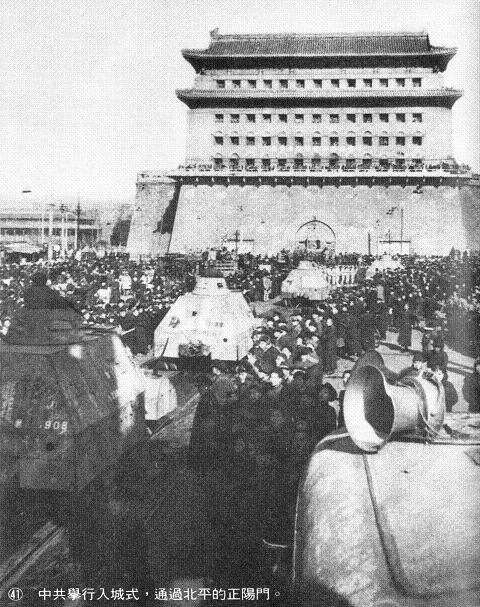
TEN TRAINS EQUIVALENT AMERICAN LEND-LEASE WEAPONS THAT STALIN & RUSSIANS GAVE TO MAO & CHINESE COMMUNISTS;
FORTY SHIPS EQUIVALENT QUANTITY OF TANKS & CANNONS, BOTH AMERICAN-MADE & JAPAN-MADE
3300 TONS OF PETROL FROM RUSSIANS IN 1947 ALONE; PLUS 2000 TONS OF DIESEL, 1000 TONS OF PLANE FUEL, 700 TONS OF EXPLOSIVES & 2000 TONS OF MACHINERY OIL
30000 TONS OF PETROL FROM RUSSIANS IN 1948; PLUS 1000 TONS OF PLANE FUEL, 5000 TONS OF KEROSINE, 3000 HEAVY WEIGHT TRUCKS & 150 ARTILLERY TRACTORS
DEATH OF MILLIONS OF YELLOW MEN, & POSSIBLY MORE IN THE FUTURE WAR AGAINST TAIWAN !!!!!
Reference: see the writing by James Perloff China Betrayed Into Communism on Friday, 24 July 2009 at
http://www.thenewamerican.com/index.php/history/world/1464
August Storm lend-lease weapons ended up in Mao's hands
"At the Teheran and Yalta wartime conferences, however, Roosevelt asked Stalin if he would break his pact with Japan and enter the Far East war. Stalin agreed, but attached conditions. He demanded that America completely equip his Far Eastern Army for the expedition, with3,000 tanks, 5,000 planes, plus all the other munitions, food, and fuel required for a 1,250,000-man army. Roosevelt accepted this demand, and 600 shiploads of Lend-Lease material were convoyed to the U.S.S.R. for the venture. Stalin’s Far Eastern Army swiftly received more than twice the supplies we gave Chiang Kai-shek during four years as our ally.
"General Douglas MacArthur protested after discovering that ships designated to supply his Pacific forces were being diverted to Russia. Major General Courtney Whitney wrote: 'One hundred of his transport ships were to be withdrawn immediately, to be used to carry munitions and supplies across the North Pacific to the Soviet forces in Vladivostok.... Later, of course, they were the basis of Soviet military support of North Korea and Red China.'
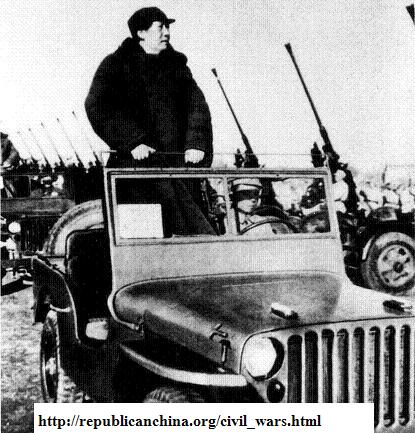
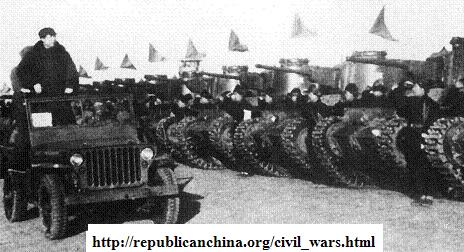
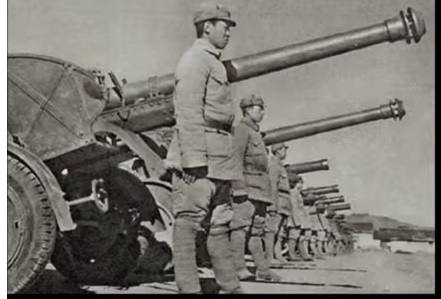
The Northwestern Battleground
Battle Of Linfen
The Battle of Dali
By October 1948, Peng Dehuai's Communist troops, having recovered from the loss from the Wei-he & Jing-he Campaigns, mounted a north-of-Weihe-River campaign. On the 6th, the Communist troops crossed the Luo-he River, with a plan to destroy Hu Zongnan's troops in the triangle area between the Luo-he River and the Yellow River and then link up with Chen Geng's Communist troops in Shanxi Province.
On the 10th, Hu Zongnan sent the right and left prongs of armies to encircle the Communist troops. On the 11th, fighting broke out at Renyicun, Xiqudou, Lijiapo & Dahaoying. Xu Zhen claimed that the Nationalist Army troops, at an own casualty of 10000 and death of 78th Deputy Division Chief Jing Chunjian, had inflicted a casualty of 30,000 onto the Communist troops. The Communist 1st "zongdui" was badly mauled while the 2nd "zongdui" decimated.
Li Zongren's Peace Talks & Communist Yangtze Crossing
Communist Yangtze Campaign
[Modified : Friday, 12-May-2006 11:47:41 EDT]
The KMT-CCP Peace Talk
Moving Gold, Silver & Foreign Currency To Taiwan -
2,600,000 ounces - Taipei;
900,000 ounces - Amoy;
380,000 ounces - U.S.A.;
200,000 ounces - Shanghai
Attacking Pukou Ahead Of the Peace Talk Breakup & Crossing the Yangtze
Contrary to the Chinese communists' befuddled claim that Stalin had ordered the communist army to stop at the northern Yangtze bank, Ledovsky, i.e., Stalin's China matter advisor, pointed out that Stalin repeatedly asked Mao and the Chinese communists to cross the Yangtze and attack south.
Mao's reply was that the Chinese communists did not have enough city-born cadres to take care of the metropolitan city of Shanghai once it was to be taken.
Stalin countered Mao with the Soviet experience in managing the cities in the Russian civil wars.
John Stuart Leighton, a scholar with no experience with politics, was planted by George Marshall to implement the American arms embargo scheme against the Republic of China.
Certainly, the entire sinologists' world was immersed in the simplistic and idiotic interpretation of the Soviet embassy's relocation to Canton [while John Stuart Leighton and the American embassy stayed behind in Nanking to greet the communist conquest army].
So naive !!! (This 'naive' was an epithet of the communist traitor-son party secretary Jiang Zemin, by the way.)
The Soviet-Chicom Tank Force Entering Nanking the Capital
As recorded by Ledovsky, Mao Tse-tung reported to the Soviets that the Chinese communists merely caught a few government troops' tanks at the Battle of Xuzhou during the Huai-hai Campaign.
The communist tanks were from the Soviet-supplied August storm arsenals and the bounty from the Japanese Kwantung Army.
Note the communist tank army, and the communist artillery were all manned by the mercenaries, including the repatriated Japanese Kwantung Army from Siberia,
with the survivors living in today's Tokyo organizing themselves into a so-called "Japanese Eighth Route Army" club
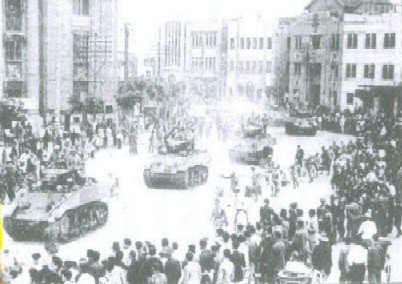
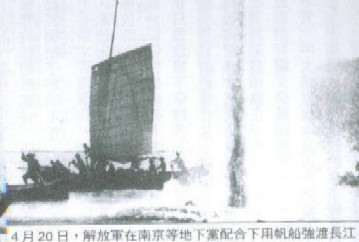
The Shanxi Battleground
The Battle Of Taiyuan
The Continuous Northwestern Campaign
The Campaign of Wugong
In mid-Nov 1948, Peng Dehuai's Communist troops came south again, attacked Weizhuang and laid siege of Yongfeng.
On February 14th, Hu Zongnan withdrew his bulk of forces to the south of the Wei-he River while leaving one division at Dali.
On the 24th, Hu Zongnan devised the defense plan of making Luqiao-Sanyuan the rightside position and Koudouzhen [Kouzhen] the leftside position. On the 27th, the Communist troops attacked Koudouzhen and destroyed Zhu Jingya's division. On March 6th, Hu Zongnan ordered that the 38th Corps and the 135th Division attack Koudouzhen. On the 11th, the 90th Corps recovered the Yaoxian county. On the 17th, Tongchuan & Pucheng were recovered.
(Throughout the resistance war time period, the communist army repeatedly attempted at penetrating south towards the Xi'an city. In 1944, the communists, taking advantage of the Japanese Ichigo Campaign, breached hundreds of miles of the pillbox blockade line. General Hu Zongnan, after defeating the Japanese in the Xixiakou Campaign, counterattacked the communists, which led to Wedemeyer's intervention to stop the civil war in this area.)
With Nanking lost to the Communists, Hu Zongnan abandoned Tongchuan and Pucheng for the south of the Wei-shui & Jing-shui Rivers on April 26th, 1949.
Peng Dehuai's 1st & 2nd Army Groups attacked south on May 16th. On the night, Peng Dehuai crossed the Jing-he River, breached the government 65th Corps' defense positions, and pushed to the northern Xianyang area. Meanwhile, the Communist 18th & 19th Army Groups crossed the Yellow River at Tongguan and Hancheng, respectively.
Hu Zongnan and the Lanzhou pacification office devised a plan to induce the Communist troops to the Baoji area for a duel. The Defense Department approved the plan to fight the Communist troops at the Jing-he & Wei-he River Plains subsequently. At dawn of May 18th, the Xi'an Pacification Office withdrew from Xi'an for the Hanzhong area. The 17th Corps and Xi'an Garrison Commander Yang Deliang were left for the Xi'an city defense. By the afternoon, the Communist troops took over Xianyang. On the 19th, the Communist troops mounted attacks at Xi'an. The 17th Corps defended the city for two days and then evacuated towards the Qin-ling Ridge.
Hu Zongnan planned to destroy Peng Dehuai's troops near the Wugong area before Heh Long and other Communist reinforcements came over.
Hu Zongnan obtained the cooperation of the Ma Family's Long-dong Army Group and the Ningxia Army Group in pincer-attacking Peng Dehuai's Communist troops.
On the 14th, the Nationalist Army troops north of the Wei-he River had recovered the Wugong city. To the southeast of Xi'an, Sheng Wen's 3rd Corps, with the 17th, 84th & 354th Divisions, defeated the Communist 60th Corps to the north of the Qin-ling Ridge from the Duqu direction and closed in towards the east and south gates of Xi'an.
With the Communist troops crossing the Wei-he River to the south, Li Zhen's 18th Army Group failed to push to the Huxian county for encircling Xi'an. At Xi'an, the Communist reinforcements from Hancheng & Tongguan converged with the troops which came south from north of the Jing-he River. On June 20th, the Long-dong Army Group, after a defeat around the Jing-he River, retreated towards Lingtai. On the 25th, the Ningxia Army Group retreated towards Binzhou without advance notice to Hu Zongnan. Hu Zongnan's troops on both riverbanks of the Wei-he River were hence exposed to and surrounded by the Communist troops.
On July 11th, Peng Dehuai & Heh Long's Communist troops circumvented to Fufeng to attack Li Zhen's 18th Army Group.
During the Wugong Campaign, Hu Zongnan's troops, i.e., the 65th, 69th, 36th, 38th & 90th Corps, incurred over half casualty. 144th Division Chief Fu Shufeng was killed in battle. 65th Deputy Corps Chief Zhang Shen, 165th Division Chief Sun Tieying, and 55th Division Chief Cao Weihan & Deputy Division Chief Shi Difei were seriously wounded.
The Battle Of Pingliang By Ma Hongkui's Ningxia Army Group
The Last Push by the Communist Army
The Campaign of Ankang
On the 19th, Sheng Wen, i.e., Hu Zongnan's chief of staff, arrived at the west bank of Ankang, and ordered that the 31st Division of the 27th Corps defend the Ankang city while the 69th & 98th Corps defend the west and north banks of the Han-shui River. At dawn of July 21st, the government troops' 27th, 69th & 98th Corps crossed the Han-shui River to the south for a counter-attack against the communists.
On Aug 5th, the Xunyang-Baihe-Zhushan-Zhuxi-Pingi counties were recovered from the communist hands. From July 21st to Aug 5th, Hu Zongnan's troops killed 5000, wounded about 9000, and captured alive 2700 Communist troops at an own casualty of 3100 and the deaths of three battalion chiefs.
After the battle, the 27th & the 69th Corps could only reorganize as one division, respectively, while the 98th Corps was reorganized into four regiments, only.
The Battle Of Lanzhou
The Battle Of Ningxia
The Battle Of Wuhan
Cheng Qian & Chen Mingren Defecting To Communist Camp
Bai Chongxi Hitting Back At Communist Forces At Qingshuping Ambush In Hunan Province
Chiang Kai-shek Frustrating Guangdong-Guangxi Defense By Withdrawing Forces to Hainan Island
The Battle of Chongqing
The Battle of Chengdu
The Battle of Xichang
The Campaign Of the Northwest
The Campaign Of the Southwest
Communist Marching To New Dominion Province
Defection of Government troops In Chinese Turkistan & Loyalists' Trek Through The Pamirs
Defection Of Lu Han In Yunnan Province For Rescuing Lu Junquan From Communist Captivity
The Battle Of Canton
The Battle Of Zhoushan Islands
The Battle of Amoy
The Battle of Quemoy
Chasing Towards Burma & Vietnam
KMT Guerilla Fighting In Sichuan & Yunnan Provinces
Retreat To Keetung & Communist Cession of the Golden Triangle To Burma
The Battle Of Hainan Island
Abandoning Zhoushan Island
Hu Zongnan's Guerilla Warfare Against the Coast
Abandoning Dachendao Island & the American Attempt At Stirring up the Third Force and Making Taiwan A Trustee Country
The Korean War: 6/25/1950 - 7/27/1953
The Vietnamese War
Wu [no] Wang [forgetting] Zai [at] Ju [the Ju fort]
TO BE CONTINUED !
|
|
Invasion Of Manchuria, Chaha'er & Jehol 1931-34
Mukden Incident - 9/18/1931 & Battle Of Jiangqiao
Shanghai Provocation - 1/28/1932
Battles of the Great Wall
China In Crises Of Internal Turmoils & Foreign Invasions
Japanese Invasion (1937-1945)
Marco Polo Bridge Incident & Battle of Tianjin-Peking
Campaign Of Nankou & Campaign of Xinkou
Air Battles Directed By Chenault & With Russian Pilots
Battles of Shanghai, Jiangyin, Si'an & Nanking Defense
Rape Of Nanking & The Great Rescue Of 1937
Eight Year Long Resistance War
Battles of Lanfeng, Wuhan, Nanchang, &
Sui-Zao,
1st Changsha Battle, Kunlunguan, Wuyuan, & Zao-Yi,
Fatigue Bombing of Chongqing by Japanese
Aggression Against Vietnam & Southeast Asia
Yu-nan & E-bei, Shanggao, & Mt Zhongtiaoshan
2nd Changsha Battle, & Pacific Wars
3rd Changsha Battle, Zhe-Gan, Changde, & E-xi
Second Burma Campaign, & Phase II
|
| [ revolution.htm & tragedy.htm] |
Communist Armed Rebellions
Second Northern Expedition
War Of Chiang Kai-shek versus Gui-xi (March 1929)
War Of The Central Plains (May 1930)
Campaigns Against Communist Strongholds
The Long March
Xi'an Incident - Turning Point of Modern History
Demise Of Red Army Western Expedition
|
| [ campaign.htm & terror.htm ] |
[ default page: war.htm ] |
|
1945-1949 Civil War
Liao-Shen Campaign
Korean War
Vietnamese War
Written by Ah Xiang
|
|
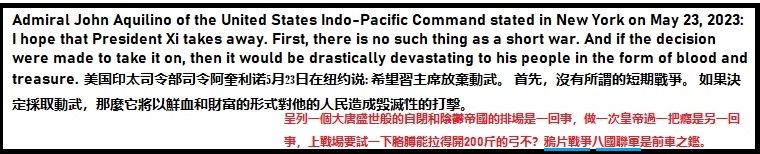
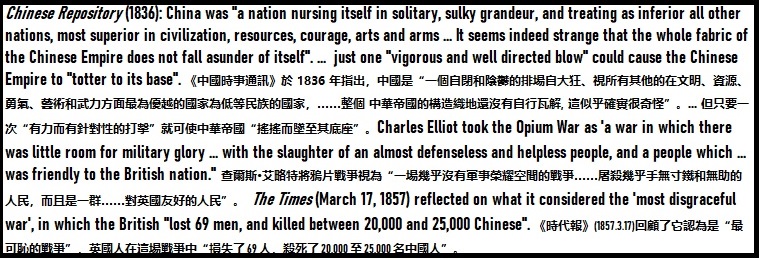
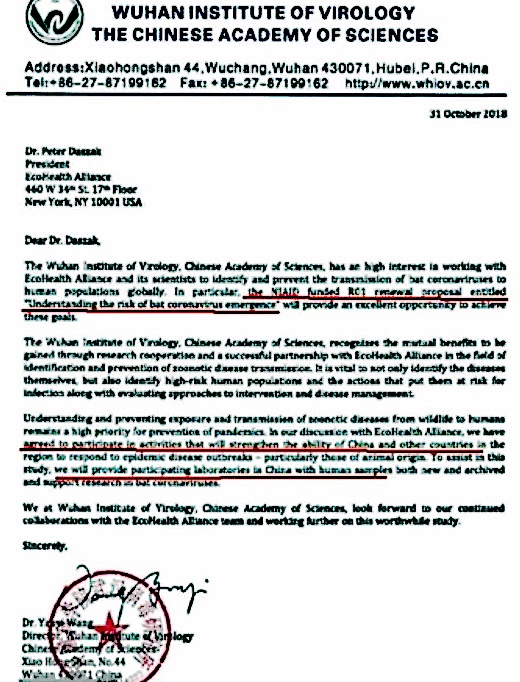

![Though, Anna Wang [Anneliese Martens], in her memoirs, expressed jealousy over Gong Peng by stating that the Anglo-American reporters had flattered the Chinese communists and the communist movement as a result of being entranced with the goldfish-eye'ed personal assistant of Zhou Enlai](GongPeng.jpg)