For twenty years, this webmaster had been telling the world that
Alan Greenspan, possibly the smartest American but bedazzled by the "conundrum" of long term interest rates, does not know that this webmaster's countryside cousins, mostly women, had been going to Guam, Samoa and other Pacific islands for a decade as the export of labor: what is coming to the U.S. market is merely a tag stating something not "made-in-China" but made-by-the-Chinese in nature.
The smartest American turned out to be Professor Peter Navarro, and it might not be some coincidence that his books "The Coming China Wars" and "Death by China" are similar to what this website wrote about for the last 20 years.
What this webmaster does not know is that the Chinese were going to Italy as well, where they worked as coolies and slaves for the "Made in Italy [by Chinese]" brands, and spread the coronavirus in Italy today.
What a farce Communist China gave the world, and what a disaster Communist China caused to the world!
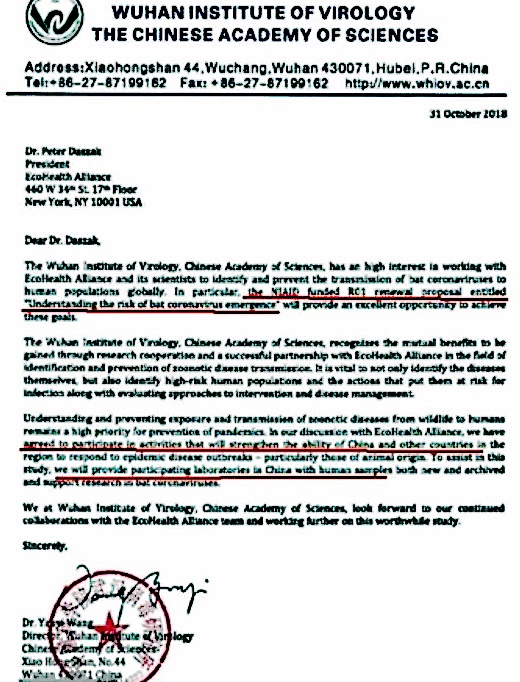
Don't forget that France (Alain Merieux of bioMerieux - sarcastically-related to Moderna, the other side of a coin) and the United States (Anthony Fauci of CDC & Peter Daszak of EcoHealth) acted as the 'enablers' in designing and constructing the P4 virus research center in Wuhan, as well as in providing the funds.
And don't forget what happened today was because the Americans served as the midwife who delivered China into the communist hands as i) Roosevelt, in collusion with Churchill and Stalin, sold out China at Tehran and Yalta; and ii) George Marshall forced three truces [Jan-10-1946, June-6-1946, & Nov-8-1946] onto the Republic of China and further imposed the 1946-47[48] arms embargo while the commies were equipped by the Stalin-supplied American August Storm weapons and augmented by the mercenaries including the Mongol cavalry, the Japanese 8th Route Army troops, the Soviet railway army corps, and the 250,000-strong [Kwantung Army-converted] Korean diehards.
(Refer to
"The Italian fashion capital being led by the Chinese";
"Coronavirus Hits Heart of Italy's Famous Cheese, Wine, Fashion Makers" for further reading.
Military Documents About Gain of Function Contradict Fauci Testimony Under Oath:
EcoHealth Alliance approached DARPA in March 2018 seeking funding to conduct gain of function research of bat borne coronaviruses...
According to the documents, NAIAD, under the direction of Dr. Fauci, went ahead with the research in Wuhan, China and at several sites across the U.S.)
In the last 2-3 decades, the ludicrous and idiotic communist nation enslaved one billion humble Chinese peasants as coolies for the multinational corporations and international banksters, and moved the mountains of China to the United States in the form of rare earths (REE), marble and granite stones, at the cost of death of innumerable Chinese men from silicosis, and imported megatons of the American wastes to China, the beautiful and divine country, for recycling, burning or pure landfill, while resettling their wives, concubines, mistresses, and children [and bastards] to the U.S., Canada, Australia, and Europe.
At the same time, they began the process of Africanizing the Chinese continent with the import of Africans by hundreds of thousands and up to a million, under the idiotic "one road and one belt" program (i.e., a replica of Han China's bribery for the Huns), and made China the land of "Aids Danger Zone No. 1".
Mind you all 77 Belt & Road countries: Your ripping USD 1 trillion from Communist China, i.e., one third of China's 3T foreign exchange reserves [on paper], is equivalent to ripping the life and blood of one billion poverty-stricken Chinese people with monthly income of no greater than 2000RMB or US$300.
(Communist premier Li Keqiang claimed that 0.6 billion Chinese, i.e., this webmaster's humble peasant Chinese, had a monthly income of less than 1000RMB or $150, or de facto zero income.)
*** ARE YOU STILL GOING TO COMMUNIST CHINA TO "STUDY" WITH SCHOLARSHIPS [AND FREE MEDICARE/WOMEN] BUT WITHOUT ADMISSION TESTS, WITHOUT ENTRANCE EXAMS, WITHOUT QUIZZES, WITHOUT MIDTERM TESTS, WITHOUT EXAMS, WITHOUT SEMI-FINALS & WITHOUT FINALS ? ***
Note Barack Hussein Obama's half brother 'adopted' China or was adopted by communist China, setting an example for numerous Africans who came to China and worked as coyotes engaged in the operation of smuggling the illegal Africans to China --not knowing that China was prone to dynastic cycles of violence that could lead to death of 60-90% of the population, such as eradication of the Arab-Persian paramilitary regime and settlement in Canton in the 9th century
and
in Zalton in the 14th century.
(South Korea, Japan, Vietnam, Thailand, and the rest of Asian countries: Don't take this lightly.
The mingled Chinese-Africans, in less than 50 years, will spill over and sweep into your countries.
First, you need to guard against the "African Swine Fever" virus that is killing all the hogs and wild boars in mainland China now --an import from Russia again and a collateral casualty of Trump's trade war.)
The sinisterness of communist China lied in its bribing the world leaders, including the U.S. vice president Joe Biden (i.e., Lunch Bucket Joe -who ate free lunches on both the American people and the humble Chinese peasants), and in bribing the United Nations leaders.
For details, check out
Robert J. Wicks' video
Riding the Dragon: 10 Lessons for Inner Strength in Challenging Times; and
Google book.
Communist China, in addition to the work on the Obamas and the Bidens, set up illicit affairs for Neil Bush in Bangkok and Hongkong, that could have led to the latter's divorce.
(The Americans apparently forgot how the Chinese communists murdered the American missionaries in the 1920s and 1930s, such as John and Betty Stam.)
The Chicoms turned filthy rich, and became more barbaric towards their own people.
The capitalists (synarchists) of the West are now horrified that the Chi-coms [and the lewd female Chicoms] accumulated the same amount of wealth or more within the last 20-30 years, that took the capitalists (synarchists) of the West 300-500 years of Black slaves' trade, opium trade and the Chinese coolie trade, etc., to achieve; and that the Chi-com, who killed off the landlords, had unlimited land to sell to make more money and could easily surpass the wealth accumulated by the capitalists (synarchists) of the West in no time.
Even worse, the Chi-com dared to challenge the only superpower in this world with the building of more aircraft carriers and financially challenge the U.S. Dollar settlement system.
The consequence of the Chi-com's reckless behavior could cause even more disasters to the Chinese people who were bound to the communist war chariots.
(There is no "profound mystery [in Chinese]" ECON 101 as to the Chi-com's filthy richness and the "Crazy Rich Asians" but immiserizing growth and a replay of the Chicom's Soviet Bank scheme: The Chicoms enslaved one billion peasants as the slave labor of the world factories, the slave labor in the mines, and the slave labor in the construction of skyscrapers and ghost towns/cities across the country;
the Chicoms then forced the exporters to convert the "foreign exchange" trade gain into the worthless RMB, i.e., "people's dollars" that were printed on the astronomical scale;
then the Chicoms laundered the "foreign exchange" to the banks in HK, the U.S., Canada, Europe, and the Caribbeans, escaping the hell they created in the expectation that the billion slaves one day will rise up and smash the communist apparatus, i.e., the historical cycle of China's dynastic violence that saw 60-90% of the population killed;
and to absorb the overprinted "people's dollars", the Chicoms conducted the violent land acquisition and enclosure movements, reaped enormous profit in the land sale, and sold the real estate bubble to the city "accomplice" citizens [whose I.D. actually carried the print of residents with no jus soli rights].)
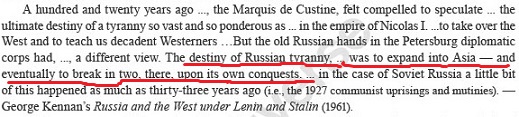
America, i.e., the United States, was and is still shortsighted today, not knowing that Korea, at one time paradise of the American Evangelicals, was delivered into the hands of the Japanese imperialists as a result of the Anglo-American confrontation against Czar Russia, and in this geopolitical process, China, the land of the Great Sinitic Civilization, was made into a piggy-backed sacrificial/funeral object -the land ruled by the most evil cult called 'communism' that was an 'import' or an 'export' of Soviet Russia.
America would not learn the lesson that the geopolitical actions it is taking today would yield the 'bad fruit' 50 years or 100 years down the road.
America, and their British cousins, must have forgot the twenty-year Anglo-Japanese military alliance that allowed Japan to develop the warplanes and aircraft carriers to invade mainland China, not to mention the post-WWI ten-year arms embargo against Republic China and George Marshall's post-WWII arms embargo against Republic China 1946-1948.
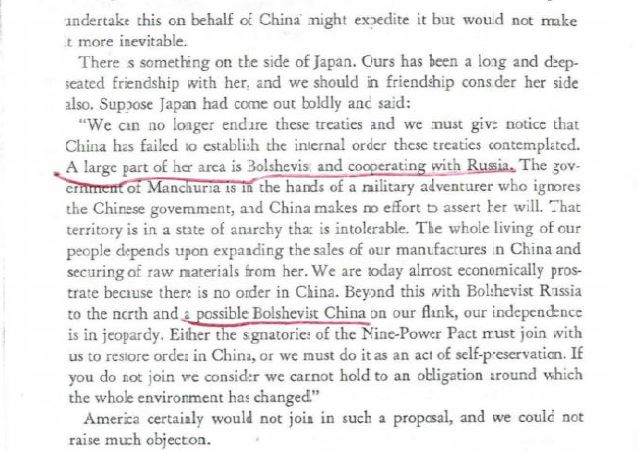
They forgot that in 1931, President Herbert Hoover gave Japan a free hand in the invasion of Manchuria on the pretext that Japan could not tolerate a half-Bolshevik China.
Earlier, President Hoover, who personally nipped the post-WWI communist uprisings in Germany and Hungary with the grains embargo, fed Lenin the ingenuity, i.e., the [worldwide communist revolution] road to Paris lay through Peking.
They of course forgot that
after the eruption of the 1937 Sino-Japanese War, the Americans, biased towards Japan and against China, adopted a policy of "neutrality" (what Utley called by "unpositive neutrality") against the 'belligerent' countries, namely, Japan and China, which was free and unrestrained arms sale to Japan and de facto arms embargo against China.
This neutrality, which William Christian Bullitt Jr. (1891-1967) felt bedazzled about,
was de factor arms embargo against China and free arms sale to Japan.
Note that the arms embargo would choke China since China did not have an industrial base to produce the basic weapons while Japan's factories could roll out the warships and airplanes on a wholesale scale.
Also note that in contrast with the Americans, the European powers, being constrained by the mediation role of the League of Nations, dared not openly sell arms to Japan.
Through 1940-1941, prior to the U.S. revocation of the 1911 U.S.-Japan Commerce Treaty, the Americans were the biggest supplier of raw material, oil, aviation oil, and weapons, to the extent that some U.S. senator called by Scott making a claim that out of one million Chinese killed by the Japanese, 544,000 Chinese were killed by the Americans.
Thirty-one U.S. congressional members made a joint declaration to the effect that the U.S., not NAZI Germany, nor Italy, was the best ally of Japan.
America, the 'stars' that engendered or heralded the rise of the [Japan] 'sun', long ago had the blueprint to make Japan into a stalwart against China and Russia, i.e., the source of the Yellow Peril and the source of the Half-Tartars [or the Russians], respectively, --whom the Americans could not assimilate according to George Kennan.
William Christian Bullitt Jr. (1891-1967) disclosed that the Americans' national policy or strategic aim was to see the Russians and Japanese' holding a balance of power against each other in China rather than seeing either the Russians or the Japanese overpowering the other party in taking control of China.
In making this geopolitical decision, you had victimized the 1 billion humble peasant Chinese.
(Note President Wilson's doctrine that the intactness of China was vital to the white civilization -- in the sense that the nation of China should be managed delicately, that is, should not be allowed to grow too powerful to pose threat to the white civilization, nor should it be allowed to be hijacked by a non-U.S. power since China's immense human labor could be turned against the white civilization.
The theme of China to the white civilization, morphing superficially into a ***hypocritical*** American national policy of engagement with Communist China for changing the Chinese communists' behavior, rested on the same underlying logic:
"The
China Exception: Russian Communism being wicked, the
Chinese are good communists", which is an inherent fear
of the Yellow Peril,
i.e., billion Chinese would actually enjoy real
democracy, go to college and develop their intelligence.
Now, President Biden, a stooge of Communist China, explicitly abandoned the
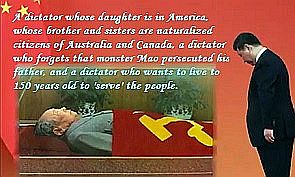
hypocritical American policy of engagement to change communist China to his imbecilic communist buddy and dictator Xi Jinping.)
Now you, as the midwife who delivered China into the communist hands, are morally obligated to take China [and North Korea {and Vietnam}] out of communism.
This time, you may feel your hands forced as North Korea, with its nuclear weapons, could become Communist China's cecal appendix in a repeat of history.
The Chicoms don't understand the urgency of Trump's trade war having the roots in nuclear North Korea, nor the domino effect on North Korea and Russia after the knock-out of communist China.
Putin thought he would reap profits by sitting on the fence of the U.S.-China trade war, i.e., the Zheltorossiya dream[, and India would not be satisfied with grabbing South Tibet (i.e., what India calls by Arunachal Pradesh), Bhutan and Sikkim alone].
Though, the Americans could be hoodwinked by the Chicoms again. The Chicoms might just sign any agreement just for sake of getting a red carpet at the White House in lieu of a visit to Mar-a-Lago, but won't change its sinister nature and will default on any trade agreement.
(Previously, this webmaster thought that the Americans could be hoodwinked by the Chicoms who might just sign any agreement just for sake of getting a red carpet at the White House in lieu of a visit to Mar-a-Lago.
With Trump's war with Communist China flaring up, this webmaster believed that China's dictator Xi Jinping would continue to commit blunders and became the tomb digger for the Chinese communist regime.
The thuggery communists, who would not allow the millions of the Hongkong people to have autonomy, could have caused the demise of the regime over the inevitable crackdown, not knowing that the communist ascension to power had its very roots in Churchill's collusion with Roosevelt in selling out the Republic of China for sake of retaining crown jewel Hongkong after hoodwinking Wellington Koo and Chiang Kai-shek that Britain would return Hongkong to China after Japan was to surrender so as not to damage the British wartime morale.
--What happened was that Putin first jumped off the fence ahead of communist China in launching an invasion of Ukraine.)
President Trump
understood the China situation and the China problem.
Should the American politicians follow the footsteps of Anson Burlingame (1820-1870),
Paul Samuel Reinsch (1869-1923)
and
Patrick Jay Hurley (1883-1963), i.e., three most prominent U.S. statemen who loved China and the Chinese people,
then the Chinese people could have a chance of salvation from the communist tyranny.
Note the historic recurrence and the repetition of similar events:
Anson Burlingame, in opposition to the anti-Chinese discriminatory whirlwinds rampant in the U.S. in the 19th century, authored the Burlingame Treaty for China and
died for China in 1870 in St. Petersburg
while still on the Manchu China's mission to the U.S. and Europe;
Paul Samuel Reinsch, who was disillusioned by President Wilson's betrayal of China over the division of WWI spoils at the Paris Peace Conference, quit the minister-to-China job to work for China and died for China in Shanghai in 1923;
and
Patrick Jay Hurley, who convinced President Roosevelt of the American moral blunders in selling out the Republic of China at Tehran and Yalta, personally travelled to Moscow and London for sake of averting and reverting China's fate of becoming a victim of WWII war spoils (i.e., the loss of Port Arthur and Hong Kong, etc.), but failed to make remedy to the secret Tehran and Yalta agreements in the aftermath of President Roosevelt's death in April 1945.
China and the Chinese lived in terror since Peng Pai and
Mao Tse-tung launched the rascal-proletariat peasant
movements in 1927. Peng Pai had at one time claimed that
the communist law would be simply the execution of
landlords once they were caught. Mao Tse-tung, directly
responsible for the rascal
movement in Hunan Province in 1927, would be the
red-handed culprits in the Purge
of Anti-Bolshevik League during 1930-1931, the Purge of Trotskyists
during 1937-1941, and the Rectification Movement
during 1942-1945.
In the caste section, we also
listed the CCP's bloody crackdown, including
Suppression of Reactionaries Movement (1950),
"Three Anti" (1951),
"Five Anti" (1952),
"Three Anti" (1953),
Gao Gang Anti-Party Clique (1953-1954),
Hu Feng Anti-Party Clique (1954-1955),
Elimination of Counterrevolutionaries (1955),
Ding Ling & Chen Qixia Anti-Party Clique (1955-1958
?),
Rectification Movement (April 27th, 1957),
Anti-Rightist Movement (June 1957),
Peng Dehuai Anti-Party Clique (1959),
Anti-Rightist Trend (1959).
Simply said, the CCP never stopped its bloody terror
campaigns since inception in history, and its claws could
be seen in the most recent crackdown on the Falungong practitioners.
Wen Yu, in his 1994 book Leftist Catastrophe of China
(Cosmos Books Ltd., ISBN 9622577164, 1994, HK), summarized
the so-called "leftist" [should be terrorist] catastrophe
of the Chinese Communist Party from the 1927 armed
uprisings (in fact, mutinies) to the 1978 Xidan
Democracy Wall. Gao Hua, a Nanking University
professor whose father fled the persecution of the
cultural revolution in Aug 1966, had presented the most
comprehensive research into the communist red terror in
the book How Did The [Red] Sun Rise Over Yan'an ? - A
History Of The Rectification Movement (The Chinese
University of Hong Kong, Sha Tin, N.T., Hong Kong,
2000 edition).
What was the "Cultural Revolution" about then? It was
nothing other than a coup d'etat that Mao Tse-tung had
initiated by having the mobsters topple Liu Shaoqi's
presidency.
Ao-feng
pointed out that Mao Tse-tung did not convene the CCP
9th Congress till 1969, i.e., till after toppling Liu
Shaoqi presidency. The CCP 9th Congress would have a
deliberate lapse of 13 years since the start of 1st
Plenary of the CCP 8th Congress in 1956.
Feng Zhijun, in Mao Tse-tung & Liu Shaoqi
[Huangfu International Publishing House, HK, April 1998
Edition], examined the Mao-Liu relationship in historical
parallel and expounded the cause and effect of the
so-called "Great Proletarian Cultural Revolution", an
event that would topple 76% of the CCP 8th Congress'
politburo members and backup commissars, majority of
deputy chairmen of the CCP Central Military Committee,
majority of deputy commissars-in-chief of the National
People's Congress 3rd Congress (Plenum), majority of premiers of the
State Council, and three quarters of ministerial leaders
and provincial leaders.
(Alternatively speaking, Jiang Qing, i.e., Mao Tse-tung's unofficial wife, had
intentionally rendered a havoc to the communists internally:
Zheng Yi, in "Seventy Years Of Espionage Between the
KMT & the CCP", pointed out that both Jiang Qing
and Zhang Chunqiao were agents who had been recruited by
Dai Li in the 1930s.)
Chinese believe in the "cycle" of life and death as
expounded by Buddhism.
The "Peng Dehuai Anti-Party Clique", the Ming Dynasty's official Hai Rui,
& the Cultural Revolution could be said to have the
apparent cause and effect.
Hei Yannan's Ten Year Turmoil (Xingchen
Publishing House, HK, 1988 edition, ISBN 9620406540) began
the coverage of the cultural revolution with "Chapter One:
Starting From the 'Historical Tragic Drama' [Ming Dynasty
Official Hai Rui's Losing His
Job]".
During the Mt Lushan Meeting of July 2-Aug 16, 1959, Peng
Dehuai was classified as reactionary for opposing Mao
Tse-tung's Great Leap Forward which would lead to the
starvation death of at minimum 40 million peasants in the
ensuing 3 years.
In 1961, a historical drama, "Hai Rui's
Dismissal" was taken as a play for sympathizing with
deposed Peng Dehuai.
In 1962, Mao Tse-tung was forced into yielding power to vice president Liu Shaoqi during a 7000-people expanded meeting of the communist party.
Mao
already resigned the state president's post at the 6th Plenary meeting of the CCP Eight Congress held in Wuchang from November 28th to December 10th, 1958, which was approved by the 1st meeting of the Second National People's Congress in April 1959.
Mao disliked being the state president
as early as 1954 for resentment of mandatory tedious duties of wearing suits and receiving foreign visitors, etc.
In 1965, Mao Tse-tung authorized his cronies in initiating
an attack at the drama, unofficially starting the cultural
revolution that would sweep through the communist
apparatus of Peking city as well as the politburo that, in
Mao's eyes, had been usurped by political enemy Liu Shaoqi,
et al.
The Cultural Revolution officially started with the People's Daily editorial "Sweeping All Ghosts and Snakes" on June 1, 1966. The Cultural Revolution purportedly resulted in an abnormal death toll of 2 million people.
R. J. Rummel's "One Hundred Years of Bloody China" estimated the number of people killed in the Cultural Revolution to be about 7.73 million.
Historical Context Of the
Mao-Liu Relationship
In the section on the terrors, this webmaster had covered
"Mao Tse-tung & Liu
Shaoqi's Initial Cooperation".
Gao Hua pointed out that Mao Tse-tung gradually exercised
control over the CCP in addition to his re-acquisition of
control over the Red Army since the 1935 Zunyi Meeting
held during the Long March.
Moscow returnee Zhang Wentian, who was encouraged by Mao
in the struggles against Bo-gu [Qin Bangxian] and Li-de
[Otto Braun] during the Long March, replaced Bo-gu as the
CCP's secretary general on Feb 5th, 1935. Mao Tse-tung,
Zhang Wentian and Wang Jiaxiang formed the so-called Three
Person Team (i.e., troika), with actual military power
resting in the hands of Mao Tse-tung.
Zhou Enlai became very much subordinate to Mao Tse-tung
since.
Moscow returnees were only in charge of party propaganda,
party affairs and regional affairs. In contrast, Red Army
generals began to enter the CCP politburo.
Thereafter, after arriving in Shenxi Province, Mao Tse-tung
began to resent Zhang Wentian's posture as a 'theorist'.
After defeating Bo-gu and Kai-feng (blasted as
doctrinairist & factionalist), Mao Tse-tung defeated
Zhang Guotao by dispatching the Red Army Fourth Front Army to
the mouth of Ma Family Cavalry.
In 1937, Mao Tse-tung allied with Liu Shaoqi in
challenging Zhang Wentian.
On Feb 20th & March 4th, 1937, twice, Liu Shaoqi wrote
letters to Zhang Wentian, criticizing ten year long
"leftist" mistakes committed by the CCP & Comintern,
blasted the CCP's leftist antagonism to his activities on
the job of the CCP Northern Bureau representative, and
hinting the necessity of the CCP leadership (i.e., Zhang
Wentian) in reflecting on the responsibility. During the
May 17-26th Meeting On the "CCP Tasks In the
KMT-Controlled Areas", Liu Shaoqi argued fervently against
Zhang Wentian by repeating what he wrote in earlier
letters.
Liu Shaoqi claimed that the CCP loss in the KMT-Controlled
areas were 100% due to the "leftist putschism" and
"closed-door-ism" mistakes, while Zhang Wentian, Bo-gu,
Kai-feng and Chen Geng accused Liu Shaoqi of sharing
Trotsky & Chen Duxiu's "revocationism". Ke Qingshi
cursed Liu Shaoqi as an "old rightist".
On June 6th, Zhang Wentian tried to desalinate Mao
Tse-tung's remarks by stating that the past CCP mistakes
were more a strategic mistake than a mistake in the
political guideline/trend. Zhang Wentian further blasted
Liu Shaoqi on the matter of citing 'big hats' such as
"leftist putschism", "venturism" and "closed-door-ism" and
rebutted Liu Shaoqi's "legality-ism" in launching the CCP
movements inside of KMT-controlled areas.
On June 9th & 10th, Liu Shaoqi backed down from
previous stance and made self-criticisms.
This would become the prelude to the Purge of Trotskyists
of 1937-1941.
In late Oct of 1937, Wang Ming & Kang Sheng returned
to Dihua (Urumqi) of the New Dominion Province from Moscow, and
thereafter entered Yan'an.
On Dec 25th, 1937, Wang Ming, in the KMT-controlled Wuhan,
issued a proclamation representing Stalin's line of
thought, i.e., the "CCP Proclamation As To the Current
Affairs", and proposed "five united" approaches to
resisting Japanese under the KMT leadership.
Wang Ming returned to Yan'an for Feb 27-March 1, 1938
meeting and proposed "seven united" approaches in
cooperation with KMT.
Mao Tse-tung, privately calling Wang Ming a "rightist
surrenderist", advised against Wang Ming's return to
Wuhan.
However, majority of the CCP politburo members did not
object to Wang Ming's trip to Wuhan where the CCP Yangtze
Bureau had become a de facto CCP ruling apparatus.
To counter Wang Ming, Mao Tse-tung recalled Liu Shaoqi to
Yan'an in mid-March, and on March 24th, Liu Shaoqi was
retained in Yan'an per politburo resolution.
Meanwhile, Mao Tse-tung dispatched Ren Bishi to Moscow for
winning over Comintern.
After two months of work by Ren Bishi in Moscow, on June
11th, the Comintern affirmed the CCP's policies, and on
July 6th, Pravda published an article with portraits of
Mao Tse-tung and Zhu De.
In Moscow, Ren Bishi replaced Wang Jiaxiang as the CCP
rep, while Georgi Dimitrov asked Wang Jiaxiang relay a
message to the CCP that Wang Ming et al should unite
around Mao Tse-tung, a message that purportedly restored
Mao Tse-tung's control over the CCP.
(Just three years ago, Mao Tse-tung faked a Comintern's
decree to get Zhang Guotao dismantle his CCP Central,
namely, the 2nd CCP Central, something to show that the
Chinese communists were blind and faithful followers of
the Soviet masters.)
Liu Shaoqi Contribution To the CCP
Liu Shaoqi Deviations From Mao Tse-tung
Peng Dehuai, Hai Rui,
& Cultural Revolution
In early 1959,
"People's Daily" and New China News Agency reported that
in Zhuangxian County of Hunan Province some commune
harvested 35000 kilograms of rice per acre, while some
commune in Guangxi Province reached 65000 kilograms per
acre. One communist official, ex-general Peng Dehuai, was
the only one who stood out against Mao, hence lost his job
and was classified as a "counter-reactionary".
The Lushan Meeting of July 2-Aug 16, 1959, declared the 'Peng
Dehuai Anti-Party Clique' for opposing Mao Tse-tung's
Great Leap Forward which led to starvation death of
minimum 40 million peasants in the ensuing 3 years.
After the 1959 Lushan Meeting, Mao went on the Anti-Rightist
Trend to rout another 3,800,000 people.
During the meeting, Wu Han, who viciously attacked the former Democratic League colleagues such as Chu Anping and Luo Longji, accused Peng Dehui of faking as the Ming dynasty's righteous minister Hai Rui (who was imprisoned by Emperor Jiajing for criticisms but was later released by the successor-emperor and survived to be the poorest and most righteous minister in history).
(Wu Han was a former disciple of scholar Hu Shi but converted to the communist cause in the early 1940s while teaching history at Lienda in Southwest China.
Wu Han, like Chu Anping and Luo Longji, cohorted with the underground communists and the pro-communist Americans like Jack Service and John King Fairbank in running the Democratic League in the 1940s.)
In 1961, a historical drama, "Hai Rui's Dismissal", was taken as a
play for sympathizing with deposed Peng Dehuai.
From January 11 to February 7, 1962, an enlarged CCP Central Work Conference was held in Peking with the consent of Mao Zedong, then chairman of the Central Committee of the Communist Party of China. 7,113 people in charge of the central government and various central departments, central bureaus, provinces, cities, prefectures, and counties, as well as responsible cadres of some important factories, mines, and troops, attended the meeting.
The meeting discussed the "Great Leap Forward", i.e., tyrant Mao's three banners including the People's Communes, and the Great Famine, and advocated "criticism and self-criticism" and "democratic centralism". During the meeting, Liu Shaoqi, vice chairman of the Central Committee of the Communist Party of China and president (chairman) of the State, attributed the cause of the Great Famine during the three-year difficult period to a division of "thirty percent natural disasters and seventy percent man-made disasters." Mao Zedong made self-criticism at the meeting. After the meeting of 7,000 people, the famine problem in mainland China eased, with Mao Zedong retreating to the second line, and Liu Shaoqi and Deng Xiaoping presiding over the daily affairs of the central government.
Though, Mao in 1962 called for not forgetting class struggles and ordered to launch socialist education movements,
that led to
a communist work conference held in Peking from February 11 to 28 with a decision to launch a nationwide campaign of new "Five Anti's" against
economic graft, waste, speculation and corruption nominally under various resolutions such as
"Regulations of the Central Committee of the Communist Party of China on Strictly Enforcing Production Increase and Saving and Opposing Corruption and Opposing Speculation", and "Instructions on the Campaign Against Decentralism and Bureaucracy".
This mutated to the Countryside Socialist Education Movement, i.e., Four Clean-ups Movement (cleansing politics, economy, organization, and thoughts, 1963-1965).
In 1965, Mao Tse-tung authorized his cronies in initiating
an attack at the 1961 drama, unofficially starting the cultural
revolution that would sweep through the communist
apparatus of the Peking city as well as the politburo that, in
Mao's eyes, had been usurped by political enemy Liu Shaoqi,
et al.
Hei Yannan, in Ten Year Turmoil, pointed out that
it was Mao Tse-tung himself who had instructed in April
1959 that people should learn from the unwavering
and defiant loyalty of Ming Dynasty's official Hai
Rui in daring to contradict and admonish Ming Emperor
Jiajing [reign AD 1522-1566].
People's Daily promptly contacted Wu Han, the CCP's
deputy mayor for Peking as well as a historian on the Ming
Dynasty, for a propaganda war on the subject of Hai Rui.
Two top opera actors, Zhou Xinfang and Ma Lianliang,
pressed on Wu Han in writing up a historical drama on
basis of Hai Rui.
Cai Xitao, a friend of Wu Han, suggested the title of "Hai
Rui's Dismissal" for the drama in late 1960.
Hai Rui, while politically correct in 1959, forgot that tyrant Mao was no longer the emperor he was defending, but Liu Shaoqi -- because Mao was losing influences to Liu Shaoqi over the famine deaths of the Great Leap Forward.
Hei Yannan stated that in 1961, Jiang Qing, i.e., Mao
Tse-tung's unofficial wife, first raised her questions
about the political nature of the drama to Mao Tse-tung.
Xi Zhongxun, who managed to escape the purge of Peng Dehuai and Jia Tuofu's "Northwestern" discussion group at the Lushan Meeting of July 2-Aug 16 1959, was implicated in accusation that he used fiction Liu Zhidan, a novel written by the wife of Liu Jingfan (Liu Zhidan's brother) as a tool of counter-revolution.
The Shenxi communist clique, including the late Shenxi communist leader Liu Zhidan's family members as well as Shenxi clique lieutenants such as Xi Zhongxun, et al., numbering hundreds of thousands, were persecuted for the fiction or fictional memoirs on Liu Zhidan.
Jia Tuofu, who was just taken off the rightist hat of the 1959 Lushan Meeting, was named in the "Xi ZHongxun, Liou Jingfan & Jia Tuofu Anti-Party Clique" for the anti-Party novel incident.
This was purportedly triggered by another communist Yan Hongyan's letter of accusation that the novel twisted the historical truth as Yan Hongyan was responsible for the persecution of the Northwestern Red Army leaders in the 1930s.
After Liu Shaoqi's 7000-Person Expanded Meeting
According to rightist Dai Huang, after the 7000-people expanded meeting of early 1962, there was a looseing period when the communists began to rehabilitate the 1959 Rightist Trend party members or the Right-sided Rightists, with Dai Huang at one time given a chance to write a self-reflection article for presentation to the party till things changed again when Mao called on "class struggle" again.
In October 1962, Mao Tse-tung instructed "You should never forget about class struggles" in its 10th Plenary of the 8th Session meeting.
Dai Huang underwent two months' criticisms at the Xinhua (new China) News Agency in 1963, and was sent to two-year re-education in 1964, after which Dai Huang, with the start of the cultural revolution on May 16th, 1966, was sent to the re-education farms of Tuanhe in Nanyuan, Qinghe in Tientsin and the countryside in Taiyuan, carrying the tag of a rightist for 21 years till rehabilitation in 1978.
Qinghe Farm, with several stages of usage, was at first a prison that housed the purported KMT special agents that saw 440 such former regime people sentenced to various terms on July 12th, 1950, before the Suppression of Reactionaries' Movement was to further incarcerate and eliminate many of the same people.
Ensuing from the 1957 anti-Rightist movement, Qinghe Farm was converted to Farm 585 to be part of the labor camps named after 1958, among others, Farm 581, Farm 582, to Farm 585.
Qinghe Farm, or Farm 585, was the most notorious in that only three rightists survived the famine of 1959-1961, including one such person named Feng Guojiang, an Indonesian Chinese who returned to China for the communist revolution.
By 1964, Kang Sheng, i.e., Mao Tse-tung's Beria, suggested to Mao
Tse-tung that the drama "Hai Rui's Dismissal" could be a plot to use
the said drama for expressing sympathy with Peng Dehuai by citation
of Mao Tse-tung's talk during the CCP 10th Plenary of the 8th
Congress that some "people invented a way of using novels
against the party" -- which was Mao Tse-tung's political purge against the Shenxi communist clique .
After that, Jiang Qing contacted Ke Qingshi, i.e., 1st
secretary of the CCP committee of Shanghai as well as a
historical feud of Liu Shaoqi, for some hatchet men
including Zhang Chunqiao and Yao Wenyuan.
Eight months later, on Nov 10th, 1965, Yao Wenyuan
published an article "New Commentary On Historical Drama - Hui Rui's
Dismissal" on the "Wen Hui Bao" newspaper in Shanghai.
The Peking city government and the party apparatus,
however, refused to carry this article.
According to Chen Tiejian of the former communist disciplinary committee,
when Liu Shaoqi and Gao Gang had conflicts over the formation of "agricultural cooperatives" in 1951-1952,
Mao Tse-tung issued a first directive to have Gao Gang conduct secretive investigation of Liu Shaoqi's arrest in Mukden in 1929 while working as the Manchurian provincial commissariat secretary.
Then in 1962,
Lü Zhenyu (1900-1980), a history institute researcher of the Chinese Academy of Social Sciences,
was secretly arrested by Mao Tse-tung at the Fengtai train station while returning from a Hunan forum on Ming dynasty philosopher Wang Fuzhi (Wang Chuanshan, 1619-1692)
and was interrogated 700 times during eight years' imprisonment for extracting confession to implicate Liu Shaoqi on a false claim of empowering Zhou Xiaochuan and Lü Zhenyu with the work of selling out the communists in Yenan.
This happend in late 1935 when
Zeng Yangfu, deputy minister of the Ministry of Railways, proactively contacted Chen Xiaocen (section chief of the Ministry of Railways), who in turn relayed the message to Lü Zhenyu, a Peking professor, that
led to the communists' sending Zhou Xiaozhou to Nanking for meeting Zeng Yangfu in regards to the united front that was proclaimed by the communists in Moscow as part of Stalin's popular front movements.
Additionally, Shen Zui, i.e., a captive who was spymaster Dai Li's henchman, was interrogated in prison no later than 1963 in regards to information on Liu Shaoqi's arrest history.
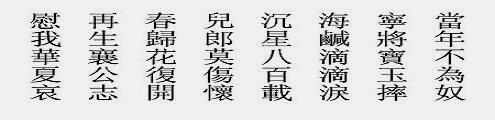
This snippet is for sons and daughters of China:
Heed the sons & ministers' agony and sorrow of our ancestors who died or lived through the Mongol,Manchu andSoviet-Chicom conquestand
theYongjia,Jingkang andJiashen cataclysms !
Jeanne d'Arc of China:
Teenager girl Xun Guan breaking out of the Wancheng city to borrow the relief troops in the late Western Jinn dynasty;
Liu-Shao-shi riding into the barbarian army to rescue her husband in the late Western Jinn dynasty;
teenager girl Shen Yunying breaking into Zhang Xianzhong's rebels on the horseback to avenge on father's death in the late Ming dynasty.
China's Solitary and Lone Heroes:
Nan Jiyun breaking out of the Suiyang siege and charging back into the city in the Tang dynasty;
Zhang Gui & Zhang Shun Brothers breaking through the Mongol siege of Xiangyang in the Southern Soong dynasty;
Liu Tiejun breaking through three communist field armies' siege of Kaifeng in the Republican China time period;
Zhang Jian's lone confrontation against the communist army during the June 3rd & 4th Massacre of 1989.
Ye Qun's Virginity
& Lin Biao's Revenge
Ye
Qun [aka Ye Yijing], i.e., future new wife of Lin
Biao, arrived in Yan'an, too. Ye Qun claimed
participation in 12/9/1935 & 12/12/1935 student
protest movements as well as enrolment in the Communist
League in Peking in 1936.
Ye Qun came to Yenan in 1938 and appearing not a darling wanted by senior or veteran communists, underwent excruciating political investigation in the rectification movement till she married at the turn of 1942-1943 with Lin Biao who just returned from Moscow where he courted Sun Weishi and dumped wife Zhang Mei (1920-2023) and their daughter.
The two bitchy women would
exchange their feuds for persecutions during the Cultural Revolution.
Jiang Qing demanded the punishment of a 1930s actress by
the name of Wang Ying [i.e., Xie Hegeng's wife] who
played the role of heroine Sai
Jinhua on Nov 15, 1936. Jiang Qing also asked Ye
Qun in recovering damaging evidence from movie director
Zheng Junli,
regarding materials such as a letter that Jiang Qing
asked Zheng Junli to relay to Ma Jiliang in Paris in
1958, ending in 9 Oct 1966 nightly ransacking of the
residencies of Shanghai actors, actresses and movie
directors. [Ye Qun added four more actors to the
persecution list, including Zhao Dan, for sake of
guarding against the true intention of ransacking Zheng
Junli's residency with the help of Air Force General
Jiang Tengjiao who disguised his soldiers as the
non-military "red guards". Zheng Junli, who surrendered
to Zhang Chunqiao most of the old correspondence and
accidentally burnt Jiang Qing's 1958 letter, failed to
convince Jiang Qing of the non-existence of this
particular letter.]
Lin Na, repeatedly
interrogated by Ye Qun [i.e., Lin Biao's wife], died when being thrown out by Ye Qun for further
persecution during the cultural revolution of the
1960s.
Lin Na, with her husband taken away by the Soviet NKVD
(i.e., Ge-bo-wu) while on the road of return to China
from Moscow, would be deprived of the post of deputy
chief of the politics section of the Yan'an Women
College in the autumn of 1940.
In the 1950s, Yan Weibing, wife of communist leader Lu
Dingyi, mailed anonymous letters to the communist
party's investigation department about Ye Qun.
After numerous years of handwriting verification, Yan
Weibing was caught.
Jiang Qing's Revenge
Jiang Qing,
a woman hungry for power, just lost a
purported courtship of a "talented" young man to Sun
Weishi [i.e., Zhou Enlai's adopted daughter] upon
arrival in Yan'an [Yenan]. Not long ago, Jiang Qing was
having an affair with Xie Yunxin [Zhang Min] after the
success of the launch of the drama "Big Storm" in
Shanghai.
Shortly before that,
Jiang Qing, whose first man was communist student and later mayor Huang Jing (Yu Qiwei), abandoned husband Tang Na on some occasions in the mid-1930s to be with
Huang Jing, which caused a stir in the newspapers about Tang Na's attempted suicide and cut short Jiang Qing's elopement to Tientsin for returning to Shanghai before continuous private entanglements with her lover, something that made Mao Tse-tung deeply hate Huang Jing to the extent of using a ruse to kill two Tientsin communists Liu Qingshan and Zhang Zishan in 1951-1952 for creating detente onto mayor Huang Jing who was to be scared into insanity and suicide.
Drama director Zhang Min proposed a divorce
with wife Xiao Kun, and actress Jiang Qing [Lan Ping]
proposed a divorce with Ma Jiliang [Tang Na]. That
caused a stir in the Shanghai entertainment circle. Dong
Zhujun claimed that she had been responsible for
dissuading Zhang Min's wife [Xiao Kun] and Ma Jiliang
[Tang Na, i.e., Jiang Qing's then husband] from
committing suicides. Ma Jiliang [Tang Na] was recorded
to have committed attempted suicide three times during
his one-year marriage with Jiang Qing. Shortly
afterward, Jiang Qing broke away from Zhang Min and
departed for Yan'an for her "big dream". Jiang Qing, for
her open sexuality on the Shanghai Bund and implication
in an arrest by the government agents in 1934, was given
negative feedback by the underground communists like
Yang Fan, for which Jiang Qing & Kang Sheng, in Feng
Zhijun's opinion, had routed Yang Fan & Pan Hannian in 1954
and put them to the lifelong imprisonment.
Similar to Yan Weibing's letter, Zhu Ming, wife of elder
communist leader Xie Juezai, send an anonymous letter in
1954, which was suspected by Jiang Qing to have the same
source as Yang Fan and Rao Shushi's 1939 report to Yenan about elopement and adultery, etc.
Since Jiang Qing went to Yenan in late August 1937 and married with Mao Tse-tung in late 1938, the rumored negative feedback could be related to partly political examination starting from late 1937 plus post mortem reports by Yang Fan[1] and Rao Shushi if indeed filed in 1939.
It could be after the death of Xie Juezai in 1960 when
Zhu Ming wrote a letter to the CCP Party Central about
her husband's post-death matter that the handwriting was
verified by the government investigators. Zhu Ming
committed suicide in 1961.
(Right after the communists took over the ROC capital city of Nanking in 1949, Jiang Qing ordered her henchman Ke Qingshi to secretly execute all the KMT government officials who were involved in arresting her in the 1930s. In the 1960s, Jiang Qing tortured and killed almost all people who were acquainted with her in the 1930s, including the communist officials who ever read the anonymous letters mailed by Lin Boqu's wife Zhu Ming in the 1950s.
In 1967, Jiang Qing, in the capacity as deputy chair of the cultural revolution group, ordered security chief Xie Fuzhi to have Yang Fan, Rao Shushi and Pan Hannian arrested to avenge on the bad mouthing that Rao Shushi submitted to Yenan back in 1939.
Rao Shushi (1903-1975), who was implicated in Gao Gang's reactionary clique case of 1954 but was arrested together with the other two in 1955, was paroled in 1965 but re-arrested in 1967.
Yang Fan and Pan Hannian, back in 1962, were sentenced to respective 16 years and 15 years in a mock trial special court hosted by Xie Juezai and released immediately after Xue Ming's suicide following confession of her writing anonymous letters against Jiang Qing since 1954.
Dong Zhujun, for implication in the entangles of Mao Tse-tung's woman Jiang Qing in the 1930s, barely survived the cultural revolution of the 1960s.
Back in the 1930s, Dong Zhujun participated in publishing a short-lived magazine called "Drama & Music" with Zheng Shamei & Xie Yunxin (aka Zhang Min).
In 1949, Dong Zhujun was responsible for persuading Yang Hu into giving up Shanghai to the CCP.)
After verification that it was Zhu Ming who wrote the anonymous letter,
Mao Tse-tung then ordered Pan Hannian and Yang Fan (Yin Yang) to be
paroled in 1962, knowing that they had no part in sending the
anonymous letter.
In another word, Mao Tse-tung did not care about Pan
Hannian's colluding with the Japanese spy agency since
1939, nor Pan Hannian's continuous work with the puppet
government throughout the resistance war time period.
Note that while Pan Hannian, passing through Peiping
(Peking), rather than the safe passage in the Yellow
Flood zone, for the 1944 rectification movement and the
preparatory meetings of the communist party's congress,
the Japanese, to coordinate with the communists for
pincer-attacking the Chinese government troops,
attempted to connect with the communists in vain --as a
result of Pan Hannian's gig in Yenan, and hence
extradited a Sorge spy ring member from Tokyo's Special
Higher Police (Tokko/tokubetsu) to travel to the communist New
4th Army's headquarters in Luhe for liaison.
Pan Hannian himself, while passing Peiping, claimed to
his cronies that he had the protection of the Japanese
communists (i.e., the Japanese spy master Kagesa
Sadaagi).
What a treachery.
According to Endo Homare, the only survivor of her
family from the 1948 communist siege of Changchun that
led to the starvation death of 300,000 civilians, the
Japanese foreign ministry funneled over 3 billion yens
of funds to the communists through Pan Hannian,
equivalent to 25 million US dollars.
Peng Dehuai, Luo
Ruiqing, Lu Dingyi & Yang Shangkun
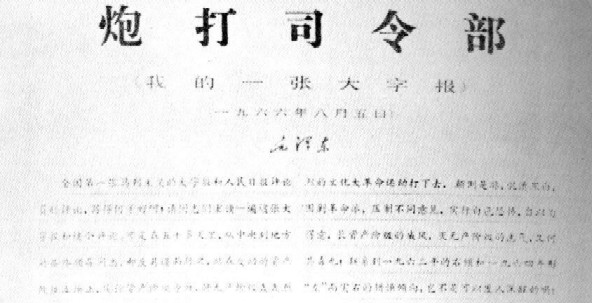
Mao Tse-tung's "My
Big Character Poster" [Aug 5th 1966]
The Fate of Xie Hegeng and Wang
Ying Couple
On Feb 22nd, 1950, Xie Hegeng & Wang Ying married
with a license from the NY city.
June 1952: McCarthy Act
9/27/54 xie arrested
10/4/54 wang ying arrested
nov 22 54 kicked to sf -as part of the swap deal with
the American prisoners of war from the Korea War
late dec back to china
mar 57 declined jiang qing's invitation
may-july 57: the anti-rightists
xie rightist for the
proposal of making zhongnanhai a park
li kenong visited wang ying, zhou enlai/dong biwu called
xie back to beijing from manchuria
dec 1960 - wang ying
invited to xiangshan hotel by zhou
5,6,7, 1966 CR
july 1 1967 taken to prison by red guards
march 1974 died in prison
75 xie released
79 rightist' tag gone
Comment by Ah Xiang
The Immiseration Growth Trade
Disrupted by President Trump
& Bursting of the Communist China's Real Estate Bubble
Communist China's immiseration trade, at a cost of
enslaving one billion peasants and coolies and polluting the nation's land, water and air, has carried
along for decades now, with the unsustainable growth backfiring before its due demise as a result of
President Trump's preemptive strike, i.e., the Sino-U.S. trade war, which triggered communist China's
counter-retaliation measures and subsequent breakup of a tacit bonding between the multinational
corporations and banksters of the West and the oligarchs of communist China, a relationship the
communists initially described as a marriage in a silly allegory that painted communist China as a
feminine (like a concubine) subservient to the U.S. as a master. What this author could not bear will be
widespread pollution-related cancer deaths that befell to the people living around the Taihu (thunder
god) Lake, which is where this author's great grandfather's lakeside home village and tomb were, that
is known as Shihu [stony lake] and Huangtan [yellow flatland] in history and penned to a poem by Fan
Chengda who was responsible for negotiating with the Jurchens to retrieve Soong Emperor Qinzong's
coffin from the Amur area in the 13th century.
Jagdish Bhagwati's immiseration vindicated an economic thesis that the more a country exports
to another trade partner, the worse off the terms of trade would be. From the economics perspective,
the immiseration trade would have corrected itself through Adam Smith's Invisible Hand and its
adjustment by the markets. Unfortunately, Communist China's immiseration growth was fatally built
on a ruinous percolation logic similar to the Mongols' unbacked fiat: the communists' sweatshops
manufactured products at the below-market or no cost for export to the West, using the slave labor
like the Uygurs in the concentration camps of Xinjiang, for example; the communists then forced
the exporters to convert the "foreign exchange" trade gain into the worthless RMB, i.e., "people's
dollars" that were printed on the astronomical scale, which was similar to the Russian rubles that
could not be freely bought and sold; for absorbing the over-printed paper currency, the communists
conducted the violent land acquisition and enclosure movements, reaped enormous profit in the land
sale, and sold the real estate bubble to the city "accomplice" citizens who once in a life time enjoyed
a flash-in-the-pan decent life of luxury travel abroad and the concept of wealth management of the
West; and the communists, in addition to squandering the money on the Belt and Road projects or
Confucius academies, laundered the "foreign exchange" to the banks in H.K., the U.S., Canada,
Europe, Australia, and the Caribbeans, escaping the hell they created in the expectation that the
billion slaves one day would rise up and smash the communist apparatus.
When the trade decreased
or stopped, partly due to President Trump's trade war and partly due to the rising labor cost which was
triggered by the inflation coupled with the decreased labor force ensuing from decades of the barbaric
policy of forced abortions, the communists could no longer print the worthless RMB paper money
to peg with the foreign exchange for running the economic engine, which then led to the bursting of
the bubble and collapse of its financial system, with the banks and ATM machines running out of
money.
This then forced the regime to take the last resort to switch to a closed-door policy to slow down
the paper currency usage on the pretext of Coronavirus, a double-edge weapon also used to exercise
militarized control of the population for an opportune invasion of Taiwan in synchronization with the
Trojan horse planted on the island.
(During the three-year lockdown, the communists, who
ordered the chaining of kitchen knives and ID'ed ownership of kitchen knives,
implemented the forced lockdown via barbed wire fences at the border, and segregation iron or plastic fences on the streets, lanes and in the neighborhoods, which was taken to be rehearsal for implementing the Cultural Revolution 2.0.)
In today's
communist China, with a widely rumored scheme of Operation Sinking Ship for decades, the totalitarian regime recently
began to prep the people for an outcome of isolation from the international community and
embracing of an Orwellian rule similar to the Kim dynasty of North Korea. The unfolding economic collapse of communist China shows the world that communist China is a castle built with sand and on the sand
of unsustainable immiserated trades used for funding the proportionally-blown real estate bubbles,
i.e., what the Japanese called by suna no utsuwa.
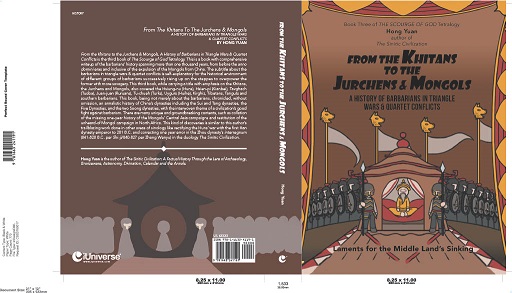
(The above passages were excerpted from the Afterword of From the Khitans to the Jurchens & Mongols: A History of Barbarians in Triangle Wars and Quartet Conflicts (The Barbarians' Tetralogy - Book III: Laments for the Middle Land's Sinking))
Ding Shu is an expert on China's Bloody 50 Year History.
The following Ding Shu article in Chinese summarizes the
death tolls during the Cultural Revolution. The kind of
horror that occurred during the Cultural Revolution might
be forgotten by those people who endured it.
Owning the time constraints, this webmaster had not been
able to continue writing on the "modern Chinese history"
for about ten years (as of 2010; and over 20 years as of 2023 [comment in year 2023]. To give visitors to this page some
information about the cultural revolution, this webmaster
transcribed some key points of the article by Ding Shu.
Million Death During the Cultural Revolution
On June 10th, 1966, Mao told Ho Chi-ming that the
proletarian revolution might lead to the downfall of
hundreds, thousands of people in academic, educational, arts,
colleges, middle schools and primary schools.
The editorial of People's Daily on June 1st, 1966, marked
the start of the cultural revolution.
Zhou Enlai stated that the movement was targeting not
communist cadres, but the authoritarian faction that had
taken the capitalist path, landlords, wealthy peasants,
rightists and bourgeoisie academic authorities.
Home ransacking originally started in Peking, with 114,000
households impacted.
Then the rampage spread across China. In Chuansha County
of Shanghai, about 7800 households were ransacked, for
example.
Altogether , 10 million households were ransacked
nationwide.
This website expresses the personal opinions of this webmaster (webmaster@republicanchina.org, webmaster@imperialchina.org, webmaster@communistchina.org, webmaster@uglychinese.org: emails deleted for security's sake, and sometime deleted inadvertently, such as the case of an email from a grandson of Commander Frank Harrington, assistant U. S. naval attache, who was Mme Chiang Kai-shek's doctor in the 1940s). In addition to this webmaster's comments, extensive citation and quotes of the ancient Chinese classics (available at http://www.sinica.edu.tw/ftms-bin/ftmsw3) were presented via transcribing and paraphrasing the Classical Chinese language
into the English language. Whenever possible, links and URLs are provided to give credit and reference to the ideas borrowed elsewhere.
This website may be used or reproduced in any form or by any means, with or without the prior written permission, on the pre-condition that an acknowledgement or a reciprocal link is expressively provided. This acknowledgment was for preventing future claims against the authorship when the contents of this website are made into a book format.
For validation against authorship, https://archive.org/, a San Francisco-based nonprofit digital library, possessed snapshots of the websites through its Wayback Machine web snapshots.
All rights reserved.
WARNING: Some of the pictures, charts and graphs posted on this website came from copyrighted materials. Citation or usage in the print format or for the financial gain could be subject to fine, penalties or sanctions without the original owner's consent.
This snippet is for sons and daughters of China:
Heed the sons & ministers' agony and sorrow of our ancestors who died or lived through the Mongol,Manchu andSoviet-Chicom conquestand
theYongjia,Jingkang andJiashen cataclysms !
Jeanne d'Arc of China:
Teenager girl Xun Guan breaking out of the Wancheng city to borrow the relief troops in the late Western Jinn dynasty;
Liu-Shao-shi riding into the barbarian army to rescue her husband in the late Western Jinn dynasty;
teenager girl Shen Yunying breaking into Zhang Xianzhong's rebels on the horseback to avenge on father's death in the late Ming dynasty.
China's Solitary and Lone Heroes:
Nan Jiyun breaking out of the Suiyang siege and charging back into the city in the Tang dynasty;
Zhang Gui & Zhang Shun Brothers breaking through the Mongol siege of Xiangyang in the Southern Soong dynasty;
Liu Tiejun breaking through three communist field armies' siege of Kaifeng in the Republican China time period;
Zhang Jian's lone confrontation against the communist army during the June 3rd & 4th Massacre of 1989.
For this webmaster, only the ancient history posed some puzzling issues that are being cracked at the moment, using the watershed line of Qin Emperor Shihuangdi's book burning to rectify what was the original history before the book burning, filtering out what was forged after the book burning, as well as filtering out the fables that were rampant just prior to the book burning, and validating against the oracle bones and bronzeware.
There is not a single piece of puzzle for this webmaster concerning the modern Chinese history.
This webmaster had read Wellington Koo's memoirs page by page from 2004-2007, and read General Hu Zongnan's biography in the early 1990s, which was to have re-lived their lives on a day by day basis.
Not to mention this webmaster's complete browsing of materials written by the Soviet agents as well as the materials that were once published like on the George Marshall Foundation's website etc., to have a full grasp of the international gaming of the 20th century.
The unforgotten emphasis on "Republican China", which was being re-outlined to be inclusive of the years of 1911 to 1955 and divided into volumes covering the periods of pre-1911 to 1919, 1919 to 1928, 1929 to 1937, 1937 to 1945, and 1945-1955, will continue.
This webmaster plans to make part of the contents of "Republican China, A Complete Untold History" into publication soon. The original plan for completion was delayed as a result of broadening of the timeline to be inclusive of the years of 1911-1955.
For up-to-date updates, check the RepublicanChina-pdf.htm page.
Due to constraints, only the most important time periods would be reorganized into some kind of publishable format, such as the 1939-1940, 1944-1945, and 1945-1950 Chinese civil wars, with special highlight on Kim Il Sung's supplying 250,000 North Korean mercenaries to fighting the Chinese civil war, with about 60,000-70,000 survivors repatriated to North Korea for the 1950 Korea War, for example --something to remind the readers how North Korea developed to threaten the world with a nuclear winter today.
Note the fundamental difference between the 250,000 ethnic-Korean Japanese Kwantung Army diehards and the ethnic-Korean Chinese living in China.
The communist statistics claimed that altogether 65,000 ethnic-Korean Chinese minority people, or the Korean migrants living in China, joined the communist army, with approximately
60% coming from the Jirin subprovince,
21% from the Sungari subprovince, and
15% from the Liaodong subprovince.
The objectives of this webmaster's writings would be i) to re-ignite the patriotic passion of the ethnic Chinese overseas; ii) to rectify the modern Chinese history to its original truth; and iii) to expound the Chinese tradition, humanity, culture and legacy to the world community.
Significance of the historical work on this website could probably be made into a parallel to the cognizance of the Chinese revolutionary forerunners of the 1890s: After 250 years of the Manchu forgery and repression, the revolutionaries in the late 19th century re-discovered the Manchu slaughters and literary inquisition against the ethnic-Han Chinese via books like "Three Rounds Of Slaughter At Jiading In 1645", "Ten Day Massacre At Yangzhou" and Jiang Lianqi's "Dong Hua Lu" [i.e., "The Lineage Extermination Against Luu Liuliang's Family"].
Revolutionary forerunner Zhang Taiyan (Zhang Binglin), a staunch anti-Manchu revolutionary scholar, invoked Xin Shi (The History [Book] of Heart, a book written by Soong loyalist Zheng Sixiao who sank it in a tin-iron box into a well in the late 13th century A.D., and rediscovered about three and half centuries later), for rallying the nationalist movements against the Manchu rule.
Additionally, revolutionaries in Sichuan often invoked 17-year-old prodigy-martyr Xia Wanchun's Xia Jiemin [Quan-]Ji (Complete anthology of Xia Wanchun's poems and prose) for taking heart of grace in the uprisings against the Manchus.
This webmaster intends to make the contents of this website into the Prometheus fire, lightening up the fuzzy part of China's history.
It is this webmaster's hope that some future generation of the Chinese patriots, including the to-be-awoken sons and grandsons of arch-thief Chinese Communist rulers [who had sought material pursuits in the West], after reflecting on the history of China, would return to China to do something for the good of the country.
This webmaster's question for the sons of China: Are you to wear the communist pigtails for 267 years?
And don't forget that your being born in the U.S. and the overseas or your parents and grandparents' being granted permanent residency by the U.S. and European countries could be ascribed to the sacrifice of martyrs on the Tian-an-men Square and the Peking city in 1989.
(If you were the Chi-com hitting this site from the Bank of China New York branch or from the party academy in Peking, spend some time reading here to cleanse your brain-washed mind.)
 ***
***

![Though, Anna Wang [Anneliese Martens], in her memoirs, expressed jealousy over Gong Peng by stating that the Anglo-American reporters had flattered the Chinese communists and the communist movement as a result of being entranced with the goldfish-eye'ed personal assistant of Zhou Enlai](GongPeng.jpg)