For twenty years, this webmaster had been telling the world that
Alan Greenspan, possibly the smartest American but bedazzled by the "conundrum" of long term interest rates, does not know that this webmaster's countryside cousins, mostly women, had been going to Guam, Samoa and other Pacific islands for a decade as the export of labor: what is coming to the U.S. market is merely a tag stating something not "made-in-China" but made-by-the-Chinese in nature.
The smartest American turned out to be Professor Peter Navarro, and it might not be some coincidence that his books "The Coming China Wars" and "Death by China" are similar to what this website wrote about for the last 20 years.
What this webmaster does not know is that the Chinese were going to Italy as well, where they worked as coolies and slaves for the "Made in Italy [by Chinese]" brands, and spread the coronavirus in Italy today.
What a farce Communist China gave the world, and what a disaster Communist China caused to the world!
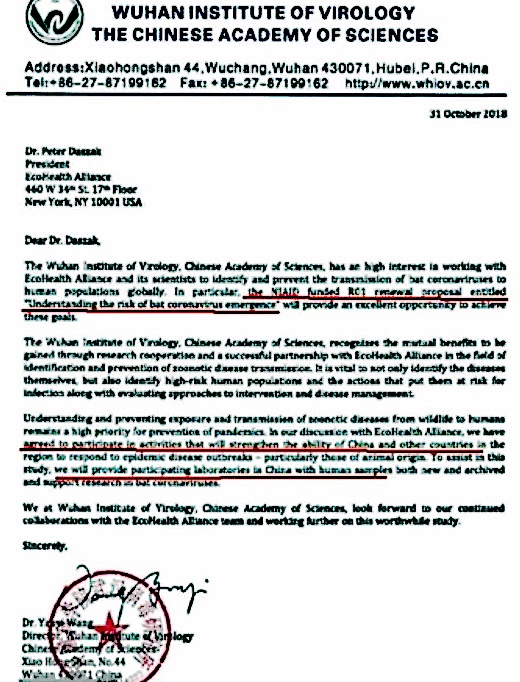
Don't forget that France (Alain Merieux of bioMerieux - sarcastically-related to Moderna, the other side of a coin) and the United States (Anthony Fauci of CDC & Peter Daszak of EcoHealth) acted as the 'enablers' in designing and constructing the P4 virus research center in Wuhan, as well as in providing the funds.
And don't forget what happened today was because the Americans served as the midwife who delivered China into the communist hands as i) Roosevelt, in collusion with Churchill and Stalin, sold out China at Tehran and Yalta; and ii) George Marshall forced three truces [Jan-10-1946, June-6-1946, & Nov-8-1946] onto the Republic of China and further imposed the 1946-47[48] arms embargo while the commies were equipped by the Stalin-supplied American August Storm weapons and augmented by the mercenaries including the Mongol cavalry, the Japanese 8th Route Army troops, the Soviet railway army corps, and the 250,000-strong [Kwantung Army-converted] Korean diehards.
(Refer to
"The Italian fashion capital being led by the Chinese";
"Coronavirus Hits Heart of Italy's Famous Cheese, Wine, Fashion Makers" for further reading.
Military Documents About Gain of Function Contradict Fauci Testimony Under Oath:
EcoHealth Alliance approached DARPA in March 2018 seeking funding to conduct gain of function research of bat borne coronaviruses...
According to the documents, NAIAD, under the direction of Dr. Fauci, went ahead with the research in Wuhan, China and at several sites across the U.S.)
In the last 2-3 decades, the ludicrous and idiotic communist nation enslaved one billion humble Chinese peasants as coolies for the multinational corporations and international banksters, and moved the mountains of China to the United States in the form of rare earths (REE), marble and granite stones, at the cost of death of innumerable Chinese men from silicosis, and imported megatons of the American wastes to China, the beautiful and divine country, for recycling, burning or pure landfill, while resettling their wives, concubines, mistresses, and children [and bastards] to the U.S., Canada, Australia, and Europe.
At the same time, they began the process of Africanizing the Chinese continent with the import of Africans by hundreds of thousands and up to a million, under the idiotic "one road and one belt" program (i.e., a replica of Han China's bribery for the Huns), and made China the land of "Aids Danger Zone No. 1".
Mind you all 77 Belt & Road countries: Your ripping USD 1 trillion from Communist China, i.e., one third of China's 3T foreign exchange reserves [on paper], is equivalent to ripping the life and blood of one billion poverty-stricken Chinese people with monthly income of no greater than 2000RMB or US$300.
(Communist premier Li Keqiang claimed that 0.6 billion Chinese, i.e., this webmaster's humble peasant Chinese, had a monthly income of less than 1000RMB or $150, or de facto zero income.)
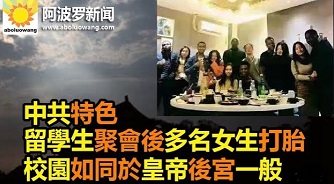
*** ARE YOU STILL GOING TO COMMUNIST CHINA TO "STUDY" WITH SCHOLARSHIPS [AND FREE MEDICARE/WOMEN] BUT WITHOUT ADMISSION TESTS, WITHOUT ENTRANCE EXAMS, WITHOUT QUIZZES, WITHOUT MIDTERM TESTS, WITHOUT EXAMS, WITHOUT SEMI-FINALS & WITHOUT FINALS ? ***
Note Barack Hussein Obama's half brother 'adopted' China or was adopted by communist China, setting an example for numerous Africans who came to China and worked as coyotes engaged in the operation of smuggling the illegal Africans to China --not knowing that China was prone to dynastic cycles of violence that could lead to death of 60-90% of the population, such as eradication of the Arab-Persian paramilitary regime and settlement in Canton in the 9th century
and
in Zalton in the 14th century.
(South Korea, Japan, Vietnam, Thailand, and the rest of Asian countries: Don't take this lightly.
The mingled Chinese-Africans, in less than 50 years, will spill over and sweep into your countries.
First, you need to guard against the "African Swine Fever" virus that is killing all the hogs and wild boars in mainland China now --an import from Russia again and a collateral casualty of Trump's trade war.)
The sinisterness of communist China lied in its bribing the world leaders, including the U.S. vice president Joe Biden (i.e., Lunch Bucket Joe -who ate free lunches on both the American people and the humble Chinese peasants), and in bribing the United Nations leaders.
For details, check out
Robert J. Wicks' video
Riding the Dragon: 10 Lessons for Inner Strength in Challenging Times; and
Google book.
Communist China, in addition to the work on the Obamas and the Bidens, set up illicit affairs for Neil Bush in Bangkok and Hongkong, that could have led to the latter's divorce.
(The Americans apparently forgot how the Chinese communists murdered the American missionaries in the 1920s and 1930s, such as John and Betty Stam.)
The Chicoms turned filthy rich, and became more barbaric towards their own people.
The capitalists (synarchists) of the West are now horrified that the Chi-coms [and the lewd female Chicoms] accumulated the same amount of wealth or more within the last 20-30 years, that took the capitalists (synarchists) of the West 300-500 years of Black slaves' trade, opium trade and the Chinese coolie trade, etc., to achieve; and that the Chi-com, who killed off the landlords, had unlimited land to sell to make more money and could easily surpass the wealth accumulated by the capitalists (synarchists) of the West in no time.
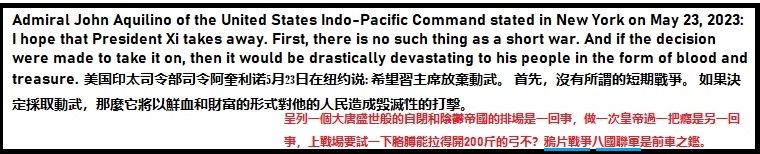
Even worse, the Chi-com dared to challenge the only superpower in this world with the building of more aircraft carriers and financially challenge the U.S. Dollar settlement system.
The consequence of the Chi-com's reckless behavior could cause even more disasters to the Chinese people who were bound to the communist war chariots.
(There is no "profound mystery [in Chinese]" ECON 101 as to the Chi-com's filthy richness and the "Crazy Rich Asians" but immiserizing growth and a replay of the Chicom's Soviet Bank scheme: The Chicoms enslaved one billion peasants as the slave labor of the world factories, the slave labor in the mines, and the slave labor in the construction of skyscrapers and ghost towns/cities across the country;
the Chicoms then forced the exporters to convert the "foreign exchange" trade gain into the worthless RMB, i.e., "people's dollars" that were printed on the astronomical scale;
then the Chicoms laundered the "foreign exchange" to the banks in HK, the U.S., Canada, Europe, and the Caribbeans, escaping the hell they created in the expectation that the billion slaves one day will rise up and smash the communist apparatus, i.e., the historical cycle of China's dynastic violence that saw 60-90% of the population killed;
and to absorb the overprinted "people's dollars", the Chicoms conducted the violent land acquisition and enclosure movements, reaped enormous profit in the land sale, and sold the real estate bubble to the city "accomplice" citizens [whose I.D. actually carried the print of residents with no jus soli rights].)
America, i.e., the United States, was and is still shortsighted today, not knowing that Korea, at one time paradise of the American Evangelicals, was delivered into the hands of the Japanese imperialists as a result of the Anglo-American confrontation against Czar Russia, and in this geopolitical process, China, the land of the Great Sinitic Civilization, was made into a piggy-backed sacrificial/funeral object -the land ruled by the most evil cult called 'communism' that was an 'import' or an 'export' of Soviet Russia.
America would not learn the lesson that the geopolitical actions it is taking today would yield the 'bad fruit' 50 years or 100 years down the road.
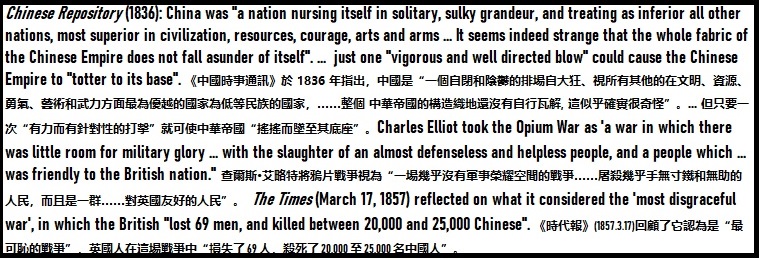
America, and their British cousins, must have forgot the twenty-year Anglo-Japanese military alliance that allowed Japan to develop the warplanes and aircraft carriers to invade mainland China, not to mention the post-WWI ten-year arms embargo against Republic China and George Marshall's post-WWII arms embargo against Republic China 1946-1948.
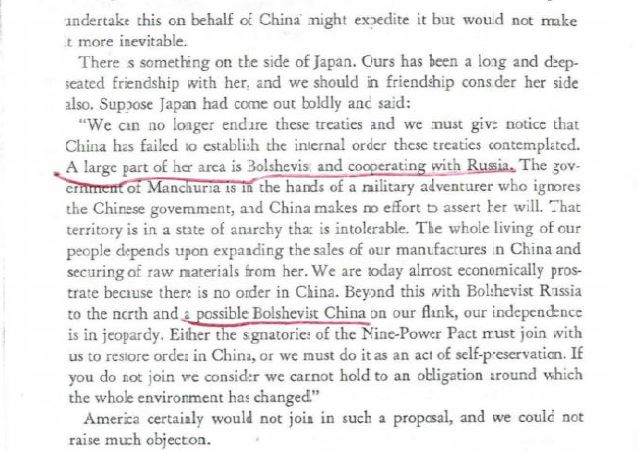
They forgot that in 1931, President Herbert Hoover gave Japan a free hand in the invasion of Manchuria on the pretext that Japan could not tolerate a half-Bolshevik China.
Earlier, President Hoover, who personally nipped the post-WWI communist uprisings in Germany and Hungary with the grains embargo, fed Lenin the ingenuity, i.e., the [worldwide communist revolution] road to Paris lay through Peking.
They of course forgot that
after the eruption of the 1937 Sino-Japanese War, the Americans, biased towards Japan and against China, adopted a policy of "neutrality" (what Utley called by "unpositive neutrality") against the 'belligerent' countries, namely, Japan and China, which was free and unrestrained arms sale to Japan and de facto arms embargo against China.
This neutrality, which William Christian Bullitt Jr. (1891-1967) felt bedazzled about,
was de factor arms embargo against China and free arms sale to Japan.
Note that the arms embargo would choke China since China did not have an industrial base to produce the basic weapons while Japan's factories could roll out the warships and airplanes on a wholesale scale.
Also note that in contrast with the Americans, the European powers, being constrained by the mediation role of the League of Nations, dared not openly sell arms to Japan.
Through 1940-1941, prior to the U.S. revocation of the 1911 U.S.-Japan Commerce Treaty, the Americans were the biggest supplier of raw material, oil, aviation oil, and weapons, to the extent that some U.S. senator called by Scott making a claim that out of one million Chinese killed by the Japanese, 544,000 Chinese were killed by the Americans.
Thirty-one U.S. congressional members made a joint declaration to the effect that the U.S., not NAZI Germany, nor Italy, was the best ally of Japan.
America, the 'stars' that engendered or heralded the rise of the [Japan] 'sun', long ago had the blueprint to make Japan into a stalwart against China and Russia, i.e., the source of the Yellow Peril and the source of the Half-Tartars [or the Russians], respectively, --whom the Americans could not assimilate according to George Kennan.
William Christian Bullitt Jr. (1891-1967) disclosed that the Americans' national policy or strategic aim was to see the Russians and Japanese' holding a balance of power against each other in China rather than seeing either the Russians or the Japanese overpowering the other party in taking control of China.
In making this geopolitical decision, you had victimized the 1 billion humble peasant Chinese.
(Note President Wilson's doctrine that the intactness of China was vital to the white civilization -- in the sense that the nation of China should be managed delicately, that is, should not be allowed to grow too powerful to pose threat to the white civilization, nor should it be allowed to be hijacked by a non-U.S. power since China's immense human labor could be turned against the white civilization.
The theme of China to the white civilization, morphing superficially into a ***hypocritical*** American national policy of engagement with Communist China for changing the Chinese communists' behavior, rested on the same underlying logic:
"The
China Exception: Russian Communism being wicked, the
Chinese are good communists", which is an inherent fear
of the Yellow Peril,
i.e., billion Chinese would actually enjoy real
democracy, go to college and develop their intelligence.
Now, President Biden, a stooge of Communist China, explicitly abandoned the
hypocritical American policy of engagement to change communist China to his imbecilic communist buddy and dictator Xi Jinping.)
Now you, as the midwife who delivered China into the communist hands, are morally obligated to take China [and North Korea {and Vietnam}] out of communism.
This time, you may feel your hands forced as North Korea, with its nuclear weapons, could become Communist China's cecal appendix in a repeat of history.
The Chicoms don't understand the urgency of Trump's trade war having the roots in nuclear North Korea, nor the domino effect on North Korea and Russia after the knock-out of communist China.
Putin thought he would reap profits by sitting on the fence of the U.S.-China trade war, i.e., the Zheltorossiya dream[, and India would not be satisfied with grabbing South Tibet (i.e., what India calls by Arunachal Pradesh), Bhutan and Sikkim alone].
Though, the Americans could be hoodwinked by the Chicoms again. The Chicoms might just sign any agreement just for sake of getting a red carpet at the White House in lieu of a visit to Mar-a-Lago, but won't change its sinister nature and will default on any trade agreement.
(Previously, this webmaster thought that the Americans could be hoodwinked by the Chicoms who might just sign any agreement just for sake of getting a red carpet at the White House in lieu of a visit to Mar-a-Lago.
With Trump's war with Communist China flaring up, this webmaster believed that China's dictator Xi Jinping would continue to commit blunders and became the tomb digger for the Chinese communist regime.
The thuggery communists, who would not allow the millions of the Hongkong people to have autonomy, could have caused the demise of the regime over the inevitable crackdown, not knowing that the communist ascension to power had its very roots in Churchill's collusion with Roosevelt in selling out the Republic of China for sake of retaining crown jewel Hongkong after hoodwinking Wellington Koo and Chiang Kai-shek that Britain would return Hongkong to China after Japan was to surrender so as not to damage the British wartime morale.
--What happened was that Putin first jumped off the fence ahead of communist China in launching an invasion of Ukraine.)
Should the American politicians follow the footsteps of Anson Burlingame (1820-1870),
Paul Samuel Reinsch (1869-1923)
and
Patrick Jay Hurley (1883-1963), i.e., three most prominent U.S. statemen who loved China and the Chinese people,
then the Chinese people could have a chance of salvation from the communist tyranny.
Note the historic recurrence and the repetition of similar events:
Anson Burlingame, in opposition to the anti-Chinese discriminatory whirlwinds rampant in the U.S. in the 19th century, authored the Burlingame Treaty for China and
died for China in 1870 in St. Petersburg
while still on the Manchu China's mission to the U.S. and Europe;
Paul Samuel Reinsch, who was disillusioned by President Wilson's betrayal of China over the division of WWI spoils at the Paris Peace Conference, quit the minister-to-China job to work for China and died for China in Shanghai in 1923;
and
Patrick Jay Hurley, who convinced President Roosevelt of the American moral blunders in selling out the Republic of China at Tehran and Yalta, personally travelled to Moscow and London for sake of averting and reverting China's fate of becoming a victim of WWII war spoils (i.e., the loss of Port Arthur and Hong Kong, etc.), but failed to make remedy to the secret Tehran and Yalta agreements in the aftermath of President Roosevelt's death in April 1945.
Survivor "rightists" remember two exile gulags, i.e., the
Jiabiangou Gully Farm of Gansu Province and the Mt Yunshan Husbandry Farm of Heilongjiang Province.
Yu Jie and Shi Tao reminded us of the hunger & persecution death of hundreds [up to possibly 1500 deaths] among 2400 rightists at Jiabiangou, a sand dune area next to the Gobi.
KMT General Fu Zuoyi's cousin, i.e., Fu Zuogong, died of hunger & persecution in March of 1960 at Jiapigou. (See Yu Jie's citation of Heh[2] Fengming's "Experiences - My 1957".)
In comparison with the Jiabiangou Gully Farm, Xie Hegeng, once a top communist mole inside of the KMT nucleus and swapped back to China with the U.S. prisoners of war from the Korean War, still could find rotten vegetable leaves for food in 1960 at the Mount Yunshan Husbandry Farm.
According to rightist Dai Huang's recollection, 10% of the 300-400 rightsis died of starvation at Farm 850.
According to Dai Huang's recollection, 10% of the 300-400 rightists died of starvation at Farm 850.
The alloted monthly grains were reduced throughout 1957-1960, from 100 jin to 72, 63, 48, 36, 19 per month.
Dai Huang's salary was reduced to RMB28 from 150, which was lower than a college graduate's pay or that of this webmaster's father's.
Hundreds of thousands of Sichuan Province girls also swamped into the northern tip of Manchuria for convenient marriages with 100,000 expatriated officers of the People's Volunteer Army.
Like tens of thousands of overseas returnees, Fu Zuogong & Xie Hegeng invariably fell victims to Mao Tse-tung's "Trickery Under The Sun".
Should we say that the June 4th 1989 Masaccre had routed China's elites & conscience for the past 15 years, the "Anti-Rightists Movement" of 1957 had doomed China's fate for 20 years after finishing off China's half century worth of elites and conscience.
Prevalent writings claimed that during this Anti-Rightist movements, Mao Tse-tung routed 3,800,000 people as rightists.
The most notable rightists included Zhang Bojun, Luo Longji, Peng Wenying, Chu Anping and Chen Renbing, the only five persons who were never rehabilitated in the 1980s.
There were two major waves of the Anti-Rightists Movement, i.e., one in 1957 and the other one beginning with the Lushan Meeting (July 2-Aug 16 1959).
The 1957 Anti-Rightists Movement targeted about 550,000 intellectuals and impacted 5-10 million people with inclusion of the family members of the rightists.
The July 2-Aug 16 1959 Mount Lushan Meeting, which declared the 'Peng Dehuai Anti-Party Clique', had brought about what should be correctly termed the "Anti-Rightist Trend", a communist party internal purge movement.
The clique consisted of Zhou Xiaozhou [provincial party secretary, Mao's wartime secretary who later committed suicide during the cultural revolution], Zhang Wentian [CCP secretary general of 1935-1945 who at one time deprived Mao of his leadership of the Red Army, and was ridiculed by Mao as 'ming jun' or the smart emperor while his wife was ridiculed by Mao to be 'niang niang' or empress], & Huang Kecheng [the PLA chief of staff].
Peng Dehuai was classified as reactionary for opposing Mao
Tse-tung's Great Leap Forward which would lead to the
starvation death of at minimum 40 million peasants in the
ensuing 3 years.
Lin Biao, i.e., another of Mao's rightside and leftside dogs since the Jiangxi Soviet of the late 1920s, took over the defense minister's post from Peng Dehuai, and on October 1st, stood next to Mao Tse-tung during the ten-year communist victory parade at the Tian'anmen Square.
The "Anti-Rightist Trend" movement was officially launched right after the October 1st parade.
Implicated in the Peng Dehuai "Rightist Trend Opportunist" clique would be Jia Tuofu (Jia Tafu), a Shenxi native communist who guided the Red Army to northern Shenxi and then director of Planning Commission and Economic Commission, plus Li Rui, et al., who were seated in the northwestern section of the meeting.
Tian Jiaying, who knew Mao's scheme against Peng, was opposed to Mao's organizing panels and groups to discuss Peng's letter, and thought Peng's position in the party required a central committee meeting for resolution.
Li Rui volunteered to take the blame on behalf of Mao's secretaries to be the culprit lodging criticisms of Mao and supporting Peng Dehuai but was blasted by Mao as a disqualified small potato follower of Peng Dehuai's four-person anti-party clique.
Li Rui told Bo Yibo that implicating Mao's gang of secretaries (i.e., Hu Qiaomu and Tian Jiaying) could deal a blow to Mao's reputation as a whole.
It was Zhou Xiaozhou who broke Li Rui's tacit arrangement with the rest of senior communists to take blame to him alone and while being agitated, lodged further criticisms which were Tian Jiaying's three sentences including admonishment against being another target of Stalin the Second after 100 years, that led to Mao's stamping on the four-person clique which Mao termed by a club.
Li Rui, a non-central committee member, already left Mao to first work in the Hunan provincial commissariat and then in the Irrigation Ministry in the early 1950s, and Zhou Xiaozhou was Hunan provincial commissariat's first secretary at the time.
Li Rui was classified as a rightist deviation opportunist with party membership revoked,
and when compounded by wife Fan Yuanzhen's betrayal as to his continuous liaison with Mao's secretaries, further in 1960 exiled to a vilage near Farm No. 850 in Manchuria, where he lived in the Xinghua-cun village, witnessed dozen old men dying of hunger and he himself almost died of hunger, and was rescued by Tian Jiaying who managed to get deputy premier Li Fuchun transfer Li to the Hulin electricity plant and then transferred back to Peking in 1961.
Mao's younger-generation secretaries, like Hu QIaomu,
Zhou Xiaozhou, Li Rui, Tian Jiaying and Wu Lengxi, et al.,
held the ancient intellectuals' Confucian morals and ideals to admonish tyrannical emperors and volunteered to take blame from the peers.
Tian Jiaying (Zeng Zhengchang, 1922-1966) committed suicide in Mao's library at the time the cultural revolution was just launched, with one of three accusations being Tian's directive to skip the stenographic record on Mao's linking Peng Dehuai to Hai Rui in a 1965 speech.
Zhou Xiaozhou (1912-1966), who was sent to a commune as deputy county commissariat secretary for about two years before transfer to southern China for another downgraded job,
committed suicide on Mao's birthday in the year the cultural revolution started.
In between, there ensued, per http://www.secretchina.com/news/articles/4/8/4/69636.html, a so-called "makeup anti-rightist movement" in 1958 during which the rightist intellectuals from departments directly subordinate to the CCP Central and the "People's Daily" newspaper agency, including Xiao Qian and Chen Qixia, were sent to the Baogezhuang Farm in Tangshan of Hebei Province, a farm built on top of salty beaches of the Bohai Sea.
(During the 1959 meeting, Wu Han, a former disciple of scholar Hu Shi but converted to the communist cause in the early 1940s while teaching history at Lienda in Southwest China and viciously attacked the former Democratic League colleagues such as Chu Anping and Luo Longji, accused Peng Dehui of faking as the Ming dynasty's righteous minister Hai Rui.
Wu Han later committed a blunder in continuously writing about Hai Rui, with release of the drama 'Hai Rui's Dismissal', not knowing that he was with emperor Mao in 1959 but served Liu Shaoqi in the early 1960s after Mao yielded the control of the party to Liu Shaoqi over death of millions of people from the Great Leap Forward, i.e., one of Mao's Three Red Banners, which led to his death in the Cultural Revolution.
Just few years ago and before the 1959 Lushan meeting, Mao already resigned the state's president to Liu Shaoqi, an idea that Mao confided in Chen Boda as early as 1954 for Mao's resentment of mandatory tedious duties of wearing suits and receiving foreign visitors, etc.
From 1953 to 1954, Chen Boda purportedly modified Marshall-sponsored 1947 R.O.C. constitution into the "Common Guiding Principles" ('gongtong gangling') as communist China's first constitution on basis of which Mao was elected.
When re-elected president at the CCP Eighth Congress, Mao suggested to set up an honorary president post, and in January 1958 proposed to vacate the state president to be an honorary state president no later than September 1958, which was ratified in the 6th Plenary meeting held in Wuchang from November 28th to December 10th, 1958, and approved by the 1st meeting of the Second National People's Congress in April 1959. However, Mao, still holding the posts of party chair and military committee chair, was to regret about the state chair' resignation soon.)
China and the Chinese lived in terrors since Peng Pai and Mao Tse-tung launched the rascal-proletariat peasant movements in 1927. Peng Pai had at one time claimed that the communist law would be simply the execution of landlords once they were caught. Mao Tse-tung, directly responsible for the rascal movement in Hunan Province in 1927, would be the red-handed culprits in the Purge of Anti-Bolshevik League during 1930-1931, the Purge of Trotskyists during 1937-1941, and the Rectification Movement during 1942-1945.
In the caste section, we also listed the CCP's bloody crackdowns, including
Suppression of Reactionaries Movement (1950),
"Three Anti" (1951),
"Five Anti" (1952),
"Three Anti" (1953),
Gao Gang Anti-Party Clique (1953-1954), Hu Feng Anti-Party Clique (1954-1955),
Elimination of Counterrevolutionaries (1955),
Ding Ling & Chen Qixia Anti-Party Clique (1955-1958?),
Rectification Movement (April 27th, 1957),
Anti-Rightist Movement (June 1957),
Peng Dehuai Anti-Party Clique (1959),
Anti-Rightist Trend (1959).
Simply said, the CCP never stopped its bloody terror campaigns since inception in history, and its claws could be seen in the most recent crackdown on the Falungong practitioners [whose body parts were said to be the source of hundreds of transplants conducted at major hospitals in China on a monthly basis.
Wen Yu, in his 1994 book "Leftist Catastrophe of China" (Cosmos Books Ltd., ISBN 9622577164, 1994, HK), summarized the leftist catastrophe of the Chinese Communist Party from the 1927 armed uprisings to the 1978 Xidan Democracy Wall.
Gao Hua, a Nanking University professor whose father fled the persecutions of the cultural revolution in Aug 1966, had presented the most comprehensive research into the communist red terror in the book "How Did The [Red] Sun Rise Over Yan'an ? - A History Of The Rectification Movement (The Chinese University of Hong Kong, Sha Tin, N.T., Hong Kong, 2000 edition).
Historical Background in the 1950s & the "China Great Reversal"
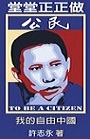
"China Great Reversal" by Hua Min was an extraordinary book from the perspective of a communist insider. Hua Min, a fictitious name literally meaning "China's citizen", was a communist party member who had befriended Liu Binyan and invited him over for a house visit in 1987, at a time when Liu Binyan was deprived of the CCP membership for a second time. Hua Min told Liu Binyan that he was planning to write a book about the "Anti-Rightist Movement" as well as a book about the "Cultural Revolution". Five years later, in 1992, Hua Min dispatched a messenger to the U.S. for seeing Liu Binyan with the 30,000 character book "China Great Reversal". Per Liu Binyan, he learnt from the messenger that Hua Min had written his book with closed windows and door every night.
(Wu Si, at http://www.secretchina.com/news/articles/4/6/28/67573.html, talked about the phenomenon of Li Rui & Li Shenzhi in China's precarious political environment. After reading Li Shenzhi's "Fifty Years Of Winds, Rains & Yellow Skies", I have found similarity between Hua Min and Li Shenzhi: Both adopted the terminology of "grand reversal" and both had cited some common examples in their respective writings. However, Liu Binyan claimed that Hua Min was unscathed by the political movements while Li Shenzhi was classified as a rightist.)
Hua Min's "China Great Reversal" (Mirror Books, Flushing, New York, Dec 1996 edition, ISBN 1-896745-19-9) was a book analyzing China's society in 1956, and before and after 1956. Liu Binyan called 1956 a 'promising' year for China because the "People's Literature" magazine published the first batch of criticism articles against the communist party, something not seen since the 1942 Yan'an Rectification Movement. Liu Binyan stated that criticisms centered around China's economic downturns related to the so-called "Three Grand Socialist Reforms" (re: agriculture, private industry & commerce, and craftsmen industry), and the intellectuals looked to the post-Stalin liberalization from the Eastern European Bloc as something that would push China towards a similar path of the "Prague Spring". All the enthusiasm and aspiration were shattered after Mao Tse-tung, who initially encouraged the intellectuals in criticizing the CCP via a movement entitled the "Hundred Flowers Blossoming", broke his promise by launching a sweeping "Anti-Rightist Movement".
Mao earlier had claimed that the CCP had then entered the stage of the KMT-like "xun zheng" (i.e., the CCP-supervised or tutelage government).
What Mao referred to was his thesis "On Ten Major Relations", with a claim that it was better to have multiple parties, i.e., allowing existence of the bourgeoise vase parties, which was taken to be part of inducement to trap the intellectuals for the Anti-Rightist Movement the following year.
CCP's "Maximum Benevolent Governance"
Hua Min pointed out that all CCP crises had derived from its own blunders throughout its history, with its damages fortunately limited to its own spheres of influences prior to taking over power in 1949.
After 1949, the damages that the CCP exacerbated would apply to the whole nation, unfortunately.
Contrary to what most anti-KMT folks had claimed, the CCP did not stabilize the economy after taking over power in 1949. Hua Min stated that the CCP had solved its fiscal and budgetary problems by printing money, which caused inflation to go up 100 folds in Nov 1949 versus Dec 1948, and 270 folds in Feb 1950 vs Dec 1948.
By the spring of 1950, 1,170,000 people were unemployed across the nation. From Jan to April 1950, 2945 factories of 14 cities were shut down, and 9347 shops of 16 cities were closed down.
In June 1950, during the CCP 3rd Plenary of the 7th Session, Mao Tse-tung had to criticise the mistaken trend in "prematurely destroying capitalism".
When the United Nations army crossed the 38th Parallel on Oct 2nd, Mao Tse-tung, against the objection of Lin Biao and Liu Shaoqi, ordered that the Northeastern Border Army, which was converted from the 13th Conglomerate of the 4th Field Army of the People's Liberation Army (PLA), be ready for the Korean dispatchment at any minute. In mid-Oct, Mao Tse-tung talked about entering the war the minute the US army closed in towards the Yalu River.
The Korean War, by 1952, would cost China 100,000,000,000,000 or 100 trillion yuan (equiv to new currency 10,000,000,000 or 10 billion yuan), while China's 1952 fiscal revenue amounted to no more than 2,300,000,000 or 2.3 billion yuan. Hua Min cited CCP Cadre Chen Yun in stating that the KMT government had net no more than 0.8 to 0.9 billion yuan, including revenues from Manchuria, prior to 1931. Mao Tse-tung, during debates with agriculturalist Liang Suming, claimed that the CCP's "maximum benevolent governance" would be to develop industry and fight the Korean War instead of "small benevolent governance" such as less taxation on peasants. (Mao called the Korean war the best opportunity to killed all reactionaries, and made up a trinity terminology linking the war to the elimination movement.)
In the following, we will briefly touch upon the communist blunders in agriculture, private industry & commerce, and craftsmen industry for an economic background of the 1957 Anti-Rightists Movement.
Blunders In the Agriculture Area
In the agriculture area, the Third Plenary of the Seventh National Session of the Chinese Communist Party (June 6th-June 9th of 1950) stated that the "land reform was foremost key to achieving an upturn of the finance and economic status of the country", namely, killing the landlords and confiscating the landlords' assets and properties for sake of financing the operations of the government rather than waiting for the peasants to grow crops and produce output to be harvested one year later.
Hua Min stated that the land reform was already completed in the so-called "old [liberated] areas" before 1949; however, 70-85% of peasants automatically fell into the category of the so-called 'medium or well-to-do families' and majority peasants had basically no interest in forming the "agricultural mutual-aid teams" or "agricultural cooperatives".
Liu Shaoqi pointed out in Dec 1951 that so-called "agricultural cooperatives" for mutual assistance and cooperation in production could be "erroneous, precarious and utopian". Mao Tse-tung, however, demanded that the CCP should launch "agricultural cooperatives" as a top issue. By the end of 1952, there would be 8,300,000 "agricultural mutual-assistance groups" and 3600 "agricultural cooperatives".
Owning to the reluctance of peasants in forming the "agricultural cooperatives", Deng Zihui advised against forcefulness in promoting the cooperative movement in Feb 1953. However, local communist officials threatened peasants with choice of the 'socialist path' vs 'capitalist path' and forcefully concentrated the peasants' cattle, tools and other personal belongings.
In Aug 1953, Mao Tse-tung called on struggles against the "rightist opportunism" for safeguarding the success of the socialist cause.
In Dec, the CCP issued a decree entitled "Resolution In Regards To Developing Agricultural Production Cooperatives".
By the spring of 1954, nationwide, "agricultural cooperatives" numbered at 95,000, more than twice the target number of 35,000, with 80% cooperatives formed under coercion.
By Jan 1955, "agricultural cooperatives" increased to 480,000.
In March, Zhou Enlai & Liu Shaoqi advised that "agricultural cooperatives" should 'stop, contract and develop'. However, in May, Mao advocated a 'foment' policy as to "agricultural cooperatives".
In July 1955, the CCP minister for agriculture, Deng Zihui, was criticized to be a 'feet-bound woman' by Mao.
In Oct, the CCP Sixth Plenary of the Seventh National Session further attacked "rightist opportunism" and upheld the orientation of "agricultural cooperatives". At the meeting, Mao called for extermination of capitalism and the 'petty production mode'. In Dec, Mao authored "Socialist Peak In Chinese Countryside" and pushed for speeding up the reform of the craftsmen industry and bourgeois industry/commerce towards socialism.
By 1956, in the countryside, small "agricultural cooperatives" were merged into big "agricultural cooperatives", and elementary "agricultural cooperatives" were elevated into advanced "agricultural cooperatives". By the end of 1956, the CCP finished the transformation within 1.5 years, faster than its original plan of 10-15 years.
On April 17th, 1953, the State Council issued a decree called "Instructions As To Persuading and Desisting Peasants From Chaotic Relocation Into Cities".
Peasants were to become the lowest caste of citizens in the Chinese society with the deprivation of the right to migration or relocation.
"Industrial-Agricultural Scissor Differential" was widened in Oct 1953 when the CCP adopted a policy of "planned purchase by the State and planned distribution by the State", namely, the CCP exercising absolute control over the harvest of grains, vegetable oil and cotton, etc. This was supposedly for meeting the new challenge of 17,000,000 new township population.
Hence, the CCP determined that the State would need to "purchase" 70.9 billion "jin" of rice for the period of July 1st, 1953 to June 30th, 1954. (Here, 2 "jin" is equivalent to 1 kilogram [kg].) The actual "purchase" figure was 78.45 billion "jin" of rice, an increase of 29.3% over the prior year, at the expense of the peasants' living standards. 78.45 billion "jin" of rice, Per Hua Min, was equivalent to one month grains supply for 0.5 billion Chinese peasants in 1954.
Hua Min pointed out that the Chinese peasants, who surrendered 67 billion "jin" of rice in 1952, would be required to surrender 90 billion "jin" of rice by June 1956, with an increase of 35%, whereas production had merely increased by 12% and agri-population had increased by 2%.
Peasants, both poverty-stricken due to the grain surrender and lacking motivation due to collectivization, certainly complained about the communist regime, with the result of about 100,000 peasants and agriculture cadres sentenced into "reactionaries". (In the whole year of 1954, 330,000 reactionaries and criminals were arrested nationwide, among whom 111,000 were classified as "reactionaries" and 10,000 around were executed.)
Blunders In the Craftsmen, Bourgeois Industry & Commerce Industries
Hundred Flowers Blossoming
Senior CCP leader Li Weihan [1896-1984], in 1984, expressed remorse over his hatchetman role in the 1957 political movement.
Li Weihan estimated that about 550,000 people, mostly intellectuals, owners or managers in industry and commerce, and members of the so-called "democratic parties", were classified as "rightists".
Among those rightists, majority lost their jobs and posts, and quite some were banished to forced 'labor re-education', 'prisons', and the border areas or hinterland.
At Jiabiangou, from 1957 to 1961, hundreds among 2400 rightists were starved to death, tortured to death or in few cases executed.
(Li Weihan [aka Luo Mai and original name Li Hesheng] was an early pal of Mao Tse-tung in the 1918 organization of the "New Citizen Society" together with Cai Hesen. He acted as the so-called CCP Chief of the "United Front Ministry" from 1948 to Dec 1964. In Oct 1962, the CCP instructed "You should never forget about class struggles" in its 10th Plenary of the 8th Session meeting. Li Weihan himself was criticized as revisionist and capitulationist for over 40 times beginning from Oct 1962, yielding to his May 1963 "progressive-thinking" proposal of "elimination of the bourgeoisie within ten years". Ao-feng pointed out that Mao Tse-tung did not convene the CCP 9th Session till 1969, i.e., till after toppling Liu Shaoqi's presidency. During the subsequent cultural revolution [1966-1976], Li Weihan was sentenced to eight year labor in Xianning of Hubei Province.)
Outsiders did not have a full understanding of China's political drama till the Nixon visit in the early 1970s. In 1972, rightist Fei Xiaotong received from the "military representative" a parcel which was a doctoral thesis entitled "Fei Xiaotong And Sociology In Revolutionary China" by R David Arkush of Harvard University (see Ye Yonglie's "History's Elegy: Inside Stories of the Anti-Rightists Movement", Cosmos Books Ltd, HK, 1995 edition).
In the same year, John Fairbank visited China and requested for a meeting with Fei Xiaotong who enjoyed the same last name of "Fei" as Fairbank [Fei Zhengqing].
The background of Arkush's thesis was related to Fei Xiaotong's article "Early Spring Weather of Intellectuals" on "People's Daily Newspaper" on March 24th, 1957.
(Note that you need to write something like Jonathan Spence's "The Search for Modern China" for becoming a top guest of commies in Peking now !!!
We Chinese called those American professors by 'bai zuo', namely, White leftists.
Fairbank, who was called by the Chinese alias 'Fan' in 1932 before adopting the 'Fei' last name, was seen attending the Smedley-organized Peking branch meeting of the China Civil Rights' Society in early 1932.
Fairbank cohorted with the Chinese communists in wartime capital Chungking, befriended Zhou Enlai, had a crush on communist woman Gong Peng, and later used his experience of sabotage work against the Republic of China as capital for becoming a Sinologist.
His book Republican China, whenever concerning the communists, was like a page by page mimeograph of the CCP's party resolutions and documents.)
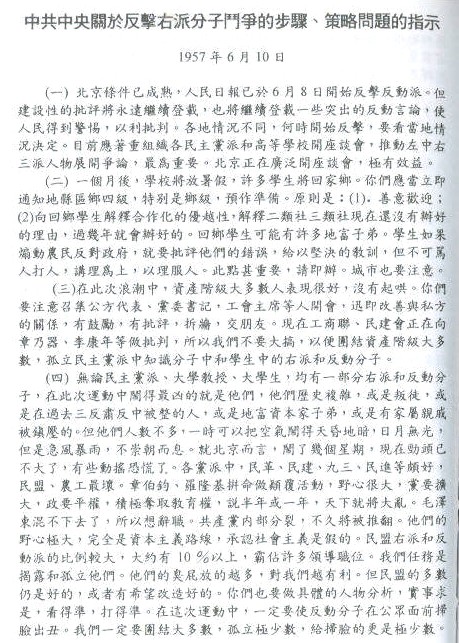
The inducement for the "anti-rightists movement" are like this: Mao Tse-tung, facing various criticism, launched the 'Rectification Movement' on April 27th, 1957.
From May to June, in about one month's time, the communists changed the tune to accuse the non-CCP intellectuals of anti-party rightists, which scared the communists themselves.
On June 13th, Peng Zhen, who tacked on the deputy post for the CCP Central's anti-Rightist panel that had Deng Xiaoping clandestinely acting as chief, convened an internal party meeting to hoodwink the communists with a claim that the non-CCP intellectuals were out-of-door people and the inside-of-door communists were 'family members' and should continue to raise criticisms of the party.
After that, a few months after an encouragement of open criticism of the CCP, Mao Tse-tung claimed that he had successfully induced the snakes out of their hibernation. Mao Tse-tung officially launched the 'Anti-Rightist Movement' in June 1957.
On such 'useful idiot' would be Dai Huang who, after reflecting on the hardship life of his natives in hometown Huning countryside with Mao's extravaganza banquet given to the Soviet navy in Shanghai in June 1956, raised criticisms, with his July 25th "10,000 characters" article taken as a criminal evidence and handpicked by news agency chief Wu Lengxi as the No. 1 rightist and later exiled to Farm 850 in northern Manchuria, where he stayed for over three years.
At some college in Nanking, students held criticism and debates for three days and three nights, continuously, and 20 out of one class of 40 were later dispatched to Manchuria for military farming. During the Anti-Rightist Movement, Mao said that Qin's First Emperor Shihuangdi just buried alive 460 Confucians but he had successfully eradicated 552,2887 "bourgeoisie rightists" nationwide in 1957.
Ensuing from the 1957 anti-Rightist movement, the communists built or converted a few farms around Peking into labor camps, including Farm 581, Farm 582, to Farm 585, etc., that were named after year 1958. Farm 585, or Qinghe Farm, was the most notorious in that only three rightists survived the famine of 1959-1961, including one such person named Feng Guojiang, an Indonesian Chinese who returned to China for the communist revolution.
(Qinghe Farm, with several stages of usage, was at first a prison that housed the purported KMT special agents that saw 440 such former regime people sentenced to various terms on July 12th, 1950, before the Suppression of Reactionaries' Movement was to further incarcerate and eliminate many of the same people.)
Fei Xiaotong's "Early Spring"
On March 24th, 1957, on the "People's Daily Newspaper", Fei Xiaotong published an article entitled "Early Spring Weather of the Intellectuals", claiming that the intellectuals were still feeling the kind of cold-warm intermittent weather even after Premier Zhou Enlai's Jan 1956 speech on the intellectuals had blown the spring wind through their minds.
Fei Xiaotong, after the 1279-person "intellectual meeting", was offered a job as deputy bureau chief of the newly-organized "National Experts Bureau".
Ye Yonglie cited two senior scholars [Chen Da & Li Jingda] as an example of intellectuals beginning to write articles again with the encouragement from Zhou Enlai's Jan 1956 speech.
Fei Xiaotong's "Early Spring", in fact, merely stated the mindset of "timid" intellectuals who were having fear that Mao Tse-tung's call for the "Hundred Flower Blossoming & Hundreds Schools Propagating" could be a trap. Indeed, it turned out to be a trap.
On April 20th, Jian Bozan followed through with another article "Why was there a feeling of the 'early spring'?"
Jian Bozan, i.e., history depart chair of Beijing U, questioned the lack of full blossom spring half a year after Mao Tse-tung proposed the "Double Hundred Policy" --a buzz word often seen in various prints in the 1970s.
Meanwhile, on the 21st, in Shanghai, Huang Chang wrote on the "Wen Hui Bao Newspaper" an article "Defrosting" appealing for a fast reckoning of "spring".
Across the Straits, per Ye Yonglie, Taiwan ridiculed Fei Xiaotong's article as representing the "crying, pitiful,& self-pitying" mainland intellectuals.
On May 31st, Fei Xiaotong wrote a continuum for publication on the CCP's "Shining Newspaper", with an explanation that it was during two Democratic League meetings that people asked him to write something about intellectuals he had observed during a prior trip. Fei Xiaotong mentioned that back in late Feb someone had told him that the "weather had changed" by citing Chairman Mao's criticism of Wang Meng's story "The newcomer youth of the CCP organization department". After hesitating back and forth several times, Fei Xiaotong took granted for Pan Guangdan's gauging Mao Tse-tung's speech at a state council meeting and released the article for publication.
The KMT propaganda in HK promptly made a big deal out of Fei Xiaotong's second article.
On June 22nd, 1957, the "People's Daily" made an editorial entitled "An Extraordinary Spring Season".
Mao's speech as to the "double hundred policy" at the 27 Feb 1957 state council meeting referred above would be made into cassette tapes to be played at the expanded "National propaganda Work Meeting" that writer and translator Fu Lei listened in on March 6th. Fu Lei, as a Shanghai representative, rode on train to Peking together with Chen Wangdao [principal of Fudan U & translator of communist manifesto], Zhou Xinfang [Peking opera actor], Xu Zhucheng [editor-in-chief of "Wen Hui Bao Newspaper"], Lin Fang ["Xin Min Wan Bao Newspaper"], Zhou Xuliang [translator] and Yao Wenyuan [later ultraleftist hatchetman during cultural revolution]. Fu Lei wrote to his son [who was studying in Poland] how excited he was to have seen Mao at the discussion panel on the 12th, and furthermore, complimented tyrant Mao as some eloquent politician with "charisma and magic".
Fu Lei, who was renowned for leaving behind the correspondence letters to his son, was to commit suicide in the coming political persecution movements.
(This webmaster was in tears whenever recalling this. The telepathy came from the hundreds of letters that this webmaster's father wrote, something reflecting deeply on the love of a father, as seen in the case of Fu Lei's correspondence.)
Turmoil of the European Communists
The "Extraordinary Spring", in Ye Yonglie's words, had to do with Nikita Khrushchov's Feb 24th, 1956 secret report during the Soviet 20th Congress, which was an exposure of Stalin's purge horrors [later divulged to the CIA by the Polish communists].
Khrushchov [Krushchev] disclosed that 98 out of 139 commissars of the Soviet 17th Congress were purged by Stalin and that 3 out of 5 marshals, all military district commanders, both Navy and airforce commanders, and all but one fleet commanders had been executed by Stalin.
Soon, there ensued the Polish rebellion in Putnam on June 28th, 1956.
Hungary followed suit with a revolution on Oct 20th, 1956.
200000 Russian soldiers invaded Budapest on Nov 4th, 1956.
This same secret report was purportedly brought back to China by communist leader Zhu De in the spring of 1956 and apparently as a courtesy to the Soviet 'big brother' authority, was internally broadcast to key communist institutions, including the New China News Agency where Dai Huang, a person who joined the communist party in 1944, was.
In China, Mao Tse-tung, who had dispatched Zhu De's delegation to Nikita Khrushchov's meeting, would first applaud Nikita Khrushchov and blast Stalin. Soon, Mao Tse-tung realized that he was exactly "Stalin the Second", something that would for sure backfire on himself should he follow through with Khrushchov's ideological line.
Mao Tse-tung proposed the "30-70" division for Stalin. (Deng Xiaoping, similarly, proposed the "30-70" division for Mao Tse-tung.)
On April 25th, 1956, Mao Tse-tung affirmed Stalin's 70% feats at an expanded CCP politburo meeting. Earlier, on April 5th, Mao Tse-tung authorized the "People's Daily" newspaper in printing the Chinese communist assessment of 30-70 division as to Joseph Stalin.
On Nov 15th, 1956, Mao Tse-tung commented on the incidents in Poland and Hungary at the CCP 2nd Plenary of the 8th Session, claiming the reactionaries in Poland or Hungary or elsewhere were not a big deal; Beria was not a big deal; and Gao Gang [i.e. Mao's political enemy routed in the early 50s] was not a big deal.
Mao Tse-tung further equated the new Polish leader to the deposed political enemy Rao Shushi and called the names of numerous Eastern European Bloc communist leaders.
For the first time, Mao Tse-tung put forward the notion of "Big Democracy vs Small Democracy" for eliminating the Polish-Hungarian kind of turmoil. Mao criticized "Big Democracy' as the parliamentary politics of the West, freedom of assembly and freedom of press.
As a conclusion, Mao Tse-tung proposed "Small Democracy" and claimed that it was nothing other than his most favourite "rectification movement".
Li Shenzhi's Big Democracy vs Small Democracy
After I put down the sentence that the "Anti-Rightists Movement" of 1957 had finished off China's half century worth of elites and conscience, I re-read Li Shenzhi's "Fifty Years Of Winds, Rains & Yellow Skies", only to find that it was Li Shenzhi who had already imprinted me with a same claim. (By the way, Li Shenzhi's usage of the yellow skies derived from Mao Tse-tung's poem in regards to the PLA crossing the Yangtze River in 1949, while Mao Tse-tung had adopted the same term as that of the Yellow Turbans of the late Western Han Dynasty.)
Li Shenzhi reflected on his naivety during the "Anti-Rightists Movement", claiming that he did not have the chance to personally experience the 1942-1945 Rectification Movement.
Throughout the anti-rightist movement, Li Shenzhi, as a communist "theorist", was not well-known as the real "democratic vase party" members. When Mao Tse-tung was talking about "Big Democracy vs Small Democracy", people did not know that it was Li Shenzhi who had provided input and terminology.
Li Shenzhi, a communist follower since the 1940s, pointed out that rightists were reactionaries in the eyes of Mao and the communists, but termed so to show a lighter tone in comparison with the real reactionaries.
Mao Tse-tung's "Small-Scale Democracy"
Trickery Under The Sun - "Yang (sun) Mou (trickery)"
"Zhao Ziyang" claimed that Mao Tse-tung had arrogantly put forward his "Trickery Under The Sun" theory as a way to counter the 'scheme' [i.e., trickery under the moon] charges by democratic party members.
Further, Zhao Ziyang mentioned that Deng Xiaoping, while inspecting Guangdong Province, had secretive instructions about "throwing out the long fish rod with bait for catching bigger fish".
Li Kangnian's Proposal For Total Buyout Of Bourgeoisie Assets In 20 Years
Huang Shaohong, Zhang Xiruo, Zhang Bojun, Luo Longji, Chu Anping & Zhang Naiqi
Chu Anping, editor-in-chief of the Guangming (Shining Path) Daily, was named the arch-rightist by Mao Tse-tung for criticizing the communist rule under the "party's heaven".
Later in September of 1966, Chu Anping left a note and disappeared forever.
Mao Tse-tung's Induction
Mao Tse-tung Routing "Democratic Vase Parties"
Deng Tuo Changing Tone of "People's Daily" Heh Xiangni's Herald Attack & Lu Yuwen's Claim Of "Anonymous Threat Letters"
Mao Tse-tung's Employing Workers For Attacks At Intellectuals & Bourgeoisie
Capitulation Of "Wen Hui Bao" Newspaper Zhang Bojun & Luo Longji Clique - Dogs Biting Dogs
The Immiseration Growth Trade
Disrupted by President Trump
& Bursting of the Communist China's Real Estate Bubble
Communist China's immiseration trade, at a cost of
enslaving one billion peasants and coolies and polluting the nation's land, water and air, has carried
along for decades now, with the unsustainable growth backfiring before its due demise as a result of
President Trump's preemptive strike, i.e., the Sino-U.S. trade war, which triggered communist China's
counter-retaliation measures and subsequent breakup of a tacit bonding between the multinational
corporations and banksters of the West and the oligarchs of communist China, a relationship the
communists initially described as a marriage in a silly allegory that painted communist China as a
feminine (like a concubine) subservient to the U.S. as a master. What this author could not bear will be
widespread pollution-related cancer deaths that befell to the people living around the Taihu (thunder
god) Lake, which is where this author's great grandfather's lakeside home village and tomb were, that
is known as Shihu [stony lake] and Huangtan [yellow flatland] in history and penned to a poem by Fan
Chengda who was responsible for negotiating with the Jurchens to retrieve Soong Emperor Qinzong's
coffin from the Amur area in the 13th century.
Jagdish Bhagwati's immiseration vindicated an economic thesis that the more a country exports
to another trade partner, the worse off the terms of trade would be. From the economics perspective,
the immiseration trade would have corrected itself through Adam Smith's Invisible Hand and its
adjustment by the markets. Unfortunately, Communist China's immiseration growth was fatally built
on a ruinous percolation logic similar to the Mongols' unbacked fiat: the communists' sweatshops
manufactured products at the below-market or no cost for export to the West, using the slave labor
like the Uygurs in the concentration camps of Xinjiang, for example; the communists then forced
the exporters to convert the "foreign exchange" trade gain into the worthless RMB, i.e., "people's
dollars" that were printed on the astronomical scale, which was similar to the Russian rubles that
could not be freely bought and sold; for absorbing the over-printed paper currency, the communists
conducted the violent land acquisition and enclosure movements, reaped enormous profit in the land
sale, and sold the real estate bubble to the city "accomplice" citizens who once in a life time enjoyed
a flash-in-the-pan decent life of luxury travel abroad and the concept of wealth management of the
West; and the communists, in addition to squandering the money on the Belt and Road projects or
Confucius academies, laundered the "foreign exchange" to the banks in H.K., the U.S., Canada,
Europe, Australia, and the Caribbeans, escaping the hell they created in the expectation that the
billion slaves one day would rise up and smash the communist apparatus.
When the trade decreased
or stopped, partly due to President Trump's trade war and partly due to the rising labor cost which was
triggered by the inflation coupled with the decreased labor force ensuing from decades of the barbaric
policy of forced abortions, the communists could no longer print the worthless RMB paper money
to peg with the foreign exchange for running the economic engine, which then led to the bursting of
the bubble and collapse of its financial system, with the banks and ATM machines running out of
money.
This then forced the regime to take the last resort to switch to a closed-door policy to slow down
the paper currency usage on the pretext of Coronavirus, a double-edge weapon also used to exercise
militarized control of the population for an opportune invasion of Taiwan in synchronization with the
Trojan horse planted on the island.
(During the three-year lockdown, the communists, who
ordered the chaining of kitchen knives and ID'ed ownership of kitchen knives,
implemented the forced lockdown via barbed wire fences at the border, and segregation iron or plastic fences on the streets, lanes and in the neighborhoods, which was taken to be rehearsal for implementing the Cultural Revolution 2.0.)
In today's
communist China, with a widely rumored scheme of Operation Sinking Ship for decades, the totalitarian regime recently
began to prep the people for an outcome of isolation from the international community and
embracing of an Orwellian rule similar to the Kim dynasty of North Korea. The unfolding economic collapse of communist China shows the world that communist China is a castle built with sand and on the sand
of unsustainable immiserated trades used for funding the proportionally-blown real estate bubbles,
i.e., what the Japanese called by suna no utsuwa.
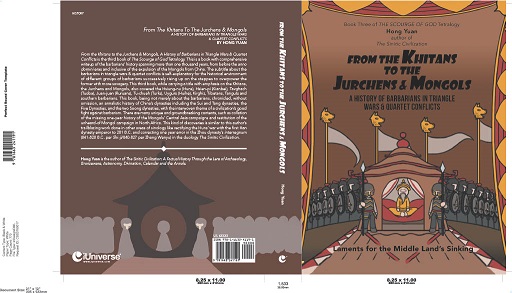
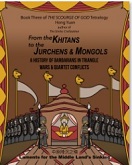
(The above passages were excerpted from the Afterword of From the Khitans to the Jurchens & Mongols: A History of Barbarians in Triangle Wars and Quartet Conflicts (The Barbarians' Tetralogy - Book III: Laments for the Middle Land's Sinking))
Attached would be an article written by Liu Xiaobo in regards to the Anti-Rightists Movement of 1957. Liu had been apparently becoming more and more strong-toned in his dissertations. One example would be his harsh criticisms of Dr. Sun Yat-sen in regards to 'parliamentary politics'. However, Liu's analysis of the human nature among the academics and distinguished and renowned intelligentsia during the Anti-Rightists Movement of 1957 could be said to be the best one I had ever read.
This website expresses the personal opinions of this webmaster (webmaster@republicanchina.org, webmaster@imperialchina.org, webmaster@communistchina.org, webmaster@uglychinese.org: emails deleted for security's sake, and sometime deleted inadvertently, such as the case of an email from a grandson of Commander Frank Harrington, assistant U. S. naval attache, who was Mme Chiang Kai-shek's doctor in the 1940s). In addition to this webmaster's comments, extensive citation and quotes of the ancient Chinese classics (available at http://www.sinica.edu.tw/ftms-bin/ftmsw3) were presented via transcribing and paraphrasing the Classical Chinese language
into the English language. Whenever possible, links and URLs are provided to give credit and reference to the ideas borrowed elsewhere.
This website may be used or reproduced in any form or by any means, with or without the prior written permission, on the pre-condition that an acknowledgement or a reciprocal link is expressively provided. This acknowledgment was for preventing future claims against the authorship when the contents of this website are made into a book format.
For validation against authorship, https://archive.org/, a San Francisco-based nonprofit digital library, possessed snapshots of the websites through its Wayback Machine web snapshots.
All rights reserved.
WARNING: Some of the pictures, charts and graphs posted on this website came from copyrighted materials. Citation or usage in the print format or for the financial gain could be subject to fine, penalties or sanctions without the original owner's consent.
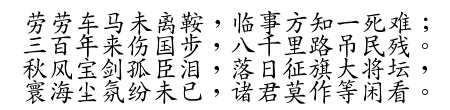
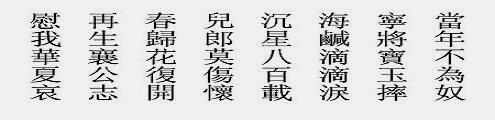
This snippet is for sons and daughters of China:
Heed the sons & ministers' agony and sorrow of our ancestors who died or lived through the Mongol,Manchu andSoviet-Chicom conquestand
theYongjia,Jingkang andJiashen cataclysms !
Jeanne d'Arc of China:
Teenager girl Xun Guan breaking out of the Wancheng city to borrow the relief troops in the late Western Jinn dynasty;
Liu-Shao-shi riding into the barbarian army to rescue her husband in the late Western Jinn dynasty;
teenager girl Shen Yunying breaking into Zhang Xianzhong's rebels on the horseback to avenge on father's death in the late Ming dynasty.
China's Solitary and Lone Heroes:
Nan Jiyun breaking out of the Suiyang siege and charging back into the city in the Tang dynasty;
Zhang Gui & Zhang Shun Brothers breaking through the Mongol siege of Xiangyang in the Southern Soong dynasty;
Liu Tiejun breaking through three communist field armies' siege of Kaifeng in the Republican China time period;
Zhang Jian's lone confrontation against the communist army during the June 3rd & 4th Massacre of 1989.
For this webmaster, only the ancient history posed some puzzling issues that are being cracked at the moment, using the watershed line of Qin Emperor Shihuangdi's book burning to rectify what was the original history before the book burning, filtering out what was forged after the book burning, as well as filtering out the fables that were rampant just prior to the book burning, and validating against the oracle bones and bronzeware.
There is not a single piece of puzzle for this webmaster concerning the modern Chinese history.
This webmaster had read Wellington Koo's memoirs page by page from 2004-2007, and read General Hu Zongnan's biography in the early 1990s, which was to have re-lived their lives on a day by day basis.
Not to mention this webmaster's complete browsing of materials written by the Soviet agents as well as the materials that were once published like on the George Marshall Foundation's website etc., to have a full grasp of the international gaming of the 20th century.
The unforgotten emphasis on "Republican China", which was being re-outlined to be inclusive of the years of 1911 to 1955 and divided into volumes covering the periods of pre-1911 to 1919, 1919 to 1928, 1929 to 1937, 1937 to 1945, and 1945-1955, will continue.
This webmaster plans to make part of the contents of "Republican China, A Complete Untold History" into publication soon. The original plan for completion was delayed as a result of broadening of the timeline to be inclusive of the years of 1911-1955.
For up-to-date updates, check the RepublicanChina-pdf.htm page.
Due to constraints, only the most important time periods would be reorganized into some kind of publishable format, such as the 1939-1940, 1944-1945, and 1945-1950 Chinese civil wars, with special highlight on Kim Il Sung's supplying 250,000 North Korean mercenaries to fighting the Chinese civil war, with about 60,000-70,000 survivors repatriated to North Korea for the 1950 Korea War, for example --something to remind the readers how North Korea developed to threaten the world with a nuclear winter today.
Note the fundamental difference between the 250,000 ethnic-Korean Japanese Kwantung Army diehards and the ethnic-Korean Chinese living in China.
The communist statistics claimed that altogether 65,000 ethnic-Korean Chinese minority people, or the Korean migrants living in China, joined the communist army, with approximately
60% coming from the Jirin subprovince,
21% from the Sungari subprovince, and
15% from the Liaodong subprovince.
The objectives of this webmaster's writings would be i) to re-ignite the patriotic passion of the ethnic Chinese overseas; ii) to rectify the modern Chinese history to its original truth; and iii) to expound the Chinese tradition, humanity, culture and legacy to the world community.
Significance of the historical work on this website could probably be made into a parallel to the cognizance of the Chinese revolutionary forerunners of the 1890s: After 250 years of the Manchu forgery and repression, the revolutionaries in the late 19th century re-discovered the Manchu slaughters and literary inquisition against the ethnic-Han Chinese via books like "Three Rounds Of Slaughter At Jiading In 1645", "Ten Day Massacre At Yangzhou" and Jiang Lianqi's "Dong Hua Lu" [i.e., "The Lineage Extermination Against Luu Liuliang's Family"].
Revolutionary forerunner Zhang Taiyan (Zhang Binglin), a staunch anti-Manchu revolutionary scholar, invoked Xin Shi (The History [Book] of Heart, a book written by Soong loyalist Zheng Sixiao who sank it in a tin-iron box into a well in the late 13th century A.D., and rediscovered about three and half centuries later), for rallying the nationalist movements against the Manchu rule.
Additionally, revolutionaries in Sichuan often invoked 17-year-old prodigy-martyr Xia Wanchun's Xia Jiemin [Quan-]Ji (Complete anthology of Xia Wanchun's poems and prose) for taking heart of grace in the uprisings against the Manchus.
This webmaster intends to make the contents of this website into the Prometheus fire, lightening up the fuzzy part of China's history.
It is this webmaster's hope that some future generation of the Chinese patriots, including the to-be-awoken sons and grandsons of arch-thief Chinese Communist rulers [who had sought material pursuits in the West], after reflecting on the history of China, would return to China to do something for the good of the country.
This webmaster's question for the sons of China: Are you to wear the communist pigtails for 267 years?
And don't forget that your being born in the U.S. and the overseas or your parents and grandparents' being granted permanent residency by the U.S. and European countries could be ascribed to the sacrifice of martyrs on the Tian-an-men Square and the Peking city in 1989.
(If you were the Chi-com hitting this site from the Bank of China New York branch or from the party academy in Peking, spend some time reading here to cleanse your brain-washed mind.)
 ***
***
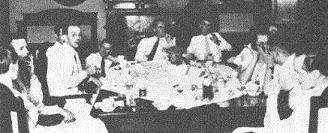
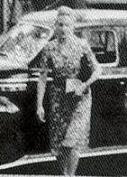
![Though, Anna Wang [Anneliese Martens], in her memoirs, expressed jealousy over Gong Peng by stating that the Anglo-American reporters had flattered the Chinese communists and the communist movement as a result of being entranced with the goldfish-eye'ed personal assistant of Zhou Enlai](GongPeng.jpg)
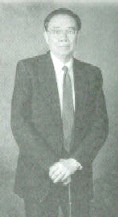 Li Shenzhi reflected on his naivety during the "Anti-Rightists Movement", claiming that he did not have the chance to personally experience the